
Learning and Teaching in Scarcity: How High-Stakes “Accountability” Cultivates Failure.
Monthly Archives: November 2013

“Fahrenheit 451” 60 Years Later: “Why do we need the things in books?”
“Sometimes writers write about a world that does not yet exist,” Neil Gaiman begins his Introduction to the 60th Anniversary Edition of Ray Bradbury’s Fahrenheit 451:
This is a book of warning. It is a reminder that what we have is valuable, and that sometimes we take what we value for granted….
People think—wrongly—that speculative fiction is about predicting the future, but it isn’t; or if it is, it tends to do a rotten job of it….
What speculative fiction is really good at is not the future but the present—taking an aspect of it that troubles or is dangerous, and extending and extrapolating that aspect into something that allows the people of that time to see what they are doing from a different angle and from a different place. It’s cautionary.
Fahrenheit 451 is speculative fiction. It’s an “If this goes on…” story. Ray Bradbury was writing about his present, which is our past.
Like Margaret Atwood’s In Other Worlds, Gaiman’s clarification about the purposes of science fiction/speculative fiction builds a foundation for reading (or re-reading) Fahrenheit 451 as well as for considering why Bradbury’s novel on book burning endures.
Sixty years ago in October 1953, Fahrenheit 451 was published. In the fall of 2013, the novel reads as an eerie crystal ball—despite Gaiman’s caution: the pervasive Seashells like iPod earbuds, wall-sized monitors and reality TV.
Yet, upon re-reading this anniversary edition, I am less interested in Bradbury’s prescience about technology and its role in isolating humans from each other, and reminded—as Gaiman suggests—of what matters.

The enduring flame of Fahrenheit 451 is perfectly stoked by Gaiman, in fact:
A young reader finding this book today, or the day after tomorrow, is going to have to imagine first a past, and then a future that belongs to that past.
But still, the heart of the book remains untouched, and the questions Bradbury raises remain as valid and important.
Why do we need the things in books?…Why should we read them? Why should we care?…
Ideas—written ideas—are special….
This is a book about caring for things. It’s a love letter to books, but I think, just as much, it’s a love letter to people….
Yes, Gaiman is a writer’s writer so he is naturally suited to understand Bradbury as well as marvel at the magic of Fahrenheit 451. But there is more.
This anniversary edition includes not only Gaiman’s new Introduction but also a concluding section—History, Context, and Criticism. The opening piece by Jonathan R. Eller explains, “Bradbury virtually lived in the public libraries of his time.” And later in a transcript of an audio-introduction, Bradbury adds:
When I left high school, I began to go to the library every day of my life for five, ten, fifteen years. So the library was my nesting place, it was my birthing place, it was my growing place. And my books are full of libraries and librarians and book people, and booksellers. So my love of books is so intense that I finally have done—what? I have written a book about a man falling in love with books.
Here, I think, another important connection between Gaiman and Bradbury highlights why Fahrenheit 451 endures: Both men are readers, the type of readers who love the idea of books, love specific books, and recognize the human dignity represented by the free access to books.
Like Bradbury, then, Gaiman has a life-long love affair with libraries:
Another way to destroy a child’s love of reading, of course, is to make sure there are no books of any kind around. And to give them nowhere to read those books.
I was lucky. I had an excellent local library growing up. I had the kind of parents who could be persuaded to drop me off in the library on their way to work in summer holidays, and the kind of librarians who did not mind a small, unaccompanied boy heading back into the children’s library every morning and working his way through the card catalogue, looking for books with ghosts or magic or rockets in them, looking for vampires or detectives or witches or wonders. And when I had finished reading the children’s’ library I began on the adult books.
They were good librarians. They liked books and they liked the books being read. They taught me how to order books from other libraries on inter-library loans. They had no snobbery about anything I read. They just seemed to like that there was this wide-eyed little boy who loved to read, and would talk to me about the books I was reading, they would find me other books in a series, they would help. They treated me as another reader – nothing less and more – which meant they treated me with respect. I was not used to being treated with respect as an eight year old.
But libraries are about Freedom. Freedom to read, freedom of ideas, freedom of communication. They are about education (which is not a process that finishes the day we leave school or university), about entertainment, about making safe spaces, and about access to information.
I worry that here in the 21st Century people misunderstand what libraries are and the purpose of them.
For those of us who share this love of books and the “[f]reedom to read, freedom of ideas, freedom of communication,” then, that Fahrenheit 451 endures is both wonderful and chilling.
If the novel had been published October 2013, I suspect it could have just as easily been applauded as a stark mirror of our present disguised as a futuristic dystopia:
“Jesus God,” said Montag….Why doesn’t someone want to talk about it! We’ve started and won two atomic wars since 2022! Is it because we’re having so much fun at home we’ve forgotten the world? Is it because we’re so rich and the rest of the world’s so poor and we just don’t care if they are? I’ve heard rumors; the world is starving, but we’re well fed. Is it true, the world works hard and we play? Is that why we’re hated so much?
And then Montag recalls a brief encounter with an old man:
The old man admitted to being a retired English professor who had been thrown out upon the world forty years ago when the last liberal arts college shut for lack of students and patronage.
Fahrenheit 451 ends with Montag as a criminal on the run who finds himself on the outskirts of the town among refugees, mostly outcast professors.
If a reader picks up Bradbury’s novel today, and then turns to her iPad to read the online blog The Answer Sheet at The Washington Post, she may read this:
The discussion of why the humanities matter has picked up steam since The New York Times published a piece last week suggesting that even some top institutions are increasingly anxious about the proliferation of STEM (science, technology, engineering and math) majors.
Meanwhile, they report a declining interest in topics like French literature.
Only eight percent of students now major in the humanities, according to the American Academy of Arts & Sciences, down from a peak of more than 17 percent in 1967. The trend is worrisome, and plenty of college presidents have come to the defense of the humanities; views of all kinds have since been published….
Tolstoy endured. Will the liberal arts?
From Aldous Huxley to Ray Bradbury to Neil Gaiman—and countless authors and readers alike along the way—Fahrenheit 451 should leave us all with Shakespeare ringing in our ears:
Miranda: O wonder!
How many goodly creatures are there here!
How beauteous mankind is! O brave new world,
That has such people in’t. (William Shakespeare, The Tempest, Act V, Scene I, ll. 203–206)
Fahrenheit 451 remains a warning we need to heed, but likely won’t—once again: Be careful what brave new world we allow to happen when we aren’t paying attention.
Is Mainstream Media Hiring from Write for America?
Is Mainstream Media Hiring from Write for America?

Kurt Vonnegut’s Children’s Crusade: Kindness
In a 2004 Paris Review interview, Haruki Murakami explained:
I liked to read Kurt Vonnegut and Richard Brautigan while I was a college student. They had a sense of humor, and at the same time what they were writing about was serious. I like those kind of books. The first time I read Vonnegut and Brautigan I was shocked to find that there were such books! It was like discovering the New World.
Murakami identified something essential in Vonnegut, a tension created by blending humor with serious themes and topics as well as Vonnegut’s ability to shuffle non-fiction and fiction in his novels like a seasoned magician.
In fact, Gregory D. Sumner catalogues the gradual emergence of Vonnegut as a thinly fictionalized character in his own novels, notably by his most celebrated work, Slaughterhouse-Five: “The opening chapter of Slaughterhouse-Five annihilates the boundary between fiction and autobiography, inviting us into Vonnegut’s uncertainty about just what he has written. It is a dance, rather than an exercise in cold objectivity” (p. 126).
From this narrative ambiguity of genre, Vonnegut is often characterized as post-modern. And while there may be some waffling about details or accuracy, Vonnegut is quite certain—uncharacteristic for actual post-modern writers—about some foundational ideals, although even then he makes his most sacred pronouncements in the most challenging ways.
Vonnegut reveled in playing the free thinker and atheist as he also referenced Jesus—a common routine in his speeches—and his persona in his speeches and non-fiction was certainly as much fabrication as Vonnegut. But the novels and their blend of memoir and fiction create and sustain the most tension.
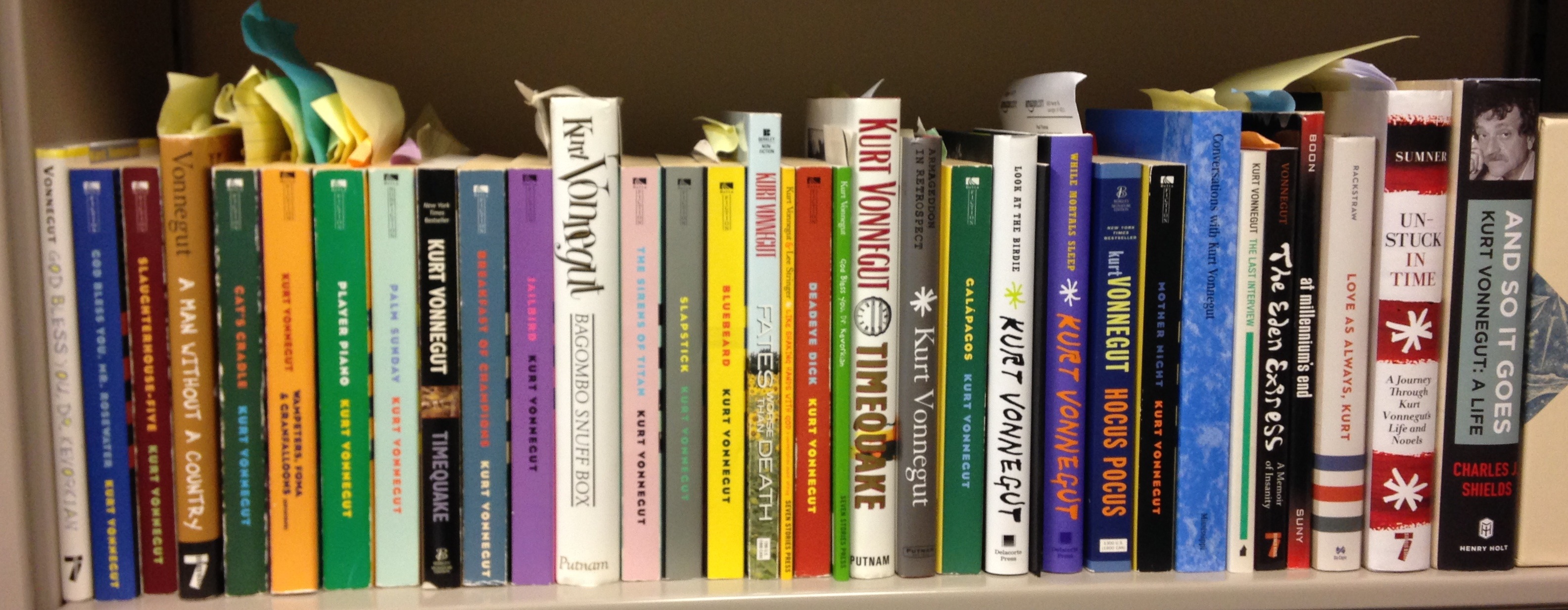
Slaughterhouse-Five presented Vonnegut a nearly insurmountable task of maintaining his joke-based writing pattern against the great human tragedy of World War II. This attempt to write a novel about being a POW during the fire bombing of Dresden, in fact, becomes the opening chapter of the novel that doesn’t genuinely start until Chapter 2. And in this first chapter while visiting a fellow veteran of WWII and his friend Bernard V. O’Hare, Vonnegut is confronted by O’Hare’s wife Mary, who is angry about Vonnegut’s considering writing a novel about his war experience:
“You were just babies then!” [Mary] said.
“What?” I said.
“You were just babies in the war—like the ones upstairs!”
I nodded that this was true. We had been foolish virgins in the war, right at the end of childhood….
So I held up my right hand and I made her a promise:…
“I tell you what,” I said, “I’ll call it ‘The Children’s Crusade.'”
She was my friend after that. (pp. 18-19)
Several years before his Dresden novel garnered him fame, Vonnegut had offered what I think is his central children’s crusade: a paean to kindness, God Bless You, Mr. Rosewater.
The titular character of the novel, Eliot Rosewater, implores:
“Go over to her shack, I guess. Sprinkles some water on the babies, say, ‘Hello, babies. Welcome to Earth. It’s hot in the summer and cold in the winter. It’s round and wet and crowded. At the outside, babies, you’ve got about a hundred years here. There’s only one rule that I know of, babies—:
“‘God damn it, you’ve got to be kind.’” (p. 129)
On November 11, 2013, the day of Vonnegut’s birth, while we who love his work raise our eyes to the heavens and hope he is in fact Resting In Peace, we might honor him by heeding those words, crafted in the glorious blasphemy that makes Vonnegut Vonnegut.
For Further Reading
21st Century “Children’s Crusade”: A Curriculum of Peace Driven by Critical Literacy [Peace Studies Journal, 6(1), January 2103]
remnant 39: “Lou Reed was massively important to ‘Island of Misfit Toys’ kids”
The Poverty Trap: Slack, Not Grit, Creates Achievement
Poverty is a trap children are born into:

No child has ever chosen to be poor. Children have never caused the poverty that defines their lives, and their education.
Yet, the adults with political, corporate, and educational wealth and power—who demand “no excuses” from schools and teachers serving the new majority of impoverished children in public schools and “grit” from children living in poverty and attending increasingly segregated schools that offer primarily test-prep—embrace a very odd stance themselves: Their “no excuses” and “grit” mottos stand on an excuse that there is nothing they can do about out-of-school factors such as poverty.
Living in poverty is a bear trap (and it is), and education is a race, a 100-meter dash.
“No excuses” advocates calling for grit, then, are facing this fact:
Children in poverty line up at the starting line with a bear trap on one leg; middle-class children start at the 20-, 30-, and 40-meter marks; and the affluent stand at the 70-, 80-, and 90-meter marks.
And while gazing at education as a stratified sprint, “no excuses” reformers shout to the children in poverty: “Run twice as fast! Ignore the bear trap! And if you have real grit, gnaw off your foot, and run twice as fast with one leg!”
These “no excuses” advocates turn to the public and shrug, “There’s nothing we can do about the trap, sorry.”
What is also revealed in this staggered 100-meter race is that all the children living and learning in relative affluence are afforded slack by the accidents of their birth: “Slack” is the term identified by Mullainathan and Shafir as the space created by abundance that allows any person access to more of her/his cognitive and emotional resources.
In the race to the top that public education has become, affluent children starting at the 90-meter line can jog, walk, lie down, and even quit before the finish line. They have the slack necessary to fail, to quit, and to try again—the sort of slack all children deserve.
Children in relative affluence do not have to wrestle with hunger, worry about where they’ll sleep, feel shame for needing medical treatment when they know their family has no insurance and a tight budget, or watch their families live every moment of their lives in the grip of poverty’s trap.
As Mullainathan and Shafir explain: “Scarcity captures the mind.” And thus, children in poverty do not have such slack, and as a result, their cognitive and emotional resources are drained, preoccupied.
The ugly little secret behind calls for “no excuses” and “grit” is that achievement is the result of slack, not grit.
Children living and learning in abundance are not inherently smarter and they do not work harder than children living and learning in poverty. Again, abundance and slack actually allow children to work slower, to make more mistakes, to quit, and to start again (and again).
Quite possibly, an even uglier secret behind the “no excuses” claim that there is nothing the rich and powerful can do about poverty is that this excuse is also a lie.
David Berliner (2013) carefully details, “To those who say that poverty will always exist, it is important to remember that many Northern European countries such as Norway and Finland have virtually wiped out childhood poverty” (p. 208).
More children are being born into the trap of poverty in the U.S., and as a result, public schools are now serving impoverished students as the typical student.
The “no excuses” and “grit” mantras driving the accountability era have been exposed as ineffective, but have yet to be acknowledged as dehumanizing.
Instead of allowing some children to remain in lives they didn’t choose or create and then condemning them also to schools unlike the schools affluent children enjoy, our first obligation as free people must be to remove the trap of poverty from every leg of every child.
Reference
David C. Berliner (2013) Inequality, Poverty, and the Socialization of America’s Youth for the Responsibilities of Citizenship, Theory Into Practice, 52:3, 203-209, DOI: 10.1080/00405841.2013.804314
UPDATE
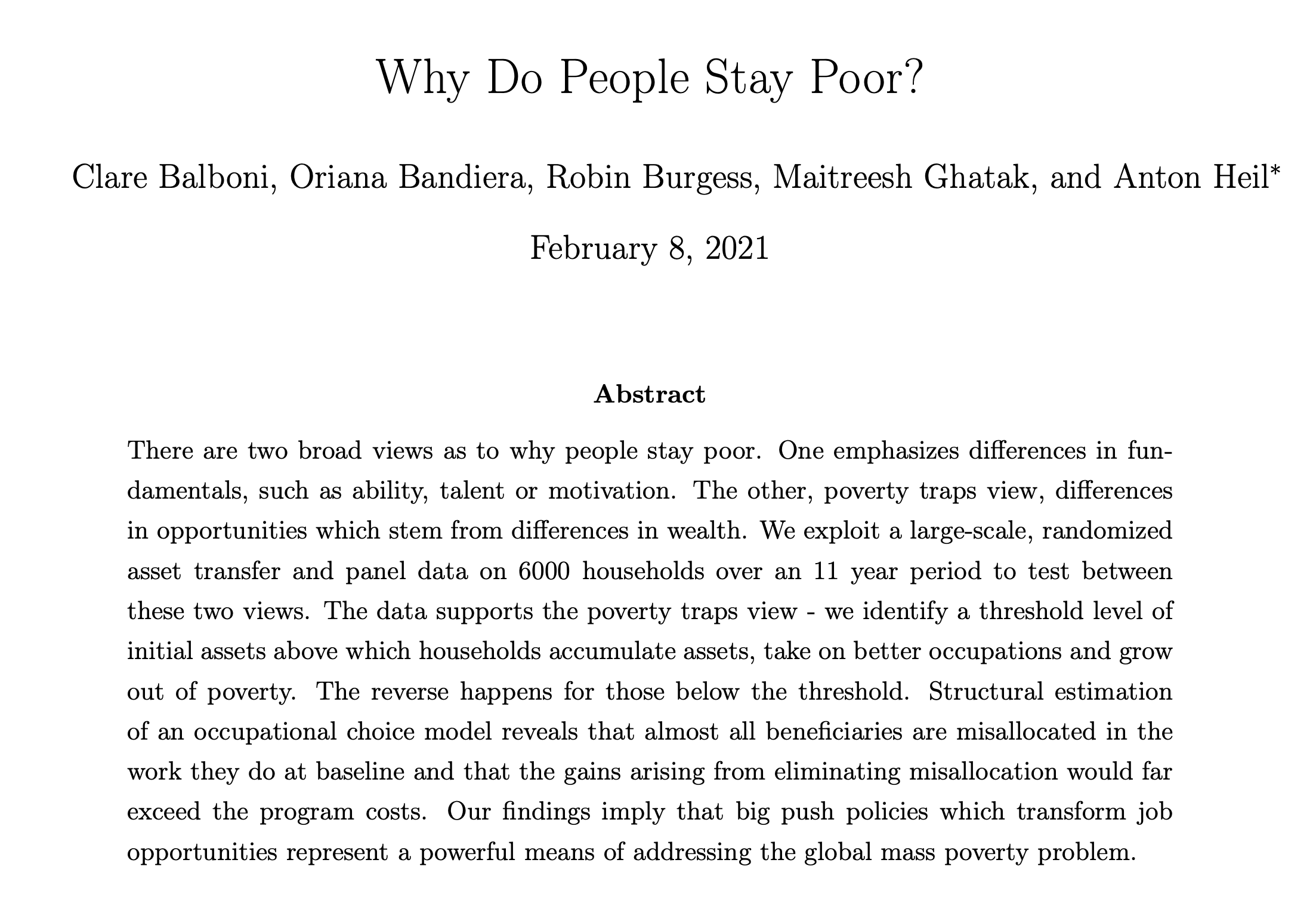
Why Do People Stay Poor? Clare Balboni, Oriana Bandiera, Robin Burgess, Maitreesh Ghatak, and Anton Heil
UPDATED [Part II]: From Spellings to Duncan [Add King and DeVos]: Incompetence and Deceit
UPDATE II: No need for comment except to prompt you to this:
Shanker Blog: We Can’t Graph Our Way Out of the Research on Education Spending
NOTE: With the appointment of John King to replace Duncan, consider this Tweet from Bruce Baker:
If not duped, then entirely deceitful – you choose: https://t.co/AefSz1praF
— Bruce Baker (@SchlFinance101) October 8, 2015
—
While Secretary of Education (2005-2009), Margaret Spellings announced that a jump of 7 points in NAEP reading scores from 1999-2005 was proof No Child Left Behind was working. The problem, however, was in the details:
During President George W. Bush’s tenure, NCLB was a corner stone of his agenda, and when then-Secretary Spellings announced that test scores were proving NCLB a success, Gerald Bracey and Stephen Krashen exposed one of two possible problems with the data. Spellings either did not understand basic statistics or was misleading for political gain. Krashen detailed the deception or ineptitude by showing that the gain Spellings noted did occur from 1999 to 2005, a change of seven points. But he also revealed that the scores rose as follows: 1999 = 212; 2000 = 213; 2002 = 219; 2003 = 218 ; 2005 = 219. The jump Spellings used to promote NCLB and Reading First occurred from 2000 to 2002, before the implementation of Reading First. Krashen notes even more problems with claiming success for NCLB and Reading First, including:
“Bracey (2006) also notes that it is very unlikely that many Reading First children were included in the NAEP assessments in 2004 (and even 2005). NAEP is given to nine year olds, but RF is directed at grade three and lower. Many RF programs did not begin until late in 2003; in fact, Bracey notes that the application package for RF was not available until April, 2002.”
With the 2013 release of NAEP data, then, shouldn’t we be skeptical of Duncan’s rush to claim victory for education reform under Obama?:
This year, Tennessee and the District of Columbia, which have both launched high-profile efforts to strengthen education by improving teacher evaluations and by other measures, showed across-the-board growth on the test compared to 2011, likely stoking more debate. Only the Defense Department schools also saw gains in both grade levels and subjects.
In Hawaii, which has also seen a concentrated effort to improve teaching quality, scores also increased with the exception of fourth grade reading. In Iowa and Washington state, scores increased except in 8th-grade math.
Specifically pointing to Tennessee, Hawaii and D.C., Education Secretary Arne Duncan said on a conference call with reporters that many of the changes seen in these states were “very, very difficult and courageous” and appear to have had an impact.
Duncan’s claims, in fact, have prompted The Wall Street Journal to announce “School Reform Delivers”:
Education Secretary Arne Duncan hailed this year’s National Assessment of Educational Progress (i.e., the nation’s report card) results on Thursday as “encouraging.” That’s true only if you look at Washington, D.C., Tennessee and states that have led on teacher accountability and other reforms….
However, a handful of states did post significant gains, and the District of Columbia and Tennessee stand out. Until very recently, Washington, D.C. was an example of public school failure. Then in 2009 former schools chancellor Michelle Rhee implemented more rigorous teacher evaluations that place a heavy emphasis on student learning. The district also tied pay to performance evaluations and eliminated tenure so that ineffective teachers could be fired.
Between 2010 and 2012, about 4% of D.C. teachers—and nearly all of those rated “ineffective”—were dismissed. About 30% of teachers rated “minimally effective” left on their own, likely because they didn’t receive a pay bump and were warned that they could be removed within a year if they failed to shape up.
Clearing out the deadwood appears to have lifted scores.
As I warned on the release date of NAEP, we should anticipate this careless and unsupported eagerness to use NAEP data as evidence of corporate reform success.
Jim Horn has highlighted that NAEP shows a powerful picture of the growing problem with re-segregation and the entrenched reality of racial and socioeconomic achievement gaps—messages ignored by Duncan. At the very least, then, Duncan is cherry-picking.
Gary Rubinstein has also dismantled the DC NAEP “miracle,” and G.F. Brandenburg provides a clear chart showing that DC gains are a continuation of a trend pre-Rhee, and thus before the policies praised by Duncan. As Rubinstein concludes:
I’m still pretty confident that in the long run education reform based primarily on putting pressure on teachers and shutting down schools for failing to live up to the PR of charter schools will not be good for kids or for the country, in general. I hope politicians won’t accept the first ‘gains’ chart without putting it into context with the rest of the data.
With the USDOE at Duncan’s disposal, it seems careless and inexcusable to make unproven claims that policy has caused test score changes when no one has had time to analyze the data in order to make such claims.
As Bruce Baker explains, after showing making causational claims between reform policy and NAEP gains is tenuous at best:
Is Tennessee’s 2-year growth an anomaly? We’ll have to wait at least another two years to figure that out [emphasis added]. Was it caused by teacher evaluation policies? That’s really unlikely, given that those states that are equally and even further above their expectations have approached teacher evaluation in very mixed ways and other states that had taken the reformy lead on teacher policies – Louisiana and Colorado – fall well below expectations.
Like Spellings, Duncan proves that he is either unqualified to be Secretary of Education due to a lack of understanding of statistics or that he is willing to place partisan politics above what is best for children and public education. Either way, this is yet another example of failure from the top in the world of education reform and politics—as well as the likelihood that the mainstream media will continue to play along.
Learning and Teaching in Scarcity: How High-Stakes ‘Accountability’ Cultivates Failure | Alternet
remnant 38: “I still owe money to the money to the money I owe”
NAEP? Nope: Why (Almost) Everyone Will Misread (Again) Data on Gaps
Let the data orgy begin!
NAEP data have been released and I anticipate almost as much time and money will be wasted on the data as has been wasted on administering the tests, scoring the tests, and creating the handy web link to all that data—notably the predictable link to gaps. [For the record, most of these data charts can be prepared without any child ever taking tests; just use the socioeconomic data on each child and extrapolate.]
Take a moment and scroll through the gray space between myriad groups in both math and reading.
…
There, enjoy it?
While you’re at it, look at the historical gaps between males and females in the SAT.
Males on average outscore females in reading and math (though females outscore males in writing, the one section of the SAT that doesn’t count for anything anywhere, hmmmm).
The problem, of course, is that standardized test data are simply metrics for social conditions that we pretend are measures of learning and teaching.
It is a particularly nasty game, but it seems few are going to stop playing any time soon. “Achievement gap”* has now ascended to the point of being classified as a subset of Tourette syndrome among politicians and education reformers.
The problems with persisting to lament achievement gaps and then address those gaps with new standards and more testing are that the solutions both primarily measure those gaps and contribute to them:
- Standardized testing remains biased by class, race, and gender.
- Standardized test scores remain mostly a reflection of any child’s home (from about 60% to as much as 86%).
- School and classes students take are more often than not a reflection of the community and homes children are born into; thus, school/learning quality is determined by a child’s socioeconomic status, but those schools do not change that status.
- If affluent children and impoverished children are provided equal learning opportunities (which they are not), the gap cannot close (go back and look at the handy NAEP charts on gaps, by the way).
The short point is something different has to be done in both the lives and schools of children in poverty (as well as racial and language subgroups overrepresented in poverty) if those data-point gaps are ever going to be reduced.
David Berliner (2013) is illustrative of what those differences should entail, using PISA data often instrumental in ranking educational quality of countries:
Let me look at inequality and schooling internationally: Do countries with greater income inequality generally do worse on achievement tests than countries where income inequality and poverty is lower? The answer is yes (Condron, 2011). Larger income disparities within a nation are associated with lower scores on international tests of achievement. For example, on the 2006 mathematics tests of the Program on International Student Achievement, with a mean score near 500, Finland scored above all other nations (548), and substantially beat the United States of America (474). But Finland is a country with low inequality and a very low childhood poverty rate. But suppose that Finland had the same rate of childhood poverty as the United States of America, and the United States of America had the same rate of childhood poverty as Finland. What might the scores of these two nations be like then? If one statistically adjusted each nation’s scores using the poverty rate of the other, then Finland’s score is predicted to be 487, a long way from the top position it had attained. The score for the United States of America would have been 509, quite a bit better than it actually did. Clearly, inequality within a nation matters. If large numbers of youth in a nation are poor, then achievement test scores are likely to be lower. If there were a reduction in the poverty rate of a nations’ youth, achievement scores are likely to go up….
To those who say that poverty will always exist, it is important to remember that many Northern European countries such as Norway and Finland have virtually wiped out childhood poverty. (pp. 205, 208)
Thus, if we are bound and determined to persist in our fetish for test scores and remain committed to raising test scores (instead of actually alleviating inequity or providing all children with wonderful and rich school days that would end in learning and happiness), guess what?
We need to do something different than what we have been doing for thirty-plus years!
First, end the standards-testing rat race.
Second, end childhood poverty.
Reference
David C. Berliner (2013) Inequality, Poverty, and the Socialization of America’s Youth for the Responsibilities of Citizenship, Theory Into Practice, 52:3, 203-209, DOI: 10.1080/00405841.2013.804314
* Please see my series on “achievement gaps”:
 dr. p.l. (paul) thomas