More Human than Human: Frankenstein as Enduring Question about What Counts as “Human”

As I have examined, my history with Frankenstein as an enduring myth in pop culture is as patch-work as The Monster and the myth themselves.

The details of the original novel by Mary Shelley, Frankenstein: Annotated for Scientists, Engineers, and Creators of All Kinds (The MIT Press), have shifted and blurred across three centuries. Most people tend to associate “Frankenstein” with The Monster and not The Creator.

Frankenstein was planted in my psyche by the classic 1931 film starring Boris Karloff and then bolstered by TV’s The Munsters (1964-1966) and one of my most formative fascinations, Young Frankenstein from 1974.

But the most powerful aspect of Frankenstein for my life as a reader and my fascination with pop culture (films, music, and comic books) was how it fits into my fandom for multi-genre works, the blending of science fiction and horror rooted in not just Karloff’s portrayal of The Monster but the original version of The Fly (1958) with Vincent Price.

There is a straight line from those early- and mid-twentieth century horror/SF classics to my favorite works of SF, Alien (1979) and Blade Runner (1982).

I am now preparing a new first-year writing seminar grounded in the question raised by Frankenstein, From Frankenstein to WandaVision: What counts as “human”?

That course preparation is focusing on how to make sure students see the value not only in Frankenstein as cultural myth but also the ways in which humans have sought to create life or some facsimile of human (such as artificial intelligence).

“More human than human” is the branding of the Tyrell Corporation in Blade Runner (1982), and I daily watch people continue to debate on Facebook aspects of replicants—and which characters are or are not replicants—some forty years after the film was released.

The seeds of this course were planted by the release of The National‘s First Two Pages of Frankenstein, lyrics in Lana Del Rey’s Did you know that there’s a tunnel under Ocean Blvd, and the film, Poor Things (2023).

But those elements also triggered how Frankenstein and creating artificial life pervades my comic book world—The Vision (thus WandaVision ), Wolverine (specifically Weapon X), and Deathlok (a character that has blurred with another multi-genre pop culture phenomenon, RoboCop [1987]).

In other words, the text focus on this first-year writing seminar (which is primarily a composition and not a literature course), then, is seeking ways to be provocative and engaging in ways that matter to almost twenty-somethings in 2024; and with the rise of ChatGPT as well as Frankenstein still right in the center of pop culture, I think I have hit the jackpot for an enduring and rich question about what counts as human.

A not exhaustive list so far of potential texts for students to examine include the following:

The annotated Frankenstein and Frankenbook share seven relatively brief and accessible essays that allow anyone (and my students) to interrogate the Frankenstein myth in ways that focus on why that myth and questions about what constitutes being human continue to haunt us.

For a composition course, the essays also provide some context for asking students to rethink the essay itself, especially essays written at the college level and for scholarly purposes.

I want to touch briefly on a couple of those essays here: I’ve Created a Monster! (And So Can You), Cory Doctorow, and Changing Conceptions of Human Nature, Kate MacCord and Jane Maienschein.

One goal of my first-year writing seminars is to have students rethink essay openings (set aside one-paragraph “introduction” for multiple-paragraph “opening”) and move past the one-sentence overstated thesis (preferring to focus readers in a full paragraph and use questions instead of statements).

With that, Doctorow provides not just a thoughtful essay, but a wonderfully engaging opening paragraph:

When it comes to predicting the future, science fiction writers are Texas marksmen: they fire a shotgun into the side of a barn, draw a target around the place where the pellets hit, and proclaim their deadly accuracy to anyone who’ll listen. They have made a lot of “predictions,” before and after Mary Shelley wrote her “modern Prometheus” story about a maker and his creature. Precious few of those predictions have come true, which is only to be expected: throw enough darts, and you’ll get a bull’s eye eventually, even if you’re wearing a blindfold.

I’ve Created a Monster! (And So Can You), Cory Doctorow

Academics, scholars, and students, I argue, can not only write clearly but also well, incorporating techniques often associated with fiction or so-called creative writing; Doctorow’s first sentence soars with technique but also establishes a very important point about how SF is typically misread: “Science fiction does something better than predict the future: it influences it.”

And thus Frankenstein as enduring myth and enduring question about what counts as human.

Another straight line from Shelley’s The Monster to Marvel’s The Vision (and the glorious multi-genre adventure of WandaVision).

The initial reason I thought a first-year writing seminar centering on the Frankenstein myth and the question of what counts as human was the rise of ChatGPT and debates about whether the writing produced by AI is in any way “good,” or to put it more directly, like a human would write.

But I know I needed more, and the essay by Kate MacCord and Jane Maienschein provides two incredibly important contexts.

First, they interrogate whether The Monster is human using a framework from Aristotle, a doorway into helping students confront the value of classic texts and classic thought (something that helps challenge the Urban Legend that higher ed is all Marxism and no classics)

Like Doctorow’s essay as a model for reconsidering the essay opening, MacCord and Maienschein serve as a powerful example of the engaging closing (again a challenge to the vapid traditional guideline that the conclusion should repeat the introduction);

To look more concretely at a topic of current interest, some people claim that embryos have personhood and should be given the legal rights of a human being. In the sense of humanity or personhood explained here, this definition would be an inaccurate assessment of embryos. Embryos are materially of the human type, but they have not yet gone through the process of development and are not yet persons in this sense. Some people like to suggest that embryos are potential persons in that they might, under the right circumstances, become persons. Or to put it biologically, perhaps an embryo or a “monster” that is not a fully formed human might be taken as having the potential to become a human being. But potential is not actual. Most of us have many potentials that we never put into action. It does not make sense to act as if every one of us is already an Olympic star or concert pianist or math genius just because we may each have the potential to become these things. It is the actual that matters. The creature is not an actual human in that he has not developed fully. Even after two centuries, Victor and his not-human creature help inform our understanding of human nature.

Changing Conceptions of Human Nature, Kate MacCord and Jane Maienschein

From a classical examination of whether The Monster is human (they say not) to the very real and current on-going struggle in the US over body autonomy and human agency at the center of the abortion debate—this is the promise of asking students to interrogate what counts as human through the Frankenstein myth.

First-year writing seminars must be about thinking better and more deeply by writing better and more deeply.

I am excited for this course in the spring as my students and I can contribute even more the enduring myth of Frankenstein.
UK PISA 2022 Results Offer Cautionary Tale for US Reading Reform

From the SAT and National Assessment of Educational Progress (NAEP) in the US to Programme for International Student Assessment (PISA), student test scores tend to prompt over-reactions in the media and among political leaders.

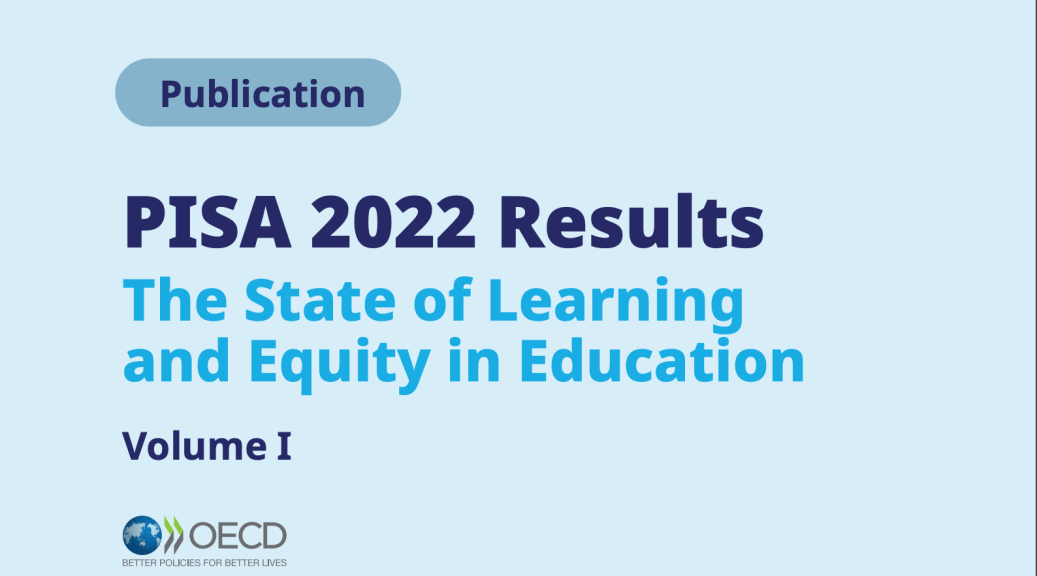
Even Finland, recently the Golden Country for educational outcomes, now finds itself with the release of PISA 2022 facing headlines like this: PISA 2022: Performance in Finland collapses, but remains above average.

However, the best lesson from PISA 2022 for the US is England (UK), especially in the context of the “science of reading” (SOR) movement driving state-level reading legislation across the country:

First, for context, England implemented phonics-centered reading policy in 2006 that rejected balanced literacy and parallels in most ways the elements of SOR-based reading legislation in the US. Research on those policies shows that students have received systematic phonics for almost two decades now, but that outcomes have not produced the promises of that reform.

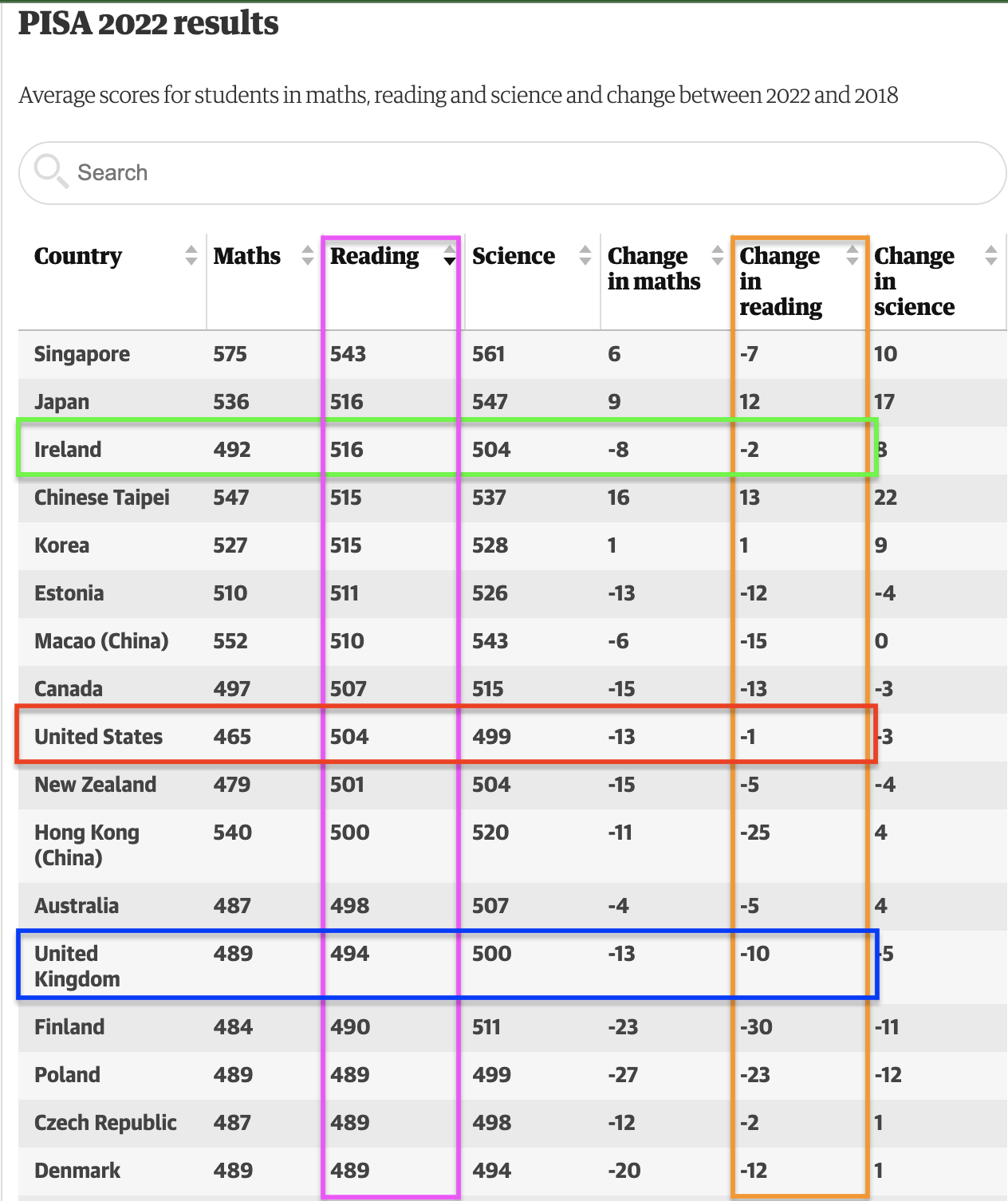
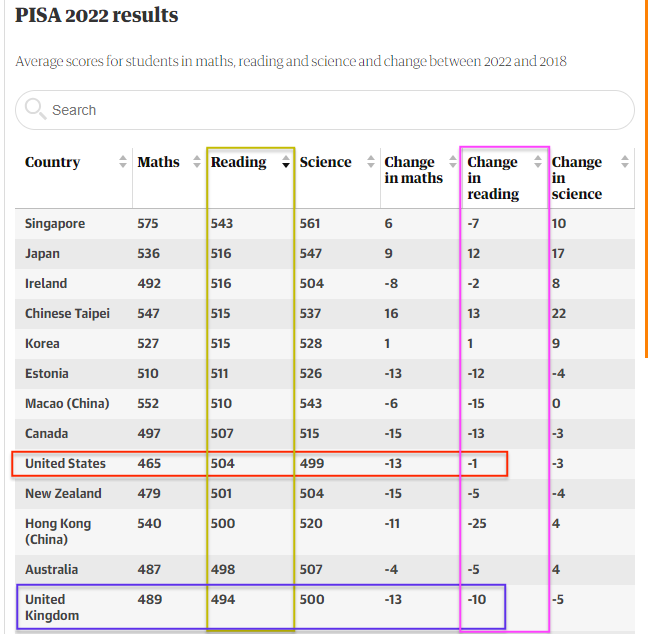
UK PISA scores in reading, none the less, rank below the US along with Australia, New Zealand, Canada, and Ireland; as well, the UK suffered a large score decrease in the wake of Covid:

While how reading is taught, what reading theory is embraced, and what reading programs are being implemented vary significantly across these countries, they all have one thing in common—perpetual reading crisis.

In fact, since A Nation at Risk, the US has endured several cycles of education crisis and reform that often hyper-focuses on reading (notably the impact of the National Reading Panel in No Child Left Behind).

Yet, none of these reforms have fulfilled promised outcomes, just as we are witnessing in the UK.

PISA 2022 and England’s reading results, then, offer some lessons we have refused to acknowledge about reading and education reform:

  • Education reform that exclusively implements in-school-only reform is guaranteed to fail. The value-added methods (VAM) era under Obama revealed that teacher impact on measurable student achievement is only 1-14%, and NAEP data show that the most successful schools in the country are Department of Defense (DoDEA) schools where the inequity of children’s lives are mitigated by access to healthcare, stable housing, food security, etc.
  • Media coverage and political rhetoric proclaiming “crisis” have repeatedly misidentified the barriers to reading proficiency and teaching reading, and thus, have resulted in policy that doesn’t address those roots causes. As the UK shows, making promises that are not fulfilled only further fuels cycles of crisis and reform. Currently in the US, SOR advocates are promising 90% of students will be at grade level proficiency; however, a recent working paper on reading reform in California show only about 1/3 of students as proficient after SOR implementation, the same percentage that media has used to claim a reading crisis and a far cry from 90%.
  • PISA is a measure of 15-years-old students (see also NAEP LTT data), which offers a way to evaluate misleading short-term score gains that are more mirage than miracle. In the US, states such as Florida and Mississippi demonstrate that while grade 4 scores in reading can be inflated, that learning isn’t real, and by middle and high school, the improvements have vanished. Thus, there are no miracles and no silver bullets in education reform.

Whether NAEP or PISA, standardized test scores are less about learning and teaching but more about the incredible inequity in the lives and schooling of children.

That inequity is no crisis; that inequity is a historical fact, especially in the US where we do not have the political will to confront both the out-of-school and in-school influences on teaching and learning.

If we are concerned about the disproportional vulnerable populations of students who routinely test well below the many different criteria for reading proficiency—and we should—reading and education reform must start with addressing inequity in the lives and education of all children.

Reading theories and reading programs are neither the problems nor the solutions to increasing student reading proficiency.

The real reading crisis in the US and internationally is the refusal by those with power to read what test scores actually show us—and the failure to act in ways that can and will make attainable gains in the best interest of children, teachers, and each nation.

READ!NG CR!S!S: PISA Edition

If you are an educator or someone who stays engaged with public education in the US, do you remember when everyone wanted to be Finland? [1]

Pasi Sahlberg and everything Finland was the hot talking point only about a decade ago.

I, too, wrote about Finland, but mostly to point out that Finland’s international test score success was more a reflection of the country’s extremely low childhood poverty rate (the US childhood poverty rate then was about 8x higher) and homogenous society than about their curriculum or teacher quality.

That was routinely rejected by education reformers who were heavily into the no excuses ideology and fond of rhetoric such as “the soft bigotry of low expectations,” “education is a game changer,” and of course) “no excuses.”

Well, uh oh!

Now not even Finland wants to be Finland: PISA 2022: Performance in Finland collapses, but remains above average.

Wow, “collapses”!

That’s pretty dramatic, but the source of this new angst is the release of PISA scores for 2022. [2]

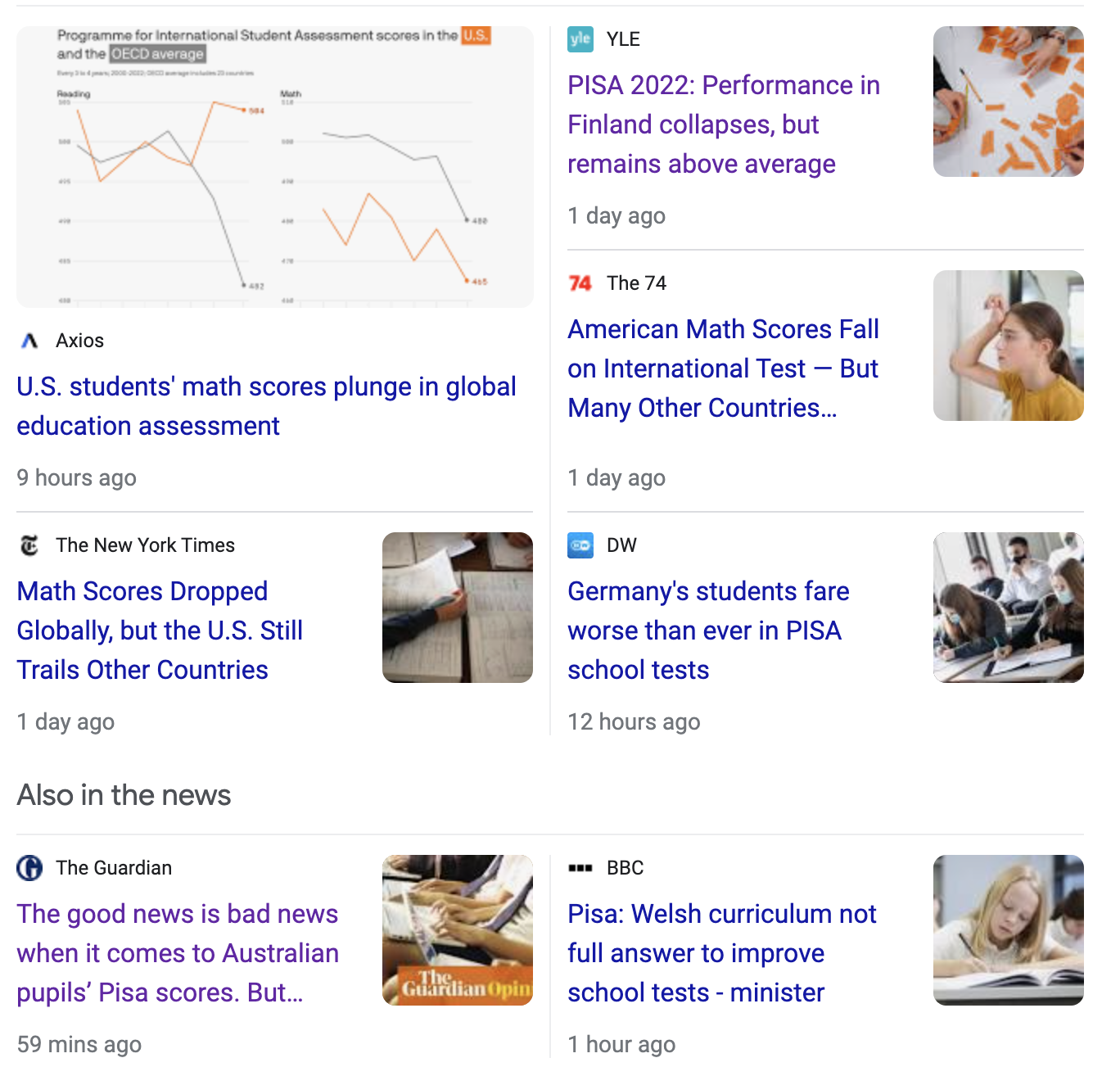
If we take a quick glance at a Google search, that PISA angst appears to be mostly universal (or better phrased, international):


The cries of “crisis” may be more intense over the large drop in math scores, but there is plenty of room for one of the national pastimes in the US: READ!NG CR!S!S!

While there literally has never been one moment in the US over the past 100 years that someone hasn’t been crying READ!NG CR!S!S!, the US has been embroiled in a particularly intense READ!NG CR!S!S! often grounded in our national testing, NAEP since 2018.

Setting aside the histrionics that always surround NAEP and PISA, look at some English-speaking countries and their reading scores for PISA 2022:

In the context of the UK having overhauled their reading legislation in ways that are being uncritically embraced in the US by the “science of reading” movement and while the US daily claims we are in the midst of a huge READ!NG CR!S!S!, one might find the US 10-point advantage and 9-point less decrease since 2018 a reason to celebrate.

One might also think that Ireland, Canada, and New Zealand may take some solace in their results.

Well, think again because there is only one response to reading test data—READ!NG CR!S!S!:

We must accept that national and international standardized testing of reading has almost nothing to do with evaluating or reforming student reading proficiency.

We must also accept that no matter the scores or the international rankings, the only media and political response anyone has is READ!NG CR!S!S!

And while it is an enduring and compelling story, shouting READ!NG CR!S!S! is best described by Macbeth:

it is a tale
Told by an idiot, full of sound and fury,
Signifying nothing.

The Tragedy of Macbeth, 5.5

[1] For a bit of historical context for this nonsense, consider this Swiss Schools and Ours: Why Theirs Are Better, Hyman G. Rickover (1962) [access a review here]

[2] I recommend Getting Ready for PISA, Tom Loveless

Media Misreads Reading Science (Again)

For more than five years, mainstream media has been obsessed with two false but compelling stories: (1) there is a national reading crisis caused by balanced literacy programs that rely on three cueing, and (2) the solution is the “science of reading” (SOR).

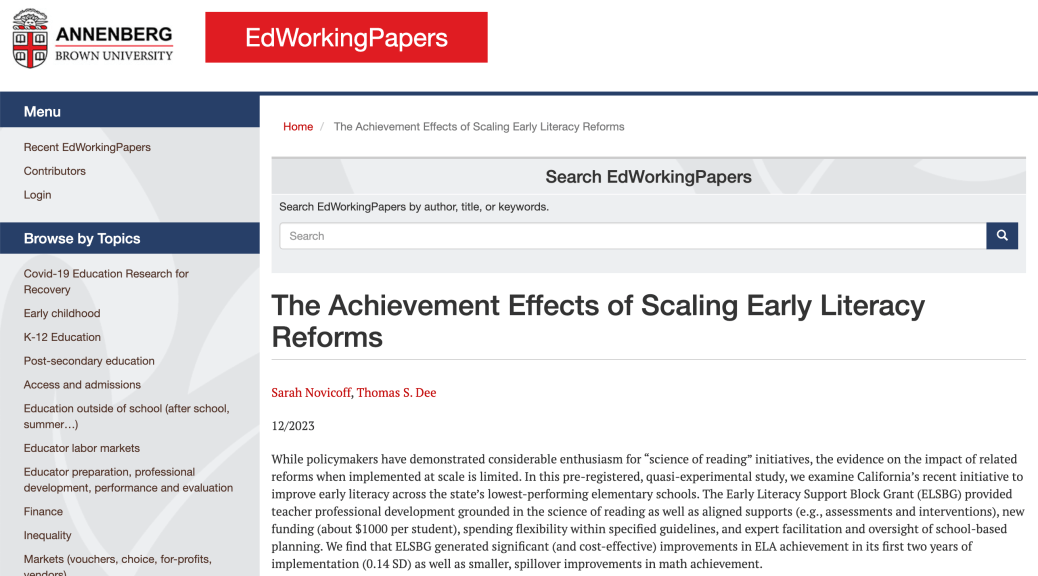
So it is no surprise that a working paper on the outcomes from a right-to-read lawsuit in California has prompting immediate high-profile coverage in The Hechinger Report and The New York Times.

Before I examine the paper itself, let’s remind ourselves of two foundational aspects of the SOR movement that is primarily media- and politically based.

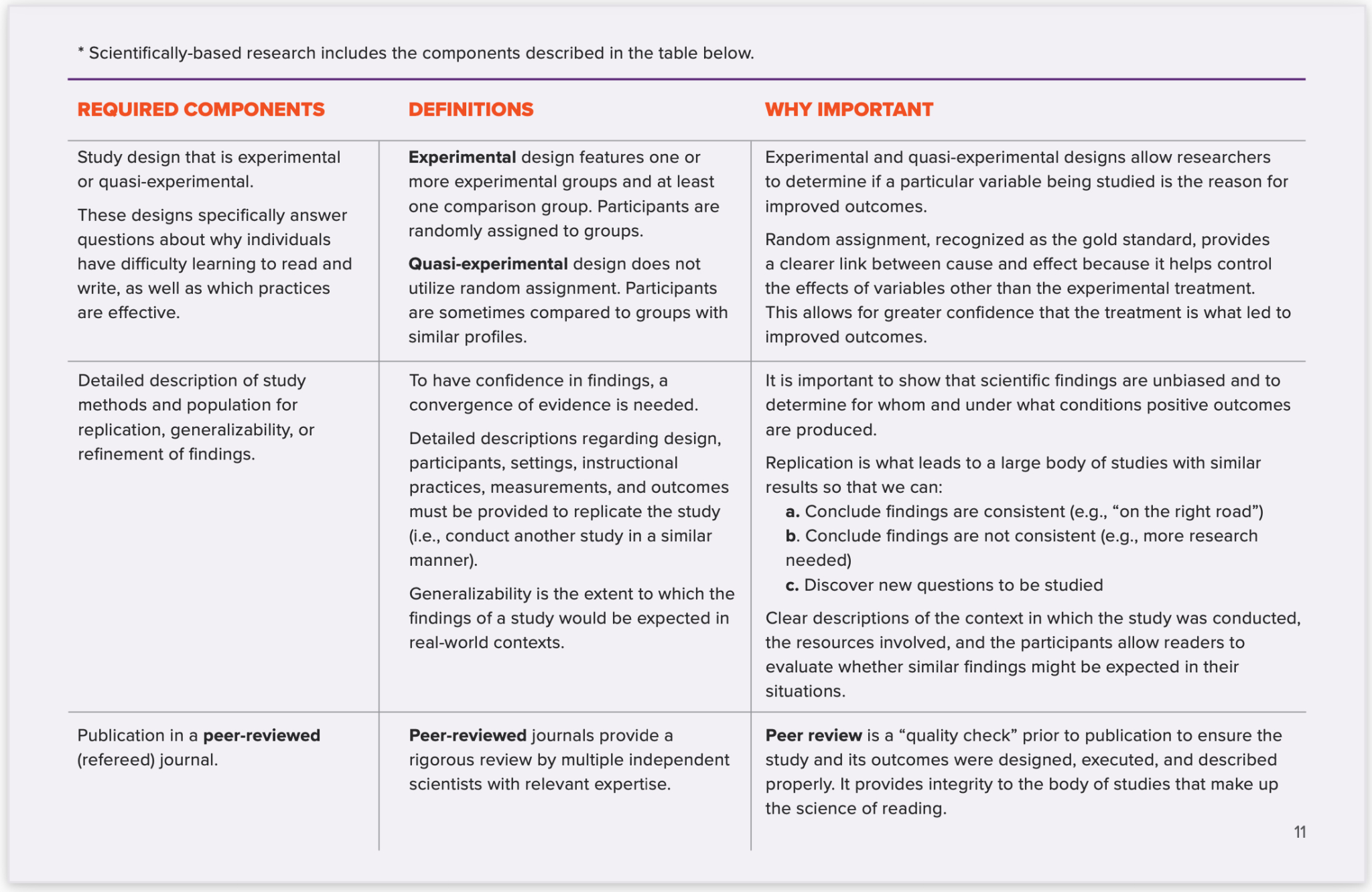
First, The Reading League has established what counts as “scientific”:


Second, advocates for SOR instruction such as NCTQ promise that SOR policy and practices will result in 90% of students reading at grade level proficiency:

Reading Foundations: Technical Report

If we maintain the essential foundations established by the SOR movement itself, we must conclude that the working paper itself should garner no media coverage because it fails to meet the standard of “scientific” and that even if we consider the findings of the paper credible, SOR policy has significantly failed in CA:

Now I want to unpack why the paper should never be covered at this level and with such a positive spin by journalists (including within the paper itself).

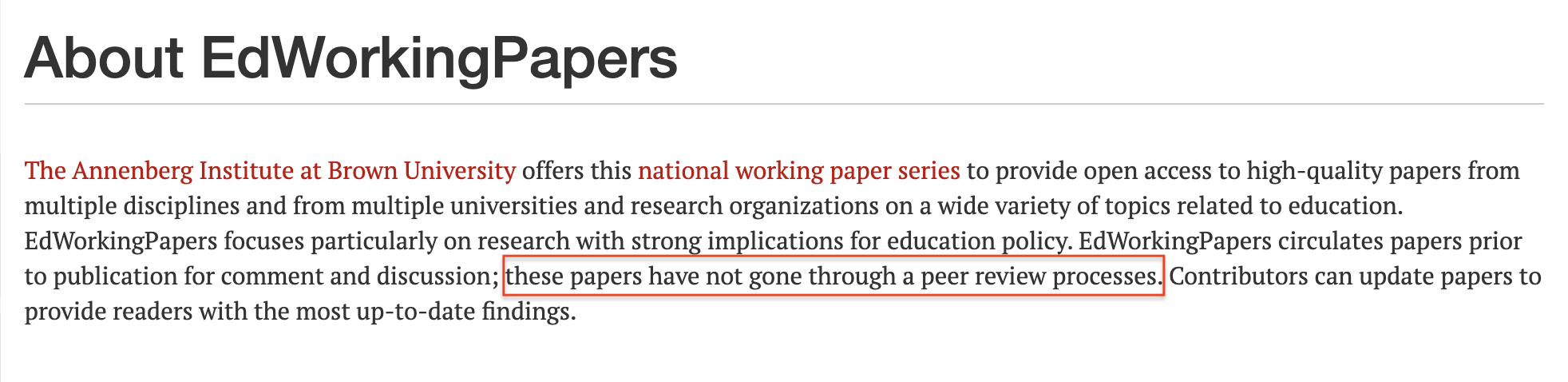
The most important issue is that a working paper is not peer-reviewed or published, thus not “scientific” per expectations identified above:

About EdWorking Papers

And as noted by Barshay: “The working paper, ‘The Achievement Effects of Scaling Early Literacy Reforms,’ was posted to the website of the Annenberg Institute for School Reform at Brown University on Dec. 4, 2023. It has not yet been published in a peer-reviewed journal, and may still be revised.”

Next, since there is a great deal of misinformation in the paper about NAEP and literacy, we should be concerned that the authors have backgrounds in social studies and economics, not literacy:

For scholars and journalists, not knowing enough to know what you don’t know can erode the credibility of research and journalism. This paper represents misrepresentations far too common in both research and media—misunderstanding NAEP reading proficiency:

Since “Basic” and not “Proficient” approximates grade level reading proficiency, NAEP data show that about 2 out of 3 students are at or above proficiency—not 1 out of 3.

Whether or not the US has a reading crisis and how scientific research can address reading proficiency in the US is negatively impacted by this simple fact: There is no standard metric for “proficiency” in reading, and NAEP along with each state sets the cut scores for proficiency differently.

Another misrepresentation or oversimplification in the paper is the failure to define clearly what counts as SOR as well as recycling oversimplified characterizations of whole language and balanced literacy:

At the center of misrepresenting reading theory and practices, this paper again significantly skews both what three cueing is and how it has or hasn’t impacted reading proficiency. [1]

The paper acknowledges two important points often misrepresented in the media: the Mississippi “miracle” is more story than science, and the last twenty years include research showing little to no positive impact from SOR policies grounded in NCLB, Reading First, and NRP:


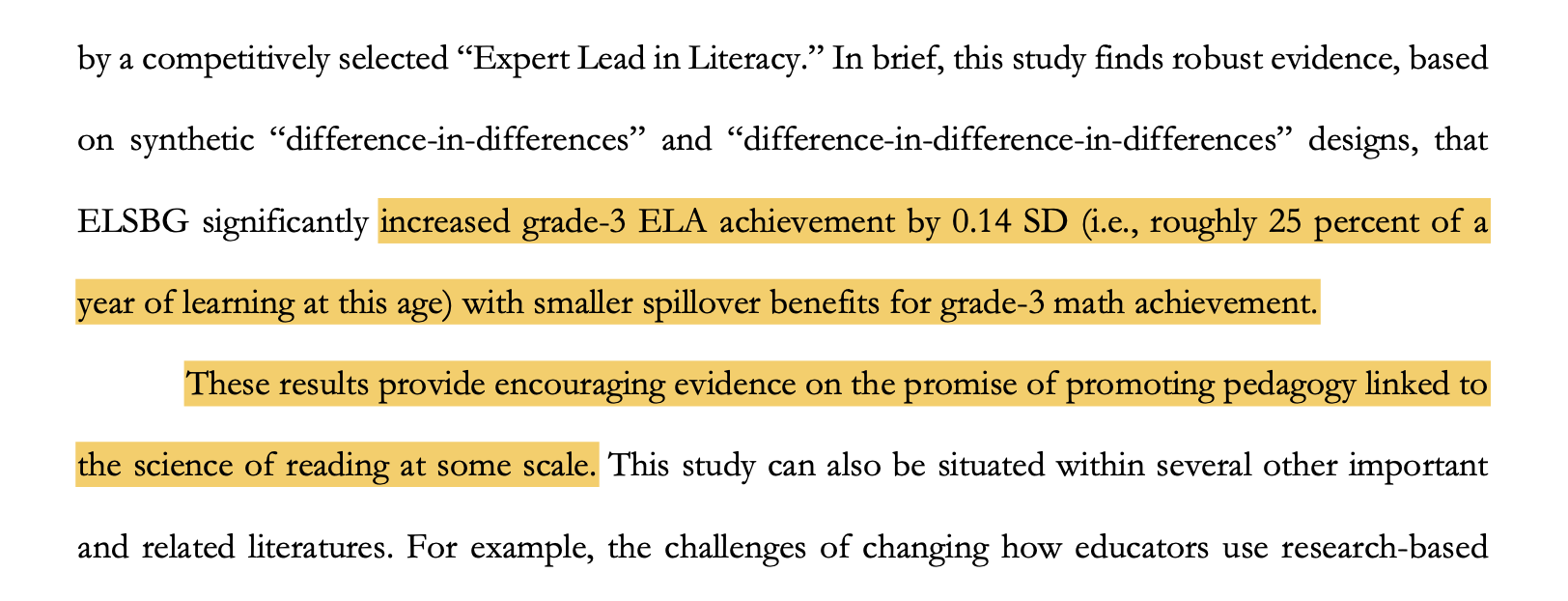
Yet despite the high standard SOR has set for reading proficiency and the minimal gains shown in this paper, the authors slip into advocacy for SOR:


The paper lacks a clear definition of what counts as SOR (except it appears anything not including three cueing counts) [2] or reading proficiency, and skirts over that the policy implemented in CA includes far more than SOR literacy practices (suggesting any gains could be more from extra funding and other practices):


Media’s outsized coverage of this paper also raises questions about outliers and selective coverage.

The paper again notes a history of SOR practices not resulting in promised gains:


However, neither the paper nor mainstream media choose to focus on substantial evidence from England about failed SOR policies over almost two decades, and one must wonder why there isn’t the same media coverage for research on high-volume reading that has been peer-reviewed and published: The Effects of Bookworms Literacy Curriculum on Student Achievement in Grades 2-5.

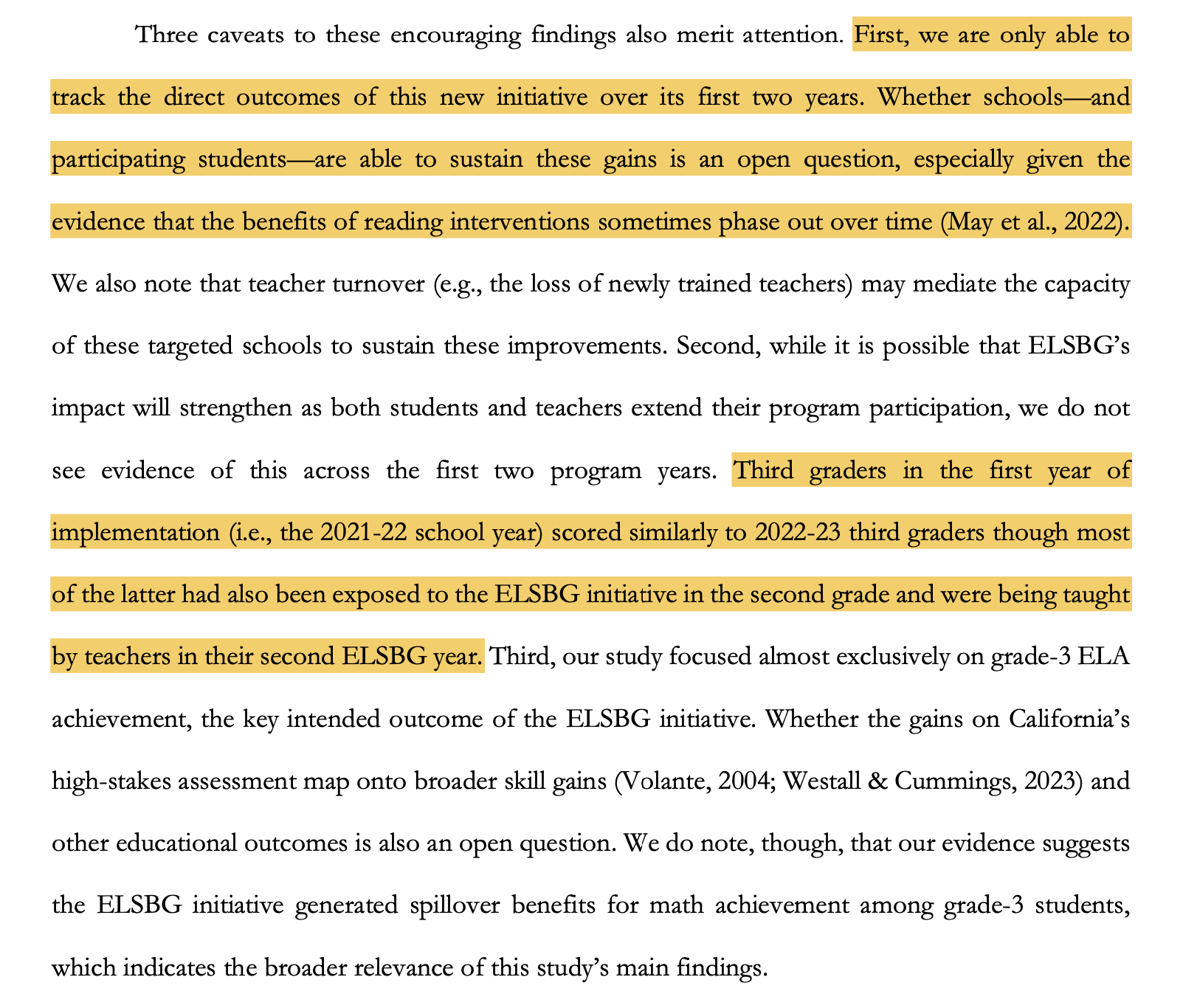
The paper’s caveats also deserve far more emphasis than the findings:

Again, decades of research and contemporary examples from MS and FL have shown repeatedly that raising reading scores in the short term and early grades almost never continues into middle school, and thus are mirages, not miracles.

Finally, the paper represents two significant problems with so-called high-quality research in education: (1) using metrics such as “X [time] of learning” and (2) judging policy and practice in terms of “cost effective” (one researcher, again, has an economics background):


Finally, then, if we circle back to the standards and promises within the SOR movement, this working paper should not be covered at all by media (a working paper is more press release than science), but if anything, the results signal a significant failure of SOR practices to meet the 9 of 10 students reaching reading proficiency.

The media coverage of this working paper could be considered much ado about nothing except it will serve to continue the manufactured crisis campaign about reading that is ultimately, and again, mis-serving children, teachers, and the promises of public education.


[1] See the following:

[2] Since no standard exists for what counts as SOR practices, many states and schools seem to cherry pick what to ban and what to implement. For example, three cueing is often banned, but state and schools implement practices and programs also not supported by science such as LETRS training for teachers, grade retention, decodable texts, and multi-sensory (O-G) programs; see Teacher Prep Review: Strengthening Elementary Reading Instruction (NCTQ) and The Science of Reading: A Literature Review:

New Adventures in Steel: Cycling Edition

Cycling is a sport that is unlike few others in that as a so-called serious recreational cyclist, I have ridden often with professional cyclists who competed at the highest levels, including the Tour de France.

Cycling is also rich in a very problematic history and tradition, captured with a bit of humor and a heavy dose of seriousness in The Rules.

Reaching back into my start as a cyclist in the 1980s, I have practiced one of the most endearing Rules:

Rule #12 // The correct number of bikes to own is n+1.While the minimum number of bikes one should own is three, the correct number is n+1, where n is the number of bikes currently owned. This equation may also be re-written as s-1, where s is the number of bikes owned that would result in separation from your partner.

The Rules

Into my fifth decade riding, buying, and building up bicycles, I have owned close to 50 different bicycles (maybe more). I also am always looking for the next new justification for that n+1.

In the early days, we so-called serious road cyclists tended to own at least two road bicycles. Once mountain biking established itself as an acceptable alternative to the road, well, that meant at least one MTB, maybe two, bringing the heard up to four.

Over the last decade, luckily, gravel cycling exploded—and thus, more reasons to buy yet another bicycle.

For almost thirty years, much of my life centered on cycling at very high levels of intensity and mileage, with my training focusing on the annual Assault on Mt. Mitchell, a 100-mile ride that ends with about 30 miles from Marion, NC to the summit of the highest mountain east of the Mississippi.

Over 18 efforts at The Assault, I struggled, suffered, and a couple times, excelled. My best finishes were in 2007 at 46 years old (best time and second best finishing order) and 2014 at 53 (best finishing order).

But two years represent a significant shift in my life as a cyclist.

In 2015, as I started up the watershed toward the Blue Ridge Parkway, I decided to quit, turning around and riding back to Marion.

Christmas eve of 2016 was more dramatic as a group of us were hit by a car that morning, resulting in two people very seriously and permanently injured, and me with a pelvis fracture.

I retired from road cycling for over a year, but then did return to the sport fully, although after more than a decade of riding 9,000-10,000 miles a year, since about 2017, my riding is much more modest (about 1-2 hours a ride over about 4 days a week).

My new adventures in cycling are a different sort of satisfying. I often ride alone and have fallen in love with my gravel bicycle, a Santa Cruz Stigmata:

In fact, I am now more likely to ride my gravel bicycle even when riding on the road.

I resisted, but I am a convert to disc brakes—although the advanced in technology over the years have eroded my ability to do my own mechanic work.

The inclusion of a gravel bicycle appeased my n+1 urge, but it also has seriously stressed our ability to store 8 bicycles in our apartment.

And this post is about how I arrived at bicycle 8, a new Ritchey Outback steel gravel bicycle:

When I began cycling in the 1980s, high-end road bicycles were all steel, and many looked like works of art.

We cyclists all lusted over the lug work and put the newest iterations of steel on our wish lists.

Throughout the 1990s and into the 2000s, aluminum, titanium, and ultimately carbon fiber nearly erased the steel market, except for department store bicycles and those of us who remained nostalgic.

In an effort to balance our cycling lives with our new dog lives, we decided to invest in Burley Tail Wagon, which was a surprise addition to the n+1 rule.

Yes, the Ritchey Outback is the dedicated dog bicycle (just as a note, so far the dog is not a fan, but we are hoping she will adapt and know that she prefers to be with us instead of her kennel).

After my maiden voyage on the Outback, I want to offer a few thoughts about cycling products and quality (and I do not in any way work for or have any association with these companies).

First, the Burley dog trailer is impressive, and our only concerns are no direct way to anchor the dog, and despite it being listed for dogs up to 75 pounds, out dog is just under 50 lbs. but seems cramped.

Next, the first ride on the Outback was a joy to recall the pleasures of steel frames. Yes, the steel bicycle is a bit heavy feeling (although the actual weight is quite light), but the ride is smooth and wonderful.

If you have ridden steel in the past, you’ll love the Outback.

After decades of riding carbon fiber, I noticed that the front end of the Outback feels much less stable, twitchy, but that sensation lessened the more I rode.

I have been a dedicated user of SRAM equipment since around 2003, and now I have used the entire line of Red, Force, Rival, and Apex. What fascinates me about SRAM is the quality of performance despite the level.

Since the Outback is mostly a functional build, I used the Apex line, and am thrilled with that choice.

At times, I become a bit depressed as my cycling life has shifted, some because of aging and some because of life.

But the Outback has brought be full circle back to a steel bicycle and once again riding mostly for myself and with something like the joy children feel pedaling down the road without a care in the world.


See Also

Review: Santa Cruz Blur 2020 Carbon R Build