

Although my book publishing career includes a couple works from 2001, I consider my first “real” book a volume from 2004, Numbers Games: Measuring and Mandating American Education.
I wrote a brief piece for a colleague at the time that she included in a book she was working on for Peter Lang USA under the guidance of Joe Kincheloe. Joe asked her if I could write a book for Lang based on that passage.
Kincheloe was a kind and generous scholar who launched my official scholarly career, although I had been writing seriously for two decades before we met.
Five years later, 2009, I co-authored 21st Century Literacy: If We Are Scripted, Are We Literate?, another work supported by Kincheloe.
Here in 2024, I am somewhat discouraged that I find reason to mention those works since, it appears, the evidence and arguments included in both fell on deaf ears, specifically with the widespread adoption of “science of reading” (SOR) legislation blanketing the US.
Many advocates and legislators have completely caved on teacher autonomy as state after state is mandating scripted reading programs based on false stories in the media that misrepresent teacher expertise about reading and a reading crisis.
At the core of the SOR movement, then, is the pernicious use of numbers games.
A foundational example I have addressed often is the misrepresentation of NAEP reading scores to declare that 60% (the seminal claim of Emily Hanford) or 2/3 of students are not proficient readers and/or not reading at grade level (see dozens of media articles such as one by Nicholas Kristof).
This numbers shell game is based in the misleading use of “proficient” by NAEP as well as the combination of ignorance about those achievement levels and willful ignorance about those achievement levels (see I. here about the NAEP Big Lie).
The NAEP numbers game is frustrating because the claim shuffles “not proficient” and “not on grade level” while literally inverting the valid claim based on NAEP. In fact, for 30 years, NAEP grade 4 reading data show that about 60%+ of students are reading at grade level and above since NAEP “basic” (not “proficient”) is equivalent to grade level reading:
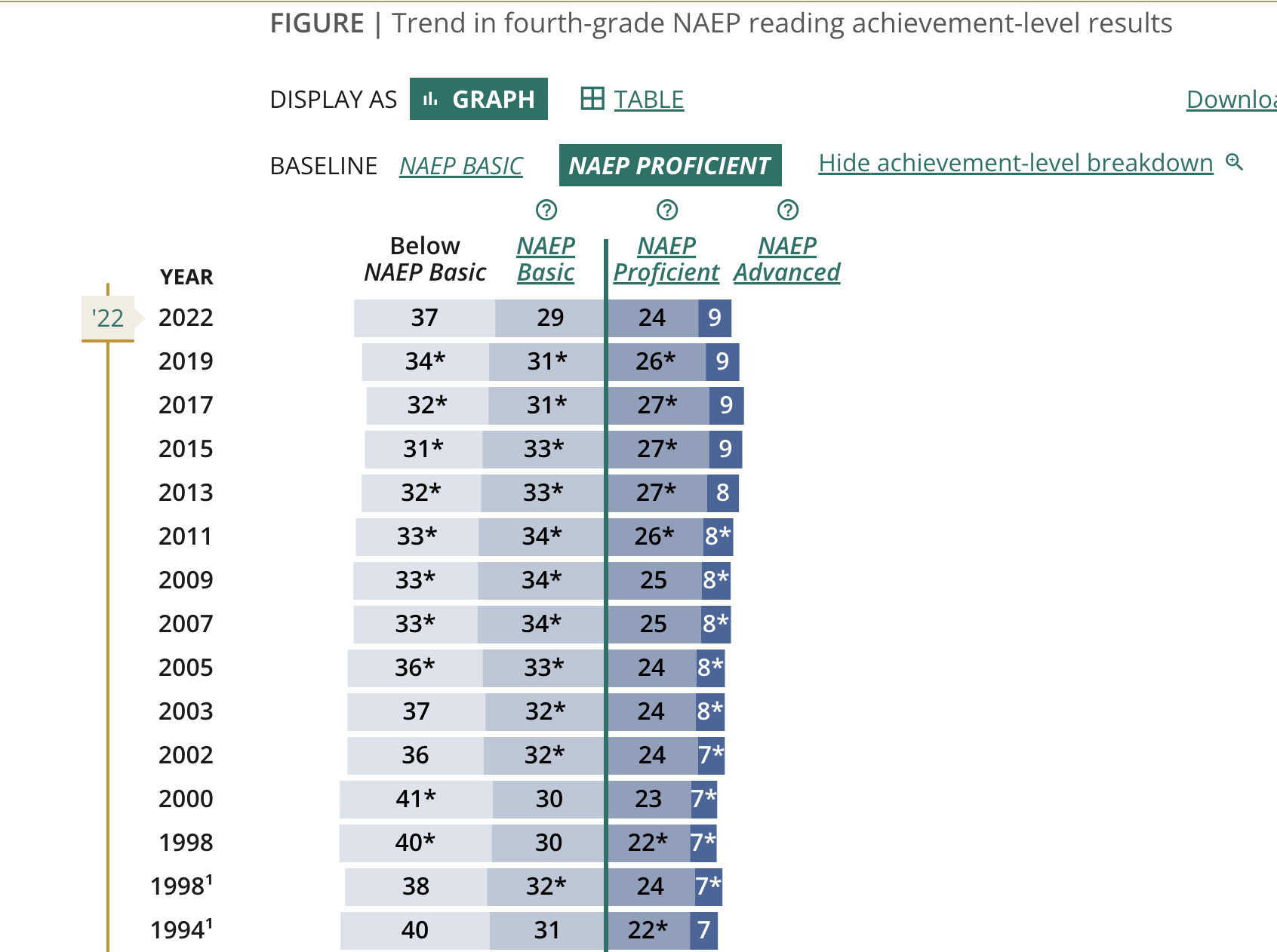
Further, and even more frustrating, is that this numbers game distracts us from the real issues: (1) The US has no standard for “grade level” reading, (2) we have never fully interrogated the need for a standard “age level” instead of “grade level” metric, and most importantly, (3) the real issue is the disproportionate number of marginalized and minoritized students in the below grade level data pool.
Swirling around the NAEP Big Lie, as well, is a numbers game that hasn’t been fully unpacked—the claim that 90-95% students can be proficient if we simply implement SOR.
As a side note, those SOR advocates making this shifting claim (sometimes it is 90%, sometimes it is 95%) have not, along with most of mainstream media, noted a powerful example of the possibility that the 90-95% proficiency is achievable: DoDEA schools have close to that rate of achievement (see below).
Now as the SOR movement has grown over the past 6 years, I have seen the 90-95% claim more and more although that numbers game still has less traction than the 2/3 not proficient claim.
However, when I began my review of a recent NCTQ report, I took the time to interrogate the 90% claim by the anti-teacher education think tank: “With effective reading instruction, we could take that [student reading proficiency] to more than 90%” (p. 4)
That claim by NCTQ has a footnote to a few studies, but the most interesting evidence is the final citation to a blog post by Nathaniel Hansford who admits at the beginning, “it has always stuck out to me as a strange figure” because:
First, most academic research does not typically use percentages in this sort of manner. Second, I often see this figure unaccompanied by a citation. And third, it seems low; I find it hard to believe that 5% of students just cannot learn how to read.
Can 95% of Children Learn to Read?
When Hansford asked for scientific evidence for the claim, this is what he discovered:
Some of the citations I was sent were policy papers, by authors and institutions that used this claim. However, these papers were not experimental and usually cited popular Science of Reading books, not experimental research. There was also, interestingly, one research paper sent to me from the 1980s, that made the claim, but did not cite any evidence to support it. So it appears that this claim has been in circulation for a long time. The most common source listed for this claim seemed to be Louisa Moats, who has written about this rule on numerous occasions. However, she does not claim that 95% of students can reach grade level, based on just core instruction, but rather in totality. Louisa Moats cites 4 sources in support for this rule. In Kilpatrick’s book Essentials of Assessing, Preventing, and Overcoming Reading Difficulties; a 2009 paper by Lim, et al. on students with Down Syndrome; a 2005 paper by Mathes, et al, examining the rate of risk reduction for struggling reading, with intensive intervention instruction, and a literature review of risk reduction, by Joseph Torgersen. In my opinion, the last two citations provide some experimental evidence to support this claim.
Can 95% of Children Learn to Read?
I have found no better conclusion about the 90-95% claim than the one offered by Hansford; there is scarce and dated scientific evidence to support, at best, that the 90-95% claim is a valid aspirational goal of reading proficiency: “This all said, it does seem there is some level of support for 96% being a benchmark goal [emphasis added], for reading proficiency rates.”
But key here is that like the NAEP Big Lie, the 90-95% claim is in no way a scientific claim being used by a movement that has used “scientific” as a rhetorical baseball bat to promote their ideological (not scientific) agenda.
The SOR numbers games are essentially lies and distractions. Regretfully, we certainly need to address reading proficiency in students, especially for marginalized and minoritized students.
But the real problems and achievable solutions are likely not to make the education marketers money but will require a different way to view education, one that acknowledges the key number that education reformers and SOR advocates ignore.
That number is 60+%.
A new study confirms a statistic that has been repeated by scientific research for decades—about 60+% of measurable student achievement is causally linked to out-of-school (OOS) factors (not reading programs, not instructional practices, not teacher quality): “Almost 63% of the variance in test performance was explained by social capital family income variables that influence the development of background knowledge.”
That fact of measurable student achievement discredits claims that reading proficiency, for example, is mostly a problem of reading programs and reading instructional practices. Reading reform for decades has simply shuffled programs and reading theory, which amounts to rearranging chairs on the deck of the Titanic.
Yet as I noted above, there is credible evidence that something approaching 90% reading proficiency is achievable if we address those OOS factors, the reading achievement of DoDEA students:
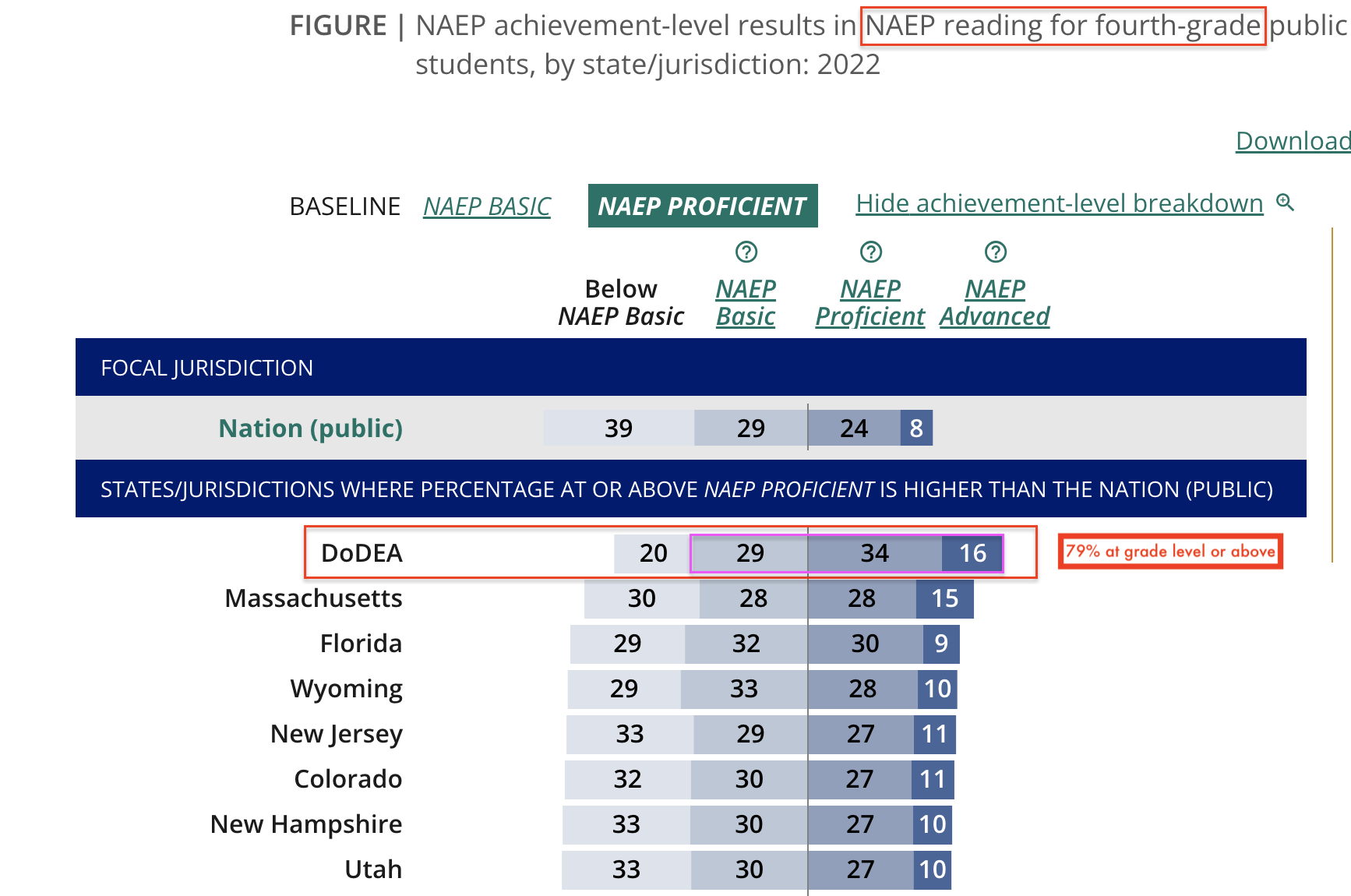
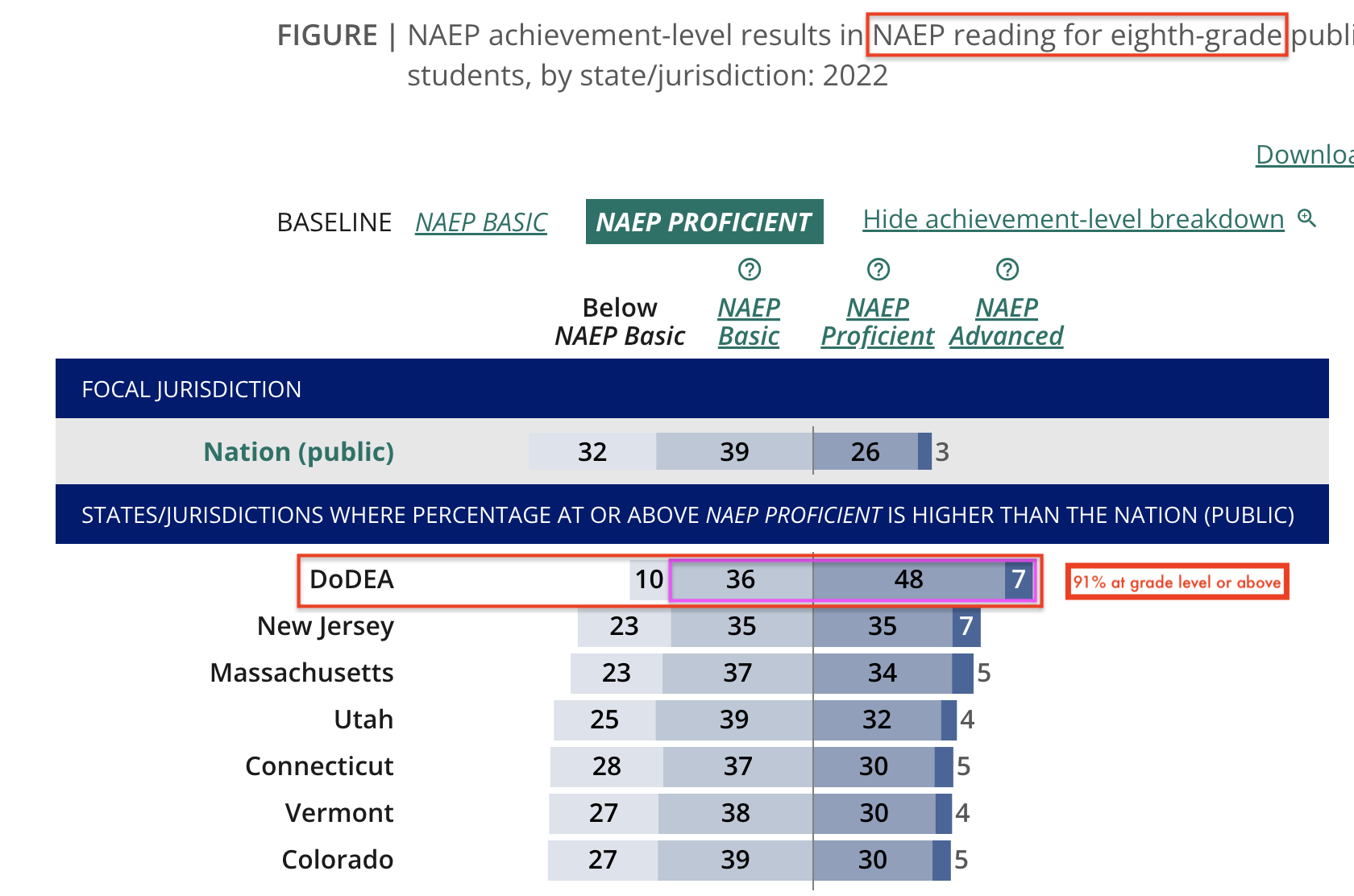
The DoDEA story isn’t one of reading programs, reading theory, or teacher bashing; in fact, there is a compelling story here:
How does the military do it? In large part by operating a school system that is insulated from many of the problems plaguing American education.
Defense Department schools are well-funded, socioeconomically and racially integrated, and have a centralized structure that is not subject to the whims of school boards or mayors….
But there are key differences.
For starters, families have access to housing and health care through the military, and at least one parent has a job.
“Having as many of those basic needs met does help set the scene for learning to occur ,” said Jessica Thorne, the principal at E.A. White Elementary, a school of about 350 students.
Her teachers are also well paid, supported by a Pentagon budget that allocates $3 billion to its schools each year, far more than comparably sized school districts. While much of the money goes toward the complicated logistics of operating schools internationally, the Defense Department estimates that it spends about $25,000 per student, on par with the highest-spending states like New York, and far more than states like Arizona, where spending per student is about $10,000 a year .
“I doubled my income,” said Heather Ryan, a White Elementary teacher . Starting her career in Florida, she said she made $31,900; after transferring to the military, she earned $65,000. With more years of experience, she now pulls in $88,000.
Competitive salaries — scaled to education and experience levels — help retain teachers at a time when many are leaving the profession. At White Elementary, teachers typically have 10 to 15 years of experience, Ms. Thorne said.
Who Runs the Best U.S. Schools? It May Be the Defense Department.
The SOR movement is playing a harmful and duplicitous numbers game that fits into decades of ineffective and harmful education reform. But the SOR movement is also following the corrosive playbook of using “science” as a rhetorical veneer for ideological agendas. Like scientific racism, the SOR movement is disturbingly absent science for many of their foundational claims.
Numbers games have consequences, and ironically, the research emerging from SOR policies is beginning to show that SOR legislation is whitewashing the curriculum and deprofessionalizing teachers.
While there are several shifting numbers in the SOR movement, there is in fact very little science to back them up. And the numbers that are being ignored are the huge taxpayers costs for shuffling reading programs to line the pockets of many of the people promoting those numbers games.
 dr. p.l. (paul) thomas