Close Reading: Evidence, schmevidence: the abuse of the word “evidence” in policy discourse about education, Gary Thomas

[Header Photo by thom masat on Unsplash]

Before the close reading below, let me offer several examples for context concerning how media have weaponized “science” resulting in misguided and even harmful reading legislation.

First, here is an example of a journalist posting an article by a journalist praising a journalist. What is missing? Actual research, evidence, or science.

Gottlieb’s article, oddly, repeats three times at the end that he is a journalist, but in the piece, he seems most concerned about advocating for Hanford:

As brilliantly illuminated by education journalist Emily Hanford’s articles over the past several years, and her 2023 “Sold a Story” podcast, the education establishment in this country — which includes textbook and curriculum publishers, schools of education and school districts — has been guilty of educational malpractice for decades, using now-discredited Whole Language methods for teaching reading.

Too little progress in teaching Colorado kids to read

See this for a critical unpacking of Hanford’s false claims repeated by Gottlieb: How Media Misinformation Became “Holy Text”: The Anatomy of the SOR Movement.

Gottlieb refers to a report and data, but offers no links to any science or research to support any of his claims, again primarily supported by Hanford’s “brilliant” podcast.

Next, Hanford’s There Is a Right Way to Teach Reading, and Mississippi Knows It demonstrates again the lack of science or research and the self-referential nature of media’s false claims about reading and the “science of reading.”

Note that the subhead, written by editors, not the journalist (“The state’s reliance on cognitive science explains why”) is directly contradicted by Hanford, although the article itself implies the opposite of what she acknowledges:

What’s up in Mississippi? There’s no way to know for sure what causes increases in test scores, but Mississippi has been doing something notable: making sure all of its teachers understand the science of reading.

There Is a Right Way to Teach Reading, and Mississippi Knows It

When Hanford makes huge claims about teachers being unprepared to teach reading (“But a lot of teachers don’t know this science“), the link provided circles back to her own journalism, not research, not science.

The consequences of this media cycle of using “science” to give stories credibility while omitting the actual science is reading policy grounded in misinformation, but also given the veneer of “science”:

Legislation that would require Michigan schools to use a reading curriculum and interventions for students with dyslexia that are backed by science has taken a different shape to satisfy school administrators who questioned the timeline in the bills.

Michigan eyes reforms to teach those with dyslexia. Critics say more is needed

And with the rise in reading legislation labeled as “scientific,” the education marketplace has eagerly jumped on board (“story,” “data,” “science”):

And thus, let’s do a close reading:

Gary Thomas (2023) Evidence, schmevidence: the abuse of the word “evidence” in policy discourse about education, Educational Review, 75:7, 1297-1312, DOI: https://tandfonline.com/doi/full/10.1080/00131911.2022.2028735

Thomas explains the essay purpose as follows:

I focus in this essay on the way that policymakers in education may promote policy through the use of words and terms used by academics and by the public about education topics – words and terms such as “evidence”, “what works”, “evidence-based policy” and “gold standard”. In particular, I examine ways in which vernacular and specialist meanings of “evidence” and “evidence-based” may become hybridised; ways in which technical terms may be appropriated by politicians and their advisers for public consumption, and, in the process, become degraded and corrupted in the service of their own policy agendas.

One issue with the use of “evidence” (and synonyms) is that policymakers are apt to resort to “’cherry-picking, obfuscation or manipulation.’”

Terms such as “evidence” (and “science”) are designed to create “the ‘almost magical power’ that certain words acquire to ‘… make people see and believe.'”

Thomas’s analysis found:

In not one of the 100 uses was “evidence” used prefatory to an actual itemisation of data in support of a proposition, and in all cases in the non-specific category, “evidence” was used with verbs – e.g. “there is evidence”, “England possesses evidence” – which simultaneously conferred authority via the supposed status of “evidence” at the same time as acting as a proxy for detailed enumeration of specific data. The authority of the non-specific “evidence” was amplified with many qualifications of the word, which, without detail of the data for which “evidence” was a proxy, appeared merely to add rhetorical weight rather than empirical support. These qualifiers included words/terms such as incriminating, overwhelming, strong, weak, little, hard, fresh, preliminary, sufficient, inadmissible, no, verifiable, hearsay, prima facie, disturbing, concrete.

As Thomas walks the reader through a few examples, he highlights: “’Evidence’ is here prefaced with ‘scientific’, seemingly to elevate its status in the absence of specificity – a strategy frequently employed in general discourse, as the analysis of the corpora revealed.”

“Evidence” (like “science” and “research”) is commonly used in place of citing actual evidence throughout media and political discourse. [As my examples above show, US media often link to other media when terms such as “science” and “research” are used.]

“Evidence” is weaponized, then, as Thomas explains:

All the examples given here reveal the fashioning of semiotics, the creation of meaning, and the dissemination of messages to non-specialist audiences in an outlet that, while widely read, offers no obvious route for scholarly interrogation or critique – at least, within a timeframe that might allow meaningful challenge. The putative “evidenced reality” proves on examination not to exist and the attempt is – in the world of retail politics – to craft an illusion of “evidence” in support of particular political agendas, employing devices such as the “negative other-representation” to attempt to augment the writer’s position.

And thus:

“Evidence”, in the pieces examined here, is used often with only a superficial allusion to any kind of research, and the research “evidence”, where any is cited, is often highly selectively sampled, with unconcealed deprecation of alternative interpretations.

Thomas then addresses the need for scholars to correct the misleading stories of media and political leaders instead of jumping on the bandwagon of reform for financial gain or prestige:

Academics must take a share of responsibility in the way that this process proceeds unimpeded. Such is the pressure inside universities for staff to be winning research grants and earning research income that there is inevitably willing involvement in con- tract research involving the kind of steering groups I have just mentioned.

Yet, Thomas ends by acknowledging that the weaponizing of “evidence” (and “science” along with other synonyms) immediately frames anyone challenging the stories negatively [1]:

In realising this, astute politicians can kill two birds with one stone. The knack is to enlist conspicuously with “science”, ostensibly adhering firmly to principles of reason and empiricism, while simultaneously projecting silliness, unreason and disengagement from research findings onto one’s interlocutor – as did Gibb in the phrase cited in illustrative case study 2: “The evidence is clear – however much it may shock the pre-conceived expectations of some education experts”, or as did Cummings in declaring that the “education world” handles scientific developments “badly”. Utter the phrase “the evidence is clear” and one straightaway affiliates oneself with reason, wisdom and unequivocal allegiance to empirical inquiry. One’s interlocutors, by contrast, are immediately forced onto the back foot, compelled to defend themselves against charges of not engaging with evidence – of subjectivity, sloppiness, credulity and narrow-mindedness borne of ideology.

Therefore, as Thomas concludes about “evidence,” here in the US we too must accept about “science” in media rhetoric and political policy”

On the basis of the analysis here, “evidence-based” is next to meaningless, given that the evidence in question is habitually unspecified and given that any evidence that is actually specified is carefully selected and/or offered as if it were superior to other evidence which suggests conclusions at variance to those being proffered. Protean and manoeuvrable, terms such as “evidence-based” are powerful rhetorically. They drop easily into conversation, speeches and documents to add weight to an assertion. Filling any gap, taking any shape, as instruments of retail politics they serve politicians’ purpose perfectly, but in any discourse with pretensions to scholarly independence and disinterestedness, their mutability ought to be troubling. Our responsibility as an academy is surely consistently to question these terms, to call for specification of evidence, to be ready to provide alternative evidence, to engage energetically with a broad range of media and social media (i.e. not just peer review and academic publications) and to question the validity of concepts such as “impact”.


[1] Compare this framing with how the Education Writers Association and Hanford frame the role of journalists and the expectation that implementing the “science of reading” may fail:


Big Lies of Education: Poverty Is an Excuse

George W. Bush built his path to the presidency on education reform, the discredited Texas “miracle,” and manufacturing his persona as a kinder and gentler conservative. One of his most effective rhetorical flourishes was evoking the “soft bigotry of low expectations.”

He spoke into cultural mythologies in the US that embrace bootstrapping and claim a rising tide lifts all boats—mythologies uncritically embraced by mainstream media.

During the Bush era of education reform in the 1990s and 2000s, charter schools increasingly received bipartisan support, notably under the Barack Obama administration.

The darling of that charter school movement was KIPP charter schools that popularized “no excuses” education.

More recently, declaring poverty an excuse in education was established in the “science of reading” manufactured reading crisis: “One of the excuses educators have long offered to explain America’s poor reading performance is poverty” (Emily Hanford, Hard Words).

While Hanford’s misleading and false story caught fire, fueling another reading crisis and state-by-state dismantling of reading instruction, Gerald Coles‘s careful and evidence-based discrediting of Hanford’s claims went mostly unacknowledged:

Can poverty and inequality be taken “out of the equation” in creating literacy and academic success? From Rudolf Flesch onward, the deplorable, unsubstantiated, simple-minded answer is supposed to be “yes, if a phonics-and-reading-skills-heavy early-reading program is employed.” However, as the current rendition reveals, just as over the past 60 years, the answer once again is “no, that’s not why Johnny can’t read.”

Cryonic Phonics

Decades of research, notably including the evidence created by the value-added methods of teacher education under Obama, confirm Coles, not Hanford or Bush or KIPP.

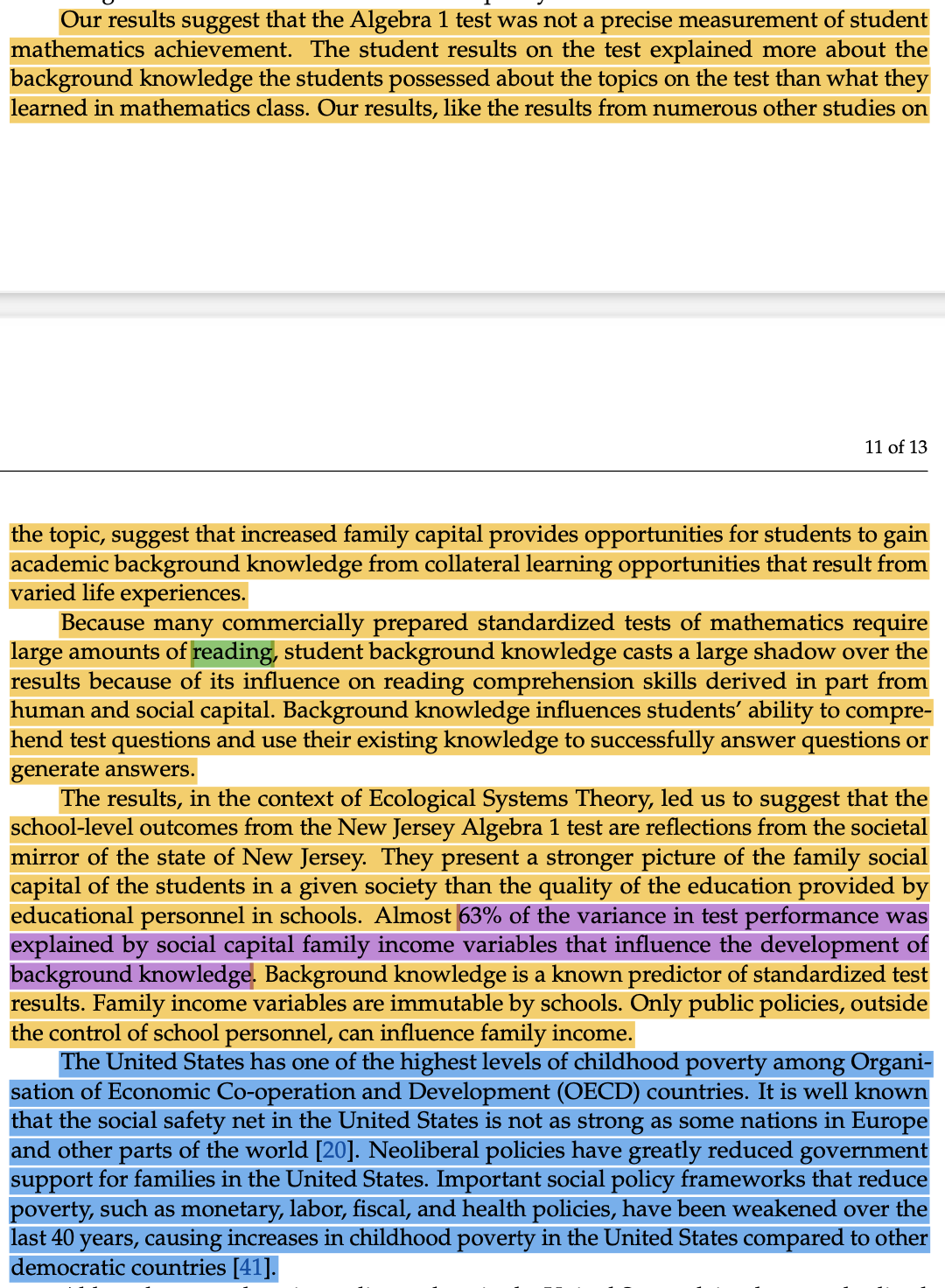
For example, consider the overwhelming evidence that poverty and out-of-school factors are causally linked to at least 60% of measurable student achievement:

Maroun, Jamil, and Christopher H. Tienken. 2024. “The Pernicious Predictability of State-Mandated Tests of Academic Achievement in the United States” Education Sciences 14, no. 2: 129. https://doi.org/10.3390/educsci14020129

For any education reform to work, out-of-school factors must be addressed along with confronting the impact of inequity in schools.

Poverty is not an excuse, but a reality that education reformers refuse to acknowledge to the detriment of students, teachers, and public education.


Update

Private schools: Who benefits?


Update 2

Burrell, N., & Harbatkin, E. (2024). Beyond the school building: Examining the association between of out-of-school factors and multidimensional school grades. Education Policy Analysis Archives, 32. https://doi.org/10.14507/epaa.32.8497


Update 3

Dearing, E., Bustamante, A. S., Zachrisson, H. D., & Vandell, D. L. (2024). Accumulation of Opportunities Predicts the Educational Attainment and Adulthood Earnings of Children Born Into Low- Versus Higher-Income Households. Educational Researcher, 0(0). https://doi.org/10.3102/0013189X241283456

Abstract

Scholars theorize that “opportunity gaps” drive achievement disparities between children born into poverty versus affluence. In a 26-year longitudinal study (N = 814), we examine (a) economic disparity in children’s accumulation of opportunities—from birth through high school—at home, childcare, school, afterschool, and in the neighborhood; (b) the extent to which opportunity is linked with educational attainment and earnings in early adulthood; and (c) whether opportunity is most strongly associated with these adult outcomes for children from low-income households. We document large opportunity gaps between children from low- versus higher-income households. These opportunity gaps are strongly linked with educational attainment and earnings, particularly for low-income children, helping explain why household income in early childhood predicts these outcomes in adulthood.


Teaching Writing: Reconsidering Genre (Again)

[Header Photo by David Pupăză on Unsplash]

My midterm exam for first-year writing invites students to interview a professor in a discipline they are considering as a major. The discussion is designed to explore those professors as researchers and writers.

On exam day, we have small and whole-class discussions designed to discover the wide variety of activities that count as research in various disciplines, and more importantly, what writing as a scholar looks like across disciplines.

The outcomes of this activity are powerful since students learn that research and writing are context-based and far more complicated that they learned in K-12 schooling.

Two points that I often emphasize are, first, that many (if not most) of the professors confess that they do not like to write, and second, I help them see that a profoundly important distinction between their K-12 teachers and professors is that professors practice the fields they teach.

This brings me to two posts on Twitter (X):

First, Luther is confronting a foundational failure of K-12 writing instruction—students being taught the “4 Types/Genres of Writing” (narration, description, exposition, persuasion).

That framing is deeply misleading and overly simplistic, but that framing is grounded in two realities: most K-12 teachers who teach writing are not writers, and the so-called “4 Types/Genres of Writing” are rooted in the rise of state-level accountability testing of writing (not any authentic or research-based approach to teaching composition).

Second, so I don’t appear to be beating up unfairly on K-12 teachers (I was one for 18 years and love K-12 teachers), Dowell is then confronting the often careless and reductive ways in which “academic writing” is both taught and even practiced (academic norms of published writing ask very little of scholars as writers and even impose reductive templates that cause lifeless and garbled writing).

The 1980s and 1990s saw a rise in state accountability testing that asked very little of students. The “4 Types/Genres of Writing” quickly supplanted the gains made with authentic writing instruction grounded in writer’s workshop and the influence of the National Writing Project in the 1970s and 1980s.

Those writing tests prompted students to write narrative or expository essays (for example) that were only a few paragraphs long (likely the 5-paragraph essay). These were scored based on state-developed rubrics that teachers taught to throughout the year.

In other words, as Gerald Bracey warned, writing instruction became almost exclusively teaching to the test. And since K-12 teachers of writers were primarily not writers themselves, this reductive and mechanical way to teach and assess writing was rarely challenged.

Let’s be blunt. K-12 teachers not resisting this dynamic is a logical response to an impossible learning and teaching environment that is dominated by accountability and high-stakes testing.

My criticism is that teachers and students were (and are) put in this situation; I am not criticizing teachers and students, who are the victims of the accountability era of education reform.

Further, while students who move from K-12 to higher ed discover that their K-12 preparation in writing is inadequate and often deeply misleading for how they are expected to write in academia, this new situation is not some idealistic wonderland of authentic writing (as Dowell confronts).

The K-12 to higher ed transition makes students feel unfairly jerked around (many are exasperated when they find out they didn’t need to “memorize” MLA and may never use it again), but navigating academic expectations for writing is equally frustrating (one first-year student this spring noted that my first-year writing seminar is unique, they said, because I teach writing while other professors simply assign and grade writing).

Students deserve better at both the K-12 and higher ed levels so here I want to offer a few thoughts on how to move past the traps I have noted above about teaching writing.

I highly recommend Genre awareness for the novice academic student: An ongoing quest by Ann Johns.

Johns argues for fostering “genre awareness” (addressing in complex and authentic ways Dowell’s concern) and not “genre acquisition” (for example, the reductive “4 Types/Genres of Writing” approach):

The first is GENRE ACQUISITION, a goal that focuses upon the students’ ability to reproduce a text type, often from a template, that is organized, or ‘staged’ in a predictable way. The Five Paragraph Essay pedagogies, so common in North America, present a highly structured version of this genre acquisition approach.

A quite different goal is GENRE AWARENESS, which is realized in a course designed to assist students in developing the rhetorical flexibility necessary for adapting their socio-cognitive genre knowledge to ever-evolving contexts. …After my many years of teaching novice tertiary students who follow familiar text templates, usually the Five Paragraph Essay, and who then fail when they confronted different types of reading and writing challenges in their college and university classrooms, I have concluded that raising genre awareness and encouraging the abilities to research and negotiate texts in academic classrooms should be the principal goals for a novice literacy curriculum (Johns 1997).

Genre awareness for the novice academic student:
An ongoing quest

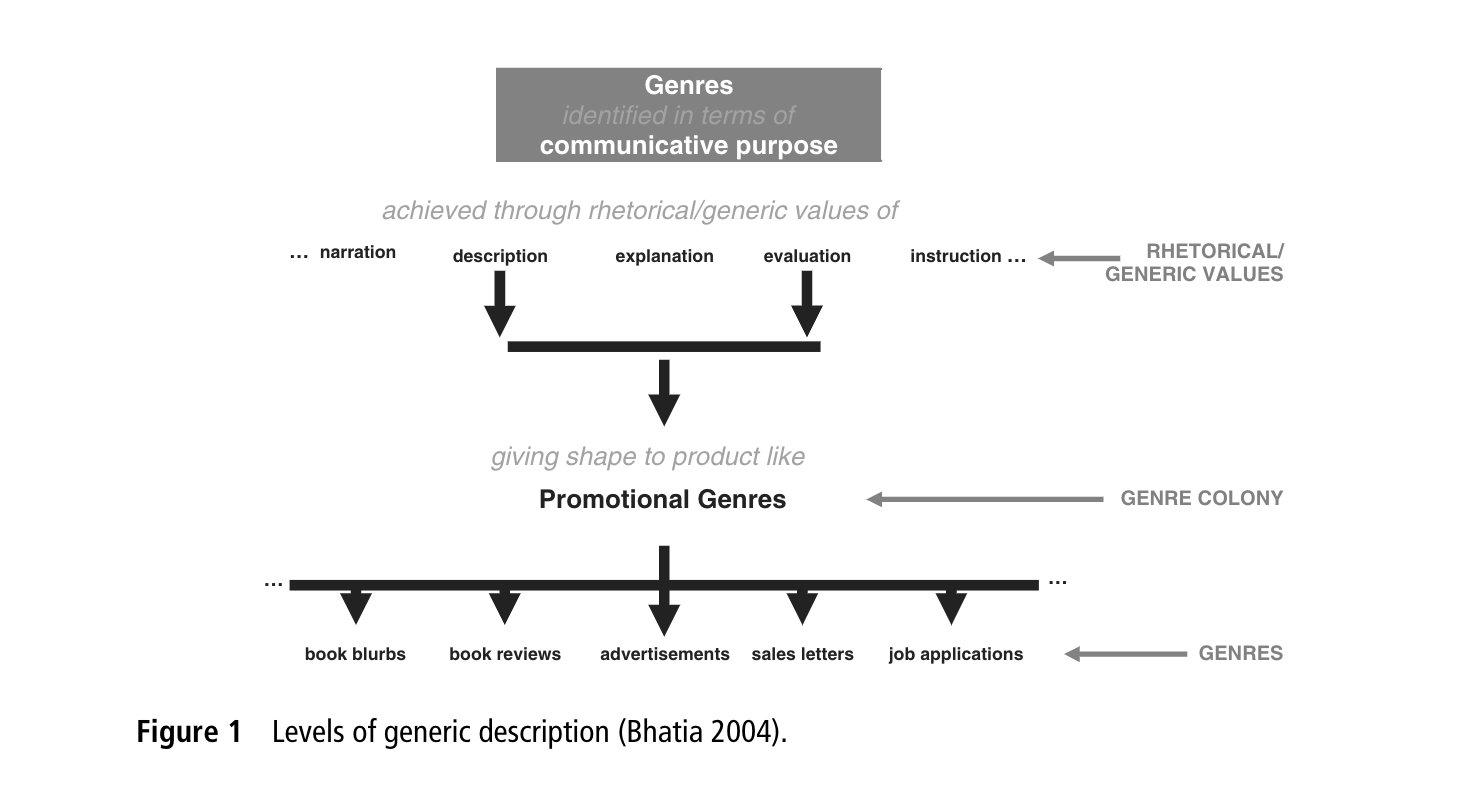
Here I think is an outstanding graphic (Johns draws from Bhatia) of moving past confusing modes of writing (narration, description, exposition, persuasion) with genres of writing (OpEd, memoir, meta-analysis, literature review, etc.):

At both the K-12 and higher ed levels, then, teaching writing has been reduced to serving something other than students—either the mandates of high-stakes testing or the nebulous and shifting expectations of “academic writing,” which include very dangerous traps such as a maze of citation expectations among disciplines.

My first-year writing students and I are at midterm this spring, and we just held our conferences for Essay 2 with a scholarly cited essay looming once we return from spring break.

In those conferences, we have been discussing the huge learning curve they are facing since I ask them to choose their essay topic and thus develop their own thesis within a genre of writing.

They are making all the decisions writers do in authentic contexts.

Before my class, they have had most of their writing prompted, most of their thesis sentences assigned to them, and most of their genre experiences entirely reduced or erased.

So I explain this to them, assuring them that their struggles are reasonable and not a product of them failing or being inadequate.

These are new and complex expectations of young writers.

But is the only fair thing to offer them, this experience of becoming a writer as an act of them as humans and not as a performance for a test or to fill in a template.


Recommended

Investigating Zombi(e)s to Foster Genre Awareness

Thomas, P.L. (2019). Teaching writing as journey, not destination: Essays exploring what “teaching writing” means. Charlotte, NC: Information Age Publishing.

RECOMMENDED: John Warner’s “Why They Can’t Write”

RECOMMENDED: John Warner’s “The Writer’s Practice”

Contrarian Truths about Public Education and Student Achievement Should Guide SC Education Reform

[This has been submitted to several newspapers in SC without response so far.]

Ranking member of the US Senate Committee on Health, Education, Labor, and Pensions, Bill Cassidy (R – LA) has issued a report announcing a reading crisis in America: “Two-thirds of America’s fourth and eighth graders are not proficient in reading.”

Here in SC, legislators are once considering new reading legislation, building on over a decade of reforms with Read to Succeed.

However, a report from the progressive NPE and an analysis from the conservative Education Next offer contrarian truths about public education and student achievement, neither of which is grounded in crisis rhetoric or blaming students, teachers, and schools for decades of political negligence.

First, based on NAEP data—similar to Cassidy’s report—Shakeel and Peterson in EdNext offer a much different view of student achievement in the US, notably about reading achievement:

Contrary to what you may have heard, average student achievement has been increasing for half a century. Across 7 million tests taken by U.S. students born between 1954 and 2007, …[r]eading scores have grown by 20 percent of a standard deviation during that time, nearly one year’s worth of learning.

When we examine differences by student race, ethnicity, and socioeconomic status, longstanding assumptions about educational inequality start to falter. Black, Hispanic, and Asian students are improving far more quickly than their white classmates in elementary, middle, and high school. In elementary school, for example, reading scores for white students have grown by 9 percent of a standard deviation each decade, compared to 28 percent for Asian students, 19 percent for Black students, and 13 percent for Hispanic students. Students from low socioeconomic backgrounds also are progressing more quickly than their more advantaged peers in elementary and middle school. And for the most part, growth rates have remained steady throughout the past five decades.


Shakeel and Peterson’s analysis confirms a concern raised by scholars for decades after A Nation at Risk—the manufactured educational crisis perpetuated by the media, political leaders, and education publishers.

Keeping the US in perpetual crisis has resulted in over four decades of blaming students, teachers, and public schools as failures even though education policy and funding have been exclusively controlled by political leadership at the national and state levels.

That leads us to a state-by-state analysis from NPE that avoids blaming students, teachers, and schools by holding political leadership accountable for the following:

  • Privatization Laws: the guardrails and limits on charter and voucher programs to ensure that taxpayers and students are protected from discrimination, corruption, and fraud.
  • Homeschooling Laws: laws to ensure that instruction is provided safely and responsibly.
  • Financial Support for Public Schools: sufficient and equitable funding of public schools.
  • Freedom to Teach and Learn: whether state laws allow all students to feel safe and thrive at school and receive honest instruction free of political intrusion.

The top five states include North Dakota, Connecticut, Vermont, Illinois, and Nebraska with Arkansas, North Carolina, Utah, Arizona, and Florida sitting at the bottom.

SC ranks 39th, receiving a grade of F for failing to fully support public schools or our democracy. That political negligence has resulted in decades of unwarranted negative messages about our schools, teachers, and students.

These reports combined offer SC an opportunity to resist crisis rhetoric as well as rejecting the ineffective reform cycles since the 1980s.

The problems facing our students, teachers, and schools are social inequities such as poverty and racism, but we also have a history of political negligence in our state that has resulted in a national recognition of our Corridor of Shame.

We can and should do better for our students, schools, and state by recognizing that the real failure is not our schools but our political leadership and the lack of political will to fund and support education as a foundational part of our democracy.

Cautionary Tales of State Reading Legislation: UK

“Lack of support for early years language and communication development is leading to a “literacy crisis” that could be costing the economy £830m for each school year group, according to new research,” write Ella Creamer in The Guardian.

The report cited is a February 2024 analysis and heralds another round of reading crisis in the UK.

This is quite interesting considering that in 2006, the UK implemented a phonics-centered reform agenda that has been documented to have been robustly practiced, notably that all students have received systematic phonics in the UK for almost two decades:

Prior to 2006 the teaching of reading in most classrooms in England is best described as balanced instruction, in which some phonics teaching has always been part of the teaching of reading typically for children in the infant years (aged five to seven) although not necessarily ‘systematic phonics’ instruction…. However in 2006 the Rose Report recommended that there should be even more emphasis on phonics teaching….

This was followed by the increased emphasis on discrete teaching of phonics recommended by the Rose Report and the PNS from 2006 onwards. Further intensification of synthetic phonics teaching was seen in England’s national curriculum of 2014, along with a range of other measures to ensure teacher compliance with the prescribed method of teaching reading, including the use of the PSC; the vetting of phonics teaching schemes; and the use of the inspectorate to focus on outcomes in statutory reading assessments as a prime focus in school inspections.

Reading wars or reading reconciliation?

Also of note, that research in 2022 revealed, once again, these reforms were misguided and ineffective. The researchers concluded, calling for a more balanced approach:

In addition to the importance of contextualised reading teaching as an evidence-based orientation to the teaching of reading we hypothesise the following pedagogical features that are likely to be effective. Phonics teaching is most likely to be effective for children aged five to six. Phonics teaching with children younger than this is not likely to be effective. A focus on whole texts and reading for meaning, to contextualise the teaching of other skills and knowledge, should drive pedagogy. Classroom teachers using their professional judgement to ensure coherence of the approach to teaching phonics and reading with other relevant teaching in their classroom is most likely to be effective. Insistence on particular schemes/ basals, scripted lessons, and other inflexible approaches is unlikely to be optimal. Well-trained classroom assistants, working in collaboration with their class teachers, could be a very important contribution to children’s reading development.

Reading wars or reading reconciliation?

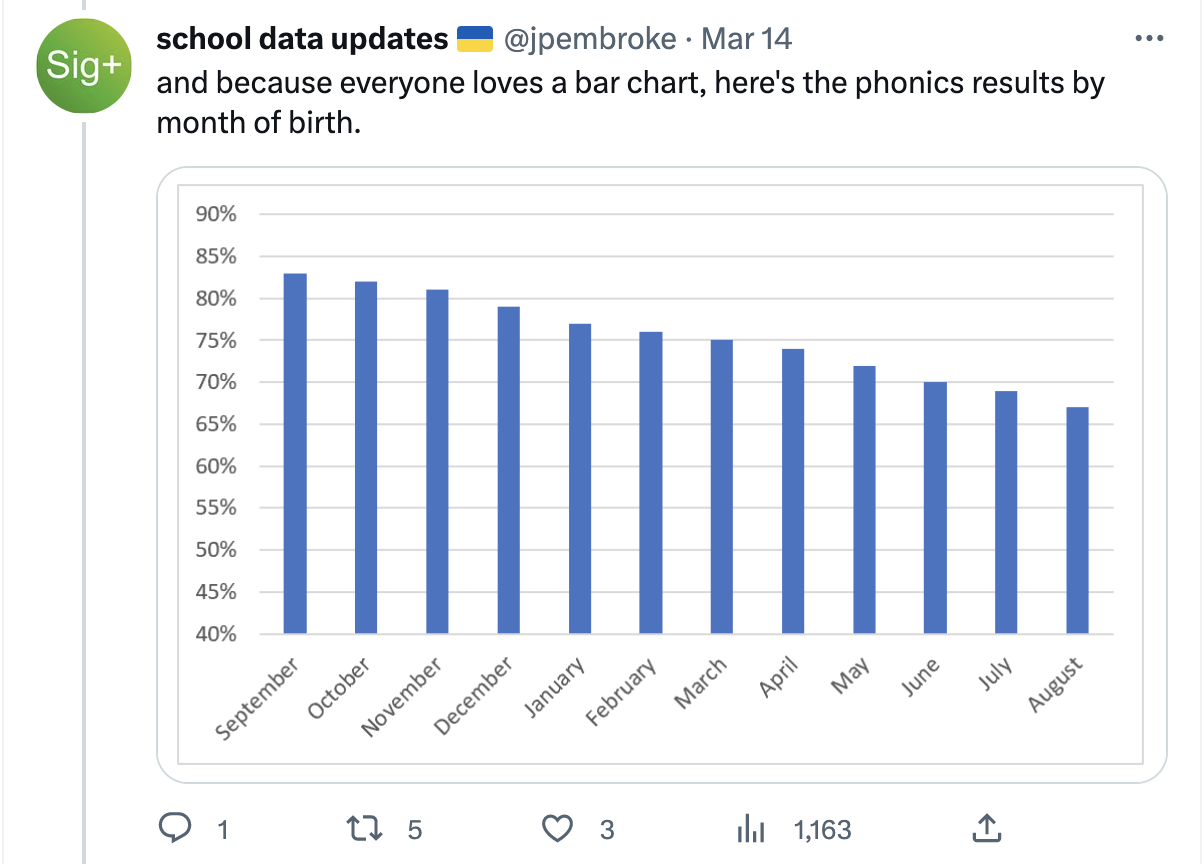
More evidence from the UK shows that reducing reading instruction to systematic phonics ignores both the science of reading instruction and the realities of human development. The mandatory phonics checks in the UK show that achievement correlates strongly with birth month, not instruction and certainly not resulting in the sort of reading achievement that avoids another reading war:

The “science of reading” movement in the US is misguided and costly, mostly benefitting commercial interests repackaging reading programs and materials emphasizing phonics.

States are rushing to mimic practices that have already failed in the UK. Our students and teachers deserve better.


See Also

Cautionary Tales of State Reading Legislation: Tennessee

UK PISA 2022 Results Offer Cautionary Tale for US Reading Reform

Big Lies of Education: National Reading Panel (NRP)

Similar to A Nation at Risk and a core part of No Child Left Behind (NCLB), the National Reading Panel (NRP) was a bi-partisan committee formed under Bill Clinton and then elevated under George W. Bush.

Joanne Yatvin, a panel member who issued a Minority Report, wrote in Education Week in 2003, warning that the NRP’s conclusions would be misrepresented and misused.

Yatvin was right.

And 15 years later, Emily Hanford—among dozens of journalists—continued to prove Yatvin correct:

The battle between whole language and phonics got so heated that the U.S. Congress eventually got involved, convening a National Reading Panel to review all the research on reading. In 2000, the panel released a report. The sum of the research showed that explicitly teaching children the relationship between sounds and letters improved reading achievement. The panel concluded that phonics lessons help kids become better readers. There is no evidence to say the same about whole language.

Hard Words

In 2024, as the “science of reading” (SOR) movement continues to steamroll state reading legislation, journalists persist in misrepresenting the panel’s findings as well as ignoring that the NRP is over two decades old, which means reading science has moved well beyond what the panel claimed to find.

Often ignored, panel members admitted the NRP was underfunded and understaffed, resulting in the panel’s overview of reading research was greatly limited to only a narrow type of published research.

Further, despite the Urban Legends of the findings repeated by Hanford and other journalists, the NRP’s conclusions are not what has been claimed.

First, Tim Shanahan, a panel member, admitted that the report did little to support classroom practice.

But more importantly, the actual findings of the panel in no way support the media claims about what research says about teaching reading, the role of phonics instruction, or the evidence on whole language.

Diane Stephens, University of South Carolina emeritus professor, provides an excellent summary of the findings:

  • Phonemic Awareness: PA is a “means rather than an end”; doesn’t increase comprehension; only one of many elements needed to read independently.
  • Phonics: Minimal value in kindergarten; no conclusion about phonics beyond grade 1 for “normally developing readers”; systematic phonics instruction in grades 2-6 with struggling readers has a weak impact on reading text and spelling; systematic phonics instruction has a positive effect in grade 1 on reading (pronouncing) real and nonsense words but not comprehension; at-risk students benefit from whole language instruction, Reading Recovery, and direct instruction.
  • Fluency: The ability of students to make sense of text grammatically and with understanding of punctuation.
  • Vocabulary: Vocabulary is acquired many ways by readers; number of words acquired cannot be accomplished through direct instruction. About 1/3 of vocabulary learning in grades 3 – 8 linked to reading.
  • Comprehension: Weak evidence in report on comprehension. Emphasizes need for SBRR (scientifically based reading research) and “putting teachers in positions where their minds are the most valued educational resource.”

As many scholars have noted (see below), the NRP found that systematic phonics and whole language were about equally effective, but the key here is that phonics instruction was found to be effective for pronunciation, not comprehension, and only in grade 1.

In short, the NRP was never a definitive overview of reading science (or a confirmation about teaching systematic phonics to all students), and now that we are 20-plus years past the report, citing the NRP should be limited to historical references, not evidence of the current state of reading science.

I recommend the following to understand fully the NRP: