[Header Photo by hannah grace on Unsplash]
I haven’t seen the memo, but it appears that there is a mandate whenever anyone discusses Taylor Swift they must include at least that she is a good songwriter, although usually the claim is that she is a great songwriter, possibly the greatest songwriter ever (although Rolling Stone would beg to differ).
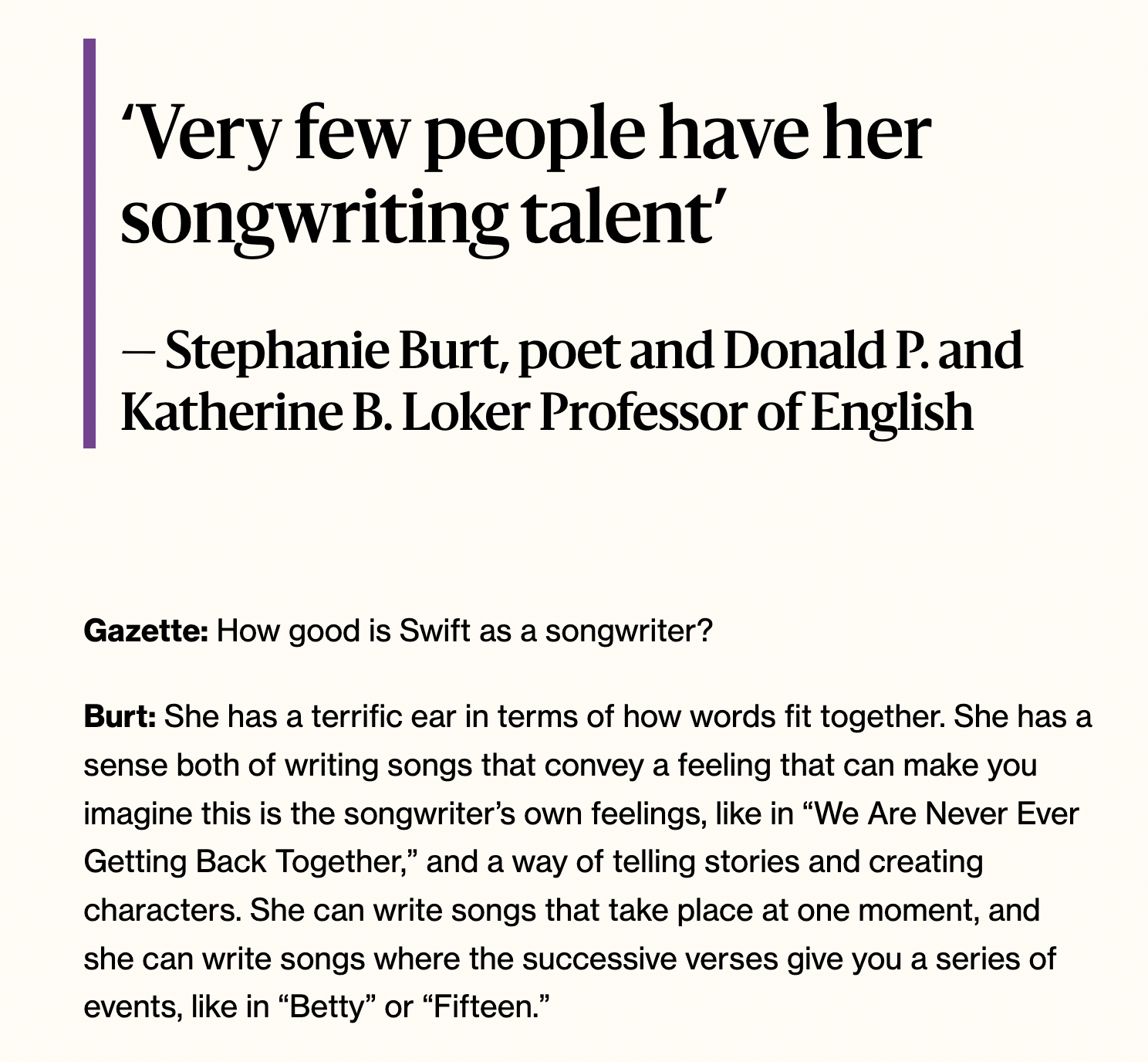
This interview with poet Stephanie Burt typifies the sort of effusive praise Swift elicits for her writing even outside pop culture among so-called serious writers:
Burt continues and makes a key point about Swift being accessible as well:
She has a lot of different gifts as a songwriter, both at the macro level, how the song tells a story or presents an attitude, and at the micro level, how the vowels and consonants fit together, and she’s able to exercise that range, along with quite a lot of melodic gifts, and in a way that does not make her seem highbrow or alienate potential audience members.
So let’s consider a simple question that seems to have already been definitely answered—Are Swift’s lyrics “good writing”?—but only as a context for answering, Just what is “good writing”?
And the short answer is, Yes, and probably not.
Because it all depends on what we mean by “good writing.”
I have been myself a “serious” writer (writing almost daily) since college, about 44 years. For 40 years, I have also been a writing teacher.
I also love popular music, and consider pop art valid art—a craft and genre all its own that shouldn’t be discounted simply for being popular.
My adult life is richer because of my love for The National (and other popular bands) and my renewed life as a comic book collector.
I am drawn myself to pop culture with “good writing”—song lyrics and narratives of comic book writers and artists (yes, I consider comic book artists “writers” as well).
What I want to emphasize, then, is that this isn’t intended to be a snob post that takes a passive aggressive swipe at pop culture icons.
That said, I think we can make fair assessments such as distinguishing song lyrics from poetry; in that, they are not the same but share some of the same characteristics that help us understand what good writing is.
It seems pedantic (like using the word “pedantic”) and even petty to announce that Swift, in fact, isn’t a good songwriter since her success as an artist is elite if not unique.
But for writers and teachers of writing and literature, often “good writing” focuses on the how of expression as well as the what.
I have noticed the general public will say something is well written if the film or book or series is engaging and interesting—regardless of the actual craft of the writing. There is definitely something to accessibility for the general audience—Burt’s writing “in a way that does not make [Swift] seem highbrow or alienate potential audience members.”
Here, then, I want to focus on good writing as craft—the writer’s choices about diction (word choice), sentence formation, and most importantly, the writer’s purposefulness and control.
Swift’s lyrics clearly resonate with a large percentage of listeners, and Swift is consciously composing those lyrics with attention to technique (metaphor and other types of figurative language).
In that respect, her lyrics are good writing in terms of purposefulness.
For example consider Swift’s “Love Story” as a craft lesson on using the Romeo and Juliet narrative. But, for this discussion, I want to offer that your consideration of Swift as a good writer should be posed beside another song also incorporating the same mythology: “Romeo and Juliet” by Dire Straits (lyrics by Mark Knopfler).
I don’t mean this as a negative criticism, but Swift’s use of craft often reads as a music performer purposefully inserting craft into her lyrics—which I would distinguish from writers who incorporate craft elements in the service of the writing and expression. [1]
The opening of the two songs are distinct with Swift framing the Romeo and Juliet reference as a overlay of an actual relationship; her opening, for me, is too direct and a bit clunky:
We were both young when I first saw you
I close my eyes and the flashback starts
Knopfler re-imagines Romeo and Juliet, the narrative creating what John Gardner always emphasized that writing should be a “vivid and continuous dream”—the goal being that the writing is so engaging that the reader forgets they are reading (think also of a viewer forgetting they are watching a film).
Yes, Swift is using figurative language and even allusion (“scarlet letter”); this is clearly writing with craft and purpose.
Not to again be pedantic, but this is about degree of what counts as “good writing” and an argument that there is a range of sophistication in writing.
For example, the use of “like” in a simile is considered more direct (and clunky) than a metaphor. Emily Dickinson’s “Hope” is the thing with feathers remains at the level of metaphor simply by avoiding simile “‘Hope’ is like a bird.”
So that range of sophistication can be seen in the following:
- Bryan can’t pay attention. His brain is like a squirrel.
- Karin is squirrely a lot of the time.
- We’ve always called him “Squirrely Matt.”
Or think about the word “boomerang.” Even in day-to-day speech we tend not to say “That moved like a boomerang” because we have adopted the simile into a metaphorical verb, “That boomeranged.”
It is here that I acknowledge that Swift’s lyrics seem to be pale or under-developed examples of good writing because I am distracted when listening to the lyrics often by a lack of control in terms of word choice and tone.
This will seem like a negative criticism, but part of the accessibility of Swift as a good writer is that her use of craft is still in an adolescent stage (which doesn’t mean “worse” or “bad”).
A poet I found who was accessible for my high school students was James Dickey; not his use of both direct comparisons (similes) in “The Hospital Window” and then the never directly mention comparison (lifeguard like Jesus/savior) in “The Lifeguard”.
This is not intended to be about Swift as much as a plea that we make claims of “good writer” and “good writing” a bit more carefully in terms of acknowledging the craft and, again, the purposefulness and control.
What is the writer doing and how is that craft in the service of expression? And then, ultimately, is that expression itself something novel or unique and, probably more importantly, is the expression a thing we should embrace, endorse, or consider seriously?
Craft in the service of bad ideas, I think, isn’t worthy of considering as “good writing,” for example (in fact, powerful writing and expression that leads humans astray is a horrible thing with too many examples dotting history).
I have to end in teacher mode by offering a smattering of poems that allow you to put my thoughts here into practice; these are glorious examples of “good writing” (I think) because of the craft, the purposefulness and the control (specifically, look closely at the word choice in Plath’s “Daddy” in the service of expression):
Those, I believe rise to the level of “good writing” while remaining mostly accessible. If you want to dip your toe in “good writing” that may be a bit less accessible, you should spend some time on Emily Dickinson (and likely not the poems you have been assigned before:
[1] After the release of Swift’s 2025 The Life of a Showgirl, this analysis of that album adresses some of my concerns about the lyrics—No Good Art Comes From Greed.
See Also
Listening to Langston Hughes about “Make America Great Again”











 dr. p.l. (paul) thomas