P. L. Thomas, Professor of Education (Furman University, Greenville SC), taught high school English in rural South Carolina before moving to teacher education. He is a former column editor for English Journal (National Council of Teachers of English), current series editor for Critical Literacy Teaching Series: Challenging Authors and Genres (Brill), and author of Teaching Writing as Journey, Not Destination: Essays Exploring What ‘Teaching Writing’ Means (IAP, 2019) and How to End the Reading War and Serve the Literacy Needs of All Students: A Primer for Parents, Policy Makers, and People Who Care (IAP, in press). NCTE named Thomas the 2013 George Orwell Award winner. He co-edited the award-winning (Divergent Book Award for Excellence in 21st Century Literacies Research) volume Critical Media Literacy and Fake News in Post-Truth America (Brill, 2018). Follow his work @plthomasEdD and the becoming radical (https://radicalscholarship.wordpress.com/).
Social media and even mainstream media appear poised to leap on Secretary Arne Duncan with both feet due to his swipe at white suburban moms.
The nearly universal sweeping outrage—some with a level of glee that must not be ignored—calls for close consideration itself.
First, rejecting Duncan’s comments about white suburban moms and Common Core critics is completely valid. I join hands with the education community in rejecting Duncan’s claims, his discourse, and his efforts to discredit a significant, credible, and growing resistance to CC that should not be trivialized and marginalized as Duncan does.
However, I find the magnitude and swiftness of the responses to this “white suburban moms” incident disappointing in the larger context of Duncan’s entire tenure as Secretary of Education.
In the first moments of Obama’s administration, Duncan has personified and voiced an education agenda that disproportionately impacts black, brown, and poor children in powerfully negative ways. And the entire agenda has been consistently cloaked in discourse characterizing these policies as the Civil Rights issue of the day.
As well, Duncan has perpetuated and embraced “no excuses” narratives while directly and indirectly endorsing education reform and policies that target and mis-serve high-poverty students, African American and Latina/o students, and English Language learners—charter schools, Teach for America, accountability based on standards and high-stakes testing.
Public commentary that highlights that education reform under Obama and Duncan fails the pursuit of equity in the context of race and class in the U.S. tends to fall on deaf ears. The same urgency witnessed in the responses to Duncan’s “white suburban moms” contrasts significantly from the silence surrounding challenges to Duncan’s discourse and policies that are classist and racist, policy designed for “other people’s children.”
The problem is not that educators and scholars have failed to identify that education reform under Obama and Duncan have continued and increased federal and state education policy creating two inequitable education systems—one for the white and affluent, another for minorities and the impoverished—because these important messages have been raised.
The problem is that rejecting education reform discourse and policy based on race and class concerns doesn’t resonate in the U.S.
As I have asked numerous times, what would the political and public support for TFA be if the organization was providing recent college graduates with no degrees in education and only five weeks of training to teach Advanced Placement or International Baccalaureate classes filled with affluent white students? (A similar question about KIPP raises the same issue.)
Indirectly, from the response to Duncan’s “white suburban moms” comments, now we know.
The measure of a people must not come from how we flinch when the privileged suffer; the measure of a people must come from how we tolerate (or ignore) the conditions that impact the impoverished and the powerless.
If white outrage is the only outrage that counts in the U.S., any victory won from that outrage is no victory at all.
This post is now a decade old, and I wrote it in the context of the Barack Obama administration intensifying the federal-based education reform initiated under George W. Bush with bi-partisan support. Public education now has been reformed for forty years, mostly based on manufactured crises and fueled by political agendas that are essentially conservative even as both major parties support the narratives and the policies.
Many have examined the federal over-reach of education reform (see HERE and HERE); reforms fail over and over, but we persist in reform cycles of crisis/miracle none the less.
Recently, a new wave of education reform has occurred, represented by Florida but common across the US in mostly conservative states. This wave is grounded in censorship and bans with the primary agenda centered on fundamentalist and conservative Christian ideology.
In short, this wave is paradoxical since it is mostly Republican leaders using government over-reach to control public education. However, the goal of this wave is dismantling public education as much as controlling it.
Therefore, I stand with the four education reform camps I identify below with the caveat that this new religious-based wave is a subset or complication of Libertarian reform (which also seeks to dismantle public education, although with much different ideological intent).
Regardless of how we identify education reform, we must constantly recognize the ideology behind and goals sought by that reform. Not all reform is equal and not all reform has democracy and individual freedom as goals.
In her “Diving into the Wreck,” the speaker of Adrienne Rich’s poem explains, “the sea is another story/the sea is not a question of power.” Critical response to this poem often includes some ambiguity about just what the wreck constitutes in the poem, but the speaker is clear about her purpose:
I came to explore the wreck. The words are purposes. The words are maps. I came to see the damage that was done
The education reform debate, however, should be classified as a question of power, and that debate is not ambiguous about the wreck—U.S. public education. To understand the education reform debate in the twenty-first century, a guide appears necessary in order to provide foundational differences among competing narratives about the failures of public education and the policies recommended for overcoming those failures.
First, all reformers are driven by ideology, and thus, those ideologies color what evidence is highlighted, how that evidence is interpreted, and what role evidence plays in claims public education has failed and arguments about which policies are needed for reform.
Second, essentially no camp exists calling for no reform. If the history of education shows us anything, it is that education is a field characterized by both debate and the perpetual tension created by calls for reform (see Kliebard for a really fine examination of this perpetual tension).
Education reform camps fall into two broad categories—Mainstream and Radical—with two divisions within each broad category: Mainstream Reform includes bureaucratic reformers and technocratic reformers; Radical Reform includes libertarian reformers and critical reformers.
Historically and currently, Mainstream Reformers have most, if not all, of the power, and Radical Reformers (although the two divisions are diametrically opposite) share being at the margins. Finally, before detailing each of the four divisions of reformers, this guide is not intended to suggest any individual reformer is solely committed to any one division. In fact, many reformers either shift between camps or simply stand with a foot in each of two camps—notably within the broad Mainstream Reform category.
Mainstream Reform includes the following overlapping and dominant divisions:
Bureaucratic Reformers: Ideologically, bureaucratic reformers tend to self-identify as progressive and support public education as a civic and economic good. Bureaucratic reformers often claim public education’s failures are related to a lack or poor quality of structure: accreditation, certification, standards, and other organizing mechanisms must be reformed in order to improve education (and likely such reforms must always be conducted as the world always changes). Evidence for claims of failure tend to be measurable, quantitative data. Bureaucratic reformers embrace a bureaucratic ideal, borrowing both from government and corporate bureaucracy models to guide reform policy. [October 2023 Update: Note that the current reading crisis and reading policy movement, the “science of reading,” fits into this category.]
Technocratic Reformers: Ideologically, technocratic reformers tend to self-identify as conservative or traditional; they support public education as one but not as the sole mechanism for achieving an educated citizenry (and workforce) that drives a vibrant economy. Skeptical of “big” government, technocratic reformers draw on business models, free market ideology, and competition as larger policy commitments reinforced by technocratic structures such as institutional hierarchies, uniform standards, and perpetual measurement. Evidence for claims of public education failure is drawn from state-to-state and international rankings of test scores—as well as ideological skepticism of government monopolies—but the overriding concern about educational quality remains with how all educational options in the U.S. insure economic competitiveness.
Radical Reform includes the following overlapping and marginalized divisions:
Libertarian Reformers: Ideologically (and obviously), libertarian reformers self-identify as libertarian, or independent; they may tolerate public education if it remains within local control, but some hardline reformers seek to replace public education with a private system. For libertarian reformers public education fails de facto as a bureaucratic institution, a government entity. Evidence of that failure is often more strongly grounded in anti-government sentiment than empirical data, but libertarian reformers do seek evidence that public education outcomes support their distrust in government. [October 2023 Update: Religious-based reforms that censor and ban texts and curriculum parallel the goal of Libertarian reform—although the outcomes are ideologically different, especially in terms of formal education as indoctrination (embraced by fundamentalists but rejected by libertarians).]
Critical Reformers*: Ideologically, critical reformers self-identify as critical, often avoiding the social stigma in the U.S. of identifying as Leftists or Marxists. Public education is cherished as a foundational commitment to democracy, community, and individual liberty. Skeptical of free market ideology and bureaucratic policy, critical reformers seek to change public education dramatically as a subset of wider social change—both driven by commitments to equity. Public education failures, then, are identified as reflecting and perpetuating inequity found in society. Evidence of those failures tend toward quantitative and qualitative data highlighting inequity among classes, races, and genders.
On an ideological/political scale, then, these four divisions run the spectrum from Left to Right as follows:
This guide, then, should serve practical purposes for navigating claims of educational failure and advocacy of reform policy. First, in order to assess the credibility of claims of public education failure and offers of educational reform, we should evaluate the internal consistency of the reformer: Does the reform address a valid claim of failure? And how is all of that shaded by the ideological grounding?
Next, recognizing in a somewhat dispassionate way that all reform comes from an ideological grounding helps distinguish how we determine the credibility of the reformer and the reform policies: Are we rejecting/embracing the ideology or the policy efficacy?
Regardless, then, of how accurate anyone believes this guide is, I would maintain that step one is to acknowledge that “educational reformer” is insufficient alone as an identifier and that ideology drives all claims of educational failure and calls for reform. As a result, for example, support or criticism of Common Core must be examined first upon the ideological basis of the support or criticism. Understanding ideological grounding helps us confront that CC criticism tends be among critical and libertarian reformers who disagree strongly with each other about the reasons for rejecting CC.
This guide seeks to raise the debate above simple claims of “reform” or even basic stances of “for” or “against” X policy.
And like the speaker in Rich’s poem, acknowledging these ideological tensions may help us all look more closely at the wreck and not as much at each other:
the thing I came for: the wreck and not the story of the wreck the thing itself and not the myth.
* Full disclosure, while I have sought to make a fair and clear attempt at identifying these four categories, as a critical reformer myself, I concede and even embrace my ideology, which is a foundational characteristic of being critical. I am neither being objective nor able to do so. Instead, I have tried to be careful and accurate—and transparent.
This is a book of warning. It is a reminder that what we have is valuable, and that sometimes we take what we value for granted….
People think—wrongly—that speculative fiction is about predicting the future, but it isn’t; or if it is, it tends to do a rotten job of it….
What speculative fiction is really good at is not the future but the present—taking an aspect of it that troubles or is dangerous, and extending and extrapolating that aspect into something that allows the people of that time to see what they are doing from a different angle and from a different place. It’s cautionary.
Fahrenheit 451 is speculative fiction. It’s an “If this goes on…” story. Ray Bradbury was writing about his present, which is our past.
Like Margaret Atwood’s In Other Worlds, Gaiman’s clarification about the purposes of science fiction/speculative fiction builds a foundation for reading (or re-reading) Fahrenheit 451as well as for considering why Bradbury’s novel on book burning endures.
Sixty years ago in October 1953, Fahrenheit 451 was published. In the fall of 2013, the novel reads as an eerie crystal ball—despite Gaiman’s caution: the pervasive Seashells like iPod earbuds, wall-sized monitors and reality TV.
Yet, upon re-reading this anniversary edition, I am less interested in Bradbury’s prescience about technology and its role in isolating humans from each other, and reminded—as Gaiman suggests—of what matters.
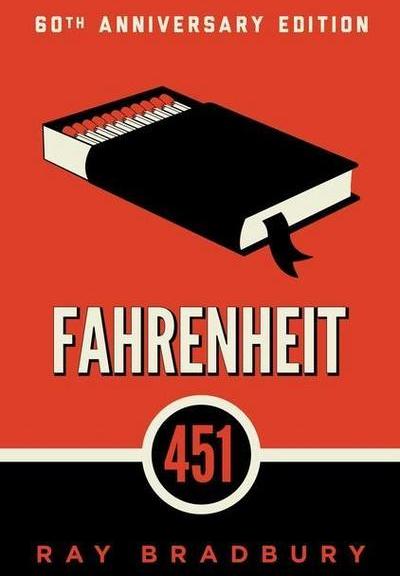
Fahrenheit 451: 60th Anniversary Edition
The enduring flame of Fahrenheit 451is perfectly stoked by Gaiman, in fact:
A young reader finding this book today, or the day after tomorrow, is going to have to imagine first a past, and then a future that belongs to that past.
But still, the heart of the book remains untouched, and the questions Bradbury raises remain as valid and important.
Why do we need the things in books?…Why should we read them? Why should we care?…
Ideas—written ideas—are special….
This is a book about caring for things. It’s a love letter to books, but I think, just as much, it’s a love letter to people….
Yes, Gaiman is a writer’s writer so he is naturally suited to understand Bradbury as well as marvel at the magic of Fahrenheit 451. But there is more.
This anniversary edition includes not only Gaiman’s new Introduction but also a concluding section—History, Context, and Criticism. The opening piece by Jonathan R. Eller explains, “Bradbury virtually lived in the public libraries of his time.” And later in a transcript of an audio-introduction, Bradbury adds:
When I left high school, I began to go to the library every day of my life for five, ten, fifteen years. So the library was my nesting place, it was my birthing place, it was my growing place. And my books are full of libraries and librarians and book people, and booksellers. So my love of books is so intense that I finally have done—what? I have written a book about a man falling in love with books.
Here, I think, another important connection between Gaiman and Bradbury highlights why Fahrenheit 451 endures: Both men are readers, the type of readers who love the idea of books, love specific books, and recognize the human dignity represented by the free access to books.
Another way to destroy a child’s love of reading, of course, is to make sure there are no books of any kind around. And to give them nowhere to read those books.
I was lucky. I had an excellent local library growing up. I had the kind of parents who could be persuaded to drop me off in the library on their way to work in summer holidays, and the kind of librarians who did not mind a small, unaccompanied boy heading back into the children’s library every morning and working his way through the card catalogue, looking for books with ghosts or magic or rockets in them, looking for vampires or detectives or witches or wonders. And when I had finished reading the children’s’ library I began on the adult books.
They were good librarians. They liked books and they liked the books being read. They taught me how to order books from other libraries on inter-library loans. They had no snobbery about anything I read. They just seemed to like that there was this wide-eyed little boy who loved to read, and would talk to me about the books I was reading, they would find me other books in a series, they would help. They treated me as another reader – nothing less and more – which meant they treated me with respect. I was not used to being treated with respect as an eight year old.
But libraries are about Freedom. Freedom to read, freedom of ideas, freedom of communication. They are about education (which is not a process that finishes the day we leave school or university), about entertainment, about making safe spaces, and about access to information.
I worry that here in the 21st Century people misunderstand what libraries are and the purpose of them.
For those of us who share this love of books and the “[f]reedom to read, freedom of ideas, freedom of communication,” then, that Fahrenheit 451 endures is both wonderful and chilling.
If the novel had been published October 2013, I suspect it could have just as easily been applauded as a stark mirror of our present disguised as a futuristic dystopia:
“Jesus God,” said Montag….Why doesn’t someone want to talk about it! We’ve started and won two atomic wars since 2022! Is it because we’re having so much fun at home we’ve forgotten the world? Is it because we’re so rich and the rest of the world’s so poor and we just don’t care if they are? I’ve heard rumors; the world is starving, but we’re well fed. Is it true, the world works hard and we play? Is that why we’re hated so much?
And then Montag recalls a brief encounter with an old man:
The old man admitted to being a retired English professor who had been thrown out upon the world forty years ago when the last liberal arts college shut for lack of students and patronage.
Fahrenheit 451 ends with Montag as a criminal on the run who finds himself on the outskirts of the town among refugees, mostly outcast professors.
If a reader picks up Bradbury’s novel today, and then turns to her iPad to read the online blog The Answer Sheet at The Washington Post, she may read this:
The discussion of why the humanities matter has picked up steam since The New York Times published a piece last week suggesting that even some top institutions are increasingly anxious about the proliferation of STEM (science, technology, engineering and math) majors.
Meanwhile, they report a declining interest in topics like French literature.
From Aldous Huxley to Ray Bradbury to Neil Gaiman—and countless authors and readers alike along the way—Fahrenheit 451 should leave us all with Shakespeare ringing in our ears:
Miranda: O wonder! How many goodly creatures are there here! How beauteous mankind is! O brave new world, That has such people in’t. (William Shakespeare, The Tempest, Act V, Scene I, ll. 203–206)
Fahrenheit 451 remains a warning we need to heed, but likely won’t—once again: Be careful what brave new world we allow to happen when we aren’t paying attention.
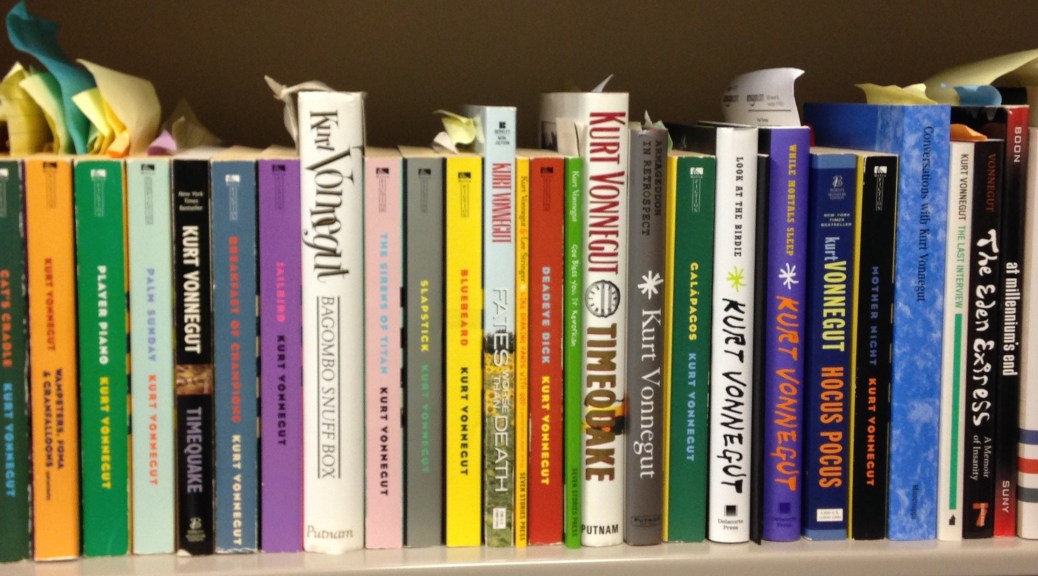
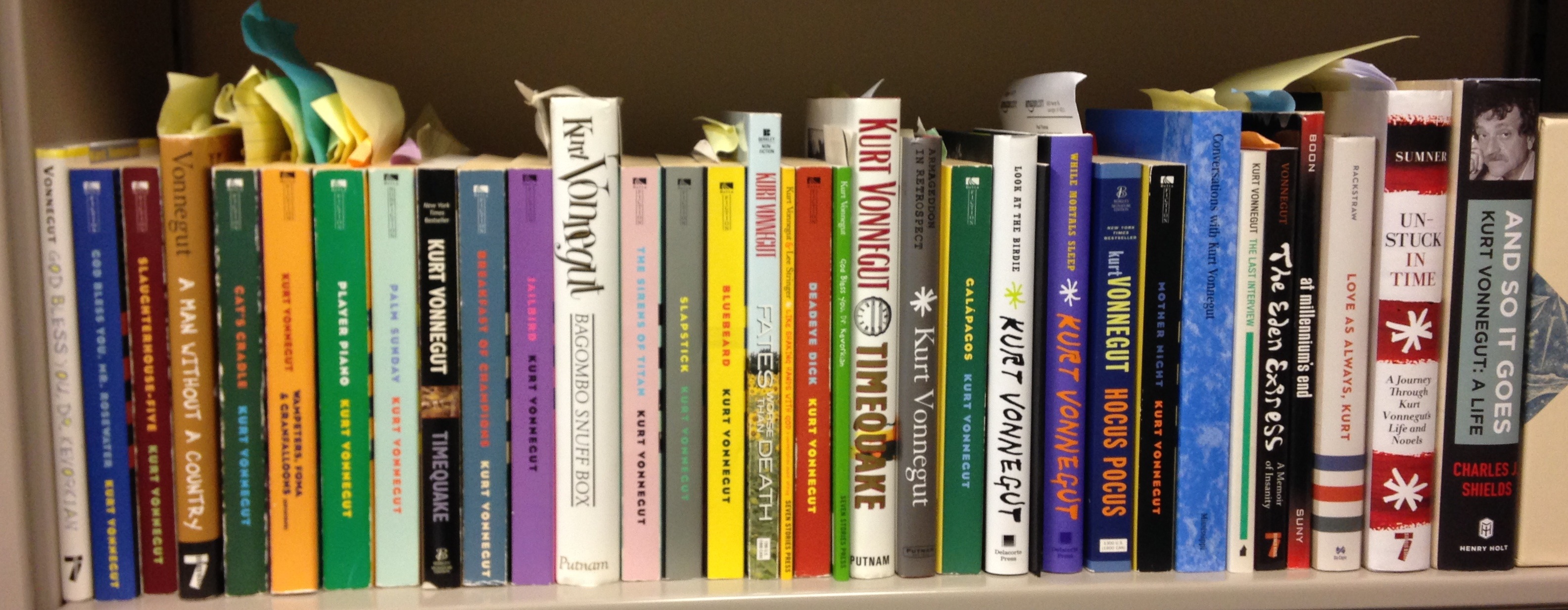
I liked to read Kurt Vonnegut and Richard Brautigan while I was a college student. They had a sense of humor, and at the same time what they were writing about was serious. I like those kind of books. The first time I read Vonnegut and Brautigan I was shocked to find that there were such books! It was like discovering the New World.
Murakami identified something essential in Vonnegut, a tension created by blending humor with serious themes and topics as well as Vonnegut’s ability to shuffle non-fiction and fiction in his novels like a seasoned magician.
In fact, Gregory D. Sumner catalogues the gradual emergence of Vonnegut as a thinly fictionalized character in his own novels, notably by his most celebrated work, Slaughterhouse-Five: “The opening chapter of Slaughterhouse-Five annihilates the boundary between fiction and autobiography, inviting us into Vonnegut’s uncertainty about just what he has written. It is a dance, rather than an exercise in cold objectivity” (p. 126).
From this narrative ambiguity of genre, Vonnegut is often characterized as post-modern. And while there may be some waffling about details or accuracy, Vonnegut is quite certain—uncharacteristic for actual post-modern writers—about some foundational ideals, although even then he makes his most sacred pronouncements in the most challenging ways.
Vonnegut reveled in playing the free thinker and atheist as he also referenced Jesus—a common routine in his speeches—and his persona in his speeches and non-fiction was certainly as much fabrication as Vonnegut. But the novels and their blend of memoir and fiction create and sustain the most tension.
Slaughterhouse-Fivepresented Vonnegut a nearly insurmountable task of maintaining his joke-based writing pattern against the great human tragedy of World War II. This attempt to write a novel about being a POW during the fire bombing of Dresden, in fact, becomes the opening chapter of the novel that doesn’t genuinely start until Chapter 2. And in this first chapter while visiting a fellow veteran of WWII and his friend Bernard V. O’Hare, Vonnegut is confronted by O’Hare’s wife Mary, who is angry about Vonnegut’s considering writing a novel about his war experience:
“You were just babies then!” [Mary] said.
“What?” I said.
“You were just babies in the war—like the ones upstairs!”
I nodded that this was true. We had been foolish virgins in the war, right at the end of childhood….
So I held up my right hand and I made her a promise:…
“I tell you what,” I said, “I’ll call it ‘The Children’s Crusade.'”
She was my friend after that. (pp. 18-19)
Several years before his Dresden novel garnered him fame, Vonnegut had offered what I think is his central children’s crusade: a paean to kindness, God Bless You, Mr. Rosewater.
The titular character of the novel, Eliot Rosewater, implores:
“Go over to her shack, I guess. Sprinkles some water on the babies, say, ‘Hello, babies. Welcome to Earth. It’s hot in the summer and cold in the winter. It’s round and wet and crowded. At the outside, babies, you’ve got about a hundred years here. There’s only one rule that I know of, babies—:
“‘God damn it, you’ve got to be kind.’” (p. 129)
On November 11, 2013, the day of Vonnegut’s birth, while we who love his work raise our eyes to the heavens and hope he is in fact Resting In Peace, we might honor him by heeding those words, crafted in the glorious blasphemy that makes Vonnegut Vonnegut.



 dr. p.l. (paul) thomas