All posts by plthomasedd

P. L. Thomas, Professor of Education (Furman University, Greenville SC), taught high school English in rural South Carolina before moving to teacher education. He is a former column editor for English Journal (National Council of Teachers of English), current series editor for Critical Literacy Teaching Series: Challenging Authors and Genres (Brill), and author of Teaching Writing as Journey, Not Destination: Essays Exploring What ‘Teaching Writing’ Means (IAP, 2019) and How to End the Reading War and Serve the Literacy Needs of All Students: A Primer for Parents, Policy Makers, and People Who Care (IAP, in press). NCTE named Thomas the 2013 George Orwell Award winner. He co-edited the award-winning (Divergent Book Award for Excellence in 21st Century Literacies Research) volume Critical Media Literacy and Fake News in Post-Truth America (Brill, 2018). Follow his work @plthomasEdD and the becoming radical (https://radicalscholarship.wordpress.com/).

Belief Culture: “We Don’t Need No Education”

“Four in 10 Americans, slightly fewer today than in years past, believe God created humans in their present form about 10,000 years ago.” This December 2010 poll also includes the finding that a scant 16 percent of the U.S. populace accepts evolution without any hand of God involved. [1]

The U.S. is unique compared to the rest of Western world, which tends to accept evolution, but the comparison is less significant than the inference we can draw about the U.S. and the associated impacts visible in our disdain for not only education, but also the well-educated, the informed: the predominant culture in the US is a belief culture.

By “belief,” I do not refer to religious faith per se. This discussion is about a belief culture that is secular, political and, ultimately, ideological, even when belief is connected to religious traditions and stances.

As Einstein offered, both belief and science have value, even as complements to each other: “Science without religion is lame, religion without science is blind” – especially as faith informs our ethics. But in the U.S., we are apt to misuse belief and ignore (or misunderstand) science when we need it most.

While it is unlike the rest of the Western world with regard to its take on evolution, the belief culture does reflect what new science is discovering about the power of belief over fact as a part of some humans’ nature:

Facts don’t necessarily have the power to change our minds. In fact, quite the opposite. In a series of studies in 2005 and 2006, researchers at the University of Michigan found that when misinformed people, particularly political partisans, were exposed to corrected facts in news stories, they rarely changed their minds. In fact, they often became even more strongly set in their beliefs. Facts, they found, were not curing misinformation. Like an underpowered antibiotic, facts could actually make misinformation even stronger.

The U.S. appears, on the surface, to be a scientific society – we consume the newest and best technology dutifully and with voracity; however, US citizens are largely opposed to scientific ways of knowing and understanding the world, to drawing conclusions about the world based on the weight of evidence while reserving a fixed conclusion if contradictory evidence reveals itself in the future. Our split personality about science is, in fact, not contradictory; we love to consume ever-changing technology, but that insatiable appetite is about the consumption, not the science.

Pop Culture and Blind Tradition

Consider the pop culture we also consume endlessly. How have we portrayed intellectuals and who do we love in our entertainment?

From Marlon Brando and James Dean to the Fonz on “Happy Days,” we have adored the uneducated, who prove themselves to be better and even smarter than the educated. In fact, if you look carefully at “Friends,” you see an interesting evolution of that narrative.

Both Joey and Ross are often portrayed as clueless and bumbling, tapping into our love of those who are not smart. But look closer. The audience, as well as the other characters, laugh with Joey (who is apparently uneducated) and at Ross (who has a PhD and is a scientist – a paleontologist, in fact). Look carefully at the episode in which Ross and Phoebe argue about evolution; Ross is shown to be foolish by the cleverer Phoebe, who doesn’t embrace evolution or value evidence.

This is the America of belief. We cherish stubborn doctrine and clever rhetoric even at the expense of fact and we often speak about tradition.

Recently, in my home state of South Carolina – which sits solidly in the Deep South that William Faulkner captured precisely in the macabre “A Rose for Emily” (yes, in the South we cling to the corpse of tradition, and are proud of it) – yet another controversy has recently erupted around the celebration of secession. Just as South Carolina has clung to the Confederate flag, the state is proud of being first to secede and to honor state’s rights (usually omitting that those state’s rights included slavery). “This is not about slavery, but tradition!” is the refrain.

Try to make a reasoned (that is, evidence-based) argument about secession or the flag issue in the South and you are apt to play Ross to the multitudes of Phoebes.

South Carolina is not alone. Secession balls are planned throughout the South, where the calls for tradition and state’s rights drown out any concerns about slavery. Again, just like those who cling to creationism, many in the South are not swayed by evidence – unless it confirms what they already believe.

The truth is that many people in the US are committed to belief over evidence and are simultaneously devoted to consumerism – creating a perfect storm for the political and corporate elites, but also sounding a death knell for the promise of universal public education established by our founders, who happened to be men of reason (although the belief among many Americans is that they were Christian men all; again, don’t bother with the evidence).

As Joe Keohane writes in the Boston Globe about the findings regarding the power of belief over facts:

In an ideal world, citizens would be able to maintain constant vigilance, monitoring both the information they receive and the way their brains are processing it. But keeping atop the news takes time and effort. And relentless self-questioning, as centuries of philosophers have shown, can be exhausting. Our brains are designed to create cognitive shortcuts – inference, intuition, and so forth – to avoid precisely that sort of discomfort while coping with the rush of information we receive on a daily basis. Without those shortcuts, few things would ever get done. Unfortunately, with them, we’re easily suckered by political falsehoods.

Belief Equals Anti-Intellectualism

The line from the Pink Floyd song providing my subtitle, “We don’t need no education,” is followed by, “We don’t need no thought-control.” This equation of education and thought-control is at the heart of the anti-intellectualism supported by the belief culture of the US, which has failed the promise of universal public education for a thriving democracy.

Let’s compare Thomas Jefferson and Secretary of Education Arne Duncan:

In a letter to John Tyler, Jefferson made this argument in 1810:

I have indeed two great measures at heart, without which no republic can maintain itself in strength: 1. That of general education, to enable every man to judge for himself what will secure or endanger his freedom. 2. To divide every county into hundreds, of such size that all the children of each will be within reach of a central school in it.

Many decades before the rise of critical pedagogy, Jefferson recognized the important relationship between access to education for everyone and education’s role in individual empowerment. Writing to George Wythe in 1786, Jefferson addressed tax support for education:

I think by far the most important bill in our whole code, is that for the diffusion of knowledge among the people. No other sure foundation can be devised for the preservation of freedom and happiness…. The tax which will be paid for this purpose is not more than the thousandth part of what will be paid to kings, priests and nobles who will rise up among us if we leave the people in ignorance.

Taxation to support universal education, then, was tied, for Jefferson, to freedom and happiness, but education was also a bulwark against the rise of an elite class – what today we witness as a corporate elite ruling both corporate and political America.

Now compare Jefferson’s comments to Secretary Duncan’s conclusions about Program for International Student Assessment (PISA) scores from 2009:

Here in the United States, we have looked forward eagerly to the 2009 PISA results. But the findings, I’m sorry to report, show that the United States needs to urgently accelerate student learning to remain competitive in the knowledge economy of the 21st century. The United States has a long way to go before it lives up to the American dream and the promise of education as the great equalizer. Every three years, PISA assesses the reading, mathematics, and scientific literacy of 15-year-old students. It provides crucial information about how well our students are prepared to do the sorts of reading, mathematics, and science that will be demanded of them in postsecondary education or the job market, and as young adults in modern society. Unfortunately, the 2009 PISA results show that American students are poorly prepared to compete in today’s knowledge economy.

Duncan gives a brief nod to education as an “equalizer,” but he repeatedly connects education to competitiveness, a strong workforce and as reinforcing our “knowledge economy.”

These differences are significant because they feed into our belief culture and its value of compliance and authority over evidence and skepticism. Jefferson’s hope that universal public education would empower the poor against the oppression of the wealthy has been lost in the tidal wave of education for competitiveness and a world-class workforce.

Instead of experts speaking to the public based on evidence, we have a belief culture guided by celebrity based on wealth (Bill Gates and Oprah) and self-promotion (Michelle Rhee) who speak to our cultural assumptions instead of to the evidence from our society and our schools.

Corporate States of America: The New Big Bang Theory

As we move into the second decade of the 21st century – an era that held great promise for technology so advanced that humanity couldn’t imagine its glories – we are faced with “The Big Bang Theory” on Thursday nights. More sitcom fun focused on an objectified young woman next door who is repeatedly exposed as not very bright – but we love her; we laugh with her because she is a certain kind of pretty (consider the lineage to Marilyn Monroe). She enjoys weekly high jinks with four scientists, all of whom we laugh at like Ross, especially the self-proclaimed brightest, Sheldon.

And don’t discount that this hilarity takes place within a show connected with the evolution controversy -the Big Bang – and four university scientists. (Scientific theory is just a theory, we are reminded by the masses.)

We are not the America Ralph Waldo Emerson evoked when he wrote “Self-Reliance”; we are not a nation that is scientific in the purest sense of the word: “Speak what you think today in hard words and tomorrow speak what tomorrow thinks in hard words again, though it contradict every thing you said today.”

We are a people clinging to belief, and it is a belief that is tied to a certain kind of authority, one that speaks to that belief but can never challenge it. We believe any authority that voices back to us what we already believe.

Duncan’s comments are messages designed to trigger what people already believe about our schools and about international competitiveness, but let’s also look at how the media plays a role parallel to the role of our entertainment industry. Consider a recent headline at The Huffington Post: “SHOCKING: Nearly 1 In 4 High School Graduates Can’t Pass Military Entrance Exam.”

Ironically, this claim isn’t shocking, since it states what the public already believes (because they have been told the story for decades): public schools are failing. But when you read the very first paragraph, you find something that should be shocking: “Nearly one-fourth of the students who try to join the US Army fail its entrance exam, painting a grim picture of an education system that produces graduates who can’t answer basic math, science and reading questions, according to a new study released Tuesday.”

The opening doesn’t confirm the sensational headline. One-in-four “students who try to join the US Army” is a much different population than all high school graduates (the population the headline seems to indicate). Few readers will notice, and few will challenge the headline, because the headline’s claim is something we already believe, just as equating education with readiness for the military appears, although quite different from Jefferson’s charge, perfectly appropriate for most Americans. At the core of the American belief culture is our acceptance of education as training, education as coercion, education as normalizing.

And what about those pesky PISA rankings for the US? Again, a simplistic reporting of the ranking fulfills what we believe about schools, so the media perpetuates the distortion despite evidence from China itself that those rankings don’t warrant the crisis reaction American media and political leaders have perpetuated. As academic and blogger Yong Zhao notes:

Interestingly, this has not become big news in China, a country that loves to celebrate its international achievement. I had thought for sure China’s major media outlets would be all over the story. But to my surprise, I have not found the story covered in big newspapers or other mainstream media outlets.

While the US uses the PISA rankings to bash schools and call for standardization in order to ensure our global competitiveness, many in China are lamenting the corrosive impact of test-driven education. But that message works against our beliefs, and we are unlikely to hear it. China seems poised to recognize the failure of standardization, while the US continues to call for more and more standardization. That should be shocking. (As well, when international comparisons of test scores include considerations of poverty, a different message is revealed about the US.

The belief dynamic has allowed the corporate and political elite in the US to use universal public education to solidify the status quo of their elite positions – reversing Jefferson’s ideal. As Alfie Kohn has argued (and as we have ignored), we use schools to prepare students for a standards- and test-driven system, to perpetuate discipline and self-discipline and to squelch human agency and skepticism.

In the second decade of the 21st century, we do not have liberals and conservatives vying for the votes and minds of America; we have corporate Democrats and corporate Republicans vying through a false dichotomy for the votes and minds of American consumers who are too often eager to hear what they already believe.

Keohane explains that the power of belief threatens the promise of democracy:

This bodes ill for a democracy, because most voters – the people making decisions about how the country runs – aren’t blank slates. They already have beliefs, and a set of facts lodged in their minds. The problem is that sometimes the things they think they know are objectively, provably false. And in the presence of the correct information, such people react very, very differently than the merely uninformed. Instead of changing their minds to reflect the correct information, they can entrench themselves even deeper.

And we have a belief culture mesmerized by celebrity authority that perpetuates the marginalization of education and of being educated and informed.

At the center of this false political dichotomy and celebrity leadership, we have universal public education reduced to serving as both scapegoat – “Schools are failing to maintain America’s place in the global economy!” – and the political/corporate tool of creating a compliant workforce and an electorate eager to score well on multiple-choice testing.

Throughout the first decade of the 21st century, the faith culture in the US fully relinquished expertise to celebrity. Al Gore and Rush Limbaugh have spoken for climate change (the little cousin to the evolution debate), spurred by Davis Guggenheim’s “An Inconvenient Truth.”

And then Guggenheim’s “Waiting for ‘Superman'” built the platform upon which Duncan, Rhee and Gates could lead the charge for education reform supported by Oprah, MSNBC and even Real Time with Bill Maher and The Colbert Report.

Watching, listening and even commenting on the cultural debates over climate change, evolution and education, I come back to the evolution debate and the cavalier discounting of evolutionary theory by the vocal members of the belief culture: evolution is just a theory, they state emphatically. “Just a theory” reveals two very important aspects of the failure of the belief culture.

First, the statement reveals that most people misunderstand the term “theory.” “Theory” is a scientific term (and, thus, a nuanced term) that is analogous to what laypeople would call fact, since a theory is the conclusion drawn from applying the scientific process to credible and extensive evidence. And that leads to the second important aspect we can draw from the statement.

By conflating “theory” with “hypothesis,” the spokespeople for the belief culture are suggesting that “theory” is no better than “belief” – that we shouldn’t accept things without evidence.

And this is the central problem with a belief culture – espousing erroneous and contradictory ideas while discounting reasonable and evidence-based information simply because that knowledge contradicts tradition.

Leaving a society trapped in the most dangerous aspect of belief: entrenched ideology.

Leaving many of us who seek education for empowerment and human agency trapped in an old song: “We don’t need no education / We don’t need no thought-control….”

[1] Posted at Truthout 26 January 2011

See Related Posts

Time as Capital: The Rise of the Frantic Class

Le Guin’s “The Ones Who Walk Away from Omelas”: Allegory of Privilege
Zombies, “Scarcity,” and Understanding Poverty

Lessons from the Zombie Apocalypse

Should SC Increase Charter School Investment?

Charter school advocates are calling for more investment from South Carolina, according to Jamie Self at The State (Columbia, SC):

South Carolina’s public charter schools struggle to find and pay for space, and often end up without access to kitchens, libraries, or places for kids to play – a problem the S.C. General Assembly needs to address, according to a new report.

The challenges that the state’s 49 brick-and-mortar public charter schools face are outlined in a new report, published with help from the Public Charter School Alliance of South Carolina by the Charter School Facilities Initiative, a partnership of federal and state charter school organizations. 

Charter schools in SC, however, are proving to match the growing body of evidence that charter schools produce similar patterns of measurable student outcomes when compared to public schools and that charter schools share and even increase the rising re-segregation of schools in the U.S.

Should SC increase charter school investment? The short answer is, No. But to answer this question fully a few factors should be considered.

First, charter school advocacy is itself a problem; as I have explained before:

Like medicine, then, education and education reform will continue to fail if placed inside the corrosive dynamics of market forces. Instead, the reform of education must include the expertise of educators who are not bound to advocating for customers, but encouraged, rewarded and praised for offering the public the transparent truth about what faces us and what outcomes are the result of any and every endeavor to provide children the opportunity to learn as a member of a free and empowered people.

Education “miracles” do not exist and market forces are neither perfect nor universal silver bullets for any problem – these are conclusions made when we are free of the limitations of advocacy and dedicated to the truth, even when it challenges our beliefs.

Next, if charter schools are a fiscally responsible investment, they should be producing outcomes that distinguish themselves from traditional public schools. However, analyses from two years of report cards for charter schools in SC reveal the clear picture that more investment is not justified (see below for complete analysis of both years’ comparisons):

  • Using 2011 SC state repost cards and the metric “Schools with Students Like Ours,” charter schools performed as follows: 3/53 ABOVE Typical, 17/53 Typical, and 33/53 BELOW Typical.
  • Using 2013 SC state repost cards and the metric “Schools with Students Like Ours,” charter schools performed as follows: 2/52 ABOVE Typical, 20/52 Typical, 22/52 BELOW Typical.

In other words, almost all charter schools in SC perform about the same or worse than the public schools they are intended to either motivate through market forces to perform better or offer parents better options; neither is likely occurring.

SC should not invest further in charter schools, but should begin decreasing charters while also seeking ways to fund fully and equitably our community public schools—while also abandoning wasteful investments in new standards and testing.

CHARTER SCHOOLS ANALYSIS AND LINKS TO DATA

How Do Charter Schools Compare to “Schools with Students Like Ours” in South Carolina?

2013 — SC Charter School Report Card Performance Compared to “Schools with Students Like Ours”

Above Typical 2/52, Typical 20/52, Below Typical 22/52 (N/A 6/52, * 2)

SOUTH CAROLINA CHARTER SCHOOLS (COMPOSITE) 2012-2013 

2013 State Report Card 

2013 SC CHARTER SCHOOL > DISTRICT

Overall Weighted Points Total 75.5
Overall Grade Conversion C
Points Total – Elementary Grades 76.6
Points Total – Middle Grades 76.8
Points Total – High School Grades 70.5 


Charter School or District

ABOVE Typical

Typical

BELOW Typical

SC Public Charter School District


X

CAPE ROMAIN ENVIRONMENTAL EDUCATION CHARTER SCHOOL
Summary   Full


X


EAST POINT ACADEMY
Summary   Full


X


IMAGINE COLUMBIA LEADERSHIP ACADEMY CHARTER
Summary   Full


X

LAKE CITY COLLEGE PREP ACADEMY
Summary   Full


X

Royal Live Oak Academy of the Arts and Sciences Charter
Summary   Full


X

SC CONNECTIONS ACADEMY
Summary   Full


X

SC VIRTUAL CHARTER SCHOOL
Summary   Full


X

SOUTH CAROLINA CALVERT ACADEMY
Summary   Full


X

SPARTANBURG CHARTER SCHOOL
Summary   Full


X


YORK PREPARATORY ACADEMY
Summary   Full


X

CALHOUN FALLS CHARTER
Summary    Full


X


PALMETTO SCHOLARS ACADEMY
Summary    Full


X


Youth Leadership Academy Charter
Summary    Full


X


Fox Creek High School
Summary    Full


X


PALMETTO STATE E-CADEMY
Summary    Full


X

PROVOST ACADEMY SOUTH CAROLINA
Summary    Full


X

SC WHITMORE SCHOOL
Summary    Full


N/A


Academy for Teaching and Learning


X

Academy of Hope


X


Aiken Performing Arts Academy


X

Anderson Five Charter School


N/A


Brashier Middle College

X


Bridgewater Academy


X


Carolina School for Inquiry


X


Charleston Charter School for Math & Science


X

Charleston Development Academy


X


Children’s Attention Home


*


CHOiCES


X


Coastal Montessori


X

Discovery School of Lancaster County


X

East Montessori Charter School


X


Legacy Charter School


X

James Island Charter High School


X


Langston Charter Middle School


X


LEAD Academy

X


Lloyd Kennedy Charter School


X

Meyer Center for Special Children


X


Midland Valley Preparatory School


X

Midlands Math and Business Academy


*


Orangeburg Consolidated School District Five Charter High School for Health Professions


X

Orange Grove Elementary Charter School


X


Palmetto Academy of Learning and Success


X


Palmetto Academy of MotorSports


N/A


Palmetto Youth Academy


X


Pattison’s Academy for Comprehensive Education


N/A


Phoenix Charter High School


X

Richland One Middle College


N/A


Richland Two Charter High School


N/A


Riverview Charter School


X


The Apple Charter School


X

Youth Academy Charter School


X

* no data found

2011 — SC Charter School Report Card Performance Compared to “Schools with Students Like Ours”

Using the South Carolina School Report Card system and the state Poverty Index, the tables below list charter schools within the SC Public School Charter District and additional charter schools within public school districts to identify how charter schools in SC compare with “Schools with Students Like Ours” (a metric established by the SC Department of Education, see notes).

Conclusions

• Charter schools in SC have produced outcomes below and occasionally typical of outcomes of public schools; thus, claims of exceptional outcomes for charter schools in SC are unsupported by the data (3/53 ABOVE Typical, 17/53 Typical, and 33/53 BELOW Typical).

• Charter schools in SC vary widely in student populations relative to the Poverty Index; but high-poverty charter schools appear to function below typical compared to high-poverty public schools, and thus, offer rare examples of meeting the needs of high-poverty students superior to outcomes found in public schools.

• Charter school advocacy in SC should be measured against the available data when that advocacy makes claims of exceptional outcomes or outcomes superior to similar public schools.

• Student populations served, stratification of students, enrollment, attrition, teacher status, and teacher turnover remain areas of concern for current charter schools and considerations of expanding charter schools in the state.

SC Poverty Index 2011

2012 ESEA – SC Public School Charter District

Overall Weighted Points Total 69.7
Overall Grade Conversion D
Points Total – Elementary Grades 80.6
Points Total – Middle Grades 79.1
Points Total – High School Grades 36.7

SC Public School Charter District – EAA School Report Cards 2011

District Summary    District Full

Elementary

Poverty Index

Relative to “Schools with Students Like Ours” (1)

LAKE CITY COLLEGE PREP ACADEMYAt-Risk/Below Average, AYP NM
Summary   Full

96.63

BELOW Typical

87/161 Average

MARY L DINKINS CHARTERAt-Risk/At-Risk, AYP NM
Summary   Full

100

BELOW Typical

93/115 Average, Below Average

SC CONNECTIONS ACADEMYAverage/Below Average, AYP NM
Summary   Full

64.7

BELOW Typical

68/83 Excellent, Good

SC VIRTUAL CHARTER SCHOOLAverage/Below Average, AYP NM
Summary   Full

73.22

BELOW Typical

68/108 Excellent, Good

SOUTH CAROLINA CALVERT ACADEMYBelow Average/Average, AYP NM
Summary   Full

55.72

BELOW Typical

54/60 Excellent, Good

SPARTANBURG CHARTER SCHOOLGood/Good, AYP NM
Summary   Full

55.21

BELOW Typical

33/58 Excellent

YORK PREPARATORY ACADEMYGood/Below Average, AYP NM
Summary   Full

29.56

BELOW Typical

18/19 Excellent

Middle

Poverty Index

Relative to “Schools with Students Like Ours” (2)

CALHOUN FALLS CHARTERBelow Average/Below Average, AYP NM
Summary    Full

89.34

BELOW Typical

30/58 Average

LAKE CITY COLLEGE PREP ACADEMYAt-Risk/At-Risk, AYP NM
Summary    Full

96.63

BELOW Typical

37/62 Average, Below Average

MARY L DINKINS CHARTERAt-Risk/At-Risk, AYP NM
Summary    Full

100

BELOW Typical

18/37 Average, Below Average

PALMETTO SCHOLARS ACADEMYExcellent/Good, AYP M
Summary    Full

31.82

Typical

10/11 Excellent

SC CONNECTIONS ACADEMYAverage/Average, AYP NM
Summary    Full

64.7

BELOW Typical

27/48 Excellent, Good

SC VIRTUAL CHARTER SCHOOLAverage/Average, AYP NM
Summary    Full

73.22

Typical

37/57 Average

SOUTH CAROLINA CALVERT ACADEMYBelow Average/Average, AYP NM
Summary    Full

55.72

BELOW Typical

26/34 Excellent, Good

YORK PREPARATORY ACADEMYGood/Average, AYP NM
Summary    Full

29.56

BELOW Typical

10/11 Excellent

High

Poverty Index

Relative to “Schools with Students Like Ours” (3)

CALHOUN FALLS CHARTERAverage/N/A, AYP NM
Summary    Full

89.34

Typical

18/42 Average

MARY L DINKINS CHARTERN/A, AYP NM
Summary    Full

100

N/A

PALMETTO STATE E-CADEMYAt-Risk/N/A, AYP NM
Summary    Full

65.06

BELOW Typical

38/40 Excellent, Good, Average

PROVOST ACADEMY SOUTH CAROLINAN/A, AYP NM
Summary    Full

71.82

N/A

SC CONNECTIONS ACADEMYBelow Average/N/A, AYP NM
Summary    Full

64.7

BELOW Typical

38/40 Excellent, Good, Average

SC VIRTUAL CHARTER SCHOOLAt-Risk/N/A, AYP NM
Summary    Full

73.22

BELOW Typical

23/40 Average

SC Charter Schools (outside SCPCSD)

School

Poverty Index

Relative to “Schools with Students Like Ours” (1, 2, 3)

FOX CREEK HIGHExcellent/Good, AYP M
Summary    Full

45.07

Typical

17/21 Excellent

CHARTER ACADEMY FOR TEACHING AND LEARNINGAverage/Average, AYP NM
Summary    Full

57.41

BELOW Typical

30/38 Excellent, Good

BRIDGEWATER ACADEMY CHARTERAverage/Excellent, AYP NM
Summary   Full

74.36

BELOW Typical

65/110 Excellent, Good

PALMETTO ACADEMY OF LEARNING (E)Excellent/Average, AYP M
Summary   Full

57.25

Typical

30/65 Excellent

PALMETTO ACADEMY OF LEARNING (M)Good/Average, AYP M
Summary    Full

57.25

Typical

16/37 Good

AIKEN PERFORMING ARTS CHARTERAt-Risk/At-Risk, AYP M
Summary    Full

76.27

BELOW Typical

23/33 Average

KENNEDY/LLOYD CHARTER SCHOOLAt-Risk/Below Average, AYP M
Summary    Full

93.75

BELOW Typical

51/72 Average, Below Average

MIDLAND VALLEY CHARTER PREPARATORY SCHOOLBelow Average/Average, AYP NM
Summary    Full

79.63

BELOW Typical

43/59 Average

BRASHIER MIDDLE COLLEGE CHARTERExcellent/Good, AYP M
Summary    Full

18.86

Typical

5/5 Excellent

LANGSTON CHARTER MIDDLE SCHOOLExcellent/Excellent, AYP M
Summary    Full

16.15

Typical

4/4 Excellent

LEAD ACADEMYBelow Average/Average, AYP NM
Summary   Full

88.16

BELOW Typical

97/129 Average

MEYER CENTER FOR SPECIAL CHILDRENExcellent/Good, AYP M
Summary    Full

94

Typical

8/10 Excellent

CAROLINA SCHOOL FOR INQUIRYBelow Average/Average, AYP NM
Summary   Full

85.22

BELOW Typical

89/124 Average

LEGACY CHARTER (ELEM)Below Average/Below Average, AYP NM
Summary   Full

87.31

BELOW Typical

97/125 Average

LEGACY CHARTER (MID)At-Risk/At-Risk, AYP NM
Summary    Full

87.31

BELOW Typical

46/49 Average, Below Average

GREENVILLE TECHNICAL CHARTERExcellent/Excellent, AYP M
Summary    Full

27.49

Typical

5/5 Excellent

GREER MIDDLE COLLEGE CHARTER SCHOOLExcellent/N/A, AYP M
Summary    Full

21.48

Typical

5/5 Excellent

RICHLAND 1 CHARTER MIDDLE COLLEGEN/A
Summary    Full

78.87

N/A

MIDLANDS MATH & BUSINESS CHARTER ACADEMY (E)Below Average/At-Risk, AYP NM
Summary   Full

94.19

BELOW Typical

110/191 Average

MIDLANDS MATH & BUSINESS CHARTER ACADEMY (M)Below Average/Below Average, AYP NM
Summary    Full

94.19

Typical

31/71 Below Average

CHARLESTON CHARTER SCHOOL FOR MATH AND SCIENCE (H)N/A, AYP NM
Summary    Full

57.91

N/A

CHARLESTON CHARTER SCHOOL FOR MATH AND SCIENCE (M)Average/Average, AYP NM
Summary    Full

57.91

BELOW Typical

33/41 Excellent, Good

CHARLESTON DEVELOPMENTAL ACADEMY CHARTER (E)Good/Excellent, AYP M
Summary   Full

91.96

ABOVE Typical

104/166 Average

CHARLESTON DEVELOPMENTAL ACADEMY CHARTER (M)Average/Average, AYP M
Summary    Full

91.96

ABOVE Typical

43/70 Below Average, At-Risk

GREG MATHIS CHARTERAt-Risk/Below Average, N/A
Summary    Full

98.94

Typical

6/14 At-Risk

JAMES ISLAND CHARTER HIGHExcellent/Excellent, AYP NM
Summary    Full

47.22

Typical

18/26 Excellent

EAST COOPER MONTESSORI CHARTER (E)Excellent/Excellent, AYP M
Summary   Full

13.54

Typical

7/7 Excellent

EAST COOPER MONTESSORI CHARTER (M)Excellent/Excellent, AYP M
Summary    Full

13.54

Typical

3/3 Excellent

ORANGE GROVE CHARTERExcellent/Excellent, AYP NM
Summary   Full

61.26

ABOVE Typical

32/68 Good

PATTISONS ACADEMY (E)N/A, AYP NM
Summary   Full

100

N/A

PATTISONS ACADEMY (M)N/A, AYP NM
Summary    Full

100

N/A

THE APPLE CHARTER SCHOOLAt-Risk/At-Risk, AYP NM
Summary   Full

95.73

BELOW Typical

99/187 Average

CHILDREN’S ATTENTION CHARTER (E)At-Risk/At-Risk, AYP NM
Summary   Full

96.77

BELOW Typical

87/171 Average

CHILDREN’S ATTENTION CHARTER (M)N/A, AYP NM
Summary    Full

96.77

N/A

CHOICES (M)At-Risk/At-Risk, AYP NM
Summary    Full

92.73

BELOW Typical

47/65 Average, Below Average

CHOICES (H)
N/A, AYP NM
Summary    Full

92.73

N/A

DISCOVERY CHARTER OF LANCASTERExcellent/Excellent, AYP M
Summary   Full

39.81

Typical

23/25 Excellent

PHOENIX CHARTER HIGH SCHOOLAt-Risk/Excellent, N/A
Summary    Full

87.5

BELOW Typical

19/40 Average

PALMETTO YOUTH ACADEMYBelow Average/Good, AYP M
Summary   Full

93.22

BELOW Typical

109/182 Average

RICHLAND TWO CHARTER HIGHN/A, AYP NM
Summary    Full

N/A

N/A

RIVERVIEW CHARTER SCHOOLGood/Good, AYP M
Summary   Full

35.31

BELOW Typical

22/23 Excellent

YOUTH ACADEMY CHARTERN/A, AYP NMSummaryFull

100

N/A

(1) Ratings are calculated with data available by 11/09/2011.  Schools with Students Like Ours are Elementary Schools with Poverty Indices of no more than 5% above or below the index for this school.

(2) Ratings are calculated with data available by 11/09/2011.  Schools with Students Like Ours are Middle Schools with Poverty Indices of no more than 5% above or below the index for this school.

(3) Ratings are calculated with data available by 11/09/2011.  Schools with Students Like Ours are High Schools with Poverty Indices of no more than 5% above or below the index for this school.

Education Reform as Collaboration, Not Competition

At This Week in Poverty, Greg Kaufmann offers Anti-Poverty Leaders Discuss the Need for a Shared Agenda. Taking a similar pose, Diane Ravitch offers her reasoned “dissent” to my post, Secretary Duncan and the Politics of White Outrage, explaining at the end:

My advice to Paul Thomas, whose sense of outrage I share, is to embrace coalition politics. When the white moms and dads realize they are in the same situation as the black and Hispanic moms and dads, they become a force to be reckoned with. The coalition of diverse groups is a source of political power that will benefit children and families of all colors and conditions.

Both pieces raise an important element in the education reform debates, especially as that overlaps with efforts to address and eradicate poverty and inequity: Failure in education and equity reform has be driven by commitments to competition models instead of embracing collaboration and coalitions. To that, I offer the following:

Education Reform as Collaboration, Not Competition

Since the mid- to late-1800s, and especially over the past thirty years, public education has experienced a constant state of reform that can be characterized by one disturbing conclusion—none of that reform appears to work (or, at least, political leaders and the media stay committed, often in conjunction, to that claim).

Despite massive political, public, and financial commitments to creating better schools in the U.S., most people remain concerned that education is not achieving its promise. While debates often focus on issues related to state-to-state or international comparisons of test scores, we have also struggled with issues of equity, such as high drop-out rates and achievement gaps (see HERE and HERE).

Ultimately, the failure of decades of education reform is likely that we have committed to in-school-only reform. “No excuses” and “poverty is not destiny” represent educational policy such as Knowledge Is Power Program (KIPP) charter schools and calls for tougher standards (Common Core) and next-generation tests. Education consultant Grant Wiggins defends this in-school-only focus: “Teachers and schools make a difference, a significant one. And we are better off improving teaching, learning, and schooling than anything else as educators because that’s what is in our control.”

Since three decades of standards-based and test-driven accountability have resulted in the current call for different standards and tests, we are poised at a moment when in-school-only reform and competition models such as school choice and Race to the Top must be examined as part of the problem. Instead, education reform must be an act of collaboration that addresses directly both social and educational reform. That collaboration model should begin by acknowledging that we are failing both the historical promise of public education and the call in No Child Left Behind to create scientifically-based education reform. For example, consider just two powerful research-based reasons to change course.

The Joseph Rowntree Foundation highlights the importance of social reform as a powerful mechanism for educational reform: “The impact of increases in income on cognitive development appears roughly comparable with that of spending similar amounts on school [emphasis added] or early education programmes. Increasing household income could substantially reduce differences in schooling outcomes, while also improving wider aspects of children’s well-being.”

And Sendhil Mullainathan and Eldar Shafir in Scarcity: Why Having Too Little Means So Much show that—despite the in-school reform argument for students needing “grit”—people in abundance succeed because of slack, not grit, and those same people would struggle in scarcity.

Education reform, then, needs to shift away from in-school-only commitments and competition, thus seeking ways in which the lives and schools of children can create the slack all children deserve so that their grit can matter.

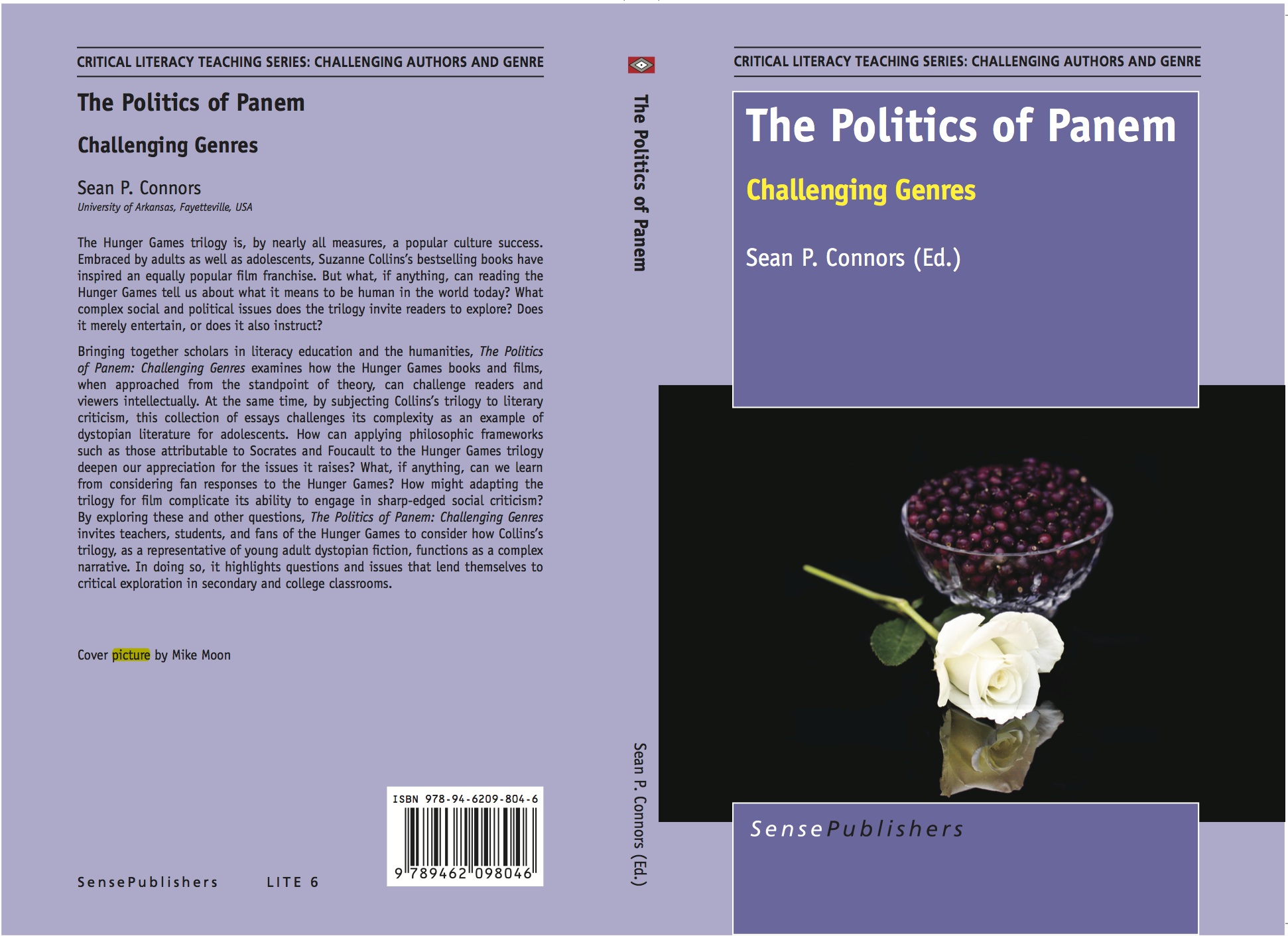
AVAILABLE TO ORDER: The Politics of Panem: Challenging Genres (Sense)

Series: Critical Literacy Teaching Series: Challenging Authors and Genres

Volume Title: The Politics of Panem: Challenging Genres

Editor: Sean P. Connors, University of Arkansas

HG cover

By any measure, Suzanne Collins’ Hunger Games series is a commercial success. In 2012, the bookselling behemoth Amazon reported that the trilogy outsold the Harry Potter series, no small accomplishment considering that the latter has the distinct advantage of consisting of seven novels. A filmic adaptation of the eponymous first novel in the Hunger Games trilogy premiered in the same year, and a sequel, Catching Fire, is scheduled for release later this fall. Still, in spite of its crossover appeal with audiences of all ages, and its subsequent blurring of the distinction between “adolescent” and “adult” literature, the novels that comprise Collins’ trilogy have received surprisingly little critical attention, a result, perhaps, of their status as young adult literature, a genre that is stigmatized in academic settings. Read from the perspective of critical theory, it is possible to appreciate Collins’ series as a multilayered narrative that lends itself to close reading, and which challenges readers to examine complex themes and social issues.

What does reading the Hunger Games series from a Marxist perspective reveal about the material basis of culture? Read from a feminist perspective, how does the trilogy illuminate power relations between men and women? In what ways does the trilogy instantiate, or subvert, dystopian genre conventions, and to what effect? To what extent might adapting the series for film complicate its ability to participate in sharp-edged social criticism? Most importantly, what does a decision to read Collins’ novels from the standpoint of theory reveal about the potential complexity and sophistication of young adult literature? By asking questions of this sort, this edited collection challenges the lingering perception that literature for adolescents is plot driven, superficial fare by making visible the complex readings that are available when readers examine works such as those that comprise the Hunger Games trilogy from the perspective of critical theory. In doing so, it reveals Collins’ series to be a complex narrative that, in the words of Aristotle, instructs at the same time that it delights.

This volume is currently in press with Sense Publishers.

Table of Contents 

Acknowledgements

Introduction: Challenging the Politics of Text Complexity, Sean P. Connors

Part One: “It’s All How You’re Perceived”: Deconstructing Adolescence in Panem

1 — “Some Walks You Have to Take Alone”: Ideology, Intertextuality, and the Fall of the Empire in The Hunger Games Trilogy, Roberta Seelinger Trites

2 — Worse Games To Play?: Deconstructing Resolution in The Hunger Games, Susan S. M. Tan

3 — Hungering for Middle Ground: Binaries of Self in Young Adult Dystopia, Meghann Meeusen

Part Two: “I Have A Kind of Power I Never Knew I Possessed”: What Philosophy Tells Us about Life in Panem

4 — The Three Faces of Evil: A Philosophic Reading of The Hunger Games, Brian McDonald

5 — “I Was Watching You, Mockingjay”: Surveillance, Tactics, and the Limits of Panopticism, Sean P. Connors

6 — Exploiting the Gaps in the Fence: Power, Agency, and Rebellion in The Hunger Games, Michael Macaluso and Cori McKenzie

Part Three: “Look at the State They Left Us In”: The Hunger Games as Social Criticism

7 — “It’s Great to Have Allies As Long As You Can Ignore the Thought That You’ll Have to Kill Them”: A Cultural Critical Response to Blurred Ethics in the Hunger Games Trilogy, Anna O. Soter

8 — “I Try to Remember Who I Am and Who I Am Not”: The Subjugation of Nature and Women in The Hunger Games, Sean P. Connors

9 — “We End Our Hunger for Justice!”: Social Responsibility in the Hunger Games Trilogy, Rodrigo Joseph Rodríguez

Part Four: “That’s a Wrap”: Films, Fandom, and the Politics of Social Media

10 — “She Has No Idea. The Effect She Can Have”: A Rhetorical Reading of The Hunger Games, Hilary Brewster

11 — Are the –Isms Ever in Your Favor?: Children’s Film Theory and The Hunger Games, Iris Shepard and Ian Wojcik-Andrews

12 — The Revolution Starts With Rue: Online Fandom and the Racial Politics of the Hunger Games, Antero Garcia and Marcelle Haddix

Afterward: Why Are Strong Female Characters Not Enough?: Katniss and Lisbeth Salander, from Novel to Film, P. L. Thomas

Author Biographies

How to Order

Flyer 1

Flyer 2

Misreading “Grit”: On Treating Children Better than Salmon or Sea Turtles

Rob McEntarffer (@rmcenta) Tweeted a question to me about my blog post, The Poverty Trap: Slack, Not Grit, Creates Achievement, asking: “can Grit research (Duckworth, etc) be used as a humanizing/empowering tool, rather than a weapon against schools/kids?”

Rob’s question is both a good one and representative of the numerous challenges I received for rejecting “grit”—some of the push-back has been for my associating “grit” and “no excuses,” but many of the arguments (some heated) I have read simply rest on a solid trust that “grit” matters and thus should be central to what educators demand from their students, regardless of their students’ backgrounds (and possibly because many students have impoverished backgrounds).

I remain adamant that demanding “grit” is deeply misguided and harmful to children, especially children living in poverty. But I also acknowledge that a large percentage of educators who embrace “grit” are genuinely seeking ways in which we can help children in poverty succeed. In other words, many “grit” advocates share my educational goals.

So I think Rob’s question needs to be answered, and done so carefully. Let me start with a nostalgic story.

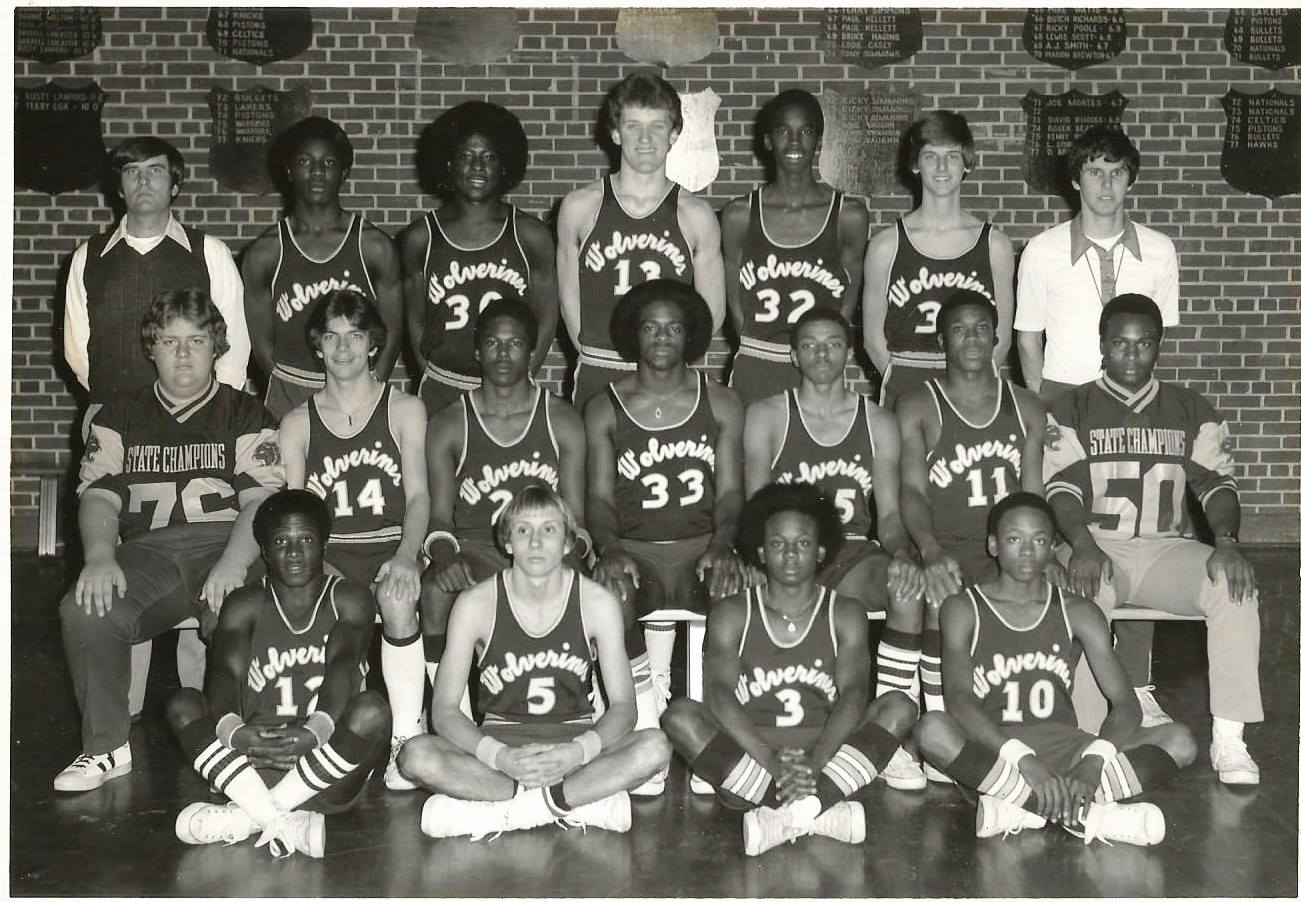
A Facebook post from a former high school friend and basketball teammate is the basis of this story—my junior year high school basketball team:

WHS basketball jr year

I am number 5, and other than wondering why I was looking away and seemingly disengaged, I am struck by my socks.

Throughout junior high and high school, I suffered the delusion I was an athlete, spending most of my free time either playing basketball or golf. My heart and soul longed for being a basketball player, and on my bedroom wall (along with the required poster of Farrah Fawcett) hung a poster of Pete Maravich who wore the same socks superstitiously every game, two pairs pushed down and tattered.

I wanted few things more than being Pistol Pete. Maravich was smart, skilled, and hard-working. Even after his career on the court, Maravich remained the personification of practice and drills: If you work hard enough, Maravich seemed to represent, you too can be a magician on the basketball court.

Soon after Maravich, I added Larry Bird to my list of role models, again latching on to his working-class ethic as an athlete. Bird prompted mythological tales—Larry Legend—about his breaking into Boston Garden to shoot in the dark when the facility was closed.

That’s right, I was a child and teenager smitten by “grit.”

After being diagnosed with scoliosis the summer before my ninth grade, I became an exercise fanatic, possibly as a response to the genetic failure of my body. I created a year-long daily calendar on poster-board each year from ninth through twelfth grades to list and monitor my workouts. For those four years, I wore ankle weights most days and jumped rope at least 300 times each night with those weights on. Every day. Four years.

My Holy Grail was dunking the basketball*—despite my being about 5’10” and around 130 pounds.

My fanaticism about practice carried over onto the driving range in good weather also. I often hit 300 range balls on the golf course practice range before setting out to play 18-27 holes.

And what did all that get me?

Look back to that junior-year photograph above. In my high school during the late 1970s, letterman jackets were the greatest treasure for want-to-be athletes like me (I often wore my father’s jacket from the 1950s to school, a jacket he earned as captain of the first state championship football team at that same high school). But the rules of receiving a letterman’s jacket revolved around lettering your junior year—no other year of lettering resulted in a jacket.

I lettered every year of high school except junior year—a year I spent almost totally on the bench. I never earned a letterman’s jacket in high school, despite lettering in two sports my senior year.

And all that golf practice resulted in a huge amount of callouses and a year on the golf team at junior college.

But I was never Pistol Pete or Larry Legend, and certainly never close to Arnold Palmer (yes, my golf fantasies had working-class heroes also).

So what is my point? I am not trying to suggest that my anecdotes of my life prove my point, but they certainly make an important case for answering Rob’s question.

You see, throughout junior high, high school, and college, I never really tried at school—I was too busy trying to be Pistol Pete and then Larry Legend. And if anyone looked at the outcomes of these two different spheres—my grades in my classes and my scrawny, blond self riding the bench of countless high school basketball games—which do you think appears to be the result of “grit,” effort?

Despite my growing up in a working class family, I thrived when I did because of a number of privileges—being white, male, and prone to math and verbal skills cherished by the school system.

And the evidence is powerful that privilege trumps effort and that human behaviors are greater reflections of the conditions of their lives (abundance or scarcity) than the content of their character.

When my junior year ended without my having earned that letterman’s jacket, I began carrying with me until this day a deep and genuine sense of failure because I wanted few things more than to hand my father back his jacket and to stand before him in the one I earned, to show him I was the man I wanted to be, which was the man he was. That was a boy’s dream, of course, because my father could not have loved me more then or now than he does.

I trust, as well, that my experiences with trying very hard at things I could never excel in and then excelling in things that required very little effort on my part do inform what I argue is a misguided commitment to “grit” in calls for education reform and in school and classroom practices, even among educators with the best of intentions. So I want to end by answering Rob with a few observations and questions I think should help us at least reconsider commitments to “grit”:

  • How do we know when one child is trying and another isn’t? And how do we know why one child works hard and another seems not to make the same effort? I recently arrived at my first year seminar class upset that so many students had failed to submit their essays on time for that class session. My assumptions were all focused on them, but once I arrived in class, I discovered they had all been having technical trouble—the campus email system wasn’t allowing attachments. The focus on “grit,” then, often maintains a singular and accusatory eye on the child, and thus ignores the context, which may be the source of the behavior.
  • How often do we misread “privilege” as “grit”? My argument is—almost always. Even when privileged people excel because of their “grit,” the distinguishing aspect of that success remains the privilege. As well, when impoverished people overcome their hurdles due to hard work and “grit,” they remain outliers, and while they should be applauded, their outlier success isn’t a credible template for everyone else struggling under the weight of poverty.
  • As I note below, “grit” may be a distorted quality among leaders because our culture is competition-based, and our leaders both feel like winners and are praised as winners. Winning is linked to effort in our society even when the effort is not the key to that success. Leaders as winners, then, tend to project their “grit” onto others—not unlike the messages found in Maravich’s basketball training videos—”Just work hard, like I did, and you can do anything!” While such messages may be inspiring, they are at least incomplete, if not mostly untrue; my efforts in high school were not failures due to my lack of effort, but due to my genetic ceiling.
  • And finally, Rob’s question directly: Can “grit” research and ideology be used as a humanizing and empowering tool, rather than a weapon against schools and children? To which I say: If we dedicate ourselves to creating the slack necessary for that “grit” to matter and for such demands to be equitable, then yes. In other words, “grit” fails when it becomes the initial and primary demand of children, superseding commitments to creating the equitable conditions that all children need in their lives and schools. My conclusion about “grit,” then, is that the ultimate concern of mine may be where we prioritize and emphasize it—and how it is used as a spotlight on children in poverty almost exclusively.

On this last point, I think, I can make my best case about why emphasizing “grit” is both misguided and harmful.

From the authoritarian extremes of “no excuses” schools such as KIPP to the more progressive embracing of “grit” that many may call “tough love,” when we honor “grit” we reduce our children to salmon and sea turtles, we create schools that perpetuate a Social Darwinism that is human-made. School, like life, for these children becomes something to survive, a mechanism for sorting.

I think we can and should do better than treating our children like salmon and sea turtles—even when we do so with love in our hearts.

* By the way, yes, I could occasionally dunk in my late teens and early twenties.

Pete Maravich: A Tribute

Safe Spaces for Teachers’ Professional Voices in a Public Sphere

It is a bittersweet irony that words are mostly inadequate to express my appreciation to be nominated for and then recognized with the National Council of Teachers of English 2013 George Orwell Award—”established in 1975 and given by the NCTE Public Language Award Committee, recognizes writers who have made outstanding contributions to the critical analysis of public discourse.”

I am first humbled to be added to the powerful list of previous winners. I also fear I pale in comparison, but having been included, I now take on the obligation of fulfilling this recognition that my work does belong here.

So let me highlight briefly that the 2013 Orwell Award directly recognizes my blogging, identifying Evidence? Secretary Duncan, You Can’t Handle the Evidence.

As both public intellectual work and a part of New Media, my blogging is fraught with minefields in the context of my life as a university professor  and scholar as well as my status as a teacher, identifying myself always as someone who spent 18 years teaching in a rural public high school in South Carolina.

Public intellectual work and blogging remain marginalized ways of being for academics and scholars, while they both are risky ventures for public school teachers.

I am cautiously optimistic that NCTE’s Orwell Award this year is about much more than me—it is about the New Media of blogging and about the importance of professional voices in public spheres.

And thus we have two obligations before us as educators, scholars, and academics:

  1. We must work diligently to create safe spaces for all teachers’ voices in public spheres. Currently, safe spaces exist for tenured professors (my status), but such is not the case for public school teachers and their students; as Arundhati Roy has explained, “We know of course there’s really no such thing as the ‘voiceless.’ There are only the deliberately silenced, or the preferably unheard.”
  2. And once those safe spaces are created, teachers must bring our individual and collective professional voices to the public sphere.

Because, as Orwell cautioned, public discourse is dominated by partisan political voices and “[p]olitical language–and with variations this is true of all political parties, from Conservatives to Anarchists–is designed to make lies sound truthful and murder respectable and to give an appearance of solidity to pure wind.”

Professional teachers’ voices in the public sphere must, as NCTE suggests “[contribute] to honesty and clarity in public language” as a form of resistance to the continued failure of partisan political discourse, especially as that partisan political discourse impacts our public school, our public teachers, and our public school students.

A MOMENT IN NCTE HISTORY – NCTE ANNUAL CONVENTION BOSTON, 2013

A MOMENT IN NCTE HISTORY – NCTE ANNUAL CONVENTION

BOSTON, 2013

Paul Thomas, Council Historian

Delivered at the Board of Directors Meeting, 2013 National Council of Teachers of English Annual Convention

“Not the Time . . . to Follow the Line of Least Resistance”

Honoring our history allows us to acknowledge that we all stand on the shoulders of giants. For those of us teaching English, we recall not only people, their lives, and careers, but also their words—and that words matter.

The Moment of History for NCTE each year, then, confirms our debt to the past and speaks to our obligations for today and tomorrow: And in that spirit, I note that “[t]his is not the time for the teacher of any language to follow the line of least resistance, to teach without the fullest possible knowledge of the implications of his medium.”

In the mid-1800s, public education was called a “’dragon. . .devouring the hope of the country as well as religion. [It dispenses] ‘Socialism, Red Republicanism, Universalism, Infidelity, Deism, Atheism, and Pantheism—anything, everything, except religion and patriotism,’” explains Jacoby (2004, pp. 257-258). Bullying public education has deep roots, at least reaching back to the threat of universal public schooling detracting from the Catholic church’s control of education in the nineteenth century.

Education historian Diane Ravitch (2013), in her Reign of Error, details how this historical trend has manifested itself in the current thirty-year accountability era. The media, in documentaries such as Waiting for “Superman” and an endless stream of articles in print and online, along with political leadership at the state and federal levels as well as on both sides of the aisle have offered a steady refrain that public schools are failures and public school teachers are mostly to blame. The solutions for three decades have been more accountability, new standards, and better high-stakes tests.

As teachers of literacy we are squarely in the crosshairs of these claims, and since we all love a good story, we are also major characters in competing narratives about education and education reform in the U.S.Ravitch (2013) documents these narratives well, but also exposes that the dominant and compelling narrative—schools are failures and teachers are to blame—is mostly misleading and that the counter-narrative—expressed by teachers, academics, scholars, and researchers—remains essentially ignored.

Let’s go back in time, then, with our current state of affairs in public education firmly in mind. Let’s go back to 1947 and Lou LaBrant, a few years before her tenure as president of NCTE, in the pages of Elementary English when she laments “…the considerable gap between the research currently available and the utilization of that research in school programs and methods” (p. 87). Later in that piece, LaBrant concludes:

Most thinking persons agree that the existence of civilized man is threatened today. While language is not food or drink, and will not satisfy the hungry and thirsty, it is the medium by which we must do much of our learning and panning, and by which we must think out solutions to our problems if we are not to solve them by the direct method of force. No sensible person believes that language will cure all difficulties; but the thoughtful person will certainly agree that language is a highly important factor in promoting understanding, and a most dangerous factor in promoting understanding between individuals and between the countries individuals represent. Moreover, language is a significant factor in the psychological adjustment of the individual. This is not the time for the teacher of any language to follow the line of least resistance, to teach without the fullest possible knowledge of the implications of his medium [emphasis added]. Before we, either as individuals or as a Council, experiment with methods of doing specific things or block out a curriculum, let us spend some time with the best scholars in the various fields of language study to discover what they know, what they believe uncertain and in need of study. Let us go to the best sources and study the answers thoughtfully. The game of Gossip is not for us. (p. 94)

Just three years later, writing about writing instruction, LaBrant (1950) also sounded an alarm about “word magic”:

There is other semantic knowledge with which our students should become familiar. They should discover the danger in word-magic, that calling a man by a name does not necessarily make him what we say; that describing the postal system as socialist does not transfer our mail to Moscow, nor brand either the writer or the postman as disciples of Stalin. We must teach our students that words are symbols which they use, and that there is stupidity in word magic. (p. 264)

Now, let’s jump ahead in history to 2001, when No Child Left Behind codified the accountability era and called for “scientifically based research” over 100 times. The implications of this legislation, of course, were that between 1947 and 2001, education had failed to listen to LaBrant.

If we move just a few years further to 2005, the College Board announced a writing section of the SAT. NCTE promptly responded (Ball, et al., 2005) by warning that research suggested that timed, high-stakes tests were likely to damage effective and equitable literacy pedagogy and learning. In subsequent years, some of the power of the SAT has diminished, but high-stakes testing has increased, both in the lives and learning of children and in the evaluation of teachers and schools.

Today, as we now face the implementation of Common Core and the highs-stakes tests related to those new standards, we are again presented with evidence from the National Education Policy Center:

As the absence or presence of rigorous or national standards says nothing about equity, educational quality, or the provision of adequate educational services, there is no reason to expect CCSS or any other standards initiative to be an effective educational reform by itself. (Mathis, 2012)

In November of 2013, then, it seems all too obvious that echoing LaBrant is necessary as we seek ways in which we can raise the discourse and change the actions of those leading the reform of public schools to fulfill our debt to our past and our obligations to today and tomorrow.

We face “a considerable gap between the research currently available and the utilization of that research in school programs and methods” and “[t]his is not the time for the teacher of any language to follow the line of least resistance, to teach without the fullest possible knowledge of the implications of his medium.” And finally, as LaBrant (1950) concluded about word magic:

Perhaps not everyone in the land is ready to read Macbeth or to write a sonnet. Better, it seems to me, that each read what he can honestly understand, and admit on occasion that he is baffled; better that the boy or girl write a simple account of what he saw on the street than that he write a collection of stereotypes on democracy. Let him, perhaps, admit with all of us that he is learning about democracy and has much to read and to think before he can say what should be. Misuse of language, as Hitler demonstrated, is a terrible thing; we teachers of English can at the very least teach our students that language is a tool of thought, a tool which can be sharp and keen, but is easily blunted. Alice was wrong, for once: It makes a great deal of difference whether one says “important” or “unimportant.” (p. 265)

We cannot afford the word magic of the current reform movement any longer. Words matter, and it is time for resistance.

References

Ball, A., Christensen, L., Fleischer, C., Haswell, R., Ketter, J., Yageldski, R., & Yancey, K. (2005, April 16). The impact of the SAT and ACT timed writing tests. Urbana, IL: National Council of Teachers of English.

Jacoby, S. (2004). Freethinkers: A history of American secularism. New York, NY: Henry Holt and Company.

LaBrant, L. (1950, April). The individual and his writing. Elementary English27(4), 261-265.

LaBrant, L. (1947, January). Research in language. Elementary English, 24(1), 86-94.

Mathis, W. (2012, October). Research-based options for education policymaking: Common Core State Standards. National Education Policy Center, School of Education, University of Colorado Boulder. Boulder, CO.

Ravitch, D. (2013). Reign of error: The hoax of the privatization movement and the danger to America’s public schools. New York, NY: Knopf.

Thomas, P. L. (2011, November 28). “Not the time…to follow the line of least resistance.” Truthout. Retrieved from