All posts by plthomasedd

P. L. Thomas, Professor of Education (Furman University, Greenville SC), taught high school English in rural South Carolina before moving to teacher education. He is a former column editor for English Journal (National Council of Teachers of English), current series editor for Critical Literacy Teaching Series: Challenging Authors and Genres (Brill), and author of Teaching Writing as Journey, Not Destination: Essays Exploring What ‘Teaching Writing’ Means (IAP, 2019) and How to End the Reading War and Serve the Literacy Needs of All Students: A Primer for Parents, Policy Makers, and People Who Care (IAP, in press). NCTE named Thomas the 2013 George Orwell Award winner. He co-edited the award-winning (Divergent Book Award for Excellence in 21st Century Literacies Research) volume Critical Media Literacy and Fake News in Post-Truth America (Brill, 2018). Follow his work @plthomasEdD and the becoming radical (https://radicalscholarship.wordpress.com/).

Gates’s Cannibalistic Culture: Coming to a School Near You!

Bill Gates has adopted education as a billionaire’s hobby for many years—once supporting small schools projects, but more recently focusing on teacher quality.

Little attention, however, has been paid in the mainstream media to Gates’s struggles in business (Microsoft) or his complete lack of expertise, experience, or success as an educational entrepreneur.

Until this expose by Vanity Fair addressing the key practices at the foundation of Microsoft’s failures (“Today, a single Apple product—the iPhone—generates more revenue than all of Microsoft’s wares combined”). [1]

Gates has argued for a need to identify the best (and worst) teachers in order to control who teachers teach and how:

What should policymakers do? One approach is to get more students in front of top teachers by identifying the top 25 percent of teachers and asking them to take on four or five more students. Part of the savings could then be used to give the top teachers a raise. (In a 2008 survey funded by the Gates Foundation, 83 percent of teachers said they would be happy to teach more students for more pay.) The rest of the savings could go toward improving teacher support and evaluation systems, to help more teachers become great.

In effect, Gates’s plan to address teacher quality is shared among almost all education reformers, including the USDOE and Secretary Arne Duncan, and focuses on labeling,ranking, and sorting teachers—a practice eerily similar to the “Cannibalistic Culture” identified as central to the failures at Microsoft:

Eichenwald’s conversations reveal that a management system known as “stack ranking”—a program that forces every unit to declare a certain percentage of employees as top performers, good performers, average, and poor—effectively crippled Microsoft’s ability to innovate. “Every current and former Microsoft employee I interviewed—every one—cited stack ranking as the most destructive process inside of Microsoft, something that drove out untold numbers of employees,” Eichenwald writes. “If you were on a team of 10 people, you walked in the first day knowing that, no matter how good everyone was, 2 people were going to get a great review, 7 were going to get mediocre reviews, and 1 was going to get a terrible review,” says a former software developer. “It leads to employees focusing on competing with each other rather than competing with other companies.”

“Competing with Each Other”: Students as Weapons of Mass Instruction

It all starts with a lie. A very compelling lie that has the weight of common sense reinforced by the proclamations of people with wealth, Bill Gates, and power, Secretary Arne Duncan: Teachers are the single most important element in the learning of a child.

The problem is, of course, this is factually untrue. Nonetheless, the follow up lie (when you base a conclusion on a false permise, that conclusion is also false) is also compelling: Teacher quality must be improved!

The balance of evidence shows that measurable student outcomes (itself a serious flaw in how we draw conclusions about both student learning and teacher quality) is overwhelmingly linked with out-of-school factors—anywhere from about 2/3 to well over 80% of that data correlated with out-of-school factors.

Even arguing that teachers are the single most important in-school factor in measurable student outcomes is problematic since the research on that claim is mixed at best (some evidence suggests that school leadership and culture are as important, if not more so, than teacher quality).

Gates and the USDOE, then, are making a foundational problem of seeking solutions to problems that haven’t been identified. In other words, no one has shown definitively that teacher quality is the primary or even one of the primary causes of low student outcomes.

Now, once we move beyond that problem, approaches to teacher evaluation and pay may need to be revised, but ample evidence shows that the proposals being offered by Gates and Duncan, as well as all across the U.S., are also without solid evidence to support them (disproportionate teacher assignment has been identified, but that reality is somehow often ignored since the privileged children are winning in that inequity [see Peske & Haycock, 2006]).

Incentive-based evaluation and compensation have a long record of being ineffective, counter-production, and not cost effective (see Hout & Elliot, 2011, and Kohn, 1993/1999). Yet, as with the compelling message about teacher quality and student outcomes, competition and incentives are almost universally embraced in U.S. culture without regard for the evidence (see Worthen, et al., 2009, regarding competition).

That leads to the revelations about the previously unexplored problems at Microsoft exposed by Eichenwald—the Cannibalistic Culture of stack ranking by which all workers are evaluated on an imposed scale of ranking in order to identify the elite workers.

If Eichenwald’s characterization of the ranking as corrosive is accurate, leading as it did to workers “competing with each other,” then we can anticipate a truly disturbing reality to occur when teachers are held accountable for their students’ grade as significant percentages of their evaluations and compensation: Teachers will begin to use their students as weapons of mass instruction to defeat the students of the competing teachers, either in their own school or within the district.

This is a debilitating and ethically corrupt outcome that cannot be avoided if we continue to seek incentive-based, VAM approaches to teacher quality.

Education and teacher quality absolutely need to be reformed, but increasing the Cannibalistic Culture for teachers and students is not the path we need as a free people seeking universal public education as a central institution supporting democracy.

Education is a collaborative venture; a culture of competition is poison in the teaching/learning dynamic. Labeling, sorting, and ranking teachers and students is inexcusable in any form as long as we are genuinely committed to fostering a culture of collaboration necessary for learning.

The Cannibalistic Culture has created the winners who call for expanding that game. The Cannibalistic Culture benefits only the winners as it forces the status of loser upon most people regardless—again consider the stack ranking at Microsoft.

Teacher evaluation and education need to be reformed toward a culture of collaboration, a culture that encourages human interactions that are not about winning or losing and not about fighting for ever-shrinking pieces of the pie.

Public education and teacher quality reform currently being pursued is certain to drive good people from teaching and to ask less and less of both teachers and students. We have ample evidence from the disturbing Microsoft story being revealed to us, but we also have the stories of generations of teachers who know how education and teaching need to be supported and reformed.

Teachers want all students to succeed. Teachers want to be treated as professionals. Teachers want school conditions that support their work as educators.

Teachers do not want to use their students to outperform some other teachers’ students.

A Cannibalistic Culture will certainly create students as weapons of mass instruction that will destroy universal public education.

[1] See also The Poisonous Employee-Ranking System That Helps Explain Microsoft’s Decline, which prompted this reposting from Daily Kos July 5, 2012.

Misleading the State of Education: Zais Plays Partisan with School Praise

Superintendents of education in states across the U.S. are necessarily political positions, either political appointments or elected offices.

Should, then, a superintendent of education visit public school districts to praise excellence—especially in districts and schools struggling under the weight of poverty? Of course.

But in the current accountability era that persists in pursuing education policy not supported by research and in the wake of Tony Bennett’s school grade manipulation scandal (and concurrentevidence from Florida that school grades are yet another failed education policy), public praise for district and school success is often a cover for promoting partisan political agendas.

via Misleading the State of Education: Zais Plays Partisan with School Praise.

Advice to Students and Authors: Submitting Your Work

If someone asks me what I do, without hesitation, I can always offer, “I am a teacher and a writer.”

I am extremely fortunate because I am able to make my living as both a teacher and a writer, something afforded me as a university professor. Being a writer and a teacher, also, are not vocations I have chosen, but who I am at my core. In other words, I did not choose to be a teacher and a writer, but I did come to recognize and embrace both ways of being.

Over the past thirty years, I have taught writing to a wide range of students (from high school through graduate courses), addressing all types of writing from poetry and fiction to personal and scholarly essays. For more than thirty years, I have been a serious writer, working on my own original poetry, fiction, essays, blogs, and academic books. Also part of life as a writer has included working as an editor—co-editing a state journal, editing a column in English Journal, editing two series at two different publishers (Peter Lang USA and Sense), and editing/co-editing book-length volumes.

All of these experiences with being a student, a teacher, a writer, and an editor have provided me with a great deal of experience that has taught me some important guidelines for students and authors preparing and submitting work in courses or for publication. I want here to outline some of that advice, recognizing that advice is often futile; it is the act of writing and experiencing all that is connected with writing that ultimately teaches us what we need to know.

First, let me offer some general comments about writing and being a writer. Essentially, there are two types of writers: ones who are compelled to write (and thus refer to themselves as writers and write regardless of achieving publication) and ones whose situation (being a student or being an academic) include the necessity to write. Each situation creates unique advantages and disadvantages, but I believe it is key for any person submitting work for course credit or publication to recognize which category she/he fits within order to understand what strategies are needed to be a successful writer regardless.

Next, two strategies are incredibly important for students and authors submitting work. One is embracing the life of a purposeful and diligent reader. Reading often as well as reading deeply and widely are essential for writing well. Reading for pleasure is important, but reading like a writer is also key. Reading like a writer involves looking at not just what writers say but how writers craft their messages. For students and authors submitting work for publication, acquiring genre awareness is a primary goal of reading.

Genre awareness is identifying and then working purposefully within or against the conventions associated with different purposes for and types of writing. For example, the characteristics of text that shape poetry (crafting a piece in lines and stanzas) differ from the characteristics of text that shape journalism. Students must gain control over the various expectations for academic writing among disciplines; writing about a work of literature is a different type of writing than preparing a literature review for a research assignment in a sociology class. Authors, as well, soon realize that submitting an Op-Ed to a local newspaper is quite different than submitting an essay to a peer-reviewed scholarly journal.

A second strategy is to seek out avenues for learning about language and writing beyond the formal classroom. One important resource is Joseph Williams’s Style. But dozens of engaging and thoughtful books exist to supplement the type of learning about of writing done in formal school settings.

Now, let me outline some guidelines for submitting writing, whether as a student for course credit or an author seeking publication:

  • In our digital age, my strongest recommendation is learn how to use your word processor, such as Word. Writers must master word processing so that the application works for you, making the tedious tasks of formatting manuscripts less time consuming so you can focus on crafting good writing. For writers, issues of headers and footers, title pages, formatting fonts and margins, handling block quotes, and formatting reference lists can create unnecessary stress that distracts from time needed for drafting and revising. The short point is that word processors will do most of these tasks in ways that are simple and quick; thus, learn how to use the word processor to do anything you need to do with preparing a manuscript.
  • A related piece of advice is “less is always better when formatting a manuscript.” A strong caution I must offer is avoid unneeded returns and all tabs. Two problematic areas for formatting a manuscript are block quotes and preparing bibliographies that require hanging indents; in both cases, do not manually put in returns and do not use tabs to format bibliographies, but do use the formatting features of your word processor. Also, bold and italics should be used sparingly and only within guidelines of the required style sheet. Never use quote marks or bold for emphasis (use italics, but, again, do so sparingly).
  • Just as less is key to formatting, simplicity is central to basic choices about manuscripts. Use 12 pt. Times New Roman for your font. Period. No variety of fonts, no variety of font sizes. Make sure headers and footers also have the same font choices. As well, in most cases (however, please conform to the style sheet required), double spacing is also required throughout, as well as 1″ margins.
  • Honor word count or page number requirements. Noting above, do not manipulate font type or size to reach a page count.
  • Follow the style requirements and refer to the appropriate guides for preparing your manuscript. Many students and authors need to conform to style and citation guidelines provided by professional organizations, such as MLA, APA, or Chicago Manual of Style. Understanding how style sheets differ and why also helps most writers conform to those guidelines.
  • When submitting cited writing, note that the list of references (headed differently among citation style sheets) is a part of the manuscript, although separated by a page break. Be sure to include the references list as part of the submitted manuscript. [Also be sure to include all proper citations in drafts and first submissions whether you are a student or author submitting for publication. Do not submit a piece and state you plan to add your references later; no one can adequately respond to a work requiring citations without full and proper documentation and the necessary list of references.]
  • Take care to provide an interesting and relevant title for all writing and take equal care with subheads (works of 4-5 pages or longer generally benefit from subheads), noting the formatting guidelines needed depending on the style sheet required.
  • Most students and writers will submit their work electronically (please attach your manuscript when you send that email), and as a result, most students and authors will receive comments and editing on their manuscripts through review features on word processors. As noted above, knowing how to use advanced review features on your word processor is crucial. Understand how to navigate track changes as you revise, but most important of all, be able to produce a clean subsequent draft to resubmit. An effective strategy is to save two versions of the returned manuscript—one that maintains all comments and track changes and a second (from which you’ll revise) that accepts all track changes and deletes all comments. Opening both files but working from the clean version (be sure to cut OFF track changes in that version) insures you’ll submit a clean draft for the next round of feedback, for a grade, or for a decision about publication.

Success when writing as a student or writing for publication, ultimately, depends on the quality of the ideas and expression in the final piece, but the initial experience a teacher and editor has with a submitted work begins that process. Students and authors must make that first experience a positive one.

The appearance of a manuscript sends a message about the purposefulness and professionalism of the writer. Students and authors must not expect teachers and editors to take more care with their manuscripts than the student or author has herself/himself.

The MLK Imperative in an Era of “No Excuses”

My father was a hard-ass, €”a Southern version of the Red Forman-type made popular in That 70’s Show. I grew up, then, in a “no excuses” environment rooted in the 1950s work ethic my father personified. [1]*

Mine was a working-class background: My paternal grandfather (for whom I was named) ran the small-town gas station where I grew up, and my maternal grandfather worked in the yarn mills in the hills of North Carolina.

Way before the “no excuses” ideology consumed the education reform movement of the 21st century, “no excuses” ruled my childhood and teen years. My behavior at home and school? No excuses. My academic achievement? No excuses.

Two important realizations, however, stem from that childhood and young adulthood of mine.

First, most of my academic, scholarly, and personal success occurred in spite of (not because of) that “no excuses” upbringing.

And second, in retrospect I recognize that the central element in that success, feeding my working-class roots, was enormous privilege driven by the coincidences of my being male, white, and possessing the academic acumen preferred by social and educational norms.

Privilege, Humility, and Community

Nestled somewhat silently and invisibly beneath the “no excuses” atmosphere of my childhood was two wonderfully loving parents €”and a culture of literacy that can clearly be identified as the source of my academic success.

The line from Dr. Seuss to Kurt Vonnegut is being necessarily oversimplified here, but from my earliest recollections, I loved reading and books. And by my late adolescence and young adulthood, I became an avid reader of Kurt Vonnegut, through whom I came to know alternative views of history (Sacco and Vanzetti by way of Jailbird, for example).

The most powerful lesson I have drawn from Vonnegut, however, has been the words, life, and actions of Eugene V. Debs:

Your Honor, years ago I recognized my kinship with all living beings, and I made up my mind that I was not one bit better than the meanest on earth. I said then, and I say now, that while there is a lower class, I am in it, and while there is a criminal element I am of it, and while there is a soul in prison, I am not free.

From Debs I have come to understand that anyone’s privilege is the foundation for humility, not arrogance (no “I deserve this unlike others” attitude), and that all people bestowed with privilege should feel compelled to work diligently for the equity of others, with Debs’ works and life serving as models.

The key to that understanding of and praxis drawn from privilege is my embracing critical pedagogy:

Thus, proponents of critical pedagogy understand that every dimension of schooling and every form of educational practice are politically contested spaces. Shaped by history and challenged by a wide range of interest groups, educational practice is a fuzzy concept as it takes place in numerous settings, is shaped by a plethora of often-invisible forces, and can operate even in the name of democracy and justice to be totalitarian and oppressive. (Kincheloe, 2005, p. 2)

My critical commitment, then, to equity is grounded in my work as an educator and scholar as well as my foundational focus on democracy, equity, and agency.

And it is there that I now turn to examining the Martin Luther King Jr. imperative in an era of “no excuses.”

Claim One: Poverty and Privilege Are Destiny

“No excuses” has a specific meaning and context in 2012, one associated with corporate education reform endorsed by Secretary of Education Arne Duncan, Bill Gates, Michelle Rhee, and a long list of self-proclaimed reformers who have little or no experience as educators or scholars. Nonetheless, these reformers drive their agendas with slogans such as “poverty is not destiny.”

While this and other slogans are culturally compelling, factually in the U.S., poverty is destiny, and that reality is often as much linked to socioeconomic status as race.

Some acknowledgement exists for the school-to-prison pipeline that plagues poor and minority students; for example, the Justice Department in Mississippi has concluded, as Ferriss reports:

The suit alleges that the state, county and city “help to operate a school-to-prison pipeline in which the rights of children in Meridian are repeatedly and routinely violated,” said a Department of Justice press release.  “As a result, children in Meridian have been systematically incarcerated for allegedly committing minor offenses, including school disciplinary infractions, and are punished disproportionately without due process of law.”

The school-to-prison pipeline, I fear, is ultimately an inadequate metaphor for the current “no excuses” policies in many high-poverty and high-minority public and charter schools that are better described with schools-as-prisons.To understand the need to change the metaphor, we must first acknowledge that in the U.S. white males outnumber Latino and African American males about 3 to 1, but in U.S. prisons, Latino and African American males outnumber white males about 10 to 1.

The race and class implications of the causes behind these data are captured, I think, in James Baldwin’s assessment in “No Name in the Street” (1972):

The truth is that the country does not know what to do with its black population now that the blacks are no longer a source of wealth, are no longer to be bought and sold and bred, like cattle; and they especially do not know what to do with young black men….It is not at all accidental that the jails and the army and the needle claim so many….€

The blurring of public institutions used for control instead of their democratic purposes has been questioned by Michel Foucault:

The practice of placing individuals under ‘observation’ is a natural extension of a justice imbued with disciplinary methods and examination procedures. Is it surprising that the cellular prison, with its regular chronologies, forced labour, its authorities of surveillance and registration, its experts in normality, who continue and multiply the functions of the judge, should have become the modern instrument of penality? Is it surprising that prisons resemble factories, schools, barracks, hospitals, which all resemble prisons? (Discipline & Punish, 1975)

The evidence that poverty is destiny is disturbingly reflected in our schools. Pre-kindergarten expulsions—€”overwhelmingly male and then disproportionately African American males—€”foreshadow our imprisonment inequities; and our “no excuses” school discipline policies, such as zero tolerance, have directly transformed the school-to-prison pipelines into schools-as-prisons:

These findings show that urban youth get subjected to levels of surveillance and repression that are not the same as long-term incarceration, but nonetheless, as the school merges with an ideology of street policing, the courts, and even the prison, a particular culture of penal control becomes an aspect of everyday life at school and beyond….

Despite the trouble it caused students, there was an important ideological dimension to their refusal to comply with law enforcement. Their contestations during interactions with police and agents contained within them a decisive critique of disciplinary practices. Policing practices, especially the demand to see ID, conflicted with students’ sense of justice and fairness and their imagined ideal of schooling. Kathleen Nolan, Police in the Hallways

While “No Excuses” Reformers (NER) issued a manifesto claiming that a child’s ZIP code does not determine access to educational quality, several recent studies show that ZIP code determines a child’s school [2], and then that school’s policies and quality further entrench that child’s future. For many African American males, ZIP code determines school quality and then that school experience is both like prison and a precursor to prison.These damning facts associated with schools, however, are but microcosms of larger social inequities. The U.S. is no longer a model of social mobility (Sawhill & MortonNorton & Ariely), and the U.S. ranks near the bottom when compared with other industrialized countries in the percentage of childhood poverty, well over 20%.

Public schools in the U.S. fail in two ways that are masked by claims that “poverty is not destiny” and school reform alone will allow schools to reform society: (1) Schools reflect the inequities of the wider society, and (2) schools perpetuate social inequities.

One of the most powerful examples of how schools reflect society is that student achievement is correlated between 60% and over 80% with out-of school factors (BerlinerJoseph Rowntree Foundation, ETS 2007 and 2009).

Yet, the current agenda coming from the NER remains blind to social realities and the inadequacy of their reform agenda, as Berliner explains:

Because of our tendency to expect individuals to overcome their own handicaps, and teachers to save the poor from stressful lives, we design social policies that are sure to fail since they are not based on reality. Our patently false ideas about the origins of success have become drivers of national educational policies. This ensures that our nation spends time and money on improvement programs that do not work consistently enough for most children and their families, while simultaneously wasting the good will of the public (Timar & Maxwell-Jolly, 2012). In the current policy environment we often end up alienating the youth and families we most want to help, while simultaneously burdening teachers with demands for success that are beyond their capabilities.

Claim Two: “No Excuses” Reform Entrenches Status Quo of Inequity

The discourse of NER has successfully framed a “failed public schools” narrative that receives the shorthand “status quo.” A central part of that narrative is built on the argument that school reform alone can change society, but these claims, in fact, create a logic problem for NER: For schools to change society (and for which there is no evidence this has ever happened), those schools must be unlike the society, yet both public schools and NER mirror and perpetuate social inequities:

Public School Problem
“No Excuses”€ Reform
Poor, Latino/Black, special needs, and ELL students assigned disproportionately inexperienced and un-under-certified teachers
Assign poor, Latino/Black, special needs, and ELL students Teach for America recruits (inexperienced and uncertified)
Public schools increasingly segregated by race and socioeconomic status
Charter schools, segregated by race and socioeconomic status
Three decades of standards-based testing and accountability to close the test-based achievement gap
Common Core State Standards linked to new tests to create a standards-based testing and accountability system
Inequitable school funding that rewards affluent and middle-class schools in affluent and middle-class neighborhoods and ignores or punishes schools in impoverished schools/neighborhood
Drain public school funding for parental choice policies that reinforce stratification found in those parental choices
State government top-down and bureaucratic reform policies that ignore teacher professionalism
Federal government top-down and bureaucratic reform policies that ignore teacher professionalism
Rename high-poverty schools “academy”€ or “€œmagnet”€ schools
Close high-poverty public schools and open “€œno excuses” charters named “€œhope”€ or “€œpromise”€ [see above]
Ignore and trivialize teacher professionalism and autonomy
Erase experienced teachers and replace with inexperienced and uncertified TFA recruits [see above]
Poor, Latino/Black, special needs, and ELL students assigned disproportionately to overcrowded classrooms
Poor, Latino/Black, special needs, and ELL students assigned to teachers rewarded for teaching 40-1 student-teacher ratio classrooms
Poor, Latino/Black, special needs, and ELL students tracked into test-prep classrooms
Poor and Latino/Black students segregated into test-prep charter schools; special needs and ELL students disregarded [left for public schools to address; €”see column to the left]
Teacher preparation buried under bureaucracy at the expense of content and pedagogy
Teacher preparation rejected at the expense of content and pedagogy
Presidents, secretaries of education, governors, and state superintendents of education misinform and mishandle education
Presidents, secretaries of education, governors, and state superintendents of education [most of whom have no experience as educators] misinform and mishandle education
Fail to acknowledge the status quo of public education [see above]: Public schools reflect and perpetuate the inequities of U.S. society
Fail to acknowledge the status quo of public education [see above and the column to the left]: NER reflect and perpetuate the inequities of U.S. society

For example, the opting out of NCLB policy under the Obama administration successfully combines the failures of traditional public schooling with the failures of “no excuses” ideology, notably the senseless consequences of the NCLB waiver in New Jersey:

Demographic Composition of New Jersey’s Priority, Focus and Reward Schools

Classification
# of Schools
Black/Latino
Free/Reduced Lunch
ELL
Student Mobility Rate
Priority
75
97%
81%
7%
24%
Focus
183
72%
63%
10%
15%
Reward
112
20%
15%
2%
5%

NER advocates depend on a narrative maintaining a focus on a fabricated status quo of failed public education in order to continue the same failures of that status quo under the mask of NER.

Claim Three: Social Context Reform Seeks Equity

While often discredited by NER narratives as embracing the status quo or, most inaccurately, suggesting children in poverty cannot learn, Social Context Reformers (SCR) are primarily educators and education scholars who call for a combination of social and education reforms committed to addressing equity: Poverty is destiny, in society and schools, but poverty should not be destiny, argues SCR.

SCR is committed to the Martin Luther King Jr. imperative from 1967:

“As a consequence, fragmentary and spasmodic reforms have failed to reach down to the profoundest needs of the poor….In addition to the absence of coordination and sufficiency, the programs of the past all have another common failing — they are indirect. Each seeks to solve poverty by first solving something else….We are likely to find that the problems of housing and education, instead of preceding the elimination of poverty, will themselves be affected if poverty is first abolished.

Instead of calling again for indirectly addressing inequity and poverty (NER), SCR seeks to reform directly both society and education:

Social Context Reform
Social Commitments to Equity
School-based Commitments to Equity
Universal healthcare (including eye care, dental care) for children and families with children
End high-stakes testing and accountability; implement teacher/school autonomy and transparency (what schools offer and how v. student outcomes)
Childhood family food security
End labeling and sorting students
Stable and well-paying work for families (reform healthcare so jobs and healthcare are not linked); increase worker’s right and empowerment
Insure equitable teacher assignments
Re-commit to fully funding and supporting universal public education
Confront inequitable discipline policies and outcomes related to race, gender, and class
Insure universal public college access for all students
Reject the traditional deficit perspectivedriving public schooling and reflecting cultural deficit view of poverty
Honor and support school, teacher, and student AUTONOMY (current accountability culture is about complianceanti-democratic)

The King imperative, address poverty and inequity directly, must be acknowledged and embraced; the first step to direct action is to unmask the paradoxes of NER.

Ellison and Baldwin Speak to the King Imperative

Ralph Ellison’s address to teachers in 1963 exposes that social and educational failures have been historically intertwined, as he confronted “‘these children,’ the difficult thirty percent. We know this very well; it has been hammered out again and again.”

Ellison asserted, “There is no such thing as a culturally deprived kid,” concluding:

I don’t know what intelligence is. But this I do know, both from life and from literature: whenever you reduce human life to two plus two equals four, the human element within the human animal says, ‘I don’t give a damn.’ You can work on that basis, but the kids cannot. If you can show me how I can cling to that which is real to me, while teaching me a way into the larger society, then I will not only drop my defenses and my hostility, but I will sing your praises and help you to make the desert bear fruit.

Embedded in the narratives of Ellison, and James Baldwin (see blow), are the threads that show education is not experiencing a crisis, but a systemic reality of the inequity in the culture and institutions of the U.S. We have no “achievement gap,” but we do have an equity gap that metrics such as the “achievement gap” reflect. Ursula K. LeGuin’s “The Ones Who Walk Away from Omelas,” an allegory of privilege, exposes that privilege exists upon the back of oppression:

They all know it is there, all the people of Omelas. Some of them have come to see it, others are content merely to know it is there. They all know that it has to be there. Some of them understand why, and some do not, but they all understand that their happiness, the beauty of their city, the tenderness of their friendships, the health of their children, the wisdom of their scholars, the skill of their makers, even the abundance of their harvest and the kindly weathers of their skies, depend wholly on this child’s abominable misery. (Le Guin, 1975, p. 282)

This SF allegory is the story of the U.S., the story of ignoring the oppressed child that our privilege depends on by acknowledging “it,” or simply walking away.

As James Baldwin states in “Lockridge: ‘The American Myth'” (1948): “The gulf between our dream and the realities that we live with is something that we do not understand and do not wish to admit. It is almost as though we were asking that others look at what we want and turn their eyes, as we do, away from what we are….”

NER in education maintains the idealism that privilege can somehow be separated from inequity. SCR, however, seeks to pull aside the rugged individualism myth in order to pursue the King imperative that we seek equity in society and schools in the U.S.—by genuine social reform that is then wedded to educational reform.

We must no longer justify inequity with our privilege, and taking an objective, apolitical pose is a “walking away” we can no longer afford.

Direct action is the only solution to the problem of inequity.

* This is a reposting from October 27, 2012, in honor of the 50th Anniversary March on Washington.

[1] This blog is a narrative/expository version of a talk I delivered at the University of Arkansas on 18 October 2012; you can view the presentation PP here.

[2] See (a) “A Rotting Apple: Education Redlining in New York City” from the Schott Foundation for Public Education; (b) The Brookings report, “Housing Costs, Zoning and Access to High-Scoring Schools”; and (c) “Is Demography Still Destiny?” from the Annenberg Institute for School Reform.

An Alternative to Accountability-Based Education Reform

During three decades of accountability based on standards and high-stakes testing at the state level and another decade-plus of federal oversight of that accountability, the overwhelming evidence has exposed accountability as a failed network of policies in education reform.

Education reform in the U.S. now faces a potential watershed moment in which setting aside accountability and embracing a school reform agenda that acknowledges social and educational inequity offer a promise of success that accountability, standards, and high-stakes testing have failed to achieve.

First, education does not exist in a vacuum. Teaching and learning are impacted by out-of-school factors and impact the world beyond the walls of schools; thus, the primary foundation upon which education reform must be built is acknowledging that the U.S. currently has one of the highest childhood poverty rates among nations against which U.S. schools are commonly compared:

Relative child poverty rates

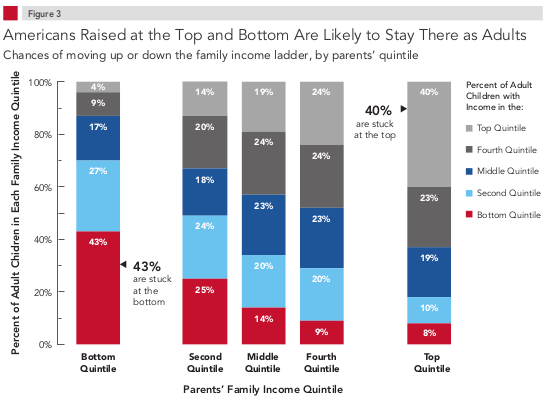
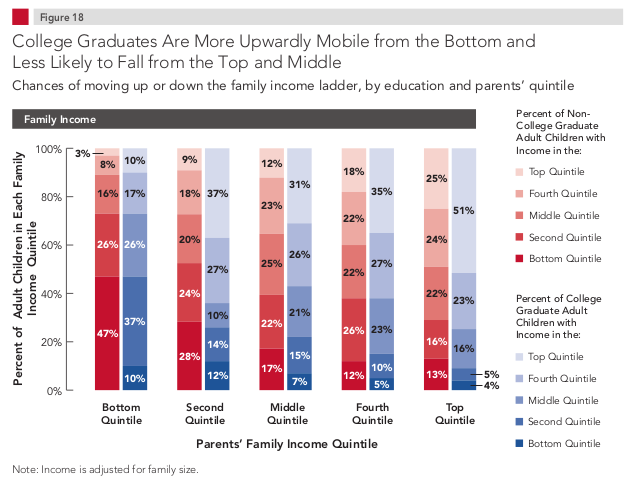
Next, another powerful example of inequity in the U.S. is that upward mobility has stagnated—notably in the top and bottom fifths—and, as Matt Bruenig has explained “you are better off being born rich regardless of whether you go to college than being born poor and getting a college degree”:

The third and final context for understanding an alternative to accountability-based education reform is the rise in the working poor in the U.S. and the increase in part-time work that leaves many working-poor families with adults holding multiple jobs but not having access to health care or retirement benefits.

Education reform must be built on policies that directly address the rising social inequity in the U.S. The essential shift away from accountability, then, must begin with social reform that addresses inequity. Social reform is necessarily the responsibility of state and federal legislation; thus, some of the policy targets addressing social inequity that are likely to impact positively a new vision of school-based reform include the following:

  • Food security: Children in poverty face food insecurity, but also suffer from access to low-quality foods (for example, fast food). Nutrition during pregnancy for women in poverty, early childhood nutrition, and nutrition during school ages are all essential elements for providing children the equity of opportunities that schools could provide.
  • Health care: Children and families in poverty tend to avoid needed preventative health care, and then are forced to seek out the least economically efficient avenues for receiving basic and urgent care, emergency rooms. If public education is to transform society and the lives of children, all children must be guaranteed the health (and nutrition) that children in affluence experience.
  • Stable work with rewarding salaries: Children and families in poverty often experience instability in the work of the parents and their homes since impoverished workers are competing with each other for entry-level and transient jobs. A stable workforce and increasing full-time jobs with benefits provide the basis upon which education can succeed where it has traditionally failed.

Certainly, many other social policies need to be addressed, but the foundational point here is that social inequity currently overwhelms public education in the U.S. A first step to education reform is social reform. As well, the public in the U.S. currently supports seeking greater equity: “The Pew Research Center has found that some 90 percent of Americans believe that the government should do everything it can to ensure equality of opportunity” (NYT February 16, 2013). What is lacking is the political will to make commitments to social equity of opportunity for all in the U.S.

Within the larger commitment to social reform, a new vision of education reform must include a broad commitment to providing an equity of opportunity for all children, and some of the policy changes must include the following:

  • End accountability based on standards and high-stakes testing: A growing body of research has shown that the accountability era has failed: “the absence or presence of rigorous or national standards says nothing about equity, educational quality, or the provision of adequate educational services, there is no reason to expect CCSS or any other standards initiative to be an effective educational reform by itself” (Mathis, 2012). A first and essential step to a new vision of education reform is to end the accountability era by shifting away from focusing on outcomes and toward attending to the conditions of teaching and learning—with an emphasis on equity of opportunity.
  • Implement a small and robust measurement system: As Stephen Krashen and others have argued, the existing National Assessment of Educational Progress (NAEP) assessment system in the U.S. provides a more than adequate foundation upon which the U.S. can develop a systematic and limited process for administering tests to random samples of students in all states and gathering descriptive data on the effectiveness of schools. This new system must be low-stakes and should dramatically reduce the funding committed to testing in the U.S.
  • Scale back and eventually end tracking: The most accurate criticism of U.S. education is that it has historically perpetuated and currently perpetuates social inequity. Tracking remains grounded in data that reflect out-of-school influences and tends to funnel impoverished students into narrow academic settings and affluent children into rich educational experiences.
  • Focus on equitable teacher assignments: The focus on teacher quality within the accountability movement has tended to mislead the public about the importance of teacher quality connected to measurable outcomes while ignoring that impoverished, minority, and special needs students along with English language learners disproportionately are assigned to inexperienced and un-/under-certified teachers. Education reform committed to equity must monitor teacher assignments so that no students experience inequitable access to high-quality, experienced teachers.
  • Decrease bureaucracy of teacher licensing and increase academic quality of education degrees: Another legitimate criticism of traditional education is that teacher licensing has many flaws built into the bureaucracy of attaining a teaching certificate. Certification and accreditation mandates and systems tend to fail educators, and thus students. However, as in other fields, the quality of education degree programs still offer a tremendous promise for preparing teachers well for the teaching profession.
  • Honor school and teacher autonomy: Individual schools and classrooms vary dramatically across the U.S. School autonomy and teacher professionalism are the greatest sources of understanding what populations of students need. The current move toward national standards and tests is inherently a flawed concept since student needs in Orangeburg, SC, are dramatically different than student needs in Seattle, WA.
  • Replace accountability with transparency: High-stakes accountability has not only failed to produce outcomes promised by its advocates, but also has created negative unintended consequences (cheating scandals, for example). A more promising approach to insuring that a public institution provides that public with needed services is to require schools to be transparent: identifying educational needs and providing evidence for practices being implemented to meet those needs.
  • Address wide range of issues impacting equity—funding, class size, technology, facilities: Moving away from accountability and toward equity is a shift in the goals and then standards against which education policy is evaluated. Issues of funding, class size, technology, and facilities must be addressed to assure all children experience an equity of opportunities in every school.
  • Abandon ranking: Education in the U.S. has suffered the negative consequences of ranking for over a century. Ranking nearly always distorts data and typically fails goals of equity. Instead of ranking, education should honor how conditions of learning match clearly identified learning goals.
  • Rethink testing and grades: Tests and grades have been the foundation upon which education in the U.S. rests, but both tend to distort education seeking equity, autonomy, and democracy. Rich feedback that challenges learners and contributes to learning, however, is the lifeblood of learning.
  • Practice patience: Crisis and urgency have characterized the accountability era, and both states have contributed to the failure of accountability. Teaching and learning are complex and unpredictable, requiring political and public patience for reaching the goals that everyone seeks.

The points identified above are not intended to be exhaustive, but the evidence is clear that education reform has been on the wrong path for three decades. Accountability has failed, but that experiment has exposed a wealth of data that should inform a new vision of the need to address social and educational inequity through policies that fulfill the promises driving our democracy and our commitment to universal public education.

For Further Reading

Closing the Opportunity Gap: What America Must Do to Give Every Child an Even Chance, Carter and Welner, eds.

Reign of Error: The Hoax of the Privatization Movement and the Danger to America’s Public Schools, Ravitch (September 17, 2013)

Social Context Reform: A Pedagogy of Equity and OpportunityThomas, Porfilio, Gorlewski, and Carr, eds. (under contract, Routledge)

James Baldwin on PBS

From James Baldwin: Film Excerpt: Writer, Teacher, Preacher

An encore of James Baldwin: The Price of the Ticket (original broadcast August 14, 1989) is scheduled for Friday, August 23 at 9pm on PBS in honor of the 50th anniversary of the March on Washington (8/28/1963). This broadcast also coincides with the 25th anniversary of James Baldwin’s death (12/1/1987) and the 150th anniversary of the Emancipation Proclamation (1/1/1863).

Also, James Baldwin: Film: James Baldwin: The Price of the Ticket

—–

James Baldwin (Aug. 2, 1924 – Dec. 1, 1987)

To Jimmy (and Jose), with Love: I Walk Freely Among Racism

What We Know Now (and How It Doesn’t Matter)

Randy Olson’s Flock of Dodos (2006) explores the evolution and Intelligent Design (ID) debate that represents the newest attack on teaching evolution in U.S. public schools. The documentary is engaging, enlightening, and nearly too fair considering Olson admits upfront that he stands with scientists who support evolution as credible science and reject ID as something outside the realm of science.

Olson’s film, however, offers a powerful message that rises above the evolution debate. Particularly in the scenes depicting scientists discussing (during a poker game) why evolution remains a target of political and public interests, the documentary shows that evidence-based expertise often fails against clear and compelling messages (such as “teach the controversy”)—even when those clear and compelling messages are inaccurate.

In other words, ID advocacy has often won in the courts of political and public opinion despite having no credibility within the discipline it claims to inform—evolutionary biology.

With that sobering reality in mind, please identify what XYZ represents in the following statement about “What We Know Now”:

Is there a bottom line to all of this? If there is one, it would appear to be this: Despite media coverage, which has been exceedingly selective and misrepresentative, and despite the anecdotal meanderings of politicians, community members, educators, board members, parents, and students, XYZ have not been effective in achieving the outcomes they were assumed to aid….

This analysis is addressing school uniform policies, conducted by sociologist David L. Brunsma who examined evidence on school uniform effectiveness (did school uniform policies achieve stated goals of those policies) “from a variety of data gathered during eight years of rigorous research into this issue.”

This comprehensive analysis of research from Brunsma replicates the message in Flock of Dodos—political, public, and media messaging continues to trump evidence in the education reform debate. Making that reality more troubling is that a central element of No Child Left Behind was a call to usher in an era of scientifically based education research. As Sasha Zucker notes in a 2004 policy report for Pearson, “A significant aspect of the No Child Left Behind Act of 2001 (NCLB) is the use of the phrase ‘scientifically based research’ well over 100 times throughout the text of the law.”

Brunsma’s conclusion about school uniform policies, I regret to note, is not an outlier in education reform but a typical representation of education reform policy. Let’s consider what we know now about the major education reform agendas currently impacting out schools:

Well into the second decade of the twenty-first century, then, education reform continues a failed tradition of honoring messaging over evidence. Neither the claims made about educational failures, nor the solutions for education reform policy today are supported by large bodies of compelling research.

As the fate of NCLB continues to be debated, the evidence shows not only that NCLB has failed its stated goals, but also that politicians, the media, and the public have failed to embrace the one element of the legislation that held the most promise—scientifically based research—suggesting that dodos may in fact not be extinct.

* Santelices, M. V., & Wilson, M. (2010, Spring). Unfair treatment? The case of Freedle, the SAT, and the standardization approach to differential item functioning. Harvard Educational Review, 80(1), 106-133.; Spelke, E. S. (2005, December). Sex differences in intrinsic aptitude for mathematics and science? American Psychologist, 60(9), 950-958; See page 4 for 2012 SAT data: http://media.collegeboard.com/digitalServices/pdf/research/TotalGroup-2012.pdf