
Evidence? Secretary Duncan, You Can’t Handle the Evidence – @ THE CHALK FACE knows SCHOOLS MATTER.
All posts by plthomasedd
Kids [Still Don’t] Count
Some predictions aren’t that bold, and this is one of them:
I predict there will be much shouting and gnashing of teeth over the newest CREDO charter schools study and that the Kids Count 2013 report will dissipate into thin air like smoke from an abandoned camp fire.
Ultimately, the charter school debate continues to be much ado about nothing because charter schools produce about the same range of quality as public and private schools. Charter schools are school-choice-lite so they appease the beefy middle ground of conservatives and progressives who want to appear reasonable, but charter schools are not credible solutions to our pressing social and educational problems that remain primarily issues of equity and opportunity.
Schooling in the US continues to be a reflection and perpetuation of the inequities of our society; they don’t transform society, and they never have—primarily because education remains a tool of the political and economic elite who simply do not want social reform since that reform would challenge their perches atop the masses.
And the Kids Count report will remain ignored because it proves exactly that—social reform is needed in the US.
But most disturbing of all, beyond how debates about the CREDO study and charter schools will overshadow substantive examinations of social inequity, is that the CREDO study helps perpetuate the mindless and also distracting focus on data that ignores the ugly underbelly of many charter schools—segregating children by race and class, perpetuating “no excuses” and zero tolerance policies for African American and Latino/a children (but not white children), demonizing and de-professionalizing teachers and teaching, and reducing education for “other people’s children” to test-prep factories beholden to textbook publishers and high-stakes testing regimes (such as the ACT).
Count of this; my prediction will be proven true.
And we all lose in the process.
Addendum
And almost no one is paying attention to the Pew report on economic mobility—except for Matt Bruenig and The Atlantic. Why? Because just as the Kids Count data refute the big political lies, so does the Pew report in terms of the American Dream; for example:
Americans raised at the bottom and top of the family income ladder are likely to remain there as adults, a phenomenon known as “stickiness at the ends.”
- While a majority of Americans exceed their parents’ family incomes, the extent of that increase is not always enough to move them to a different rung of the family income ladder.
- Forty-three percent of Americans raised in the bottom quintile remain stuck in the bottom as adults, and 70 percent remain below the middle.
- Forty percent raised in the top quintile remain at the top as adults, and 63 percent remain above the middle.
- Only 4 percent of those raised in the bottom quintile make it all the way to the top as adults, confirming that the “rags-to-riches” story is more often found in Hollywood than in reality. Similarly, just 8 percent of those raised in the top quintile fall all the way to the bottom….
There is stickiness at the ends of the wealth ladder.
- Sixty-six percent of those raised in the bottom of the wealth ladder remain on the bottom two rungs themselves, and 66 percent of those raised in the top of the wealth ladder remain on the top two rungs.
Blacks have a harder time exceeding the family income and wealth of their parents than do whites.
- Sixty-six percent of blacks raised in the second quintile surpass their parents’ family income compared with 89 percent of whites.
- Only 23 percent of blacks raised in the middle surpass their parents’ family wealth compared with over half (56 percent) of whites.
Blacks are more likely to be stuck in the bottom and fall from the middle than are whites.
- Over half of blacks (53 percent) raised in the bottom of the family income ladder remain stuck in the bottom as adults, compared with only a third (33 percent) of whites. Half of blacks (56 percent) raised in the middle of the family income ladder fall to the bottom two rungs as adults compared with just under a third of whites (32 percent).
- Half of blacks (50 percent) raised in the bottom of the family wealth ladder remain stuck in the bottom as adults, compared with only a third (33 percent) of whites. More than two-thirds of blacks (68 percent) raised in the middle fall to the bottom two rungs of the ladder as adults compared with just under a third of whites (30 percent).
Kids Count?
The Annie E. Casey Foundation has released their 2013 Kids Count report, cataloging child well-being in the U.S. and individual states.
Let’s place the Kids Count report first in the context of Matt Bruenig’s What’s more important: a college degree or being born rich?, and his conclusion:
So, you are 2.5x more likely to be a rich adult if you were born rich and never bothered to go to college than if you were born poor and, against all odds, went to college and graduated. The disparity in the outcomes of rich and poor kids persists, not only when you control for college attainment, but even when you compare non-degreed rich kids to degreed poor kids!
Therefore, the answer to the question in the title is that you are better off being born rich regardless of whether you go to college than if you are born poor and do go to college.
Next, I want to highlight my home state of SC:
- 45th (down from 43rd) in national ranking of child well-being
- From 2007-2011, childhood poverty rose steadily from 21% to 28%
- Children in homes with parents lacking secure employment, 35%
- Increases in children in single-parent homes, children living in high-poverty communities
A couple of quick thoughts.
Evidence is undeniable that social equity and opportunity are deeply connected with educational equity and opportunity. This report simply confirms that it is irresponsible to continue to suggest that schools alone are failing impoverished children and their families. Social and educational inequity of opportunity are cancers on a free people who claim to be just and kind.
Second, where are the “no excuses” advocates when it comes to social inequity? Why aren’t they peddling their “no excuses” mantra about childhood poverty, job insecurity, high-poverty neighborhoods, low birth weights, lack of health care, child and teen deaths?
The silence and inaction are inexcusable.
Guest column: Invest money in learning, not high-stakes tests | The Greenville News | greenvilleonline.com
Post-Katrina New Orleans: Disatser Capitalism Feeds on Poverty and Racism
Drawing from her Hope Against Hope, Sarah Carr asks, Can school reform hurt communities?—focusing on New Orleans:
New Orleans may be the extreme test case, but reforms like these are reshaping public education across the country. The movement is rooted in the notion that “fixing” schools is the strongest lever for lifting communities out of poverty. The criminal justice and health care systems may be broken, living-wage jobs in short supply, and families forced to live in unstable or unsafe conditions. But the buck supposedly stops in the classroom. Thus teachers can find themselves charged with remedying an impossibly broad set of challenges that go far beyond reading at grade level.
Post-Katrina New Orleans represents a crucible for both disaster capitalism and the neoliberal (privatization) agenda driving education reform. After the hurricane devastated New Orleans, the city was swept clean of its teacher workforce (overwhelmingly African Americans constituting a significant percentage of the black middle class), its public schools, and its teachers union so that Paul Vallas could rebuild the school system with charter schools and Teach for American recruits, inexperienced and uncertified teachers who are often white, affluent, and transplants to New Orleans from all across the US. Carr highlights the tensions in this human-made flood of the city:
But most explanations have focused on the radical overhaul of the city’s education system: the expansion of independent charter schools (which more than 80 percent of New Orleans public school children now attend); a greater reliance on alternative teacher training programs like Teach for America; and the increased use of test scores to determine whether educators should keep their jobs and schools should stay open….
This mentality has attracted ambitious, talented young teachers from across the country. But it has also risked turning teaching into a missionary pursuit. At a few of the charter schools I have reported on over the last six years, less than 10 percent of the teachers came from New Orleans or were older than 35. “I think a lot of people who come to New Orleans want to change New Orleanians,” said Mary Laurie, a veteran school administrator and principal of O. Perry Walker High School….
This disconnect can manifest itself in ways both small (as when a teacher fails to recognize a popular New Orleans term, like “beaucoup” for “a lot”) and large (as when a teacher can’t grasp what students are going through at home).
Yet, while New Orleans has become a feast for disaster capitalism (see Archer and Bessie’s graphic journalism here, here, and here), political and public concern for the city and for the greater assault on public education, children and families living in poverty, and teachers remains essentially absent.
In her critical analysis of education reform in New Orleans, Kristen Buras concludes: “Critical research and ongoing activism in multiple spaces are crucial. What is currently happening in New Orleans is not socially conscious capitalism. It is simply unconscionable” (p. 324).
That New Orleans, public schools across the US, teachers, teachers unions, and families in poverty remain under assault while political leadership, advocacy representatives, and the public remain focused on baseless calls for Common Core and next generation testing as well as equally baseless attacks of teacher education exposes some harsh realities about the US: profit and the privilege of wealth matter, but workers, children, and the impoverished do not.
There is simply no other lesson one can draw from New Orleans today.
The Politics of Calling for No Politics
REVIEW: Teach For America and the Struggle for Urban School Reform, Crawford-Garrett
In her Chapter 3 for Becoming and Being a Teacher, Katherine Crawford-Garrett (University of New Mexico) “trace[d] the experiences of one cohort of first-year TFA corps members teaching in Philadelphia during the 2010-2011 school year at a time when the School District faced intense pressure to reform” (p. 27).
This chapter is a examination of several tensions related to Teach for America (TFA), teacher education, teacher agency, and urban education. Her new book from Peter Lang USA, Teach For America and the Struggle for Urban School Reform: Searching for Agency in an Era of Standardization, presents an extended critical analysis of those same experiences.
While TFA research, advocacy, and commentary offer various degrees of soaring rhetoric and harsh condemnation, Crawford-Garrett’s work reminds me of the powerful and effective look at one TFA corp member in New Orleans detailed in Sara Carr’s Hope Against Hope. Crawford-Garret, like Carr, seeks important understanding about education, education reform, and teacher education through a critical look at the complex and unpredictable experiences of novice teachers in high-poverty urban schools under incredible accountability pressure.
The seven chapters of Teach For America and the Struggle for Urban School Reform are grounded in some key contexts:
[T]he tragedy of urban education in this country has become a media spectacle, with the film Waiting for Superman garnering accolades, regardless of its limiting portrayals of teachers, optimistic endorsement of school choice and unexamined claim that outside intervention is an unequivocal good….The favored remedies…have little to do with the deep, reflective and locally driven approach that characterized the Civil Rights movement, emphasizing instead the de-professionalization of teachers, the persistent depiction of students and families as deficient and an overreliance on top-down mechanisms to improve teaching and learning. (p. 3)
For educators, administrators, policy leaders, and the public, Crawford-Garrett details an accessible, in-depth, and critical journey that maintains a focus on the tensions and complexity of education in two often contradictory contexts—high-stakes accountability and urban education.
While it would be easy simply to marginalize or reject TFA as an organization or even the often overly idealistic corp members, Crawford-Garrett instead confronts and challenges deficit perspectives about teaching, learning, and students; assumptions about urban education; and the failure of traditional education and education reform to honor and support teacher agency.
Reading this volume helps stakeholders from many arenas better understand the challenges of urban education, education reform, teacher education, and ultimately achieving the often ignored goals of democratic and emancipatory public education.
Teaching in Dystopia: The Common Corpse
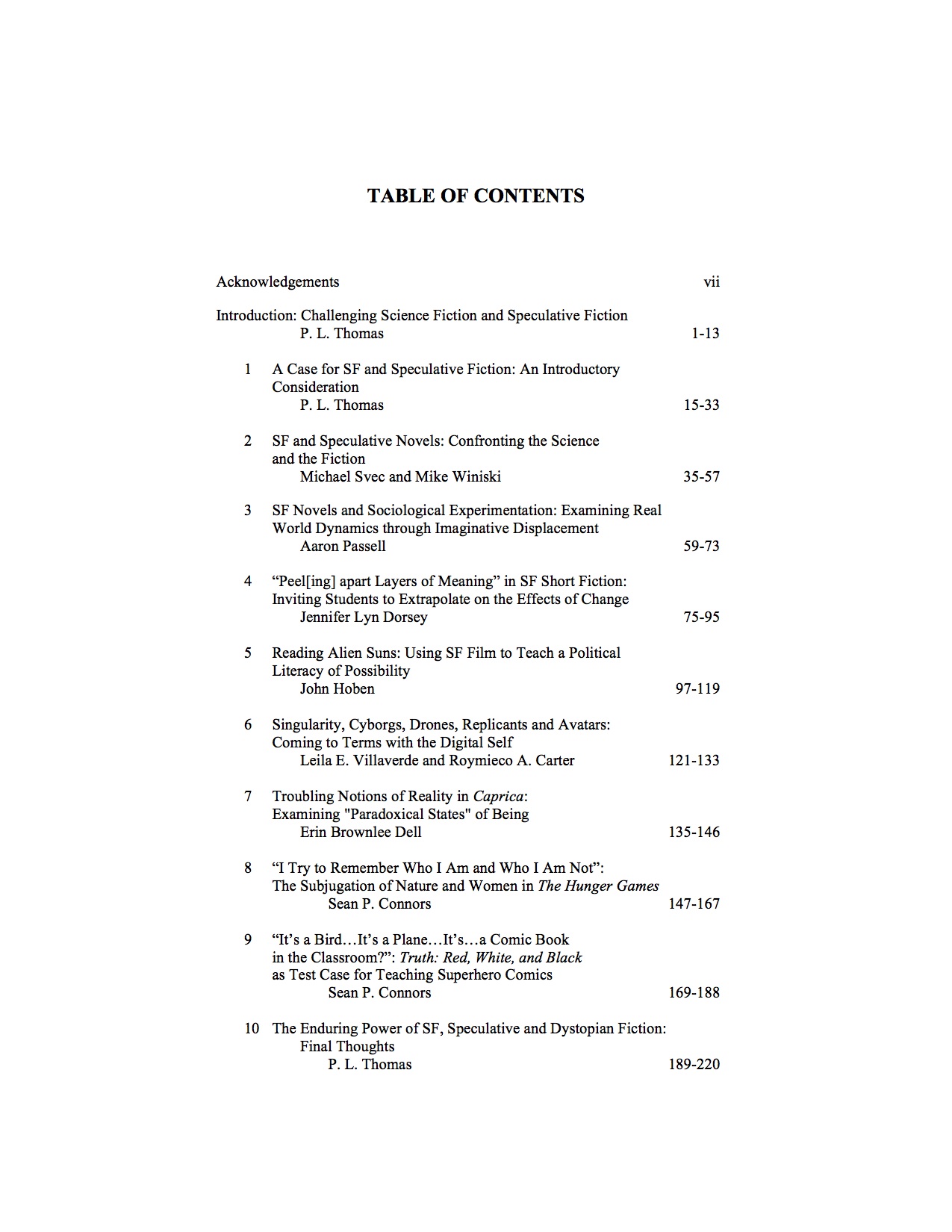
IN PRESS: Science Fiction and Speculative Fiction (Sense)

 dr. p.l. (paul) thomas