
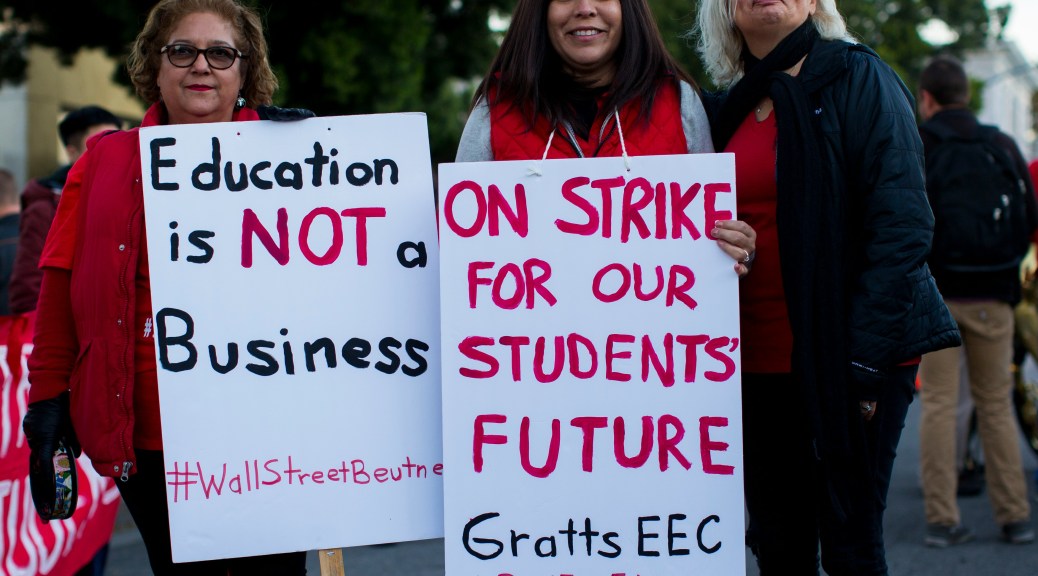
Click to access: 2/24/2024 Open Letter to SC Educators, Diane Stephens
All posts by plthomasedd
Responses Needed to Senator Cassidy’s Report on Literacy
U.S. Senator Bill Cassidy, M.D. (R-LA) has released a report on literacy that opens with yet another example of misrepresenting NAEP reading scores to manufacture a reading crisis for political gain: “Two-thirds of America’s fourth and eighth graders are not proficient in reading.”
The report is an embarrassing recycling of the media misinformation campaign about reading in the US.
In fact, most of the footnotes cite news articles (including the Washington Times, a conservative outlet that lacks credibility) and conservative think tanks (ExcelinEd, Fordham). [1]
Notably missing are citations to scientific research on reading or credible analyses of NAEP data.
Responses are needed and can be sent to Literacy@help.senate.gov by April 5, 2024.
Here is my response:
I am very disappointed in this report, notably since it starts with misinformation about NAEP: https://www.help.senate.gov/imo/media/doc/literacy_report.pdf
The report is deeply flawed and relies on misleading and false journalism (footnotes) to support misleading and inaccurate claims:
How Media Misinformation Became “Holy Text”: The Anatomy of the SOR Movement
Good intentions are not enough and government policy on education has done more harm than good since A Nation at Risk. We can do better, and we should. But we must start with accurate claims and credible solutions.
Big Lies of Education: Reading Proficiency and NAEP
Big Lies of Education: A Nation at Risk and Education “Crisis”
Stop using misinformation and crisis rhetoric for political gain [2] and genuinely address what students and teachers need to be successful.
US Senate Committee on Health, Education, Labor, and Pensions

[1] Analysis of 33 footnotes for the report:
Preventing a Lost Generation: Facing a Critical Moment for Students’ Literacy
Senator Bill Cassady, MD, Ranking Member
US Senate Committee on Health, Education, Labor, and Pensions
NAEP/PISA Data/ Government Reports
National Achievement-Level Results, National Assessment of Educational Progress (Oct. 24, 2022), https://www.nationsreportcard.gov/reading/nation/achievement/.
National Achievement-Level Results, The National Assessment of Educational Progress (Oct. 24, 2022), https://www.nationsreportcard.gov/reading/nation/achievement/.
Trends in High School Dropout and Completion Rates in the United States, National Center for Education Statistics (Jan. 2020), https://nces.ed.gov/programs/dropout/index.asp.
Thomas G. Sticht, Vice President, Basic Skills in Defense, Human Resources Research Organization (June 1982), https://files.eric.ed.gov/fulltext/ED237776.pdf.
Scores Decline in NAEP Reading at Grades 4 and 8 Compared to 2019, National Assessment of Educational Progress (Oct. 24, 2022), https://www.nationsreportcard.gov/highlights/reading/2022/
NAEP Report Card: 2019 NAEP Reading Assessment, National Assessment of Educational Progress (2019), https://www.nationsreportcard.gov/highlights/reading/2019/g12/.
NAEP Long-Term Trend Assessment Results: Reading and Mathematics, National Assessment of Educational Progress (Sept. 1, 2022), https://www.nationsreportcard.gov/highlights/ltt/2022/.
Program for International Student Assessment 2022 Results, Organization for Economic Cooperation and Development (Dec. 5, 2023), https://www.oecd.org/publication/pisa-2022-results/.
AEP Report Card: Reading State Achievement-Level Results, National Assessment of Educational Progress (Oct. 24, 2022), https://www.nationsreportcard.gov/reading/states/achievement/.
Teaching Children to Read: An Evidence-Based Assessment of the Scientific Research Literature on Reading and Its Implications for Reading Instruction, National Reading Panel (Apr. 2000), https://www.nichd.nih.gov/sites/default/files/publications/pubs/nrp/Documents/report.pdf.
National Achievement-Level Results, National Assessment of Educational Progress (Oct. 24, 2022), https://www.nationsreportcard.gov/reading/nation/achievement/.
NAEP Long-Term Trend Assessment Results: Reading and Mathematics, National Assessment of Educational Progress (Sept. 1, 2022), https://www.nationsreportcard.gov/highlights/ltt/2022/.
Joint Dear Colleague Letter, U.S. Department of Education Office for Civil Rights (Jan. 8, 2014), [LINK OMITTED, apparent error]
Resource on Confronting Racial Discrimination in Student Discipline, U.S. Department of Education Office for Civil Rights (May 2023), https://www.justice.gov/opa/press-release/file/1585291/dl?inline.
Think Tank/Advocacy Reports
Donald J. Hernandez, Professor, Double Jeopardy: How Third-Grade Reading Skills and Poverty Influence High School Graduation, The Annie E. Casey Foundation (2012), https://assets.aecf.org/m/resourcedoc/AECF-DoubleJeopardy-2012-Full.pdf.
Anthony P. Carnevale et al., Director and Research Professor, Recovery: Job Growth and Education Requirements Through 2020, Georgetown Public Policy Institute – Center on Education and the Workforce (June 2013), https://cewgeorgetown.wpenginepowered.com/wp-content/uploads/2014/11/Recovery2020.FR_.Web_.pdf
Economic Impacts of Dropouts. National Dropout Prevention Center (n.d.), https://dropoutprevention.org/resources/statistics/quick-facts/economic-impacts-of-dropouts/.
Erin Fahle et. al, Research Scientist, The First Year of Pandemic Recovery: A District-Level Analysis, The Harvard University Center for Education Policy and Research & The Educational Opportunity Project at Stanford University (Jan. 2024), https://educationrecoveryscorecard.org/wp-content/uploads/2024/01/ERS-Report-Final-1.31.pdf.
Why The Three-Cueing Systems Model Doesn’t Teach Children to Read, Excel in Ed (2022), https://excelined.org/wp-content/uploads/2022/12/ExcelinEd_FactSheet_ThreeCueingDoesNotTeachChildrenToRead.pdf.
2023 Voice of the Superintendent Survey Executive Brief, EAB (Feb. 16, 2023), https://pages.eab.com/2023SuperintendentSurveyExecutiveBrief.html.
Daniel Buck, Soft-on-Consequences Discipline Is Terrible For Teachers, Thomas B. Fordham Institute (Feb. 9, 2023), https://fordhaminstitute.org/national/commentary/soft-consequences-discipline-terrible-teachers.
Max Eden, The Trouble with Social Emotional Learning, House Committee on Appropriations – Labor, Health and Human Services, Education, and Related Agencies (Apr. 6, 2022) AEI, https://www.aei.org/research-products/testimony/the-trouble-with-social-emotional-learning/.
Chronic Absenteeism: 2017-2023, Return2Learn Tracker (Oct. 23, 2023), https://www.returntolearntracker.net/.
Media
Micaela Burrow, Army Qualification Test Scores Plummeted Further In 2022, Daily Caller. (Sept. 16, 2022). https://dailycaller.com/2022/09/16/army-qualification-scores-plummeted-2022/.
April Rubin, ACT Test Scores Fall to Lowest Levels in 32 Years, Axios (Oct. 11, 2023), https://www.axios.com/2023/10/11/act-test-scores-lowest-2023.
Matt Barnum & Kalyn Belsha, Blizzard of State Test Scores Shows Some Progress in Math, Divergence in Reading, Chalkbeat (Oct. 2, 2023), https://www.chalkbeat.org/2023/10/2/23896045/state-test-scores-data-math-reading-pandemic-era-learning-loss.
Linda Jacobson, Science of Reading Push Helped Some States Exceed Pre-Pandemic Performance, The 74 Million (Oct. 17, 2023), https://www.the74million.org/article/science-of-reading-push-helped-some-states-exceed-pre-pandemic-performance/.
Liana Loewus, Data: How Reading Is Really Being Taught, Education Week (Dec. 3, 2019), https://www.edweek.org/teaching-learning/data-how-reading-is-reallybeing-taught/2019/12.
Sarah Schwartz, Teachers College to ‘Dissolve’ Lucy Calkins’ Reading and Writing Project, Education Week (Sept. 5, 2023), https://www.edweek.org/teaching-learning/teachers-college-to-dissolve-lucy-calkins-reading-and-writing-project/2023/09.
Sarah Schwartz, Reading Recovery Sues Ohio Over Ban on ‘Cueing’ in Literacy Instruction, Education Week (Oct. 18, 2023), https://www.edweek.org/teaching-learning/reading-recovery-sues-ohio-over-ban-on-cueing-in-literacy-instruction/2023/10.
Susan Ferrechio, Teachers Unions Worked with CDC to Keep Schools Closed for COVID, GOP Report Says, The Washington Times (Mar. 30, 2022), https://www.washingtontimes.com/news/2022/mar/30/republican-report-shows-teachers-unions-helped-cdc/.
Sarah D. Sparks, Two Decades of Progress, Nearly Gone: National Math, Reading Scores Hit Historic Lows, Education Week (Oct. 24, 2022), https://www.edweek.org/leadership/two-decades-of-progress-nearly-gone-national-math-reading-scores-hit-historic-lows/2022/10.
Arianna Prothero, Student Behavior Isn’t Getting Any Better, Survey Shows, Education Week (Apr. 20, 2023), https://www.edweek.org/leadership/student-behaviorisnt-getting-any-better-survey-shows/2023/04.
Sarah Mervosh, Who Runs the Best U.S. Schools? It May Be the Defense Department., The New York Times (Oct. 10, 2023), https://www.nytimes.com/2023/10/10/us/schools-pandemic-defense-department.html.
Commercial Blogs
TPT Survey Report: What 2,000+ Teachers Think About SEL, Teachers Pay Teachers (May 2022), https://blog.teacherspayteachers.com/tpt-survey-report-what-2000-teachers-think-about-social-emotional-learning/.
[2] See:
A school for students with dyslexia continues to stay open despite two F grades from the BESE, Louisiana’s Board of Elementary and Secondary Education. The Louisiana Key Academy is run by Senator Bill Cassidy (R-LA) and his wife, Laura. Both are physicians. Neither are specialists in reading disorders, although they have a child with dyslexia.
Big Lies of Education: Reading Proficiency and NAEP
Update February 2026
Major Changes Coming to the NAEP Reading Assessment, Tom Loveless
Some Big Lies of Education start with journalists (even at the biggest of media outlets).
“One of the most bearish statistics for the future of the United States is this: Two-thirds of fourth graders in the United States are not proficient in reading,” wrote Nicholas Kristof in The New York Times.
Kristof’s piece in 2023 can be traced back to a similar claim by Emily Hanford in 2018: “More than 60 percent of American fourth-graders are not proficient readers, according to the National Assessment of Educational Progress, and it’s been that way since testing began in the 1990s,” including a surprisingly ineffective graphic:

The student reading proficiency Big Lie grounded in misrepresenting or misunderstanding NAEP is likely one of the most complicated Big Lies of Education.
In media and political rhetoric, first, the terms “reading proficiency” and “grade level reading” are commonly jumbled and used inappropriately as synonyms.
Achievement levels such as “basic” and “proficient,” used in NAEP for reading, are misleading and complicated for most people not familiar with technical terminology.
NAEP “basic” is approximately grade level (although even that claim is problematic since no standard exists in the US for “proficient” or “grade level”), and “proficient” on NAEP is high:

NAEP testing and data are normative, measuring what a general population is achieving (not individual students), and as noted above, NAEP “proficient” is aspirational.
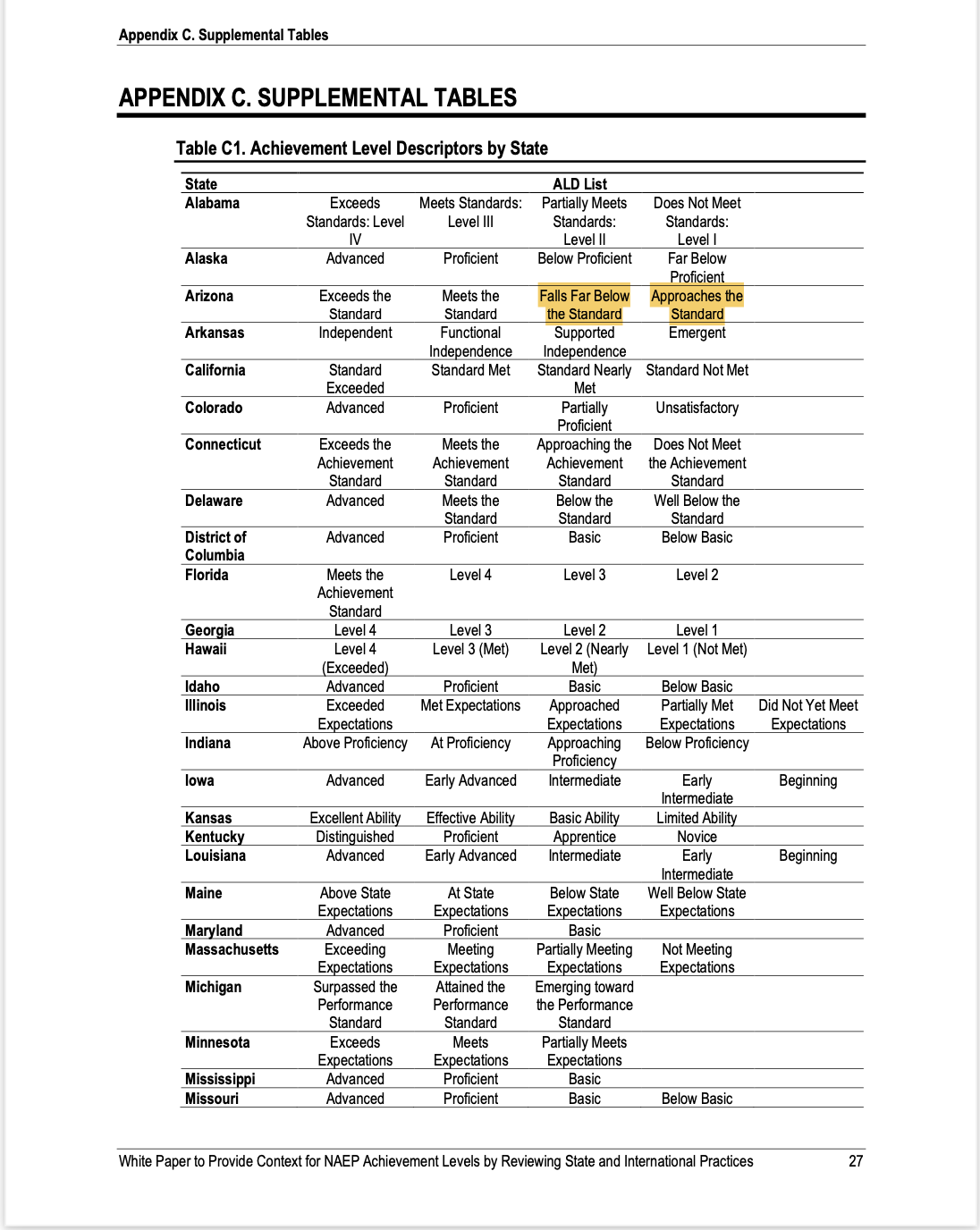
State accountability testing is measuring individual achievement, and states tend to use “proficient” as a measure that falls in the “basic” range of NAEP, suggesting that state-level proficient is “grade level” approximate or at least what most student should be able to achieve at that grade [1]:

Hanford’s and Kristof’s Big Lie, then, is a combination of blurring NAEP achievement levels with grade level reading achievement and manufacturing a reading crisis with that misinformation.
Ironically, NAEP grade 4 reading scores for a decade show that 2/3 of students are reading at or above grade level, the inverse of the false crisis claims of the media:

The Big Lie about reading proficiency and NAEP help perpetuate the Big Lie about educational crisis, but it also masks the more complicated truths: the US has no standard metric for assessing the national reading achievement of students, and focusing on manufactured reading crises distracts reformers from addressing what we can identify—inequitable access to reading proficiency among minoritized and marginalized populations of students.
I recommend the following to understand the essential failure, the Big Lie, of using NAEP to manufacture a crisis around reading proficiency in the US:
Media Misrepresentations of NAEP
- Hanford, E. (2018, September 10). Hard words: Why aren’t kids being taught to read? APM Reports. https://www.apmreports.org/episode/2018/09/10/hard-words-why-american-kids-arent-being-taught-to-read
- Kristof, N. (2023b, February 11). Two-thirds of kids struggle to read, and we know how to fix it. New York Times. https://www.nytimes.com/2023/02/11/opinion/reading-kids-phonics.html
Understanding NAEP
- Loveless, T. (2016, June 13). The NAEP proficiency myth. Brookings. https://www.brookings.edu/blog/brown-center-chalkboard/2016/06/13/the-naep-proficiency-myth/
- Loveless, T. (2023, June 11). Literacy and NAEP proficient (Web log). https://tomloveless.com/posts/literacy-and-naep-proficient/
- Rosenberg, B. (2004, May). What’s proficient? The No Child Left Behind Act and the many meanings of proficiency. Washington, DC: American Federation of Teachers. https://files.eric.ed.gov/fulltext/ED497886.pdf
- Scale scores and NAEP achievement levels. (2021). National Center for Educational Statistics. https://nces.ed.gov/nationsreportcard/guides/scores_achv.aspx#achievement
- White Paper to Provide Context for NAEP Achievement Levels by Reviewing State and International Practices, Behuniak and Way (Feb 2022)
- A History of NAEP Achievement Levels: Issues, Implementation, and Impact 1989–2009, Mary Lyn Bourque (Mar 2009)
- Fact Check: Linda McMahon’s claim that 70% of 8th-graders ‘can’t read proficiently’ lacks a bit of reading comprehension (Snopes)
- Thomas, P.L. (2025, July 28). There is no literacy crisis in the U.S. Here’s what’s really happening. The Washington Post. https://wapo.st/474j758
[1] State achievement level descriptors (ALD) vary greatly:


Big Lies of Education: Series

Series
Big Lies of Education: A Nation at Risk and Education “Crisis”
Big Lies of Education: Reading Proficiency and NAEP
Big Lies of Education: National Reading Panel (NRP)
Big Lies of Education: Poverty Is an Excuse
Big Lies of Education: International Test Rankings and Economic Competitiveness
Big Lies of Education: Grade Retention
Big Lies of Education: Growth Mindset and Grit
Big Lies of Education: Word Gap
Big Lies of Education: Miracle Schools
Big Lies of Education: “Science of” Era Edition [Access PP PDF Here]
One-Time
Monthly
Yearly
Make a one-time donation
Make a monthly donation
Make a yearly donation
Choose an amount
$5.00
$15.00
$100.00
$5.00
$15.00
$100.00
$5.00
$15.00
$100.00
Or enter a custom amount
$
Your contribution is appreciated.
Your contribution is appreciated.
Your contribution is appreciated.
DonateDonate monthlyDonate yearly
Big Lies of Education: A Nation at Risk and Education “Crisis”
Some Big Lies of Education start with politicians (even the biggest of politicians).
“And please abolish that abomination, the Department of Education,” implored Ronald Reagan as he established his goals for the committee charged with producing A Nation at Risk (1983). Reagan sought to shift the public’s support from public schools to school choice as well as, in his misguided words, return prayer to schools.
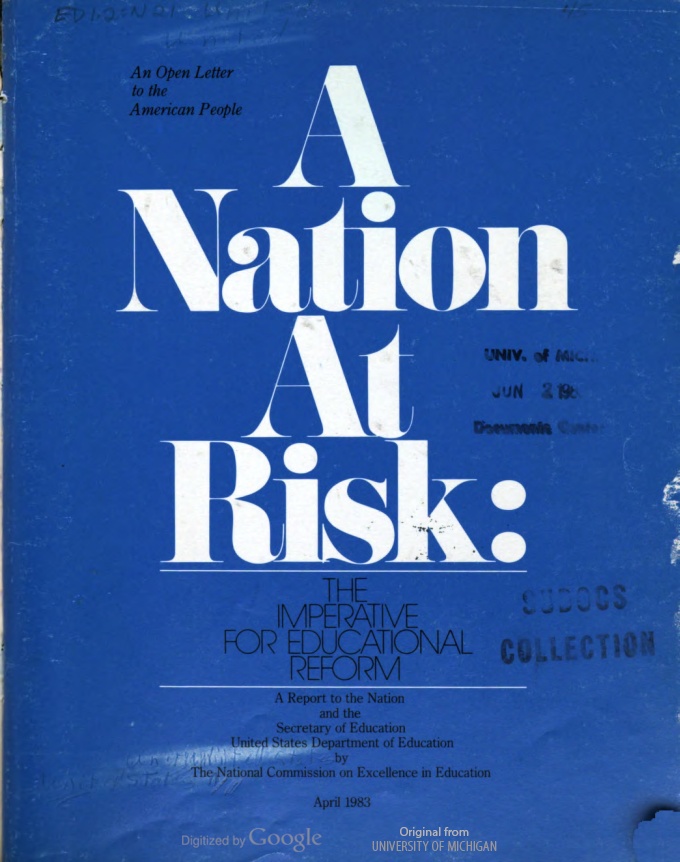
A Nation at Risk represents two important aspects of US education reform.
First, as noted by several scholars and committee members, the charge of the committee was primarily about partisan politics and not about substantive education reform.
Second, the report established the manufactured “crisis,” which is eagerly perpetuated by mainstream media, as the basis for decades of accountability-based reform that has resulted in an unproductive cycle of crisis/reform that never accomplishes any effective change for students, teachers, public education, or democratic society.
The narrative created by A Nation at Risk has none the less some enduring elements that are uncritically supported by mainstream media (complicit in the Big Lie):
- Educational failure is grounded in the educational system itself, and thus, education reform has been in-school-only reform policies.
- Identifying systemic societal, community, and home influences on measurable student learning is rejected as using poverty/inequity as an “excuse.”
- Teachers are simultaneously the most important factor in education and the agents of failure due to poor training and/or low expectations for marginalized student populations.
- The rhetoric is grounded in crisis/miracle binary and the primary evidence for those claims are standardized tests (mostly state-level accountability testing and NAEP).
- Policies tend to be one-size-fits all solutions to overstated and unsupported problems.
Edling (2015) has identified similar patterns grounded in media rhetoric resulting in education policy internationally:
• Viewing education as being in more or less permanent crisis
• Taking the role as a spokesperson for teachers and on behalf of the field of education
• Excluding the knowledge and experiences of teacher(s), educators and/or educational researchers in the public press
• Simplifying the notion of being a good teacher through stereotypes and dualistic frameworks that overlook task and relational complexity.
Edling, S. (2015). Between curriculum complexity and stereotypes: Exploring stereotypes of teachers and education in media as a question of structural violence. Journal of Curriculum Studies, 47(3), 399-415. https://doi.org/10.1080/00220272.2014.956796
The template established by A Nation at Risk can bee seen in every reform movement since the 1980s, first at the state level and then at the national level with No Child Left Behind (NCLB).
From the standards and testing reforms in the 1980s and 1990s to the charter schools and value-added methods for teacher evaluation under Obama and to today’s “science of reading” (SOR) movement, the essential elements noted above characterize the obsession in the US with crisis/reform in education with no real change ever accomplished.
Ironically, neither the claims of educational crisis nor the reforms proposed throughout the past five decades have been grounded in credible evidence.
A Nation at Risk established the manufactured crisis approach to education reform, which has created only political and market profits for those driving the crisis rhetoric and the reforms.
I recommend the following to understand the essential failure, the Big Lie, of A Nation at Risk as a template for crisis/education reform in the US:
- Berliner, D. C., & Biddle, B. J. (1997). The Manufactured Crisis: Myths, fraud, and the attack on America’s public schools. Longman.
- Bracey, G. W. (2003). April foolishness: The 20th anniversary of A Nation at Risk. Phi Delta Kappan, 84(8), 616-621.
- Edling, S. (2015). Between curriculum complexity and stereotypes: Exploring stereotypes of teachers and education in media as a question of structural violence. Journal of Curriculum Studies, 47(3), 399-415. https://doi.org/10.1080/00220272.2014.956796
- Harvey, J. (2023, May 5). Gaslighting Americans about public schools: The truth about ‘A Nation at Risk.’ The Answer Sheet. The Washington Post. https://www.washingtonpost.com/education/2023/04/26/how-nationatrisk-report-hurt-publicschools/
- Holton, G. (2003, April 25). An insider’s view of “A Nation at Risk” and why it still matters. The Chronicle Review, 49(33), B13.
- Kamenetz, A. (2018, April 29). What ‘A Nation At Risk’ got wrong, and right, about U.S. schools. NPR. https://www.npr.org/sections/ed/2018/04/29/604986823/what-a-nation-at-risk-got-wrong-and-right-about-u-s-schools
- Thomas, P.L. (2015). Ignored under Obama: Word magic, crisis discourse, and utopian expectations. In P. R. Carr & B. J. Porfilio (Eds.), The phenomenon of Obama and the agenda for education: Can hope (still) audaciously trump neoliberalism? (pp. 45-68). Charlotte, NC: Information Age Publishing.
- Forty Years of Failure: When Caricature Drives Education Reform in Post-Truth America

TG2: Student Evaluations of Teaching in Higher Education Fail Everyone

Only Monsters Attack Libraries and Books
[Header Photo by Jen Theodore on Unsplash]
One of the most powerful texts I use in teaching writing is the Prologue to Louise DeSalvo’s memoir, Vertigo.
We read only the first page, but it is charged with purposeful writing and engaging storytelling of a young woman fleeing the angers of her home and seeking sanctuary:

The narrative voice of DeSalvo as an adult, a Virginia Woolf scholar, echoing herself at thirteen helps establish that tension, that dichotomy—an emotionally unsafe home contrasted with the “welcoming lights a few blocks away,” the library.
This memoir is one of trauma, but DeSalvo develops a motif of the sanctuary that libraries and books offer her throughout her life.
Her life story challenges the idealizing of family and the demonizing of schools, libraries, books, and frankly, education.
Not as dramatically but similar to DeSalvo, my own life story is one of breaking free of the intellectual and ethical shackles of my home where racism and other bigotries were the norm; like DeSalvo’s experiences, my sanctuaries were school and books, and education.
I had a former friend and colleague who died relatively recently, and I will carry with me always his telling me that he had an argument with his father once about how the two of them had diverged dramatically in beliefs and ideologies. His father shouted that his greatest regret was sending his son to college.
That fills me with a tremendous sadness, and I also feel fortunate because despite the same dynamic in my family with my parents—I am dramatically unlike them in beliefs and ideology—my parents, now deceased, always encouraged my books, my thinking, my learning, and my education.
In fact, my father often stopped strangers to tell them I earned my doctorate, a thing both embarrassing and heart warming.
It is 2024. And the world is filled with monsters:
On Monday, bill sponsor Del. Brandon Steele, R-Raleigh, called for support of his legislation in a fiery speech, in which he said libraries were “the sanctuary for pedophilia” where people needed to be held accountable for exposing children to obscene content.
“I’m voting to protect children from being groomed and targeted by pedophiles and get rid of the sanctuary that was set up in our code 25 years ago,” Steele said to members of the House Committee on the Judiciary.
He continued, “If it’s a crime in the parking lot, it’s a crime in the building — period. I hope the chilling effect chills the pedophiles. We’re not going to create a safe space for them.”
West Virginia House to Vote on Bill That Could Lead to Librarians Facing Jail Time
The culture wars in the US have taken an ugly turn, and the core of those battles is that tension between the family and the child as well as the ways in which every child can and should find their true Self often masked by the expectations of that home life.
As adults, most of us have experienced that break, that necessary journey that includes disagreeing with our parents, seeing that who we are is not the same as who our parents want us to be.
Sometimes it is ideology, sometimes it is sexuality, sometimes it is gender.
These tensions, these breaks are none the less difficult and even painful.
I was talking with a colleague about the ways in which education, especially higher education, is often popularly and falsely characterized as institutions of indoctrination. The dynamic is actually very similar to DeSalvo’s opening story in her memoir.
For many college students, college is a first major opportunity to be free of home expectations, a place to not only explore who they truly are but a place to discover who they are or want to be.
If a young person seems to suddenly be a different person, parents and the public may misinterpret that as college or professors causing the change. What is more likely is that college is the place where young people have the first opportunity to express that true Self.
Exposure to new or different ideas, in fact, are not necessarily what causes anyone to change who they are, but allows people to see who they are.
Ironically, places that indoctrinate and groom children the most are their homes and their churches—the sources today of those most likely to accuse others of indoctrination and grooming.
Also ironically, universal public education was a foundational commitment (ideologically well before afforded everyone) of the US because being educated was recognized as necessary for a democracy and individual freedom.
There is a little parable by Haruki Murakami. In it, the manufactured terrors by conservatives seem to come true. A boy finds himself imprisoned in a labyrinthine library, confronting a horrifying fate:
The sheep man cocked his head to one side. “Wow, that’s a tough one.”
“Please, tell me. My mother is waiting for me back home.”
“Okay, kid. Then I’ll give it to you straight. The top of your head’ll be sawed off and all your brain’ll get slurped right up.”
I was too shocked for words.
“You mean,” I said, when I had recovered, “you mean that old man’s going to eat my brains?”
“Yes, I’m really sorry, but that’s the way it has to be,” the sheep man said, reluctantly.
The Strange Library
Murakami’s brief Kafkan nightmare, it seems, parallels what some people believe is a reality of libraries—a place where the brains of children are eaten.
The Strange Library is a sort of twisted fantasy, fitting into the tradition of children’s fears like the belief that a monster lurks under your bed or in your closet.
State representatives attacking libraries and books—that is no twisted fantasy. It is real and it is wrong.
Only monsters attack libraries and books.
And they aren’t hiding under our beds or in our closets.
They are elected officials filing bills and making outrageous pronouncements.
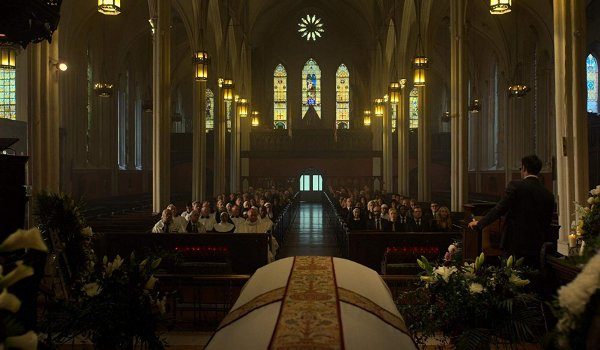
We have been rewatching the Daredevil series that ran for three seasons on Netflix. In the season 3 and series finale, Matt Murdock (Daredevil) gives a eulogy for Father Paul Lantom, Murdock’s surrogate father after his father’s death:
For me, personally, he spent many years trying to get me to face my own fears. To understand how they enslaved me, how they divided me from the people that I love. He counseled me to transcend my fears, to be brave enough to forgive and see the possibilities of being a man without fear. That was his legacy. And now it’s up to all of us to live up to it.
A New Napkin (S3 E13)
Culture wars are mostly about fear, but the worst thing about them is that they are about irrational fears, manufactured horrors.
Libraries and books are sanctuaries, not labyrinths where children have their brains eaten.
Once Murdock embraced being the man without fear, he became Daredevil, a superhero, a person who saves those in need. And by assuming this alter-ego, he found his true Self.
Fear of libraries, books, education, and knowledge is a fear of our Selves, our true Selves.
Only monsters attack libraries and books.
Update
West Virginia House passes bill allowing prosecution of librarians

US Education Reform as Industry: The Problem, Not the Solution
[Header Photo by Natasha Hall on Unsplash]
US education reform is an industry.
Simply put, since Ground Zero under the Reagan administration, A Nation at Risk, the US has experienced a constant cycle of education crisis followed by the same template for education reform.
Despite some of the actors in this reform process having good intentions, education reform has been driven primarily by those reaping political and financial rewards from those perpetual reform cycles.
In fact, the political and financial incentives for reform are not improving education, but simply waiting a few years for the crisis/reform cycle to be re-initiated.
This is a capitalism.
Owning a new car, for example, is the lifeblood of the car industry—not producing a car that serves the owner well for decades.
This is consumerism, the dirty underbelly of capitalism.
There is no distinction, then, in the US between public institutions grounded in service and the free market.
For over forty years, the US has been trapped in the foundational Lie of A Nation at Risk, a partisan report that Reagan manufactured in order to break the public’s support for public education, and as Reagan’s own marching orders revealed, to shift that support to school choice and return prayer to the classroom (the latter being one of the ugliest political lies since voluntary prayer is allowed in public schools, while forced prayer is restricted).
Regardless of the reform of the moment—charter schools, teacher evaluation, school choice, accountability, reading legislation, standards and testing, etc.—the ideology and claims remain constant: students are failing, teachers are failing, and public schools are failing.
Also consistent is a paradoxical lack of credible evidence for the claims—either for the crisis or the solutions.
Decades of charter school advocacy have been devoid of carefully unpacking that outcomes for private, public, and charter schools are essentially the same, mostly grounded in the population of students being served.
Yet, charter school advocates decry traditional public school in crisis and charter schools are miracles.
The teacher evaluation movement grounded in value added methods of evaluation also produced a stunning outcome, showing that teacher quality’s impact on student achievement remains minor, only about 1-14% as measured in testing. Concurrently, research for decades have shown that out-of-school (OOS) factors remain the dominant causal influence on learning, 60% and higher.
There is enormous political and financial profit in shouting educational crisis and promising educational miracles, but that profit also depends on the rest of us not engaging with the lack of credible evidence for both.
The current mania to reform reading is yet another cycle grounded in a manufactured crisis (easily shown to be a false claim based on the data critics use) and equally manufactured and false miracles, such as Mississippi and Florida.
Perpetual reading reform may be the best (or worst) example of education reform as industry since reading is a foundational and incredibly important aspect of education for children; further, reading instruction in the US has been fatally linked to reading programs—commercial reading programs.
It would seem that eventually we could admit that no reading program (despite all of them being marketed as research-based) has led to a nation satisfied with reading proficiency in student.
It would seem that eventually we could admit that reading programs are neither the problem nor the solution for reading proficiency.
The only value in reading programs is political or financial; and both depend on constantly replacing old programs with new programs (again, this is the car industry).
Frankly, what remains absent in education reform narratives about crisis and miracles is confronting the conditions in which students and teachers live and learn/teach.
Low and so-called delayed reading proficiency remains mostly among students facing tremendous inequities in the lives and education.
High-poverty and minority-majority neighborhoods and schools present students and teachers with barriers to learning and teaching that are immune to simply adopting a new reading program, or demanding that those teachers be retrained (again).
Constant teacher retraining is also an industry.
If you can pause, step back, and genuinely examine this round of reading reform, many, if not most, of the strongest advocates for new reading programs and teacher training are profiting politically and/or financially.
Ironically, those advocates have spent a great deal of energy demonizing the reading programs they want to replace as sources of enormous profit.
As I have argued for decades, the problems are not programs or necessarily even instructional theories, but our failure to invest in social and educational systems that are equitable.
It is not that any reading program so far has failed because of the program itself; the failure is hyper-focusing on programs and instruction without regard to the systemic forces in society and schools that remain significant barriers to student and teacher success.
States are dumping huge amounts of tax payers’ money—$100 million a year is a recurring price tag—into doing the exact same reading reform committed to just a couple decades ago under NCLB.
In fact, reading programs that have been identified in research as failing are now being mandated in states across the US.
Even more frustrating is that early research on states having already committed to reading program shuffling reveals significant problems with that implementation—erasing text diversity and de-professionalizing teachers.
Yet, who benefits from another round of program shuffling?
Politicians grandstanding and commercial reading program companies.
When I explain to people that they likely would be better off not buying a new car with that concurrent loan and monthly payments or at least acknowledging that choosing between an Accord or Camry is no real choice at all, I generally get smirks or soft nods.
When I argue that education reform is an industry, I am personally attacked, often with lies and anger.
To me this suggests we have far more people invested in perpetual education reform in the US than even our precious fetish for new cars.
That’s a damn shame.
A goddamn shame.
The cost is our democracy, not just the lives and liberty of our children—although it is hard to imagine anything more important than that for a people claiming to be committed to freedom.
A people hiding behind flags and freedom in hope of cashing in.

What We Talk about When We Talk about Reading
In my work as a public educator/scholar, I have had conversations with dozens of people seeking to understand education issues and topics because they are not themselves educators or are not literacy educators.
Yesterday, I had such a conversation for over an hour, discussing the issue of reading in my state in the context of the “science of reading” (SOR) movement.
During that discussion, a key point was made about how debates about reading proficiency of students and teaching reading are often absent nuance—and that the nuance itself is part of the problem with finding effective reform.
Like all states in the US (although at an extreme level), my home state of South Carolina has been an early and eager education reform state, including multiple iterations of reading legislation reform.
Also like most states, SC education and reading reform has been a constant cycle of crisis and new reform. We seem to refuse to acknowledge that reform itself is need of reform because so far the reform never works (or we wouldn’t need the next round of reform).
None the less, since we seem committed to shouting reading crisis every few years in order to justify yet more reading reform, this round of reading crisis serves as a powerful example of how the rhetoric around discussing reading proficiency and teaching reading is fraught with miscommunication and often unnecessary antagonism because of basic misunderstandings or problematic clarifications.
At the broadest level, what we mean by “reading” is an essential part of the conversation.
Particularly in the SOR era, there is a spectrum of what counts as “reading” for beginning readers that has on one extreme the ability to pronounce words absent meaning (such as nonsense words), and then on the other extreme, students being able to create meaning from a text without decoding (walking through a picture book and recreating the story either from memory or using the pictures).
Somewhere in the middle of that spectrum is, I think, what we should be talking about when we talk about reading—a student’s ability to eagerly and critically produce meaning from text grounded in automatic word recognition.
However, what greatly complicates how we talk about “reading” is that discussion often relies on (what should be) technical language.
Media, public, and political rhetoric around reading tends to use for “reading” both “reading proficiency” and “grade level reading.” Rarely, those two terms are used distinctly, but more often than not, they are tossed around as synonymns.
Here is a serious concern as I have noted often.
First, we have no standard metric of “proficient” or “grade level” at the federal or state level, and there is little understanding about how “proficient” is often an aspirational metric that is well above “grade level” (for example, NAEP achievement levels in which “basic” is approximately grade level).
Next, we have no clarification in the US about what percentage of students can or should be at whatever level we agree on and at what grade. [Note that I would add another issue is that we prefer “grade level” to “age level,” the latter being in my opinion a better metric.]
This, then, leads to another significant aspect of the current SOR movement; when we talk about reading, we often talk about what percentage of students are reading appropriately (?) at certain designated grades, often grade 3 or 4.
A claim made by SOR advocates helps show how this is a problem since many of them promise that 90-95% of students can be proficient readers.
Setting aside that this is a speculative claim and not a statistic supported by a valid body of science, the 90-95% argument often isn’t a clear one in terms of when.
Does that mean 90-95% of students can eventually become proficient readers or grade level readers, or that 90-95% of students can be proficient or at grade level in every single grade throughout schooling?
I think those questions are essential clarifications to address.
Among other elements of reading wars and education/reading reform, I think what we talk about when we talk about reading needs to be addressed in ways that clarify the elements noted above.
We need standard definitions for “reading,” “reading proficiency,” and “grade level reading”; we also should strongly consider replacing “grade level” with “age level” (to alleviate that distorting impact of policies such as grade retention on standardized measures of reading).
And we also need a national conversation about what are reasonable and aspirational goals for what percentage of students meet those metrics and when.
We seem to have ignored a key lesson and failure of NCLB—mandating 100% of students achieve proficiency by 2014. In other words, aspirational mandates doom reform to failure and erase any possibility that we do in fact reform reading policy in the best interests of students (and not the adults who profit in the debate and reform).
We all must do better to acknowledge what we talk about when we talk about reading—or we are destined to remain trapped in the crisis/reform cycle that hasn’t served anyone well (except for the profiteering) for over forty years.
Note
The title is a reference to a title that is a reference. Haruki Murakami’s What I Talk About When I Talk About Running, which is inspired by Raymond Carver’s What We Talk About When We Talk About Love.

“Science of Reading” Playing Numbers Games Not Supported by Science
Although my book publishing career includes a couple works from 2001, I consider my first “real” book a volume from 2004, Numbers Games: Measuring and Mandating American Education.
I wrote a brief piece for a colleague at the time that she included in a book she was working on for Peter Lang USA under the guidance of Joe Kincheloe. Joe asked her if I could write a book for Lang based on that passage.
Kincheloe was a kind and generous scholar who launched my official scholarly career, although I had been writing seriously for two decades before we met.
Five years later, 2009, I co-authored 21st Century Literacy: If We Are Scripted, Are We Literate?, another work supported by Kincheloe.
Here in 2024, I am somewhat discouraged that I find reason to mention those works since, it appears, the evidence and arguments included in both fell on deaf ears, specifically with the widespread adoption of “science of reading” (SOR) legislation blanketing the US.
Many advocates and legislators have completely caved on teacher autonomy as state after state is mandating scripted reading programs based on false stories in the media that misrepresent teacher expertise about reading and a reading crisis.
At the core of the SOR movement, then, is the pernicious use of numbers games.
A foundational example I have addressed often is the misrepresentation of NAEP reading scores to declare that 60% (the seminal claim of Emily Hanford) or 2/3 of students are not proficient readers and/or not reading at grade level (see dozens of media articles such as one by Nicholas Kristof).
This numbers shell game is based in the misleading use of “proficient” by NAEP as well as the combination of ignorance about those achievement levels and willful ignorance about those achievement levels (see I. here about the NAEP Big Lie).
The NAEP numbers game is frustrating because the claim shuffles “not proficient” and “not on grade level” while literally inverting the valid claim based on NAEP. In fact, for 30 years, NAEP grade 4 reading data show that about 60%+ of students are reading at grade level and above since NAEP “basic” (not “proficient”) is equivalent to grade level reading:
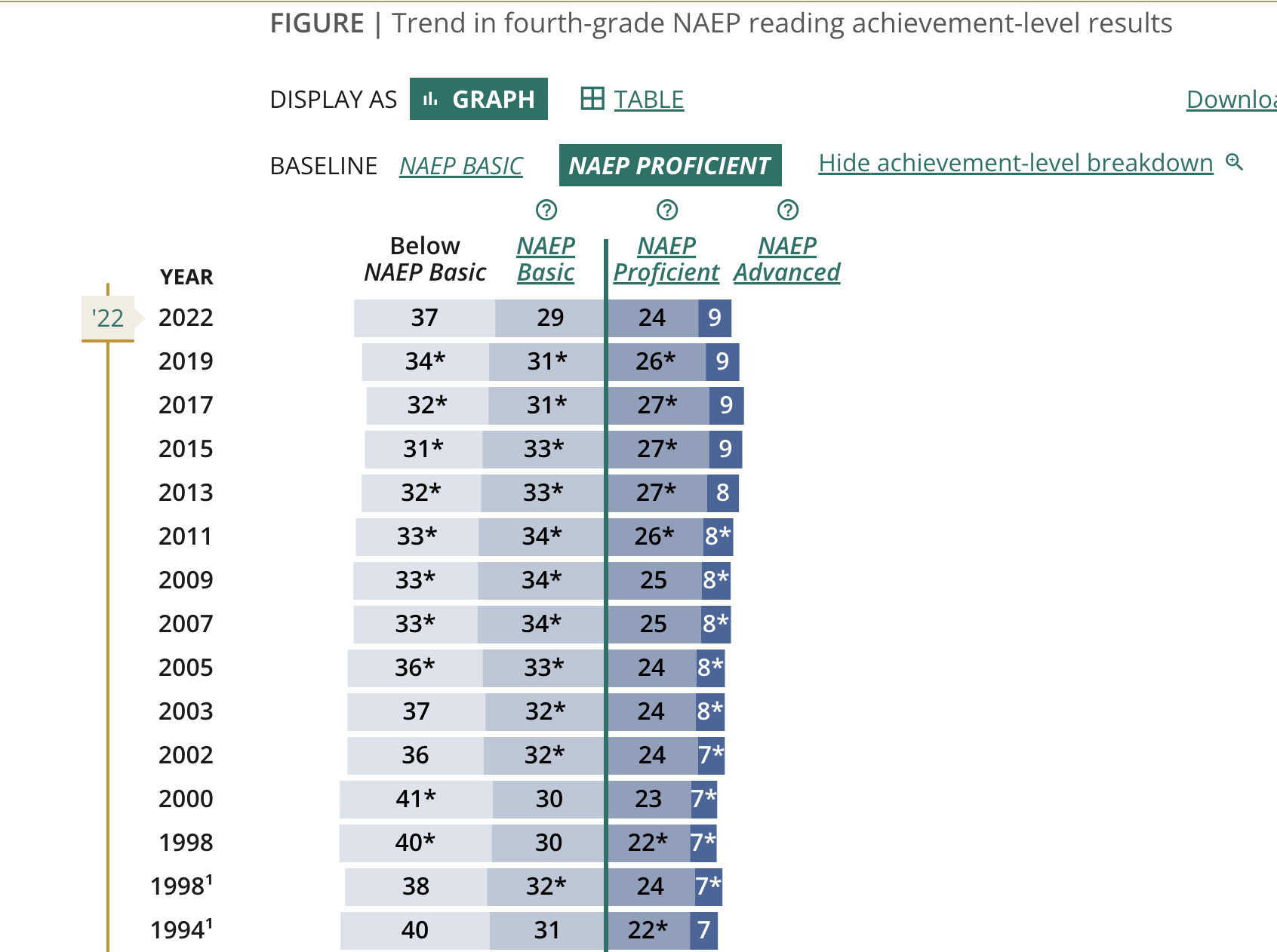
Further, and even more frustrating, is that this numbers game distracts us from the real issues: (1) The US has no standard for “grade level” reading, (2) we have never fully interrogated the need for a standard “age level” instead of “grade level” metric, and most importantly, (3) the real issue is the disproportionate number of marginalized and minoritized students in the below grade level data pool.
Swirling around the NAEP Big Lie, as well, is a numbers game that hasn’t been fully unpacked—the claim that 90-95% students can be proficient if we simply implement SOR.
As a side note, those SOR advocates making this shifting claim (sometimes it is 90%, sometimes it is 95%) have not, along with most of mainstream media, noted a powerful example of the possibility that the 90-95% proficiency is achievable: DoDEA schools have close to that rate of achievement (see below).
Now as the SOR movement has grown over the past 6 years, I have seen the 90-95% claim more and more although that numbers game still has less traction than the 2/3 not proficient claim.
However, when I began my review of a recent NCTQ report, I took the time to interrogate the 90% claim by the anti-teacher education think tank: “With effective reading instruction, we could take that [student reading proficiency] to more than 90%” (p. 4)
That claim by NCTQ has a footnote to a few studies, but the most interesting evidence is the final citation to a blog post by Nathaniel Hansford who admits at the beginning, “it has always stuck out to me as a strange figure” because:
First, most academic research does not typically use percentages in this sort of manner. Second, I often see this figure unaccompanied by a citation. And third, it seems low; I find it hard to believe that 5% of students just cannot learn how to read.
Can 95% of Children Learn to Read?
When Hansford asked for scientific evidence for the claim, this is what he discovered:
Some of the citations I was sent were policy papers, by authors and institutions that used this claim. However, these papers were not experimental and usually cited popular Science of Reading books, not experimental research. There was also, interestingly, one research paper sent to me from the 1980s, that made the claim, but did not cite any evidence to support it. So it appears that this claim has been in circulation for a long time. The most common source listed for this claim seemed to be Louisa Moats, who has written about this rule on numerous occasions. However, she does not claim that 95% of students can reach grade level, based on just core instruction, but rather in totality. Louisa Moats cites 4 sources in support for this rule. In Kilpatrick’s book Essentials of Assessing, Preventing, and Overcoming Reading Difficulties; a 2009 paper by Lim, et al. on students with Down Syndrome; a 2005 paper by Mathes, et al, examining the rate of risk reduction for struggling reading, with intensive intervention instruction, and a literature review of risk reduction, by Joseph Torgersen. In my opinion, the last two citations provide some experimental evidence to support this claim.
Can 95% of Children Learn to Read?
I have found no better conclusion about the 90-95% claim than the one offered by Hansford; there is scarce and dated scientific evidence to support, at best, that the 90-95% claim is a valid aspirational goal of reading proficiency: “This all said, it does seem there is some level of support for 96% being a benchmark goal [emphasis added], for reading proficiency rates.”
But key here is that like the NAEP Big Lie, the 90-95% claim is in no way a scientific claim being used by a movement that has used “scientific” as a rhetorical baseball bat to promote their ideological (not scientific) agenda.
The SOR numbers games are essentially lies and distractions. Regretfully, we certainly need to address reading proficiency in students, especially for marginalized and minoritized students.
But the real problems and achievable solutions are likely not to make the education marketers money but will require a different way to view education, one that acknowledges the key number that education reformers and SOR advocates ignore.
That number is 60+%.
A new study confirms a statistic that has been repeated by scientific research for decades—about 60+% of measurable student achievement is causally linked to out-of-school (OOS) factors (not reading programs, not instructional practices, not teacher quality): “Almost 63% of the variance in test performance was explained by social capital family income variables that influence the development of background knowledge.”
That fact of measurable student achievement discredits claims that reading proficiency, for example, is mostly a problem of reading programs and reading instructional practices. Reading reform for decades has simply shuffled programs and reading theory, which amounts to rearranging chairs on the deck of the Titanic.
Yet as I noted above, there is credible evidence that something approaching 90% reading proficiency is achievable if we address those OOS factors, the reading achievement of DoDEA students:
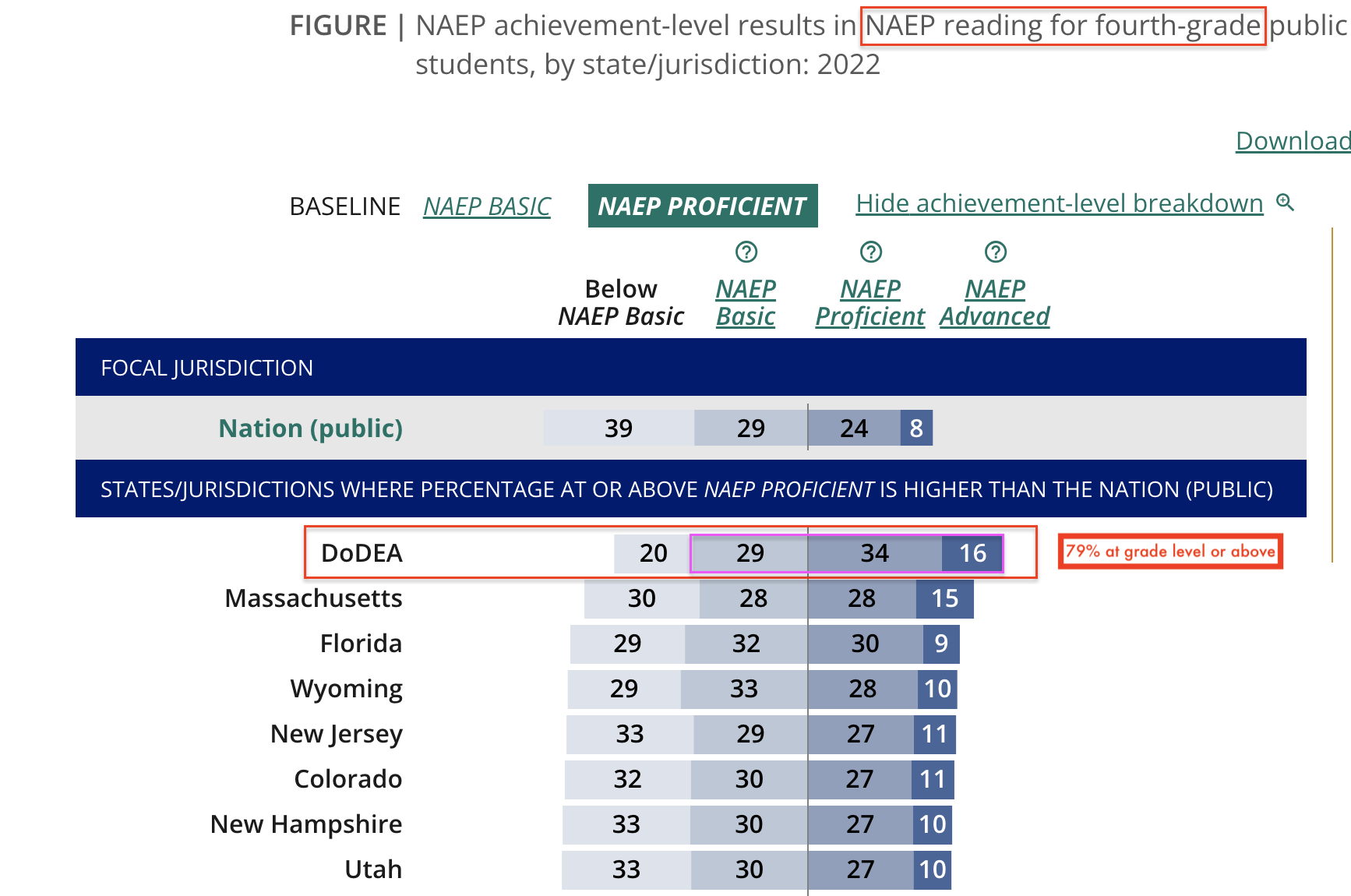
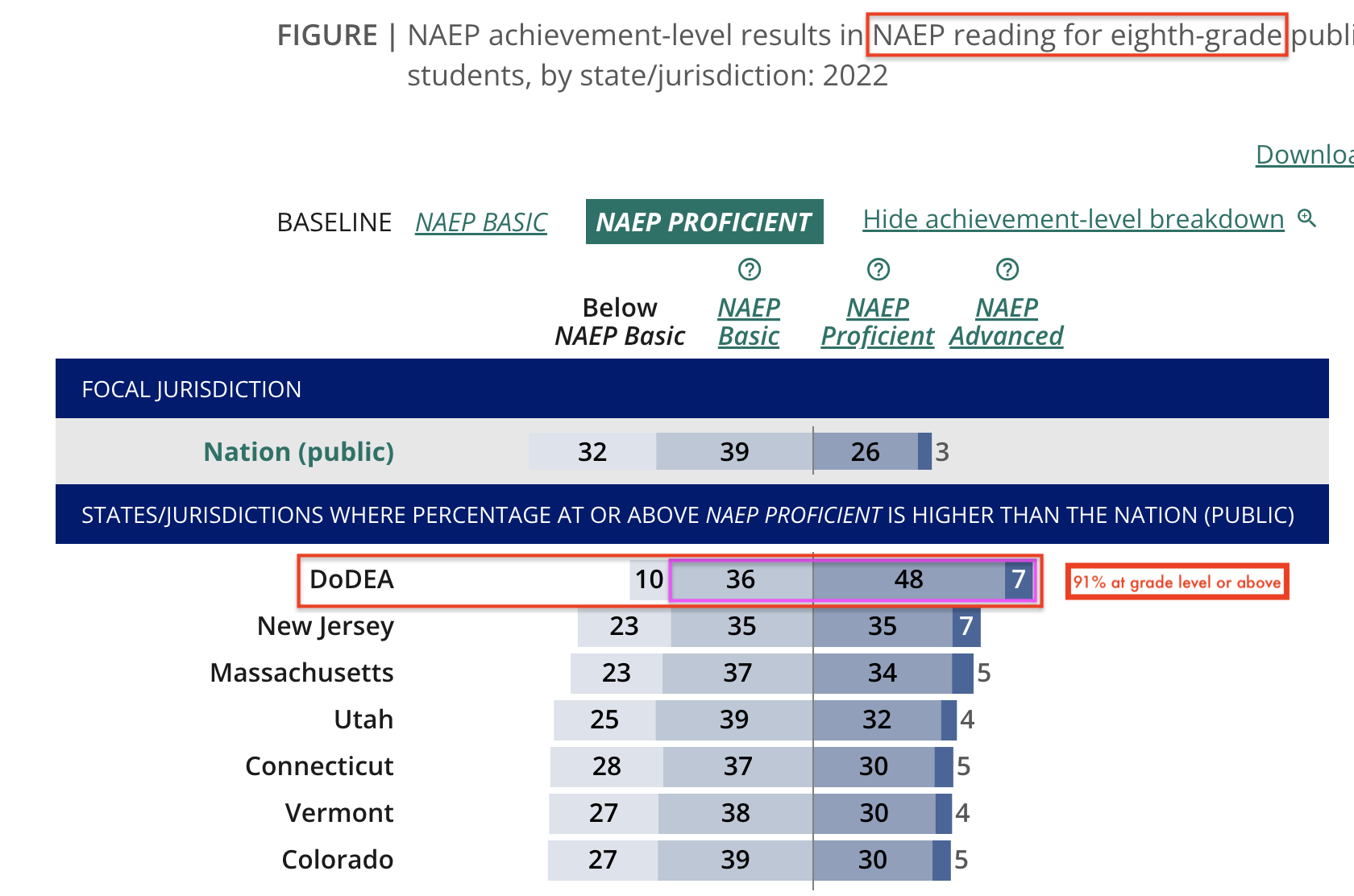
The DoDEA story isn’t one of reading programs, reading theory, or teacher bashing; in fact, there is a compelling story here:
How does the military do it? In large part by operating a school system that is insulated from many of the problems plaguing American education.
Defense Department schools are well-funded, socioeconomically and racially integrated, and have a centralized structure that is not subject to the whims of school boards or mayors….
But there are key differences.
For starters, families have access to housing and health care through the military, and at least one parent has a job.
“Having as many of those basic needs met does help set the scene for learning to occur ,” said Jessica Thorne, the principal at E.A. White Elementary, a school of about 350 students.
Her teachers are also well paid, supported by a Pentagon budget that allocates $3 billion to its schools each year, far more than comparably sized school districts. While much of the money goes toward the complicated logistics of operating schools internationally, the Defense Department estimates that it spends about $25,000 per student, on par with the highest-spending states like New York, and far more than states like Arizona, where spending per student is about $10,000 a year .
“I doubled my income,” said Heather Ryan, a White Elementary teacher . Starting her career in Florida, she said she made $31,900; after transferring to the military, she earned $65,000. With more years of experience, she now pulls in $88,000.
Competitive salaries — scaled to education and experience levels — help retain teachers at a time when many are leaving the profession. At White Elementary, teachers typically have 10 to 15 years of experience, Ms. Thorne said.
Who Runs the Best U.S. Schools? It May Be the Defense Department.
The SOR movement is playing a harmful and duplicitous numbers game that fits into decades of ineffective and harmful education reform. But the SOR movement is also following the corrosive playbook of using “science” as a rhetorical veneer for ideological agendas. Like scientific racism, the SOR movement is disturbingly absent science for many of their foundational claims.
Numbers games have consequences, and ironically, the research emerging from SOR policies is beginning to show that SOR legislation is whitewashing the curriculum and deprofessionalizing teachers.
While there are several shifting numbers in the SOR movement, there is in fact very little science to back them up. And the numbers that are being ignored are the huge taxpayers costs for shuffling reading programs to line the pockets of many of the people promoting those numbers games.
 dr. p.l. (paul) thomas