All posts by plthomasedd

P. L. Thomas, Professor of Education (Furman University, Greenville SC), taught high school English in rural South Carolina before moving to teacher education. He is a former column editor for English Journal (National Council of Teachers of English), current series editor for Critical Literacy Teaching Series: Challenging Authors and Genres (Brill), and author of Teaching Writing as Journey, Not Destination: Essays Exploring What ‘Teaching Writing’ Means (IAP, 2019) and How to End the Reading War and Serve the Literacy Needs of All Students: A Primer for Parents, Policy Makers, and People Who Care (IAP, in press). NCTE named Thomas the 2013 George Orwell Award winner. He co-edited the award-winning (Divergent Book Award for Excellence in 21st Century Literacies Research) volume Critical Media Literacy and Fake News in Post-Truth America (Brill, 2018). Follow his work @plthomasEdD and the becoming radical (https://radicalscholarship.wordpress.com/).

What Works?: The Wrong Question for Education Reform

[Header Photo by Vadim Bogulov on Unsplash]

I stumbled my way to becoming a high school teacher of English in the same high school from which I had graduated just five years before.

After graduating from junior college, I was set to transfer to the main campus of the University of South Carolina; that plan included a friend I had attended every year of school with since grade 1.

He had a catastrophic accident that summer, leaving him paralyzed and changing both our plans for continuing college.

I then stumbled, mostly fearful of heading off without the comfort of that friend since we were both small-town boys. So I abruptly shifted to attending the local satellite campus of the South Carolina university system, which meant I also committed to living at home for the rest of my undergraduate years.

My entry in teacher certification was yet another stumble since I did not really choose the degree and career until I was sitting at orientation the fall I transferred to the satellite university.

As a rising junior, I needed to declare my major and had been contemplating pre-law and architecture. But on the spur of the moment, and after several clarifying questions, I became a secondary English education major.

The transfer and relatively late decision to be in teacher certification resulted in my graduating in December, and then, being in a sort of limbo that next spring (although I did enroll in an MEd program as well as worked as a substitute teacher).

But the greatest stumbling of all, I must admit, was those first 5 to 7 years as a high school English teacher.

I often think of the beginning-teacher Me—idealistic and nearly fanatically focused on finding the instructional practices that worked (specifically, how to teach my high school students to write well).

Semester after semester, I revised and rebooted my instruction. Yet, often, student assignments were submitted with about the same degree of struggling, the same (and often predictable) performances that needed to be revised.

In this mania for finding out what works, I even created my own writing textbook, developed directly from my students’ work.

Year after year, a pattern developed: I was highly regarded by my students, my colleagues, my administration, and my students’ parents as an excellent teacher, notably an excellent teacher of writing; yet, I felt constantly as if I was failing.

I had an unhealthy tunnel vision focused on finding what works, and I was not willing or able to simply step back and consider what I now know is true, but is also counter-intuitive. And I just made that claim on social media:

What I have learned as I just completed my year 40 as a teacher is that many instructional practices work, but often predicting what works is fraught practice.

And what I am now certain about is my second point above: What works is profoundly impacted by learning (and living) and teaching conditions.

My mother, who completed only one year of junior college, taught me to read at an advanced level well before I entered public schooling. And she used entirely whole word strategies (note cards taped to objects all over our house) and picture books (from Dr. Seuss to Go, Dog, Go and One Fish, Two Fish, Red Fish, Blue Fish).

We were working class/poor and my parents were not highly literate, but what worked for me isn’t necessarily supported by scientific research and isn’t a template for what would work for anyone else.

Here, then, is why the pursuit of what works in education reform fails:

  • What works feeds into the silver-bullet fallacy. No instructional practice or program works universally because instructional/program effectiveness is relative to individual differences among students and time.
  • What works feeds into the in-school-only reform paradigm. Ironically, hyper-focusing on what works (instruction/programs) ignores the body of scientific research that shows teachers’ impact on measurable student learning (1-14%) is magnitudes less than out-of-school factors (60+%). Reforming instruction and programs, then, can never have the sort of measurable outcomes that addressing out-of-school factors could produce. This in part explains why all reform appears to fail and we remain in a constant cycle of crisis/reform in education.
  • What works is trapped in a flawed model of human behavior. Humans develop is somewhat predictable in terms of stages; however, the exact when of that development is not nearly as fixed as systematic instruction and programs require. Most what works claims are bound to predictive grade- (or age-) level achievement that is linked to aspirational expectations that 100% of students can or should be at these levels. Again, this paradigm in part explains why we are in constant crisis since the expectations are unrealistic.
  • What works is a subjective designation grounded in the definition of “works.” At the policy level, what works is always political/ideological because some power structure endorses the defining characteristics of “works”; since education policy is at the whim of political structures, what works can and will be manipulated by political shifts creating an instability that is counter-educational. For example, in writing instruction, do rubrics work? Rubrics can be effective for clarifying expectations for students (transparency) and for standardizing grades assigned to writing (fairness); thus, in that context of “works,” the answer is yes. But rubrics do most of the writer’s work for students by detailing the decisions that emerging writers need to develop; therefore, if your goal is teaching students how to make authentic writing decisions, rubrics do not work (similar to how training wheels do not work). Different power structures, then, could define rubrics as what works or as “currently unsupported instructional practices” based on the mandated definition of “works.”

The US needs a reckoning, one similar to my own experiences as an early-career high school English teacher.

What works? Well, not spending any more time trying to identify and then mandate what works.

Many different instructional practices work under different conditions. And even when something doesn’t work, we have time to find out what will work if we would focus more on what really matters—the learning (and living) and teaching conditions of students’ schooling (and lives).

Almost 60 years after my formative years as a beginning reader, I have witnessed my grandson’s journey to reading grounded in his iPad, playing Minecraft and watching YouTube videos about how to play his video games.

Both he and I became eager readers because of our passion for reading as a means to the things we love.

Not an instructional practice.

Not a program.

What works is less a thing we can identify and mandate and more an ideological shift in verb tense—what worked.

A move from being predictive to descriptive, which takes a great deal of patience, a comfort for the unknown and unknowable, and the wisdom to look carefully at the right things—the students in front of us and not the mandates grounded in what works.


See Also

Follow an example thread here:

Crisis Rhetoric Fails “Science of” Era of Reading Reform

[Header Photo by Joël de Vriend on Unsplash]

The fall of 2024 will mark year 41 for me as a literacy educator, scholar, and advocate.

About half of that career was spent in K-12 public education in rural Upstate South Carolina, where I was born and live. I have witnessed daily race, social class, and gender inequity at some of the most extreme levels in the US.

At the core of my work as an educator, as well, I have named, challenged, and advocated to correct all forms of inequity. That work has often been in very hostile environments in the South where the power structures deny these inequities exist and persist at calling for traditional values as code for maintaining the status quo.

Also throughout my career as an educator and scholar, I have developed a solid grounding in the history of education and the field of literacy. Having written an educational biography of Lou LaBrant and serving as Council Historian for the National Council of Teachers of English were foundational experiences for that commitment to the history of education.

Further, having begun as an educator in 1984, I have lived and worked my entire career in the high-stakes accountability era of education reform. At every point along the way, I have raised a hand in opposition to this reform paradigm because it is driven by media, the market, and politicians who are more committed to education reform as industry than to serving the needs of our students or honoring the professionalism of America’s teachers, who are more than 70% women.

The “science of reading” movement and the offspring “science of” reform agendas are nothing new, except they are incredibly harmful—notably for the very students some of the advocates use as shields against criticism.

Once again, “science,” “crisis,” and “miracle” are being weaponized to not only label and punish students but also de-professionalize teachers.

One of the most effective and dishonest tactics is the “crisis” claim about reading in the US.

First, this claim lacks a basic understanding of educational testing, and further, the claim is ahistorical.

At least since the 1940s in the US, two facts can be proven: (1) at no point has student reading achievement (“proficiency”) been declared adequate; there has been a perpetual cry of reading “crisis” in every decade by media and political leaders, and (2) throughout the history of US public education, there has been a pervasive so-called “achievement gap” (better referred to as an “opportunity gap”) with marginalized populations of students performing well below average or white and affluent students.

That means that current reading achievement however measured and current “achievement gaps” are not a crisis but a historical and current reality maintained by political negligence.

Since current “science of” advocates have a fetish for misrepresenting and citing NAEP, let’s look at how NAEP in fact proves my point.

Consider Mississippi, the darling of reading reform and media crowning as a “miracle:

At grades 4 and 8 in reading, Black students in MS were BELOW basic (approximately below grade level) at a rate of 51%, about the national rate for Black students.

Note that despite well over a decade of SOR reading reform, the achievement gap for Black students remains about the same as in 1998.

Education and reading reform is not addressing the inequity Black students suffer in MS or anywhere in the US. However, the SOR movement has been doubling down on labeling and punishing Black students through grade retention, which serves to inflate grade 4 scores but not better prepare students.

MS has consistently retained about 9000-12000 students (mostly Black students) since 2014; if SOR policy and instruction were actually working, these retention number should drop or even disappear (since SOR advocates claim to be able to have 95% students reach proficiency).

Weaponizing “science,” “crisis,” and “miracle” are veneers for denying what the actual science and evidence have shown for decades: far more than 60% of measurable student achievement is causally related to out-of-school factors.

And thus, my advocacy for my entire career has been for both social and education reform that focuses on equity and refuses to blame teachers and students for that inequity.

For the past forty-plus years, however, education reform has solely targeted blame on schools, teachers, and students.

Those racially minoritized students and students living in poverty have routinely been characterized by deficit ideology, and reform has sought to “fix” those students by inculcating grit or growth mindset—or simply imposing a systematic phonics regime on those students, treating them all as if they have reading “disorders.”

And if those students don’t perform, retain them (punish them) and label them. Yet, there is never any consequences for the reformers when none of their reform promises are fulfilled (see the charter fiasco in New Orleans).

Hyper-focusing on MS (and Florida) is not just a lie, but a distraction.

Again, let’s look at NAEP:

DODEA (Department of Defense) students are the most successful in reading in the US, but you see almost no media or political coverage of this fact.

Students in military families are often from impoverished backgrounds, yet Black students BELOW basic are at rates of 25% (grade 4) and 18% (grade 8), dramatically less than the national average and MS.

And here is what the media, the market, and politicians refuse to acknowledge: DODEA students have medical care, food security, housing security, and parents with work stability.

Also, DODEA teachers are paid above most public school teachers.

Unlike the false claims about MS, DODEA achievement shows that both in- and out-of-school reform must be addressed for the in-school achievement to rise in authentic ways.

I am tempted to say the real crisis is how media and political leaders mislead the public about education and education reform—as well as demonize students and teachers.

But that is also nothing new.

There is great profit in perpetual crisis so don’t hold your breath that anything will change any time soon.


Recommended

Mississippi Miracle, Mirage, or Political Lie?: 2019 NAEP Reading Scores Prompt Questions, Not Answers [Update September 2023]

Grade Retention Harms Children, Corrupts Test Data, But Not a Miracle: Mississippi Edition [UPDATED]

Reading Reform We Refuse to Choose

When Exceptional Publicly Funded Schools Are Not a Miracle, and Why

Kids Count, Deficit Ideology, and NAEP Misinformation: 2024 Edition

The 2024 Kids Count Data Book is out and adorned with the lovely smiling faces of children.

Regretfully, Kids Count shows more about how good intentions are not enough and that our public and political focus on education remains grounded in deficit ideology and misinformation linked to NAEP testing.

First, note the focus on education once again using NAEP “proficiency”:

And then, note the deficit perspective for ranking states based on NAEP proficiency:

Imagine if this report focused first on NAEP “basic” and above? And then identified students at or above basic?

Kids Count is yet another part of the manufactured crisis in education that serves negative portrayals of students, teachers, and public schools—and ultimately the education reform industry.

Yet, this report and its negative as well as misleading use of data must make us ask: If kids count, why do we persist in ranking and vilifying those children and the people spending their lives serving them in our schools?

Schedule: Fall 2024 – Winter/Spring 2025

ILEC

Tuesday, September 3rd, 2024

7:00 PM, EST, 6:00 PM CST.   

Dr. Paul Thomas

“Science of” Movements as Trojan Horse Education Reform [access PP HERE]


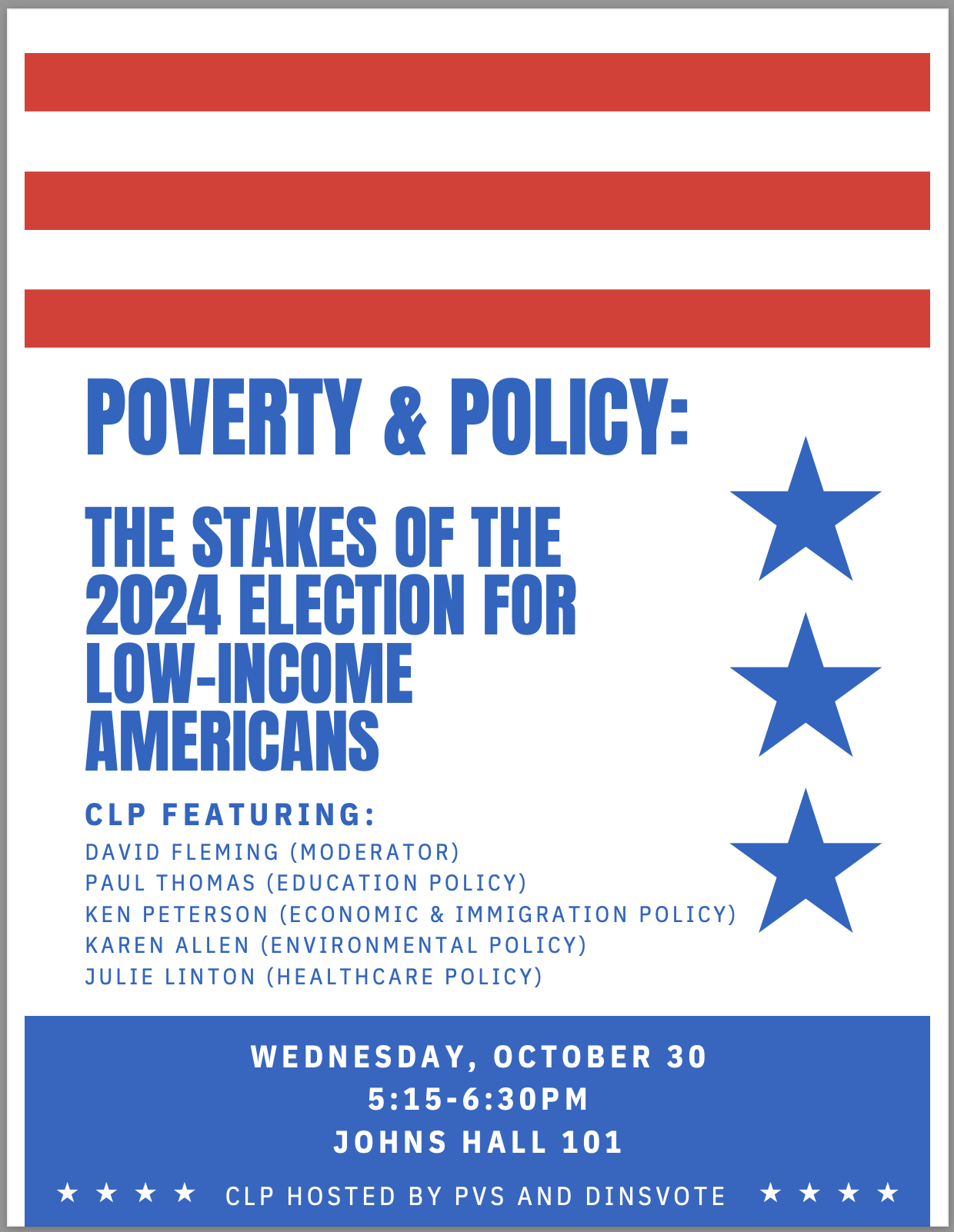
Poverty & Policy: The Stakes of the 2024 Election for Low-Income Americans. 

  • Wednesday, October 30
  • 5:15-6:30pm
  • Johns Hall 101

The CLP will feature the following Furman experts: 

David Fleming, Professor of Political Science and International Affairs at Furman University (moderator)
Paul Thomas, Professor of Education at Furman University (education policy)
Ken Peterson, Professor of Economics at Furman University (economic and immigration policy)
Karen Allen, Professor of Sustainability and Anthropology (environmental policy)
Julie Linton, MD, FAAP, Professor of Pediatrics, Prisma Health Children’s Hospital Upstate, USC School of Medicine Greenville, Professor in Furman’s Community Engaged Medicine (healthcare policy)


What Really Matters: I Am Thinking about People Tonight [click title for text of talk]

Slideshow [click for PP slideshow]


2024 NCTE Annual Convention

November 21–24

Boston, Massachusetts

11/21/2024

11:30 AM – 12:45 PM EST

Groundwork: Heart, Hope, and Humanity in Rural Education

Room 258 A


11/22/2024

12:30 PM – 1:45 PM EST

Resisting Scripted Curriculum as Erasure: Holding Onto the Heart, Hope, and Humanity of Reading

Room 210 B

Rountables Listing [click for PP]

Roundtable:
Paul Thomas

“Orange: Teaching Reading not Simply Black-and-White” [click HERE for PDF]


11/23/2024

2:45 PM – 4:00 PM EST

Standing for—Indeed, Fighting for—Teacher Professionalism and the Right to Teach Responsively

Room 205 A

Roundtables Listing [click for PP]

Opening Talk:

Paul Thomas

Attacks on Balanced Literacy Are Attacks on Teacher Professionalism [click title to access PP]

The “science of reading” movement has promoted a misleading story about reading through the media—reading proficiency is in crisis because teachers do not know how to teach reading and were not properly prepared by teacher education. This opening talk with argue that attacks on BL are grounded in efforts to deprofessionalize teachers.

Roundtable:

Paul Thomas

Reclaiming BL’s Commitment to Serving Individual Student Needs and Teacher Autonomy [click title to access PP]

Thomas will examine an authentic definition of BL as a reading philosophy that centers serving the individual needs of all students. He will examine also the caricatures of guessing and three cueing (MSV), providing attendees scholarly evidence for accurate characterizations of BL as well as deeper understanding of reading proficiency.


 Literacy in the Disciplines 6-12

Webinar

December 10, 2024 – 6-7 pm

We Teach English in Times of Perpetual Crisis: Selling a Story of Reading (and Literacy)

English-speaking countries around the world are once again fighting another Reading War. In the US, the movement is called the “science of reading” (SOR) and the result has been intense media scrutiny of reading programs, teachers, and teacher education as well as highly prescriptive state-level legislation and mandates. Those of us who do not teach beginning readers are not exempt from the negative consequences of another Reading War. This webinar will briefly introduce the history of Reading Wars and identify the key elements of the SOR movement and why the public stories and legislation are poised to erase teacher autonomy and serving the individual needs of students.

Access PP HERE

We Teach English in Times of Perpetual Crisis: Selling a Story of Reading (and Literacy) [Webinar Companion Post]

Recommended Reading

English Journal Series: We Teach English in Times of Perpetual Crisis


CCIRA 2025

Thursday, February 6, 2025

Session One — 10:15-11:45 a.m.

“Science of” Movements as Trojan Horse Education Reform [Access PP PDF Here]

In June 2024, the newly formed Evidence Advocacy Center announced plans to “[transform] the [teaching] profession into an evidence-based system.” However, the EAC admitted “educators will relinquish certain freedoms.” This session will examine the “science of” movements as a subset of a 40-year cycle of accountability-based education reform (Trojan Horse Education Reform) that de-professionalizes teachers and fails to serve the needs of students or public education.

Session Two — 2:00 – 3:30 p.m.

Big Lies of Education: “Science of” Era Edition [Access PP PDF Here]

Education practices and policy are often directly and indirectly driven by the stories told in the media, among the public, and by political leaders. This session will explore the Big Lies in the compelling but misleading narratives, including A Nation at Risk/education “crisis,” reading proficiency/NAEP, National Reading Panel, poverty as an excuse, and international test rankings and economic competitiveness.

Thomas, P.L. (2022). How to end the Reading War and serve the literacy needs of all students: A primer for parents, policy makers, and people who care (2nd Ed.). Charlotte, NC: Information Age Publishing.


PSLA 2025 Annual Conference

“Ignite the Literacy Light & Lead”

February 20-22, 2025

Hilton Beachfront Resort & Spa
Hilton Head Island, South Carolina

Panel Presentation: “Remaining Responsive to Learners in Challenging Times”

Saturday, February 22nd from 8:00-9:00 am

Palmetto Room


Furman University CLP

“Banned Together” Screening

Thursday February 27, 2025

6:30pm in Burgiss Theater

Panel:

Jennifer Wiggin, producer

Josh Malkin, SC ACLU

Paul Thomas, Furman University


SC for Ed Webinar: Understanding NAEP during Another Reading Crisis

Understanding NAEP during Another Reading Crisis

Click HERE for PDF of PowerPoint

March 20, 6:30 pm


A4PEP

The Manufactured Crisis: Exposing the False Narrative of Public Education’s “Failure”

Date & Time

Apr 16, 2025 08:30 PM EST

Description

Join us for a timely and vital conversation on April 16 at 6:30 p.m. ET with Dr. P.L. Thomas, Professor of Education at Furman University. For decades, media and policymakers have pushed a narrative that America’s public schools are “failing.” But who benefits from this story, and who is harmed by it? Dr. Thomas will expose how the education reform industry has fueled a false crisis, undermining trust in public schools while advancing corporate-driven reforms. Drawing on his experience as a teacher, scholar, and national award-winning writer, Dr. Thomas will offer critical insights into how we can challenge disinformation and reclaim a narrative rooted in equity, democracy, and community empowerment.

REGISTER HERE

6:30 pm, April 16

[Click HERE for presentation]

The Bridge (Fiction)

[Header Photo by Catherine Kay Greenup on Unsplash]

The bridge came to Penske Loving in a dream when they were 14 years old.

The dream was so vivid and intense Penske woke sitting up. The clock/radio softly glowed;  it was only 4:37 am, but Penske could not even imagine going back to sleep.

So they slipped out of bed, found a sheet of paper and a black ballpoint pen, and then carefully drew the bridge from the dream.

For a week or so, Penske would stare at the picture just before bed, hoping to revisit the dream. But that never happened.

Then, even though Penske had no experience or knowledge for building anything, they found a nearly perfectly flat and abandoned field—just like in the dream—and began building the bridge.

The bridge went over nothing except perfectly flat ground and went from nowhere in particular to nowhere in particular. Penske only stepped off the distance, but it seemed to be about 30 or 40 feet.

Penske never told anyone about the bridge, and as far as they knew, no one ever saw it being built. They used anything they could find—random bricks, stones, lumber, tree branches and trunks.

The project from the dream took over a year, finished when Penske was 15. The bridge had consumed almost every moment of Penske’s mind and life for that year in fact.

A bridge over nothing, spanning from nowhere in particular to nowhere in particular.


Penske jerked awake. They sat there disoriented for a few moments before touching their phone screen. Another morning wide awake around 3 or 4 am.

They were 37 and slowly realized that in their dream they had been thinking about the bridge.

Penske had not thought of the bridge in many, many years.

Unable to fall back asleep, Penske tried to recall when they last visited the bridge or when they simply forgot about it entirely. These things had to have happened, they thought, even as they couldn’t pinpoint either.

Trying to remember was fruitless, and Penske simply feel asleep again, awakened a couple hours later by the phone alarm set for 6:21 on workdays.

“Science of” Movements as Trojan Horse Education Reform

[Header Photo by Tayla Kohler on Unsplash]

The charter school story in New Orleans is almost two-decades long, but most people will not dig past the most recent development: After a 7-year experiment, New Orleans is an all-charter district no more.

In the wake of Katrina in 2005, Louisiana Governor Bobby Jindal (R) leveraged the natural disaster to begin the eventual shift of schools in New Orleans from traditional public schools (TPS) significantly staffed by a Black professional class of teachers to a charter school Recovery School District (RSD) run by Paul Vallas and often staffed by young, white, and affluent Teach for America (TFA) recruits.

This moment was acknowledged by some as disaster capitalism that had far more to do with politics than improving student achievement. The endgame was to entrench school choice schemes and create a cheaper although fluctuating teacher workforce (TFA).

Yet, as many of us warned, an all-charter school system in New Orleans never outperformed the TPS it replaced.

In fact, all across the US, charter schooling, RSD, TFA, and almost every major education reform schemes have never delivered on the academic outcomes promised.

Here, it is important to acknowledge that most education reform in the US over the past 40 years has been grounded in conservative ideology (even though the political support has been bi-partisan) and most of that reform is Trojan Horse reform—using a false veneer of reform to accomplish ideological and political agendas.

School choice schemes are not about student achievement but about publicly funding private education and “white flight” as public schools have become majority-minority populations of students.

TFA and organizations such as National Council on Teacher Quality (NCTQ) are not designed to improve teacher quality or teacher preparation but about creating a cheap workforce and eradicating teacher professionalism to make way for teachers as mere monitors for scripted programs and computer-based instruction.

Although just two examples, the key point is running through Trojan Horse education reform is not just political and conservative ideology but also a commitment to market forces.

Education reform in the US primarily creates churn—new standards, new programs, new materials, new teacher training, etc.—that serves the needs of the market, not parents or their children. That churn is promoted by education reform influencers who only gain if schools, teachers, and students are perpetually viewed as failing—permanent crisis.

Lurking underneath education reforms during George W. Bush’s tenure as governor of Texas and president of the US was the lure of scripted curriculum that shifted authority away from the teacher and to the state and primarily commercial products.

Although Bush’s reform agendas flourished with bi-partisan support, scripted curriculum and de-professionalizing teachers (see also the value-added methods schemes and the “bad teacher” attacks under Michelle Rhee) mostly lost favor and lay dormant post-Obama (even as the Obama administration double-down on most of the conservative elements established by Bush’s administration).

That is, lay dormant until the “bad teacher” myth was resurrected by Emily Hanford and the “science of reading” (SOR) movement.

As Aukerman explains, the story being sold included several elements of failure and incompetence that pits classroom teachers against teacher educators (both of which are primarily women professionals):

Now that SOR has mostly uncritically swept across the US in the form of state-level reading legislation and policy, the evidence suggests that at the core of the so-called success of SOR policies (see Mississippi and Florida) is one of the most conservative and harmful policies possible—grade retention, as Westall and Cummings explain:

Similar to the results for states with comprehensive early literacy policies, states whose policies mandate third-grade retention see significant and persistent increases in high-stakes reading scores in all cohorts. The magnitude of these estimates is similar to that of the “any early literacy policy” estimates described in Section 4.1.1 above, suggesting that states with retention components essentially explain all the average effects of early literacy policies on high-stakes reading scores. By contrast, there is no consistent evidence that high-stakes reading scores increase in states without a retention component.


Grade retention disproportionately impacts poor students, Black students, Multi-lingual learners, and other marginalized population of students. Retention is popular because it represents a type of accountability and punishment for “other people’s children” who need to be “fixed” by those in power.

Concurrent with the SOR movement, a new flurry of “science of” movements have propagated: “science of learning,” “science of writing,” “science of math.”

The mostly uncritical support for SOR by the media, the education market, parents, and politicians have provided fertile ground for a larger “science of” movement to drive our newest round of the same education reform structures we have been implementing without improving student achievement for forty-plus years.

Let’s emphasize here, Trojan Horse education reform doesn’t work to improve teaching and learning, but it does work for media, market, and political interests.

And now, the mask is coming off with the announcement of the Evidence Advocacy Center:

In the EAC’s plan for the transformation of the profession into an evidence-based system, educators will relinquish certain freedoms — notably the leeway to employ ineffective practices — but will gain guidance that empowers them to fulfill their original purpose by profoundly impacting the future of students, families and communities. The alternative is to continue rearranging the deck chairs under the guise of education reform.


“Relinquish certain freedoms” is eerily similar to the explanation handmaid’s received in The Handmaid’s Tale:

There is more than one kind of freedom, said Aunt Lydia. Freedom to and freedom from. in the days of anarchy, it was freedom to. Now you are being given freedom from. Don’t underrate it….

We were a society dying, said Aunt Lydia, of too much choice. (pp. 24, 25)


Under the Brave New World of “science of” education mandates, teachers will have freedom from professional autonomy and freedom to implement scripted programs!

And who benefits?:

Many of these groups are fundamentally conservative, but even a modicum of interrogating the Who and Why behind this agenda reveals some chilling concerns.

NCTQ was founded by the Thomas B. Fordham Institute, a conservative think tank dedicated to school choice/charter schools and market forces. Note that there is a distinct contradiction between advocating for “science” in education practices and citing NCTQ, which has never produced any scientifically valid “reports.”

The leadership of EAC includes several connections to the University of Oregon, home of DIBELS®, a phonics-centric program that was revitalized by the SOR movement.

Other leaders include Louisa Moats, creator of LETRS, which is being mandated across the US to retrain teachers in SOR even though, again, the program is not supported by science.

The Reading League has its own market connections, endorsing practices not supported by the science (decodable texts, notably).

The 95 Percent Group is also based on an aspirational claim not grounded in settled science, as one analysis concludes about the 95% claim: “This all said, it does seem there is some level of support for 96% being a benchmark goal [emphasis added], for reading proficiency rates.”

And two key comments lurking in the background of these “science of” movements must not be ignored.

First, directly from the International Dyslexia Association:

The term “Structured Literacy” is not designed to replace Orton Gillingham, Multi-Sensory, or other terms in common use. It is an umbrella term designed to describe all of the programs that teach reading in essentially the same way. In our marketing, this term will help us simplify our message and connect our successes. “Structured Literacy” will help us sell what we do so well.


And then from the Education Writers Association:

Connect the dots and connect the rhetoric: “Relinquish certain freedoms,” “sell what we do so well,” “watchdogs.”

The “science of” movements are yet another cycle of Trojan Horse education reform. We have already opened the gates and waved this in with blinders on, so now we must do our best to reclaim teaching and learning that serves the needs of our students and not the media, the market, and political/ideological agendas at the expense of those students.

Recommended

What You See Is Not What You Get: Science of Reading Reforms As a Guise for Standardization, Centralization, and Privatization | American Journal of Education, Elena Aydarova

Politics of phonics: How Power, profit and politics guide reading Policies

Third Grade Retention: The Fool’s Gold of Reading Reform

[Header Photo by Renee Kiffin on Unsplash]

Here is a report on reading reform across the US that is very important, but likely not in the ways intended: The Effects of Early Literacy Policies on Student Achievement, John Westall and Amy Cummings.

A key value in this report is the comprehensive data on reading reform in the US, such as these two figures:

Notably, most of the US has early literacy policy, significantly clustered since about 2010. While this is important context, the figures also reveal a key problem with this report—the source being a conservative think tank, ExcelinEd.

ExcelinEd is a Jeb Bush venture and represents the political and ideological connections among third grade retention, reading policy, and political gain.

I want here to focus on that dynamic, specifically how this report provides further evidence of the need for intense and critical re-evaluation of third grade retention.

ExcelinEd is grounded in Florida’s reading reform and high rates of grade retention that have produced exceptionally high NAEP scores in grade 4 reading (an outcome this report confirms across the US), but the largest decrease from grade 4 to grade 8 reading scores.

Let’s here note what Westall and Cummings detail about grade retention:

  • Third grade retention (required by 22 states) significantly contributes to increases in early grade high-stakes assessment scores as part of comprehensive early literacy policy.
  • Retention does not appear to drive similar increases in low-stakes assessments.
  • No direct causal claim is made about the impact of retention since other policy and practices linked to retention may drive the increases.

Here is where this report is important, I think, but, again, not as intended:

Similar to the results for states with comprehensive early literacy policies, states whose policies mandate third-grade retention see significant and persistent increases in high-stakes reading scores in all cohorts. The magnitude of these estimates is similar to that of the “any early literacy policy” estimates described in Section 4.1.1 above, suggesting that states with retention components essentially explain all the average effects of early literacy policies on high-stakes reading scores. By contrast, there is no consistent evidence that high-stakes reading scores increase in states without a retention component.

Grade retention has immediate political appeal since we as a nation primarily discuss and judge schools and students based on high-stakes testing data.

What is lost in that political appeal is that this report clearly notes that we still have significant gaps in understanding the role of retention in raising test scores, evidence that early test score increases fade by middle grade testing, and evidence that retention creates inequity and non-academic harm in students.

Therefore, third grade retention is the Fool’s Gold of reading reform.

What I suspect you will not see emphasized by the most ardent reading reform advocates is the closing concessions in this report:

Although our study sheds light on the potential benefits of early literacy policies, there are some limitations that point to areas for future research. For example, while we provide evidence that comprehensive early literacy policies and retention mandates play an important role in improving state summative assessment scores, we cannot examine the mechanisms by which these policy components improve outcomes. Further research on the implementation of these policy components is therefore vital to understanding how early literacy policies operate. Additionally, we only focus on short-run test-score outcomes. However, prior work has established the importance of early literacy skills in determining non-cognitive outcomes and long-term student success (Cunningham & Stanovich, 1997; Fiester & Smith, 2010; Hernandez, 2011; Sparks et al., 2014). To fully understand the benefits of early literacy policies, it is important to enumerate their non-cognitive and long-term impacts. Finally, this study does not examine the costs associated with early literacy policies.

I want here to emphasize the need to critically examine “mechanisms by which these policy components improve outcomes.”

Again, as I have stressed before, we need a more standard and understandable set of terminology and assessments that produce NAEP and state-level high-stakes testing data that can help drive authentic reform (not misleading early gains and then drops in later grades).

Currently, NAEP “proficient” remains misleading and the terminology used in state-level testing is incredibly mixed and difficult for the media, the public, and political leaders to navigate (see the information provided here).

Next, since England has implemented early literacy reform at a comprehensive and national level beginning in 2006, we must heed to lessons found in their outcomes.

In terms of the impact of grade retention on high-stakes testing, the UK implements phonics checks that have shown score increases by age month, suggesting that age-based development could be driving scores instead of any policy or instruction:

And thus, I agree with this argument from the UK:

There is certainly a strong argument for changing primary assessment to take account of age to lessen the risk of singling out summer born pupils as the low achievers. Assessments should be fewer in number, standardised, comparable with one another and generate norm-referenced age-standardised scores. And even then, the phrase ‘below age-related expectations‘ would be a misnomer; pupils with low attainment for their age would be more appropriate. This is not about re-designing the assessment system for Ofsted; this is about creating a more efficient and effective approach that would provide accurate, timely data capable of ironing out the creases caused by differences in age and allow attainment to be tracked over time. Yes, it would allow Inspectors  – and teachers – to identify those in the lowest 20% nationally – for their age! – but it would also have an interesting side-effect: a move to age standardisation would signal the end of expected standards as we know them.

My concern has always been that since NAEP is grade-based, grade retention removes the lowest scoring students from the testing pool and then reintroduces them when they are biologically older than their grade peers. Both of those skew test data by distorting the testing pool.

The NAEP Long-term trend (LTT) data is age-based and often reveals different outcomes that grade-based NAEP.

Finally, we must start with better data but also be more honest about what we know and do not know.

The first thing we know is that high-stakes testing data is causally related to out-of-school factors at 60%+ rate.

And as this report concludes, we do not know how the matrix of policy reforms [1] impact high- and low-stake testing:

This report is incredibly important in that it does suggest that despite that complex list of different policy elements, grade retention may be the single policy that produces the outcomes that are politically attractive (this same dynamic holds in college admission where despite using a matrix of admission criteria, SAT/ACT scores often are the determining data point).

Finally, although this report identifies evidence on grade retention as mixed, the body of research over decades confirms significant negative consequences from retention.

Therefore, until we can answer these questions, we are making political and not educational decisions about early literacy in the US:

  • How causally linked is biological age with high-stakes assessment, and thus, how does grade retention distort grade-level testing?
  • What are the criteria for assessments that are labeled “reading” and does that criteria impact the ability to increase test scores without improving student achievement?
  • Are there policies and practices linked to grade retention that can support student achievement without negative outcomes for those students?
  • How do we reform reading in the US by focusing more on equity than high-stakes testing data?

I predict that if we answered these questions we would expose grade retention as Fool’s gold in reading policy.

And unless we change how we are debating and mandating reading policy, those students who need and deserve reform the most will continue to be cheated by education reform as industry.


[1] Note that although most of the current state-level reading policy is identified as conforming to the “science of reading,” many of the mandates support practices not supported by the current body of research (LETRS training, Orton-Gillingham phonics, decodable texts, etc.):

The Science of Reading: A Literature Review

Poem: right justified (the elephants in the room)

[Header Photo by redcharlie on Unsplash]

“This was a disgrace,”
Trump told reporters.
“This was a rigged trial
by a conflicted judge
who was corrupt.
It’s a rigged trial, a disgrace.”

rigged

manipulated
or controlled
by deceptive
or dishonest means

disgrace

to be a source
of shame to


“This political witch hunt
does nothing more
than make fools
out of the Democrats.”
Evan Power, chairman, Republican Party of Florida

witch hunt

the searching out
and deliberate harassment
of those
(such as political opponents)
with unpopular views


“In America,
the rule of law
should be applied
in a dispassionate,
even-handed manner,
not become captive
to the political agenda
of some kangaroo court.”
Gov. Ron DeSantis (FL-R)

kangaroo court

a mock court
in which the principles
of law and justice
are disregarded or perverted


“Banana republic.
To orchestrate charges
in an election year
for something years earlier
just to try and take out
a political opponent —
this is what people have been fleeing
in 3rd World countries for decades.”
Florida Chief Financial Officer Jimmy Patronis

banana republic

a small dependent country
usually of the tropics
especially : one run despotically


“The verdict in New York
is a complete travesty
that makes a mockery
of our system of justice.”
U.S. Sen. Marco Rubio

travesty

a debased,
distorted,
or grossly inferior
imitation

mockery

an insincere,
contemptible,
or impertinent
imitation


—P.L. Thomas

[Definitions sourced from Merriam-Webster]


Recommended

“The Elephant in the Room,” Kay Ryan

Attacking Public Education and Teachers as American as Apple Pie

[Header Photo by CDC on Unsplash]

The more things change, the more they stay the same.

Let’s always avoid outsized hand wringing about how much worse anything is today than in some idealized past.

If you take a bit of time, you can explore how public education in the US was demonized and attacked in the nineteenth century, primarily by the Catholic Church who saw public education as a threat to their education monopoly:

[P]ublic schools … [are] a “dragon … devouring the hope of the country as well as religion.” Secular public education … [is filled with] “Socialism, Red Republicanism, Universalism, Infidelity, Deism, Atheism, and Pantheism—anything, everything, except religion and patriotism.” (Jacoby, pp. 257-258)


Yet in 2024, public education is under several waves of assault that, if not unprecedented, is at an intensity that is exceptional.

In literacy education, two waves have targeted schools—censorship and bans as well as the “science of reading” (SOR) movement that has demonized teachers as well as decreased the diversity and quality of texts used to teach students to read.

Although not exclusively but significantly, these attacks on public education and literacy specifically are conservative. And then, beneath those traditional values are deeply harmful beliefs grounded in sexism/misogyny and racism.

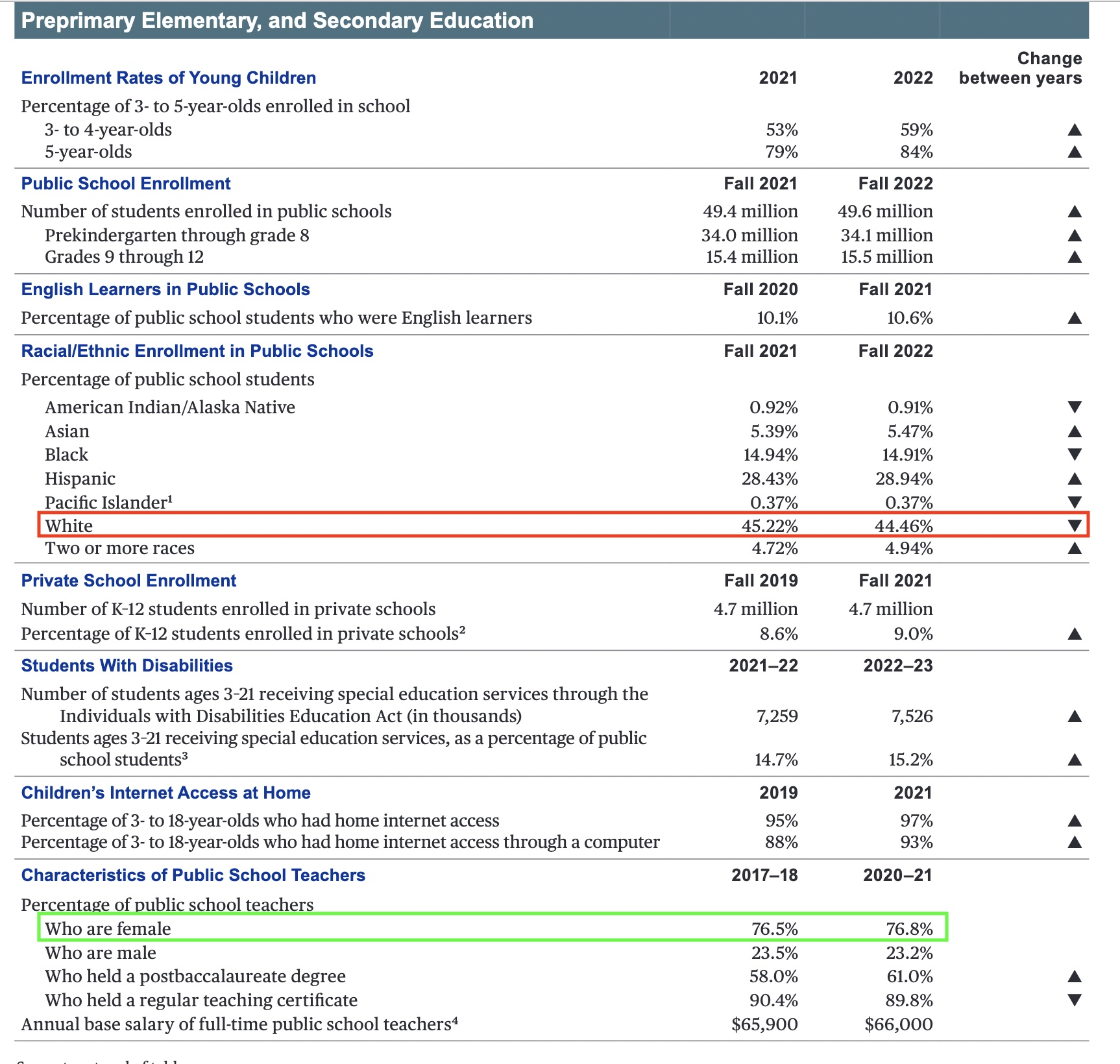
The recent Report on the Condition of Education 2024 provides a couple data points to support why attacks on public education and teachers are intensifying, if not increasing:

First, the proportion of white students in US public schools is below 50% and continuing to decrease.

Next, the teacher workforce in the US is over 3/4 women, and among literacy teachers, that number is even higher.

Republican states are again increasing school choice schemes, and at the core of that is another move to allow white flight from public schools, funded by the public. This parallels the rise of private schools and white flight after Brown v. Board (notably across the South).

The nation-wide and often bi-partisan embracing of the SOR movement is grounded in a false but compelling claim that teachers of reading and teacher educators don’t know how to teach reading, a claim made without evidence among journalists and politicians.

That the teacher workforce is almost entirely women drives both the attacks on teachers and why that attack is uncritically embraced.

The result is so-called “structured literacy,” which is a veneer for scripted curriculum.

Scripted curriculum de-professionalizes teaching as a profession and centers instructional authority in commercial programs and not teachers.

Public education and public education teachers deserve better, primarily because they both serve our children and if allowed our democracy.

Deinfluencing Reading Policy

[Header Photo by Diggity Marketing on Unsplash]

My partner and I were discussing this YouTube video by Nick Lewis, who explains in the beginning how social media influencers make profits (watch the first few minutes, by the way, for his explanation):

The key point here is that social media influencers need consumers to always be interested and buying the next thing, the new thing.

Influencers are not incentivized to find for their audiences The Thing, something that lasts, something that solves a problem, because the value is in churn—consumer buying the thing and then almost immediately positioned to want to replace that thing with the new thing.

That dynamic is exactly what is working in the perpetual reading war where influencers (journalists, education reformers, politicians) are incentivized to keep the public in a constant state of crisis/reform.

Those crisis influencers must first create market space (“Reading programs X and Y have failed!”) and then promote the New Reading Program—and then in just a few years, that reading program will be declared a failure so if we will only adopt this Next New Reading Program …

Reading reform influencers are like social media influencers as well in that they lack expertise in the issue; their only expertise is the influencing and the creation of constant churn.

The “science of” movements in education are just that—influencers creating market churn—and not in most ways about addressing real educational problems and certainly not about solving them.

If education and reading were satisfactorily improved, what would they do?

We need to deinfluence reading (and education) reform if we are genuinely concerned about improving student achievement.