P. L. Thomas, Professor of Education (Furman University, Greenville SC), taught high school English in rural South Carolina before moving to teacher education. He is a former column editor for English Journal (National Council of Teachers of English), current series editor for Critical Literacy Teaching Series: Challenging Authors and Genres (Brill), and author of Teaching Writing as Journey, Not Destination: Essays Exploring What ‘Teaching Writing’ Means (IAP, 2019) and How to End the Reading War and Serve the Literacy Needs of All Students: A Primer for Parents, Policy Makers, and People Who Care (IAP, in press). NCTE named Thomas the 2013 George Orwell Award winner. He co-edited the award-winning (Divergent Book Award for Excellence in 21st Century Literacies Research) volume Critical Media Literacy and Fake News in Post-Truth America (Brill, 2018). Follow his work @plthomasEdD and the becoming radical (https://radicalscholarship.wordpress.com/).
Megan Chaffin, Holly Sheppard Riesco, Kathryn Hackett-Hill, Vicki Collet, Megan Yates Grizzle & Jacob Warren (25 Oct 2023): “Phonics Monkeys” and “Real Life Reading”: Heteroglossic Views of a State Reading Initiative, Literacy Research and Instruction, DOI: 10.1080/19388071.2023.2271085
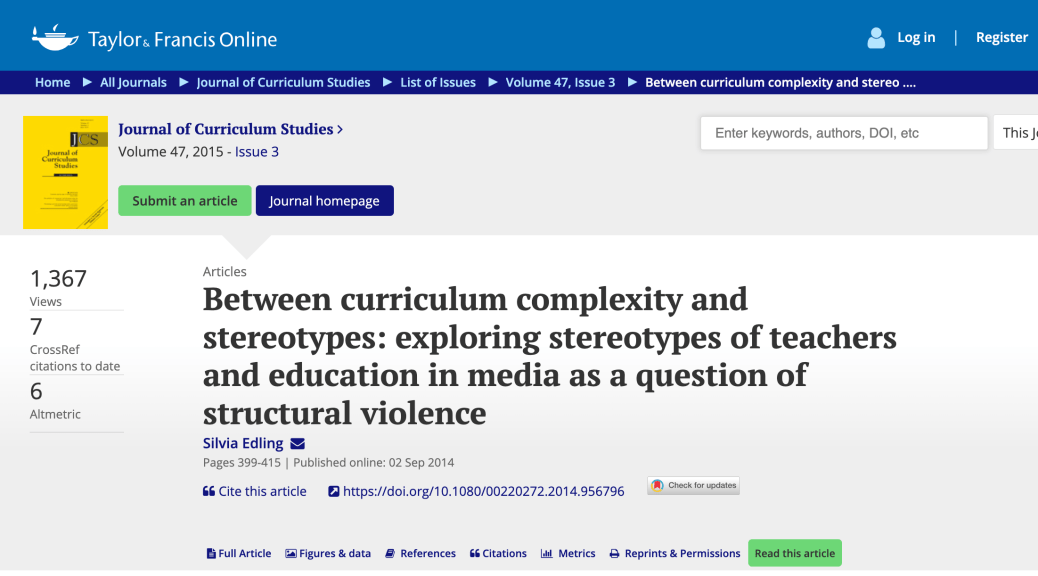
Overwhelming whiteness: a critical analysis of race in a scripted reading curriculum, Amanda Rigell, Arianna Banack, Amy Maples, Judson Laughter, Amy Broemmel, Nora Vines & Jennifer Jordan (2022) Overwhelming whiteness: a critical analysis of race in a scripted reading curriculum, Journal of Curriculum Studies, 54:6, 852-870, DOI: 10.1080/00220272.2022.2030803
For many years I have been raising concerns about the use of “crisis” rhetoric around education [1], specifically challenging the default use of “crisis” and “miracle” in mainstream media.
The central role of “crisis” rhetoric in the accountability era of education reform has been characterized as a “manufactured” [2] crisis.
The current subset of education reform, the “science of reading” (SOR) movement, fits into the same patterns of the broader accountability era of education reform, I have argued.
Here, I am using Edling excellent work on the relationship between mainstream media and education to reinforce the claims that SOR as a reform movement is both mainstream accountability reform and essentially conservative.
I want this overview to be accessible, but I also highly recommend reading the piece in it entirety (click title above for access).
Edling’s first sentence establishes: “What is of particular interest in this paper is how professional teachers repeatedly, although not always, seem to be pictured in a de-contextualized and non-relational manner by actors outside education, and especially how the media often fails to take educational complexity and practice into account.”
Media representations of education, then, are often overly simplistic. Note that a key aspect of the SOR movement [3] is the claim that reading science is simple (the simple view of reading) and settled, effectively erasing the complexity of reading science and of reading instruction.
Edling’s explanation about the relationship between media and education also describes well the story of reading found in the SOR movement:
Newspapers do not just write about education, they also represent to their readers what education is ‘about’ (p. 392, see also McLure, 2003; Thomas, 2004). Similarly, Fairclough (1995) stresses that the media has the power: ‘to shape governments and parties … influence knowledge, beliefs, values, social relations, social identities’ (p. 2). From this way of reasoning, the media can be seen as an important power source for the construction of certain ideologies that can either exclude or include (Fairclough, 1995, p. 14), depending on how they are positioned and what sets the agenda for what is to be framed as true or false in society (cf. Johnson-Cartee, 2005).
There is no doubt that critical analyses of education in general are necessary in order to improve quality. Education is here understood as a broad concept that includes institutions such as (pre)schools, teacher education and the ideas behind them (cf. Sa ̈fstro ̈m & Ekerwald, 2012). However, what is highlighted here is not criticism of the media itself, but how the media’s recurring simplifications and often negative images of education and teachers are understood and how they might affect people who are seen or define themselves as teachers. Moreover, teachers in teacher education and teachers at (pre)schools are dialectically interconnected, in that teacher education aims to educate teachers, who are capable of acting as professionals in various educational positions—not the least in (pre) schools. For that reason, the term teacher includes teachers at (pre) schools and teacher education (cf. Hallse ́n, 2013).
In the paper, four interrelated propensities are problematized concerning the media’s portrayals of teachers and education:
Viewing education as being in more or less permanent crisis
Taking the role as a spokesperson for teachers and on behalf of the field of education
Excluding the knowledge and experiences of teacher(s), educators and/or educational researchers in the public press
Simplifying the notion of being a good teacher through stereotypes and dualistic frameworks that overlook task and relational complexity.
The SOR movement is yet another reading crisis in a long line of similar reading crises reaching back to the 1940s. Also the SOR movement is being driven by journalists who are identified as literacy experts, and those journalists have repeatedly characterized teachers as ill-equipped to teach reading because the entire field of teacher education has failed those teachers.
As the fourth bullet point above notes, as well, the SOR movement depends on simplistic characterizations of balanced literacy and reading programs as well as cartoonish caricatures of “three cueing” and “guessing” as pervasive failures of reading instruction across the entire US.
Edling details next “educational crisis discourse”:
Although crisis in the media is generally pictured as having specific causes that can be limited to a certain time in history (Wiklund, 2006), research indicates that the notion of educational crisis has been used as a more or less constant image ever since the 1950s and 1960s, and can be associated with the progressive school vs. conservative school problematic…. [C]risis is something that originates in the clash between different world views. As it is reasonable to assume that different world views will exist as long as there are humans, it is equally reasonable to assume that crises—including educational crises—will too.
The repetition of the word crisis is closely related to ideas that teachers and teacher education are incapable of dealing with education in a proper way. Crisis is used as a blanket to cover the field of education and, as in a situation of social crisis, groups outside education feel the need to step in and take control. The phenomenon can be described as an outside-in vs. an inside-out professionalism (cf. Stanley & Stonach, 2013). It is argued that the way in which people from the outside have assumed the right to define what is good and bad education has created a systematic disbelief in teachers in ways that have reduced their professional autonomy (Ball, 2011; Beach & Bagley, 2012; Krantz, 2009; Lauder, Brown, & Halsey, 2009).
Other researchers point to how the media refers to teacher education and teachers as lacking the necessary qualities and blames them for the crisis in school without taking the purposes and contexts of education into account (cf. Cochran-Smith & Fries, 2008; MacLure, 2003; Thomas, 2004; Warburton & Saunders, 1996).
The SOR movement has manufactured a reading crisis (mostly from misrepresenting NAEP data) and then placing soft or indirect blame on reading teachers and direct blame on teacher educators.
Edling notes that blame for educational crises do vary across countries (Sweden, for example, portrays teachers as victims of the crisis as well as the authorities who can overcome that crisis, contrary to the SOR story of teacher blaming). However, Edling adds that in most crisis discourse about education “teacher educator(s) and educational researchers were degraded and silenced,” similar to the current SOR movement.
Broadly, Edling emphasizes “a tendency to repeatedly fixate the debate on education in a dualistic and simplified image that omits the task and relational complexity,” resulting in “[s]tructural violence”:
Structural violence is generated through social practice and law, and hence becomes closely entwined in a specific culture and the norms that govern it, which implies that people in general, including members of group who suffers from their consequences, risks upholding the norms in their every-day actions since the norms are taken for granted as true. From this sense, people or groups of people, such as teachers, are not neutral or simply passive victims but partakers in the weaving of social structures. Violence is produced as a recurring beat through endorsed ideals, speech, gestures, choice of focus and solutions to world problems. The violence that becomes materialized as a consequence of these structures does not necessarily have to do with ill-will, as in deliberately wanting to do harm. On the contrary, what characterizes these acts is that they appear to be normal, harmless and sometimes have the ambition to do good, whereas in reality, they make life difficult for certain groups of people (cf. Cudd, 2006, p. 127, Epp & Watkinsson, 1997, p. 6).
Here is a key point: Journalists and teachers do not need to be bad actors for the media stories and resulting consequences to be bad actions. Hanford and other journalists as well as elected officials likely see their work as good work even as their messaging and policy endorsements are oversimplified, misguided, and harmful (to teachers and students).
This helps explain why Hanford and other journalists have teacher support:
She argues that our identity is not just shaped by how we see ourselves, but also through the way others see us, and that seeing is often coloured by stereotypes and norms (Young, 1990, p. 46–47). In accordance with the associative model, teachers can choose to see themselves as part of the professional group of teachers, which research describes as complex and multidimensional. At the same time, the group affinity model helps to illuminate how teachers’ identity as a group is shaped from the outside based on stereotyped and simplified images of teachers and educational researchers. Hence, people can identify themselves as members of the group known as ‘teacher professionals’ that is associated with certain practices. At the same time, they may have to face contrasting images of a teacher created by the media.
Parallel to the role of NAEP in the media-manufactured reading crisis, the role of standardized tests is acknowledged by Edling: “In a sense, one could argue that reports such as TIMMS and PISA have presented evidence of the failure of education in many countries, which might suggest that the negative criticism of teachers and education is justified. The results in the reports have been used to motivate several reforms focusing on measurability, accountability and control.”
Ultimately the stories perpetuated by media are stereotypes: “Once people have become accustomed to stereotypical thinking, they may not be able to see individuals or situations for what they are. Accordingly, a problem with stereotypes is that they are used to judge and pigeonhole people, without really taking into account context and unique individuals.”
The crisis story of reading in SOR is a simplistic story of caricature about teachers, teacher educators, balanced literacy, and reading programs. the complexity of the real world of teaching and learning reading are erased. As Edling notes:
Parallel with the recurring waves of crisis that wash over the field of education and the recurring stereotyped images of teachers, the curriculum complexity of the purposes and practices of education generally goes unnoticed in the media debate on education. What is forgotten is that teachers are not free to do as they want, even though their profession often allows them some kind of freedom to judge. Indeed, as the teaching profession is politically defined, it is obliged to pay attention to a multitude of different policies (Ball et al., 2012) and curriculum purposes (Hopmann, 2007). In a sense, it is possible to assert that teaching in many countries have come to be restricted to a standard and accountability movement; and hence, rendered more mechanical and simplified than before—very much following the logic presented in media (cf. Apple, 2011; Berliner, 2013).
Consequently, Edling explains: “Rather than beginning the discussion with the various demands that are embedded in teachers’ professional assignments, there are tendencies within the media to portray the good teacher as someone who is capable of efficiently transferring knowledge to pupils, where the epistemology of knowledge stems from science rendering it equal with truth and fact about a world (Wiklund, 2006, p. 177).”
The weaponizing of “science” in the SOR movement, in fact, has begun to creep broader into the science of learning, the science of writing, and the science of math.
The great paradox of crisis rhetoric in media coverage of education is it insures failure:
The implication is that whatever they do, they will end up as failures in the sense of being unable to embrace the multitude of requirements at the same time. Hence, drawing on the task and relational complexity of teachers’ work, one might ask whether it is possible to be an impeccable teacher in the relational midst of education if a multitude of educational purposes and relational inconsistencies have to be taken into account. If it is not, perhaps there is a point in adhering to more nuanced judgements of teachers’ quality in accordance with curriculum content, purposes and the ways in which relations are played out in educational spaces.
Edling warns: “[T]he power of the media and the damaging consequences of repeatedly judging groups of people through a grid of stereo- types need nevertheless to be taken seriously,” concluding:
Consequently, when the media systematically define teachers as working in a field of crisis and need exterior help to sort things out, it automatically excludes the professional knowledge and experiences of teachers and educational researchers and their task and relational complexity, which are already present in their day-to-day work, from the debate.
In the light of these tendencies, research on structural violence helps to remind us that: (a) teachers are unwillingly forced into a paradoxical (in)visibility (even in Sweden, where it is pointed out that their voices need to be heard), (b) they are squeezed in-between two pressuring external demands, namely the complexities in their professional assignment that are politically steered and stereotypes of the good and bad teacher produced by, in this case, the media, (c) they risk wasting time and energy on addressing prejudices that have nothing to do with the specific work they are expected to do, and d) the logic of binary stereotypes is a power issue that brands teachers into a position of permanent failure.
While Edling is writing about media coverage of education in general, her examination matches exactly how the SOR movement works as well as how that movement is grounded in misinformation to the detriment of teachers, students, and democracy.
[3] See an overview of the story about reading now commonplace in media, grounded in Emily Hanford’s journalism, specifically her article “Hard Words.”
There is an incredibly powerful and frustrating dynamic about mainstream media in the US: While common knowledge claims mainstream media is liberal media, actual mainstream journalism in the US perpetuates as fact conservative ideology.
And the topic that suffers the most from that contradiction is education.
We are but 8 days into 2024, and the self-proclaimed Queen of US journalism, the New York Times, has offered up what may prove to be one of the classic examples of that liberal/conservative contradiction (see, for example, the NYT covering poverty at the level of The Onion).
Currently, media has renewed interest in college admissions, specifically using standardized tests such as the SAT or ACT for admissions. Progressive/liberal advocates call for not using SAT/ACT for admissions ; conservatives support maintaining standardized tests in admissions.
This college admissions/SAT example parallels the NYT piece on grocery shopping by people in poverty; the claims of the articles are driven by normative conservative ideology (poor people buy junk food and standardized tests measure merit) not empirical evidence.
Mainstream media misrepresenting education and educational research, then, is normal in the US. In fact, far more coverage of education is misleading or outright false than is credible.
One of the best examples of this problem is coverage of reading proficiency and the current reading crisis, specifically the “science of reading” movement.
Along with many others, I have documented that media coverage of reading is both “holy text” and significantly misleading.
Key elements of that misguided coverage include the following:
Misrepresenting “reading proficiency” based on misunderstanding NAEP achievement levels. Media makes the claim 1/3 of students are not proficient readers when, in fact, NAEP shows 2/3 of students read at grade level or above.
Misrepresenting balanced literacy, three cueing, guessing, and popular reading programs. Essentially, no evidence exists showing balanced literacy has created a reading crisis or that any sort of uniform approach to reading exists across the US since many programs and interpretations of reading co-exist now and throughout the history of the US.
Misrepresenting teacher knowledge and practice related to reading as well as broadly discrediting teacher education, primarily based on a think-tank (NCTQ) agenda and not empirical evidence.
Misrepresenting reading science by distorting conclusions from NRP and ignoring or cherry-picking from the two decades of research since NRP.
Claiming reading science is settled and asserting that brain research is also settled. Both reading and brain science are evolving, each ripe with debate and room for greater understanding.
Simultaneously narrowing the reading science to only experimental/quasi-experimental research while using as evidence anecdotes and endorsing practices (grade retention, systematic phonics instruction for all students) and programs (LETRS, Orton-Gillingham) lacking scientific support.
Aligning SOR with social justice agendas although a growing body of research shows SOR contradicts equity goals.
In short, reading proficiency and reading instruction deserve better than mainstream media is providing.
Education journalists need in 2024 to step back from the “holy text” template, re-engage with the full story and body of evidence, and then provide the sort of critical coverage students, teachers, and our democracy deserve.
Recent Research Challenging SOR Policy/Legislation
Elena Aydarova; “Whatever You Want to Call It”: Science of Reading Mythologies in the Education Reform Movement. Harvard Educational Review 1 December 2023; 93 (4): 556–581. https://doi.org/10.17763/1943-5045-93.4.556
Megan Chaffin, Holly Sheppard Riesco, Kathryn Hackett-Hill, Vicki Collet, Megan Yates Grizzle & Jacob Warren (25 Oct 2023): “Phonics Monkeys” and “Real Life Reading”: Heteroglossic Views of a State Reading Initiative, Literacy Research and Instruction. 10.1080/19388071.2023.2271085
Overwhelming whiteness: a critical analysis of race in a scripted reading curriculum, Amanda Rigell, Arianna Banack, Amy Maples, Judson Laughter, Amy Broemmel, Nora Vines & Jennifer Jordan (2022) Overwhelming whiteness: a critical analysis of race in a scripted reading curriculum, Journal of Curriculum Studies, 54:6, 852-870, 10.1080/00220272.2022.2030803
Compton-Lilly, C., Spence, L.K., Thomas, P.L., & Decker, S.L. (2023, November 2). Stories grounded in decades of research: What we truly know about the teaching of reading. The Reading Teacher. https://doi.org/10.1002/trtr.2258
Thomas, P.L. (2023). The “Science of Reading,” Education Faddism, and the Failure to Honor the Intellectual Lives of All Children: On Deficit Lenses and Ignoring Class and Race Stereotyping. Voices in the Middle, 30(3), 17-21. https://library.ncte.org/journals/vm/issues/v30-3/32439
Thomas, P.L. (2022). The Science of Reading movement: The never-ending debate and the need for a different approach to reading instruction. Boulder, CO: National Education Policy Center. http://nepc.colorado.edu/publication/science-of-reading
In the wake of the “science of reading” tsunami, most states have passed new or revised reading legislation over the past decade. Research on the outcomes of those flawed decisions are now being published and exposing a common theme—”unintended consequences.”
While I think for some these consequences are intended, the research is showing that once again, following a similar pattern of accountability reform since the 1980s, the SOR legislative reform movement is simply not fulfilling promised outcomes and is often causing more or different harm.
School systems around the world use achievement tests to assign students to schools, classes, and instructional resources, including remediation. Using a regression discontinuity design, we study a Florida policy that places middle school students who score below a proficiency cutoff into remedial classes. Students scoring below the cutoff receive more educational resources, but they are also placed in classes that are more segregated by race, socio-economic status, and prior achievement. Increased tracking occurs not only in the remedial subject, but also in other core subjects. These tracking effects are significantly larger and more likely to persist beyond the year of remediation for Black students.
II.
Elena Aydarova; “Whatever You Want to Call It”: Science of Reading Mythologies in the Education Reform Movement. Harvard Educational Review 1 December 2023; 93 (4): 556–581. https://doi.org/10.17763/1943-5045-93.4.556
Abstract
In recent years, a wave of science of reading (SOR) reforms have swept across the nation. Although advocates argue that these are based on science-based research, SOR remains a contested and ambiguous notion. In this essay, Elena Aydarova uses an anthropology of policy approach to analyze advocacy efforts that promoted SOR reforms and legislative deliberations in Tennessee. Drawing on Barthes’s theory of mythology, this analysis sheds light on the semiotic chains that link SOR with tradition, knowledge-build ingcurricula, and the scaling down of social safety nets. This deciphering of SOR mythologies under scores how the focus on “science” distorts the intentions of these myths to naturalize socioeconomic inequality and depoliticize social conditions of precarity. This study problematizes the claims made by SOR advocates and sheds light on the ways these reforms are likely to reproduce, rather than disrupt, inequities and injustices.
III. (Math research relevant to reading)
Clements, Douglas H., Renee Lizcano, and Julie Sarama. 2023. “Research and Pedagogies for Early Math” Education Sciences 13, no. 8: 839. https://doi.org/10.3390/educsci13080839
Abstract
The increasing interest in early childhood mathematics education for decades has increased the need for empirically supported pedagogical strategies. However, there is little agreement on how early math might best be taught. We draw from the empirical literature to paint a picture of research-based and research-validated pedagogical approaches and strategies for teaching early math. Most approaches share core characteristics, including concern for children’s interests and engagement and for working on content matched to children’s level of thinking. Learning trajectories are an especially useful organizing structure because they combine and integrate educational goals, development of children’s thinking, and empirically supported pedagogical strategies. Therefore, they help teachers interpret what the child is doing, thinking, and constructing, and offer instructional activities that extend children’s mathematical thinking. Simultaneously, teachers can see instructional strategies from the child’s perspective, offering meaningful and joyful opportunities to engage in learning.
In this commentary, we identify a phonics-first ideology and its polemical distortions of research and science to promote legislation that constrains and diminishes the teaching of reading. We affirm our own, and a majority of reading professionals’, commitment to teaching phonics. However, we argue that phonics instruction is more effective when embedded in a more comprehensive program of literacy instruction that accommodates students’ individual needs and multiple approaches to teaching phonics—a view supported by substantial research. After summarizing the politicization of phonics in the United States, we critique a legislated training course for teachers in Tennessee as representative of how a phonics-first ideology is expressed polemically for political purposes. We contrast it with a more collaboratively developed, balanced, nonlegislative approach in the previous governor’s administration. Specifically, the training course (a) makes an unfounded claim that there is a national reading crisis that can be traced to insufficient or inappropriate phonics instruction; (b) distorts, misrepresents, or omits relevant research findings and recommendations, most prominently from the report of the National Reading Panel; (c) inaccurately suggests that “balanced literacy instruction” is “whole language” instruction in disguise; and (d) wrongly claims that its views of phonics are based on a settled science of reading.
V.
Compton-Lilly, C., Spence, L.K., Thomas, P.L. and Decker, S.L. (2023), Stories Grounded in Decades of Research: What We Truly Know about the Teaching of Reading. Read Teach, 77: 392-400. https://doi.org/10.1002/trtr.2258
Abstract
The recent dissemination of selective research findings related to reading privileges a narrow body of reading scholarship and a singular, unproven solution—teaching phonics. We offer a research-based correction by presenting two compelling bodies of research to argue that reading instruction must be responsive to individual children. While this confluence of complexity does not deny the importance of phonics, it highlights the significant findings related to: (1) the brain and reading, and (2) the systematic observation of young readers. We argue that reductive and singular models of reading fail to honor the cultures, experiences, and diversity of children. This confluence of research findings reveals an unequivocal need for caution as states, universities, schools, and teachers adopt assumedly universal and narrow approaches to teaching reading.
Megan Chaffin, Holly Sheppard Riesco, Kathryn Hackett-Hill, Vicki Collet, Megan Yates Grizzle & Jacob Warren (25 Oct 2023): “Phonics Monkeys” and “Real Life Reading”: Heteroglossic Views of a State Reading Initiative, Literacy Research and Instruction, DOI: 10.1080/19388071.2023.2271085
Abstract
Framed by Bakhtinian theories of authoritative discourse and heteroglossia, this study examines perceptions of a Science-of-Reading- based state reading initiative five years into implementation. Using interview transcripts, researchers engaged in polyphonic analysis to bring the voices of teachers, reading interventionists, parents, administrators, and state department of education officials into created dialogue. Findings from this qualitative study suggest there were contrasting perspectives about reading and the SRI, that many participants felt the initiative narrowed reading instruction and constrained teachers’ agency, and that, overall, there have been limited opportunities for dialogue about the initiative. Findings demonstrate that a narrow view of reading research may silence and delegitimize some stakeholder voices. This state’s goal of sharpening the focus of reading instruction led to instruction that was perceived by some stakeholders as narrow, boring, and meaningless, unlikely to create the statewide culture of reading that was targeted. Implications for this and future state reading initiatives point to the value of dialogue among varied stakeholders, which might allow for the idiosyncrasies of the teaching and learning of reading and writing to be addressed.
School systems have taken on greater roles in guiding and supporting classroom instruction by redesigning their educational infrastructure—the coordinated resources, structures, and norms that support teachers’ work and drive instructional improvement. However, teachers often adapt or resist common instructional approaches, citing students’ unique needs. Drawing on data from a qualitative, comparative study, I examine how different types of public school systems (charter, suburban, and urban) redesigned their educational infrastructures and how teachers used system-provided educational infrastructure when constructing their practice. I found that teachers experienced their educational infrastructure as providing both affordances and constraints around their instructional decisions, particularly how they responded to their perceptions of students’ needs. Despite differences in each system’s educational infrastructure arrangements, teachers faced a common challenge related to differentiating instruction in diverse classrooms. Findings suggest the need for educational infrastructure redesign efforts to include professional learning around asset-based differentiation strategies and culturally responsive pedagogy.
X.
Overwhelming whiteness: a critical analysis of race in a scripted reading curriculum, Amanda Rigell, Arianna Banack, Amy Maples, Judson Laughter, Amy Broemmel, Nora Vines & Jennifer Jordan (2022) Overwhelming whiteness: a critical analysis of race in a scripted reading curriculum, Journal of Curriculum Studies, 54:6, 852-870, DOI: 10.1080/00220272.2022.2030803
Abstract
Teachers in the US are increasingly required to use scripted curricula. Such instructional materials often reflect the overwhelming whiteness of the publishing industry through a lack of representation of authors and protagonists outside of white, middle-class normative characters. Implementation of such curricula stands in direct contrast to studies finding that culturally relevant pedagogy and curricula benefit students across racial and ethnic groups. This paper describes a qualitative analysis of the scripted Wit and Wisdom English Language Arts curriculum for grades K-8 guided by the research question: How might the curriculum reproduce a white supremacist master script? Following a quantitative analysis of racial representation across all core and supplementary texts in the curriculum, the research team used guiding questions grounded in a critical discourse and anti-racist teaching framework to qualitatively analyse teacher-facing materials at each grade level. The findings of this study indicate that whiteness is centred at every level of the curriculum in text selection and thematic grouping of texts, as well as through discursive moves in teacher-facing materials (e.g. essential questions for learning modules). Based on the findings, the research team suggests mechanisms for individual and collective efforts to resist whiteness-centred curricula at the system, school, and classroom level.
XI.
Maroun, Jamil, and Christopher H. Tienken. 2024. “The Pernicious Predictability of State-Mandated Tests of Academic Achievement in the United States” Education Sciences 14, no. 2: 129. https://doi.org/10.3390/educsci14020129
Abstract
The purpose of this study was to determine the predictiveness of community and family demographic variables related to the development of student academic background knowledge on the percentage of students who pass a state-mandated, commercially prepared, standardized Algebra 1 test in the state of New Jersey, USA. This explanatory, cross-sectional study utilized quantitative methods through hierarchical regression analysis. The results suggest that family demographic variables found in the United States Census data related to the development of student academic background knowledge predicted 75 percent of schools in which students achieved a passing score on a state standardized high school assessment of Algebra 1. We can conclude that construct-irrelevant variance, influenced in part by student background knowledge, can be used to predict standardized test results. The results call into question the use of standardized tests as tools for policy makers and educational leaders to accurately judge student learning or school quality.
Rios, A., Matthews, S. D., Zentell, S. & Kogut, A. (2024). More being, different doing: Illuminating examples of culturally relevant literacy teaching. Journal of Adolescent & Adult Literacy, 67, 283–293. https://doi.org/10.1002/jaal.1329
Legislators are again poised to address reading in South Carolina with “Read to Succeed” scheduled for a subcommittee hearing January 10.
I have been a literacy educator in SC for 40 years, 18 years as a high school English teacher and now in my 22nd year in higher education. My doctoral work at the University of South Carolina afforded me the opportunity to explore the long history of debate about reading in the US reaching back into the 1940s when literacy teacher and scholar Lou LaBrant raised a familiar concern: “A brief consideration will indicate reasons for the considerable gap between the research currently available and the utilization of that research in school programs and methods.”
LaBrant wrote just after a reading crisis was declared in the 1940s due to low literacy rates in WWII recruits, noting: “[W]e hear many persons saying that the present group of near-illiterates are results of ‘new methods,’ ‘progressive schools,’ or any deviation from the old mechanical procedures. They say we must return to drill and formal reciting from a text book.”
Eighty years later, journalists, pundits, and political leaders are announcing another reading crisis, the “science of reading” movement, and pointing at the exact same causes while offering the same solutions grounded almost entirely in phonics and going back to basics.
SC has been targeting reading for a decade through Read to Succeed, and yet, we find ourselves still mired in a reading crisis.
Let’s instead look at the evidence around us to close the gap LaBrant acknowledged.
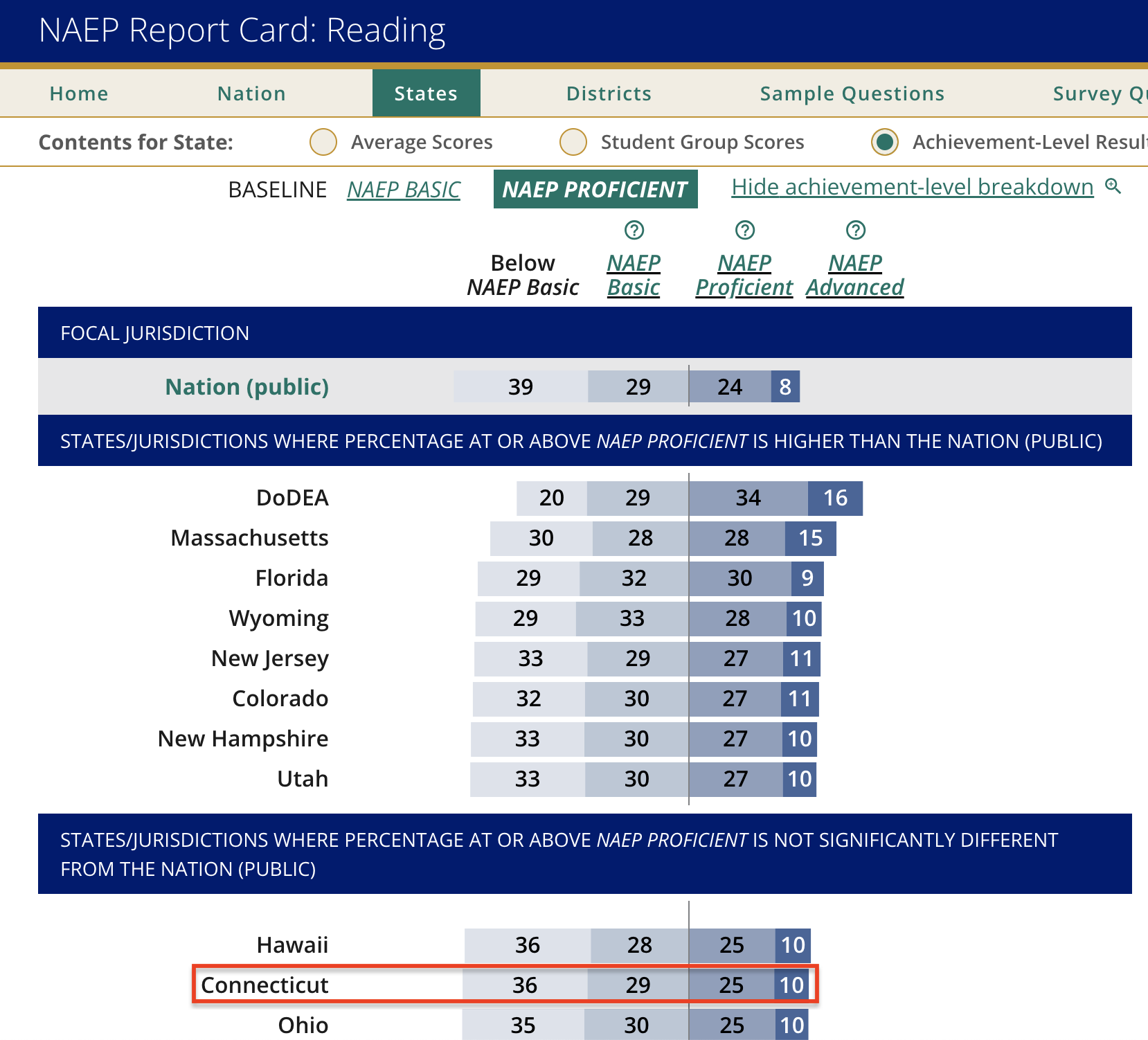
In Connecticut, legislation has targeted reading mandating the “science of reading,” but now the unintended consequences are coming home to roost: “[T]he new mandate will cost districts collectively more than $100 million in the school year 2024-25.”
Even more concerning is this legislation bans adopted materials while mandating new materials, even for schools with strong reading proficiency: “CSDE ordered the remaining 68 applicants to either augment their existing programs or replace them entirely. These districts include New Canaan Public Schools, where 83.2 percent of their students read proficiently. Darien, Westport Eastford, Wilton, Colebrook, Cheshire, Ridgefield, Bethany were also denied in part or all together, even though their third graders scored near or above the 80 percent level.”
A recent analysis in the Harvard Educational Review reveals a similar pattern in reading legislation in Tennessee: “Since the early 2010s, Tennessee has had ‘a revolving door of reading reforms’—from the Ready to Read initiative in 2016 to the revisions of English language arts standards that in 2017 introduced ‘foundational literacy’ skills.”
Like CT, TN is facing a $100 million price tag, yet most of that funds purchasing commercial reading products not supported by science: “[A]lthough the new legislation overtly addressed changes in literacy instruction, it ultimately served to secure a market share for certain private providers of curriculum, assessment, and teacher professional development.”
This “science of reading” fad repeats the Common Core era of new standards and new teaching and learning materials—a cycle of reform that never achieves what is promised.
Often in SC, we pride ourselves on not simply following the fad, but in education, we have failed to do something different since the 1980s. Yes, we should serve better the individual needs of students as readers, but jumping on the “science of reading” bandwagon is taking the same path we have been traveling and expecting a different destination.
Regretfully, we persist in the historical negligence LaBrant confronted in 1942: “An easy way to evade the question of improved living and better schools for our underprivileged is to say the whole trouble is lack of drill. Lack of drill! Let’s be honest. Lack of good food; lack of well-lighted homes with books and papers; lack of attractive, well equipped schools, where reading is interesting and meaningful; lack of economic security permitting the use of free schools—lack of a good chance, the kind of chance these unlettered boys are now fighting to give to others.”
Legislators should resist the “science of reading” fad and make a different commitment to students and reading.
Legislators are again poised to address reading in South Carolina with “Read to Succeed” scheduled for a subcommittee hearing on Jan. 10.
I have been a literacy educator in South Carolina for 40 years, including 18 years as a high school English teacher. As an Education professor at Furman University, I’m now in my 22nd year in higher education.
My doctoral work at the University of South Carolina afforded me the opportunity to explore the long history of debate about reading in the U.S. reaching back into the 1940s when literacy teacher and scholar Lou LaBrant raised a familiar concern about “the considerable gap between the research currently available and the utilization of that research in school programs and methods.”
Just after a reading crisis was declared in the 1940s due to low literacy rates among WWII recruits, LaBrant wrote: “(W)e hear many persons saying that the present group of near-illiterates are results of ‘new methods,’ ‘progressive schools,’ or any deviation from the old mechanical procedures. They say we must return to drill and formal reciting from a text book.”
Eighty years later, journalists, pundits and political leaders are announcing another reading crisis — the “science of reading” movement — and pointing at the exact same causes while offering the same solutions grounded almost entirely in phonics and a return to basics.
South Carolina has been targeting reading for a decade through Read to Succeed, and yet, we find ourselves still mired in a reading crisis. Let’s instead look at the evidence around us to close the gap LaBrant acknowledged.
In Connecticut, legislation has targeted reading mandating the “science of reading,” but now the unintended consequences are coming home to roost: “(T)he new mandate will cost districts collectively more than $100 million in the school year 2024-25.”
Even more concerning is this legislation bans adopted materials while mandating new materials, even for schools with strong reading proficiency: “CSDE ordered the remaining 68 applicants to either augment their existing programs or replace them entirely. These districts include New Canaan Public Schools, where 83.2% of their students read proficiently. Darien, Westport Eastford, Wilton, Colebrook, Cheshire, Ridgefield, Bethany were also denied in part or all together, even though their third graders scored near or above the 80% level.”
A recent analysis in the Harvard Educational Review reveals a similar pattern in reading legislation in Tennessee: “Since the early 2010s, Tennessee has had ‘a revolving door of reading reforms’ — from the Ready to Read initiative in 2016 to the revisions of English language arts standards that in 2017 introduced ‘foundational literacy’ skills.” Like CT, TN is facing a $100 million price tag, yet most of that funds purchasing commercial reading products not supported by science.
This “science of reading” fad is a repeat of the Common Core era of new standards and new teaching and learning materials — a cycle of reform that never achieves what is promised.
Often in South Carolina, we pride ourselves on not simply following the fad, but in education, we have failed to do something different since the 1980s. Yes, we should better serve the individual needs of students as readers, but jumping on the “science of reading” bandwagon is taking the same path we have been traveling and expecting a different destination.
Regretfully, we persist in the historical negligence LaBrant confronted in 1942: “An easy way to evade the question of improved living and better schools for our underprivileged is to say the whole trouble is lack of drill. Lack of drill! Let’s be honest. Lack of good food; lack of well-lighted homes with books and papers; lack of attractive, well equipped schools, where reading is interesting and meaningful; lack of economic security permitting the use of free schools — lack of a good chance, the kind of chance these unlettered boys are now fighting to give to others.”
Legislators should resist the “science of reading” fad and make a different commitment to students and reading.
Legislation in Connecticut[1] targeting reading that mandates the “science of reading” comes with unintended and expensive consequences: “[T]he new mandate will cost districts collectively more than $100 million in the school year 2024-25.”
Published in the Harvard Educational Review[2], research by professor Elena Aydarova (University of Wisconsin-Madison) offers an analysis of more than a decade of reading legislation in Tennessee[3], which serves as a cautionary tale[4] for reading legislation in all states, including the following key takeaways:
Approximately 3 out of 5 states have passed new or revised reading legislation since 2018, prompted by misleading media coverage of reading. For example, based on NAEP reading scores about 2/3 of students read at grade level or above; however, media misrepresents that figure as 1/3 (due to misunderstanding NAEP achievement levels[5]).
Claiming US has a reading crisis and blaming a lack of phonics instruction have a long and unsuccessful history in US and England[6]. Back-to-basics movements such as the “science of reading” have never worked.
“Since the early 2010s, Tennessee has had ‘a revolving door of reading reforms’—from the Ready to Read initiative in 2016 to the revisions of English language arts standards that in 2017 introduced ‘foundational literacy’ skills.”
Media and political discussions of the “science of reading” have no consistent definition for the term, often misrepresenting the current research, or “science,” about teaching reading. Advocates for the “science of reading” rarely offer sources for claims.
Like CT, TN legislation primarily funds replacing existing materials and programs with new (but untested) materials and programs: “In the first year of implementation, $100 million was allocated for the reform, with $60 million coming from CO VID-19 relief funds. Most of these resources, however, went toward covering the products and services provided by nonprofit and private-sector organizations.”
Key conclusion: “Although misappropriations of ‘science’ for political and private sector gains are not new in reading policies (Pearson, 2004, Schoenfeld & Pearson, 2012), this analysis of ‘science of reading’ mythologies sheds light on why the actual science becomes irrelevant in policy contexts.”
“Together, these symbolic substitutions revealed the parasitic nature of ‘science of reading’ mythologies: although the new legislation overtly addressed changes in literacy instruction, it ultimately served to secure a market share for certain private providers of curriculum, assessment, and teacher professional development.”
[2] “Whatever You Want to Call It”: Science of Reading Mythologies in the Education Reform Movement, Elena Aydarova, Harvard Educational Review (2023) 93 (4): 556–581. https://doi.org/10.17763/1943-5045-93.4.556
[6] Wyse, D., & Bradbury, A. (2022). Reading wars or reading reconciliation? A critical examination of robust research evidence, curriculum policy and teachers’ practices for teaching phonics and reading. Review of Education, 10(1), e3314. https://doi.org/10.1002/rev3.3314
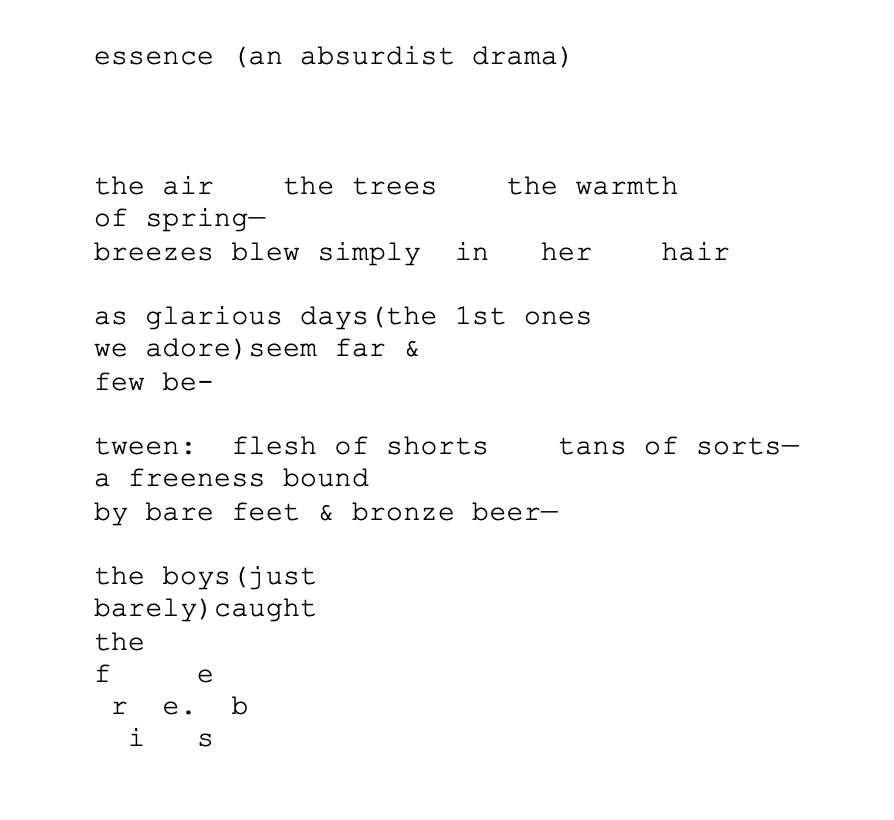
I am sitting in my dorm room of a local junior college looking out the window from the third floor of an ornate but old rock building. On that day, I wrote my first real poem, inspired by e.e. cummings’s “[In just-]” that I had recently read in my speech course with Steve Brannon.
I began playing with letter and word placement while watching students throwing a Frisbee on the dorm lawn, weaving the word “Frisbee” to reveal “free,” “is,” and “be”:
Winter 2023.
This has been my journey across five decades to be a writer. I could have never envisioned as a college student that I would in fact become a writer and that my writer life would primarily be grounded in a WordPress blog.
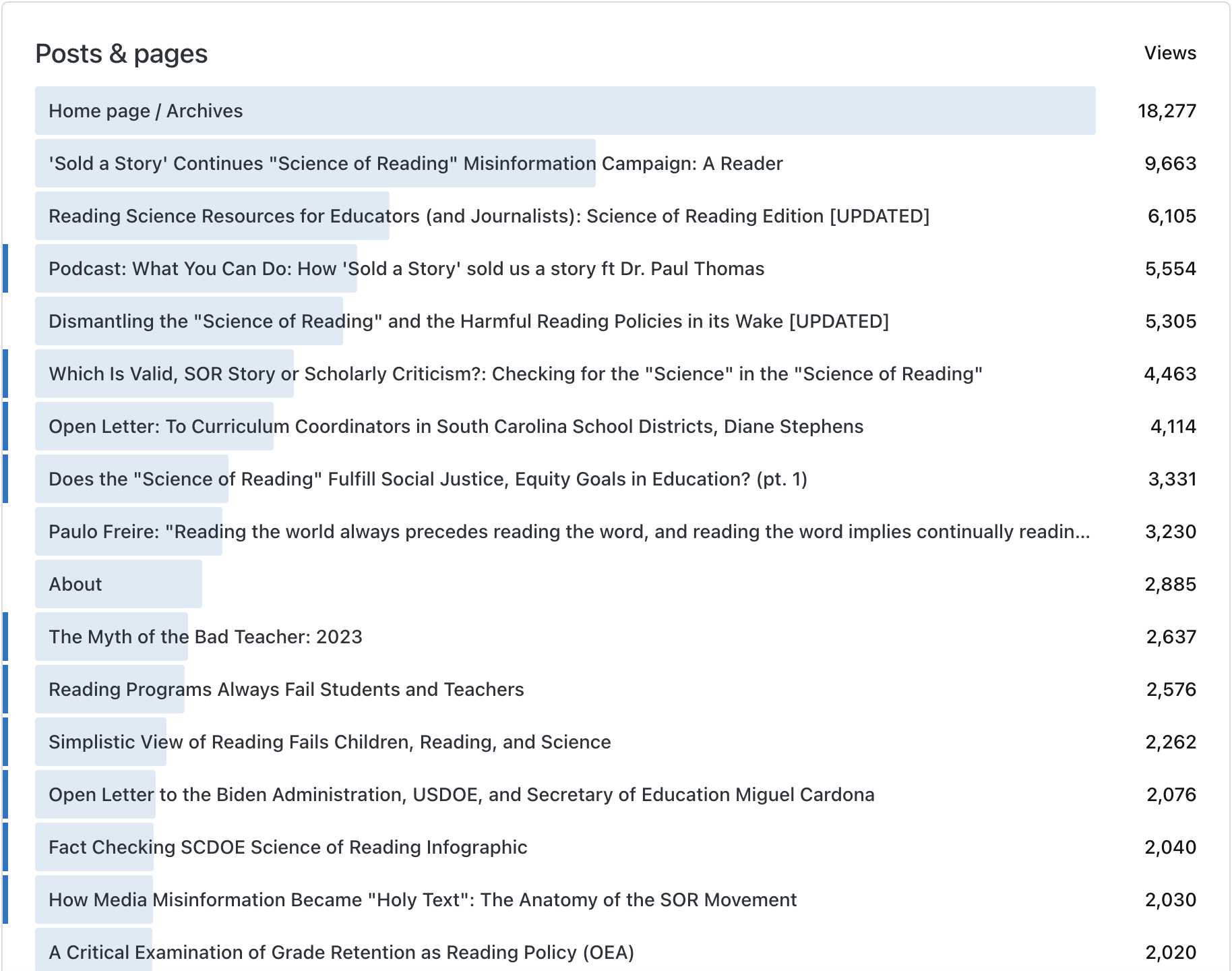
I start blogging reluctantly at my own blog in 2013, a decade ago. Oddly, 2014 was a peak year until nearly being matched in 2023, which saw almost 219,000 views and about 138,000 visitors.
Over my 22 years in higher education, I have gradually decreased my traditional scholarly work after authoring, co-authoring, editing, or co-editing almost 30 books and dozens of journal articles. Traditional work feels perfomative and hollow, to be honest.
Instead, I prefer public work, activism that has an open-access audience and may better impact how the world of education works.
My social media audience is over 10,000 and my social media traffic is consistent with hundreds of views per day resulting in 10,000-20,000 views per month.
In 2023, for example, my open-access work on grade retention contributed to removing grade retention in Ohio. My primary work on the “science of reading” has maintained an audience with much less satisfying outcomes.
It means a great deal to me to have this space to be a writer, and I appreciate even more my audience of smart, kind, and dedicated folk who often share with me the need to speak up as one avenue of activism.
The top 10 posts of 2023 include the following with links below:
While I remain primarily committed to my public work here on this blog, 2023 (and 2022) was a fruitful time for producing traditional scholarship that is open-access; let me share those again here:
Compton-Lilly, C., Spence, L.K., Thomas, P.L., & Decker, S.L. (2023, November 2). Stories grounded in decades of research: What we truly know about the teaching of reading. The Reading Teacher. https://doi.org/10.1002/trtr.2258
Thomas, P.L. (2023). The “Science of Reading,” Education Faddism, and the Failure to Honor the Intellectual Lives of All Children: On Deficit Lenses and Ignoring Class and Race Stereotyping. Voices in the Middle, 30(3), 17-21. https://library.ncte.org/journals/vm/issues/v30-3/32439
Thomas, P.L. (2022). The Science of Reading movement: The never-ending debate and the need for a different approach to reading instruction. Boulder, CO: National Education Policy Center. http://nepc.colorado.edu/publication/science-of-reading
Writing is a solitary venture with an urge to speak to a community beyond the Self. Often it is a lonely act, and too often, it feels pointless (we writers are also an anxious bunch prone to depression and such).
And it is now cool to relentless trash all social media.
However, the virtual community I have built over the past decade through the blog and social media is incredible and important.
My existential leanings allow me not just to survive, but thrive.
Remember, the struggle itself to the heights is enough to fill a person’s heart. In this struggle, yes, I am happy.
My journey across seven decades since the late 1960s as a student and then a teacher has included an overlap between the fields of English and math—which tend to constitute what we call the “basics” or “core” subjects in formal education.
While I always scored high on standardized tests as a student, by high school, I was firmly a math person since I achieved As in math and science courses, but stumbled to mostly Bs and a few As in English. In fact, I graduated high school committed to majoring in physics, possibly the most math of the sciences.
Those of you who know me may be anticipating that in the five years after graduating college, I stood in the same classroom once taught in by my favorite high school English teacher, Lynn Harrill, as a high school English teacher myself.
My teaching career has been exclusively literacy, teaching writing and doing public work on reading policy.
Since my doctoral program, I have also focused often on the history of education, and I routinely argue that we in education stumble into the history mistake cliche—repeating the same approaches and failing because we refuse to learn from history.
I also feel as if I am shouting down a well because we also have contemporary evidence for the reading war mistakes we are currently making: England/UK has been implementing phonics-centric reading legislation since 2006 (paralleling the “science of reading” [SOR] movement here in the US) with growing evidence that the strategy is not working (again, as it has never worked over 80 years in the US).
At the risk of yet more shouting down a well, consider the following two examples of what we persist in doing wrong in education reform and who that directly benefits.
First, nudging its way into the media spotlight where reading has been marathon dancing is the newest math war spurred by PISA and NAEP test data: The Divider (announces The Chronicle).
For those of us slogging through the current and a couple other reading wars over the past several decades, the coverage of the math war will sound disturbingly familiar; some snippets include social media fights, the obligatory and uncritical citing of A Nation at Risk, parent anger, and ideological/political divides over skills:
That “framework” is a policy document that will shape how math is taught in California and beyond, and Nelson, a computer-science professor at the University of California at Berkeley, had major problems with it — and with Boaler, too. He’d seen a series of tweets critical of her, and reposted one of them with his own scathing commentary. Now, Boaler was confronting him….
By the 1980s, Japan’s soaring tech sector was churning out video recorders and semiconductors, and America’s math students were still not doing well at either problem-solving or the “basics.” In a 1983 report titled “A Nation at Risk,” a U.S. panel of education experts warned: “Our once unchallenged preeminence in commerce, industry, science, and technological innovation is being overtaken by competitors throughout the world.” Students were dropping out of the math pipeline at staggering rates each year after ninth grade, Hispanic and Black students most of all….
But in the decade in between, traditionalists grew alarmed. California, early to embrace the “new new math,” was a breeding ground of dissent. When Palo Alto’s school district planned to align its program with the 1992 state framework, angry parents organized on the nascent internet under the name Honest Open Logical Debate. Other anti-reform groups followed, like Mathematically Correct and Q.E.D., and their opposition blossomed into a statewide movement backed by irate mathematicians and Republican lawmakers….
By the time Boaler was in graduate school, Britain was in a similar whiplash. It had adopted a national reform-oriented math curriculum, and upset Conservatives were pushing back. For her dissertation, Boaler compared two schools, one in each camp, and found that students using reform methods were better at thinking critically about math skills and applying them to unfamiliar problems. Stanford soon came calling.
With little imagination, one could imagine an AI bot cranking out this piece when prompted: “Write a piece on the math war based on the current reading war.”
The history and current reality of both the reading and math wars are basically the same story—one we are determined to repeat again in another decade or so.
A key thread in that recurring cycle of failure, I think, is personified by Jo Boaler, self-identified “warrior”:
In pursuit of that goal, Boaler is helping draft California’s latest math framework, a nonbinding guide for how public schools in the most populous state should teach math. It is expected to shape instruction not only in the Golden State — whichflounders in math, despite being home to Silicon Valley — but also the rest of the country, which struggles with it, too. Some of the document’s key ideas are already reshaping math class, as well as admissions at some of the nation’s most selective colleges, much to Boaler’s delight. “Viva la Maths Revolution!” she often declares.
But Boaler can’t shake her critics, whom she sees as elite gatekeepers standing in the way of better lives for young people. Their resistance is merely an invitation to keep marching. “When doing the work of the warrior, it is important to remember this: You should expect and even welcome pushback,” she has written. “If you are not getting pushback, you are probably not being disruptive enough.”
Setting aside if Boaler is right or wrong, she is clearly driven by missionary zeal, the belief she is right and the determination to act on that belief.
If nothing else, the SOR movement is a collection of people with missionary zeal, wielding “science” as their broadsword in their crusade to bring reading proficiency to the students of the US.
Here, I want to pause and speak directly to the math folk reading: Please, for the love of learning, take a different approach, finally, or you’ll regret the missionary zeal, and most of all, the tremendous amount of time and money that will be wasted in your crusade.
So here you go, a little evidence if anyone cares:
In a January 2022 letter to CSDE, Fran Rabinowitz, the president of Connecticut Association of Public School Superintendents, said the new mandate [Connecticut’s “Right to Read” law] will cost districts collectively more than $100 million in the school year 2024-25. Cheshire Public Schools, for example, estimates that replacing its highly effective PreK-3 curriculum will cost $536,292 for licenses, texts, and supporting materials. The estimate does not include the cost of training. Wilton Public Schools puts the price tag at upwards of $1 million….
CSDE ordered the remaining 68 applicants to either augment their existing programs or replace them entirely. These districts include New Canaan Public Schools, where 83.2 percent of their students read proficiently. Darien, Westport Eastford, Wilton, Colebrook, Cheshire, Ridgefield, Bethany were also denied in part or all together, even though their third graders scored near or above the 80 percent level.
One objective of the Right to Read legislation was to “address systemic racial injustice by closing the literacy opportunity gap.” CSDE seems intent on closing the “literacy opportunity gap” by dismantling successful programs instead of demanding that underperforming schools do right by their students and fix theirs.
That’s right, Connecticut has bought into the SOR mania, passed aggressive reading legislation that will cost taxpayers at least an extra $100 million, and even very successful schools with over 80% of students at or above reading proficiency must ditch effective reading programs to adopt the new mandated programs.
In the Reform Crusade, everybody has to reform, regardless.
That’s also right, CT sits in the top quintile of grade 4 reading achievement on NAEP reading in 2022.
“Crisis” in education is mere rhetoric devoid of evidence, decontextualized from history, and driven by missionary zeal.
Math and reading have been in a state of manufactured crisis for as long as we have focused media and political attention on our schools. The US has not had a single moment in the last 100 years when anyone found math or reading achievement acceptable—always a crisis.
Math and reading have been in a state of perpetual reform since that other holy text of manufactured crisis, A Nation at Risk, from the early 1980s.
These cycles of crisis and reform have been driven by people with missionary zeal and the only profit from these crusades has been for commercial education interests eager to rebrand and sell you the next shiny promise that will be replaced by the next shiny promise in about a decade.
For the math folk out there still reading, something about all that doesn’t add up.
As a ideological and political strategy, creating a simplistic caricature to attack and drum up support has proven to be extremely effective for conservatives in the US. Notably, a key caricature to attack in higher education has been Critical Race Theory (CRT):
We put “CRT” in quotation marks throughout this report because so often the conflict campaign’s definition of “CRT” (like its description of actual K–12 practice) is a caricatured distortion by loud opponents as self-appointed “experts.” The conflict campaign thrives on caricature — on often distorting altogether both scholarship and K–12 educators’ efforts at accurate and inclusive education, deeming it (and particularly K–12 efforts to discuss the full scope of racism in our nation) wholly inappropriate for school.
The caricature of CRT being leveraged to dismantle higher education among conservatives and Republicans is nothing like the theory itself; further, the presence or even influence of CRT in higher education instruction and courses is wildly overstated by the attacks as well.
But caricature works in public rhetoric designed to score ideological/political points.
Using caricature from the right to attack education perceived as being liberal has a very long tradition from public critics of progressive education and John Dewey to the more recent scapegoating of whole language and balanced literacy in the Reading War.
Ideological criticism in education based in caricature isn’t valid and does far more harm than good. A current example is the outsized attacks on three cueing (see V. here) that is a foundational part of the “science of reading” (SOR) movement and legislation across the US.
A window into a much more serious problem in education can be found in Lou LaBrant’s criticism of the Project Method:
The cause for my wrath is not new or single. It is of slow growth and has many characteristics. It is known to many as a variation of the project method; to me, as the soap performance. With the project, neatly defined by theorizing educators as “a purposeful activity carried to a successful conclusion,” I know better than to be at war. With what passes for purposeful activity and is unfortunately carried to a conclusion because it will kill time, I have much to complain. To be, for a moment, coherent: I am disturbed by the practice, much more common than our publications would indicate, of using the carving of little toy boats and castles, the dressing of quaint dolls, the pasting of advertising pictures, and the manipulation of clay and soap as the teaching of English literature. (p. 245)
It is doubtful, however, whether playing with toy furniture will produce in the average adult an ambition to own his own house, or whether enjoyment in carving a boat for the Lady of the Lake will induce one to read Cavender’s House. Quite the contrary may be the result. In encouraging much of handwork in connection with the reading of literature, it seems to the writer, wrong emphasis is made. The children may be interested, yes. But it makes considerable difference whether the interest be such as to lead to more reading or more carving. Soap is doubtless an excellent material, and important in present civilization. The question is whether carving out of soap a castle or a horse or a clown will stimulate interest in the drama, or even in daily bathing….On the contrary, the need of the reader is to secure a picture from the written word. (p. 245)
That the making of concrete models will keep interested many pupils who would otherwise find much of the English course dull may be granted. The remedy would seem to be in changing the reading material rather than in turning the literature course into a class in handcraft. (p. 246)
If we fast-forward about 60 years, Lisa Delpit offered similar criticism of workshop approaches that she noted often failed minoritized and poor students who had different lives outside of school than more affluent students who were often white:
Good liberal intentions are not enough.
Although the problem is not necessarily inherent in the method, in some instances adherents of process approaches to writing create situations in which students ultimately find themselves held accountable for knowing a set of rules about which no one has ever directly informed them … If such explicitness is not provided to students, what it feels like to people who are old enough to judge is that there are secrets being kept, that time is being wasted, that the teacher is abdicating his or her duty to teach. A doctoral student of my acquaintance was assigned to a writing class to hone his writing skills. The student was placed in the section led by a white professor who utilized a process approach, consisting primarily of having the students write essays and then assemble into groups to edit each other’s papers. That procedure infuriated this particular student. He had many angry encounters with the teacher about what she was doing.
Conservatives latched onto that criticism and quickly (and falsely) aligned Delpit with the basic skills ideologues:
I do not advocate a simplistic ‘basic skills’ approach for children outside of the culture of power. It would be (and has been) tragic to operate as if these children were incapable of critical and higher-order thinking and reasoning. Rather, I suggest that schools must provide these children the content that other families from a different cultural orientation provide at home. This does not mean separating children according to family background, but instead, ensuring that each classroom incorporate strategies appropriate for all the children in its confines.
Both LaBrant and Delpit in their criticism represent the reductive faddism of instruction that exists in education, should be criticized, but like attacks based in caricature, should not be confused for the authentic version of the practice.
There are two dominant realities in education that reach back over a century—the failure to translate research and science into classroom practice (the “considerable gap” identified by LaBrant in 1947) and the packaged commercial versions of complex educational theory or philosophy that renders instruction reductive, ineffective, but efficient.
For example, Harvey “Smokey” Daniels often laments that his use of “best practice” quickly became a branding term for commercial education materials, rendering the term useless and the practices pale versions of what research supports.
LaBrant bristled at the Project Method that became a hot thing to do at the exclusion of students reading and writing in their English classes; LaBrant was prone to far less glitzy approaches as can be noted in her scholarly titles: Writing Is Learned by Writing (1957).
Many decades before reading and writing workshop became brands, LaBrant was practicing free reading and students writing by choice in workshop settings. Once you read through LaBrant’s classroom practices, you notice that none of that meant ignoring so-called skills and certainly that didn’t mean letting students do as they please with no mentoring or accountability (the context Delpit rightfully confronted).
While caricature attacks are mostly ideological and political—lacking any real interest in reforming practice for the benefit of students—education does have a reductive practice problem, faddism and simply enough examples of misunderstanding or learning contexts that limit good practice to justify criticism.
Fueling that more credible need for criticism, I think, is the “my instruction can beat up your instruction” approach to educational debate.
Instruction one-upmanship is the wrong way to address how to serve the individual needs of all students because it misses the point of instruction.
“My instruction can beat up your instruction” feeds the idea that there is The Right Instruction out there if only we’d find it and implement it; “my instruction can beat up your instruction” is silver-bullet thinking.
However, as Dewey, LaBrant, and Delpit would assert, instruction is right when it serves the student. There simply is no one right way existing decontextualized from students.
Again, let’s we return to LaBrant, this time exasperated about her need to make a case for students writing:
It ought to be unnecessary to say that writing is learned by writing; unfortunately there is need. Again and again teachers or schools are accused of failing to teach students to write decent English, and again and again investigations show that students have been taught about punctuation, the function of a paragraph, parts of speech, selection of “vivid” words, spelling—that students have done everything but the writing of many complete papers. Again and again college freshmen report that never in either high school or grammar school have they been asked to select a topic for writing, and write their own ideas about that subject. Some have been given topics for writing; others have been asked to summarize what someone else has said; numbers have been given work on revising sentences, filling in blanks, punctuating sentences, and analyzing what others have written….Knowing facts about language does not necessarily result in ability to use it. (p. 417)
The irony here is that for decades, notably in the context of literacy, too many advocates overemphasize discrete skills instruction (often called “direct instruction”) and too many practitioners since the 1980s have misunderstood “workshop” to the exclusion of addressing students’ need to develop skills.
The education debates, then, suffer from oversimplification (caricature) that leads to the same crisis/reform cycles we have experienced repeatedly since LaBrant took aim at the Project Method.
As a first-year writing professor, I can attest that LaBrant’s concerns from 70 years ago ring true today; most students have written way too little and have received almost no direct writing instruction about writing by choice and authentically.
Still.
The problems and the causes are complicated.
The solutions are complicated as well.
But we remain trapped in the simplistic—caricature, faddism, and “my instruction can beat up your instruction.”
Recommended
educator, public scholar, poet&writer – academic freedom isn't free










 dr. p.l. (paul) thomas