
See Also
The Indoctrination Paradox: The Christian Conservative Crusade for Public Schools

From CNN: How long you breastfeed may impact your child’s test scores later, study shows.
This sounds really compelling; it fits into a cultural narrative that breast feeding is superior to using baby formula.
This sounds really compelling until about ten paragraphs in and then:
“Though the results are certainly interesting, you have to bear in mind the limitations that inevitably arise in research using observational data from major cohort studies,” McConway added….
The fact that the study was observational means it followed people’s behavior rather than randomly assigning the behavior in question, McConway noted.
Consequently, the results only show a correlation between breastfeeding and test scores — not causation.
“It’s not possible to be certain about what’s causing what,” he said.
How long you breastfeed may impact your child’s test scores later, study shows
Few people will read that far, and even most who do will likely take away a careless claim that the research doesn’t justify.
Therefore, this article should never have been written—similar to many articles about educational research.
One enduring example of media repeating a misunderstanding of educational research is the word gap myth. Media repeat that number of words in children’s vocabulary is connected to economic status (again, this sounds right to most people).
Yet, the Hart and Risley study this myth is based on has been debunked often, and the word gap myth itself is based on flawed logic about literacy [1].
Media has ben shown, in fact, to cover education quite badly, typically overemphasizing think tank research versus university-based research (the former far less credible than the latter) and featuring the voices of non-educators (reformers and innovators) over educators:
Currently, the misinformation campaign, ironically, related to education is the “science of reading” (SOR) movement that repeatedly misrepresents NAEP data, makes claims that have no scientific evidence (relying on anecdote [2]), and repeatedly relies on think tank “reports” (NCTQ, for example) that are also not scientific [3].
A subset of the SOR movement is also grade retention. High-profile coverage of Mississippi has made the exact breast feeding mistake from above: “’It’s not possible to be certain about what’s causing what,’ he said.”
Recently in the NYT, a think-tank funded report on MS grade retention is cited; however, the report itself notes that outcomes cannot be linked to grade retention itself [3].
In short, the report proves nothing about retention—just as the study on breast feeding proves nothing about student achievement.
The breast feeding story, the word gap myth, and the SOR story are all compelling because they sound true, but they are all false narratives that fails educational research—and public education.
[2] Hoffman, J.V., Hikida, M., & Sailors, M. (2020). Contesting science that silences: Amplifying equity, agency, and design research in literacy teacher preparation. Reading Research Quarterly, 55(S1), S255–S266. Retrieved July 26, 2022, from https://doi.org/10.1002/rrq.353
[3] See:
[3] Scroll to end HERE.
The National Children’s Book and Literacy Alliance has a dire message about children and reading in the US:
The 2013 National Assessment of Education Progress (NAEP) reading test results demonstrate that far too many young people continue to read below grade level. Sixty five percent of all U.S. fourth graders scored “below proficient,” which means that they are not reading at grade level. Only 35 percent of fourth graders are reading at or above grade level. In addition, 64 percent of eighth graders are reading below grade level, whereas 36 percent are reading at or above grade level.
Statistics
Doubt this claim? Well, try the NYT and Nicholas Kristof: Two-Thirds of Kids Struggle to Read, and We Know How to Fix It.
Kristof laments: “One of the most bearish statistics for the future of the United States is this: Two-thirds of fourth graders in the United States are not proficient in reading.”
That 2/3 of US children are below grade level reading is a staggering and damning statistic, nearly hard to believe until you do a little simple Googling:

Well, that Googling is a heap of trouble actually. But the message has a consistent core—the use of NAEP reading data to claim that 2/3 of students are not reading on grade level.
But I imagine there is another simple Google search that organizations, parents, journalists, and politicians are not doing:
NAEP student achievement levels are performance standards that describe what students should know and be able to do. Results are reported as percentages of students performing at or above three NAEP achievement levels (NAEP Basic, NAEP Proficient, and NAEP Advanced). Students performing at or above the NAEP Proficient level on NAEP assessments demonstrate solid academic performance and competency over challenging subject matter. It should be noted that the NAEP Proficient achievement level does not represent grade level proficiency as determined by other assessment standards (e.g., state or district assessments). See short descriptions of NAEP achievement levels for each assessment subject.
Scale Scores and NAEP Achievement Levels
While still a complicated statistic and claim, the reality is that if we use NAEP data as evidence, about 2/3 of students in the US read at or above grade level.
That is much different than what has become common knowledge among reading crisis advocates.
As I have explained, grade-level reading proficiency is a problematic statistic that is more grounded in textbook and testing concerns than in supporting student learning or effective teaching.
Especially in the high-stakes accountability era since the 1980s, statistical efforts to evaluate and reform education have made grade-level proficiency increasingly important and a high-stakes aspect of how we treat children in our schools.
One of the most harmful consequences has been the rise in grade retention at grade 3 based on testing data—a policy associated with the Florida Model but currently celebrated in Mississippi.
Grade retention, in fact, has made grade-level proficiency an even more complicated and problematic statistic since retention removes the lowest scoring students from the testing population and then reintroduces them into a grade level one year older than their peers.
States with high levels of retained students often see test scores increase, but those increases may be from students being older and not from any identifiable academic gain (note that many states with increased grade 3 or 4 scores, the gains disappear by middle school).
In fact, test scores are highly correlated with birth months:
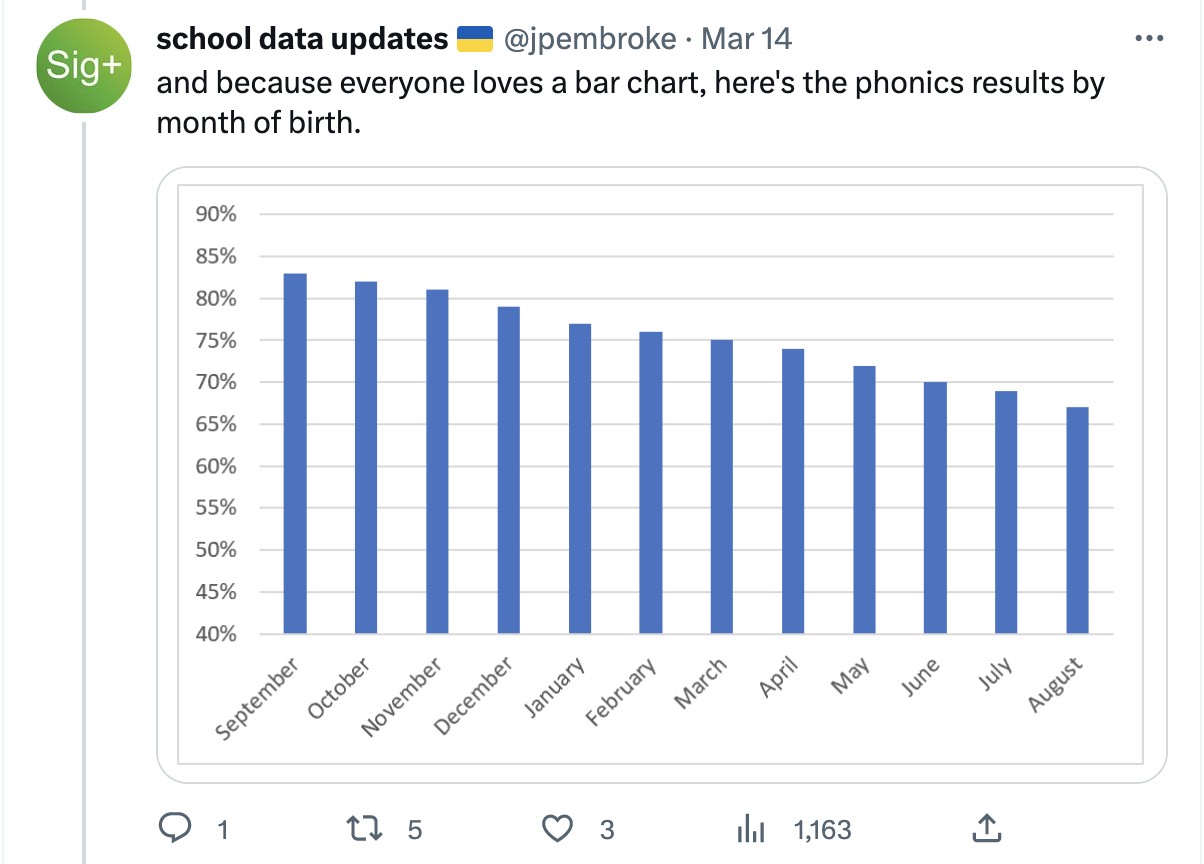
Therefore, for testing and especially teaching and learning, grade-proficiency should likely be replaced with age-level proficiency.
Along with shifting from grade-level to age-level proficiency, as the NAEP explanation above reveals, we need to establish a normalized standard for “proficiency.”
And next, we must stop using proficiency levels to punish students:
Grade retention, the practice of holding students back to repeat a grade, does more harm than good:
• retaining students who have not met proficiency levels with the intent of repeating instruction is punitive, socially inappropriate, and educationally ineffective;
• basing retention on high-stakes tests will disproportionately and negatively impact children of color, impoverished children, English Language Learners, and special needs students; and
• retaining students is strongly correlated with behavior problems and increased drop-out rates.
Resolution on Mandatory Grade Retention and High-Stakes Testing
Finally, once we move from grade-level to age-level reading proficiency, create a standard for measuring that proficiency, and stop using proficiency in punitive policy, we have to come to terms with the threshold for proficiency.
One central confusion that persists with testing is the expectation for students meeting or exceeding proficiency at any designated point (grade or age).
One of the greatest flaws in NCLB was the mandate that 100% of students achieve proficiency by 2014. That impossible goal in many ways brought an end to the NCLB era.
However, we are confronted with two problems with setting age-level reading proficiency.
First, if we want age-level proficiency to be attainable by all students at any given age, that standard may be so low as to be pointless.
Next, as is more statistically valid, if we establish age-level reading proficiency where most students can be at or above proficiency, we must come to a social agreement on what percentage below proficiency is acceptable.
Historically with NAEP, that has been about 1/3 of students, which may be evidence that this is normal, even as it causes discomfort in the context of equally compelling and misleading beliefs about the urgency of third grade reading proficiency.
Our current reading crisis is doubling down on the worst aspects of all the previous reading crises as well as the worst elements of education reform.
One way to rise above these historical failures is to understand and then reform reading proficiency as one tool for supporting student achievement and teacher effectiveness.
In an embarrassing promoted Tweet, the University of Florida makes the same false claim about a reading crisis found in media:
The link shows that the program ad is using NAEP data incorrectly (again):
The bookworm is on the verge of becoming an endangered species in America. More than 60% of students in our nation’s K-12 schools can’t proficiently read at their grade levels, and pandemic-related remote learning and a teacher shortage in the past few years have exacerbated the decline. Literacy is in crisis, and the bookworm’s only hope for survival is through fundamental improvements to the entire reading ecosystem.
Seems hard to trust a program at a university that doesn’t understand the data being used to make their claims.
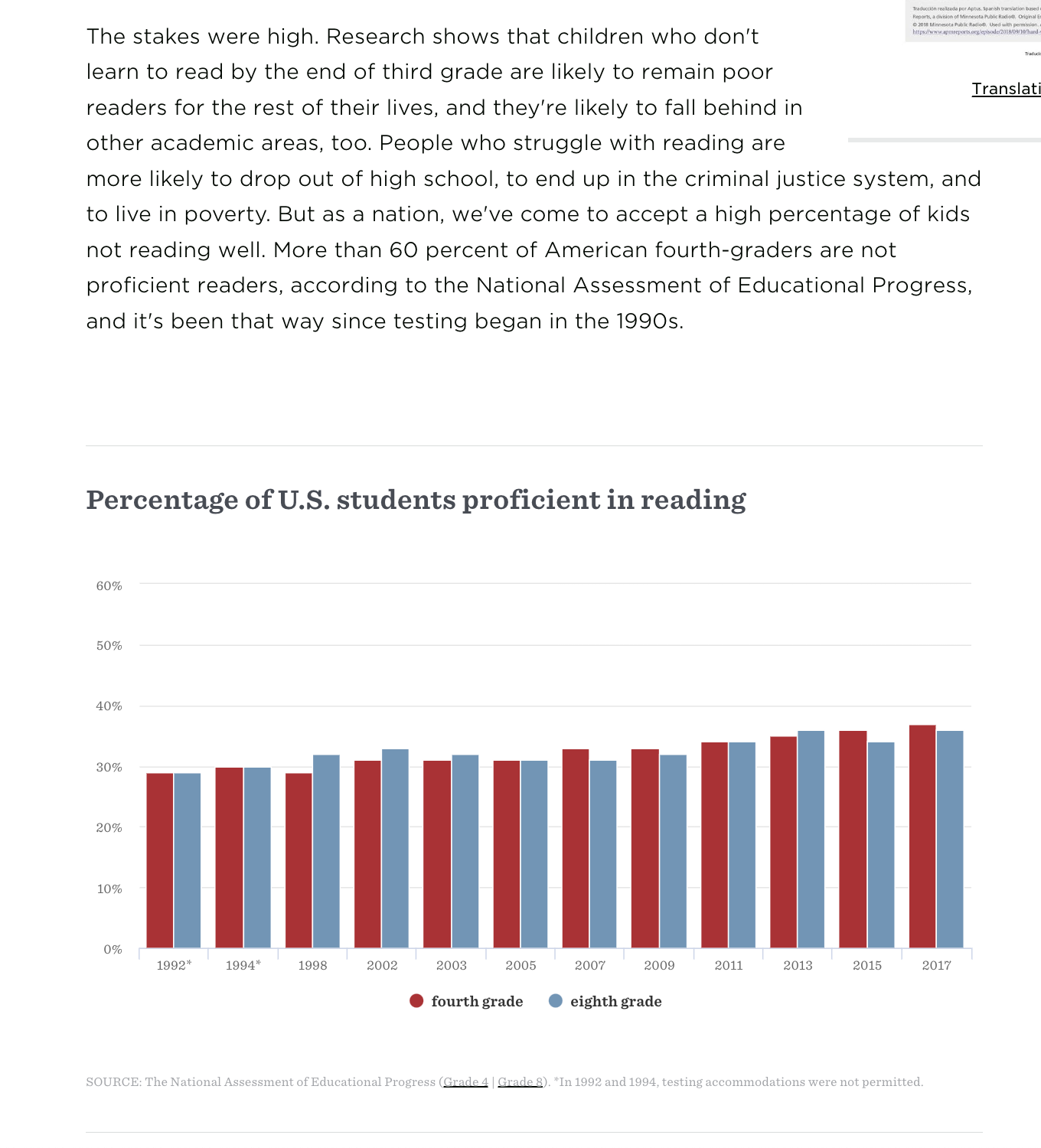
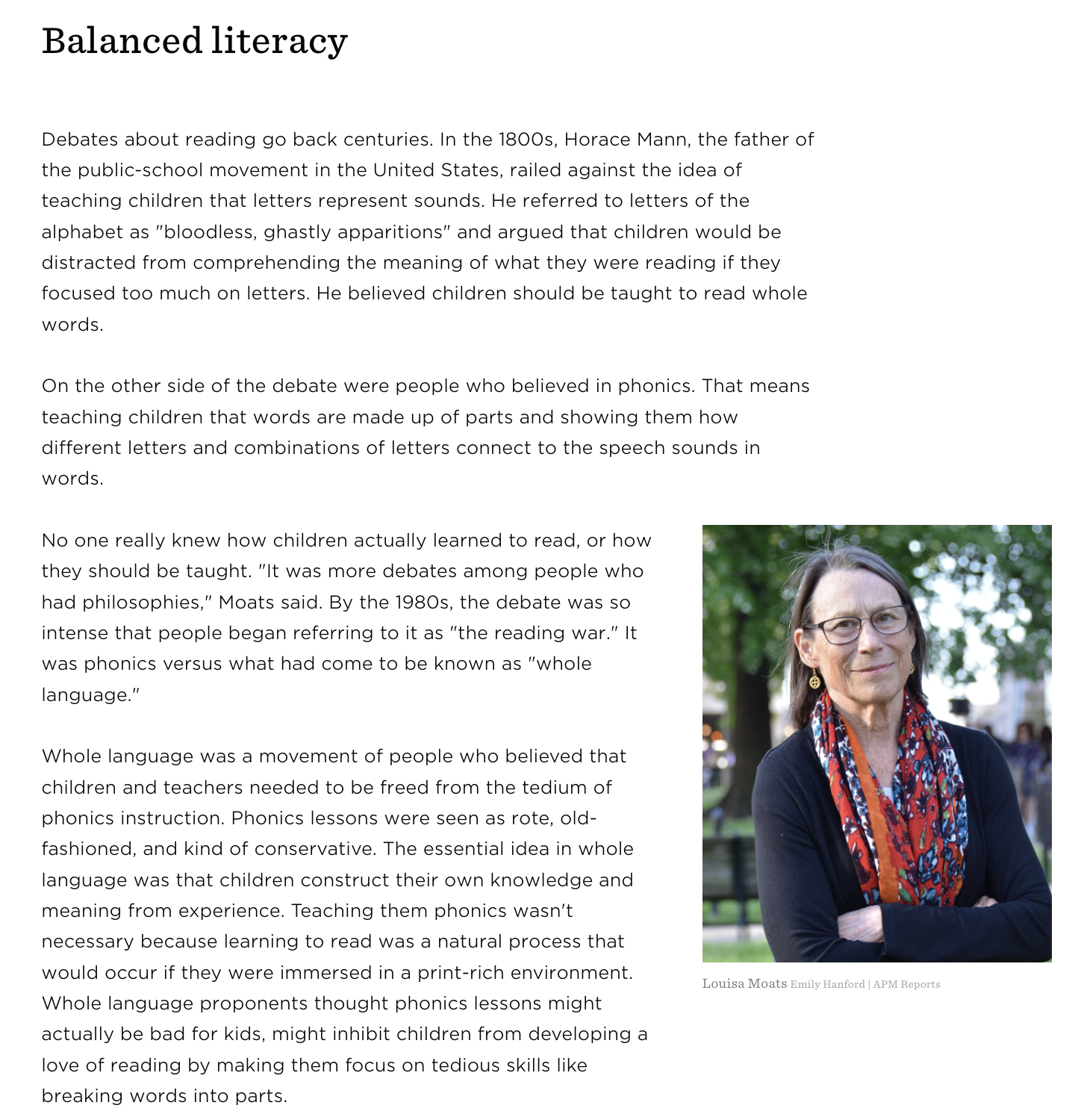
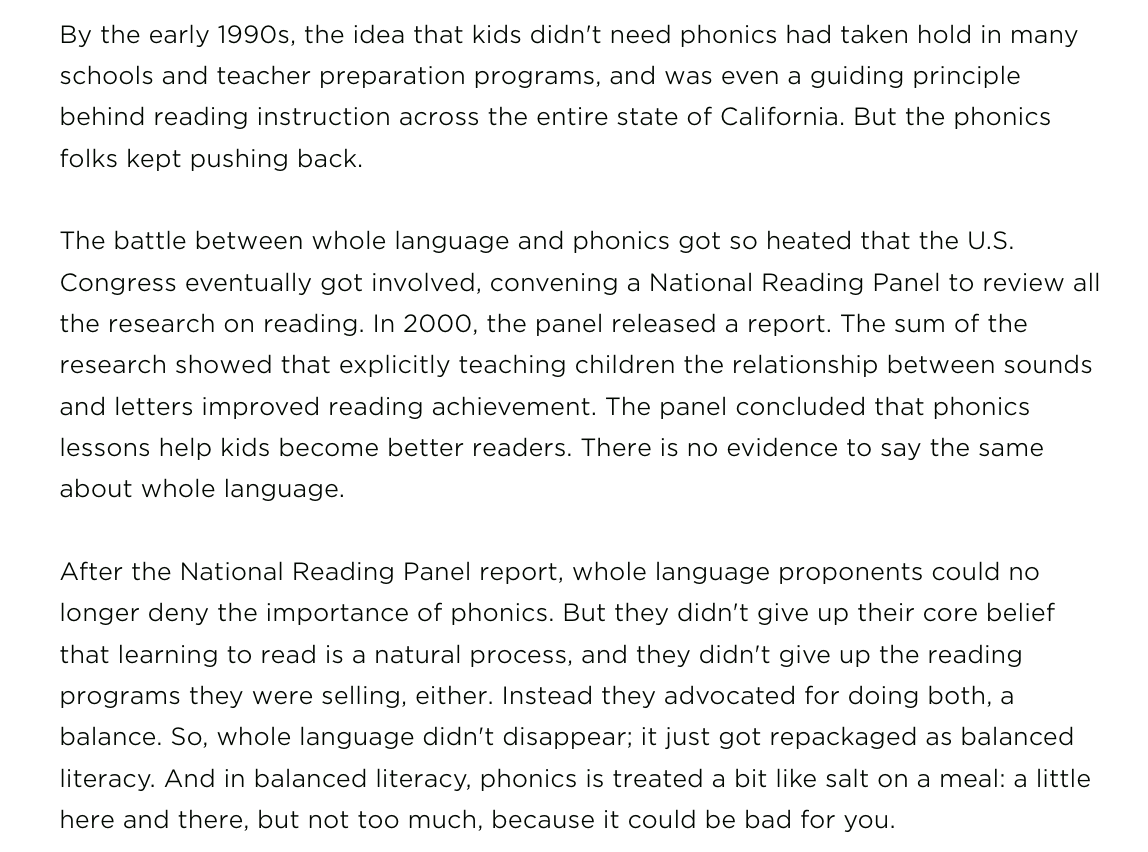
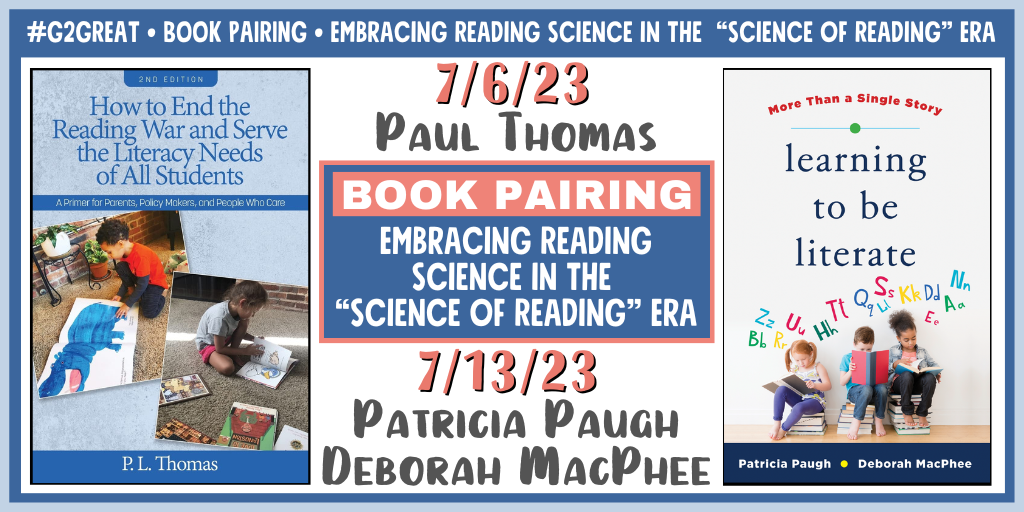
The “science of reading” movement is mostly journalism, anecdotes, and politics. Note that the movement has its roots in Emily Hanford’s Hard Words, which established misinformation and misunderstanding NAEP, whole language, and balanced literacy.
The evidence used for crisis shows a flat to improving trend line and Hanford’s uses anti-BL sources, Moates and Seidenberg, who have finanacial interests in SOR:




They like to get you in a compromising position
“Authority Song,” John Mellencamp
They like to get you there and smile in your face
They think, they’re so cute when they got you in that condition
Well I think, it’s a total disgrace…
I fight authority, authority always wins
As an educator for 40 years who doesn’t grade or test, I hate to do this, but let’s start with a pop quiz (and the worst possible kind, multiple choice):
In the US, where are children being indoctrinated?
Let’s add another just for fun:
When children are indoctrinated, what ideology is being imposed on those children in the US?
I’ll let you ponder those while you read, now, because the point here is to work our way to these answers.
I want to start with a few stories of my life and time as a public school English teacher in my small hometown that is very conservative and mostly fundamentalist Christians.
As I have written often, my childhood was nearly as idealistic as I recall. My parents were fun and doting—lots of play initiated by my parents and lots of formative engagement with my parents that lay the foundation of my becoming an academic, an avid reader, and a writer.
But, well into my late teens, I lived under the possibility of physical violence and anger from my father—although what I call “violence” was pretty mild compared to the beatings that were seen as normal in the South throughout the 1960s and 1970s.
My point is that I was raised in a household where the authoritarian/patriarchal norm was supported by corporal punishment.
By adolescence, however, I had recognized in myself a strong aversion to authority. My father’s credo, “Do as I say, not as I do,” taught me the opposite of his intended lesson.
I came to loath hypocrisy and authority-for-authority’s-sake.
In the privacy of my room, I listened to George Carlin and Richard Pryor for hours and began to read voraciously. The result was that by college, I had become a completely different person than my parents, than almost everyone in my hometown.
I toyed with rejecting religion in high school (even as I was elected president of the Fellowship of Christian Athletes my senior year), and then, I did the embarrassingly aggressive atheist routine for my first few years of college.
Ironically, although I rejected much of what my parents taught me directly and indirectly—their heavy smoking, their subtle and not-so-subtle racism, etc.—college taught me a lesson similar to my father but completely unlike my father’s mandates; in college I learned to shut my mouth an listen.
I was well into my thirties before I could recognize the distinction between authoritarian and authoritative (Paulo Freire), but that was my journey away from conservative ideologies (authoritarian) and toward liberal ideologies (authoritative) grounded in the sanctity of the human mind and the glorious possibilities of ideas most often found in books.
By the end of college, I had dedicated myself to being a teacher and a writer, always reading multiple books at a time.
My missionary zeal, then, worked in a different way than what I had witnessed growing up in a small rural town in South Carolina; I took a position in that hometown high school determined to give my students the opportunity to find their own minds, their own intellect, and not embarrass themselves as I had if and when they went off to college.
Being a teacher in a conservative small town in the South introduced me to the indoctrination paradox, in fact.
Nearly daily, I was the one being accused of indoctrination even as I had chosen to teach directly as a rejection of indoctrination. Of course, those most adamant that I was indoctrinating were the most fundamentalist people in town who were terrified of a diversity of ideas, who were the first to try to ban books, who were convinced of their own certainty in a way that was terrifying.
I have hundreds of examples, but one situation stands out to me to this day.
A beautiful part of teaching literature is that novels open the door to ideas and class discussion.
Having students read Kurt Vonnegut or Margaret Atwood, among many others, often led to discussions of free will, but when I would note to students that it defied logic to assert that there is an all-knowing god and human free will, many of my most conservative and religious students would have melt downs in class (this occurred also when we read The Scarlet Letter and confronted Original Sin).
For many of my students, my class was their first experience with questioning ideas and coming to their own understanding as opposed to simply accepting the authority of what their parents or churches told them was the Truth.
Increasingly over my nearly two decades as a public school teacher, I had homeschooled students transfer into our public school, and as a college professor at a selective liberal arts college, I teach a significant number of homeschooled students.
The subset of homeschooled students who often fit inside very conservative and fundamentalist Christian ideology was similar to those experiences while I was a K-12 teacher, but often even more pronounced.
I enter my year 40 as an educator this coming fall. For my entire career (and what I have explored as a historian of education), universal public education, books, and independent thought have always been under attack—especially from conservatives and Christians.
However, the most recent wave of book bans and curriculum gag orders focusing on CRT and chilling charges that LGBTQ+ materials are grooming children is a level of ugliness I never really expected.
The indoctrination paradox is gaining momentum because the end game of Christian conservatives is not to eradicate indoctrination or grooming from public schools, but to have complete control of indoctrination and grooming.
If you want to know what that end game looks like, take a peak inside the world of Christian conservative homeschooling: The revolt of the Christian home-schoolers by Peter Jamison.
These are the chilling highlights but you’d do yourself a service to read the entire piece, carefully:
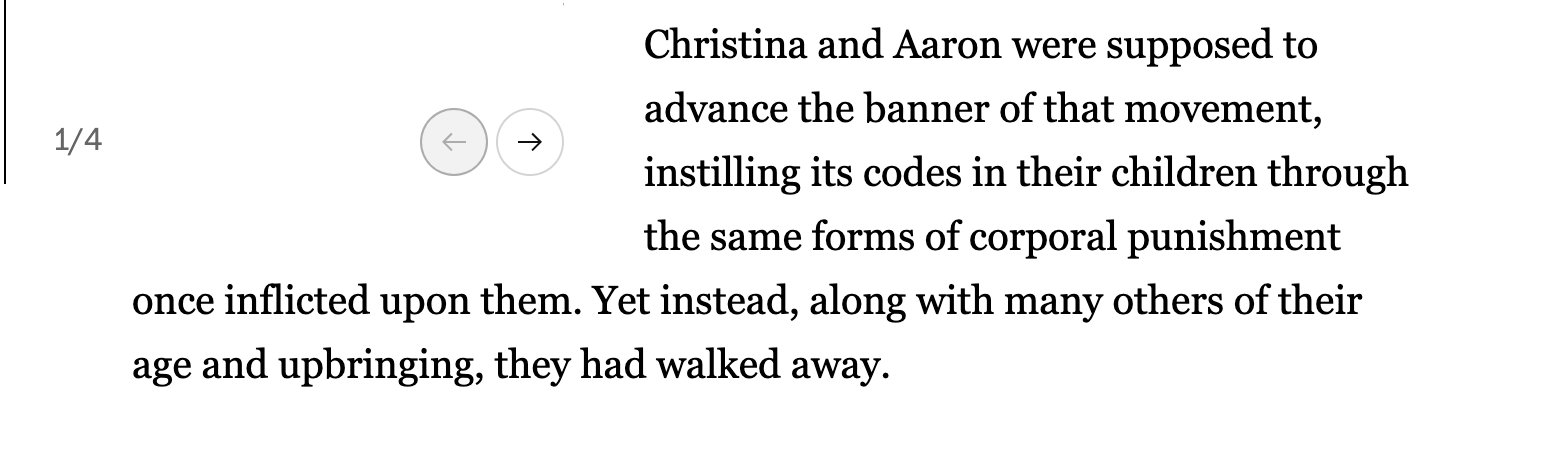
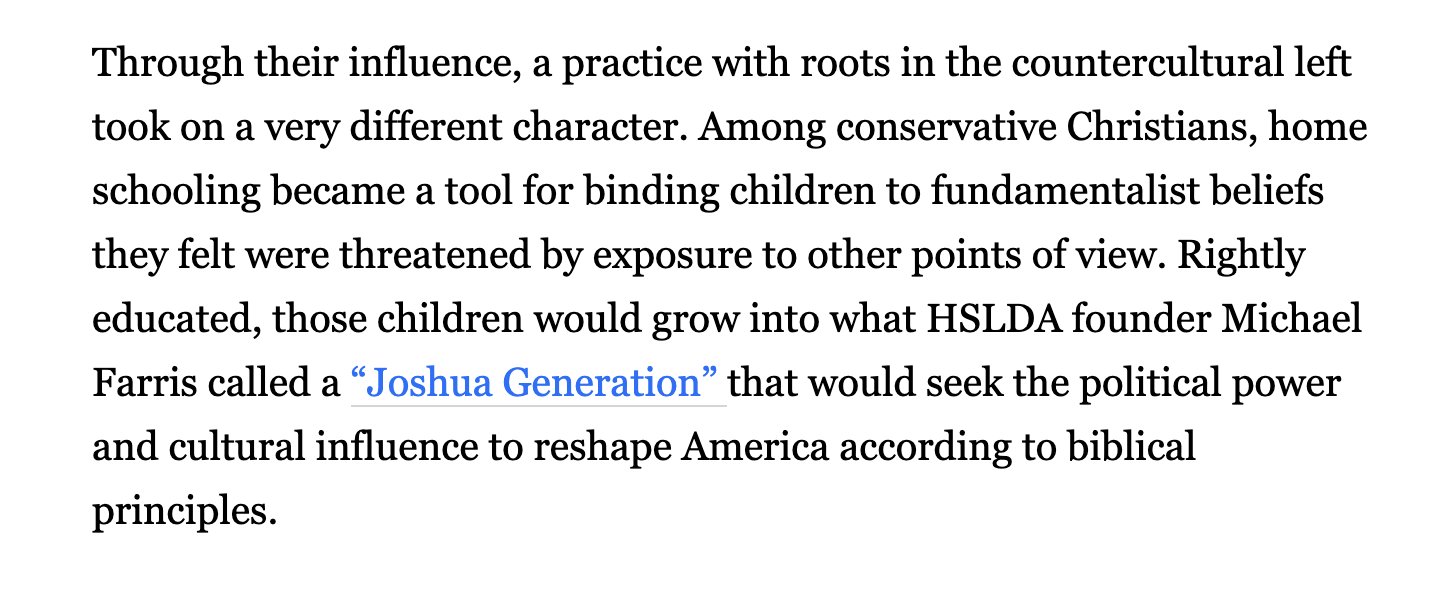
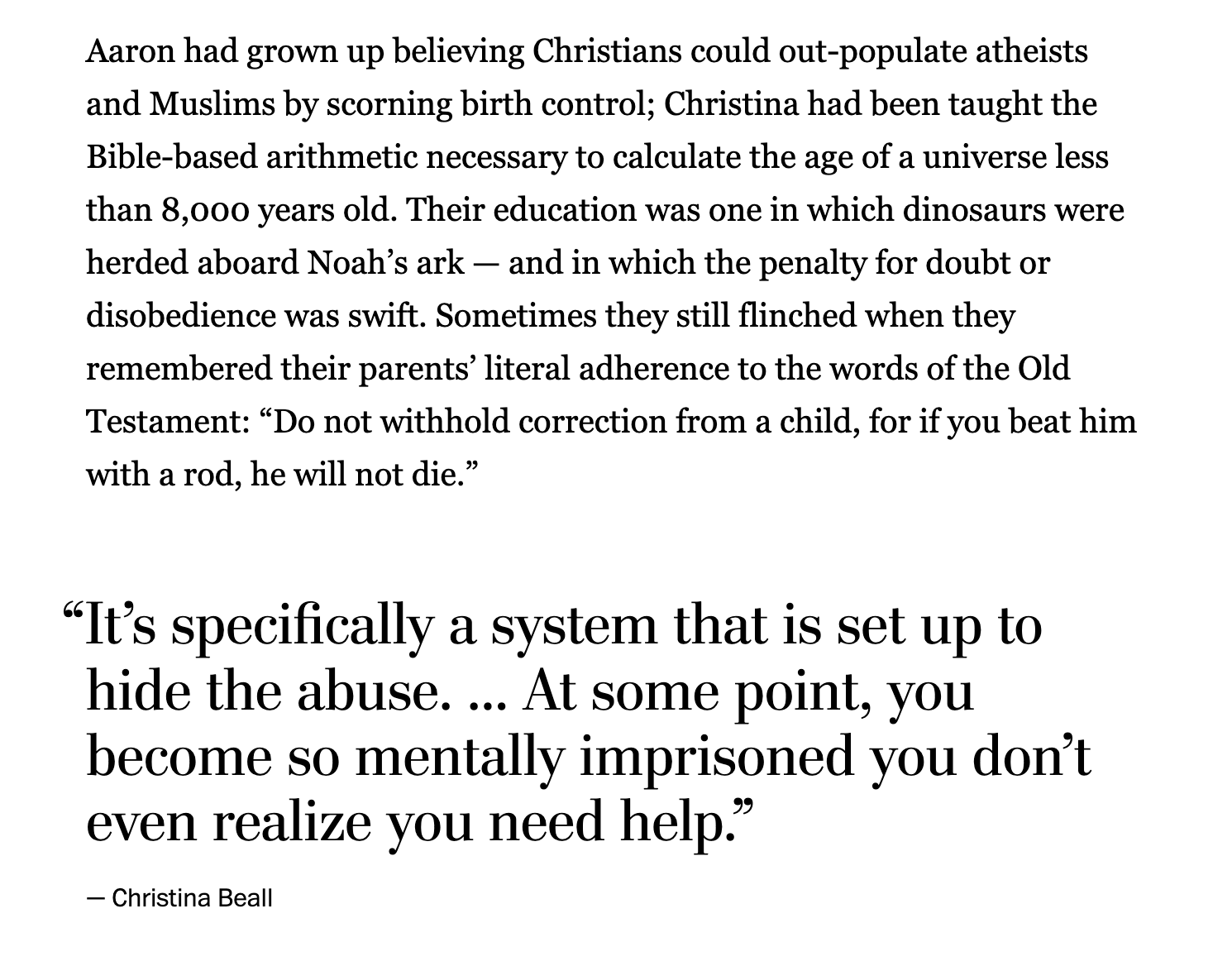
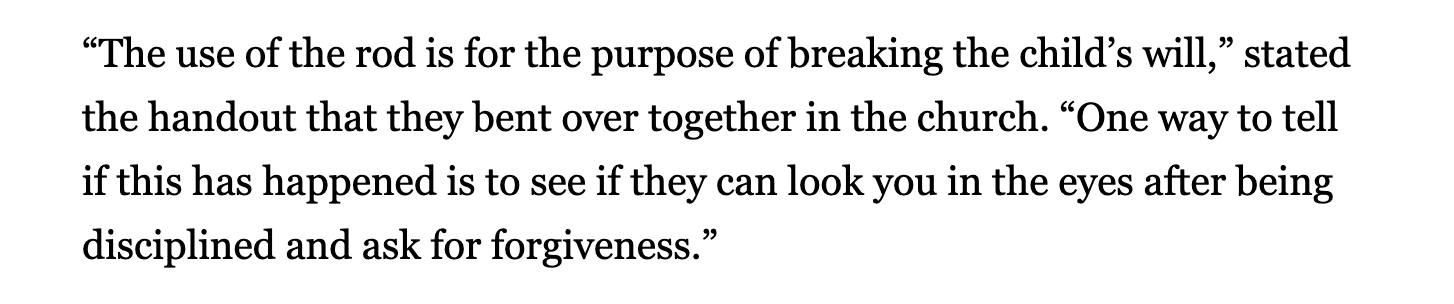


Corporal punishment, aversion to different ideas, a fear of books, and, most chilling of all, “to reshape America according to biblical principles.”
This is the America being built in Florida, where the governor claims that book bans are not book bans.
So here is the disturbing answers from the opening pop quiz.
The first answer is “4. all of the above,” and the second answer is “2. Conservative.”
And that is the indoctrination paradox.
Just How Secular is Europe Compared to the United States?

Republican/conservative education reform has been a subset of disaster capitalism for decades now, most prominently after Hurricane Katrina when Republicans used the natural disaster to dismantle public education and erase the existing teacher workforce in New Orleans.
In 2023, Republicans have continued to manufacture educational crises in order to reform education, where “reform” is a veneer for dismantling education.
The twin conservative attacks on schools include the anti-CRT/curriculum gag order movement and the “science of reading” (SOR) movement—both depending on false claims of educational failures by teachers and public schools.
What flies under the radar is that anti-CRT and reading legislation are being promoted by conservative organizations and ideologies in the form of “model legislation” and fact sheets that are devoid of facts.
In the context of the crisis/miracle narratives about education in the media, among the public, and by politicians, disaster reform has evolved into its own powerful and harmful machine.
Not surprising, a key example comes from Florida and Jeb Bush: ExcelinEd.
The disaster education reform organization is Orwellian in its claims but insidious in its carefully packaged information and templates for policy. The key point here is that the SOR movement as a media and parent advocacy event has now fully been folded into the existing Republican education reform machine that is more about dismantling education than supporting student learning or teacher quality.
In short, the materials about reading presented by ExcelinEd are false but very well designed and compelling to the general public and politician looking for ready-made legislation and effective talking points.
As the NCLB/NRP era showed us with Reading First, however, the entire Bush family is driven by market interests, not a pursuit of democratic education for all.
ExcelinEd offers online a series of PDF resources:
The short version of concern here is that nearly all of the information above is misinformation; however, as the SOR movement has shown, most people remain easily targeted by claims of a reading crisis and a set of simplistic blame and solutions.
As I have shown, there simply is no reading crisis in the US, but there is a very long history of political negligence in terms of providing marginalized students and their teachers with the learning and teaching environments as well as social conditions that would support earlier and more developed reading in our students.
Two aspects of the materials above deserve highlighting (again).
First, the Republican commitment to SOR is grounded in doubling-down on punitive policy, grade retention.
The two states identified over and over in the materials above are Florida and Mississippi; however, those states are examples of mirages, not miracles.
ExcelinEd only cites work by Winters [1] to “prove” the effectiveness of grade retention. This strategy is cherry picking “research” by a conservative “scholar” who (surprisingly) only finds positive results for the conservative reform of the day—school choice, charter schools, VAM evaluations of teachers, and now, grade retention.
The research on grade retention is complicated but politically attractive since grade retention (the likely sources of “success” in FL and MS) can raise reading scores in grades 3 or 4, but those “gains” disappear by middle school.
Grade retention distorts the population of students being tested by removing the lowest scoring students and reintroducing older students to grade-level testing. As I have noted before, students achievement can vary significantly by just a month of age difference:

A review of the Florida Model that depends on grade retention has concluded that research does not show whether any short term gains are from retention or additional services. Further, a comprehensive study still notes that grade retention is harmful, especially to marginalized populations of students:
The negative effect of retention was strongest for African American and Hispanic girls. Even though grade retention in the elementary grades does not harm students in terms of their academic achievement or educational motivation at the transition to high school, retention increases the odds that a student will drop out of school before obtaining a high school diploma.
Hughes, J. N., West, S. G., Kim, H., & Bauer, S. S. (2018). Effect of early grade retention on school completion: A prospective study. Journal of Educational Psychology, 110(7), 974–991. https://doi.org/10.1037/edu0000243
A second problematic aspect is the hyper-focus on three-cueing, which fits into the Rufo “caricature” approach to attacking CRT.
Republicans have latched onto the SOR misinformation campaign that perpetuates a cartoon version of three-cueing and fabricates a crisis around claiming that teachers are telling students to guess words instead of using phonics/decoding strategies.
Three-cueing, in fact, is a research-based approach better referred to as “multiple cueing”:

ExcelinEd’s prepackaged misinformation campaign and templates for legislation are yet more proof that the SOR movement is another nail in the coffin of public education, an anti-teacher and anti-public school movement that depends on crisis rhetoric and fulfills the goals of disaster reform driven by Republicans and conservatives who serve the needs of the educational marketplace—not students, or teachers.
[1] UPDATE: Another Mississippi “miracle” article in the NYT highlights grade retention positively, again citing only a new study by Kirsten Slungaard Mumma and Marcus A. Winters.
First, this is a working paper supported by Mississippi Department of Education and the acknowledgements add: “This project was made possible by a grant from ExcelinEd.”
Here are some key additional caveats beyond how biased this report likely is in terms of meeting the ideological aims of ExcelinEd:
Finally, we must wondering why Kristof chose to highlight a flawed and biased think-tank funded report on grade retention instead of this: Following the Letter of the Law: 2020-21 Retention Outcomes Under Michigan’s Read by Grade Three Law.
Westall, Utter, and Strunk find much more problematic outcomes with retention, findings that fit within decades of research:
Early literacy skills are critical to the educational outcomes of young students. Accordingly, 19 states have early literacy policies that require grade retention for underperforming readers at the end of third grade. However, there is mixed evidence about retention’s effectiveness and concerns that retention may disproportionately impact traditionally disadvantaged student groups. Using regressions and a regression discontinuity design, we examine retention outcomes under Michigan’s early literacy law, the Read by Grade Three Law. We find that Black and economically disadvantaged students are more frequently eligible for retention and retained than their peers. While controlling for students’ test performance, particularly their math scores, eliminates this disparity for Black students, it persists for economically disadvantaged students. We show that differences in average math performance, exemption characteristics, district characteristics, and eligibility-induced student mobility across districts do not explain the disparities in the implementation of retention by economic disadvantage status.
Abstract

[Header and images property of Marvel and artists]
The Daredevil universes are in flux at Marvel.
With anticipation building for the streaming series reboot from Netflix to Disney+—Daredevil: Born Again—Marvel has announced the end to Daredevil v7 and the launch of Daredevil v8 over the summer of 2023.
In the midst of the industry and narrative turbulence around one of Marvel’s iconic and foundational characters comes what feels like a semi-classic re-centering of the Daredevil myth, Daredevil & Echo, reaching back to Daredevil v2 and the introduction of Echo:


Some of the semi-classic re-centering is grounded in the creative team, notably the artwork of Phil Noto:


Daredevil & Echo 1 is a powerful Hell’s Kitchen story that includes the standard focus on justice but weaves a dual narrative about past and present in the visually distinct way Noto portrays Daredevil:

This limited 4-issue series opens with parallel stories and characters, switching between 1835 and present day Hell’s Kitchen. Daredevil and Echo in present day are juxtaposed with Tommy Murdock and Creeping Death (Soena’hane’e).
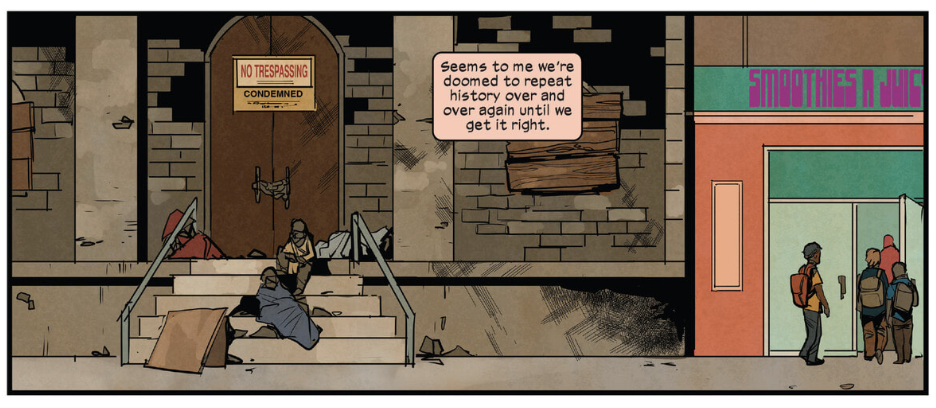
The tension of the narratives dramatize a truism about history:
Then, with the pairing of Daredevil and Echo, writers Taboo and B. Earl introduce a motif of ableism between the characters’ acknowledgement of blindness and deafness:


Another motif in this issue is innocence as Daredevil and Echo must confront a powerful child, depicted with Noto’s flair for spreads and use of color:
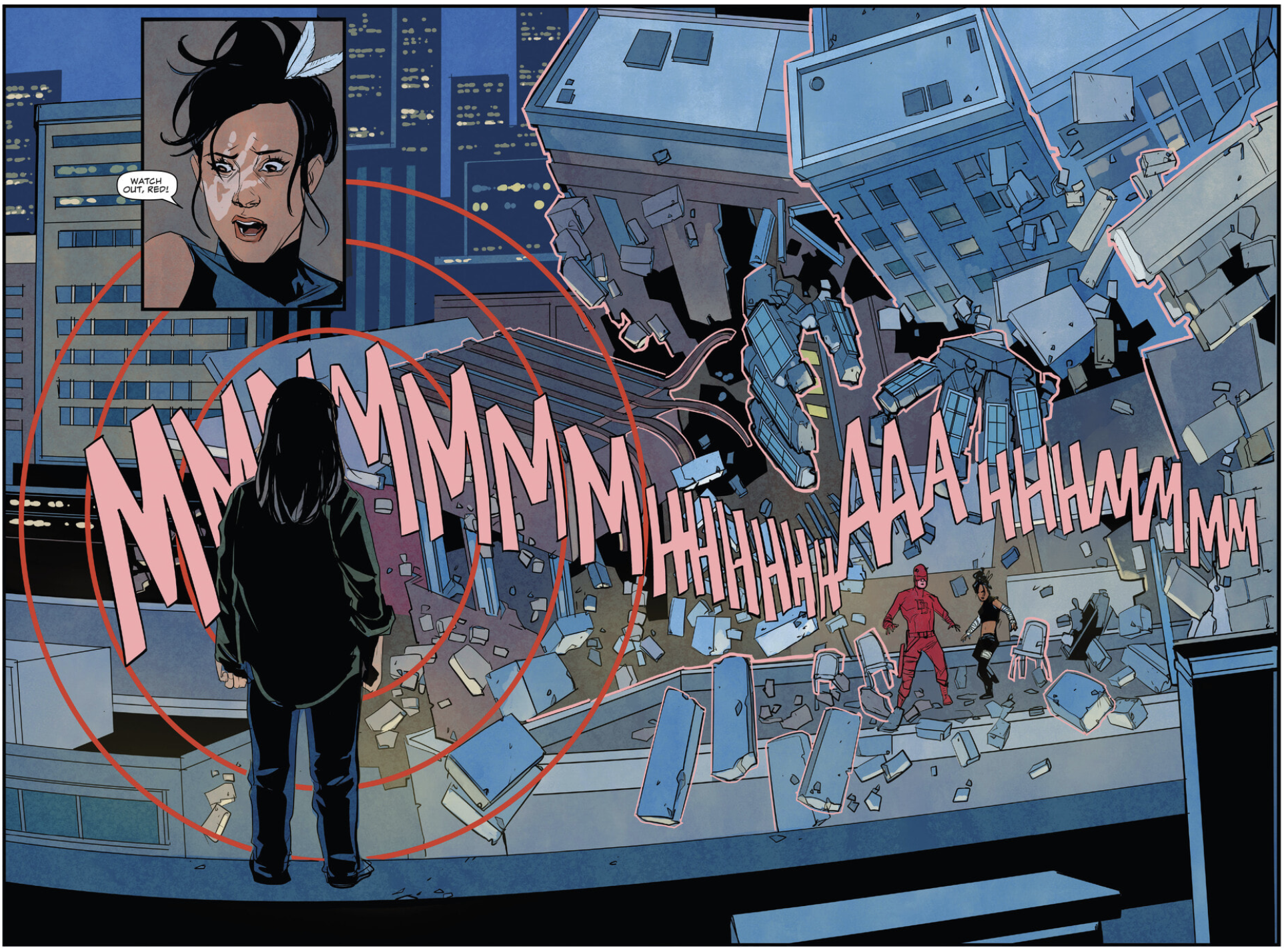

The elements of ableism and innocence are then merged as the child is deaf:

Further, the narratives also begin to overlap with the central evil force being the Blind One

The narrative pacing and interchanging panels for past and present build tension as the reality of the evil force emerges even as Daredevil and Echo find nothing as well: “See no evil.l Hear no evil”:


The many ways in which Marvel ends and restarts characters is often maddening, but with characters such as Daredevil, there are enduring reasons to remain loyal to what will happen next.
The Daredevil & Echo interlude during one of the most turbulent seasons for Daredevil is off to a very promising start that feels like meeting Daredevil and Hell’s Kitchen again for the first time.

On August 16, 2000, the Rev. Jesse Jackson closed his speech at the Democratic National Convention with a refrain: “Stay out of the Bushes.”
Twenty-three years later, Jackson’s political message is just as relevant, but now in terms of the two decades of reading crisis that have been perpetuated since that address.
The Bushes, George W. and Jeb, built their political careers on crisis rhetoric about schools.
George W. Bush’s false Texas “miracle” was parlayed into the federal overreach and impossibly idealistic No Child Left Behind (NCLB), which mandated 100% of students would be proficient in reading by 2014.
Jeb Bush mirrored his brother’s pose as an education governor, in part by supporting draconian reading legislation that became known as the Florida Model:
Florida, which passed it’s Just Read, Florida! retention-based third-grade literacy policy in 2002, is largely considered the trailblazer of such policies (CCSSO, 2019). Florida’s policy includes several provisions designed to improve students’ literacy in grades K-3, including early identification of students who need additional supports, ongoing monitoring and communication with families, a range of literacy interventions, and third-grade retention for students who do not meet a certain score on the state assessment. By 2021, 19 states had adopted retention-based third-grade literacy policies that contained several elements of Florida’s policy.
Cummings, A., Strunk, K.O., & De Voto, C. (2021). “A lot of states were doing it”: The development of Michigan’s Read by Grade Three law. Journal of Educational Change. https:// link.springer.com/article/10.1007/s10833-021-09438-y
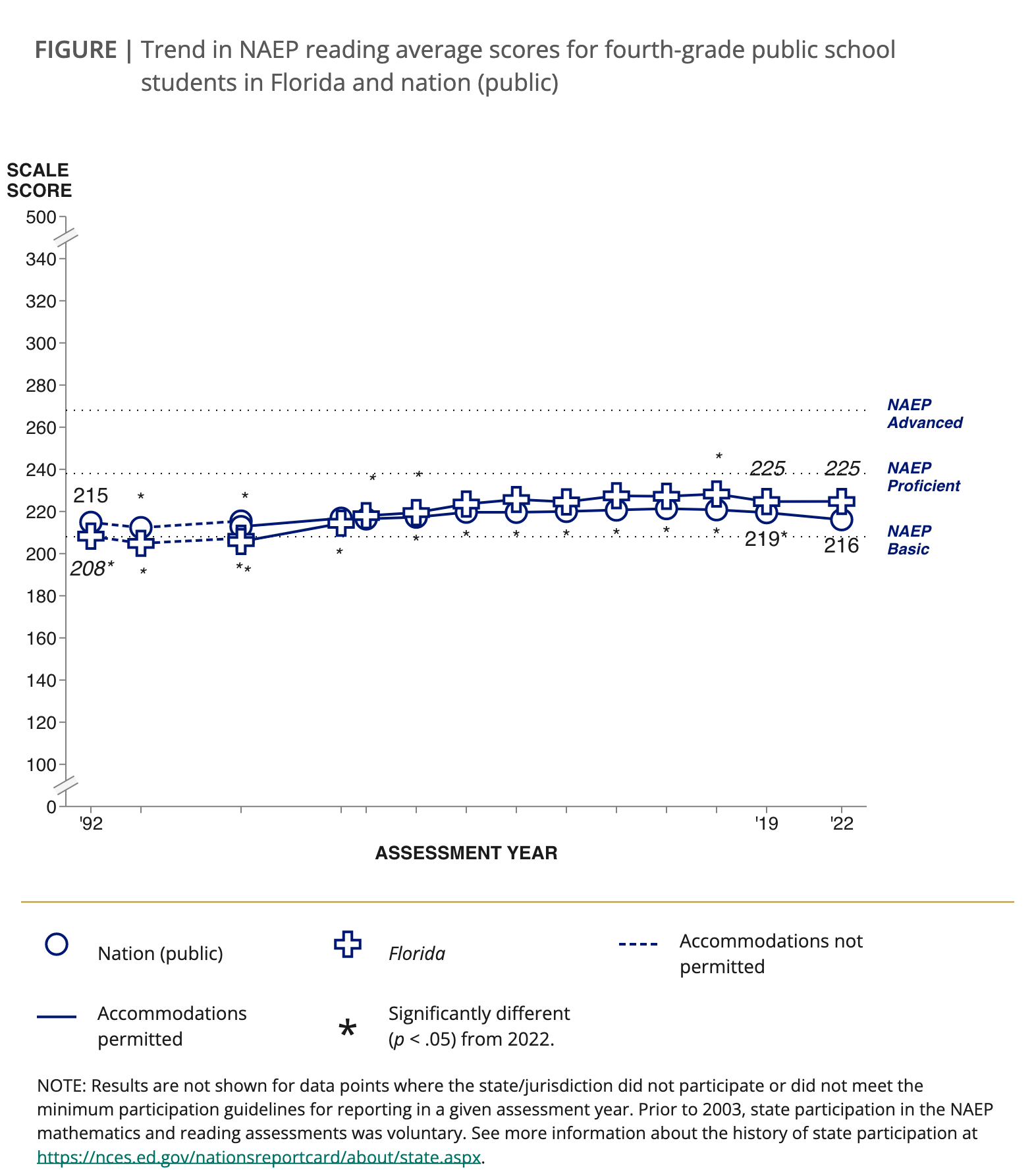
Crying “crisis” and promising education “miracles” always fails. Here is FL NAEP reading data over the recent years since they adopted harsh grade retention policies, a story of flat scores:
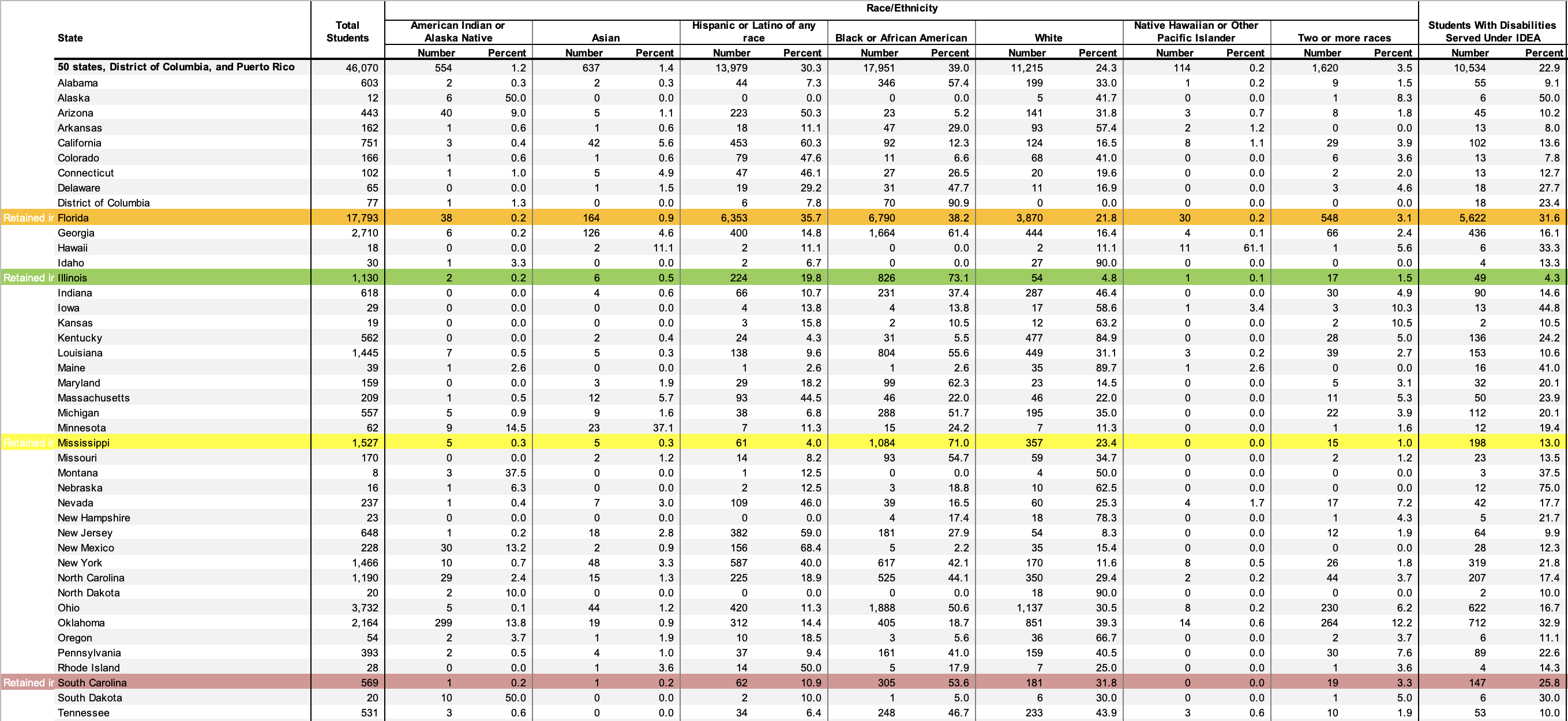
Florida has not improved reading achievement but the state has retained a huge number of students, disproportionately minoritized children:
Unintentionally, FL has also established that inflated grades 3 and 4 test data are achievement mirages, according to a recent analysis: “a Stanford University study of state-level standardized tests showed that Florida’s ‘learning rate’ was the worst in the country — by a wide margin,” and thus:
· Florida kids regress dramatically as they age in the system. Since 2003, Florida’s eighth grade rank as a state has never come close to its fourth grade rank on any NAEP test in any subject.
· The size of Florida’s regression is dramatic and growing, especially in math. Florida’s overall average NAEP state rank regression between fourth and eighth grade since 2003 is 17 spots (math) and 18 spots (reading). But since 2015, the averages are 27 spots (math) and 19 spots (reading).Florida’s education system is vastly underperforming
Florida’s education system is vastly underperforming
However, the Florida Model mirage has maintained media and political momentum, laying the foundation for the next “miracle” that wasn’t, Mississippi. Starting in 2019 and continuing through 2023, MS is characterized as a “miracle” based on NAEP data—even though no research exists for why MS has had a steady increase in NAEP score for decades, well before “science of reading” or grade retention legislation:

Just like FL, MS has seen gains in early grades, but stagnant achievement by middle school:

Yet, political propaganda continues to mislead by suggesting success where none really exists.
Especially in the South, and notably among Republican led states, the FL Model and MS “miracle” have inspired state reading policy and expanded grade retention, despite decades showing great harm for retention.
With the media uncritically spreading political propaganda—see Alabama and Louisiana compared to MS and FL—the damage is spreading to what should be dubbed the Tennessee Disaster:
More than half of Tennessee third graders fell short of a threshold required to move on to fourth grade unless they meet exemption standards, up their scores in a retake, attend summer school, undergo tutoring or file an appeal.
The state education department said in a news release Monday that 60% of third graders scored as “below” or “approaching” proficiency on the English language arts section of the Tennessee Comprehensive Assessment Program.
Third grade reading scores: Tennessee reports 60% fall short on TCAP test
TN has learned the Republican play book, in fact.
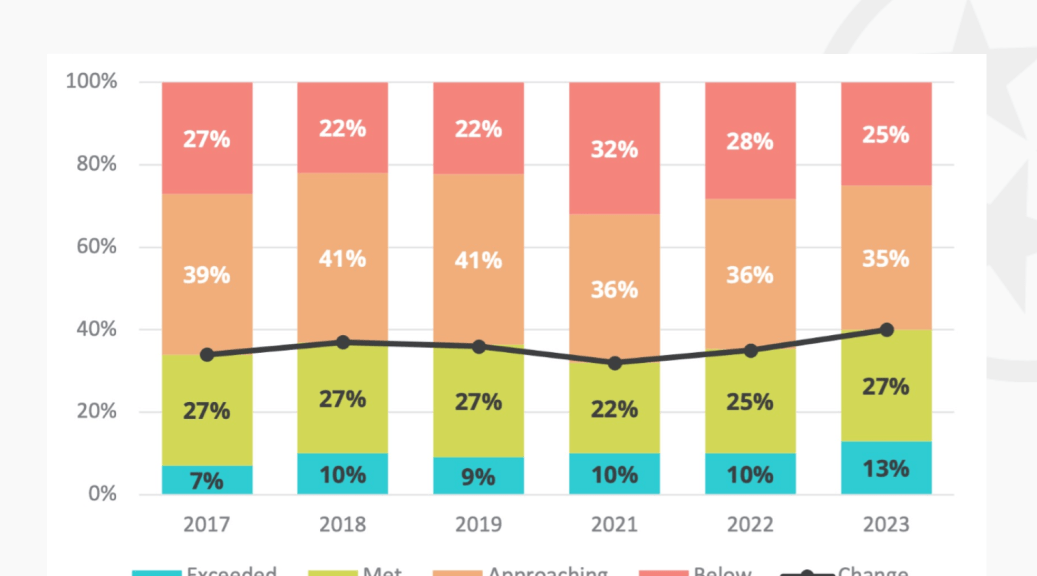
First, create a false reading crisis; note that TN’s NAEP reading (like the rest of the nation) has been flat for decades:

Yet, as a next step, the FL Department of Education has proclaimed “Tennessee Makes Historic Gains in Third Grade Reading, Offers Strong Support for Students” even as the state data is underwhelming and, once again, flat:

The reality in TN is a snapshot of the entire nation; there is no reading crisis and the reform is mostly about political agendas:
So why do Lee and Schwinn want parents, taxpayers and legislators to think that two-thirds of Tennessee public school students can’t read? Why do they want you to think that your kids’ and grandkids’ teachers are not doing a good job teaching them to read when, in fact, almost 90% of Tennessee students are reading on grade level by the time they graduate?
It’s because they want to create a fake crisis to make it easier to continue the privatization of public schools through private school vouchers and privately-run, publicly-funded charter schools.
Don’t believe claims that Tennessee students can’t read
The current SOR movement has been fully integrated into the manufactured crisis machine of Republican efforts to dismantle public education with false charges of failure and simplistic reform that causes great harm to students.
Jackson’s rhetorical flurry, “Stay out of the Bushes,” hits a bit differently in 2023, but we still should heed the warning if we care about students, reading, and public schools.
A Critical Examination of Grade Retention as Reading Policy (OEA)





 dr. p.l. (paul) thomas