All posts by plthomasedd

P. L. Thomas, Professor of Education (Furman University, Greenville SC), taught high school English in rural South Carolina before moving to teacher education. He is a former column editor for English Journal (National Council of Teachers of English), current series editor for Critical Literacy Teaching Series: Challenging Authors and Genres (Brill), and author of Teaching Writing as Journey, Not Destination: Essays Exploring What ‘Teaching Writing’ Means (IAP, 2019) and How to End the Reading War and Serve the Literacy Needs of All Students: A Primer for Parents, Policy Makers, and People Who Care (IAP, in press). NCTE named Thomas the 2013 George Orwell Award winner. He co-edited the award-winning (Divergent Book Award for Excellence in 21st Century Literacies Research) volume Critical Media Literacy and Fake News in Post-Truth America (Brill, 2018). Follow his work @plthomasEdD and the becoming radical (https://radicalscholarship.wordpress.com/).

More Anxiety Chronicles: 2019 Travel Edition

The last time I acquiesced to boarding a plane to travel was 2007, a series of flying adventures all compressed into November of that year. I had only flown once before, and have avoided flying since 2007, resulting in quite a few long-distance drives as well as passing on several opportunities I genuinely should have taken.

At the core of all this, better framed as at the marrow, is my anxiety, which is best served by retreat, avoidance, and clinging frantically to the stasis of the known. I find new experiences nearly unbearable.

As friends have come to know, even when I do travel somewhere new, my greatest pleasure is to return over and over to the same bar or restaurant while I am away, creating a temporary stasis for my anxious self.

But there is another anxiety, another newness that is inevitable until it isn’t—aging. Each moment as a human is new; we can never know what it is like to be the next moment older, and then the next year or decade older.

Simply living, the anxious know, is a terror train (or plane) adventure.

As ridiculous as number anxiety is, I am terrified by the approaching reality of 60, just a bit over a year away. Some of that anxiety is driving me to re-evaluate my urge toward stasis so I accepted recently an offer to travel to Vermont. To a ski resort town.

Since others have asked when talking to me about the trip, I do not ski, and as noted above, tend not to fly.

2D16A1B1-1103-4872-AACF-A4E71EB91626

I can only do so much new; therefore, I accepted the flight, but did not ski. While the rest of the group did ski a couple days, I created for myself a writing retreat instead.

F0056D6C-A27A-4DCA-B780-8C93EC859987

Dealing with anxiety in a public way, among friends and acquaintances, is its own kind of particular hell. So making my trip somewhat public on social media stirred up the usual exhausting discussions about flying.

I am not “afraid” of flying (I know it is far safer than driving), and I cannot take meds, drink a lot, or somehow sedate myself for the flight to ease the anxiety. The anxiety around flying is about the entire experience from start to finish.

As I have tried to explain, my anxiety starts the moment I know about the entire trip and doesn’t end until the trip does. There is no making it better, there is no reprieve during the trip.

Yet, I must field the same questions over and over from people I like and even love.

It is none the less exhausting itself and part of the formula that drives me wanting simply not to do new things or the things, like flying, that I know make me miserable.

But I discovered an interesting irony to this new, this trying something unenjoyable again. My anxiety around flying is a very specific experience within a much larger set of triggers—sound and claustrophobia.

Trying to talk through flying anxiety again, I spontaneously said that I feel the same way flying that I do in department meetings (or any formal setting), the urge to simply run away, to find that stasis of anywhere else as long as there is space and silence.

Dozens of ways in my day-to-day life include feeling trapped, and thus becoming anxious, that are not much different from flying, although planes are incredibly small spaces that force me into compact social spaces with strangers and suffering loud and abrupt noises in ways that are extreme when compared to my normal life.

People focus on the “flying” and have trouble hearing me about the anxiety. (I am not mad about this, but it is exhausting.)

But the trip also included a whole new experience that seems related to my anxiety as well as my being an introvert and my dislike for coercion (me coercing others and others coercing me).

When I posted images of the ski resort on my social media with a snarky “No thank you” an odd thing happened.

I received a number of repeated demands from friends and acquaintances, chastising me for being at a ski resort and writing instead of skiing.

Of course, I have had this experience before whereby people impose onto others how those others should enjoy the world, but this was another experience with the sorts of stress that come with being anxious. I have no desire for other people to do or enjoy anything because I do, and I take no offense when people do not do or enjoy the things I do.

I truly find it puzzling that most people, it seems, are not only certain others will and should enjoy what they do, but that they must, or it is some sort of judgment passed down on who they are.

I despise the cold and snow so I have every reason to trust that I do not want to ski, even though I have never skied. As I walked around the ski resort, I was further assured of that; the inordinate amount of clothing and gear reminded me of the claustrophobia I endured to get to this damned place.

But there were hundreds of people there, gleefully; and the people I traveled with were also thrilled with the experiences despite the cold and even rain. I seems likely skiing is an enjoyable thing for some people, and I am happy for them.

But not for me.

I do know what I enjoy, and what I do not enjoy. I know myself, in fact, very well, but I do not yet know me of the next moment, the next year, the next decade.

That makes me anxious but I have no urge to flee that reality. I want it quite deeply, and it is there I recognize the seeds of anxiety.

I also care too much. And it is in the caring that we also find our suffering.

Here’s to caring, and to suffering. If that’s not your thing, I am fine with that also.

Recommended: Literacy Crises: False Claims and Real Solutions, Jeff McQuillan [Update 2 February 2023]

[UPDATE]

After posting this in 2019 while working on the first edition of How to End the Reading War and Serve the Literacy Needs of All Students: A Primer for Parents, Policy Makers, and People Who Care, I have published the second edition and continued to work on the “science of reading” movement.

Regretfully, McQuillan’s work is even more relevant in 2023 because the media and political response to the SOR movement has gained momentum despite the evidence that it is mostly misinformation and another round of the exact reading war McQuillan debunked in the 1990s.

I highly recommend accessing this (which I will cite/quote below in the update of the original post):

McQuillan, Jeff (1998) “Seven Myths about Literacy in the United States,” Practical Assessment, Research, and Evaluation: Vol. 6 , Article 1.
DOI: https://doi.org/10.7275/em9c-0h59
Available at: https://scholarworks.umass.edu/pare/vol6/iss1/1 [1]


Recently, I have been (frantically but carefully) drafting a new book for IAP about the current “science of reading” version of the Reading War: How to End the Reading War and Serve the Literacy Needs of All Students: A Primer for Parents, Policy Makers, and People Who Care.

Those familiar with this blog and my scholarly work should be aware that I often ground my examinations of education in a historical context, drawing heavily on the subject of my dissertation, Lou LaBrant. The book I am writing begins in earnest, in fact, with “Chapter 1: A Historical Perspective of the Reading War: 1940s and 1990s Editions.”

As I have posted here, the “science of reading” over-reaction to reading and dyslexia across mainstream media as well as in state-level reading legislation has a number of disturbing parallels with the claims of a reading crisis in the 1980s and 1990s. Few people, I explained, are aware of the 1997 report authored by Linda Darling-Hammond on NAEP, reading achievement in the U.S., and the positive correlations with whole language (WL) practices and test scores.

I imagine even fewer  education journalists and political leaders have read a powerful and important work about that literacy crisis in the 1990s, Literacy Crises: False Claims and Real Solutions by Jeff McQuillan.

In his Chapter 1, “What Isn’t Wrong with Reading: Seven Myths about Literacy in the United States,” McQuillan admits, “Serious problems exist with reading achievement in many United States schools,” adding, “Yet in the midst of media coverage of our (latest) ‘literary crisis,’ we should be very clear about what is and is not failing in our schools” (p. 1).

This leads to his list of myths ([1] updated with material from McQuillan’s article noted above), which are again being recycled in the “science of reading” version of the Reading War:

Myth 1: Reading Achievement in the United States Has Declined in the Past Twenty-Five Years.

Myth 2: Forty Percent of United States Children Can’t Read at a Basic Level.

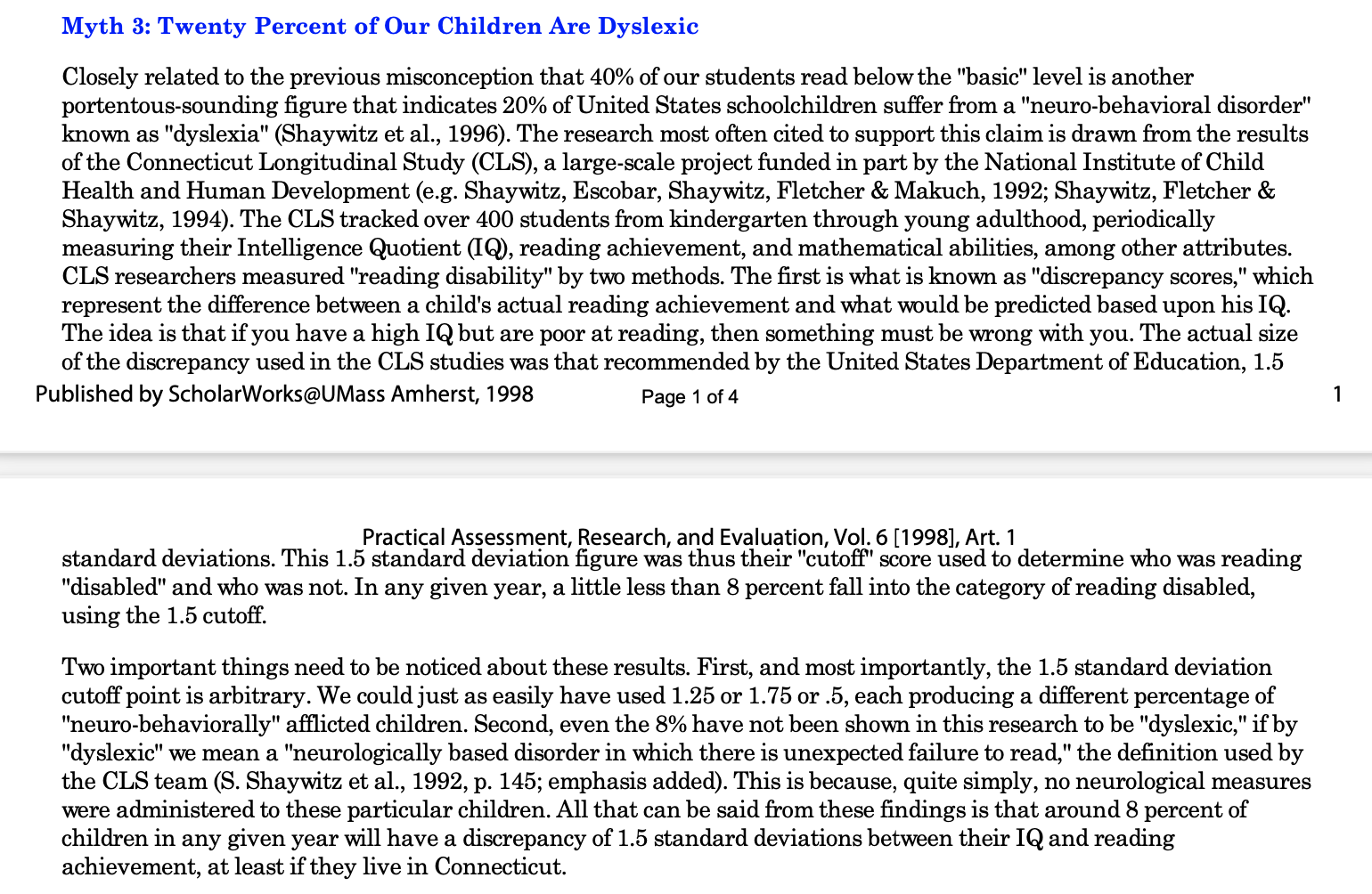
Myth 3: Twenty Percent of Our Children Are Dyslexic.

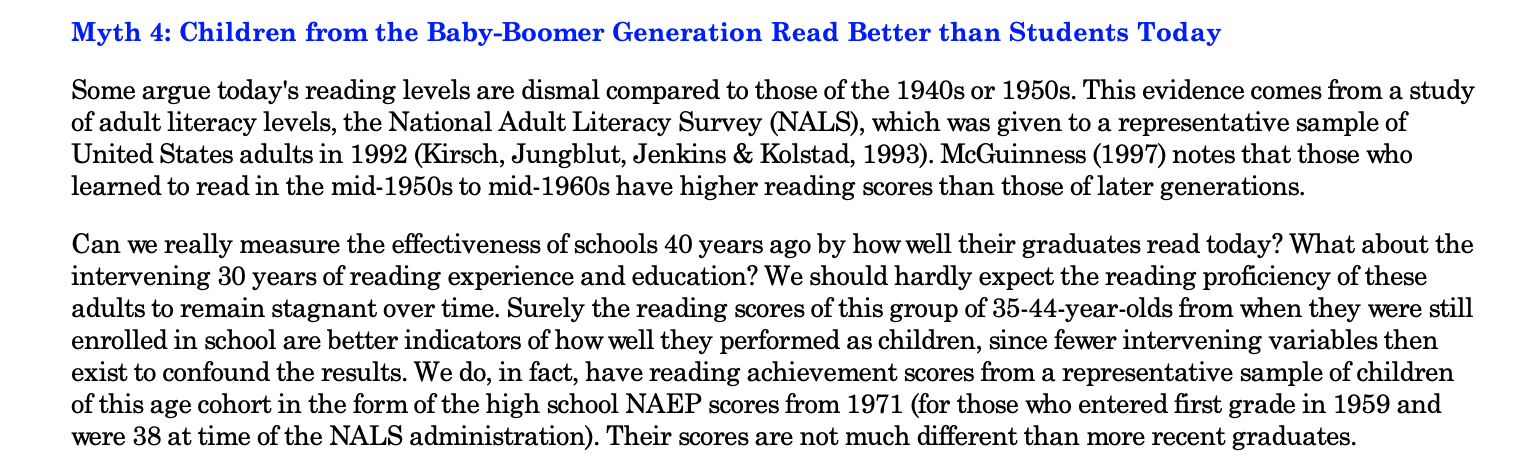
Myth 4: Children from the Baby Boomer Generation Read Better than Students Today.

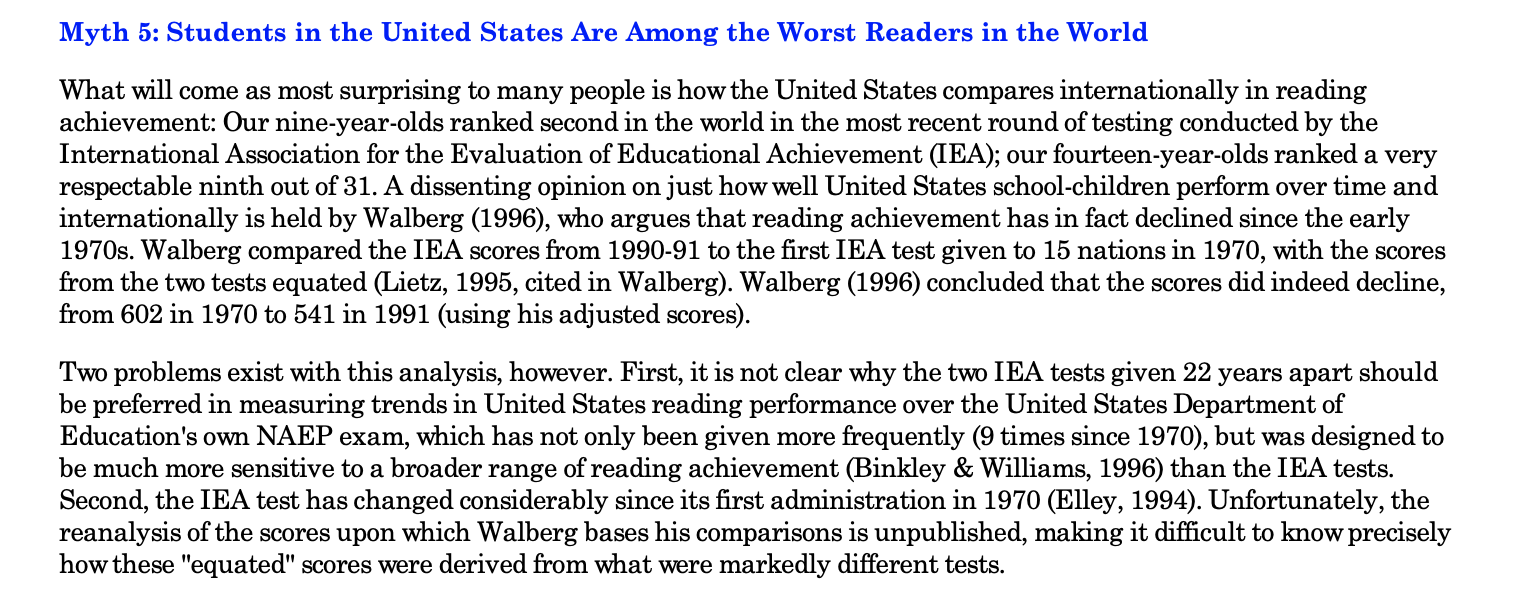
Myth 5: Students in the United States Are Among the Worst Readers in the World.

Myth 6: The Number of Good Readers Has Been Declining, While the Number of Poor Readers Has been Increasing.

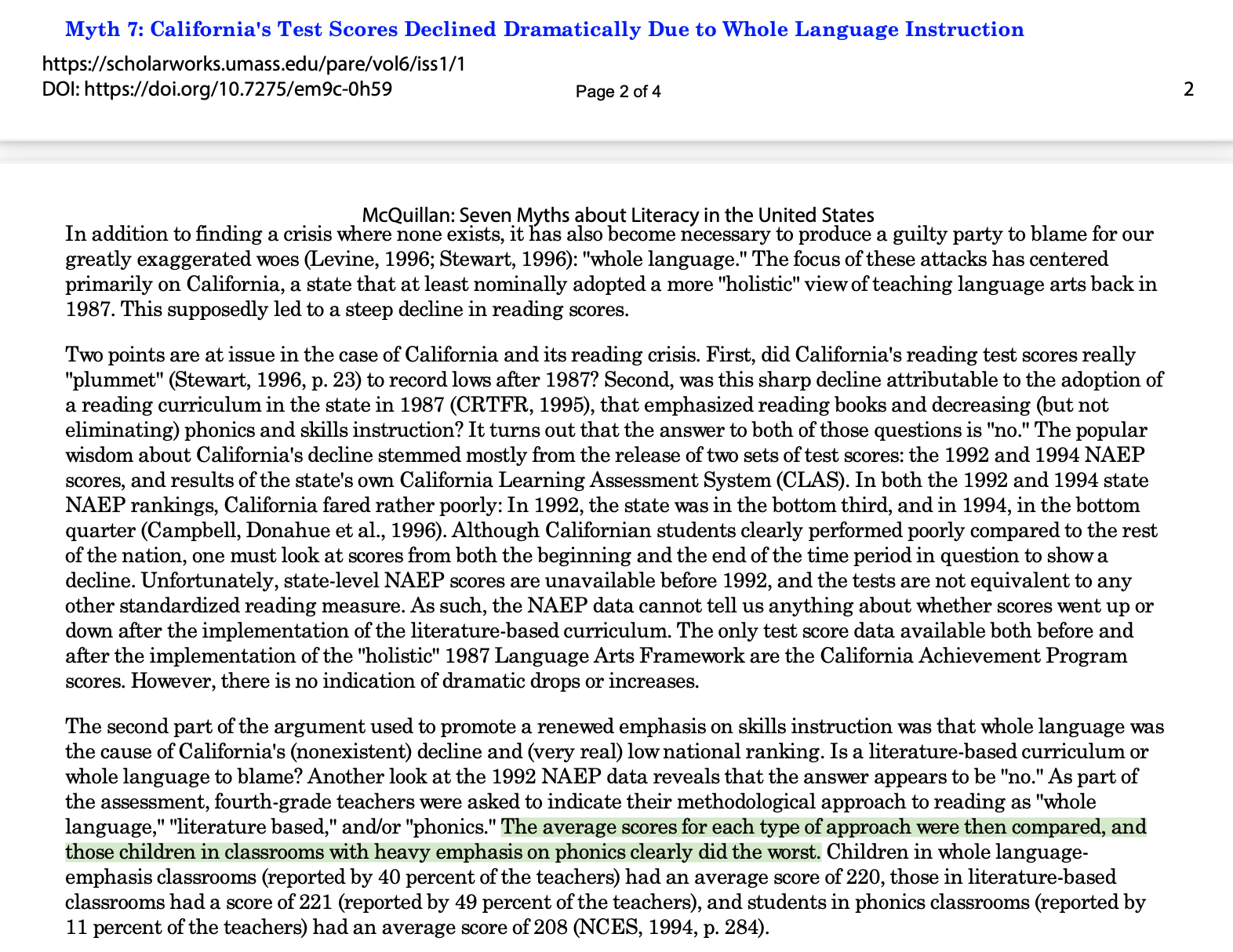
Myth 7: California’s Test Scores Declined Dramatically Due to Whole Language Instruction.

DOI: https://doi.org/10.7275/em9c-0h59

McQuillan carefully dismantles each of these, with evidence, but many today continue to make the same misguided and unsupported claims.

In 2019 (and 2023), McQuillan’s work remains important, and relevant, both for understanding how we should teach better our students to read and how the current version of the Reading War is wandering once again down very worn dead-end roads.

Review at TCR: Teaching Writing as Journey, Not Destination: Essays Exploring What “Teaching Writing” Means

Teaching Writing as Journey, Not Destination: Essays Exploring What “Teaching Writing” Means

cover

reviewed by Amy Lannin – December 23, 2019

Title: Teaching Writing as Journey, Not Destination: Essays Exploring What “Teaching Writing” Means

Author(s): P.L. Thomas

Publisher: Information Age Publishing, Charlotte

ISBN: 1641135131, Pages: 321, Year: 2019

Search for book at Amazon.com

NEW: The ethics of digital literacy: Developing knowledge and skills across grade levels

Thomas, P.L. (2019). The ethical dilemma of satire in an era of fake news and the brave new world of social media. In K.H. Turner (ed.). The ethics of digital literacy: Developing knowledge and skills across grade levels (pp. xx-xx). Lanham, MD: Rowman & Littlefield Publishers.

The Ethics of Digital Literacy

Developing Knowledge and Skills Across Grade Levels

SERIES EDITED BY DOMINIC P. SCIBILIA – EDITED BY KRISTEN HAWLEY TURNER

The digital era has brought many opportunities – and many challenges – to teachers and students at all levels. Underlying questions about how technologies have changed the ways individuals read, write, and interact are questions about the ethics of participation in a digital world. As users consume and create seemingly infinite content, what are the moral guidelines that must be considered? How do we teach students to be responsible, ethical citizens in a digital world?

This book shares practices across levels, from teaching elementary students to adults, in an effort to explore these questions. It is organized into five sections that address the following aspects of teaching ethics in a digital world: ethical contexts, ethical selves, ethical communities, ethical stances, and ethical practices. 

Rowman & Littlefield Publishers

Pages: 200 • Trim: 6 x 9

978-1-4758-4675-1 • Hardback • January 2020 • $60.00 • (£39.95)

978-1-4758-4676-8 • Paperback • December 2019 • $30.00 • (£19.95)

978-1-4758-4677-5 • eBook • December 2019 • $28.50 • (£18.95) (coming soon)

Series Preface
Dominic Scibilia

Foreword
Antero Garcia

Introduction
Kristen Hawley Turner

Section 1: Ethical Contexts

Chapter 1: Meditation

Nicole Mirra

Chapter 2: Access, Readiness, and the Ethical Imperative of Advocacy

Lauren King and Kristen Hawley Turner

Chapter 3: Seeing Each Other Ethically Online

Derek Burtch and Amanda Gordon

Section Reflection
Kristen Hawley Turner

Section 2: Ethical Selves

Chapter 4: Meditation

Sara B. Kajder

Chapter 5: The Ethical Mandate for Shaping Digital Footprints: Reflections from Teachers

Susan Luft and Paul Tomizawa

Chapter 6: The Ethics of Composing: Identity Performances in Digital Spaces

Brandon Sams and Mike P. Cook

Chapter 7: Creatures of Habit: Self Reflexive Practices as an Ethical Pathway to Digital Literacy

Andrea L. Zellner and Leigh Graves Wolf

Section Reflection

Kristen Hawley Turner

Section 3: Ethical Communities

Chapter 8: Meditation

W. Ian O’Byrne

Chapter 9: Creating Online Communities: Fostering Understanding of Ethics and Digital Citizenship

Jade Feliciano

Chapter 10: Moving Beyond Troll Rhetoric and Facilitating Productive Online Discourse

Priscilla Thomas and Alex Corbitt

Chapter 11: Fostering Cosmopolitan Dispositions through Collaborative Classroom Activities:

Ethical Digital Engagement of K-12 Learners

Aaron R. Gierhart, Sarah Bonner, Anna Smith, and Robyn Seglem

Chapter 12: Online with Intention: Promoting Digital Health and Wellness in the Classroom Lauren Zucker and Nicole Damico

Section Reflection

Kristen Hawley Turner

Section 4: Ethical Stances

Chapter 13: Meditation

Troy Hicks

Chapter 14: Designing for Power, Agency, and Equity in Digital Literacies: New Tools, Same Problems

Katie Henry and Bud Hunt

Chapter 15: Educators discussing ethics, equity, and literacy through collaborative annotation

Jeremiah H. Kalir and Joe Dillon

Chapter 16: “It’s Whatever”: Students’ Digital Literacy Experiences in a Title 1 High School

Lisa Scherff

Section Reflection

Kristen Hawley Turner

Section 5: Ethical Practice

Chapter 17: Meditation

Renee Hobbs

Chapter 18: “Where did I find that?” Helping Students Develop Ethical Practices in Digital Writing

Kristen Hawley Turner

Chapter 19: Beyond quotations: Fostering Original Thinking during Research in the Digital Era

Michelle C. Walker, Monica Sheehan, and Ramona Biondi

Chapter 20: The Ethical Dilemma of Satire in an Era of Fake News and the Brave New World of Social Media

P. L. Thomas

Section Reflection

Kristen Hawley Turner

9 Poems in 2019

Writing poetry is a distinctly different process for me when compared to blogging or traditional scholarly writing such as essays for journals, chapters for books, or complete book volumes. Poetry, as I tend to explain, simply comes to me for no conscious rhyme or reason.

Often, I quickly type out those first bursts in Notes on my smartphone, mailing that draft to myself. Some days, I revise on that Notes draft because my brain is frantically working before I am unable to find a space to stop in front of the laptop and properly draft.

Poems typically are revised over several hours while I drift back and forth between that draft and other work, writing, or such.

2019 included 9 completed poems, included below. They are good representations of how my poetry tends to focus on relationships (my deceased father recurs in the poems below), playing with and being fascinated with language and grammar (many of these poems began with obsessing on a specific word), and body parts. I always must share that I am deeply indebted to those works that inspire me—new music, novels, etc.

9 poems of 2019:

the sun was never at our fingertips

afraid of ghost (v.)

vertiginous (Notre-Dame cathedral is on fire)

over full (overwhelmed)

filthy feet (next step)

past (father’s day)

the most often thing (nature is a force)

i love a woman who swears

quotidian

Top Posts of 2019

You’ll notice a trend around the “science of reading” Reading War that gained momentum in 2019. Since I spent so much of the past year writing about that topic, I am now using much of that work to compose a new book for IAP: How to End the Reading War and Serve the Literacy Needs of All Students: A Primer for Parents, Policy Makers, and People Who Care. Hoping to have this to the publisher early in 2020.

As always, I am thankful for those who visit this blog and read my work. It is the focal point of my writer life, my advocacy, and my scholarship.

At this writing, my blog has 10,400 followers, and in 2019, had 122,746 visitors with 175,492 views.

I learn a great deal sitting at my laptop and composing several days each week. Without an audience, I must wonder if I am a writer, so those who read, again, are very important to me.

Top 10 posts of 2019:

The Big Lie about the “Science of Reading” (Updated) 34,921

The Big Lie about the “Science of Reading”: NAEP 2019 Edition 8054

The Problem with Balanced Literacy 3847

Checklist: Media Coverage of the “Science of Reading” 1415

The Dancing Comma, and Other Punctuation High Jinx 1237

RECOMMENDED: John Warner’s “The Writer’s Practice” 1236

The Wrong “Scientific” for Education 965

Evidence v. Advocacy in Teaching Reading: “We Should Not Mistake Zeal for Warrant” 961

Parent Advocacy and the New (But Still Misguided) Phonics Assault on Reading 802

Minus 5: How a Culture of Grades Degrades Learning 756

Not quite Top 10, but want to give these an additional bump:

12. Super Sex: Body Objectification and Superhero Narratives 714

14. Unsweet Tea: On Tokenism, Whiteness, and the Promise of Culturally Relevant Teaching 618

16. Dog in the Sink 590

Note

A few more stats.

118 posts in 2019.

123,688 words at an average of 1,048 words per post.

“We did not have to stress about our grade but instead we were able to just work”: Student Evaluations of Learning

The evidence on student evaluations of teaching (SET) suggests that this sort of feedback is deeply biased in the U.S. against women educators, Black educators, and international educators; in other words, using SETs for evaluation in higher education is a misguided tradition that cannot be justified by the sort of scientific inquiry and research that the academy claims to embrace.

In both my levels of teaching—about two decades each as a high school teacher and now in higher education—I have always sought student voices and feedback. Those reflections, however, prompt students’ perceptions of their learning. And the validity and reliability of that feedback, of course, is best determined by me through the lens of what learning goals we were pursuing in any course.

Each fall, I teach two sections of my first-year writing seminar, Reconsidering James Baldwin in the Era of #BlackLivesMatter, which culminates in a portfolio assessment for their final exam grounded in minimum requirements for receiving a grade in the course:

Exam/ Final Writing Portfolio

Resubmit all REFLECTIONS (1-15) on exam date noted above. You may include any other artifacts of work throughout the semester to support the grade you deserve in the course.

Submit the following through email attachments:

  • Final drafts of E.1, E.2, E.3, and E.4 as email attachments; be sure to submit CLEAN files (no track changes or comments visible).
  • Label files with your last name, essay number, “final,” and the date of submission, such as Thomas.E1final.121715.docx
  • Attach also a reflection (1-2 pages) on what you have learned as a writer and what you see as the key weaknesses you need to continue to address. Label the file your last name and final reflection, such as Thomas.finalreflection.docx
  • In the body of the email, RANK your four essays from the best to the weakest.

URGENT: Reminder

Minimum Requirements for course credit:

  • Submit all essays in MULTIPLE DRAFTS per schedule before the last day of the course; initial drafts and subsequent drafts should be submitted with great care, as if each is the final submission, but students are expected to participate in process writing throughout the entire semester as a minimum requirement of this course—including a minimum of ONE conference per major essay.
  • Demonstrate adequate understanding of proper documentation and citation of sources through a single well-cited essay or several well-cited essays. A cited essay MUST be included in your final portfolio.

Final Grade Sheet—FYW 1259 (Fall 2019)/Thomas

Some of the challenges students face in a first-year writing course as well as unique features of courses I teach include not receiving grades on assignments, submitting multiple drafts of essays (and engaging significantly in revising those essays), participating in peer reviewing, and moving beyond the “research paper” and “memorizing MLA” toward scholarly writing in which incorporating high-quality sources and a wide variety of citation styles are the norm of essay writing.

When I read the students’ reflections, I focus on my two overarching goals for the course: Students thinking (and behaving) differently about writing and language (the two text books are designed to address these), and students developing their own agency as writers and students.

This fall, students were very enthusiastic about John Warner’s The Writer’s Practice (the first time I have assigned it) and often pleased with Style: Lessons in Clarity and Grace, 12th Edition, by Joseph M. Williams and Joseph Bizup (a text I have used for many years through many editions). I recommend them both highly.

Below, I want to offer some of the selected feedback, in my students’ own words (anonymously), that reflects the most important patterns from their learning this fall. Again, I want to emphasize these are reflections on learning, not intended to be any sort of proof about my teaching or the structure of my course. None the less, I am as pleased as I have ever been with this group of students and who they have become and are becoming—which is proof, I think, of how important the students themselves are to any claims we make about teacher or professor quality.

I am highlighting feedback about the nature of first-year writing courses, students navigating a course without grades, students coming to embrace feedback for revising their writing, the transition from high school to college writing, and student perceptions of writing and being writers along with many other significant comments by these students.

It is a powerful thing, to me, that these comments below are rich with the language and concepts found in the two text books, noting as well that students read and reflected on these texts throughout the semester with no graded form of assessment or accountability such as tests.

In their own words, below are excerpts of reflections about their learning:

Student 1: This semester has been hard. In high school, I was very weak in writing, and sadly, I never sought out the help I needed. Before college, I would tell myself that I could wait till college, and then, I will learn proper writing and receive the help I was in need of. Thankfully, I was able to take an FYW class that would aid in my college writing and teach me the skills to become a strong writer.

Student 2: The in-class conferences were very significant in my progression throughout the course as I got to see first-hand from my teacher on what I did wrong and what I could do to improve my writing. The Writer’s Practice and Style helped me a numerous amount with my writing, such as ways to approach certain types of essays and how to connect with your audience in the best possible ways. There were many different forms of writing that helped me improve my weaknesses, such as communication, concision, clarity, complexity, and many other forms.

Student 3: This semester, I have grown as a writer and as a student. Coming out of high school, one of my main concerns was my ability to write at a college level. I took AP classes in high school and those are supposed to simulate a college level course. However, now taken actual college courses, I see that AP is nothing but a different form of standardized testing. The First Year Writing course has greatly improved my ability as a writer and made me enjoy writing again….

Overall, I believe Furman provides a unique opportunity to students through the First Year Writing classes. Not many universities are concerned with every individual student’s ability to write. The class allows a student to explore their own writing in depth and properly address the issues they consistently make. If every college student was given a similar opportunity, their writing ability would improve greatly. I’ll admit, I was hesitant when I first saw that I would have to take a required writing class in college. However, I would now gladly recommend to other colleges and universities to implement a similar style of course in their institution.

Student 4: This ties into a larger area of focus for me: concision. I fall victim to large paragraphs and sentences at times. This can confuse the audience and make my arguments hard to follow. It took some training for me realize where I lose readers, but through the readings we have in class, I’ve seen it is not a bad thing to use short sentences. It used to come across as choppy to me, but it’s just direct. Short sentences don’t necessarily mean bad ones. Often, short sentences are more effective at conveying points I would want to make. I would definitely say my concision and clarity are areas I intend to improve upon….

All things considered, I think you gave us the best possible FYW experience. This isn’t meant as flattery, but rather, my true opinion. You gave us the tools necessary to succeed, and allowed us to work independently to reach our goals. You didn’t hold our hand through every process, and you didn’t leave us out to dry when help was needed. I look forward to writing, I look forward to improving my writing.

Student 5: Throughout the year, I have learned many different techniques and styles that have improved my writing. The most improvement I noticed in my actual writing was the improvement of clarity and focusing on the audience. The Writers Practice book helped my writing with focusing on the audience, and the Style book helped me with making my writing more concise.

Student 6: Having to submit multiple rewrites has been a very helpful tactic for me. In each rewrite I would notice similar patterns in my mistakes. It has even come to the point where when I am writing a paper, and something doesn’t sound write I can picture a sentence from a previous essay that Dr. Thomas highlighted in green and I am able to fix my mistake based on a previously made mistake.

I also appreciate the in-class conferences. I feel like many professors simply markup student papers and send them back with vague explanations. This leaves students curious on what they need to fix and how to fix it. Having the in-class conferences after receiving feedback helps to solidify the problems with my essay and learn from my mistakes. After I have my conference, I am confident that I have a clear understanding on how to fix my paper.

Student 7: After developing my first “vomit draft” to this essay, the ideas came flowing rapidly. This leads me into something else that I have learned as a writer, which is the importance of “vomit drafting” and the pre-writing stage. In high school, I always had to force the drafting stage. Yet in this class, I had the freedom to hold off on drafting until I was in the mood or I had an idea that made me want to start drafting right away. I also discovered ways to get into the writing mood, and the main strategy I used this semester was reading Bad Feminist (Roxane Gay). Reading good writing inspires me to attempt to do the same thing….

I am glad that I have founded a passion for writing and confidence in my ability to write effectively while conveying a purpose. To add on, [a] general notion that has been brought to my attention in this class was that my opinions matter, and writing is one of the best ways to demonstrate my thoughts to the world. Some of the discussions we have had allowed me to make initial opinions on them, and I have been able to control that energy through my writing. This class has had a variety of benefits to it, and I am excited to see where my new passion for writing takes me in the future.

Student 8: What I appreciated most about this course was our ability to choose our own topics for essays. It was because of this process that I realized my [excitement] towards writing when it was about topics that I actually cared about. Generally, in all of the writing I did in the past, it felt like such a chore. Preparing keyhole five paragraph essays was so formulaic and boring, I absolutely never enjoyed the writing process. Being able to experience the opposite and having the creative freedom to choose anything I wanted to write about made my experience that much more enjoyable. A new experience I hope to be able to carry with me on journey at Furman.

Student 9: I had also previously thought that fancy wording was more formal in writing, but reading Style taught me that simpler writing is actually better. Another important lesson Style taught me was that most grammar “rules” are not really rules but choices writers make for clearer writing. This way of thinking of grammar is a lot less intimidating, and I feel better knowing that sometimes my grammatical “mistakes” are really just someone’s personal preference.

The Writer’s Practice helped me to find a writing process that works for me, rather than forcing me to use one process, like in high school. It also taught me to consider the audience more in my writing and think about answering their questions. John Warner allowed me to think of writing as a never ending journey of improvement, rather than one with a final destination and made me realize that despite not feeling like I’m improving, I’m actually making a lot of progress in my writing.

Student 10: Over this semester, I have learned to address writing in a completely new way. The best thing I will take from this course is that my writing should not just be defined by the grade I receive, but by the amount I have improved each time I write. Additionally, I will never become a perfect writer because I can always learn more and improve.

Moreover, I have learned the importance of rewriting essays. In my high school classes, as well as my other classes at Furman thus far, I was not given the opportunity to rewrite essays as many times as I want, so I was never able to see how much they could improve each time. In the future, I plan to write early assigned essays as soon as possible so that I can have them reviewed by my classmates and complete rewrites to make the essay the best it can be.

Student 11: There are no rules in writing, but there are consequences. This idea has nagged at me since it was planted in my mind at the beginning of the semester. The best writers can artfully break or bend the “rules” of writing, but they also are fully prepared to handle the consequences.

Student 12: This class has helped me pay closer attention to how I am writing, as I used to mostly pay attention only to what I was writing. I have learned more things from this semester-long course than I learned in all four years of high school. It is shocking how much I have learned from this class….

Writing essays and then receiving them with comments, not a grade, was very helpful. This is a class solely focused on teaching freshman college students how to write academically, so to grade students without any feedback or opportunities to fix their essays would be pointless and not beneficial.

Student 13: I first notice my style. Back then I was fairly confident I could just write things as they were in my head and that would be enough. That quickly turned out to be false. Apparently not everyone thinks the same way I do and writing in that stream of consciousness sort of way does not work. I have to write to my audience and my audience is not just the voices in my head. Doing this is complex and has multiple aspects but perhaps the most important is writing clearly. I think learning this was one of the most game changing things for me.

Student 14: At the beginning of this course, I was nervous and unsure of my writing abilities.  At orientation, I remember someone saying, “You may think you know how to write, but you really don’t.”  This terrified me, so I was determined to do my absolute best in this course.  In high school, I was very self-conscious about my writing and would become defensive when someone would give me feedback.  The main thing this course taught me was to accept feedback with open arms, since that is the only way your writing will improve.

Student 15: Over the course of the semester I have been pushed in my writing skills through practicing different styles, and continually writing pieces that were much longer than the average of what I used to consistently write. I have enjoyed being able to write about topics that I am passionate about, and I think that it made the transition to college level writing easier, because I had more to say and was not opposed to doing research to learn more about the topic….

I know that I will have to continue writing with citations, so one way that I plan on improving my weakness in them is to go to the writing lab for help and clarification. Going into a science field it is crucial that I master this skill before I graduate. My midterm interview with Dr. Anderson gave me insight as to how important it is in sustainability science. I’ve learned that I can write much more that I thought I could, and the readings helped me to consider my audience much more than I used to.

Student 16: One thing in particular that I think I learned that will be very helpful in the future was through Essay 3. Before this essay, I had never written an APA style research paper. Going into this essay, I had only written one cited paper in the past but did not give much thought into picking specific sources and evaluating their validity. Learning the style of an APA paper will be very helpful in the future, as one subject that I am interested in majoring in is economics. One factor in writing a research paper I still need to work on is synthesizing multiple sources.

I have learned how to organize information well and concisely through Essay 2 and 4. This was my first time writing a hyperlink paper so the idea of writing in short paragraphs was a new to me. Writing these papers taught me how to write in this different style. This was definitely my favorite type of essay to write. It gave me the opportunity to write about something that I was passionate about and also to learn in detail about a specific subject matter.

Student 17: Overall, the main lesson I learned is to give more attention to detail. Every part of an essay should be intentional. The introduction should connect to the conclusion without summarizing the essay completely. Similarly, word choice, sentence structure, and paragraphing can play a major role in the meaning of the essay. Dr. Thomas’ feedback made me realize how important every decision is. It’s also important to maintain the balance between caution and overthinking every decision. In The Writer’s Practice, the author explained that being afraid to write is one of the main inhibitors of good writing. I am still working on finding that balance myself.

Student 18: The structure of this class forced independent learning and I believe that is the best type of learning for me specifically. My first essay exposed my overuse of some sayings and structures. In addition, I wrote in a vague high school-like way. By the end of this course, I tried to shy away from my common tendencies and in my opinion, it ended in success. At the end of the last essay, I felt more confident and ready to move on in my writing career.

In addition, the variety in types of papers written helped me explore the types of writing and made me a more versatile writer. Although I found the APA format annoying and tedious, it made me think in a different, yet still creative, way when compared to the personal narrative. Overall, I learned how to write from these specific perspectives and what the goal of each of these types of writings were.

Student 19: Through this First Year Writing class, I have learned the importance of rewriting and continuing to go back and reflect on what I have written. Reflection is important as no matter how good I think a paper might be, there is always room for improvement. Even the greats have to go back and revise. I really liked what Dr. Thomas said, “if Baldwin had another day, he would’ve gone back and changed some things in even his greatest works.”

Student 20: I have enjoyed this course and it has helped me develop in my writing skills. I enjoyed the class discussions that we had, and I really liked the laid-back feel of it. This feel gave me, and my classmates the feeling that we could truly work on developing our writing skills. We did not have to stress about our grade but instead we were able to just work….

One of the first things I learned to do in this class was to create my own writing process. I have my own process now where I plan a paper and the direction that I want to go in by the end of the paper. I have used this process all semester long and in my other classes as well. There have been areas that I have been challenged in this class as well.

Student 21: Throughout the semester, I believe that my writing improved tremendously. The combination of reflecting on the books that teach writing and writing my own works alongside this. I was trying to actively use my learnings from the reflections and apply them to my papers while writing them.

Something specific that I have learned as as writer is considering audience. This may seem fairly straightforward, but deciding whether or not your audience has prior information on the topic is key. For example, in my paper about Pokémon Go, I should have assumed that none of my readers would have much previous Pokémon Go knowledge besides the fact that it was once very popular. Though, in my paper about Amazon, that was probably not the case. Amazon is one of the biggest companies in the world and is commonplace on the Furman campus.

Student 22: The most influential and beneficial skill that I have improved on is my ability to take criticism. When you returned our first essay, I was absolutely mortified because I had expectations that I would not have much to change resulting from the praise that I received throughout high school for my writing. It honestly took until essay 3 for me to get over the feeling of embarrassment I felt due to the critiques on my essays, but it was an incredibly beneficial realization. I now understand that I should not take academic criticism to heart as much as I did in the beginning of the year because being so sensitive just hinders my ability to improve. The thicker skin that I have developed throughout this class has translated into my other classes as well and has allowed me to be more satisfied with my best effort despite criticism.

Student 23: When writing my first reflection I stated, “I have never been a fan of anything I have written.” I was not well informed in the process of writing and never felt fully prepared by any English teacher to write. That statement is no longer true after finishing my FYW with Dr. Thomas. I enjoy writing, I enjoy my peers work, and for once I am proud of what I have written. John Warner’s, The Writers Practice, was instrumental in the development of my writing. I learned that I will never become a perfect writer, and neither will anyone else. A quote in The Writers Practice by Jeff O’Neal stated, “You are going to spend your whole life learning to write, and then you are going to die.” Although the two books in class we have read have provided me with an incredible amount of guidance when it comes to my writing, I will be continuously learning to write throughout my life. I will never reach a peak perfection in my writing and I am okay with that….

This college level writing class has removed most of my preconceived notions about writing that were drilled into my head in high school. Writing is much different than my high school classes were, I was taught a very structured style of writing to obtain all points on a standardized exam. Writing can be more expressional, it does not always to conform to a certain set of standards and isn’t mathematical.

The Science of Writing: A 36-Year Journey and Counting

[Header Photo by Ron Otsu on Unsplash]

Science is not a hammer.

Science is an old-growth forest, each tree an organic thing. Think of a tree as a theory. At any moment that tree (theory) is fully a tree but not the tree it will be.

As a tree grows, it becomes more robust, a stronger trunk, deeper roots. If we inspect that trunk, we find rings detailing the history of how that tree became stronger with age. Theories too are not simply the result of fixed evidence, but an accumulation of evidence, an accumulation that evolves over time.

Science, like that old-growth forest, is never settled, but it is always at any moment the best that it can be in terms of being a forest and in terms of the trees being the tress of that moment. You see, science is also organic, not yet the forest or trees it can and will be.

Old-growth forests are also characterized by being untouched by humans, and while science is the product of humans, science often seeks ways to limit the flaws of that human contact (a lofty and unattainable goal, but one that helps science aspire toward truth and Truth).

Science ultimately is aspirational; it can never be settled, fixed, and anyone using science as a hammer is, in fact, not being scientific.

Science is not a hammer.

Science is an old-growth forest, each tree an organic thing.

#

Viewing science as a hammer is the fatal flaw of the “science of reading” (SoR) movement that has gained momentum in 2019. Advocates of SoR begin by claiming that this science is settled:

In spite of the current discussions, the science on this instructional issue is settled. Castles, Rastle, & Nation (2018) lay out that there is a clear progression to effective literacy instruction. First and foremost, children need to understand the principles of spelling-sound correspondences and to solidify a store of high-frequency words to read words and phrases fluently. Most children need explicit teaching to build this knowledge. After decoding and high-frequency words are established, more attention can be devoted to comprehension with a focus on making meaning. Castles et al. (2018) offer a logical and research-based model. In spite of this research, educators remain without consensus about what is most important—phonics instruction or a focus on comprehension.

Science is not a hammer, neither is it to be used to bludgeon nor is it a singular tool.

In fact, especially for education as well as teaching literacy, science is a much broader spectrum of evidence than SoR advocates are arguing, steeped as they are in the neurosciences.

The science needed to guide real-world teaching of literacy is an old-growth forest of many types of trees at different stages of growth.

For example, I primarily have been a teacher of writing for 36 years and counting. I have taught students from 9th grade through graduate courses.

As a scholar of teaching writing, I am well versed in the experimental/quasi-experimental research base on teaching writing as well as a huge and complex body of qualitative research.

I also have 36 years of experience with thousands of students.

All of that is at my disposal as I teach any student to write, an act that for me is highly individualized—even when I taught 100-125 high school students five days a week.

The generalizations and controls that result from and govern experimental/quasi-experimental research (which is dominant in neuroscience) are informative (not prescriptive) for me as a teacher, but my work tends to be with many different outliers—humans, that is—who may thrive with practices outside the constraints of narrow types of science.

I don’t use science as a hammer because students are fragile things, and instruction that treats them all as ten-penny nails is unwarranted.

#

You may be thinking about climate change, evolutionary science, or vaccinations—all of which many people would argue are settled science.

“Settled,” I think, remains a problematic word even in those contexts.

All science based in experimental/quasi-experimental research when properly vetted is compelling, compelling to the point that it feels settled, compelling to the point that we must act in ways that confirm it is settled even as we are aware this tree may grow.

Since all sciences remain in the replication loop, we are best off calling even the largest tree with the most powerful trunk and deepest roots “compelling,” not settled.

In qualitative research, “compelling” is the best we can hope for, but much of that research is compelling, although with caveats about the evidence not reaching standards of generalizability and the conditions of the evidence not bound by controls.

#

Let me end with an anecdote, what some would call not scientific. It is the story of having taught writing for 36 years and counting, and still being very cautious about my practice and very nervous about the fate of my field of teaching writing.

Actually this is an anecdote about gathering anecdotal evidence, the sort of scientific teaching that John Dewey envisioned for progressive educators.

I always spend the last class of my first-year writing seminars by discussing with students what has worked and what I should do differently in the future.

I also use this class to re-emphasize that my overarching goals for these classes are about fostering in them greater authority and autonomy as students and writers about to run the gauntlet of three-and-a-half additional years (or more) of college.

This fall, students argued for having Essay 1 turned in earlier, allowing more time and class sessions for Essay 3 (the academically cited essay), and moving Essay 4 earlier to leave more time for the revised submission.

We fleshed out these requests against the goals of the course, and ultimately, I found their anecdotal feedback compelling. My schedule for fall 2020 will be revised.

As the professor, as well, I have reflected on how to better encourage students to revise their essays and not simply address what I have marked for them. I discussed this problem with another teacher, and am considering a new policy on how students should resubmit their essays.

In the past, I have required students to resubmit essays in clean Word files, track changes, comments, and highlighting all removed. Part of that requirement was aimed at helping students better use Word as a tool, but I also have trouble with Word files that are busy.

However, as I discussed student revision with a friend who teaches writing, I thought about how students having the track changes visible for their revisions would show them how much, or how little, they actually revised. Visible track changes can be a very effective teaching tool.

So my new policy may be that students submit two Word files, one clean and one with only the track changes of their revisions (with the file including “TC”).

This, then, is a brief anecdote about how I teach scientifically as a professional educator, a writer, and an expert in literacy. I teach with caution, I resist teaching with a hammer.

This means that when some students demonstrate a need for a type of instruction not supported by a narrow type of research, I still provide the student with that instruction. We may even experiment with a range of strategies until the student feels capable on their own.

I am always cautious, but I am also nervous because while the “science of reading” mania is in full stride, I see on the horizon a similar fate for the teaching of writing: Scientific evidence on how to teach writing is slim.

I suspect the mainstream media will discover a field that already exists, has for a century or more. I suspect the allure of “science” will blind that media and those who also feel passionate about the dismal state of student writing.

So somewhat preemptively, I want to offer about the teaching of writing:

Science is not a hammer.

Science is an old-growth forest, each tree an organic thing.


Steeling Myself

Forget it, nothing I change changes anything

“Walk It Back,” The National

Just come outside and leave with me

“The Day I Die,” The National

Yesterday I met with my four classes for the last time this semester. The classes include about 75% first-year students, something I very much enjoy about teaching at the college level.

As I have started doing more purposefully, I ended these last class sessions by telling the students I feel very fortunate to have taught them, that I love them, and that I am always here to help if they need anything since once they have been my students, they are always my students.

While I was telling the first class of the day, my foundations education course, all of this, I felt myself flushed with cold chills, the urge to cry rising up through my chest toward my eyes.

This is nothing unusual because I am a world-class crier, but except for people very close to me, my crying is usually reserved for times when I am alone—often in the car listening to music and being very melodramatically maudlin.

I toyed with that this morning, in fact, as I sang along to The National’s Sleep Well Beast; the rising music of the opening of the album, “Nobody Else Will Be There,” always pulls at my chest and then by “Hey baby,” the wonderful sadness of wanting to cry.

It’s a hobby of mine, sadness and crying; the type of hobby that is a purging and starting over.

But it isn’t something I have chosen to do or the person I have decided to be.

I am simply the victim of hyper-awareness. I am perpetually aware of everything, and I feel the entirety of the universe far too deeply and incessantly.

When I told my education class I love them, they moaned with genuine affection. I could see each one of them, and all of them, and I felt it all far too deeply. My unscientific hypothesis is that when humans become overfull with feelings, the body must purge something, and that something is usually tears.

We humans are biologically and genetically predisposed to equilibrium, I think.

Stasis, calm, and maybe even peace.

These are conditions I understand at only an intellectual level. I suspect there are conditions like peace, and happiness. But my hyper-awareness, my proclivity for depression, my (likely) ADHD and OCD, among many other labels I am sure—these have an intersection called “anxiety.”

I live, then, in a constant state of impending doom, or more rightly explained, in a constant state of anticipating impending doom.

Living is a perpetual series of mild to severe electrical shocks to my emotional self. Therefore, as a coping mechanism, I steel myself, intellectually and physically, pushing my frail and exhausted emotional self well below the surface, far away from others and with any luck myself.

As a consequence, many people find me stoic, reserved, uncaring, distant, arrogant, aloof—I could go on.

I practiced the art of steeling myself for about 40 years before it all fell apart. And then briefly, I was a participant in prescription pharmaceuticals until I decided:

The more level they have me
The more I cannot stand me
I have helpless friendships
And bad taste in liquids (“I’ll Still Destroy You,” The National)

After about four years of a peach-colored pill that had me level and gaining weight, I have since then self-medicated. I have somewhat low-brow but nevertheless discerning taste in beer.

Of course, the problem with self-medicating is proper dosage, and I suspect as with prescription drugs, over time, our medications come to do us more harm than good.

I stood there feeling the urge to cry after telling my class I love them, in part, because the end of fall semester always comes between Thanksgiving and Christmas—by far my worst time of the year.

I feel a tug of fear at Summer Solstice each June. By Halloween and the end of daylight savings time, I am deeply aware of the most inevitable impending doom, the contracting of daylight around me at both morning and evening.

Thanksgiving signals for me the downward spiral toward Christmas, which corresponds with the Winter Solstice, the shortest daylight of the year. Darkness, cold weather, dead leaves cover over everything.

I really hate the holidays, especially Christmas, but it took me many years after naming my hyper-awareness, anxiety, and Sundowner’s syndrome to really understand why.

Three of us sat together this past Saturday afternoon at a local taphouse. We share varying spectrums of anxiety and depression; most importantly we have some community in our shared outlier qualities.

One friend noted this is the closest he comes to being happy; we have joked about our goal being just not being depressed or sad. The absence of sadness is quite enough. No need to push it.

Later, after the exhaustion had set in from a hard cycling ride earlier in the day and the creeping weight of a few beers, we found ourselves watching Elf. We are not religious, not the types who will be found watching Christmas movies.

We laughed, justified the watching because it is a Will Ferrell movie (oddly, we had caught the end of Talladega Nights right before Elf).

Sometimes in our separateness we find a sort of solace by our proximity.

And laughing, I think, is very similar yet distinct from crying. A sudden laugh is a purging, like crying, but it is also a much different kind of oasis, itself a burst that is briefly static but fleeting.

The unselfconsciousness of laughing is quite peaceful for the anxious.

Until we return to life, to living, to the universe brilliantly around us.

I am quite glad I take the time to tell my students I love them. I regret I have not done that more intentionally and throughout my career.

It is a way to steel myself against the impending doom of things being over.

I really hate Christmas and the contracting daylight surrounding me, however, as another semester is also coming to a close.

“Nothing I do makes me feel different,” I sang alone driving to work this morning, considering a good cry to make up for steeling myself yesterday as I spoke to my students for the last time this semester.