Category Archives: Crisis

Lost in Translation: Science of Reading Edition

When Anders Ericsson, an internationally renowned cognitive psychologist, died in 2020, a New York Times article included as a subhead: “His research helped inspire ‘Outliers,’ Malcolm Gladwell’s best-selling book on the keys to excelling.”

In short, the general public was more aware of Gladwell’s popularized version of Ericsson’s work than Ericsson, and likely, nearly no one in the general public had read Ericsson’s scholarship.

As a result, Ericsson penned a clarification that includes a key point:

Although I accept that the process of writing an engaging popular article requires considerable simplification, I think it is essential that the article does not contain incorrect statements and misinformation. My primary goal with this review is to describe several claims in Jaffe’s article that were simply false or clearly misleading and then discuss how APS might successfully develop successful methods for providing research summaries for non-specialists that are informative and accurately presents the major views of APS members and FellowsAt the very least they should not contain factually incorrect statements and avoid reinforcing existing misconceptions in the popular media.

The Danger of Delegating Education to Journalists: Why the APS Observer Needs Peer Review When Summarizing New Scientific Developments

Ericsson is confronting an essential problem when journalists and mainstream media seek ways to translate scholarship, research, and science into accessible and engaging media for the public. Journalists prioritize narratives, stories, as the primary mode to accomplish that translation.

Several months ago, I thought again about Ericsson’s valid concerns about Gladwell’s very popular but reductive Outliers:

[An article by Jaffe] goes on to state that “Ericsson and his colleagues found in a 1993 study that professional musicians had accumulated about 10,000 hours of deliberate practice over the course of a decade. The results became the basis of Ericsson’s deliberate practice theory of elite performance, also called the 10,000 hour rule” (Jaffe, 2012, p. 13). With these two sentences Jaffe reinforces misconceptions in some popularized books and internet blogs that incorrectly infer a close connection between deliberate practice and the “10,000 hour rule”.  In fact, the 10,000 hour rule was invented by Malcolm Gladwell (2008, p. 40) who stated that “researchers have settled on what they believe is the magic number for true expertise: ten thousand hours.” Gladwell cited our research on expert musicians as a stimulus for his provocative generalization to a magical number. 

The Danger of Delegating Education to Journalists: Why the APS Observer Needs Peer Review When Summarizing New Scientific Developments

Ericsson came to mind as I was having an extended phone conversation with a producer at 60 Minutes about the current “science of reading” (SOR) movement and the significant amount of misinformation being presented in mainstream media and then driving state-level reading legislation (now in about 47 states).

While the producer was thoughtful and receptive to my concerns about media misrepresenting NAEP data, student reading proficiency, and the so-called failure of popular reading programs and balanced literacy, he ultimately concluded after we talked almost two hours, that there is no story in the truth, thus he would not be able to produce a story about that truth.

As Ericsson’s career demonstrates, the public finds misinformation in the form of simplistic stories more compelling than nuanced and messy research; further, most people, including politicians, have read or viewed the journalism, but not the actual research (notably because too much research is behind a pay wall and/or nearly impossible for the average person to comprehend).

The Ericsson/Gladwell/”grit” dynamic is now being replicated with even greater consequence in the SOR movement that has been codified in legislation banning and mandating programs and practices primarily or even exclusively grounded in media misinformation, and not the full reading science.

For example, the recent controversy about a co-authored article in The Reading Teacher perfectly highlights the essential problem.

Let’s do a thought experiment for a moment: Which do you think the general public and political leaders are more familiar with (or familiar with at all), Emily Hanford’s Sold a Story or Nell Duke’s (with colleagues) work on the active view of reading?

And, importantly, which of those two do you think is a better representation of the current state of reading science (or full body of research on reading and teaching reading)?

Now let’s explore some artifacts to answer those questions.

First, Hanford in her journalism has repeated that SOR is “settled science” called the simple view of reading (SVR):

Covering How Students Learn to Read: Tips to Get Started
There Is a Right Way to Teach Reading, and Mississippi Knows It

The “simple and settled” mantra has been a central part of Hanford’s print journalism and her more popular podcast.

But that same mantra is central to the claims made by The Reading League, likely the leading organization promoting SOR:
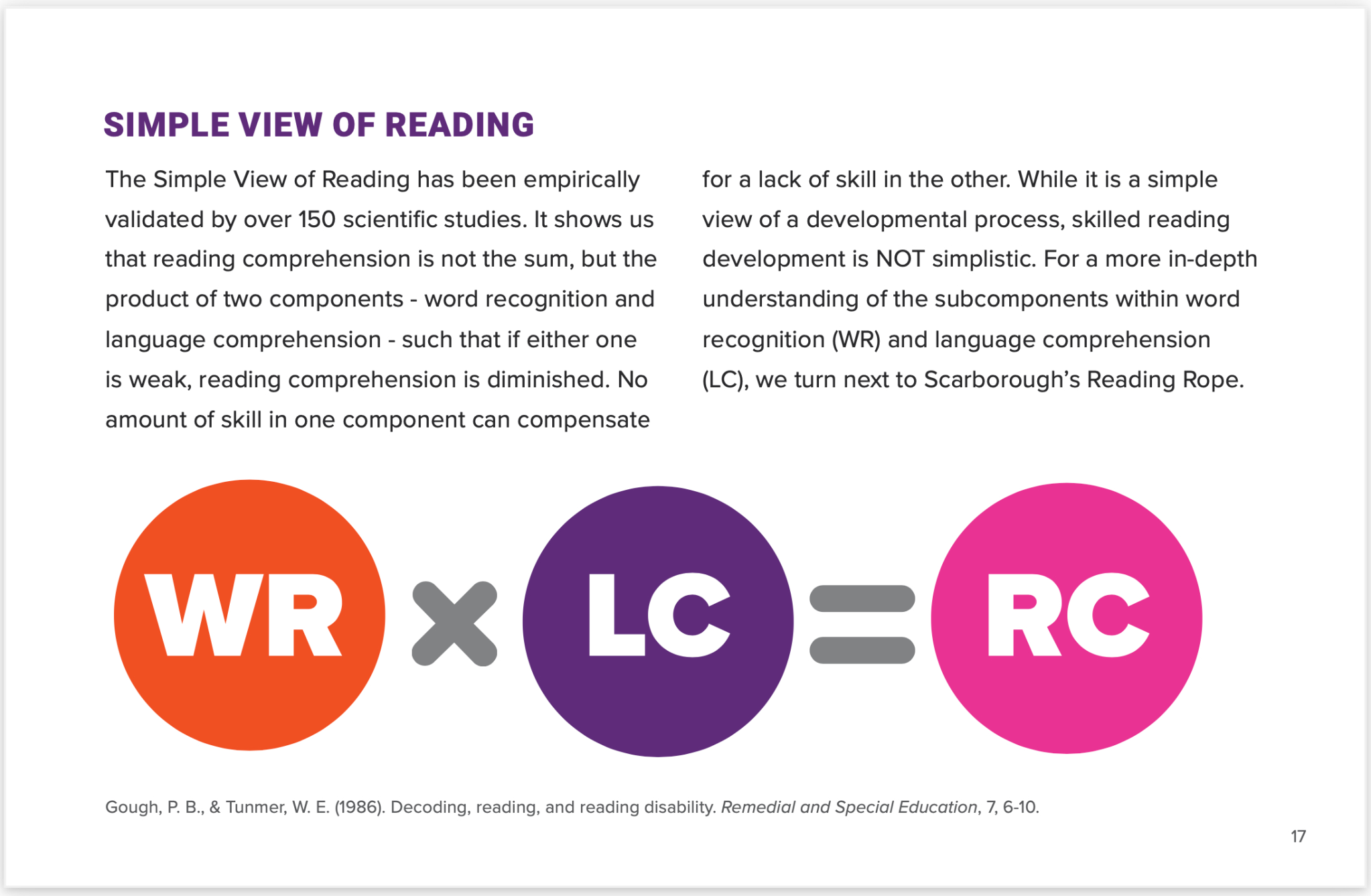
Science of Reading: Defining Guide

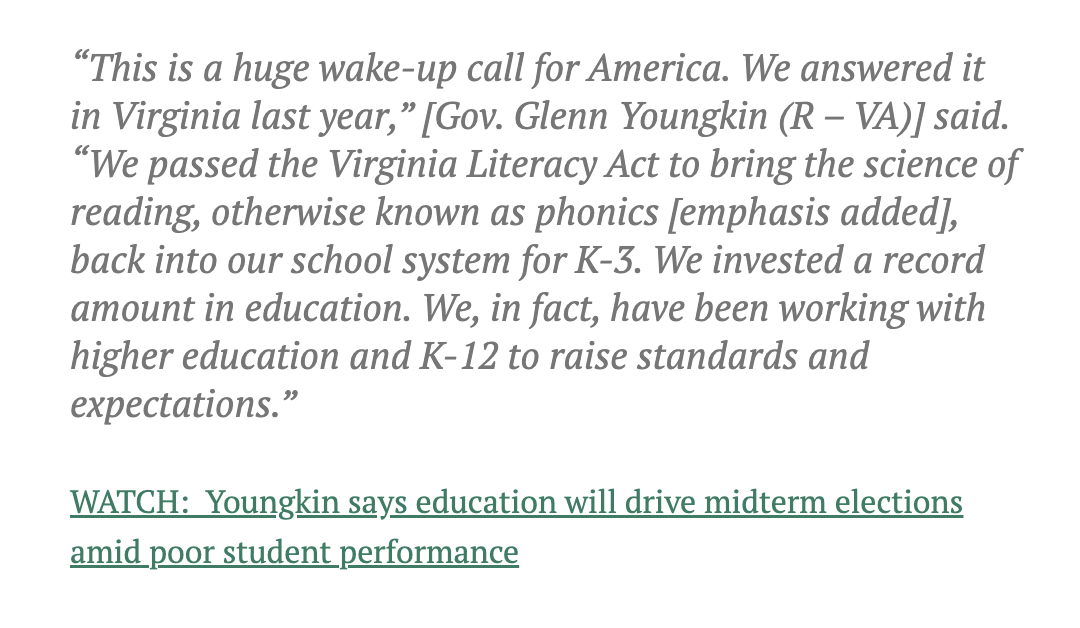
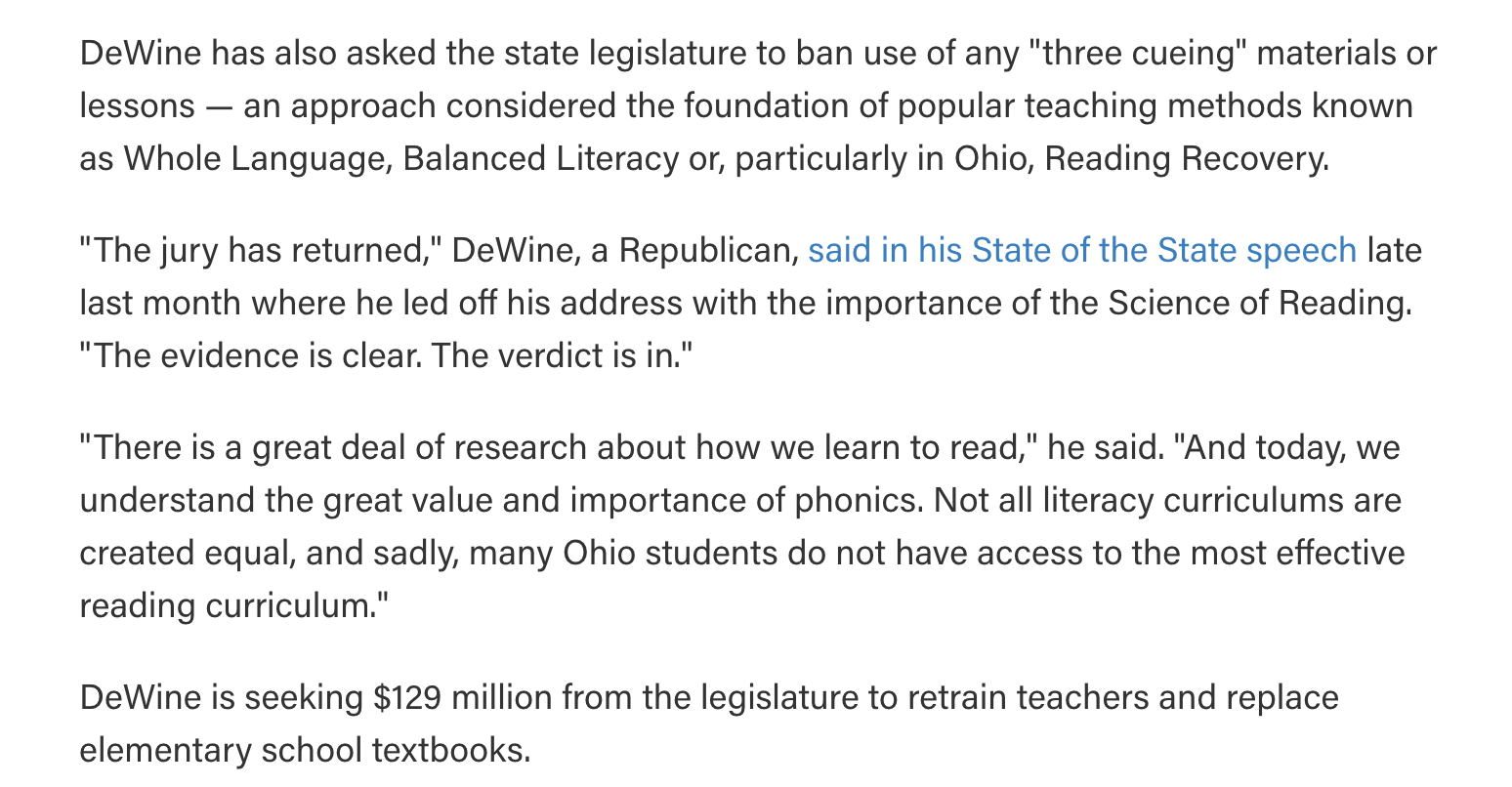
Now let’s note how these misleading and oversimplified claims about reading science have manifested themselves in political rhetoric and then state legislation:
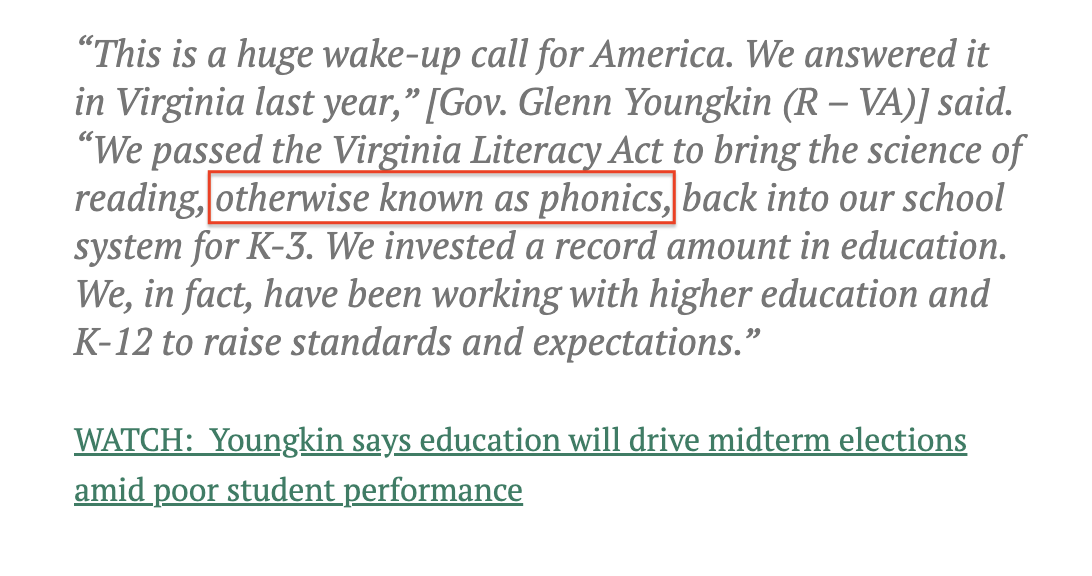
WATCH:  Youngkin says education will drive midterm elections amid poor student performance
‘The evidence is clear’: DeWine pushes for ‘Science of Reading’ as only approach in Ohio classrooms

While this is only one example [1] of the caution Ericsson raised, the misrepresentation of reading science as “simple and settled” has become holy text and then spurred misguided reading legislation and policy.

The more nuanced and on-going body of reading science is much better represented by the research from literacy scholars:
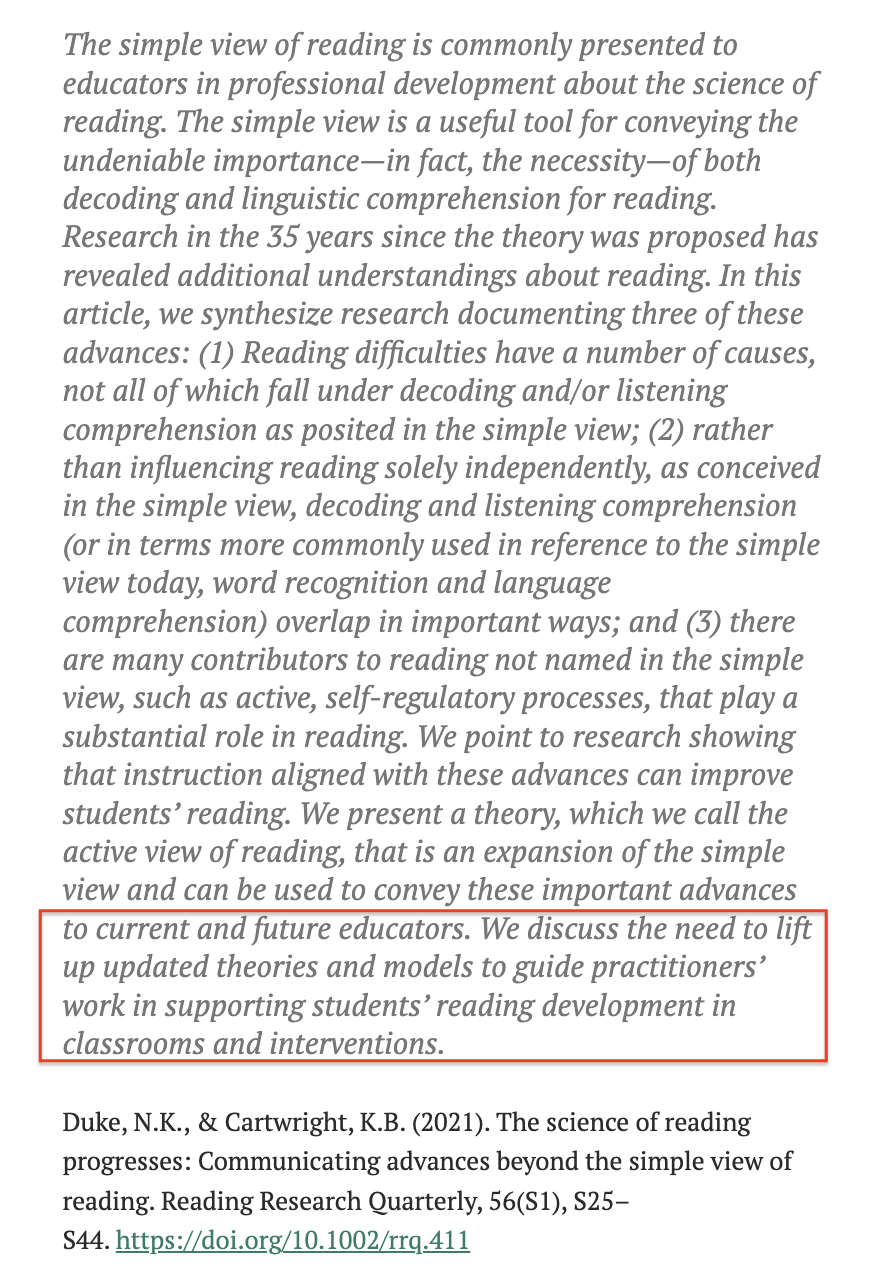
Duke, N.K., & Cartwright, K.B. (2021). The science of reading progresses: Communicating advances beyond the simple view of reading. Reading Research Quarterly, 56(S1), S25–S44. https://doi.org/10.1002/rrq.411

From Arkansas to New York City, political leaders have misrepresented dyslexia, reading proficiency, reading instruction, and reading programs in ways that parallel the stories found in mainstream media.

Like Gladwell, Hanford and dozens of mainstream journalists are reaping the rewards of compelling stories that misinform while also feeding commercial and political interests that are mis-serving students, teachers, and public education.

Once again, we find ourselves not only in the tired and false rhetoric of reading crisis but also lost in translation because a sensationalistic podcast tells a melodramatic story that runs roughshod over anything resembling a fair representation of student reading proficiency, teacher expertise, or our obsession with finding the next reading program.


Note

[1] For a more detailed examination of the misinformation in media, see the following:

Recommended

The Danger of Delegating Education to Journalists: Why the APS Observer Needs Peer Review When Summarizing New Scientific Developments, K. Anders Ericsson 

Reading Educational Research: How to Avoid Getting Statistically Snookered, Gerald Bracey

Setting the Record Straight: Responses to Misconceptions About Public Education in the U.S., Gerald Bracey
NAEP, Media Fuel Manufactured Reading Crisis

Consider how people would respond to the two following statements for a survey:

  1. About 2/3 of US students read below “proficient” on national testing.
  2. About 2/3 of US students read at or above “grade level” on national testing.

We don’t need to imagine, however.

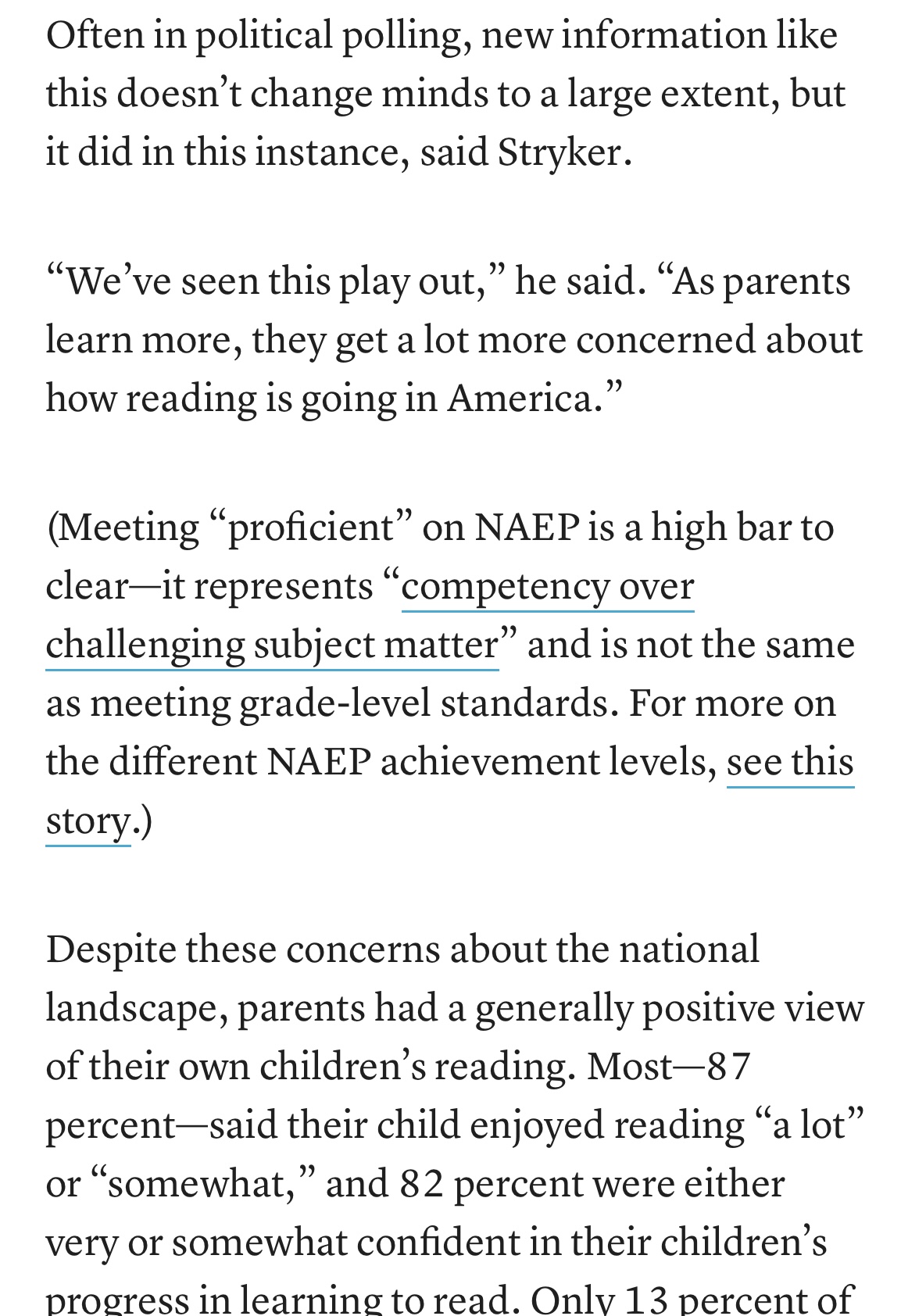
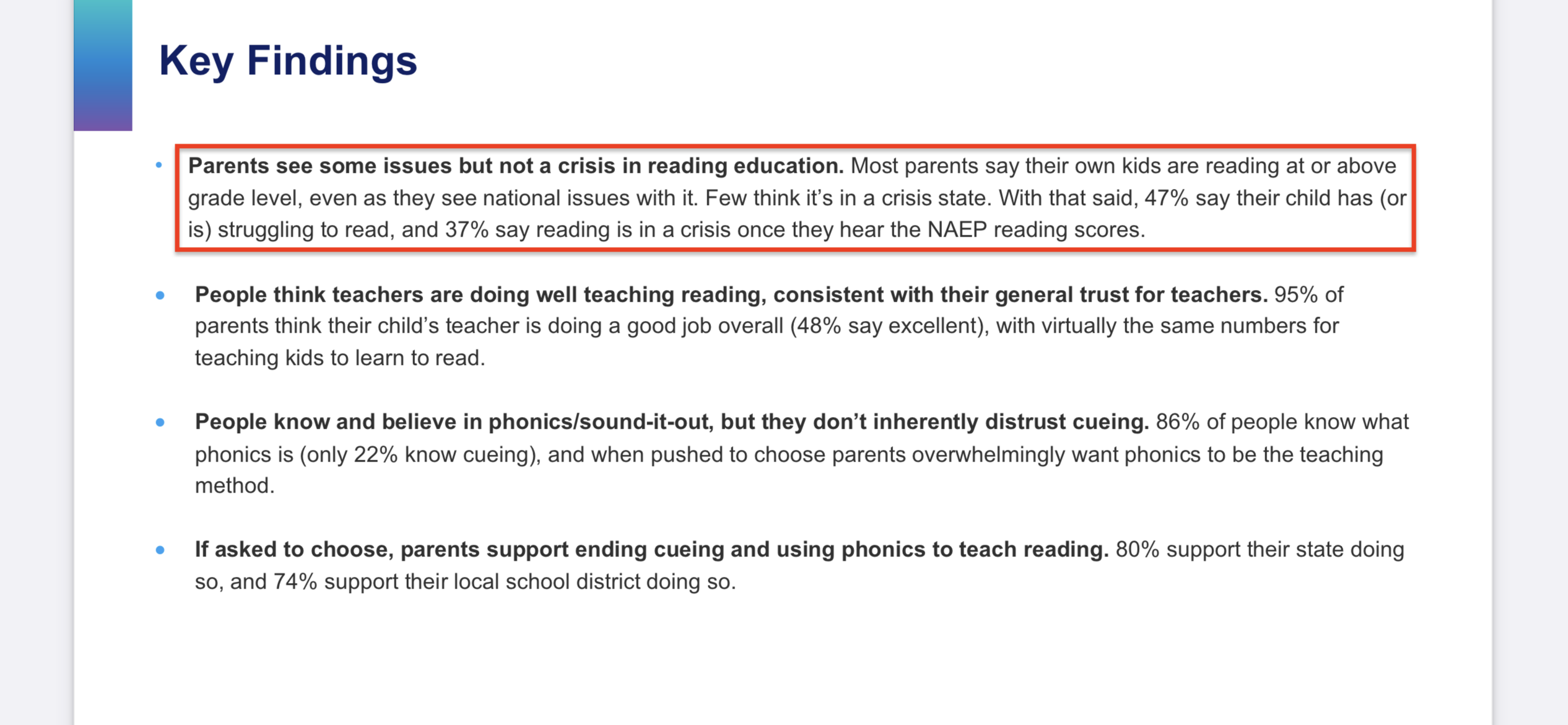
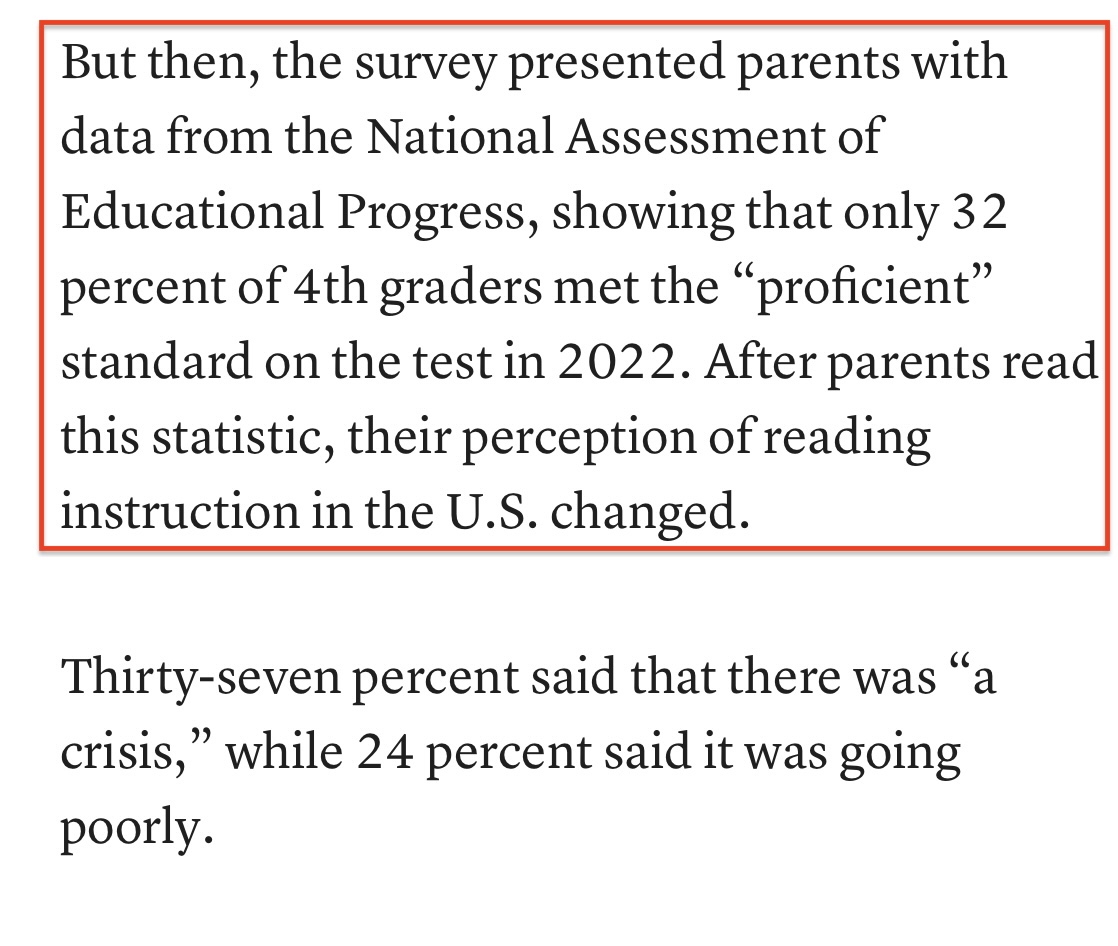
Coverage in Education Week of a new survey on parents’ perceptions of reading reveals incredibly damning findings—damning not about reading achievement or teaching but about NAEP and media:

The survey’s findings reflect that damning dynamic:

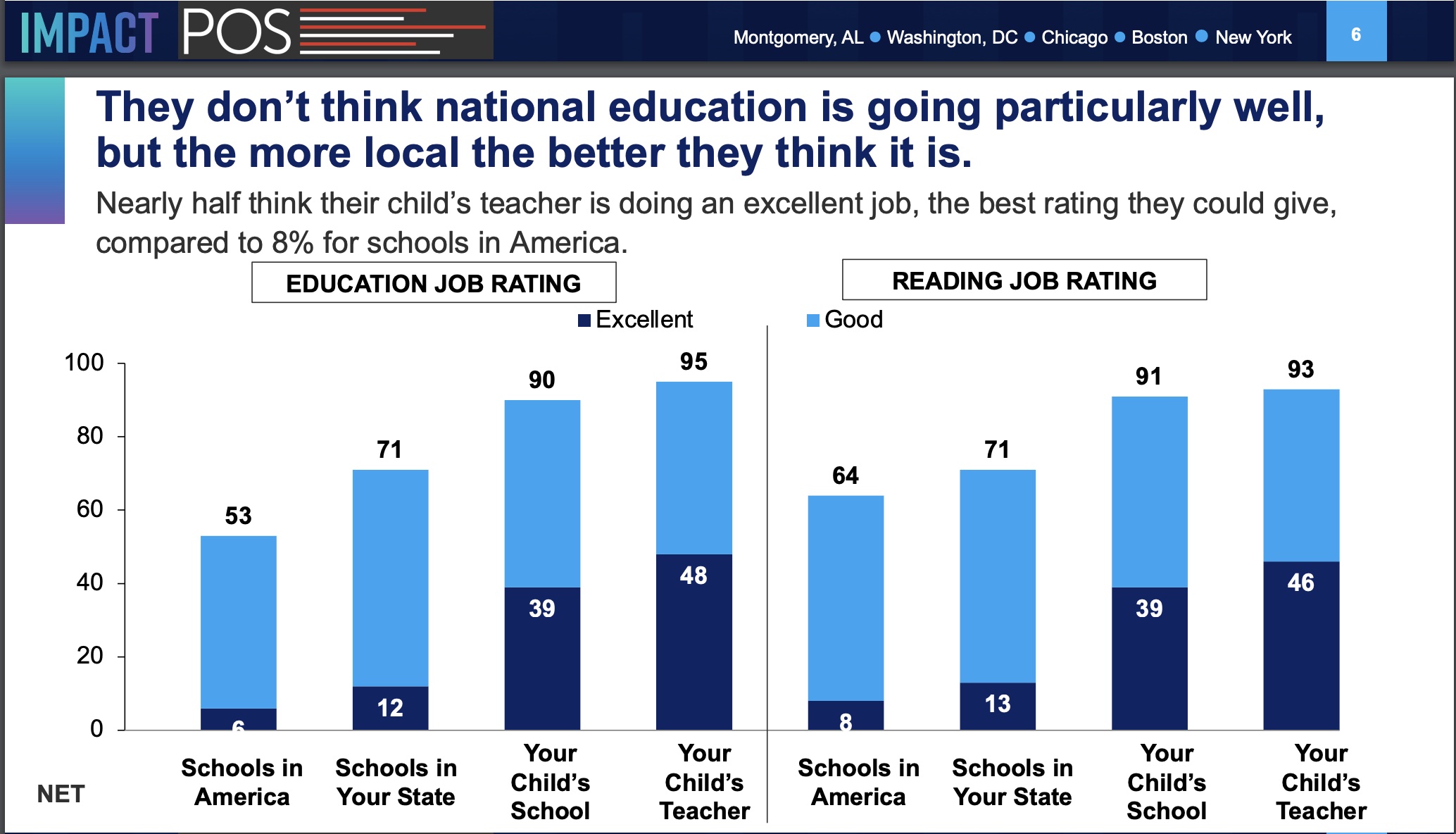
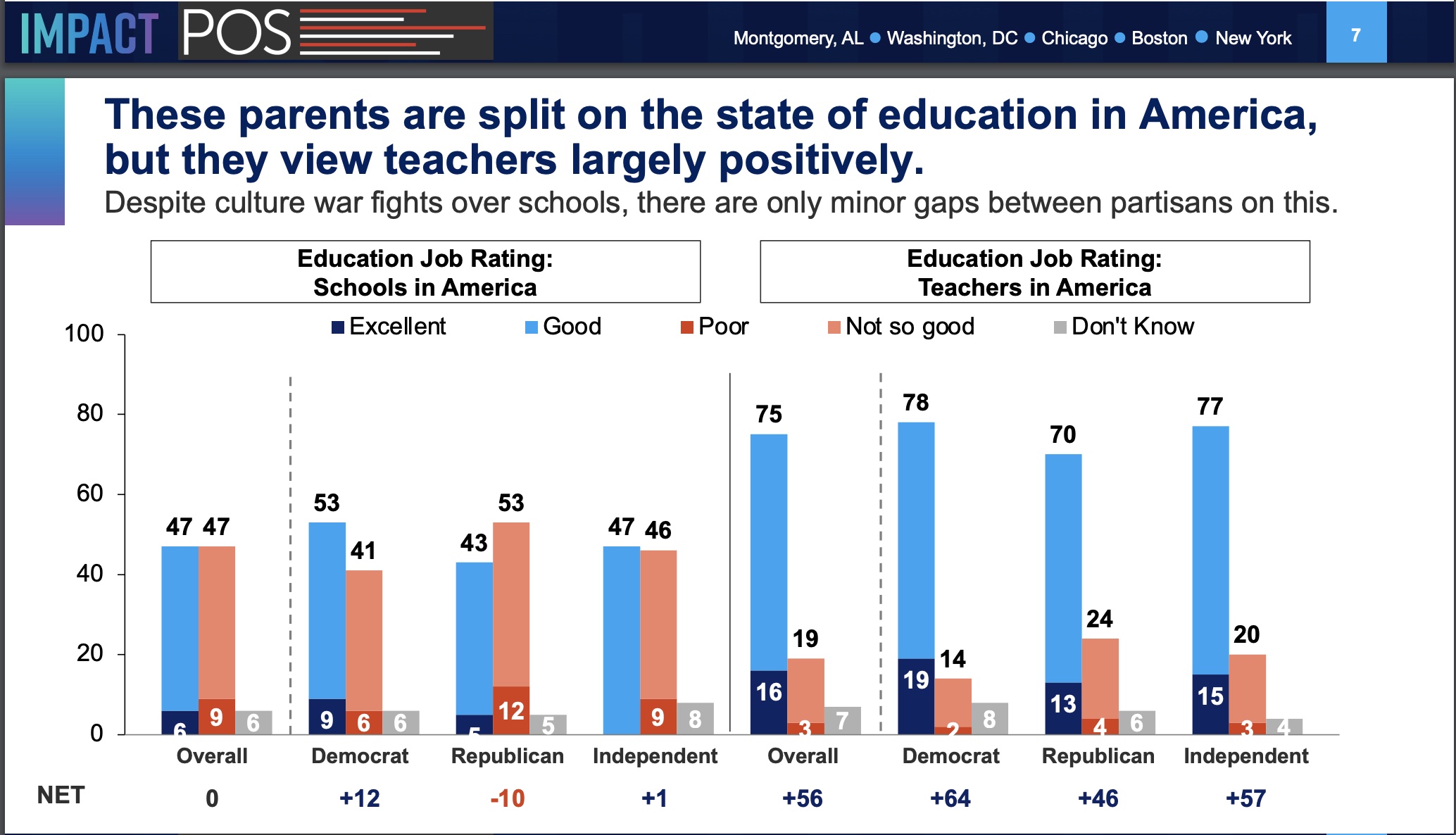
Yet, despite the misinformation about NAEP, these survey findings reflect decades of surveys showing parents generally have positive views of their children’s schools and teachers but believe public education nationally is failing:

This survey, though, exposes the source of that disconnect—media coverage of NAEP data, which seems to be designed more to manufacture a crisis than to assess student reading achievement.

The opening two hypothetical statements show where the problem lies because the first is an accurate statement about NAEP and the second is an accurate statement about reading at grade level.

As NAEP explains and others have addressed for years (see below), NAEP “proficiency” is well above grade level and “basic” represents something close to grade-level proficiency. However, the larger problem is the US has no standard criteria for “grade-level proficiency” and states set their own levels with NAEP using terminology that is at least confusing if not intentionally misleading.

Another problem, as I have argued, is that “grade level” is likely a worse metric than “age level” since many states now implement grade 3 retention based on reading tests, corrupting populations of students being assessed since data show that student scores on early reading are strongly correlated with birth month.

See the following to better understand NAEP and media misinformation about reading proficiency:

The US has a long and troubling history of media and political leaders being more invested in a manufactured education crisis than actually investing in better public education.

As a result, parents and students are trapped between their own genuine appreciation and need for effective, responsive reading instruction and a media-fueled political campaign to misinform the public because a constant state of reading crisis benefits a contracting media and generates political capital.

The reading crisis in the US is that the public is reading misinformation about reading and teachers, grounded in a national testing program designed to manufacture crisis.


NOTE

The survey also shows how misinformation about three cueing and phonics misleads parents and distorts their perception of reading instruction:

The framing of the survey misrepresents both cueing and guessing; see the following:

Testing for Perpetual Education Crisis

“The administrations in charge,” writes Gilles Deleuze in Postscript on the Societies of Control, “never cease announcing supposedly necessary reforms: to reform schools, to reform industries, hospitals, the armed forces, prisons” (p. 4).

Deleuze’s generalization about “supposedly necessary reforms” serves as an important entry point into the perpetual education crisis in the US. Since A Nation at Risk, public education has experienced several cycles of crisis that fuel ever-new and ever-different sets of standards and high-stakes testing.

Even more disturbing is that for at least a century, “the administrations in charge” have shouted that US children cannot read—with the current reading crisis also including the gobsmacking additional crisis that teachers of reading do not know how to teach reading.

The gasoline that is routinely tossed on the perpetual fire of education crisis is test scores—state accountability tests, NAEP, SAT, ACT, etc.

While all that test data itself may or may not be valuable information for both how well students are learning and how to better serve those students through reform, ultimately all that testing has almost nothing to do with either of those goals; in fact, test data in the US are primarily fuel for that perpetual state of crisis.

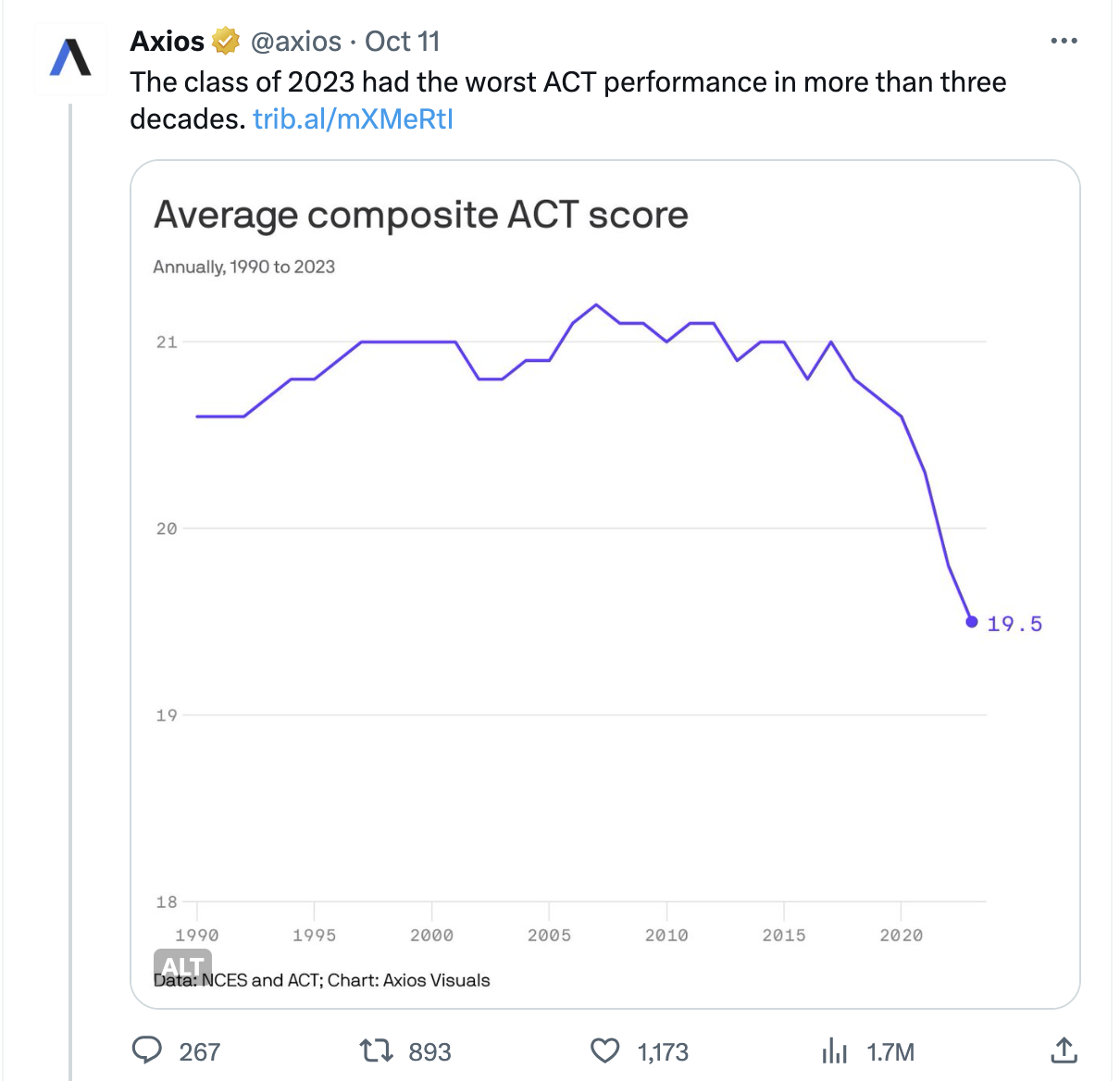
Here is the most recent example—2023 ACT scores:

I have noted that reactions and overreactions to NAEP in recent years follow a similar set of problems found in reactions/overreactions to the SAT for many decades; the lessons from those reactions include:

  • Lesson: Populations being tested impact data drawn from tests.
  • Lesson: Ranking by test data must account for population differences among students tested. 
  • Lesson: Conclusions drawn from test data must acknowledge purpose of test being used (see Gerald Bracey)

The social media and traditional media responses to 2023 ACT data expose a few more concerns about media, public, and political misunderstanding of test data as well as how “the administrations in charge” depend on manipulating test data to insure the perpetual education crisis.

Many people have confronted the distorting ways in which the ACT data are being displayed; certainly the mainstream graph from Axios above suggests “crisis”; however, by simply modifying the X/Y axes, that same data appear at least less dramatic and possibly not even significant if the issues I list above are carefully considered.

Many causal elements could be at work to explain the ACT decrease, including population shifts, social influences (such as the Covid impact), and the inherently problematic element of using test data for purposes not intended as well as making nuanced claims based on singular data points (averages).

For example, the ACT is exclusively designed to measure college preparedness, like the SAT, and not general educational quality of schools or general evaluations of student learning.

Students who take the ACT are a narrow subset of students skewed by region and academic selectivity (college-bound students versus general population of US students).

Also, while a careful analysis could answer these questions, the ACT score drop may or may not represent a significant event, depending on what that single point (average) represents (how many questions and how large is the change substantively).

Likely, however, there is never any credible reason to respond to college entrance data as a crisis of general educational quality because, as noted above, that simply is not what the tests are designed to measure.

The larger issue remains: Testing in the US rarely serves well evaluating learning and teacher, testing has not functioned in service of achieving effective education reform, but testing does fuel perpetual education crisis.

This crisis-of-the-day about the ACT parallels the central problem with NAEP, a test that seems designed to mislead and not inform since NAEP’s “Proficient” feeds a false narrative that a majority of students are not on grade level as readers.

The ACT crisis graph being pushed by mainstream media is less a marker of declining educational quality in the US and more further proof that “the administrations in charge” want and need testing data to justify “supposedly necessary reforms,” testing as gas for the perpetual education crisis fire.

Open Letter to the Biden Administration, USDOE, and Secretary of Education Miguel Cardona

Reporting for NPR in 2018 about A Nation at Risk, Anya Kamenetz noted:

When it appeared in April 1983, the report received widespread coverage on radio and TV. President Reagan joined the co-authors in a series of public hearings around the country.

The report’s narrative of failing schools — students being out-competed internationally and declining educational standards — persists, and has become an entrenched part of the debate over education in the U.S.

What ‘A Nation At Risk’ Got Wrong, And Right, About U.S. Schools

In 2023, writing for The Answer Sheet in The Washington Post, James Harvey explains that the report under Reagan was “gaslighting” for political purposes, and not the clarion call to address education reform that media, the public, and political leaders claimed.

In short, A Nation at Risk was a “manufactured crisis.”

Yet, education reform has become a central part of the political process for governors and presidents since the 1980s, reaching a critical peak under George W. Bush who turned the discredited “Texas Miracle” into groundbreaking and bipartisan federal legislation, No Child Left Behind (NCLB).

In fact, public education in the US has been under an intense public and political microscope for forty years of high-stakes accountability. For educators, that accountability is indistinguishable regardless of the political party in the White House.

The Obama administration in many ways continued and even doubled-down on the crisis/miracle rhetoric found under W. Bush.

At the core of education crisis/miracle rhetoric has been the use and misuse of standardized test data.

For many decades, the media and public fretted over public education based on SAT data (and then ACT data), which represents the central issue of misunderstanding test scores (the College Board warns of not ranking states by SAT averages, yet the media persists) and misusing test data (SAT/ACT tests are designed to predict college success, not evaluate the quality of public education).

With the decrease in the influence of SAT/ACT testing, however, the media, public, and political leaders have focused more on National Assessment of Educational Progress (NAEP) data.

Since 2019, there have been NAEP-inspired claims of educational crisis based on 2019 reading scores, 2022 math scores, and 2022 history/civics scores.

As one powerful example, high-profile media, The New York Times, and journalist, Nicholas Kristof, proclaim:

One of the most bearish statistics for the future of the United States is this: Two-thirds of fourth graders in the United States are not proficient in reading.

Two-Thirds of Kids Struggle to Read, and We Know How to Fix It

However, despite warnings from 2016, Tom loveless explains:

In February, 2023 Bari Weiss produced a podcast, “Why 65% of Fourth Graders Can’t Really Read” and Nicholas Kristof, New York Times columnist, wrote “Two-Thirds of Kids Struggle to Read, and We Know How to Fix It.” Both headlines are misleading. The 65% and two-thirds figures are referring to the percentage of 4th graders who scored below proficient on the last reading test of the National Assessment of Educational Progress (NAEP)administered in 2022.

The problem is this: scoring below proficient doesn’t mean “can’t really read” or “struggling to read.”   It also does not mean “functionally illiterate” or identify “non- readers” as some of the more vituperative descriptions on social media have claimed. It doesn’t even mean “below grade level in reading,” one of the milder distortions.

Literacy and NAEP Proficient

Further,  scholars Reinking, Hruby and Risko (2023), in fact, assert: “[T]here is no indisputable evidence of a national crisis in reading, and even if there were a crisis, there is no evidence that the amount of phonics in classrooms is necessarily the cause or the solution.”

Two problems currently exist with the stories being told about schools and the education reform movement—the data do not support claims of “crisis” and NAEP perpetuates the “crisis” myth by design.

Touted as the “Nation’s Report Card,” NAEP developed achievement levels that were designed to hold states accountable for having high standards, and as a result, “proficiency” on NAEP is “aspirational” but not representative of “grade-level proficiency.”

The US is now mired in decades of punitive education legislation (standards and high-stakes testing as well as third-grade retention and VAM-based teacher evaluation) that has not worked because the central claim of “crisis” is simply not supported by the evidence.

Especially in the wake of the devastating impact of Covid on public education, students, and teachers, the Biden Administration has the historic opportunity to change direction in US public education reform.

This open letter, then, is an urgent call to do the following:

  • Acknowledge and reject the false narratives of manufactured public education “crises” and media-created education “miracles.”
  • Declare accountability-based, punitive reform a failure—despite good intentions—and call for equity-based, supportive reform that forefronts the impact of systemic forces outside and inside our public schools.
  • Reform dramatically NAEP testing so that test data better supports learning and instruction instead of driving a false story of education crisis (for example, reform the use of NAEP “proficiency” to represent “age-level proficiency”).

US public education has a long and inexcusable history of political negligence in terms of supporting the most vulnerable children in our society; that includes negligence of vulnerable students in our public education system.

Our children and the country deserve robust and substantive education reform, not false stories of failure and misguided blame and punishment.

Regretfully, the last forty years have been a perpetual cycle of manufactured crisis and punitive policy.

The Biden Administration—notably a rhetorical “friend” of education embodied by Dr. Jill Biden—can and should chose a different story about our schools, our students, and our teachers.

As celebrated author James Baldwin urged: “The challenge is in the moment, the time is always now.”

Test Scores Reflect Media, Political Agendas, Not Student or Educational Achievement [UPDATED]

In the US, the crisis/miracle obsession with reading mostly focuses on NAEP scores. For the UK, the same crisis/miracle rhetoric around reading is grounded in PIRLS.

The media and political stories around the current reading crisis cycle have interested and overlapping dynamics in these two English-dominant countries, specifically a hyper-focus on phonics.

Here are some recent media examples for context:

Let’s start with the “soar[ing]” NAEP reading scores in MS, LA, and AL as represented by AP:

‘Mississippi miracle’: Kids’ reading scores have soared in Deep South states

Now, let’s add the media response to PIRLS data in the UK:

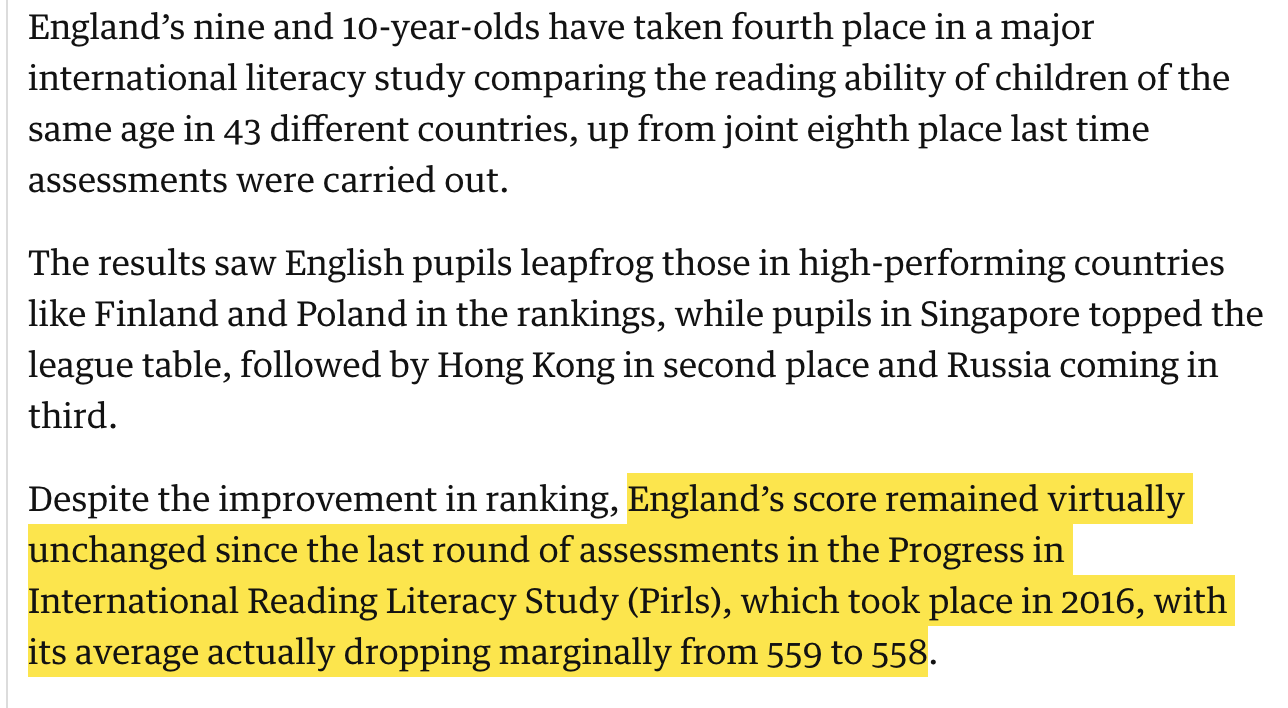
Reading ability of children in England scores well in global survey

Now I will share data on NAEP and PIRLS that shows media and political responses to test scores are fodder for their predetermined messaging, not real reflections of student achievement or educational quality.

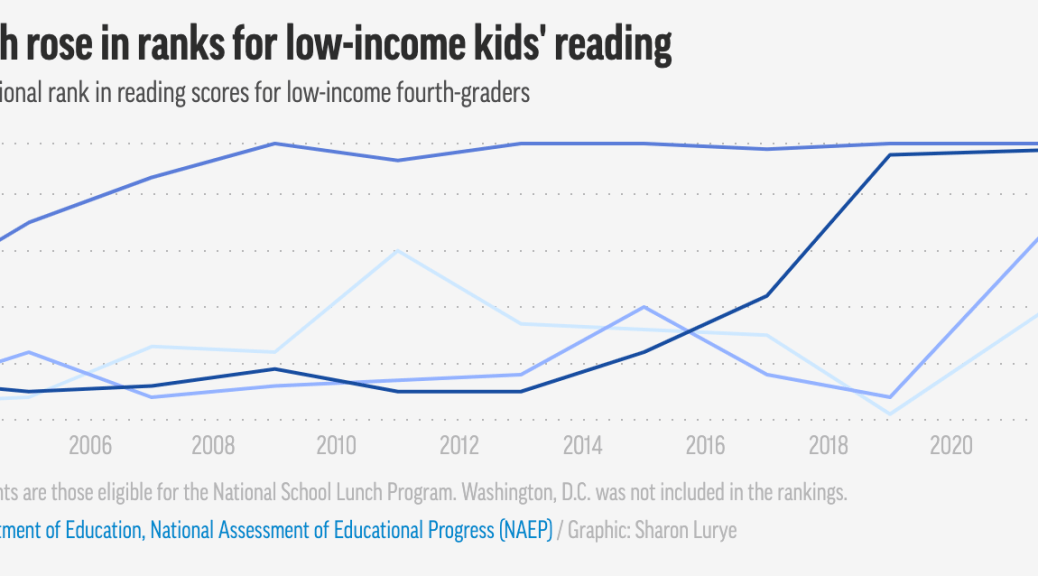
A key point is that the media coverage above represents a bait-and-switch approach to analyzing test scores. The claims in both the US and UK are focusing on rank among states/countries and not trends of data within states/countries.

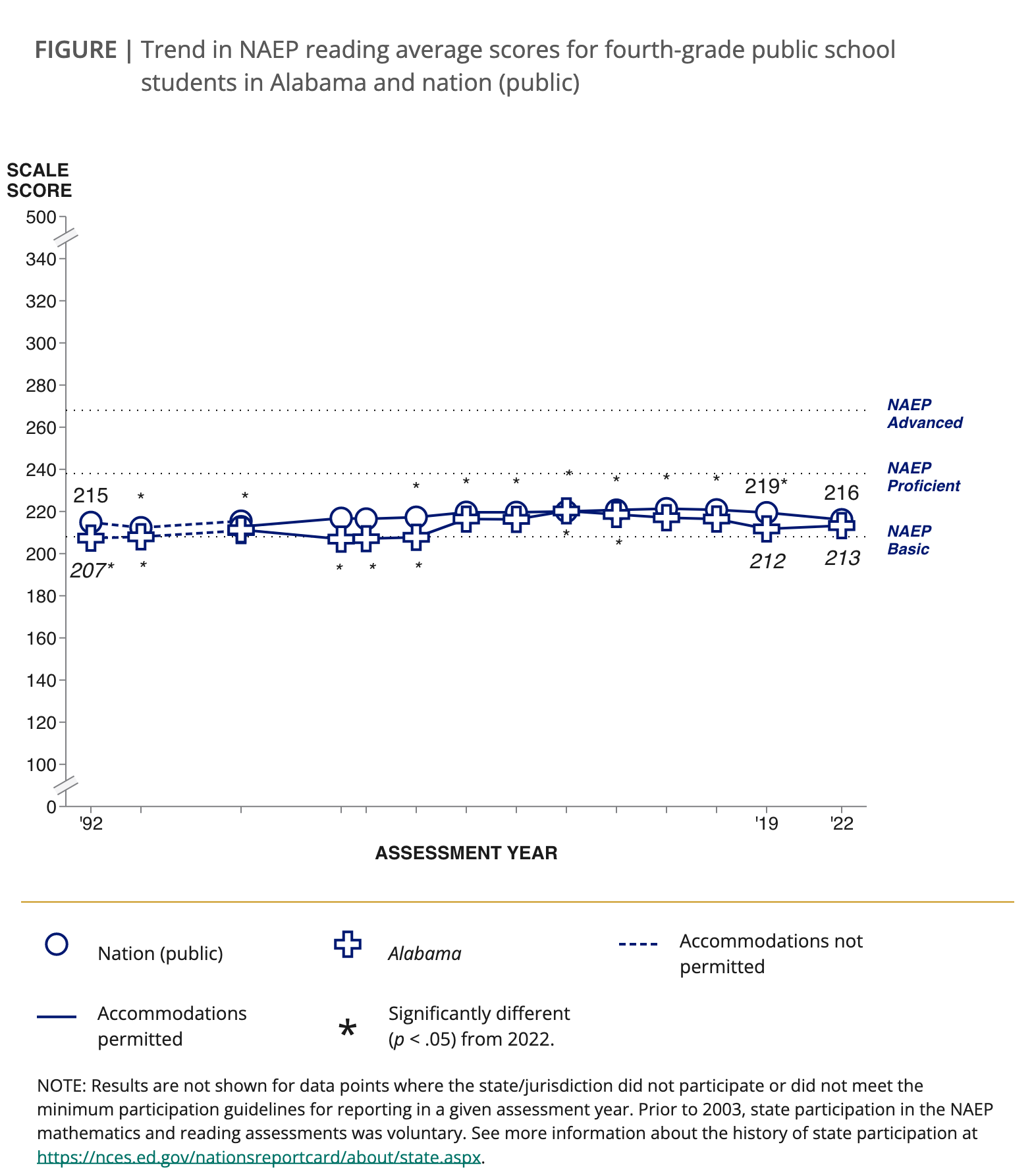
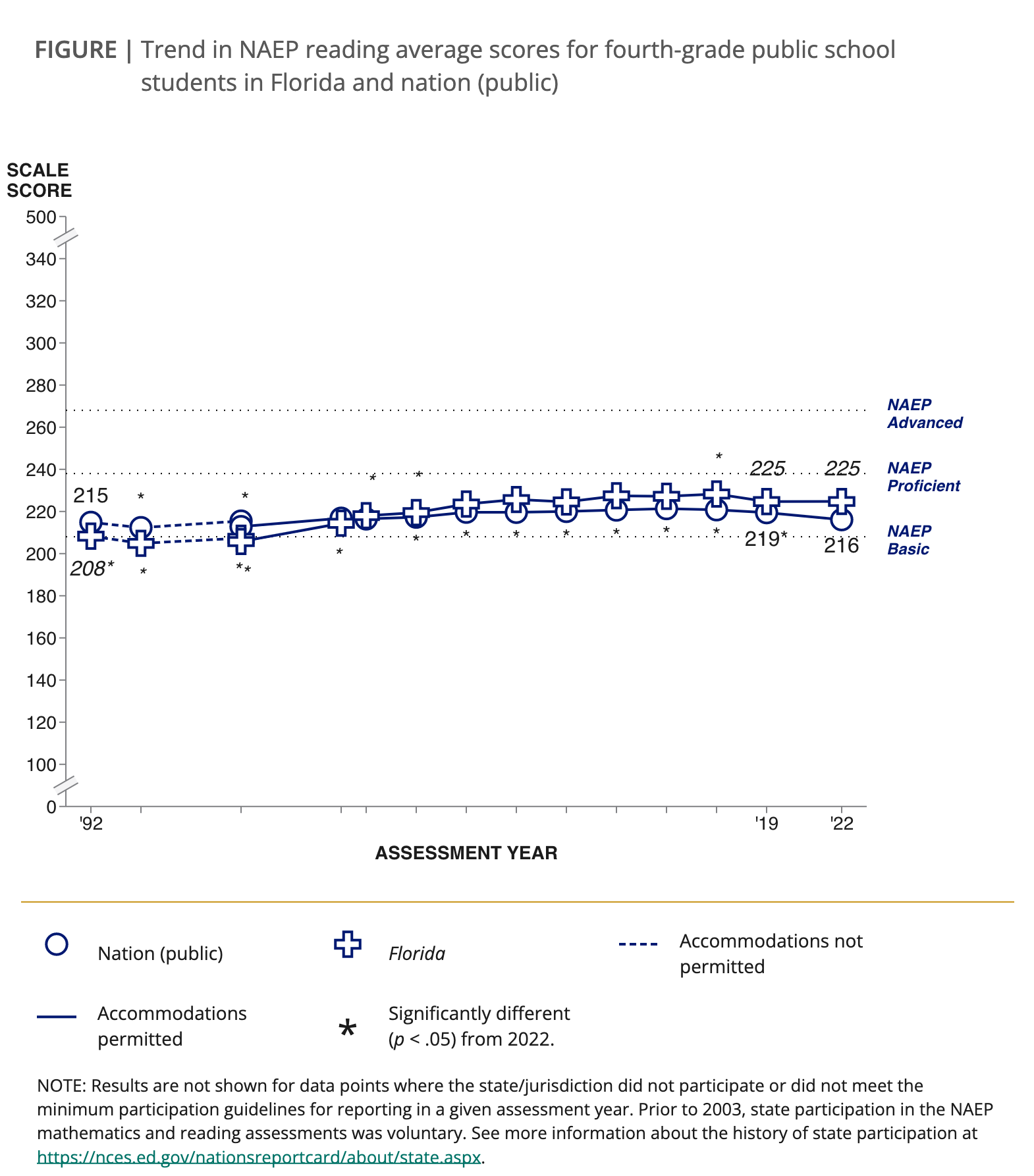
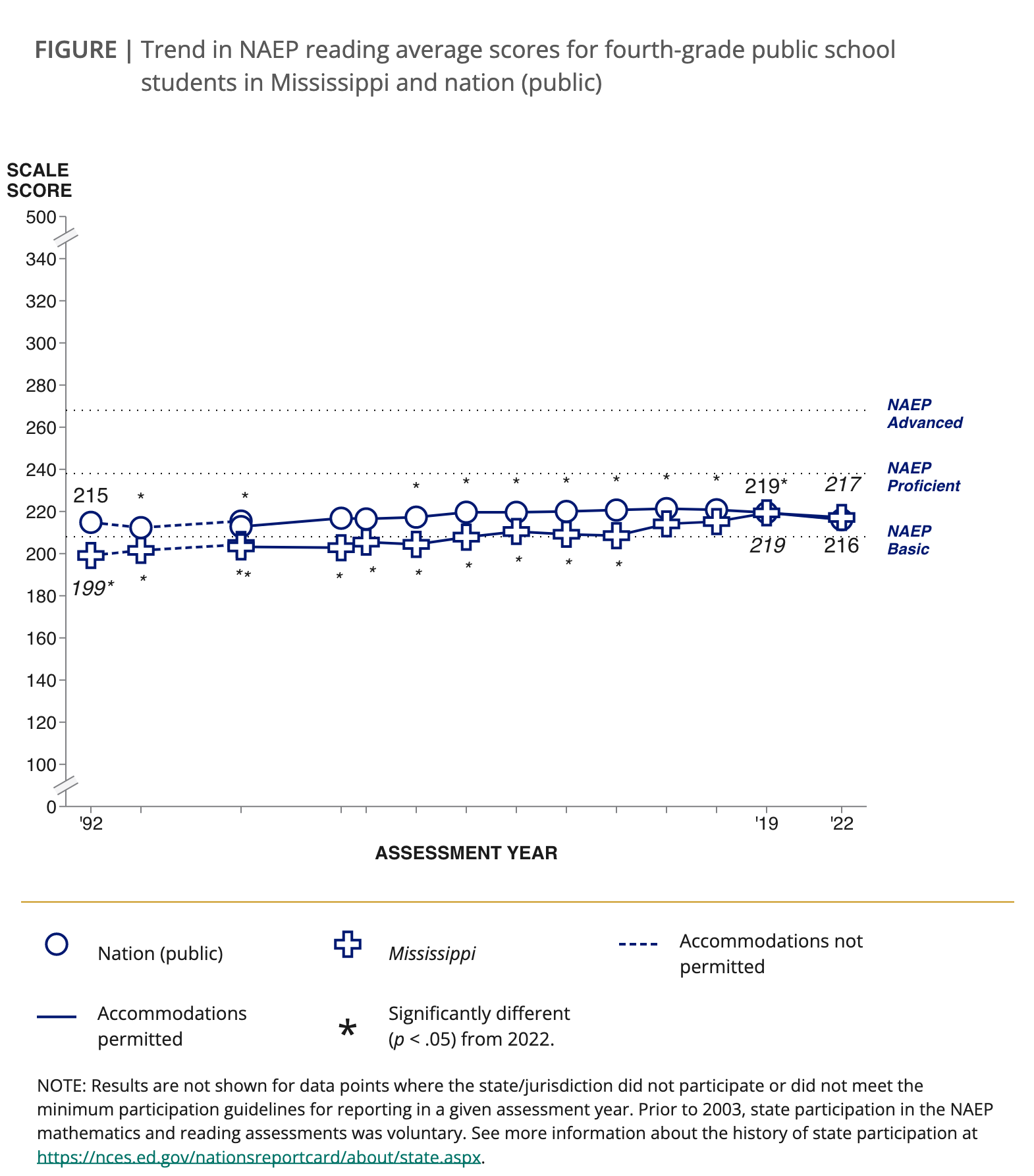
Do any of these state trend lines from FL, MS, AL, or LA appear to be “soar[ing]” data?

The fair description of the “miracle” states identified by AP is that test scores are mostly flat, and AL, for example, appears to have peaked more than a decade ago and is trending down.

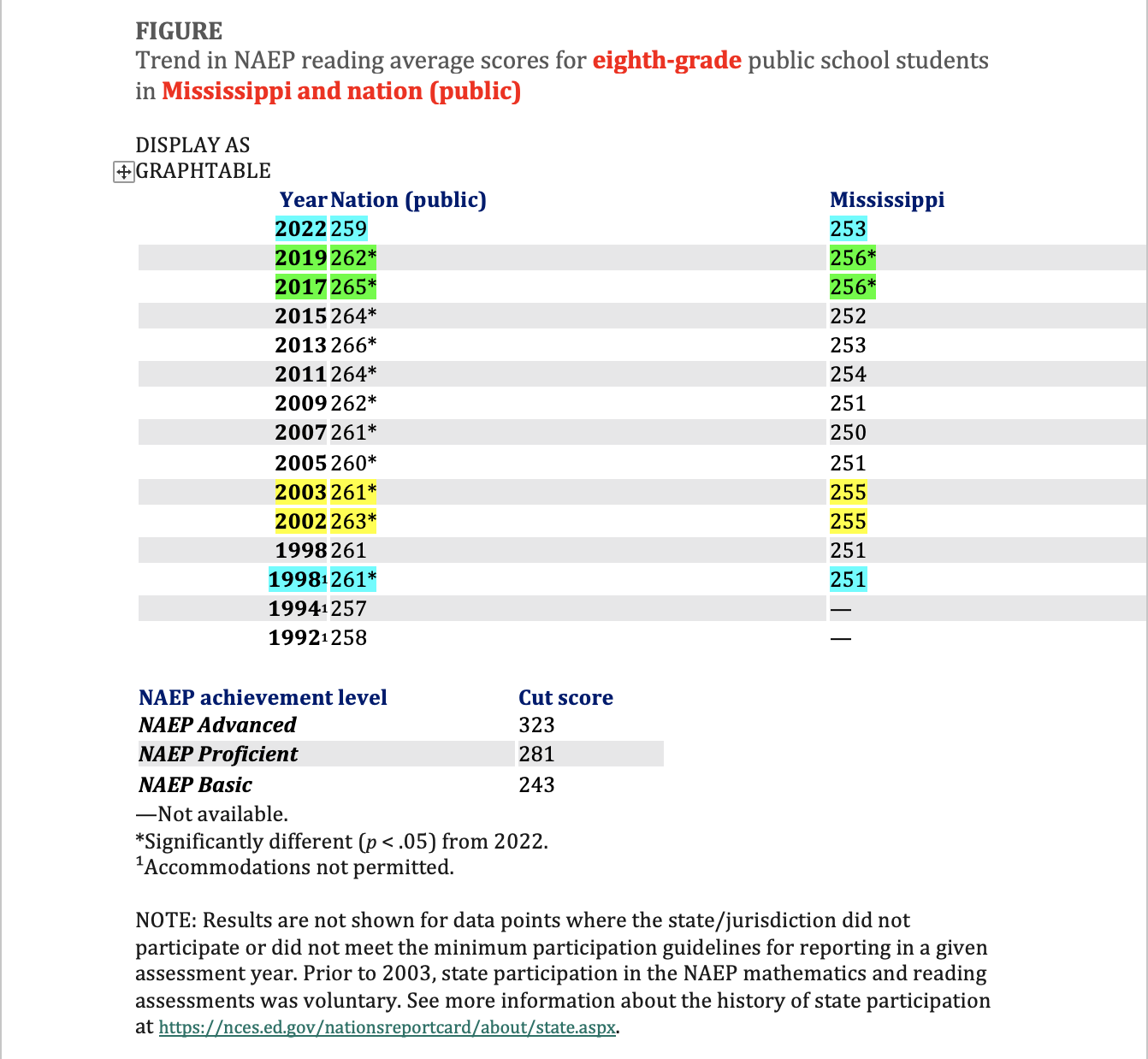
The foundational “miracle” state, MS, has had two significant increases, one before their SOR commitment and one after; but there remains no research on why the increases:

Scroll up and notice that in the UK, PIRLS scores have tracked flat and slightly down as well.

The problematic elements in all of this is that many journalists and politicians have used flat NAEP scores to shout “crisis” and “miracle,” while in the UK, the current flat and slightly down scores are reason to shout “Success!” (although research on the phonics-centered reform in England since 2006 has not delivered as promised [1]).

Many problems exist with relying on standardized tests scores to evaluate and reform education. Standardized testing remains heavily race, gender, and class biased.

But the greatest issue with tests data is that inexpert and ideologically motivated journalists and politicians persistently conform the data to their desired stories—some times crisis, some times miracle.

Once again, the stories being sold—don’t buy them.


Recommended

Three Twitter threads on reading, language and a response to an article in the Sunday Times today by Nick Gibb, Michael Rosen

[1] Wyse, D., & Bradbury, A. (2022). Reading wars or reading reconciliation? A critical examination of robust research evidence, curriculum policy and teachers’ practices for teaching phonics and reading. Review of Education10(1), e3314. https://doi.org/10.1002/rev3.3314

UPDATE

Mainstream media continues to push a false story about MS as a model for the nation. Note that MS, TN, AL, and LA demonstrate that political manipulation of early test data is a mirage, not a miracle.

All four states remain at the bottom of NAEP reading scores for both proficient and basic a full decade into the era of SOR reading legislation:

The Proficiency Trap and the Never-Ending Crisis Cycles in Education: A Reader

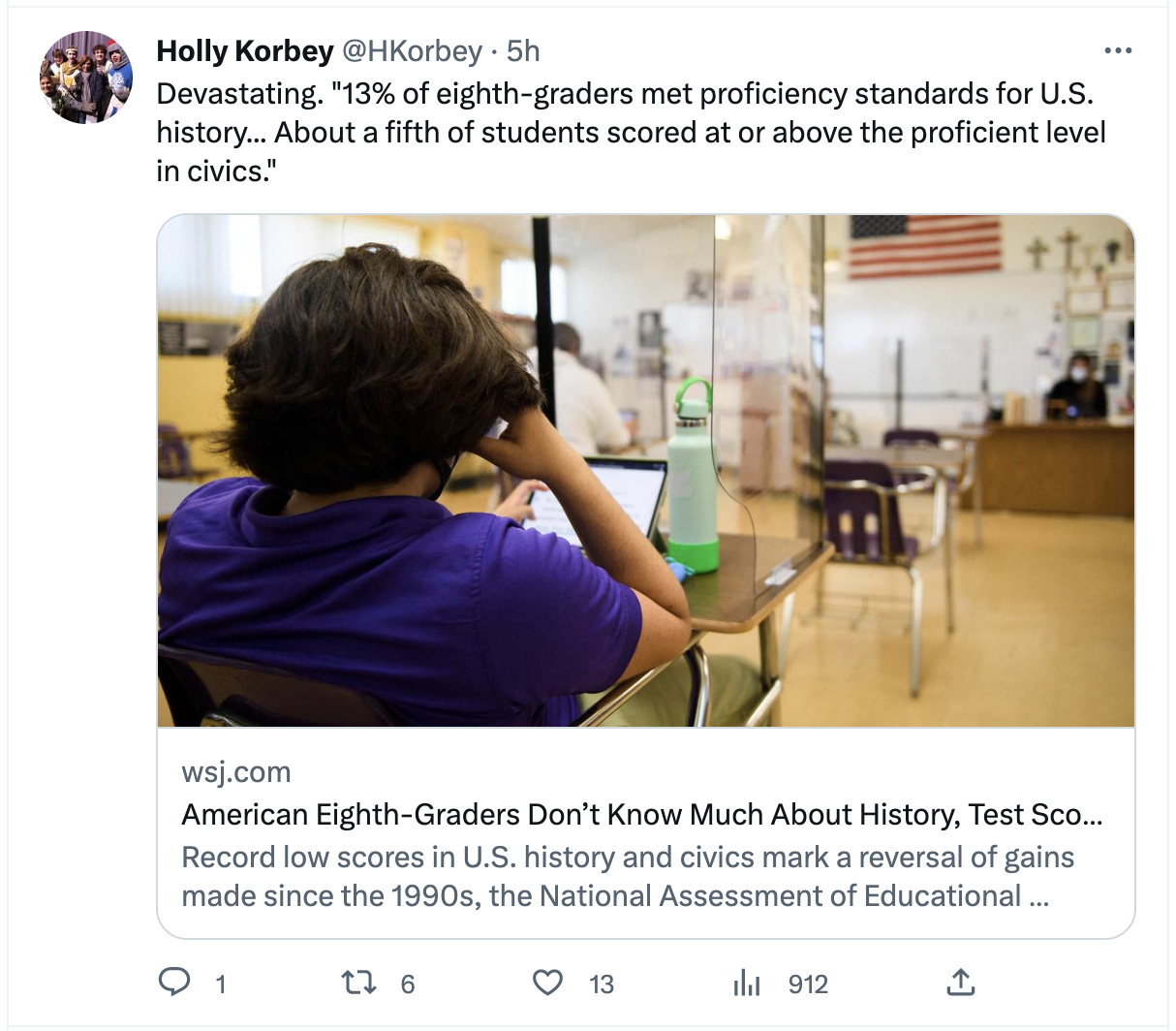
The newest NAEP crisis (until the next one) concerns history and civics NAEP scores post-pandemic.

Similar to the NAEP crisis around reading—grounded in a misunderstanding of “proficiency” and what NAEP shows longitudinally (see Mississippi, for example)—this newest round of crisis rhetoric around NAEP exposes a central problem with media, public, and political responses to test data as well as embedding proficiency mandates in accountability legislation.

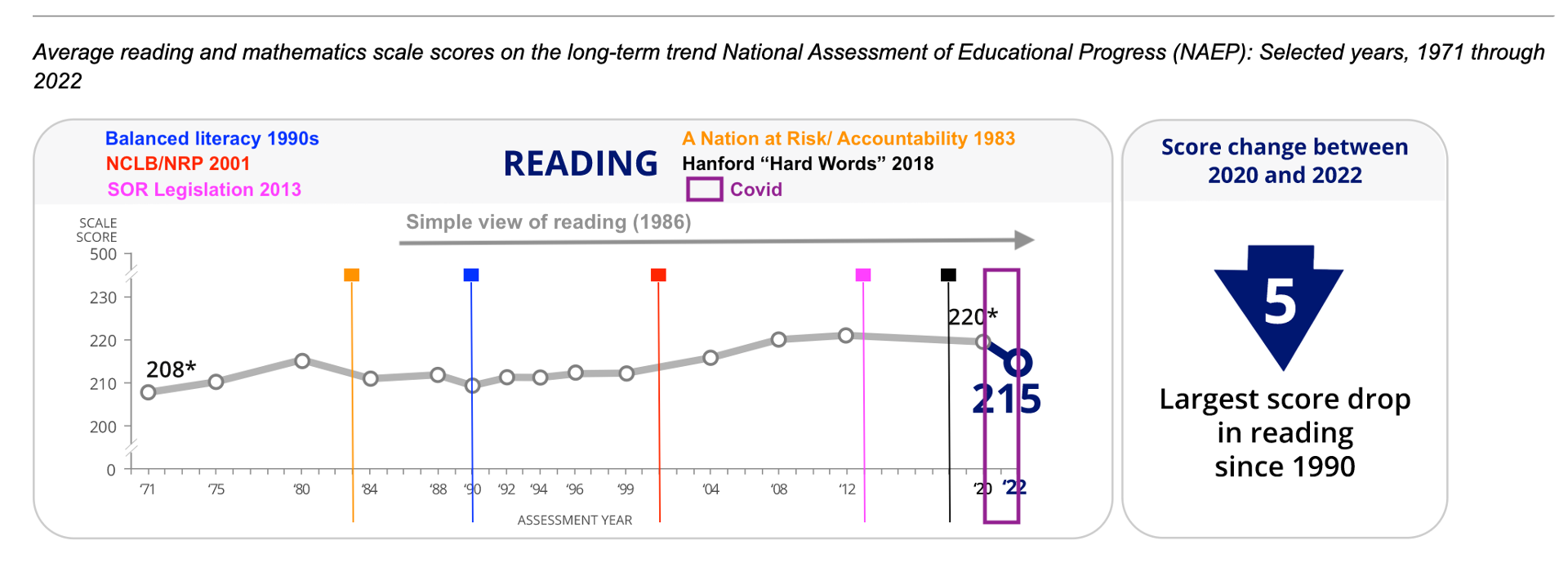
As many have noted, announcing a reading crisis is contradicted by longitudinal NAEP data:

But possibly a more problematic issue with NAEP is confusing NAEP achievement levels with commonly used terms such as “grade level proficiency” (notably as related to reading).

Yet, as is explained clearly on the NAEP web site: “It should be noted that the NAEP Proficient achievement level does not represent grade level proficiency as determined by other assessment standards (e.g., state or district assessments).”

Public, media, and political claims that 2/3 of students are below grade level proficiency, then, is a false claim based on misreading NAEP data and misunderstanding the term “proficiency,” which is determined by each assessment or state (not a fixed metric).

Here is a reader for those genuinely interested in understanding NAEP data, what we mean by “proficiency,” and why expecting all students to be above any level of achievement is counter to understanding human nature (recall the failed effort in NCLB to mandate 100% of student achievement proficiency by 2014):

NAEP-mania! 2023: US History and Civics Edition

Way back in the late 1970s, I changed my schedule—either in grade 10 or 11—and found myself in two class periods without my friends; I had been trafficking among the top-ranked students in my class (I graduated number 8 out of about 150 students), but the schedule change put me in a so-called “regular” history class.

The class was taught by a football and track coach. He had a very simple and even elegant instructional strategy.

In the center of the classroom stood an overhead projector. Beside it, daily, he had a designated stack of overheads.

After the first couple classes, he assigned the slowest note taker (or better named, note copier) to sit beside the stack of notes to rotate as that student completed copying.

After one day of this tedium, I rushed to guidance and returned to my original schedule along side my friends.

Something that is rarely discussed in the many public discussions of US education is that history, social studies, civics, and government courses in public schools are disproportionately taught by coaches.

Most coaches are coincidentally teachers—and a few teachers are coincidentally coaches. A significant number of US public school students get begrudging instruction in history, social studies, civics, and government—and that instruction is superficially facts, easy to test (or at least easy to put on tests that are easy to score).

So while Republicans have been dismantling history curriculum and banning books, US students produced our latest NAEP education crisis: Eighth-Graders’ History, Civics Test Scores Hit Record Low, cries the WSJ.

Yet, here is an interesting tidbit (especially for those of us mired in the manufactured reading crisis over the past five years or so):

This relatively flat data line for NAEP history scores should remind you of reading NAEP data:

Despite evidence to the contrary, once again, mainstream media, the public, and political leaders have only two ways to react to anything about US public education—crisis or miracle.

We might anticipate that the drop in US history and civics NAEP scores (despite the obvious connection to Covid, as noted above in NAEP reading) will prompt “science of history” and “science of civics” movements.

But, honestly, those will not materialize because politically the US does not care about history or civics—at least not about the quality of teaching and learning in history or civics.

Politically, we only care about anything that allows a public outrage and melodramatic media response to further prove that students suck, teachers suck, and schools, well, suck.

Similar to the false stories around reading, however, the actual problems with history and civics teaching and learning in the US have little to do with a very bad test (that, we should note, is what NAEP is, a very bad test).

History, social studies, civics, and government courses have for decades been part of an open secret—a set of content eagerly sacrificed to the scholastic sports Gods.

And more recently, history, social studies, civics, and government are the political tool of the Republican Party who wants schooling to indoctrinate children in the fairy tales that maintain the status quo of inequitable power, freedom, and humanity that is the good ol’ U.S. of A.

The real purpose of NAEP is to give periodic space to the only way journalists know how to respond to education:

Ironically, that journalists and the public are so easily fooled by this nonsense is the strongest indictment of the failures of US public education.

We all should know better. We all should do better.

But we won’t.

That, by the way, is one predictable lesson of history.

SOR Movement Maintains Conservative Assault on Teachers and Public Schools [Updated]

[Header Photo by Kelly Sikkema on Unsplash]

Although Gerald Bracey and Gerald Holton exposed A Nation at Risk many years ago, James Harvey calling the Reagan-era “report” “gaslighting” is possibly the best way to frame the manufactured crisis that set off five decades of misguided education reform in the US.
The crisis rhetoric of A Nation at Risk has become the norm for how media covers education, how the public perceives public education (mostly “other people’s schools”), and how politicians gain political points.

Harvey notes: “One of the tragedies around ‘A Nation at Risk’ was not simply that it misdiagnosed the problem and put forth ersatz solutions, but that it refused to face up to the financial implications of its argument.”

The elements of that crisis approach to education include the following:

  • Teachers are failing students.
  • Teacher education is failing teachers and students.
  • Public education is failing.
  • But this “miracle” school is doing the right thing!

As many scholars have noted, these claims are baseless but made primarily as a political move to dismantle public education and teacher education (and also teachers unions).

The media has now spoken directly into that conservative machine with the “science of reading” (SOR) movement that follows the tired and destructive pattern begun under Reagan in the 1980s.

For example, there is now a clear merging of the SOR movement and conservative politics as well as education market interests—from charter schools to the Bushes and Republican governors:

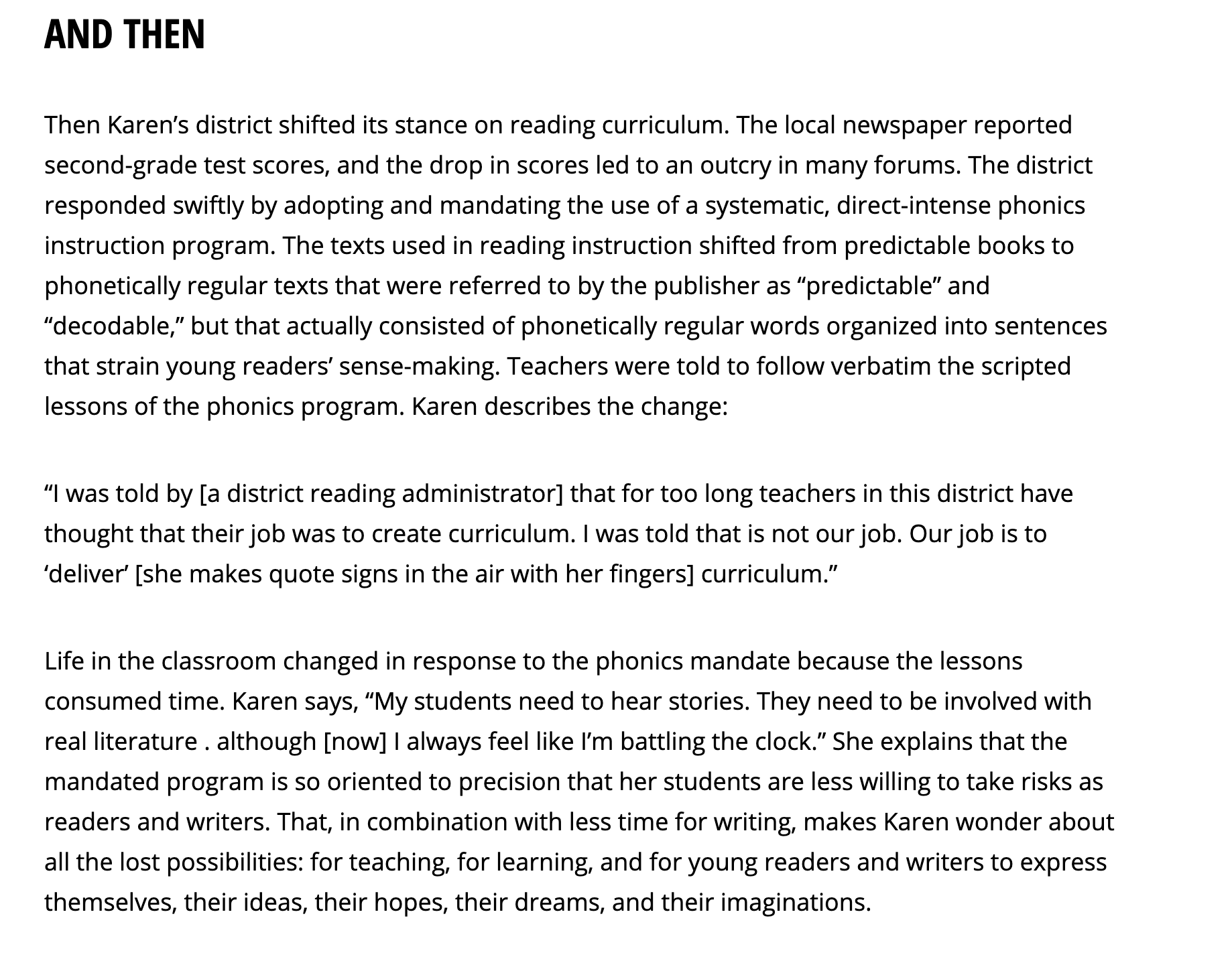
What is very disturbing is that the false claims of crisis and the misguided policy solutions being passed in almost every state now were already exposed twenty years ago by Richard J. Meyer’s Captives of the Script: Killing Us Softly with Phonics:

The SOR movement is yet more teacher bashing and school bashing, serving the conservative anti-school agenda of Republicans and market interests that feed off our public schools.

This has never been about reading.

This has never been about serving the needs of children.

This is more partisan politics; this is about conservative ideology at the expense of children, teachers, and public education.


Update May 24, 2023

From Texas, more pieces to the puzzle:

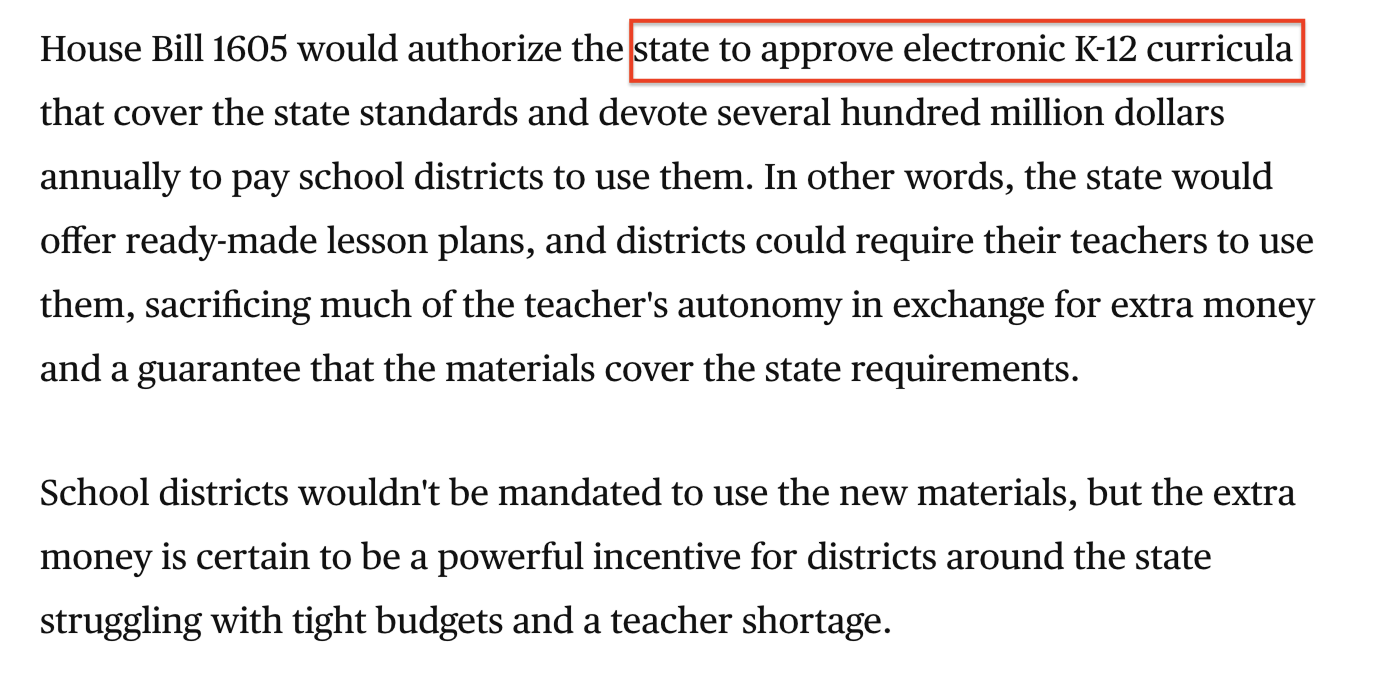
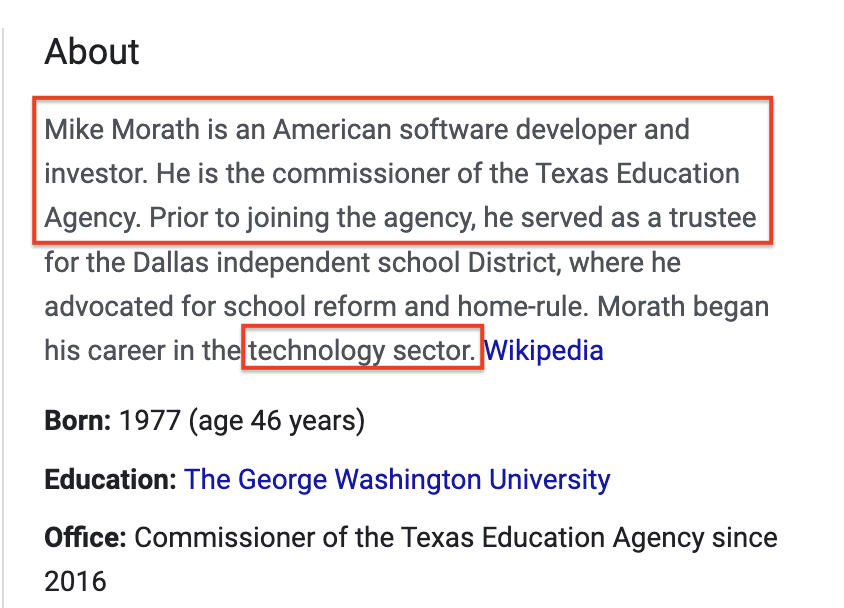
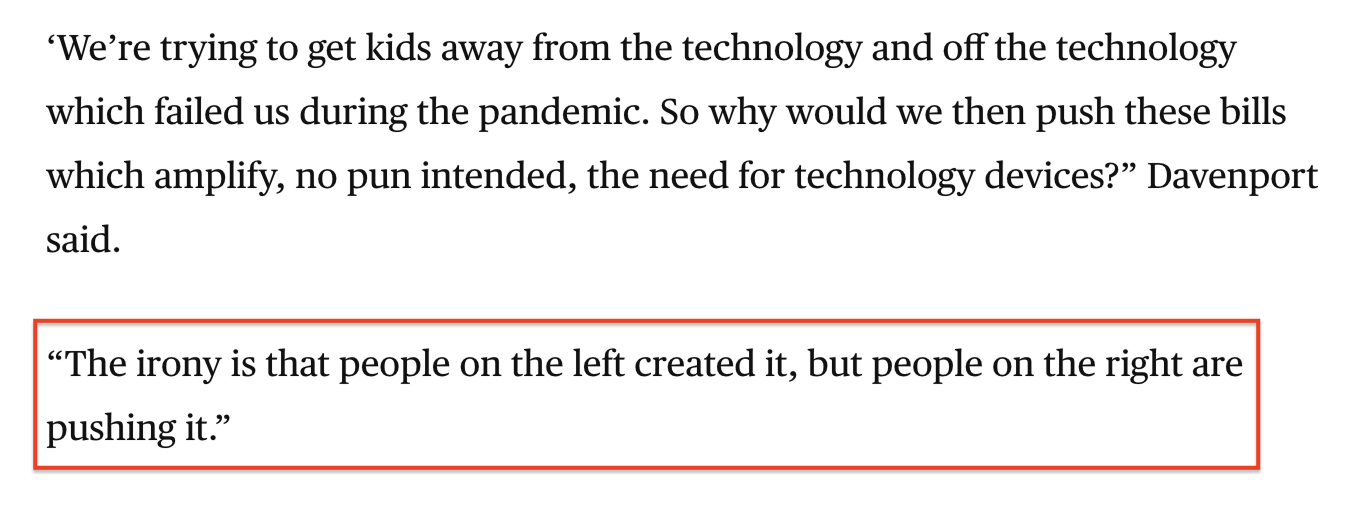
‘Woke’ filter? Texas teachers face less creative control under pair of bills


Update July 2, 2023

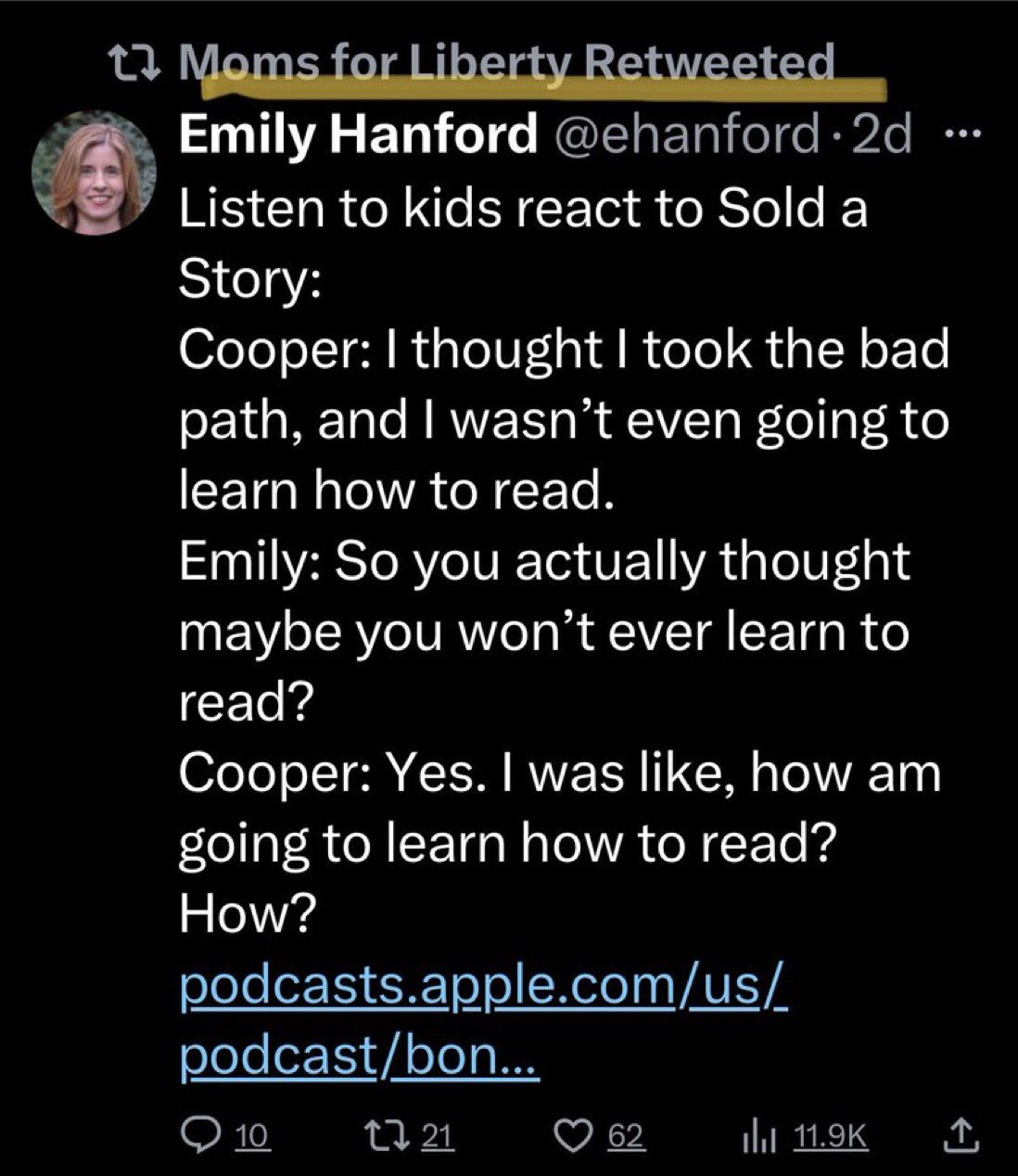
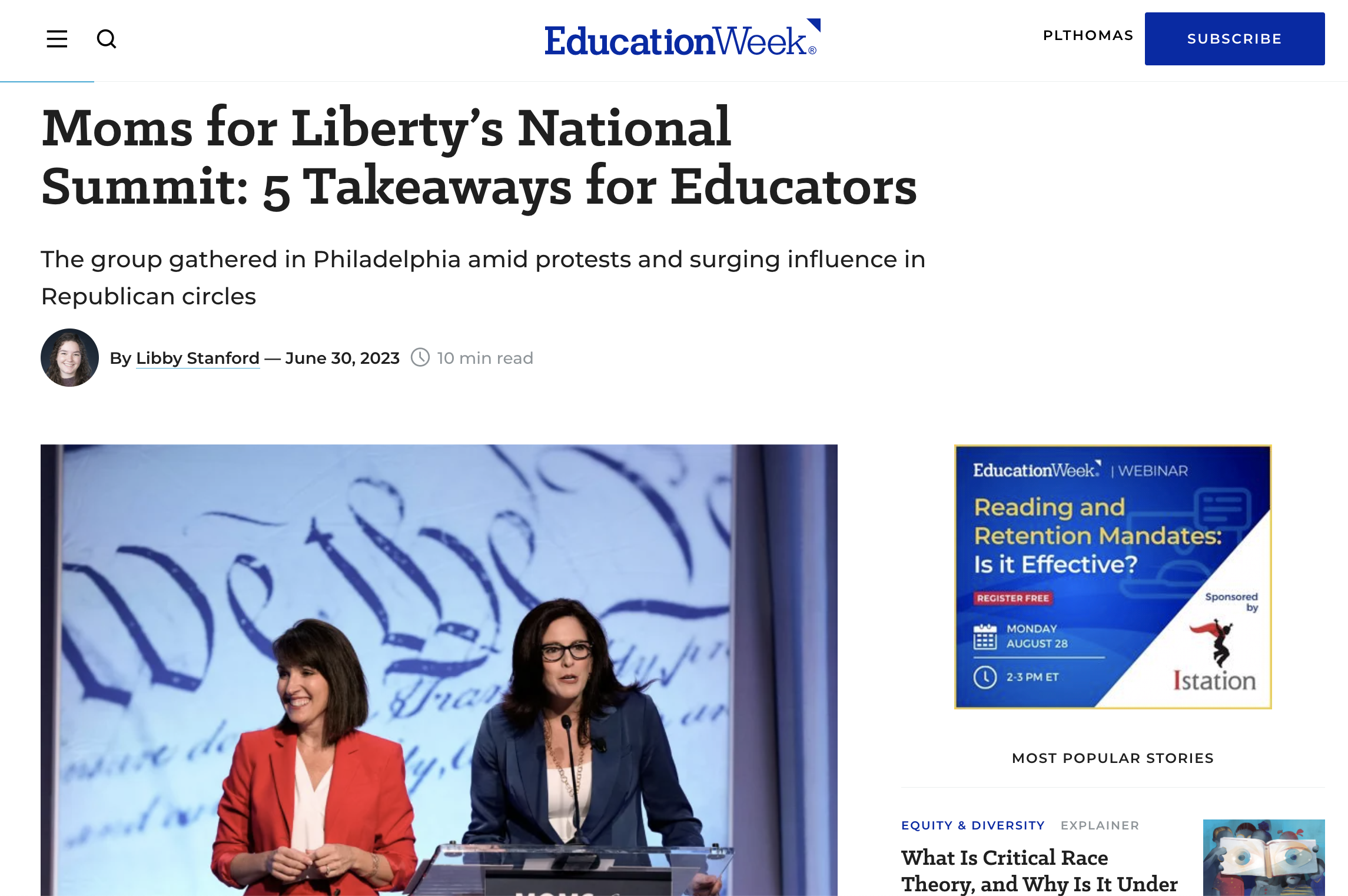
The connection between Moms for Liberty and the SOR movement continue to grow stronger:


Update May 24, 2024

Conservatives continue to double-down on the media misinformation because SOR is a deeply conservative movement grounded in a manufactured crisis.


Recommended

Politics of phonics: How Power, profit and politics guide reading Policies

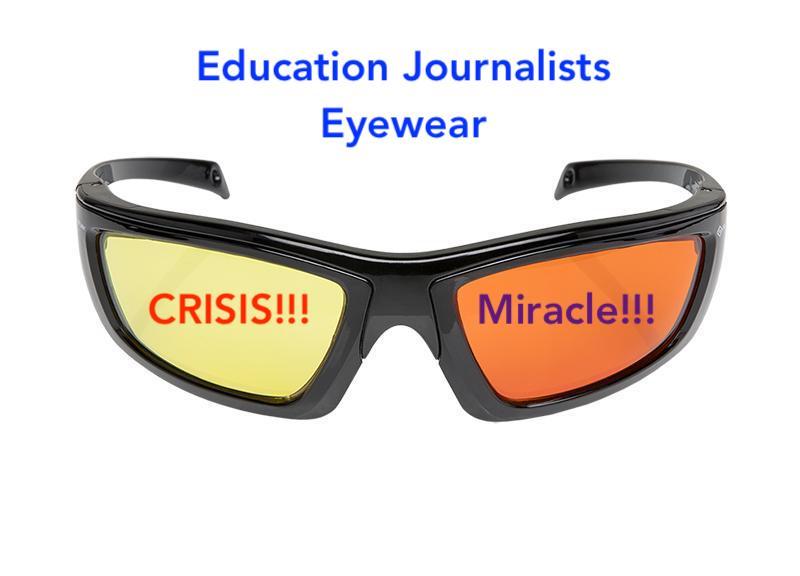
No Crisis, No Miracles: The False Narratives of Education Journalism

With a sort of humility rarely found when someone of prominence speaks to or about education in the US, celebrated author Ralph Ellison (Invisible Man) found himself speaking at a teachers conference in 1963 “to discuss ‘these children,’ the difficult thirty percent,” the identified population making up the drop-out crisis of the time [1].

One of the most impressive aspects of Ellison’s talk is his emphasis on systemic influences on children and their language acquisition: “The American scene is a diversified one, and the society which gives it its character is a pluralistic society-or at least it is supposed to be,” explaining:

The education which goes on outside the classroom, which goes on as they walk within the mixed environment of Alabama, teaches children that they should not reach out for certain things. Much of the education that I received at Tuskegee (this isn’t quite true of Oklahoma City) was an education away from the uses of the imagination, away from the attitudes of aggression and courage. This is not an attack. This is descriptive, this is autobiographic. You did not do certain things because you might be destroyed. You didn’t do certain things because you were going to be frustrated. There were things you didn’t do because the world outside was not about to accommodate you….

It does me no good to be told that I’m down on the bottom of the pile and that I have nothing with which to get out. I know better. It does me no good to be told that I have no heroes, that I have no respect for the father principle because my father is a drunk. I would simply say to you that there are good drunks and bad drunks. The Eskimos have sixteen or more words to describe snow because they live with snow. I have about twenty-five different words to describe Negroes because I live principally with Negroes. “Language is equipment for living,” to quote Kenneth ’Burke. One uses the language which helps to preserve one’s life, which helps to make one feel at peace in the world, and which screens out the greatest amount of chaos. All human beings do this.

What These Children Are Like

And then Ellison goes right to the core issue about language in marginalized and minoritized populations:

Some of us look at the Negro community in the South and say that these kids have no capacity to manipulate language. Well, these are not the Negroes I know. Because I know that the wordplay of Negro kids in the South would make the experimental poets, the modern poets, green with envy. I don’t mean that these kids possess broad dictionary knowledge, but within the bounds of their familiar environment and within the bounds of their rich oral culture, they possess a great virtuosity with the music and poetry of words. The question is how can you get this skill into the mainstream of the language, because it is without doubt there. And much of it finds its way into the broader language. Now I know this just as William Faulkner knew it. This does not require a lot of testing; all you have to do is to walk into a Negro church….

Thus we must recognize that the children in question are not so much “culturally deprived” as products of a different cultural complex. I’m talking about how people deal with their environment, about what they make of what is abiding in it, about what helps them to find their way, and about that which helps them to be at home in the world. All this seems to me to constitute a culture. If you can abstract their manners, their codes, their customs and attitudes into forms of expression, if you can convert them into forms of art, if you can stylize them and give them many and subtle ranges of reference, then you are dealing with a culture. People have learned this culture; it has been transferred to them from generation to generation, and in its forms they have projected their most transcendent images of themselves and of the world.

What These Children Are Like

On social media, I had a cognitive scientist SOR-splain to me literacy in my home state of South Carolina, recommending I look at narrow assessments of reading (a popular program) to admit that SC has a reading crisis. Like Ellison, I pointed out I don’t need a test to know the truth about reading and literacy in SC, all across the South, and even in the US.

In my 39th year as a literacy educator in SC, where I was born in 1961 and attended formal education from 1967 through 1998, I have lived and witnessed firsthand a fact that the media narratives never capture, but let me ask you to help me before I explain the real story.

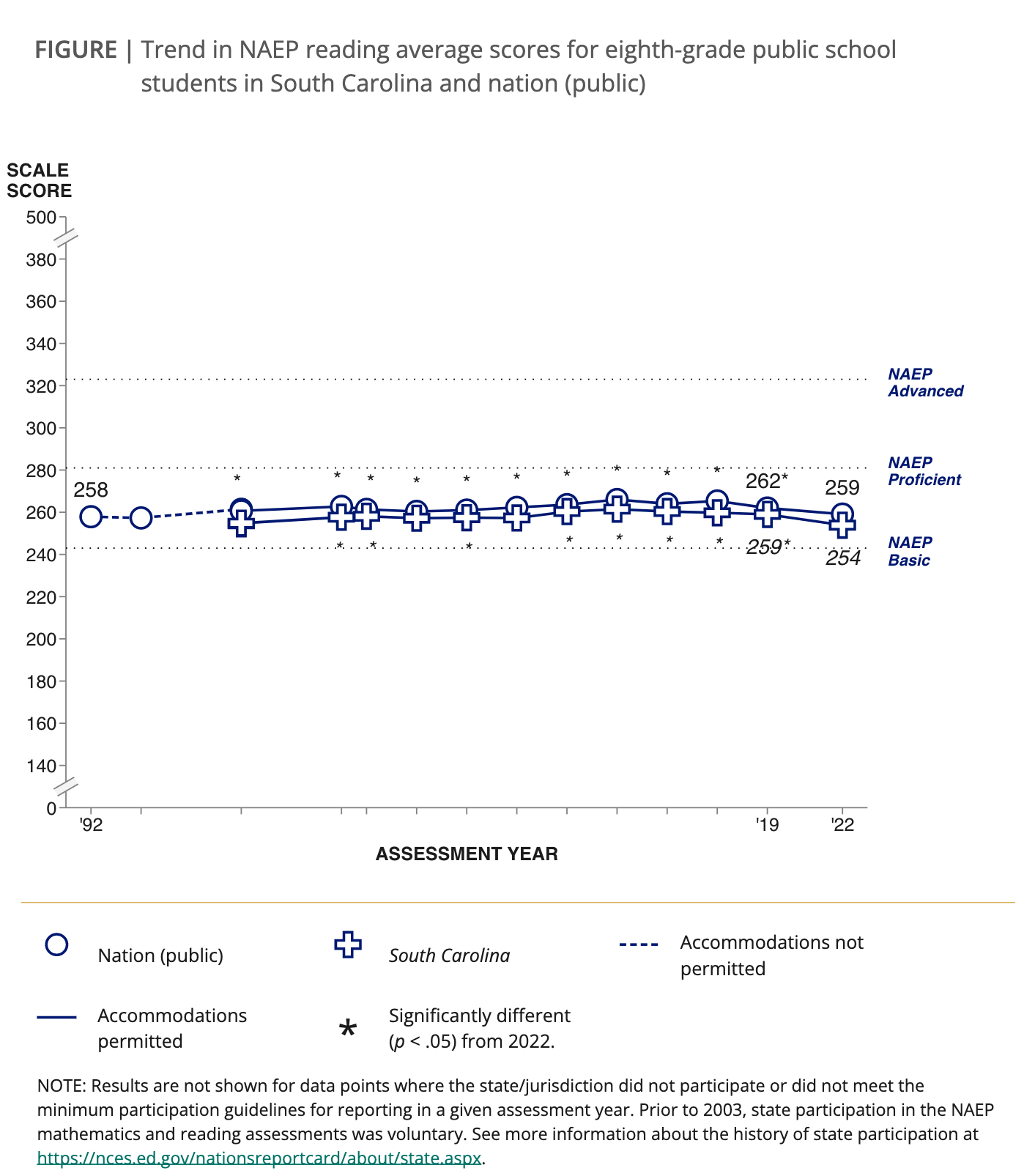
Here are longitudinal data for SC NAEP reading scores in grades 4 and 8 from 1992 to 2022; could you please identify where the “crisis” is?:

I lived, learned, and taught in the three decades before these three decades, and I can only conclude that reading achievement (whatever that is) as measured in formal testing has been about the same forever.

In my home state and across the nation, this is the real story: We have become content with a historical and current negligence about the reading acquisition of some populations (Black and brown students, poor students, special needs students, multi-lingual learners), and we lack the political will to address the systemic forces of inequity in the lives and schooling of these students to do anything about it.

Historical negligence is not a crisis; it simply is how things are, what we have come to accept as “normal.”

As I have examined in my scholarship [2], journalism in the US has only two false stories about education—crisis and miracle.

The problem is that neither narrative is true; they are anecdotal and melodramatic so they are compelling to the public, politically useful, and likely to drive reader/viewership for the media.

The US remains in a false crisis cycle begun by A Nation at Risk, and then powerfully expanded under the Obama/Duncan era of shouting education crisis while propping up the false charter school miracle machine (for example, the Harlem “miracle” celebrated by David Brooks citing the Obamas).

The crisis/miracle narrative approach from the Obama era has recently been replicated by the media obsession with SOR; Hanford’s seminal story planted both seeds by falsely claiming the US has a reading crisis and promoting a miracle school that wasn’t.

Again, please point out the crisis here:

And as I have explained, the miracle of the moment, Mississippi, like all the other educational miracles, simply doesn’t exist; MS has had steady growth and some jumps, often well before any SOR reading legislation:

And MS remains below NAEP proficient and continues to have drops between grade 4 and 8:

For many years, I have had to help my students navigate the media obsession with the melodramatic—crisis! miracle!—often found in films such as Waiting for Superman (false union crisis v. charter miracles) and the compelling documentary about education in SC, Corridor of Shame (an emotionally manipulative film about the powerful connection between poverty and educational negligence in the state).

The media, public, and politicians love and benefit from the crisis/miracle rhetoric about education. But those stories do not serve the needs of children, teachers, or schools.

Ellison ends his talk powerfully:

I don’t know what intelligence is. But this I do know, both from life and from literature: whenever you reduce human life to two plus two equals four, the human element within the human animal says, “I don’t give a damn.” You can work on that basis, but the kids cannot. If you can show me how I can cling to that which is real to me, while teaching me a way into the larger society, then I will not only drop my defenses and my hostility, but I will sing your praises and help you to make the desert bear fruit.

What These Children Are Like

Education journalism has reduced education to crisis or miracle, and like the reductive formula Ellison rejects for children, I must reject this false pair of stories.

There is no reading or education crisis, and there are no miracle schools.

There is historical and current political negligence for addressing inequity in the lives and schooling of “other people’s children” in the US.

But that reality doesn’t sell or garner votes.


[1] Toward end, Ellison is scathing:

The great body of Negro slang–that unorthodox language–exists precisely because Negroes need words which will communicate, which will designate the objects, processes, manners and subtleties of their urban experience with the least amount of distortion from the outside. So the problem is, once again, what do we choose and what do we reject of that which the greater society makes available? These kids with whom we’re concerned, these dropouts, are living critics of their environment, of our society and our educational system, and they are quite savage critics of some of their teachers.

What These Children Are Like

[2] Thomas, P.L. (2016). Miracle school myth. In W.J. Mathis & T.M. Trujillo, Learning from the Federal Market-Based Reforms: Lessons for ESSA. Charlotte, NC: IAP.

Thomas, P.L. (2015). Ignored under Obama: Word magic, crisis discourse, and utopian expectations. In P. R. Carr & B. J. Porfilio (Eds.), The phenomenon of Obama and the agenda for education: Can hope (still) audaciously trump neoliberalism? (pp. 45-68). Charlotte, NC: Information Age Publishing.

The “Manufactured Crisis” and the Repeated Failure of Education Journalism [UPDATED]

[Header Photo by Nik on Unsplash]

For people not in the field of education, A Nation at Risk is either a hazy (or nonexistent) footnote of history or a pedestrian (and obvious) claim that didn’t need a government committee to announce—US public education is a failure.

However, for all its fanfare and eager media coverage, the real significance of the politically driven report is that it set in motion a pattern still vibrant in 2023; mainstream media is constantly fanning the flames of “manufactured crisis.”

A Nation at Risk was a media, public, and political hit, but scholars were quick to note that the claims in the report were overstated, oversimplified, and lacking any credible evidence [1].

In short, manufactured.

From the early 1980s and into the 2020s, mainstream education journalism has hopped feverishly from crisis to crisis and endorsed boondoggle after boondoggle—never once stopping to say “My bad!” or to pause, step back, and reconsider their template.

David Labaree concludes:

When the state takes the quantified depiction of schooling that educational researchers provide and uses it to devise a plan for school reform, the best we can hope for is that the reform effort will fail.  As the history of school reform makes clear, this is indeed most often the outcome.  One reform after another has bounced off the classroom door without having much effect in shaping what goes on inside, simply because the understanding of schooling that is embodied in the reform is so inaccurate that the reform effort cannot survive in the classroom ecology.  At worst, however, the reform actually succeeds in imposing change on the process of teaching and learning in classrooms.  Scott provides a series of horror stories about the results of such an imposition in noneducational contexts, from the devastating impact of the collectivization of agriculture in the Soviet Union to the parallel effect of imposing monoculture on German forests.  The problem in all these cases is that the effort to impose an abstract technical ideal ends up destroying a complex distinctive ecology that depends on local practical knowledge.  The current efforts by states across the globe to impose abstract technical standards on the educational village bear the signs of another ecological disaster.

The Lure of Statistics for Educational Researchers

As a result, a stunningly harmful pattern has emerged:

  • Amanda Ripley was wrong about Michelle Rhee.
  • Jay Matthews and Paul Tough were wrong about “no excuses” charter schools and Teach For America.
  • David Brooks was wrong about “miracle” charter schools (and everything else).
  • [Insert journalist] was wrong about Common Core and VAM.

And now, rest assured it will come to pass, Emily Hanford and Natalie Wexler are wrong about the “science of reading.”

Remember Waiting for Superman?

Sold a Story and The Truth about Reading are the same melodramatic misinformation campaign depending on an uninformed public to sell yet another educational crisis.

There will be no reckoning; there never is.

But some day (soon?) the “science of reading” histrionics will be a faint memory while everyone scrambles to the next education manufactured crisis.

The only things not to be addressed, of course, are the actual needs of students, teachers, and universal public education.


[1] See Gerald Bracey, Gerald Holton, and David Berliner and Bruce Biddle (who coined “manufactured myth”).