The story is simple and may sound obvious: Poor children suffer from a significant “word gap” (WG) when compared to middle-class and affluent children.
To re-cap, the WG Story runs as follows: Parents from lower-class backgrounds do not talk enough to their children in the early years of life, in contrast to affluent European American parents who talk a great deal. This relative deficit impedes children’s vocabulary development, which, in turn, leads them to under achieve in school. It is a small step from this narrative to a rationale for intervention: If these parents could be taught to behave more like their privileged counterparts, marginalized children would develop larger vocabularies, which would boost their success in school.
As is typical in the Big Lies of Education, compelling and enduring stories do not necessarily prove to be accurate. And the resilience of Big Lies often rests on a complex matrix of causes, detailed by Miller, Sperry, and Sperry:
In sum, nearly 20 years after its inception, the WG Story had gone from academic obscurity to celebrity status. Biases of class, race, and method paved the way for this juggernaut, which gathered force with the convergence of two events, NCLB and LENA, in its Life History. The WG Story flourished by traveling back and forth between academic, policy, and public spheres, illustrating the permeability of discourses (Bakhtin,1981), and inadvertently reproducing the educational inequality it was intended to reduce.
The WG Story and its impact are driven by deficit ideologies (what most people believe regardless of empirical evidence) despite flawed methodology in the foundational research, which, according to Miller, Sperry and Sperry, “did not arise from virgin ground but rather from soil already cultivated with the language deprivation story” that began in the 1960s.
They also acknowledge the role of the media and advocacy:
But the WG Story did not remain sealed off in the academy (Bakhtin, 1981, 1986). It was widely covered in the popular press, and high-profile foundations amplified the Story by funding initiatives to close the Gap.
Again, uncritically embracing the WG Story reflects core deficit beliefs: “The most fundamental historical through-line between the WG Story and its backstory is the fixation on the language defects of marginalized families.”
There is an enduring and false set of beliefs that link deficit ideologies about social class and language: So-called nonstandard or underdeveloped literacy reflects moral and intelligence deficits in not just individual people but entire classifications of people.
In short, any person’s functional vocabulary is not a measure of that person’s character or intelligence, particularly when framed against a norm or standard based on cultural and ideological beliefs instead of valid empirical evidence.
Dyson, A. H. (2015). Research and Policy: The Search for Inclusion: Deficit Discourse and the Erasure of Childhoods. Language Arts, 92(3), 199-207. http://www.jstor.org/stable/24575568
Currently, US education is under one of the most intense eras of criticism—although there has never been a moment over the past century and a half absent cries of education “crisis.”
Notably during the accountability era begun in the early 1980s, permanent (and manufactured) education crisis has been further eroded by the education marketplace and fads promising to end that crisis.
One enduring tension in the field of education as well is between calls for high-quality and narrowly “scientific” evidence for educational practices [1] and the pervasive embracing of education fads that promise more than research supports.
Two of the current examples of this “gap” [2] between research and practice are growth mindset and grit theories and interventions.
I am now revising a chapter on the current research on growth mindset and grit, and offer here an overview of what educators should know before embracing or continuing to embrace advocacy for both theories and interventions that promise to address student achievement.
In short, the research does not support claims by advocates for growth mindset and grit. Here is a list of what we currently do know about both:
Advocates for growth mindset and grit significantly overstate the casual relationship between these theories/interventions and student achievement.
Research published and cited by advocates is often plagued by flawed research design and/or population concerns, expectancy bias, and reporting errors (including financial conflicts) (Macnamara & Burgoyne, 2023).
Advocates tend to acknowledge that implementation of both growth mindset and grit is often suffers from oversimplification, misunderstanding, and reducing the theories and interventions to slogans and isolated lessons.
Meta-analyses and high-quality independent studies tend to have mixed results with weak effectiveness measures that may not be significant. Increasingly, research on both is negative, in fact (see chart below).
Despite the lack of evidence to support either growth mindset or grit, both continue to be implemented in many schools; some scholars raise concerns that this support is driven by ideology (deficit ideology, bootstrapping/ rugged individualism/ meritocracy) and racism/classism.
Scholars also warn that overemphasizing growth mindset and grit allows educators and policy to ignore the more significant impact of out-of-school factors [3], and as a result, often messaging and interventions manifest as “blaming the victims.”
Below, I include a chart of recent public commentary and a research overview of growth mindset and grit. I also provide the references after the chart with a few key quotes in some of the more powerful studies.
Positive Dweck, et al. Dweck & Yeager, 2019 Hecht et al., 2021
Mixed Haimovitz & Dweck, 2017 Miller, 2019 Sisk et al., 2018 Tipton et al., 2023 Yeager et al., 2022 Yeager & Dweck, 2020
Negative Brez et al., 2020 (Burnette et al., 2018; Dixson et al., 2017; Sisk et al., 2018; Schmidt et al., 2017) Burgoyne et al., 2020 Ganimian, 2020 Li & Bates, 2019 Macnamara & Burgoyne, 2023
Cushing, I. (2021), Language, discipline and ‘teaching like a champion.’ British Educational Research Journal, 47(1), 23-41. https://doi.org/10.1002/berj.3696
Dudley-Marling, C. (2007). Return of the deficit. Journal of Educational Controversy, 2(1), 1–13.
Freire, P. (2000). Pedagogy of freedom: ethics, democracy, and civic courage. Rowman & Littlefield Publishers.
Thomas, P.L. (2023). The “Science of Reading,” education faddism, and the failure to honor the intellectual lives of all children: On deficit lenses and ignoring class and race stereotyping. Voices in the Middle, 30(3), 17-21. https://publicationsncte.org/content/journals/10.58680/vm202332439
Brez, C., Hampton, E. M., Behrendt, L., Brown, L., & Powers, J. (2020). Failure to replicate: Testing a growth mindset intervention for college student success. Basic and Applied Social Psychology, 42(6), 460–468. https://doi.org/10.1080/01973533.2020.1806845
“The pattern of findings is clear that the intervention had little impact on students’ academic success even among sub-samples of students who are traditionally assumed to benefit from this type of intervention (e.g., minority, low income, and first-generation students)” (p. 464)
Burgoyne, A. P., Hambrick, D.Z., & Macnamara, B.N. (2020). How firm are the foundations of mind-set theory? The claims appear stronger than the evidence. Psychological Science, 31(3).https://doi.org/10.1177/0956797619897588.
Burnette, J. L., Russell, M. V., Hoyt, C. L., Orvidas, K., & Widman, L. (2018). An online growth mindset intervention in a sample of rural adolescent girls. British Journal of Educational Psychology, 88(3), 428–445. https://doi.org/10.1111/bjep.12192
Dixson, D. D., Roberson, C. C. B., & Worrell, F. C. (2017). Psychosocial keys to African American achievement? Examining the relationship between achievement and psychosocial variables in high achieving African Americans. Journal of Advanced Academics, 28(2), 120–140. https://doi.org/10.1177/1932202X17701734
Ganimian, A. J. (2020). Growth-mindset interventions at scale: Experimental evidence from Argentina. Educational Evaluation and Policy Analysis, 42(3), 417–438. https://doi.org/10.3102/0162373720938041
Haimovitz K., & Dweck, C.S. (2017). The origins of children’s growth and fixed mindsets: New research and a new proposal. Child Development, 88(6), 1849–1859. https://doi.org/10.1111/cdev.12955
Hecht, C. A., Yeager, D. S., Dweck, C. S., & Murphy, M. C. (2021). Beliefs, affordances, and adolescent development: Lessons from a decade of growth mindset interventions. In J. J. Lockman (Ed.), Advances in child development and behavior (Vol. 61, pp. 169–197). JAI. https://doi.org/10.1016/bs.acdb.2021.04.004
Li, Y., & Bates, T. C. (2019). You can’t change your basic ability, but you work at things, and that’s how we get hard things done: Testing the role of growth mindset on response to setbacks, educational attainment, and cognitive ability. Journal of Experimental Psychology: General, 148(9), 1640–1655. https://doi.org/10.1037/xge0000669
Macnamara, B. N., & Burgoyne, A. P. (2023). Do growth mindset interventions impact students’ academic achievement? A systematic review and meta-analysis with recommendations for best practices. Psychological Bulletin, 149(3–4), 133–173. https://doi.org/10.1037/bul0000352
“Taken together, our findings indicate that studies adhering to best practices are unlikely to demonstrate that growth mindset interventions bene t students’ academic achievement. Instead, significant meta-analytic results only occurred when quality control was lacking, and these results were no longer significant after adjusting for publication bias. This pattern suggests that apparent effects of growth mindset interventions on academic achievement are likely spurious and due to inadequate study design, awed reporting, and bias” (p. 163)
Petrik, R. L., Vega, J., & Vindas-Meléndez, A. R. (2022). A reflection on growth mindset and meritocracy. Journal of Humanistic Mathematics, 12(1), 408–421. DOI: 10.5642/jhummath.202201.3
Schmidt, J.A., Shumow, L., & Kackar-Cam, H.Z. (2017). Does mindset intervention predict students’ daily experience in classrooms? A comparison of seventh and ninth graders’ trajectories. Journal of Youth and Adolescence, 46(3), 582–602. https://doi.org/10.1007/s10964-016-0489-z
Sisk, V. F., Burgoyne, A. P., Sun, J., Butler, J. L., & Macnamara, B. N. (2018). To what extent and under which circumstances are growth mind-sets important to academic achievement? Two meta-analyses. Psychological Science, 29(4), 549-571. https://doi.org/10.1177/0956797617739704
Tipton, E., Bryan C., Murray J., McDaniel M., Schneider B., & Yeager D.S. (2023, March/April). Why meta-analyses of growth mindset and other interventions should follow best practices for examining heterogeneity: Commentary on Macnamara and Burgoyne (2023) and Burnette et al. (2023). Psychological Bulletin, 149(3-4), 229-241. doi: 10.1037/bul0000384
Yeager, D. S., Carroll, J. M., Buontempo, J., Cimpian, A., Woody, S., Crosnoe, R., Muller, C., Murray, J., Mhatre, P., Kersting, N., Hulleman, C., Kudym, M., Murphy, M., Duckworth, A. L., Walton, G. M., & Dweck, C. S. (2022). Teacher mindsets help explain where a growth-mindset intervention does and doesn’t work. Psychological Science, 33(1), 18-32. https://doi.org/10.1177/09567976211028984
Yeager D. S., & Dweck C. S. (2020). What can be learned from growth mindset controversies? American Psychologist, 75(9), 1269–1284. https://doi.org/10.1037/amp0000794
Allen, R.E., Kannangara, C., & Carson, J. (2021). True grit: How important is the concept of grit for education? A narrative literature review. International Journal of Educational Psychology, 10(1), 73-87. https://doi.org/10.17583/ijep.2021.4578
Barcza-Renner, K., Shipherd, A. M., & Basevitch, I. (2024). An examination of the relationship between burnout and grit in college athletes. Asian Journal of Sport & Exercise Psychology, 4(3), 138–143. https://doi.org/10.1016/j.ajsep.2024.10.007
“This study was one of the first to examine the relationship between burnout and grit in student-athletes. The results indicated that student-athletes who were high in grit, also self-reported symptoms of burnout and that this relationship was strongest during the first two years of college. It is plausible athletes who are grittier are also more likely to persevere through stress and challenges, including burnout symptoms. Athletes higher in grit may also be investing more effort into their sport, which could be increasing symptoms of burnout, as well.” (p. 142)
Credé, M. (2018). What shall we do about grit? A critical review of what we know and what we don’t know. Educational Researcher, 47(9), 606-611. https://doi.org/10.3102/0013189X18801322
“For all its intuitive appeal, the grit literature is currently characterized by a number of serious theoretical and empirical challenges ranging from a lack of construct validity, discriminant validity, and predictive validity. At present there is no empirical support for the idea that grit is the combination of perseverance and passion or for the claim that grit adds to our understanding of success and performance. Indeed, the best available evidence strongly suggests that grit is largely a repackaging of conscientiousness—a widely studied personality trait” (p. 610)
Credé, M., Tynan, M.C., & Harms, P.D. (2017). Much ado about grit: A meta-analytic synthesis of the grit literature. Journal of Personality and Social Psychology, 113(3), 492–511. https://doi.org/10.1037/pspp0000102
Cushing, I. (2021), Language, discipline and ‘teaching like a champion.’ British Educational Research Journal, 47(1), 23-41. https://doi.org/10.1002/berj.3696
Goodman, S. (2018). It’s not about grit: Trauma, inequity, and the power of transformative teaching. Teachers College Press.
Gorski, P.C. (2016). Poverty and the ideological imperative: A call to unhook from deficit and grit ideology and to strive for structural ideology in teacher education. Journal of Education for Teaching, 42(4), 378-386. DOI: 10.1080/02607476.2016.1215546
Kohn, A. (2014). Grit? A skeptical look at the latest educational fad. Educational Leadership, 74, 104–108.
“Make no mistake: Duckworth is selling grit, not dispassionately investigating its effects” (para. 6).
Stahl, G. (2024). “Pedagogies of the poor” to “pedagogies on the poor”: Compliance, grit, and the corporeal. In P.P. Trifonas & S. Jagger (eds) Handbook of curriculum theory, research, and practice. Springer International Handbooks of Education. Springer. https://doi.org/10.1007/978-3-031-21155-3_39
Tewell, E. (2020). The problem with grit: dismantling deficit thinking in library instruction. Libraries and the Academy20(1), 137-159. https://dx.doi.org/10.1353/pla.2020.0007.
“The ideal of meritocracy, much like grit and growth mind-set, assumes that the best and brightest rise to the top based on their hard work and determination, without regard for the historical and present-day subordination of many groups….Deficit models view students as perpetual lacking and at fault. This belief is neither healthy nor accurate. Instead, we need to remain open to broader ways of engaging students and of thinking about their lives, consider what power they really have to effect change, and where we share some responsibility. It is essential to examine how issues of access and equity shape our students’ experiences and to question how success is defined and attained” (p. 150)
[3] Maroun, J., & Tienken, C.H. (2024). The pernicious predictability of state-mandated tests of academic achievement in the United States. Education Sciences, 14(2), 129-142. https://doi.org/10.3390/educsci14020129
As a writer and a teacher of writing, I am well aware of the need to avoid cliches, but cliches often do, in fact, capture well something that is worth considering.
In this education reform “science of” era, reading reformers are suffering the negative consequences of missing the forest by hyper-focusing on a few trees.
The cautionary tales being ignored [1] are also expanding, and possibly the most powerful evidence that the SOR movement is misguided is in the UK, where a similar reading reform movement was implemented in 2006.
Not surprising, but phonics-intensive reading reform in the UK has not achieved what was promised—and media as well as political leaders are still shouting “reading crisis.” [2]
At the core of education reform broadly and reading reform narrowly are several fatal flaws that mainstream reformers refuse to avoid: (1) manufactured crises, (2) one-size-fits-all solutions, and (3) policies and mandates that are hostile to teacher autonomy and individual student needs.
Digging deeper into the monolithic reading reform cycles over the past 40 years (and reaching back into 80 years of reading crisis rhetoric and fruitless reading wars), some of the most ignored evidence in reading crisis rhetoric and reading reform/policy concerns the failure to address how demanding teacher fidelity to policy and programs reinforces deficit ideology about language and marginalized students.
As I have noted, I was confronted with evidence about Units of Study (UoS) that has never been the focus of the outsized and misguided attacks on that program and Lucy Calkins. Teachers at a conference just weeks before the Covid shutdown explained to me that their problem with UoS was not the program itself but the excessive policing and accountability by administrators that teachers implement the program with fidelity.
Two problems exist with implementing programs with fidelity. First, that shifts the locus of authority away from the teacher and to the program itself. And thus, second, that shift institutionalizes a deficit ideology about language and students since programs tend to impose standardized versions of literacy as well as evaluate students in terms of how they fail to demonstrate standard literacy.
Fidelity to programs creates obstacles for honoring fidelity to student needs.
Few people challenge how efforts to standardized language is a way to standardize humans (and children). Formal schooling’s approach to language is almost exclusively standardizing—systematic phonics, Standard English grammar, and false concepts such as the “word gap” (see Recommended articles below).
What we in the US should not be ignoring is evidence from the UK of how policy manifests itself in the real-world classroom.
Cushing and Clayton offer excellent data based on evidence drawn from the Critical Language Awareness group (CLAW). Here are some of the highlights of that evidence:
“[T]eachers work in contexts where they undoubtedly negotiate a dense array of top-down policy initiatives which may well not align with their language ideological beliefs.” Key here is that policy imposes beliefs about language, thus, there is no such thing as objective or apolitical policy.
And thus: “We understand language discrimination not simply as about individual attitudes which manifest in individual, malicious acts of prejudice, but as a structural phenomenon underpinned by language ideologies which stratify, rank, and hierarchically organise language varieties and the communities associated with them (Lippi-Green, 2012). Schools are particularly key sites of language ideological production and the co-construction of racial, class, and linguistic stratification.”
Language/reading policy legislates national ideology grounded in deficit ideology:
Attempting to justify these structural deficits, the state produced a stigmatising narrative of strivers and scroungers which framed working-class and racialised minorities as responsible for their own hardships, and thus responsible for their own welfare by modifying their individual behaviours, including language (Tyler, 2018).
Austerity, public cuts, and the 2011 nationwide uprisings that followed created an ideological space in which educational reform was deemed by the state to be urgent and necessary, and where the most marginalised members of society could begin to experience upward social mobility and educational success simply by changing their language (see Nijjar, 2018).
The dynamic in place in the UK is being replicated in the US:
These mechanisms include new national curricula, high-stakes standardised grammar tests for primary school students, high-stakes GCSE assessments for secondary school students, revised professional standards for teachers, and Ofsted, the schools inspectorate. These policy mechanisms place teachers into positions where they are encouraged (and rewarded) to perceive marginalised students’ language as deficient, to engage in hostile language policing, and to reproduce ideologies of linguistic correctness which bolster language discrimination. At the same time, post-2010 curriculum changes stripped away units and assessments concerned with spoken language study, leaving little room for teachers to engage in critical debates about language variation, attitudes, and ideologies. These changes coordinated with a resurgence of deficit discourses in policy, such as those clustered around the so-called word gap and an increased focus on technical grammar and vocabulary—at the expense of critical and social aspects of language.
Language/reading policy tends to erase how language ideologies are “intricately connected to race, class, and privilege.” In short, “language ideologies were a proxy for other forms of stigma,” and that stigma impacts both students and teachers, especially those from marginalized backgrounds and identities.
Reading policy ignores and even resists critical approaches to language that “challenge language discrimination.” Yet, Cushing and Clayton document “how students had ‘loved looking at how and why their language got policed’ and how the unit allowed students to see that ‘attitudes about their language were really just about their social class.'”
Literacy instruction not grounded in deficit ideology faces multiple obstacles, then: “internal obstacles (in the form of management) and external obstacles (in the form of Ofsted, national curricula, assessments, and examination boards).”
“What is important to stress here is that schools are under increasing pressure to demonstrate ideological fidelity to externally produced, state-produced education policy, themselves which are underpinned by academic scholarship subscribing to normative ideologies about language and discourses of deficit (Cushing, 2023c).”
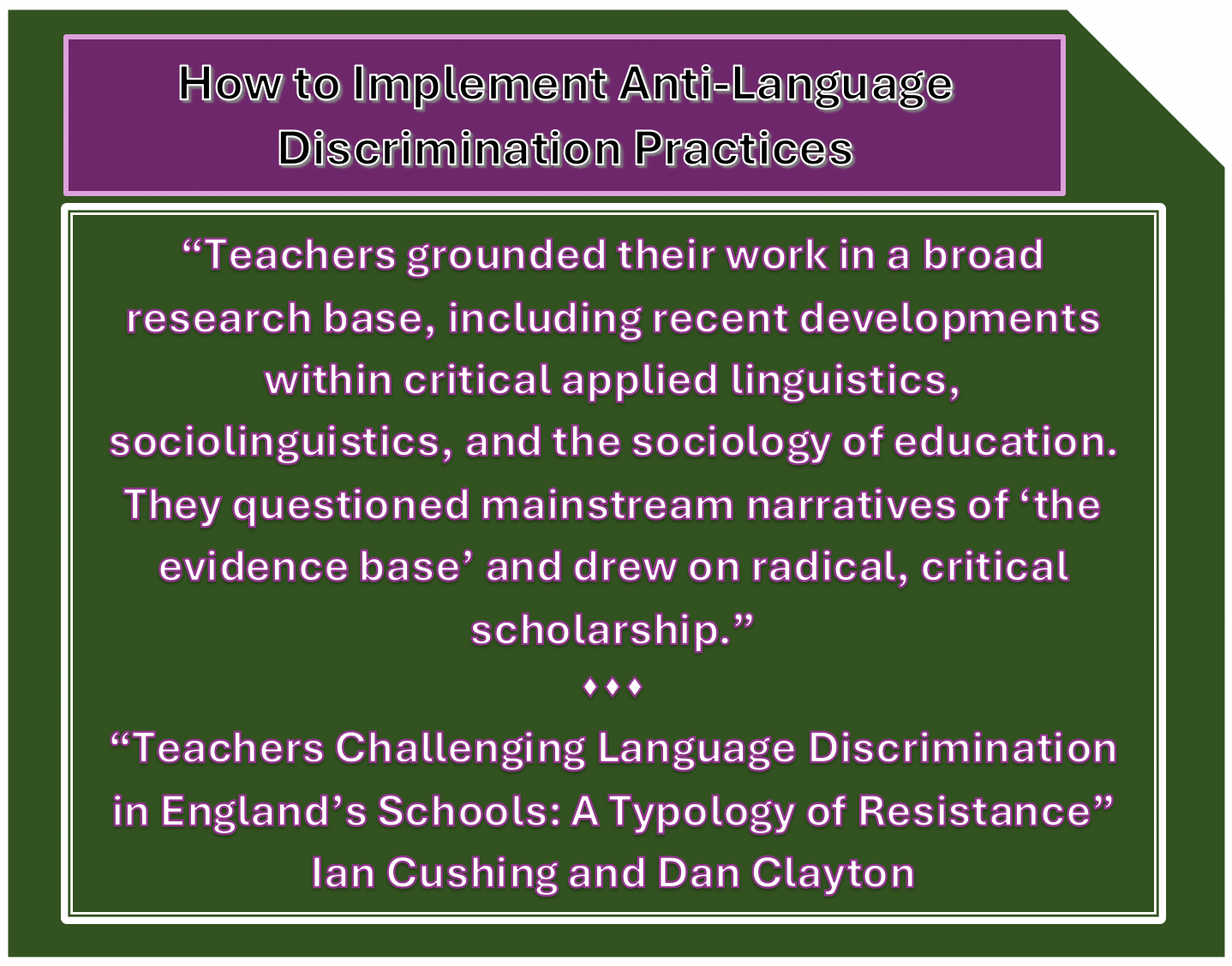
Cushing and Clayton build to a typology for anti-language discrimination. Here, I want to emphasize a key component about what counts as evidence: “Teachers grounded their work in a broad research base, including recent developments within critical applied linguistics, sociolinguistics, and the sociology of education. They questioned mainstream narratives of ‘the evidence base’ and drew on radical, critical scholarship.”
The article ends by noting that teachers alone cannot change this pattern, and I want to stress that is especially true in the US where teachers are often powerless and have been publicly discredited as not knowing how to teach reading.
However, the evidence is clear that “[l]anguage discrimination is a structural phenomenon” and that reading policy and reading programs are key elements in that structure.
Mandating fidelity to deficit beliefs about language and students is at the core of the SOR movement. Once again, we are missing the evidence by focusing on a few trees and ignoring the forest.
“Teaching reading to children whose language differs from the oral language of the classroom and from the linguistic structure of academic text adds an additional layer of complexity to reading instruction,” write Washington and Seidenberg.
This speaks to a concern I have raised, and been harshly criticized for, about teaching phonics, the centering of standardized pronunciation, and the deficit perspective of stigmatizing regional and cultural pronunciation patterns.
Here I invite you to read the following as a text set to interrogate systematic phonics instruction, standardized pronunciation, and the humanity of individual student differences grounded in their spoken language variations:
First, simply stating something (or posting on Twitter) doesn’t make it true.
And, second, good intentions are not enough—especially in education.
Before considering whether or not the “science of reading” movement is fulfilling social justice and equity goals in education, let’s acknowledge how two relatively recent movements in education help inform a credible answer to that question.
For many years now, educators have been embracing both grit and growth mindset uncritically, promoting these concepts and practices as both scientific and especially necessary for marginalized and vulnerable populations of student (Black students, poor students, multi-language learners, and special needs students). [See HERE and HERE for research and examinations of grit and growth mindset.]
However, two important aspects of these movements must be considered: the science and research base is increasingly challenging the initial claims of both grit and growth mindset, and the appeal of both are grounded in deficit ideologies that are essentially racist and classist.
Grit and growth mindset prove to be cautionary tales, in fact, because education is often victim of faddism that spreads before the full science is understood and that is embraced without critical analysis of how well the concepts and practices actually accomplish what advocates claim.
Grit and growth mindset speak to a cultural belief that struggling students (disproportionately minoritized racial groups, speakers of languages other than English, impoverished students, and special needs students) lacks experiences and qualities existing in students who excel (disproportionately students who are white and affluent).
These beliefs are a subset of the rugged individualism mythology of the U.S. that needs success and failure to be centered in who people are and whether or not people work hard, even in the face of substantial challenges not of their making (and even when we are dealing with children).
This is why faddism in education is often driven by sloganism also—“no excuses” charter schools thrived even as they harmed the vulnerable and marginalized populations that they were disproportionately marketed to.
That belief system either carelessly ignores or brazenly rejects the power of systemic forces such as racism and classism.
Over the past few years, the “science of reading” movement has ridden a similar wave of claiming “scientific” paired with advocates associating the movement with social justice and equity goals. As a result, the “science of reading” movement is still in the uncritical phase of fadism.
What complicates this dynamic is that we have a century of evidence that the students who struggle the most as learners and as readers are the very vulnerable and marginalized groups that these fads’ advocates target, and justifiably so.
This brings us to the opening points: Saying the “science of reading” movement is a social justice and equity movement doesn’t make it true, and those very real and justifiable good intentions simply are not enough to ignore that the “science of reading” movement, in fact, is harming the students who need reading reform the most (see, for example, HERE).
Over the course of a 65-year career, educator Lou LaBrant lived and worked through multiple back-to-basic movements, lamenting those cycles in her memoir.
In the U.S., we seem fatally attracted to viewing children and students in the most harsh and deficit perspectives, determined to prove that those who succeed and those who fail somehow deserve those outcomes.
The “no excuses” movement has been one of the worst examples of demanding that children/students and their teachers somehow ignore the realities of their lives when they enter schools and just suck it up and learn.
Like grit and growth mindset, the “science of reading” is a reductive and deficit belief system that diagnoses students struggling to read as lacking structure and basics (the exact same claim that has been made without success for a century, LaBrant lived and documented).
The result is reading policy that promotes scripted curriculum that erases teacher autonomy and student individual needs and then reduces reading in the early grades to pronouncing nonsense words.
The social justice and equity reckoning hasn’t quite taken hold yet with the “science of reading” [1], as it has with grit and growth mindset, and the “science of reading” movement has successfully deflected that the practices and policies actually are not supported by science (see HERE).
But the evidence is starting to build as critics have warned.
First, the education miracle machine is being unmasked. Florida, for example, represents how political marketing can use early test-based achievement mirages to mask that the entire system still fails to meet the needs of all students (see also Mississippi where celebrating 2019 NAEP grade 4 reading scores masked their persistent achievement gap and struggling students at later grades).
And, reading programs marketed as meeting the “science of reading” mandate are being exposed as failing to meet social justice and equity goals.
Consider for example two reading programs heavily marketed as “science of reading” endorsed: Wonders and HMH Into Reading [1].
An analysis from NYU of three programs, including these two, found the following:
1. All three curricula were Culturally Destructive or Culturally Insufficient.
2. All three curricula used superficial visual representations to signify diversity, especially skin tone and bodily presentation, without including meaningful cultural context, practices or traditions.
3. All three curricula were dominated by one-sided storytelling that provided a single, ahistorical narrative.
4. All three curricula used language, tone and syntax that demeaned and dehumanized Black, Indigenous and characters of color, while encouraging empathy and connection with White characters.
5. All three curricula provided little to no guidance for teachers on engaging students’ prior knowledge, backgrounds and cultures; or reflecting on their own bias, beliefs and experiences.
We found that these three curricula, which collectively reach millions of students across the country, have deficits that are mostly not being raised in the current public debate about curriculum. Their texts, language, tone and guidance communicate harmful messages to students of all backgrounds, especially Black, Indigenous, students of color, LGBTQIA+ students, and students with disabilities.
The “science of reading” movement is often championed for legitimate concerns about learning and students and by people with good intentions. But that movement is also another example of faddism and marketing boondoggles at the expense of the vulnerable and marginalized students who need and deserve a reckoning for reductive mythologies and deficit ideologies.
Ultimately, the “science of reading” movement is not fulfilling social justice and equity goals in education, and like grit and growth mindset, the reckoning is one the horizon, but our students and teachers deserve better and now.
Burns, M. K., Duke, N. K., & Cartwright, K. B. (2023). Evaluating components of the active view of reading as intervention targets: Implications for social justice. School Psychology, 38(1), 30–41. https://doi.org/10.1037/spq0000519
While Paulo Freire is strongly associated with critical pedagogy, I often remind myself that Freire came to his philosophy of teaching and learning through his commitment to teaching adults to read and write.
The U.S. finds itself repeatedly in a state of crisis-paralysis because people periodically discover illiteracy and aliteracy among our students and even adults.
The irony of the nearly nonstop and melodramatic cries of “reading crisis” is that the need for literacy always remains vital for human autonomy, human dignity, and human freedom, but the crisis approach always fails that need.
The problem is that public fears around illiteracy and aliteracy are often overly simplistic, and then calls for solving the “reading crisis” are equally simplistic.
The current Reading War driven by the “science of reading” movement is once again repeating that failed dynamic, notably by claiming that the simple view of reading (SVR) is the current and settled reading science (it isn’t; see here).
And concurrent with this Reading War is a dramatic rise in censorship and book banning—yet another layer of misunderstanding reading and teaching/learning.
Since we seem destined to remain stuck in misreading reading, I want to share Freire’s The Importance of the Act of Reading as an ideal text to reconsider what reading is and why literacy is central to the human condition.
First and vital to understanding literacy, Freire begins by asserting “the practice of teaching—which is political practice as well.”
In other words, teaching reading and any reading done by students (or anyone) are inherently political acts—behaviors that necessarily place humans in situations of power imbalances.
Freire’s meditation on reading was originally presented as a talk in Brazil in 1981. Then, Freire challenged the mechanical and reductive view of reading:
Reading is not exhausted merely by decoding the written word or written language, but rather anticipated by and extending into knowledge of the world. Reading the world precedes reading the word, and the subsequent reading of the word cannot dispense with continually reading the world. Language and reality are dynamically intertwined. The understanding attained by critical reading of a text implies perceiving the relationship between text and context.
One side of the reading debate often focuses on isolated text-only approaches that argue for phonics-first and/or systematic phonics instruction for all before addressing comprehension (or critical comprehension, which is often only approached for some students deemed “advanced”).
Freire, however, grounds reading in the context of reading the world before beginning to decode text for meaning.
In short, context matters, and lived experiences form the basis of anyone acquiring reading and writing. This is key to understanding the problem with focusing exclusively or primarily on in-school reading and writing instruction.
If we in the U.S. value reading for all students and adults, we must acknowledge that addressing the lived experiences of all people—eliminating poverty, food insecurity, job insecurity, etc.—is an essential aspect of needed reading policy.
Simply changing how we teach reading will never achieve the goals we claim to have.
And in this talk, Freire used his own experiences to think aloud and complexly about reading:
I put objective distance between myself and the different moments in which the act of reading occurred in my existential experience: first, reading the world, the tiny world in which I moved; afterwards, reading the word, not always the word-world in the course of my schooling.
Yes, young students must make the transition from reading their world to reading the word, but those acts of reading cannot (and should not) be separated (think of the reductive practice of having students pronounce nonsense words).
Freire speaks not only to acquiring reading, but also to why we read—and this is a powerful refuting of the rise in censorship and book bans being imposed by some parents onto all parents and students:
As I became familiar with my world, however, as I perceived and understood it better by reading it, my terrors diminished.
It is important to add that reading my world, always basic to me, did not make me grow up prematurely, a rationalist in boy’s clothing. Exercising my boy’s curiosity did not distort it, nor did understanding my world cause me to scorn the enchanting mystery of that world. In this I was aided rather than discouraged by my parents.
It was precisely my parents who introduced me to reading the word at a certain moment in this rich experience of understanding my immediate world.
Like Freire, my journey to literacy was enthusiastically driven by my parents and their commitment to me having free access to essentially anything I wanted to read. And like Freire, I had that freedom significantly reinforced by teachers when I was in high school:
I would like to go back to a time when I was a secondary-school student. There I gained experience in the critical interpretation of texts I read in class with the Portuguese teacher’s help, which I remember to this day. Those moments did not consist of mere exercises, aimed at our simply becoming aware of the existence of the page in front of us, to be scanned, mechanically and monotonously spelled out, instead of truly read. Those moments were not reading lessons in the traditional sense, but rather moments in which texts were offered to our restless searching, including that of the young teacher, Jose Pessoa.
Reading and all literacy as well as formal and informal education are human ways of coming to understand the world—including the dark and light—so that we gain agency in our living, so that we are not paralyzed by fear and ignorance.
The why and how of reading, then, are not mere mechanics, but a complex process of critical comprehension:
Mechanically memorizing the description of an object does not constitute knowing the object. That is why reading a text taken as pure description of an object (like a syntactical rule), and undertaken to memorize the description, is neither real reading, nor does it result in knowledge of the object to which the text refers.
And regardless of the simplistic calls by Republicans and conservatives to “just teach” and to not be political, we must recognize that all teaching, learning, and literacy are political acts. As he did throughout his career, Freire denounced the banking concept of teaching that erases human agency and views students as empty piggy banks into which teachers deposit value:
First, I would like to reaffirm that I always saw teaching adults to read and write as a political act, an act of knowledge, and therefore as a creative act. I would find it impossible to be engaged in a work of mechanically memorizing vowel sounds, like in the exercises ba-be-bi-bo-bu, la-le-li-lo-lu. Nor could I reduce learning to read and write merely to learning words, syllables, or letters, a process of teaching in which the teacher fills the supposedly empty heads of the learners with his or her words. On the contrary, the student is the subject of the process of learning to read and write as an act of knowing and a creative act. The fact that he or she needs the teacher’s help, as in the pedagogical situation, does not mean that the teacher’s help annuls the student’s creativity and responsibility for constructing his or her own written language and reading this language.
Freire builds to this: “Reading the world always precedes reading the word, and reading the word implies continually reading the world.”
Reading is not simply decoding text or recognizing whole words. Reading is context, and reading requires context—a context that is far more than letters, sounds, words, sentences, and paragraphs.
Reading is a very human and individual act because “reading always involves critical perception, interpretation, and re-wrìting what is read,” which is how Freire wrote his talk before sharing it aloud as yet another act of re-reading in order to re-write.
Several students in my literacy course in our MAT program chose to read Donna Alvermann’s Effective Literacy Instruction for Adolescents. While the initial discussion around Alvermann’s essay focused on those students struggling with the density of her academic writing, they emphasized the importance and power of her addressing student self efficacy in the fostering of student literacy development:
Adolescents’ perceptions of how competent they are as readers and writers, generally speaking, will affect how motivated they are to learn in their subject area classes (e.g., the sciences, social studies, mathematics, and literature). Thus, if academic literacy instruction is to be effective, it must address issues of self-efficacy and engagement.
That discussion led to some very insightful comments about the importance of providing students feedback, as opposed to grades, on their writing as part of the drafting and workshop process (anchored in their reading Graham and Perin’s 2007 Writing Next analysis of research on teaching writing).
As a long-time advocate of feedback and someone who practices de-grading the classroom as well as delaying grades (assigning grades for courses but not on assignments), I strongly supported this discussion, and was impressed with the thoughtfulness of the students.
That discussion had a subtext also—a concern raised by several students about the need for teachers to provide students positive feedback (so students know what they are doing well), and not just negative feedback. (Some of that subtext, I am sure, was an unexpressed feeling among some of these graduate students that they received mostly or exclusively “negative” feedback from me on their first submitted essays.)
After several students worked through this argument for positive feedback, I asked them to step back even further to consider, or -re-consider, what counts as “positive” or “negative” feedback.
I appreciate the hard work that went into this essay. It has many merits, but it also has something profoundly and disturbingly wrong with it. In fact, I’m writing this feedback on my phone, cowering in the bathtub with my wife, after your essay terrorized and nearly destroyed us….
The essay was formatted correctly, and each sentence was more or less intelligible in itself. But altogether, the effect was—disorientation. Worse, actually. Pure senselessness. The Void.
This satirical piece does exactly what my MAT students requested, blending positive (“many merits”) with negative (“something profoundly and disturbingly wrong with it”) feedback; and I think, herein is the problem with the dichotomy itself.
Once dramatically while I was teaching high school and often since I have been teaching at my current selective liberal arts university, I have encountered students who perceive all feedback as negative and reject having to revise their writing.
My argument to my MAT students was that actionable feedback on student writing is not inherently “negative” even though it does suggest something is “wrong” and needs “correcting” (perceptions grounded in students’ experiences in traditional classrooms that focus on the error hunt and punish students with grades).
However, I am well aware over almost four decades that part of my challenge as a writing teacher is how to help students see and respond to feedback as supportive and not an attack on their work or them as people (we had a great discussion about whether or not students can or should see their writing as inextricable from them as people).
In other words, affect matters.
Throughout the past 20 years teaching in higher education, I have been struggling against the perception by students than my written feedback is “mean,” “harsh,” “negative,” etc., while they simultaneously find my face-to-face feedback supportive and “good.”
I continue to seek ways to make feedback on student writing more effective as a key aspect of helping students grow as writers and thinkers as well as fostering their independence as writers and thinkers (learning to revise and edit their work on their own).
Students persist, however, in finding the feedback “negative,” and occasionally shutting down.
If there is a path to moving past the dichotomy of negative/positive feedback to student writing, I think it lies in the following concepts and practices:
Having explicit discussions with students about the inherent need for all writers to revise writing, ideally in the context of feedback from an expert and/or supportive writer/teacher. I often share with students samples of my own work submitted for publication with track changes and comments from editors.
Adopting strategies and rhetoric that rejects deficit ideology and the error hunt (Connie Weaver). It is important for teachers and students to prefer “revising” and “editing” instead of “error,” “mistake,” and “correcting” as the language surrounding the writing process. The pursuit in writing must be grounded in the recognition that all writing can be better even when it is currently quite good (and especially if is is somewhat or deeply flawed).
Clarifying for students that challenging and critical feedback is intended as actionable by students as writers, and thus, inherently positive. One of the recurring tone issues I experience with students viewing my written feedback as negative is misreading questions; students often read questions as sarcastic or accusatory when I am asking in order to elicit a response (for example, when I write “Did you look at the sample?” how I move forward with helping a student depends on that answer). As my MAT students expressed in the context of Alvermann, students absolutely do need to see themselves as writers and do need to trust they will be successful, but they also must embrace the need to revise and the awareness that no one produces “perfect” writing in one (or even several) drafts.
Feedback and the dynamic between teachers and students (including trust) are the lifeblood of the writing process when students are young and developing. As I noted above, affect matters and the teacher/student relationship inevitably impacts how effective the teacher is.
As teachers providing feedback, we must be careful and purposeful in our feedback, focusing on actionable feedback and creating/maintaining a culture of support and encouragement.
To that end, I believe we cannot reduce feedback to a positive/negative dichotomy that serves only to reinforce the cultures and practices we need to reject, deficit ideologies and the error hunt.
In the McSweeney’s parody above, the writing teacher and their wife are ensnared in a demon-possessed student essay, but the more horrifying detail of this piece is the ending—the realization that teachers and students are actually trapped in an even greater hellscape:
“I did it,” she sobbed. “I killed it. I killed it.”
“You did it,” I said, climbing into the bathtub with her, holding my wife close. “It’s over. It’s all over now.”
Yes, let’s work on feedback and the affect created around the writing process, but let’s not ignore that their are larger dynamics (grades and testing) at play that erode the teacher/student relationship as well as the effectiveness of teaching and the possibilities of learning.
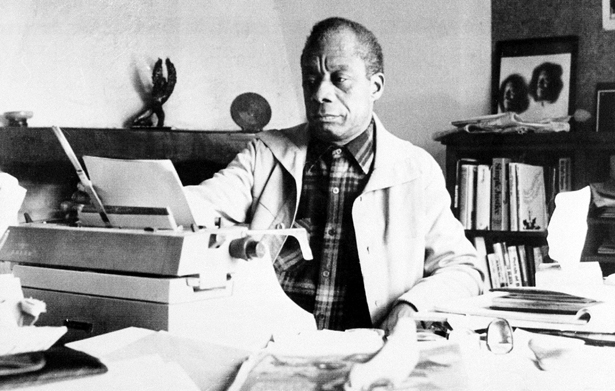
James Baldwin wrote in 1966 about the antagonistic relationship between Black Americans and the police; his willingness to interrogate that dynamic provides a powerful framework for rethinking the antagonism between educators and students. (The Nation)
Teaching in my third academic year impacted by the Covid pandemic, I am feeling nostalgic for some (but not all) of the pre-pandemic dynamics in the classroom.
My university established and followed strict protocols throughout the 2020-2021 academic year that allowed many courses to be taught face-to-face (while professors were allowed to teach remotely and courses provided many hybrid opportunities to address student needs). But last year was a very stilted teaching and learning experience with faculty and students fully masked and social distancing (maintaining the six-feet requirement typical pre-vaccine).
This fall we are face-to-face, masked, but not social distancing; therefore, I am enjoying being able to do small group work in class again. A return to semi-normalcy in the classroom means that Monday, as my first-year writing seminar students formed groups to discuss their reading of Baldwin, I waited a few minutes before strolling around the room to listen to the discussions.
Anyone who teaches knows what happened; as I approached each group, students fell silent, and several looked up, concerned.
I always take these moments to begin a discussion about the antagonistic relationship that exists between teachers and their students. Students admit that a teacher approaching makes them afraid they are doing something wrong, even when they are fully engaged in the assignment.
Many of us who went through teacher training or conduct teacher training have discussed walking toward students as a classroom management technique.
It does work, but we rarely unpack why and almost never interrogate that the technique should not “work.”
My first-year students at a selective liberal arts college (having almost all been very successful in K-12, either straight-A students or close to that) are quick to acknowledge the many ways that they feel antagonism from and toward their teachers. From dress codes to bathroom restrictions to grading policies to late-to-class rules—students find the school days filled with landmines policed by their teachers.
Of note is how difficult it is for first-year college students to shift away from student behaviors (raising hands, asking to go to the bathroom) and toward autonomous adult behaviors (we explicitly focus on the difference between access to going to the bathroom in high school and college).
Part of this reductive and dehumanizing dynamic is the prevalence of uncritical embracing of simplistic behaviorism grounded most vividly in the punishment/reward elements of school rules and grading.
Despite my commitment to creating a classroom environment driven by collaboration and not antagonism, students still primarily experience antagonistic relationships with their teachers/professors when learning formally.
As a professor, I witness that reality because of one of the worst aspects of the teaching profession—educators publicly shaming student behaviors.
When I started teaching high school in 1984, I quickly learned to avoid the teachers’ lounge, where my colleagues tended to gather and endlessly rail against (by name) students that I taught (and loved). What I noticed was a proclivity for teachers to angrily berate teenagers for behaving like teenagers.
One of my fortunate gifts as a teacher is that I chose to teach high school and that I genuinely love teenagers because they have reached an early stage of adulthood but also maintain some of the most endearing qualities of childhood. I very much enjoyed discovering and unpacking the world with teenagers who found everything to be new (even as I realized that none of it was new).
Jump about four decades later, and I see that played out just a bit differently on social media, where teachers and professors routinely hold forth in anger about a student’s email asking if they missed anything when absent. This sort of public (although anonymous) student shaming seems to be common at the beginning and end of semesters so there has been a flurry of them over the past few weeks.
Tip toeing the line of subtweeting, I Tweeted this yesterday with those type of social media posts in mind:
I do not grade and do not take off for being late …
My composition class is *low-stakes with high expectations* where students can work on behaviors that have high-stakes consequences in other environments @TG2Chat
Throughout my career as a high school teacher and now a college professor, I have worked diligently to be student-centered in the way that honors the autonomy and human dignity of my students; I have also embraced Paulo Freire’s concepts of choosing to be authoritative and not authoritarian as a teacher, parent, and coach.
This critical commitment has often been well embraced by my students (although not all of them) but rebuffed by many, if not most, of my colleagues. A typical criticism I hear (which I confront in the second Tweet above) is that if adult authority figures are not authoritarian, students will take advantage of them.
The nasty (and false, I think) Puritanical belief that humans (especially children and teenagers) left alone will behave in base and selfish ways seems to be how many teachers/professors view their students. This deficit perspective is pervasive in education, often manifested as racism, classism [1], sexism, and agism but masked as “necessary” lest we lose all control!
I firmly reject that my job as a teacher is to “fix” inherently flawed young humans and instead embrace that to teach is to provide the guidance necessary for young people to develop their autonomy and recognize their and other’s basic human dignity.
Over almost 40 years of teaching, I have had very few students attempt to take advantage of me, and most of them have suffered the consequences they deserved for that behavior while many of them have directly reached out to me over the years to apologize.
A low-stakes teaching and learning environment has allowed me to be very demanding, having extremely high standards for students, and I have found that students respond well to high expectations couched in clear expectations, detailed support and feedback, and patience paired with firm guidelines for student behavior and artifacts of their learning.
I have documented on social media several times that my students submit work on time at well over 90-95% rates although I do not grade assignments and do not record or deduct for late work. Almost all the work that is late can be traced tp legitimate reasons (the types of real-world justifications for late work that adults enjoy).
Students and educators deserve a teaching/learning environment grounded in collaboration and not antagonism—where everyone has their autonomy and human dignity honored, and even celebrated.
If K-12 and undergraduate students already knew and behaved in all the ways adults want, why would they need to be in our classes?
When Student Y sends a preposterous email, our job as educators is to teach the student why it is preposterous, and how to engage with another human in ways that show respect to both the student and the teacher.
And that teaching—even when our last nerve is tested—must be as patient as possible, although firm, and our students must trust that we are here to work with them for their success, not to police them for their flaws until they are properly “fixed.”
At its core, I think James Baldwin’s view of policing serves us well here: “The law is meant to be my servant and not my master, still less my torturer and my murderer.”
And so, many days while teaching, I explain to students that I work for them, and when all is going as it should, I actually am there to work with them.
None the less, every time I walk toward a small group of students, they fall silent and look up, faces expecting antagonism and not yet sure we are there for the same thing—whatever any student needs to live autonomous lives where their human dignity is seen and appreciated.
[1] See:
The return of the deficit signifies a depressing symmetry in demographic trends and public policy. Deborah Stone (1997), writing on the art of political decisionmaking, argues that “political reasoning is [about] metaphormaking and categorymaking . . . strategic portrayal for persuasion’s sake, and ultimately for policy’s sake” (p. 9). Portraying disproportionate school failure among Black and Hispanic youth in terms of “personal troubles” (Mills, 1959) or cultural deficiencies sustains public policies that emphasize individual self interest and personal responsibility (e.g., welfare reform, high stakes testing), leaving no reason to consider the effects of poverty and discrimination or underfunded schools and deteriorating facilities on children’s learning.
Dudley-Marling, Curt (2007) “Return of the Deficit,” Journal of Educational Controversy: Vol. 2 : No. 1 , Article 5. Available at: https://cedar.wwu.edu/jec/vol2/iss1/5
My granddaughter is six, in the first grade, and currently in the throes of learning to read—as commanded by formal schooling. Recently, she has shown some of those typical bursts of improvement I have witnessed in learning by young children; those moments give meaning to the word “marvelous.”
In an effort to inject some joy into my granddaughter’s reading journey, I have given her some comic books (a medium that was central to my own journey to being a voracious reader and writer). I was concerned that the text and format of a comic book would be beyond her, but she loves to make her own books, which are heavily picture-oriented to tell stories, so I thought even if she couldn’t read comic books, they would be very appealing to her own hobby.
But what surprised me was when she picked up a graphic novel of Marvel’s Spider-Gwen, she immediately began reading quite well—until she hit very commonly used wording and words that aren’t served well by structured phonics; she stumbled over “gonna” and “wanna,” but was really thrown by “MJ” as the way characters refer to Mary Jane Watson.
Having been taught formally how to read in an environment grounded in correctness, my granddaughter stumbles over the far more prevalent language usage in the real world.
This tension is represented well by the fate of the pronoun “they” (and its forms); “they” for centuries has served in the real-world of speaking English as a gender-neutral singular pronoun even as so-called standard English has persisted in tossing that usage into the “incorrect” bin (although this nonsense is finally losing momentum in formal formats).
For more than a century, the field of English/ELA has resisted real-world language usage and awareness and preferred training children in language acquisition through systems of correctness (phonics rules and grammar rules). Teaching that is grounded in rules and correctness appears to be easier because that approach contributes to control and simplistic forms of assessment and grading, but approaching language through correctness is a dis-service to children and language.
Even though there are increasingly important calls for de-emphasizing correctness in English/ELA, such as the Conference on College Composition and Communication (CCCC)’s call for Black linguistic justice, those of us who teach reading, literature, or writing face an incredibly complex paradox—the challenge of fostering in students a healthy and valid view of language while also raising their awareness of the politics of language (that dialects such as so-called standard English, for example, do carry political weight in the real world even though it shouldn’t).
Boland and Queen address the tyranny of correctness in the real world in their Why grammar mistakes in a short email could make some people judge you. Here they investigate why “readers judged strangers harshly simply because of writing errors”—themselves using language of “correctness” (“errors”).
Every semester when I once again address issues surround formatting (citation styles, submitting assignments), I must confront the tyranny of correctness in terms of not wanting to perpetuate the unhealthy culture of correctness while also wanting my students to be aware of the power of correctness so that they have power over their language use instead of being victims of the “error hunt.”
Here, then, are some of the ever-evolving ways I am trying to navigate the tensions in teaching language against the tyranny of correctness:
De-grade correctness and formatting related to language. Removing grades and punishment allows a teacher still to address language use and shifts the focus to editing and away from correcting.
Change the language we use about language. I avoid “correct/incorrect,” “right/wrong,” and any reference to “fixing” or “correcting” when I mean “revising” or “editing.”
Use minimum expectations that move issues of correctness and formatting outside the more substantive elements of language usage. I often have students submit early drafts to address formatting (such as the working references list for a cited essay) well before submitting the essay for my feedback.
Examine all dialects and forms of language as powerful and complex language while also interrogating the politics of dialects, including that “standard English” exists and why it exists. Student awareness about the growing debate to de-center standard English is the least we can do in English/ELA on the path to actually de-centering it.
Foster a culture of purposefulness instead of a culture of rules. When we examine, for example, the arcane formatting guidelines involved in formal citation, I try to emphasize not that this or that format is “right,” but that formal writing needs to exhibit purposefulness by the writer as part of their credibility and authority. A submitted essay with two or three fonts and font sizes appears careless, for example, and diminishes the reader’s trust in the purposefulness of the writer.
Shift all explorations of language to discovery instead of complying with correctness. This, as I noted about my ploy with my granddaughter, is about the joy and wonder of language usage. Once we set aside corrupted and debasing beliefs about “good” or “bad” language (especially that one dialect is more or less rich than another), we allow students to engage with all language in healthy and complex ways.
I became a reader and writer vey heavily influenced by collecting and reading comic books, where the text is not simply formatted on the page and where artwork provides a substantial percentage of the textual meaning. My granddaughter has been zipping through reading aloud from children’s books or her homework worksheets (often designed to match the culture of correctness). But comic books and even signage have proven that correctness falters in the real world.
For far too long English/ELA classes and teachers have been associated with a hostility toward language (and students) because of a culture of correctness; our fields have also been too often disengaged with the real world, where WandaVision is more compelling than Shakespeare.
If we love language and our students, we must correct course on correctness in English/ELA.
Yesterday I had The Talk with two of my classes—my first-year writing seminar and my upper-level writing/research course.
Doing so proved to me once again that you can’t have The Talk too often with young people. Students were under-informed, misinformed, and worst of all, filled with fear.
The Talk, of course, for these classes was about plagiarism.
Two students in separate classes shared what I think is far too common with the emphasis on what to avoid, plagiarism, (a deficit perspective) instead of what to do and why, scholarly/academic citation—one having been “terrified” by a seminar on plagiarism when they were first-year students and the other struggling to express their concern about teachers being too “harsh” (a recognition that their experience with citation was mostly about avoiding punishment).
Despite the differences in class levels, these students were equally hesitant to answer basic questions about the purposes of citation and what constitutes plagiarism; they offered tentative and incomplete answers when I persisted in coaxing responses.
We tended to agree, eventually, that what constitutes plagiarism is a complicated issue. Students, unlike teachers and professors, were quick to argue that citation errors are not plagiarism, and students also place far more emphasis on intent (which among my colleagues is typically rejected out of hand).
The purpose of The Talk yesterday was to help students make some distinctions about reasonable expectations for citation in academic settings as opposed to intimidating students into not plagiarizing. My questions revolved around the purposes of the bibliographies included in cited essays as well as the basic expectations of in-text citations.
In other words, I wanted students to feel more empowered with increased confidence in terms of knowing they were not plagiarizing even when they remained uncertain about the formatting expectations of the style manual they were being required to use (my students typically are using APA in my courses but have backgrounds in MLA).
Approaching citation at the conceptual level (and avoiding the negative approach of “don’t plagiarize”) seeks to help students understand attribution in academic settings.
Some of the key concepts I emphasized include the following:
Recognizing that the primary purpose of the bibliographies included in cited writing is to provide enough information so that a reasonable person can locate the source with a minimum of effort. I urge students to start with what information is essential for that purpose and then to attend to the tedious formatting requirements of that information next.
Understanding that in-text citation is required to identify appropriate attribution of other people’s ideas and words. I have found that students often focus on attribution for words (quoting) but aren’t as apt to voice the need to cite ideas. (Note: Students are well aware that blunt plagiarism—passing off an entire essay as your own when it isn’t or pasting huge sections of text from Wikipedia into an essay as if they wrote it—is wrong; therefore, they see plagiarism as a situation about intent and characterize most concerns raised by teachers/professors in their cited work as citation errors, not plagiarism.)
Recognizing that the primary purpose of in-text citations is to include the essential information required by the style sheet assigned so that a reasonable person knows which source in the list of references is being cited. Here, the issues of citation at the conceptual level overlap with style sheet formatting so we discuss the different thresholds of major citation systems (APA focusing on author name and year as opposed to MLA using only the name).
The discussion of citation at the conceptual level seemed to help students feel more confidence as most of them faced the unfamiliar waters of APA, but we also had to confront the elephant in the room—what I call the gauntlet of academic citation.
I shared with students the harsh truths about plagiarism in higher education.
First, I explained my experience on my university Academic Discipline Committee, where many years ago I came to the realization that my university has no official definition of plagiarism and that professors vary significantly in their definitions of plagiarism as well as how they identify and punish plagiarism across campus (some religiously using Turnitin.com and others never reporting even blunt plagiarism).
Regretfully, this discussion brought students back to fear, but I think they need to be aware of the unpredictable landscape of citation in college so that they can better advocate for themselves. I specifically urged them to seek out an advocate if they find themselves in situations where they think plagiarism is being misidentified in their work.
For me, after 37 years of teaching high school and college students writing and the gauntlet of academic citation, I recognized yesterday that we adults fail the citation/plagiarism talk the same way we fail the sex talk—by focusing on what not to do and instilling fear instead of understanding in young people.
This new recognition sits now beside a long-standing Truth I practice and preach about teaching all aspects of writing; there is no one-shot inoculation (or even two-shot inoculation in our age of Covid-19) because writing and the technicalities of citation are complex, things we gradually acquire even as there is simply no finish line.
Instilling fear in young people is a dis-service to them as well as the lessons we hope to teach and the good we believe we are doing for them.
educator, public scholar, poet&writer – academic freedom isn't free











 dr. p.l. (paul) thomas