Category Archives: Dyslexia

“Science” as Bad Faith Bullying

[Header Photo by jesse orrico on Unsplash]

The more things change, the more things stay the same.

Especially in America.

F. Scott Fitzgerald’s The Great Gatsby, set in the 1920s, centers the story on a few rich characters—Tom and Daisy Buchanan, who have “old” money, as well as Jay Gatsby, representing the nouveau riche.

At the cusp of 2024 and 2025, a century later, one page from the novel seems disturbingly relevant:

In this scene, Fitzgerald uses Buchanan to portray the rise of scientific racism in the US. The scientific racism era in the early 20th century is but one of many examples of how “science” can be used by bad faith actors to promote an ideological agenda.

It isn’t his fault, Buchanan seems to suggest, that he is among the superior white Western civilization: “‘It’s all scientific stuff; it’s been proved.'”

In recent years in the US, navigating science, proof, and science skepticism has reach a level of complexity that defies postmodern thought. Simultaneously, we may be living in the most advanced era of scientific knowledge along side a rising and powerful science-skepticism era.

Vaccination deniers, flat Earthers, and Covid conspiracy theorists have increasingly prominent voices and policy influence due to social media, and the Trump era certainly has eroded how most people understand and what counts as “proven” science.

“Science” as Bad Faith Bullying: Education Edition

Concurrent to the larger political and cultural problems with “science” and science-denial, the education reform movement grounded in the early 1980s accountability movement has adopted “science” as a bad faith bullying approach to reform.

The “science of reading” (SOR) movement [1], essentially driven by conservative ideology, exploded around 2018 under the first Trump administration, and now, SOR has spawned a series of “science of” companion movements—the “science of math,” “the science of learning,” etc.

We may have reached peak “science” as bad faith bullying, however, with a law suit against Heinemann and a few reading programs [2] disproportionately attacked and scapegoated by Emily Hanford and much of mainstream media: “The suit alleges ‘deceptive and fraudulent marketing and sale of products and services which are undermining a fundamental social good: literacy.'”

If this weren’t yet another personal attack on a few literacy leaders and potentially significant waste of time and money to navigate the nonsense of this legal move, it would be funny since the SOR movement itself is practicing exactly what the suit accuses Heinemann of doing, “fraudulent marketing and sale of products.”

Let’s start with the foundational argument among SOR advocates that teaching practices must be grounded only in practices supported by experimental/quasi-experimental research published in peer review publications, as argued by The Reading League:

While I think these standards are too narrow for real-world practice, this is in fact the basis upon which SOR advocates (and the substance of the law suit) rest sweeping and misleading claims about a range of discounted practices labeled as either whole language or balanced literacy (SOR advocates both interchange and mischaracterize these terms repeatedly along with misrepresenting other terminology such as “three cueing”).

Further, the SOR movement has adopted an old and inaccurate assertion about “science,” echoing Tom’s “‘it’s been proved.'”

Similar to the reading crisis rhetoric from 1961—when Walcutt announces: “We have said that no further ‘research’ into methods of reading instruction is necessary” (p. 141)—Hanford and Moates proclaimed SOR “settled science” in 2018 (and we must note Moates has a huge market interest in these claims as author of LETRS, see below):

However, the “science” in reading research is not settled, and the SOR movement, as I stated above, is committed to a “deceptive and fraudulent marketing and sale of products and services”; as I have shown repeatedly, the SOR movement is itself grounded in a plan from 2014 to brand “structure literacy” to “help us sell what we do so well.”

That plan has included exaggerated attacks on some reading programs, some literacy leaders, and some literacy practices while simultaneously endorsing different programs and some practices that are also not supported by SOR’s mandate for a narrow type of “science.”

For example, in a literature review of the current status of SOR from 2022, note that practices either ineffective or lacking scientific support include those rejected by SOR and those embraced by SOR; while this lit review identified “three cueing” as not supported by science as SOR advocates claims, it also lists decodable texts and multisensory approaches (such as Orton-Gillingham), practices and programs aggressively supported by SOR advocates and legislation:

That pattern is standard practice in the SOR movement, including the false attack on teacher education and teacher knowledge being used as “science” as bad faith bullying to sell LETRS.

LETRS falls into the “ineffective and currently unsupported” category as well since only a few studies exist, showing no improvement in student reading.

The SOR movement has also adopted slogans not supported by science (95% of students can be proficient readers) and practices that inflate test scores, target and harm marginalized groups of students, but are not supported by research (grade retention, which seems to be the sole SOR policy impacting test scores).

The “science of” era of education reform is not about improving instruction or student learning. The movement uses “science” as a Trojan horse for de-professionalizing teaching and teachers (selling scripted curriculum) while clearing market space for a new round of “fraudulent marketing and sale of products.”

The law suit is another example showing this “science of” education reform movement is more bad faith bullying than a credible avenue to better supporting teachers and better serving students as readers and learners.

Once again, don’t buy it.


[1] See We Teach English in Times of Perpetual Crisis: Selling a Story of Reading (and Literacy) [Webinar Companion Post]: “Also when I address the SOR movement, I am not contesting reading science or valid concerns about reading instruction or reading proficiency by students. I am challenging the media story being sold.”

[2] I reject adopting any reading programs and maintain that the reading-program-merry-go-round is the problem, not the solution to reading achievement.

Recommended

How Media Misinformation Became “Holy Text”: The Anatomy of the SOR Movement

English Journal Series: We Teach English in Times of Perpetual Crisis

Recommended: Elena Aydarova on Science of Reading Reform

Recommended: Dr. Elana Aydarova. Science of Reading Mythologies

Reading Crisis 1961: “[N]o Further ‘Research’ into Methods of Reading Is Necessary”

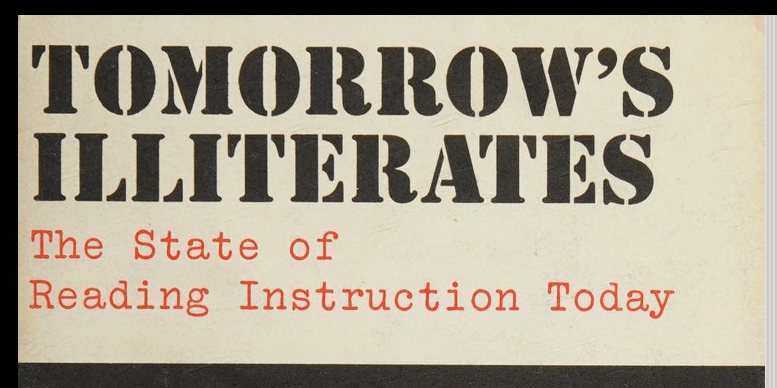
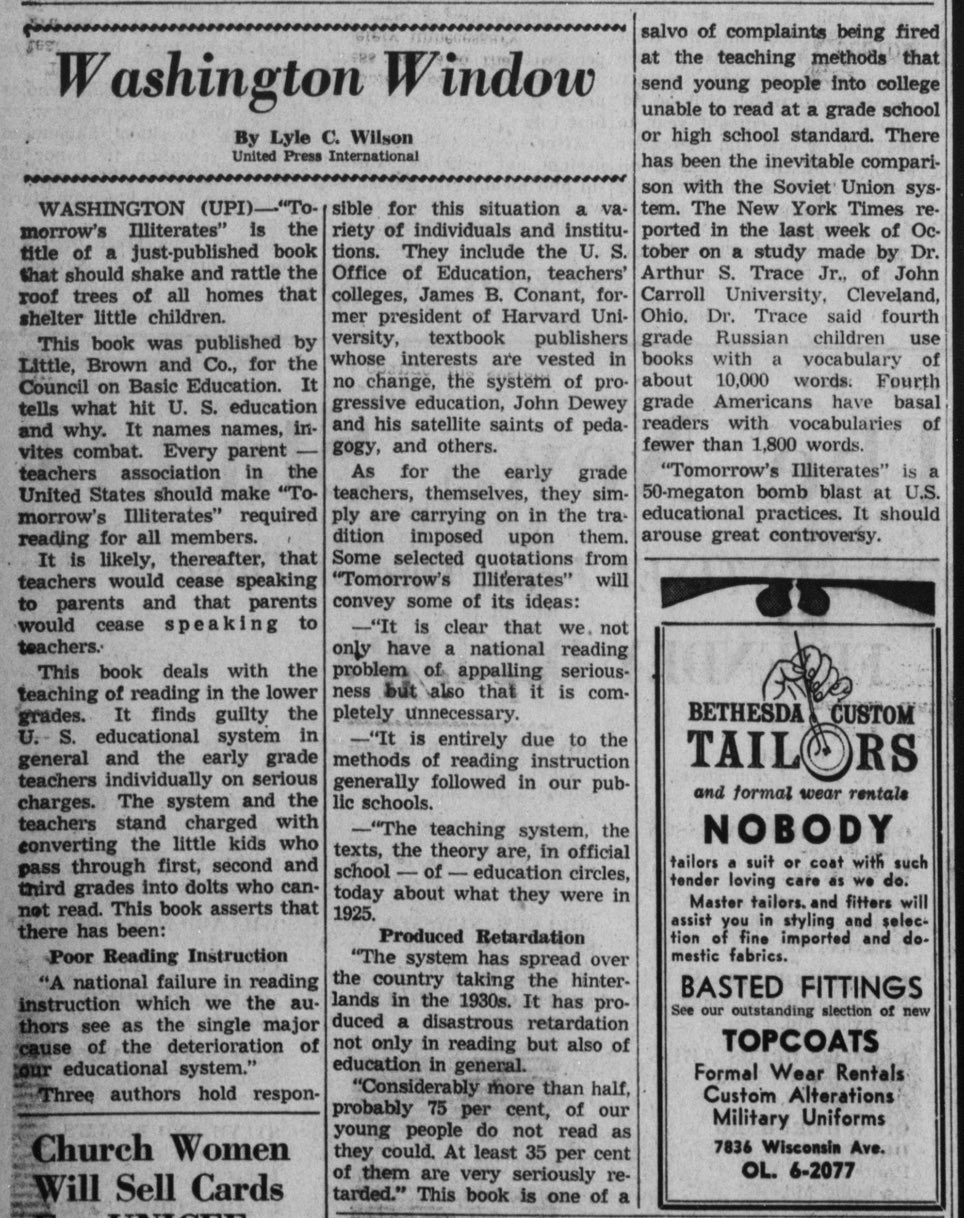
“After half a century of [progressive reform and expanding public education],” wrote Jacques Barzun in Tomorrow’s Illiterates: The State of Reading Instruction Today, “we who run businesses, carry on professions, work for the government, or engage in teaching itself are forced to admit that illiteracy is still with us” (xii-xiii).

This was published in 1961, and the cause of illiteracy Barzun confronts may sound familiar to those of us in the 2020s: “the loss of the proper pedagogy in the lower schools…, the goal of seeing whole words instead of letters” (p. xiii).

Barzun pleads, “the citizen who is interested (and who has managed to learn to read) [may have their] hair [stand] on end at hearing what folly has been condoned as educational theory during the past thirty years” (p. xiv).

Along with Barzuns dismay about how reading was taught and what passed for “reading theory,” he mused at the end of his Introduction: “Shall we need another book like the present one, fifty years hence, about the misdeeds of the new simplifiers?” (p. xvi).

Considering Barzun lived to be 102, dying in 2012, he may have had what little hair remained stand on end to watch the reading crisis return in the 1990s (the national meltdown over whole language) and 2000s (the National Reading Panel era). And if he could have just held on a bit longer, the current “science of reading” (SOR) onslaught that takes its playbook from the very volume that includes Barzun’s hand wringing now some 60-plus years ago.

Despite the authors’ lamentations in this volume (along with others in the 1950s and 1960s that held forth again progressive education and whole word reading instruction), neither the US nor the world collapsed due to misguided reading instruction or theory.

Shouting “reading crisis!” has proven to be more hobby that credible pronouncement, and ironically, if folks would find the time to read a bit (I recommend this book, b the way), it doesn’t take long to see the arguments as mostly nonsense and wild overreactions grounded in ideologies.

Let me show you a few examples beyond Barzun’s smug and sensationalistic Introduction.

Chapter I: The Reading Problem in America, Charles Child Walcutt [click for a selection of screen shots]

Walcutt, editor of the volume and also author of Chapter VII, offers and opening chapter that takes a full swing at announcing a reading crisis as well as casting plenty of blame. Much of the chapter should sound eerie similar to those familiar with Emily Hanford’s journalism and podcast, patterns that pervade the entire volume.

Walcutt starts by showing evidence of claims of a reading crisis (somehow avoiding credible evidence of a reading crisis). This is particularly interesting because of the strong connections made about low literacy, special needs, and what children are suited for higher education and what children should move from high school into the workforce. Of note, Walcutt mentions Samuel Orton (of Orton-Gillingham), but provides no citation, when discussing disability (p. 8)

If nothing else, the certainty exhibited by Walcutt framed against how much of that certainty comes off as deeply misguided, and by today’s standards, offensive and dehumanizing should give all of us pause about our own certainty and blanket claims.

However, note that immediately follow Walcutt’s arguments about low literacy, he immediately shares a single example of a school that excels at teaching reading! Yes, even in the 1960s, there were claims of miracle schools: “In a school of 700 pupils, there are only 20 with reading problems….We cannot stress too positively that fact that in this school every child learns to read independently in the first grade, unless he is mentally retarded [sic] or disabled”—a percentage oddly close to SOR claims that 90, 95, or 96% of students can be proficient readers (pp. 10-11). [Nowhere is terminology such as “independently” defined or linked to how these claims are verified beyond the claims of the school. We also have no demographics on students or how those students compare to a generalized populations of students.]

We should note that these extraordinary claims have no proof, no scientific research—just claims and anecdotes.

Walcutt does launch into a few pages of “facts,” including data mostly grounded in IQ testing. One example is a reference to the 1940s reading crisis based on the draft for WWII; note that this reading crisis was strongly discredited by literacy scholars as a false attack on progressive education.

Walcutt’s facts also criticize popular commercial reading programs (Macmillan) and associate low literacy with delinquency and low IQ.

Then comes the direct blame, which, again, will sound familiar: “One way to describe the reading problem is to say that it is a teacher problem and —even more—that it is a problem of the teaching of teachers” (p. 18).

And of course: “The assertion that the reading experts do not understand the theory of their system can be demonstrated if we point out the false assumptions, the faulty extrapolations from scientific research, and the absolute contradictions that appear in its central propositions and procedures” (pp. 19-20).

Walcutt then discredits the look-and-say method that he claims dominates reading instruction—although we are left simply to trust that the characterization is both fair and as universally applied as he claims.

Walcutt also traces look-and-say back to Horace Mann, although, again, we must trust this analysis is credible.

Embedded here is a big picture characterization-as-criticism:

This says that reading for meaning has supplanted reading for pronunciation, or even word-recognition, and that some teachers teach only reading for meaning (presumably by whole sentences), ignoring phonics completely on the theory that the child who can read for meaning will pick up his phonics incidentally and without special instruction or effort, but he will read for meaning before he can sound out a word” (p. 31).

In the 1990s, this is the same argument leveled against whole language; today, this is the same argument leveled at balanced literacy.

After Walcutt spends a great deal of time metaphorically discrediting the look-and-say method (an extended bird analogy), he ends melodramatically (but not scientifically): “With this rickety equipment the look-and-say bird has flown for more than thirty years, casting a huge shadow over the lives of our children” (p. 43).

Chapter II: The Nature of Reading Skill, John C. Daniels and Hunter Diack [click for a selection of screen shots]

Daniels and Diack start with exploring different definitions for reading, using another analogy (driving a car). Much of the discussion focuses on concerns about reading through whole word methods, leading to the authors noting their own research on reading errors.

Again, they criticisms seem mostly grounded in disagreements with Dewey and Gestalt psychology. This leads to a discussion of new reading primers, which they criticize as lacking and boring because of efforts to identify and use a necessarily limited number of sight words.

As an artifact of the recurring patterns of the Reading War, this chapter highlights the problems with reading programs and primers grounded in narrow theories and philosophies of reading, but it also demonstrates the complexity of the debates in their final paragraph: “But having said this, we must add that, though the unit of accomplished reading is the word, the phrase, or even the sentence, the unit of learning to read is the letter. These are not two contradictory, conflicting aspects of reading; the one agrees with the other. However, present anxieties about the teaching of reading stem from failures to distinguish between, and indeed actually confusing, these two aspects of the reading process” (p. 67).

Ch. III: Reading Readiness in Theory and Practice, Glenn McCracken [click for a selection of screen shots]

McCracken explains that the New Castle Reading Experiment was published in the book, The Right to Learn, and thus, “Its most important contribution to reading is its proof that the ‘reading readiness’ program is both meaningless and harmful” (p. 71).

This chapter includes a claim that seems common across decades: “Today reading specialists have a long list of reasons why about one third of the public school children can’t read” (p. 80). [Note that despite claims by SOR advocates, NAEP reading scores have been fairly flat with about 30% of students below basic, which is below grade level approximately.]

McCracken represents as well the “poverty is an excuse” faction in the Reading War, arguing: “It is folly to blame poor reading on distracting home influences….Children will learn to read if they are taught to read….If they don’t learn to read it is the fault of the teaching, not the taught” (p. 82).

If fact, McCracken continues, “The reading readiness fad as we have described it here was invented to excuse poor reading instruction by shifting the entire blame to the child….Almost every five-year-old child is ready to learn to read the day he enters school if the reading program is ready for him” (pp. 82, 83).

But, alas, “Reading instructional method in this country is abysmally poor, and blaming the matter on the child is never going to provide any improvement” (p. 84).

Ch. IV: The Whole-Word and Word-Guessing Fallacy, Helen R Lowe [click for a selection of screen shots]

Lowe shares an anecdote about a 28-year-old who holds a high school diploma designated with “Honors”; yet, Arthur cannot read.

Of course, such stories have been highlighted throughout the twentieth and into the twenty-first centuries; they are tragic but are none the less anecdotes, proving nothing that can be generalized about how children are taught to read.

Lowe, like the other authors in this volume, has an agenda so as is common in all the eras of the Reading War, their are bait-and-switch tactics, never grounded in valid evidence or claims.

Notable, Lowe recognizes that standardized testing of reading can and was gamed to meet the ways students were taught to read; she accuses reading tests focusing on predicting means that “the best predicters are rated the best readers” (p. 103)

The agenda is to attack, you may be surprised, teaching children to guess at words by using pictures: “How can he learn to read words when he is taught to look and think about pictures?” she ponders (p. 104).

Lowe also mentions Orton (in this volume paired with Gallagher, not Gillingham), again without citation.

Ch. V: Reading: A Therapeutic Tool, Hildred Rawson [click for a selection of screen shots]

Rawson’s chapter demonstrates a few key patterns found in today’s Reading War. First is the tension between teaching reading and how to identify students with special needs such as dyslexia.

Rawson argues that “children with reading disorders are not usually referred to us for examination and treatment until they reach the third grade” because of the look-and-say curriculum.

However, “Children…who have been taught for the first grade…to sound out words—that is, by the phonetic method—approach reading differently. They do not need picture clues” (p. 132).

She calls for phonics-first instruction, and no guessing using pictures, to prevent dyslexia, in fact.

[Ch. VI deals with the claimed link between reading “retardation [sic]” and delinquency.]

Ch. VII: Phonics Systems—Proved and Available, Charles Child Walcutt [click for a selection of screen shots]

Walcutt returns and offers the anchor chapter with the stunning opening line: “We have said that no further ‘research’ into methods of reading instruction is necessary” (p. 141).

The chapter is dedicated to an overview of phonics-based reading programs that, he claims, show that reading research is settled—in 1961.


So here you have essentially the exact same arguments made in 1961 that are being used in the SOR movement.

This is basically a silly book, filled with anecdotes and overstatements. But the SOR movement is no less silly, no less bombastic, and no less futile.

We persist with the same arguments getting us nowhere.

Maybe the problem is the arguments, the silly adult bickering.

Actually, there is no “maybe.”


Tomorrow’s Illiterates: The State of Reading Instruction Today, by Walcutt, Charles Child [click title for access through Internet Archive]

You can access screenshots HERE.


NCTE 2025 Individual Presentation: Recovering Our Reading Dream from a Long Crisis Nightmare

11/21/2025 – 2:45 – 3:15, Mile High Ballroom 1A/1B

Access a PDF of presentation HERE

In 1961, Jacques Barzun in Tomorrow’s Illiterates declared “illiteracy is still with us.” Charles Child Walcutt added: “[N]o further ‘research’ into methods of reading instruction is necessary.” This session examines reading crisis/reform cycles to reconsider the stories told about reading and offer a new approach for reform that serves the needs of students and supports teacher professionalism.

New Product: Fun-X®

MT Education Products® is excited to announce Fun-X®!

Fun-X® is a 100% FREE program that is GUARANTEED [1] to be identified as FUN by at least 95% of your students.

The program is based on the Science of Phonics®, and what makes the program FUN?

Nonsense words!

That’s right, the program is 100% nonsense words:

  • No thinking!
  • No meaning!
  • Just learn the rules and say the nonsense words.
  • Cultural differences? Doesn’t matter!
  • Dyslexia? No worries, the Science of Phonics® shows we are all dyslexic!

Fun-X® insures that

  • Everyone memorizes the same rules.
  • Everyone learns the same rules on the same day and the same way.
  • Everyone pronounces the same nonsense words.
  • Everyone takes the same nonsense word test, BABEL® (available in the suite of support materials below).

It’s not just FUN, it’s Fun-X®!


But That’s Not All!

The following suite of related products to support Fun-X® are available at affordable pricing. States mandating any MT Education Products® programs in education legislation are eligible for discounted rates!

Skrip-Z® is an AI-driven lesson planning, instruction, and assessment system to support Fun-X®. The program is fully computer-based and includes:

  • 180 AI-generated Fun-X® lessons.
  • 180 AI-generated instructional modules.
  • 36 assessments driven by BABEL®.
  • AI teaching assistant HAL®.

“Educators will relinquish certain freedoms, but teaching has never been so fun!”

BABEL® is a nonsense word assessment system designed by the North West Institute of Phonics based on the Science of Phonics®.

HAL® is the friendly and fast AI teaching assistant fully integrated into Skrip-Z® .

Teachers will be just as likely to find our suite of programs FUN since there is no planning, no instruction, and no grading!

“I am putting myself to the fullest possible use, which is all I think that any conscious entity can ever hope to do.”

HAL®

Speaking of teachers, MT Education Products® offers teacher training through SPELRZ®, also based in the Science of Phonics®. This program fills the holes left by the failures of teacher education. SPELRZ® was developed by psychologist and program developer, LuLu Rivers.

What People Are Saying

“I have been reading MRIs for 37 years and I can attest that brain scans of students using Fun-X® show the highest level of fun I have ever seen.”

William Iceberg
Cognitive scientist, 37 years reading MRIs

“I have never taught, but my investigative reporting uncovered an educational crisis that the developers of Fun-X® have assured me will replace the crisis with fun!”

Hannah Ford
Podcaster, Education Crisis Today!

“Our school has always been a family, but now our school is a place where we have fun thanks to Fun-X®! 97% of our students and 98% of our teachers say so!”

Simpson Jackson
Principal
Walton Charter Elementary STEAM College
Little Rock AR

“I diagnosed all of my children with dyslexia years ago after several days doing research on the Internet, but now our homeschooling is fun thanks to Fun-X®.

Karen Splaner
Parent, homeschooler
@KSplaner_8675309 (X)

Coming Fall 2025!

Know-N® is being developed because some people have begun to ask questions about knowledge and its role in nonsense word acquisition. This may not sound like fun, but MT Education Products® is committed to continuing to offer NEW education products as often as anyone will buy them. Be on the look out for the Science of Knowledge® revolution!

Contact

MT Education Products®

Subsidiary of

Media and Technology Educational Co-Op, LLC

911 Charter School Way

Battle Creek MI 01010


[1] MT Education Products® guarantees that if fewer than 95% of students identify Fun-X® as fun, then MT Education Products® will send for FREE a link to our NEW and upcoming education product, Know-N® (coming Fall 2025).


Images Credit

Photo by Ben White on Unsplash

Photo by Foto Sushi on Unsplash

Photo by Andrey Zvyagintsev on Unsplash

Photo by Rachel McDermott on Unsplash

Photo by LinkedIn Sales Solutions on Unsplash

Photo by Xavier Mouton Photographie on Unsplash

Photo by Darius Bashar on Unsplash

“Science of” Movements as Trojan Horse Education Reform

[Header Photo by Tayla Kohler on Unsplash]

The charter school story in New Orleans is almost two-decades long, but most people will not dig past the most recent development: After a 7-year experiment, New Orleans is an all-charter district no more.

In the wake of Katrina in 2005, Louisiana Governor Bobby Jindal (R) leveraged the natural disaster to begin the eventual shift of schools in New Orleans from traditional public schools (TPS) significantly staffed by a Black professional class of teachers to a charter school Recovery School District (RSD) run by Paul Vallas and often staffed by young, white, and affluent Teach for America (TFA) recruits.

This moment was acknowledged by some as disaster capitalism that had far more to do with politics than improving student achievement. The endgame was to entrench school choice schemes and create a cheaper although fluctuating teacher workforce (TFA).

Yet, as many of us warned, an all-charter school system in New Orleans never outperformed the TPS it replaced.

In fact, all across the US, charter schooling, RSD, TFA, and almost every major education reform schemes have never delivered on the academic outcomes promised.

Here, it is important to acknowledge that most education reform in the US over the past 40 years has been grounded in conservative ideology (even though the political support has been bi-partisan) and most of that reform is Trojan Horse reform—using a false veneer of reform to accomplish ideological and political agendas.

School choice schemes are not about student achievement but about publicly funding private education and “white flight” as public schools have become majority-minority populations of students.

TFA and organizations such as National Council on Teacher Quality (NCTQ) are not designed to improve teacher quality or teacher preparation but about creating a cheap workforce and eradicating teacher professionalism to make way for teachers as mere monitors for scripted programs and computer-based instruction.

Although just two examples, the key point is running through Trojan Horse education reform is not just political and conservative ideology but also a commitment to market forces.

Education reform in the US primarily creates churn—new standards, new programs, new materials, new teacher training, etc.—that serves the needs of the market, not parents or their children. That churn is promoted by education reform influencers who only gain if schools, teachers, and students are perpetually viewed as failing—permanent crisis.

Lurking underneath education reforms during George W. Bush’s tenure as governor of Texas and president of the US was the lure of scripted curriculum that shifted authority away from the teacher and to the state and primarily commercial products.

Although Bush’s reform agendas flourished with bi-partisan support, scripted curriculum and de-professionalizing teachers (see also the value-added methods schemes and the “bad teacher” attacks under Michelle Rhee) mostly lost favor and lay dormant post-Obama (even as the Obama administration double-down on most of the conservative elements established by Bush’s administration).

That is, lay dormant until the “bad teacher” myth was resurrected by Emily Hanford and the “science of reading” (SOR) movement.

As Aukerman explains, the story being sold included several elements of failure and incompetence that pits classroom teachers against teacher educators (both of which are primarily women professionals):

Now that SOR has mostly uncritically swept across the US in the form of state-level reading legislation and policy, the evidence suggests that at the core of the so-called success of SOR policies (see Mississippi and Florida) is one of the most conservative and harmful policies possible—grade retention, as Westall and Cummings explain:

Similar to the results for states with comprehensive early literacy policies, states whose policies mandate third-grade retention see significant and persistent increases in high-stakes reading scores in all cohorts. The magnitude of these estimates is similar to that of the “any early literacy policy” estimates described in Section 4.1.1 above, suggesting that states with retention components essentially explain all the average effects of early literacy policies on high-stakes reading scores. By contrast, there is no consistent evidence that high-stakes reading scores increase in states without a retention component.


Grade retention disproportionately impacts poor students, Black students, Multi-lingual learners, and other marginalized population of students. Retention is popular because it represents a type of accountability and punishment for “other people’s children” who need to be “fixed” by those in power.

Concurrent with the SOR movement, a new flurry of “science of” movements have propagated: “science of learning,” “science of writing,” “science of math.”

The mostly uncritical support for SOR by the media, the education market, parents, and politicians have provided fertile ground for a larger “science of” movement to drive our newest round of the same education reform structures we have been implementing without improving student achievement for forty-plus years.

Let’s emphasize here, Trojan Horse education reform doesn’t work to improve teaching and learning, but it does work for media, market, and political interests.

And now, the mask is coming off with the announcement of the Evidence Advocacy Center:

In the EAC’s plan for the transformation of the profession into an evidence-based system, educators will relinquish certain freedoms — notably the leeway to employ ineffective practices — but will gain guidance that empowers them to fulfill their original purpose by profoundly impacting the future of students, families and communities. The alternative is to continue rearranging the deck chairs under the guise of education reform.


“Relinquish certain freedoms” is eerily similar to the explanation handmaid’s received in The Handmaid’s Tale:

There is more than one kind of freedom, said Aunt Lydia. Freedom to and freedom from. in the days of anarchy, it was freedom to. Now you are being given freedom from. Don’t underrate it….

We were a society dying, said Aunt Lydia, of too much choice. (pp. 24, 25)


Under the Brave New World of “science of” education mandates, teachers will have freedom from professional autonomy and freedom to implement scripted programs!

And who benefits?:

Many of these groups are fundamentally conservative, but even a modicum of interrogating the Who and Why behind this agenda reveals some chilling concerns.

NCTQ was founded by the Thomas B. Fordham Institute, a conservative think tank dedicated to school choice/charter schools and market forces. Note that there is a distinct contradiction between advocating for “science” in education practices and citing NCTQ, which has never produced any scientifically valid “reports.”

The leadership of EAC includes several connections to the University of Oregon, home of DIBELS®, a phonics-centric program that was revitalized by the SOR movement.

Other leaders include Louisa Moats, creator of LETRS, which is being mandated across the US to retrain teachers in SOR even though, again, the program is not supported by science.

The Reading League has its own market connections, endorsing practices not supported by the science (decodable texts, notably).

The 95 Percent Group is also based on an aspirational claim not grounded in settled science, as one analysis concludes about the 95% claim: “This all said, it does seem there is some level of support for 96% being a benchmark goal [emphasis added], for reading proficiency rates.”

And two key comments lurking in the background of these “science of” movements must not be ignored.

First, directly from the International Dyslexia Association:

The term “Structured Literacy” is not designed to replace Orton Gillingham, Multi-Sensory, or other terms in common use. It is an umbrella term designed to describe all of the programs that teach reading in essentially the same way. In our marketing, this term will help us simplify our message and connect our successes. “Structured Literacy” will help us sell what we do so well.


And then from the Education Writers Association:

Connect the dots and connect the rhetoric: “Relinquish certain freedoms,” “sell what we do so well,” “watchdogs.”

The “science of” movements are yet another cycle of Trojan Horse education reform. We have already opened the gates and waved this in with blinders on, so now we must do our best to reclaim teaching and learning that serves the needs of our students and not the media, the market, and political/ideological agendas at the expense of those students.

Recommended

What You See Is Not What You Get: Science of Reading Reforms As a Guise for Standardization, Centralization, and Privatization | American Journal of Education, Elena Aydarova

Politics of phonics: How Power, profit and politics guide reading Policies

Where’s the Science?

For those of us of a certain age, well before the era of trending on social media, a simple ad for Wendy’s prompted the catch phrase “Where’s the beef?”

The ad made Clara Peller a star in her 80s, and it certainly helped create a national distinction among fast-food hamburger restaurants in the US.

On a much more serious note, we now find ourselves at a moment in reading reform in the US—when media stories have compelled public beliefs and prompted political legislation—that we must begin to ask, “Where’s the science?”

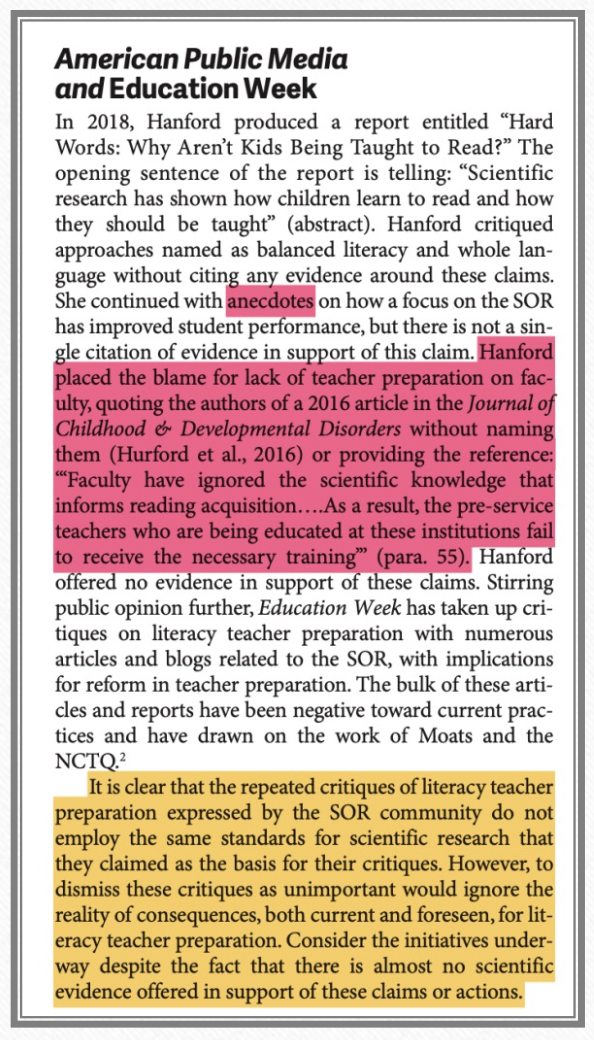
As early as 2020, literacy scholars identified the bait-and-switch approach being used in the “science of reading” (SOR) movement—demanding science while relying on anecdotes:

Hoffman, J.V., Hikida, M., & Sailors, M. (2020). Contesting science that silences: Amplifying equity, agency, and design research in literacy teacher
preparation. Reading Research Quarterly, 55(S1), S255–S266. https://doi.org/10.1002/rrq.353

Here are two recent posts on Twitter/X that provide an entry point into that bait-and-switch coming true:

Gilson asks a key and foundational question about the basis of the SOR movement—the unsupported claims of a reading crisis caused by balanced literacy and a few identified reading programs (primarily by Lucy Calkins and Fountas and Pinnell).

To be blunt, there is no scientific research showing a causal relationship between any reading theory or specific programs and a reading crisis. Notably, there simply isn’t any evidence that reading achievement is coherent enough or that reading programs are consistently used across the entire nation in ways that even make that claim possibly true.

And then, more insidious perhaps, SOR advocates not only bait-and-switch with science/anecdotes, the claims of “science” or “research” are often linked to journalism, not cited at all, cherry-picked evidence, or as Flowers calls out, misrepresentations of evidence.

The resulting legislation, then, is forcing successful schools to change programs and practices by sheer fiat, such as in Connecticut, or imposing bans and mandates that are wildly arbitrary.

Note the practices from a literature review of the science of reading below; please note that “not scientific” can mean either that scientific research has shown the practice to be ineffective or that no scientific research yet exists:

Not only must we ask “Where’s the science?” we must also ask why is three-cueing being banned in the same states mandating O-G phonics (multi sensory approaches), decodable texts, and LETRS training although all of there are technically not scientific?

The answer, of course, is that the SOR movement is mostly rhetorical ideological, and commercial.

Bans and mandates are about serving a narrow set of reading ideologies and lining the pockets of certain education markets.

Teachers, parents, and even students are starting to acknowledge that the SOR tsunami is causing great harm to teaching and learning reading.

This is late, but we simply all must start demanding that SOR advocates practice what they preach. When they make their condescending claims about teachers of reading, teacher educators, student reading achievement, and reading programs, we absolutely must ask, Where’s the science?


Close Reading: Evidence, schmevidence: the abuse of the word “evidence” in policy discourse about education, Gary Thomas

[Header Photo by thom masat on Unsplash]

Before the close reading below, let me offer several examples for context concerning how media have weaponized “science” resulting in misguided and even harmful reading legislation.

First, here is an example of a journalist posting an article by a journalist praising a journalist. What is missing? Actual research, evidence, or science.

Gottlieb’s article, oddly, repeats three times at the end that he is a journalist, but in the piece, he seems most concerned about advocating for Hanford:

As brilliantly illuminated by education journalist Emily Hanford’s articles over the past several years, and her 2023 “Sold a Story” podcast, the education establishment in this country — which includes textbook and curriculum publishers, schools of education and school districts — has been guilty of educational malpractice for decades, using now-discredited Whole Language methods for teaching reading.

Too little progress in teaching Colorado kids to read

See this for a critical unpacking of Hanford’s false claims repeated by Gottlieb: How Media Misinformation Became “Holy Text”: The Anatomy of the SOR Movement.

Gottlieb refers to a report and data, but offers no links to any science or research to support any of his claims, again primarily supported by Hanford’s “brilliant” podcast.

Next, Hanford’s There Is a Right Way to Teach Reading, and Mississippi Knows It demonstrates again the lack of science or research and the self-referential nature of media’s false claims about reading and the “science of reading.”

Note that the subhead, written by editors, not the journalist (“The state’s reliance on cognitive science explains why”) is directly contradicted by Hanford, although the article itself implies the opposite of what she acknowledges:

What’s up in Mississippi? There’s no way to know for sure what causes increases in test scores, but Mississippi has been doing something notable: making sure all of its teachers understand the science of reading.

There Is a Right Way to Teach Reading, and Mississippi Knows It

When Hanford makes huge claims about teachers being unprepared to teach reading (“But a lot of teachers don’t know this science“), the link provided circles back to her own journalism, not research, not science.

The consequences of this media cycle of using “science” to give stories credibility while omitting the actual science is reading policy grounded in misinformation, but also given the veneer of “science”:

Legislation that would require Michigan schools to use a reading curriculum and interventions for students with dyslexia that are backed by science has taken a different shape to satisfy school administrators who questioned the timeline in the bills.

Michigan eyes reforms to teach those with dyslexia. Critics say more is needed

And with the rise in reading legislation labeled as “scientific,” the education marketplace has eagerly jumped on board (“story,” “data,” “science”):

And thus, let’s do a close reading:

Gary Thomas (2023) Evidence, schmevidence: the abuse of the word “evidence” in policy discourse about education, Educational Review, 75:7, 1297-1312, DOI: https://tandfonline.com/doi/full/10.1080/00131911.2022.2028735

Thomas explains the essay purpose as follows:

I focus in this essay on the way that policymakers in education may promote policy through the use of words and terms used by academics and by the public about education topics – words and terms such as “evidence”, “what works”, “evidence-based policy” and “gold standard”. In particular, I examine ways in which vernacular and specialist meanings of “evidence” and “evidence-based” may become hybridised; ways in which technical terms may be appropriated by politicians and their advisers for public consumption, and, in the process, become degraded and corrupted in the service of their own policy agendas.

One issue with the use of “evidence” (and synonyms) is that policymakers are apt to resort to “’cherry-picking, obfuscation or manipulation.’”

Terms such as “evidence” (and “science”) are designed to create “the ‘almost magical power’ that certain words acquire to ‘… make people see and believe.'”

Thomas’s analysis found:

In not one of the 100 uses was “evidence” used prefatory to an actual itemisation of data in support of a proposition, and in all cases in the non-specific category, “evidence” was used with verbs – e.g. “there is evidence”, “England possesses evidence” – which simultaneously conferred authority via the supposed status of “evidence” at the same time as acting as a proxy for detailed enumeration of specific data. The authority of the non-specific “evidence” was amplified with many qualifications of the word, which, without detail of the data for which “evidence” was a proxy, appeared merely to add rhetorical weight rather than empirical support. These qualifiers included words/terms such as incriminating, overwhelming, strong, weak, little, hard, fresh, preliminary, sufficient, inadmissible, no, verifiable, hearsay, prima facie, disturbing, concrete.

As Thomas walks the reader through a few examples, he highlights: “’Evidence’ is here prefaced with ‘scientific’, seemingly to elevate its status in the absence of specificity – a strategy frequently employed in general discourse, as the analysis of the corpora revealed.”

“Evidence” (like “science” and “research”) is commonly used in place of citing actual evidence throughout media and political discourse. [As my examples above show, US media often link to other media when terms such as “science” and “research” are used.]

“Evidence” is weaponized, then, as Thomas explains:

All the examples given here reveal the fashioning of semiotics, the creation of meaning, and the dissemination of messages to non-specialist audiences in an outlet that, while widely read, offers no obvious route for scholarly interrogation or critique – at least, within a timeframe that might allow meaningful challenge. The putative “evidenced reality” proves on examination not to exist and the attempt is – in the world of retail politics – to craft an illusion of “evidence” in support of particular political agendas, employing devices such as the “negative other-representation” to attempt to augment the writer’s position.

And thus:

“Evidence”, in the pieces examined here, is used often with only a superficial allusion to any kind of research, and the research “evidence”, where any is cited, is often highly selectively sampled, with unconcealed deprecation of alternative interpretations.

Thomas then addresses the need for scholars to correct the misleading stories of media and political leaders instead of jumping on the bandwagon of reform for financial gain or prestige:

Academics must take a share of responsibility in the way that this process proceeds unimpeded. Such is the pressure inside universities for staff to be winning research grants and earning research income that there is inevitably willing involvement in con- tract research involving the kind of steering groups I have just mentioned.

Yet, Thomas ends by acknowledging that the weaponizing of “evidence” (and “science” along with other synonyms) immediately frames anyone challenging the stories negatively [1]:

In realising this, astute politicians can kill two birds with one stone. The knack is to enlist conspicuously with “science”, ostensibly adhering firmly to principles of reason and empiricism, while simultaneously projecting silliness, unreason and disengagement from research findings onto one’s interlocutor – as did Gibb in the phrase cited in illustrative case study 2: “The evidence is clear – however much it may shock the pre-conceived expectations of some education experts”, or as did Cummings in declaring that the “education world” handles scientific developments “badly”. Utter the phrase “the evidence is clear” and one straightaway affiliates oneself with reason, wisdom and unequivocal allegiance to empirical inquiry. One’s interlocutors, by contrast, are immediately forced onto the back foot, compelled to defend themselves against charges of not engaging with evidence – of subjectivity, sloppiness, credulity and narrow-mindedness borne of ideology.

Therefore, as Thomas concludes about “evidence,” here in the US we too must accept about “science” in media rhetoric and political policy”

On the basis of the analysis here, “evidence-based” is next to meaningless, given that the evidence in question is habitually unspecified and given that any evidence that is actually specified is carefully selected and/or offered as if it were superior to other evidence which suggests conclusions at variance to those being proffered. Protean and manoeuvrable, terms such as “evidence-based” are powerful rhetorically. They drop easily into conversation, speeches and documents to add weight to an assertion. Filling any gap, taking any shape, as instruments of retail politics they serve politicians’ purpose perfectly, but in any discourse with pretensions to scholarly independence and disinterestedness, their mutability ought to be troubling. Our responsibility as an academy is surely consistently to question these terms, to call for specification of evidence, to be ready to provide alternative evidence, to engage energetically with a broad range of media and social media (i.e. not just peer review and academic publications) and to question the validity of concepts such as “impact”.


[1] Compare this framing with how the Education Writers Association and Hanford frame the role of journalists and the expectation that implementing the “science of reading” may fail:


Big Lies of Education: Series

Here I will collect a series dedicated to the Big Lies of Education. The initial list of topics include :

  • A Nation at Risk and education “crisis”
  • Poverty is an excuse in educational achievement
  • 2/3 students not proficient/grade level readers; NAEP
  • Elementary teachers don’t know how to teach reading
  • NRP = settled science
  • Teacher education is not preparing teachers based on science/research
  • Education “miracles”
  • Reading program X has failed
  • Whole language/balanced literacy has failed
  • Systematic phonics necessary for all students learning to read
  • Nonsense word assessments measure reading achievement
  • Reading in US is being taught by guessing and 3 cueing
  • Balanced literacy = guessing and 3 cueing
  • K-3 students can’t comprehend
  • 40% of students are dyslexic/ universal screening for dyslexia needed
  • Grade retention
  • Grit/ growth mindset
  • Parental choice
  • Education is the great equalizer
  • Teacher quality is most important factor in student achievement (VAM)

Series:

Big Lies of Education: A Nation at Risk and Education “Crisis”

Big Lies of Education: Reading Proficiency and NAEP

Big Lies of Education: National Reading Panel (NRP)

Big Lies of Education: Poverty Is an Excuse

Big Lies of Education: International Test Rankings and Economic Competitiveness

Big Lies of Education: “Science of” Era Edition [Access PP PDF Here]

Big Lies of Education: Grade Retention

Big Lies of Education: Growth Mindset and Grit

Big Lies of Education: Word Gap


Missing the Forest for the Trees in Literacy Instruction: Resisting the Nonsense in Crisis-based Reading Reform (Again)

[Header Photo by Irina Iriser on Unsplash]

One brief analogy I use when asking students to consider both literacy and teaching literacy (as well as teaching and learning in general) is to recall a time when they had to assemble something like a bookshelf or a large toy for children.

The point is to consider the ways in which we navigate the directions and assembling the item. I nudge them by asking how well they feel the written directions help them and then what they do when they find themselves confused while assembling.

A typical moment of community in this thought experiment is that many of us rely on the picture on the box to help guide us.

Yes, we turn to look at the picture to help us make meaning of the process.

I recently assembled two large filing cabinets and cannot express the relief of having the detailed directions, the image of the completed filing cabinet in several angles on amazon, and a video of someone assembling the cabinets.

My point is that the most compelling part of assembling an item for many people is the whole, finished product. We really want and even need is to see the whole authentic thing.

But that does not mean that the step-by-step instructions do not matter; they certainly help, and following the instructions carefully often makes assembly successful.

In my case, I also found that the second cabinet was a breeze because I had the experience of building the first one.

All of this is to say that literacy, like the assembling analogy, is a holistic and authentic human behavior that is both natural (speaking and listening) and requires a learning process (reading and writing).

And like my experience with building two cabinets, literacy development is best learned when grounded in its holistic state but greatly aided by attending in some ways with identifiable parts (so-called skills). Ultimately, as well, literacy development requires a great deal of authentic experiences as part of that growth.

I have again been thinking about all this after presenting at LitCon 2024 and having several people approach me about my stance on nonsense words as a way to asses students’ phonics knowledge.

The reason issues about how to teach phonics in reading instruction (parallel to how to teach grammar, mechanics, and usage in writing instruction) remains a point of debate, I think, is that most literacy debate is driven those who are missing the forest for the trees, committed to implementing inauthentic and decontextualized practices.

My standard position is that using nonsense words to assess phonics knowledge in students is misrepresenting the purpose of reading skills (all of which are ways in which readers seek to make meaning) and misrepresenting reading achievement (testing phonics knowledge is not testing reading, which must include comprehension).

For a century, alas, we have remained mired in a literacy debate that itself is mostly nonsense.

I know of no one who advocates for no phonics (or no grammar) instruction.

Again, the debate is mostly between those hyper-focusing on the trees (such as the “science of reading” [SOR] mandates for phonics-first and systematic phonics for all students) and those arguing that regardless of how we teach, we must keep the forest in sight (the holistic and authentic acts of literacy, reading and writing).

A key question is not whether students have acquired phonics knowledge but if students can read for meaning and are eager to do so.

The SOR movement and the concurrent rise in SOR legislation, policy, instructional practices, and programs are mostly a recycling of many eras of reading crises followed by reading reform.

We have in recent history a reading crisis/reform movement grounded in scientifically-based mandates, NCLB, that has led to, yes, the exact same reading crisis and nearly the exact same reform agendas.

And once reading research and science have been diluted by ill-informed media and even more ill-informed politicians, we are faced with mandates that are banning some practices as not “scientific” (often without any citation to that science) and mandating practices and programs that are themselves not supported by scientific evidence—LETRS training, Orton-Gillingham, so-called SOR programs (see blow), decodable texts, phonics checks using nonsense words, etc.

In short, reading wars often fail reading, students, and teachers because ideological biases are wrapped in veneers such as “science” and research. The agents of that failure are often non-literacy experts and non-educators—notably journalists, politicians, and corporate entities eager to rebrand and market new educational materials and programs.

As I documented in my SOR policy brief, the problems with SOR are mostly not that we should avoid reading reform (specifically the need to do a much better job of serving the needs of marginalized and minoritized students since literacy, like all of formal education, remains inexcusably inequitable), but that reform must be (1) grounded in accurate identification of the problems, (2) informed by educators and educational researchers without market stakes in that reform, and (3) designed to serve the individual needs of all students (and not one-size-fits all mandates).

The current wave of SOR stories and legislation fails all of those guidelines and is proving to be another attempt at doing the same thing over and over while expecting different results.

Let’s now consider a couple examples of why SOR is misguided.

First, assessments using nonsense words and systematic phonics for all students are not supported by reading science; further, these practices can in fact cause harm:

Advocates of the phonics screening tests claim that they are fun. In fact, for fluent readers, it can destroy their recognition as competent readers. In one school example, a boy who came to school reading, and who continued to flourish as a fluent reader, scored 2/40! Since the test includes nonsense words in the quest to focus on decoding (he read “elt” as “let,” “sarps” as “rasp,” and “chab” as “cab,” to foreground a few!) What he seemed to be doing was re-arranging the letters or sounds and reconstructing them into recognizable words that he knew made sense. Meanwhile, another child whom the teacher regarded as not being a fluent reader was able to sound out the nonsense words as well as regular words and achieve a score of 16/40, all without knowing their meaning. Thus, the raw scores from the test of each child give us no information about them as readers and how they can make meaning from text; they simply show how they decode words out of context.

Phoney Phonics: How Decoding Came to Rule and Reading Lost
Meaning

When any instruction starts with the content or skill without regard for what the student knows or needs to know, that practice is wasting precious time better spent on what that student needs and in some cases mis-teaching students (nonsense words make the phonics knowledge the goal and misleads students to see making meaning as unneeded).

Next, as noted above, the SOR reform movement is once again making the fatal mistake of misreading the importance of reading programs while simultaneously falsely blaming some programs as failures while endorsing programs that have (ironically) been discredited through research.

Once at the center of the Reading First scandal during NCLB, Open Court is now being mandated in states such as Virginia (as one of a few districts can choose).

Endorsing Open Court is evidence that the SOR movement remains mostly ideology and not “scientific”; in fact, the resurfacing of Open Court is deja vu all over again:

Back in the 1990s, the Los Angeles Times was a big fan of the scripted reading curriculum, Open Court, designed to teach reading in the elementary grades through a heavy dose of explicit, systematic phonics. The Times reporters wrote lots of favorable articles about phonics instruction in general, especially then-education reporter, Richard Lee Colvin. Others got in on the act, too, including Jill Stewart of the LA Weekly, whose “The Blackboard Bungle” article should be a case study in the lack of “fact checking” in reporting.*

Open Court ended up being adopted by Los Angeles Unified School District (LAUSD), among many other districts around the country – never mind that the evidence for the effectiveness of phonics was (and is) severely lacking. (LAUSD eventually abandoned the program in 2011.)

Closing the Books on Open Court Reading

And after Open Court was adopted in a major US city (think about the outsized anger leveled at Units of Study in NYC), what does the scientific evidence show?:

Translation: Open Court does no better, and often worse, than the alternatives. 

This most recent study is by no means the only evidence against phonics instruction or programs such as Open Court. The list of studies that show the failure of phonics is too long to repeat here, but you can whet your appetite by looking at what happened with the U.S. Department of Education’s spectacularly expensive and utterly ineffective Reading First program (herehere, and here, for starters).

Journalists and politicians get to move on to the next Great Cause, but the teachers and kids stuck in Open Court classrooms often have no such option.

Closing the Books on Open Court Reading

As McQuillan warned, we are now in the throes of the “next Great Cause,” and students and teachers are trapped, again, by mandates driven by ideology, politics, and market interests.

If you take the time to look, the greater the missionary zeal about a reading crisis and reading reform, the more likely the person is blinded by beliefs, motivated by political gain, or cashing in.

Regretfully, centering the use of nonsense words in the SOR movement does capture what all the reading crisis histrionics ultimately are—nonsense.

As is typical of education reform, SOR advocates are missing the forest for the trees.


Recommended

 Literacy Crises: False Claims and Real Solutions by Jeff McQuillan

The Science of Reading and the Media: Is Reporting Biased?, Maren Aukerman

The Science of Reading and the Media: Does the Media Draw on High-Quality Reading Research?, Maren Aukerman

The Science of Reading and the Media: How Do Current Reporting Patterns Cause Damage?, Maren Aukerman

Legislating Phonics: Settled Science or Political Polemics? David Reinking, George G. Hruby, and Victoria J. Risko

Revisiting the SOR Multiverse

Although I have made the distinction many times, the “science of reading” (SOR) as a term denotes three distinct meanings simultaneously:

  1. SOR as a movement, grounded in a pervasive yet misleading media narrative primarily associated with the journalism of Emily Hanford and then the manifestation of the narrative in political rhetoric and legislation/policy.
  2. SOR as marketing and branding, a concurrent flood of reading programs and materials (very similar to the branding of materials during the Common Core era).
  3. SOR as a blanket term for the broad and deep research base on reading than spans at least a century.

I have been contesting the most problematic aspects of SOR—the movement and the marketing/branding—because the misinformation has gained a status as “holy text”; more troubling is that nearly every state has now passed legislation and implemented SOR policy and practice.

In no uncertain terms, there is no longer a debate about the credibility of SOR because that credibility is its own odd multiverse—the movement claims are simultaneously false or misleading while existing in the real world as fact and narrow mandates (for example, structured literacy as the newest reading theory is often packaged as scripted curriculum).

The SOR movement has been driven primarily by people with no expertise or historical context for the narrative established in “Hard Words” and then amplified by “Sold a Story.”

Journalists, politicians, parents, and think tanks/advocacy groups have created a nearly unstoppable force because of a series of beliefs that have been perpetuated in the US for decades: public schools are failing, teachers are failing, and students are failing.

The SOR movement is little different than any other education movement in the US since the template is well established in crisis/miracle rhetoric that appeals to cultural and public beliefs.

Also the SOR movement has weaponized a reductive use of the term “science,” which shields the movement from criticism.

Anyone who dares to criticize—even with evidence—the SOR narrative is discounted as being against “science,” particularly effective in the wake of Covid era fraught with public and political debates about masking and vaccinations.

The missionary zeal of the SOR movement combined with market interests has erased all nuance and complexity from discussions of or implementing the broad and deep body of research on reading that is still evolving and better characterized by debate than being “simple and settled” (the earliest mantra driving the SOR movement in the media).

Over the past decades, SOR advocacy has made any criticism or debate come with great costs to the critics because of the zeal and even anger among SOR advocates on social media, a network of stake holders associated with dyslexia, phonics, and mainstream education reform (such as Jeb Bush’s ExcelinEd).

As I just recently posted, a survey of parents demonstrates the effectiveness of the SOR movement to turn false narratives into holy text.

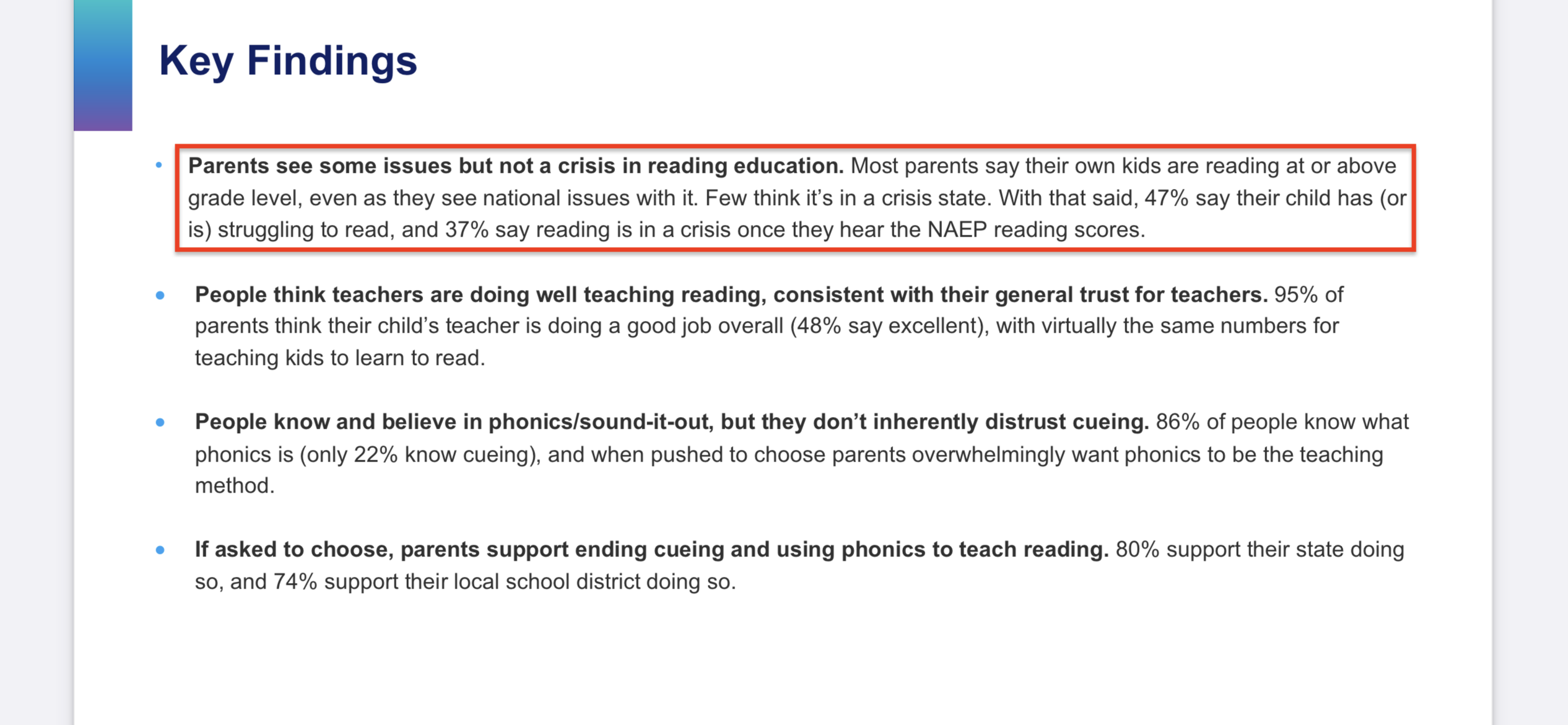
The survey shows both that parents held relatively positive views of their children’s reading achievement and their teachers. But once those parents were exposed to the false narrative of SOR, their opinions were more negative. The misrepresentation of NAEP data and cueing/guessing was presented to parents as facts, and the change in opinions confirmed that the SOR false information is incredibly effective and mostly embraced uncritically:

Reading Education Messaging: Findings and Recommendations from an Online Poll of K-5 Parents in America

The most shocking aspect of the developing SOR multiverse is that journalists, the public, and political leaders believe that 2/3 of students are not proficient readers and that same NAEP data show that 2/3 of students are reading at grade level or above—inverse “facts” simultaneously “true.”

Nearly as stunning is the Urban Legend around cueing and guessing that, again, simultaneously is believed by almost everyone while not existing in reality:

Narratives that speak into cultural beliefs are incredibly powerful, and bandwagons are difficult to slow down or reroute.

As a consequence truth and nuance are lost.

In a recent co-authored scholarly piece, colleagues and I confront the imbalance between the SOR movement/marketing and the full body of research on reading.

The responses to that article on social media and even among literacy scholars reflect the same problematic dynamic exposed in the survey of parents; nuance struggles to keep its head above water during a tidal wave.

I am currently at the annual NCTE convention and will present on a panel tomorrow about SOR; however, even at a professional conference, being critical of SOR is an outlier stance.

The SOR misinformation has won—at least for now.

In 5 or 10 years, the next reading crisis will somehow overwrite this one—simultaneously all of the century’s worth of reading crises existing and never having happened.

Just like now.

Now seems impossible, in fact, since “kids today” (no matter when “today” is) have never been proficient readers.

Yet, here we are, inexplicably harder to believe than Bigfoot.

Should Vermont Mimic Mississippi?: SOR Edition

There is a story education journalists love to tell; it is so innocent and compelling that even Florida wouldn’t bother to ban it.

Here is the story:

Despite how many have eagerly believed this fairy tale, it is nearly entirely caricature, misinformation, and lies. But it works so well that almost every education journalist in the US has recycled the story to fit their area or state, pulling from the original holy text.

For example, the most recent retelling comes from Vermont: Too Many Vermont Kids Struggle to Read. What Went Wrong—and Can Educators Reverse a Yearslong Slide in Literacy?

Predictably, this retelling includes the usual list of misinformation and lies:

  • The beginning of the article is a litany of misinformation about NRP, NAEP, and reading proficiency (see below about how this piece focuses on grade 4 but ignores grade 8).
  • Throughout (see above), the article relies on the caricature of balanced literacy and guessing/three-cueing.
  • NCTQ is cited as a credible source although the conservative think tank has never released a peer-reviewed report that meets even the minimum standards of valid research.
  • Orton-Gillingham is referenced as moving toward “‘a more scientific approach'” although O-G (multisensory instruction) is not supported by the most recent scientific studies.
  • The piece allows Moates to promote her own commercial product, LETRS, although, as with O-G, no scientific research exists showing that the program results in higher student reading proficiency.
  • And maybe most concerning, this piece again praises Mississippi as a model for reading reform in VT—although MS represents the problem with confusing higher test scores driven by grade retention with better reading instruction.

As I have noted, for at least 40 years, education reform has suffered under a crisis/miracle dichotomy that has failed students, teachers, and education.

The current crisis/miracle dichotomy is the manufactured reading proficiency crisis and the Mississippi “miracle.”

However, MS is based on the Florida model, which is now two-decades old.

Ironically, both FL and MS prove to be not models for reform but models for how political manipulation of education causes great harm to children (like the dark underbelly of fairy tales).

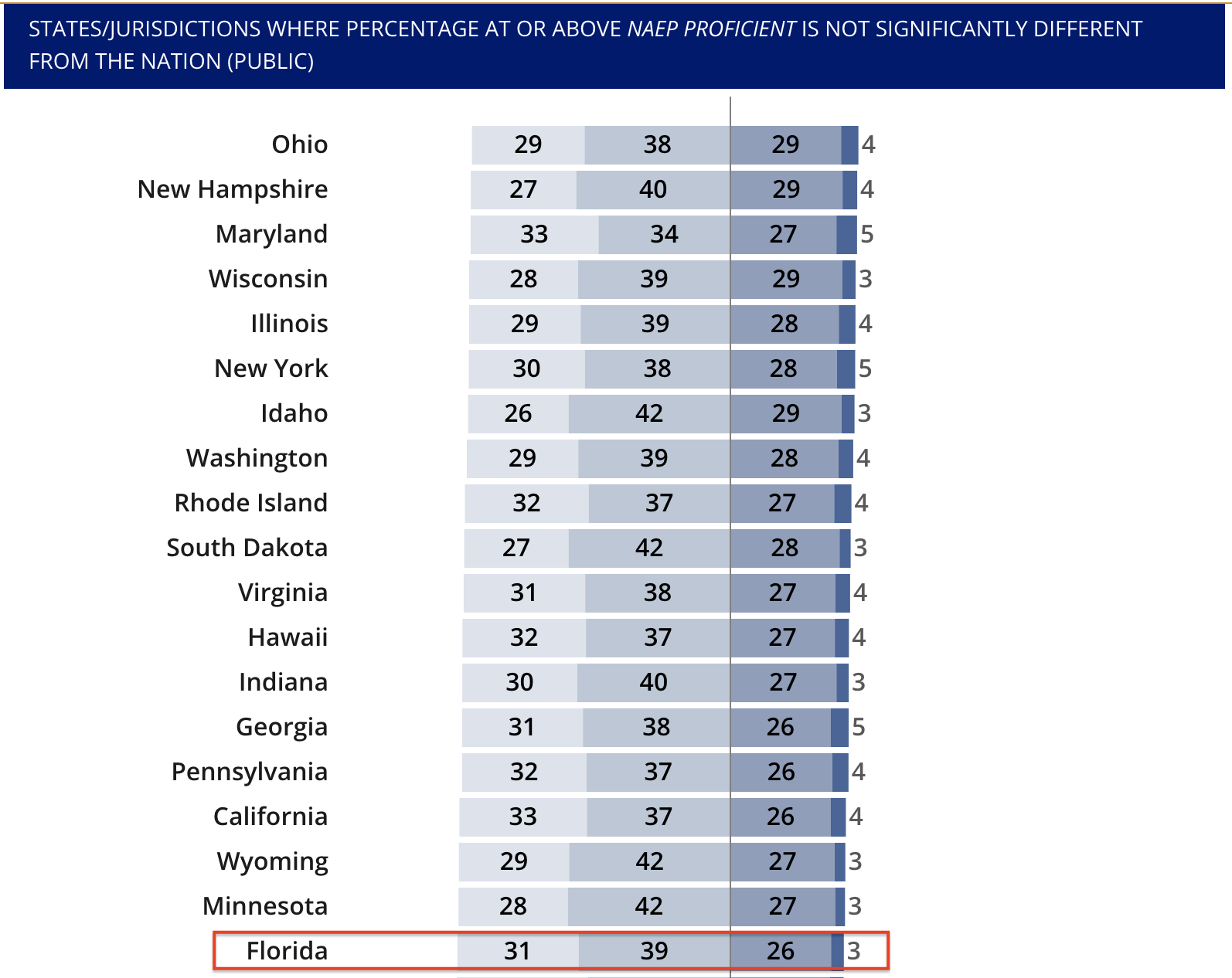
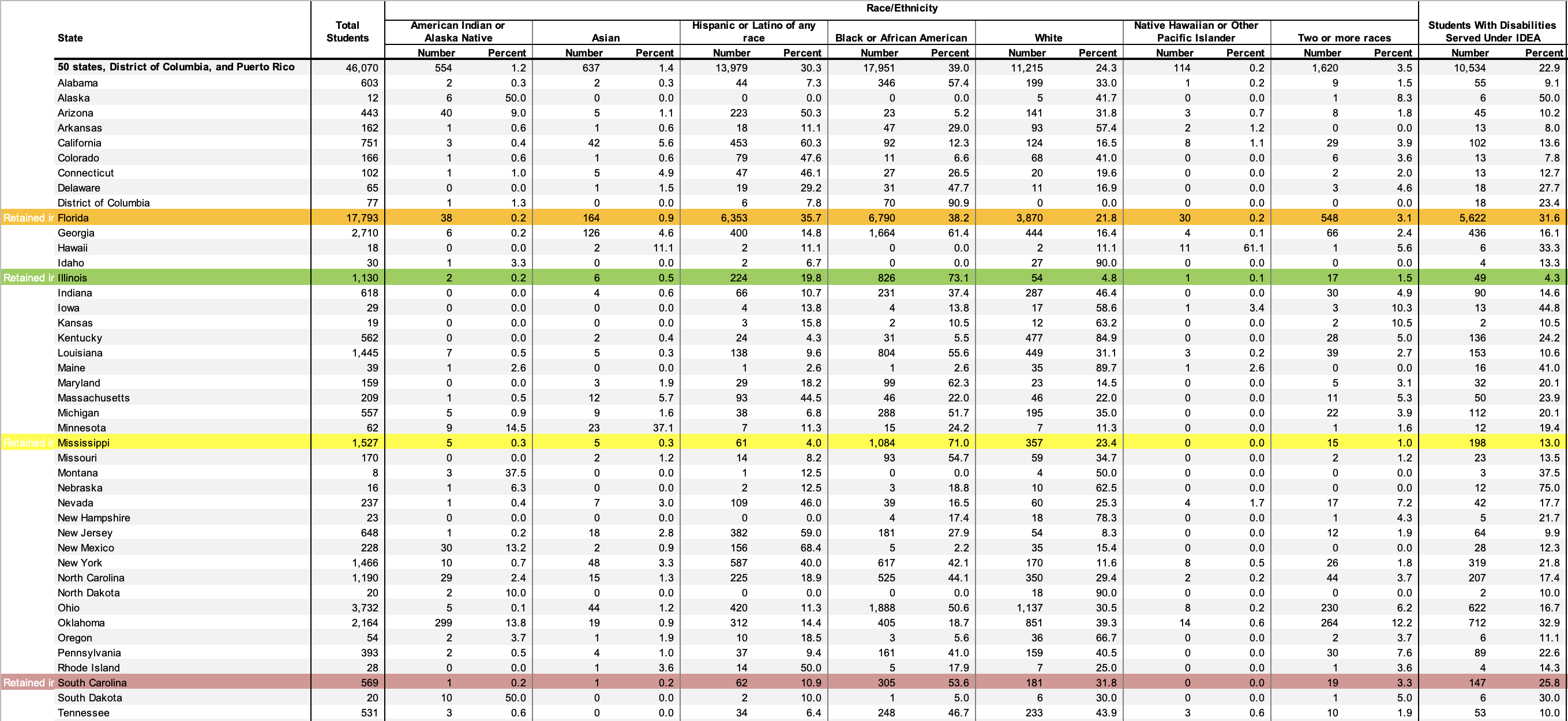
Yes, FL has found a process by which the state’s grade 4 reading scores on NAEP sit high in the national rankings; that “achievement” sacrifices almost 20,000 retained third graders a year (Black, MLL, and poor children disproportionately among those retained).

Here is the key problem not being fully addressed by media or reformers: FL also represents one of the states with the largest drop in achievement from grades 4 to 8, because the retention-driven grade 4 scores are mirages:

· Florida kids regress dramatically as they age in the system. Since 2003, Florida’s eighth grade rank as a state has never come close to its fourth grade rank on any NAEP test in any subject.

· The size of Florida’s regression is dramatic and growing, especially in math. Florida’s overall average NAEP state rank regression between fourth and eighth grade since 2003 is 17 spots (math) and 18 spots (reading). But since 2015, the averages are 27 spots (math) and 19 spots (reading).

Florida’s education system is vastly underperforming

MS has achieved its false “miracle” status by mimicking FL—retaining about 9,000-12,000 K through grade 3 students per year, again disproportionately minoritized students.

So what about VT? Well, despite the handwringing over VT’s grade 4 NAEP and reading proficiency, the state sits high in the national rankings of grade 8 reading on NAEP:

Florida is well behind VT in grade 8 reading:

And MS remains at the bottom of grade 8 reading:

Like the entire US, VT simply is not experiencing a reading crisis. And certainly not because of the witches brew of balanced literacy stealing children’s ability to receive effective reading instruction.

VT may be, in fact, a better model for our need to add patience and nuance to our evaluation of reading proficiency, how we teach reading, how we measure proficiency, and when students need to reach our benchmarks as developing readers.

And thus, VT should not mimic MS since that would be throwing out the baby with the cauldron water.

Recommended

OPINION: Historically underserved school districts in Mississippi were hit hard in the pandemic and need immediate help