Category Archives: Education

FYW Students Respond to Warner’s The Writer’s Practice: Progress, Not Perfection

When John Warner released The Writer’s Practice: Building Confidence in Your Nonfiction Writing soon after his Why They Can’t Write, I highly recommended both volumes for those teaching writing (here and here). Of course, a much better barometer of the value of books on how to write and how to teach writing is to put them in the hands of students and teachers.

A bit past midway through this fall semester of 2019, my first-year writing students have just finished reading and reflecting on The Writer’s Practice; the final reflections and our in-class debrief yesterday revealed high praise and key lessons we who teach writing can learn from what my students valued about the book, and how they framed those lessons for them as students and writers.

One student began her reflection as follows:

As I opened up The Writer’s Practice to read the final section, I felt myself experiencing emotions similar to those when I am about to finish a really wonderful piece of fictional writing. This feeling for me is more guttural, and it comes about when I am truly sad or upset to be finishing a piece. Most of the time it is because there is a change in the plot that I didn’t enjoy, or I just truly don’t want the happily ever after to conclude. But I was genuinely confused as to why I experienced this feeling when reading the final few sentences of this piece. Never in my life has I been saddened by the conclusion of reading a book for school, fiction or nonfiction, besides The Catcher and the Rye and now this book. Because of this, I have come to the conclusion that I truly did enjoy reading this book. And I believe it was mostly because of the informal language used throughout. The way in which Warner speaks to the audience is something very intriguing to me, and it made me feel like I was holding a conversation with an actual person instead of reading a boring and monotonous book for school.

In the two sections of FYW I teach, I read in reflections and heard in our discussion some powerful patterns throughout the student endorsements of Warner’s book as an effective textbook for teaching writing. Those patterns include the following:

  • One student expressed relief that Warner encouraged progress, and not perfection. In fact, many students recognized that Warner’s lessons combined with my approach to teaching writing had significantly reduced their levels of stress and anxiety about writing. The overwhelming result of reducing stress and anxiety for students as writers is that they are more eager to write, they produce better early drafts of their essays, and they are also more motivated to revise (and even begin again) in order to produce the essays they want to write. In short, Warner’s messages resonate with and compliment my commitment to having students choose their topics and types of essays as well as my low-stakes approached to teaching (delaying grades, emphasizing feedback and revision, and fostering a writing and learning community among students and with me as a mentor/teacher).
  • Several students responded directly to Warner speaking from his own humble authority as a practicing writer, an authority grounded in his recognition that becoming a writing is a journey, and not a destination. Here, I think, was one of the most powerful aspects of how students praised Warner’s book: students valued that Warner did not speak down to them; they felt respected and appreciate the casual and empathetic tone Warner maintains throughout the book. A common response was that teaching and textbooks can too often be condescending, and students have found that this book and some of the different aspects of my teaching and writing instruction honored their basic human dignity.
  • In terms of nuts-and-bolts writing lessons that were effective because of Warner’s text, I would highlight that students almost universally came to recognize and value the role of having a clear audience at the center of their work as writers. I have always struggled with helping students move away from writing for the teacher/professor (working mostly as compliant students) and toward thinking and working more as writers (drafting for real audiences). Students reading and engaging with Warner’s text while completing my second essay assignment, a public essay that incorporates hyperlinks for citation, was mentioned as very effective experiences for a number of students, especially in terms of writing with an audience in mind and writing by choice about a topic that interests and even invigorates the writer/students.
  • Broader and foundational lessons (ones that are essential for students making the transition from high school to college, from writing like a student to writing as a scholar) include students rethinking what essay writing entails (different disciplines have different expectations for essays), students moving away from rules-based thinking to conventional awareness, and students thinking and working more purposefully through their writing process. The one-size-fits-all effect of the five-paragraph essay (which all of my students bring to the class in some form) and the tyranny of grammar rules and writing mandates definitely were at least strongly confronted if not entirely debunked through the combination of students reading Warner and receiving similar messages in my class.

As a teacher, specifically of writing, this experience with assigning Warner’s The Writer’s Practice has reinforced the importance of the relationship among the teacher, students, and the textbook. When the messages and learning environment are cohesive, like a good piece of writing, everything is more effective.

My initial recommendation for this book is now strongly supported by actually incorporating it into my FYWs, but I must hasten to add a final word of caution as well.

This really positive experience with teaching writing and with students showing real and  often observable learning as writers also exposes one of the most challenging aspects of formal writing instruction and learning in formal schooling: Even as first-year college students, these young writers are at a very early stage of development as writers, and thinkers.

Once again, placing too much emphasis on evaluating my teaching, evaluating the students’ writing, or evaluating the effectiveness of an FYW course is quite dangerous and likely very misleading.

Many of the students expressing effusive praise for Warner stumbled mightily in the writing of those reflections, and continue to struggle in their formal essay assignments. People evaluating as outsiders those students’ writing would likely find it hard to identify the growth (or quality), especially the changes in attitudes these students have experienced about writing forms and the writing process.

For students as writers and me as a teacher of writing, it remains as issue of progress, not perfection.

Students as Writers and Thinkers: Another Grading Dilemma

A high school ELA teacher who completed the certification program where I teach was telling me recently about one of her students. The student, the teacher explained, had submitted an essay that the student worked diligently on, completing multiple drafts.

The teacher noted that the final essay showed marked improvement in the writing, but grading the essay also posed a dilemma because despite substantive feedback on the content from the teacher, the student simply made very little progress in thinking well about the topic.

person holding ballpoint pen writing on notebook
Photo by Thought Catalog on Unsplash

Having taught high school ELA and then at the college level for 18 years each, I quipped, “That’s what Bs are for,” adding, “Maybe a B+.”

I wasn’t being as cavalier as it seems because I have navigated this problem hundreds of times since most of my teaching of writing has been situated in the lives of teenagers and young adults. Compounding the concern for brain development—that this age group is still developing the ability to think critically and deeply—is, for me, my own practice of de-grading and de-testing my classes.

In other words, this scenario is one of dozens that highlights why grading is often misleading and almost always harmful to the learning process.

In a reasonable world, this teacher would be allowed simply to express to the student this reality—the writing is exceptional for showing improvement, but the thinking on the topic remains trapped in simplistic and unsupported ways.

And that assessment in the form of expository feedback can be shared in this spirit: This is not a negative criticism of your effort, or your ability, but a fair reflection of your current growth, a snapshot of your journey to writing and thinking more complexly and in more compelling ways.

For teachers of writing, this problem also asks us to face key elements of giving students feedback and grading when required. The challenge revolves around having clear goals for the writing assignment, and then being able to contextualize those goals by student characteristics such as brain development (a really challenging concern).

Here are some of the common issues teachers of writing face when working with teenagers and young adults, problems that occur at the intersection of writing proficiency and thinking well:

  • Students make a large number of extreme claims, rarely offering credible evidence in compelling ways. Yet, the students have a high command of the language and construct effective sentences and paragraphs as well as relatively cohesive essays.
  • Students submit a jumbled draft, seemingly carelessly constructed (surface features, formatting), but includes several strong claims linked to solid evidence. Sentence structure, paragraphing, and essay coherence are spotty at best.
  • Students submit a well structured essay with solid sentence and paragraph formation; surface features are also solid. The essays pose a manageable number of reasonable claims linked to evidence in traditional ways (for example, all claims about a text are connected to quotes from the text); however, that evidence is thin, from sources that are not credible, or doesn’t support the claim (the quote doesn’t support the claim).

Just to name a few common challenges above, but the focus here is that each of these situations is common and made complicated by the need to grade; each is, in fact, not as challenging for offering feedback, especially to support revision.

The evaluation culture of schooling works against both student growth as writers and thinkers, in fact, because summative evaluation de-contextualizes artifacts of learning from the larger realities of human development.

Grades also stunt some of the essential elements of learning, notably that errors are often not to be avoided, but are essential for growth.

For example, many of my students in first-year college writing submit work that is mostly claims, no evidence, or work that is narrowly grounded in the “all evidence is quoting” trap they have mis-learned from writing too much literary analysis in high school (such as in Advanced Placement Literature and Composition).

Less of my instruction is about writing in those cases, although I tend to find that young writers are lazy and careless with word choice, sentence formation, and paragraphing, but more about the substance of their claims and their ability to find, choose, and incorporate effective evidence.

Young people, we must remember, live in experiences outside of schooling where being persistent, loud, or assertive results in simplistic or even false claims being viewed as credible. And young people often have not reached a level of brain development to investigate critically claims and evidence.

To teach writing is inextricable from teaching thinking. Simultaneously, those of us teaching writing can distinguish between something like good writing that can sit next to poor thinking, and flawed writing that includes important aspects of complex thinking.

Much to our chagrin, we almost always have to grade the submitted writing sample—even when we are aware that many of our teenagers and young adults simply will not think complexly for several more years despite our best effort to nudge them along that path.

Ultimately, assigning, responding to, and then assessing/grading student writing requires that we very clearly identify what our goals are for the writing assignment and the students, that we acknowledge the tension between responding to and assessing/grading both the writing and thinking in writing samples, and that we find ways to resolve how assessment/grading inhibits and even deforms those learning goals (such as delaying grades).

As I approach forty years of teaching teenagers and young adults to write and think, I have remained fairly vigilant in my demands for their ability to grow as writers while also becoming more and more patient with the time it takes for them to become the critical thinkers I hope they will be.

2019 NCTE Annual Convention, Baltimore, MD, November 21-24, 2019

Access all presentation materials at this LINK.

first spring (Baltimore is burning)


(A.02) Teaching Beyond Fear: Inquiry Around Gun Violence in the English Language Classroom

Date: Thursday, November 21, 2019
Time: 9:30 a.m. – 10:45 a.m.
Location: Ballroom II

Beginning with a keynote from YA author Tom Leveen, this roundtable utilizes experiences and expertise from English educators, young adult literature authors, classroom teachers, and mental health professionals in order to consider how secondary English Language Arts can address school gun violence. More specifically, presenters will discuss using young adult literature and writing strategies to guide students as they explore difficult issues, such as violence in schools. 

Roundtable Leader: Paul Thomas: History of Violence: Guns, U.S. Education, and American Exceptionalism

See Also

Let’s Not Fail School Safety as We Have School Reform

School Safety and Security: Research and Evidence


(B.06) Misreading the Science of Reading

Date: Thursday, November 21, 2019
Time: 11:00 a.m. – 12:15 p.m.
Location: 306

In pursuit of helping all children to become readers, this session by the Elementary Steering Committee will address the misleading narratives that assert that all children acquire reading in the same way, featuring several reading scholars who will discuss the multiple ways the “Science of Reading” is misread and misleading.

Co-presenter: Paul Thomas

See Also

Dear Media, Stop Misrepresenting Reading Instruction, Please

The Big Lie about the “Science of Reading” (Updated)

Checklist: Media Coverage of the “Science of Reading”


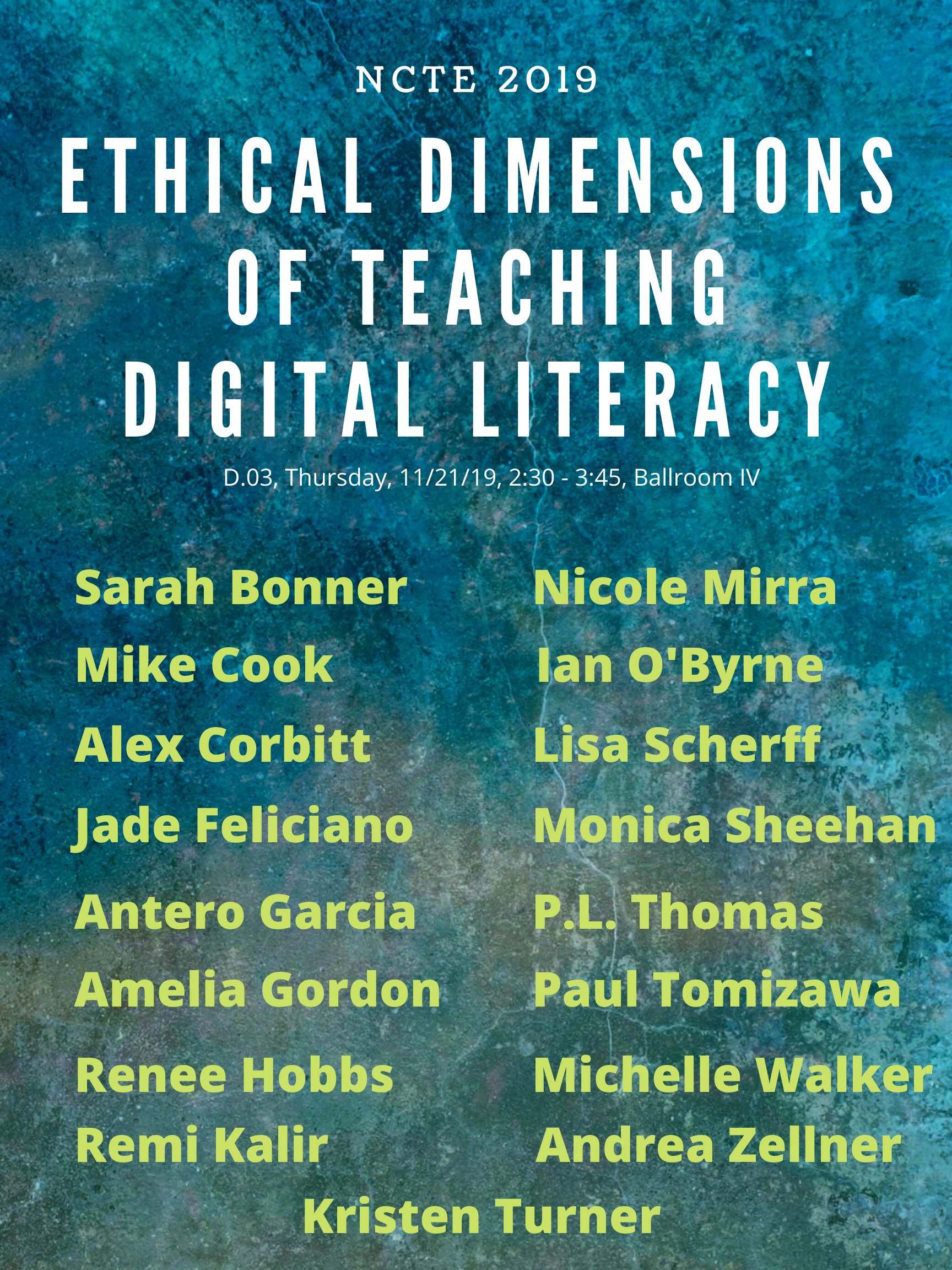
(D.03) Ethical Dimensions of Teaching Digital Literacy

Date: Thursday, November 21, 2019
Time: 2:30 p.m. – 3:45 p.m.
Location: Ballroom IV

How do we teach students to be responsible, ethical citizens in a digital world? From reading and writing online to social interactions, teachers have responsibilities in teaching the ethical dimensions of digital literacy. This session will provide practical applications across grade levels.

Roundtable Leader: Paul Thomas: The Ethical Dilemma of Satire in an Era of Fake News and the Brave New World of Social

Image

See Also

The Ethics of Digital Literacy: Developing Knowledge and Skills Across Grade Levels


(E.09) Expanding the Canon: New Voices, New Inquiry, New Ideas

Date: Friday, November 22, 2019
Time: 9:30 a.m. – 10:45 a.m.
Location: 307

At NCTE 2018, Chimamanda Ngozi Adichie confessed that she still reads “dead white men” even as she advocated for expanding the canon. In other words, expanding the canon does not mean erasing authors, but rather incorporating new perspectives, asking new questions, sharing new ideas. This roundtable session explores what it means to expand the canon by making contemporary connections. Participants will select among 13 tables, each offering units grounded in canonical text(s) and exploring critical and contemporary ways to investigate those texts. After brief opening comments, participants will have the opportunity to circulate among 3 of the 13 roundtables.

Roundtable Leader: Paul Thomas: Haruki Murakami and The Great Gatsby

See Also

Re-reading Faulkner in Trumplandia: “[H]is ferocious conviction in the rightness of his own actions”

The “Vast Carelessness” of White America

Cormac McCarthy’s Mostly White, Male Mythology: Rethinking the Canon


(F.02) Critical Media Literacy in English Education

Date: Friday, November 22, 2019
Time: 11:00 a.m. – 12:15 p.m.
Location: Ballroom IV

The roundtable session on critical media literacy in English education focuses on the ways in which English educators advocate with others for critical media literacy. Linking to the conference theme, several roundtable presenters inquire into our conception and practices of critical media literacies, including the ways of consuming, producing and distributing critical media literacies in an age of post-truth politics.

Opening Comments: Paul Thomas: What Is Teaching English?

See Also

On Pedagogy and Expertise: Enduring False Dichotomies in Education

The Right Remains Wrong about Teaching, Learning, and Critical Thinking

Teacher Preparation and the Kafkan Nightmare of Accreditation


(G.02) L. Ramon Veal Research Seminar

Date: Friday, November 22, 2019
Time: 12:30 p.m. – 1:45 p.m.
Location: Ballroom IV

The L. Ramon Veal Research Seminar is an ELATE-sponsored session that supports graduate students and teacher researchers engaged in educational research through directed discussion with senior scholars in ELA teacher education.

Respondent: Paul Thomas


(H.01) The Intersection of Literacy, Sport, Culture, and Society

Date: Friday, November 22, 2019
Time: 2:00 p.m. – 3:15 p.m.
Location: Ballroom II

This roundtable session invites attendees to explore contemporary literacies and diverse teaching practices by using sports content and an examination of sports culture to create learning environments that empower students to think critically about issues impacting the world around them.

Roundtable Leader: Paul Thomas: Race, Athleticism, and Intelligence in Media Narratives of Athletes

See Also

Racism not Below the Surface in U.S., Still

Richard Sherman’s GPA and “Thug” Label: The Codes that Blind

The Politics of Wealth and Power

The NFL and the Politics of Lies

Kaeptain America?: On Respectability Politics


(M.43) Nurturing an Inquisitive Spirit and Fostering Our Public Selves Through Social Media

Date: Saturday, November 23, 2019
Time: 2:45 p.m. – 4:00 p.m.
Location: 346

Teaching necessitates attending to the learning and growth of other people, but how, as teachers, can we nurture our own creative and intellectual development? In this interactive session, attendees will dialogue with educators who, through bogging, podcasting, and tweeting, are using social media to foster their public selves.

Co-presenter: Sean Connors
Co-presenter: Paul Thomas
Co-presenter: John Warner

See Also


Teaching in Hostile Times

There is a long-time joke at my university that has far more than a grain of truth in it—the campus and the university environment captured in a metaphor, the bubble. Referring to the bubble elicits smiles and even laughter, until the bubble bursts.

Over three M-W-F morning courses this fall, I teach 40 students—39 are first-year students, and 39 are white. Most, as is typical of my university are women, and most are significantly privileged in a number of ways.

During fall break this year, vandalism and theft invaded the bubble, including Swastikas and sexually hostile language written on young women’s dormitory doors and marker boards.

So far the university response has been a mostly silent investigation and one official email from the Chief Diversity Officer and University Chaplain. When I engaged one class in a conversation about the incident, I heard the following concerns from students, which I shared with the President, Provost, Academic Dean, and CDO:

  • Students are concerned with a lack of information, and that only one email from two FU admins has been sent [1]. Some mentioned that email was in their spam folder.
  • Students expressed concern that almost no professors have addressed these events in class.
  • Students openly wondered if this is being “swept under the rug,” and fear that if/when people responsible are discovered, what the consequences will be.
  • More broadly, students expressed some trepidation about the open-campus nature, and seemed unsure how to alert and who to alert with specific concerns.

The second point stands out to me because a couple students directly noted that in one class the discussion planned for a class session was about how things used to be bad at the university—highlighting offensive pictures in old year books and such—yet the professor left the discussion there, failing to use that moment to link to the current evidence that things are still bad at the university.

Of the 15 students in that class, only one had been in a class that addressed the hostile vandalism; that class is taught by Melinda Menzer, professor of English, who has been quoted by media extensively on the incident:

“We are in a time where, nationally and internationally, white supremacists and their rhetoric have become more visible and more violent,” Menzer said. “We’ve seen Nazis and neo-Nazis marching on our streets, and they feel empowered in a way they have not felt empowered in decades.”

Menzer is a member of Temple of Israel in Greenville. Her grandfather immigrated to the United States from Lithuania in 1925 — the rest of his family was murdered in the Holocaust.

“None of this is abstract to me or my family, and I also think it shouldn’t be seen in isolation,” Menzer said. “They (white supremacists) don’t just hate Jews — they hate Muslims, they hate African Americans, they have strong anti-immigrant rhetoric. Those things are tied together in their manifestos. It is a matter for all good people to speak up against this hatred, now.”

Menzer said for her and others on campus, the graffiti is not something that can be brushed off as a joke.

“It is easy to say, ‘They’re just trying to scare people,’ or, ‘This is a joke,'” Menzer said. “It’s not that they are trying to scare people — it’s that they are scaring people. They are creating a negative environment, and that is why we all must speak out.”

Menzer said she does not feel that Furman is unique or more dangerous than other campuses because of the incident, but that the graffiti is a reflection of the rise in white supremacy worldwide.

“It is more important than ever before for a group of people to speak up and to name hate when they see it and to denounce it,” Menzer said. “All of us who have a voice need to send a clear message — this is hate, and we denounce it,” Menzer said.

Her careful and direct analysis and call for action, however, as my students have witnessed, have fallen mostly on deaf ears among faculty.

Faculty chair, Christopher Hutton, offered his own call to action to faculty in the first faculty meeting after the vandalism, in part concluding:

In the meantime, it is easy to feel powerless. What can we do as faculty? Well? We can teach [emphasis in original]. The messages we convey to students can be powerful. We can use this incident as a reminder that we must condemn acts of hatred and intolerance. We can be present [emphasis in original], taking an active part in the multiple efforts that are already underway across campus such as FaithZone, SafeZone, the recently announced anti-racism workshop coming up in a few weeks, CLP events, and other opportunities for inclusive dialogue. We can keep an eye out for those who might be most affected by the incident and provide support. What we can not do is to let the abhorrent behavior of a few individuals overshadow the good work that all of you are doing with students every day. We can, indeed we must [emphasis in original] continue to strive towards an inclusive environment in which the academic mission of the university can thrive. I stand here today to say that I plan to take part in that process and that I trust that you will also.

These calls both focus on the role of professors to teach in times of hostility.

As I have allowed and encouraged conversations in my classes, I have discovered that my students were uninformed about important concepts—gaslighting, the male gaze, the sexist origins of “hysterical,” and the traditional resistance in academia toward professors being political, either being public intellectuals or bringing so-called politics into their teaching.

Despite these conversations being grounded in horrible events, and despite these conversations being off-topic in that they were not in my original lesson plans and were only tangentially related to the content of the courses, the lessons were powerful and deeply academic, firmly grounded in the very essence of liberal arts and formal education in the pursuit of an ethical democracy.

These were examinations of personal autonomy, breeches of consent, and the rise of emboldened hatred—even as we all anticipate the perpetrators claiming it was all a joke.

The absence of addressing these events in classrooms is not surprising to me since the traditional view of teaching—K-12 and college—includes somehow requiring that teachers and professors remain dispassionate and politically neutral. At my university, the norm is clearly that professors should just teach their classes, that professors can and must be politically neutral.

Professor of political science and author of Comrade, Jodi Dean has recently weighed in on that tension with an argument for The Comradely Professor:

Etymologically, comrade derives from camera [emphasis in original], the Latin word for room, chamber, and vault. The generic function of a vault is producing a space and holding it open. This lets us hone in on the meaning of comrade: Sharing a room, sharing a space generates a closeness, an intensity of feeling and expectation of solidarity that differentiates those on one side from those on the other. Politically, comradeship is a relation of supported cover, that is, the expectation of solidarity that those on the same side have of each other. Comrade, then, is a mode of address, figure of political belonging, and carrier of expectations for action. When we call ourselves comrades, we are saying that we are on the same side, united around a common political purpose.

And the problem with comradely professors?:

The comradely scholar is committed, fierce, and resolutely partisan. That means that she is more likely to be hated than loved in the academy. Her commitments are political, not disciplinary or professional commitments, which of course does not mean that she is undisciplined or unprofessional.

Like Dean, I argue and practice the ideology, critical pedagogy, that scholarship and teaching are inextricable from each other and both can only be political—even taking the neutral pose is political.

The professors at my university not discussing the hostile vandalism as part of class are making political choices and political stances, yet only those of us addressing these events directly in class will be framed as being the political ones. Comments online with the news article have born that out.

Most of my students are young women and some are Jewish; as Menzer noted, it doesn’t matter the claimed intent of the hostile vandalism because those acts have intimidated people, they have incited fear.

Teaching in hostile times requires a great deal of teachers, even more than in so-called normal times.

Our classrooms are not bubbles, our schools and colleges are not bubbles, and our ethical duties include a recognition that nothing is merely academic, that nothing is politically neutral.

Teaching in hostile times means teaching students’ lived lives, it means inviting their entire experiences into the classroom so that we as teachers and professors can listen, learn, and fully teach.

See Also

Diversity Has Become a Booming Business. So Where Are the Results?


[1] In my original email, I noted “one” admin inaccurately; the one email is signed by two admins as noted earlier in the post above.

In the News

These SC colleges don’t require SAT, ACT scores for admission. Here’s why, Ariel Gilreath (The Greenville News)

Gatekeepers of college education

Paul Thomas, a professor of education at Furman University and educator for 36 years, said that although creators of standardized tests have been working against bias for decades, they are still biased.

“There’s quite a lot of body of research that standardized tests are far more strongly correlated with out-of-school factors than they are to in-school factors,” Thomas said. “Standardized tests are a stronger reflection of factors beyond a child’s control than they are of a child’s ability.”

Among Thomas’ critiques of using standardized tests like the SAT are flaws that other critics have pointed out — that some students are bad test-takers, that poorer students are less likely to have access to test preparation materials and tutors, that the outcome of a high-stakes test could be determined on whether the student slept well the night before.

“The SAT is one data point from one time period. GPA is dozens of data points over years,” Thomas said. “GPA is a single number that is a richer data point.”

But Thomas’ biggest critique of the SAT and ACT is their use as gatekeepers for college education.

“The SAT and ACT are gatekeepers that are not good data for student ability, and they’re not good data for who deserves to go to college,” Thomas said.

The weight of SAT and ACT scores in admissions decisions also make it an easy target for misuse — a test administrator in Los Angeles was central to a lucrative scheme discovered earlier this year where student scores were fixed by a tutor who took the test for them or corrected their incorrect answers.

While the number of test-optional schools in the country are rising, Thomas said the path to reducing standardized testing in education is a difficult one — annual standardized scores are widely published and often used to rank state education systems and even individual schools.

“The SAT and the ACT are very powerful. These are organizations that generate a huge amount of money,” Thomas said. “Americans believe in this stuff.”

Swastikas and ‘sexually explicit’ graffiti found at Furman University dorm, Ariel Gilreath (The Greenville News)

Paul Thomas, a professor of education at the school, said in an email to his students that the graffiti was “neither funny nor inconsequential.”

“Where you live these four years and where you learn, I think, are sacred spaces – and while no one can promise these spaces will be perfect, we must all work diligently to insure they are safe and inclusive,” Thomas said in the statement.

Hall Pass

I noticed I had been tagged by a former high school student on Facebook a few days ago. “While looking for pictures of my Daddy in some old memory and picture boxes that I forgot existed,” she began, “I came across this WHS [Woodruff High School] artifact that became the deciding factor on whether or not I was punished with demerits for a week out of every month.”*

She posted these pictures of the artifacts, hall passes from my class:

No photo description available.

Image may contain: drink and indoor

The high school where I taught English for 18 years was the same high school I had attended. By the time I was reaching the end of my time there, the school had morphed into an extremely authoritarian environment—demerits issued to students for being late to class, simply going to the restroom during class (for any reason), eating in class or chewing gum, and the usual assortment of what most people would deem disciplinary issues such as fighting or causing a disturbance during class (“holding court” and talking back being the major offenses).

These strict rules meant some students found themselves issued in-school suspension (ISS) for nothing more than very minor infractions, such as needing to use the restroom several times.

As this student noted, and as is typical of school dress codes, for example, these policies were very harsh and disproportionate for young women during their menstrual cycles:

I was 15 years old and hated getting demerits for needing to use the restroom. (you know——that unfair rule that is a blatant disregard for females and the needs we biologically have zero control over. The one that punishes females because periods refuse to schedule themselves around a 12 minute break or that 4 minutes we were given to change classes.) 

Early in my career as a teacher, which began in the fall of 1984, I recognized that teaching English was often about far more than reading, writing, and literacy. My classroom, my teaching, and the school environment—all of these projected daily lessons to students about who they were and who they should be.

Frankly, I found those lessons to be extremely problematic.

One principal allowed prayer over the intercom and boldly announced that he would be proud to be punished for flagrantly breaking the law—all while expecting students to meticulously follow every rule imposed on them by the administration and teachers.

The first decade of teaching, in fact, taught me that formal education is often a way to reflect and perpetuate the very worst aspects of sexism, racism, and classism grounded in a community. In my doctoral program, I came to recognize I had been thinking and practicing critical pedagogy without any real awareness it had a formal name and philosophy.

But the restroom pass, I think, and how I navigated school and classroom rules with my students stand today as (using my former student’s language) powerful artifacts of a more basic grounding for how formal education and teaching should be guided—maintaining an awareness of and respect for basic human dignity among all students.

While the school policy for restroom visits mandated that all students were turned in for any trip during class, I initiated a policy that allowed students simply to take a prepared pass (see the artifacts above) and go to the restroom if needed, no demerits issued. Students did not need to ask and were expected to leave and return with a minimum of disruption to class.

I explained my policy and stressed to students that it was their responsibility to honor what I was offering—that using my policy to sneak a smoke, vandalize the restroom, or simply to wander the halls would put them at great risk of being punished harshly if caught by another teacher or an administrator. In other words, I could offer grace from embarrassment and demerits, but I could not control what happened once they left my room.

Throughout much of those 18 years, I was almost daily reprimanded by administration for not issuing demerits for students coming late to class, using the restroom during class, and eating or chewing gum in class. This was stressful (and petty, I felt) and genuinely helped bring my career as a public school teacher to an end.

Human dignity and professionalism also cannot be partitioned.

Another aspect of how I managed my class in opposition to school rules I found dehumanizing and (using every chance to teach) draconian included that I always explained to my students that I was not sneaking or hiding my practices as a teacher from anyone. I was openly challenging these rules and I was also willing to pay the consequences.

Once the assistant principal and athletic director/football coach stood at my door and began to yell at me since several students were eating while working on their essays. That day, I walked out of the class, past him, and to the principal, explaining what happened and noting it needed to be the last time it did.

How can we, I asked, expect students to maintain a level of behavior, tone, and deference to authority that the people charged with authority in the school flaunted daily?

I simply have never been able to separate my personal aversion to hypocrisy from my roles as teacher, coach, or parent. As I have noted in posts before, I had a sign on my wall that read: “Any fool can make a rule and any fool will mind it” (Henry David Thoreau).

The more I taught, the more I recognized that my role as a teacher of literacy was about power and human autonomy. I could not compartmentalize classroom discipline, interacting with students, and the so-called ELA curriculum from each other.

Ethically and philosophically, all of my behavior as the teacher and as a person had to be consistent with the ideals I believed in—central to that being the need to respect the human dignity and autonomy of the students assigned to my class, and all of the students in our school.

Of course, over 18 years, I made many mistakes in both how I treated students and in my teaching; I failed students from time to time as people, and I did occasional great harm to reading and writing (sigh).

But much of the time, my classroom was a safe haven for young people to be honest and genuine, for learning to be a community experience, and for lessons that were healthy and fair but not simply about Nathaniel Hawthorne or writing literary analysis.

And my classroom was a work-in-progress, searching for ways to meet Paulo Freire‘s idea of teacher/student working with students/teachers as well as creating my teaching role as authoritative, not authoritarian.

Reading the Facebook post from a former student, written 20 years after the fact, helped me understand that the hall pass was more than a loophole or a pass to use the restroom. It was a pass for a student to be fully human as a 15 year old young woman.

How often as adults, especially in schools, do we deny children and teens access to their humanity as if they need a pass for that? As if each of us is not born with inalienable rights to life, liberty, and the pursuit of happiness?

When we as adults are charged with roles of authority, our first directive should be always to see and to hear the humanity of those assigned to that authority.

It has been two decades since I left teaching high school, and one of my students reached out with kindness and once again taught me a lesson.

And a reminder for me as a person and a teacher: “But I have promises to keep,/ And miles to go before I sleep.”


* The full post reads:

While looking for pictures of my Daddy in some old memory and picture boxes that I forgot existed, I came across this WHS artifact that became the deciding factor on whether or not I was punished with demerits for a week out of every month.

I feel like I need to make this confession——20 years later. When you were my teacher in tenth grade, I accidentally brought this hall pass home in my coat pocket on like the first or second day of school. I had every intention of returning it and apologizing for the accidental theft, but I was 15 years old and hated getting demerits for needing to use the restroom. (you know——that unfair rule that is a blatant disregard for females and the needs we biologically have zero control over. The one that punishes females because periods refuse to schedule themselves around a 12 minute break or that 4 minutes we were given to change classes.)

I wasn’t searching for a loophole, but a loophole found me. I held onto to this hall pass for my entire sophomore year. I went from having to attend Saturday school regularly to have demerits erased to stave off ISS to never getting another demerit.

This hall pass did the same thing my junior and senior years. I used to look at it and remember there was at least one teacher at WHS that refused to enforce such bullshit. Tonight I looked at it and saw a symbol of how indoctrinated and conditioned we are/were to the archaic rules and punishments that infringe on our very basic needs.

Thank you for being a teacher that absolutely refused to punish girls for having functional ovaries.

Margaret Atwood’s The Testaments: Reading and Writing Beyond Gilead

Becka said that spelling was not reading: reading, she said, was when you could hear the words as if they were a song. (p. 297)

The Testaments, Margaret Atwood

“How did Gilead fall?” Margaret Atwood asks in the Acknowledgements, noting that The Testaments, set 15 years after the main action of The Handmaid’s Tale but drafted 30-plus years after that novel, “was written in response to this question” (p. 417).

Even a writer of Atwood’s talent and success probably could never have imagined that Handmaid has become the cultural and political touchstone that has occurred with the rise of Trump and the popular Hulu series.

Those who found Handmaid in the late 1980s to be powerful then and an extremely compelling work of fiction may be skeptical about Atwood’s very late return to this now modern classic. For both the newly converted and the long-time fans of Atwood, I want to assure you all that this much delayed sequel pays off quite wonderfully.

I came to Atwood as a teacher—specifically high school Advanced Placement Literature and Composition—and then as a scholar. I have also grounded a tremendous amount of my academic and public work in Atwood’s fiction and non-fiction.

With efforts here, then, to avoid as much as possible spoilers, I want to highlight a few of the ways in which Atwood maintains elements from Handmaid while also extending her writer’s urge to connect literacy with empowerment and attaining ones full humanity.

The Testaments offers the narratives of three women—notably including Aunt Lydia from Handmaid. In both novels, as is common with Atwood’s fiction, the narrations are both lending a voice to those often unheard or silenced and working as meta-narrations about the nature of truth when stories are told, retold, and examined (both novels end with Gilead being  the focus of academic scholarship).

Much of Atwood’s fiction is an exploration of what it means to tell and retell stories.

Names and renaming are also prominent in the sequel, dramatizing the power of names and (re)naming as those processes disproportionately impact women in the service of men and patriarchy.

Handmaid details the end of the U.S. and how Gilead comes into being, although much of that is limited to what Offred could have known as a handmaid. Then, many of the finer details are revealed in the Historical Notes, a scholarly examination of Gilead well after its fall.

Testaments broadens the perspectives by including one voice from an inner woman of power, a woman mostly trapped in the upper levels of the Gilead machine, and another view from outside (Canada) that is both somewhat naive and deeply cynical.

These testaments piece together a well established Gilead for the reader and also document the theocracy’s final days. Some of the most compelling elements here are the full development of Aunt Lydia and the careful examination of two characters being groomed to be Aunts (after narrowly avoiding being wed to Commanders).

Part XVII: Reading Room serves as an excellent example of where Atwood excels in combining many of the thematic and narratives elements of her dystopian speculative novel. Aunts are women designed within Gilead to control other women; Aunts are embodiments of a sort of paradoxical authority, including their legal access to reading and writing.

In their journey to becoming Aunts, Agnes and Becka—who have bonded over their fears of being married to a Commander—take on a mentee (Agnes)/mentor (Becka) relationship since Becka has learned to read and write well ahead of Agnes. The motif of reading and writing is emphasized near the end of the novel, and Gilead, I think, to highlight the power of language.

Agnes struggles:

My reading abilities progressed slowly and with many stumbles. Becka helped a lot. We used Bible verses to practise, from the approved selection that was available to Supplicants.. With my very own eyes I was able to read portions of Scripture that I had until then only heard. (p. 297)

These scenes reminded me of Atwood’s deft use in the original novel of Commanders reading scripture to the Wives and Handmaids, with the reader alerted to what Becka soon reveals to Agnes:

The day came when the locked wooden Bible box reserved for me would be brought out to the Reading Room and I would finally open this most forbidden of books. I was very excited about it, but that morning Becka said, “I need to warn you.”

“Warn me?” I said. “But it’s holy.”

“It doesn’t say what they say it says.” (p. 302)

This echoes in Handmaid when the Commander reads the Bible before the Ceremony with Offred:

The Commander pauses, looking down, scanning the page….We lean toward him a little, iron fillings to the magnet. He has something we don’t have, he has the word. How we squandered it once….

For lunch it was the Beatitudes….They played it from a tape….The voice was a man’s….I knew they made that up, I knew it was wrong, and they left things out, too, but there was no way of checking. (pp. 88-89)

In both novels, Atwood reveals that whoever controls the word maintains power. These novels should remind readers that throughout history, learning to read has been carefully controlled—who is allowed, who is not, and who remains so burdened with living that to read seems a luxury.

And so Agnes gains a sort of consciousness along with gaining literacy: “Being able to read and write did not provide the answers to all questions. It led to other questions, and then to others” (p. 299).

As Becka cautioned, Agnes confronts that “[t]he truth was not noble, it was horrible”:

This is what the Aunts meant, then, when they said women’s minds were too weak for reading. We would crumble, we would fall apart under the contradictions, we would not be able to hold firm.

Up until that time I had not seriously doubted the rightness and especially the truthfulness of Gilead’s theology. If I’d failed at perfection, I’d concluded that the fault was mine. But as I discovered what had been changed by Gilead, what had been added, and what had been omitted, I feared I might lose my faith. (p. 303)

This awakening in Agnes born of her learning to read and write leads to a larger theme for Atwood: “Once a story you’ve regarded as true has turned false, you begin suspecting all stories” (p. 307).

And in Testaments, “Beneath its outer show of virtue and purity, Gilead was rotting” (p. 308).

As compelling as Atwood’s motifs are in their deconstructing of history and the present, The Testaments if no mere “protest novel,” which James Baldwin rejected, explaining:

It must be remembered that the oppressed and the oppressor are bound together within the same society; they accept the same criteria, they share the same beliefs, they both alike depend on the same reality….

The failure of the protest novel lies in its rejection of life, the human being, the denial of his beauty, dread, power, in the insistence that it is his categorization alone which is real and which cannot be transcended. (pp. 17-18)

Atwood doesn’t stoop to simple Continue reading Margaret Atwood’s The Testaments: Reading and Writing Beyond Gilead

Unsweet Tea: On Tokenism, Whiteness, and the Promise of Culturally Relevant Teaching

I stood as I have many times in front of the two tea dispensers at a chain sub sandwich shop. But this time, I was suddenly struck with the choice I always make—the “unsweet tea.”

Medium Freshly-Brewed Iced Tea Unsweetened

I was born, raised, and have lived my entire life in the Deep South. My mother made tea that would rival pancake syrup and trained my sister and me in the meticulous ritual of steeping tea bags and then pouring the hot tea over a huge mound of processed sugar.

The tea pot was dedicated only to steeping tea, and the tea jar and the giant plastic sugar spoon were sacred as well.

Once I left home, my mother flirted with sun tea, but the syrup-sweet tea of my childhood later became my defining feature of what could rightfully call itself The South. When ordering tea, The South hands you sweetened ice tea; hot tea or tea without sugar are not even mentioned, or considered.

So with a great deal of shame, I must admit that only a week or so ago I was truck with the absurdity that is “unsweet tea,” which of course is just tea.

The “unsweet” is a necessity only because “sweet tea” in South Carolina is the norm, the default, what has been rendered invisible and simultaneously right.

All across the U.S., then, “unsweet tea” in The South is a less controversial entry point into how whiteness works as the norm, the invisible, and the right.

Whiteness as the normal and as the invisible drives the greatest bulk of privilege in the U.S., but once that whiteness and privilege are exposed, confronted, white fragility is the response, as Robin DiAngelo (2011) details:

White people in North America live in a social environment that protects and insulates them from race-based stress. This insulated environment of racial protection builds white expectations for racial comfort while at the same time lowering the ability to tolerate racial stress, leading to what I refer to as White Fragility. White Fragility is a state in which even a minimum amount of racial stress becomes intolerable, triggering a range of defensive moves. These moves include the outward display of emotions such as anger, fear, and guilt, and behaviors such as argumentation, silence, and leaving the stress-inducing situation. These behaviors, in turn, function to reinstate white racial equilibrium.

White fragility as a response to naming and confronting privilege as well as racism is extremely powerful because that response is clinging to an entrenched norm with incredibly long and anchored roots.

Despite claims that formal public education works to change students and thus reform society, schools most often reflect and perpetuate privilege and all sorts of inequities and norms. Thus, education—teachers/teaching, curriculum, testing, discipline, dress codes, etc.—tends to work in the service of whiteness.

Just as whiteness must be exposed and confronted in society, education that is liberatory and life- as well as society-changing must be willing to commit, as Gloria Ladson-Billings explains, to culturally relevant teaching:

A hallmark for me of a culturally relevant teacher is someone who understands that we’re operating in a fundamentally inequitable system [emphasis added] — they take that as a given. And that the teacher’s role is not merely to help kids fit into an unfair system, but rather to give them the skills, the knowledge and the dispositions to change the inequity. The idea is not to get more people at the top of an unfair pyramid; the idea is to say the pyramid is the wrong structure. How can we really create a circle, if you will, that includes everybody?

Instead, Ladson-Billings laments:

I find that teachers often shy away from critical consciousness because they’re afraid that it’s too political [emphasis added]. A perfect example for me is some years ago when Mike Brown was killed in Ferguson, that district in Ferguson sent out a directive that teachers not talk about this. This is exactly what kids are talking about every single day, because at night when they go home and turn on the news, their streets are flooded with protesters, and they need an adult to help make sense of this. But the school has said, “No, you can’t talk about this.”

One result of teachers and schools self-regulating in the service of whiteness, privilege, and inequity is tokenism—viewing culturally relevant teaching through a deficit lens isolated on Black and Brown students or students living in poverty; and selecting curriculum, materials (texts, programs, etc.), and events that highlight diversity and multiculturalism,

but [as Ladson-Billings explains] what research has found is just changing the content is never going to be enough, if you are pedagogically doing the very same things: Read the chapter, answer the questions at the back of the book, come take the test. You really haven’t attended to the deep cultural concerns. What happens is school districts want you to do just that — teach exactly the way you’ve been teaching, just change the information [emphasis added]. That does little or nothing to increase engagement, and it certainly doesn’t help kids feel any more empowered about what they’re learning.

Whiteness, like sweet tea in The South, is ubiquitous in the U.S.—but whiteness desires to remain invisible as it drives privilege for some and further entrenches inequity for others. White fragility is the only consequence of rendering whiteness visible so that it can be eradicated.

This confrontation of whiteness is the duty of white people, and that must not be dulled by tokenism and self-regulation.

Recognizing that “unsweet tea” is just tea serves as a powerful example of the importance of naming as a first step to exposing in a journey to eradicating whiteness and privilege.

Genuine and robust culturally relevant teaching does offer a promise to move beyond whiteness and to quell white fragility, as Ladson-Billings argues:

When we do this work, there are certain baselines that people have to have. Number one, they have to believe that racism is real, and number two, they have to believe that they may be acting on it….

The most segregated group of kids in the country are white kids. We never refer to their schools as segregated. We refer to black and brown kids as going to segregated schools.

So, integration in which kids of different races and ethnicities have an opportunity to fully participate in the life of the school is what I would hope to see.

De-centering whiteness proves to be a bitter drink for white people who are too often compelled to respond with white fragility or tokenism.

Now, whiteness must seek ways to work against itself, making whiteness visible, centering it one last time in order to recenter our society and schools in ways that are equitable.


See Also

The female price of male pleasure

The Great Accountability Scam: High-Stakes Testing Edition

Among other teachers and education scholars, I have been making a case throughout my 36 years in education that has prompted mostly derision from edureformers, politicians, the media, and “no excuses” advocates; the position grounded in evidence includes:

  • Standardized and high-stakes tests are weak proxies for student achievement and teacher/school quality but powerful proxies for the socioeconomic status of students’ homes and communities.
  • And thus, important contributions made by teachers and schools to student learning are very difficult to measure or identify in any direct or singular way (either in a one-sitting test or linked to one teacher over one course, etc.).
  • Accountability structures do not and cannot reform in any substantive way teaching and learning; in fact, high-stakes standards and testing are likely to impact negatively complex and powerful teaching and learning in the name of democracy, human agency, and equity.
  • All in-school-only education reform, then, will appear to (and actually) “fail” as long as public policy does not first or concurrently address socioeconomic inequities such as healthcare, work quality and stability, food insecurity, safety and justice, etc.
  • Social and educational reforms are extremely complex and take far more time than political and public impatience allows; however, the proper political will should shift the U.S. social and educational reform toward an equity structure (not an accountability structure) in order to see observable positive change over time.
  • In-school equity reform must address teacher assignments, de-tracking course access, fully funding all in-school meals, fully publicly funding K-16 education, school discipline and dress codes grounded in restorative justice and race/class/gender equity, and student/teacher ratios.

Historically and currently, public education—as well as charter schools and private schools—serve well the students with the most race, class, and gender privileges and mis-serve inexcusably the most vulnerable students—black and brown students, English language learners, special needs students, and impoverished students.

Accountability does not and cannot address that gap; high-stakes testing measures that gap and often increases the inequity since the stakes are tied to gatekeeping in education and society.

Formal education in the U.S. has mostly reflected and perpetuated our national and regional inequities, and the claim that schooling is a “game changer” remains a deforming myth.

As a recent additional source of evidence for my claims, please see this study by Kenneth Shores, Pennsylvania State University and Matthew P. Steinberg, George Mason University:

The Great Recession was the most severe economic downturn in the United States since the Great Depression. Using data from the Stanford Education Data Archive (SEDA), we describe the patterns of math and English language arts (ELA) achievement for students attending schools in communities differentially affected by recession-induced employment shocks. Employing a difference-in-differences strategy that leverages both cross-county variation in the economic shock of the recession and within-county, cross-cohort variation in school-age years of exposure to the recession, we find that declines in student math and ELA achievement were greater for cohorts of students attending school during the Great Recession in communities most adversely affected by recession-induced employment shocks, relative to cohorts of students that entered school after the recession had officially ended. Moreover, declines in student achievement were larger in school districts serving more economically disadvantaged and minority students. We conclude by discussing potential policy responses. (Abstract)