Category Archives: Education

The Big Lie about the “Science of Reading” (Updated)

While too often inordinately dangerous* for the most vulnerable, social media can be a powerful window into how we think about and judge education. Recently, the reading wars have been once again invigorated; this time driven often by parents and advocates for students with special needs and accompanied by a very familiar refrain, the “science of reading.”

One problem with public debate about education is that political and public voices often lack experience and expertise in education as well as any sort of historical context.

First, those who have studied the history of education, and specifically the ever-recurring reading wars, know that there has never been a decade in the last 100+ years absent political and public distress about a reading crisis.

However, one doesn’t need a very long memory to recognize that if we currently are (finally?) having a reading crisis, it comes in the wake of almost two decades (nested in a larger four decades of accountability birthed under Ronald Reagan) dedicated to scientifically-based education policy, specifically reading policy driven by the National Reading Panel (NRP).

The NRP was touted as (finally?) a clearing house of high-quality evidence on teaching children to read (although it proved itself to be partisan hokum).

This is all quite fascinating in the context of the current media blitz about the reading crisis and a need (yes, once again) to focus on the science of reading. Concurrent with that media fail is a move within the academia to shift reading away from literacy experts and into the purview of special needs, treating all reading instruction as something like remediation or a learning disability.

For example, I noticed a very odd dynamic on social media: a post on a community Facebook page for advocates of education that was linked to a dyslexia Facebook page promoting this from Mississippi:

MS gains propaganda

The message included dramatic arguments: Mississippi has somehow found the science of reading and is excelling in ways South Carolina refuses to do.

Knowing standardized test scores, and NAEP specifically, well, I was immediately skeptical of these claims.

Here is the short version: In 2017 NAEP data, MS is slightly ahead of SC in 4th-grade reading (both states remain near the bottom and below the national average), but SC is slightly ahead of MS in 8th-grade reading (again, both near the bottom and below the national average):
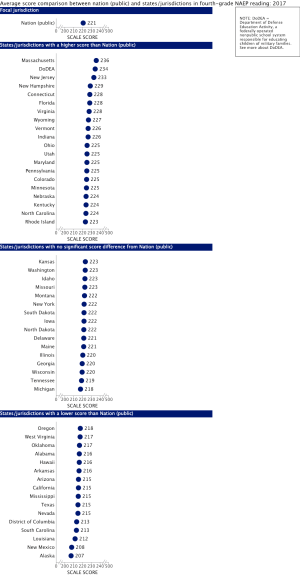
4th reading 2017

8th reading 2017

While Mississippi is promoting gains (accurately), the data remain clear that high-poverty states tend to score low on standardized testing while more affluent states tend to score higher.

What is extremely important to note is that some traditionally low scoring states have found methods (test-prep, reading programs focused on raising test scores, and grade retention) that increase test scores short term (making for political propaganda), but those gains have proven to be a mirage, disappearing in the span between 3rd/4th- grade tests to 8th-grade tests and then high school (see, for example, research on Florida).

So we sit here with some real problems and questions: Is there a reading crisis in the U.S. and my home state of SC? And if so, is that crisis somehow the result of refusing to implement the science of reading?

Well, first, I need to note that the “science of reading” is code for intensive phonics and is intended as an antidote to the current evil in reading, balanced literacy.

Now, consider this: In the late 1980s and early 1990s, a similar event happened when people started shouting about the reading crisis in California spawned by whole language (now, people claim balanced literacy and whole language are the same thing, and thus, equally evil).

Literacy scholar Stephen Krashen, and others, unmasked that round of the reading wars, noting that although CA claimed whole language as the official reading approach of the state, teachers were almost never practicing whole language.

Further, the reading score plummet of those years did correlate with whole language being the official policy, but the causes of those lower scores were a large influx of non-native speakers of English and significant decreases in educational funding (larger classes specifically negatively impacting achievement).

This isn’t particularly simple or compelling but let’s detail why this recent round of the reading wars is way off base:

  • Standardized tests of reading are only proxies of reading, typically they reduce reading to a series of discrete skills that test designers claim add up to reading. This is at least inadequate, if not misleading. No standardized test measures eagerness and joy for reading, as well; nearly none address critical literacy.
  • Making raising reading test scores your primary or exclusive goal is actually cheating all students. Period. And this is what many states are doing, including MS.
  • Achieving test score gains when you are low scoring is much easier that making gains when you are high achieving.
  • Adopting, implementing, and staying focused on any reading program—these are also very common practices, and completely flawed approaches to literacy. Access to books in the home and choice reading remain the strongest predictors of increased reading and reading achievement.
  • Ultimately, if we insist on using reading test scores to judge the quality of teaching reading in any state or the country, we must acknowledge that how students are being taught is both almost impossible to identify and completely impossible to characterize as one clear practice (teachers are very likely to shut their doors and do as they please, regardless of policies).
  • And most important is the fact that standardized test scores of reading are a reflection of a large number of factors, with teaching practices only one (probably small) causal factor.

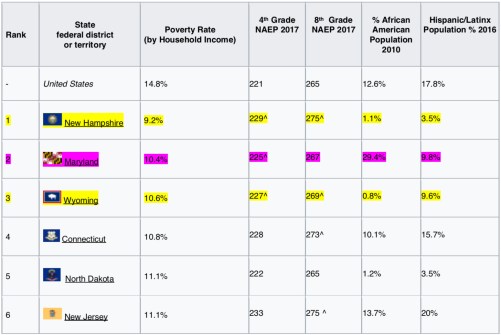
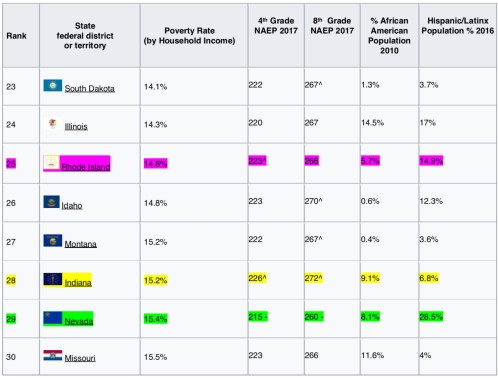
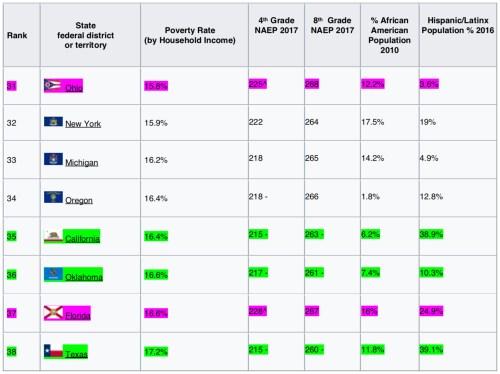
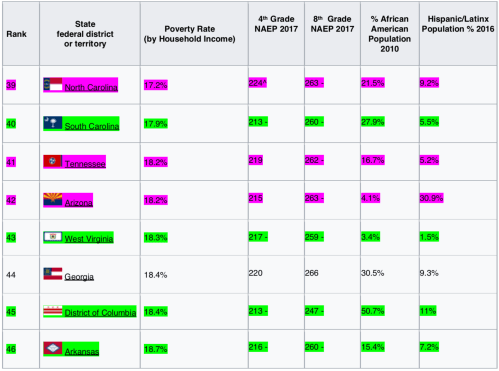
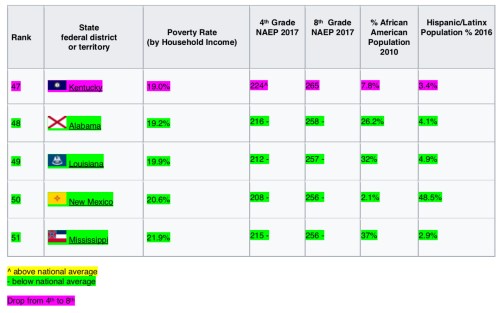
To that last point, consider this matrix of 2017 NAEP reading scores (4th/8th) along with the poverty in each state, the African American population percentage, and the Hispanic/Latinx population percentage. These data portray a much more complex picture of the reading problem, and resist the distraction that how students are being taught reading is cheating students, who could be saved by the “science of reading” (which, by the way, is balanced literacy—o, irony):

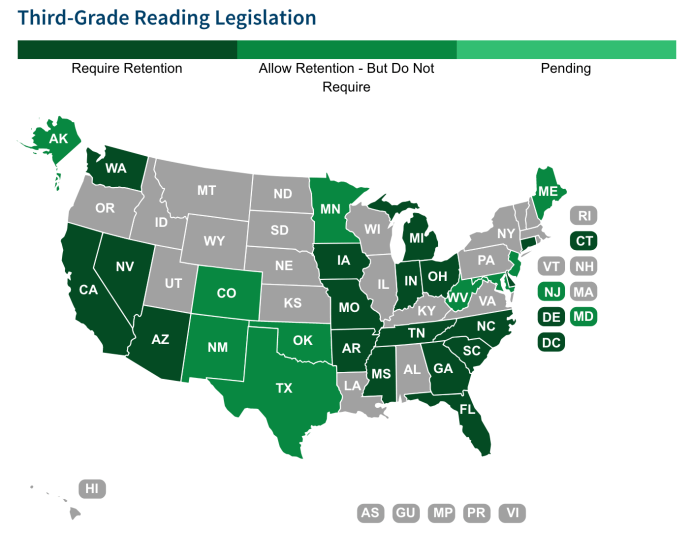
[Click links above each chart for expanded charts with grade retention legislation identified.]

Poverty NAEP 4 8 2017 grade retention 1
NAEP reading 2017 1

Poverty NAEP 4 8 2017 grade retention 2

NAEP reading 2017 2

Poverty NAEP 4 8 2017 grade retention 3

NAEP reading 2017 3

Poverty NAEP 4 8 2017 grade retention 4
NAEP reading 2017 4

Poverty NAEP 4 8 2017 grade retention 5
NAEP reading 2017 5

Poverty NAEP 4 8 2017 grade retention 6
NAEP reading 2017 6

Poverty NAEP 4 8 2017 grade retention 7
NAEP reading 2017 7

The “science of reading” mantra is a Big Lie, but it is also a huge and costly distraction from some real problems.

Relatively affluent states still tend to score above average or average on reading tests; relatively poor states tend to score below average on reading tests.

Some states that historically scored low, under the weight of poverty and the consequences of conservative political ideology that refuses to address that poverty, have begun to implement harmful policies to raise test scores (see the magenta highlighting) in the short-term for political points.

It is 2019. There is no reading crisis in the way the “science of reading” advocates are claiming.

It is 2019. Balanced literacy is the science of reading, but it is not the most common way teachers are teaching reading because schools are almost exclusively trying to raise scores, not students who are eager, joyful, and critical readers.

It is 2019. Political and public efforts to do anything—often the wrong thing—so no one addresses poverty remain the American Way.

It is 2019. It is still mostly about poverty when people insist it is about reading and reading policy.


* This opening has been revised because I made a careless error by making an analogy using the “Wild West,” seeking an engaging opening but making a culturally insensitive comparison instead. I regret this use of phrasing, but also appreciate being kindly informed of my carelessness in private. I try to listen to such concerns, and kindness, and am learning every day to be a better person, and writer.


Third-Grade Reading Legislation
3rd grade retention legislation

Evidence v. Advocacy in Teaching Reading: “We Should Not Mistake Zeal for Warrant”

There is a certain karmic irony to the rise of public intellectuals who start to drive outside their lane—actually who take over all the lanes—only to prove that, in fact, they do not know everything.

Current bloviator-know-nothings include Jordan Peterson and Steven Pinker, the latter who has squandered intellectual capital he had built in psycholinguistics.

Both are experts in the field of psychology, a discipline apt to include far too many scholars with delusions of grandeur (only surpassed in arrogance by scholars in economics and about on par with scholars in political science for knowing everything).

Those of us who are scholars, practitioners, or both in the field of education have suffered a long history of being marginalized as both not really an academic discipline (education as “teacher training”) and merely classroom teachers.

As someone with experience and expertise as a practitioner (high school English teacher for 18 years) and researcher in education, I often find I hold no sway in issues related to education in my public work or with my scholarly impact. Imagine if I held forth in book form on psychology, economic, or politics? Think the New York Times would scramble to hang on my every word as they did for a psychologist claiming to be an expert in teaching reading?

(These are rhetorical questions.)

There exists another layer to education that often remains unexamined: K-12 public education is almost exclusively run along partisan political lines through bureaucracy and legislation that is not created by practitioners or educational researchers.

Practitioners who teach literacy/reading and literacy/reading scholars are currently under assault again by a new round of the reading wars. As has been common in these periodic skirmishes, there really is no war because the so-called factions do not have anywhere near equal power.

As a self-proclaimed reading expert, Daniel Willingham, psychology professor, represents what is essentially wrong with the entire framing of debates about teaching reading as a war.

Stated perfectly by Andrew Davis in his careful debunking of intensive/synthetic phonics advocacy, “The zeal with which synthetic phonics is championed by its advocates has been remarkably effective in pushing it to the top of the educational agenda; but we should not mistake zeal for warrant.”

During the current media blitz once again hand-wringing that children are not being taught to read because teachers are not prepared properly in teacher education and students are not receiving intensive phonics instruction, Willingham held forth on his blog to answer: Just how polarized are we about reading instruction?

His post doesn’t answer the question very well, but in another moment of karmic irony, Willingham reveals why “we should not mistake zeal for warrant.”

Affecting a tone of being fair and balanced, Willingham offers 6 positions on reading:

  1. The vast majority of children first learn to read by decoding sound. The extent to which children can learn to read in the absence of systematic phonics instruction varies (probably as a bell curve), depending on their phonemic awareness and other oral language skills when they enter school; the former helps a child to figure out decoding on her own, and the latter to compensate for difficulty in decoding.
  2. Some children—an extremely small percentage, but greater than zero—teach themselves to decode with very minimal input from adults. Many more need just a little support.
  3. The speed with which most children learn to decode will be slower if they receive haphazard instruction in phonics than it would be with systematic instruction. A substantial percentage will make very little progress without systematic phonics instruction.
  4. Phonics instruction is not a literacy program. The lifeblood of a literacy program is real language, as experienced in read-alouds, children’s literature, and opportunities to speak, listen, and to write. Children also need to see teachers and parents take joy in literacy.
  5. Although systematic phonics instruction seems like it might bore children, researchers examining the effect of phonics instruction on reading motivation report no effect.
  6. That said, there’s certainly the potential for reading instruction to tilt too far in the direction of phonics instruction, a concern Jean Chall warned about in her 1967 report. Classrooms should devote much more time to the activities listed in #4 above than to phonics instruction.

He then claims the reading wars problem is that factions take either the side of the even or the odd numbered claims—although he argues “I think all of the six statements above are true.”

The problem is a sneaky one because most of Willingham’s audience, like Willingham, has no literacy expertise or practical experience teaching children to read. For a lay audience, it is unfair to expect anyone to notice that Willingham has misrepresented the so-called factions in the reading war.

One of the leading literacy experts in the U.S. is Stephen Krashen; in his relentless analysis of research on teaching reading, he notes that the pro-phonics research often is deeply flawed because it presents either garbled or false definitions of whole language (or balanced literacy) in order to make claims of intensive phonics being more effective.

Willingham’s claims about reading instruction and the failures of teaching, teachers, and teacher education can only stand on completely misrepresenting the field of literacy and the so-called debate itself.

Let me frame a different approach to understanding the problem pro-phonics advocates fumble.

Here is the real dynamic concerning the teaching of reading in U.S. K-12 education: Teaching reading practices are guided primarily by legislation (with no assurance that legislation is grounded in anything more than zeal at the expense of warrant) and then driven by the combination of textbook companies appealing to that legislation and accountability structures (most significantly the mandate to raise reading test scores without investigating if those scores are credible proxies for reading growth or—god forbid—reading eagerness).

That is almost the entire real-world power structure governing how students are taught to read.

Well outside this dynamic stand teacher education and literacy/reading researchers, practitioners, and advocates—all of whom have almost no power, yet are the scapegoats when psychology-professors-turned-reading-experts hold forth in book form or in the NYT.

I should note, as well, that an even smaller and less powerful group often not acknowledged is literacy experts with a historical perspective, a group that I strongly identify with.

The teaching of reading and the public debate about reading have always been characterized by overblown histrionics and a nearly complete failure to implement what we know about learning to read in K-12 public schools because of partisan political bureaucracy, textbook companies, the massive and growing testing industry, and the misguided influence of non-educators posing as reading and literacy experts.

I realize there is nothing sexy about this—there is no war, or crisis—and this message once again will fall on deaf ears because I do not currently hold a position in a psychology department or an elected position where I could pander to an uninformed electorate.


Recommended

To read or not to read: decoding Synthetic Phonics, Andrew Davis

What is wrong with NPR’s “why millions of children can’t read” (NPR Morning Report, Jan 2 and Feb 6, 2019), Stephen Krashen

Defending Whole Language: The Limits of Phonics Instruction and the Efficacy of Whole Language Instruction, Stephen Krashen

The Dancing Comma, and Other Punctuation High Jinx

Social media are filled with bad political takes and far too much sexism and racism passed off as “It was a joke!”

Often in the same post.

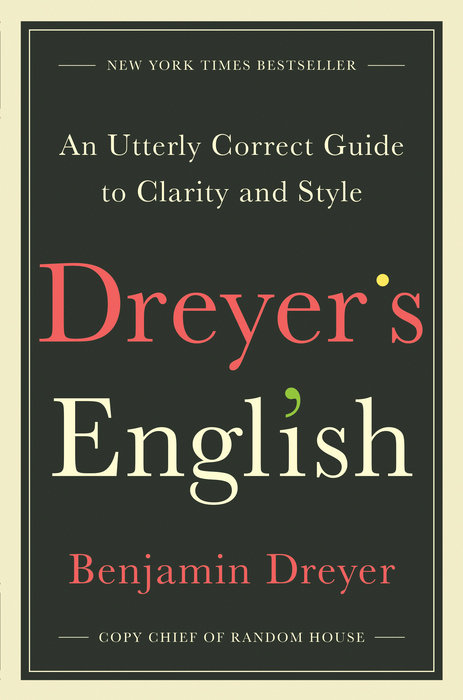
But none of that can stand in the way of some good ol’ grammar, mechanics, and usage snark. Let’s take for example Benjamin Dreyer‘s interactions over Rob Lowe making a multi-level fool of himself on Twitter:

This Twitter discussion fits well into Dreyer’s recent release of Dreyer’s English and the perennial grammar wars (a bit of a misnomer since these wars between prescriptivists and descriptivists span across grammar, mechanics, and usage).

As Dreyer explains, punctuation placement in relationship to quote marks has different conventions in American and British usage:

  • I recommend that students avoid making adverbs into adverbs, such as using “secondly” instead of “second.” (American convention of period inside the closing quote mark.)
  • I recommend that students avoid making adverbs into adverbs, such as using “secondly” instead of “second”. (British convention of period outside the closing quote mark.)

These differences, I think, are excellent entry points into helping students copyedit their own work better, but also into fostering conventional awareness of language use (instead of a rules-based approach).

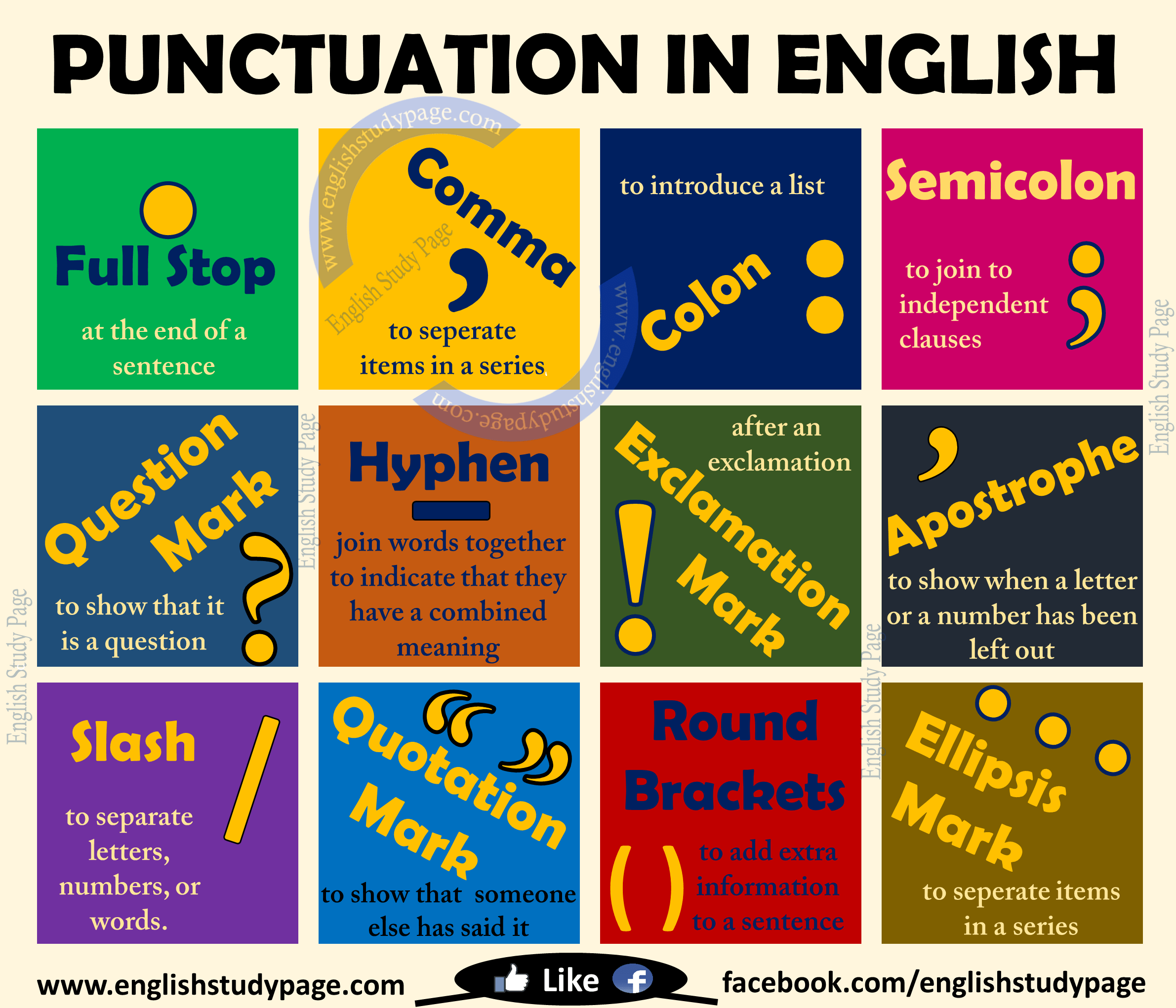
Image result for punctuation

I typically discuss the American/British difference before moving to the placement of punctuation in the context of quote marks as an issue of meaning, for example:

  • Standard English includes puzzling constructions such as, “I am being clear, aren’t I?”
  • Did you say, “My preferred name is Stephen”?

The question mark should remain, as in the first example, inside the closing quote mark to reflect that the quote itself is the question. In the second example, the entire sentence is the question, and the quote a statement; thus the question mark remains outside the closing quote mark.

All in all, these adventures in prescriptive versus descriptive approaches to language conventions may still feel like much ado about nothing to students, who often write because they are required to write and who simply don’t find the distinctions all that important.

The general public communicates moment by moment aloud and in text littered with so-called mistakes while also having almost no loss of communication.

And to be blunt, Rob Lowe’s problems in his Tweets are far less about his lack of understanding punctuation placement—and trying to show off about the Oxford comma but falling flat—and far more about his glib racism.

We descriptivists tend to argue that language conventions are a secondary issue to expression, although, as I explain below, it is nearly impossible to separate expression from conventions.

And so, this Twitter flurry over punctuation and quote marks provides another excellent entry point into helping students understand the role of conventional and purposeful language in establishing your credibility and authority as a writer.

As I have expressed before, some of the best lessons I ever learned about responding to student writing have been grounded in understanding how Advanced Placement graders are trained when scoring written responses.

One convention of writing about the action of fiction is to use present tense verbs—a contrast to using past tense verbs in detailing history.

However, at an AP training session, we were encouraged not to focus on the convention but to look for students being consistent. In other words, verb tense shift (dancing around from present to past without purpose or control) was a reason to lower a score, to identify the writing as less sophisticated.

I thought about this when I read Dreyer’s responses on Twitter because I still stress to my students that understanding punctuation placement in relationship to quote marks is mostly a problem for their credibility and authority as writers when the final punctuation dances around throughout the essay—some times inside, some times outside, with no rhyme or reason.

As a writing teacher who seeks ways to foster my students as autonomous and eager writers who also have a healthy attitude about language (an inclusive and historical awareness of conventions), I seek opportunities like Dreyer’s chastising Lowe as entry points into exploring conventional awareness and how language use cannot be disentangled from writer credibility and authority.

I often come back to again and again to making the case that credibility and authority are driven by writer control and purpose.

The dancing comma implies a lack of control, or purpose.

My argument, then, is not to browbeat students into being correct, but to encourage them to find ways to make their voices heard and appreciated.

And maybe to avoid being called out on social media, and to avoid stepping in the original mess again over and over.

My Journey with the Essay

I believe in coyotes and time as an abstract
Explain the change, the difference between
What you want and what you need, there’s the key

“I Believe,” R.E.M.

I am a writer.

I am a teacher—often and maybe essentially a teacher of writing.

Through no real singular decision, I have become mostly a writer of essays and a poet, and concurrently, when I teach writing, almost exclusively a teacher of essays.

In May of 2018, I submitted a manuscript of a book on teaching writing. Recently, I have been compulsively checking the publisher’s web site because that book has been listed as “in press” for several weeks now.

Today, I checked and saw “published”—somewhat symbolically, I suppose, about a nine-month journey to its born-on date.

Those intervening months mean, as I argue in this collection of essays drawn from several years of blogging about teaching writing, that today I am a different writer and teacher of writing than when that manuscript was compiled and submitted.

Writing and teaching writing as journey, not destination, remains a powerful metaphor that grounds me because both avocations spark powerful and nearly debilitating anxiety in me.

As a regular blogger, I have become more and more skeptical of and terrified by the fixity of published works, especially books.

I like hyperlinks and being my own editor and publisher (although I often fumble these roles quite badly); I feel as if the blog posts are more living documents (I can and do copyedit them whenever I find mistakes or am prompted by a kind reader). And I have some concrete recognition of readers, a readership quantified and displayed daily for me by WordPress.

Yet, to paraphrase Robert Frost, something there is that doesn’t love a book.

books

Frost’s ode to a wall, I think, captures a similar ambiguity about books, especially for those of us enamored by them and for those who spend their lives critiquing and even criticizing them.

For the past nine months, I have been wading deeply into books about teaching writing—the production of my own book of essays and then reading and reviewing two published volumes by John Warner, Why They Can’t Write and  The Writer’s Practice.

This wading and mulling, nearly constantly thinking and rethinking, however, are nothing new because I exist in a permanent state of feeling compelled to write and teach writing along with being terrified I have no idea how to write or teach writing.

At the center of my compulsions and insecurities lies the essay.

Poets Write Beautiful Essays: On “Coyote” by Chloe Garcia Roberts

Like Warner, as a writer and a teacher of writing, I struggle with how to provide students some structure and guidelines for writing, and specifically writing essays, without reducing their task to templates, prescriptions, and rules that prove often to be false.

This morning as I saw that my book is now published, I read Chloe Garcia Roberts’s “Coyote,” and searched her book title, discovering that she is a poet.

And as I teach my students, I tend to read as a writer.

The essay “Coyote” opens with narrative, immediately engaging the reader with character, plot, and setting. While the first paragraph reads nothing like the introduction/thesis often prescribed to students, it does end by focusing the reader: “But actually what was happening here when the coyote was being seen as a dog was not passing, it was shifting.”

Soon, we realizing that Roberts is exploring ideas and words, “passing,” “shifting,” among others. But this isn’t some simplistic “definition essay” that may be assigned to high school students.

This essay by a poet is a testament to the power of mode—narration, description, exposition, persuasion—and a model of craft; Roberts offers historical references and literary allusions, and she breaks the narrator/reader wall.

What becomes compelling to me, however, is her diction, this essay as tour de force of seeking not a good word, but the right word, pushing me to google some along the way: liminal, thaumatrope, oscillation, crepuscular, rife.

The voice of the essayist, the poet-as-essayist, speaks through science, through history, through literature; layers here, I think, at the core of the essay speak about being an essayist like a coyote:

The ferryman is never the hero. He is always heartless. If your family cannot pay, you cannot pass. Reviled by both sides, his only purpose, his only function, is to change people from one side to the other. In Western myths, the ferryman sometimes rows alone and sometimes is accompanied by Hermes the trickster, the guider of souls. In American mythology, Coyóte plays all the roles. He is not a note in a larger spiritual pantheon but a full revolution of unraveling and creation, of journey and return.

The essay itself is a journey, and the essayist, then, is the ferryman.

“Coyote” is beautiful, and it meets the broad characteristics I often share with students: essays start somehow, develop some focus briefly and somehow, and then ends somehow—hopefully always compelling.

Now, with my teaching writing book published, I have come yet again to something new, something that will not be in that book about the essay itself as a journey, captured with poetic shape in the last paragraph of “Coyote,” again nothing like a traditional conclusion guided by the worst writing advice ever (restate the introduction in different words):

In English, a siren song is another way to say an alluring deception, a seductive lie. But I ask you: how can a song be deceptive if it is a matter of life or death that it be sung? If our very existence depends on it being sung? And in case you cannot see it, I should inform you I am singing right now.

Roberts ends with questions and her own alluring image of essayist singing, embracing the complexities she has drawn for us and drawn us into.

I, a fellow essayist and poet on a much less successful level, am further ferried along in my journey as writer and writing teacher, awaiting my copies of a book of essays, themselves fixed but just markers in my rearview mirror as I continue on my way.


Published

Teaching Writing as Journey, Not Destination: Essays Exploring What “Teaching Writing” Means (IAP)

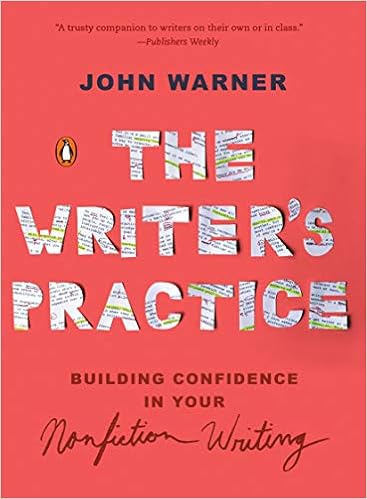
RECOMMENDED: John Warner’s “The Writer’s Practice”

One of the most valuable habits I have cultivated as a teacher for 35-plus years is listening to my students in the spaces before and after class time. This is a kind of professional eavesdropping not intended to pry on my students personally but to hear who they are as students when they are relaxed and speaking with each other (not under the teacher’s gaze).

Before class during the start of this semester, I saw one of my students diligently reading and then talking with other students near her. She was reading “They Say/ I Say” for her first-year writing (FYW) seminar.

When I asked her about the text and the course, a floodgate opened; she and other students in the class truly dislike the text and the course using it.

Since I teach two sections of FYW each fall, and held a small administrative role for a few years over our retooled first-year seminar program, I often ask students to talk to me about their FYW experiences. Too often, I continue to hear that our students are in seminars that put writing instruction secondary, although writing is the primary purpose of the courses.

First-year writing for many students remains drudgery, repeating the experiences they have had in high school and throughout their K-12 courses.

As a teacher of writing, first at the secondary level for 18 years before teaching college writing currently, I have fought a long and discouraging battle against template approaches to writing instruction (typified by “They Say/I Say”), the five-paragraph essay, and rubrics.

Seeking authentic practices and teaching writing as a writer have been my guiding principles, but too often, that journey has been over rocky terrain and decidedly uphill. Writing prompts, templates, and rubrics are powerful and often necessary tools for teachers of writing with little or no experiences as writers, and these artificial tools also facilitate some of the most entrenched, and worst, practices in traditional schools—grades, testing, and accountability.

Fortunately, I have discovered an important and engaging (mostly virtual) colleague in the pursuit of effective and authentic writing instruction—writer, public intellectual, and teacher John Warner.

Quickly in the wake of his excellent Why They Can’t Write (see my review here), Warner now offers The Writer’s Practice: Building Confidence in Your Nonfiction Writing.

In the former volume, Warner takes solid aim at the five-paragraph essay and this work appeals primarily to teachers of writing, I think. His Practice serves more as an authoritative guide for anyone who wants to be or grow as a writer.

While I think the title offers an excellent focus for the book and how to become a writer, or better writer, “practice,” Warner’s opening framing is also extremely important: “In this book, rather than ‘assignments’ or ‘essays,’ I want us to consider what we’re doing in terms of ‘experiences.'”

This past Friday and Saturday, I attended the annual convention of the South Carolina Council of Teachers of English (SCCTE). Throughout the sessions, keynotes, and conversations among teachers, I witnessed why Warner’s newest book is so valuable.

Many who teach literacy struggle with the tension between being authoritarian and being authoritative—a foundational teaching decision emphasized in Paulo Freire’s critical pedagogy.

Writing and writing instruction driven by prompts, templates, and rubrics are authoritarian, thus simultaneously inauthentic and effective for control. Writing and writing instruction driven by structure (negotiated between teachers and students) and committed to providing students with many varied opportunities to make and practice the decisions writers make are authoritative, thus authentic but prone to uncertainty and unpredictability.

The authoritative teacher must have expertise and the ability to teach on the fly, regardless of the lesson plan.

Formal schooling tends toward the former because of the perceived need for control. However, writing is a complex behavior, and teaching writing often requires a teacher who is also a writer, who can guide novice writers through practiced experiences.

Practice, then, Warner explains, offers an authoritative text:

The goal is to provide a non-prescriptive alternative to a text like They Say/I Say while still honoring the kind of critical thinking we’re supposed to value in academia. I want that thinking to be fun, and engaging, and empowering, rather than intimidating, or something performed by rote to please a disembodied authority like a teacher, or worse, a faceless, unknowable “assessor.”

As I listened and discussed with friends and others at SCCTE, I once again recognized how many of us have failed writing instruction, allowed writing workshop and student choice to flounder because these practices have been confused with class time and student assignments devolving into unstructured and unguided license.

Writing workshop and student choice, however, are not about allowing students (who have little experience or expertise as writers) to do anything they please, but about an expert teacher providing purposeful structures within which students as novices can practice, revise, and grow as writers against their rich reading lives.

And thus, Warner’s Practice, which offers excellent opportunities for writers and teachers of writing to experiment with his framing in search of the practice that works best for them.

The volumes sections—skills drills, analytical writing, research and argument, other writing experiences (including a broad range from jokes to thinking about sentences)—are ideal for K-12 and post-secondary writing instruction that is primarily aimed at all students (not just those who want to be writers) and seeks a variety of essay writing grounded in the academic disciplines (more so than writing fiction and poetry).

Finally, a real gift of this volume is the Appendix where Warner offers some possible weekly structures for using this as a text in first-year writing.

As I did with Why They Can’t Write, I highly recommend Practice, especially for those who teach writing. It is a needed and compelling argument that writing requires structure and practice, but too often is muted by prompts, templates, and rubrics that serve an authoritarian goal but not the needs of students who could be writers.


Coming Soon (Shameless Plug Edition)

Teaching Writing as Journey, Not Destination: Essays Exploring What “Teaching Writing” Means (IAP), P.L. Thomas

“Despite the Data”: Higher Education Fails Equity, Inclusion with SETs

Entering higher education in my early 40s after 18 successful years as a high school English teacher, I remain 17 years later baffled and even disappointed at the mess of contradictions that characterizes an institution populated by the most educated people possible.

Immediately I had to hold my tongue against the pervasive culture of college professors bemoaning constantly how busy they are. When my high school teaching career ended, I was wearing a wrist brace because I was hand marking about 4000 essays and 6000 journals per year while teaching five course and about 100 students (many colleagues taught 20+ more students per year).

I also coached many of those years, with work days from about 7:30 AM until 10 or 11 PM in the evening.

By contrast, I teach two first-year writing courses each fall (as part of my full load, a minimum of five course per academic year), a total of 24 students, and my teaching schedule tends to be three days a week, often a Monday evening class included.

The Ivory Tower effect is a bit more accurate than I would prefer.

More disturbing, however, is the power of tradition among academics, a dynamic that works against practices and policies being based on evidence (and thus in a state of flux when that evidence changes).

While the U.S. has a long history of characterizing and even demonizing higher education as some sort of liberal cult, the truth is that the very worst qualities of higher education are from its conservative urges as institutions.

Of course, you can find a disproportionate number of professors who have left-leaning social and philosophical ideologies, but the most powerful department/colleges in higher education are often the most conservative—political science, economics—or the most apt to take non-political poses—the hard sciences.

This disconnect between how higher education is perceived and how higher education exists stems from, in part, I think, higher education presenting itself rhetorically as progressive—mission statements, social justice initiatives, etc.

However, with a little unpacking, we can expose that practices and policies often contradict and even work against that rhetoric and those initiatives.

One example that I have addressed again and again is the use of student evaluations of teaching (SET) to drive significantly the promotion, tenure, and reward process.

Consider a few points raised in Colleges Are Getting Smarter About Student Evaluations. Here’s How by Kristen Doerer:

“Having a female instructor is correlated with higher student achievement,” Wu said, but female instructors received systematically lower course evaluations. In looking at prerequisite courses, the two researchers found a negative correlation between students’ evaluations and learning. “If you took the prerequisite class from a professor with high student teaching evaluations,” Harbaugh said, “you were likely, everything else equal, to do worse in the second class.”

The team found numerous studies with similar findings. “It replicates what many, many other people found,” said Harbaugh. “But to see it at my own university, I sort of felt like I had to do something about it.”…

Studies since the 1980s have found gender bias in student evaluations and, since the early 2000s, have found racial bias as well. A 2016 study of data from the United States and France found that students’ teaching evaluations “measure students’ gender biases better than they measure the instructor’s teaching effectiveness,” and that more-effective instructors got lower ratings than others did….

Despite the data, at many colleges, particularly research-based institutions, student evaluations are still the main measure, if not the only one, of teaching effectiveness in promotion-and-tenure decisions.

Common among universities and colleges across the U.S., diversity and inclusion are pervasive problems. Poor students and students of color are underrepresented in many colleges, especially the so-called elite institutions; women and people of color are equally underrepresented on faculties.

Nothing rings more true or frustrating than Doerer’s use of “despite the data.”

I have rejected SETs directly in my bi-annual self-evaluation for merit raises. I have consistently advocated the administration and our faculty status committee to end or greatly reduce the influence of SETs.

In all of the situations, I have repeatedly shared the research, the data:

And without fail, those with power, who tend to be white men, offer a tepid acknowledgement of the research followed by a quick “But we have to do something.” Doerer includes a response (from a white man) that sounds all too familiar:

Ken Ryalls, president of the IDEA Center, a nonprofit higher-education consulting organization, recognizes the bias but thinks doing away with evaluations isn’t the answer. He opposes efforts to eliminate the voice of students. “It seems ludicrous,” he said, “to have the hubris to think that students sitting in the classroom have nothing to tell us.”

“The argument that you should get rid of student evaluations because there is bias inherently is a bit silly,” he said. “Because basically every human endeavor has bias.”

The “yes, but” dynamic works to maintain the inequitable status quo. And as Ryalls’s comment shows, the “yes, but” response is often a distraction.

No one is arguing to remove the voice of students, but as Doerer’s reporting confronts and as the research base shows, student evaluations of teaching are fraught with student biases that corrupt the teacher evaluation process, effectively discouraging women, people of color, and international faculty from remaining in a hostile environment with very real negative career consequences.

For example, calls to end SETs a primary or major instruments for promotion, tenure, and merit pay are often part of a larger examination of how to make student feedback more effective for teaching and learning.

Doerer notes:

That’s in large part why Oregon decided to try a midterm student-experience survey that only the applicable faculty member can view. An instructor can make changes in the middle of a semester, when students can still benefit, encouraging them to give constructive feedback.

For many years, I have asked students for feedback at midterm, and explained that I would like the opportunity to address their concerns, and also to identify what is working well, because receiving complaints after a course really benefits no one.

Further, when student feedback is for the professor only, it becomes a conversation about improving teaching and learning, and as a professor myself, I am best equipped to interpret student comments. I consistently receive feedback intended as negative by students, but will never change them because they misunderstand my role and their roles in the classroom.

Yes, student feedback is valuable, but it likely cannot be simply or easily reduced to numbers, formulas, or even verbatim interpretations of their direct words.

It has taken nearly four decades of high-stakes accountability in K-12 education for people to begin to acknowledge that high-stakes accountability causes far more harm than good.

In higher education, if equity and inclusion are real goals, we can and must seek ways that students have safe and open spaces for providing their professors feedback, we can and must better support faculty in how to interpret that feedback in ways that improve their teaching and student learning, but to reach those goals, we must end the practice of using SETs in significant ways to evaluate faculty.

Higher education must end the tradition of “despite the data,” recognize that rhetoric means less than nothing if contradicted by practices, policies, and a culture of “yes, but.”

How to Avoid the Tyranny of the Lesson Plan: Planning Less to Teach Better

woman holding marker
Teaching is a daily intimidating adventure, one that requires we find the confidence to enter each lesson with the board empty. Photo by rawpixel on Unsplash.

My journey to becoming a certified high school English teacher occurred during the early 1980s. My methods course work was solidly grounded in an era obsessed with behavioral objectives and highly detailed lesson plans.

This approach to preparing to teach centered content acquisition and the authority of the teacher. In many respects, I was trained to teach as if students didn’t even exist in the process.

I immediately entered an M.Ed. program since I graduated in December and would not find a full-time teaching position until the coming fall. Those courses further entrenched mastery learning, although I also had my first glimpse into a much broader array of educational philosophies that included reading John Dewey, Maxine Greene, and others I would eventually recognize as my own critical perspective.

Many years later, after those nearly overwhelming first years of teaching when all that philosophy and theory has to be put into some sort of practice, I was well on my way to being a student-centered and critical teacher when I had a student teacher. She was a very short black woman who taught from a script—every single lesson she taught.

I immediately thought of my initial training to teach as well as this student teacher as I was reading Christine Tulley’s How to Avoid Overprepping for Your Classes.

First, after my 18 years teaching high school, I have been working in teacher education for 17 years while also helping with providing university professors attaining and improving their writing pedagogy. In both cases, I have witnessed what Tulley confronts:

I recently consulted with a Ph.D. student who was logging long nights and weekends in her office. I knew she was trying to revise her dissertation into a book and complete a book proposal, but I soon learned that she was also using the late nights to get ready for class and “keep up” with course planning. With classes and committee work scheduled during the day, she never had time to write.

When I do classroom observations, for example, my teacher candidates feel compelled to perform, believing that “teaching” is about the lesson plan and teacher behavior (again, as if students are not present).

But it is Tulley’s next point that really sparked my memory of my student teacher from many years ago:

I often see this pattern of overpreparing among the early-career faculty members whom I mentor. Many have unwittingly fallen into what Armando Bengochea terms “the teaching trap.” Bengochea notes that such overprepping is a real problem for faculty members who suffer from impostor syndrome or use course preparation as a procrastination strategy because it sounds legitimate. They often engage in extensive lecture preparation, working to fill all available class time as a protection mechanism. The result is they have to do a time-consuming deep dive into content each week to develop lengthy lecture slides or handouts. Perhaps not surprisingly, a disproportionate number of faculty of color, non-native speakers, women and other marginalized populations prepare too much for the classes they teach.

Even though I now work at a selective university with students often benefitting from a great deal of privilege, my teacher candidates are often young women, several of whom struggle against being small in stature or “looking young.”

Tulley has prodded me to understand better why I have struggled for years to help my teacher candidates understand, and practice, a key distinction I make about teaching: Teaching is not about meticulous and detailed lesson plans but about being prepared every day you enter a classroom.

In some significant ways, I am here once again addressing that teachers need both pedagogy and expertise. The urge to hyper-plan—my student teacher who scripted every lesson—is often a self-defense mechanism, but it is one that is counter to our goals as educators.

I want here to examine briefly how to avoid the tyranny of lesson plans while also building on and pushing against Tulley’s alternative to “overprepping”:

Pattern teaching is a solution I regularly offer to faculty members who seek parameters on preparing for courses efficiently and effectively. The premise is simple and not revolutionary: develop a regular pattern or structure to the class. Often instructors create such a pattern (the first 15 minutes are used to review homework, group work is always done on Wednesdays and so on) for their students’ benefit. But pattern teaching can also influence how content is delivered, making it a useful strategy for streamline course preparation.

One nuance I would offer to Tulley’s ideas is that teachers should distinguish between planning (what we should decrease) and being prepared (an ongoing state of gaining both more effective pedagogy and greater expertise).

While I am not opposed to “pattern teaching,” I have adopted a different language cultivated in my years teaching for the Spartanburg Writing Project. We used the metaphor of writing teachers building and expanding their “teaching toolbox.”

That toolbox would be available so that daily teaching did not need to be scripted or meticulously planned. Teaching in a frame structure (for example, the writing or reading workshop guided by elements similar to Tulley’s patterns) allowed the teacher to pick and choose among the tools to apply as needed in the flow, spontaneously, of teaching.

Finally, here let me offer a few different ways of thinking about being prepared to teach daily instead of planning:

  • Create a syllabus/daily schedule and each lesson plan as tentative frames, not “that which you must execute.” The key here is that when any teacher spends an inordinate amount of time planning schedules and lesson plans, they feel compelled to follow through on that plan regardless of how it works, or doesn’t, in practice. Syllabi, daily schedules, and daily lesson plans should provide some organization and structure, but they are not exhaustive or fixed.
  • Rethink what counts as preparing to teach. Preparing to teach includes a teacher’s time spent being a student themselves, reading, researching, thinking, discussing with other teachers, etc. While Tulley recognizes many young professors lament so much time planning as a distraction from doing scholarship, I would argue all teachers at every level are preparing to teach by being scholarly; the two must not be in conflict, in other words.
  • Consider first and foremost what students will be doing in daily lesson plans. As I have noted above, too often teaching and planning to teach remain focused on teacher behaviors. The key, I think, to avoiding the tyranny of the lesson plan is to recognize that the essence of learning is student behavior, students being actively engaged in behaviors the teacher fosters and negotiates, but does not orchestrate.
  • Seek ways to build self-confidence by always being a student of how to teach and the content of courses being taught. Teaching is a state of constant learning and growing. That process occurs outside the classroom, but also in the classroom every day. Our teaching goal is to become adept at improv, not playing a role.
  • Resist the allure of being a martyr. Teaching has an unhealthy culture that includes who can make the best case about their martyrdom—lamenting in the teachers’ lounge or posting on Facebook about hours and hours spent planning and grading. There is clearly something compelling about this, but I believe it is ultimately not personally or professionally healthy.

I certainly understand why beginning teachers at all levels are drawn to over-planning, even scripting daily lessons. But I also recognize that this urge has more to do with matters not related to teaching and learning.

The lesson plan outlined down to the exact minute and governed by the teacher may leave no space for problems or look effective and efficient to anyone watching the play work out. What is sacrificed, I am certain, is student engagement and that teacher’s emotional reserves. This is not sustainable.

Teaching is a daily intimidating adventure, one that requires we find the confidence to enter each lesson with the board empty.

Charter Schools Fail SC: A Reader

Nationally, momentum has been building toward political and public recognition that the education reform movement begun in the early 1980s has fallen well short of promises. This failure was identified throughout the accountability era by educators and scholars, of course, but political leaders and the public chose to ignore those with experience and expertise in their own field.

The problem with the reform movement included a refusal to acknowledge the primary problems in our public schools—overwhelming poverty and inequity of opportunity along social class and racial lines—and ideological commitments to the accountability paradigm (standards and high-stakes testing as well as focusing on so-called teacher quality) despite that solution in no way matching those ignored problems.

A subset of that movement has been the rise of charter schools, which served to bridge a political divide between school choice advocates on the right and public school advocates on the left. Charter schools are touted as public schools, but they also are driven by many elements (the worse kinds) of market forces.

Even with charter school popularity, they constitute a very small percentage of schooling in the U.S. (data from Education Week):

  • Traditional public schools: 91,422 (2015-16, Source)
  • Public charter schools: 6,855 (2015-16, Source)
  • Private schools: 34,576 (2015-16, Source)

And thus: “According to data from three years earlier2.8 million public school students, or 5.7 percent, are in charter schools.”

Here is what we know about charter schools, then, messages repeated by educators and scholars for many years. Charter schools do not outperform public schools because they are charter schools (just as private schools do no outperform public schools).

When charter schools claim to outperform public schools, the reasons often lie in serving different populations (notably concerning ELL and special needs students), having the ability to select or counsel out students, and other policies and practices that public schools often cannot or do not implement (longer school days and years, for example).

Charter schools, like all school choice, contribute heavily to segregation—one of the serious problems lingering in public schools today.

Recent reporting at the Post and Courier (Charleston, SC) may suggest the tide is also turning against charter school advocacy trumping evidence:

This media recognition matches messages I have been sending for many years, including damning analysis that charter schools in SC mostly perform the same or worse than comparable public schools:

And my analysis of two years of data on SC charter schools has shown:

  • Using 2011 SC state repost cards and the metric “Schools with Students Like Ours,” charter schools performed as follows: 3/53 ABOVE Typical, 17/53 Typical, and 33/53 BELOW Typical.
  • Using 2013 SC state repost cards and the metric “Schools with Students Like Ours,” charter schools performed as follows: 2/52 ABOVE Typical, 20/52 Typical, 22/52 BELOW Typical.

Here, then, is a reader to further reinforce how charter schools fail SC, particularly in terms of re-segregating a system long-plagued by race and class inequity:


See Also

Challenging the market logic of school choice: A spatial analysis of charter school expansion in Chicago, Stephanie Farmer, Chris D. Poulos, and Ashley Baber

ABSTRACT

Corporate education reformers take for granted that market competition in the public schools system will improve education conditions. We conducted a spatial analysis of Chicago Public Schools, examining the spatial features of charter school expansion in relation to under-18 population decline, school utilization, and school closure locations. Our findings indicate that 69% of new charter schools were opened in areas with significantly declining under-18 population and approximately 80% of charter schools were opened within walking distance of closed school locations. Our findings show, contrary to corporate education reform logic, that a competitive charter school market created spatial and financial inefficiencies resulting in school closures and systemwide budgetary cuts primarily impacting distressed neighborhoods. We explain the overproduction of charter schools through the lens of the firm-like behavior of charter school operators driven by a self-interested growth mandate that can undermine the stability of the public schools system as a whole.

When Ideology Trumps Evidence, Expertise

How do humans know the world? That answer is very complex, of course, but each of us begins understanding the world through our senses.

At the most basic level, we can explain “knowing the world” as an on-going interaction between our genetics and the experiences we gather from that world through our senses. As we mature, particularly as our brain develops, and thus our ability to use cognition (thinking), we are more able to think through our sensory perceptions (slow down and even change our responses) than merely react.

This dynamic is incredibly important as we try to understand the distinction between correlation and cause. Humans, however, are hostages to ancient evolutionary impulses that often contributed to our survival; in other words, in the earliest years of human existence, making abrupt causal assumptions (which may have often been mere correlation) were preferable to making more deliberate decisions because of the primary need simply to survive.

Contemporary humans not currently in dire environments or under the stress of poverty, oppression, or disease (for example) have the privilege of cognitive deliberation: Many of us in relatively stable and safe lives can (and should) be more careful about drawing causal or correlational conclusions, and thus, we should be far more deliberate about “knowing the world” based on more than our personal experiences and grounded in robust evidence while also resisting the allure of knowing the world through mere ideology.

In many of my courses, I ask students to consider all that by one simple thought experiment grounded in our sense of smell, “closely linked with memory.” I ask students to recall a first visit to a friend’s home and having the realization that other people’s houses smell different.

girl holding white flower covered with flower
Photo by Annie Spratt on Unsplash

Many, if not most, students begin to nod and even smile, recalling the experience. I then ask them to interrogate how they reacted to the house smelling different, and we conclude that our urge is to think of the different smell as bad or wrong.

Here, I think, is a powerful example of how human experience, cognition, and ideology conspire to derail human potential.

Recently on Twitter, I joined a discussion about charter schools, specifically contentious debates about the charter chain KIPP:

Stepping back from the topic of charter schools itself and looking broadly at the nature of the advocacy for charter schools is a microcosm of the problem I noted above. Charter schools (6855) are a very small fraction of public schools (91, 422) in the U.S., and only 5.7% of students attend charter schools (see data here).

At one level, then, the public and political debate and discourse about charter schools are both disproportionate and distorted by advocacy driven by ideology and not evidence and expertise.

That dynamic is driven by a belief that charter and private schools are outperforming public schools, which have suffered under a very long history of being characterized as failing. Yet, research has shown time and again that type of schooling has no real causal relationship with so-called school quality; in short, charter, private, and public schools all have about the same outcomes when conditions of that schooling are constant.

When charter schools boast of superior outcomes, the truth lies in many factors—such as underserving significant populations of students or the ability to choose or “counsel out” students—that make a comparison with public schools misleading at best and false at worst.

The charter school phenomenon represents the problem with ideology driving public policy at the expense of evidence and expertise.

Now, as I noted, charter schools and students attending charter schools are relatively small populations, and thus in the grand scheme of funding and public policy, my discussion here may seem as disproportionate as the debate itself.

My concern is that the charter school dynamic is just one aspect of a much more insidious problem with the U.S. persisting as a belief culture, particularly in terms of the political and public faith in equity, equal opportunity, and our having reached some sort of post-racial (and post-racist) society.

If we dig deeper in the charter school debate and the persistent antagonism toward public schools, we see a powerful racial element. U.S. public schools now serve a majority-minority population of students (white students constitute 48.9%), and what we can say about charter, private, and public schools is that all types of schooling have witnessed an increase in segregation.

Beliefs about school quality must not be disentangled from beliefs about race.

Let’s place the charter school debate in how the public perceives racial equity. Blacks and whites grossly mischaracterize both historical racial inequity and current racial inequity.

As an interview with Michael Kraus details:

For instance, one question in the study asked: “For every $100 earned by an average white family, how much do you think was earned by an average black family in 2013?” The average respondent guessed $85.59, meaning they thought black families make $14.41 less than average white families. The real answer, based on the Current Population Survey, was $57.30, a gap of $42.70. Study participants were off by almost 30 points.

The gap between estimate and reality was largest for a question about household wealth. Participants guessed that the difference between white and black households would be about $100 to $85, when in reality it’s $100 to $5. In other words, study participants were off by almost 80 points. Participants were also overly optimistic about differences in wages and health coverage.

If we allow public policy to be driven by belief, we find no political motivation for that policy addressing the realities of racial inequity:

Michael Kraus argues that these misperceptions fit conveniently with the idea of the American dream—that every individual, regardless of background, can succeed with talent and hard work. “Those beliefs can lead us astray, can lead us to not see the world for what it is. There’s a lot of work that still needs doing if our economic reality is going to match up with our narratives of opportunity.”

The irony is that believing the American Dream already exists prevents the U.S. from attaining the American Dream of racial equity.

As an educator for almost four decades now, I must share a final thought on evidence. Despite my best efforts—for example when we try to examine evolution and how the U.S. compares with international acceptance of evolution—students remain themselves resistant to setting aside their beliefs and then embracing a more accurate understanding of the world based on evidence and expertise.

From corporal punishment, to school safety, and to grade retention, when I engage students or the public, most people remain committed to their beliefs and refuse to engage with evidence while often discounting expertise.

So the really sobering reality about how we know the world is that too many of us are failing the evolutionary curve toward knowing the world based on evidence and expertise instead of imposing our ideologies onto that world.

The consequences of this are dire, especially to the most vulnerable among us.


See Related

Unlearning the Lessons of Hillbilly Elegy, Stanley Greenberg

On Pedagogy and Expertise: Enduring False Dichotomies in Education

English educator Lou LaBrant taught in a wide variety of contexts for 65 years while also producing a significant body of scholarship from the 1920s into the late 1980s. Her career was nearly as prodigious as her attitude.

Writing in 1931, for example, LaBrant announces: “The cause for my wrath is not new or single” (p. 245). Her “wrath” was pointedly aimed at the rise of the project method in the early decades of the twentieth century.

Projects, LaBrant noticed, began to dwarf, and even replace, time students spent on authentic literacy—students reading and writing by choice, the practices LaBrant advocated for over decades as “scientific.”

As I write this 9 decades later, project based learning (PBL) is, once again, all the rage. And from my perspective, similar to LaBrant’s, I watch as teachers and students are put in impossible teaching/learning situations all in the service of “doing PBL.”

While PBL flourishes in my home state of South Carolina, I also have witnessed throughout the past four decades a mind-numbing parade of new standards, new high-stakes tests, and new regulations and processes for certifying and evaluating teachers.

Formal teacher education and K-12 education suffer from the same problem LaBrant wrestled with her entire career—the misapplication of scientific principles in the pursuit of codifying “good teaching” and “student achievement.”

The current teacher evaluation rubric (with over 400 indicators) SC teacher educators and evaluators must navigate is disturbing proof that we have chosen The Hulk (the monster misguided science produces) over Bruce Banner (the measured scientist) in our unbridled lust to control how teachers teach and how students learn.

The Incredible Hulk showed the transformation of scientist Bruce Banner into the green monster.
The Incredible Hulk 1 (vol. 1) offers a powerful contrast between the scientist and the potential monster science can produce.

LaBrant resonates with me because I have existed in the field of education for almost 40 years now in a constant state of “wrath” because of one of the most disturbing dichotomies that define the field—the disconnect between pedagogy and expertise.

This disconnect, or false tension, is best reflected in the on-going discussions about teaching writing. To teach writing well, many of us argue, teachers must have some authentic experience and expertise in writing themselves; without that expertise, all the pedagogy one can attain is ultimately inadequate.

Expertise grounds teaching, I think, in authentic goals, also essential for any pedagogy or program to be effective.

For example, best practices in writing instruction, a well-planned and implemented workshop model, is for naught if teachers are mandating students produce five-paragraph essays that are driven by a prompt and rubric mandated by the teacher.

Now here is the problem: A seasoned and active professional writer would fair little better if tossed into a teaching situation with no experience or expertise in evidence-based pedagogy.

This false dichotomy is well represented by the contrast between K-12 teaching and higher education. K-12 is dominated by the belief that anyone can teach anything if equipped with pedagogy, programs, and accountability (see The Hulk rubric now governing teaching in SC I have confronted in the link above); higher education embraces a laissez-faire norm that anyone can teach when equipped with expertise.

My second career as a teacher educator has proven to me what I long suspected as a high school English teacher for 18 years: There are profound limits to our urge for discovering and prescribing “good teaching” and “student achievement.”

I have railed against this often, but I call this our technocratic urge, a perverse and dangerous form of “scientific” (again, The Hulk, not Bruce Banner).

During the early decades of LaBrant’s career, there was a relatively balanced tension among educational philosophies and theories that included at least two factions using the term “scientific” in dramatically different ways.

John Dewey’s progressivism, which LaBrant practiced, argued for an amorphous, classroom-based approach to what today we would call action research (each teacher is a researcher-in-practice with every different class of students). The goal here recognized that students and learning are fluid and relative.

To teach, Dewey tried to advocate, is to experiment, perpetually. What works for one student today may not work for another on that same day, in that same lesson. And what works in a lesson or unit this year may inform a future lesson or unit, but it certainly can never be reduced to a template for future teaching.

Dewey’s scientific lost, however, to the efficiency educators who sought a different type of “scientific”—one that identified a fixed prescription for what “good” teaching must look like and what “student achievement” must conform to.

Today as a teacher educator in SC, I am supposed to learn The Hulk rubric and then I am supposedly equipped to visit any teachers classroom, regardless of grade level or content, and be able to make a credible assessment if the teacher is effective or not.

This cult of pedagogy, I think, has only one compelling quality, efficiency. This is the same problem with education’s pursuit of “the” program, such as PBL. Design a program, detail the parameters of what make the program “work,” and then anyone can observe to simply verify if the program is being met.

Having taught now about an equal time—almost two decades each—as a K-12 teacher and a college professor, I am far more disturbed by the cult of pedagogy in K-12 than the laissez-faire, and even dismissive, attitude about pedagogy in higher ed.

A colleague in economics once confessed to me that he held conservative ideologies in economics and liberal social beliefs. As a result, he had decided to function mostly as a Democrat because, he believed, it was easier to teach Democrats better economics than to make Republican “give a damn” about human suffering.

I find this fits the false dichotomy I have examined here. I worry that we have two problems in teaching and learning—fostering expertise in “generalist” teachers (K-12) and fostering a greater understanding of and respect for pedagogy in experts (higher education). I suspect the latter is easier.

LaBrant ended her unpacking of the project method with a key element of how “scientific” can work in education. Science at its best requires that we define problems, generate evidence, and then conform the solutions to the problems.

The project method, LaBrant noted, was missing an obvious solution as educators lamented students either not reading or lacking reading ability:

That the making of concrete models will keep interested many pupils who would otherwise find much of the English course dull may be granted. The remedy would seem to be in changing the reading material rather than in turning the literature course into a class in handcraft. (p. 246)

Our rubrics and programs are the wrong goals, the wrong solutions, even as we occasionally recognize the problems of needing “good” teachers in order to increase student achievement.

Neither pedagogy nor expertise is itself the solution, but a complex understand of how both of these work together helps us seek the best possible pursuit of science and avoid the monster we currently embrace.