Category Archives: education reform

Lehre Ist Tot

This past week an early career teacher, highly regarded in the classroom and very accomplished in the field of education, received a parental request that a student not be required to read The Great Gatsby. That parent, however, had signed a consent agreement with all texts, including that novel, identified as required reading at the beginning of the course.

The parent then reached out to the administration, who confirmed that the teacher had to assign a different work. This, of course, undermines the teacher and the process established, but it also creates more work for teachers already under incredible strain.

While parental oversight of assigned reading has been common in education for decades, this situation comes as states are increasingly passing parental trigger legislation, which moves the parental power from each parent’s own children to parents being able to ban works for all teachers or students to explore in classes.

That same teacher, frustrated and disillusioned, later that day read aloud their resignation letter to me in the context of telling me that much that they had taught in the first three years of teaching could no longer be taught in the last couple years—and increasingly will be directly banned in the coming year (as my home state is poised to pass its own educational gag order this spring).

The teacher cried while reading the letter aloud, and added that the resignation was depressing; this, you see, was a career they had been working toward since high school—and within 6 years, teaching is dead.

The current anti-teacher climate in the U.S. is incredibly harsh and driven by orchestrated false narratives:

Right-wing media are creating parental trigger structures even without the concurrent legislation:

While teacher and school bashing (notably as “liberal indoctrination”) has a long history in the U.S., reaching back to Catholic schools fighting for market space as public schooling increased in the 19th century, the current anti-teacher climate has its roots not in Republican politics but in the Obama administration’s education agenda.

Obama’s appointment of Arne Duncan as Secretary of Education heralded an era of education reform that actually doubled-down on the worst aspects under George W. Bush, and that doubling down feed into a growing media attack on “bad teachers.”

Instead of rejecting the standard approaches to education reform begun under Reagan and federalized under W. Bush, the Obama administration turned their blame to teachers and teacher quality. During the Obama years, the great experiment in value-added methods (VAM) devastated the teaching profession.

The perennial paradox of education has always been that teacher quality matters but it remains a very small part of measurable student achievement (only about 10-15%). Therefore, the Holy Grail of the VAM experiment—identifying “good” and “bad” teachers through standardized test scores of students—was always doomed to fail.

But it did accomplish planting the seeds of today’s multi-pronged attack on teachers—the “science of reading” movement blaming teachers and teacher educators for student reading achievement and the anti-CRT/educational gag order movements being linked to parent trigger laws.

Throughout the education reform era over the past 40 years, many of us in education have argued that education reform initiatives are less about improving education and more about killing public education and the teaching profession—charter schools and voucher schemes, Teach For America, VAM and merit pay, demonizing and dismantling unions and tenure, etc., to name a few.

From Fox News lies to parental trigger laws and education gag orders, the evidence is very clear now that this current wave of teacher bashing is definitely about killing the profession, and not about student discomfort.

Let me return to the opening teacher story.

When the parent was asked for reasons why they wanted their child not to read The Great Gatsby—so the teacher had context for choosing an alternate text—the parent responded that they did not want the child (a high school student) to read about inappropriate relationships and sexual content. So here is a point of fact about the insincerity of these challenges; that student had already read and studied The Crucible, without any complaint, a play grounded in adultery.

I am certain some parents challenging what their children are being taught are sincere, but I am also certain the larger political motivation among conservatives is to completely dismantle public education.

Just as I have explained that there simply is no CRT propaganda agenda in K-12 schools, there is no liberal indoctrination/grooming occurring in K-12 (or K-16) education either.

The Ingraham rants are simply political lies.

And these lies are not improving education.

They have one goal and it seems to have been effective: Teaching is dead.

The Politics of Reading Proficiency (and Charter Schools)

It seems almost quaint now, except for the racism, but in 2009, Representative Joe Wilson (R-SC) shouted “You lie” at Barack Obama. Post-Obama, the issue of political lies intensified dramatically, however, with Donald Trump building his presidential campaign on an extreme practice of lies that was well outside the norm of the sorts of lies people tend to expect from politicians.

In the wake of Trump, political lies have maintained the new low bar set by Trump; however, as I have detailed, there is a long history now of political leaders building their political careers on education reform, recently reading legislation, and that strategy in part depends on politicians, not educators, having the power to mandate standards, high-stakes testing, and most important of all, what counts as “proficiency” for reading achievement (currently, by the way, “proficiency” is set by each state with no federal oversight [see explanation here]—despite the stated goals of the Common Core movement to address that).

Many elements of the education reform movement begun in the early 1980s have served a similar political function, especially charter schools; the Obama administration, for example, solidified charter school expansion as a bi-partisan political strategy.

Since the release of the 2019 NAEP data on reading and after high-profile media coverage, a key example of politicians using reading achievement as political capital is Mississippi. The so-called “Mississippi Miracle” (a haunting cousin of the “Texas” and “Harlem” miracles that proved to be lies) is easily unmasked as a mirage (a lie) once the data is contextualized.

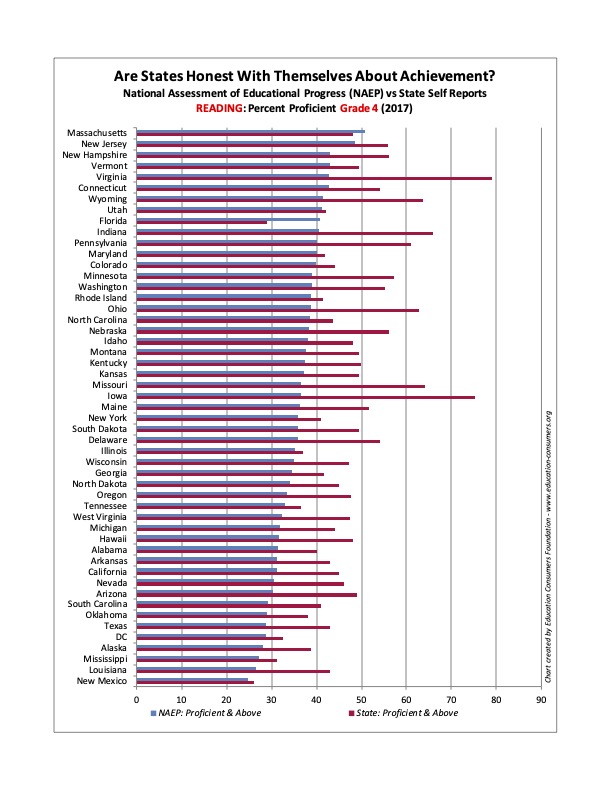
While Mississippi’s 2019 NAEP reading scores for 4th grade were heralded as an aspirational outlier, Mississippi is not alone in its effective political game of smoke and mirrors using reading proficiency scores; see the following comparison of state proficiency scores compared to national NAEP data:

Most states have some degree of lower standards for proficiency than NAEP, but the issue is not that NAEP is a credible measure of reading (it isn’t); the issue is that state-level reading proficiency is a political tool of elected officials.

While the media and political leaders in Mississippi have claimed “miracle” for the state, the data show otherwise:

As the scatterplot suggests, Mississippi has a fairly normal strong correlation between socioeconomic status and reading achievement (low poverty correlated with high scores and high poverty correlated with low scores). Yes, Mississippi has had a long pattern of raising reading scores since the 1998 while not closing key achievement “gaps” (see NAEP longitudinal data), but the state is not somehow miraculously serving high-poverty students (because of the “science of reading”) in a way that is superior to other states (whose failures are being falsely attributed to an absence of the “science of reading”).

While a perverse way to say it, Mississippi reading achievement isn’t a “miracle” (and there currently is no scientific evidence that reading achievement gains are caused by a switch to the so-called “science of reading”) but is mostly “normal” in terms of producing measurable student achievement that is more a reflection of socioeconomic status (and race) that actual achievement.

In short, if you look at the data from all states, you will find a pattern of political hype (lies) not matching the data.

Similar to Mississippi, my home state of South Carolina tends toward that normal, but since this tool allows adding charter schools, please note how charter school (red dots) achievement (as I have documented before) mostly matches traditional publics schools (TPS), with a few outperforming and several underperforming when compared based on similar demographics:

The key to charter school analysis is to compare charter and traditional public schools with similar demographics (in the scatterplot above, that is the vertical axis); note that most charter schools cluster with TPS, but several fall lower on achievement when compared to TPS.

None the less, a great deal of political capital has been and is currently being spent on claiming the “science of reading” has created “miracles” (a lie) and that charter schools save children in poverty and Black/brown students (another lie).

Reading achievement is once again a hot media and political topic, but that discourse and legislation coming from it, are mostly lies that are serving the needs of political leaders and not students.

Dear Legislators: Your Job Is Funding, Not Dictating, Education

Let’s start with a thought experiment.

Your elected state legislators are confronted with a series of bills addressing crumbling bridges and roads in your state. After a period of typical partisan debate, a final bill is proposed that not only funds new bridge and road construction, but also dictates how those bridges and roads must be constructed.

Most of the legislators who wrote and voted on the bill have laws degrees or career experiences in business; none of the legislators are structural engineers, and thus, no expertise in constructing bridges or roads.

Structural engineers and those whose profession is building bridges and roads note that the legislation is dangerous, ill conceived, and certainly will result in bridges and roads that will cost people’s lives.

None the less, the bill passes and then is signed by your governor.

This thought experiment likely seems outlandish, but it represents a key distinction about the role of legislators as that impacts public institutions (in this hypothetical situation, our highway/road infrastructure). In brief, it is the role of legislators to fund and ensure at least adequate if not excellent public institutions; it is not the role of legislators to dictate how those public institutions should be realized since a legislative body often lacks the expertise to create those mandates.

This brings me to my primary area of expertise, education.

Specifically since the last months of the Trump administration, there has been a wave of state-level legislation censoring curriculum, banning books and ideas, and mandating all aspects of formal education (curriculum and instruction)—often including mechanisms for parents to trigger censorship and even dismissal of teachers and professors based on personal ideologies and perceived “discomfort” by students.

This partisan political trend fits into a larger contemporary and century-long history of legislators mandating not just that education by provided but what and how that education must include.

As one example, since about 2018, states have proposed and passed very detailed and prescriptive reading legislation, a movement that fits into the accountability era of education that began in the late 1970s and early 1980s.

My home state of South Carolina is a powerful example of good intentions that have gone terribly wrong.

Under the guidance of then-governor (and future Secretary of Education under Bill Clinton) Richard Riley, SC established the now-familiar structure of K-12 public education, broadly labeled as accountability—state-level standards (approved by legislators), state-level high-stakes testing (approved by legislators), and various consequences for schools and teachers meeting or not those mandated parameters.

Throughout the 1980s and into the 1990s, bolstered by the misleading and partisan A Nation at Risk report released under Ronald Reagan, governors increasingly discovered that focusing on education reform paid significant political dividends (regardless of political party).

The narrative was simple, although deeply misleading: U.S. public education is failing students and the country because of the inherent flaws of the education establishment; therefore, it is the responsibility of elected officials to mandate all aspects of education.

By the mid-1990s into the 2000s, George W. Bush pushed the envelope of being an education governor onto the national stage; Bush created another false narrative around his so-called “Texas Miracle” (along with Rod Paige as Texas superintendent of education) that helped propel Bush to the White House and then take the state-level template for education reform to the federal level with No Child Left Behind (NCLB).

While NCLB floundered, never producing the results promised in the same ways that state-level accountability never fulfilled promises, the template was set for governors and presidents; the Obama administration (embodied by Arne Duncan as Secretary of Education) doubled-down on the Bush/ Paige/ Spellings model, in fact.

In many ways, the current wave of curriculum gag orders and book censorship (as well as the copy-cat legislation imposing a misguided “science of reading” mandate on reading instruction) is the logical progression within that accountability approach to education.

In that model, authority is centered in elected officials, and expertise is trumped by that political authority.

Since the 1980s, accountability legislation and political micromanaging have not improved education in the U.S. (at regular intervals, the same crisis discourse is repeated, followed by the same strategies for reform, just under different political leaders), but that model has served political careers well at the expense of education, democracy, and now, academic freedom.

Legislators, then, have replaced their democratic responsibilities for funding and ensuring public institutions with using education, for example, as a political football for their own careers.

Just as legislators should fund but not mandate how to build our roads and bridges, they should fully fund but not dictate how or what teachers teach—especially when their mandates are serving ideological agendas and not teaching or learning in a country that claims to respect individual liberty, democracy, and academic freedom.

RECOMMENDED: The Language of Literacy Education (Brill, 2021)

Public and media debate as well as public policy driven by those debates is too often driven by misuse and misunderstanding of key terms and concepts, especially for the field of education.

Two such terms—Critical Race Theory and the “science of reading” (SoR)—have demonstrated that phenomenon over the past few years.

SoR debates have resulted in many states adopting harmful reading policy (often including practices not supported by research, such as grade retention and citing discredited sources such as the National Reading Panel and NCTQ).

With reading and literacy a high-priority focus of the media and state-level legislation, understanding and using terms and concepts around reading and literacy correctly and clearly are urgently needed. Therefore, I strongly recommend a new volume, Language of Literacy Education, edited by Vicki S. Collet, Associate Director, NWA Writing Project, and Associate Professor, CIED, University of Arkansas.

The volume offers research-based explanations for literacy terms [1], such as SoR, the simple view of reading, etc., that often contrast with the way these terms are used in public and media discourse as well as in state-level legislation debates and policy.

For example, the volume’s definition for SoR is how the term should be used and understood:

Science of reading, broadly defined, is research results from a variety of fields and methodologies, including basic and applied science, related to reading and reading instruction. The science of reading is supported by ongoing research with a “dynamic interplay among methods, theories, and findings” (Pearson, 2020). Examining this full range of science “can be a helpful policy guide to initiatives that seek to improve students’ reading ability and appetite” (Collet et al., 2021)….

Because of the complexity of reading and the differences among learners and contexts, no single instructional approach has been found to be effective in teaching all students to read (Compton-Lily et al, 2020; International Dyslexia Association, 2018; Malloy et al., 2019).

Collet, V.S. (2021). Science of reading. In V.S. Collet (Ed.), The language of literacy education (p. 66).  Brill Publishers.

While I strongly endorse the full definition provided here for a nuanced and robust understanding of SoR and how people learn to read over their entire lifetime, I find the inclusion of the current problems with the misuse of SoR as compelling:

Some instantiations of the “science of reading” are narrowly construed to emphasize basic research from cognitive psychology, neuroscience, and linguistics that describe how the brain learns to read in the early years. Public discourse sometimes focuses on the alphabet principle (Liberman et al., 1989) and a simple view of reading (Gough & Tunmer, 1986). This overly-restrictive view “is being used to shape public policy and silence other perspectives” (Hoffman et al., 2020, p. S258) and to narrow curricula (Compton-Lily et al., 2020; Vaughn et al., 2020) and should not be confused with the body of scientific studies of reading, which includes an interdisciplinary store of knowledge about “reading-related skills, processes, antecedents, and outcomes” (Alexander, 2020, p. S90). A “cautionary disposition to avoid drawing unwarranted inferences about the efficacy of pedagogical alternatives that have not themselves been rigorously examined” (Cervetti et al., 2020, p. S168) is needed. In contrast, research on reading instruction and the preparation of literacy teachers is robust, extensive, and useful for guiding reform efforts (Hoffman et. al, 2020).

Collet, V.S. (2021). Science of reading. In V.S. Collet (Ed.), The language of literacy education (p. 66).  Brill Publishers.

Ultimately, Collett reaches an important conclusion that should be driving our understanding of reading, teaching reading, and reading policy: “At times controversial, the science of reading is an ongoing body of research, ‘an area for inquiry rather than a foregone conclusion’ (Woulfin et al., 2020, p. S111).”

Parents, the media, politicians, and anyone advocating for better literacy instruction must have this volume at their side in order to navigate this debate in ways that could benefit our teachers and their students.

Misinformation and misusing terms result in harmful debates and ultimately extremely harmful educational policy.


See Also

Thomas, P.L. (2020). How to end the Reading War and serve the literacy needs of all students: A primer for parents, policy makers, and people who careCharlotte, NC: Information Age Publishing.

Fact Checking the “Science of Reading”: A Quick Guide for Teachers

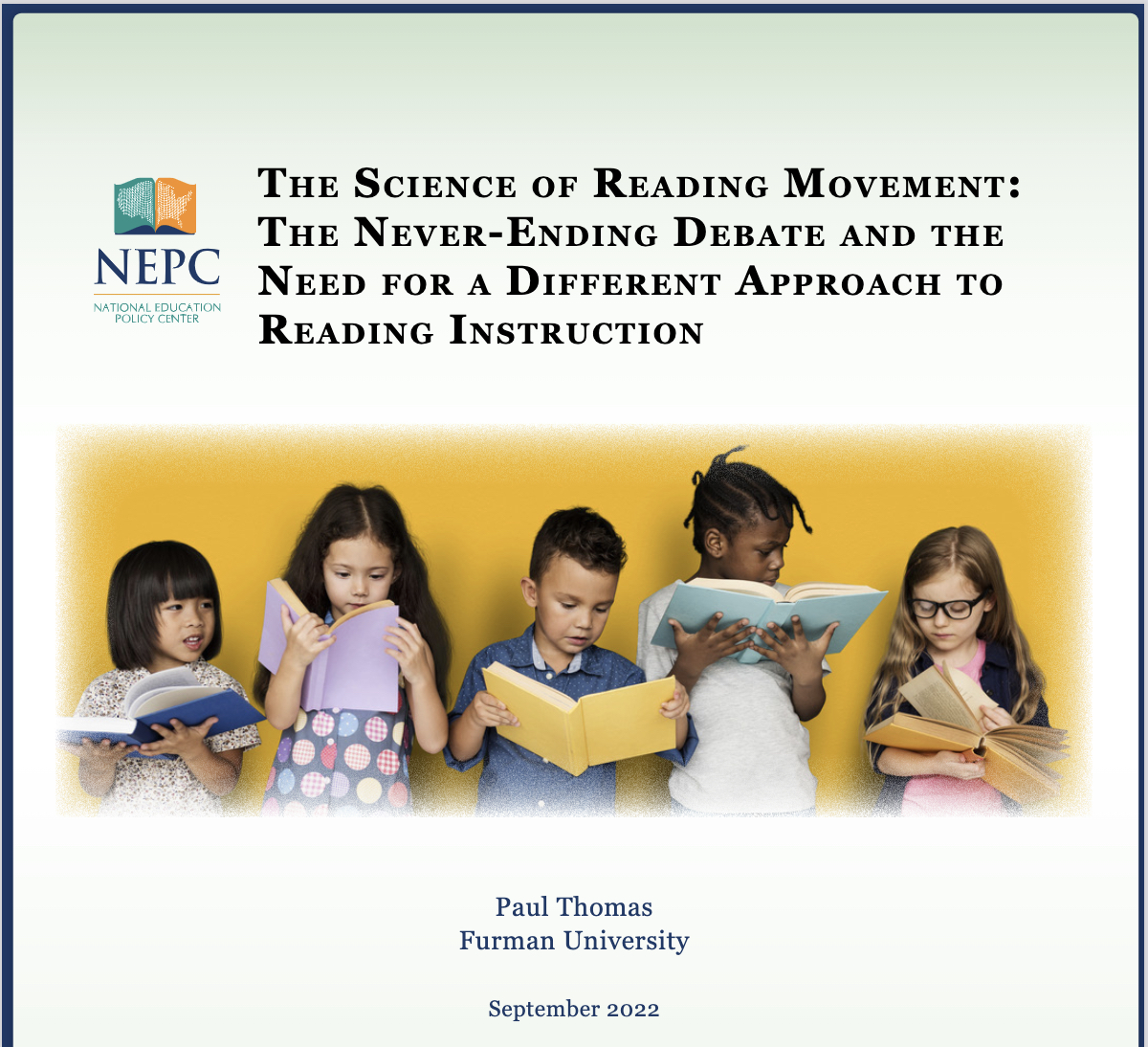
Policy Statement on the “Science of Reading” (NEPC)

Making Early Literacy Policy Work: Three Considerations for Policymakers Based on Kentucky’s “Read to Succeed” Act (NEPC)

Red Flags, Red Herrings, and Common Ground: An Expert Study in Response to State Reading Policy

[1] Terms included:

Annotation
Argumentative Writing
Assessment
Background Knowledge
Biliteracy
Close Reading
Comprehension
Comprehension Strategies
Comprehensive Literacy Instruction
Construction-Integration (CI) Model
Context
Contextual Reading Model
Critical Literacy and Critical Media Literacy
Cueing Systems
Culturally Responsive Instruction
Decoding
Diffferentiation
Digital Literacies
Direct Instruction
Disciplinary Literacy
Discourse Analysis
Discussion
Dyslexia
Embodied Literacies
Emergent Literacy
Fluency
Four-Part Mental Processor
Genre
Gradual Release of Responsibility
Grammar and Mechanics
Graphic Organizers
Guided Reading/Writing
Independent Reading/Writing
Informational text Integrated Instruction
Intervention
Language Development
Learning Progressions
Literacy/Literacies
Literary Devices
Mentor Texts
Miscue Analysis
Modeling
Morphology
Motivation
Multicultural Literature
Multimodality
Narrative Text
New Literacies
Peer Response
Perspective and Point of View
Phonics
Phonological and Phonemic Awareness
Pragmatic Knowledge
Question Answer Relationship
Read Aloud
Readability
Reading Recovery
Reading-Writing Relationships
Reciprocal Teaching
Rhetorical Factors and Devices
Running Record
Scafffolding
Science of Reading
Semantics
Sentence Frames
Shared Reading/Writing
Sight Words
Simple View of Reading
Small-Group Instruction
Sociocultural Perspective
Standards
Story Elements/Story Grammar
Text Structures and Text Features
Theme
Thesis
Think Aloud
Transactional Theory
Translanguaging
Understanding
Vocabulary Instruction
Voice
Workshop (Reading & Writing)
Writing Process
Zone of Proximal Development

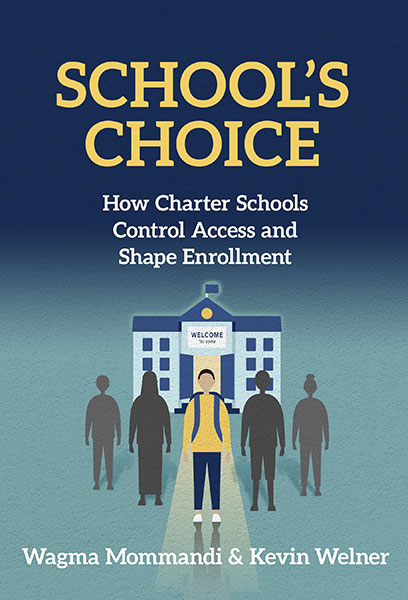
Recommended: School’s Choice: How Charter Schools Control Access and Shape Enrollment (TCP)

School’s Choice: How Charter Schools Control Access and Shape Enrollment

School’s Choice 9780807765814

Wagma Mommandi, a former public-school teacher, is a PhD candidate in education policy at the University of Colorado Boulder School of Education. 

Kevin Welner is a professor and the director of the National Education Policy Center, which is housed at the CU Boulder School of Education.

Access issues are pivotal to almost all charter school tensions and debates. How well are these schools performing? Are they segregating and stratifying? Are they public and democratic? Are they fairly funded? Can apparent successes be scaled up? Answers to all these core questions hinge on how access to charter schools is shaped. This book describes the incentives and pressures on charter schools to restrict access and examines how charters navigate those pressures, explaining access-restricting practices in relation to the ecosystem within which charter schools are created. It also explains how charters have sometimes responded by resisting the pressures and sometimes by surrendering to them. The text presents analyses of 13 different types of practices around access, each of which shapes the school’s enrollment. The authors conclude by offering recommendations for how states and authorizers can address access-related inequities that arise in the charter sector. School’s Choice provides timely information on critical academic and policy issues that will come into play as charter school policy continues to evolve.

Book Features:

  • Examines how charter schools control who gains and retains access.
  • Explores policies and practices that undermine equitable admission and encourage opportunity hoarding.
  • Offers a set of policy recommendations at the state and federal level to address access-related issues.

Beware the Roadbuilders 2021

I entered the classroom as a high school English teacher in Upstate South Carolina in the fall of 1984, coinciding with the start of the high-stakes accountability movement in my home state as well as across the U.S.

Many people identify the Nation at Risk report under Ronald Reagan as ground zero for the accountability movement that entrenched patterns of school reform lasting until today—ever-changing standards, ever-changing high-stakes tests, and a never-ending refrain that schools are failing.

George W. Bush brought state-level education reform/accountability to the federal level with the bi-partisan No Child Left Behind, and then Barack Obama doubled down on the same basic concepts and approaches despite decades of accountability measures not working.

As a result, when I entered the world of blogging and public commentary during Obama’s administration, I found two enduring and powerful metaphors for the essential flaws of the accountability/education reform movement.

One is from Oscar Wilde: “But their remedies do not cure the disease: they merely prolong it. Indeed, their remedies are part of the disease.”

And the other is inspired by a scene from Alice Walker’s The Color Purple, detailed in a letter from Nettie to Celie:

The first thing I should tell you about is the road. The road finally reached the cassava fields about nine months ago and the Olinka, who love nothing better than a celebration, outdid themselves preparing a feast for the roadbuilders who talked and laughed and cut their eyes at the Olinka women the whole day. In the evening many were invited into the village itself and there was merrymaking far into the night. I think Africans are very much like white people back home, in that they think they are the center of the universe and that everything that is done is done for them. The Olinka definitely hold this view. And so they naturally thought the road being built was for them [emphasis added]. And, in fact, the roadbuilders talked much of how quickly the Olinka will now be able to get to the coast. With a tarmac road it is only a three-day journey. By bicycle it will be even less. Of course no one in Olinka owns a bicycle, but one of the roadbuilders has one, and all the Olinka men covet it and talk of someday soon purchasing their own.

Well, the morning after the road was “finished” as far as the Olinka were concerned (after all, it had reached their village), what should we discover but that the roadbuilders were back at work. They have instructions to continue the road for another thirty miles! And to continue it on its present course right through the village of Olinka. By the time we were out of bed, the road was already being dug through Catherine’s newly planted yam field. Of course the Olinka were up in arms. But the roadbuilders were literally up in arms. They had guns, Celie, with orders to shoot!

It was pitiful, Celie. The people felt so betrayed! They stood by helplessly—they really don’t know how to fight, and rarely think of it since the old days of tribal wars—as their crops and then their very homes were destroyed. Yes. The roadbuilders didn’t deviate an inch from the plan the headman was following. Every hut that lay in the proposed roadpath was leveled. And, Celie, our church, our school, my hut, all went down in a matter of hours. Fortunately, we were able to save all of our things, but with a tarmac road running straight through the middle of it, the village itself seems gutted.

Immediately after understanding the roadbuilders’ intentions, the chief set off toward the coast, seeking explanations and reparations. Two weeks later he returned with even more disturbing news. The whole territory, including the Olinkas’ village, now belongs to a rubber manufacturer in England. As he neared the coast, he was stunned to see hundreds and hundreds of villagers much like the Olinka clearing the forests on each side of the road, and planting rubber trees. The ancient, giant mahogany trees, all the trees, the game, everything of the forest was being destroyed, and the land was forced to lie flat, he said, and bare as the palm of his hand.

The Color Purple

From this, I drew a conclusion that has served as a guiding metaphor for my criticism of the education reform movement and the title of one of my books, Beware the Roadbuilders: Literature as Resistance (Garn Press): “Beware the roadbuilders. They are not here to serve you, they are on their way to bulldoze right over you.”

I have come back to this metaphor as both ongoing criticism and confirmation that accountability is a failed approach to education reform.

One element of the tension between the accountability/education reform movement and those of us committed to education and social reform grounded in equity (and not accountability) is the shared acknowledgement that universal public education has a long history of failing marginalized and oppressed populations of students, reflecting the larger failures of communities, states, and the broader U.S. to serve marginalized and oppressed people.

It is 2021, and in my home state of SC, the metaphor I have depended on is being vividly and callously brought to reality:

The dismantling of Black communities for state and federal highways is not just a thing of the past. It’s happening now a few miles north of Charleston with the proposed West I-526 Lowcountry Corridor, at a time when President Biden and his transportation secretary have vowed to stop it.

South Carolina is proposing to sweep aside dozens of homes, and potentially hundreds of people, to widen a freeway interchange choked with traffic in this booming coastal region. The $3 billion project is expected to begin about two years after the plan becomes final. …

Under the state’s preferred proposal for the interchange upgrade, 94 percent of people and structures that would be displaced live in environmental justice communities mostly composed of Black and Brown residents.

Black people are about to be swept aside for a South Carolina freeway — again

It is 2021, and I must reach the same conclusion I drew in 2014: Beware the roadbuilders. They are not here to serve you, they are on their way to bulldoze right over you.


Recommended

‘White Men’s Roads Through Black Men’s Homes’: Advancing Racial Equity Through Highway Reconstruction, Deborah N. Archer

Abstract

Racial and economic segregation in urban communities is often understood as a natural consequence of poor choices by individuals. In reality, racially and economically segregated cities are the result of many factors, including the nation’s interstate highway system. In states around the country, highway construction displaced Black households and cut the heart and soul out of thriving Black communities as homes, churches, schools, and businesses were destroyed. In other communities, the highway system was a tool of a segregationist agenda, erecting a wall that separated White and Black communities and protected White people from Black migration. In these ways, construction of the interstate highway system contributed to the residential concentration of race and poverty, and created physical, economic, and psychological barriers that persist.

Today, the interstate highway system is on the verge of transformational change as aging highways around the country are crumbling or insufficient to meet growing demand and must be rebuilt or replaced. The possibility of significant infrastructure development offers an opportunity to redress some of the harm caused by the interstate highway system, to strengthen impacted communities, and to advance racial equity. Still, there is a risk that federal, state, and local highway builders will repeat the sins of the past at the expense of communities of color whose homes, businesses, and community institutions again stand in the path of the bulldozers. Moreover, there is reason to believe that traditional civil rights laws, standing alone, are insufficient to redress the structural and institutional racism that shaped the interstate highway system and continues to threaten communities of color as the highways are rebuilt.

This Article is the first in the legal literature to explore in depth the racial equity concerns and opportunities raised by modern highway redevelopment. It also builds upon the work of legal scholars who advocate for addressing systemic racial inequality by requiring that policymakers conduct a thorough and comprehensive analysis of how a proposed action, policy, or practice will affect racial and ethnic groups. The Article concludes by proposing a way forward for highway redevelopment projects: requiring jurisdictions to complete comprehensive racial equity impact studies prior to any construction. Racial equity impact studies have been used or proposed in various contexts to reform racialized institutions and structures. This Article argues that highway redevelopment projects should join this growing list.

Archer, Deborah N., ‘White Men’s Roads Through Black Men’s Homes’: Advancing Racial Equity Through Highway Reconstruction (February 18, 2020). 73 Vanderbilt Law Review 1259 (2020), NYU School of Law, Public Law Research Paper No. 20-49, Available at SSRN: https://ssrn.com/abstract=3539889

Moving from “All Students Must” to “Each Student Deserves”

Since publishing my book, How to End the Reading War and Serve the Literacy Needs of All Students, that examines the current “science of reading” (SoR) version of the Reading War, I have given several interviews and presentations on that work.

I have also continued to blog about the movement, and in all of these experiences, I am forced to rethink and think more complexly through what I know and understand about the SoR movement as well as how to teach reading and literacy.

The most recent interview, by literacy expert Sam Bommarito, proved to be an enlightening experience on several levels.

First, Sam’s experience and expertise in the field of literacy were a welcomed change from being interviewed by generalists and journalists because his questions dove directly into the core of the issues surrounding SoR and those questions challenged me to think more deeply and carefully.

Our exchange between people with similar levels of expertise on the subject allowed (or even required) us to focus on how best to offer any viewers nuanced but clear explanations of a deeply complex topic; as I noted (and emphasize often now), the evidence on teaching reading is not simple, and not settled.

But the larger take-away for me after the interview was that Sam’s third question—Does it make any sense to effectively ban selected practices found in balanced approaches to reading, e.g., reading recovery, workshop teaching or guided reading?—prompted me to explain in greater detail a core concept that grounds a fundamental reason I reject the SoR movement.

Whether I am addressing literacy specifically or teaching pedagogy broadly, I have relied for many years on the best practice concepts expressed by Zemelman, Daniels, and Hyde.

Each chapter in their book (now in its fourth edition) ends with a chart that suggests instructional practices that teachers should increase or decrease; for example, on writing instruction (download sample here):

Key to note is that best practice is grounded in broad and diverse bodies of research on teaching and learning, and that best practice philosophy neither requires nor bans any specific instructional approach; whether a teacher uses any pedagogy is directly linked to student need (not a prescription form some authority such as standards or an adopted program).

When SoR advocates call for “all students must” (for example, systematic intensive phonics for all students and universal screening for dyslexia), they are misrepresenting what we know about teaching and learning: There is no universal silver bullet for “all students.”

Best practice structures promote research and evidence as a spectrum, a range of practices for every teacher’s toolbox; best practice also recommends that instruction begin with individual students, their demonstrated known, unknown, and misconceptions.

If we think carefully about decoding and direct instruction in phonics and phonemic awareness, teachers will face a wide diversity of students in any class in terms of where they are in their reading development; in short, there simply is no situation where “all students must” serves students well.

Literacy is not simple, and literacy development is not linear, sequential, or systematic.

For example, most people do not accumulate vocabulary in order to be able to read, but develop their vocabulary by reading.

Context (in terms of so-called literacy skills) and engagement are extremely important when students are developing their literacy; regretfully, many misguided movements during the history of the Reading War have eroded an essential aspect of literacy that must be honored—literacy as holistic.

Here, we must address a fundamental paradox in the SoR movement.

Several different kinds of advocacy are fueling the SoR movement—from parents advocating for greater awareness of dyslexia to Black and poor parents advocating for under-/un-served populations of students to advocates for the needs of emerging bilingual students.

The common denominator here is a genuine concern for the under-/un-served student, a pervasive belief that for a number of reasons, too many students are being failed by the system itself (although some elements of the SoR movement are also directly blaming teachers and teacher educators for those failures).

The paradox is that the aggressive advocacy behind the SoR movement is driving an all-or-nothing silver-bullet approach to teaching reading, which will mis-serve students as much or more than the current conditions of teaching and learning in U.S. public schools.

So this leads me to Sam’s effort to bridge the divisions in the Reading War (something I am far more skeptical about, as I address in Sam’s question 5: Cambourne and Crouch recently said we should stop using the Reading Wars metaphor and replace it with the metaphor of the Reading Quilt- with different “sides” adding different pieces to the quilt. Do you see any hope for that point of view? Do you see hope for an end to the divisive discourse?  Do you see hope for ending the reading wars? [13:20]).

I am no fan of compromise (as I explain in the interview) but I think we do have common ground in terms of two beliefs: (1) Far too many students are being under-/un-served in our current K-12 public school system (notably in their literacy), and (2) the under-/un-served are disproportionately marginalized and vulnerable populations of students (Black students, poor students, emerging bilinguals, students with special needs).

Not a compromise, but my modest proposal is that all of us concerned with reading and literacy among K-12 students need to set aside the “all students must” mandate and commit instead to “each student deserves.”

“All students must” be screened for dyslexia is a guaranteed disaster for students (consider the over-diagnosing of ADHD as one example), but “each student deserves” access to ample books and other texts in their homes and schools fulfills what we know about literacy development without being overly simplistic or harmful.

Each student deserves whatever teaching and learning experiences they need and want in order to grow and develop at the rate unique to them (not some manufactured and artificial “grade level” proficiency).

This commitment shifts our instruction and assessment gaze away from compliance to a reading program or to a set of prescribed standards and toward the demonstrated needs and wants of each student who enters any classroom.

The ultimate irony here is that the whole language (WL), reading/writing workshop, and balanced literacy (BL) movements (all falsely demonized since the 1990s) offer that exact commitment along with very high standards for teacher expertise (each of us in charge of any student must have a very complex toolbox for teaching and also must be prepared to individualized instruction).

Again, as I stated in the interview, WL, workshops, and BL did not fail our students, but we have certainly failed the core commitment of those movements—serving the learning needs of each student.

What we know about teaching reading is not simple or settled, but I think we can and must all agree that instead of falling prey to the overly simplistic and harmful “all students must,” a better way forward is a resolute commitment to “each student deserves.”


Podcast: Educational Movements and Trends

Educational Movements and Trends

How can historical perspective help direct teaching and learning?

​When trying to solve problems, humans are prone to looking for a “silver bullet” which often bypasses the learning process. Educational trends prove this theory. The hot teaching movement today may not have solid research behind it. History shows us that we are not good at being patient students throughout life’s journey.​

Our guests Dr. Michele Dufresne, President and founder of Pioneer Valley Books and Dr. Paul Thomas at Furman University share that while K-12 education may be a basic right, not everyone has equal access to it. If every child is capable of learning and no one progresses at the same rate, then how can teachers better support student growth? Having an educated society impacts all facets of our communities.

Episode 1

Educational Trends part 2

The “Science of Reading”: A Reader for Educators

How to End the Reading War and Serve the Literacy Needs of All Students: A Primer for Parents, Policy Makers, and People Who Care, P.L. Thomas

Fact Checking the “Science of Reading”: A Quick Guide for Teachers

Historical Context

What Shall We Do About Reading Today?: A Symposium ( November 1942, The Elementary English Review, National Council of Teachers of English)

LaBrant, L. (1947, January). Research in language. Elementary English, 24(1), 86-94. Stable URL: http://www.jstor.org/stable/41383425

Lou LaBrant on reading

Doing What Matters Most: Investing in Quality Teaching, Linda Darling Hammond (1997)

Whole Language and the Great Plummet of 1987-92: An Urban Legend from California, Stephen Krashen

Silver Bullets, Babies, and Bath Water: Literature Response Groups in a Balanced Literacy Program, Dixie Lee Spiegel (The Reading Teacher, 1998)

Literacy Crises: False Claims and Real Solutions, Jeff McQuillan

National Reading Panel (NRP)

The Federal Government Wants Me to Teach What?: A Teacher’s Guide to the National Reading Panel Report, Diane Stephens (NCTE, 2008)

Beyond the Smoke and Mirrors: A Critique of the National Reading Panel Report on Phonics, Elaine M. Garan (2001) https://journals.sagepub.com/doi/abs/10.1177/003172170108200705

Babes in the Woods: The Wanderings of the National Reading Panel, Joanne Yatvin, The Phi Delta Kappan, Vol. 83, No. 5 (Jan., 2002), pp. 364-369 https://www.jstor.org/stable/20440142

I Told You So! The Misinterpretation and Misuse of The National Reading Panel Report, Joanne Yatvin (Education Week)

My Experiences in Teaching Reading and Being a Member of the National Reading Panel

“Science of Reading”

Policy Statement on the “Science of Reading” (NEPC)

The Critical Story of the “Science of Reading” and Why Its Narrow Plotline Is Putting Our Children and Schools at Risk

Perspective | Is there really a ‘science of reading’ that tells us exactly how to teach kids to read?

The Trouble With Binaries: A Perspective on the Science of Reading, David B. Yaden Jr., David Reinking, and Peter Smagorinsky

Where Is the Evidence? Looking Back to Jeanne Chall and Enduring Debates About the Science of Reading, Peggy Semingson and William Kerns

The Sciences of Reading Instruction, Rachael Gabriel (Educational Leadership)

The Science of Reading Progresses: Communicating Advances Beyond the Simple View of Reading, Nell Duke and Kelly B. Cartwright

Science of Reading Advocates Have a Messaging Problem, Claude Goldenberg (Education Week)

MacPhee, D., Handsfield, L.J., & Paugh, P. (2021). Conflict or conversation? Media portrayals of the science of reading. Reading Research Quarterly, TBD. https://doi.org/10.1002/rrq.384

Bowers, J. S., & Bowers, P. N. (2021, January 22). The science of reading provides little or no support for the widespread claim that systematic phonics should be part of initial reading instruction: A response to Buckingham. https://doi.org/10.31234/osf.io/f5qyu

Reading Policy

Making Early Literacy Policy Work: Three Considerations for Policymakers Based on Kentucky’s “Read to Succeed” Act (NEPC)

Red Flags, Red Herrings, and Common Ground: An Expert Study in Response to State Reading Policy

Phonics

Phoney Phonics: How Decoding Came to Rule and Reading Lost Meaning (TCR)

The Phonics Debate: 2004, Stephen Krashen

Defending Whole Language: The Limits of Phonics Instruction and the Efficacy of Whole Language Instruction, Stephen Krashen

Does Phonics Deserve the Credit for Improvement in PIRLS?, Stephen Krashen

Reconsidering the Evidence That Systematic Phonics Is More Effective Than Alternative Methods of Reading Instruction, Jeffrey S. Bowers (2020)

To read or not to read: decoding Synthetic Phonics, Andrew Davis

Cryonics Phonics: Inequality’s Little Helper, Gerald Coles

Grade Retention

UPDATED: Grade Retention Research https://radicalscholarship.wordpress.com/2014/09/04/grade-retention-research/

Grade Retention:

Black students disproportionately retained (grades 3 and 4)

(USDOE/Office of Civil Rights) – Data 2017-2018

Dyslexia

An Examination of Dyslexia Research and Instruction, with Policy Implications, Peter Johnston and Donna Scanlon

Research Advisory: Dyslexia (ILA) (2016)

Emerging Bilinguals

Caught in the Crosshairs: Emerging Bilinguals and the Reading Wars (NEPC)

NCTQ

NEPC reviews of NCTQ reports

NCTQ on States’ Teacher Evaluation Systems’ Failures, Again

Measuring Up: The National Council on Teacher Quality’s Ratings of Teacher Preparation Programs and Measures of Teacher Performance

Mississippi

UPDATED: Mississippi Miracle or Mirage?: 2019 NAEP Reading Scores Prompt Questions, Not Answers

Mississippi rising? A partial explanation for its NAEP improvement is that it holds students back

Chicken Little Journalism Fails Education (Again and Again): Up Next, the Science of Science?

Often education journalism is disturbing in its “deja vu all over again“: Why Other Countries Keep Outperforming Us in Education (and How to Catch Up).

Criticizing U.S. public education through international comparisons is a long-standing tradition in the U.S. media, reaching back at least into the mid-twentieth century.

This is one of many crisis approaches to covering education—Chicken Little journalism—that makes false and misleading claims about the quality of U.S. education (always framed as a failure) and that because of the low status of the U.S. in international comparisons of education, the country is doomed, economically and politically.

Oddly enough, as international rankings of education have fluctuated over 70-plus years, some countries have risen and fallen in economic and political status (even inversely proportional to their education ranking) while the U.S. has remained in most ways the or one of the most dominant countries—even as we perpetually wallow in educational mediocrity.

Yet, this isn’t even remotely surprising as Gerald Bracey (and many others) detailed repeatedly that international comparisons of educational quality are essentially hokum—the research is often flawed (apples to oranges comparisons) and the conclusions drawn are based on false assumptions (that education quality directly causes economic quality).

Media coverage, however, will not (cannot?) reach for a different playbook; U.S. public education is always in crisis and the sky is falling because schools (and teachers) are failing.

Next up? I am betting on the “science of science.”

Why? You guessed it: The Latest Science Scores Are Out. The News Isn’t Good for Schools. As Sarah D. Sparks reports:

Fewer than 1 in 4 high school seniors and a little more than a third of 4th and 8th graders performed proficiently in science in 2019, according to national test results out this week.

The results are the latest from the National Assessment of Educational Progress in science. Since the assessment, known as “the nation’s report card,” was last given in science in 2015, 4th graders’ performance has declined overall, while average scores have been flat for students in grades 8 and 12.

“The 4th grade scores were concerning,” said Peggy Carr, the associate commissioner of the National Center for Education Statistics, which administers NAEP. “Whether we’re looking at the average scores or the performance by percentiles, it is clear that many students were struggling with science.”

The Latest Science Scores Are Out. The News Isn’t Good for Schools

And it seems low tests scores mean that schools once again are failing to teach those all-important standards:

Carr said the test generally aligned with the Next Generation Science Standards, on which 40 states and the District of Columbia have based their own science teaching standards. Georgia, Massachusetts, and New Hampshire are developing new science assessments under a federal pilot program.

But it is even worse than we thought: “These widening gaps between the highest- and lowest-performing students, particularly in grade 4, mirror similar trends seen in national and global reading, math, and social studies assessments.”

Yep, U.S. students suck across all the core disciplines compared to the rest of the world!

And what makes this really upsetting, it seems, is we know how to teach science (you know, the “science of science”) because there is research: Effective Science Learning Means Observing and Explaining. There’s a Curriculum for That. Not only is there research, but also there are other countries doing it better and there are, again, those standards:

Organizing instruction around phenomena is a key feature of many reforms aimed at meeting the Next Generation Science Standards, an ambitious set of standards adopted or adapted by 44 states in 2013. Phenomena are also an organizing feature of instructional reforms in countries outside the United States, like high-performing Finland. But what is phenomenon-based learning, and what evidence is there that it works?…

Our study found that students exposed to the phenomenon-based curriculum learned more based on a test aligned with the Next Generation standards than did students using the textbook. Importantly, the results were similar across students of different racial and ethnic backgrounds.

William R. Penuel

Up next, of course, is the media trying to understand why science scores are so abysmal (like reading and math), assigning blame (schools, teachers, teacher education), and proposing Education Reform. What should we expect?

Well, since fourth-grade scores are in the dumpster, we need high-stakes science testing of all third-grade students and to impose grade retention on all those students who do not show proficiency in that pivotal third-grade year.

We also should start universal screening of 4K students for basic science knowledge (or maybe use “science” to screen fetuses in utero).

Simultaneously, states must adopt legislation mandating that all science curricula are based on research, the “science of science.”

Of course, teachers need to be retrained in the “science of science” because, you know, all teacher education programs have failed to teach the “science of science” [insert NCTQ report not yet released].

And while we are at it, are we sure Next Generation Science Standards are cutting it? Maybe we need Post-Next Generation Science Standards just to be safe?

Finally, we must give all this a ride, wait 6-7 or even 10 years, and then start the whole process over again.

The magical thing about Chicken Little journalism is that since the sky never falls, we can always point to the heavens and shout, “The sky is falling!”