
Category Archives: education reform

The Fatal Flaw of Teacher Education: “We have met the enemy and he is us.”

Since the fall of 1984, I have been a teacher—the first 18 years as a high school English teacher in a rural public school in South Carolina, and then as a teacher educator at a private liberal arts university only about an hour’s drive from that high school and my hometown.

SC adds important layers to viewing the professions of K-12 teacher and college professor because SC is a so-called “right-to-work” state (non-union) and the South clings to a tradition of respecting authority (notably as a mask for lingering sexism, racism, and harsh attitudes about children).

Throughout my three-plus decades as an educator, I have worked within and against the accountability movement that has now reached a fever pitch, aiming the political, media, and public accusatory fingers at both teachers and teacher educators. I believe my public record as a strong public education, student, and teacher advocate is solid so it is incredibly difficult to turn my accusatory finger toward those colleagues I genuinely admire, have sought to defend against the misguided and dishonest attacks from the eduction reform movement.

As I have detailed repeatedly, claims that education is itself a powerful mechanism for social change and individual success and that teachers are the most important aspect of that formula are factually untrue.

Historically and currently, educators at all levels have little influence over or voice in public policy, and the norms of teaching have always dictated that teachers and professors remain objective, and thus not political, in the classroom.

All of these factors have combined for the perfect storm, specifically in the South but nationally as well, for further de-professionalizing teaching as federal and state policy continues to increase accountability based on prescriptive standards and high-stakes testing despite the growing evidence that those policies do not work.

Teacher education stands at the intersection of that disturbing trend.

“We have met the enemy and he is us.”

While I continue to seek ways to support K-12 teachers in raising and asserting their professional voices, I am deeply aware that public school teachers (especially in non-union states) must consider the job insecurity related to any political efforts.

Yes, I want K-12 public school teachers to embrace their empowerment, but I appreciate that call from a tenured university professor rings hollow.

That is not the case, however, among my university-based teacher educators, many of whom are themselves tenured and all of whom are directly culpable for the policies being imposed on both public education and teacher education.

Yet, in the same tradition of public school teachers, teacher educators remain mostly inert, passive, and compliant. In fact, as I have noted, many in teacher education rush to out-do the exact reformers poised to destroy public education and teacher education.

Education reform at all levels and in all contexts is designed so that everyone is constantly starting over, never able to finish because the bureaucracy needs that paralysis of infinite compliance:
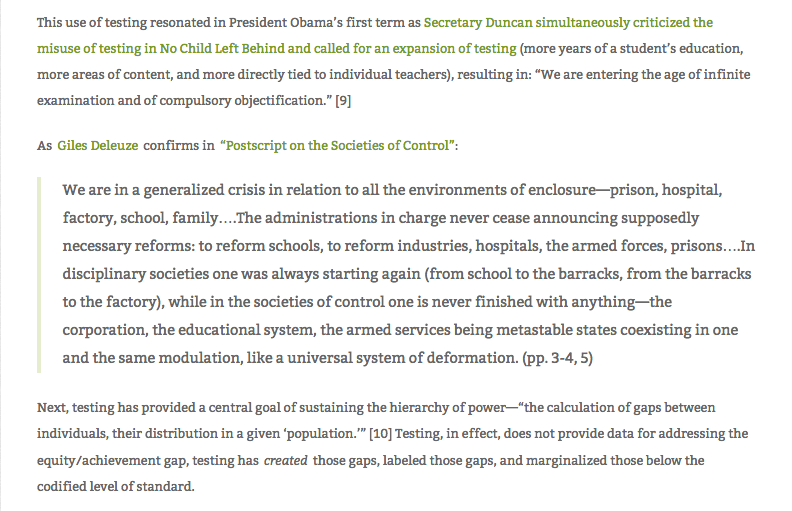
testing 2

Having now been in higher education for well over a decade, I have watched how other departments and disciplines function. Most disciplines are not only self-determining, but also self-policing.

Biologists are not scrambling to comply with political demands, and they certainly are not abdicating their field to political, media, or public expectations. Consider that biology remains firm on evolutionary biology and climate change despite the tremendous political, media, and public misunderstanding and misinformation about as well as resistant to significant bodies of research and credible evidence.

Teacher education, on the other hand, simultaneously notes that value-added methods (VAM) for evaluating teachers and teacher education are not supported by the research base while also rushing to implement policies that require VAM in teacher evaluation as well as certification and accreditation.

Such professional schizophrenia for K-12 teachers is unhealthy and dehumanizing, but often understandable in the larger context of job security.

In higher education, that professional schizophrenia is inexcusable.

To my fellow teacher educators, then, I must stress that we are the possible line in the sand about failed accountability, about the complete failure to implement evidence-based policy and practice.

When we lament the lack of respect for education by the other disciplines, when we lament that teaching is not a prestigious profession in the U.S., when we read yet another media trashing of teachers and teacher certification and degrees, when we listen to politicians and self-proclaimed reformers with no background in education make repeated claims that are untrue, how do we simply complain and then turn right around and comply?

Or possibly more important: Why do we simply complain and then turn right around and comply?

As long as we continue such schizophrenia, we are contributing to education as the punch line in a not-so-funny cartoon:
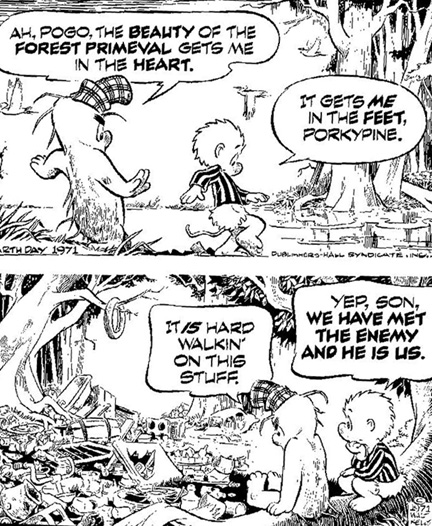
Pogo_-_Earth_Day_1971_poster

For Further Reading

Maxine Greene and the “Frozen Sea Inside of Us”

Lessons from the Zombie Apocalypse

“A generalized crisis in relation to all the environments of enclosure”: Deleuze

Re-framing teacher evaluation discourse in the media: an analysis and narrative-based proposal, Jasmine B. Ulmer

Consuming Education and Unintended (Ignored) Consequences

As I have noted often, the roots of the accountability era—President Reagan’s directive for the Nation at Risk report—are clearly connected to commitments to free market forces as central to education reform.

Over the past thirty years or so, parental choice has been promoted through a variety of market formats (vouchers, tuition tax credits, charter schools), and then accountability driven by standards and high-stakes tests have increasingly been morphed from academic incentives to financial incentives—starting with school report cards and exit exams for students before expanding to linking teacher retention and pay to student test scores and even now calling for adding teacher education to the value-added mania.

Many have begun to confront the negative impact of focusing high-stakes accountability on test scores, but those concerns tend to be about narrowing the curriculum and expectations by teaching to the test or about the lack of credible research supporting value-added methods of evaluating teachers or teacher education programs.

While those concerns are powerful and accurate, something more insidious is rarely examined: the unintended and ignored consequences of creating in education a culture of competitiveness among teachers about student test scores.

Whether value-added methods are used to determine teacher retention or merit pay, those policies are creating a system of labeling and ranking teachers, and thus, pitting teachers against each other for a finite number of jobs or pool of compensation.

The result of those policies is that each teacher must now not only prioritize her/his students’ test scores, but also seek ways in which her/his students can score higher than students in other teachers’ classes.

If Teacher A, then, finds ways in which to raise her/his students’ scores, she/he is incentivized to implement those practices while not sharing them with the wider community of teachers.

Yes, value-added methods (VAM) further reduce education to teaching to the test, but even more troubling is that VAM codifies a culture of competition that consumes the very community needed so that all students and all teachers excel.

Competition is often barbaric—as we witnessed at the end of the 2015 Superbowl when the Seahawks and Patriots were reduced in the closing seconds to the sort of fighting not accepted in the sport of football.

Schools, teaching, and learning are increasingly like those closing seconds—the circumstances are reduced, the stakes are high, and everyone becomes desperate to grab “his/hers,” without regard to others.

In education, then, the market forces us into the barbarism that formal education has been trying to overcome for decades.

The Real Education Crisis?

For Education Week‘s Quality Counts 2015, Christina A. Samuels opens a piece on early reading with the following:

Children who are not reading proficiently by 3rd grade are widely seen as being in academic crisis. Educators are increasingly looking for actions they can take in the younger grades—even as early as preschool—to head off failure later in a child’s school career.

Framing 3rd-grade reading proficiency as a crisis is about as enduring (and suspect) as the uncritical belief in the literacy deficit among children raised in poverty.

Later in the article, Samuels notes that many states have implemented grade retention policies based on high-stakes tests in 3rd grade, adding:

Student retention as a part of a strategy to support early literacy has vocal critics as well as supporters. But no one is arguing against the importance of ensuring that children are reaching reading milestones throughout the early grades.

Modeling once again the central flaw of education journalism, Samuels represents grade retention as nothing more than a tug-of-war between “vocal critics” and “supporters”—with word choices that clearly skew the reader toward the more reasonable “supporters.”

Despite the intentions of this piece about the importance of early literacy in children, we must acknowledge that the real crisis in education is both how the media covers education and how politicians design and implement policy.

First, “crisis” is the worst possible description of any educational condition since a state of crisis forces urgency when deliberation and patience are warranted. Think about the differences between emergency rooms and doctors’ offices. (See a discussion of crisis here also.)

Impoverished children have overwhelming life conditions that inhibit their ability to learn at the same rates and in the same ways as their more affluent peers. Children in poverty do not need harsh and intense educational experiences (harsh and intense often characterize their lives, and are thus the conditions muting their learning); they do not need high-stakes tests and punitive consequences.

And that leads to the ultimate education crisis: Confusing grade retention with reading policy.

That is not only a crisis, but inexcusable since there is no debate about grade retention, despite the breezy framing above.

Decades of research show that grade retention is often harmful and other strategies are always more effective (Note: the evidence-based alternative to grade retention is not “social promotion,” the great ugliness tossed out by all who embrace grade retention).

I suppose the great irony here is that it appears many in the media and most political leaders are not capable of reading the research and have a really limited vocabulary themselves.

So let me make this simple: There is no crisis in reading, and grade retention hurts children.

Now let’s address and fully fund rich and evidence-based reading for all children throughout their formal education in our public schools and make genuine commitments to the lives of all children so those policies can work.

For Further Reading

NCTE: Resolution on Mandatory Grade Retention and High-Stakes Testing

Florida Retention Policy a Blight on Literacy, Children across US

Grade Retention Research

Retain to Impede: When Reading Legislation Fails (Again)

First, Do No Harm: That Includes the Media

Just Say No to Just Read, Florida, South Carolina

Keeping children back a year doesn’t help them read better

Education Journalism Deserves an F: A Reader

On the local evening news, a story ran recently about closing down a popular segment of a relatively new rail trail to work on the crumbling infrastructure of pipes crossing beneath the trail and nearby roads.

As part of the story, the on-air reporter chatted with two women who frequently walk along the trail each morning, but will now be diverted. The reporter ended the segment by asking those two women their opinions of replacing the pipes—both nodding in agreement while endorsing the work.

Watching this, I recognized everything wrong with journalism in the U.S. The story was breezy and relevant, but I had to wonder what authority two random women walking down a rail trail had to be credible voices about the need for infrastructure work in the area.

My disappointment in journalism, notably education journalism, has been documented regularly in my blogging over the past two-plus years. And the recent national debate about police behavior and accountability has now intersected with my own work refuting the national teacher-bashing more and more common during the Obama administration as well as my persistent challenges to education journalism.

The tension is between supporting the institutions of public education, criminal justice, journalism, and unions as well as the individual people who work in those fields or situations, but being deeply concerned that we are mostly failing each of those in systemic ways.

It is possible, then, I think, to strongly criticize education journalism as failing its duty while not necessarily indicting each and every education journalist.

That said, education journalism is quite flawed, mired in a lack of knowledge about the history, practice, and research in education, trapped like a bug in amber in the compulsion to air “both sides” equally of every issue.

Here, then, I offer a reader to that concern:

No Excuses for Advocacy Masquerading as Research

Education Writers Association: Independent Bloggers Need Not Apply, Anthony Cody

O, Free Press, Where Art Thou?

Invoking “Oliver Rule (Expanded)” for Education Reform Debate

U.S. and Education Reform Need a Critical Free Press

My Open Letter to Journalists: A Critical Free Press, pt. 2

See Also

Ed Writers – Try looking beyond propaganda & press releases for success stories

CALL: Chapters for revised volume, De-Testing and De-Grading Schools (Peter Lang USA)

Classroom teachers, researchers, and de-testing/de-grading advocates are encouraged to contact me about a revised volume for Peter Lang USA: De-Testing and De-Grading Schools: Authentic Alternatives to Accountability and Standardization.

Synopsis of original volume from 2013:

A century of education and education reform along with the last three decades of high-stakes testing and accountability reveals a disturbing paradox: Education has a steadfast commitment to testing and grading despite decades of research, theory, and philosophy that reveal the corrosive consequences of both testing and grading within an education system designed to support human agency and democratic principles.

This edited volume brings together a collection of essays that confronts the failure of testing and grading and then offers practical and detailed examinations of implementing at the macro and micro levels of education teaching and learning free of the weight of testing and grading. The book explores the historical failure of testing and grading; the theoretical and philosophical arguments against testing and grading; the negative influence of testing and grading on social justice, race, class, and gender; and the role of testing and grading in perpetuating a deficit perspective of children, learning, race, and class.

The chapters fall under two broad sections: Part I: «Degrading Learning, Detesting Education: The Failure of High-Stake Accountability in Education» includes essays on the historical, theoretical, and philosophical arguments against testing and grading; Part II: «De-Grading and De-Testing in a Time of High-Stakes Education Reform» presents practical experiments in de-testing and de-grading classrooms for authentic learning experiences.

Original Table of Contents:

Contents: Alfie Kohn: Introduction: The Roots of Grades-and-Tests – Lisa Guisbond/Monty Neill/Bob Schaeffer: NCLB’s Lost Decade for Educational Progress: What Can We Learn from This Policy Failure? – Fernando F. Padró: High-Stakes Testing Assessment: The Deus ex Machina of Quality in Education – Anthony Cody: Technocratic Groupthink Inflates the Testing Bubble – Lawrence Baines/Rhonda Goolsby: Mean Scores in a Mean World – Julie A. Gorlewski/David A. Gorlewski: De-grading Literacy: How New York State Tests Knowledge, Culture, and Critical Thinking – Morna McDermott: The Corporate Model of Schooling: How High Stakes Testing Dehumanizes Education – Richard Mora: Standardized Testing and Boredom at an Urban Middle School – Brian R. Beabout and Andre M. Perry: Reconciling Student Outcomes and Community Self-Reliance in Modern School Reform Contexts – David L. Bolton/John M. Elmore: The Role of Assessment in Empowering/Disempowering Students in the Critical Pedagogy Classroom – Alfie Kohn: The Case Against Grades – Joe Bower: Reduced to Numbers: From Concealing to Revealing Learning – John Hoben: Outside the Wounding Machine: Grading and the Motive for Metaphor – Peter DeWitt: No Testing Week: Focusing on Creativity in the Classroom – Hadley J. Ferguson: Journey into Ungrading – Jim Webber/Maja Wilson: Moving Beyond «Parents Just Want to Know the Grade!» – P. L. Thomas: De-grading Writing Instruction in a Time of High-Stakes Testing: The Power of Feedback in Workshop – Brian Rhode: One Week, Many Thoughts – Lisa William-White: Conclusion: Striving toward Authentic Teaching for Social Justice.

Most of the original chapters will be updated and revised, but a few are unable to work on the revised volume project. Thus, we should have room for 2-4 new chapters.

Please send proposals ASAP, and we are requiring full drafts by July 31, 2015, to submit the revised volume by September 15, 2015.

Chapters must be in APA citation/style format and about 6000 words maximum; both practical and research/theoretical cases highlighting de-testing and de-grading classrooms are needed.

Email me with proposals or questions: paul.thomas@furman.edu


USDOE: When in a Hole, Keep Digging

The U.S. Department of Education ended 2014 with another (and predictable) reach into education reform, proposing new policy for teacher education.

Reviewing the reform initiative for NEPCKevin K. Kumashiro has drawn several disturbing (and predictable) conclusions:

This review considers the evidentiary support for the proposed regulations and identifies seven concerns: (1) an underestimation of what could be a quite high and unnecessary cost and burden; (2) an unfounded attribution of educational inequities to individual teachers rather than to root systemic causes; (3) an improperly narrow definition of teacher classroom readiness; (4) a reliance on scientifically discredited processes of test-based accountability and value-added measures for data analysis; (5) inaccurate causal explanations that will put into place a disincentive for teachers to work in high-needs schools; (6) a restriction on the accessibility of federal student financial aid and thus a limiting of pathways into the teaching profession; and (7) an unwarranted, narrow, and harmful view of the very purposes of education.

While acknowledging the nearly complete failure of this new USDOE proposal to reform teacher education is crucial, that may not be as important as also highlighting the pattern of ineptitude now shaping the Obama education legacy.

The elements of that legacy share several qualities that confirm my call for invoking the Reagan directive to abolish the USDOE:

  • Using federal initiatives and funding to leverage policy and practices in K-12 and higher education: Race to the Top, opting out of NCLB, tuition-free community college.
  • Endorsing, funding, and imposing policies, practices, and organizations that significant bodies of research either refute or reveal to be mostly speculative or no more effective than existing practices or structures: value-added methods of evaluating teachers, schools, or programs; new standards; new high-stakes tests; charter schools (and other choice mechanisms); Teach for America; third-grade retention based on high-stakes tests.
  • Masking social and educational root problems as well as “scientifically discredited” policy commitments behind Orwellian political discourse (utopian claims about teacher impact and educational attainment, parental choice; framing racist and classist structures [charter schools] and ideologies [‘no excuses,” “grit”] as “the civil rights issue of our time”).

Instead of identifying and confronting the social and educational inequity overburdening K-12 public education, schools, teachers, and students—and then promoting research-based policy addressing those inequities—the USDOE is content with maintaining the status quo of keeping the Obama education legacy at the bottom of a very deep hole begun by others and doggedly continuing to dig.

These facts have now existed well beyond a decade, and thus, are not about individual people (elected or appointed) or a political party.

This is a failed approach to government mandated instead of publicly funded universal public education.

The burden now facing the public is about both triggering the democratic process and embracing publicly funded universal public education as central to preserving that democracy.

The rhetoric and policy flowing from the USDOE are in the service of something other than either education in the name of democracy or the public good.

We all must shine light on those facts and demand different.

Publicly Funded, Not Free

Between two versions of libertarian ideology, I think, many in the U.S. have committed to the wrong one: childish Ayn Rand libertarianism instead of the child-like (idealistic) Henry David Thoreau libertarianism found in the opening of his “Civil Disobedience”:

I heartily accept the motto, — “That government is best which governs least”; and I should like to see it acted up to more rapidly and systematically. Carried out, it finally amounts to this, which also I believe, — “That government is best which governs not at all”; and when men are prepared for it, that will be the kind of government which they will have. Government is at best but an expedient; but most governments are usually, and all governments are sometimes, inexpedient….

But, to speak practically and as a citizen, unlike those who call themselves no-government men, I ask for, not at once no government, but at once a better government. Let every man make known what kind of government would command his respect, and that will be one step toward obtaining it.

While I find the rugged individualism and self-defeating as well as heartless selfishness of Rand libertarianism ethically repulsive, the tension offered in Thoreau’s quest for no government strikes me as a practical mechanism for maintaining democracy against the threat of totalitarianism.

And it is at his “better government” call that I think we can look to something such as the roads and highways in the U.S. for a template.

While we may quibble over road conditions near our homes or on our commute to work, I think we must all acknowledge in the U.S. that the publicly funded infrastructure is foundational for market success in the nation. As well, while we have depended on the political system to approve and fund those roads, highways, and bridges, we have not then turned over the design and construction of that system to politicians, but to engineers and construction experts.

That distinct line, however, has not been nearly as sacred in public education, where political leaders and appointees have far too much direct influence not only on the funding but also on the actually policy—the result being that we have far less to be proud of from our public schools than our public highway/road system—the former still much further from achieving the original intent than the latter.

I was reminded of all this once the social media frenzy began about President Barack Obama’s plan to “mak[e] two years of community college free for students,” as reported in Politico. That news prompted #FreeCommunityCollege on Twitter as well.

Against the Obama administration’s abysmal record on public education, this plan certainly sounds encouraging, but the media and public response highlights a serious problem beyond the usual concern about clamoring to score partisan political points: Obama’s plan if approved would create fully publicly funded and no-tuition community college, not free community college.

As well, this plan is a pale version of what Germany has recently re-embraced, as explained by Barbara Kehm:

From this semester, all higher education will be free for both Germans and international students at universities across the country, after Lower Saxony became the final state to abolish tuition fees….

It’s important to be aware of two things when it comes to understanding how German higher education is funded and how the country got to this point. First, Germany is a federal country with 16 autonomous states responsible for education, higher education and cultural affairs. Second, the German higher education system – consisting of 379 higher education institutions with about 2.4m students – is a public system which is publicly funded. There are a number of small private institutions but they enroll less than 5% of the total student body.

This is not a matter of mere semantics, but the German commitment and Obama’s community college proposal are about not charging students (a user fee similar to toll highways in the U.S.), but instead making a social commitment to fully publicly fund all or some of any person’s higher education (an education version of our public highway system).

“Free” is not only factually inaccurate, but the implication detracts from the exact concept that needs our support now more than ever: “publicly funded” is a necessary and rightful commitment by a people that builds the foundation upon which all else exists—life, liberty, and the pursuits of happiness as well as the glorified free market in the U.S.

To return to my example above, try building your company yourself without the publicly funded roads and highways, without the publicly funded judicial system, just to start. Yes, our publicly funded institutions in the U.S. have many problems and flaws, but the one aspect about them that isn’t flawed is that they are publicly funded.

While I am deeply skeptical of our partisan political system masquerading as democracy in the U.S., I certainly join those cheering Obama’s plan for no-tuition community college; however, my guarded optimism has strings attached, requiring that this proposal is the first step toward addressing several issues related to education:

  • Two years of no-tuition community college means little in the wake of dismantling K-12 public education, which is the ugly legacy of the Obama administration. The era of accountability-based education reform must end immediately, and then a new era of fully funding and supporting universal public education must begin—one that rejects market forces and political overstep.
  • Two years of no-tuition community college means little in the wake of the massive debt being incurred by college students in the U.S. The existing debt must be addressed (eradicated where possible), and then a system that greatly lessens college-related debt must be established while we work toward a model of universal no-tuition higher education.
  • Two years of no-tuition community college means little in the context of a depressed job market in which recent college graduates do not find full-time, stable work that matches their degrees. A college degree and enormous debt with no prospect of work is a nightmare, but a college degree without debt and no prospect of work isn’t much better. We must recognize that education policy cannot be separated from work policy.
  • Two years of no-tuition community college means little in the context of the harsh reality that educational attainment does not lessen the powerful and corrupting influence of racism and classism in the U.S. The cultural myth that education is the great equalizer is currently a false promiseBlacks with some college have about the same employment prospects as white high school drop-outs, and educational attainment is valuable within ones race, but doesn’t erase inequities among races.

Instead of rushing to promote misleading hastags or to prop up a political candidate along partisan lines, we should see Obama’s proposal for no-tuition community college as an opportunity to “make known what kind of government would command [our] respect,” to emphasize the essential nature of publicly funded institutions that constitute “better government.”

Authoritarian Schools, Authoritarian State in the Service of Privilege

The fruits of the Reagan Era are proving to be mostly poison apples.

Both begun under Reagan, mass incarceration and high-stakes education reform have escalated the rise of the authoritarian school and the authoritarian state in the service of privilege.

During the past few years, teachers and police are coming under increased scrutiny in the wake of disaster capitalism’s influence how we do school and how we enforce law—significantly at the expense of children living in poverty, black and brown children, and children speaking home languages other than English.

Jose Vilson has offered a bold and critical examination of how political and public calls for greater teacher and police quality and oversight intersect, revealing, I think, that these are not simple black and white issues. Bad teachers and bad police there certainly are, but to play the flawed individual game feeds into the central problem in the U.S.: We refuse to acknowledge systemic causes (racism, sexism, homophobia) for individual situations.

Vilson builds to what I think is the crux of the matter: “To protect and to serve, and that’s something we can never turn our backs to.” Teachers and police are public servants, embodying the will of the people. As public servants, teachers and police fail their charge when they twist their service into authority over the public, instead of from or in service of.

Authoritarian (and thus “bad”) teachers and authoritarian (and thus “bad”) police are consequences of a larger reality: The U.S. is a racist and sexist nation functioning as an authoritarian state, and most of our structures serve that status quo as well as the interests of the privileged.

Democracy and meritocracy along with the ideals of life, liberty and the pursuit of happiness for everyone remain worthy of a people, but those are not what our public institutions serve in the U.S. today.

Sacrificing Democracy and “Other People’s Children” at the Alter of Authority

Well before Bill Ayers was demonized during Barack Obama’s run for president or before Ayers’s radical past was more widely recognized after his memoir in 2001, I was introduced to his wonderful To Teach while in my doctoral program in the mid-1990s.

Ayers offers characterizations of traditional schooling that resonated with me then and do also now:

There are a lot of quiet, passive classrooms where not much learning is taking place, and others where children’s hearts, souls, and minds are being silently destroyed in the name of good management….

In school, a high value is placed on quiet: “Is everything quiet?” the superintendent asks the principal, and the principal asks the teacher, and the teacher asks the child. If everything is quiet, it is assumed all is well. This is why many normal children—considering what kind of intelligence is expected and what will be rewarded here—become passive, quiet, obedient, dull. The environment practically demands it. (pp. 23, 64)

At nearly every level of considering education, we always come back to classroom management and discipline. And it is here I want to ask two genuinely important questions:

  1. Why do we persist at accountability-based education reform driven by standards and high-stakes tests even though that approach has never worked over 100+ years?
  2. Why do we persist with harsh policies such as police in schools, zero-tolerance, “no excuses,” grade retention, and corporal punishment even though they are ineffective and even do more harm? [1]

Because all of these commitments do accomplish one thing that is actually the sacred element in formal schooling—authoritarian environments.

As long as we remain trapped in accountability reform and in-school authoritarian practices, we are admitting that we are not seeking universal public education in the service of life, liberty, and the pursuit of happiness—individual freedom and democracy.

Authoritarian schools feed an authoritarian state (where, for example, police are feared and teachers are disrespected).

Democracy must be fertilized with schools that practice community and collaboration.

So in our necessary and important rush to honor good teachers and good police, let’s be careful about our accusatory gazes because when teachers and police are bad, it may well be that their behavior reflects a failed system, an authoritarian system that serves the status quo and the interests of the privileged.

We need to lift our eyes and look closely at who supports accountability-based education reform and harsh in-school policies—and why.

There is the place to start toward better teachers and police who honor, as Vilson noted, their need to serve and protect as agents of the public good.

[1] I think in the context of these two questions, we must ask, Why are reformers convinced class size doesn’t matter (despite many enrolling their children in private schools with very low class sizes)? The answer is likely that large class size forces teachers to focus primarily on classroom management/discipline and consequently accomplishes again the main objective: authoritarian classrooms.

NOTE: HT to David Kaib for a series of Tweets recently.

A Call for Social Media Solidarity: “This Is Our House”

Let me start with an image.

Whether you have witnessed this in person or on TV, picture a college football stadium during a special event game when the fans organize a “white out” (or other appropriate color). The effect is impressive with the stadium almost entirely one color, a statement by the fans that “this is our house.”

Now, let me make a case about creating that same sort of solidarity among educators and public education advocates through social media.

Historically and significantly during the last three decades, U.S. public education policy and public discourse have been dominated by politicians, political appointees, billionaire hobbyists, pundits, and self-appointed entrepreneurs—most of whom having no or little experience or expertise in the field of education or education scholarship.

In fact, the “white out” in the media is inversely proportional to the expertise in the field:

Across MSNBC, CNN, And Fox, Only 9 Percent Of Guests In Education Segments Were Educators. On segments in which there was a substantial discussion of domestic education policy between January 1, 2014, and October 31, 2014, there were 185 guests total on CNN, MSNBC, and Fox, only 16 of whom were educators, or 9 percent. Media Matters

Next, allow me to chase what may appear to be a brief tangent.

While teaching high school English in rural SC for 18 years, I always enjoyed my U.S. literature unit on Arthur Miller’s The Crucible. One of the lines from the play was particularly enjoyable—when Tituba exclaims, “No, no, sir, I don’t truck with no Devil!”

Having grown up in the 1960s and 1970s, my mind always goes to this [1]:

Art and property of Robert Crumb.

But students often found the phrasing odd, despite my affinity for the metaphor and power of Tituba’s language.

To this day, I am apt to adopt Tituba’s stance when expressing my allegiances, and that brings me back to the point of this call for social media solidarity among educators and public education advocates.

Over about two years of blogging at my own site and engaging regularly on Twitter and other social media platforms, I have gradually adopted a stance that I do not truck with those who are disproportionately dominating the field of and public discourse about education.

Yes, I have done my share of calling out, discrediting, and arguing with, but except on rare occasions, I am done with that. Those who have tried to include me in the “@” wars on Twitter may have noticed my silence when the other side is added.

Each time we invoke their names, their flawed ideas, or their policies, we are joining the tables they have set. Once again, look at the chart above.

Also, don’t forget the Oliver Rule in which one-on-one debates imply for the public equal credibility between two people debating. As well, to debate implies that a position is debatable [2], and some issues simply aren’t up for debate.

Therefore, I am now asking that educators, scholars, and public education advocates who are active on social media (blogging, Tweeting, etc.) to make an effort to dedicate a day, a week, a month, or as I have done, a policy to creating our own educators’ “white out” on social media—establishing our place for our voices as a model against the mainstream media dedicated to those with authority (elections, appointments, wealth) but without credibility.

Don’t spend blogs rejecting their public claims and education policy.

Don’t engage them on Twitter, or “@” them into a Twitter exchange.

Symbolic messages matter, and the strongest message we can send about those who shall not be named is exactly that: erase them from the spaces they have dominated without deserving that space.

And in that open arena, let us raise our voices.

Our cases about what is not working and why, our evidence-based proposals for reform, our struggles in the classroom, our successes with students, our recognition of social and educational inequity, our commitment to social justice driven by educational equity—and all on our terms, not theirs.

This is our house.

See Also

Claiming the Education Reform Narrative

Whose Reform?: Claiming the Education Reform Narrative, pt. 2

[1] The term “keep on truckin'” likely reaches back to at least early twentieth century Jazz musicians; Robert Crumb popularized this in the late 1960s, however.

[2] Please examine how anti-evolution forces have “won” in the public arena by making teaching an evolution a debate, notably detailed in the documentary Flock of Dodos.