
Category Archives: education reform

Bearing Witness: Hypocrisy, Not Ideology

Unless this is mangled memory (and in my advancing age, it may well be), when the sit-com Seinfeld interspersed Jerry Seinfeld doing stand-up with the main show, I was struck by one routine about sports fandom. Seinfeld noted that since the players on any team are constantly changing, fans are essentially pulling for the jerseys.

As observational humor goes, that joke is funny, but I also think it essentially nails what is wrong with partisan politics when anyone defends her/his party (team) regardless of behaviors while simultaneously illuminating every slip of the other party (team) as if the world is coming to an end.

For that reason mainly, I have removed myself entirely from partisan politics (inspired by the late and great George Carlin, who is the team to which I lend my loyalty).

Recently, I have noticed Democrats posting on social media a news story concerning Rudy Giuliani’s daughter being arrested for shoplifting. I ignored the posts at first, but since I certainly have found Giuliani in the past and recently to be beyond loathsome in his commentary (notably when paired with equally loathsome Bill O’Reilley), I happened to click the link once to discover the story is from 2010.

All of this puts me in an ethical/intellectual bind because in many respects the Giuliani-as-law-and-order-politician/daughter-as-criminal dynamic does highlight what I believe is how we must judge both leadership and privilege in the U.S. But the context in which I have found this story (and it being from 2010) still reeks of partisan sniping and pettiness (especially if we consider the recent ugliness surrounding comments about the Obama daughters).

In the U.S., political leadership, wealth and success, and privilege are nearly inseparable—despite the meritocracy myth perpetuated by the privileged to mask their greased paths to power and wealth.

And thus, the genuine differences between Democrats and Republicans remain mostly in word only—platforms, speeches, and published commentaries. War mongering, accountability-driven public education reform, economic policy, etc., remain significantly similar regardless of political party affiliation in the U.S., particularly is we assess the policy against the larger ideology justifying those policies (free market mechanisms, neoliberalism, etc.).

Participating in partisan politics, then, in the same ways we participate in team sport allows privileged leadership to continue serving the interests of the privileged at the expense of the great majority of people in the U.S.—notably the marginalized.

While I am not suggesting ideology doesn’t matter, I am calling for placing judgments of leaders and the privileged in the context of hypocrisy first. Let me offer some context.

Both Democrats and Republicans champion market forces for reforming public education, notably parental choice as a driving mechanism for reform.

However, when controlling for student demographics (and conditions such as selection exclusivity and attrition), among private, charter, and public schools, virtually no differences in major outcomes exist.

But let’s go further, many endorsing market forces (whether vouchers on the right or charter schools on the left) often claim issues such as class size do not matter—assertions that must be tested against not only those making the claims but also the evidence from the market itself.

Bill Gates, for example, has pushed for classes of 40 students with teachers paid bonuses for those large class sizes; however, Gates himself attended elite private schools with extremely low class sizes.

And therein lies the problem with hypocrisy.

While private schools do not in fact outperform public schools (both forms of schooling have a wide range of so-called quality), the market dynamics around private schools responding to parental choice clearly show that low class sizes are important—in fact, justifying larger financial investments by parents.

And I think now we can circle back to how Giuliani and his daughter can and should matter.

Privileged leadership in the U.S. represents word and deed designed for everyone else except the privileged class; in education, what privileged leaders are saying is that, for example, class size doesn’t matter for other people’s children (but it does for mine and my privileged friends).

Giuliani’s tone-deaf and offensive claims about law enforcement and black/brown people/families reveal the arrogance of leadership and privilege—and thus, he should be held accountable for his hypocrisy. But not as yet another partisan mask for letting those on the “other” political team slide (which is what I believe most of the posts I have seen are doing).

Kurt Vonnegut’s Cat’s Cradle, among many things, is about the puppet show that is partisan politics as team sport. Vonnegut’s dystopia, however, is playing out before us now whenever we fail to see past the veneer of ideological claims, whenever we continue to pull for the jerseys.

To judge leadership/privilege against hypocrisy is a moral imperative that is lost in ideological team sport.

“But to recommend thrift to the poor is both grotesque and insulting,” wrote Oscar Wilde. Why? Because the people demanding thrift among the poor are not themselves living under the same directive; if fact, the wealthy who demand thrift of the poor wallow in waste and excess.

Those demanding “no excuses,” as with those rejecting the importance of class size, for example, tend to live in abundance and slack—among the very riches of excuses.

And so I believe that a key part of our fight for public education and democracy is that we cannot have genuine ideological battles until we hold all ideologies responsible for the validity of their own investment in those ideologies.

Hypocrites have no moral authority. Without moral authority, a person deserves no political authority.

As long as we allow hypocrisy, however, in order to preserve our partisan politics as team sport, we are part of the problem.

In a 1961 interview by Studs Terkel, James Baldwin states: “People don’t live by the standards they say they live by, and the gap between their profession and the actuality is what creates this despair, and this uncertainty, which is very, very dangerous.”

Baldwin, then, as writer/artist describes himself—in a 1984 interview by Julius Lester—as a witness: “Witness to whence I came, where I am. Witness to see what I’ve seen and the possibilities that I think I see.”

Every people, every generation needs the artists-as-witnesses, but a democracy requires that each one of us serves as witness in the way Baldwin explains:

Lester: You have been politically engaged, but you have never succumbed to ideology, which has devoured some of the best black writers of my generation.

Baldwin: Perhaps I did not succumb to ideology, as you put it, because I have never seen myself as a spokesman. I am a witness. In the church in which I was raised you were supposed to bear witness to the truth. Now, later on, you wonder what in the world the truth is, but you do know what a lie is….

A spokesman assumes that he is speaking for others. I never assumed that—I never assumed that I could….No society can smash the social contract and be exempt from the consequences, and the consequences are chaos for everybody in the society.

Hypocrisy is that obvious lie we must bear witness to by rising above mere ideology.
Whose Reform?: Claiming the Education Reform Narrative, pt. 2

For thirty years, the education reform movement committed to accountability linked to standards and high-stakes testing has been mostly orchestrated by the privileged class and imposed onto (while also creating) marginalized groups as the Others: black and brown students, English language learners, high-poverty students, special needs students, schools disproportionally serving any of these populations, and more recently, teachers and even parents who advocate for students and public education.

Resistance to that reform has mostly been reactionary, and thus, voices and actions of resistance have remained within the reform structure dictated by the reformers.

As I called for ways to claim the education reform narrative, I acknowledged the need for all marginalized groups to step outside being cast as the Other—but James Baldwin and Audre Lourde make that case far more powerfully than I:

My own point of view, speaking out of black America, when I had to try to answer the stigma, that species of social curse, it seemed a great mistake to answer in the language of the oppressor. As long as I react as a “nigger,” as long as I protest my case on evidence and assumptions held by others, I’m simply reinforcing those assumptions. As long as I complain about being oppressed, the oppressor is in consolation of knowing that I know my place, so to speak. (James Baldwin: The Last Interview, p. 72)

For the master’s tools will never dismantle the master’s house. They may allow us temporarily to beat him at his own game, but they will never enable us to bring about genuine change. (The Master’s Tools Will Never Dismantle the Master’s House, Audre Lorde)

As we move into 2015, I invite you to join me in avoiding the “great mistake” by claiming the education reform movement on our own terms, in our own language.

Compassionate Teaching: “a hug and a little bit of extra attention”

As I examined a week ago, while many people anticipate Santa Claus, family reunions, and peace on earth during the Christmas/New Year’s season, I await the inevitable worrying, anxiety, and stress. And there is nothing rational about either the anticipation or the days and even weeks struggling against the weight of all that anxiety.

Firmly underneath that this year (tempered briefly when I sit quietly with my granddaughter sleeping on my chest), I was immediately drawn to two moments on social media.

First (either on Twitter or Facebook), I saw this quote attributed to Gandhi:

There is nothing that wastes the body like worry, and one who has any faith in God should be ashamed to worry about anything whatsoever.

And then, this headline at Valerie Strauss’s The Answer Sheet: Mom: How I know my anxious daughter’s kindergarten teacher is great.

What I would call normal (for lack of a better word) worrying and anxiety can be exhausting—even if it is rational and based in healthy responses to the world.

But irrational and relentless worrying and anxiety are characterized by the fear of the unknown, the uncontrollable, and (I think, worst of all) highly negative “what if” thinking.

As an adult and life-long sufferer of anxiety, I can attest that these psychological experiences are physically taxing, nearly debilitating even though many of us have learned how to mask for others (in 1999, my family physician could not diagnose my panic attacks because he said I always seemed so relaxed) and how to function in self-denial (we fear admitting our own human frailties, I think, because we anxious are also perfectionists).

As I read Jane Dimyan-Ehrenfeld’s celebration of her anxious daughter’s kindergarten teacher, I started seeing more clearly how my discomfort with our field of education grows directly out of my own lived experiences with anxiety.

“As you can imagine, I too love my daughter’s teacher, Mrs. Brooks,” Dimyan-Ehrenfeld explains, adding:

Although she is an anxious kid, she loves school, not only because in her classroom learning goes hand in hand with joy and inquiry and creative exploration, but also because she adores Mrs. Brooks, who knows how to solve my daughter’s nervous stomachaches with a hug and a little bit of extra attention, who understands and honors her strengths, and who makes her laugh and teaches her funny sayings like, “Wake up and smell the cappuccino!” My daughter has watched Mrs. Brooks and learned kindness and compassion, becoming an important friend to a student with severe developmental disabilities in the classroom, no doubt in large part because she saw how much Mrs. Brooks. adored this little boy (Mrs. Brooks cried when he left for another school, and threw him a beautiful party on his last day). Where other teachers might have been relieved to lose a high-needs student from their rooms, Mrs. Brooks mourned the loss of a sweet kid, and my daughter watched this and learned.

Dimyan-Ehrenfeld’s point focuses on the current failure of addressing teacher quality by emphasizing measurable teacher impact on student test scores. And here, I agree, but I think the issue is even larger than that.

Education has historically trained teachers under some dictums I have always rejected: don’t be friends with your students, don’t touch students, and start the year as a strict disciplinarian (you can always ease off a bit later).

So I think Dimyan-Ehrenfeld’s essay about her daughter’s kind and compassionate teacher is a charge against historical and current failures about what it means to be an effective teacher.

In part, it makes sense that education and schooling focus mostly in the cognitive domain; of course, that is what learning is, I suppose.

But we fail education and our students if we ignore that teaching and learning exist in the emotional realities of being a human.

In my high anxiety phases, I am much less capable of attending to myself, but I also must retract from the needs of others (anxiety drains our ability to be the compassionate people we wish to be, and need from others)—even if that is nearly imperceptible to others.

And worrying/anxiety share a quality with poverty (as examined in Scarcity) that must be central to our work as teachers: No one—especially children, teens, and young adults—can take a vacation from anxiety, stress, or poverty because they are pervasive states beyond the control of many people.

“Don’t worry” or “relax” serves about the same purpose as “stop being poor” by placing all the emphasis (and possibly blame) on the person who is actually under the control of the anxiety/poverty but not necessarily capable of overcoming those forces alone or under that weight due to personal failure or weakness.

All humans—especially children and the young—need the empathy of others, a community of support grounded in having the awareness of what others may be experiencing if it is beyond your own experiences.

For me, part of the urge to mask grows from how exhausting it is to explain irrational anxiety to someone with no context for understanding what I struggle against. There’s a certain peace among we anxious commiserating, but those who have no experience with “what if” worrying must have empathy in order to grasp something beyond their world.

Thus, when Dimyan-Ehrenfeld emphasizes “kindness and compassion,” I was compelled by her “I too love my daughter’s teacher” to consider more deeply just why I have set out to confront corporal punishment, grade retention, and “no excuses”/deficit ideologies related to children and students: they all breed stress and anxiety unnecessarily in children/students.

Public schooling has a long history of creating stress and anxiety in the education and lives of children; over the past thirty years, that historical reality has been amplified under the guise of rigor, standards, and “no excuses”—all of which erase any hope for kindness and compassion unless each teacher her/himself is willing to risk either.

Teaching the whole child is often trivialized, and mostly marginalized—even mocked. But the great paradox of honoring the cognitive growth of children and students is that we must create lives and classrooms filled with kindness and compassion first before those cognitive goals can matter.

Recess, friendships, laughing, reading by choice, art, band, chorus, clubs, athletics—these are the moments of formal schooling that remain with children and teachers because they are filled with emotional and interpersonal meaning.

Of course, we want our students to learn and our children and youth to grow, but those aspirations are not purely cognitive and not measurable in any valid ways.

Teachers who love their students in word and deed, students who love their teachers in word and deed—these are the foundational conditions of high quality teaching and excellent student achievement.

If we start with kindness, compassion, empathy, and love, and if we remain always true to those ideals, we have a much better chance to achieve the so-called high expectations many champion while creating heartless and soulless schools that impose stress and anxiety on children that erode their capacities for learning and growing.

This is the ultimate immeasurable of being a teacher, the humanity of “a hug and a little bit of extra attention.”

Top Posts of 2014

As a writer (and teacher), I am humbled and grateful for you, the readers. So here as a “thank you” more than anything else are my top posts of 2014 (modified as a Top 10, which is more than 10 because I list the actual top 10 of 2014 and expand to include top 10 published in 2014).

And for 2015, I sincerely wish for all, peace & happiness. Let’s see what we all can do to make that happen for others and ourselves.

Modified Top Posts of 2014

Le Guin’s “The Ones Who Walk Away from Omelas”: Allegory of Privilege (2013) – 9,972

Diagramming Sentences and the Art of Misguided Nostalgia – 5,117

NPR Whitewashes “Grit” Narrative – 4,967

Open Letter to Teachers Unions, Professional Organizations, and Teacher Education – 4,819

The Poverty Trap: Slack, Not Grit, Creates Achievement (2013) – 4,427

What do College Professors Want from Incoming High School Graduates? – 3,960

“Fahrenheit 451” 60 Years Later: “Why do we need the things in books?” (2013) – 3,075

Richard Sherman’s GPA and “Thug” Label: The Codes that Blind – 2,568

New Criticism, Close Reading, and Failing Critical Literacy Again – 2,283

“Education as Great Equalizer” Deforming Myth, Not Reality – 2,204

The “Grit” Narrative, “Grit” Research, and Codes that Blind – 2,128

Reading Out of Context: “But there was something missing,” Walter Dean Myers – 2,108

UPDATED: Grit, Education Narratives Veneer for White, Wealth Privilege – 2,094

Top Posts of 2013

Time to Invoke Reagan Directive: “And please abolish that abomination, the Department of Education”

It’s the end of the world as we know it (and I feel fine).
R.E.M.
The challenge is in the moment, the time is always now.
James Baldwin

Speaking as a witness from within the bowels of the Ronald Reagan administration when President Reagan gave the committee responsible for A Nation at Risk their prime directives, Gerald Holton ended with Reagan’s emphatic “And please abolish that abomination, the Department of Education.”

About thirty years later, we must now admit it is time to invoke the Reagan directive because the USDOE cannot be any other kind of government than the very worst kind: All uninformed bureaucracy that seeks always to dig deeper from the bottom of a very deep and fruitless hole.

While Reagan’s characterizing the USDOE as an “abomination” may have been premature in the early 1980s, we must admit now that Reagan was prescient.

Throughout the 1980s and 1990s, states scrambled to “fix” public education through a series of accountability-based bureaucratic mandates built on standards (and new standards) and high-stakes tests (and new high-stakes tests).

By the turn of the century, we witnessed the tipping point that would prove Reagan right—No Child Left Behind [1], the ultimate shifting of know-nothing bureaucracy from the states to the federal government, specifically the USDOE.

Few could have been brave enough to predict that the George W. Bush 8 years of horrible education policy could be trumped by the Obama administration, but we are now solidly in the reality that the USDOE is a total Obamination—relentless failed bureaucracy piled on top of failed bureaucracy.

Under Obama and the appointee-leadership of Secretary Arne Duncan, public education has been bombarded by competitive grants, teacher bashing, union bashing, and a series of policies at the state and federal levels that are neither supported by research nor appropriate responses to the very real problems facing public schools (many of which are beyond the walls or control of those schools).

The two latest abominations are calling for expanding value-added methods (VAM) into teacher education and ranking colleges and universities.

Even those along a wide spectrum of ideologies who believe in the promise of VAM have consistently demonstrated that VAM is not as effective as policies claim and that VAM should not be used in any high-stakes contexts for schools, teachers, or teacher education.

Those of us who see no promise for VAM add that all this expanded testing is a tremendous waste of time and money—most notably because grasping at measurable data is missing the greatest problems burdening our schools, social and educational inequities (ironically, all circumstances that could be addressed effectively if government would behave as government as demonstrated in many other countries around the world).

As Gerald Bracey explained in numerous contexts, ranking itself is fool’s gold—and in education, ranking is particularly caustic since it creates competition where we should be in collaboration (this is also a fundamental problem with VAM as a mechanism for sorting teachers, schools, or schools/departments of education).

The two most recent abominations are not unique, however, but lie in a long line including Race to the Top, Opting Out of NCLB, and Common Core.

Simply stated, these policies are designed and promoted by people with no or little experience or expertise in the field of education. Their advocacy remains plagued by the bi-partisan political tactic of simple saying things that aren’t true and then using the bully pulpit of election or appointment to plow ahead (and thus, beware the roadbuilders).

Maybe this will sound outlandish, but let’s consider what people who have taught, studied, and researched the field of education recognize about the proposal to hold colleges/departments of education accountable for the test scores of students being taught by graduates from those colleges/departments (holding grandparents responsible for their grandchildren’s behavior, in effect):

Ridiculous I suppose—like asking the legal profession to weigh in on jurisprudence or the medical profession to craft health policy. [2]

Many people have called for the ghost of Ronald Reagan, and I never counted myself among them until now. But in the waning days of 2014, I welcome that ghost of administration’s past to ramble into the room and, as Holton paraphrased, make the call once again: “And please abolish that abomination, the Department of Education.”

[1] The irony is NCLB called for scientifically based policy in education, and we have gotten anything except: Whatever Happened to Scientifically Based Research in Education Policy?

[2] Education has a very long history of being ignored as a field in terms of policy, and public education has also long labored under a misguided business model; see from Callahan, R. E. (1962). Education and the cult of efficiency: A study of the social forces that have shaped the administration of the public schools. Chicago: The University of Chicago Press:

For while schools everywhere reflect to some extent the culture of which they are a part and respond to forces within that culture, the American public schools, because of the nature of their pattern of organization, support, and control, were especially vulnerable and responded quickly to the strongest social forces. . . .The business influence was exerted upon education in several ways: through newspapers, journals, and books; through speeches at educational meetings; and, more directly, through actions of school boards. It was exerted by laymen, by professional journalists, by businessmen or industrialists either individually or in groups. . ., and finally by educators themselves. Whatever its source, the influence was exerted in the form of suggestions or demands that the schools be organized and operated in a more businesslike way and that more emphasis by placed upon a practical and immediately useful education….

The tragedy itself was fourfold: that educational questions were subordinated to business considerations; that administrators were produced who were not, in any true sense, educators; that a scientific label was put on some very unscientific and dubious methods and practices; and that an anti-intellectual climate, already prevalent, was strengthened. (pp. 1, 5-6, 246)

Claiming the Education Reform Narrative

If the education reform movement is transitioning into a next phase and if my call for teaching with our doors open as an act of resistance can gain traction beyond the school house, educators must also begin to lead when our leaders fail, in part by claiming the education reform narrative away from political, media, and non-expert reform advocates.

Here, then, I want to outline the how’s and why’s of raising our professional voices as educators in order to succeed in a public arena:

  • Too often, educators have been on the defensive, historically and during the recent three decades of accountability, in the education reform debate. That has left those without expertise always determining the ground and content of the debate, framing educators as professionals as always rejecting reform and having little to offer as an alternative. Step one, then, is we must begin to initiate the narratives about what educational problems exist and then what policies better address those needs. This must include avoiding both the people and policies dominating mainstream reform. Instead of rejecting over and over the edu-reform leader of the moment, we must speak with authority on our own terms—not as a response to the person or the policy.
  • If Edu-reformer X is wrong and lacking credibility, we must not rush to pat Edu-reformer X on the back if/when he/she expresses a position we have offered credibly often. Our evidence-based professional stances are credible on their own; we do not need those without credibility but with misplaced authority in order to be right. For example, as an alternative to refuting edu-reformers, at the school level, since standardized test scores are problematic across public education, we must not celebrate if our school has high test scores, but instead, find more valid ways to celebrate our schools that also honor all public schools.
  • We must stop trying to out-do the edu-reformers: stop offering better accountability, stop offering better testing, stop offering better standards. The accountability approach to education reform and education is a failure, period. Just as educational leaders have failed by fighting for a place at the accountability table, educators have also too often made this mistake. We must make the case for professional and shared responsibility for the good of each student as well as all students.
  • We cannot fall prey to government bashing. “Publicly funded,” not “free,” is the heart of a democracy, the essential foundation for economic commitments to work well and for a people to achieve justice. When our government has failed, in fact, it has failed to act as government. It is ours to show that public education rests beside other essentials, such as the fire department or roads/highways, that the public tends to embrace positively.
  • Stories matter more than research, and words matter. While as professionals we must assert our evidence-based reasons schools struggle and policies to address those problems, we must take care to craft narratives that accurately reflect that research base; here are real people doing real things, and not “research shows.” But just as we must stop playing at the accountability table set for us, we must set aside the words and phrases at the heart of the failed reform agenda: accountability, grit, no excuses, rigor, achievement gap.
  • More broadly, we must not participate in the decades’ long and corrosive crisis/Utopian discourse framing of current reform: the contradictory education is in perpetual crisis and education is the one true way. They are both false, and they are both counter-narratives to the stories we must tell.
  • One of the most powerful and complicated parts of the flawed reform agenda is the claim about teacher quality, and here, educators have a huge challenge. We must begin to assert that teachers and teacher quality matter, but that value is not easily measured. As I noted above, this will require that we find avenues and techniques to celebrate our schools, our teachers, and our students in credible and complex ways—stories with teachers and children, and not numbers. And thus, we must shape a community narrative; teacher quality is not about one teacher, but about a community of educators and a community of learners, often over many years. Why not take a class of 8th graders at the end of their journey at a middle school and highlight all three years and all the teachers involved—experiences both academic and extracurricular? Teaching and learning are complex, and often messy; thus, we must make this story vivid and compelling.

Yes, some edu-reformers must be confronted, rarely and when egregious, and some policies must be directly and powerfully refuted (as I have with corporal punishment and grade retention), but we now need to shift the balance of our public voices.

The case, however, is now clear that political leaders, the media, and most edu-reformers have weak credibility and support failed policies.

“The challenge is in the moment,” James Baldwin implored, “the time is always now.”

It is time to claim our profession, and part of that includes claiming the education reform narrative, one that is informed, honest, and productive.

Open Letter to Teachers Unions, Professional Organizations, and Teacher Education

After speaking and guiding a workshop recently, I was struck by some distinct impressions I witnessed among several hundred educators.

First, although teachers and educational leaders coming to a conference are a skewed subset of teachers, I was impressed with their passion for teaching but more so for their students.

However, I must add that these teachers repeatedly expressed a lack of agency as professionals; a common refrain was “I [we] can’t,” and the reasons were administration and mandates such as Common Core (or other standards) and high-stakes testing. That sense of fatalism was most often framed against these teachers clearly knowing what they would do (and better) if they felt empowered, professionally empowered, to teach from their expertise as that intersects with their students’ needs.

This experience came just two weeks after my trip to the National Council of Teachers of English (NCTE) annual convention, this year in Washington DC—where I presented on the value of books and libraries as well as delivering the Moment of History as the Council Historian. Again, I spent several days with a skewed subset of teachers, but there I would also characterize much of the talk as “I [we] can’t”—because of administration, because of Common Core.

I must admit that during my 13 years as a teacher educator, once our students enter the field of education, I listen as my highly motivated and bright young teachers begin to speak in “I [we] can’t,” often apologizing for essentially never being able to implement in their classes the many research-based practices and robust philosophies we explored when they were in methods courses.

Let me now highlight here that the first experience above was with all unionized teachers; the second example, with active members of a professional organization; and the third, with traditionally certified teachers from a selective university and a highly praised and accredited program.

Earlier this year, Helen Klein reported:

American teachers feel stressed out and insignificant, and it may be impacting students’ educations.

Gallup’s State Of America’s Schools Report, released Wednesday, says nearly 70 percent of K – 12 teachers surveyed in a 2012 poll do not feel engaged in their work. The study said they are likely to spread their negative attitudes to co-workers and devote minimal discretionary effort to their jobs.

…When compared to 12 other occupational groups, teachers were least likely to report feeling like their “opinions seem to count” at work.

And thus, I have a very serious question:

If being unionized, a member of a professional organization, or certified results in teachers feeling the same powerlessness, the same lack of professionalism as most other teachers, how do teachers unions, professional organizations, and teacher education justify themselves?

I think this question is valid, and I think we now stand at a watershed moment for teachers unions, professional organizations, and teacher education. And I offer this hard and blunt question because, ultimately, I believe in the promise of teachers unions, professional organizations, and teacher education as a discipline.

My first impression about this question is that far too often unions, professional organizations, and teacher education have failed teachers and education by racing to grab a seat at the table—eager to contribute to how to implement standards, testing, and bureaucracy. All three arenas of educational leadership have failed educator professionalism by rushing to participate within the partisan political accountability movement over the past thirty years.

Leadership from unions, professional organizations, and teacher education has been overwhelming as fatalistic as the teachers I described above; diligently compromising, eagerly complying, breathlessly trying to excel at accountability and bureaucracy—in effect, leading by following.

If we return to what we know about how teachers feel, Klein noted the ultimate danger of a lack of teacher professionalism:

“The problem is that when teachers are not fully engaged in their work, their students pay the price every day,” says the report. “Disengaged teachers are less likely to bring the energy, insights, and resilience that effective teaching requires to the classroom. They are less likely to build the kind of positive, caring relationships with their students that form the emotional core of the learning process.”

And thus, compliant, fatalistic educational leadership feeds compliant, fatalistic teachers—failing the most important aspect of universal public education, students.

Instead of challenging the assumption that public education needs accountability based on standards and high-stakes testing, unions, professional organizations, and teacher educators have mostly focused on helping teachers navigate each new round of standards and tests—even praising each new round despite no evidence that standards and testing work (or are in any way address the real roots of educational inequity).

Too often, that same pattern has occurred with value-added methods for teacher evaluation and calls for reforming teacher education. [1] The responses have been about implementing policies slowly so they can be done correctly—not substantive rejecting of deeply flawed policy and the dismantling of teaching as a profession.

I do not discount that a powerful consequence of high-stakes accountability is that educators and educational leaders are on the defensive, often frantic because a failure to comply with flawed policy can result in serious consequences—risking funding, lost jobs, ruined careers even.

However, the exact reasons that teachers unions, professional organizations, and teacher education should matter are the antidotes to remaining trapped in a state of frantic reaction: Collective and professional noncooperation with any policies not supported by the knowledge-base of the field of education and the established norms of professionalism.

So this is my point: Teachers unions, professional organizations, and teacher education have a duty to their own existence and to teachers as well as the field of education; that duty includes no longer fighting for a place at the education reform table, no longer putting organizational leadership and bureaucracy before the integrity of education as a discipline and a profession.

As English educator and former NCTE president Lou LaBrant announced in 1947: “This is not the time for the teacher of any language to follow the line of least resistance, to teach without the fullest possible knowledge of the implications of his medium.”

As James Baldwin declared in Nobody Knows My Name: “The challenge is in the moment, the time is always now.”

This is about time. It is time to set aside the failed pursuit of accountability, the corrosive insistence on rigor, and the dehumanizing commitment to standardization.

It is time that teaching reclaim its rightful place as a profession, setting the table for how teachers teach, how students learn.

It is time leaders in teachers unions, professional organizations, and teacher education lead by leading.

[1] We do have examples of resistance, although too rare; see this response to NCTQ by NCTE.

Creating Crime, Criminals to Justify Deadly Force

“The road to hell is paved with good intentions”—and this I learned while teaching high school (more than) once when I supported a new school policy designed to encourage our students to come to class each day prepared, specifically having done their homework.

Let me offer some context before explaining further.

I taught in the rural high school I had attended, and this was a rules-based public school, reminding many people of the strictest private schools.

Students took each year a handbook test, which they had to pass before they could begin their classes. We had a demerit system and, eventually, in-school suspension—including automatic demerits for being late to class, chewing gum, and having to use the restroom during class.

I found the climate of the school and the rules themselves to be unnecessarily harsh, counter-educational; therefore, I had posted on my wall instead of the required classroom rules, this:

“Any fool can make a rule, and any fool will mind it.” – Henry David Thoreau

But we also were a relatively collaborative school in that the principal came to the department chairs and sought support and consensus for changes or major decisions. One of those changes was creating and implementing homework center.

If students failed to have homework completed for any class, teachers turned those students in (we had elaborate 3-carbon-copy forms for the task), requiring that students serve homework center for 30 minutes after school and present the required homework.

Of course, the intent of homework center was to encourage students to complete their homework.

However, not long after the practice was implemented, we discovered several key things: (i) the number of students assigned to homework center swelled quickly, (ii) students began to embrace showing up for class without homework, openly declaring they would use homework center to complete the assignment, and (iii) students attending homework center tended to be the same students over and over (similar to what we observed with in-school suspension), but not the same students typically in the discipline process.

I also learned a larger lesson: Once we instituted homework center, no matter how much evidence we had that it did not work—that it actually created new problems—no one in authority was willing to end it.

School rules and laws create the boundaries of what constitutes infractions or crime and who is a delinquent or a criminal.

Schooling as preparation for life, in its ugliest form, is how we determine what rules/laws count and who suffers the burdens of both.

As I have noted before, the Reagan administration provided fertile ground for education reform and mass incarceration, increasing racial and class inequity in schools and society.

And just as Berliner and Biddle recognized the manufactured crisis of education reform, we are now faced with the social realities in which crime and criminals are being created in order to justify deadly force.

While we witness a cycle of black young males being shot and killed while unarmed (or holding something mostly harmless but appearing harmful), across the U.S. marijuana is being legalized so that mostly white people can now build businesses around the once-illegal recreational drug that has been the cause of thousands upon thousands of people being labeled as criminals—disproportionately young black males who did not use or sell at higher rates than affluent whites, but suffered the greater weight of arrest, prosecution, and sentencing.

This is no abstraction: One day marijuana possession makes you a criminal; the next day, an entrepreneur.

Too often in the U.S. crimes and policing those crimes are the mechanisms for determining who we demonize (police claimed Tamir Rice looked 20, when the boy was 12; Darren Wilson claimed Michael Brown “look[ed] like a demon”) in order to justify the most extreme responses to created criminals.

Often we are left with no hard proof for what happened when a police officer charged with protecting the public shoots and kills a person later shown to be unarmed, innocent.

We are left then with seeking ways in which those realities are less tragic, and we must consider at least this: What if deadly force was automatically reviewed with complete transparency? And what if police officers in the U.S. were trained differently, as they appear to be in other countries where deadly shootings are rare or nearly non-existent?

Blacks and people in poverty are disproportionately innocent victims in the criminal justice system designed and implemented by the privileged.

That system creates crimes, creates criminals, and creates the powerless who then behave in ways that work in the service of those in power to point to those powerless taking any power they can as justification for the system, an often dead-end and deadly system for those powerless.

The U.S. was born out of lawlessness—and countless crimes against the humanity of native and enslaved peoples. Instead of humility, we have adopted idealism and arrogance, failed in the exact way Thoreau criticized: Too often foolish people with power making foolish laws, creating crimes and criminals.

In “We Can Change the Country,” James Baldwin confronts the most damning creation before us:

It is the American Republic—repeat, the American Republic—which created something they call a “nigger.” They created it out of necessities of their own. The nature of the crisis is that I am not a “nigger”—I never was. I am a man….

Now there are several concrete and dangerous things we must do to prevent the murder—and please remember there are several million ways to murder—of future children (by which I mean both black and white children). And one of them, and perhaps the most important, is to take a very hard look at our economic and our political institutions….

We have to begin a massive campaign of civil disobedience. I mean nationwide. And this is no stage joke. Some laws should not be obeyed. (The Cross of Redemption, pp. 60, 61)

Baldwin recognized that who controls laws creates crime and criminals, and he also recognized “a gesture can blow up a town”—although those left mostly unscathed are the ones making the rules leading to those gestures.

Testing the Education Market, Cashing In, and Failing Social Justice Again

On Black Friday 2014—when the U.S. officially begins the Christmas holiday season, revealing that we mostly worship consumerism (all else is mere decoration)—we are poised to be distracted once again from those things that really matter. Shopping feeding frenzies will allow Ferguson and Tamir Rice to fade away for the privileged—while those most directly impacted by racism and classism, poverty and austerity remain trapped in those realities.

History is proof that these failures have lingered, and that they fade. Listen to James Baldwin. Listen to Martin Luther King Jr.

But in the narrower education reform debate, we have also allowed ourselves to be distracted, mostly by the Common Core debate itself. As I have stated more times that I care to note, that Common Core advocates have sustained the debate is both a waste of our precious time and proof that Common Core has won.

As well, we are misguided whenever we argue that Common Core uniquely is the problem—instead of recognizing that Common Core is but a current form of a continual failure in education, accountability built on standards and high-stakes testing.

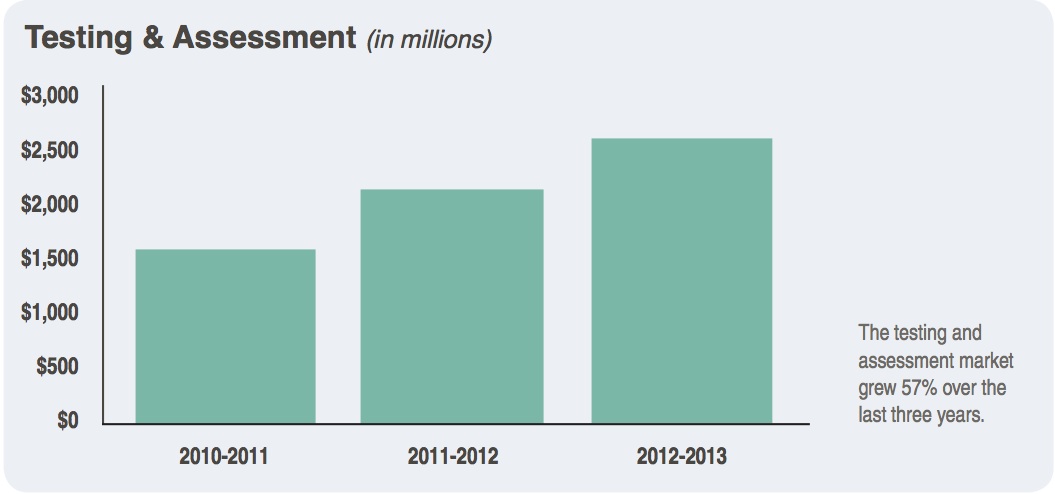
With the release of Behind the Data: Testing and Assessment—A PreK-12 U.S. Education Technology Market Report*, we have yet another opportunity to confront that Common Core is the problem, not the solution, because it is the source of a powerful drain on public resources in education that are not now invested in conditions related to racial and class inequity in our public schools.

Richards and Stebbins (2014) explain:

The PreK-12 testing and assessment market segment has experienced remarkable growth over the last several years. This growth has occurred in difficult economic times during an overall PreK-12 budget and spending decline….

Participants almost universally identified four key factors affecting the recent growth of the digital testing and assessment market segment:

1) The Common Core State Standards are Changing Curricula

2) The Rollout of Common Core Assessments are Galvanizing Activity….

(Executive Summary, pp. 1, 2)

testing and assessment 57 percent
(Richards & Stebbins 2014).

So as I have argued before, Common Core advocacy is market-driven, benefiting those invested in its adoption. But we must also acknowledge that that market success is at the expense of the very students who most need our public schools.

And there is the problem—not the end of cursive, not how we teach math, not whether the standards are age-appropriate.

Common Core is a continuation of failing social justice, draining public resources from needed actions that confront directly the inexcusable inequities of our schools, inequities often reflecting the tragic inequities of our society:

As the absence or presence of rigorous or national standards says nothing about equity, educational quality, or the provision of adequate educational services, there is no reason to expect CCSS or any other standards initiative to be an effective educational reform by itself. (Mathis, 2012, 2 of 5)

Who will be held accountable for the cost of feeding the education market while starving our marginalized children’s hope?

Reference

Richards, J., & Stebbins, L. (2014). Behind the Data: Testing and Assessment—A PreK-12 U.S. Education Technology Market Report. Washington, D.C.: Software & Information Industry Association.

* Thanks to Schools Matter for posting, and thus, drawing my attention to the study.

Teaching with Our Doors Open: Professional Transparency as Acts of Resistance

“It is very nearly impossible, after all, to become an educated person in a country so distrustful of the independent mind.”
James Baldwin, “They Can’t Turn Back”

During my 18 years as a public high school English teacher, I had a standing commitment shared with my students: I taught with my door open.

This may not sound that radical, but I want to offer two points of context: (i) I taught with a colleague who always kept the door locked (and advocated that all other teachers do that also to create a barrier for drop-in visits by administrators), and (ii) I taught in ways not supported by my school as well as allowing student behavior explicitly punishable by school rules (eating and drinking in class, for example).

This context of my years as an English teacher came back to me during my session at the 2014 National Council of Teachers of English. At the end of the session, including Sean Connors (University of Arkansas) and Nita Schmidt (University of Iowa), the audience discussion turned to a tradition in teaching that likely is doing us great harm: teaching with our doors shut as an act of resistance (since we use the shut doors to implement practices counter to mandates).

Let me offer two moments from the history of teaching English before making a call for teaching with our doors open as acts of resistance.

Around 1931-1932, English educator (and 1954 NCTE president) Lou LaBrant taught while working on her doctorate at Northwestern University. In her unpublished memoir housed with her papers at the Museum of Education (University of South Carolina), LaBrant recalled a powerful—and disturbing—situation she encountered with her roommate, a Spanish teacher at her school.

Since the school had a prescriptive curriculum (including required books, etc.) and a standard assessment system based on that curriculum, LaBrant and her roommate fabricated an entire year’s lesson plans to conform to the mandates, but then implemented what LaBrant called progressive practices throughout the year (LaBrant did not require the books provided, allowing choice in reading and writing instead, for example).

In one respect, LaBrant and her roommate represent the all-too-common “shut your door and teach the way you believe.” But the disturbing aspect is that LaBrant’s students scored exceptionally high at the end of the year on the mandated assessment, prompting the administration to highlight how well LaBrant implement the requirements—and thus attributing the students’ success to the prescribed curriculum LaBrant did not implement.

Now let’s jump forward about 40 years to what Stephen Krashen calls Whole Language and the Great Plummet of 1987-92.

Krashen and Regie Routman have both detailed how problematic “shut your door and teach” can be when we consider literacy policy.

While many blamed whole language as a policy commitment in California for the literacy test score drop in the late 1980s and early 1990s, Krashen explains:

Did teachers change their ways in California? Nobody really knows. There have been no empirical studies comparing methodology in language arts teaching before and after the 1987 committee met. (p. 749)

Routman is more direct:

So while the California framework…recommended the teaching of skills in context (as opposed to isolation), in actuality, the teacher training to empower all teachers to do this successfully was insufficient. In addition, the framework was widely misinterpreted. (p. 19)

At best, then, we can say about whole language implementation in California: (i) we have no firm data on if it was practiced, (ii) few teachers were adequately trained to implement whole language, and (iii) evidence suggests whole language was misunderstood often. Ultimately, California failed whole language, but whole language did not fail California—in part, because so many teachers shut their doors and teach.

This highlights a central tension around teacher agency and professionalism within a culture that demands teachers to be not political, not activists: Implementing mandates is not the work of professionals, notably when teachers and the research base for a field are excluded from how the policies are created within a partisan political arena (that teachers are deterred from entering as professionals).

My solution, then, is that teachers must begin to embrace and embody their professional selves by teaching with the doors open, especially when our practices reject flawed policy and mandates. Additionally, we must make transparent more credible artifacts of students learning, and not simply rely on the high-stakes testing data also used to de-professionalize teachers.

Teaching with our doors open creates agency where the system has denied it; teaching with our doors open offers direct alternatives to the practices we reject, to practices not supported by the evidence of our field; and teaching with our doors open models for our students how professionals behave.

While there is understandable refuge in teaching with our doors closed—historical and current forces that have worked to deny teachers their voices, their professionalism—it will only be through teaching with our doors open that we can both serve our students well and create a lever to reclaim our profession.

See Also

A Call for Non-Cooperation: So that Teachers Are Not Foreigners in Their Own Profession