While we can never make statistically valid claims about who and what is posted in online comments, I believe those comments represent common beliefs more than we’d like to admit.
Possibly the nastiest and most troubling comments occur when I publish something about race and racism, as in this piece in The State (Columbia, SC) about racial inequity in school discipline and mass incarceration.
Let’s consider some of the failed logic:
“I don’t believe your statistics and here are some statistics that prove my point”—this comment reveals the power of seeking support for a belief someone will never release. What is also interesting is that this approach almost always shifts entirely the discussion, not actually refuting the original statistical evidence: to reject racism in mass incarceration, for example, single-mother birth rates are cited.
Racism denial almost always plays the poverty card, but in the racial inequity of mass incarceration, that point falls flat. Impoverished white males outnumber black males 2 to 1; thus, incarceration is not more significantly a function of poverty than race, since black males outnumber white males 6 to 1 in prison.
Racism denial also has a favorite statistic: black on black crime rates. However, white on white crime rates are about the same as black on black crime rates, both over 80%. In fact, crime in the U.S. is typically within race and by someone the victim knows (often family). If within-race crime rates explained mass incarceration, then blacks and whites would be about equally represented in prisons.
And finally, I have been told by email that I don’t know anything about being a police officer since I have never been a police officer—these denials are by white former officers who, of course, know nothing about being black (using their logic). Much of what I offer about the racism of school discipline and the judicial system is based on the research and lived experienced of blacks, to me a much more credible source of understanding the inequity.
The raw data on school discipline and mass incarceration are undeniable in terms of racial inequity. As I noted, that requires a careful and nuanced consideration of the many reasons that inequity exists. In the case of mass incarceration, Michelle Alexander has offered a detailed examination that uncovers significant racism in who is arrested, how (and if) people are charged, and what sentences are handed down.
Decades of research also shows racial inequity in school discipline and then high and disturbing correlations between school discipline and incarceration rates.
Denial of racism in school discipline and incarceration, from the nasty to the illogical, is embracing school and judicial realities that mis-serve black children and black young adults—and then mis-serves us all.
Asking why these inequities exist so that they can be eradicated is a call for justice, not a plea for anarchy.
The puzzle isn’t hard to put together because the pieces are in clear sight and fit together easily, but political, media, and public interest in facing the final picture is at least weak, if not completely absent.
Gerald Bracey (2003) and more directly Gerald Holton (2003) exposed that the stated original intent under the Ronald Reagan administration was to create enough negative perceptions of public education through A Nation at Risk to leverage Reagan’s political goals:
We met with President Reagan at the White House, who at first was jovial, charming, and full of funny stories, but then turned serious when he gave us our marching orders. He told us that our report should focus on five fundamental points that would bring excellence to education: Bring God back into the classroom. Encourage tuition tax credits for families using private schools. Support vouchers. Leave the primary responsibility for education to parents. And please abolish that abomination, the Department of Education. (Holton, n.p., electronic)
The accountability formula spawned after A Nation at Risk swept the popular media included standards, high-stakes testing, and increased reports of pubic school failure.
While the federal report created fertile ground for state-based school accountability, that proved not to be enough for political leaders, who within 15-20 years began orchestrating national versions of education accountability. The result was No Child Left Behind and then Common Core standards and the connected high-stakes tests—both neatly wrapped in bi-partisan veneer.
About thirty years after Reagan gave the commission that created A Nation at Risk the clear message about the need for the public to see public education as a failure, David Coleman, a lead architect of Common Core, exposed in 2011 what really matters about the national standards movement; after joking about having no qualifications for writing national education standards, Coleman explained:
[T]hese standards are worthy of nothing if the assessments built on them are not worthy of teaching to, period. This is quite a demanding charge, I might add to you, because it has within it the kind of statement – you know, “Oh, the standards were just fine, but the real work begins now in defining the assessment,” which if you were involved in the standards is a slightly exhausting statement to make.
But let’s be rather clear: we’re at the start of something here, and its promise – our top priorities in our organization, and I’ll tell you a little bit more about our organization, is to do our darnedest to ensure that the assessment is worthy of your time, is worthy of imitation….
There is no amount of hand-waving, there’s no amount of saying, “They teach to the standards, not the test; we don’t do that here.” Whatever. The truth is – and if I misrepresent you, you are welcome to take the mic back. But the truth is teachers do. Tests exert an enormous effect on instructional practice, direct and indirect, and it‟s hence our obligation to make tests that are worthy of that kind of attention.
The pieces to the puzzle: Education accountability began as a political move to discredit public schools, and next the Common Core standards movement embraced that above everything, tests matter most.
In a move likely to cause political and academic stress in many states, a consortium that is designing assessments for the Common Core State Standards released data Monday projecting that more than half of students will fall short of the marks that connote grade-level skills on its tests of English/language arts and mathematics.
Like Naomi Klein’s disaster capitalism—the consequences of which are being exposed in New Orleans, notably through replacing the public schools with charter schools—the Common Core movement is not about improving public education, but a form of disaster bureaucracy, the use of education policy to insure the perception of educational failure among the public so that political gain can continue to be built on that manufactured crisis.
Yes, disaster bureaucracy is an ugly picture, but it is evident now the accountability movement is exactly that.
Common Core is not some unique and flawed thing, however, but the logical extension of the Reagan imperative to use education accountability to erode public support for public schools so that unpopular political agendas (school choice, for example) become more viable.
The remaining moral imperative facing us is to turn away from political claims of school and teacher failure, away from their repeatedly ineffective and destructive reforms, and toward the actual sources of what schools, teachers, and students struggle under as we continue to reform universal public education: social and educational inequities that have created two Americas and two school systems that have little to do with merit.
Accountability built on standards and high-stakes testing (not Common Core uniquely) is the problem because it is a designed as disaster bureaucracy, not as education reform.
References
Bracey, G. W. (2003). April foolishness: The 20th anniversary of A Nation at Risk. Phi Delta Kappan, 84(8), 616-621.
Holton, G. (2003, April 25). An insider’s view of “A nation at risk” and why it still matters. The Chronicle of Higher Education, 49(33), B13-15. Retrieved March 26, 2010, from OmniFile Full Text Mega database.
South Carolina is a hard-core right-wing state, often leaning Libertarian and almost always contradictory.
SC politicians push school choice while running against a woman’s right to choose. Now we learn that school choice advocacy in SC does not include parents’ right to choose whether or not their children participate in relentless testing.
According to a memo from the SC Department of Education and to district superintendents:
It has come to the attention of the South Carolina Department of Education (SCDE) that opt-out request forms are circulating around the state giving some parents the belief that they can opt their children out of state and federal testing requirements, among other things. With regard to testing, federal and state laws require that all students be included in South Carolina’s state assessment system.
There is no state provision for parents or eligible students (who are age eighteen or older) to opt-out of state-or district-wide testing….
With regard to any requests from parents for a school district to omit their children’s data from any district submission to the SCDE, neither federal nor state law allows a parent to opt-out of federal or state-required data collection processes, which is safeguarded by the SCDE.
While I have written often about the dangers of idealizing parental choice, it is certainly interesting to recognize the contradictory messages right-wing political leadership in SC sends about their own occasional support of choice (which reveals itself to be no real support of choice at all—only when it serves the interests of those leaders).
Poor Kids and the “Word Gap” opens with an important admission by Jessica Lahey: The Horace Mann ideal that education is the “great equalizer” has not materialized (or at least, has eroded). While the impact of education appears powerful within class and race classifications, educational attainment remains ineffective in overcoming social inequity.
As the article title states, however, Lahey turns to the “word gap”—a compelling and repeated entry point for discussing the educational differences among social classes and races of children. Quoting a Clinton Foundation report, the article equates that “word gap” with childhood hunger and food insecurity before detailing the Obama administration’s initiative to bridge that socioeconomic word gap.
Lahey’s article, the Clinton Foundation, and the Obama initiative are all sincerely grounded in good intentions, and all rightfully highlight the need to address the inequity of education in the U.S. that mirrors the social inequities a rising and high percentage of impoverished children experience.
But, once again, the problem persists that we remain committed to a deficit gaze, one that ultimately blames the parents of children in poverty (often the mother) for the “word gap.”
Looking closely at the Clinton Foundation report, in fact, reveals that Hart and Risley’s 1995 research (see chart on page 10) continues to anchor assumptions that the quantity and quality of words are linked to both the socioeconomic status of a child’s home and then the child’s ability to succeed once in formal schooling.
As Dudley-Marling and Lucas emphasize, the foundational study by Hart and Risley and pathologizing the language of impoverished students are misguided and misleading because of the essential deficit perspectives embedded in each, perspectives reflecting and perpetuating stereotypes. “Pathologizing” language means that the language itself is seen as a “sickness” and thus what must be “treated”—including the concurrent implicating that the host of the language, the child, is also diseased and must be treated.
As well, research in the UK reveals that the dynamic among literacy, social class, and educational attainment is complex, but also powerful. Pleasure reading and even the quality of that reading appear to increase literacy in adults, Sullivan and Brown detail.
Sullivan reaches two important conclusions: the need to protect the library and the importance of books in the child’s home.
This focus—on strategies for enriching the literacy of children born into impoverished homes—offers important ways for shifting our deficit gaze away from blaming the victims of poverty and toward systemic causes for characteristics (“word gap,” for example) so that we can develop policy to prevent the conditions in the first place and also create contexts for alleviating inequity that already exists.
The great challenges facing the U.S. and our disturbingly high percentage of children living in poverty are social inequities linked to classism and racism. We must admit these problems, and then we must address them directly (and not by clinging to idealistic beliefs such as education will be the “great equalizer”).
But we must also address directly the existing inequities reflected in the homes and education of impoverished children.
Let’s not blame high-poverty mothers; instead, let’s develop policies that provide books for children in their homes while we commit to social programs that allow impoverished families the sort of security and opportunities supporting them in their roles as a child’s first teachers.
Let’s not diagnose and then treat impoverished children and their literacy; instead, let’s insure that all children have rich and engaging formal schooling experiences
The deficit gaze fails because it focuses on people and not the conditions within which people find themselves (through no fault of their own).
Regardless of good intentions, we must shift our deficit gaze and begin to ask different questions so we can create new and more humane answers.
Among media, political, and public claims driving calls for education reform, two beliefs are dominant: (i) education is the single most important lever for lifting anyone above the circumstances of her/his birth, and (ii) teacher quality is the single greatest factor in whether that educational experience accomplishes the first belief.
As I have increased my contribution to public debates about education reform, I have witnessed that media, political, and public comments are often knee-jerk and simplistic either/or responses to complex research.
For example, when I note that 40 years of research reject grade retention, responses tend to discount that research with “So you want us just to pass them on?”—suggesting that social promotion is the only alternative to grade retention (which, of course, it isn’t). Similarly, when I share that 60 years of research on corporal punishment also refute spanking—that, in fact, there is no debate on its use—responses immediately include, “So we are just supposed to let children do whatever they want?”
But I have also discovered that in my education courses, students challenge many research-based conclusions, although the students are more thoughtful—particularly when I share the evidence on the impact of education and teachers [1].
Consider the follow body of evidence below; and then, in the context of this evidence, I want to unpack what education and teacher impact actually entails.
Is teacher quality actually the single greatest factor in student achievement? Di Carlo details what research shows:
But in the big picture, roughly 60 percent of achievement outcomes is explained by student and family background characteristics (most are unobserved, but likely pertain to income/poverty). Observable and unobservable schooling factors explain roughly 20 percent, most of this (10-15 percent) being teacher effects. The rest of the variation (about 20 percent) is unexplained (error). In other words, though precise estimates vary, the preponderance of evidence shows that achievement differences between students are overwhelmingly attributable to factors outside of schools and classrooms (see Hanushek et al. 1998; Rockoff 2003; Goldhaber et al. 1999; Rowan et al. 2002; Nye et al. 2004).
Also consider Donald Hirsch’s research on the UK for the Joseph Rowntree Foundation: “Just 14 per cent of variation in individuals’ performance is accounted for by school quality [emphasis added]. Most variation is explained by other factors, underlining the need to look at the range of children’s experiences, inside and outside school, when seeking to raise achievement.”
We see here two important points: (i) out-of-school factors dwarf measurable influences of teacher quality, and (ii) teacher quality is a subset of school quality. Thus, school and teacher quality is not even close to the most important measurable factor in student achievement.
Now, what is the evidence on social mobility in the U.S., notably in terms of how educational attainment influences the relationship between social class or race and that mobility?
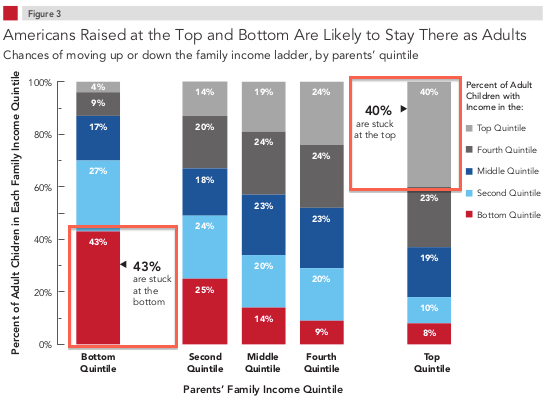
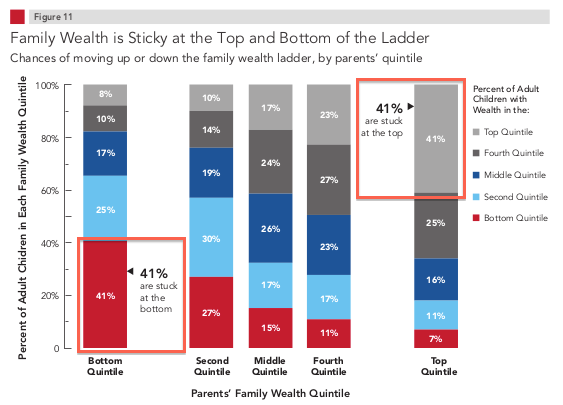
Social mobility appears fairly sticky in the bottom and top quintiles:
From Pew’s Economic Mobility Project data; analysis by Bruenig, 2013, June 13: “As far as income mobility goes, you are 10x more likely to wind up in the richest fifth as an adult if you were born there than if you were born in the poorest fifth.”From Pew’s Economic Mobility Project data; analysis by Bruenig, 2013, June 13: “As far as wealth mobility goes, you are more than 5x more likely to wind up in the wealthiest fifth as an adult if you were born there than if you were born in the least wealthiest fifth.”
One convenient way to describe what’s going on is that rich kids are more likely to get a better education, which translates into being richer and wealthier as adults. It is certainly the case that richer kids are more likely to get a college degree, and it is certainly the case that getting a college degree leaves you much better off on average than not getting one. But this does not explain the full picture of social immobility [emphasis added].
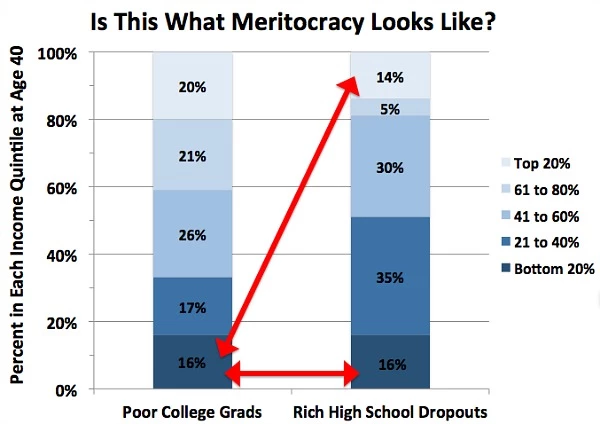
And thus, social mobility appears more strongly connected to the social class of a person’s family than to education (a function of combined school and teacher quality):
From Pew’s Economic Mobility Project data; analysis by Bruenig, 2013, June 13: “[Y]ou are 2.5x more likely to be a rich adult if you were born rich and never bothered to go to college than if you were born poor and, against all odds, went to college and graduated.”The consequences of the dynamic between social class and education are, as Matt O’Brien explains, as follows:
Data from Richard Reeves and Isabel Sawhill. O’Brien concludes: “Even poor kids who do everything right don’t do much better than rich kids who do everything wrong.”
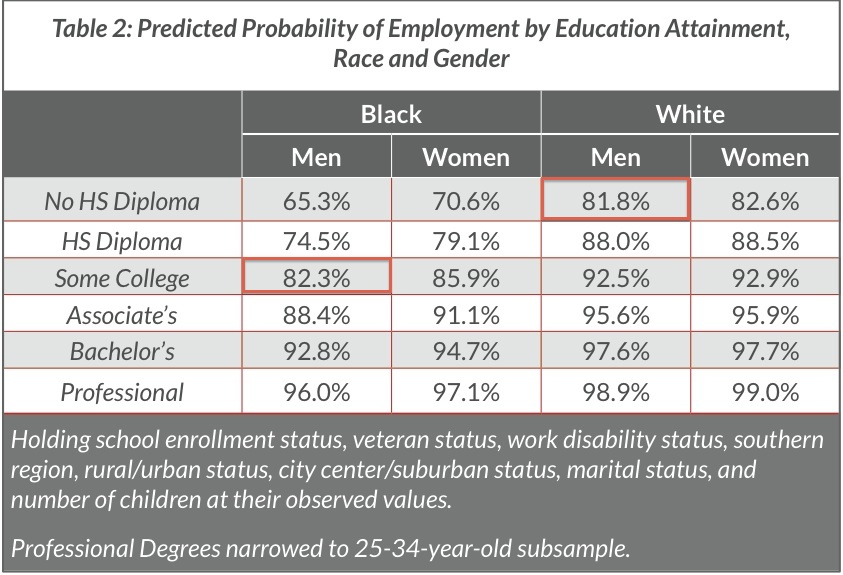
Now, consider the relationship between educational attainment and race. First, in Closing the Race Gap, O’Sullivan, Mugglestone, and Allison (2014) detail that blacks with some college earn about the same as whites with no high school diploma:
O’Sullivan, Mugglestone, and Allison (2014)
From this report as well, Susan Adams explains: “African-American college students are about as likely to get hired as whites who have dropped out of high school.”
Significant income disparities exist along racial lines despite educational attainment, as Bruenig (2014, October 24) shows:
Bruenig (2014, October 24): “First, understand that blacks and Hispanics have lower incomes than whites up and down the educational spectrum. On average, black families at a given level of educational attainment receive incomes that are just 66% of what white families at the same level of educational attainment receive. For Hispanic families, that figure is 79%. Naturally, when education-controlled income disparities like this exist, education-controlled wealth disparities will exist.”
The impact of education (school and teacher quality), then, when placed in the context of both social class and race refutes the opening claims: (i) education is the single most important lever for lifting anyone above the circumstances of her/his birth, and (ii) teacher quality is the single greatest factor in whether that educational experience accomplishes the first belief.
When I offer these measurable facts to either the public or my students, often I hear: “So you are saying that education and teachers do not matter?”
Here is the hard part.
First, making claims that measurable education and teacher impact exists is problematic. Thus, I absolutely support that both education and teachers matter, but I also caution that this impact is not singular, direct, or easily quantified.
Part of that problem is that the impact of any person’s education or the influence of any teacher or teachers tends to occur over long periods of time, and we are hard pressed to tease out and measure specific teachers or practices since that impact is cumulative, interrelated, and multi-faceted (consider that a student can learn a valuable lesson from a flawed lesson or a weak teacher).
Our first conclusion, then, is that making claims about education being the single or sole factor in success or that the teacher is the single most important factor in achievement is misleading, overly simplistic.
But, there are fair and accurate claims we can make about the importance of education, leading to our second conclusion.
Our second conclusion is that within social class and race, educational attainment has significant influence, but that education alone appears less effective in overcoming large social inequities such as classism and racism.
From this, I think we have several important lessons:
Media, public, and political hyperbole about education and teacher impact does a disservice to public education, teachers, students, and the public. Overstating the impact of education and teachers assures that we will continue to fail our students and the promise of universal public education.
In our endless quest for education reform, we would be better served if we moved away from mostly measurable data points for making claims about and policies in education. Education is messy and complicated; quantified data are in fact simplistic and misleading.
Until we confront the corrosive influence of class and race in the U.S. and until we admit that education alone is not enough to overcome classism and racism, we are perpetuating social inequity.
Let’s be clear: Education and teachers matter. But, regretfully, they simply do not matter in the ways most people claim or believe, and certainly not in ways that are easy to identify.
The good news, however, is that there is much we can do to change this, if we have the resolve to confront the evidence, accept the ugly truths, and then to do something different.
[1] This post is in debt to my current, fall 2014 EDU 111 course at Furman University, a group of students fully committed to engaging with the topics, challenging claims, and seeking to understand the complexity of education. They are proof that teaching is an act of learning, if the teacher is there to listen as well as talk.
Although I accept that the process of writing an engaging popular article requires considerable simplification, I think it is essential that the article does not contain incorrect statements and misinformation. My primary goal with this review is to describe several claims in Jaffe’s article that were simply false or clearly misleading and then discuss how APS might successfully develop successful methods for providing research summaries for non-specialists that are informative and accurately presents the major views of APS members and Fellows. At the very least they should not contain factually incorrect statements and avoid reinforcing existing misconceptions in the popular media.
Through the Gladwell/10,000 hour rule example, Ericsson provides an important argument relevant to the current (and historical) public debate about school quality, teaching and learning, and education reform.
Much in the same way Gladwell has misrepresented research (which is typical within the media), and how that has been uncritically embraced by the media and public (as well as many if not most practitioners), a wide array of issues have received the same fate: learning styles, “grit,” collaborative learning, progressive education, charter schools, school choice, language gap, and so on.
Even when a claim or practice has a kernel of research at its source, popular oversimplification (often by journalists, but practitioners as well) and then commercialization/politicizing (creating programs and policies through publishers, “star” advocates, and legislation) significantly distort that research.
Education Has Failed Research, Historically
John Dewey represents an odd paradox in that he is possibly the most mentioned educator in the U.S. (either as the source of all that is wrong in education or idealistically cited as all that is right about how school could be), despite the reality that Dewey is mostly misunderstood and misrepresented; and thus his philosophy, progressivism, remains mostly absent in U.S. public schools.
Dewey can be blamed, in part, for this reality because he refused on principle to allow his experiments in education to be carefully catalogued because he believed no educational practice should be come a template for others.
Throughout much of the twentieth century, Lou LaBrant, a vigilant progressive educator, spent much of her career practicing and advocating for progressive literacy instruction, but LaBrant also confronted the many instances of how progressivism was misrepresented.
Broadly, and early, LaBrant recognized the public confusion about progressivism:
Two adults speak of “progressive education.” One means a school where responsibility, critical thinking, and honest expression are emphasized; the other thinks of license, lack of plans, irresponsibility. They argue fruitlessly about being “for” or “against” progressive education. (LaBrant, 1944, pp. 477-478)
But she also confronted how progressivism was mostly distorted in its application. LaBrant’s criticisms still reflect why education has failed research, and why research has not failed education.
Credible educational research-based philosophy, theory, and pedagogy are often corrupted by oversimplification.
In 1931, LaBrant published a scathing criticism of the popularity of the project method, an oversimplification of Dewey that resulted in students doing crafts in English class instead of reading or writing:
The cause for my wrath is not new or single. It is of slow growth and has many characteristics. It is known to many as a variation of the project method; to me, as the soap performance. With the project, neatly defined by theorizing educators as “a purposeful activity carried to a successful conclusion,” I know better than to be at war. With what passes for purposeful activity and is unfortunately carried to a conclusion because it will kill time, I have much to complain. To be, for a moment, coherent: I am disturbed by the practice, much more common than our publications would indicate, of using the carving of little toy boats and castles, the dressing of quaint dolls, the pasting of advertising pictures, and the manipulation of clay and soap as the teaching of English literature. (p. 245)
Credible educational research is often corrupted by commercialization/politicizing, reducing that research to misguided programs/legislation.
“[L]anguage behavior can not be reduced to formula,” LaBrant (1947) argued (p. 20)—emphasizing that literacy growth was complicated but flourished when it was child-centered and practical (for example, in the ways many privileged children experience in their homes because one or more of the parents are afforded the conditions within which to foster their children’s literacy).
By mid-twentieth century, LaBrant (1949) had identified the central failure of teaching reading: “Our language programs have been set up as costume parties and not anything more basic than that” (p. 16).
For at least 80-plus years since LaBrant fought this fight, the same patterns of media, political, public, and practitioners failing educational research have continued
Oversimplification, Commercialization/Politicizing: Recovering the Evidence
The list is incredibly long, too long to be exhaustive here, but consider the following: sloganism (“Work hard. Be nice.”), silver-bullet ideologies (“grit,” 10,000-hour rule), miracle schools (KIPP), evidence-based programs (Dibbles, 4-block, 6-traits), common sense claims and policy absent evidence (Common Core), and trendy legislation (3rd-grade retention policies as reading policy, merit pay) as well as politicized government reports (National Reading Panel).
Each of these can be traced to some kernel of research (sometimes robust bodies of research, and sometimes cherry-picked research), but all of these represent a current and historical fact: Education has failed research, but research has not failed education.
When educational research is reduced to scripts or programs/legislation, that knowledge base is invariably distorted, corrupted—as Ericsson details well above.
Journalists, politicians, and commercial education entities have all played a fundamental and crippling role in this reality; thus, as Ericsson argues, educators, scholars and researchers must not allow the fate of educational research to remain primarily in the wrong hands.
We have a public and professional obligation to confront these oversimplifications as well as the commercialization/politicizing of educational research. And we must do this through our public work that speaks to those failures and the public simultaneously.
As LaBrant and Ericsson reveal, unless we take that call seriously, we too are part of the reason education continues to fail research.
References
LaBrant, L. (1949). A genetic approach to language. Unpublished manuscript, Institute of General Semantics, Lakeville, CT.
LaBrant, L. (1947). Um-brel-la has syllables three. The Packet, 2(1), 20-25.
LaBrant, L. (1944, November). The words they know. The English Journal, 33(9), 475-480.
LaBrant, L. (1931, March). Masquerading. The English Journal, 20(3), pp. 244-246.
Mathematics may well be simple, but the complexities of race and culture are often irreducible. They cannot be wholly addressed in a single essay or book or television show or movie.
The Department of Education Reform (DER) at the University of Arkansas (and funded by the Walton family) is apparently no longer content with pretending to be educators and researchers. Just in time for Halloween, they are pretending to be sociologists*—and continuing to do all of this quite badly, except for the masking.
“We found that, when students are primed through some initial exposure to a cultural institution, this interacts with indicators of students’ disadvantaged status that are associated with low cultural capital and produces higher gains in attitudes toward future cultural consumption,” Kisida said. “Cultural mobility is likely driven, in part, by disadvantaged children becoming activated to acquire cultural capital, thus compensating for family background characteristics and changing their preferences.”
The problem? Here, as I have outlined about how we use deficit perspectives to marginalize impoverished children and blame their parents, this study focuses on “cultural capital” in a way that is bankrupt in terms of cultural sensitivity because the claims include that impoverished children, once again, lack something valued in society and that their parents, once again, are to blame (thus, fix the children mis-served by their inadequate parents, but nothing about the social forces placing both those parents and their children in poverty).
Behind the masks of experimental research and publishing in selective research journals, we find deficit views, stereotypes, and enough shades of the Great White Hope narrative to fuel yet another horrible Hollywood film on the renegade teacher brave enough to take poor or minority children on a field trip to the local museum.
Deficit perspectives and reducing children to “cultural capital” are tone deaf, bankrupt insensitivities that discredit whatever research claims to measure when conducting “a large-scale experimental study” and publishing in “the highest ranking educational research journal.”
Once again, the DER has offered us not objective research but more evidence of Thomas Jefferson’s warning about bias (and privilege, ironically): “The moment a person forms a theory, his imagination sees, in every object, only the traits which favor that theory.”
This study of “cultural capital” is just that—a privileged quantifying of how the world is and should be (“primed” and “activated” children for “future cultural consumption,” for example), a version ultimately deforming, not informing.
Although one might imagine Bourdieu’s concern about this research:
I’m thinking of what has been called the “return of individualism,” a kind of self-fulfilling prophecy which tends to destroy the philosophical foundations of the welfare state and in particular the notion of collective responsibility….The return to the individual is also what makes it possible to “blame the victim,” who is entirely responsible for his or her own misfortune, and to preach the gospel of self-help, all of this being justified by the endlessly repeated need to reduce costs for companies….
In the United States, the state is splitting into two, with on the one hand a state which provides social guarantees, but only for the privileged, who are sufficiently well-off to provide themselves with insurance, with guarantees, and a repressive, policing state, for the populace. (Acts of Resistance, pp. 7, 32)
In Why important education research often gets ignored, Dennis Hayes notes that “[t]eachers’ professional development is ‘fragmented, occasional and insufficiently informed by research'” in the UK, concluding (with some snark), “It will come as no surprise then that this report is likely to be ignored, like much of the research available to teachers.”
“A brief consideration will indicate reasons for the considerable gap between the research currently available and the utilization of that research in school programs and methods,” wrote Lou LaBrant, although her point was made about education in the U.S.—and in 1947.
Little appears to have changed, then, since LaBrant’s recognition of the “considerable gap” also examined by Hayes, but complicating the failure of research to reach the classroom is how research is distorted by the media, which disproportionately covers think-tank reports (often not peer-reviewed) compared to more rigorous university-based research (see Molnar and Yettick).
One enduring failure of research and reporting on research is the persistent claims about the language deficit among the poor. However, even when that claim is challenged in the mainstream press, the source of that misconception continues to be embraced as credible.
It has been nearly 20 years since a landmark education study found that by age 3, children from low-income families have heard 30 million fewer words than more affluent children, putting them at an educational disadvantage before they even began school. The findings led to increased calls for publicly funded prekindergarten programs and dozens of campaigns urging parents to get chatty with their children.
Now, a growing body of research is challenging the notion that merely exposing poor children to more language is enough to overcome the deficits they face. The quality of the communication between children and their parents and caregivers, the researchers say, is of much greater importance than the number of words a child hears.
That “landmark study” is by Hart and Risley from 1995, but despite the newer research highlighted by Quenqua, this article remains uncritical of Hart and Risley’s claim that children in poverty can be distinguished from the wealthier peers by the quantity of language they are exposed to in their homes.
Two significant problems are revealed in Quenqua’s article: Hart and Risley’s research maintains its credibility and the new research remains within a deficit perspective, one that marginalizes people in poverty while keeping the gaze of judgment on the impoverished.
Absent in Quenqua (or any media consideration of language acquisition by the poor) is that Dudley-Marling and Lucas have discredited Hart and Risley for perpetuating stereotypes and overgeneralizing claims from a skewed perspective.
Inevitably, when the media and educators address language acquisition and children in poverty (and often minority students), Hart and Risley is cited directly, and a deficit view of language and poverty is presented as fact—despite those claims being baseless stereotyping and debunked mischaracterizations of language, as Dudley-Marling and Lucas stress:
[Hart and Risley] are establishing a norm thoroughly biased in favor of middle- and upper-middle-class children. This common-sense rendering of the data pathologizes the language and culture of poor families, reflecting harmful, long-standing stereotypes that hold the poor primarily responsible for their economic and academic struggles (Nunberg, 2002). (p. 367)
This brings us to the second problem with Quenqua’s piece on shifting from quantity to quality of language when teaching children in poverty. While this newer study seems to refute Hart and Risley, the broader assumptions remain trapped in the same deficit gaze that places all the focus and blame on impoverished children’s parents.
We, then, are faced with a shift from “quantity” to “quality” as no real change at all because the message persists that impoverished parents lack something that is thus passed on to their children, who must have that lack filled (once it was more words, now it is higher quality words).
In other words, we are not willing to turn our deficit gaze away from the victims of poverty and toward the systemic conditions creating that poverty—and consequences such as differences in language among social classes that reflect not failed people but a failed society.
Yes, education seems too often implementing practices in the classroom without proper attention to research, but we also must admit that our education system is just as prone to falling for research claims as long as they conform to our stereotypes, those “common-sense renderings” exposed by Dudley-Marling and Lucas—a much more damning concern we must confront if research is ever to matter in the schooling and lives of children.
When did we stop cherishing our small communities in favor of looking out for number one? When did we lose the idea that we have accomplished great things collaboratively, as a nation of small communities–the GI Bill, the Hoover Dam, the middle class–not as individual, high-profile wealth-producers?
Schools, too, are temporary communities, that function best when the folks involved understand the importance of consideration for our fellow humans, which leads to the rising tide that lifts all boats.
Within a week of my reading this, I was sitting at my sister-in-law’s, surrounded by my niece, daughter, wife, and sister-in-law as well as my niece’s two children while I held my granddaughter. In the flow of unrelated discussions, the women in the room had a quick but notable discussion of the age-old anger at men who leave the toilet seat up. The consensus of the women in the room was that such acts are essentially rude, an inconsiderate act that fails to recognize the basic human dignity of other people using the toilet differently.
I think it is fair to say that these women felt as if leaving the toilet seat up was a statement that suggested they simply don’t exist—a pretty awful feeling for a loved one to have.
Since then, I have found myself contemplating the toilet seat in a similar way to Flanagan’s consideration of the airplane seat, and I think her question deserves a fuller reply.
Community and collaboration, I think, are not concepts we have lost in the U.S., but ideals we have never really embraced. And the reason why lies with our essential materialistic consumerism linked to our embracing the rugged individual myth.
The problem with materialism, consumerism, and broadly ownership in Western and U.S cultures can best be revealed through toilet seat etiquette, but let’s start somewhere else—the car.
In the U.S. (and especially in the rural areas), we not only covet our cars, but also each person old enough in the family has his/her own car—and mass transit isn’t even an option. To have your own car in the U.S. is a teenage rite of passage—often a very public marker of class that further ostracizes young people.
Much the same can be said about iPods (and earbuds) or smartphones.
But the toilet is a different matter.
Even in our own homes, the toilet can and will be a communal possession—guests have access to the toilet as do all who live in a home.
Just as death and bodily functions level (and thus humanize) people despite their class, race, gender, or ideologies (we all die and we all must evacuate our bladders), the toilet challenges our individualistic sense of ownership—or at least it should.
“Ownership is an entirely human construct,” writes Barbara Kingsolver in “Making Peace” from her collection High Tide in Tucson, adding:
At some point people got along without it. Many theorists have addressed the question of how private property came about, and some have gone so far as to suggest this artificial notion has led us into a mess of trouble….[T]o own land, plants, other animals, more stuff than we need—that is the particular product of a human imagination.
In the beginning, humans were communal and social creatures. (p. 26)
I would add to Kingsolver’s excellent essay that this tipping point in which, as she explains, humans have come to see ownership “as a natural condition, right as rain” (p. 30) is the imbalance at the foundation of our loss of community, our honoring of individual ownership to the exclusion of communal property and thus eroding the very individual rights we claim to cherish.
The problem is one John Dewey, William James, and others have confronted in philosophical terms—the fabricated choice between the individual and the collective, an either/or in which the U.S. and most Westerners have lined up to support only the individual.
And thus, men lift toilet seats and leave them up as if no one else exists—especially and most damning, as if no women will need to use that particular toilet in a way different than he has.
Failure to honor basic toilet etiquette is simply callousness, selfishness, and a lack of self- as well as collective awareness. It is a very impersonal and undignified “Up yours,” offered in absentia.
As Kingsolver notes, we have abandoned collaboration for competition and championed “I” over “we” to the detriment of each of us as well as all of us.
Again, to Dewey—the individual/community dynamic is not a choice, but an inseparable and symbiotic relationship. To honor the individual, we must simultaneously honor the community, and to honor the community, we must not ignore the individual.
Thus, to recognize the toilet as mine (either literally as in “I bought it” or temporally as in “I am currently on it”) as well as always someone else’s is the toilet seat compact that would benefit all of humanity if we were to expand that premise to essentially everything. This, of course, is the argument Kurt Vonnegut offered over and over in the waning years of his life about the planet: It is in each of our selfish interests to treat the planet as if it belongs to everyone.
“Life is better,” ends Kingsolver, “since I abdicated the throne*. What a relief, to relinquish ownership of unownable things” (p. 33). And I am certain that if we could balance our sense of individual ownership with communal ownership, we would have a similar response because life would be better if we humans lived each moment with the simple compassion and awareness found in toilet seat etiquette that honors communal dignity while also challenging the patriarchy of lifted seats.
Although the foundational approach to education reform has remained the same (as has the structure of and instruction in public schools) for about a century—one grounded in revising or updating in-school-only elements such as standards/curriculum, technology, and testing—the past thirty years have seen education reform increase accountability based on standards and high-stakes testing (despite that approach never working) while rushing to experiment with charter schools and value-added methods of evaluating teachers (despite neither working as well).
And thus the “R” word that has remained ignored in education reform is not “reform,” but “race”—or more directly “racism.”
Throughout our current three decades of education reform, poverty has been a significant part of the discourse and equation—often framed as “not an excuse” or misrepresented as the “achievement gap.” Poverty, then, has been allowed in the conversation, included in the policies, and identified as a significant barrier to learning, but only as something we must overcome through racketing up the same old approaches to education reform noted above.
Just as one example, every year SAT data are released, the strongest correlations with scores remain the socioeconomic status of students’ homes and the academic attainment of those students’ parents. Yet, these historic and current patterns remain for the education reformers evidence not of systemic social inequity and not evidence of failed education reform or systemic school inequity, but proof that teachers and students simply are not trying hard enough.
Education reform not only ignores inequity bred from racism, classism, and sexism, but also actively perpetuates and even increases that inequity (most significantly reflected in high-stakes standardized testing).
The political, media, and public narratives in the U.S. focus only on the individual, and in the relationship among effort, talent, and opportunity, those narratives address only effort.
We must ask: Who benefits from cultural narratives that claim success comes from effort and failure from sloth? Who benefits when those cultural narratives begin by claiming everyone has the same opportunity in the U.S., by erasing the evidence of the power of privilege and disadvantage, most often grounded in race?
Sloganism and the Racist Politics of Education Reform
The ugly answer to those questions is that white and affluent privilege benefits from these cultural narratives that are in fact false and racist.
But we aren’t allowed to utter “lie” or “racism” in polite company in the U.S.—and such decorum, of course, may have sprung from those privileged few who are the ones most likely to have their sensibility bruised by both the directness and accuracy of those claims.
In a land where “racism” is not allowed in the conversation, racism does not disappear, but remains corrosive, powerfully so; as poet Adrienne Rich notes, “what is missing, desaparecido, [is] rendered unspeakable, thus unthinkable.” If we cannot say it, if we cannot think it, we certainly will not act to eradicate it.
And to demand individuals simply try harder in a context where effort is not the problem, and not the solution, is a harsher and more damning racism than in those days not too far in the U.S. past where racial slurs were public, frequent, and normal. “Work hard. Be nice” is the twenty-first century masked racial slur:
Currently, the grotesque reality we have created includes shunning direct and public racist language in the same ways we deflect credible acknowledgements of racism.
Just as book censorship is an effective and masked act of racism and sexism (authors or color and female writers are disproportionately impacted, silenced), just as mass incarceration is an effective and masked act of racism (white males outnumber black males 6-1 in society while black males outnumber white males 6-1 in prison), “no excuses” education reform focused on in-school policy and driven by accountability, standards, and high-stakes testing is an effective and masked act of racism.
The primary sloganism used for effort is “grit,” and the anecdotal proof remains the Great White Male (Steve Jobs, for example)—with the exceptional outlier of color tossed in for good measure (the election of Barack Obama proves U.S. is a post-racial society, goes the claim).
Calling out racism is ignored, is shunned because the “grit” narrative and the Great White Male fall apart in the light of such calls—like a vampire reduced to dust by the risen sun.
Arguing that poor black people are not “holding up their end of the bargain,” or that they are in need of moral instruction is an old and dubious tradition in America….
The “structural conditions” Chait outlines above can be summed up under the phrase “white supremacy.” I have spent the past two days searching for an era when black culture could be said to be “independent” of white supremacy. I have not found one.
And then it is Coates’s conclusion that exposes the essential racism in education reform—demanding exceptional effort by those marginalized exclusively for their race:
There is no evidence that black people are less responsible, less moral, or less upstanding in their dealings with America nor with themselves. But there is overwhelming evidence that America is irresponsible, immoral, and unconscionable in its dealings with black people and with itself. Urging African-Americans to become superhuman is great advice if you are concerned with creating extraordinary individuals. It is terrible advice if you are concerned with creating an equitable society. The black freedom struggle is not about raising a race of hyper-moral super-humans. It is about all people garnering the right to live like the normal humans they are.
Gay has been brought to the place where she is confronting her ambition as a black Haitian because she is riding a wave of success for her novel, An Untamed States, and a collection of essays, Bad Feminist. “I began to understand the shape and ferocity of my ambition when I was in kindergarten,” Gay admits, adding a haunting event:
Each student had been given a piece of paper in class, bearing an illustration of two water glasses. We were instructed to color in one-half of the illustration. I suspect we were learning about fractions. I diligently shaded in one half of one of the glasses and smugly turned my work in to the teacher. If it had been the parlance of the day, I would have thought, Nailed it. I had not, of course, “nailed it.” I was supposed to color in an entire glass. Instead of the praise I anticipated, I received an F, which, in retrospect, seems a bit harsh for kindergarten. I couldn’t bring such a grade home to my parents. I had already begun demanding excellence of myself and couldn’t face falling short.
On the bus ride home, I stuffed my shame between the dry, cracked leather of the seat and assumed the matter had been dealt with. The driver, a zealous sort, found my crumpled failure and handed it to my mother when he dropped me off the next day. She was not pleased. I was not pleased with her displeasure. I never wanted to experience that feeling again. I vowed to be better. I vowed to be the best. As a black girl in these United States—I was the daughter of Haitian immigrants—I had no choice but to work toward being the best.
Like Coates, Gay recognizes her experience is not only hers:
Many people of color living in this country can likely relate to the onset of outsized ambition at too young an age, an ambition fueled by the sense, often confirmed by ignorance, of being a second-class citizen and needing to claw your way toward equal consideration and some semblance of respect. Many people of color, like me, remember the moment that first began to shape their ambition and what that moment felt like.
Coates’s “superhuman” and Gay’s “outsized ambition” reverberate inside the walls built in the U.S. to keep such voices quiet because the truth is harsh, and ugly—as Gay explains:
I am thinking about success, ambition, and blackness and how breaking through while black is tempered by so much burden. Nothing exemplifies black success and ambition like Black History Month, a celebratory month I’ve come to dread as a time when people take an uncanny interest in sharing black-history facts with me to show how they are not racist. It’s the month where we segregate some of history’s most significant contributors into black history instead of fully integrating them into American history. Each February, we hold up civil-rights heroes and the black innovators and writers and artists who have made so much possible for this generation. We say, look at what the best of us have achieved. We conjure W. E. B. Du Bois, who once wrote, “The Negro race, like all races, is going to be saved by its exceptional men.” We ask much of our exceptional men and women. We must be exceptional if we are to be anything at all.
While Gay as a black Haitian woman and I as a privileged white male have experienced much different lives, I can strongly identify with the allure she feels for the myth of the rugged individual:
I have come to realize how much I have, throughout my life, bought into the narrative of this alluring myth of personal responsibility and excellence. I realize how much I believe that all good things will come if I—if we—just work hard enough. This attitude leaves me always relentless, always working hard enough and then harder still. I am ashamed that sometimes a part of me believes we, as a people, will be saved by those among us who are exceptional without considering who might pay the price for such salvation or who would be left behind.
Further, in the way that we should be confronting education reform, Gay unpacks President Obama’s My Brother’s Keeper, exposing the essential failure of the policy (an essential failure identified by Martin Luther King Jr. as addressing social inequity indirectly, instead of directly):
The initiative is certainly well-intentioned, but it also speaks to the idea that black Americans must make themselves more respectable in order to matter. In its initial incarnation, it also gave the impression that only boys and men matter. On its surface, My Brother’s Keeper is a program that does nothing to address the systemic and structural issues young men of color will face, no matter how well prepared or respectable or personally responsible they are.
Gay warns us about the dangers of exceptionality: “We forget that we should not only measure black progress by the most visibly successful among us, but also by those who continue to be left behind.” And then, after wrestling with the tensions created by her advantages shaded by burdens of her race and gender, Gay concludes:
I have achieved a modicum of success, but I never stop working. I never stop. I don’t even feel the flush of pleasure I once did when I achieve a new milestone. I am having a moment, but I only want more. I need more. I cannot merely be good enough because I am chased by the pernicious whispers that I might only be “good enough for a black woman.” There is the shame of sometimes believing they might be right because that’s how profound racism in this country can break any woman down. I know I am one of the lucky ones because unlike far too many people of color, I had far more than “half as much” to work with, the whole of my life. It is often unbearable to consider what half as much to work with means for those who are doing their damndest to make do. I call this ambition, but it’s something much worse because it cannot ever be satisfied.
What I Have Learned from Sports
In my introductory education course and two first year seminars this fall, I have shared Gay’s wonderful and complicated essay. That education course has begun to confront the uncomfortable facts of privilege and race, and those first year students (since I teach at a selective university which results in a student population disproportionately white and affluent) echo Gay’s experiences with ambition and guilt. Gay’s kindergarten memory reflects something quite wrong about how all children are raised in the U.S. as well as revealing the scar of racism.
With those first-year students, we confronted the public and adult messages they have been sent about effort, talent, and opportunity. That discussion was sobering.
I shared with them my own journey—again one resting on significant privilege since I am white and male, but tinged slightly by my working-class background—to rejecting the “grit” propaganda—a journey traced through my efforts to be a successful athlete.
In high school, I worked doggedly to be a good basketball player; I made very little effort in school. I was usually the last player selected on the basketball team each year (primarily because the coaches knew my father) and then rode the bench, but I made mostly As and a few Bs in my classes.
At basketball practice, I often tried harder than anyone, something noted by the coaches even. But on game day, the better athletes (some who made almost no effort in practice) played. I had been raised in a “Word hard. Be nice” household, a vestige of 1950s idealism in the U.S. But the world of sport showed me the truth: Talent trumps effort when given the opportunity.
In other words, the “grit” honoring of effort first (and even exclusively) is a warped version of the real order of things: Opportunity, talent, and then effort.
The “grit” narrative, then, and the sloganism of “Work hard. Be nice”—regardless of good intentions—are the racial slurs of our time.
To end that racism, it first must be named, and then directly, we must attend to the opportunities denied so that talent and effort can matter. And the first opportunity every child, every person deserves is the basic human dignity that is destroyed when, as Gay stated, anyone feels that “[w]e must be exceptional if we are to be anything at all.”
educator, public scholar, poet&writer – academic freedom isn't free




 dr. p.l. (paul) thomas