Category Archives: education reform

Once Again, NAEP? Nope: “states and schools have lied about the rigor of their courses”

Some say the world will end in fire,
Some say in ice.

“Fire and Ice,” Robert Frost

While it appears I was right about Teacher Appreciation Week 2014, I was a tad bit off about the source of the Zombie Apocalypse or Armageddon: The world will not end because of PISA score rankings, but because of stagnant NAEP scores by high school students.

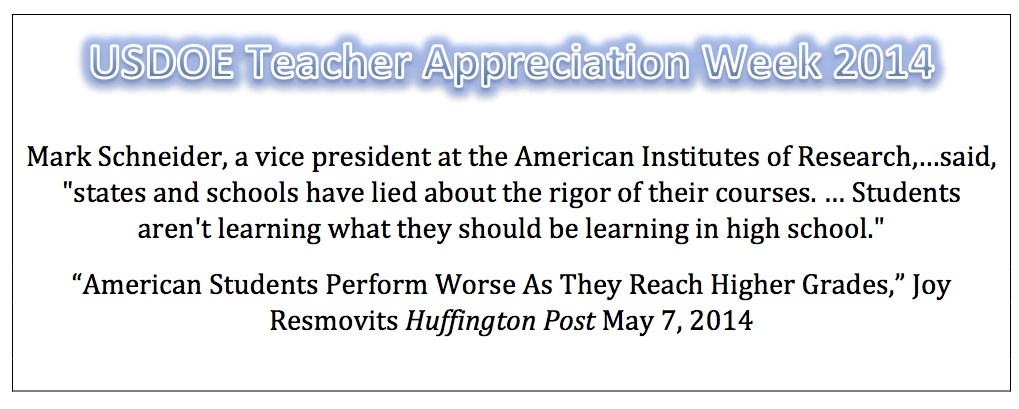
In fact, the U.S. Department of Education has just released a hot-off-the-press bumper sticker that celebrates Teacher Appreciation Week 2014 by acknowledging recent NAEP data:

USDOE TAW 2014

What happens when inept political leadership (Note: The 21st century prerequisite for holding the position of Secretary of Education appears to be a gentle blend of an absence of expertise and outright dishonesty related to NAEP reporting) collides with press-release journalism [1] (like an asteroid slamming into the Earth)?

Well, the claim made above by Schneider (“a vice president at the American Institutes of Research who previously led the government arm that administered NAEP”)—a truly ugly claim about education and teachers that appears to have been accepted without any request for evidence (Evidence? Secretary Duncan, You Can’t Handle the Evidence).

NAEP, then, once again prompts handwringing about stagnant scores and achievement gaps—and there are always charts and graphs to make the point along with the usual insincere nod to “the Civil Rights Issue of Our Time”:

U.S. Secretary of Education Arne Duncan said in a statement about the results, “We project that our nation’s public schools will become majority-minority this fall—making it even more urgent to put renewed attention into the academic rigor and equity of course offerings and into efforts to redesign high schools. We must reject educational stagnation in our high schools, and as [a] nation, we must do better for all students, especially for African-American and Latino students.”

Amongst the ugliness and baseless pontificating by political leaders are absent some key points that the media will fail (again) to uncover:

  • NAEP data are released and pronouncements made, but no one really knows the cause of the data concerns. Why scores appear stagnant and why racial/socioeconomic gaps persist are often complex (although a huge and evidence-based source of both is likely inequity and poverty). The initial reactions to NAEP this time in EdWeek and HuffPo are overwhelmingly speculation by people with political agendas. If we are genuinely interested in people who are likely telling lies, it appears we may want to look at the people cited in these articles.
  • “Achievement gap” is a misnomer for “opportunity gaps,” and using standardized tests to measure and examine that gap is inherently flawed since standardized testing remains biased by race, class, and gender; and thus, the tests themselves not only measure but create the gaps. Furthermore, for any gap to close, identified populations of students would need to be treated differently, but the current policy is a common core of what students experience in schools. And another dirty little secret is that the current era of accountability has damned high-poverty and minority students to test-prep course work that in fact asks less of them (thus, it is not “states and schools” that are telling lies, but politicians who shape accountability policy who are in fact telling lies).
  • Throughout the 20th and into the 21st centuries, we have found no correlation between how U.S. students do on test comparisons (among states or internationally) and claimed goals such as international competitiveness or the robustness of the U.S economy. None. And while we are at it, over the last three decades of accountability, we have found no correlation between the existence or quality of standards and measurable student outcomes. None. Again, it is a political lie to continue to cry “crisis” over test scores. A lie.

While I remain certain that accountability built on standards and high-stakes testing is a fundamental flaw in education reform, political leadership and the media are not doing us any favors either. This latest “high school achievement crisis” based on a rush to misread NAEP data is but more of the same—lamentably so as we certainly could do a better job even within the flawed test-based culture of U.S. education, as Matthew Di Carlo has outlined.

Childhood is steeped in a series of lies—what Kurt Vonnegut has labeled “foma,” although many of these lies are not so harmless: the Easter bunny, Santa Claus, work hard and be nice.

But one truism from our youths must be accepted as fact: Action speaks louder than words.

If we apply that to the USDOE, then we are likely to recognize just who is telling lies and about what:

  1. Lie: U.S. schools, teachers, and students are failing because of low standards and expectations.
  2. Lie: New standards and new tests will save public schools.
  3. Lie: State X is worse than State Y because NAEP (or SAT) scores say so; the U.S. is falling behind Country X because PISA scores say so.
  4. Lie: Poverty is not destiny.
  5. Lie: Arne Duncan (or Bill Gates or Michelle Rhee) knows what he is talking about.
  6. Lie: Education reform is the Civil Rights issue of our time.
  7. Lie: U.S. education is struggling because of “bad” teachers who are too hard to fire.
  8. Lie: Charter school X is a “miracle” school.

Truth: The USDOE is the embodiment of “lies, damned lies, and statistics.”

For Further Reading

I love the smell of NAEPalm in the morning

[1] See also Is It Journalism, or Just a Repackaged Press Release? Here’s a Tool to Help You Find Out.


PISA Brainwashing: Measure, Rank, Repeat

When Mary Catherine Bradshaw, a teacher since 1984 in Nashville, TN, announced her retirement from public schools, Bradshaw pointed her finger at one major reason, standardized testing:

[S]he says standardized testing is the reason….

Testing, she said, has taken away from instructional time and taken the joy out of learning.

Much has changed, she said, since she took her first job as a teacher at Hillsboro in 1984 when she said she was attracted to its diversity and commitment to academic reputation.

“There was more of a focus on the whole student, the joy of learning, building a community and finding one’s own passion in the midst of the K-12 experience,” she said.

“Now, with the focus on testing, data collection and closing a too narrowly defined gap among learners, I have found myself ready to retire from public education.”

Bradshaw’s concern about the loss of joy due to the central place of testing in education is echoed in a recent statement about PISA rankings [1], as Peter Wilby details in Academics warn international school league tables are killing ‘joy of learning’:

Now nearly 100 leading educational figures from around the world have issued an unprecedented challenge to Pisa – and what they call “the negative consequences” of its rankings – in a letter to its director, Andreas Schleicher….

“Education policy across the world is being driven by the single aim of pushing up national performance levels on Pisa,” says one signatory, Stephen Ball, professor at London university’s Institute of Education. “It’s having a tremendously distorting effect, right down to the level of classroom teaching.” Another signatory, Sally Tomlinson, research fellow at Oxford university’s education department, says that, though the Pisa league tables appear to be scientifically based, “you really can’t compare a country the size of Liechtenstein with one the size of China and nor can you compare education systems that developed over the years in different political, social and cultural contexts”.

The signatories are particularly concerned about the UK, the US and other countries imitating schools in Asian countries that come high in the Pisa rankings. They are suspicious of Shanghai’s success. “Shanghai’s approach is an incredibly strategic one,” says Ball. “Their students practise the tests. It’s difficult to see what their maths teachers can say to ours except ‘teach to the test’.”

While international rankings based on test scores have influenced public perception of U.S. public education for at least 60+ years (see Hyman Rickover’s books lamenting U.S. rankings, for example), state rankings based on NAEP and SAT/ACT scores have also been central to perception as well as policy, especially since the early 1980s.

While the open letter to Schleicher is a powerful and important challenge to the misleading influence of PISA, the essential problem is high-stakes testing coupled with ranking as well as a persistent misinterpretation of test data (see this excellent examination of how test scores are misunderstood and misused).

As I have addressed often about the SAT (see HERE and HERE), even when a comparison of states appears fair and accurate—South Carolina with Mississippi, for example, since the states share a similar high-poverty demographics of students—the reality is far more complex: MS has a higher SAT average score than SC because the test-taking populations of students are significantly different despite the overall student populations being similar:

Two Southern states, Mississippi and South Carolina, share both a long history of high poverty rates (Mississippi at over 30% and SC at over 25%) and reputations for poor schools systems. Yet, when we compare the SAT scores (pdf) from Mississippi in 2010 (CR 566, M 548, W 552 for a 1,666 total) to SAT scores in SC (CR 484, 495, 468 for a 1,447 total), we may be compelled to charge that Mississippi has overcome a higher poverty rate than South Carolina to achieve, on average, a score 219 points higher.

This conclusion, based on a “few data points”, is factually accurate, but ultimately misleading once we add just one more data point: the percentage of students taking the exam. Just 3% of Mississippi seniors took the exam, compared to 66% in South Carolina. A fact of statistics tells us that SC’s larger percentage taking the exam is much closer to the normal distribution of the all seniors in that state, thus the average must be lower than a uniquely elite population, such as in Mississippi. Here, the statistics determined by the populations taking the exam trump the raw data of test averages, even when placed in the context of poverty. (The truth about failure in US schools)

Even if the open letter about PISA prompts reform by the OECD, we have evidence that the problem will persist. For example, The College Board struggles with both the statistical complexity of SAT data (see here about the recentering) and the misleading use of SAT data to rank states:

Educators, the media and others should:

8.1 Not rank or rate teachers, educational institutions, districts or states solely on aggregate scores derived from tests
that are intended primarily as a measure of individual students. Do not use aggregate scores as the single measure to
rank or rate teachers, educational institutions, districts, or states.

And yet, each year when SAT data are released, the media, political leaders, and public school critics rank states and pronounce schools a failure.

The open letter about PISA implores, “Slow down the testing juggernaut,” adding:

OECD’s narrow focus on standardised testing risks turning learning into drudgery and killing the joy of learning. As Pisa has led many governments into an international competition for higher test scores, OECD has assumed the power to shape education policy around the world, with no debate about the necessity or limitations of OECD’s goals. We are deeply concerned that measuring a great diversity of educational traditions and cultures using a single, narrow, biased yardstick could, in the end, do irreparable harm to our schools and our students.

Once we apply the brakes, we must then take a close look at the fundamental policy errors—high-stakes standardized testing, labeling, sorting, and ranking—and then abandon those practices for alternatives that address inequity both outside and inside schools and that honor the essential dignity and humanity of students and their teachers.

For Further Reading

Among the Many Things Wrong With International Achievement Comparisons, Gene V. Glass

More Things Wrong with International Assessments Like PISA, Gene V. Glass

[1] As full disclosure, I am a signatory on the letter.

Consumed by the Digital Divide

The term “digital divide” is commonly used in education as a subset of the “achievement gap”—representing the inequity between impoverished and affluent students. Both terms, however, tend to keep the focus on observable or measurable outcomes, and thus, distract attention away from the inequity of opportunity that is likely the foundational source of those outcomes.

Currently, South Carolina appears poised to, yet again, make another standards shift—dumping the Common Core the state adopted just a few years ago—but in the coverage of that continuing debate, two points are worth highlighting: (1) “Computer testing allows for a better assessment of both students’ abilities and teachers’ effectiveness….,” and (2) “Democrats say the bill forces the Legislature to spend money on technology in classrooms….,” including “[b]oth the House and Senate budget proposals would spend about $30 million on technology next school year, focusing on rural districts.”

As I have examined before, the educational advantages of technology are at best mixed, technology creates equity concerns as well as outcome disparities (efforts to close the digital divide in schools often increase the achievement gap), and investments in technology are by the nature of technology an endless commitment of precious taxpayers’ dollars.

Capitalism and consumerism are hidden in plain sight in the U.S. Consumerism has a symbiotic relationship with technology in the broader economy and a related symbiotic relationship among technology and the perpetually changing standards movement in education.

In the context of consumerism, then, that technology is perpetually upgrading and that standards (and related high-stakes testing) are perpetually changing are warranted and even necessary: New replaces old, to be replaced by the soon-to-come newer.

But when we shift the context to a pursuit of equity and teaching/learning, technology as a constantly moving (and therefore never finished) investment is exposed as a different sort of “digital divide”—the gap between the technology we have accumulated now and the technology upgrades we have committed to in the future (and mostly a commitment based on new without any mechanism for determining better).

One of the many problems with adopting, implementing, and testing Common Core is the included rush to invest in technology. That technology rush is also being highlighted with the rise in calls for computer-graded writing. [The perceived efficiency of such investments in technology are myopic, I argue, much as purchasing a Prius for the narrow gas savings that many consumers fail to place in the larger purchasing investment (see also).]

Let me offer here a few concerns about the technology gold rush—and argue that we should curtail significantly most of the technology investments being promoted for public schools because those investments are not fiscally or educationally sound:

  • Cutting-edge technology has a market-inflated price tag that is fiscally irresponsible for tax-funded investments, especially in high-poverty schools where funds should be spent on greater priorities related to inequity.
  • Technology often inhibits student learning since students are apt to abdicate their own understanding to the (perceived) efficiency of the technology. For example, students using bibliography generating programs (such as NoodleBib) consistently submit work with garbled bibliographies and absolutely no sense of citation format; they also are often angry at me and technology broadly once they are told the bibliographies are formatted improperly.
  • Technology often encourages teachers/professors to abdicate their roles to the (perceived) effectiveness of technology. For example, many professors using Turnitin to monitor plagiarism are apt not to offer students instruction in proper citation and then simply punish students once the program designates the student work as plagiarized.
  • Technology requires additional time for learning the technology (and then learning the upgrades)—time better spent on the primary learning experiences themselves.
  • Computer-based testing may be a certain kind of efficient since students receive immediate feedback and computer programs can adapt questions to students as they answer, but neither of these advantages are necessarily advantages in terms of good pedagogy or assessment. Efficient? Yes. But efficiency doesn’t insure more important goals.
  • In many cases, advocacy for increasing technology as well as the amount of programs, vendors, and hardware (all involving immediate and recurring investments of funds) is driven by a consumer mindset and not a pedagogical grounding. I have seen large and complex systems adopted that offer little to no advantage over more readily available and cheaper uses of technology; I can and do use a word processor program in conjunction with email in ways that are just as effective as more complex and expensive programs. As Perelam notes:

Whatever benefit current computer technology can provide emerging writers is already embodied in imperfect but useful word processors. Conversations with colleagues at MIT who know much more than I do about artificial intelligence has led me to Perelman’s Conjecture: People’s belief in the current adequacy of Automated Essay Scoring is proportional to the square of their intellectual distance from people who actually know what they are talking about.

Technology-for-technology’s sake is certainly central to the consumer economy in the U.S. and the world. It makes some simplistic economic sense that iPhones are in perpetual flux so that grabbing the next iPhone contributes in some perverse way to a consumer economy.

Education, however, both as a field and as a public institution should be (must be) shielded from that inefficient and ineffective digital divide—that gap between the technology we have now and how the technology we could have makes the current technology undesirable.

Especially if you are in public education and especially if you have been in the field 10 or 20 years, I urge you to take a casual accounting of the hardware and software scattered through your school and district that sit unused. Now consider the urgency and promise associated with all that when they were purchased.

It’s fool’s gold, in many ways, and the technology we must have to implement next-generation tests today will be in the same closed storage closets with the LaserDisks tomorrow.

The technology arms race benefits tech vendors, but not students, teachers, education, or society.

Computer-graded essays will not improve the teaching of writing and computer-based high-stakes testing will not enhance student learning or teacher quality.

But falling prey to calls for both will line someone’s pockets needlessly with tax dollars.

Technology has its place in education, of course, but currently, the rush to embrace technology is greatly distorted, driven by an equally misguided commitment to ever-changing standards and high-stakes tests.

Investing in new technology while children are experiencing food insecurity—as just one example—is inexcusable, especially when we have three decades of accountability, standards, testing, and technology investment that have proven impotent to address the equity hurdles facing schools and society.

Welcome to SC: A Heaping Stumbling-Bumbling Mess of Ineptitude

This is my 53rd year of living in South Carolina, the totality of my life.

This is my 31st year as an educator in SC—18 years as a high school English teacher and 13 years now in higher education.

My teaching career, coincidentally, began the exact year SC officially stepped into the accountability/standards/testing arms race that grew out of the early 1980s.

Over the past 30 years, SC has created, implemented, revised, and changed a nearly mind-boggling array of standards and tests:

  • SC Frameworks
  • SC state standards (revised multiple times)
  • BSAP and exit exams
  • PACT
  • PASS
  • HSAP and EOC (end-of-course) tests
  • Common Core and high-stakes tests TBD
  • Two concurrent and competing sets of school report cards (the long-standing state version and the federal letter-grade based version)

Before I move on, let me add that SC is a high-poverty state (in the bottom quartile of poverty in the U.S.) that is historically and increasingly racially diverse, a right-to-work state that picks fights with unions that have no power, and a challenging environment for children of color (in the bottom third of the U.S. for African American and Latino/a children).

So now let’s return to the Accountability Hunger Games: SC Edition:

SC Senate approves replacing Common Core in 1 year

That’s right, before SC schools, teachers, and students can actually make the transition from the repeatedly revised (and obviously failed) standards-and-tests Merry-Go-Round of state-based accountability to the all-mighty Common Core gravy train of world-class and college-ready standards and next-generation high-stakes tests [insert trumpet]:

The Senate on Thursday unanimously approved a bill that replaces Common Core education standards with those developed in South Carolina by the 2015-16 school year.

The bill, which passed 42-0, is a compromise of legislation that initially sought to repeal the math and reading standards that have been rolled out in classrooms statewide since their adoption by two state boards in 2010. Testing aligned to those standards must start next year, using new tests that assess college and career readiness, or the state will lose its waiver from the all-or-nothing provisions of the federal No Child Left Behind law.

But the state won’t be able to use tests South Carolina officials helped create with 21 other states. A bid must go out by September for their replacement.

[Insert wah-wah-wah]

As ridiculous and muddled as that all is (and I think “heaping stumbling-bumbling mess of ineptitude” may be understating the level of ridiculousness), Seanna Adcox’s coverage of this likely next-move for SC is chock-full of even more ineptitude so let me counts the ways:

  1.  “‘We’re back on track,’ said Sen. Mike Fair, R-Greenville.” Fair has built a political career on his yearly efforts to dismantle SC’s science standards by inserting an endless series of not-so-clever Creationism edits to the evolution elements of those standards. [HINT: He may not be the best authority on SC’s decisions about standards.]
  2. “Democrats say the bill forces the Legislature to spend money on technology in classrooms….” Ironically and sadly, SC is an equal-opportunity state in terms of political party ineptitude. SC is notorious for our Corridor of Shame, a swipe of high-poverty communities that roughly follows I-95 across the state. I will simply ask that you return to the Kids Count report on childhood opportunity and consider where tax dollars may be better spent than on technology investments for computer-based high-stakes testing that will further stigmatize the growing number of poor children of color in SC. [HINT: It ain’t on more technology that will fail and become obsolete.]
  3. “Computer testing allows for a better assessment of both students’ abilities and teachers’ effectiveness….” And nothing like baseless and inaccurate claims to help! [HINT: Nope.]
  4. “‘This is about maintaining control,’ said Campsen, R-Isle of Palms. ‘We shouldn’t cede our authority over children’s education to an outside process.'” See above and consider the smashing good job SC has done on its own for three decades. [HINT: That last sentence is sarcasm.]
  5. “Both the House and Senate budget proposals would spend about $30 million on technology next school year, focusing on rural districts.” $30 million on technology. [HINT: $30 million on technology.]

Unless that technology plan includes a provision for turning the iPads purchased into food trays once they are obsolete in a few months, I would posit that this entire farce is beyond ineptitude.

And I must add: SC is not some looney example of ineptitude in the world of education reform (although we do tend to be on the outer edges of looney in many things); in fact, the series of fits and starts that constitute SC’s heaping stumbling-bumbling mess of ineptitude are being replicated all across the U.S. as political manipulation of education collides with Tea Party lunacy.

If we may pause, then, and consider the real problems and the likely solutions: SC has an equity problem in our state and thus in our schools, and accountability/standards/testing do not address those essential equity problems.

SC must step off the accountability Merry-Go-Round, but this latest effort suggests we are enjoying the circus too much to make any reasonable decisions.

Legalizing Marijuana Offers Lesson for Changing Course in Education Reform

The role of causality in educational research needs to be questioned on the basis that education is not the same as medicine. As Biesta says: “Being a student is not an illness, just as teaching is not a cure.” (2007, p8) We should never assume that education is a “push and pull” process of simply linear causal relationships.

Tait Coles, Take no heroes; only inspiration.

“Batman has officially been kicking the ass of Gotham’s villains for 75 years,” explains Ryan Kristobak, “and so to honor the Dark Knight, the Warner Bros. panel unveiled the ‘Batman Beyond’ animated short at this year’s WonderCon.”

For long-time and recent fans of Batman, however, the legends of the Dark Knight are complicated by the many versions that exist among the DC comic book and graphic novel universe, films, TV, animated series, and video games.

The Batman Myth has several foundational characteristics and common themes that are nested in the Caped Crusader’s first appearance in Detective Comics 27 in 1940: Batman’s essential nature as a detective and crime fighter, the ambiguous relationship between Batman and the Gotham police department and city officials, and the larger themes about justice that are contrasted by Batman’s vigilante tendencies.

In The Dark Knight Rises, the final installment of the film trilogy directed by Christopher Nolan and starring Christian Bale, the opening scene framing the film also highlights a central message reflecting how justice is traditionally characterized in the U.S. The mayor of Gotham and Commissioner Gordon preside over Harvey Dent Day, named for the district attorney who is killed as Two-Face in The Dark Knight:

[the Mayor is giving a speech being at hosted at Wayne Manor]

Mayor: Harvey Dent Day may not be our oldest public holiday, but we’re here tonight because it’s one of the most important. Harvey Dent’s uncompromising stand against organized crime has made Gotham a safer place than it was at the time of his death, eight years ago. This city has seen a historic turn around. No city is without crime, but this city is without organized crime because of Dent’s act gave law enforcement teeth in its fight against the mob. Now people are talking about repealing the Dent Act, and to them I say, not on my watch.

[the audience claps]

Mayor: I wanna thank the Wayne Foundation for hosting this event, and I’m told, Mr. Wayne couldn’t be here tonight. I’m sure he’s with us in spirit….

Mayor: Jim Gordon, can tell you the truth about Harvey Dent. He could…but I’ll let him tell you himself. Commissioner Gordon!

[the audience claps as Gordon makes his way to the stand, Gordon looks down at his prepared speech and says to himself as he remembers the real truth of what happened to Dent]

Commissioner Gordon: The truth…

[he addresses the audience]

Commissioner Gordon: I have a speech telling the truth about Harvey Dent. Maybe the time isn’t right.

[he puts the speech away in his jacket pocket]

Commissioner Gordon: Maybe right now, all you need to know is that there are one thousand inmates in Blackgate Prison as the direct result of the Dent Act. These are violent criminals, essential cogs in the organized crime machine. Maybe, for now, all I should say about the death of Harvey Dent is this; it has not been for nothing. (transcript found here)

Justice in Nolan’s Gotham reflects the central elements of justice found in the U.S.: the right laws, the right people to enforce those laws, and the evidence those laws are working represented by a growing prison population.

Reagan Era Mass Incarceration and Education Accountability

As I have detailed in Education Reform in the New Jim Crow Era, the 1980s and the Reagan administration planted the seeds of both an era of mass incarceration, labeled the New Jim Crow by Michelle Alexander, and the high-stakes accountability era in public education.

The most troubling aspects of both mass incarceration and high-stakes education accountability are that the policies have created, not ended, the claimed problems they were designed to address.

Over the past thirty years, the criminal justice system in the U.S. has filled prisons with a disproportionate number of African American men as part of our most recent war on drugs—despite whites and African Americans using recreational drugs at the same rates.

The current era of mass incarceration has unintended consequences similar to prohibition in the 1920s and 1930s:

Prohibition turned law-abiding citizens into criminals, made a mockery of the justice system, caused illicit drinking to seem glamorous and fun, encouraged neighborhood gangs to become national crime syndicates, permitted government officials to bend and sometimes even break the law, and fostered cynicism and hypocrisy that corroded the social contract all across the country. With Prohibition in place, but ineffectively enforced, one observer noted, America had hardly freed itself from the scourge of alcohol abuse – instead, the “drys” had their law, while the “wets” had their liquor.

The recent legalization of marijuana suggests a possible social recognition that traditional views of the right laws enforced by the right people and resulting in the right people sitting in prison is the wrong formula for either justice or a peaceful and equitable society.

Along with a growing number of states legalizing or decriminalizing marijuana is a concurrent discussion of releasing prior drug offenders from prison, again suggesting a social admission that the laws we establish create criminals, but rarely deter crime.

Seeking justice must not be separated from seeking equity. If the shift in how people in the U.S. view marijuana signals anything, I think, it shows a broader concern for equity: Just as changing inequitable laws surrounding powder cocaine and crack came to represent an inequitable criminal justice system, legalizing marijuana is yet another effort to move the pursuit of justice in the U.S. toward a pursuit of equity.

Legalizing Marijuana: A Lesson for Changing Course in Education Reform

The war on drugs and the resulting mass incarceration have proven to be the wrong policies for achieving justice or equity in the U.S. Directly, we know that mass incarceration negatively impacts children (see Holly Yettick and Children of the Prison Boom).

But the parallel era of high-stakes education accountability shares the central flaws now being recognized in mass incarceration: high-stakes accountability creates failure in schools, teachers, and students (see FairTest’s Reports: High Stakes Testing Hurts Education).

Under Barack Obama and Secretary of Education Arne Duncan, federal and state education policies have remained focused on identifying the right standards and the right tests, most recently Common Core standards and so-called “next generation” tests. Unlike the move toward legalizing marijuana, education reform remains trapped and unable to see the Bitter Lessons from Chasing Better Tests, as Duncan proclaimed in 2009:

Until states develop better assessments—which we will support and fund through Race to the Top—we must rely on standardized tests to monitor progress—but this is an important area for reform and an important conversation to have.

Debating the quality of Common Core and the related tests, however, are the wrong arguments because high-stakes accountability is the wrong policy paradigm just as the war on drugs and mass incarceration are the wrong policies for justice.

Adopting and implementing Common Core as yet another round of seeking the right standards and the right tests will not work. We have three decades of evidence on that approach revealing that there is no correlation between the existence or quality of standards and student achievement (see Mathis, 2012).

The war on drugs has proven to be finding ourselves in a hole and continuing to dig. Legalizing marijuana is dropping the shovel and choosing instead to acknowledge that failure and to try another approach, one more rightly attuned to equity.

This is a lesson high-stakes accountability advocates need to learn.

Common Core and the related high-stakes tests are the wrong approach to equity and high-quality education; they are finding ourselves in a hole we created and continuing to dig.

As legalizing marijuana signals a possible turn to the end of mass incarceration, we need also to end the era of high-stakes accountability in education.

Let’s choose instead An Alternative to Accountability-Based Education Reform.

Devaluing Teachers in the Age of Value-Added

“We teach the children of the middle class, the wealthy and the poor,” explains Anthony Cody, continuing:

We teach the damaged and disabled, the whole and the gifted. We teach the immigrants and the dispossessed natives, the transients and even the incarcerated.

In years past we formed unions and professional organizations to get fair pay, so women would get the same pay as men. We got due process so we could not be fired at an administrator’s whim. We got pensions so we could retire after many years of service.

But career teachers are not convenient or necessary any more. We cost too much. We expect our hard-won expertise to be recognized with respect and autonomy. We talk back at staff meetings, and object when we are told we must follow mindless scripts, and prepare for tests that have little value to our students.

During the 1980s and 1990s, U.S. public schools and the students they serve felt the weight of standards- and test-based accountability—a bureaucratic process that has wasted huge amounts of tax-payers’ money and incalculable time and energy assigning labels, rankings, and blame. The Reagan-era launching of accountability has lulled the U.S. into a sort of complacency that rests on maintaining a gaze on schools, students, and test data so that no one must look at the true source of educational failure: poverty and social inequity, including the lingering corrosive influences of racism, classism, and sexism.

The George W. Bush and Barack Obama eras—resting on intensified commitments to accountability such as No Child Left Behind (NCLB) and Race to the Top (RTTT)—have continued that misguided gaze and battering, but during the past decade-plus, teachers have been added to the agenda.

As Cody notes above, however, simultaneously political leaders, the media, and the public claim that teachers are the most valuable part of any student’s learning (a factually untrue claim), but that high-poverty and minority students can be taught by those without any degree or experience in education (Teach for America) and that career teachers no longer deserve their profession—no tenure, no professional wages, no autonomy, no voice in what or how they teach.

And while the media and political leaders maintain these contradictory narratives and support these contradictory policies, value-added methods (VAM) of evaluating and compensating U.S. public teachers are being adopted, again simultaneously, as the research base repeatedly reveals that VAM is yet another flawed use of high-stake accountability and testing.

When Raj Chetty, John N. Friedman, and Jonah E. Rockoff released (and re-released) reports claiming that teacher quality equates to significant earning power for students, the media and political leaders tripped over themselves to cite (and cite) those reports.

What do we know about the Chetty, et al., assertions?

From 2012:

[T]hose using the results of this paper to argue forcefully for specific policies are drawing unsupported conclusions from otherwise very important empirical findings. (Di Carlo)

These are interesting findings. It’s a really cool academic study. It’s a freakin’ amazing data set! But these findings cannot be immediately translated into what the headlines have suggested – that immediate use of value-added metrics to reshape the teacher workforce can lift the economy, and increase wages across the board! The headlines and media spin have been dreadfully overstated and deceptive. Other headlines and editorial commentary has been simply ignorant and irresponsible. (No Mr. Moran, this one study did not, does not, cannot negate  the vast array of concerns that have been raised about using value-added estimates as blunt, heavily weighted instruments in personnel policy in school systems.) (Baker)

And now, a thorough review concludes:

Can the quality of teachers be measured the way that a person’s weight or height is measured? Some economists have tried, but the “value-added” they have attempted to measure has proven elusive. The results have not been consistent over tests or over time. Nevertheless, a two-part report by Raj Chetty and his colleagues claims that higher value-added scores for teachers lead to greater economic success for their students later in life. This review of the methods of Chetty et al. focuses on their most important result: that teacher value-added affects income in adulthood. Five key problems with the research emerge. First, their own results show that the calculation of teacher value-added is unreliable. Second, their own research also generated a result that contradicts their main claim—but the report pushed that inconvenient result aside. Third, the trumpeted result is based on an erroneous calculation. Fourth, the report incorrectly assumes that the (miscalculated) result holds across students’ lifetimes despite the authors’ own research indicating otherwise. Fifth, the report cites studies as support for the authors’ methodology, even though they don’t provide that support. Despite widespread references to this study in policy circles, the shortcomings and shaky extrapolations make this report misleading and unreliable for determining educational policy.

Similar to the findings in Edward H. Haertel’s analysis of VAM, Reliability and validity of inferences about teachers based on student test scores (ETS, 2013), the American Statistical Association has issued ASA Statement on Using Value-Added Models for Educational Assessment, emphasizing:

Research on VAMs has been fairly consistent that aspects of educational effectiveness that are measurable and within teacher control represent a small part of the total variation in student test scores or growth; most estimates in the literature attribute between 1% and 14% of the total variability to teachers. This is not saying that teachers have little effect on students, but that variation among teachers accounts for a small part of the variation in scores. The majority of the variation in test scores is attributable to factors outside of the teacher’s control such as student and family background, poverty, curriculum, and unmeasured influences.

The VAM scores themselves have large standard errors, even when calculated using several years of data. These large standard errors make rankings unstable, even under the best scenarios for modeling. Combining VAMs across multiple years decreases the standard error of VAM scores. Multiple years of data, however, do not help problems caused when a model systematically undervalues teachers who work in specific contexts or with specific types of students, since that systematic undervaluation would be present in every year of data.

Among DiCarlo, Baker, Haertel and the ASA, several key patterns emerge regarding VAM: (1) VAM remains an experimental statistical model, (2) VAM is unstable and significantly impacted by factors beyond a teacher’s control and beyond the scope of that statistical model to control, and (3) implementing VAM in high-stakes policies exaggerates the flaws of VAM.

The rhetoric about valuing teachers rings hollow more and more as teaching continues to be dismantled and teachers continue to be devalued by misguided commitments to VAM and other efforts to reduce teaching to a service industry.

VAM as reform policy, like NCLB, is sham-science being used to serve a corporate need for cheap and interchangeable labor. VAM, ironically, proves that evidence does not matter in education policy.

Like all workers in the U.S., we simply do not value teachers.

Political leaders, the media, and the public call for more tests for schools, teachers, and students, but they continue to fail themselves to acknowledge the mounting evidence against test-based accountability.

And thus, we don’t need numbers to prove what Cody states directly: “But career teachers are not convenient or necessary any more.”

Skepticism or Cynicism for Obama Education Agenda?

One response to my Relaxing zero tolerance in schools could be Obama’s boldest civil rights reform is worth highlighting: Readers adamant that the Obama education agenda is beyond such hope.

Let me note here that I have long since slipped past healthy skepticism and resigned myself to unhealthy cynicism with respect to either major political party and their leaders, including Obama.

I have tried before to confront the possibilities and the failures associated with Obama and Secretary Duncan, a set of policies and a series of rhetorical flurries that leave me even more depressed than those dark years under George W. Bush and his Secretaries, Rod Paige and Margaret Spellings:

Paul R. Carr and Brad Porfilio are now preparing a revised edition of The Phenomenon of Obama and the Agenda for Education: Can Hope Audaciously Trump Neoliberalism?—in which I have had and will have chapters.

I must note that my revised chapter is none too rosy; in fact, it is a solid statement of cynicism that has left skepticism in the dust. The revised chapter ends:

This call for change is not being heard, blocked by the din of the crisis discourse and utopian expectations that deform our children, our schools, and our society. The great failure being masked is that bureaucratic calls for school reform are perpetuating the labeling and marginalizing of teachers and students whose conditions in mechanistic schools parallel the inequities that the political elite are willingly ignoring both in their discourse and in their policies.

So when I confront the late but important recognition by the Obama administration that current education policies and practices are indeed racist, classist, and sexist, I believe it is on us to redouble our efforts, remind everyone we have been saying that for many years.

We actually don’t need Obama’s administration to tell us these things. But unless we make an effort to shift the gaze and the discourse in the right direction, on those extremely rare moments when they do, we are losing a moment.

I am not calling for our collective patting of the backs among the Obama administration. I would say the best tactic is to say, “Shame on you all for just noticing, but let’s get to work and stop all that other nonsense that is also doing harm!”

The Obama administration has hidden behind “education reform is the civil rights issue of our time” while promoting the worst possible education policies and maintaining an inexcusable allegiance to Secretary Duncan.

Let’s not forget that, and let’s not forget the “hope and change” rhetoric that lured many of us to have hope for change.

The recent shift driven by the Office of Civil Rights reports, however, is our opportunity to turn the “no excuses” and “zero tolerance” mantras on their heads, raising our voices and our eyes toward those in charge who are failing us and the children in our schools.

If there is hope for that change, it is in our grasp to make it happen.

College Athletes’ Academic Cheating a Harbinger of a Failed System

Margaret Atwood’s narrator, June/Offred, characterizes her situation in the dystopian speculative world of The Handmaid’s Tale:

Apart from the details, this could be a college guest room, for the less distinguished visitors; or a room in a rooming house, of former times, for ladies in reduced circumstances. This is what we are now. The circumstances have been reduced; for those of us who still have circumstances….

In reduced circumstances you have to believe all kinds of things. I believe in thought transference now, vibrations in the ether, that sort of junk. I never used to….

In reduced circumstances the desire to live attaches itself to strange objects. I would like a pet: a bird, say, or a cat. A familiar. Anything at all familiar. A rat would do, in a pinch, but there’s no chance of that. (pp. 8, 105, 111)

In her reduced circumstances as a handmaid—her entire existence focusing on becoming pregnant by a Commander to whom she is assigned, potentially a series of three before she is cast aside as infertile, thus useless—June/Offred’s fantasies about her Commander turn murderous:

I think about how I could take the back of the toilet apart, the toilet in my own bathroom, on a bath night, quickly and quietly, so Cora outside on the chair would not hear me. I could get the sharp lever out and hide it in my sleeve, and smuggle it into the Commander’s study, the next time, because after a request like that there’s always a next time, whether you say yes or no. I think about how I could approach the Commander, to kiss him, here alone, and take off his jacket, as if to allow or invite something further, some approach to true love, and put my arms around him and slip the lever out from the sleeve and drive the sharp end into him suddenly, between his ribs. I think about the blood coming out of him, hot as soup, sexual, over my hand. (pp. 139-140)

The novel reveals no evidence that June in her life in “former times” has been anything other than a relatively typical young woman with a family and a normal life. Atwood asks readers to consider her reduced circumstances (ones she does not create, ones she has no power to change alone) and how they shape the individuals in this disturbing Brave New World.

Atwood’s “reduced circumstances” are a narrative and fictional examination through a novelist’s perspective—a thought experiment replicated in the graphic novels and TV series The Walking Dead, as the comic book creator Robert Kirkman explains: “I want to explore how people deal with the extreme situations and how these events change [emphasis in original] them. I’m in this for the long haul.”

Research on human behavior has revealed, as well, that the same human behaves differently as the situations around change, what Sendhil Mullainathan and Eldar Shafir in Scarcity: Why Having Too Little Means So Much define as “scarcity” and “slack.” The “reduced circumstances” of The Handmaid’s Tale, then, is a state of “scarcity,” and poverty is one of the most common types of scarcity:

One cannot take a vacation from poverty [emphasis added]. Simply deciding not to be poor—even for a bit—is never an option….

Still, one prevailing view explains the strong correlation between poverty and failure by saying failure causes poverty.

Our data suggest causality runs at least as strongly in the other direction [emphasis added]: that poverty—the scarcity mindset—causes failure.(pp. 148, 155)

Given that we hold highly negative stereotypes about the poor, essentially defined by a failure (they are poor!), it is natural to attribute personal failure to them….Accidents of birth—such as what continent you are born on—have a large effect on your chance of being poor….The failures of the poor are part and parcel of the misfortune of being poor in the first place. Under these conditions, we all would have (and have!) failed. (pp. 154, 155, 161)

We are faced with a perplexing problem that sets up a clash between a powerful cultural ideal (the rugged individual and the allure of individual accountability) against a compelling research base that, as Mullainathan and Shafir offer, suggests individual behavior is at least as likely to represent systemic conditions, and not individual qualities (either those that are fixed or those can be learned, such as “grit”).

Although they may seem unrelated narrowly, two academic cheating phenomena are ideal examples of this perplexing problem—attempting to tease out individual culpability from systemic forces.

One consequence of the high-stakes era of accountability in public education has been the seemingly endless accounts of cheating on high-stakes testing; the most notorious being the DC eraser-gate under the reign of Michelle Rhee but also scandals such as the one in Georgia.

Academic cheating by college athletes has also been exposed recently, notably associated with the University of North Carolina. But college athletes cheating to remain eligible is not anything new; for example, Florida State University has received similar criticism for ignoring or covering up the academic deficiencies of athletes in the past.

It is at this point—the academic cheating and dodging of college athletes—that I want to focus on the concept of “reduced circumstances” and “scarcity” in order to consider where the source of these outcomes lie.

A few additional points inform this consideration.

First, college athletes at Northwestern University are seeking to form a union so that they can gain some degree of autonomy over their circumstances as college athletes—circumstances dictated by the NCAA. This move by athletes themselves appears to match a call by Andre Perry, his being specifically about graduation rates:

Black athletes have no choice but to play a major role in their own success. They must take full advantage of the scholarships afforded to them in spite of the climate. But some athletes have to pay a political price to force institutions to cater to black males’ academic talents. Graduation is a team effort, but black athletes must flex their political muscle to pave a way from the stadiums in January to the graduation stages in May.

Perry’s argument is one that focuses on individual agency and the athletes’ ability to rise above “the climate.”

However, David Zirin, discussing a Meet the Press examination of the NCAA and the circumstances of college athletes, seeks a systemic focus:

Yet far more glaring than the content of the discussion was what the discussion was missing. This is not surprising given the parties sitting around the table, but there was zero discussion about how institutionalized racism animates the amassed wealth of the NCAA, the top college coaches and the power conferences. It does not take Cornel West to point out that the revenue producing sports of basketball and football are overwhelmingly populated by African-American athletes. The population of the United States that is most desperate for an escape out of poverty is the population that has gotten the rawest possible deal from an NCAA, which is actively benefiting from this state of affairs….

The issue of the NCAA is a racial justice issue.

The public and the media, I believe, have already sided with blaming the athletes as well as blaming a failure of leadership and accountability among coaches and university administration, including presidents.

For example, the media has rushed to identify a student paper (a bare paragraph) as an example of the cheating at UNC, a claim now refuted by the whistleblower in the scandal, Mary Willingham. That rush and misrepresentation highlight, however, where the accusatory gaze is likely to remain—on the student athlete as culpable, on the coaches, professors, and universities.

As Zirin asks, what will be missing?

Few will consider that the academic scandal among student athletes at UNC—like the cheating scandals on high-stakes tests in public schools—is powerful evidence of a flawed system, one that places young people in “reduced circumstances” and then their behavior is changed.

As I have argued before [*see the entire post included below] (from a position of my own experiences as a teacher and scholastic coach and as someone who advocates for student athletes), school-based athletics in the U.S. corrupts both sport and academics. The entire scholastic sports dynamic is the essential problem.

There simply is no natural relationship between athletics and academics, and by creating a context in which young people are coerced into academics by linking their participation in athletics to their classroom achievement, we are devaluing both athletics and academics.

So I see a solution to the tension between Perry’s call for athlete agency and Zirin’s call for confronting systemic racism: We must address the conditions first so that we can clearly see to what extent individuals can and should be held accountable.

It seems simple enough, but if student athletes were not required to achieve certain academic outcomes (attendance, grades, graduation), then there would be no need to cheat. Hold athletes accountable for that which is athletic, and then hold students accountable for that which is academic. But don’t continue to conflate the two artificially because we want to create the appearance that we believe academics matter more than athletics (we don’t and they aren’t).

In conditions of scarcity—demanding of anyone outcomes over which that person has no control or no hope of accomplishing without a change in systemic conditions (such as academic outcomes an athlete is not prepared or able to accomplish or closing an achievement gap between populations of students)—the same person behaves differently than if that person were in a condition of abundance or privilege, “slack” as Mullainathan and Shafir call it.

Let’s turn to The Walking Dead, a world created by Kirkman, as he explains, in which “extreme situations…change” people.

In season 4 episode 14, “Look at the Flowers,” Carol, who has already demonstrated her ability to take extreme measures in “reduced circumstances” (season 4 episode 2, “Under My Skin”), offers another example paralleling June/Offred, as Dalton Ross explains:

If you thought Carol had a zero-tolerance attitude when she killed and burned two bodies back at the prison to stop the spread of a deadly virus, tonight she went truly sub-zero. The insanity began when little Lizzie stabbed and killed her sister Mika to prove that she would come back to life, leaving Carol to knife Mika’s brain to stop her from coming back as a zombie. She and Tyreese then had to decide what to do with Lizzie, with Carol saying that, “We can’t sleep with her and Judith under the same roof. She can’t be around other people.” And with that, Carol walked Lizzie outside, told her to “look at the flowers,” and then put a bullet in her brain.

Two children die, one at the hands of Carol, and that scene reminded me immediately of John Steinbeck’s Of Mice and Men, when George shoots his best friend Lenny.

After Lenny has killed Curley’s wife and run away to the hiding spot he and George have already designated, George finds Lenny:

George had been listening to the distant sounds. For a moment he was business-like. “Look acrost the river, Lennie, an’ I’ll tell you so you can almost see it.” (p. 103)

George and Lenny are hired hands, workers, pursuing their own American Dream. That pursuit has been difficult, including George trying to overcome Lenny having the mind of a child guiding the powerful and large body of a man. And it is in this final scene that George, like Carol, finds himself in “reduced circumstances.” While Lenny gazes across the river, George tells the same story he’s told hundreds of times, about the farm they will buy and the rabbits Lenny will tend as his own, and then:

And George raised the gun and steadied it, and he brought the muzzle of it close to the back of Lennie’s head. The hand shook violently, but his face set and his hand steadied. He pulled the trigger. The crash of the shot rolled up the hills and rolled down again. Lennie jarred, and then settled slowly forward to the sand, and he lay without quivering. (p. 105)

Cultural assumptions are powerful lenses for judging outcomes.

If we assume the “dumb jock” stereotype to be true, we point our fingers at the student athletes as cheaters and allow our gaze never to consider that the entire system is failing those student athletes.

If we assume people in poverty are lazy (and use that as a mask for lingering racist stereotypes of African American and Latino/a students and people), we point our fingers and say they simply aren’t trying hard enough; they need “grit.” And we fail to recognize and confront the pervasive racism, classism, and sexism that constitute the “reduced circumstances” of their lives.

Of course, college athletes should not be cheating to maintain their access to participating in sports, but it may be important to consider who is responsible for putting them in that situation to begin with—and who benefits most from maintaining that system.

***

*An Honest Proposal: End Scholastic Sport in the U.S. (originally posted at Daily Kos 14 August 2011)

While teaching the introductory education course at my university, I have taught many of our athletes, and they often immediately make an extra effort to engage with me once I explain to them that I was a high school English teacher for 18 years, including many years as the head soccer coach for the boys and girls teams. I also tell them that my wife is a P.E. teacher as well as a varsity/junior varsity volleyball coach and varsity assistant/junior varsity head soccer coach.

My daughter was an elite high school and club soccer player throughout her academic life as well.

One semester, a young man from England sat in my class as a member of the university’s soccer team. He was a popular and thoughtful young man whose British accent garnered him a good deal of attention, but I was most struck by his willingness to discuss how the U.S. and his native England approached education and sport differently.

Soccer is an interesting sport through which to view those differences since, as this young man personified, many soccer athletes come to the U.S. for their education after they have come to terms with their not attaining the professional career they had been striving to achieve.

Yes, this young man was older than his peers and viewed sport in the U.S. as a ticket to education, but he was quick to note that he thought the direct connection between education and sport in the U.S. is ridiculous; no such connection exists in many countries outside the U.S. where sport is a club, not scholastic, activity.

And when I saw a recent story at Education Week titled “NCAA Approves Higher Academic Standards for Athletes,” I immediately thought about my soccer student from England, and I have been mulling this for some time: It is time we stop not only the charade that is “higher standards for student-athletes,” but also the corrosive connection between education and team sport.

The education reform we should address and never even mention is ending scholastic sports entirely in the U.S.

First, at the philosophical level, by creating an artificial relationship between academics and athletics (consider the unique leverage we use athletics for to coerce children to engage in their academics), we are devaluing both.

If academics truly matter, then why are we spending so much energy bribing and manipulating students to take their studies seriously?

And if athletics are truly less important than academics (along with band, chorus, art, drama, etc.), then why are so many professional lives spent in fields connected to athletics?

The truth is that academics and athletics are valuable in and of themselves, and that no real relationship exists between the two. Children and adults should be allowed and encouraged to engage in either without being held hostage to artificial guidelines—such as grade and graduation requirements for student-athletes in K-12 or college athletics.

In my life and career as an educator, I have witnessed hundreds of young people with gifts and passions that are daily trivialized and dampened because the adult world has fabricated coercive and dishonest mechanisms to shape children in ways that conform to false cultural narratives (high school algebra matters more than basketball, for example).

I have taught students gifted in art, who suffered in real ways taking required math courses; I have taught gifted athletes who were banished from sport teams due to grades, withering in classes and filled with resentment instead of being inspired to turn to their books because their sport was taken away; and I could make a list like this that goes on for pages.

It is both dehumanizing and dishonest to use sport to coerce children and young adults to suffer through the academics that we have deemed essential for them.

Now, on a practical level, athletic teams associated with schools and colleges are at the heart of the culture in the U.S.—parallel to the love and affection for local soccer clubs in England, for example.

I think that cultural aspect of scholastic sport matters and can and should be preserved, but that this is also corrupted by the dishonest and manipulative political game of claiming to have high standards for student-athletes when we know that at all levels these claims are little more than wink-wink, nod-nod.

My solution, then, is to end all scholastic sport in education throughout the U.S. and replace that with a club system that includes schools and colleges fielding club teams.

At the K-12 levels, club teams could be sponsored by any school that wishes to sponsor a team, and these teams would be delineated by age groups—common in club sport—but the schools would not be required to monitor their athletes’ grades or anything related to their schooling (just as we do not require any businesses to monitor their teen employees). In fact, the club associated with the schools would not have to include only students from that school.

K-12 schools would likely focus on community athletes, many of which will be in their schools, but the removal of the false connection between any student’s ability and desire for either schooling or sport would eliminate huge and tedious bureaucracy; corrosive tension among students, coaches, and educators; and superficial and erroneous cultural messages about “what matters.”

Here is also another important and practical matter related to scholastic sport—the inordinate amount of funding and time spent on managing athletics and athletic facilities at the school level. When we alleviate schools of scholastic sport, we also shift facilities to the club level, where public and private entities who wish to preserve sport can step in and assume these responsibilities.

At the college levels, colleges and universities would also field club teams—which could continue to be monitored by the NCAA—but their players would be drawn into those clubs for athletic purposes only, likely as a stepping stone to professional teams. Colleges and universities would be free to offer scholarships to those athletes wishing to attend college, but this would be purely within the purview of the colleges/universities and the athletes who wish to gain an education.

The end of scholastic sport is an end to hypocrisy, it is an acknowledgement that sport and academics both matter, and it is an education reform we never mention but could implement immediately with positive outcomes for everyone involved.

So-called high academic standards for student-athletes are not about students, athletes, or any sort of respect for the academic life. So-called high academic standards for student-athletes are more political pontificating and, worst of all, more of the tremendous coercion practices at the heart of a misguided American culture that claims one thing—the pursuit of individual freedom and democracy—while instituting another—the codifying of indoctrinating and manipulating the country’s children through our foundational institutions.

Ending scholastic sport is the first step toward honoring sport, academics, and the humanity of the youth of our free society.

Reclaiming “No Excuses”: A Reader

With Waiting for excuses for the inexcusable, Leonard Pitts Jr. offers us all a watershed moment—one that involves reclaiming the language and the narratives in order to take direct action against the one thing we refuse to acknowledge or change in the U.S., racism.

“What excuses will they make this time?” Pitts begins, emphasizing:

Meaning that cadre of letters-to-the-editor writers and conservative pundits who so reliably say such stupid things whenever the subject is race. Indeed, race is the third rail of American conscience; to touch it is to be zapped by rationalizations, justifications and lies that defy reason, but that some must embrace to preserve for themselves the fiction of liberty and justice for all. Otherwise, they’d have to face the fact that advantage and disadvantage, health and sickness, wealth and poverty, life and death, are still parceled out according to melanin content of skin.

And then Pitts makes a case that must stand as a model for any and all who seek the sort of equity and dignity that political leaders pay lip service to while ensuring nothing of the kind: Pitts presents evidence in the face of ideological claims with no basis in evidence:

One waits, then, with morbid fascination to see what excuse those folks will make as federal data released last week reveal that African-American children are significantly more likely to be suspended – from preschool. Repeating for emphasis: public preschool, that phase of education where the curriculum encompasses colors, shapes, finger painting and counting to 10. Apparently, our capacity for bias extends even there. According to the Department of Education, while black kids make up about 18 percent of those attending preschool, they account for 42 percent of those who are suspended once – and nearly half of those suspended more than once.

Let us then all confront The Undeniables:

  • Ideological narratives and policies built on those narratives—”grit,” “no excuses,” and “zero tolerance”—are almost exclusively driven by the privileged.
  • Those same policies and narratives are almost exclusively imposed on marginalized groups of students—African American, Latino/a, impoverished (see for example, the KIPP model, its primary focus, and its mantra: Work hard. Be nice.).
  • The consequences of those narratives and policies serve to maintain the interests of the privileged at the expense of the marginalized.

As I have been arguing repeatedly because the evidence is overwhelming: Anyone denying racism in the U.S. has an evidence problem (See Denying Racism Has an Evidence ProblemThe Mistrial of Jordan Davis: More Evidence Problems for Denying RacismFrom Baldwin to Coates: Denying Racism, Ignoring Evidence).

Yes, it is time for “grit” (often defined as “perseverance and passion for long-term goals”). We must not waver from demanding an end to inequity in the form of racism, classism, and sexism.

Yes, it is time for “no excuses.” As Pitts explains, there are no excuses for the “made up facts,” the dodges, and the fabricated fairy tales designed to maintain the current imbalance of opportunity in the U.S. (see the Gritty White Hope lesson on Steve Jobs presented by NPR without any criticism).

Yes, it is time for “zero tolerance.” We must have zero tolerance for the false narratives (see the roots of seeking ideological narratives to prop up capitalistic goals) perpetuated by the privileged to keep most everyone else in a state of the compliant worker.

And thus, a reader:

Waiting for excuses for the inexcusable, Leonard Pitts Jr.

The Secret Lives of Inner-City Black Males, Ta-Nehisi Coates

Black Pathology and the Closing of the Progressive Mind, Ta-Nehisi Coates

The New Jim Crow, Michelle Alexander

Prekindergarteners Left Behind: Expulsion Rates in State Prekindergarten Programs, Walter S. Gilliam (2005)

Implementing Policies to Reduce the Likelihood of Preschool Expulsion, Walter S. Gilliam (2008)

Police in the Hallways: Discipline in an Urban High School, Kathleen Nolan

Denying Racism Has an Evidence Problem

The Mistrial of Jordan Davis: More Evidence Problems for Denying Racism

End Zero-Tolerance Policies: A Reader

Civil Rights Issue of Our Time?

Beyond “Doubly Disadvantaged”: Race, Class, and Gender in U.S. Schools and Society

educator, public scholar, poet&writer – academic freedom isn't free