My advice to Paul Thomas, whose sense of outrage I share, is to embrace coalition politics. When the white moms and dads realize they are in the same situation as the black and Hispanic moms and dads, they become a force to be reckoned with. The coalition of diverse groups is a source of political power that will benefit children and families of all colors and conditions.
Both pieces raise an important element in the education reform debates, especially as that overlaps with efforts to address and eradicate poverty and inequity: Failure in education and equity reform has be driven by commitments to competition models instead of embracing collaboration and coalitions. To that, I offer the following:
Education Reform as Collaboration, Not Competition
Since the mid- to late-1800s, and especially over the past thirty years, public education has experienced a constant state of reform that can be characterized by one disturbing conclusion—none of that reform appears to work (or, at least, political leaders and the media stay committed, often in conjunction, to that claim).
Despite massive political, public, and financial commitments to creating better schools in the U.S., most people remain concerned that education is not achieving its promise. While debates often focus on issues related to state-to-state or international comparisons of test scores, we have also struggled with issues of equity, such as high drop-out rates and achievement gaps (see HERE and HERE).
Ultimately, the failure of decades of education reform is likely that we have committed to in-school-only reform. “No excuses” and “poverty is not destiny” represent educational policy such as Knowledge Is Power Program (KIPP) charter schools and calls for tougher standards (Common Core) and next-generation tests. Education consultant Grant Wiggins defends this in-school-only focus: “Teachers and schools make a difference, a significant one. And we are better off improving teaching, learning, and schooling than anything else as educators because that’s what is in our control.”
Since three decades of standards-based and test-driven accountability have resulted in the current call for different standards and tests, we are poised at a moment when in-school-only reform and competition models such as school choice and Race to the Top must be examined as part of the problem. Instead, education reform must be an act of collaboration that addresses directly both social and educational reform. That collaboration model should begin by acknowledging that we are failing both the historical promise of public education and the call in No Child Left Behind to create scientifically-based education reform. For example, consider just two powerful research-based reasons to change course.
The Joseph Rowntree Foundation highlights the importance of social reform as a powerful mechanism for educational reform: “The impact of increases in income on cognitive development appears roughly comparable with that of spending similar amounts on school [emphasis added] or early education programmes. Increasing household income could substantially reduce differences in schooling outcomes, while also improving wider aspects of children’s well-being.”
And Sendhil Mullainathan and Eldar Shafir in Scarcity: Why Having Too Little Means So Much show that—despite the in-school reform argument for students needing “grit”—people in abundance succeed because of slack, not grit, and those same people would struggle in scarcity.
Rob McEntarffer (@rmcenta) Tweeted a question to me about my blog post, The Poverty Trap: Slack, Not Grit, Creates Achievement, asking: “can Grit research (Duckworth, etc) be used as a humanizing/empowering tool, rather than a weapon against schools/kids?”
Rob’s question is both a good one and representative of the numerous challenges I received for rejecting “grit”—some of the push-back has been for my associating “grit” and “no excuses,” but many of the arguments (some heated) I have read simply rest on a solid trust that “grit” matters and thus should be central to what educators demand from their students, regardless of their students’ backgrounds (and possibly because many students have impoverished backgrounds).
I remain adamant that demanding “grit” is deeply misguided and harmful to children, especially children living in poverty. But I also acknowledge that a large percentage of educators who embrace “grit” are genuinely seeking ways in which we can help children in poverty succeed. In other words, many “grit” advocates share my educational goals.
So I think Rob’s question needs to be answered, and done so carefully. Let me start with a nostalgic story.
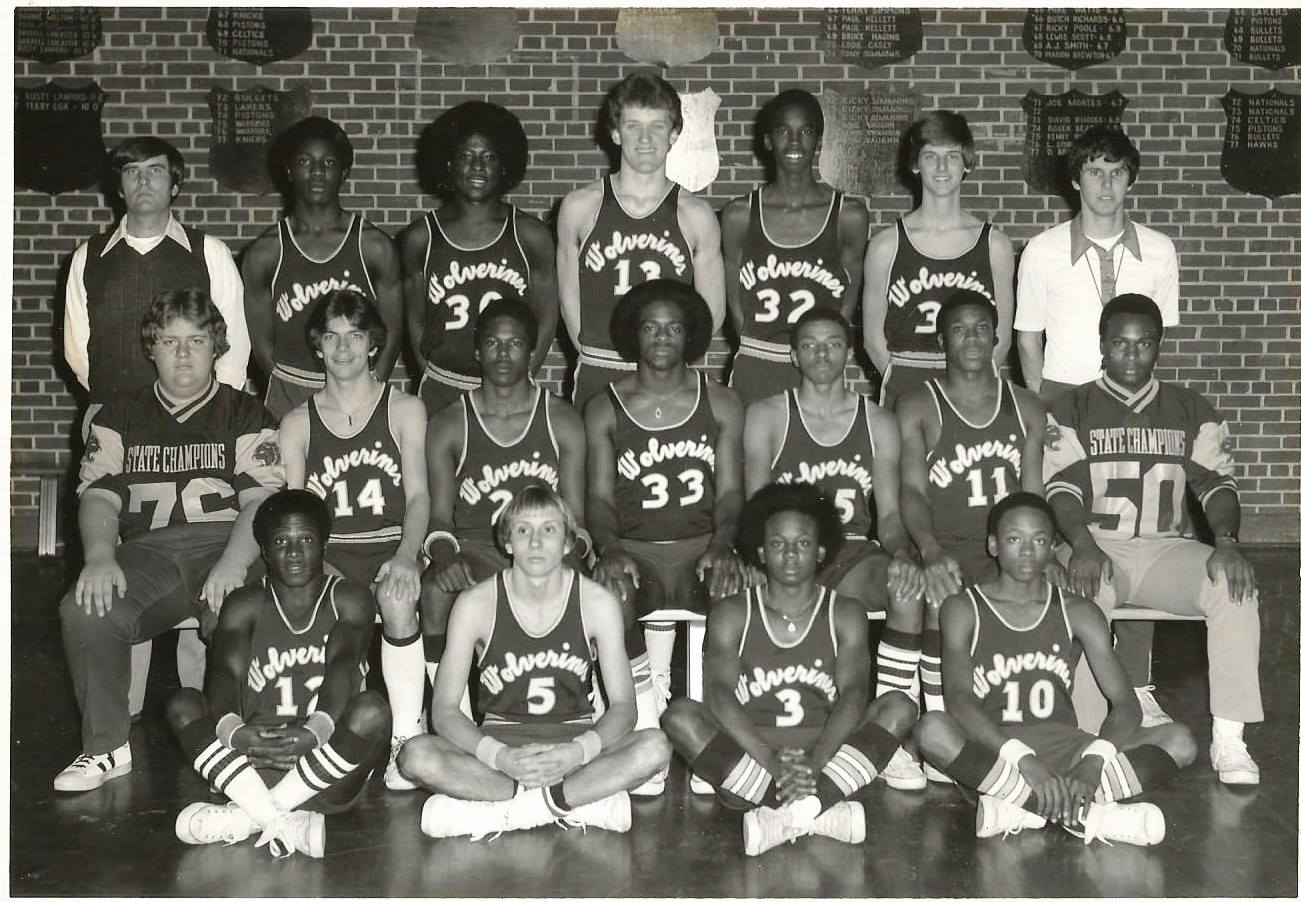
A Facebook post from a former high school friend and basketball teammate is the basis of this story—my junior year high school basketball team:
I am number 5, and other than wondering why I was looking away and seemingly disengaged, I am struck by my socks.
Throughout junior high and high school, I suffered the delusion I was an athlete, spending most of my free time either playing basketball or golf. My heart and soul longed for being a basketball player, and on my bedroom wall (along with the required poster of Farrah Fawcett) hung a poster of Pete Maravich who wore the same socks superstitiously every game, two pairs pushed down and tattered.
I wanted few things more than being Pistol Pete. Maravich was smart, skilled, and hard-working. Even after his career on the court, Maravich remained the personification of practice and drills: If you work hard enough, Maravich seemed to represent, you too can be a magician on the basketball court.
Soon after Maravich, I added Larry Bird to my list of role models, again latching on to his working-class ethic as an athlete. Bird prompted mythological tales—Larry Legend—about his breaking into Boston Garden to shoot in the dark when the facility was closed.
That’s right, I was a child and teenager smitten by “grit.”
After being diagnosed with scoliosis the summer before my ninth grade, I became an exercise fanatic, possibly as a response to the genetic failure of my body. I created a year-long daily calendar on poster-board each year from ninth through twelfth grades to list and monitor my workouts. For those four years, I wore ankle weights most days and jumped rope at least 300 times each night with those weights on. Every day. Four years.
My Holy Grail was dunking the basketball*—despite my being about 5’10” and around 130 pounds.
My fanaticism about practice carried over onto the driving range in good weather also. I often hit 300 range balls on the golf course practice range before setting out to play 18-27 holes.
And what did all that get me?
Look back to that junior-year photograph above. In my high school during the late 1970s, letterman jackets were the greatest treasure for want-to-be athletes like me (I often wore my father’s jacket from the 1950s to school, a jacket he earned as captain of the first state championship football team at that same high school). But the rules of receiving a letterman’s jacket revolved around lettering your junior year—no other year of lettering resulted in a jacket.
I lettered every year of high school except junior year—a year I spent almost totally on the bench. I never earned a letterman’s jacket in high school, despite lettering in two sports my senior year.
And all that golf practice resulted in a huge amount of callouses and a year on the golf team at junior college.
But I was never Pistol Pete or Larry Legend, and certainly never close to Arnold Palmer (yes, my golf fantasies had working-class heroes also).
So what is my point? I am not trying to suggest that my anecdotes of my life prove my point, but they certainly make an important case for answering Rob’s question.
You see, throughout junior high, high school, and college, I never really tried at school—I was too busy trying to be Pistol Pete and then Larry Legend. And if anyone looked at the outcomes of these two different spheres—my grades in my classes and my scrawny, blond self riding the bench of countless high school basketball games—which do you think appears to be the result of “grit,” effort?
Despite my growing up in a working class family, I thrived when I did because of a number of privileges—being white, male, and prone to math and verbal skills cherished by the school system.
And the evidence is powerful that privilege trumps effort and that human behaviors are greater reflections of the conditions of their lives (abundance or scarcity) than the content of their character.
When my junior year ended without my having earned that letterman’s jacket, I began carrying with me until this day a deep and genuine sense of failure because I wanted few things more than to hand my father back his jacket and to stand before him in the one I earned, to show him I was the man I wanted to be, which was the man he was. That was a boy’s dream, of course, because my father could not have loved me more then or now than he does.
I trust, as well, that my experiences with trying very hard at things I could never excel in and then excelling in things that required very little effort on my part do inform what I argue is a misguided commitment to “grit” in calls for education reform and in school and classroom practices, even among educators with the best of intentions. So I want to end by answering Rob with a few observations and questions I think should help us at least reconsider commitments to “grit”:
How do we know when one child is trying and another isn’t? And how do we know why one child works hard and another seems not to make the same effort? I recently arrived at my first year seminar class upset that so many students had failed to submit their essays on time for that class session. My assumptions were all focused on them, but once I arrived in class, I discovered they had all been having technical trouble—the campus email system wasn’t allowing attachments. The focus on “grit,” then, often maintains a singular and accusatory eye on the child, and thus ignores the context, which may be the source of the behavior.
How often do we misread “privilege” as “grit”? My argument is—almost always. Even when privileged people excel because of their “grit,” the distinguishing aspect of that success remains the privilege. As well, when impoverished people overcome their hurdles due to hard work and “grit,” they remain outliers, and while they should be applauded, their outlier success isn’t a credible template for everyone else struggling under the weight of poverty.
As I note below, “grit” may be a distorted quality among leaders because our culture is competition-based, and our leaders both feel like winners and are praised as winners. Winning is linked to effort in our society even when the effort is not the key to that success. Leaders as winners, then, tend to project their “grit” onto others—not unlike the messages found in Maravich’s basketball training videos—”Just work hard, like I did, and you can do anything!” While such messages may be inspiring, they are at least incomplete, if not mostly untrue; my efforts in high school were not failures due to my lack of effort, but due to my genetic ceiling.
And finally, Rob’s question directly: Can “grit” research and ideology be used as a humanizing and empowering tool, rather than a weapon against schools and children? To which I say: If we dedicate ourselves to creating the slack necessary for that “grit” to matter and for such demands to be equitable, then yes. In other words, “grit” fails when it becomes the initial and primary demand of children, superseding commitments to creating the equitable conditions that all children need in their lives and schools. My conclusion about “grit,” then, is that the ultimate concern of mine may be where we prioritize and emphasize it—and how it is used as a spotlight on children in poverty almost exclusively.
On this last point, I think, I can make my best case about why emphasizing “grit” is both misguided and harmful.
From the authoritarian extremes of “no excuses” schools such as KIPP to the more progressive embracing of “grit” that many may call “tough love,” when we honor “grit” we reduce our children to salmon and sea turtles, we create schools that perpetuate a Social Darwinism that is human-made. School, like life, for these children becomes something to survive, a mechanism for sorting.
I think we can and should do better than treating our children like salmon and sea turtles—even when we do so with love in our hearts.
* By the way, yes, I could occasionally dunk in my late teens and early twenties.
The country is engaged in a fierce debate about two educational reforms that bear directly on the future of its schoolchildren: first, teacher evaluation systems that are taking hold just about everywhere, and, second, the Common Core learning standards that have been adopted by all but a few states and are supposed to move the schools toward a more challenging, writing-intensive curriculum.
Both reforms — or at least the principles behind them — got a welcome boost from reading and math scores released recently by the federal government. …
Two examples are the District of Columbia and Tennessee, among the first to install more ambitious standards and teacher evaluations. Tennessee jumped from 46th in the country in fourth-grade math two years ago to 37th, and from 41st in the nation to 34th in eighth-grade reading. The District of Columbia, though still performing below the national average, has also shown progress. The scores of its students improved significantly in both math and English.
Moreover, according to Education Secretary Arne Duncan, the eight states that managed to get the Common Core standards in place in time for the latest National Assessment of Educational Progress exams this year showed improvement from 2009 scores in either reading or math.
Kool-Aid journalism occurs when journalists relinquish their work as researchers and reporters to political appointees—in this case the Editorial Board of the NYT decides to turn Secretary Duncan’s baseless claims into statements of fact that support an editorial position. The Board concludes:
But the progress seen elsewhere — like Tennessee and the District of Columbia — shows that improvement is possible if the states strengthen their resolve and apply solutions that have been shown to work.
However, if the Editorial Board at the NYT had made even a basic effort at confirming Duncan’s claims, the Board could have discovered that NAEP data are complicated and cannot prove in any way that recent reforms are a success.
As I have detailed, and despite my not having any training as a journalist or as an investigative reporter, the Editorial Board could have benefitted from the following clarifications about NAEP that I found easily—all of which discredit Duncan’s claims and the Board’s position:
When I point out that raw changes in state proficiency rates or NAEP scores are not valid evidence that a policy or set of policies is “working,” I often get the following response: “Oh Matt, we can’t have a randomized trial or peer-reviewed article for everything. We have to make decisions and conclusions based on imperfect information sometimes.”
This statement is obviously true. In this case, however, it’s also a straw man. There’s a huge middle ground between the highest-quality research and the kind of speculation that often drives our education debate. I’m not saying we always need experiments or highly complex analyses to guide policy decisions (though, in general, these are always preferred and sometimes required). The point, rather, is that we shouldn’t draw conclusions based on evidence that doesn’t support those conclusions.
This shows that the places with the greatest gains were D.C., Tennessee, and Indiana, three places that have embraced the corporate reform strategy of testing, closing down schools, and opening charters. If this was the only data we had access to, it would seem to prove that “the ends justify the means” when it comes to education reform….
There are many other things to analyze, and I’m looking forward to reading how others analyze the data. For example, it is curious that Louisiana had ‘gains’ that were smaller than the national average despite that state having, certainly, the most aggressive reforms occurring. For ‘reformers’ who are so obsessed with test scores and test score gains, this is certainly something that shouldn’t be ignored. Also, Washington and Hawaii were pretty high up on the ‘growth’ numbers even though Washington does not have charter schools and Hawaii has been very slow to adopt Race To The Top reforms so their ‘gains’ can’t be attributed to those.
I’m still pretty confident that in the long run education reform based primarily on putting pressure on teachers and shutting down schools for failing to live up to the PR of charter schools will not be good for kids or for the country, in general. I hope politicians won’t accept the first ‘gains’ chart without putting it into context with the rest of the data.
Latest NAEP Results, by G.F. Brandenburg exposes that DC gains pre-date the reforms championed by Duncan and the NYT:
First of all, the increases in some of the scores in DC (my home town) are a continuation of a trend that has been going on since about 2000. As a result of those increases, DC’s fourth grade math students, while still dead last in the nation, have nearly caught up with MISSISSIPPI, the lowest-scoring state in the US.
You will have to strain your imagination to see any huge differences between the trends pre-Rhee and post-Rhee. (She was installed after testing was over in 2007.)…
So, the Educational DEforms instituted by Rhee, Henderson, and their corporate masters have not produced the promised miracles.
Yesterday gave us the release of the 2013 NAEP results, which of course brings with it a bunch of ridiculous attempts to cast those results as supporting the reform-du-jour. Most specifically yesterday, the big media buzz was around the gains from 2011 to 2013 which were argued to show that Tennessee and Washington DC are huge outliers – modern miracles – and that because these two settings have placed significant emphasis on teacher evaluation policy – that current trends in teacher evaluation policy are working – that tougher evaluations are the answer to improving student outcomes – not money… not class size… none of that other stuff.
I won’t even get into all of the different things that might be picked up in a supposed swing of test scores at the state level over a 2 year period. Whether 2 year swings are substantive and important or not can certainly be debated (not really), but whether policy implementation can yield a shift in state average test scores in a two year period is perhaps even more suspect….
Is Tennessee’s 2-year growth an anomaly? we’ll have to wait at least another two years to figure that out. Was it caused by teacher evaluation policies? That’s really unlikely, given that those states that are equally and even further above their expectations have approached teacher evaluation in very mixed ways and other states that had taken the reformy lead on teacher policies – Louisiana and Colorado – fall well below expectations.
As it stands, the position taken by the NYT Editorial Board lacks even the barest qualities of credibility, but it does expose the utter failure of Kool-Aid journalism.
I remain adamant about my concluding point concerning the racial components of Duncan’s comment and the responses to it: If white outrage is the only outrage that counts in the U.S., any victory won from that outrage is no victory at all.
But there is another component of the response that deserves the “conversation” Duncan claims he would like to see us embrace: Duncan is simultaneously the embodiment and the victim of a toxic combination of privilege, bureaucracy, and arrogance.
First, Duncan’s incompetence is no different than the incompetence exhibited by previous Secretaries, such as Margaret Spellings. Where has the outrage been about the national leaders of education having essentially no grasp of data or statistics? Or the likelihood that they feel compelled to protect their partisan politics regardless of the truth?
Next, Duncan’s most recent embarrassment must be placed in the larger context of the entire education agenda under Obama—an agenda characterized by Civil Rights discourse used with Orwellian aims of masking classist and racist policies impacting negatively and disproportionately black, brown, and poor children (“other people’s children”) as well as English language learners. Where has the outrage been about maintaining and expanding two separate education systems—one for the privileged children of our leaders and another for the impoverished and marginalized?
Duncan, then, is not an isolated failure as Secretary of Education, and his recent “clumsy phrasing” isn’t an aberration in his public discourse.
Since Duncan has called for a return to a conversation, I want to repost here a simple request I made during the summer of 2013: A request that Duncan confront the wealth of evidence that refutes his Common Core advocacy.
Secretary of Education Arne Duncan appears now to be assuming the mantle of self-righteous indignation—a tenuous perch for someone who is leading a field in which he has no experience or expertise.
As Valerie Strauss has reported, Duncan this summer lambasted news editors, berating them for failing to demand evidence for claims against Common Core.
Duncan, first, is striking an insincere pose that manufactures a false universe in which only evidence-based support for CC and Tea Party railings against CC exist. This conveniently ignores the growing legions of educators, academics, and scholars who reject CC, and actually have the evidence.
Since Duncan is demanding evidence, it is high time he practices what he preaches (let’s all pause here because that strikes me as a bit of lunacy, in fact, to expect a political appointee to live by the rules he imposes on others).
Secretary Duncan, please either confirm or discredit the following body of evidence that refutes any credibility for needing CC or that CC will work as education reform:
Loveless (2012), How Well Are American Students Learning?: “Despite all the money and effort devoted to developing the Common Core State Standards—not to mention the simmering controversy over their adoption in several states—the study foresees little to no impact on student learning” (p. 3).
Mathis (2012): Existence and/or quality of standards not positively correlated with NAEP or international benchmark test data; “Further, the wave of high-stakes testing associated with No Child Left Behind (NCLB) has resulted in the ‘dumbing down’ and narrowing of the curriculum” (2 of 5).
Whitehurst (2009), Don’t Forget Curriculum: “The lack of evidence that better content standards enhance student achievement is remarkable given the level of investment in this policy and high hopes attached to it. There is a rational argument to be made for good content standards being a precondition for other desirable reforms, but it is currently just that – an argument.”
Horn (2013): “The 2012 NAEP Long-Term Trends are out, and there is a good deal that we may learn from forty years of choking children and teachers with more tests with higher stakes: IT DOESN’T WORK!”
Evidence? Secretary Duncan, you can’t handle the evidence.
Evidence and Rigor: Scrutinizing the Rhetorical Embrace of Evidence-Based Decision Making Educational Researcher April 2012 41: 98-101, doi:10.3102/0013189X12440306
[1] The original blog posting has been identified by the National Council of Teachers of English in recognizing my work for the 2013 George Orwell Award.
Social media and even mainstream media appear poised to leap on Secretary Arne Duncan with both feet due to his swipe at white suburban moms.
The nearly universal sweeping outrage—some with a level of glee that must not be ignored—calls for close consideration itself.
First, rejecting Duncan’s comments about white suburban moms and Common Core critics is completely valid. I join hands with the education community in rejecting Duncan’s claims, his discourse, and his efforts to discredit a significant, credible, and growing resistance to CC that should not be trivialized and marginalized as Duncan does.
However, I find the magnitude and swiftness of the responses to this “white suburban moms” incident disappointing in the larger context of Duncan’s entire tenure as Secretary of Education.
In the first moments of Obama’s administration, Duncan has personified and voiced an education agenda that disproportionately impacts black, brown, and poor children in powerfully negative ways. And the entire agenda has been consistently cloaked in discourse characterizing these policies as the Civil Rights issue of the day.
As well, Duncan has perpetuated and embraced “no excuses” narratives while directly and indirectly endorsing education reform and policies that target and mis-serve high-poverty students, African American and Latina/o students, and English Language learners—charter schools, Teach for America, accountability based on standards and high-stakes testing.
Public commentary that highlights that education reform under Obama and Duncan fails the pursuit of equity in the context of race and class in the U.S. tends to fall on deaf ears. The same urgency witnessed in the responses to Duncan’s “white suburban moms” contrasts significantly from the silence surrounding challenges to Duncan’s discourse and policies that are classist and racist, policy designed for “other people’s children.”
The problem is not that educators and scholars have failed to identify that education reform under Obama and Duncan have continued and increased federal and state education policy creating two inequitable education systems—one for the white and affluent, another for minorities and the impoverished—because these important messages have been raised.
The problem is that rejecting education reform discourse and policy based on race and class concerns doesn’t resonate in the U.S.
As I have asked numerous times, what would the political and public support for TFA be if the organization was providing recent college graduates with no degrees in education and only five weeks of training to teach Advanced Placement or International Baccalaureate classes filled with affluent white students? (A similar question about KIPP raises the same issue.)
Indirectly, from the response to Duncan’s “white suburban moms” comments, now we know.
The measure of a people must not come from how we flinch when the privileged suffer; the measure of a people must come from how we tolerate (or ignore) the conditions that impact the impoverished and the powerless.
If white outrage is the only outrage that counts in the U.S., any victory won from that outrage is no victory at all.
This post is now a decade old, and I wrote it in the context of the Barack Obama administration intensifying the federal-based education reform initiated under George W. Bush with bi-partisan support. Public education now has been reformed for forty years, mostly based on manufactured crises and fueled by political agendas that are essentially conservative even as both major parties support the narratives and the policies.
Many have examined the federal over-reach of education reform (see HERE and HERE); reforms fail over and over, but we persist in reform cycles of crisis/miracle none the less.
Recently, a new wave of education reform has occurred, represented by Florida but common across the US in mostly conservative states. This wave is grounded in censorship and bans with the primary agenda centered on fundamentalist and conservative Christian ideology.
In short, this wave is paradoxical since it is mostly Republican leaders using government over-reach to control public education. However, the goal of this wave is dismantling public education as much as controlling it.
Therefore, I stand with the four education reform camps I identify below with the caveat that this new religious-based wave is a subset or complication of Libertarian reform (which also seeks to dismantle public education, although with much different ideological intent).
Regardless of how we identify education reform, we must constantly recognize the ideology behind and goals sought by that reform. Not all reform is equal and not all reform has democracy and individual freedom as goals.
In her “Diving into the Wreck,” the speaker of Adrienne Rich’s poem explains, “the sea is another story/the sea is not a question of power.” Critical response to this poem often includes some ambiguity about just what the wreck constitutes in the poem, but the speaker is clear about her purpose:
I came to explore the wreck. The words are purposes. The words are maps. I came to see the damage that was done
The education reform debate, however, should be classified as a question of power, and that debate is not ambiguous about the wreck—U.S. public education. To understand the education reform debate in the twenty-first century, a guide appears necessary in order to provide foundational differences among competing narratives about the failures of public education and the policies recommended for overcoming those failures.
First, all reformers are driven by ideology, and thus, those ideologies color what evidence is highlighted, how that evidence is interpreted, and what role evidence plays in claims public education has failed and arguments about which policies are needed for reform.
Second, essentially no camp exists calling for no reform. If the history of education shows us anything, it is that education is a field characterized by both debate and the perpetual tension created by calls for reform (see Kliebard for a really fine examination of this perpetual tension).
Education reform camps fall into two broad categories—Mainstream and Radical—with two divisions within each broad category: Mainstream Reform includes bureaucratic reformers and technocratic reformers; Radical Reform includes libertarian reformers and critical reformers.
Historically and currently, Mainstream Reformers have most, if not all, of the power, and Radical Reformers (although the two divisions are diametrically opposite) share being at the margins. Finally, before detailing each of the four divisions of reformers, this guide is not intended to suggest any individual reformer is solely committed to any one division. In fact, many reformers either shift between camps or simply stand with a foot in each of two camps—notably within the broad Mainstream Reform category.
Mainstream Reform includes the following overlapping and dominant divisions:
Bureaucratic Reformers: Ideologically, bureaucratic reformers tend to self-identify as progressive and support public education as a civic and economic good. Bureaucratic reformers often claim public education’s failures are related to a lack or poor quality of structure: accreditation, certification, standards, and other organizing mechanisms must be reformed in order to improve education (and likely such reforms must always be conducted as the world always changes). Evidence for claims of failure tend to be measurable, quantitative data. Bureaucratic reformers embrace a bureaucratic ideal, borrowing both from government and corporate bureaucracy models to guide reform policy. [October 2023 Update: Note that the current reading crisis and reading policy movement, the “science of reading,” fits into this category.]
Technocratic Reformers: Ideologically, technocratic reformers tend to self-identify as conservative or traditional; they support public education as one but not as the sole mechanism for achieving an educated citizenry (and workforce) that drives a vibrant economy. Skeptical of “big” government, technocratic reformers draw on business models, free market ideology, and competition as larger policy commitments reinforced by technocratic structures such as institutional hierarchies, uniform standards, and perpetual measurement. Evidence for claims of public education failure is drawn from state-to-state and international rankings of test scores—as well as ideological skepticism of government monopolies—but the overriding concern about educational quality remains with how all educational options in the U.S. insure economic competitiveness.
Radical Reform includes the following overlapping and marginalized divisions:
Libertarian Reformers: Ideologically (and obviously), libertarian reformers self-identify as libertarian, or independent; they may tolerate public education if it remains within local control, but some hardline reformers seek to replace public education with a private system. For libertarian reformers public education fails de facto as a bureaucratic institution, a government entity. Evidence of that failure is often more strongly grounded in anti-government sentiment than empirical data, but libertarian reformers do seek evidence that public education outcomes support their distrust in government. [October 2023 Update: Religious-based reforms that censor and ban texts and curriculum parallel the goal of Libertarian reform—although the outcomes are ideologically different, especially in terms of formal education as indoctrination (embraced by fundamentalists but rejected by libertarians).]
Critical Reformers*: Ideologically, critical reformers self-identify as critical, often avoiding the social stigma in the U.S. of identifying as Leftists or Marxists. Public education is cherished as a foundational commitment to democracy, community, and individual liberty. Skeptical of free market ideology and bureaucratic policy, critical reformers seek to change public education dramatically as a subset of wider social change—both driven by commitments to equity. Public education failures, then, are identified as reflecting and perpetuating inequity found in society. Evidence of those failures tend toward quantitative and qualitative data highlighting inequity among classes, races, and genders.
On an ideological/political scale, then, these four divisions run the spectrum from Left to Right as follows:
This guide, then, should serve practical purposes for navigating claims of educational failure and advocacy of reform policy. First, in order to assess the credibility of claims of public education failure and offers of educational reform, we should evaluate the internal consistency of the reformer: Does the reform address a valid claim of failure? And how is all of that shaded by the ideological grounding?
Next, recognizing in a somewhat dispassionate way that all reform comes from an ideological grounding helps distinguish how we determine the credibility of the reformer and the reform policies: Are we rejecting/embracing the ideology or the policy efficacy?
Regardless, then, of how accurate anyone believes this guide is, I would maintain that step one is to acknowledge that “educational reformer” is insufficient alone as an identifier and that ideology drives all claims of educational failure and calls for reform. As a result, for example, support or criticism of Common Core must be examined first upon the ideological basis of the support or criticism. Understanding ideological grounding helps us confront that CC criticism tends be among critical and libertarian reformers who disagree strongly with each other about the reasons for rejecting CC.
This guide seeks to raise the debate above simple claims of “reform” or even basic stances of “for” or “against” X policy.
And like the speaker in Rich’s poem, acknowledging these ideological tensions may help us all look more closely at the wreck and not as much at each other:
the thing I came for: the wreck and not the story of the wreck the thing itself and not the myth.
* Full disclosure, while I have sought to make a fair and clear attempt at identifying these four categories, as a critical reformer myself, I concede and even embrace my ideology, which is a foundational characteristic of being critical. I am neither being objective nor able to do so. Instead, I have tried to be careful and accurate—and transparent.
No child has ever chosen to be poor. Children have never caused the poverty that defines their lives, and their education.
Yet, the adults with political, corporate, and educational wealth and power—who demand “no excuses” from schools and teachers serving the new majority of impoverished children in public schools and “grit” from children living in poverty and attending increasingly segregated schools that offer primarily test-prep—embrace a very odd stance themselves: Their “no excuses” and “grit” mottos stand on an excuse that there is nothing they can do about out-of-school factors such as poverty.
Living in poverty is a bear trap (and it is), and education is a race, a 100-meter dash.
“No excuses” advocates calling for grit, then, are facing this fact:
Children in poverty line up at the starting line with a bear trap on one leg; middle-class children start at the 20-, 30-, and 40-meter marks; and the affluent stand at the 70-, 80-, and 90-meter marks.
And while gazing at education as a stratified sprint, “no excuses” reformers shout to the children in poverty: “Run twice as fast! Ignore the bear trap! And if you have real grit, gnaw off your foot, and run twice as fast with one leg!”
These “no excuses” advocates turn to the public and shrug, “There’s nothing we can do about the trap, sorry.”
What is also revealed in this staggered 100-meter race is that all the children living and learning in relative affluence are afforded slack by the accidents of their birth: “Slack” is the term identified by Mullainathan and Shafir as the space created by abundance that allows any person access to more of her/his cognitive and emotional resources.
In the race to the top that public education has become, affluent children starting at the 90-meter line can jog, walk, lie down, and even quit before the finish line. They have the slack necessary to fail, to quit, and to try again—the sort of slack all children deserve.
Children in relative affluence do not have to wrestle with hunger, worry about where they’ll sleep, feel shame for needing medical treatment when they know their family has no insurance and a tight budget, or watch their families live every moment of their lives in the grip of poverty’s trap.
As Mullainathan and Shafir explain: “Scarcity captures the mind.” And thus, children in poverty do not have such slack, and as a result, their cognitive and emotional resources are drained, preoccupied.
Children living and learning in abundance are not inherently smarter and they do not work harder than children living and learning in poverty. Again, abundance and slack actually allow children to work slower, to make more mistakes, to quit, and to start again (and again).
Quite possibly, an even uglier secret behind the “no excuses” claim that there is nothing the rich and powerful can do about poverty is that this excuse is also a lie.
David Berliner (2013) carefully details, “To those who say that poverty will always exist, it is important to remember that many Northern European countries such as Norway and Finland have virtually wiped out childhood poverty” (p. 208).
More children are being born into the trap of poverty in the U.S., and as a result, public schools are now serving impoverished students as the typical student.
Instead of allowing some children to remain in lives they didn’t choose or create and then condemning them also to schools unlike the schools affluent children enjoy, our first obligation as free people must be to remove the trap of poverty from every leg of every child.
Reference
David C. Berliner (2013) Inequality, Poverty, and the Socialization of America’s Youth for the Responsibilities of Citizenship, Theory Into Practice, 52:3, 203-209, DOI: 10.1080/00405841.2013.804314
UPDATE
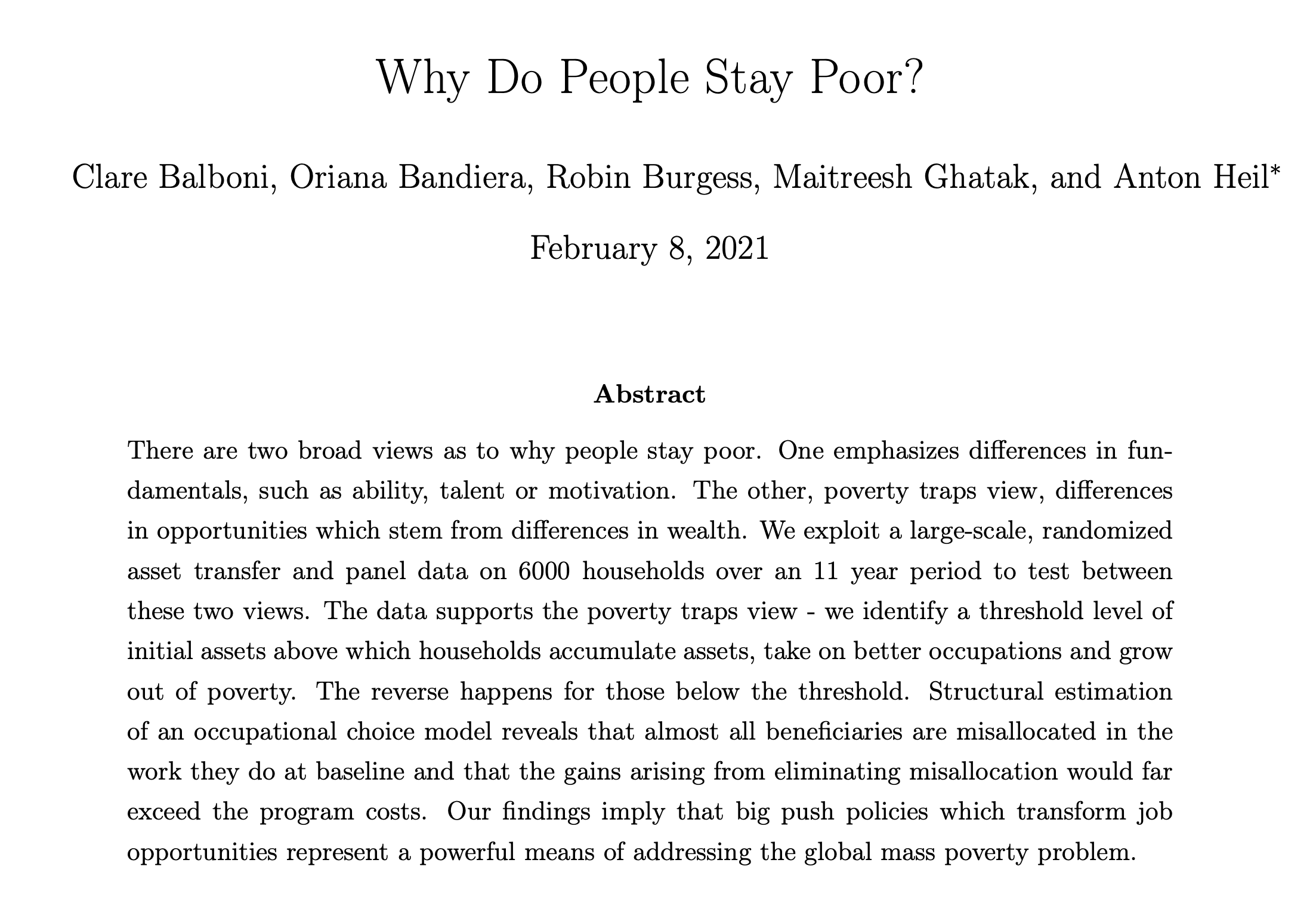
Why Do People Stay Poor? Clare Balboni, Oriana Bandiera, Robin Burgess, Maitreesh Ghatak, and Anton Heil
During President George W. Bush’s tenure, NCLB was a corner stone of his agenda, and when then-Secretary Spellings announced that test scores were proving NCLB a success, Gerald Bracey and Stephen Krashen exposed one of two possible problems with the data. Spellings either did not understand basic statistics or was misleading for political gain. Krashen detailed the deception or ineptitude by showing that the gain Spellings noted did occur from 1999 to 2005, a change of seven points. But he also revealed that the scores rose as follows: 1999 = 212; 2000 = 213; 2002 = 219; 2003 = 218 ; 2005 = 219. The jump Spellings used to promote NCLB and Reading First occurred from 2000 to 2002, before the implementation of Reading First. Krashen notes even more problems with claiming success for NCLB and Reading First, including:
“Bracey (2006) also notes that it is very unlikely that many Reading First children were included in the NAEP assessments in 2004 (and even 2005). NAEP is given to nine year olds, but RF is directed at grade three and lower. Many RF programs did not begin until late in 2003; in fact, Bracey notes that the application package for RF was not available until April, 2002.”
This year, Tennessee and the District of Columbia, which have both launched high-profile efforts to strengthen education by improving teacher evaluations and by other measures, showed across-the-board growth on the test compared to 2011, likely stoking more debate. Only the Defense Department schools also saw gains in both grade levels and subjects.
In Hawaii, which has also seen a concentrated effort to improve teaching quality, scores also increased with the exception of fourth grade reading. In Iowa and Washington state, scores increased except in 8th-grade math.
Specifically pointing to Tennessee, Hawaii and D.C., Education Secretary Arne Duncan said on a conference call with reporters that many of the changes seen in these states were “very, very difficult and courageous” and appear to have had an impact.
Duncan’s claims, in fact, have prompted The Wall Street Journal to announce “School Reform Delivers”:
Education Secretary Arne Duncan hailed this year’s National Assessment of Educational Progress (i.e., the nation’s report card) results on Thursday as “encouraging.” That’s true only if you look at Washington, D.C., Tennessee and states that have led on teacher accountability and other reforms….
However, a handful of states did post significant gains, and the District of Columbia and Tennessee stand out. Until very recently, Washington, D.C. was an example of public school failure. Then in 2009 former schools chancellor Michelle Rhee implemented more rigorous teacher evaluations that place a heavy emphasis on student learning. The district also tied pay to performance evaluations and eliminated tenure so that ineffective teachers could be fired.
Between 2010 and 2012, about 4% of D.C. teachers—and nearly all of those rated “ineffective”—were dismissed. About 30% of teachers rated “minimally effective” left on their own, likely because they didn’t receive a pay bump and were warned that they could be removed within a year if they failed to shape up.
Clearing out the deadwood appears to have lifted scores.
Jim Horn has highlighted that NAEP shows a powerful picture of the growing problem with re-segregation and the entrenched reality of racial and socioeconomic achievement gaps—messages ignored by Duncan. At the very least, then, Duncan is cherry-picking.
Gary Rubinstein has also dismantled the DC NAEP “miracle,” and G.F. Brandenburg provides a clear chart showing that DC gains are a continuation of a trend pre-Rhee, and thus before the policies praised by Duncan. As Rubinstein concludes:
I’m still pretty confident that in the long run education reform based primarily on putting pressure on teachers and shutting down schools for failing to live up to the PR of charter schools will not be good for kids or for the country, in general. I hope politicians won’t accept the first ‘gains’ chart without putting it into context with the rest of the data.
With the USDOE at Duncan’s disposal, it seems careless and inexcusable to make unproven claims that policy has caused test score changes when no one has had time to analyze the data in order to make such claims.
Is Tennessee’s 2-year growth an anomaly? We’ll have to wait at least another two years to figure that out [emphasis added]. Was it caused by teacher evaluation policies? That’s really unlikely, given that those states that are equally and even further above their expectations have approached teacher evaluation in very mixed ways and other states that had taken the reformy lead on teacher policies – Louisiana and Colorado – fall well below expectations.
Like Spellings, Duncan proves that he is either unqualified to be Secretary of Education due to a lack of understanding of statistics or that he is willing to place partisan politics above what is best for children and public education. Either way, this is yet another example of failure from the top in the world of education reform and politics—as well as the likelihood that the mainstream media will continue to play along.
In the myriad debates surrounding implementation of Common Core and the concurrent tests, the sheer costs of this process tends to be ignored. Another issue related to both CC and the related costs is yet another series of commitments to technology as a part of the perpetual education reform process. Here is a reposting of a presentation [see Note below] I gave offering a stern caution about our repeated rush to embrace technology:
Author Kurt Vonnegut quipped, “Novels that leave out technology misrepresent life as badly as Victorians misrepresented life by leaving out sex.” As with novels, so with schools, I believe, but we must take one step beyond “whether schools should address technology” to “how.”
In Walden, Henry David Thoreau offered two warnings that should guide how we approach technology: “We are in great haste to construct a magnetic telegraph from Maine to Texas; but Maine and Texas, it may be, have nothing important to communicate,” and, “We do not ride on the railroad; it rides upon us.”
Shifting from seeking technology for technology’s sake to critical technological awareness
Caution: Inflated costs (market forces) in state-of-the-art technology
Caution: Pursuing state-of-the-art technology is self-defeating since “state-of-the-art” is a moving target; teaching students to use state-of-the-art technology fails to recognize that it will be “old” technology once students leave school. Also, state-of-the-art technology has a high risk/reward factor since many “new” gadgets fail and many “new” upgrades fizzle. Consider the storage facilities at schools filled with cables, software, out-dated hardware, and the LaserDisk players that never caught on.
Caution: Adding new technology or upgrading existing technology requires added time spent for teachers (in-service) and students to learn the technology itself, draining time better served on teaching and learning themselves.
Caution: Research base, although sparse, does not support a positive role for technology in improving teaching/learning, and evidence we have shows teachers rarely use technology provided (EdWeek synthesis of research on technology):
That study found that most of the schools that have integrated laptops and other digital tools into learning are not maximizing the use of those devices in ways that best make use of their potential.
Almost every generation has been subjected in its formative years to some “groundbreaking” pedagogical technology. In the ’60s and ’70s, “instructional TV was going to revolutionize everything,” recalls Thomas C. Reeves, an instructional technology expert at the University of Georgia. “But the notion that a good teacher would be just as effective on videotape is not the case.”
Many would-be educational innovators treat technology as an end-all and be-all, making no effort to figure out how to integrate it into the classroom. “Computers, in and of themselves, do very little to aid learning,” Gavriel Salomon of the University of Haifa and David Perkins of Harvard observed in 1996. Placing them in the classroom “does not automatically inspire teachers to rethink their teaching or students to adopt new modes of learning.”
…In 2009, the Education Department released a study of whether math and reading software helped student achievement in first, fourth, and sixth grades, based on testing in hundreds of classrooms. The study found that the difference in test scores between the software-using classes and the control group was “not statistically different from zero.“In sixth-grade math, students who used software got lower test scores — and the effect got significantly worse in the second year of use.
Caution: Seeking to close GAPS (equity, achievement, technology) found in the lives of children (children in poverty, disadvantaged; children in affluence, privileged) through education presents a paradox: As Walt Gardner has succinctly explained: “Don’t forget that advantaged children are not standing still in the interim. They continue to benefit from travel and other enriching learning experiences. As a result, the gap will persist.”
Caution: Begin with educational (teaching/learning) NEEDS, not the allure of new technology.
Alfie Kohn in January 2010 argued against national standards in Education Week; I then offered a direct rejection of CC in the same publication in August of 2010. A few others took early stances against CC, such as Susan Ohanian (whose work is impressive and certainly well before most people raised any concerns) and Stephen Krashen.
Diane Ravitch and Carol Burris have taken stances opposing CC more recently, and they represent thoughtful and patient considerations of the exact issue raised by the comment quoted above. At first, Ravitch and Burris appeared willing to consider that CC could prove to be an effective reform mechanism. But both of their explanations for deciding to oppose CC are windows into my initial and continuing stance against the expensive and unnecessary venture into what for most states will be the third or fourth set of standards and high-stakes tests in about thirty years.
I have been a teacher for those thirty years, in fact—the first 18 years spent as a public school teacher in the rural South and the last 13 years as a teacher educator in the same region.
My work as a classroom teacher in the 1980s and 1990s was characterized by quarterly multiple-choice benchmark tests of reading and quarterly writing samples from my students that asked them to write one of four types of writing: description, narration, persuasion, or exposition (types that do not exist as stand-alone forms in the real world, by the way, but exist only in a world where standards and testing rule).
During those years also, state standards changed three times, and concurrent with those changes, we adopted new textbooks and sat through hours and hours of in-service, handed over more and more class time to test-prep, and implemented SAT courses during the school day (ones for which students received credit toward graduation) that required huge investments in hardware and software, which mostly never worked (my home state of SC has a history of so-called low SAT scores so our 1990s approach to addressing that was to encourage more students to take the SAT).
Eventually, the entire state of SC became invested in MAP testing while students at the high school where I taught were assigned two ELA and two math courses as sophomores if they had 8th-grade test data suggesting they would struggle with the state high-stakes tests. Our administration assigned as many as half our sophomores in double ELA and math courses, in fact.
One legacy of this test-mania was that many sophomores in our school wrote only 3-5-3 essays (3-sentence introduction, 5-sentence body paragraph, 3-sentence conclusion) because that was how they were trained to answer on the state writing test—a strategy that did increase how many passed but also ignored good writing pedagogy and mis-educated those students severely.
In the 1980s and 1990s, my high school became a master of doing the wrong thing the right way as we were regularly the top-scoring school in the state on the state’s high-stakes tests.
Once at higher education, I watched my teacher candidates and teachers in the surrounding public schools suffer under yet more revisions to the standards and two different versions of high-stakes tests (since the mid-1980s, SC has implemented BSAP and then PACT and then PASS); now the entire state is implementing CC and poised for the CC-based and once again new set of high-stakes test.
All of this is to say: If you have ever taught in public schools during the past three decades you know that the comment quoted at the beginning is patently false. In fact, if you have taught in public schools during the past three decades you know that CC cannot be separated from highs-stakes testing.
In 2013, with almost all states in the U.S. committed to CC, with the U.S. Department of Education supporting CC, with teachers’ unions supporting CC, with textbook and testing companies supporting CC, and with professional teacher organizations supporting CC, there is a deafening silence about a few facts that must be confronted if anyone or any organization wishes to make this claim: “You can’t combine the issue of high stakes testing with the common core [sic] they are two different matters”:
Name a state in the U.S. that implemented state standards since 1980 without also implementing high-stakes tests.
Name a state in the U.S. that has adopted CC and has not adopted some form of high-stakes testing related to CC.
Name a state that does not have high-stakes accountability mechanisms in place—as a legacy of state legislation and/or as a result of complying with federal mandates within policy such as Race to the Top or opting out of NCLB.
Name a school (especially a high-poverty school) where “what is tested is what is taught” does not drive most of what occurs in that school.
Name a state that is not spending tax payer money (totaling in the 10s if not 100s of millions of dollars nationally) on CC resources and technology, CC-aligned text books, CC testing, and CC teacher in-service.
Name a strong CC advocate who isn’t making money and/or gaining political advantage by endorsing CC.
My doctorate is in curriculum and instruction. A foundational part of my doctoral study and dissertation research, then, explored the century-old debate about what content matters, what should be taught in public schools. Any standards movement is a direct descendent of the larger curriculum debate.
While John Dewey and even Joseph Schwab provide engaging and powerful places upon which Eliot Eisner and others have the luxury of thinking deeply about esoteric things (issues that I too find fascinating), in the real world of day-to-day K-12 teaching, it is pure delusion and myopic idealism to make claims that CC and high-stakes testing debates are “two different matters.”
Around 2000 when my daughter was 11 and attending a public middle school, she came out to the car one day leaning against the weight of her giant backpack, slid into my car, and then said: “All they care about is the PACT test [SC’s high-stakes test at the time]; they don’t care if we learn anything.” [1] She never once as a student mentioned the standards. And in many ways as a child of the accountability era, I think she learned to hate school. She loved her friends and loved many of her teachers, but she hated what school had become throughout the 1990s—which pales to what school has become in the twenty-first century.
Thus, address the bullet points above if you don’t believe me, or better yet, ask a classroom teacher—not a union leader, not a politician, not a representative of Pearson, not a consultant.



 dr. p.l. (paul) thomas