Dominic Wyse and Charlotte Hacking present a ground-breaking account of teaching phonics, reading, and writing. Created from a landmark study, new research, new theory, and cutting-edge teacher professional development, this balanced approach to teaching seeks to improve all children’s learning, and therefore life chances.
The book dismantles polarised debates about the teaching of phonics and analyses the latest scientific evidence of what really works. It shows, in vivid detail, how phonics, reading, and writing should be taught through the creativity of some of the best authors of books for children. By describing lessons inspired by ‘real books’, it showcases why the new approach is more effective than narrow phonics approaches.
The authors call for a paradigm shift in literacy education. The chapters show how and why education policies should be improved on the basis of unique analyses of research evidence from experimental trials and the new theory and model the Double Helix of Reading and Writing. It is a book of hope for the future in the context of powerful elites influencing narrow curricula, narrow pedagogy, and high stakes assessments.
The Balancing Act will be of interest to anyone who is invested in young children’s development. It is essential reading for teachers, trainee teachers, lecturers, researchers, and policy makers world-wide who want to improve the teaching of reading and writing in the English language.
ILEC Vision: To promote literacy learning practices that enable all children and youth to realize their full potential as literate, thinking human beings.
At the annual conference of the American Educational Research Association (AERA), …I witnessed the spread of serious misinformation about reading research and related reforms. In this post, I aim to address four particularly troubling ideas I encountered. For each, I will not only provide factual corrections but also contextual clarifications, highlighting any bits of truth or valid criticisms that may exist within these misconceptions.
The post, however, misrepresents valid concerns about SOR messaging and the growing reality of negative consequences for SOR-based legislation and mandates[1]. Further, many of the bullet points under “facts” do not refute but support valid criticisms framed as “myths.” The post focuses on idealized possibilities of SOR to the exclusion of the current implementation of SOR-based programs and instruction.
Positive Aspects of the Post:
Under Myth #1, Quintero acknowledges the problems with misrepresenting National Assessment of Educational Progress (NAEP) data[2] on reading and minimizing the impact of poverty and inequity on student achievement[3].
Quintero concedes: “Reading science (indeed, any science!) is not settled; science is dynamic and evolving.”
ILEC Concerns:
Myth #1(“The reading crisis is manufactured”) is self-contradictory in that the “fact” bullets repeat the valid concerns raised among SOR critics about misrepresenting NAEP data and ignoring out-of-school factors in education reform. Once again, the SOR reading “crisis” is in fact manufactured[4].
Myths #2 (individualized instruction) and #3 (SOR restricts teacher agency) misrepresent the trend across the US of banning some reading programs and mandating other programs that tend to be structured literacy and too often scripted curriculum. Scripted curriculum does in practice impose on-size-fits-all instruction and de-professionalizes teachers[5].
Myth #4 (“The Science of Reading harms English learners”) fails to acknowledge concerns raised among Multilingual learner (MLL) scholars and teachers about SOR’s one-size-fits-all mandates[6] and “whitewashing”[7] the texts offered students from diverse backgrounds[8].
Quintero poses a false binary between SOR reform or reverting to an inadequate status quo, ignoring credible alternatives to reading reform grounded in equity/diversity and teacher agency.
May 4 has become a special day in pop culture, especially for fans and nerds who love Star Wars. May 4, 2024, proved to be a doubly special day since it fell on Free Comic Book Day.
That morning, I had two of my grandchildren—my granddaughter, 9, and my grandson, 7. With some trepidation that they would be far less excited than I was, I offered to take them to Free Comic Book Day at my local comic book shop, The Tangled Web.
The store was filled with adult faces I knew from visiting the shop at least weekly, but I was pleased to see many children there also as we weaved through the pay line to reach the back room tables stacked with free comic books.
The sign read “Three Books Only,” and the store owner greeted us, adding that the comics for children were on the first table.
My grandson said he saw the book he wanted, Pokemon, as we shuffled forward in line.
When we reached the end, where the owner was sitting, my granddaughter was holding three books when she saw one at the end she wanted so we told her she could swap out one she was holding.
The owner heard us and told her to keep all four.
We looked around a bit—my grandson wanted to see the high-priced Pokemon cards behind the case—and then as we walked to the car, my granddaughter took my hand and said the owner was nice for letting her have an extra book.
Immediately in the car, my grandson began flipping through his Pokemon book, saying some times he just likes to look at the pictures. I told him that over my comic book life sine the 1970s, I almost always do a first “read” of the books just looking at the artwork.
Back at the apartment, my granddaughter took one book in to read, a teaser copy of Monster High (IDW). My partner was setting up for her and the children to play Smash Bros. on the TV while my granddaughter consumed her new comic book.
Soon, she moved over to the couch, sitting down heavily and sighing. The story ended in a cliff hanger, and she was sad there wasn’t more.
My granddaughter was hooked. The magic of free comic book day.
No tests. No assignments. No chastising children not to look at pictures while making meaning.
Just a few encouraging adults, access to books, and the freedom to read for pleasure.
We had to drop the children off with their father just after midday to head to my partner’s book club. I tend to be a passive observer, although I did read their first book.
The book club consists of mostly friends in a gamer group, and the anchor for the monthly gathering is a series of wines for tasting.
The discussions are relatively haphazard, often wandering off into very interesting tangents punctuated with attending to children and dogs or grabbing snacks provided by everyone.
This Saturday the food was supposed to be Star Wars themed because of May 4.
As time passed and some needed to leave, the group chose the next book—this month had been nonfiction and the next category is works in translation (something I was particularly excited about)—by sharing blurbs about several suggested books (including three from my partner).
To say the least, my partner and I are as excited as my grandchildren were in the wake of Free Comic Book Day.
The next day, however, I read Dan Kois writing about the “Decline by 9”:
[A] child’s attitude towards reading enjoyment and importance is a predictor of reading frequency, which is why it also is striking to note the drop between ages eight and nine in the percentage of kids who think reading books for fun is extremely or very important (from 65% to 57%). Similarly, the number of kids who say they love reading drops significantly from 40% among eight-year-olds to 28% among nine-year-olds.
Kois acknowledges some of the standard reasons cited for children not reading—often over many decades blaming technology such as smartphones today—but then makes this point:
But others also pointed to the way reading is being taught to young children in an educational environment that gets more and more test-focused all the time. “I do not blame teachers for this,” said O’Sullivan, but the transformation of the reading curriculum means “there’s not a lot of time for discovery and enjoyment in reading.” She noted a change I, too, had noticed: Reading in the classroom has moved away from encouraging students to dive into a whole book and moved toward students reading excerpts and responding to them. “Even in elementary school, you read, you take a quiz, you get the points. You do a reading log, and you have to read so many minutes a day. It’s really taking a lot of the joy out of reading.”
The specific reference is to the “science of reading” (SOR) movement that has targeted reading programs by banning some and mandating those that are often scripted curriculum and phonics-heavy.
As Kois’s article acknowledges, the SOR movement is sacrificing important aspects of reading, including pleasure, rich texts, and diversity [1].
But this is a matter of intensity because formal schooling has always been one of the places where pleasure reading goes to die.
I taught high school English for 18 years throughout the 1980s and 1990s, witnessing first-hand that most of my very bright students had become non-readers even though you could visit any K-1 classroom and see a room full of children eager to read.
My high school students all had one thing in common—formal schooling.
This May the Fourth was a truly wonderful day for reading that I was gifted to witness. On a Saturday and nowhere near a school.
I watched children and adults choose to be readers, eager and excited.
And again, no tests. No assignments. No chastising anyone about how to make meaning or what mattered about what they were reading.
This May the Fourth was about The Force, not some Jedi skill set, but reading for pleasure and not reading as a task.
Not much, according to NEPC Fellow Elena Aydarova of the University of Wisconsin-Madison, as explained in a recent article published in the peer-refereed Harvard Educational Review. In fact, she warns that legislators are using science-of-reading legislation to distract from more serious approaches to addressing students’ needs.
Using an “anthropology of policy approach,” Aydarova zeroes in on legislative debates surrounding science of reading (SOR) reforms that have swept the nation in the past half decade. As of July 2022, 29 states and the District of Columbia had adopted this approach, Aydarova writes.
Aydarova closely examines Tennessee’s Literacy Success Act (LSA). She analyses videos of legislative meetings and debates, stakeholder interviews, and examinations of bills, policy reports, media coverage, and other documents associated with the LSA, which was passed in 2021.
This SOR bill was first introduced in 2020. As the bill underwent revisions, the phrase “science of reading” was substituted with “foundational literacy skills” to describe the same content: “Across contexts and artifacts produced by various actors, the meanings of ‘science of reading’ shifted and were frequently replaced with new signs, such as ‘foundational literacy skills,’ ‘phonics,’ and others.”
Aydarova finds little evidence that advocates, intermediaries, or legislators grounded their support in anything resembling scientific evidence. Instead, “science of reading” becomes a catch-all phrase representing a grab bag of priorities and beliefs: “[I]n advocates’ testimonies and in legislative deliberations, neuroscience as SOR’s foundational element was reduced to vague references to ‘brain’ and was often accompanied by casual excuses that speakers did not know what ‘it all’ meant.”
Motivations for supporting SOR reforms range from commercial to ideological. For instance, Aydarova notes that after the passage of The Literacy Success Act in 2021, nearly half of Tennessee’s school districts adopted curricula promoted by the Knowledge Matters Campaign. This campaign, supported by curriculum companies such as Amplify and wealthy backers such as the Charles Koch Foundation, added SOR wording to its marketing effort as the curriculum it had originally supported fell out of favor due to its association with Common Core State Standards, which had become politically unpopular in many states.
As the SOR bill reached the legislative floor, “science” was rarely mentioned.
“The link to science disappeared, and instead the sign shifted toward tradition rooted in these politicians’ own past experiences,” Aydarova writes. “During final deliberations, legislators shared that they knew phonics worked because they had learned to read with its help themselves.”
Concerningly, the bill’s supporters also positioned it as “a substitution for investing in communities and creating the safety nets that were necessary for families to climb out of poverty.”
For instance, legislators dismissed as “state over-reach” proposals that would have expanded access to early education or placed more social workers in schools in underserved communities. Yet they “emphasized the importance of proposing legislation to reform reading instruction to solve other social issues,” such as incarceration, impoverishment, and unemployment. Aydarova writes:
Based on artificial causality—poverty and imprisonment rates would decline if phonics was used for reading instruction—these reforms naturalized the widening socioeconomic inequities and depoliticized social conditions of precarity that contribute to growing prison populations. Through these material substitutions, the SOR legislation promised students and their communities freedom, and robbed them of it at the same time.
In the end, Aydarova finds that, “Science has little bearing on what is proposed or discussed, despite various policy actors’ claims to the contrary. Instead, SOR myths link tradition, curriculum products, and divestment from social safety nets.”
Government data has shown that in 2022-23, 30% of five-year-olds in England were not meeting the expected standard for literacy at the end of their reception year at school. Literacy was the area of learning in which the lowest proportion of children reached the target level.
Now, recent research from think tank Pro Bono Economics has found that this lack of early reading skills could result in a £830 million cost to the economy for each year group over their lifetimes.
A 2023 report from the National Literacy Trust found that less than half of children aged eight to 18 say they enjoy reading. Enjoyment is at its lowest level since 2005. Part of learning to read should be learning to love books – and enjoyment in reading is linked to higher achievement. If children don’t like reading, how we teach it to them isn’t working.
Our view, as academic linguists, is that part of the reason why so many children do not experience joy in reading is the excessive focus on synthetic phonics in early education.
Synthetic phonics teaches reading by guiding children to decode words by linking letters (graphemes) to their corresponding sounds (phonemes). For instance, children are taught that the letter “g” corresponds to the initial sound in “get”.
Synthetic phonics is often referred to in everyday language simply as “phonics”. That is useful shorthand but technically speaking “phonics” is a broader term, which refers to all methods of teaching reading that emphasise relations between letters and sounds. Phonics, in this broader sense, also includes analytic phonics, for example. But in analytic phonics whole words are analysed, with the pronunciation of individual letters and groups of letters deduced from that – not the other way around.
Synthetic phonics has always played a role in teaching children how to read, alongside other methods. However, following recommendations by former headteacher and Ofsted Chief Inspector Sir Jim Rose in 2006, it rapidly became the main approach in England, more so than in other Anglophone nations.
The government has pointed to England’s high ranking in the comparative Progress in International Reading Study (PIRLS) as evidence that phonics is working. Unfortunately, other research does not support this narrative around synthetic phonics and literacy.
Another international comparison of student achievement, PISA (Programme for International Student Assessment), looks at 15-year-olds. Here, UK students’ performance in reading was at its highest in 2000, before the heavy emphasis on phonics. Children in the Republic of Ireland and Canada, where synthetic phonics isn’t as central, outperform their British peers in reading.
And in general, England’s PIRLS scores – as well as other data – show that achievement in reading has stayed fairly stable since 2001, rather than showing the improvement that might be expected if phonics was indeed so effective.
Processing language
In synthetic phonics, children do not focus on texts or even paragraphs or sentences. Instead, they process language word by word, letter by letter. An extreme but real example of this is when they are asked to read word lists that even include nonsense words, such as “stroft” or “quoop”. The goal here isn’t to expand vocabulary but to practice blending letter sounds, turning each word into a challenging task.
Children are also given “decodable books”, intended to help them practice a few specific sounds. A genuine example of a story designed to make children practice just eight phonemes, starts as follows: “Tim taps it. Sam sits in. Tim nips in. Sam tips it.” Many of these artificial sentences sound unlike anything children would ever hear or read in a real-life context.
To be fair, the images in this decodable book make it clear that Tim taps the door of a house, that Sam sits inside that house, and so on. But it’s difficult to imagine that children’s attention will be captured by these stories – it certainly wasn’t in the case of one of us, Willem’s, own children.
This is not a good start if we wish to encourage kids to read for pleasure, as the National Curriculum rightly suggests we should.
Educational researchers have argued that the government’s focus on synthetic phonics is not warranted by the research literature. And the relation between sounds and spelling in English is devilishly difficult compared to many other languages, such as Spanish or Polish. For instance, “g” sounds very different in “gel” than it does in “get”. This makes exceedingly high reliance on synthetic phonics a poor decision to begin with.
Broader comprehension
There are alternatives to England’s focus on synthetic phonics. In the Republic of Ireland and Canada, for instance, phonics is integrated into an approach that emphasises reading whole texts and includes strategies other than just synthetic phonics. Children are taught to consider the wider context to look for meaning and identify words.
Take the sentence “Sam sits in his house”. A child may not have learnt the sound corresponding to “ou” and not been taught that an “e” at the end of a word isn’t always pronounced. But if they have genuinely understood the preceding sentences in the story, they have a good chance of figuring out that the word is “house” knowing that Tim has just knocked on a front door and that Sam must sit inside something.
And we know from a study that has examined the findings of many research papers that a phonics-led approach is less effective than one that focuses on comprehension more broadly, by getting children to engage with the text and images in different ways.
We believe the government’s plan for literacy isn’t working. Focusing on stories that children like to read would be a better place to start.
This analysis is another powerful cautionary tale about education reform, notably the “science of reading” (SOR) movement sweeping across the US, mostly unchecked.
As I do a close reading of Riordan’s study, you should also note that the foundational failure of the SOR movement driving new and reformed reading legislation in states is that the main claims of the movement are dramatically oversimplified or misleading. I strongly recommend reviewing how these SOR claims are contradicted by a full examination of the research and science currently available on reading acquisition and teaching: Recommended: Fact-checking the Science of Reading, Rob Tierney and P David Pearson.
This close reading is intended to inform directly how and why SOR-based reading legislation is not only misguided but likely causing harm, notably as Riordan addresses, to the most vulnerable populations of students that education reform is often targeting.
First, here is an overview of Riordan’s study:
Similar to public, political, and educator beliefs in the US, “QFT [quality first teaching] is a commonly held belief amongst school staff” in the UK, Riordan found. In other words, despite evidence that student achievement is overwhelmingly linked to out-of-school factors, teacher quality and instructional practices are often the primary if not exclusive levers of education reform designed to closed so-called achievement gaps due to economic inequities.
Riordan identifies bureaucracy and simplistic messaging as the sources of implementation failure:
Nonetheless, “[t]his explicit demand [belief in QFT] is an example of the growing pressure on education practitioners to ensure their practices are supported by evidence (of many kinds),” Riordan explains, adding, “School staff believe that high-quality teaching reduces SED attainment gaps and that their belief is backed by research evidence.”
The research/science-to-instruction dynamic is often characterized by narrow citations or cherry-picking evidence: “Because school leaders cited the same references to research evidence to justify very different policies and practices, I conducted a review of the literature that led to these citations.”
One key problem is that while the evidence base may be narrow and “[a]lthough there is agreement that high-quality teaching is important to tackle SED, principles of QFT are nevertheless being implemented in a myriad of ways across secondary schools in England.”
In the US, many scholars have noted that the SOR movement uses “science” rhetoric but depends on anecdotes for evidence; and, in the UK:
Although many school staff (and particularly school leaders) are aware of the EEF resources and believe that there is evidence supporting principles of QFT, no interviewee described this evidence in any further detail. When asked why QFT works, staff reasoned intuitively. The line of reasoning that can be reconstructed from their replies is independent of the research evidence.
…This intuitive argument, reasoned by school staff, is limited but I do not challenge its validity. The main point here is that this line of reasoning does not reflect the research evidence (which is described in detail below ‘The weakness of the evidence for QFT’). It is not the strength of the evidence base that has convinced school leaders to implement QFT practices. This highlights the importance of the psychological aspects of bringing research evidence to bear on practice. It also raises the possibility that a message was disseminated that was already widely believed. I turn to this bureaucratic concern next.
That intuitive urge, again, however, is linked to limited evidence: “Just five studies are being relied upon to disseminate the message that high-quality teaching is the most effective way to reduce SED attainment gaps.”
What may also be driving a misguided reform paradigm is convenience, or a lack of political imagination:
Evidence- or science-based reform, then, tends to be reduced to a “sham” (consider the misleading “miracle” rhetoric around Mississippi, also addressed in Tierney and Pearson):
The unintended consequence is a “misdirection of energy and time of school staff” driven by “pressure to conform to the policies promoted.”
Key to recognize is Riordan identifies that QFT reforms not only fail to close gaps but also cause harm: Some “attempts to improve the quality of teaching are contributing to a large attainment gap,” including: “It is by turning to a more refined measure of SED that we find evidence that the school’s innovations in teaching and learning over the last five years have benefitted its most affluent students most of all.”
Riordan’s conclusion is important and damning:
It has reviewed the wider picture in which school leaders are choosing to implement (or at least justifying the implementation of) particular practices based on a generic message instead of the specific research supporting those practices. The problem here is that the mechanisms operating to connect research with practice are too crude to acknowledge the richness and messiness of social science research. The message, ‘high-quality teaching is the most effective way to support students facing SED’, is too simple to be meaningful.
For the US, education reform broadly and the SOR movement can also be described as grounded in messages that are “too simple to be meaningful” and thus too simple to be effective and even likely to be harmful.
Senior Research Fellow in the Centre for Teachers and Teaching Research, UCL
2 April 2024
Evidence is obviously a good thing. We take it for granted that evidence from research can help solve the post-lockdown crises in education – from how to keep teachers in the profession to how to improve behaviour in schools, get children back into school and protect the mental health of a generation.
But my research and that of others shows that incorporating strategies that have evidence backing them into teaching doesn’t always yield the results we want.
The Department for Education encourages school leadership teams to cite evidence from research studies when deciding how to spend school funding. Teachers are more frequently required to conduct their own research as part of their professional training than they were a decade ago. Independent consultancies have sprung up to support schools to bring evidence-based methods into their teaching.
This push for evidence to back up teaching methods has become particularly strong in the past ten years. The movement has been driven by the Education Endowment Foundation (EEF), a charity set up in 2011 with funding from the Conservative-Liberal Democrat coalition government to provide schools with information about which teaching methods and other approaches to education actually work.
The EEF funds randomised controlled trials – large-scale studies in which students are randomly assigned to an educational initiative or not and then comparisons are then made to see which students perform better. For instance, several of these studies have been carried out in which some children received one-on-one reading sessions with a trained classroom assistant, and their reading progress was compared to children who had not. The cost of one of these trials was around £500,000 over the course of a year.
Trials such as this in education were lobbied for by Ben Goldacre, a doctor and data scientist who wrote a report in 2013 on behalf of the Department for Education. Goldacre suggested that education should follow the lead of medicine in the use of evidence.
Using evidence
In 2023, however, researchers at the University of Warwick pointed out something that should have been obvious for some time but has been very much overlooked – that following the evidence is not resulting in the progress we might expect.
Reading is the most heavily supported area of the EEF’s research, accounting for more than 40% of projects. Most schools have implemented reading programmes with significant amounts of evidence behind them. But, despite this, reading abilities have not changed much in the UK for decades.
This flatlining of test scores is a global phenomenon. If reading programmes worked as the evidence says they do, reading abilities should be better.
And the evidence is coming back with unexpected results. A series of randomised controlled trials, including one looking at how to improve literacy through evidence, have suggested that schools that use methods based on research are not performing better than schools that do not.
In fact, research by a team at Sheffield Hallam University have demonstrated that on average, these kinds of education initiatives have very little to no impact.
My work has shown that when the findings of different research studies are brought together and synthesised, teachers may end up implementing these findings in contradictory ways. Research messages are frequently too vague to be effective because the skills and expertise of teaching are difficult to transfer.
It is also becoming apparent that the gains in education are usually very small, perhaps because learning is the sum total of trillions of interactions. It is possible that the research trials we really need in education would be so vast that they are currently too impractical to do.
It seems that evidence is much harder to tame and to apply sensibly in education than elsewhere. In my view, it was inevitable and necessary that educators had to follow medicine in our search for answers. But we now need to think harder about the peculiarities of how evidence works in education.
Right now, we don’t have enough evidence to be confident that evidence should always be our first port of call.
Sally Riordan, Senior Research Fellow in the Centre for Teachers and Teaching Research, UCL
“Human development is an important component of determining a nation’s productivity and is measured in employee skills identified by employers as critical for success in the modern global economy,” claims Thomas A. Hemphill, adding:
The United States is obviously not getting a sufficient return on investment in elementary and secondary education, as it has mediocre scores in mathematics literacy and declining scores for science literacy for 15-year-old students surveyed in 2022. The only significant improvement for 15-year-olds is in reading, where the United States finally entered the top 10 in 2022.
If these educational trends continue, the United States will not have an adequate indigenous workforce of scientists, engineers and technologists equipped to maintain scientific and technological leadership and instead will become perpetually reliant on scientifically and technologically skilled immigrants. We must demand that elementary and secondary education systems reorient efforts to significantly improve mathematical and scientific teaching expectations in the classroom.
However, for decades, evidence has shown that there is no causal link between international rankings of student test scores and national economic competitiveness.
This Big Lie is purely rhetorical and relies on throwing statistical comparisons at the public while drawing hasty and unsupported causal claims from those numbers.
Bracey offers this from researchers on the relationship between international education rankings and economic competitiveness:
Such countries [highest achieving] “do not experience substantially greater economic growth than countries that are merely average in terms of achievement.”
The researchers then lay out an interpretation of their findings that differs from the causal interpretation one usually hears:
“We venture, here, the interpretation that much of the achievement ‘effect’ is not really causal in character. It may be, rather, that nation-states with strong prodevelopment policies, and with regimes powerful enough to enforce these, produce both more economic growth and more disciplined student-achievement levels in fields (e.g., science and mathematics) perceived to be especially development related. This idea would explain the status of the Asian Tigers whose regimes have been much focused on producing both economic growth and achievement-oriented students in math and science.”
“From our study, the main conclusion is that the relationship between achievement in science and mathematics in schoolchildren and national economic growth is both time and case sensitive. Moreover, the relationship largely reflects the gap between the bottom third of the nations and the rest; the middle of the pack does not much differ from the rest. . . . Much of the obsession with the achievement ‘horse race’ proceeds as if beating the Asian Tigers in mathematics and science education is necessary for the economic well-being of other developed countries. Our analysis offers little support for this obsession. . . .
“Achievement indicators do not capture the extent to which schooling promotes initiative, creativity, entrepreneurship, and other strengths not sufficiently curricularized to warrant cross-national data collection and analysis. Unfortunately, the policy discourse that often follows from international achievement races involves exaggerated causal claims frequently stress- ing educational ‘silver bullets’ for economic woes. Our analyses do not offer defini- tive answers, but they raise important ques- tions about the validity of these claims. In an era that celebrates evidence-based policy formation, it behooves us to carefully weigh the evidence, rather than use it simply as a rhetorical weapon.”
A key point to note here is Bracey is writing in 2007, and the OpEd above is March 2024. The Big Lie about international education rankings and economic competitiveness is both a lie and a lie that will not die.
I strongly recommend Tom Loveless exposing a similar problem with misrepresenting and overstating the consequences of NAEP data: Literacy and NAEP Proficient.
Bracey offers a brief but better way to understand test data and economic competitiveness: “education is critical, but among the developed nations differences in test scores are trivial.”
Instead of another Big Lie, the US would be better served if we tried new and evidence-based (not ideological) ways to reform our schools and our social/economic structures.
Regardless of your level of optimism, there simply is no other conclusion to draw from over forty years of educational crisis and reform: Education reform has almost nothing to do with improving education for students, but education reform has become an industry.
And one of the most powerful engines driving the crisis/reform industry in education is education journalism.
Interesting is that both are provable false narratives.
Yet, these stories endure because “[v]iewing education as being in more or less permanent crisis” (Edling, 2015) creates market and political profit for media, private education corporations, and politicians.
As a simple fact of logic, consider that for at least the last century, on every standardized test in every content area, students in poverty as a group have scored significantly lower than more affluent students.
Over that century, the teachers, instructional practices, programs, and curriculums/standards have changed dozens of times and have never been coherent at any one point across the US.
The only constant, of course, has been the economic inequity of the populations of students being taught and tested.
Yet, what have the media and political leaders focused on almost exclusively in the forty-plus-years of intense accountability reform (over what can be called at least half a dozen cycles in those decades)?
Instruction, curriculum/standards, and programs.
Why?
Teacher training churn, standardized test churn, and program churn are industries, and there is profit in constant churn.
Never has it been more clear that education reform is industry: “The administrations in charge,” writes Gilles Deleuze in Postscript on the Societies of Control, “never cease announcing supposedly necessary reforms: to reform schools, to reform industries, hospitals, the armed forces, prisons” (p. 4).
And never has it been more clear that education journalism is deeply invested in that churn, in manufacturing perpetual crisis:
Just within the past twenty years, Gates+ money has incubated several new education-only media outlets, such as Chalkbeat, EdReports, EdSurge, Education Next, Ed Post, FutureEd, and The 74. Gates+ money has also substantially boosted the efforts of preexisting education-only media organizations, such as EdSource, Education Week, the Education Writers Association, the Thomas B. Fordham Institute, and the Hechinger Report. All told, this accounts for almost all large-audience, US, K–12-education-only print media outlets, other than those tied to the traditional public education establishment.
I suspect no one embodies education reform as industry as well as Bill Gates, education reform hobbyist.
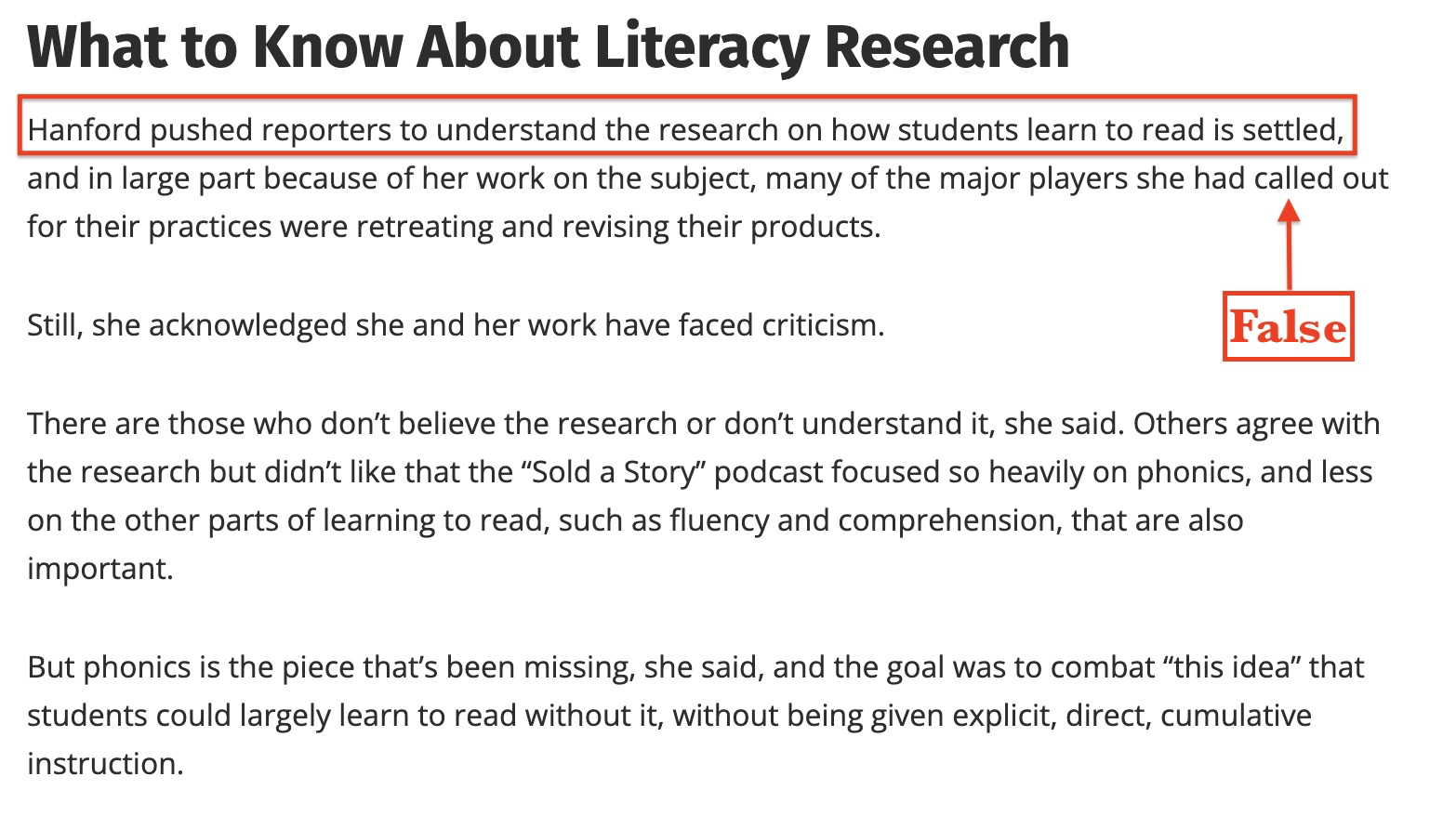
And, for example, nothing better exemplify what the true commitment in education journalism is better than the Education Writers Association and the current darling of education misinformation, Emily Hanford:
Manufacture a crisis with a melodramatic story, and then steel the troops for the inevitable outcome so that everyone can circle back to yet another crisis and more reform.
There is the sound of profit in the background as journalists as “watchdogs” announce more and more failure and crisis among school, teachers, and students.
The real literacy crisis is that too many people cannot read the writing on the wall. Or more likely, too many people are blinded by the profit of education reform as industry to even see the writing on the wall.
Thought Experiment 1
If you wonder if or how money matters, consider that the Department of Education Reform at the University of Arkansas is funded by Walton money. The Walton’s are significant school choice and charter school proponents. The “research” coming out of the DER is overwhelming positive about school choice and charter schools.
Coincidence?
Thought Experiment 2
England passed reading reform mandating systematic phonics for all students in 2006 (although their media and political leaders persist in crying “reading crisis”).











 dr. p.l. (paul) thomas