“Lack of support for early years language and communication development is leading to a “literacy crisis” that could be costing the economy £830m for each school year group, according to new research,” write Ella Creamer in The Guardian.
The report cited is a February 2024 analysis and heralds another round of reading crisis in the UK.
This is quite interesting considering that in 2006, the UK implemented a phonics-centered reform agenda that has been documented to have been robustly practiced, notably that all students have received systematic phonics in the UK for almost two decades:
Prior to 2006 the teaching of reading in most classrooms in England is best described as balanced instruction, in which some phonics teaching has always been part of the teaching of reading typically for children in the infant years (aged five to seven) although not necessarily ‘systematic phonics’ instruction…. However in 2006 the Rose Report recommended that there should be even more emphasis on phonics teaching….
This was followed by the increased emphasis on discrete teaching of phonics recommended by the Rose Report and the PNS from 2006 onwards. Further intensification of synthetic phonics teaching was seen in England’s national curriculum of 2014, along with a range of other measures to ensure teacher compliance with the prescribed method of teaching reading, including the use of the PSC; the vetting of phonics teaching schemes; and the use of the inspectorate to focus on outcomes in statutory reading assessments as a prime focus in school inspections.
Also of note, that research in 2022 revealed, once again, these reforms were misguided and ineffective. The researchers concluded, calling for a more balanced approach:
In addition to the importance of contextualised reading teaching as an evidence-based orientation to the teaching of reading we hypothesise the following pedagogical features that are likely to be effective. Phonics teaching is most likely to be effective for children aged five to six. Phonics teaching with children younger than this is not likely to be effective. A focus on whole texts and reading for meaning, to contextualise the teaching of other skills and knowledge, should drive pedagogy. Classroom teachers using their professional judgement to ensure coherence of the approach to teaching phonics and reading with other relevant teaching in their classroom is most likely to be effective. Insistence on particular schemes/ basals, scripted lessons, and other inflexible approaches is unlikely to be optimal. Well-trained classroom assistants, working in collaboration with their class teachers, could be a very important contribution to children’s reading development.
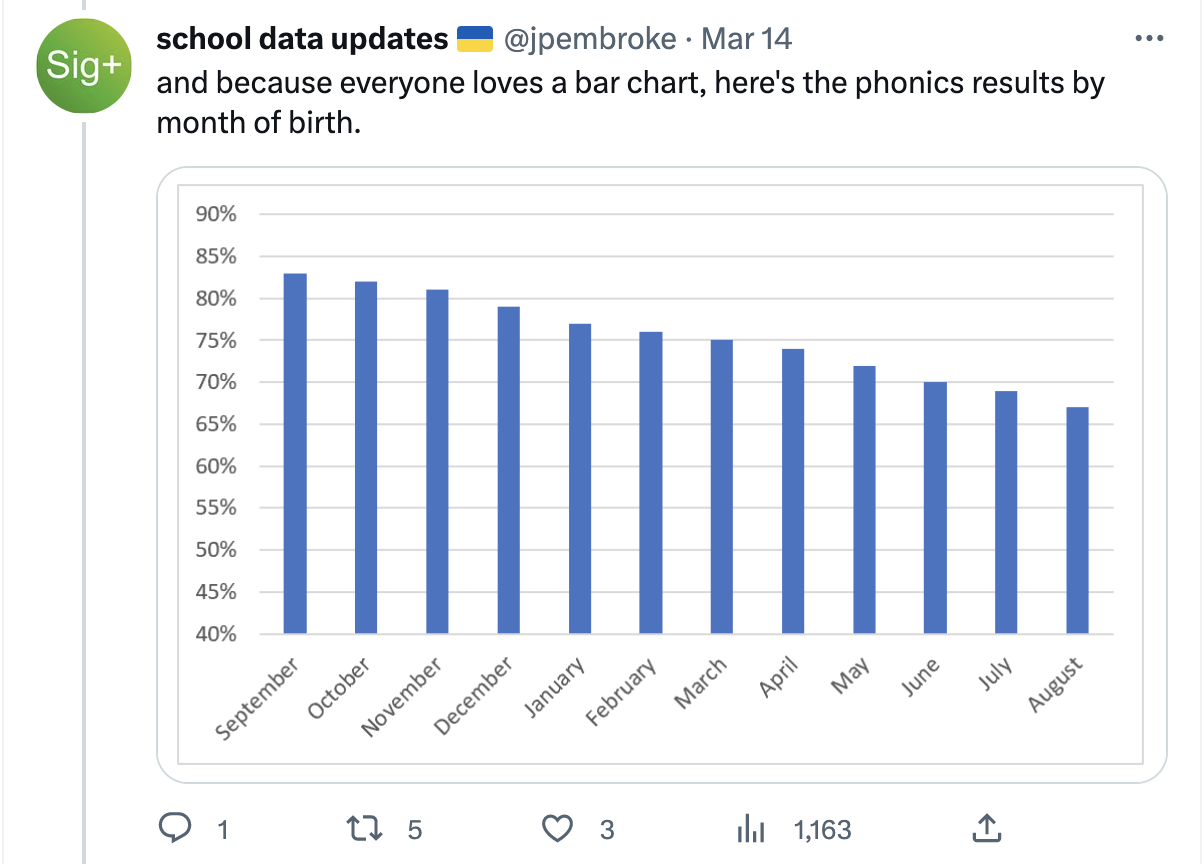
More evidence from the UK shows that reducing reading instruction to systematic phonics ignores both the science of reading instruction and the realities of human development. The mandatory phonics checks in the UK show that achievement correlates strongly with birth month, not instruction and certainly not resulting in the sort of reading achievement that avoids another reading war:
The “science of reading” movement in the US is misguided and costly, mostly benefitting commercial interests repackaging reading programs and materials emphasizing phonics.
States are rushing to mimic practices that have already failed in the UK. Our students and teachers deserve better.
Similar to A Nation at Risk and a core part of No Child Left Behind (NCLB), the National Reading Panel (NRP) was a bi-partisan committee formed under Bill Clinton and then elevated under George W. Bush.
Joanne Yatvin, a panel member who issued a Minority Report, wrote in Education Week in 2003, warning that the NRP’s conclusions would be misrepresented and misused.
Yatvin was right.
And 15 years later, Emily Hanford—among dozens of journalists—continued to prove Yatvin correct:
The battle between whole language and phonics got so heated that the U.S. Congress eventually got involved, convening a National Reading Panel to review all the research on reading. In 2000, the panel released a report. The sum of the research showed that explicitly teaching children the relationship between sounds and letters improved reading achievement. The panel concluded that phonics lessons help kids become better readers. There is no evidence to say the same about whole language.
In 2024, as the “science of reading” (SOR) movement continues to steamroll state reading legislation, journalists persist in misrepresenting the panel’s findings as well as ignoring that the NRP is over two decades old, which means reading science has moved well beyond what the panel claimed to find.
Often ignored, panel members admitted the NRP was underfunded and understaffed, resulting in the panel’s overview of reading research was greatly limited to only a narrow type of published research.
Further, despite the Urban Legends of the findings repeated by Hanford and other journalists, the NRP’s conclusions are not what has been claimed.
First, Tim Shanahan, a panel member, admitted that the report did little to support classroom practice.
But more importantly, the actual findings of the panel in no way support the media claims about what research says about teaching reading, the role of phonics instruction, or the evidence on whole language.
Diane Stephens, University of South Carolina emeritus professor, provides an excellent summary of the findings:
Phonemic Awareness: PA is a “means rather than an end”; doesn’t increase comprehension; only one of many elements needed to read independently.
Phonics: Minimal value in kindergarten; no conclusion about phonics beyond grade 1 for “normally developing readers”; systematic phonics instruction in grades 2-6 with struggling readers has a weak impact on reading text and spelling; systematic phonics instruction has a positive effect in grade 1 on reading (pronouncing) real and nonsense words but not comprehension; at-risk students benefit from whole language instruction, Reading Recovery, and direct instruction.
Fluency: The ability of students to make sense of text grammatically and with understanding of punctuation.
Vocabulary: Vocabulary is acquired many ways by readers; number of words acquired cannot be accomplished through direct instruction. About 1/3 of vocabulary learning in grades 3 – 8 linked to reading.
Comprehension: Weak evidence in report on comprehension. Emphasizes need for SBRR (scientifically based reading research) and “putting teachers in positions where their minds are the most valued educational resource.”
As many scholars have noted (see below), the NRP found that systematic phonics and whole language were about equally effective, but the key here is that phonics instruction was found to be effective for pronunciation, not comprehension, and only in grade 1.
In short, the NRP was never a definitive overview of reading science (or a confirmation about teaching systematic phonics to all students), and now that we are 20-plus years past the report, citing the NRP should be limited to historical references, not evidence of the current state of reading science.
I recommend the following to understand fully the NRP:
Shanahan, T. (2003, April). Research-based reading instruction: Myths about the National Reading Panel report. The Reading Teacher, 56(7), 646-655.
Bowers, J.S. (2020).Reconsidering the evidence that systematic phonics is more effective than alternative methods of reading instruction. Educational Psychology Review, 32(2020), 681-705. https://link.springer.com/article/10.1007%2Fs10648-019-09515-y
Collet, V.S., Penaflorida, J., French, S., Allred, J., Greiner, A., & Chen, J. (2021). Red flags, red herrings, and common ground: An expert study in response to state reading policy. Educational Considerations, 47(1). https://doi.org/10.4148/0146-9282.2241
Garan, E.M. (2001, March). Beyond smoke and mirrors: A critique of the National Reading Panel report on phonics. Phi Delta Kappan, 82(7), 500-506. https://doi.org/10.1177/003172170108200705
Seidenberg, M.S., Cooper Borkenhagen, M., & Kearns, D.M. (2020). Lost in translation? Challenges in connecting reading science and educational practice. Reading Research Quarterly, 55(S1), S119–S130. https://doi.org/10.1002/rrq.341
Yatvin, J. (2002). Babes in the woods: The wanderings of the National Reading Panel. The Phi Delta Kappan,83(5), 364-369
“Schooling in the United States is revered as a societal foundation for possibility, empowerment, and social mobility,” explain Rios, Matthews, Zentell, and Kogut, adding, “However, US schooling systems also serve as institutions foundationally designed for and historically entrenched in the service of white, monolingual, middle- and upper-class populations.”
Further, they argue, “Scholars advocate for acknowledging students’ cultures as assets and incorporating them in teaching, a praxis known as culturally relevant pedagogy.”
The SOR movement and resulting legislation fits into the larger accountability education reform movement that is grounded in essentialism and conservative ideology.
Here, I offer a close reading of Social in/justice and the deficit foundations of oracy by Ian Cushing as a powerful entry point to understanding how SOR reading reform is conservative ideology that ultimately harms children’s linguistic development and thus the development of Self.
Cushing frames his examination in two points: first, that literacy instruction (specifically in this piece, oracy) is grounded in deficit ideology, adding, “The second is that the oracy agenda’s vision for social justice is flawed in how it relies on a theory of change where marginalised children can experience equality and upward mobility by making tweaks to their language, and that oracy provides the compensatory tool to do so.”
In other words, much of literacy instruction is aimed at “fixing” children in the context of a social norm while ignoring social inequities, such as those norms themselves.
And thus, “Marginalised children routinely experience the hostile policing of their language and public humiliation for their purported inability to speak correctly.”
The essential conservative ideology behind deficit views of language invert reform agendas:
Put another way, I argue that England’s oracy agenda interprets structural inequality as a ‘linguistic problem requiring linguistic solutions, rather than as a politico-economic problem requiring politico-economic solutions’ (Rosa, 2016, p. 165). Whilst the apparent progressivism of oracy may appear to some to be a liberatory means to afford marginalised children greater opportunities, I show here that it is rooted in deficit-based assumptions about language which overdetermine marginalised children as linguistically inferior and blames them for their own struggles.
A progressive or critical alternative to conservative ideology grounding reform, then, includes this recognition: “Social justice is a long-term project which will only be ever achieved when our efforts are on structural transformations as opposed to tweaking individual behaviours (Gandolfi & Mills, 2023; Kaba, 2021; Picower, 2012).”
However, similar to here in the US, “[S]implistic notions of social justice … have long characterised mainstream education policy, especially in England. … [D]ominant conceptualisations of social justice in education are ones rooted in individualised explanations of inequality, and result in individualised and reductive solutions,” for example, the SOR movement and legislation focusing on reforming teacher practice and raising student reading proficiency scores.
Notable is how progressive veneers in reform hide conservative ideology:
[T]he phrase social justice has been co-opted by the political right since the 1980s, producing a narrative reliant on individual change rather than state responsibility. The Labour Party has reproduced these same logics in relation to oracy and social justice (e.g. Hardy, 2020; The Labour Party, 2023; Starmer, 2023). Whilst my critique is of a bipartisan narrative, then, of particular concern here are the social justice logics emerging from the left, particularly academics and charities who position themselves as liberally progressive.
[D]eficit and dichotomous framings … essentialise marginalised children as linguistically impoverished and in need of remediation.
Central to understanding the political nature of reform is to acknowledge the political and ideological nature of language and language acquisition—including the ideological bias in the “word gap” narrative:
Any description of language is ideological, and these ideologies are products of specific sociopolitical contexts. … These deficit perspectives continued into the twenty-first century in terms of the ‘word gap’ (Hart & Risley, 1995), blaming low academic performance on irresponsible parenting and broken homes rather than the structural inequalities within wider society (Valencia, 2010). Whilst the terminology used to represent marginalised communities as displaying linguistic deficiencies has shifted over time, the underlying logics remain the same. Yet oracy has, for the most part, evaded academic scrutiny and been positioned as a progressive linguistic concept which stands in opposition to deficit thinking.
Deficit perspectives of language and children include overlapping aspects of both classism and racism as well as ableism, reflecting normative biases framed as individual deficits to be overcome through policy:
These representations align with Bereiter and Engelmann’s depictions of working-class African American children in the 1960s, who were deemed to be ‘not simply deficient in their use of words; they are deficient in their repertoire of concepts’, and thus incapable of abstract thought (Bereiter & Engelmann, 1966, p. 127)….
These ableist labels are reflective of a long history of academic scholarship which perceives non-speech languages and their users as disordered and primitive (see Henner & Robinson, 2023). In similar ways to other deficit perspectives of the time and overlooking the structural inequalities marginalised children experience, Wilkinson poses that it is inadequate linguistic abilities which put such children at a disadvantage in school, and that these inadequacies act as an impediment to the interactions required for the middle-class conditions of school….
These framings tie together race, class, and dis/ability in producing discourses of deficiency which continue to circulate in contemporary policy.
This leads to a key recognition about literacy policy that is fundamentally conservative, normative, and deficit-driven:
The oracy for social justice narrative is, then, a bipartisan one, and one entirely in line with recent, mainstream political conceptualisations of social justice which focus on individualised remediation rather than endemic structures of inequality which require radical transformation….
When children are framed as suffering from gaps in their language, logics follow that they require interventions to close them, which often legitimises language prescription and policing under the purportedly progressive aims of oracy.
Ultimately, then: “[D]eficit perspectives frame marginalised children as part of an ‘at-risk’ discourse, in which struggling families are both blamed for their own educational failures and responsible for addressing them.”
Education and literacy reform, regardless of the nation, tends to focus on “fixing” children or teachers, and that inidividual gaze is a distraction from addressing systemic causes of the so-called “gaps” in the performances of those students or teachers in formal schooling.
Centering the concept of literacy “gaps” and calling for closing those gaps are offering cures equal to or greater than the disease: “[O]ften framed as a progressive project, then, I have shown here how it has long relied on academic scholarship rooted in deficit, dichotomous, and anti-Black ideologies about language and supposed gaps. This has surfaced without any critical interrogation of language gap ideologies, despite the extensive body of scholarship which has debunked and rejected them (e.g. Aggarwal, 2016, Avineri et al., 2015, Cushing, 2023b, García & Otheguy, 2017, Johnson & Johnson, 2021).”
These failures are, again, bipartisan: “[B]oth sides rely on normative notions of language which rely on deficit and dichotomous framings.” And thus, “we should all be suspicious of bipartisan narratives which position oracy as a pragmatic tool for structural change.”
Cushing concludes in a way that is equally relevant to education and reading reform in the US: “Genuine social justice efforts require transformative methodologies which target the root causes of injustices and reimagine the societies which our schools are part of, generating solutions which modify systems as opposed to individuals.”
Sources
Overwhelming whiteness: a critical analysis of race in a scripted reading curriculum, Amanda Rigell, Arianna Banack, Amy Maples, Judson Laughter, Amy Broemmel, Nora Vines & Jennifer Jordan (2022) Overwhelming whiteness: a critical analysis of race in a scripted reading curriculum, Journal of Curriculum Studies, 54:6, 852-870, DOI: 10.1080/00220272.2022.2030803
Rios, A., Matthews, S. D., Zentell, S. & Kogut, A. (2024). More being, different doing: Illuminating examples of culturally relevant literacy teaching. Journal of Adolescent & Adult Literacy, 67, 283–293. https://doi.org/10.1002/jaal.1329
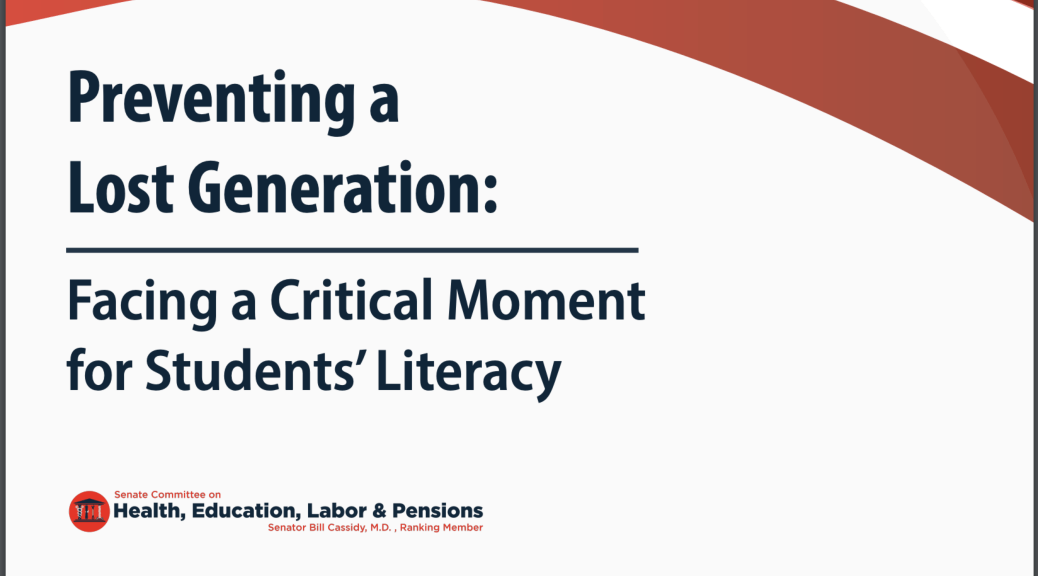
“The 2022 NAEP results show that the average reading score for fourth graders is lower than it has been in over 20 years. For eighth and twelfth graders, average scores are at about a 30-year low,” states Senator Bill Cassidy (R-LA) in his new literacy report, adding, “The 2022 NAEP LongTerm Trend assessment for nine-year-old students showed average reading scores not seen since 1999.”
Cassidy’s alert about a reading crisis fits into dozens and dozens of media articles announcing crises and failures among students, teachers, and public schools all across the US. Typical of that journalism was Nicholas Kristof in the New York Times about a year ago:
One of the most bearish statistics for the future of the United States is this: Two-thirds of fourth graders in the United States are not proficient in reading.
Reading may be the most important skill we can give children. It’s the pilot light of that fire.
Yet we fail to ignite that pilot light, so today some one in five adults in the United States struggles with basic literacy, and after more than 25 years of campaigns and fads, American children are still struggling to read. Eighth graders today are actually a hair worse at reading than their counterparts were in 1998.
One explanation gaining ground is that, with the best of intentions, we grown-ups have bungled the task of teaching kids to read. There is growing evidence from neuroscience and careful experiments that the United States has adopted reading strategies that just don’t work very well and that we haven’t relied enough on a simple starting point — helping kids learn to sound out words with phonics.
As I have noted, education and reading crises have simply been a fact of US narratives since A Nation at Risk. But as I have also been detailing, these claims are misleading and manufactured.
Based on NAEP data—similar to Cassidy’s report—Shakeel and Peterson offer a much different view of student achievement in the US, notably about reading achievement:
This analysis demonstrates that the current reading crisis is manufactured, exclusively rhetorical and ideological, generating profit for media, politicians, and commercial publishers.
In short, the manufactured crises are distractions from the other contrarian truth about education as highlighted in the analysis from NPE:
This educational grading from NPE is unique because it doesn’t grade students, teachers, or public school, but holds political leadership accountable for supporting universal public education and democracy. The standards for these grades include the following:
Privatization Laws: the guardrails and limits on charter and voucher programs to ensure that taxpayers and students are protected from discrimination, corruption, and fraud.
Homeschooling Laws: laws to ensure that instruction is provided safely and responsibly.
Financial Support for Public Schools: sufficient and equitable funding of public schools.
Freedom to Teach and Learn: whether state laws allow all students to feel safe and thrive at school and receive honest instruction free of political intrusion.
These two examples come from contrasting ideologies, yet they offer contrarian truths about public schools and student achievement that would better serve how we talk about schools and student achievement as well as how we seek ways in which to reform those schools in order to better serve those students and our democracy.
Thomas, P.L. (2022). The Science of Reading movement: The never-ending debate and the need for a different approach to reading instruction. Boulder, CO: National Education Policy Center. http://nepc.colorado.edu/publication/science-of-reading
Accordingly, when policymakers explore new guidelines, they would be wise to do the following:
• Be wary of overstatements and oversimplifications within media and public advocacy, acknowledging concerns raised but remaining skeptical of simplistic claims about causes and solutions.
• Attend to known influences on measurable student reading achievement, including the socioeconomics of communities, schools, and homes; teacher expertise and autonomy; and teaching and learning conditions.
• Recognize student-centered as an important research-supported guiding principle but also acknowledge the reality that translating such research-based principles into classroom practice is always challenging.
• Shift new reading policies away from prescription and mandates (“one-size-fits-all” approaches) and toward support for individual student needs and ongoing teacher-informed reform.
In rethinking past efforts and undertaking new reforms, policymakers should additionally move beyond the ineffective cycles demonstrated during earlier debates and reforms, avoid ing specific mandates and instead providing teachers the flexibility and support necessary to adapt their teaching strategies to specific students’ needs. Therefore, state policymakers should do the following:
• End narrowly prescriptive non-research-based policies and programs such as:
o Grade retention based on reading performance. o High-stakes reading testing at Grade 3. o Mandates and bans that require or prohibit specific instructional practices, such as systematic phonics and the three-cueing approach. o A “one-size-fits-all” approach to dyslexia and struggling readers.
• Form state reading panels, consisting of classroom teachers, researchers, and other literacy experts. Panels would support teachers by serving in an advisory role for teacher education, teacher professional development, and classroom practice. They would develop and maintain resources in best practice and up-to-date reading and literacy research.
On a more local level, school- and district-level policymakers should do the following:
• Develop teacher-informed reading programs based on the population of students served and the expertise of faculty serving those students, avoiding lockstep implementation of commercial reading programs and ensuring that instructional materials support—rather than dictate—teacher practice.
• Provide students struggling to read and other at-risk students with certified, experienced teachers and low student-teacher ratios to support individualized and differentiated instruction.
U.S. Senator Bill Cassidy, M.D. (R-LA) has released a report on literacy that opens with yet another example of misrepresenting NAEP reading scores to manufacture a reading crisis for political gain: “Two-thirds of America’s fourth and eighth graders are not proficient in reading.”
The report is an embarrassing recycling of the media misinformation campaign about reading in the US.
In fact, most of the footnotes cite news articles (including the Washington Times, a conservative outlet that lacks credibility) and conservative think tanks (ExcelinEd, Fordham). [1]
Notably missing are citations to scientific research on reading or credible analyses of NAEP data.
Responses are needed and can be sent to Literacy@help.senate.gov by April 5, 2024.
Good intentions are not enough and government policy on education has done more harm than good since A Nation at Risk. We can do better, and we should. But we must start with accurate claims and credible solutions.
A school for students with dyslexia continues to stay open despite two F grades from the BESE, Louisiana’s Board of Elementary and Secondary Education. The Louisiana Key Academy is run by Senator Bill Cassidy (R-LA) and his wife, Laura. Both are physicians. Neither are specialists in reading disorders, although they have a child with dyslexia.
One of the most powerful texts I use in teaching writing is the Prologue to Louise DeSalvo’s memoir, Vertigo.
We read only the first page, but it is charged with purposeful writing and engaging storytelling of a young woman fleeing the angers of her home and seeking sanctuary:
The narrative voice of DeSalvo as an adult, a Virginia Woolf scholar, echoing herself at thirteen helps establish that tension, that dichotomy—an emotionally unsafe home contrasted with the “welcoming lights a few blocks away,” the library.
This memoir is one of trauma, but DeSalvo develops a motif of the sanctuary that libraries and books offer her throughout her life.
Her life story challenges the idealizing of family and the demonizing of schools, libraries, books, and frankly, education.
Not as dramatically but similar to DeSalvo, my own life story is one of breaking free of the intellectual and ethical shackles of my home where racism and other bigotries were the norm; like DeSalvo’s experiences, my sanctuaries were school and books, and education.
I had a former friend and colleague who died relatively recently, and I will carry with me always his telling me that he had an argument with his father once about how the two of them had diverged dramatically in beliefs and ideologies. His father shouted that his greatest regret was sending his son to college.
That fills me with a tremendous sadness, and I also feel fortunate because despite the same dynamic in my family with my parents—I am dramatically unlike them in beliefs and ideology—my parents, now deceased, always encouraged my books, my thinking, my learning, and my education.
In fact, my father often stopped strangers to tell them I earned my doctorate, a thing both embarrassing and heart warming.
It is 2024. And the world is filled with monsters:
On Monday, bill sponsor Del. Brandon Steele, R-Raleigh, called for support of his legislation in a fiery speech, in which he said libraries were “the sanctuary for pedophilia” where people needed to be held accountable for exposing children to obscene content.
“I’m voting to protect children from being groomed and targeted by pedophiles and get rid of the sanctuary that was set up in our code 25 years ago,” Steele said to members of the House Committee on the Judiciary.
He continued, “If it’s a crime in the parking lot, it’s a crime in the building — period. I hope the chilling effect chills the pedophiles. We’re not going to create a safe space for them.”
The culture wars in the US have taken an ugly turn, and the core of those battles is that tension between the family and the child as well as the ways in which every child can and should find their true Self often masked by the expectations of that home life.
As adults, most of us have experienced that break, that necessary journey that includes disagreeing with our parents, seeing that who we are is not the same as who our parents want us to be.
Sometimes it is ideology, sometimes it is sexuality, sometimes it is gender.
These tensions, these breaks are none the less difficult and even painful.
I was talking with a colleague about the ways in which education, especially higher education, is often popularly and falsely characterized as institutions of indoctrination. The dynamic is actually very similar to DeSalvo’s opening story in her memoir.
For many college students, college is a first major opportunity to be free of home expectations, a place to not only explore who they truly are but a place to discover who they are or want to be.
If a young person seems to suddenly be a different person, parents and the public may misinterpret that as college or professors causing the change. What is more likely is that college is the place where young people have the first opportunity to express that true Self.
Exposure to new or different ideas, in fact, are not necessarily what causes anyone to change who they are, but allows people to see who they are.
Ironically, places that indoctrinate and groom children the most are their homes and their churches—the sources today of those most likely to accuse others of indoctrination and grooming.
Also ironically, universal public education was a foundational commitment (ideologically well before afforded everyone) of the US because being educated was recognized as necessary for a democracy and individual freedom.
There is a little parable by Haruki Murakami. In it, the manufactured terrors by conservatives seem to come true. A boy finds himself imprisoned in a labyrinthine library, confronting a horrifying fate:
The sheep man cocked his head to one side. “Wow, that’s a tough one.”
“Please, tell me. My mother is waiting for me back home.”
“Okay, kid. Then I’ll give it to you straight. The top of your head’ll be sawed off and all your brain’ll get slurped right up.”
I was too shocked for words.
“You mean,” I said, when I had recovered, “you mean that old man’s going to eat my brains?”
“Yes, I’m really sorry, but that’s the way it has to be,” the sheep man said, reluctantly.
Murakami’s brief Kafkan nightmare, it seems, parallels what some people believe is a reality of libraries—a place where the brains of children are eaten.
The Strange Library is a sort of twisted fantasy, fitting into the tradition of children’s fears like the belief that a monster lurks under your bed or in your closet.
State representatives attacking libraries and books—that is no twisted fantasy. It is real and it is wrong.
Only monsters attack libraries and books.
And they aren’t hiding under our beds or in our closets.
They are elected officials filing bills and making outrageous pronouncements.
We have been rewatching the Daredevil series that ran for three seasons on Netflix. In the season 3 and series finale, Matt Murdock (Daredevil) gives a eulogy for Father Paul Lantom, Murdock’s surrogate father after his father’s death:
For me, personally, he spent many years trying to get me to face my own fears. To understand how they enslaved me, how they divided me from the people that I love. He counseled me to transcend my fears, to be brave enough to forgive and see the possibilities of being a man without fear. That was his legacy. And now it’s up to all of us to live up to it.
Culture wars are mostly about fear, but the worst thing about them is that they are about irrational fears, manufactured horrors.
Libraries and books are sanctuaries, not labyrinths where children have their brains eaten.
Once Murdock embraced being the man without fear, he became Daredevil, a superhero, a person who saves those in need. And by assuming this alter-ego, he found his true Self.
Fear of libraries, books, education, and knowledge is a fear of our Selves, our true Selves.
Simply put, since Ground Zero under the Reagan administration, A Nation at Risk, the US has experienced a constant cycle of education crisis followed by the same template for education reform.
Despite some of the actors in this reform process having good intentions, education reform has been driven primarily by those reaping political and financial rewards from those perpetual reform cycles.
In fact, the political and financial incentives for reform are not improving education, but simply waiting a few years for the crisis/reform cycle to be re-initiated.
This is a capitalism.
Owning a new car, for example, is the lifeblood of the car industry—not producing a car that serves the owner well for decades.
This is consumerism, the dirty underbelly of capitalism.
There is no distinction, then, in the US between public institutions grounded in service and the free market.
For over forty years, the US has been trapped in the foundational Lie of A Nation at Risk, a partisan report that Reagan manufactured in order to break the public’s support for public education, and as Reagan’s own marching orders revealed, to shift that support to school choice and return prayer to the classroom (the latter being one of the ugliest political lies since voluntary prayer is allowed in public schools, while forced prayer is restricted).
Regardless of the reform of the moment—charter schools, teacher evaluation, school choice, accountability, reading legislation, standards and testing, etc.—the ideology and claims remain constant: students are failing, teachers are failing, and public schools are failing.
Also consistent is a paradoxical lack of credible evidence for the claims—either for the crisis or the solutions.
Decades of charter school advocacy have been devoid of carefully unpacking that outcomes for private, public, and charter schools are essentially the same, mostly grounded in the population of students being served.
Yet, charter school advocates decry traditional public school in crisis and charter schools are miracles.
The teacher evaluation movement grounded in value added methods of evaluation also produced a stunning outcome, showing that teacher quality’s impact on student achievement remains minor, only about 1-14% as measured in testing. Concurrently, research for decades have shown that out-of-school (OOS) factors remain the dominant causal influence on learning, 60% and higher.
There is enormous political and financial profit in shouting educational crisis and promising educational miracles, but that profit also depends on the rest of us not engaging with the lack of credible evidence for both.
The current mania to reform reading is yet another cycle grounded in a manufactured crisis (easily shown to be a false claim based on the data critics use) and equally manufactured and false miracles, such as Mississippi and Florida.
Perpetual reading reform may be the best (or worst) example of education reform as industry since reading is a foundational and incredibly important aspect of education for children; further, reading instruction in the US has been fatally linked to reading programs—commercial reading programs.
It would seem that eventually we could admit that no reading program (despite all of them being marketed as research-based) has led to a nation satisfied with reading proficiency in student.
It would seem that eventually we could admit that reading programs are neither the problem nor the solution for reading proficiency.
The only value in reading programs is political or financial; and both depend on constantly replacing old programs with new programs (again, this is the car industry).
Frankly, what remains absent in education reform narratives about crisis and miracles is confronting the conditions in which students and teachers live and learn/teach.
Low and so-called delayed reading proficiency remains mostly among students facing tremendous inequities in the lives and education.
High-poverty and minority-majority neighborhoods and schools present students and teachers with barriers to learning and teaching that are immune to simply adopting a new reading program, or demanding that those teachers be retrained (again).
Constant teacher retraining is also an industry.
If you can pause, step back, and genuinely examine this round of reading reform, many, if not most, of the strongest advocates for new reading programs and teacher training are profiting politically and/or financially.
Ironically, those advocates have spent a great deal of energy demonizing the reading programs they want to replace as sources of enormous profit.
As I have argued for decades, the problems are not programs or necessarily even instructional theories, but our failure to invest in social and educational systems that are equitable.
It is not that any reading program so far has failed because of the program itself; the failure is hyper-focusing on programs and instruction without regard to the systemic forces in society and schools that remain significant barriers to student and teacher success.
States are dumping huge amounts of tax payers’ money—$100 million a year is a recurring price tag—into doing the exact same reading reform committed to just a couple decades ago under NCLB.
In fact, reading programs that have been identified in research as failing are now being mandated in states across the US.
Even more frustrating is that early research on states having already committed to reading program shuffling reveals significant problems with that implementation—erasing text diversity and de-professionalizing teachers.
Yet, who benefits from another round of program shuffling?
Politicians grandstanding and commercial reading program companies.
When I explain to people that they likely would be better off not buying a new car with that concurrent loan and monthly payments or at least acknowledging that choosing between an Accord or Camry is no real choice at all, I generally get smirks or soft nods.
When I argue that education reform is an industry, I am personally attacked, often with lies and anger.
To me this suggests we have far more people invested in perpetual education reform in the US than even our precious fetish for new cars.
That’s a damn shame.
A goddamn shame.
The cost is our democracy, not just the lives and liberty of our children—although it is hard to imagine anything more important than that for a people claiming to be committed to freedom.
A people hiding behind flags and freedom in hope of cashing in.
In my work as a public educator/scholar, I have had conversations with dozens of people seeking to understand education issues and topics because they are not themselves educators or are not literacy educators.
Yesterday, I had such a conversation for over an hour, discussing the issue of reading in my state in the context of the “science of reading” (SOR) movement.
During that discussion, a key point was made about how debates about reading proficiency of students and teaching reading are often absent nuance—and that the nuance itself is part of the problem with finding effective reform.
Like all states in the US (although at an extreme level), my home state of South Carolina has been an early and eager education reform state, including multiple iterations of reading legislation reform.
Also like most states, SC education and reading reform has been a constant cycle of crisis and new reform. We seem to refuse to acknowledge that reform itself is need of reform because so far the reform never works (or we wouldn’t need the next round of reform).
None the less, since we seem committed to shouting reading crisis every few years in order to justify yet more reading reform, this round of reading crisis serves as a powerful example of how the rhetoric around discussing reading proficiency and teaching reading is fraught with miscommunication and often unnecessary antagonism because of basic misunderstandings or problematic clarifications.
At the broadest level, what we mean by “reading” is an essential part of the conversation.
Particularly in the SOR era, there is a spectrum of what counts as “reading” for beginning readers that has on one extreme the ability to pronounce words absent meaning (such as nonsense words), and then on the other extreme, students being able to create meaning from a text without decoding (walking through a picture book and recreating the story either from memory or using the pictures).
Somewhere in the middle of that spectrum is, I think, what we should be talking about when we talk about reading—a student’s ability to eagerly and critically produce meaning from text grounded in automatic word recognition.
However, what greatly complicates how we talk about “reading” is that discussion often relies on (what should be) technical language.
Media, public, and political rhetoric around reading tends to use for “reading” both “reading proficiency” and “grade level reading.” Rarely, those two terms are used distinctly, but more often than not, they are tossed around as synonymns.
Here is a serious concern as I have noted often.
First, we have no standard metric of “proficient” or “grade level” at the federal or state level, and there is little understanding about how “proficient” is often an aspirational metric that is well above “grade level” (for example, NAEP achievement levels in which “basic” is approximately grade level).
Next, we have no clarification in the US about what percentage of students can or should be at whatever level we agree on and at what grade. [Note that I would add another issue is that we prefer “grade level” to “age level,” the latter being in my opinion a better metric.]
This, then, leads to another significant aspect of the current SOR movement; when we talk about reading, we often talk about what percentage of students are reading appropriately (?) at certain designated grades, often grade 3 or 4.
A claim made by SOR advocates helps show how this is a problem since many of them promise that 90-95% of students can be proficient readers.
Setting aside that this is a speculative claim and not a statistic supported by a valid body of science, the 90-95% argument often isn’t a clear one in terms of when.
Does that mean 90-95% of students can eventually become proficient readers or grade level readers, or that 90-95% of students can be proficient or at grade level in every single grade throughout schooling?
I think those questions are essential clarifications to address.
Among other elements of reading wars and education/reading reform, I think what we talk about when we talk about reading needs to be addressed in ways that clarify the elements noted above.
We need standard definitions for “reading,” “reading proficiency,” and “grade level reading”; we also should strongly consider replacing “grade level” with “age level” (to alleviate that distorting impact of policies such as grade retention on standardized measures of reading).
And we also need a national conversation about what are reasonable and aspirational goals for what percentage of students meet those metrics and when.
We seem to have ignored a key lesson and failure of NCLB—mandating 100% of students achieve proficiency by 2014. In other words, aspirational mandates doom reform to failure and erase any possibility that we do in fact reform reading policy in the best interests of students (and not the adults who profit in the debate and reform).
We all must do better to acknowledge what we talk about when we talk about reading—or we are destined to remain trapped in the crisis/reform cycle that hasn’t served anyone well (except for the profiteering) for over forty years.
Note
The title is a reference to a title that is a reference. Haruki Murakami’s What I Talk About When I Talk About Running, which is inspired by Raymond Carver’s What We Talk About When We Talk About Love.
educator, public scholar, poet&writer – academic freedom isn't free













 dr. p.l. (paul) thomas