Category Archives: education

ILEC Response: Reading Reform Across America (The Albert Shanker Institute, July 2023), Susan Neuman, Esther Quintero, and Kayla Reist

International Literacy Educators Coalition

ILEC Vision: To promote literacy learning practices that enable all children and youth to realize their full potential as literate, thinking human beings.

Download a PDF of the response.


ILEC Response: Reading Reform Across America (The Albert Shanker Institute, July 2023), Susan Neuman, Esther Quintero, and Kayla Reist

The report asserts, “Our goal is to provide a basic yet systematic description of states’ efforts to improve reading instruction.” And is grounded in the following:

Furthermore, legislative efforts have at times been criticized widely, but our analysis reveals significant variation among states, rendering blanket characterizations unhelpful….Whether we see the current state of American students’ reading achievement as a new crisis or as part of a stable trend, the truth remains that more than one-third (37 percent) of the nation’s fourth-graders performed below the National Assessment of Educational Progress (NAEP) “Basic” level in 2022. Because there is no achievement-level description for below “Basic,” it is difficult to make full sense of this statistic. (p. 1)

Reading Reform Across America

While the report is ambitious, the increase in reading legislation is framed as a positive reform effort motivated by “answering teachers’ calls for better support with regard to reading.” This positive spin ignores the media, market, and political influences on another reading war and avoids confronting how many states are passing legislation that mandates and bans reading practices based on advocacy and not the full body of reading science.[1]

Positive Aspects of the Report:

  1. The report makes a strong case for reading achievement being significantly inequitable among marginalized groups of students.
  2. The report acknowledges the concerns raised about grade retention policy.

ILEC Concerns:

  1. State reading legislation is not a response to teachers, but to an orchestrated political reform movement grounded in misinformation about reading achievement, teacher expertise, and teacher education.
  2. The report fails to fully engage with patterns of extreme measures in several states’ legislation that bans three cueing, reading programs, balanced literacy, etc., as well as legislation that mandates universal dyslexia screening, structured literacy programs, etc.—both of which are based on advocacy and not the full body of research.
  3. The report does not address the contradiction of calling for scientific practice while mandating and funding programs and practices not fully supported by research; for example, mandating LETRS training for all teachers of reading.
  4. Posing the current reading legislation movement as positive is idealistic bordering on irresponsible.

[1] Reading Science Resources for Educators (and Journalists): Science of Reading Edition [UPDATED]; The Negative Legislative Consequences of the SOR Media Story: An Open-Access Reader


Recommended

What Do We Really Know about Reading Proficiency in the US?

Neoliberal Education Reform: “Science of Reading” Edition

Something Compares: “I’m Not Down”

When I read that Dolores O’Riordan died, I experienced an irrational emptiness that defies explanation.

Then I cried.

I have cried several times since then as well.

Yesterday, from behind me as she sat at her desk looking at her phone, my partner said, “Sinéad O’Connor died.”

Once again, an irrational emptiness.

I resisted at first. But then I cried.

I have cried several times since then as well.

And now I carry the news of O’Connor’s death with me in my partner’s voice along side the emptiness I feel for the death of O’Riordan, who was only 46. A decade younger than O’Connor at her death, 56.

Like most people familiar with O’Connor, I associate her with tearing up the Pope’s picture on Saturday Night Live, which I watched live, and “Nothing Compares to U”—the mesmerizing and chilling video especially.

But the very first thing that comes to me when I think of O’Connor is the image of her with Kris Kristofferson.

When I was growing up, Kris Kristofferson was a famous actor and musician, but I wasn’t a fan of country music even though I enjoyed him in movies. It isn’t hard to do the right thing when you are a wealthy and famous white man, but Kristofferson did the right thing at that moment.

And when I think of that singular act of kindness, I have a Grinch moment—my heart swelling nearly out of my chest.

My first infatuation as a reader was science fiction, Arthur C. Clarke and others. But my first literary crush as a reader was British writer D.H. Lawrence, who believed in “blood consciousness”:

Lawrence had long believed in the duality of human consciousness, seeing a polarity between blood and mental consciousness. For him, mental consciousness was characterised by the exertion of human will, something that was demonstrated by an emphasis on science, mechanisation and materialism. In contrast, he viewed the consciousness of the blood as something inherent and more intuitive; it was as if the blood remembered older religious ideas than those imposed by Christianity, a different kind of relationship between humankind and the cosmos. Thus Lawrence’s particular interest in the notion of blood-consciousness indicates his preference for a more instinctive, rather than scientific, response to questions about man’s place in the world.

Lawrence’s “Best Adventure”: Blood-Consciousness and Cornwall

Then, and now, blood consciousness appeals to me because I often feel connections deep in me, in my bones, in my blood.

There was a hedonism to Lawrence, of course, that appealed to me as a late teen into my early 20s, but Lawrence’s work was also about language, the dialects that join us, the dialects that separate us.

Lawrence was writing about blood consciousness but class consciousness as well (priming me for reading Marx).

And there is a pattern to my affinities.

In college English courses, I found myself drawn to Irish writers, William Butler Yeats and James Joyce. Throughout my life, that Irish thread has repeated itself—George Carlin (who often spoke of his Irish heritage), Colin Farrell, Brendan Gleeson, and others.

Of course as well, there was music—U2, The Cranberries, and O’Connor.

Listening to Irish actors and singers resonates with my deep Southern drawl since we in the South owe a bit to Irish descendants who came to the Southern US among others from the British Isles. I am Scotch/Irish on my father’s side, which compels me to trust Lawrence’s faith in blood consciousness.

Regardless, there is something about language running through my love for the Irish, and that is where O’Connor and O’Riordan speak to me both literally and metaphorically.

These smallish women, physically frail, with powerful voices, daring to say what shouldn’t be said.

There is a deep humanity in O’Connor’s and O’Riordan’s lyrics, but there is also a confrontational politics that demands that we not just listen, but that we really hear what they are saying:

It’s the same old theme, since 1916
In your head, in your head, they’re still fightin’
With their tanks and their bombs and their bombs and their guns
In your head, in your head, they are dyin’

“Zombie,” The Cranberries

O’Riordan’s death came well past the pop stardom years for The Cranberries.

For O’Connor, the Pope incident on SNL likely derailed her career as a pop star because O’Connor committed the Great Sin for a woman.

Speaking with her own voice. Daring to claim her voice and body as if it were her own:

I don’t wanna be no man’s woman
I’ve other work I want to get done
I haven’t travelled this far to become
No man’s woman
No man’s woman

“No Man’s Woman,” Sinéad O’Connor

Yesterday, alone in the apartment, I played through several of O’Connor’s songs. Today, I did the same in the car with The Cranberries.

There was more crying, and my chest feels eerily empty even as my heart swells with each song.

In O’Connor’s and O’Riordan’s songs and voices, there is a longing, a humanity, a demand, and a frailty.

We humans can be very lonely and at times very lost. Longing for that Other to be by our side, to love and cherish.

To reach for, to hold.

But also wanting to be comfortable with ourselves, our true selves, the one in our bones, in our blood.

Crying and feeling sadness for people I did not know is irrational. It is uncomfortable to think about being able to listen to their songs any time, their existences somehow captured forever.

I am aware much of this sadness is about what these women and their death’s represent: We humans are incredibly frail.

And even as we may often admit physical frailty, we resist admitting our mental frailties.

We lose people all the time due to our own carelessness.

O’Connor’s death again makes me wish we could be better with and for each other.

We should all be willing, no, eager, to walk on stage into the jeers and booing of others, take that other person in our arms and say, “Don’t let the bastards get you down.”

Fecking hell. If only.


See Also

Should We Be Nice?: The Banshees of Inisherin

Sinead O’Connor Danced on the Edge of the Dark All Her Life, Susan McKay

Auden wrote of Yeats, “Mad Ireland hurt you into poetry.” Cruel Ireland hurt Ms. O’Connor into song. She called Ireland a theocracy. She was furious that in a country that had supposedly fought for and won its freedom, women and children were so silenced and disempowered. She understood and had experienced pain, neglect and injustice and sang for those who also knew these things….

On Wednesday night I watched videos of Ms. O’Connor performing and read some of the tributes on social media. Two stood out for me. One quoted the Yeats poem that inspired her extraordinary “Troy”: “What could have made her peaceful with a mind/That nobleness made simple as a fire. … Why, what could she have done, being what she is?/Was there another Troy for her to burn?”

Sinead O’Connor Danced on the Edge of the Dark All Her Life

What Do We Really Know about Reading Proficiency in the US?

A data-rich but disappointing report on reading legislation in the US from 2019-2022 has been released by the Shanker Institute.

The report concedes “legislative efforts have at times been criticized widely,” but chooses to applaud the “science of reading” (SOR) movement without considering the considerable scholarly criticism raising cautions about claims of a reading crisis and mandates in that legislation.

Further, the report ignores how the SOR movement fits into decades of political education reform since the 1980s, reforms that have repeatedly failed to produce positive outcomes for students or teachers.

While the report lacks critical grounding, it also offers a couple key points to consider. First:

There are no quick fixes: The path to improvement will require time, consistent investment and a holistic approach to reform. The magnitude of the task should motivate us to persevere and collaborate more effectively. Yet, we are concerned about the polarizing rhetoric surrounding reading and hope that this review can foster a more measured dialogue about the strengths and limitations of state efforts and reading improvement more broadly.

Reading Reform Across America

The emphasis on avoiding one-size-fits all solutions is important and supported by many critics of the SOR movement. And certainly the “polarizing rhetoric” of the SOR debate is harmful; yet, this report’s positive spin on harmful legislation is certain to trigger, not ameliorate that caustic debate.

Valid criticism isn’t any more “polarizing” than idealistic endorsements.

Next, and more importantly for this post:

Whether we see the current state of American students’ reading achievement as a new crisis or as part of a stable trend, the truth remains that more than one-third (37 percent) of the nation’s fourth-graders performed below the National Assessment of Educational Progress (NAEP) “Basic” level in 2022. Because there is no achievement-level description for below “Basic,” it is difficult to make full sense of this statistic.

Reading Reform Across America

Here is the central problem with the SOR movement as well as nine decades of reading wars: The truth is that we know very little empirically about reading proficiency in the US because we have no stable or unified metric or assessment to understand what proficiency is or how well students are developing as readers.

There simply has never been a single day in the US since at least the 1940s that the media, public, and political leaders have declared reading proficiency adequate.

What does it mean to have been in a continual reading crisis in the US for almost a century and yet the country has experienced no major or catastrophic decline?

What does it mean to have been in a continual reading crisis in the US for almost a century because we claim reading is essential for student and societal success and yet the dooms day messaging never materializes?

That leads us to this: What do we really know about reading proficiency in the US?

As the report notes, one aspect of reading proficiency in the US is quite clear and easy to document with multiple data points: Reading proficiency data expose a significant inequity among marginalized groups of students—notably Black and brown students, students in poverty, multi-lingual learners (whom the report advocates for admirably), and special needs students.

Yet this fact about reading is replicated in all other educational measurements, and thus, is not a unique reality about reading proficiency, suggesting something other than reading legislation (or any educational legislation) is needed in the US.

Also, it seems fair and supported by the evidence that we have to note that reading progress by students (how well any students gains reading proficiency in relationship with their peers) is a strong marker for educational progress in general.

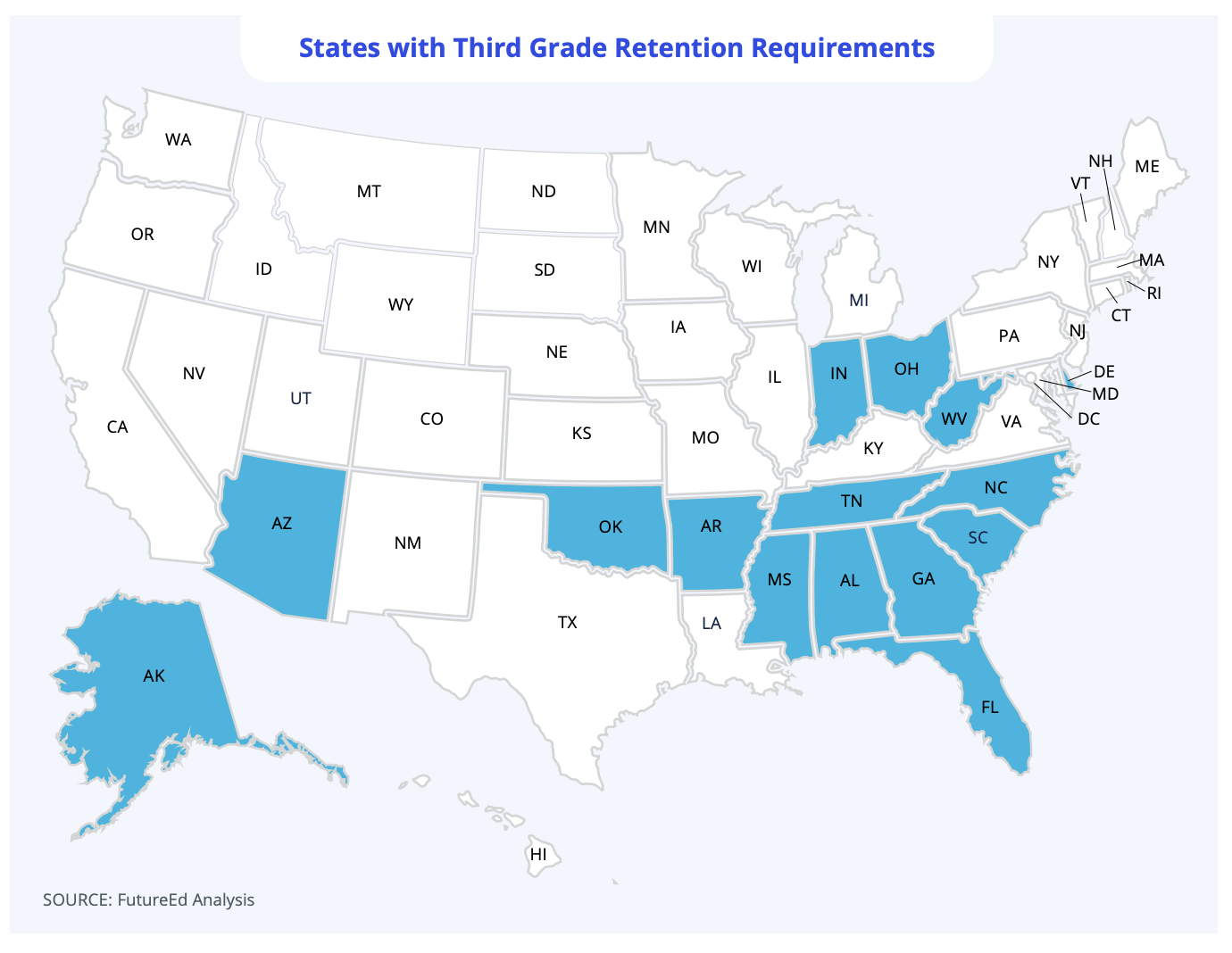
While over-emphasizing reading proficiency at grade 3 is problematic, no one suggests that early reading progress should be ignored. Yet, many states persist in adopting harmful grade 3 retention that has been shown to correlate strongly with negative consequences.

The report does concede about grade retention: “Consequently, there are reasons to be cautious about the policy.”

Beyond these two points, however, claims about reading proficiency are at best speculation and at worst ideological assertions without empirical support.

The latter, regretfully, is the crux of most reading wars for decades.

So here is what we don’t have but urgently need in order to address reading in ways that are supportive of students and teachers and avoids the “polarizing rhetoric” with which the report seems deeply concerned:

  • A standardized definition of “proficiency” that is age-based and not grade-based.
  • A comprehensive documentation of reading programs and instructional practices implemented in the US over the last decade.
  • A set of diverse assessments grounded in a standardized definition of “proficiency.”
  • Patience and a willingness to admit that human behaviors occur on a spectrum; not all students learn at the same rates.
  • Reading legislation that neither mandates nor bans practices or policies, but provides a funding framework that supports educators as autonomous professionals.

The polarization in public and political debates about reading is in part driven by all that we do not know and do not have regarding reading proficiency, allowing too many people (some without good intentions) to make melodramatic claims that reinforce political, media, and market interests, not student achievement or teacher/teaching quality.

Ultimately, this current trend in reading legislation is far more dangerous than promising since the decisions being made for teachers and students are not grounded evidence-based claims.

The inequity exposed in data on reading achievement is itself enough to justify that we do something, but continuing to do the same thing over and over while expecting different results is a tremendous political and educational mistake.

We simply do not know what we need to know about reading proficiency, but we do know that reading achievement is not uniquely inequitable; and thus, education reform broadly has failed for decades, and we are far past time to re-evaluate political educational reform.

This report eagerly endorsing more of the same political educational reform; therefore, it fails in its central mission.

Neoliberal Education Reform: “Science of Reading” Edition

[Header Photo by Mike Erskine on Unsplash]

Cliches become cliches often because they do capture a truth, and “fish don’t know they are in water” may sound trite, but the saying captures well our five decades of education reform in the US.

Since A Nation at Risk under Ronald Reagan and then reinforced and expanded under George W. Bush (with Rod Paige and Margaret Spelling as Secretaries of Education), education reform in the US has been grounded in neoliberal ideology, the foundational beliefs of Republicans and conservatives.

“Neoliberalism” is a challenging term. First, it is hard to define, and second, the use of the word “liberal” has two contrasting meanings in the US—”liberal” as in “classic liberalism” is “conservative” or politically “right,” yet in common usage “liberal” is typically associate with “progressive” or politically “left.”

However, to simplify, in education reform, we can fairly interchange “neoliberal” with “conservative” and “Republican”—even though, as I want to discuss here, it is incredibly important to understand that neoliberal education reform is embraced and perpetuated by both Republicans and Democrats.

Look at the education reform landscape since the 1980s to understand.

A Nation at Risk established the neoliberal education reform playbook: manufacture an education crisis; declare that students, teachers, and public schools are failing; and mandate accountability policies to “fix” students, teachers, and schools (in-school reform only).

Insiders exposed that Reagan gave marching orders to the committee that created A Nation at Risk; Reagan wanted the US to embrace school choice (neoliberalism is a market ideology) and to “put prayer back in schools” (although voluntary prayer has always been allowed in public education, Reagan and Republicans depended on culture wars).

A key component of neoliberal education reform is the buy-in of the media. Until decades later, after numerous scholars discredited the report as a “manufactured crisis,” the media uncritically declared US education—teachers and students—failures.

And thus we set out on several cycles of the same accountability reform grounded in new standards, new tests, and new political mandates.

Governors scrambled to show they took education seriously, and George W. Bush in Texas turned his role as education reform governor into a launching pad for the White House.

Here is another key element.

Although Bush claimed a Texas “miracle,” again as with A Nation at Risk, after the political success and media as well as public buy-in, scholars showed that the “miracle” was a “mirage” (or better yet, a lie).

None the less, Bush took Paige into his administration and No Child Left Behind (NCLB) was modeled in the Texas “miracle”/”mirage”—and just as Democrats rushed to embraced Reagan’s lie, Democrats joyfully made NCLB one of the most prominent federal bi-partisan accomplishments in recent US history.

Few things show how pervasive neoliberal (Republican/conservative) education reform has become the water to the fish (education) than the Barack Obama/Arne Duncan education era.

Instead of ushering in a progressive or critical response to the Bush education policy, Obama/Duncan doubled down—fueling the draconian value-added method era of teacher evaluation, launching the deceptive and austere education career of Michelle Rhee, and supercharging the charter school movement (a “school-choice lite” movement that fulfills the market beliefs of neoliberalism).

At 40 years since A Nation at Risk, all we have to show for the constant reform in education is a series of claims of “crisis” and a smattering of “miracles”—both of which are always manufactured.

But if we reach back further, into the 1940s, we see that neoliberalism also depends on sparking culture wars. For example, the reading wars have always been about attacking progressive/liberal ideologies—Dewey in the early to mid-1900s, whole language in the 1990s, and now, balanced literacy.

So now we come to the “science of reading” (SOR).

SOR has its roots firmly in NCLB and the National Reading Panel (SOR cites the NRP report as much or more than any other evidence)—the peak of neoliberal education reform.

SOR was also fueled throughout the 2000s by the Florida model, which depends heavily on grade retention and laser-focusing on grade 3 reading.

Around 2013, states began to revisit or reimagine reading legislation, but in 2018, the media supercharged the SOR movement, echoing the “manufactured crisis” approach of A Nation at Risk.

Notably, the “manufactured crisis” of the SOR movement is firmly grounded in NAEP testing; first, the media misrepresents NAEP data, and second, NAEP is purposefully designed (the test is a neoliberal tool) to create the veneer of failure by students, teachers, and schools.

NAEP allows media and political leaders to shout that 2/3 of students are not proficient in reading even though that claim isn’t what most people think.

Therefore, at its core, the SOR movement is another neoliberal education reform movement, a tool of Republican/conservative ideology and politics.

SOR has the student/teacher/school failure rhetoric, the “miracle” that is a “mirage,” the eager and uncritical compliance of the media, and the compelling use of standardized tests data (NAEP). But most importantly to understand how SOR is neoliberal education reform, the policies are repackaging Jeb Bush’s Florida model, emphasizing punitive reading policies such as grade retention.

However just like all the other neoliberal education reform since the 1980s, it will not work because it isn’t designed to work.

We are only 20 years since NCLB/NRP which mandated scientifically based reading instruction, yet there is a reading crisis?

Here is the dirty little secret about neoliberal education reform: It is a distraction for political gain.

Neoliberalism keeps the public’s gaze on individuals (students, teachers) and away from systemic forces; SOR wants people to believe that a couple reading programs are to blame for reading failures instead of poverty and inequity.

And the neoliberal attacks in SOR on people are yet another swipe at progressive and critical educators.

Like fish, many educators cannot see they are willing participants in neoliberal education reform; almost all Democrats cannot see they are willing participants in neoliberal education reform.

Fish don’t know they are in water, but with the SOR movement (and whatever crisis comes next), the better analogy may be lobsters in a slowing boiling pot.

Gaming the System with Grade Retention: The Politics of Reading Crisis Pt. 3

Michael Hiltzik’s How Mississippi gamed its national reading test scores to produce ‘miracle’ gains is the first national media to challenge the Mississippi “miracle,” recently perpetuated again by Nicholas Kristof in the NYT.

Below is a reader that links the key components of the politics of reading crisis:

Note that the connections include policy in Florida (often called the “Florida Model” and anchored by third grade retention) and Mississippi and the influence of Jeb Bush’s ExcelinEd (which funded the report on retention in MS that Kristof cited).

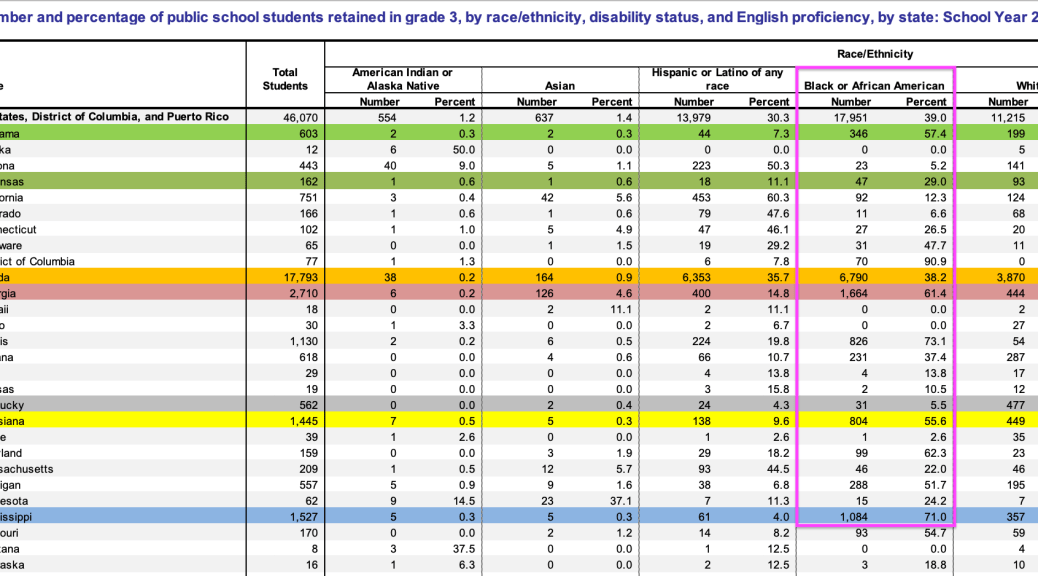
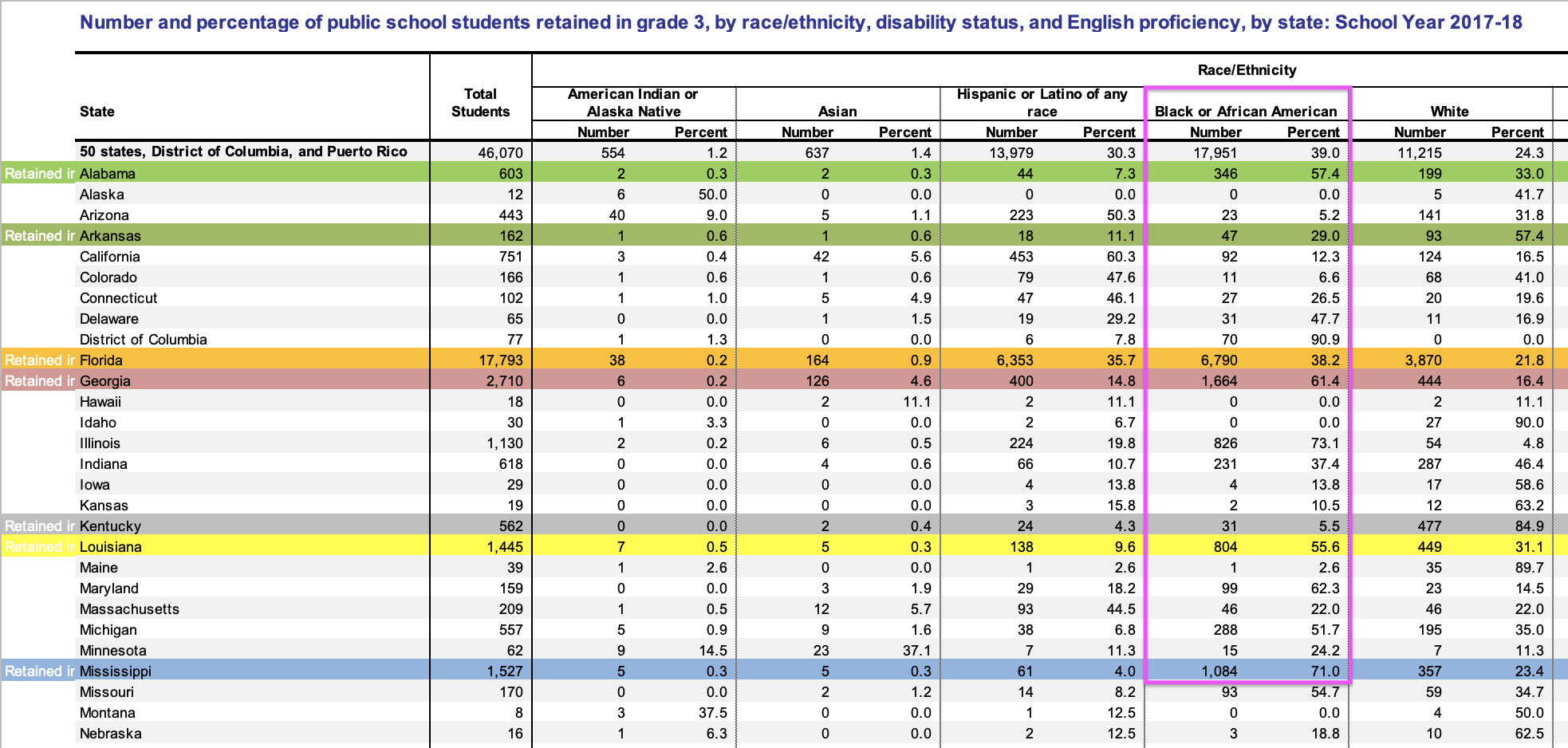
Here are some of the ugly numbers concerning grade retention and its disproportionate impact on Black students:

The short response to all this must be that grade retention is gaming the system and it is harmful to children, disproportionately harmful to Black, brown, and poor children.

Open Letter to Teachers of Young Children: Dr. Diane Stephens

Open Letter to Teachers of Young Children

Dr. Diane Stephens

June 23, 2023

I have become increasingly concerned about states (and, in the past, the federal government) making decisions/passing laws about the practices associated with teaching reading and writing. I believe that teachers should step up and assert their right to be treated as professionals. To accomplish this, teachers need to

  • make a life-long commitment to broadening and deepening their knowledge base so their curricular decisions are consistently based on current peer-reviewed research which appears in top-tier reading journals, their own experiences, and their knowledge of each child in their classroom 
  • keep track of legislative bills and laws that attempt to curtail their curricular decision-making and 
  • take action (write, call, protest) so that their rights as teachers as not dictated by legislation.

In so doing, we will honor our responsibility to ensure that, in turn, children have rights as readers and writer. We are the only ones who can do this.

We need to stand up and demand that decision-makers at the local, state and national level resist what has been a long-established practice of telling one professional group, teachers, what to do while honoring the right of every other profession to establish their own standards and scientifically based practices.  

Below I have drafted a list of the rights of children as readers and writers. If you have classroom footage to go with #2, #3, #4, #5, and/or #11 and consent from parents to use that footage for educational purposes, please send the videos and copy of the consent forms and I will select one for each of those rights. Also please weigh in on your thoughts about books to name for #10. You can contact me at stephens.diane@gmail.com.

The Rights of Children as Readers and Writers 

in Pre-K, K and 1st grade Classrooms

1.  Children have the right to fall in love with books (if they haven’t already) and know that books make sense, so teachers read books to and with children (this is called an Interactive Read-Aloud).  The teacher chooses books that are easy for the children to understand. This is referred to as their Listening Comprehension.  Via Read Aloud, children also learn that Reading is a Meaning-Making Process. To see an Interactive Read Aloud in Brooke Bridges’ Kindergarten classroom, see Additional Video #2: Interactive Read-Alouds https://www.scholastic.com/content/educators/en/pro/readingrevealed.html#additionalvideos.  The password is learners.

2. Children have the right to understand how books work so teachers read large-sized versions of books which allow every child see the pages clearly and then teachers read the books to them, pointing to words as they read. This is called Interactive Shared Reading. This helps children learn that books in English are read top to bottom and right to left. This is referred to as Book Knowledge. It also helps the children understand that there is a relationship between what the teacher “says” and what is written on the page. This is often referred to as Print-to-Speech Matching.  

3.  Children have the right to understand that oral and written language can be segmented and blended so teachers teach them songs, rhymes, and word games – oral and written. This is referred to as Phonemic Awareness

4.  Children have the right to understand how language works e.g., that some sound/symbol relationships are constant. Teachers help young children learn this through alphabet cards with pictures of objects the children have brought in and pictures of each other under the first letter of their names, through songs and rhymes and large group discussion of Morning Message, and via word hunts for words that contain consistent patterns, e.g., /an/, /am/, /at/ and also for words in which two letters make the one sound like /th/, /sh/, /ch/. Children also learn about this by reading and writing. This particularly understanding is referred to as Phonics.  

5. Children have the right to understand that written language is as predictable as the oral language they hear around them, so teachers read and provide access to books that sound like the language they know. This reinforces the idea that Reading is a Meaning-Making Process and it helps children develop Fluency – the ability to read smoothly and meaningfully, in thought units. 

6. Children have the right to understand that writing (and therefore reading) are ways of communicating, so teachers encourage children to use their emergent understanding of sound/symbol relationships to write labels, letters, and books. This allows students to understand that Writing is a Meaning-Making Process. To see kindergarten teacher Brooke Bridges introduce and carry out book-making early in the third month of school, see Additional Video #9 – Creating Books with Children https://www.scholastic.com/content/educators/en/pro/readingrevealed.html#additionalvideos. The password is learners.

7. Children have the right to believe in their ability to make sense of text, so teachers provide books with which they will be successful and, as children’s skills and strategies develop, teachers ensure that those books are matched to children’s evolving strengths. This helps children develop Agency – a belief that they are capable of making sense of print.  Children without a sense of agency often stop trying and claim they do not “like” reading. These students all too often eventually drop out of school. To see kindergartners reading together in Resi Suehiro’s Kindergarten classroom, see Additional Video #1 – Buddy Reading in Kindergarten https://www.scholastic.com/content/educators/en/pro/readingrevealed.html#additionalvideos. The password is learners.

8.  Children have the right to choose books during an independent reading time.  This increases their interest in books and in their Motivation to read.  To see how Nicole Bishop helps her first graders choose books, see Additional Video #5 – Look, Think, Pass https://www.scholastic.com/content/educators/en/pro/readingrevealed.html#additionalvideos. The password is learners.

9.  Children have the right to have ample time to read because volume of reading is directly related to Reading Achievement. To see Independent Reading in Brooke Bridges’ Kindergarten classroom, see Additional Video #18 – Independent Reading in Kindergarten https://www.scholastic.com/content/educators/en/pro/readingrevealed.html#additionalvideos. Password is learners.

10.  Children have the right to have their uniqueness recognized, so their teachers provide whole group support based on the strengths and needs of the whole group, flexible small group support for children with similar strengths and one-on-one support. This means not subjecting children to one-size-fits-all instruction. This insures Authenticity of Instructional Support to each child as opposed to fidelity to a program that may help only a few children.

To get an idea of the diversity of one kindergarten classroom in which there seems to be little ethnic diversity, listen to this intro by Brooke Bridges about the characteristics of her students during academic year 2018-2019:  https://drive.google.com/file/d/1FyZpkm4tAg8glex7khLzPnK5U_VYY8Rs/view?usp=sharing.

To see how Ms. Bridges responses to children vary (a) during independent reading, see Additional Video #18 – Independent Reading in Kindergarten https://www.scholastic.com/content/educators/en/pro/readingrevealed.html#additionalvideos and (b) during independent writing,  see Additional Video #9 – Creating Books with Children https://www.scholastic.com/content/educators/en/pro/readingrevealed.html#additionalvideos

Both of these videos show how she supports children based on her knowledge of them. 

The password for the last two videos is learners.

11. Children have the right to learn problem-solving skills and strategies to figure out unfamiliar words, see, for example, Scanlon and Anderson’s (2010) Interactive Strategies List (below).  This fosters Reading Independence

    Interactive Strategies:

  • Check the pictures
  • Think about the sounds in the word 
  • Think of words that might make sense 
  • Look for word families or other parts you know 
  • Read past the puzzling word
  • Go back to the beginning of the sentence and start again
  • Try different pronunciations of some of the letters, particularly the vowels. 
  • Break the word into smaller parts 

It would be great if legislators (and some publishers of reading materials for pre-K to 3), already understood that they should be stepping back from mandating or selling curriculum to teachers – that they should instead be encouraging teachers to make their own informed curricular decisions and to choose materials based on their knowledge of the broad field of research on reading and writing and on their knowledge of children in their classrooms. 

But that’s not going to happen spontaneously. It is only going to happen if informed teachers get themselves involved in the decision-making process by writing letters, making phone calls, and scheduling appointments with decision-makers.

I realize that taking political action is not comfortable. If it helps just think of it as having a conversation (through the mail, on the phone, in an office) with someone who does not yet know enough about teaching reading and writing. 

Think of legislators as learners who need our help.

It is our responsibility to ensure that children have the at least the eleven rights outlined in this letter. If a law limiting these rights has already been passed in your state, learn the process for submitting amendments and propose them. If a bill is in process (see, for example South Carolina Senate Bill 518), write, call, visit your legislator and the members of the House and Senate Education Committees. And be sure to be in contact with the legislative aide for both Committees. Those individuals are lawyers who put pen to paper. And, in my experience, they really listen. 

Please, step up for your rights as professionals and for the rights of the children you serve.  If enough of us stand up, there is no limit to how much we can improve our own lives and the lives of children.

Thanks.

Diane Stephens, Ph.D. 

Distinguished Professor Emerita

John E. Swearingen, Sr. Professor Emerita in Education

University of South Carolina                      

Reference

D.M. Scanlon and K.L. Anderson (2010). “Using the Interactive Strategies Approach to Prevent Reading Difficulties in an RTI Context” (p. 49). In M.Y. Lipson and K.K. Wixson (Eds.), Successful Approaches to RTI: Collaborative Practices for Improving K–12 Literacy, Newark, DE: International Reading Association.

NAEP LTT 2023: A Different Story about Reading

“The Nation’s Report Card” has released NAEP Long-Term Trend Assessment Results: Reading and Mathematics for 2023.

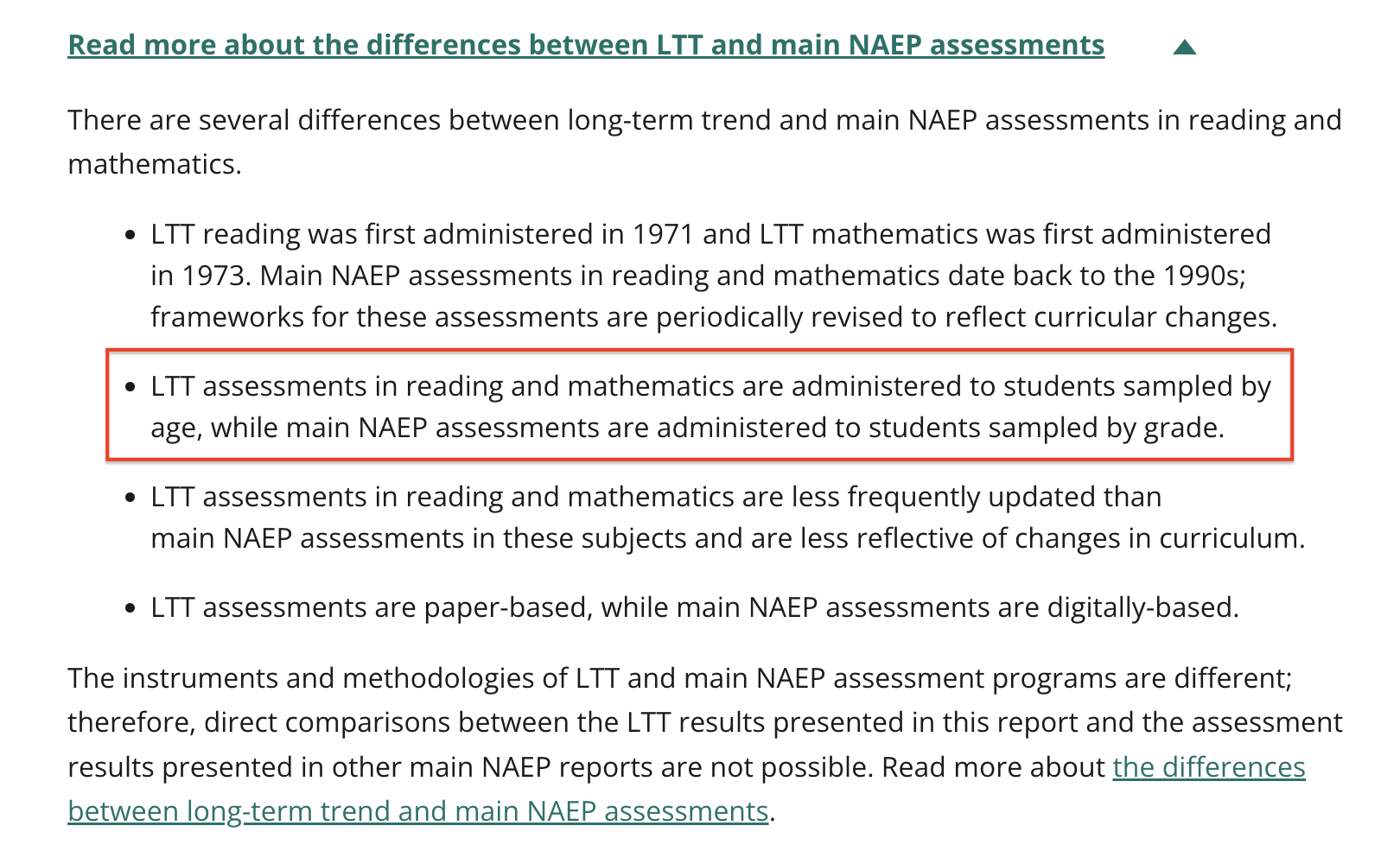
The LTT is different than regularly reported NAEP testing, as explained here:

As I will highlight below, it is important to emphasize LTT is age-based and NAEP is grade-based.

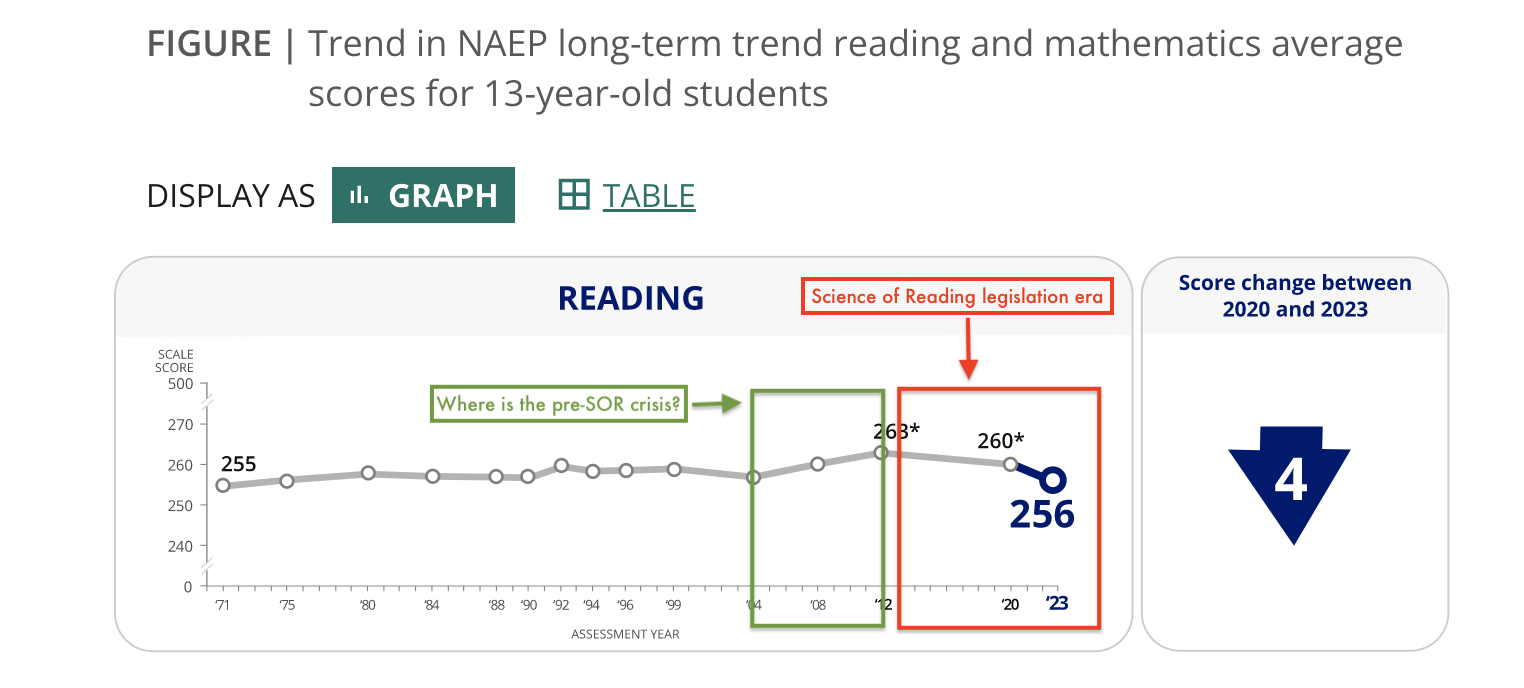
LTT assesses reading for 13-year-old students, and by 2023, these students have experienced school solidly in the “science of reading” (SOR)-legislation era, which can be traced to 2013 (30+ states enacting SOR legislation and growing to almost every state within the last couple years [1]).

Being age-based (and not impacted by grade retention), the trends tell a much different story than the popular and misleading SOR movement.

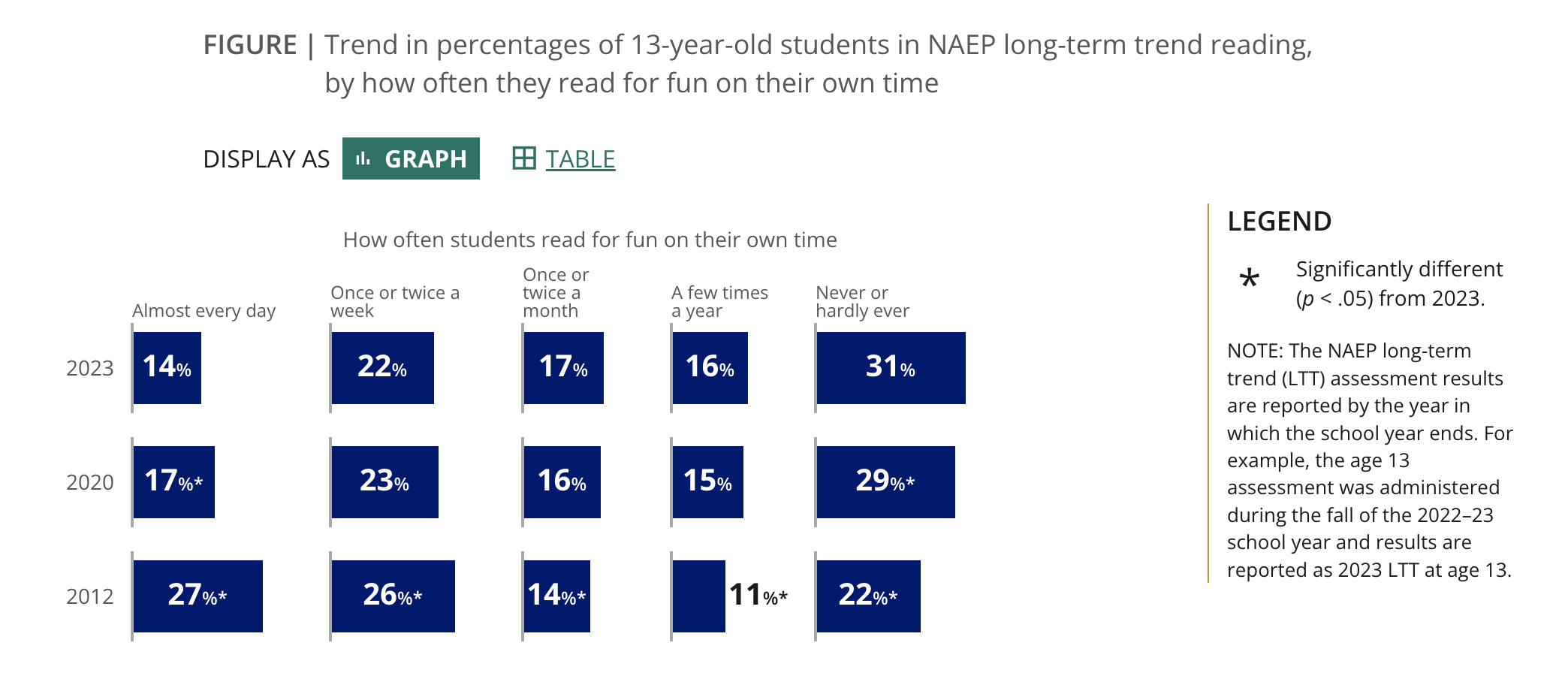
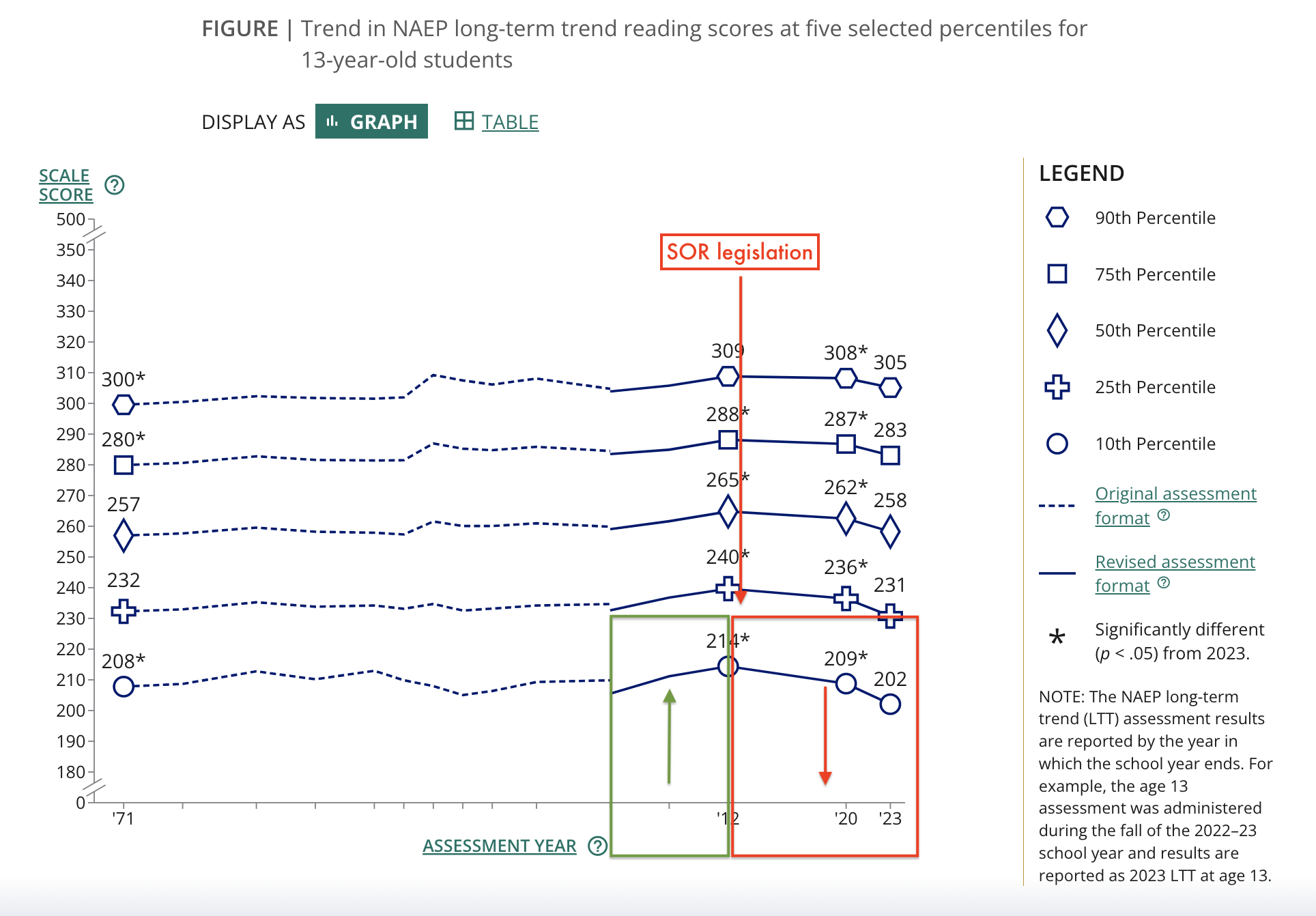
Consider the following [2]:

Here is the different story:

  • There is no reading crisis.
  • Test-based gains in grades 3 and 4 are likely mirages, grounded in harmful policies and practices such as grade retention.
  • Age 13 students were improving at every percentile when media and politicians began crying “crisis,” but have declined in SOR era, notably the lowest performing students declining the most.
  • Reading for fun and by choice have declined significantly in the SOR era (a serious concern since reading by choice is strongly supported by research as key for literacy growth).

Here are suggested readings reinforced by the LTT data:

The US has been sold a story about reading that is false, but it drives media clicks, sells reading programs and materials, and serves the rhetorical needs of political leaders.

Students, on the other hand, pay the price for false stories.


[1] Documenting SOR/grade-three-intensive reading legislation, connected to FL as early as 2002, but commonly associated with 2013 as rise of SOR-labeled legislation (notably in MS):

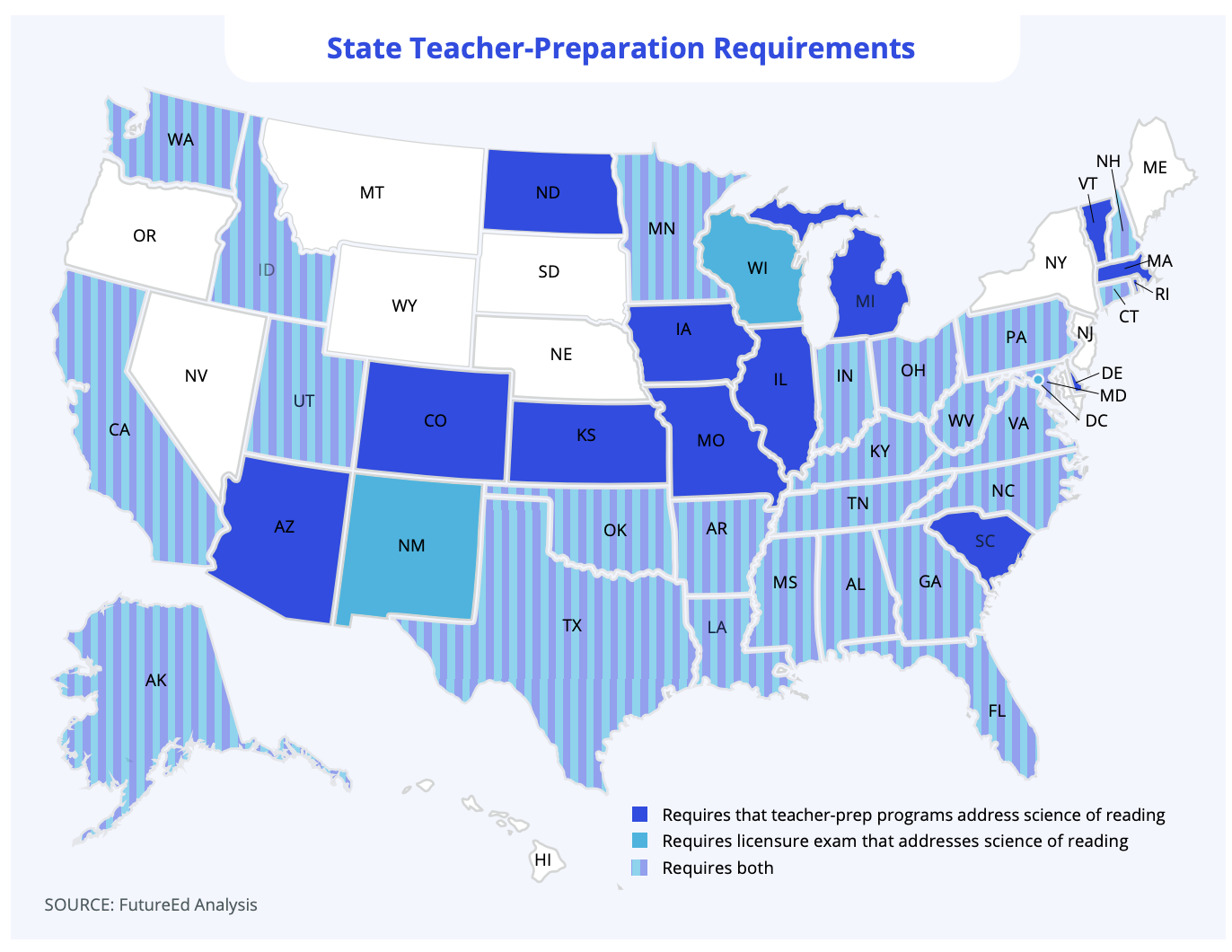
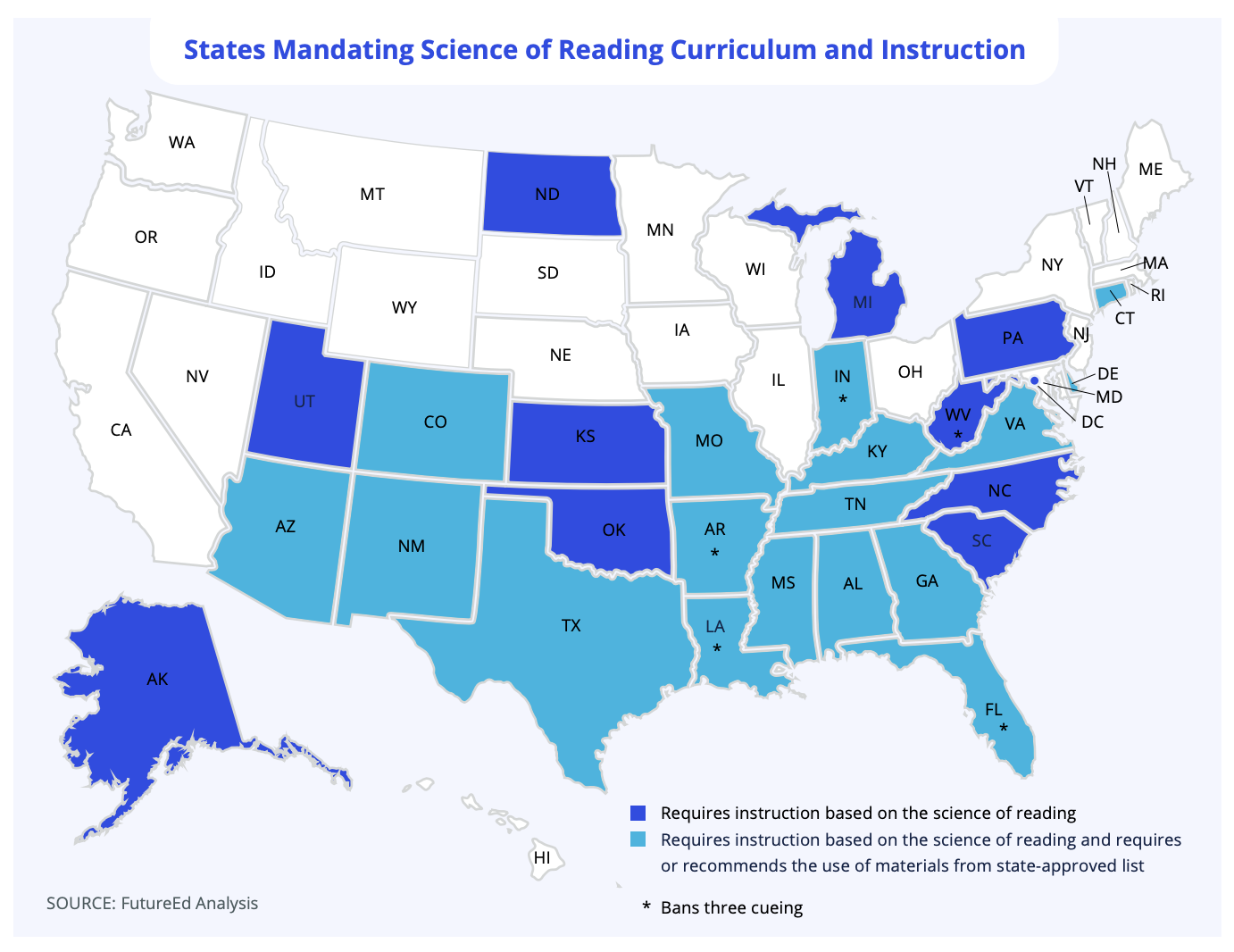
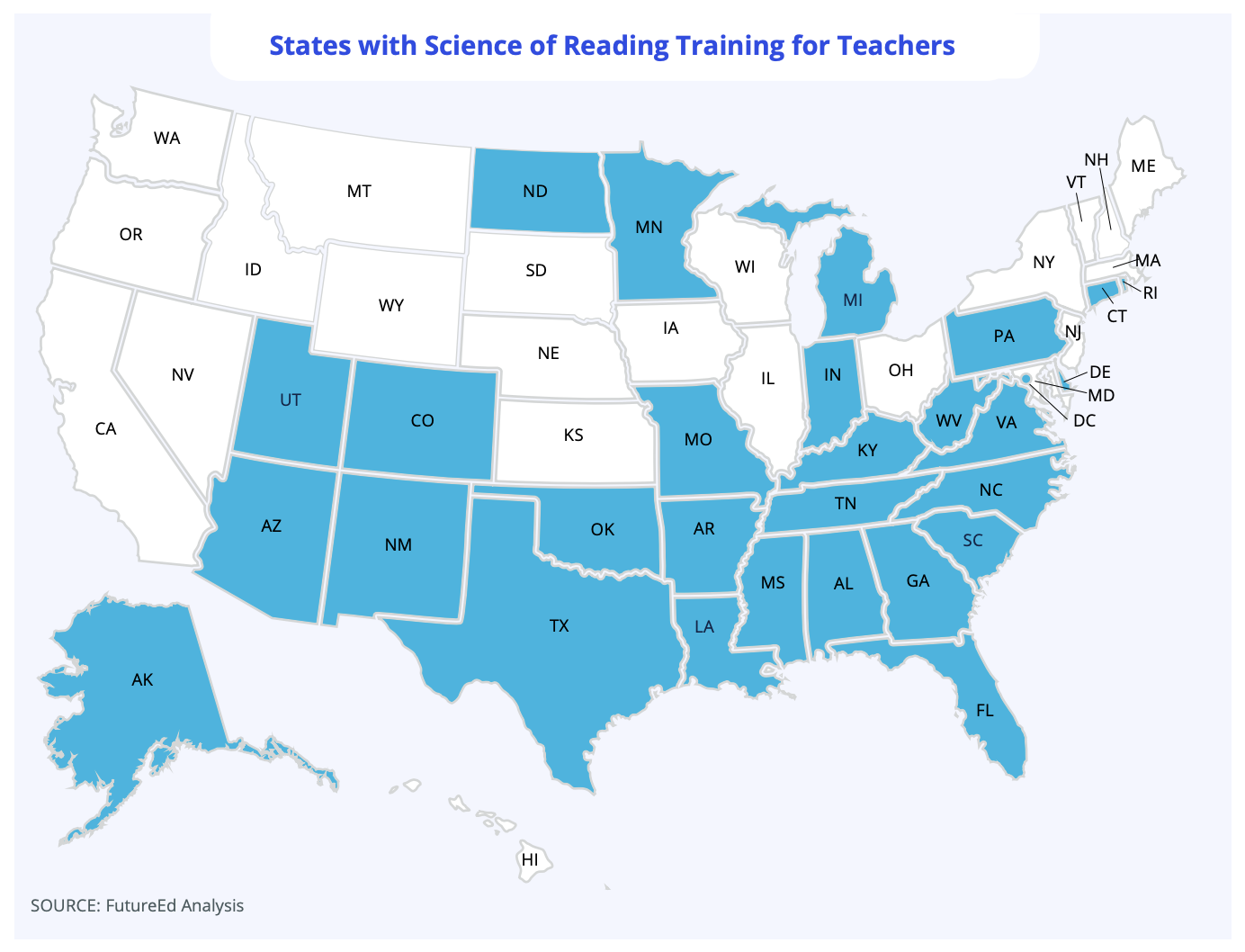
Olson, L. (2023, June). The reading revolution: How states are scaling literacy reform. FutureEd. Retrieved June 22, 2023, from https://www.future-ed.org/teaching-children-to-read-one-state-at-a-time/

Cummings, A. (2021). Making early literacy policy work in Kentucky: Three considerations for policymakers on the “Read to Succeed” act. Boulder, CO: National Education PolicyCenter. Retrieved May 18, 2022, from https://nepc.colorado.edu/publication/literacy

Cummings, A., Strunk, K.O., & De Voto, C. (2021). “A lot of states were doing it”: The development of Michigan’s Read by Grade Three law. Journal of Educational Change. Retrieved April 28, 2022, from https://link.springer.com/article/10.1007/s10833-021-09438-y

Collet, V.S., Penaflorida, J., French, S., Allred, J., Greiner, A., & Chen, J. (2021). Red flags, red herrings, and common ground: An expert study in response to state reading policy. Educational Considerations, 47(1). Retrieved July 26, 2022, from https://doi.org/10.4148/0146-9282.2241

Reinking, D., Hruby, G.G., & Risko, V.J. (2023). Legislating phonics: Settle science of political polemic? Teachers College Record. https://doi.org/10.1177/01614681231155688

Schwartz, S. (2022, July 20). Which states have passed “science of reading” laws? What’s in them? Education Week. Retrieved July 25, 2022, from https://www.edweek.org/teaching-learning/which-states-have-passed- science-of-reading-laws-whats-in-them/2022/07

Thomas, P.L. (2022). The Science of Reading movement: The never-ending debate and the need for a different approach to reading instruction. Boulder, CO: National Education Policy Center. http://nepc.colorado.edu/publication/science-of-reading

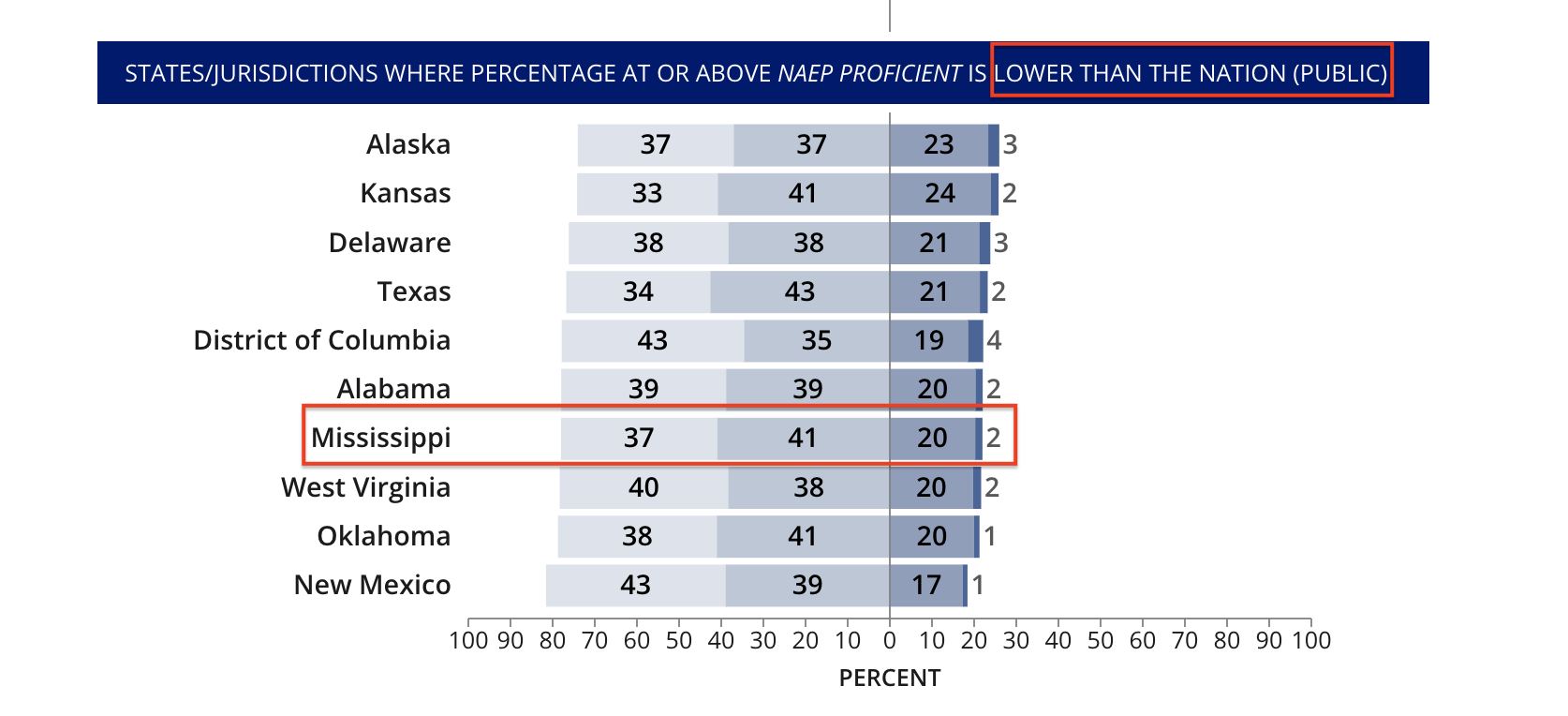
[2] Despite claims of a “miracle” MS grade 8 NAEP in reading remains at the bottom after a decade of SOR legislation:

Open Letter to the Biden Administration, USDOE, and Secretary of Education Miguel Cardona

Reporting for NPR in 2018 about A Nation at Risk, Anya Kamenetz noted:

When it appeared in April 1983, the report received widespread coverage on radio and TV. President Reagan joined the co-authors in a series of public hearings around the country.

The report’s narrative of failing schools — students being out-competed internationally and declining educational standards — persists, and has become an entrenched part of the debate over education in the U.S.

What ‘A Nation At Risk’ Got Wrong, And Right, About U.S. Schools

In 2023, writing for The Answer Sheet in The Washington Post, James Harvey explains that the report under Reagan was “gaslighting” for political purposes, and not the clarion call to address education reform that media, the public, and political leaders claimed.

In short, A Nation at Risk was a “manufactured crisis.”

Yet, education reform has become a central part of the political process for governors and presidents since the 1980s, reaching a critical peak under George W. Bush who turned the discredited “Texas Miracle” into groundbreaking and bipartisan federal legislation, No Child Left Behind (NCLB).

In fact, public education in the US has been under an intense public and political microscope for forty years of high-stakes accountability. For educators, that accountability is indistinguishable regardless of the political party in the White House.

The Obama administration in many ways continued and even doubled-down on the crisis/miracle rhetoric found under W. Bush.

At the core of education crisis/miracle rhetoric has been the use and misuse of standardized test data.

For many decades, the media and public fretted over public education based on SAT data (and then ACT data), which represents the central issue of misunderstanding test scores (the College Board warns of not ranking states by SAT averages, yet the media persists) and misusing test data (SAT/ACT tests are designed to predict college success, not evaluate the quality of public education).

With the decrease in the influence of SAT/ACT testing, however, the media, public, and political leaders have focused more on National Assessment of Educational Progress (NAEP) data.

Since 2019, there have been NAEP-inspired claims of educational crisis based on 2019 reading scores, 2022 math scores, and 2022 history/civics scores.

As one powerful example, high-profile media, The New York Times, and journalist, Nicholas Kristof, proclaim:

One of the most bearish statistics for the future of the United States is this: Two-thirds of fourth graders in the United States are not proficient in reading.

Two-Thirds of Kids Struggle to Read, and We Know How to Fix It

However, despite warnings from 2016, Tom loveless explains:

In February, 2023 Bari Weiss produced a podcast, “Why 65% of Fourth Graders Can’t Really Read” and Nicholas Kristof, New York Times columnist, wrote “Two-Thirds of Kids Struggle to Read, and We Know How to Fix It.” Both headlines are misleading. The 65% and two-thirds figures are referring to the percentage of 4th graders who scored below proficient on the last reading test of the National Assessment of Educational Progress (NAEP)administered in 2022.

The problem is this: scoring below proficient doesn’t mean “can’t really read” or “struggling to read.”   It also does not mean “functionally illiterate” or identify “non- readers” as some of the more vituperative descriptions on social media have claimed. It doesn’t even mean “below grade level in reading,” one of the milder distortions.

Literacy and NAEP Proficient

Further,  scholars Reinking, Hruby and Risko (2023), in fact, assert: “[T]here is no indisputable evidence of a national crisis in reading, and even if there were a crisis, there is no evidence that the amount of phonics in classrooms is necessarily the cause or the solution.”

Two problems currently exist with the stories being told about schools and the education reform movement—the data do not support claims of “crisis” and NAEP perpetuates the “crisis” myth by design.

Touted as the “Nation’s Report Card,” NAEP developed achievement levels that were designed to hold states accountable for having high standards, and as a result, “proficiency” on NAEP is “aspirational” but not representative of “grade-level proficiency.”

The US is now mired in decades of punitive education legislation (standards and high-stakes testing as well as third-grade retention and VAM-based teacher evaluation) that has not worked because the central claim of “crisis” is simply not supported by the evidence.

Especially in the wake of the devastating impact of Covid on public education, students, and teachers, the Biden Administration has the historic opportunity to change direction in US public education reform.

This open letter, then, is an urgent call to do the following:

  • Acknowledge and reject the false narratives of manufactured public education “crises” and media-created education “miracles.”
  • Declare accountability-based, punitive reform a failure—despite good intentions—and call for equity-based, supportive reform that forefronts the impact of systemic forces outside and inside our public schools.
  • Reform dramatically NAEP testing so that test data better supports learning and instruction instead of driving a false story of education crisis (for example, reform the use of NAEP “proficiency” to represent “age-level proficiency”).

US public education has a long and inexcusable history of political negligence in terms of supporting the most vulnerable children in our society; that includes negligence of vulnerable students in our public education system.

Our children and the country deserve robust and substantive education reform, not false stories of failure and misguided blame and punishment.

Regretfully, the last forty years have been a perpetual cycle of manufactured crisis and punitive policy.

The Biden Administration—notably a rhetorical “friend” of education embodied by Dr. Jill Biden—can and should chose a different story about our schools, our students, and our teachers.

As celebrated author James Baldwin urged: “The challenge is in the moment, the time is always now.”