Category Archives: education

Understanding Critical Race Theory: A Reader for Educators

[Note: Access a PP of this material and more HERE]

Update 22 February 2022: What is critical race theory?

UPDATE: Understanding the Attacks on Critical Race Theory (NEPC)

While Republicans continue to claim the U.S. “is not a racist country” and passing legislation directly and indirectly banning critical race theory (CRT) and the 1619 project, the recent comments by former VP Mike Pence capture the real message behind these events:

For Republicans and conservatives who reject systemic racism as a “left-wing myth,” there remains a significant challenge: How can we explain the tremendous racial gaps (see below) that exist in the U.S. between Black and white Americans?

These attacks are directly effecting K-12 and higher education; therefore, educators must be well informed about these issues. Here are valuable resources for understanding CRT, the 1619 Project, and systemic racism:

Critical Race Theory

Why Critical Race Theory (CRT) is Controversial
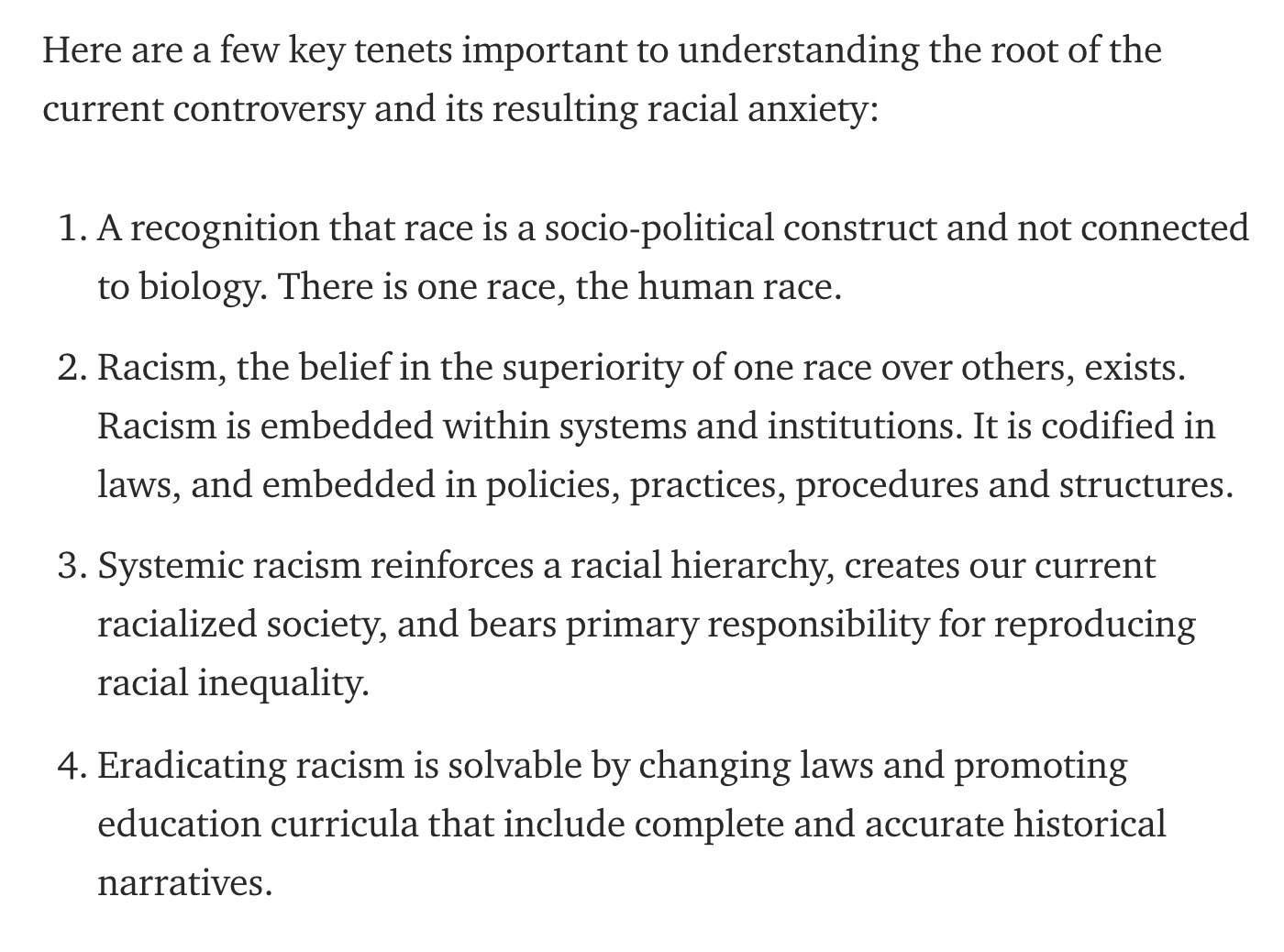
A Lesson on Critical Race Theory

Perspective | Trump calls critical race theory ‘un-American.’ Let’s review.

Critical Race Theory

74 Interview: Researcher Gloria Ladson-Billings on Culturally Relevant Teaching, the Role of Teachers in Trump’s America & Lessons From Her Two Decades in Education Research

But That’s Just Good Teaching! The Case for Culturally Relevant Pedagogy, Gloria Ladson-Billings

Academic Who Brought Critical Race Theory To Education Says Bills Are Misguided

Code of Conduct: A Guide to Responsive Discipline

OPINION: Using critical race theory to understand the backlash against it

The Conspicuous Absence of Derrick Bell—Rethinking the CRT Debate, Part 1

What’s Really Behind the 1619 Backlash? An Interview With Nikole Hannah-Jones and Ta-Nehisi Coates

Watch “Critical Race Theory & Culturally Responsive Teaching: An Open Conversation About What the Right Gets Wrong” on #Vimeo

What Critical Race Theory Is, and What It Means for Teachers

Critical Race Theory: A Brief History

Critical Race Theory: What It Is. And What It Is Not. A Q&A with Adrienne Dixson (NEPC)

Busting Anti-Racist Education Myths, Rick Wormeli

The 1619 Project

1619 Project

What History Professors Really Think About ‘The 1619 Project’

Systemic Racism

7 Ways We Know Systemic Racism Is Real

Rate of fatal police shootings in the United States from 2015 to May 2021, by ethnicity

Risk of being killed by police use of force in the United States by age, race–ethnicity, and sex

The Essence of Innocence: Consequences of Dehumanizing Black Children

The social category “children” defines a group of individuals who are perceived to be distinct, with essential characteristics including innocence and the need for protection (Haslam, Rothschild, & Ernst, 2000). The present research examined whether Black boys are given the protections of childhood equally to their peers. We tested 3 hypotheses: (a) that Black boys are seen as less “childlike” than their White peers, (b) that the characteristics associated with childhood will be applied less when thinking specifically about Black boys relative to White boys, and (c) that these trends would be exacerbated in contexts where Black males are dehumanized by associating them (implicitly) with apes (Goff, Eberhardt, Williams, & Jackson, 2008). We expected, derivative of these 3 principal hypotheses, that individuals would perceive Black boys as being more responsible for their actions and as being more appropriate targets for police violence. We find support for these hypotheses across 4 studies using laboratory, field, and translational (mixed laboratory/field) methods. We find converging evidence that Black boys are seen as older and less innocent and that they prompt a less essential conception of childhood than do their White same-age peers. Further, our findings demonstrate that the Black/ape association predicted actual racial disparities in police violence toward children. These data represent the first attitude/behavior matching of its kind in a policing context. Taken together, this research suggests that dehumanization is a uniquely dangerous intergroup attitude, that intergroup perception of children is underexplored, and that both topics should be research priorities.

Journal of Personality and Social Psychology, 2014, Vol. 106, No. 4, 526 –545

Characteristics of Public School Teachers

Figure 2. Percentage distribution of teachers in public elementary and secondary schools, by race/ethnicity: School years 1999–2000 and 2017–18

The Civil Rights Project: School Discipline

Stop the School-to-Prison Pipeline

When the Best isn’t Good Enough: The Racial Representation Gap in Education

Discretion and Disproportionality: Explaining the Underrepresentation of High-Achieving Students of Color in Gifted Programs

Students of color are underrepresented in gifted programs relative to White students, but the reasons for this underrepresentation are poorly understood. We investigate the predictors of gifted assignment using nationally representative, longitudinal data on elementary students. We document that even among students with high standardized test scores, Black students are less likely to be assigned to gifted services in both math and reading, a pattern that persists when controlling for other background factors, such as health and socioeconomic status, and characteristics of classrooms and schools. We then investigate the role of teacher discretion, leveraging research from political science suggesting that clients of government services from traditionally underrepresented groups benefit from diversity in the providers of those services, including teachers. Even after conditioning on test scores and other factors, Black students indeed are referred to gifted programs, particularly in reading, at significantly lower rates when taught by non-Black teachers, a concerning result given the relatively low incidence of assignment to own-race teachers among Black students.

https://doi.org/10.1177/2332858415622175

What We Get Wrong About Closing the Racial Wealth Gap

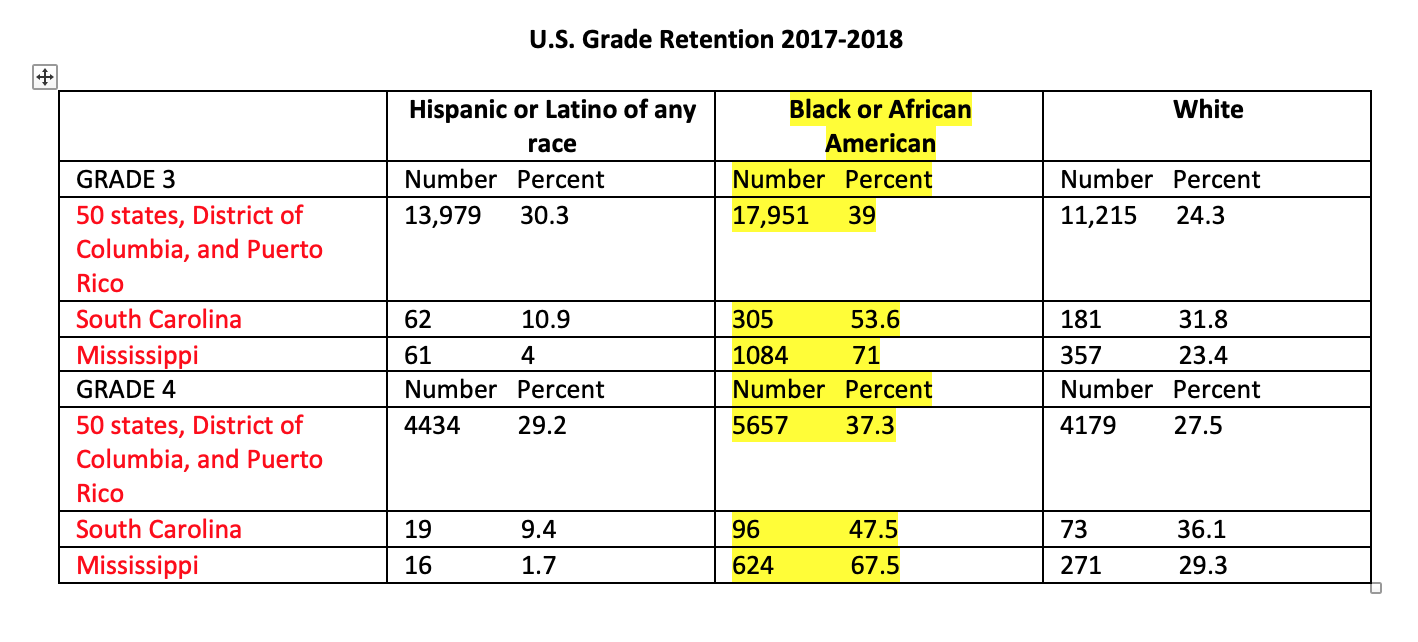
Grade Retention and Expulsions/Suspensions: Black students disproportionately retained (grades 3 and 4) and expelled (USDOE/Office of Civil Rights) – Data 2017-2018
Schools, black children, and corporal punishment

Racial disparities in school-based disciplinary actions are associated with county-level rates of racial bias

There are substantial gaps in educational outcomes between black and white students in the United States. Recently, increased attention has focused on differences in the rates at which black and white students are disciplined, finding that black students are more likely to be seen as problematic and more likely to be punished than white students are for the same offense. Although these disparities suggest that racial biases are a contributor, no previous research has shown associations with psychological measurements of bias and disciplinary outcomes. We show that county-level estimates of racial bias, as measured using data from approximately 1.6 million visitors to the Project Implicit website, are associated with racial disciplinary disparities across approximately 96,000 schools in the United States, covering around 32 million white and black students. These associations do not extend to sexuality biases, showing the specificity of the effect. These findings suggest that acknowledging that racial biases and racial disparities in education go hand-in-hand may be an important step in resolving both of these social ills.

https://doi.org/10.1073/pnas.1808307116

Re-Imagining School Discipline: A Plea To Education Leaders

How Non-Zero Tolerance Policies Better Support Our Students: Part II
Should South Carolina Ban Critical Race Theory and the 1619 Project?

[UPDATE: See published version here: MY TURN: Should South Carolina cancel Critical Race Theory?]

“In total, lawmakers in at least 15 states have introduced bills that seek to restrict how teachers can discuss racism, sexism, and other social issues,” reports Sarah Schwartz for Education Week.

South Carolina (H630) has joined Republicans across the U.S. challenging Critical Race Theory (CRT) and the 1619 Project.

The key problem with this copycat legislation is CRT isn’t implemented in K-12 education and the 1619 Project is not adopted curriculum.

CRT is rare in higher education, reserved for some graduate programs (specifically among legal scholars), but CRT provides a way to examine systemic racism, not simply the actions of individual racists.

For example, CRT is an academic process for trying to understand why police kill Black people disproportionately to white people. According to CRT, the killing of Tamir Rice is rooted in systemic racism (viewing Black boys as older than their biological age) that does not require the officer being consciously a racist individual.

Ultimately, legislation aimed at CRT or the 1619 Project is misleading, a threat to academic freedom and the education of students in SC. As Eesha Pendharker reports in Education Week: “[E]xperts say the laws ultimately will unravel years of administrators’ fitful efforts to improve educational opportunities and academic outcomes for America’s children of color, who today make up the majority of the nation’s student body.”

What, then, is occurring in SC K-12 education in terms of race and racism?

  • Diversity, equity, and inclusion (DEI) training that covers implicit bias, systemic racism and racial privilege, and microaggressions. This training is now common for educators and students, but worth monitoring because DEI training is often not effective and can serve as superficial distractions allowing schools to avoid harder diversity work.
  • Diversifying faculty and the curriculum. Public school teachers are about 80% white, less diverse than society and the population of students in public schooling (increasingly Black and brown). Also, for many years, a greater representation of Black and brown voices and history have been included in what students are taught (typically in English/ELA and history/social studies). Diversifying the curriculum has prompted controversial legislation by Republicans, however.
  • Implementing culturally relevant teaching. The work of Gloria Ladson-Billings has gained momentum in K-12 education. Culturally relevant teaching, as she defines it, is “a threefold approach to ensuring that all children are successful. That approach requires a focus on students’ learning, an attempt to develop their cultural competence, and to increase their sociopolitical or critical consciousness.” This focus seeks to honor all children while acknowledging that differences remain among students by race, gender, culture, etc.
  • Adopting responsive discipline. Decades of research have revealed racially inequitable discipline in schools, popularly known as the school-to-prison pipeline. Many schools have begun to reconsider inequitable practices such as zero-tolerance policies and expulsion/suspension, for example.
  • Expanding educational access and improving educational quality for children of color. Black and brown students are under-represented in advanced programs (such as Advanced Placement and gifted programs), and often are taught by teachers with the least experience, who are under-/un-certified, and sit in classrooms with the highest student/teacher ratios. Public schools are not the “great equalizers” politicians claim, and often reflect and perpetuate inequity.

State legislation and the Superintendent of Education targeting CRT and the 1619 Project is political theater, a solution in search of a problem. Race and racism remain a significant part of life as well as education in SC. Republicans are poised to ruin the very good and needed, but incomplete, work identified above.

It is critical that teachers and students are free to examine the truth of our past and our present so that we can create the future we believe is possible.

Understanding the Conservative Backlash against Critical Race Theory (and Diversity, Equity, and Inclusion Initiatives)

I was recently asked on Twitter if there can be any valid criticisms of Critical Race Theory (CRT), and that question was couched in a belief that everyone challenging CRT was being broadly (and unfairly) painted as racists.

In my own posts about CRT, I have in fact noted that a foundational part of anything “critical” is the essential and perpetual challenging of assumptions; the paradox of CRT and critical pedagogy is that to be critical one must continually step back to challenge the very thing being used to interrogate the world.

Simply put, CRT scholars are as apt to reconsider CRT as anything and everything else. Those of us working under the mantle “critical” are vigilant about identifying and avoiding indoctrination—or else we are not being critical.

However, since I have repeatedly noted the CRT is essentially non-existent in K-12 public education and extremely rare in higher education (mostly at the fringes of some graduate programs such as law, education, and sociology), I pushed against the question by asking for specific examples of CRT being misused, and thus deserving criticism.

What followed confirmed part of what I expected but also something I could not have predicted: CRT is under attack in expensive private schools, specifically in New York.

The example shared with me focuses on one parent whose charges about the misuse of CRT has gone viral.

First, let me stress that I still have had no one prove that CRT is common or even present in how K-12 public school students are taught (more about this below), but this example is fraught with problems since all I can find is conservative sensationalistic media covering what parents are claiming their children have told them.

Next, these examples of backlash in very expensive private schools does prove one of my point offered in another post: people take personal and individual offense when systems are challenged.

From the New York Post, for example, consider this:

“First and foremost, neither I, nor my child, have ‘white privilege,’ nor do we need to apologize for it,” Goldman wrote last September. “Suggesting I do is insulting. Suggesting to my 9-year-old child she does is child abuse, not education.”

Inside the growing underground network of parents fighting ‘anti-racism’ in NYC schools

Using this private-school based backlash as a basis, then, let’s unpack what is going on in order to understand the conservative perspective of CRT.

The most important aspect of trying to understand this controversy is recognizing that the challenges to CRT are not about CRT specifically (since CRT is a theoretical lens and not a program—and since CRT simply doesn’t exist in K-12 schooling). Conservatives are misusing the term “CRT” as a marker for any and all diversity, equity, and inclusion (DEI) initiatives or any and all lessons addressing race and racism in schools.

However, a central tenet of CRT proposes that racism in the U.S. is systemic, built into many (if not most) laws, policies, and unconscious behaviors of everyone in the country.

Here is the great irony of the attack on CRT: Since racism is systemic (built into the system), anti-racism practices are designed to reform those systems (not to attack individual people), and as I noted in a previous post, for example about Tamir Rice, “A police officer shooting and killing a Black boy, then, does not have to be a consciously racist individual to have acted in a way that is driven by systemic racism.”

Two components of anti-racism efforts trigger conservatives—asserting the fact of systemic racism and acknowledging the reality of white privilege (see the parent’s comment above).

Again, conservatives see these assertions as blaming and condemning them personally and all white people broadly.

Setting aside that DEI programs and teaching about race/racism often are not directly driven by CRT, in order to understand the conservative backlash against CRT, we must unpack the concept of “blame” in terms of racism and white privilege.

In 2021, systemic inequity based on race (and gender) are incredibly hard to refute. White people earn more than Black people even when they have the same level of education, do the same work; this holds true for the pay gap between men and women.

Using the lens of CRT, we can conclude from those race gaps that systemic racism impacts human behaviors even when individuals are not actively or consciously racist; again, this actually alleviates automatic individual blame for a racist society.

At the core of this backlash is that conservatives view simply acknowledging systemic racism and white privilege as a direct attack on the fact of “whiteness”; to conservatives DEI initiatives and teaching about race and racism feel like a personal assault on their identity and not their behavior.

Conservatives in the U.S. are strongly individualistic so much of this tension is grounded in the conservative belief in individualism and rejecting of collectivism (systemic forces).

This explains the parent above adamantly proclaiming that he and his child do not have white privilege and his adding, “we [don’t] need to apologize for [being white].”

Further, this also explains why Republicans are successful when they proclaim the U.S. is not a racist country, despite the overwhelming evidence of racial inequity.

Finally, then, we must confront the problem of blame and culpability, which I think falls into these broad categories:

  • Individual racists. Some people in the U.S. are genuinely and openly racist, and of course, they actively perpetuate systemic racism and deserve blame, and condemnation.
  • Racism/white privilege deniers. As demonstrated in the NYP article above, some people strongly reject that systemic racism and white privilege exist; they are likely to believe that the U.S. is a meritocracy and that success/failure are rooted in individual effort and capacity. In other words, they believe rich people deserve to be rich and poor people deserve to be poor. Many of these people genuinely believe they are not racist and freely espouse that no one race is superior to the other; however, since the data overwhelming show racial inequities in terms of success and failure in the U.S., this position implies patterns of stereotypes (racism and sexism) that are hard to ignore (i.e., Black people and poor people are lazy). Racism and white privilege denial perpetuates racism, and thus, that denial (not simply being white) deserves blame.
  • People who are “color blind” MLK “race neutralists.” NRP has reported that “[n]early half of the speakers at the Republican news conference in May invoked Martin Luther King Jr., expressing their desire to be judged ‘by the content of their character, not the color of their skin.'” It is common to hear among people who reject CRT/DEI that they “do not see race.” While this is a compelling argument, especially when paired with the MLK quote oversimplified and taken out of context, race neutrality is another form of racism denial that perpetuates racism. The problem is not seeing race, but having negative (and racist) responses to acknowledging race. The irony here is that King was clearly speaking to conservative American values (“content of their character” is the language of rugged individualism and meritocracy), but its rhetorical value can be oversimplified and, as the current climate proves, manipulated for the exact opposite effect King intended. Race neutrality (not simply being white) also deserves blame.
  • People who act on their awareness of systemic racism/white privilege. The goal of teaching about race and racism as well as DEI programs is to create the very meritocracy conservatives already believe the U.S. has attained. These lessons and programs are designed to raise awareness about how to behave differently, how to contribute to bringing an end to inequity (racism and white privilege). What is required, I suspect, is empathy, a willingness to listen to other people’s experiences and value them as much as your own. Conservatives often express a contradictory rugged individualism that inhibits that empathy, especially when confronted with concepts such as micro-aggressions. “X doesn’t bother me so I don’t see why X would bother anyone else,” they exclaim. For those who are willing to listen and then willing to act (even when they are white), they have found the road to not being blamed. And another irony because this isn’t about the color of your skin, but about the content of your character and your individual behavior.

CRT is not the problem, but it has become a powerful code for conservatives who are nearly permanently inward looking, unable to hear and see the very systemic problems that CRT helps us identify in order to change.

CRT and DEI programs can, of course, be misused, and then, would deserve criticism. But that isn’t what is in front of us or the parents at elite private schools.

The problem is us even though it isn’t every single one of us.

Unpacking Nonsense: Knowledge as Commodity

Make your money with a suit and tie
Make your money with shrewd denial
Make your money expert advice…
You can lie
As long as you mean it

“King of Comedy,” R.E.M.

The school choice debate, reaching back into the twentieth century, tends to be framed around either/or concepts such as the free market (the Invisible Hand) versus public institutions (the Commons). But school choice that pits universal public education against private schools, charter schools, and homeschooling (as well as unschooling) is at its core a debate about the autonomy and humanity of children and teens along with a rarely interrogated idealism about parents and parental choice.

The U.S. has a long history of struggling badly with childhood and exactly when a human is an autonomous adult—from child labor to the garbled array of ages at which teens and young adults are allowed to behave as full adults (15-16 for driving, 18 for voting and joining the military, 21 for alcohol, and dozens of conflicting ages and laws across the country governing sexual autonomy, etc.).

If anyone clings to the foundational commitment to universal public education (often associated with the arguments posed by Thomas Jefferson) as necessary for creating and preserving a democracy, a so-called free people, then we must admit that a public education grounded in knowledge that is critically interrogated must be preserved against the forces of indoctrination.

Education is about asking, What do we know? How do we know it? And who does this knowledge benefit (or leave out)?

This final point is one of the tensions with religious education or church-grounded schools. I have taught in a graduate program that included teachers from a nearby Christian school where every lesson taught had to be linked directly to passages from the Bible.

Regardless of your faith or lack thereof, this is a necessarily distorted education—one that is being presented to children and teens as facts or t/Truth.

I have taught many students at my university, also, who came from religious schooling and noted that they had never been taught evolution (for example) or, when we covered evolution in my foundations course, they explained that their education had presented the scientific concept significantly differently than what we examined.

Whether we call what students learn in school “knowledge” or “content” or “curriculum,” we always must be aware that what students are taught is always chosen by someone for some reason; in other words, there is no politically, ethically, or intellectually neutral “knowledge.”

In fact, every classroom is by its nature of humans interacting with different levels of power a political space.

All of this lies beneath the current attack from conservatives and Republicans on Critical Race Theory (CRT) and the 1619 Project (what we teach in U.S. history).

The reasons these attacks on public schooling are relevant to the school choice debate are, as I recently noted, that all alternatives to universal public schooling (private schools, charter schools, homeschooling, and unschooling) benefit from a discredited (and demonized) public education system.

Now one of the natural consequences of the rightwing attack on schooling is waving the “For Sale” sign:

Let me note here that this isn’t parody, but a very real addition to the school choice/homeschooling movement.

Elements of this “anti-woke” version of U.S. history are stunning, although predictable.

First, Anzaldua frames herself as an early career high school history teacher, who “was not just a leftist, but a full-blown socialist, intersectional feminist, and ‘antiracist’.” She adds (seemingly unaware of the irony) that her own anti-woke wokeness can be attributed to one of the most discredited academics of our time, Jordan Peterson.

But more importantly, the course that is being advertised as “fact based history” has several supporting links that perpetuate misinformation—scary uses of red and imagery linking CRT to “communism!” and CRT resources that are simply a list of links to misinformation and more scare tactics.

From “communism” and “socialism” to “CRT” and any use of the term “critical,” conservatives are uniformly misinformed [1], and thus, all of their arguments are invalid since they start with a false premise—the most significant of which is that essentially no one in public education is teaching history/social studies from a CRT lens.

Even in higher education, CRT is rare.

Setting aside that the exact people accusing public education of being politicized by the Left are themselves politicizing the teaching of history, what is wrong with this entry into the market place of ideas for education children and young adults in the U.S.?

How about considering the textbook choice—published in 1888!

Here is a fundamental problem with the long history of debates about the teaching of history in the U.S., a complete misunderstanding about what history is, how history is always biased and evolving.

Conservatives are often some of the loudest about combating the “rewriting of history” (consider the debates about statues and memorials to Confederate generals and the Civil War)—as if there is anything other than the perpetual rewriting of history.

In other words, history is the writing and rewriting of history.

Offering seventh graders a textbook 133 years old is educational malpractice; it is making a conscious decision to deny children (who have no political power and very little intellectual autonomy) the wealth of historical thinking that has occurred in the century-plus.

Consider that in 1888, women could not vote and the U.S. existed under Jim Crow laws of segregation.

So a U.S. history course grounded in a textbook from 1888 can be yours (or your children’s) for a mere $900.

While many (too many) culture war debates in the U.S. are overly simplistic—Us v. Them—a reasonable person can recognize that some aspects of human existence are well suited for the free market while others are not (the military or legal system working for the highest bidder).

This brings us back to the Commons. Tax-funded roads and highway systems are some of the most powerful and important contributions to the free market thriving, for example, and thus, evidence that the free market and the Commons are not in competition, but symbiotic.

But just as essential are public schools, and I would argue, universal healthcare.

As this homeschooling course proves, knowledge can be a commodity—truth determined by the consumer (and even for the consumer).

But knowledge must not be a mere commodity if we value learning and a well-informed citizenry, populated continually by children growing through adolescence into whatever moment we deem them adults.

Counter to the cartoon version of critical educators (as Leftist, Marxist indoctrinators), all aspects of critical education are in fact committed above all else to this: “Critical pedagogy wants to know who’s indoctrinating whom.”

Critical educators are invested in helping foster critical students; these are acts of interrogating knowledge, not indoctrinating anyone.

While the attacks from conservatives and Republicans are both an affront to the discipline of history and the founding principles of teaching and learning, this is another example of idealizing parental choice over the autonomy of children, adolescence, and young adults.

I have explained often that I was raised in a home and community that taught me directly and indirectly incredibly harmful “knowledge” as t/Truth (much of it racism, and a great deal of it sexist). I am biased about the value of universal public education because my school and teacher experiences were opportunities for me to discover knowledge and embrace my own intellectual autonomy that was corrupted and even stunted by the choices made by my parents and community.

As a career-long educator, a critical educator, I must tell you when it comes to “anti-woke, pro-American, and fact based history education,” don’t buy it.


[1] Consider that Anzaldua identifies as a “freethinker,” a term that has a meaning I suspect she is completely unaware exists: “freethinking is most closely linked with secularism, atheism, agnosticism, humanism, anti-clericalism, and religious critique.”

What Do White Folk Fear?

Consider this description of public schools in the U.S.:

[P]ublic schools … [are] a “dragon … devouring the hope of the country as well as religion.” Secular public education … [is filled with] “Socialism, Red Republicanism, Universalism, Infidelity, Deism, Atheism, and Pantheism—anything, everything, except religion and patriotism.”

Freethinkers: A History of American Secularism, Susan Jacoby, (pp. 257-258)

Some of this language is archaic, but the attack on public schools here is little different than the current climate in the U.S. where Republicans in several states are taking aim at Critical Race Theory (CRT) and the 1619 Project, as Sarah Schwartz reports:

In total, lawmakers in at least 15 states have introduced bills that seek to restrict how teachers can discuss racism, sexism, and other social issues.

The legislation, all introduced by Republican lawmakers, uses similar language as an executive order former President Donald Trump put in place to ban diversity training for federal workers. The order has since been rescinded by President Joe Biden.

Supporters of these laws say they’re designed to get schools to stop teaching critical race theory, an academic framework that examines how racism has shaped the U.S. legal system. The Idaho legislation specifically mentions critical race theory by name. Lawmakers claim that teachers have adopted its tenets, and are teaching about race, gender, and identity in ways that sow division among students.

Four States Have Placed Legal Limits on How Teachers Can Discuss Race. More May Follow

The current conservative attack on confronting racism in the U.S. is little different than the opening condemnation of public schools, which comes from John Hughes, Catholic bishop in New York in the mid-1800s. Hughes was known as the “‘father of Catholic education,'” Susan Jacoby adds, and if we dig deep enough, this attack on public schools had little basis in facts but was a market response to the creeping threat of public schools to Catholic education.

For well over 150 years, then, conservatives in the U.S. have been launching false claims that public schooling is liberal indoctrination, home to socialism, communism, and anti-religious bigotry. The recent attacks on CRT and the 1619 Project are nothing new, except now public schools are accused of being anti-white (despite about 80% of public school teachers being white).

While simplistic, provocative messaging is effective because it triggers an emotional response, the truth about K-12 public education in the U.S. is that it has always been and is now extremely conservative.

I make this claim in several important contexts: I have been an educator for 37 years (18 years as a public school teacher and another 19 years as a teacher educator at a private university, both in South Carolina), and my scholarly background is rooted in the history of public education.

But here is the most important element of my background; I am a critical educator. Critical pedagogy and CRT (among many other critical lenses) do inform my teaching.

Until the Trump-inspired attack on CRT, however, almost no one outside of graduate programs in the U.S. had even heard of CRT, much less were implementing it in any way in K-12 schools.

Certainly, in recent years concurrent with the increased media and public awareness of police killing Black Americans at a disproportionate rate—and with the rise of the Black Lives Matter movement—K-12 and higher education has begun to adopt programs and teaching that address diversity, equity, and inclusion.

The rabid assault on CRT is mostly a solution in search of a problem; however, many schools have adopted, for example, concepts such as culturally relevant teaching (the work of Gloria Ladson-Billings) and have sought ways to diversity the field of teaching and the curriculum.

All of this is also occurring as the U.S. becomes more racially diverse—less white—and as public schools have become majority-minority populations (more Black and brown than white students).

So we have a problem. Again, CRT essentially doesn’t exist in K-12 education, and the 1619 Project is not an adopted curriculum, although some teachers (probably very few) likely have used the materials as a resource for teaching history.

That means something else is behind these efforts to control what is taught in schools—just as the attack by a Catholic bishop in the 1800s was more about turf than any real moral failure (or creeping socialism) in public schools.

What is behind the current attack on public schools addressing racism? In other words, what do white folk fear?

As I recently wrote, the attacks on CRT and the 1619 Project are grounded in white people (notably those with the most power and wealth) fearing a loss of the white privilege they claim doesn’t exist (in the same way they claim the U.S. isn’t a racist country):

White privilege is a system of advantage that benefits all white people (or to be more clear, all people who are perceived of as white).

That racial privilege, however, is no guarantee of success or shield of protection for some individual people who are white. White people fail, white people suffer inequity and disadvantages (such as poverty), and white people in some individual cases are substantially worse off than individual Black people.

Racism is a system of power and race that disadvantages all Black people in the U.S. (or to be more clear, all people who are perceived of as Black).

Racism is not a universal barrier to success or happiness or achievement, but it is a pervasive burden that tints every aspect of living for any Black person.

Black people are typically more starkly aware of racism (nearly moment by moment) than white people are of white privilege; white privilege works in an invisible way for white people while racism is a blunt object for Black people. …

To be blunt, reaching a state of equity and equality in the U.S. would be a material change in the lives of white people. Change is terrifying to those who are born into a state of advantage.

Equity and meritocracy realized, then, in the U.S. is a threat to white privilege.

A Case for Critical Race Theory, and More

On Busted Pencil with Tim Slekar this week, we confronted that fear by noting that the conservative attack on teaching about race and racism is an effort to avoid facing the reality than many wealthy and powerful white people in the U.S. in fact did not earn that power and wealth by their superior effort and character; they may not even deserve that power and wealth.

White people in power are afraid of other people recognizing that the U.S. is not a meritocracy, and that if we work toward true equity and meritocracy, many of the elite will no longer be among the elite.

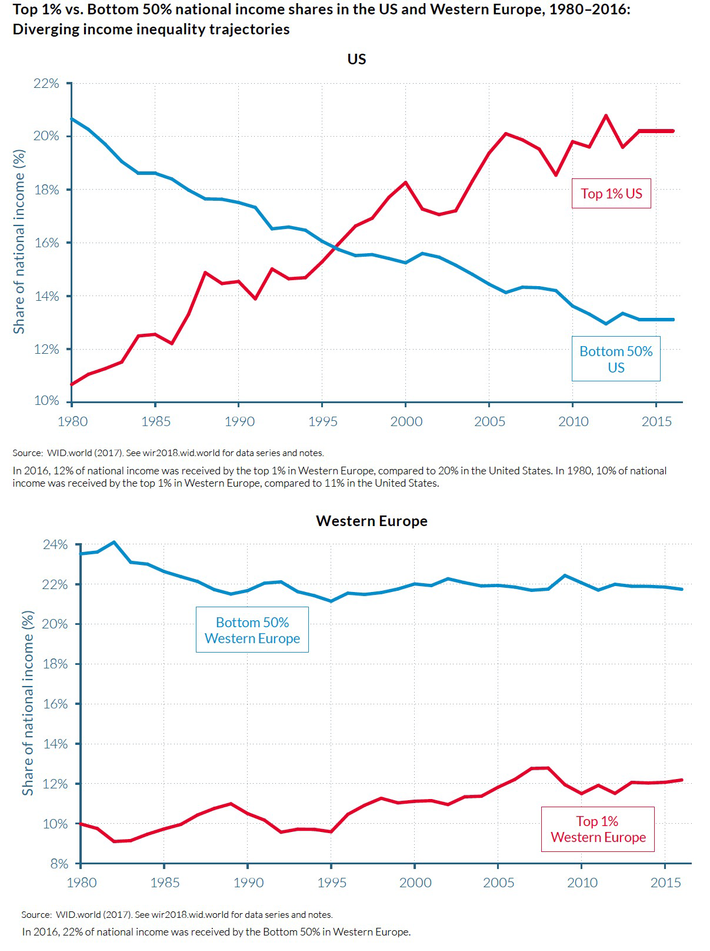
The game is rigged in the U.S. in the favor of white and male Americans, resulting in this reality:

New Study Confirms That American Workers Are Getting Ripped Off

The rich (mostly white) is getting richer while everyone else (increasingly Black and brown) is being cheated by the rich.

Much of this tension has been increased during Covid because the shut downs highlighted just which workers in the U.S. are essential—the least well paid (such as service workers) and those living in the most vulnerable conditions (hourly laborers without guaranteed insurance or retirement).

If all the service workers in the U.S. did not go to work tomorrow, the country would shut down; if all the CEOs stayed home, no one would notice.

White people are afraid of losing their unfair advantage of simply being white, and that fear is driven by a changing world, a changing country.

Attacks by Republicans on CRT and the 1619 Project are crass fear-mongering and a distraction, driven by white fear.

CRT and the 1619 Project are not any significant part of K-12 schooling, and white students are not being taught they are inherently evil because they are white.

White folk perpetuating these lies are doing so because they are afraid; they are afraid of what they see in any mirror they face.

Chicken Little Journalism Fails Education (Again and Again): Up Next, the Science of Science?

Often education journalism is disturbing in its “deja vu all over again“: Why Other Countries Keep Outperforming Us in Education (and How to Catch Up).

Criticizing U.S. public education through international comparisons is a long-standing tradition in the U.S. media, reaching back at least into the mid-twentieth century.

This is one of many crisis approaches to covering education—Chicken Little journalism—that makes false and misleading claims about the quality of U.S. education (always framed as a failure) and that because of the low status of the U.S. in international comparisons of education, the country is doomed, economically and politically.

Oddly enough, as international rankings of education have fluctuated over 70-plus years, some countries have risen and fallen in economic and political status (even inversely proportional to their education ranking) while the U.S. has remained in most ways the or one of the most dominant countries—even as we perpetually wallow in educational mediocrity.

Yet, this isn’t even remotely surprising as Gerald Bracey (and many others) detailed repeatedly that international comparisons of educational quality are essentially hokum—the research is often flawed (apples to oranges comparisons) and the conclusions drawn are based on false assumptions (that education quality directly causes economic quality).

Media coverage, however, will not (cannot?) reach for a different playbook; U.S. public education is always in crisis and the sky is falling because schools (and teachers) are failing.

Next up? I am betting on the “science of science.”

Why? You guessed it: The Latest Science Scores Are Out. The News Isn’t Good for Schools. As Sarah D. Sparks reports:

Fewer than 1 in 4 high school seniors and a little more than a third of 4th and 8th graders performed proficiently in science in 2019, according to national test results out this week.

The results are the latest from the National Assessment of Educational Progress in science. Since the assessment, known as “the nation’s report card,” was last given in science in 2015, 4th graders’ performance has declined overall, while average scores have been flat for students in grades 8 and 12.

“The 4th grade scores were concerning,” said Peggy Carr, the associate commissioner of the National Center for Education Statistics, which administers NAEP. “Whether we’re looking at the average scores or the performance by percentiles, it is clear that many students were struggling with science.”

The Latest Science Scores Are Out. The News Isn’t Good for Schools

And it seems low tests scores mean that schools once again are failing to teach those all-important standards:

Carr said the test generally aligned with the Next Generation Science Standards, on which 40 states and the District of Columbia have based their own science teaching standards. Georgia, Massachusetts, and New Hampshire are developing new science assessments under a federal pilot program.

But it is even worse than we thought: “These widening gaps between the highest- and lowest-performing students, particularly in grade 4, mirror similar trends seen in national and global reading, math, and social studies assessments.”

Yep, U.S. students suck across all the core disciplines compared to the rest of the world!

And what makes this really upsetting, it seems, is we know how to teach science (you know, the “science of science”) because there is research: Effective Science Learning Means Observing and Explaining. There’s a Curriculum for That. Not only is there research, but also there are other countries doing it better and there are, again, those standards:

Organizing instruction around phenomena is a key feature of many reforms aimed at meeting the Next Generation Science Standards, an ambitious set of standards adopted or adapted by 44 states in 2013. Phenomena are also an organizing feature of instructional reforms in countries outside the United States, like high-performing Finland. But what is phenomenon-based learning, and what evidence is there that it works?…

Our study found that students exposed to the phenomenon-based curriculum learned more based on a test aligned with the Next Generation standards than did students using the textbook. Importantly, the results were similar across students of different racial and ethnic backgrounds.

William R. Penuel

Up next, of course, is the media trying to understand why science scores are so abysmal (like reading and math), assigning blame (schools, teachers, teacher education), and proposing Education Reform. What should we expect?

Well, since fourth-grade scores are in the dumpster, we need high-stakes science testing of all third-grade students and to impose grade retention on all those students who do not show proficiency in that pivotal third-grade year.

We also should start universal screening of 4K students for basic science knowledge (or maybe use “science” to screen fetuses in utero).

Simultaneously, states must adopt legislation mandating that all science curricula are based on research, the “science of science.”

Of course, teachers need to be retrained in the “science of science” because, you know, all teacher education programs have failed to teach the “science of science” [insert NCTQ report not yet released].

And while we are at it, are we sure Next Generation Science Standards are cutting it? Maybe we need Post-Next Generation Science Standards just to be safe?

Finally, we must give all this a ride, wait 6-7 or even 10 years, and then start the whole process over again.

The magical thing about Chicken Little journalism is that since the sky never falls, we can always point to the heavens and shout, “The sky is falling!”

A Case for Critical Race Theory, and More

White privilege is a system of advantage that benefits all white people (or to be more clear, all people who are perceived of as white).

That racial privilege, however, is no guarantee of success or shield of protection for some individual people who are white. White people fail, white people suffer inequity and disadvantages (such as poverty), and white people in some individual cases are substantially worse off than individual Black people.

Racism is a system of power and race that disadvantages all Black people in the U.S. (or to be more clear, all people who are perceived of as Black).

Racism is not a universal barrier to success or happiness or achievement, but it is a pervasive burden that tints every aspect of living for any Black person.

Black people are typically more starkly aware of racism (nearly moment by moment) than white people are of white privilege; white privilege works in an invisible way for white people while racism is a blunt object for Black people.

Race, however, is not biological; race is a social construction that has very real consequences because of the systems of white privilege and racism.

Conservative white men with power, political power, have launched a campaign against their own distorted and purposefully misleading characterization of critical race theory (CRT), a narrow and complicated legal and academic term and concept.

First, CRT is not practiced or implemented in the vast majority of K-12 schools, and is rare in higher education. I am speaking as someone who has taught about 20 years each in K-12 and higher education while being a critical educator.

Critical educators are rare, and at best, we are tolerated; but being a critical educator has professional negative consequences because being “critical” is a commitment to challenging systemic forces.

As the attack on CRT shows, people take personal and individual offense when systems are challenged.

Even though white people in the U.S. on average earn more and hold disproportionate positions of power than Black people, white people perceive anti-racism efforts (which are designed to dismantle white privilege) as an attack; white people perceive a creeping loss of their privilege even as they deny that privilege exists.

To be blunt, reaching a state of equity and equality in the U.S. would be a material change in the lives of white people. Change is terrifying to those who are born into a state of advantage.

Equity and meritocracy realized, then, in the U.S. is a threat to white privilege.

Anti-racism efforts, which include concepts such as CRT, are not some sort of reverse racism, not a blanket condemnation of white people.

Again, white privilege and racism are systemic, as CRT argues, built into the fabric of most if not all institutions in the U.S. including policing and the judicial system (which CRT specifically addresses). But white privilege and racism are also built into formal education and, as the 1619 Project proposes, into the very core of capitalism and the U.S. economic system.

Anti-racism efforts, including those found in K-12 and higher education, ask educators and students to consider how racism happened (historically) and to examine critically how white privilege and racism remain in our contemporary daily lives in the U.S.

The backlash against CRT has had some high-profile consequences, including Nikole Hannah-Jones being denied tenure at the University of North Carolina through a process that is overtly partisan politics—the same conservatives decrying CRT punishing the most prominent face of the 1619 Project, which sits at the center of this storm.

That politically partisan denial of tenure occurred around the birthday of Malcolm X, who I think serves an important point here.

Malcolm X was considered during his life a radical, in today’s language “critical,” and despite his careful and powerful rhetoric when positioned in the mainstream media of his day, he was demonized as the exact embodiment of racial threat that white Americans were openly embracing in the 1960s.

To understand racism in the U.S., consider this from Malcolm X: “History proves that the white man is a devil.”

For knee-jerk conservatives, this is proof of Malcolm X himself being racist.

But read in its full and clear language, the comment is not racist since it is grounded in “history proves.” Malcolm X is drawing a valid generalization about white people based on Black people living in the reality of active individual and systemic racism in the U.S.—from slavery to Jim Crow, from separate bathrooms and water fountains to segregated schools, from lynchings and the rise of the KKK to interracial marriage being illegal until the mid-1960s.

Racism is a set of race-based generalizations based on stereotypes, not evidence. I won’t list them here, but white racism toward Black people includes the very ugliest of claims about Black people that have no basis in fact, no historical, biological, or sociological evidence.

Part of the backlash against CRT is simply denial and racial discomfort, but that backlash is also a profound misconception about the fact of racism. Conservatives are apt to claim that the U.S. is not a racist country, and that any racism in the U.S. is merely a thing of the past.

Let me offer here two examples of why CRT and anti-racism efforts are valid, and must be central to formal education.

First, CRT argues that our current systems have racism baked into them because they were designed and created when, in fact, being virulently racist was not only socially and politically acceptable, but often a social and political advantage.

For example, Ben Tillman had a long successful political career in South Carolina (1890-1918), as governor and U.S. Senator. Tillman is something of an extreme example, but he was one of may white men who were racist and creating the laws that govern this county.

Detailed at Historic Columbia are some of the key elements of Tillman as racist politician who helped created our current systemic racism:

In a 1909 speech at the Red Shirt Reunion in Anderson, SC, Tillman boasted about his role in the 1876 murder of six Black militia members, whom he called “negro thugs.” White leaders celebrated the “Hamburg Riot” as a key victory of the 1876 Red Shirt paramilitary campaign, which successfully intimidated Black voters and stuffed ballot boxes to ensure the election of Wade Hampton III, and with it, the end of Reconstruction. Today, these murders are known as the Hamburg Massacre, one of the earliest lynchings in South Carolina.

Although he began as a perpetrator, Tillman later used his platform as governor and senator to serve as an instigator of and advocate for racial violence. Perhaps his most well-known pronouncement occurred in an 1892 speech, when, as governor [emphasis added], he vowed that “I would lead a lynching”–a claim carried by the state’s leading newspapers. His election to the governorship in 1890 unleashed what human rights activist Modjeska Monteith Simkins later called “an era of lynching.” By the end of the decade, at least 53 men, 51 of whom were Black, were lynched in South Carolina.

Yet, Tillman was most proud of his role in the Constitutional Convention of 1895, which introduced an “understanding clause” and poll tax as barriers to the vote, designed to eradicate Black participation in government. In a speech to his fellow United States Senators [emphasis added] five years later, he reminded them that, “We [South Carolinians] did not disfranchise [sic] the negroes until 1895. Then we had a constitutional convention convened which took the matter up calmly, deliberately, and avowedly with the purpose of disenfranchising as many of them as we could under the fourteenth and fifteenth amendments….” This speech affirmed a sentiment repeated throughout his career on the national stage about the role of African Americans in American democracy:

“We of the South have never recognized the right of the negro to govern white men, and we never will. We have never believed him to be the equal of the white man, and we will not submit to his gratifying his lust on our wives and daughters without lynching him.”

Historic Columbia

Today, we all live in a country under systems intentionally designed to be racist—some as overt as Tillman but others far more subtle (consider the sentencing differences between powder and crack cocaine and racial disparities in police shootings).

CRT and anti-racism efforts ask us to consider how these racial disparities came to be, how they continue to exist in today’s society, and what we can do to dismantle the inequities.

Denial and neutrality allow racism and racial inequity to remain; only naming, exploring critically, and confronting racism can erase racism.

Consider this second example, drawn from headlines within the last decade.

How did the killing of Tamir Rice by a police officer occur?:

“Shots fired, male down,” one of the officers in the car called across his radio. “Black male, maybe 20 [emphasis added], black revolver, black handgun by him. Send E.M.S. this way, and a roadblock.”

But the boy, Tamir Rice, was only 12. Now, with the county sheriff’s office reviewing the shooting, interviews and recently released video and police records show how a series of miscommunications, tactical errors and institutional failures by the Cleveland police cascaded into one irreversible mistake.

In Tamir Rice Case, Many Errors by Cleveland Police, Then a Fatal One

A racist stereotype (Black males are inherently dangerous and violent) combined with implicit bias (Black children are viewed as much older and more mature than their biological ages) led to the death of Rice. This tragic event is a real-life manifestation of what CRT argues, systemic forces with material consequences for Black people.

A police officer shooting and killing a Black boy, then, does not have to be a consciously racist individual to have acted in a way that is driven by systemic racism.

As further evidence, just a few years later, Kyle Rittenhouse, then 17, shot and killed two people during protests in Wisconsin. The same conservatives attacking CRT refer to Black boys as “men” and Rittenhouse as a “boy.”

Attacks on CRT and anti-racism initiatives are embarrassing and offensive caricatures; these attacks are themselves racist and provide the evidence proving why CRT and anti-racism practices remain necessary.

We are now facing a paradox because the misleading attacks on CRT are justification for increasing CRT and other anti-racism efforts in K-12 and higher education.

CRT is incredibly rare in any formal education setting. More K-12 and higher education situations are incorporating (often begrudgingly) anti-racism practices and examinations (which may or may not have elements informed by CRT).

Diversity, equity, and inclusion experiences for children are not blaming all white people or white students simply for being white; but those discussions are designed, as noted above, to critically explore how evidence-based racial disparities came to be, how they continue to exist in today’s society, and what we can do to dismantle the inequities.

Being white is not a crime, but denying racism is itself an act of racism.

To take a stand against anti-racism (against CRT) is taking a stand for racism.

In this case, we can say “not all white people,” but clearly identify those people white or Black who are to blame when they seek ways to deny and perpetuate the racism that remains in our daily lives.

How Do We Know?: Not Simple, Not Settled

In the early to mid-1980s, I entered the world of serious recreational cycling. I had been an athlete throughout my childhood and teen years, but found myself sedentary and out of shape in the first few years of my career as a high school English teacher.

Road cycling wasn’t the most inviting of sports, being both an individual and group endeavor. I quickly discovered, in fact, that cycling is deeply tradition-bound and steeped in ritual and conformity.

Ultimately, it is also an orchestra of Social Darwinism; you must be strong enough and skilled enough to ride with a group regardless of anything else (such as the right bicycle or the proper kit).

Early on, I had to focus on fitness—riding more often and longer, but always alone—and finding ways I could afford ever-better bicycles (see Rule 12). Gradually, I began shaving my legs and made the most daunting commitment facing me, using toe clips on my pedals.

Greg LeMond (L) strapped into the traditional toe clips along side Bernard Hinault (R) sporting the future, clipless pedals (a design inspired by ski bindings and pioneered by Look).

Toe clips were a must among serious cyclists, but they involved literally reaching down and tightening a leather or nylon strap around your feet. The monumental learning curve was reaching down to tighten the straps and always reaching down to flick the release when coming to a stop.

At the time, I lived only a couple miles from my bicycle shop so I rode my bicycle there to buy my first toe clips. They installed the clips to my pedals and went over how to tighten and release.

Filled with glee about my next step toward being a real cyclist, I rolled out of the shop parking lot and promptly came to a stop at a red light where I fell over fairly dramatically beside several cars—having completely forgotten to reach down to loosen the straps.

Just as I had to learn how to shift gears (old-school down-tube friction shifting), I learned to tighten and release the toe clips along with dozens of other behaviors necessary to ride in tight packs of cyclists at high intensity and to near exhaustion.

High-paced group cycling is a mix of many precise behaviors in incredibly tense contexts—from being dropped from the group to being in or causing a serious accident.

That was three decades ago, and today (after many changes to pedals and shifting) I function on a bicycle in ways that seem entirely natural, requiring essentially no thought.

Matching kits, clipless pedals.

Cycling for me is automatic behavior; I also have acquired an incredible amount of knowledge about bicycles (I do bicycle maintenance and build bicycles) and the history of the sport.

I often think of this journey in learning of mine, which was again prompted by a few exchanges on Twitter:

These comments about what we know and how we know it are common, but, I think, trapped in a misunderstanding about, for example, “rote memorization.”

Memorization and automatic behavior are not about “bad” or “good.” In fact, memorization and automatic behavior are inevitable for most humans, even essential.

The trap can be exposed by considering a behavior most of us have in common—assembling something from parts such as a TV stand or entertainment unit, or a children’s toy.

Do you recall opening the box, spreading out the parts, laying out the directions, and then beginning to assemble? Was there a moment (or several) while assembling when you turned from the directions to look on the box at the image of the fully assembled item?

So here is my point: The Twitter exchange above is trapped in viewing learning in a reductive way based on part-to-whole, easier-to-harder, sequential perceptions of learning.

This singular and reductive view is the trap.

Since most of the items we assemble are a one-time event, that assembly is both learning to assemble and assembling at the same time. (I once assembled a TV stand, badly, and then my in-laws wanted the same stand. The second assembly was a near-euphoric experience since I was able to apply what I had learned from doing the whole thing one time before.)

My journey in cycling and my assembly example here reveal that learning resulting in memorization and automatic behavior is extremely complex and is in fact an interplay between part and whole, not a step-by-step journey from part to whole.

“Breaking it down” is not always easier or clearer for some students, in some learning activities.

Many people learning to use toe straps, for example, would go into a grass field, strap in, and (as I did publicly) fall down repeatedly. Learning the real thing required doing the whole and real thing relatively badly until they improved (motivated by real consequences).

There is no debate, then, about the good or bad in memorization or automatic behavior. The real tension is about how and why we come to memorize or behave automatically.

Despite misleading claims that memorization is a foundation, we often come to know something, have it memorized, after (not before) we have rich and complex experiences with the knowledge or behavior.

In my doctoral program, I had to perform from memory in two intense settings—written comps and dissertation defense. I studied for neither because I had engaged with the material for so long and in such intense situations (course work, numerous papers, a full dissertation) that I had much of the material in recall.

Twenty-five-plus years later, much of that dissertation work remains in recall for me.

Like with cycling, my final doctoral work felt natural, as much a part of me as pedaling with my hands off the handlebars while I remove my cycling vest and stuff it into a rear pocket while sitting at the back of a high-paced group.

The quests for silver-bullets and simple step-by-step paths to learning and automatic behavior are at the core of many educational debates, in fact, including the incessant reading debate.

The complexity of cycling reminds me of the complexity in reading—the many interconnected behaviors and knowledge required to do both automatically and well.

Reading, learning to read, and teaching someone to read—like all learning—are not simple and how we come to know is just not settled.

In fact, learning will never be simple or settled because human beings are far too complex.

The paradox, of course, is that how we know is simple to explain: It is some type of interplay between doing the whole thing we want to learn and coming to know the many intricate parts that make up that whole thing.

How do we know?

It is a journey—not simple, not settled.

Plagiarism, Accountability, and Adult Hypocrisy

You said “I think I’m like Tennessee Williams”
I wait for the click. I wait, but it doesn’t kick in

“City Middle,” The National

A refrain by my father throughout my childhood and into my adolescence has shaped how I try to live my life; it remains possibly the strongest impulse I have as an adult.

My father’s parenting philosophy was possibly as misguided as it was reflective of the essential problem with how adults interact with children and teens: “Do as I say, not as I do.”

As a child growing up in the rural crossroads of Enoree, South Carolina, I witnessed my father announcing his dictum, sitting in our living room with a glass of Crown Royal in one hand and a cigarette in the other.

By the time I was a teen, the scenes were often far more physical, occasionally ending with me on the floor as my father attempted to wrestle me into compliance.

A game of him demanding, “Don’t say another word,” and me replying, “Word,” as he tightening his hold on me against the faux-brick linoleum of a different living room floor.

Adulthood for me has included a career in education, where I have taught and coached, and I am a father and grandfather. I am routinely tested, then, by interacting with children and young adults—challenged not to give into the adult hypocrisy of my father, of nearly every adult I encounter.

When the now-former president of the University of South Carolina was exposed as having plagiarized the end of his graduation speech, I immediately thought of my father and adult hypocrisy, certain that little or nothing would come of the plagiarism by the head of an institution that routinely holds students to draconian expectations for plagiarism and academic honesty.

In this case—unlike many high-profile examples that include Joe Biden, Melania Trump, and Rand Paul—Bob Caslen resigned, but there appeared to be nothing to suggest he was going to be held accountable by the system. And honestly, little consequences will occur to Caslen’s power, wealth, or status.

The university-level equivalent of this for students would be if a student were caught plagiarizing and that student were allowed to drop the course without any academic penalty, continuing on with coursework from there.

In academia, however, plagiarism for students tends to result in an assignment zero, a course F, or expulsion. Caslen is experiencing nothing equivalent to these consequences for students.

Since I teach writing, primarily first-year and upper-level writing at the university level, I often write about plagiarism and citation because these aspect of academic writing are both essential and deeply problematic.

I have even referred to the citation/plagiarism trap since consequences for plagiarism and the gauntlet of citation in college scholarship are disproportionately elements of stress for both students and professors.

The tension for me as a teacher, scholar, and writer is that I recognize how academic honesty and the mechanics of citation serve a writer’s credibility even while citation formatting and style guides are unnecessarily complex and often arbitrary to the point of inanity.

When we are dealing with citation, I find myself telling students that I recognize that APA, for example, is often mind-numbingly complex and essential in academic contexts that require formal citation (students also write using hyperlinks as citation, which emphasizes the possibility of citing that is academically honest and not tedious and pedantic).

The harsh reality about adulthood is that accountability, despite all the grandstanding adults do about it, is heaped mostly upon the youngest, the weakest, and the most marginalized. People with status—Biden, Paul, Melania Trump, Caslen—breeze through life little troubled by the bar we set for children, teens, and young adults in formal schooling.

“Pretenses. Hypocrisy” have driven Big Daddy into a rage, and Brick, to drink.

Especially for those of us charged with the care and education of children, teens, and young adults, we must lead by example; nothing is a worse lesson for young people than rhetoric that contradicts action.

If academic honesty and the proper attribution of other people’s words and ideas matter—and I think they do—certainly those standards must be higher for adults than children.

Otherwise, we are proving children right when they realize—as I did one day as a child standing in a smokey living room in Enoree, SC—that adult words are too often bullshit.

Despite all the jumbled mess that is the work and life of William Faulkner, I side with Addie from As I Lay Dying:

So I took Anse. And when I knew that I had Cash, I knew that living was terrible and that this was the answer to it. That was when I learned that words are no good; that words dont ever fit even what they are trying to say at.

As I Lay Dying (p. 171)

“Words are no good,” that is, when actions reveal that they are merely words that serve to ask more of some than of others.

Brevity

Some words are predictable—”arrogant,” “intimidating,” “mean,” “stoic,” “blunt,” “sarcastic.”

Predictable, that is, as descriptions of me.

I anticipate them, and I recognize they are inaccurate in some (most?) ways. They also hurt, sting at the very core of who I am, who I try to be.

Especially as a teacher.

Recently, a new label popped up—”passive aggressive.”

I didn’t expect that because “passive aggressive” doesn’t square with “blunt,” which I most certainly am. The context was also frustrating since it involved me frantically communicating (mostly on my phone email App) with a student who had put themselves in a precarious situation, about to fail a course by not meeting minimum requirements.

Since expectations for my course are explicit on my course materials, and since I routinely email students reminding students of those expectations (as well as express them aloud in class several times throughout a semester), I had every right to let the situation play out in a way that would not have served the student well.

In my efforts to find some avenue for this student to pass the course, however, my email communications were characterized as “passive aggressive,” and the conversation turned to the ways in which I was responsible for the situation.

This event sits in the context of recent course SETs showing a pattern of students finding my feedback “mean” and “blunt” (one comment noted I am supportive and patient in conferences, but not in written feedback).

While none of this is really new (except the “passive aggressive” charge), I suspect some of the student perceptions are exaggerated by the tensions created in our Covid-19 context; I certainly feel far more stress, and have trouble with patience because of the pervasive stress of the pandemic and how that has changed dramatically the teaching/learning conditions of my courses.

Since I do not grade assignments and I require as well as allow students to revise major works as often as they choose, my courses are extremely gracious and low-stakes when compared to traditional courses.

Yes, my non-graded approach does cause some paradoxical stress for students accustomed to grades and tests, but ultimately, the criticisms offered by students have a clear source—me, as a person, or more specifically my text-based persona in written feedback and emails.

Having taught for 37 years, and having spent about half that career working with 100-125 students at a time, I have honed an incredibly important skill to facilitate my primary work as a teacher of writing—efficiency.

As a high school English teacher, I experimented for several years with how to give feedback on thousands of student essays so that I could return those drafts quickly and not spend hours and hours responding. Eventually I created a numbering system that allowed me to mark and highlight on student drafts, assigning numbers that students then used to refer to a text I wrote that guided their revision (see here).

That system helped me be efficient (students received essays back the same or next day after submitting), but it also supported my efforts to foster students as independent writers (not simply “correcting” the “errors” I marked).

Quick and efficient responses to my students are behaviors I pride myself on. I tend to respond to student emails immediately, often on my phone.

People who know me also know my emails are exceedingly brief. I return student essays as Word attachments, and the text of the email tends to be only “attached.”

I return my university students’ essays the same day, often within a couple hours of their being due. Brevity in emailing allows me to work quickly.

Brevity, however, isn’t always the best form of communication.

Usually when a course has just begun, a student or two will respond to my “attached” email by noting they had attached their submission, failing to see I was returning their draft with my comments (some of that confusion is that they usually wait days for essays to be returned in other courses).

I have abandoned my numbering system since I handle a much lower paper load teaching at the university level. I still respond with very terse comments and use a great deal of highlighting, guiding students to ample support material to support their revisions.

At the beginning of a course, I do warn students not to interpret my comments on their writing or my emails as negative, angry, or sarcastic. I also stress that any questions I ask are genuine questions; their answers inform how I continue to help them.

Notably, since I provide a great deal of support material (such as sample essays with notes provided in the margins), I often ask students if they used the support materials and samples when submitting their draft. It is quite a different thing if they have (and the materials didn’t help) or if they simply chose not to.

At 60, I certainly can be brief to the point of blunt. Less patient? Probably.

I am often perceived as stoic (caveat: I am an introvert), and as a result, viewed as intimidating (although that charge really does hurt my feelings).

And then the Universe steps in: How to decipher a curt or passive-aggressive email by Erica Dhawan.

Dhawan examines specifically emails that are brief and confronts the problem of intent versus perception, but also the importance of the imbalance of power in communications that are brief:

Brevity from the upper echelons of power isn’t exactly uncommon. At Morgan Stanley, there was a running joke that the more senior you were, the fewer characters you needed to express your gratitude in a text or email. You started your career with Thank you so much! and after a promotion or two, this was cut down to Thanks. Another promotion produced Thx or even TX. One senior leader just wrote T.

How to decipher a curt or passive-aggressive email

What is important for my situation (and I do recommend reading the entire article, which is itself brief) is that brevity is often perceived as inadequate feedback and passive aggressive.

Regardless of my intentions or my warnings to students, their psychological and emotional responses to my written feedback and emails over-ride the significant feedback I do provide as well as the person they encounter when we talk face-to-face (in reality or on Zoom).

As an old dog, I am faced with having to learn new tricks because the consequences of these dynamics do negatively impact the teaching/learning environment of my classes.

At the core of this tension is, again, the power imbalance; despite my best efforts to foster a relationship with students that is collaborative and cooperative, students have mostly had somewhat antagonistic relationships with teachers, notably in the context of submitting writing to be evaluated.

Dhawan concludes: “If you have a high level of trust, opt for the phone call, and don’t hesitate to respond quickly and informally. If you have less trust or a higher gap in power levels, be specific and polite in your responses and use formal channels.” This is in the context of business relationships, but as an educator, I recognize the same problem because at the university level I have less time to foster trust and cannot ignore the “gap in power levels” between professors and students.

“Brevity is the soul of wit” is an often misunderstood line from Shakespeare (folk quote it as a pearl of wisdom although Shakespeare is using it to parody Polonius, a blowhard who is never brief and often wrong).

It turns out, in the digital era, brevity is the source of miscommunication.

[Insert face palm emoji here]