Category Archives: Educational Research

Mainstream Media Fails Educational Research (Still)

From CNN: How long you breastfeed may impact your child’s test scores later, study shows.

This sounds really compelling; it fits into a cultural narrative that breast feeding is superior to using baby formula.

This sounds really compelling until about ten paragraphs in and then:

“Though the results are certainly interesting, you have to bear in mind the limitations that inevitably arise in research using observational data from major cohort studies,” McConway added….

The fact that the study was observational means it followed people’s behavior rather than randomly assigning the behavior in question, McConway noted.

Consequently, the results only show a correlation between breastfeeding and test scores — not causation.

“It’s not possible to be certain about what’s causing what,” he said.

How long you breastfeed may impact your child’s test scores later, study shows

Few people will read that far, and even most who do will likely take away a careless claim that the research doesn’t justify.

Therefore, this article should never have been written—similar to many articles about educational research.

One enduring example of media repeating a misunderstanding of educational research is the word gap myth. Media repeat that number of words in children’s vocabulary is connected to economic status (again, this sounds right to most people).

Yet, the Hart and Risley study this myth is based on has been debunked often, and the word gap myth itself is based on flawed logic about literacy [1].

Media has ben shown, in fact, to cover education quite badly, typically overemphasizing think tank research versus university-based research (the former far less credible than the latter) and featuring the voices of non-educators (reformers and innovators) over educators:

Currently, the misinformation campaign, ironically, related to education is the “science of reading” (SOR) movement that repeatedly misrepresents NAEP data, makes claims that have no scientific evidence (relying on anecdote [2]), and repeatedly relies on think tank “reports” (NCTQ, for example) that are also not scientific [3].

A subset of the SOR movement is also grade retention. High-profile coverage of Mississippi has made the exact breast feeding mistake from above: “’It’s not possible to be certain about what’s causing what,’ he said.”

Recently in the NYT, a think-tank funded report on MS grade retention is cited; however, the report itself notes that outcomes cannot be linked to grade retention itself [3].

In short, the report proves nothing about retention—just as the study on breast feeding proves nothing about student achievement.

The breast feeding story, the word gap myth, and the SOR story are all compelling because they sound true, but they are all false narratives that fails educational research—and public education.


[1] The “Word Gap”: A Reader

[2] Hoffman, J.V., Hikida, M., & Sailors, M. (2020). Contesting science that silences: Amplifying equity, agency, and design research in literacy teacher preparation. Reading Research Quarterly, 55(S1), S255–S266. Retrieved July 26, 2022, from https://doi.org/10.1002/rrq.353

[3] See:

[3] Scroll to end HERE.
Disaster Reform and Shadow Reading Legislation: The Politics of Reading Crisis pt. 2 [UPDATED]

Republican/conservative education reform has been a subset of disaster capitalism for decades now, most prominently after Hurricane Katrina when Republicans used the natural disaster to dismantle public education and erase the existing teacher workforce in New Orleans.

In 2023, Republicans have continued to manufacture educational crises in order to reform education, where “reform” is a veneer for dismantling education.

The twin conservative attacks on schools include the anti-CRT/curriculum gag order movement and the “science of reading” (SOR) movement—both depending on false claims of educational failures by teachers and public schools.

What flies under the radar is that anti-CRT and reading legislation are being promoted by conservative organizations and ideologies in the form of “model legislation” and fact sheets that are devoid of facts.

In the context of the crisis/miracle narratives about education in the media, among the public, and by politicians, disaster reform has evolved into its own powerful and harmful machine.

Not surprising, a key example comes from Florida and Jeb Bush: ExcelinEd.

The disaster education reform organization is Orwellian in its claims but insidious in its carefully packaged information and templates for policy. The key point here is that the SOR movement as a media and parent advocacy event has now fully been folded into the existing Republican education reform machine that is more about dismantling education than supporting student learning or teacher quality.

In short, the materials about reading presented by ExcelinEd are false but very well designed and compelling to the general public and politician looking for ready-made legislation and effective talking points.

As the NCLB/NRP era showed us with Reading First, however, the entire Bush family is driven by market interests, not a pursuit of democratic education for all.

ExcelinEd offers online a series of PDF resources:

The short version of concern here is that nearly all of the information above is misinformation; however, as the SOR movement has shown, most people remain easily targeted by claims of a reading crisis and a set of simplistic blame and solutions.

As I have shown, there simply is no reading crisis in the US, but there is a very long history of political negligence in terms of providing marginalized students and their teachers with the learning and teaching environments as well as social conditions that would support earlier and more developed reading in our students.

Two aspects of the materials above deserve highlighting (again).

First, the Republican commitment to SOR is grounded in doubling-down on punitive policy, grade retention.

The two states identified over and over in the materials above are Florida and Mississippi; however, those states are examples of mirages, not miracles.

ExcelinEd only cites work by Winters [1] to “prove” the effectiveness of grade retention. This strategy is cherry picking “research” by a conservative “scholar” who (surprisingly) only finds positive results for the conservative reform of the day—school choice, charter schools, VAM evaluations of teachers, and now, grade retention.

The research on grade retention is complicated but politically attractive since grade retention (the likely sources of “success” in FL and MS) can raise reading scores in grades 3 or 4, but those “gains” disappear by middle school.

Grade retention distorts the population of students being tested by removing the lowest scoring students and reintroducing older students to grade-level testing. As I have noted before, students achievement can vary significantly by just a month of age difference:

A review of the Florida Model that depends on grade retention has concluded that research does not show whether any short term gains are from retention or additional services. Further, a comprehensive study still notes that grade retention is harmful, especially to marginalized populations of students:

The negative effect of retention was strongest for African American and Hispanic girls. Even though grade retention in the elementary grades does not harm students in terms of their academic achievement or educational motivation at the transition to high school, retention increases the odds that a student will drop out of school before obtaining a high school diploma.

Hughes, J. N., West, S. G., Kim, H., & Bauer, S. S. (2018). Effect of early grade retention on school completion: A prospective study. Journal of Educational Psychology, 110(7), 974–991. https://doi.org/10.1037/edu0000243

A second problematic aspect is the hyper-focus on three-cueing, which fits into the Rufo “caricature” approach to attacking CRT.

Republicans have latched onto the SOR misinformation campaign that perpetuates a cartoon version of three-cueing and fabricates a crisis around claiming that teachers are telling students to guess words instead of using phonics/decoding strategies.

Three-cueing, in fact, is a research-based approach better referred to as “multiple cueing”:

Compton-Lilly, C.F., Mitra, A., Guay, M., & Spence, L.K. (2020). A confluence of complexity: Intersections among reading theory, neuroscience, and observations of young readers. Reading Research Quarterly, 55(S1), S185-S195. https://doi.org/10.1002/rrq.348

ExcelinEd’s prepackaged misinformation campaign and templates for legislation are yet more proof that the SOR movement is another nail in the coffin of public education, an anti-teacher and anti-public school movement that depends on crisis rhetoric and fulfills the goals of disaster reform driven by Republicans and conservatives who serve the needs of the educational marketplace—not students, or teachers.


[1] UPDATE: Another Mississippi “miracle” article in the NYT highlights grade retention positively, again citing only a new study by Kirsten Slungaard Mumma and Marcus A. Winters.

First, this is a working paper supported by Mississippi Department of Education and the acknowledgements add: “This project was made possible by a grant from ExcelinEd.”

Here are some key additional caveats beyond how biased this report likely is in terms of meeting the ideological aims of ExcelinEd:

  • The policy brief concedes: “That said, though the results are distinctly positive for the policy treatment overall, the analysis cannot entirely disentangle the extent to which the observed benefits in ELA are due to the additional year of instruction or to other specific features of the approach Mississippi took to providing literacy-focused supports and interventions to students.”
  • In the full working paper, section “2.1 Within-Age vs Within-Grade Comparisons” details a common failure of analyzing grade retention: “Comparing the later outcomes of students retained at a point in time to students in their cohort who were promoted is complicated by the fact that the two groups are enrolled in different grade levels during later years.” The findings of this working paper must be tempered by this fact of the study: “Unfortunately, within-age comparisons of student test scores are not possible in Mississippi because scores on the state’s standardized tests are comparable within grades over time but not across grades.” In other words, as noted above, higher test scores may be the result of students simply being older in a tested grade level, and not because grade retention or any of the services/instructional practices were effective. Again, these “gains” are likely mirages.

Finally, we must wondering why Kristof chose to highlight a flawed and biased think-tank funded report on grade retention instead of this: Following the Letter of the Law: 2020-21 Retention Outcomes Under Michigan’s Read by Grade Three Law.

Westall, Utter, and Strunk find much more problematic outcomes with retention, findings that fit within decades of research:

Early literacy skills are critical to the educational outcomes of young students. Accordingly, 19 states have early literacy policies that require grade retention for underperforming readers at the end of third grade. However, there is mixed evidence about retention’s effectiveness and concerns that retention may disproportionately impact traditionally disadvantaged student groups. Using regressions and a regression discontinuity design, we examine retention outcomes under Michigan’s early literacy law, the Read by Grade Three Law. We find that Black and economically disadvantaged students are more frequently eligible for retention and retained than their peers. While controlling for students’ test performance, particularly their math scores, eliminates this disparity for Black students, it persists for economically disadvantaged students. We show that differences in average math performance, exemption characteristics, district characteristics, and eligibility-induced student mobility across districts do not explain the disparities in the implementation of retention by economic disadvantage status.

Abstract

The Proficiency Trap and the Never-Ending Crisis Cycles in Education: A Reader

The newest NAEP crisis (until the next one) concerns history and civics NAEP scores post-pandemic.

Similar to the NAEP crisis around reading—grounded in a misunderstanding of “proficiency” and what NAEP shows longitudinally (see Mississippi, for example)—this newest round of crisis rhetoric around NAEP exposes a central problem with media, public, and political responses to test data as well as embedding proficiency mandates in accountability legislation.

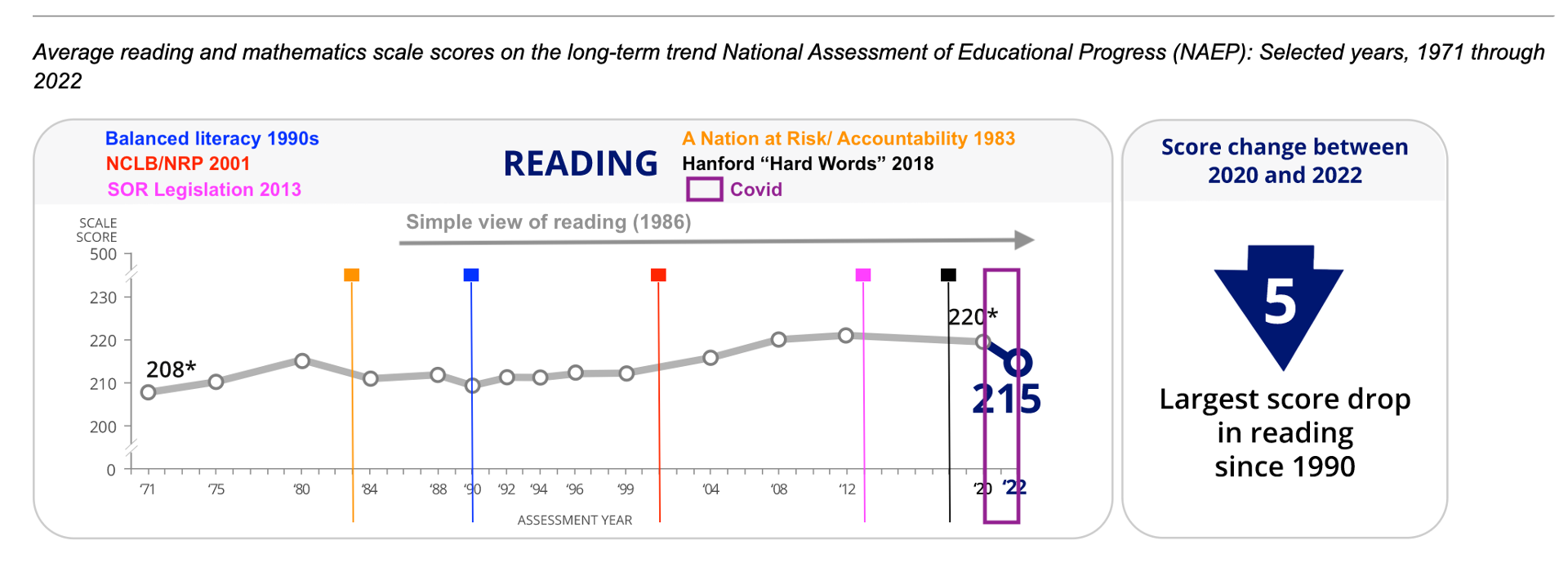
As many have noted, announcing a reading crisis is contradicted by longitudinal NAEP data:

But possibly a more problematic issue with NAEP is confusing NAEP achievement levels with commonly used terms such as “grade level proficiency” (notably as related to reading).

Yet, as is explained clearly on the NAEP web site: “It should be noted that the NAEP Proficient achievement level does not represent grade level proficiency as determined by other assessment standards (e.g., state or district assessments).”

Public, media, and political claims that 2/3 of students are below grade level proficiency, then, is a false claim based on misreading NAEP data and misunderstanding the term “proficiency,” which is determined by each assessment or state (not a fixed metric).

Here is a reader for those genuinely interested in understanding NAEP data, what we mean by “proficiency,” and why expecting all students to be above any level of achievement is counter to understanding human nature (recall the failed effort in NCLB to mandate 100% of student achievement proficiency by 2014):

[Submitted]: South Carolina Needs a New Story and Different Political Responses to Reading

[Below is an OpEd submitted to newspapers in SC; no response yet.]

Writing in Teachers College Record, literacy scholars Reinking, Hruby, and Risko explain: “Since 2015, 47 state legislatures have enacted, or are currently considering, a remarkable total of 145 bills that address reading and reading instruction in public schools.”

A few days apart, an article in the New York Times again announced the US has a reading crisis, and in EdSource, a school’s exceptional success with multilingual learners was celebrated.

The problem with new reading legislation, another reading crisis, and highlighting education “miracles” is that they all are factually untrue.

For example, Reinking, Hruby, and Risko demonstrate that reading achievement as measured by NAEP grade 4 reading scores have remained flat for many years in the US:

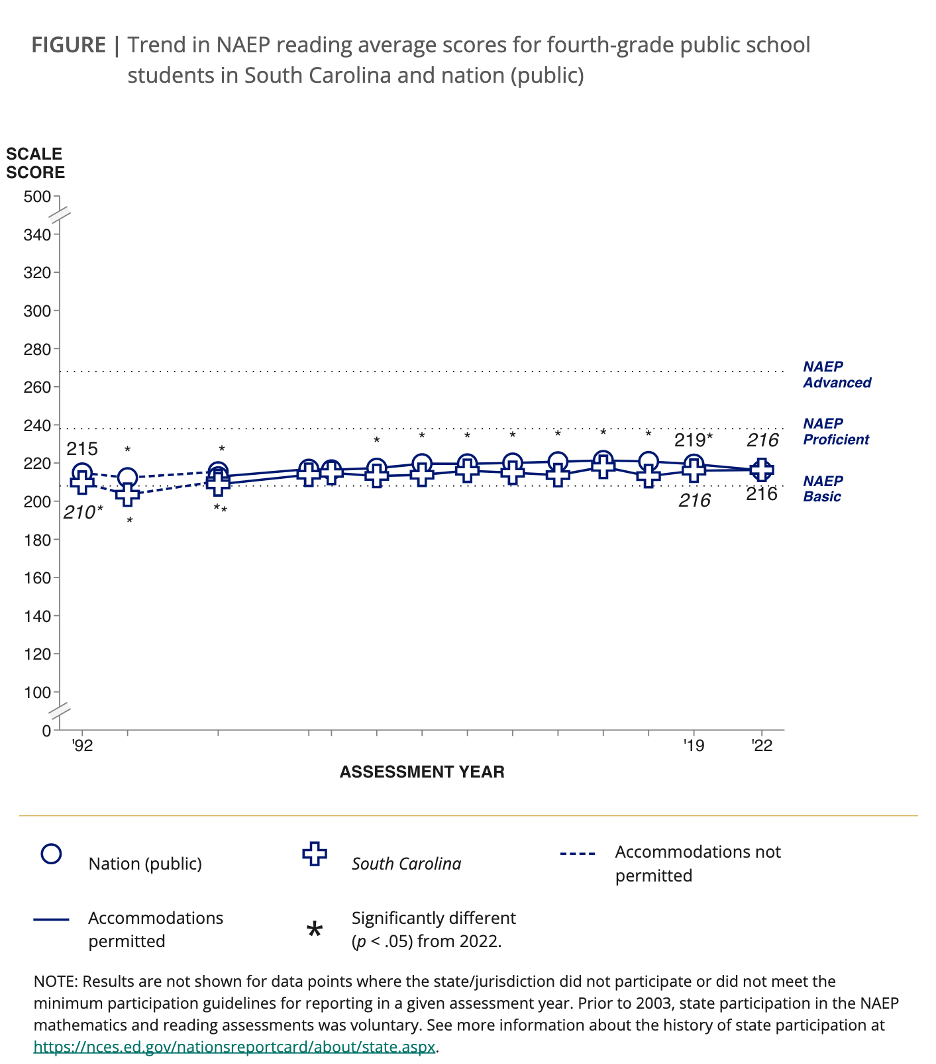
The same is true of South Carolina:

South Carolina has also been an early and eager adopted of standards, high-stakes testing, and embracing the current trend to legislate reading. However, these models of crisis and reform have never produced the sort of reading achievement that the media, the public, or political leaders have promised.

After multiple versions of different standards and tests as well as several rounds of reading wars, South Carolina like the rest of the US continues to lament low reading proficiency in students.

As a lifelong literacy educator in SC over five decades, I recommend that we first stop focusing on crisis and “miracle” stories about our schools, our teachers, and our students. These extreme stories almost always prove to be misleading or false.

Next, and most importantly, we need to do something different—at the school and classroom levels, but also at the political level of legislation, funding, and mandates.

South Carolina has a historical challenge of extreme pockets of poverty, and recent data from the value-added era of education reform under Obama confirmed that about 86 – 99% of measurable student achievement is linked to out-of-school factors, not teacher practice or quality.

The historical negligence of political leadership in SC highlighted in the documentary Corridor of Shame has simply never been addressed.

Further, what do students, teachers, and public schools needed from legislators in SC?

Political leaders must resist the current trend to ban teaching practices and reading programs while also mandating narrow approaches to reading and a new batch of preferred reading programs.

Simply put, there is no silver bullet for teaching reading, and neither the problem nor the solution is a magic reading program.

Students and teachers instead need political leaders to address learning and teaching conditions in our schools concurrent with addressing poverty and inequity in the homes and communities of our children.

Equitable learning and teaching conditions would include repealing grade retention, reducing significantly class sizes in the earliest grades and for the populations of students struggling to read, funding better all aspects of public education (teacher pay, school facilities, learning and teaching materials), and refusing to succumb to the current trends of legislating curriculum through bans and censorship.

The two most powerful commitments that a state can make in terms of supporting education and reading instruction is ensuring that the individual educational needs of all students are supported and that teacher professionalism is directly and fully supported.

For my entire career in SC as a literacy educator, political leaders have failed to address poverty and inequity, ignored the needs of our most vulnerable students, and eroded the profession of teaching in the state.

The stories we have told and the political responses to those stories have failed all of us for decades. We must do better and that means we must do something different.

COE Spring Forum: Are We in the Midst of “Reading Wars” – Again?

COE Spring Forum: Are We in the Midst of “Reading Wars” – Again?

Access this PowerPoint for my part of the forum. Access expanded PowerPoint also.

YouTube RECORDING

Rachael Gabriel SLIDES

See RESEARCH supporting my presentation:

Reading Science Resources for Educators (and Journalists): Science of Reading Edition [UPDATED]

Where Do We Go from Here?: Learning and Teaching in the SOR Era

One of the most important and too often ignored works by Martin Luther King Jr. is his Where Do We Go from Here: Chaos or Community? (see an excerpts here).

I have relied on this work for many years in the context of my public writing and scholarship addressing equity, poverty, race, and literacy (for example, see pt. 1 and pt. 2). What has always rung true and important is King’s practical call for needed direct action instead of the status quo of political indirect action.

For example, King noted that the political will in the US was to view education as a mechanism for erasing poverty, racism, and inequity (indirect action) instead of directly eradicating the forces that create poverty, racism, and inequity.

I have reached a very sobering moment in my public work addressing the “science of reading” (SOR) movement as that has informed reading legislation across the US:

Since 2015, 47 state legislatures have enacted, or are currently considering, a remarkable total of 145 bills that address reading and reading instruction in public schools.1 Many of these bills are relatively routine appropriations, procedural issues, licensures, and so forth. However, an increasing number define, endorse, and sometimes mandate instructional approaches—a legislative excursion into matters that in other fields of practice, such as medicine or law, are left to certified professionals and the standards set by their professional organizations or accrediting agencies. In that sense, the existence of such laws suggests a perception of a problem with the teaching of reading of such consequence that it demands legislative action. In so doing, it moves professional practice into the political realm, subject to all the forces and vested interests inherent to that domain.

More specifically, it moves the teaching of reading into ideological territory, at least in the narrow pragmatic sense suggested by Fine and Sandstrom (1993; see also Seliger, 1970/2019). They defined ideologies as uniting individuals around shared beliefs and offering “diagnoses of what is and is not problematic in the sociopolitical world” (p. 24). Ideologies, they say, motivate ameliorative action, create affinity by energizing emotional reactions, and set boundaries of acceptable belief, inoculating members against outside influences and helping to recruit new members. Further, ideologies, so conceived, naturally generate a dissimulating rhetoric in which “speech about topics of public controversy, including political and ‘scientific’ speech . . . is subject to slanting and shaping when those treatments seem beneficial to [ideological] groups” (p. 30).

Reinking, D., Hruby, G. G., & Risko, V. J. (2023). Legislating Phonics: Settled Science or Political Polemics? Teachers College Record125(1), 104–131. https://doi.org/10.1177/01614681231155688

In my own work about reading policy, I had cited 32 states less than a year ago, and now, I must admit, SOR reading policy has become the dominant approach to teaching reading in the US despite extensive and credibly scholarly evidence that the reading crisis; blame leveled at reading programs, balanced literacy, and teacher educators; and misrepresentation of reading science are false narratives.

Media stories, political responses, and state-level legislation have resulted in pre-service and in-service training/retraining (often LETRS) and reading programs being banned with short lists of SOR-approved programs being mandated—both of which substantially change the landscape of how children will learn to read and how teachers will be mandated to teach (often in scripted environments).

Therefore, where do we go from here?

First, we must resist fatalism, and thus, we must adopt practices and strategies for advocating for addressing individual student needs as readers and teacher autonomy as reading teachers—even as both students and teachers must adopt ways to navigate this new SOR reality.

Key concerns about SOR legislation and policy include reducing reading instruction to scripted programs (often labeled “structured literacy) that erase individual student needs and teacher professionalism.

Educators, parents, and advocates for reading must acknowledge and reinforce that reading science is not settled, even as we have decades of valuable evidence for what works when teaching children to read.

This advocacy must walk a very difficult path of honoring individual stories of parents, children, and teachers while also raising cautions that anecdotes do not equal science (credible generalizations).

Anecdotes are powerful and compelling, but they often perpetuate overly melodramatic stories that misrepresent reading and teaching reading.

Next, we must hold SOR practices and policies to the highest standards of meeting the equity and diversity needs of our students.

Early evidence suggests that SOR-labeled reading programs and materials often have the same lack of diversity that has plagued reading materials for decades.

One of the historical negative consequences of “science” (which has historically been used to support racism and sexism) is that it promotes authority grounded in claims of being objective, which allows science to often be a veneer for practices that are, in fact, inequitable and biased.

The technocratic focus of the SOR movement and policy is fertile ground for continuing to see reading and students in monolithic ways that erases their humanity. Cultural backgrounds, regional dialects, and individual experiences must all be honored and fostered in our pursuit of teaching reading and the love of literacy that all children deserve.

There simply is not one right way to become a reader, and not one right way to teach children to read.

Finally, we must begin to detail and document what learning to read and teaching reading should look like if we do in fact embrace addressing individual student needs and teacher autonomy.

As a start, that requires that everyone must resist forming reading camps (labels are our enemy) and that we shift away from adopting reading programs to teach reading and call for teaching children to read.

I don’t see what we must do next as a compromise, but as a different way forward.

At its core, the SOR movement and the legislation that has become a national norm are deja vu all over again. We have lived the reading crisis/reading reform merry-go-round for almost a century.

I remain committed to King’s vision of recognizing that status quo approaches to systematic and important problems are doomed to fail again, to feed the entrenched political cycle.

Each child is precious, and unique, and each child deserves the opportunity to love reading, to become an eager and critical reader in order to enjoy the sort of human autonomy we claim to cherish.

Too often adult pettiness stands in the way of that opportunity.

The “Science of Reading” Era: An Open-Access Reader [UPDATED]

[Header Photo by Thought Catalog on Unsplash]

[Revised and Updated]

Increasingly since around 2012, the media story around the “science of reading” has resulted in legislation that bans targeted reading instruction and mandates limited reading program options for schools, teachers, and students.

Concurrently, literacy scholars have documented that key aspects of the SOR media story are false, and thus, legislation based on the media SOR story is misguided and likely to be ineffective or harmful.

Scholars have documented that the following elements of the media SOR story are misleading or false:

  • The US has a reading crisis because of reading programs not aligned with SOR and based in balanced literacy instead.
  • SOR is settled science that is reflected in NRP reports and the simple view of reading (SVR).
  • Students have not been afforded systematic phonics instruction that must be implemented for all students before they can comprehend or even “love” to read.
  • The reading crisis includes misidentifying and under-serving students with dyslexia, who represent a large percentage of students struggling to read at grade level.
  • The evidence of a reading crisis is NAEP data.

While there is a great deal of scholarly research available, such as two targeted issues of highly regarded Reading Research Quarterly, below is a listing of open-access scholarship that refutes the media story around SOR and establishes why reading legislation based on that SOR story should be rejected or revised:

These open-access scholarly examinations of the SOR movement should be used to advocate for an accurate characterization of reading and reading instruction, to address the individual needs of all students, to support the professional autonomy of teachers, and to call for reading legislation that avoids sweeping bans, narrow mandates, and creating yet more profit for the education marketplace.

Recommended

The Balancing Act: An Evidence-Based Approach to Teaching Phonics, Reading and Writing, Dominic Wyse and Charlotte Hacking

Reading wars or reading reconciliation? A critical examination of robust research evidence, curriculum policy and teachers’ practices for teaching phonics and reading, Dominic Wyse and Alice Bradbury

Decoding, reading and writing: the double helix theory of teaching, Dominic Wyse and Charlotte Hacking


Unsettling the Science of Reading: Who Is Being Sold a Story?, Nick Covington

See Also

[4-article series at English Journal]

Thomas, P.L. (2024, March). We teach English in times of perpetual crisis: The long (and tedious) history of reading crisis. English Journal, 113(4), 21-26. https://publicationsncte.org/content/journals/10.58680/ej2024113421


Thomas, P.L. (2023, November). Everything you know is wrong: The “science of reading” era of reading legislation. Perspectives and Provocations, (11), 1-17. https://drive.google.com/file/d/12fAfLV1pCh7ZXV-UFsTftFd7y_MLSK-O/view

Compton-Lilly, C., Spence, L.K., Thomas, P.L., & Decker, S.L. (2023, November 2). Stories grounded in decades of research: What we truly know about the teaching of reading. The Reading Teacher. https://doi.org/10.1002/trtr.2258

[Update]

Compton-Lilly, C., Spence, L.K., Thomas, P.L. and Decker, S.L. (2024), A Response to our Critics: Agreements, Clarifications, and Children. Read Teach. https://doi.org/10.1002/trtr.2298

Thomas, P.L. (2023, September). NEPC review: Teacher prep review: Strengthening elementary reading instruction. Boulder, CO: National Education Policy Center. https://nepc.colorado.edu/review/teacher-prep

Thomas, P.L. (2023). The Science of Reading Era: Seeking the “Science” in Yet Another Anti-Teacher Movement. Journal of Reading Recovery, 22(5), 5-17. https://readingrecovery.org/wp-content/uploads/2023/05/JRR_22-2_spring_2023_thomas.pdf

Thomas, P.L. (2023). The “Science of Reading,” Education Faddism, and the Failure to Honor the Intellectual Lives of All Children: On Deficit Lenses and Ignoring Class and Race Stereotyping. Voices in the Middle, 30(3), 17-21. https://publicationsncte.org/content/journals/10.58680/vm202332439

Thomas, P.L. (2022). The Science of Reading movement: The never-ending debate and the need for a different approach to reading instruction. Boulder, CO: National Education Policy Center. http://nepc.colorado.edu/publication/science-of-reading

A Critical Examination of Grade Retention as Reading Policy (white paper). Prepared for the Ohio Education Association in response to Ohio’s “Third Grade Reading Guarantee,” September 15, 2022.

Even More Problems with Grade-Level Proficiency

I have explained often about the essential flaw with grade-level proficiency, notably the third-grade reading myth.

Grade level in reading is a calculation that serves textbook companies and testing, but fulfills almost no genuine purpose in the real world; it is a technocratic cog in the efficiency machine.

Now that we are squarely in the newest reading war, the “science of reading,” two other aspects of grade-level proficiency have been central to that movement—the hyper-focus on third-grade reading proficiency that includes high-stakes elements such as grade retention and the misinformation rhetoric that claims 65% of students are not reading at grade-level (the NAEP proficiency myth).

These alone are enough to set aside or at least be skeptical about rhetoric, practice, and policy grounded in grade-level proficiency, but there is even more to consider.

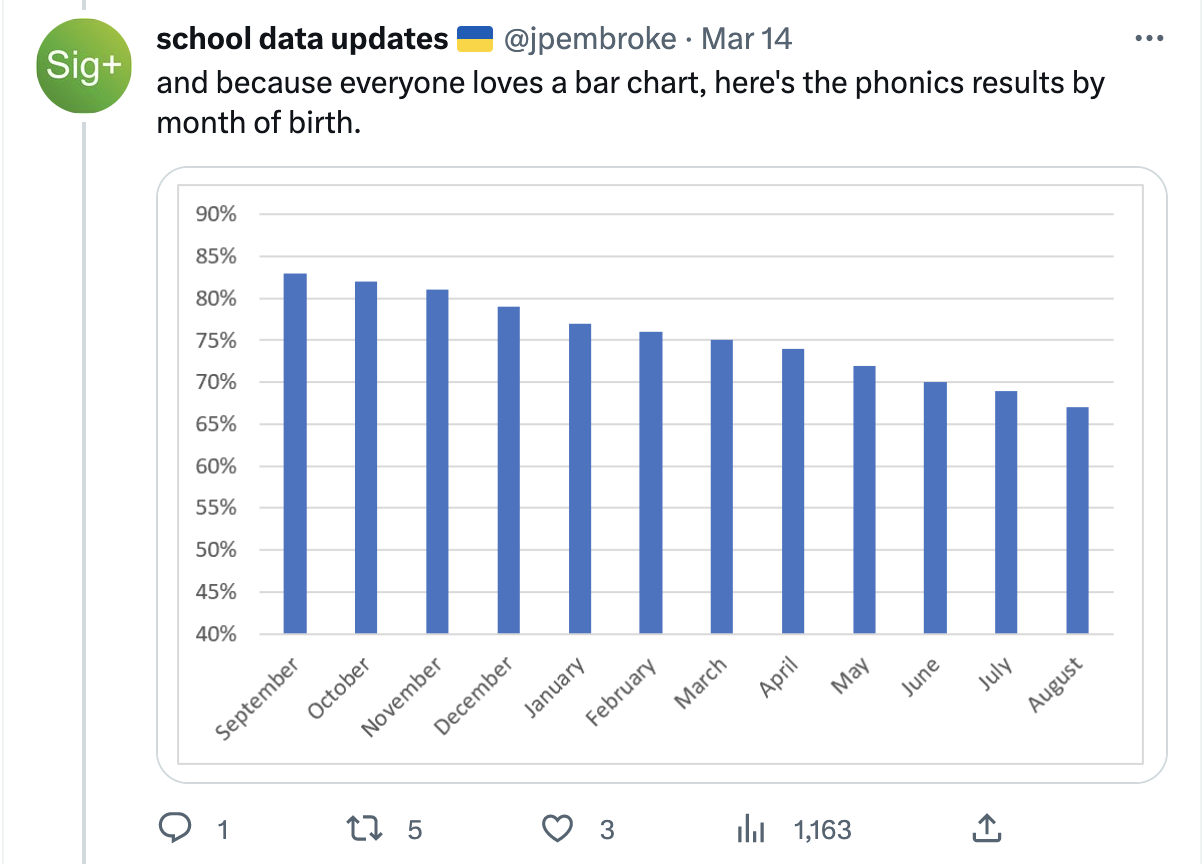
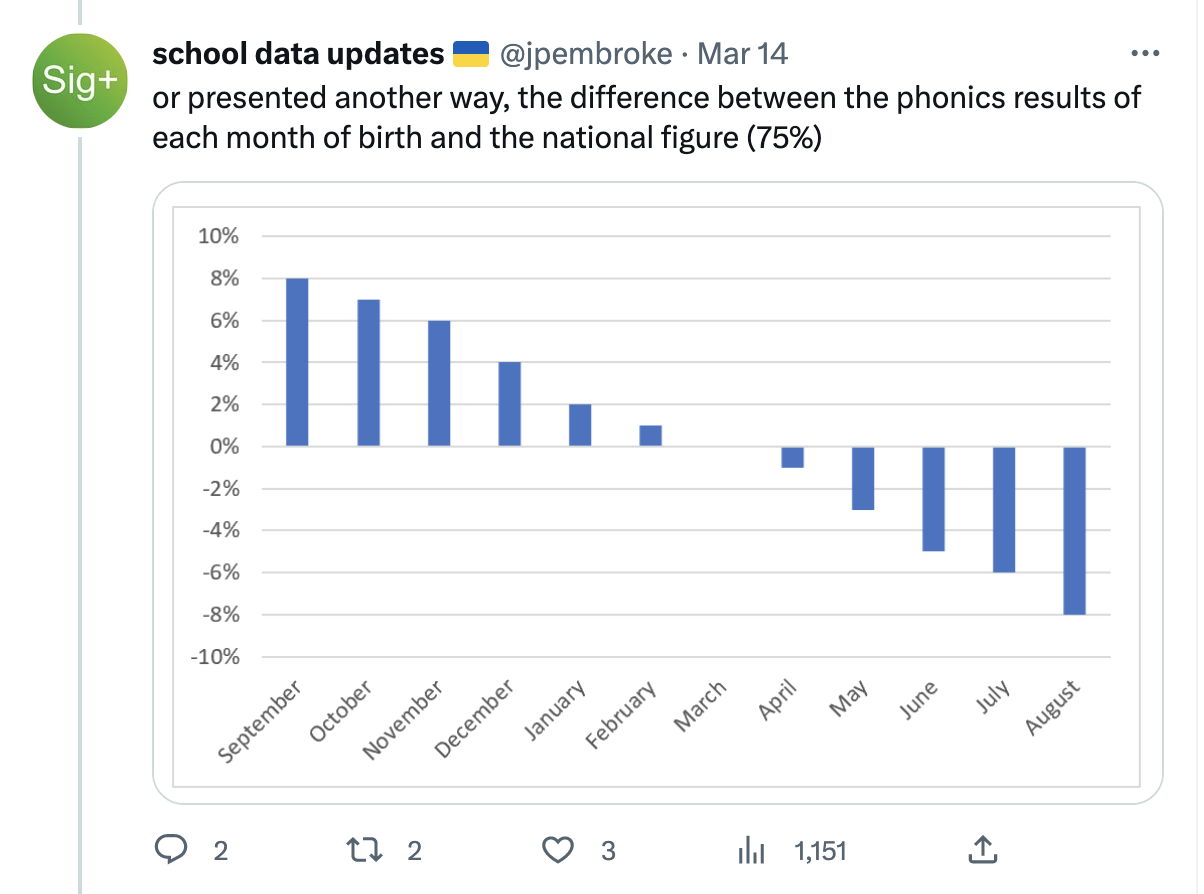
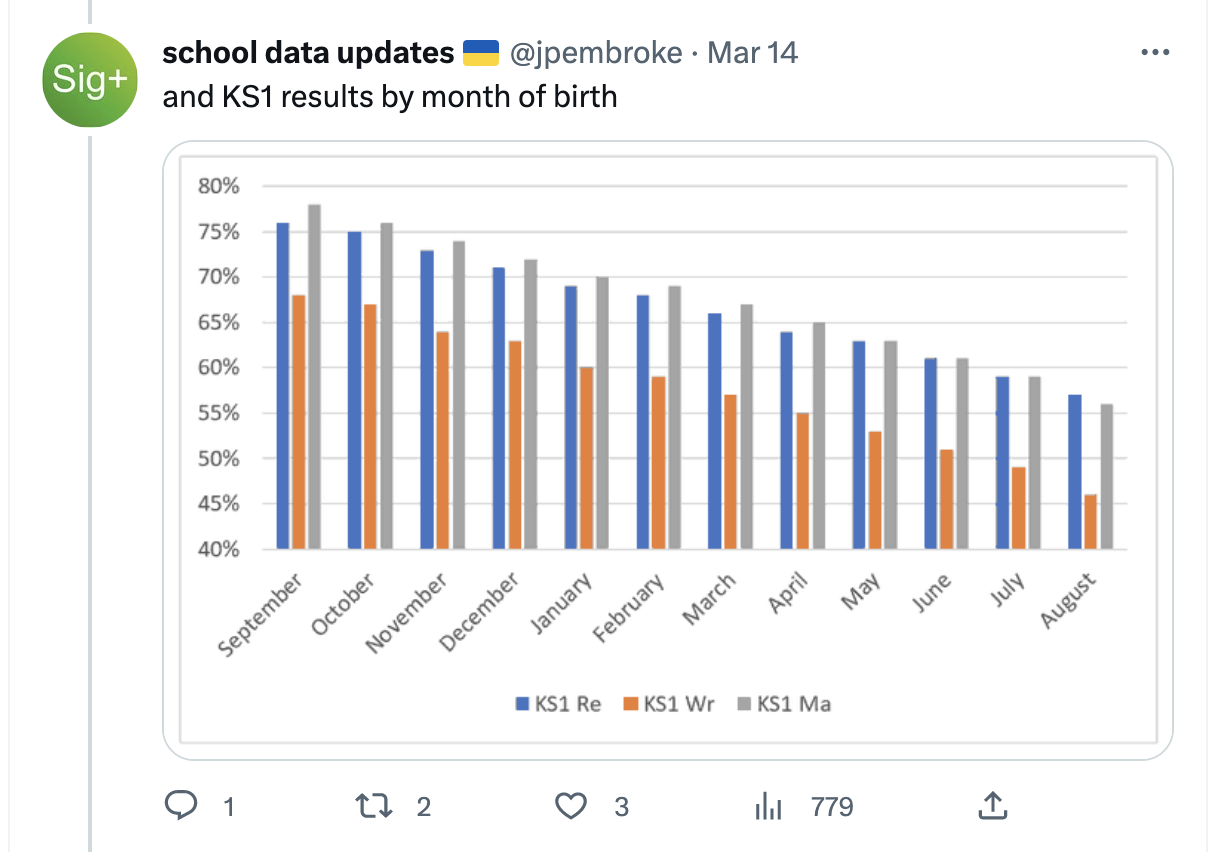
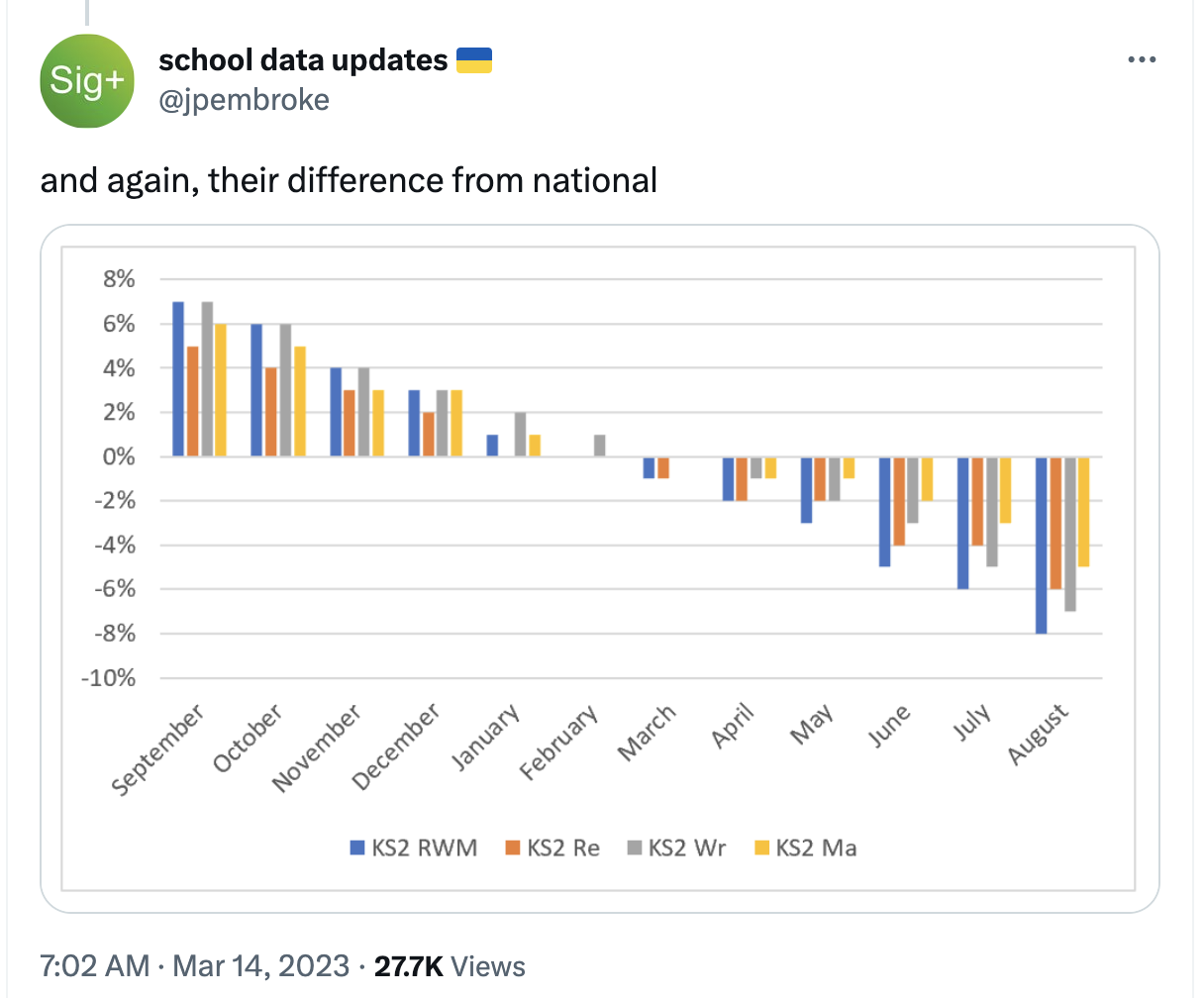
A Twitter thread examines grade-level achievement aggregated by month of birth:

The thread builds off a blog post: Age-Related Expectations? by James Pembroke.

The most fascinating aspect of this analysis thread is the series of charts provided:

As the analysis shows, student achievement is strongly correlated with birth month, which calls into question how well standardized testing serves high-stakes practices and how often standardized testing reflects something other than actual learning.

Being older in your assigned grade level is not an aspect of merit, and being older in your assigned grade seems to have measured achievement benefits that aren’t essentially unfair to younger members of a grade.

Further, this sort of analysis helps contribute to concerns raised about grade retention, which necessarily removes students most likely to score low on testing and reintroduces those students as older than their peers in the assigned grade, which would seem to insure their test data corrupts both sets of measurements.

This data above are from the UK, but a similar analysis by month/year of birth applied to retained students and their younger peers would be a powerful contribution to understanding how grade retention likely inflates test data while continuing to be harmful to the students retained (and not actually raising achievement).

There appears to be even more problems with grade-level proficiency than noted previously, and now, even more reason not to continue to use the rhetoric or the metric.

The Long and Tired History of Media-Driven Reading Wars

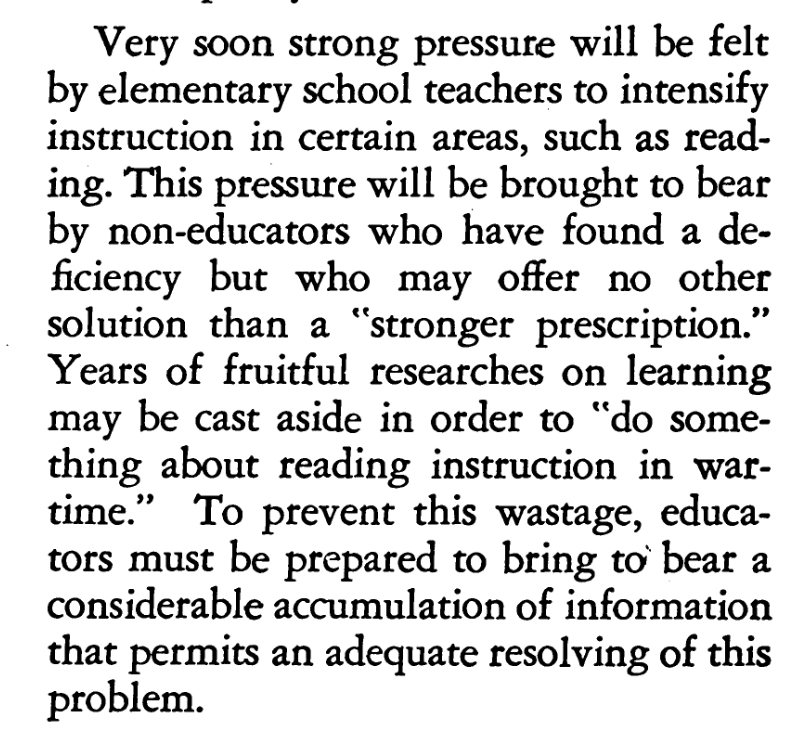
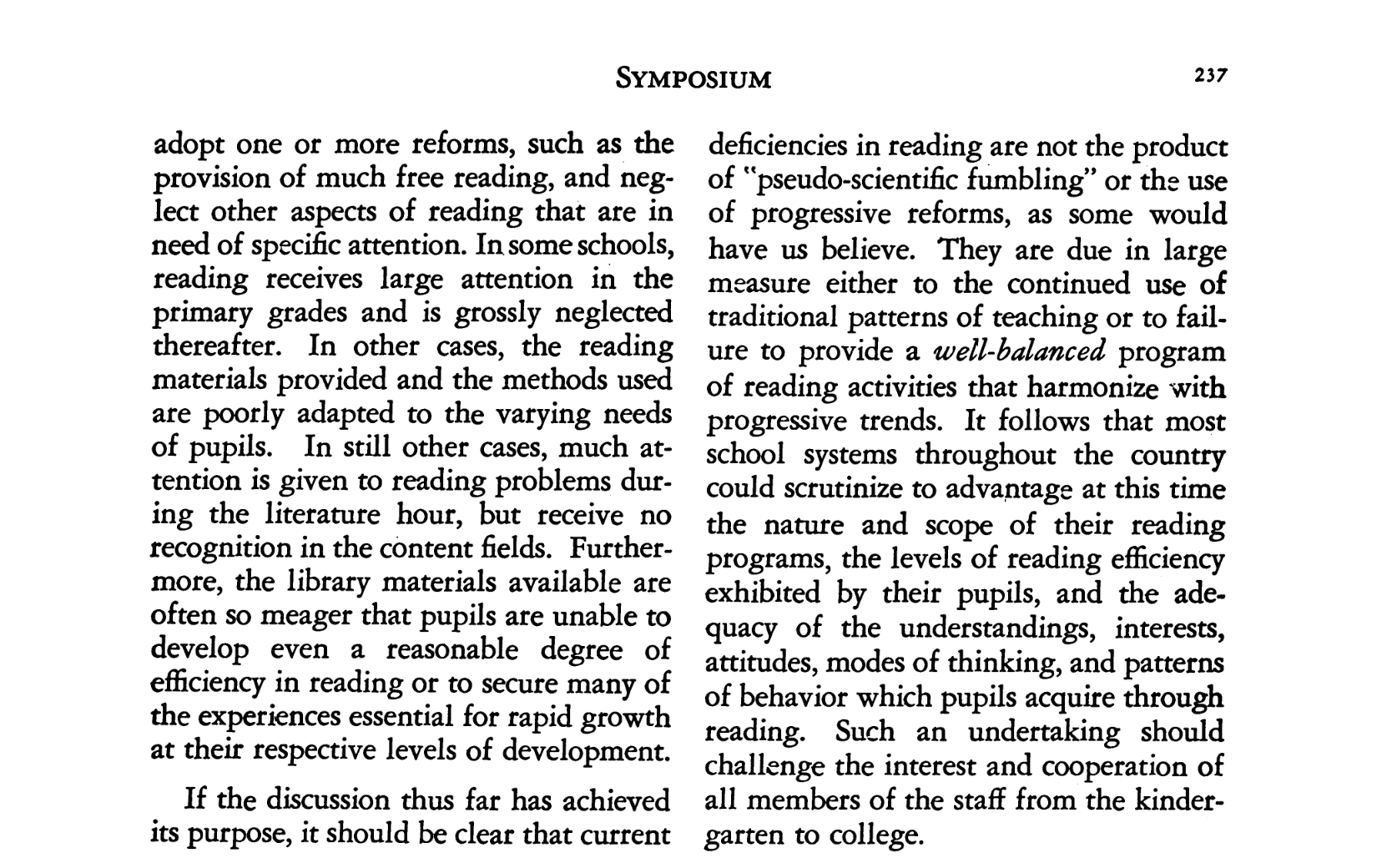
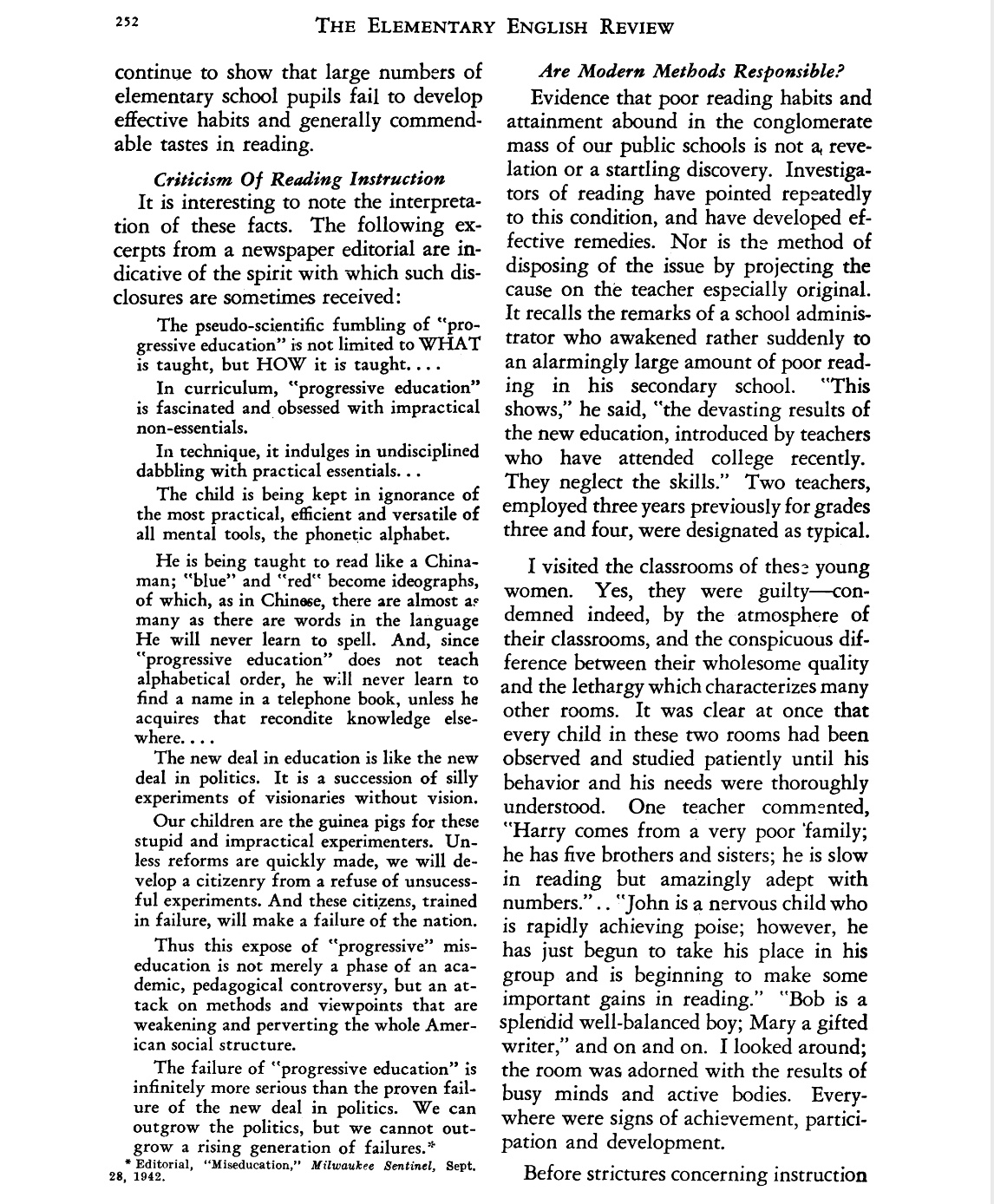
Consider the following excerpts from a scholarly journal of literacy. The articles included are responses from literary scholars to a political and media claim of a reading crisis.

First from Emmett A. Betts:

Next, from William S. Gray:

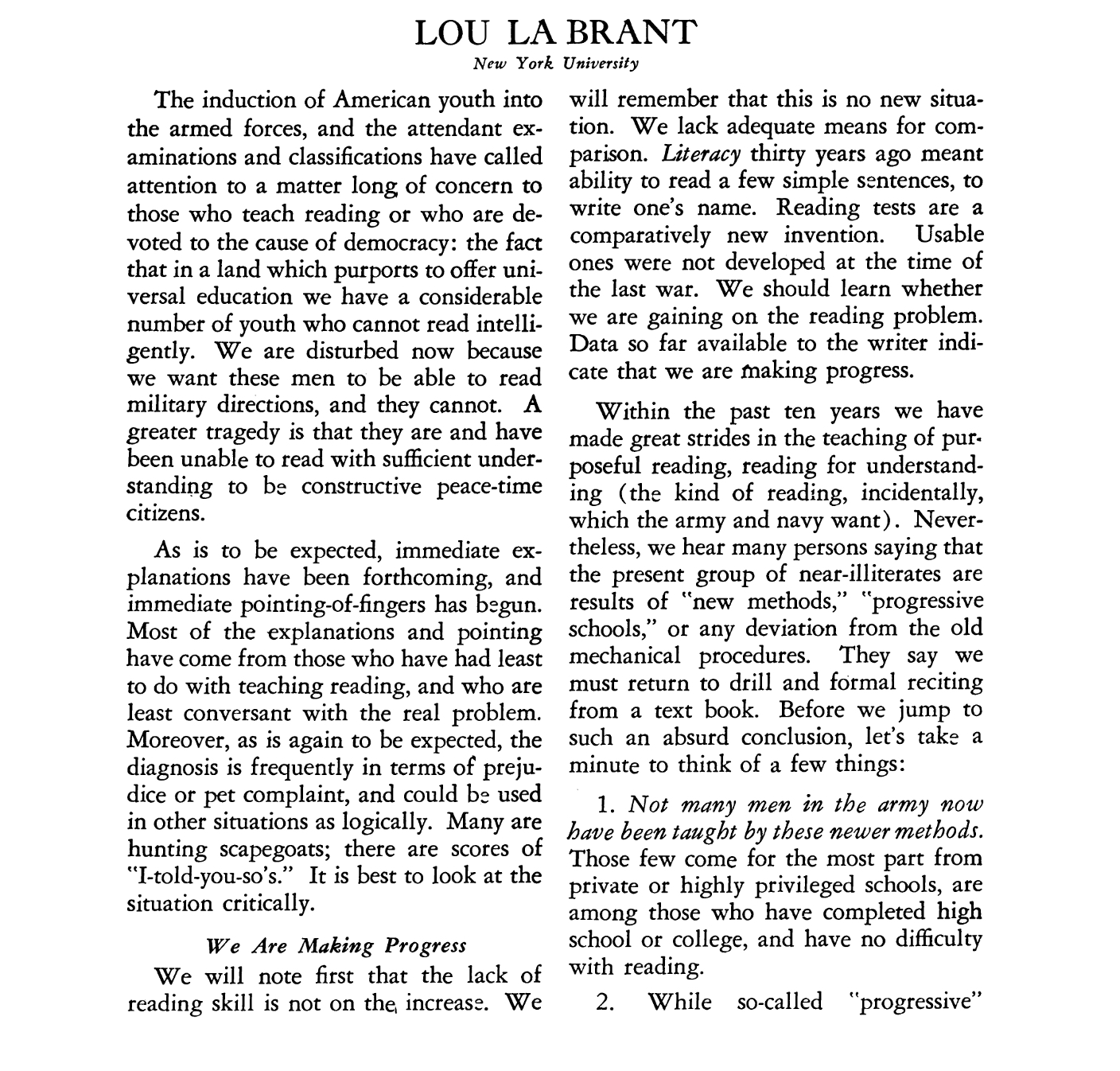
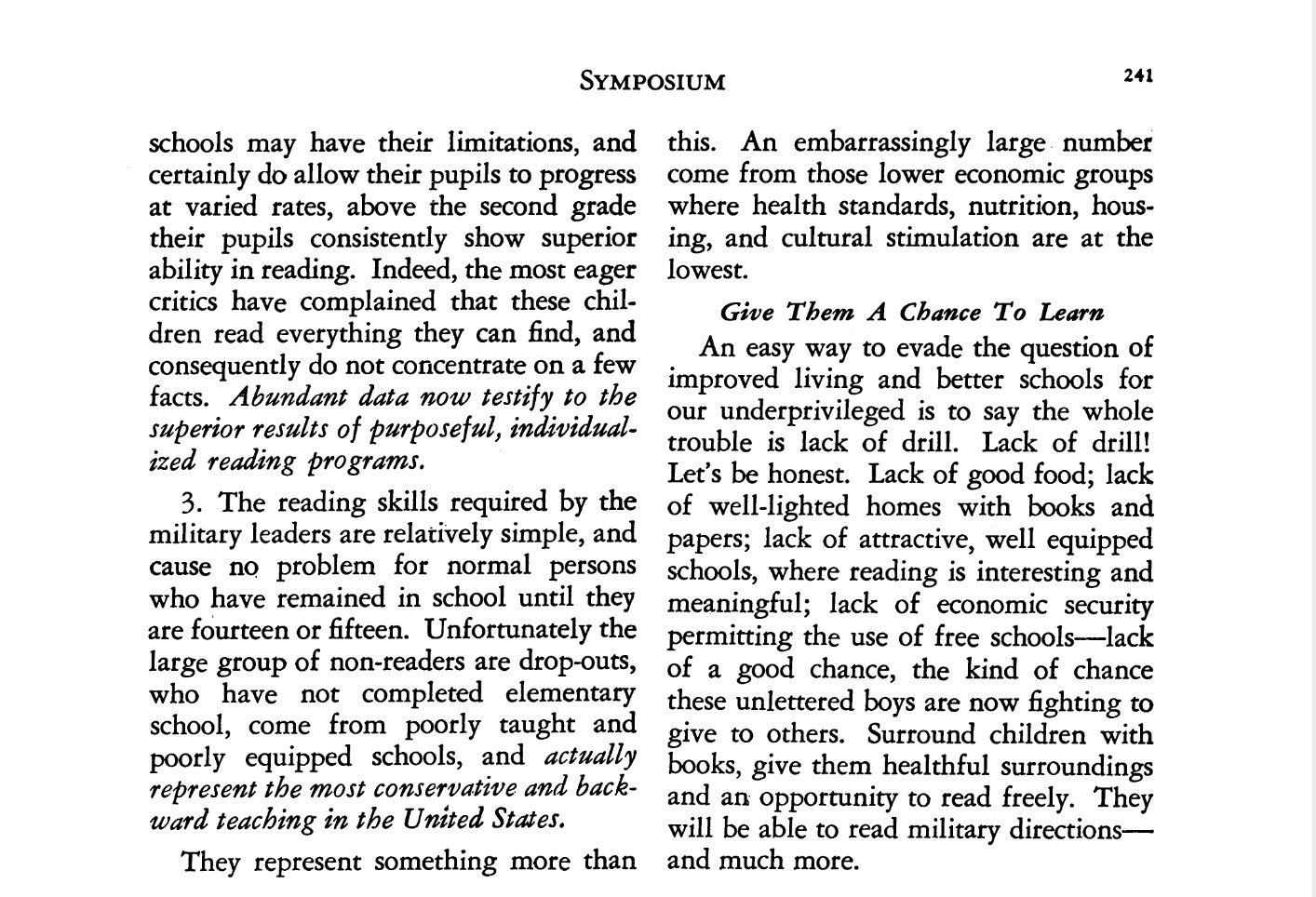
And then, from Lou LaBrant:

Finally, Paul Witty:

These patterns may seem familiar in 2023 to anyone following the “science of reading” movement:

  • Public schools are failing to teach adequately children to read.
  • Reading teachers are ill-equipped to teach reading.
  • Reading and teaching strategies are not scientific.
  • Political leaders and the media drive the criticism.
  • And literacy scholars carefully debunk the entire narrative, to no avail.

These excerpts are from 1942 and collected in The Elementary English Review (The National Council of Teachers of English), which would become Language Arts [1].

The reading crisis was spurred by high illiteracy rates in WWII draftees and Eleanor Roosevelt’s call to action and media coverage of the reading crisis.

The blame game, like now, is misguided and ill informed. Progressive education was the scapegoat, but LaBrant and others noted these soldiers had attended mostly traditional schooling.

Scholar after scholar also note that high illiteracy rates were caused by high poverty levels.

In 2023, as we are trying to stay afloat during the “science of reading” tidal wave of misinformation, we must acknowledge that this current reading war does not differ in any significant way from several since the 1940s.

We must also acknowledge that at no point has the US found reading achievement adequate regardless of teacher training, reading theories, or reading programs and instructional practices.

Reading Wars, then, are reductive, misleading, and ultimately ineffective—over and over.

The “science of reading” movement is another round of misguided blame, misinformation, and yet more hollow calls for “reform” that isn’t anything new or valid.

The “science of reading” is tired and lazy journalism, politics, and ultimately education.


[1] Betts, E., Dolch, E., Gates, A., Gray, W., Horn, E., LaBrant, L., . . . Witty, P. (1942). What shall we do about reading today?: A symposium. The Elementary English Review, 19(7), 225-256. http://www.jstor.org/stable/41382636 [access HERE]