My entire career in education, begun in the fall of 1984, has been during the accountability era of education that is primarily characterized by one reality—perpetual reform.
The template has been mind-numbingly predictable, a non-stop cycle of crisis>reform>crisis>reform, etc.
Another constant of that cycle is that the crisis-of-the-moment has almost always been overblown or nonexistent, leading to reforms that fall short of the promised outcomes. Reforms, ironically, just lead to another crisis.
But one of the most powerful and damning elements in the crisis/reform cycle has been the education miracle. [1]
Two problems exist with basing education reform on education miracles. First, and overwhelmingly, education miracles are almost always debunked as misinformation, misunderstanding of data, or outright fraud. Research has shown that statistically education miracles are so incredibly rare that they essentially do not exist.
Second, even when an education miracle is valid, it is by definition an outlier, and thus, the policies and practices of how the miracle occurred are likely not scalable and certainly should not be used as a template for universal reform.
Those core problems with education miracles have prompted the attention of Howard Wainer, Irina Grabovsky and Daniel H. Robinson, who have analyzed the reading reform miracle claims linked to Mississippi:
In 1748, famed Scot David Hume defined nature. He elaborated such a law as “a regularity of past experience projected by the mind to future cases”. He argued that the evidence for a miracle is rarely sufficient to suspend rational belief because a closer look has always revealed that what was reported as a miracle was more likely false, resulting from misperception, mistransmission, or deception….
A careful examination confirms that enthusiasm to emulate Mississippi should be tempered with scepticism….
In short, the authors followed a key point of logic: If something seems too good to be true, then it is likely not true.
In their analysis, On education miracles in general (and those in Mississippi in particular), they focused on two of the key problems with the story about Mississippi’s outlier grade 4 reading scores (in the top quartile of state scores) on NAEP: What is the cause of the score increases? And, why are Mississippi’s grade 8 reading scores remaining in the bottom quartile of state scores?
They found, notably, that Mississippi’s instructional reform, teacher retraining, additional funding, and reading program changes were not the cause of the score increases, concluding:
But it was the second component of the Mississippi Miracle, a new retention policy, perhaps inspired by New Orleans’ Katrina disaster a decade earlier, that is likely to be the key to their success….
Prior to 2013, a higher percentage of third-graders moved on to the fourth grade and took the NAEP fourth-grade reading test. After 2013, only those students who did well enough in reading moved on to the fourth grade and took the test.
It is a fact of arithmetic that the mean score of any data set always increases if you delete some of the lowest scores (what is technically called “left truncation of the score distribution”)….
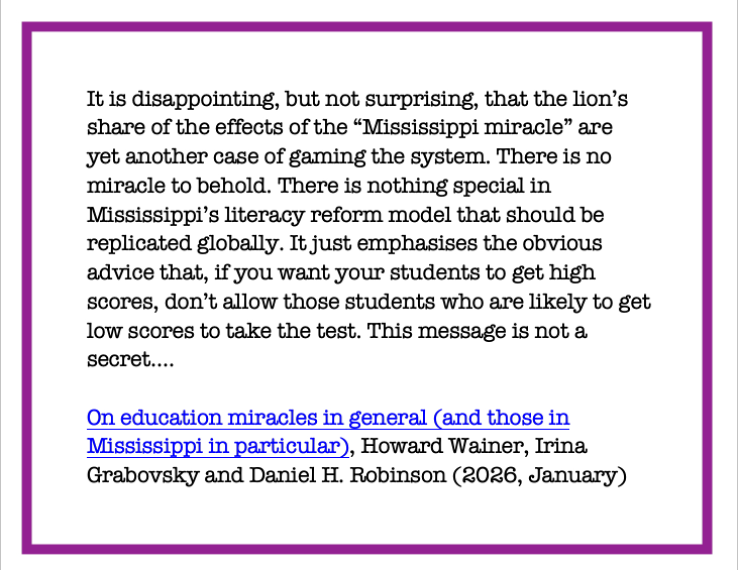
In short, Mississippi has inflated grade 4 NAEP scores, but that is unlikely evidence that student reading proficiency has improved. This is not a story about reading reform, but about “gaming the system”:
It is disappointing, but not surprising, that the lion’s share of the effects of the “Mississippi miracle” are yet another case of gaming the system. There is no miracle to behold. There is nothing special in Mississippi’s literacy reform model that should be replicated globally. It just emphasises the obvious advice that, if you want your students to get high scores, don’t allow those students who are likely to get low scores to take the test. This message is not a secret….
Wainer, Grabovsky and Robinson’s analysis also needs to be put in context of two other studies.
First, their analysis puts a finer point on the findings by Westall and Cummings, whose comprehensive review of contemporary reading reform found the following: Third grade retention (required by 22 states) is the determining factor for increased test scores (states such as Florida and Mississippi, who both have scores plummet in grade 8), but those score increases are short-term.
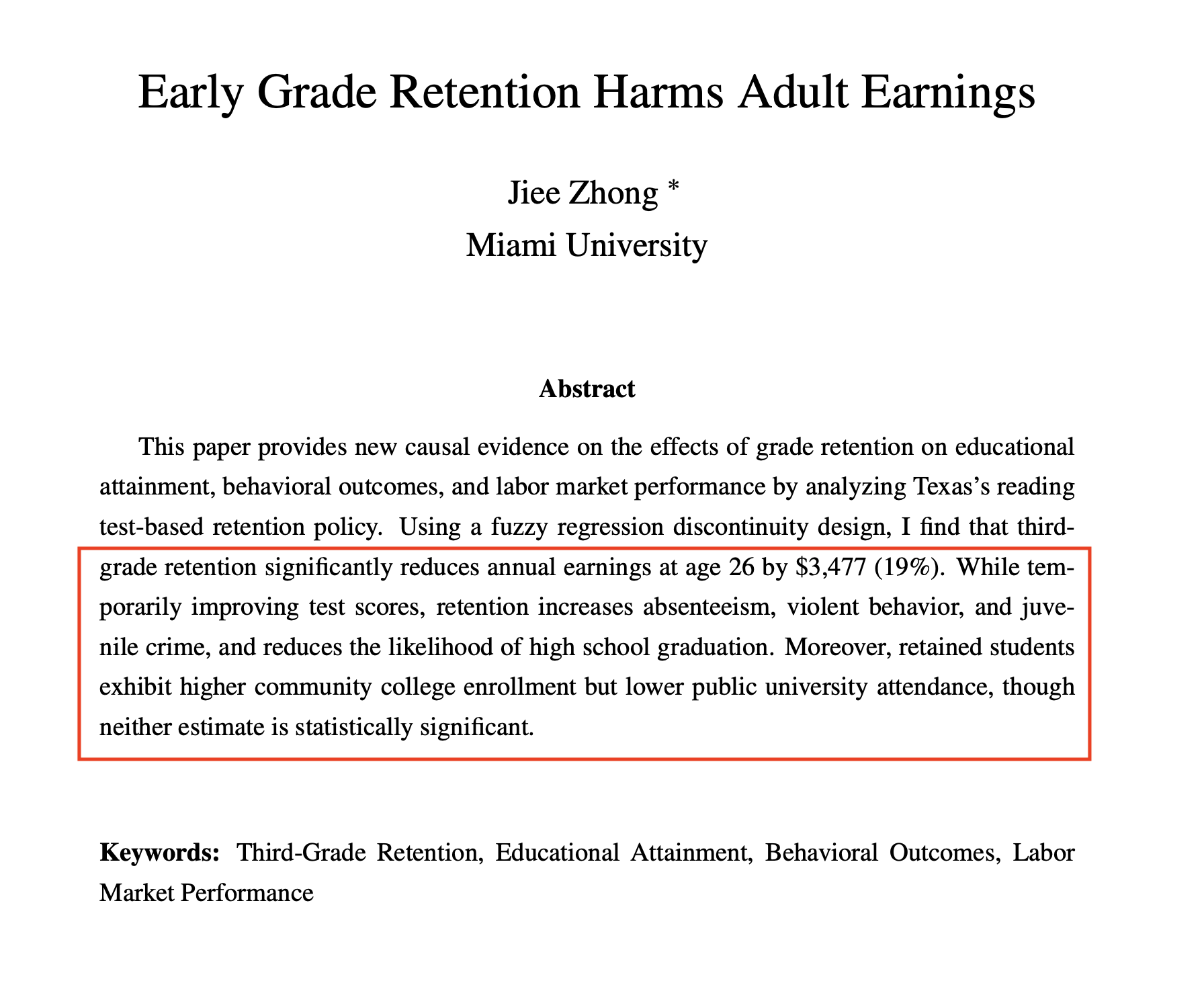
Next is a recent study on grade retention. Jiee Zhong concluded:
[T]hird-grade retention significantly reduces annual earnings at age 26 by $3,477 (19%). While temporarily improving test scores, retention increases absenteeism, violent behavior, and juvenile crime, and reduces the likelihood of high school graduation. Moreover, retained students exhibit higher community college enrollment but lower public university attendance, though neither estimate is statistically significant.
Grade retention masquerading as reading reform, then, is fool’s gold for inflating test scores, but it is also harming the very students the reform purports to be helping.
The evidence now suggests that reading reform should not be guided by miracle claims; that no states should be looking to a miracle state for reading reform templates; that the so-called “science of reading” movement is mostly smoke and mirrors, and should be recognized as the “science of retention”; and that grade retention policies are distorting test scores at the expense of our most vulnerable students in life changing ways.
Third grade retention (required by 22 states) significantly contributes to increases in early grade high-stakes assessment scores as part of comprehensive early literacy policy.
Retention does not appear to drive similar increases in low-stakes assessments.
No direct causal claim is made about the impact of retention since other policy and practices linked to retention may drive the increases.
However, their analysis concludes about grade retention as reading reform :
Similar to the results for states with comprehensive early literacy policies, states whose policies mandate third-grade retention see significant and persistent increases in high-stakes reading scores in all cohorts. The magnitude of these estimates is similar to that of the “any early literacy policy” estimates described in Section 4.1.1 above, suggesting that states with retention components essentially explain all the average effects of early literacy policies on high-stakes reading scores. By contrast, there is no consistent evidence that high-stakes reading scores increase in states without a retention component.
Therefore, one Big Lie about grade retention is that it allows misinformation and false advocacy for the recent “science of reading” reform across most states in the US.
Since grade retention in the early grades removes the lowest scoring students from populations being tested and reintroduces them biologically older when tested, the increased scores may likely be from these population manipulations and not from more effective instruction or increased student learning.
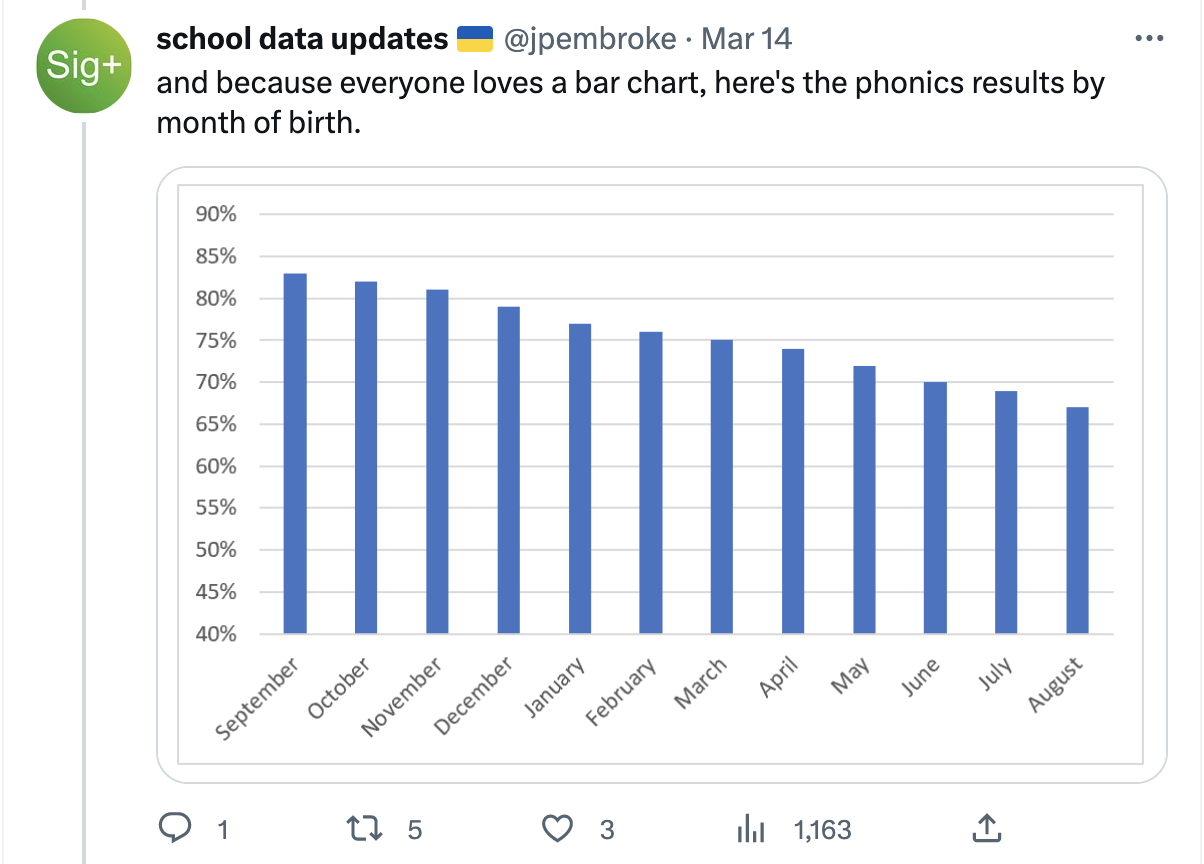
Evidence from the UK, for example, suggests that skills-based reading testing (phonics checks) that count as “reading” assessment strongly correlate with biological age (again suggesting that test scores may be about age and not instruction or learning):
Another Big Lie about grade retention is that reading reform advocates fail to acknowledge decades of evidence that grade retention mostly drives students dropping out of school and numerous negative emotional consequences for those students retained.
Resolved, that the National Council of Teachers of English strongly oppose legislation mandating that children, in any grade level, who do not meet criteria in reading be retained.
And be it further resolved that NCTE strongly oppose the use of high-stakes test performance in reading as the criterion for student retention.
Grade retention, then, is an effective Big Lie of Education because it allows misinformation based in test-score increases to promote policy and practices that fail to increase test scores in sustained ways (see the dramatic drop in “success” for “high-flying” states such as Mississippi and Florida, both of which taut strong grade 4 reading scores, inflated by grade retention, but do not sustain those mirage gains by grade 8).
Grade retention is a Big Lie of education reform that punishes minoritized and marginalized students, inflates test scores, and fuels politicized education reform.
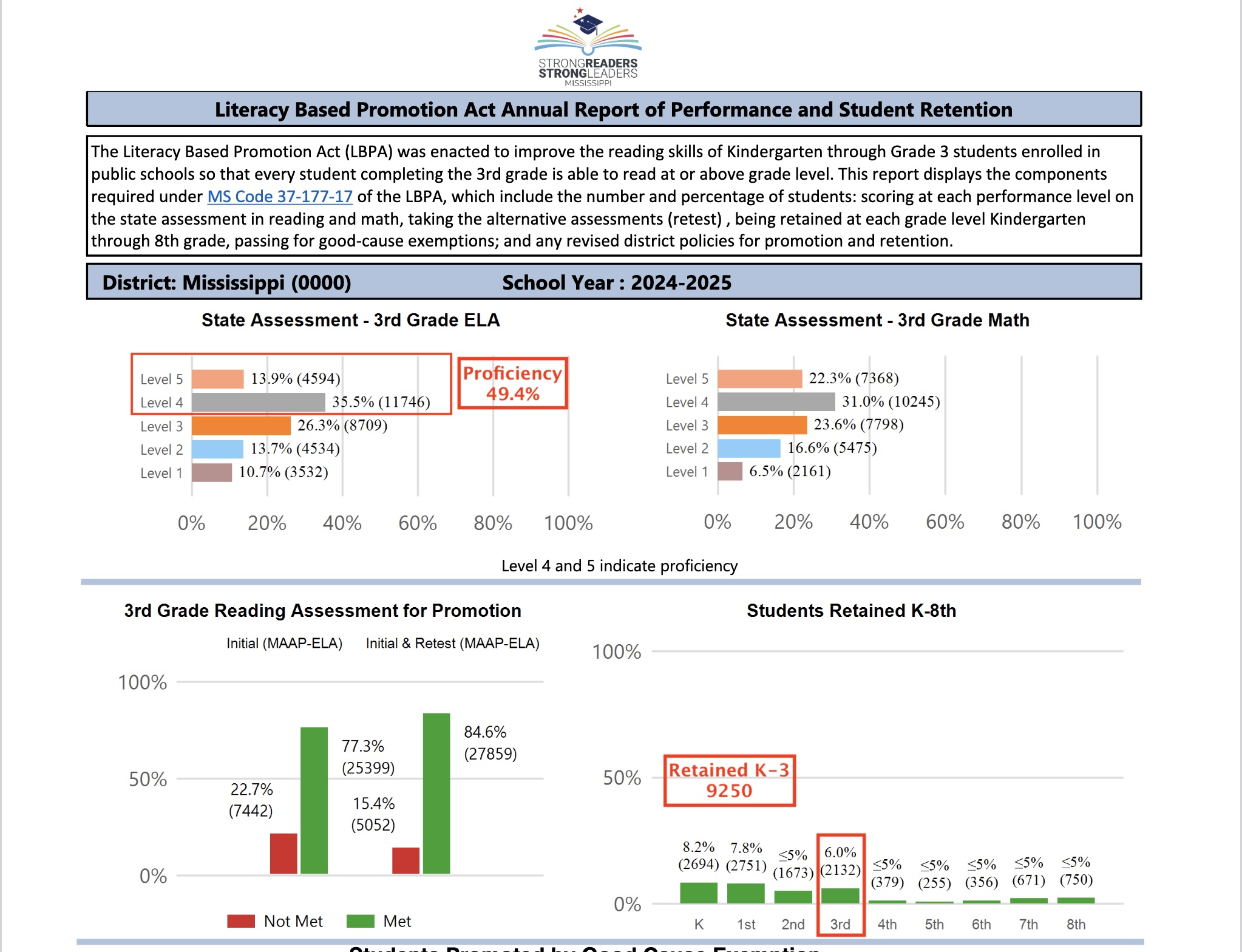
[1] Consider that states retaining thousands of students each year, such as Mississippi, have not seen those retention numbers drop, suggesting that the “science of reading” reforms are simply not working but the retention continues to inflate scores.
The following data from Mississippi on reading proficiency and grade retention exposes that these claims are misleading or possibly false:
The more things change, the more things stay the same.
Especially in America.
F. Scott Fitzgerald’s The Great Gatsby, set in the 1920s, centers the story on a few rich characters—Tom and Daisy Buchanan, who have “old” money, as well as Jay Gatsby, representing the nouveau riche.
At the cusp of 2024 and 2025, a century later, one page from the novel seems disturbingly relevant:
In this scene, Fitzgerald uses Buchanan to portray the rise of scientific racism in the US. The scientific racism era in the early 20th century is but one of many examples of how “science” can be used by bad faith actors to promote an ideological agenda.
It isn’t his fault, Buchanan seems to suggest, that he is among the superior white Western civilization: “‘It’s all scientific stuff; it’s been proved.'”
In recent years in the US, navigating science, proof, and science skepticism has reach a level of complexity that defies postmodern thought. Simultaneously, we may be living in the most advanced era of scientific knowledge along side a rising and powerful science-skepticism era.
Vaccination deniers, flat Earthers, and Covid conspiracy theorists have increasingly prominent voices and policy influence due to social media, and the Trump era certainly has eroded how most people understand and what counts as “proven” science.
“Science” as Bad Faith Bullying: Education Edition
Concurrent to the larger political and cultural problems with “science” and science-denial, the education reform movement grounded in the early 1980s accountability movement has adopted “science” as a bad faith bullying approach to reform.
The “science of reading” (SOR) movement [1], essentially driven by conservative ideology, exploded around 2018 under the first Trump administration, and now, SOR has spawned a series of “science of” companion movements—the “science of math,” “the science of learning,” etc.
We may have reached peak “science” as bad faith bullying, however, with a law suit against Heinemann and a few reading programs [2] disproportionately attacked and scapegoated by Emily Hanford and much of mainstream media: “The suit alleges ‘deceptive and fraudulent marketing and sale of products and services which are undermining a fundamental social good: literacy.'”
If this weren’t yet another personal attack on a few literacy leaders and potentially significant waste of time and money to navigate the nonsense of this legal move, it would be funny since the SOR movement itself is practicing exactly what the suit accuses Heinemann of doing, “fraudulent marketing and sale of products.”
Let’s start with the foundational argument among SOR advocates that teaching practices must be grounded only in practices supported by experimental/quasi-experimental research published in peer review publications, as argued by The Reading League:
While I think these standards are too narrow for real-world practice, this is in fact the basis upon which SOR advocates (and the substance of the law suit) rest sweeping and misleading claims about a range of discounted practices labeled as either whole language or balanced literacy (SOR advocates both interchange and mischaracterize these terms repeatedly along with misrepresenting other terminology such as “three cueing”).
Further, the SOR movement has adopted an old and inaccurate assertion about “science,” echoing Tom’s “‘it’s been proved.'”
Similar to the reading crisis rhetoric from 1961—when Walcutt announces: “We have said that no further ‘research’ into methods of reading instruction is necessary” (p. 141)—Hanford and Moates proclaimed SOR “settled science” in 2018 (and we must note Moates has a huge market interest in these claims as author of LETRS, see below):
However, the “science” in reading research is not settled, and the SOR movement, as I stated above, is committed to a “deceptive and fraudulent marketing and sale of products and services”; as I have shown repeatedly, the SOR movement is itself grounded in a plan from 2014 to brand “structure literacy” to “help us sell what we do so well.”
That plan has included exaggerated attacks on some reading programs, some literacy leaders, and some literacy practices while simultaneously endorsing different programs and some practices that are also not supported by SOR’s mandate for a narrow type of “science.”
For example, in a literature review of the current status of SOR from 2022, note that practices either ineffective or lacking scientific support include those rejected by SOR and those embraced by SOR; while this lit review identified “three cueing” as not supported by science as SOR advocates claims, it also lists decodable texts and multisensory approaches (such as Orton-Gillingham), practices and programs aggressively supported by SOR advocates and legislation:
That pattern is standard practice in the SOR movement, including the false attack on teacher education and teacher knowledge being used as “science” as bad faith bullying to sell LETRS.
LETRS falls into the “ineffective and currently unsupported” category as well since only a few studies exist, showing no improvement in student reading.
The SOR movement has also adopted slogans not supported by science (95% of students can be proficient readers) and practices that inflate test scores, target and harm marginalized groups of students, but are not supported by research (grade retention, which seems to be the sole SOR policy impacting test scores).
The “science of” era of education reform is not about improving instruction or student learning. The movement uses “science” as a Trojan horse for de-professionalizing teaching and teachers (selling scripted curriculum) while clearing market space for a new round of “fraudulent marketing and sale of products.”
The law suit is another example showing this “science of” education reform movement is more bad faith bullying than a credible avenue to better supporting teachers and better serving students as readers and learners.
[2] I reject adopting any reading programs and maintain that the reading-program-merry-go-round is the problem, not the solution to reading achievement.
The fall of 2024 will mark year 41 for me as a literacy educator, scholar, and advocate.
About half of that career was spent in K-12 public education in rural Upstate South Carolina, where I was born and live. I have witnessed daily race, social class, and gender inequity at some of the most extreme levels in the US.
At the core of my work as an educator, as well, I have named, challenged, and advocated to correct all forms of inequity. That work has often been in very hostile environments in the South where the power structures deny these inequities exist and persist at calling for traditional values as code for maintaining the status quo.
Also throughout my career as an educator and scholar, I have developed a solid grounding in the history of education and the field of literacy. Having written an educational biography of Lou LaBrant and serving as Council Historian for the National Council of Teachers of English were foundational experiences for that commitment to the history of education.
Further, having begun as an educator in 1984, I have lived and worked my entire career in the high-stakes accountability era of education reform. At every point along the way, I have raised a hand in opposition to this reform paradigm because it is driven by media, the market, and politicians who are more committed to education reform as industry than to serving the needs of our students or honoring the professionalism of America’s teachers, who are more than 70% women.
The “science of reading” movement and the offspring “science of” reform agendas are nothing new, except they are incredibly harmful—notably for the very students some of the advocates use as shields against criticism.
Once again, “science,” “crisis,” and “miracle” are being weaponized to not only label and punish students but also de-professionalize teachers.
One of the most effective and dishonest tactics is the “crisis” claim about reading in the US.
First, this claim lacks a basic understanding of educational testing, and further, the claim is ahistorical.
At least since the 1940s in the US, two facts can be proven: (1) at no point has student reading achievement (“proficiency”) been declared adequate; there has been a perpetual cry of reading “crisis” in every decade by media and political leaders, and (2) throughout the history of US public education, there has been a pervasive so-called “achievement gap” (better referred to as an “opportunity gap”) with marginalized populations of students performing well below average or white and affluent students.
That means that current reading achievement however measured and current “achievement gaps” are not a crisis but a historical and current reality maintained by political negligence.
Since current “science of” advocates have a fetish for misrepresenting and citing NAEP, let’s look at how NAEP in fact proves my point.
Consider Mississippi, the darling of reading reform and media crowning as a “miracle:
At grades 4 and 8 in reading, Black students in MS were BELOW basic (approximately below grade level) at a rate of 51%, about the national rate for Black students.
Note that despite well over a decade of SOR reading reform, the achievement gap for Black students remains about the same as in 1998.
Education and reading reform is not addressing the inequity Black students suffer in MS or anywhere in the US. However, the SOR movement has been doubling down on labeling and punishing Black students through grade retention, which serves to inflate grade 4 scores but not better prepare students.
MS has consistently retained about 9000-12000 students (mostly Black students) since 2014; if SOR policy and instruction were actually working, these retention number should drop or even disappear (since SOR advocates claim to be able to have 95% students reach proficiency).
And thus, my advocacy for my entire career has been for both social and education reform that focuses on equity and refuses to blame teachers and students for that inequity.
For the past forty-plus years, however, education reform has solely targeted blame on schools, teachers, and students.
Those racially minoritized students and students living in poverty have routinely been characterized by deficit ideology, and reform has sought to “fix” those students by inculcating grit or growth mindset—or simply imposing a systematic phonics regime on those students, treating them all as if they have reading “disorders.”
And if those students don’t perform, retain them (punish them) and label them. Yet, there is never any consequences for the reformers when none of their reform promises are fulfilled (see the charter fiasco in New Orleans).
Hyper-focusing on MS (and Florida) is not just a lie, but a distraction.
Students in military families are often from impoverished backgrounds, yet Black students BELOW basic are at rates of 25% (grade 4) and 18% (grade 8), dramatically less than the national average and MS.
And here is what the media, the market, and politicians refuse to acknowledge: DODEA students have medical care, food security, housing security, and parents with work stability.
Also, DODEA teachers are paid above most public school teachers.
Unlike the false claims about MS, DODEA achievement shows that both in- and out-of-school reform must be addressed for the in-school achievement to rise in authentic ways.
I am tempted to say the real crisis is how media and political leaders mislead the public about education and education reform—as well as demonize students and teachers.
But that is also nothing new.
There is great profit in perpetual crisis so don’t hold your breath that anything will change any time soon.
In the wake of Katrina in 2005, Louisiana Governor Bobby Jindal (R) leveraged the natural disaster to begin the eventual shift of schools in New Orleans from traditional public schools (TPS) significantly staffed by a Black professional class of teachers to a charter school Recovery School District (RSD) run by Paul Vallas and often staffed by young, white, and affluent Teach for America (TFA) recruits.
This moment was acknowledged by some as disaster capitalism that had far more to do with politics than improving student achievement. The endgame was to entrench school choice schemes and create a cheaper although fluctuating teacher workforce (TFA).
Yet, as many of us warned, an all-charter school system in New Orleans never outperformed the TPS it replaced.
In fact, all across the US, charter schooling, RSD, TFA, and almost every major education reform schemes have never delivered on the academic outcomes promised.
Here, it is important to acknowledge that most education reform in the US over the past 40 years has been grounded in conservative ideology (even though the political support has been bi-partisan) and most of that reform is Trojan Horse reform—using a false veneer of reform to accomplish ideological and political agendas.
School choice schemes are not about student achievement but about publicly funding private education and “white flight” as public schools have become majority-minority populations of students.
TFA and organizations such as National Council on Teacher Quality (NCTQ) are not designed to improve teacher quality or teacher preparation but about creating a cheap workforce and eradicating teacher professionalism to make way for teachers as mere monitors for scripted programs and computer-based instruction.
Although just two examples, the key point is running through Trojan Horse education reform is not just political and conservative ideology but also a commitment to market forces.
Education reform in the US primarily creates churn—new standards, new programs, new materials, new teacher training, etc.—that serves the needs of the market, not parents or their children. That churn is promoted by education reform influencers who only gain if schools, teachers, and students are perpetually viewed as failing—permanent crisis.
Lurking underneath education reforms during George W. Bush’s tenure as governor of Texas and president of the US was the lure of scripted curriculum that shifted authority away from the teacher and to the state and primarily commercial products.
Although Bush’s reform agendas flourished with bi-partisan support, scripted curriculum and de-professionalizing teachers (see also the value-added methods schemes and the “bad teacher” attacks under Michelle Rhee) mostly lost favor and lay dormant post-Obama (even as the Obama administration double-down on most of the conservative elements established by Bush’s administration).
That is, lay dormant until the “bad teacher” myth was resurrected by Emily Hanford and the “science of reading” (SOR) movement.
As Aukerman explains, the story being sold included several elements of failure and incompetence that pits classroom teachers against teacher educators (both of which are primarily women professionals):
Now that SOR has mostly uncritically swept across the US in the form of state-level reading legislation and policy, the evidence suggests that at the core of the so-called success of SOR policies (see Mississippi and Florida) is one of the most conservative and harmful policies possible—grade retention, as Westall and Cummings explain:
Similar to the results for states with comprehensive early literacy policies, states whose policies mandate third-grade retention see significant and persistent increases in high-stakes reading scores in all cohorts. The magnitude of these estimates is similar to that of the “any early literacy policy” estimates described in Section 4.1.1 above, suggesting that states with retention components essentially explain all the average effects of early literacy policies on high-stakes reading scores. By contrast, there is no consistent evidence that high-stakes reading scores increase in states without a retention component.
Grade retention disproportionately impacts poor students, Black students, Multi-lingual learners, and other marginalized population of students. Retention is popular because it represents a type of accountability and punishment for “other people’s children” who need to be “fixed” by those in power.
Concurrent with the SOR movement, a new flurry of “science of” movements have propagated: “science of learning,” “science of writing,” “science of math.”
The mostly uncritical support for SOR by the media, the education market, parents, and politicians have provided fertile ground for a larger “science of” movement to drive our newest round of the same education reform structures we have been implementing without improving student achievement for forty-plus years.
Let’s emphasize here, Trojan Horse education reform doesn’t work to improve teaching and learning, but it does work for media, market, and political interests.
And now, the mask is coming off with the announcement of the Evidence Advocacy Center:
In the EAC’s plan for the transformation of the profession into an evidence-based system, educators will relinquish certain freedoms — notably the leeway to employ ineffective practices — but will gain guidance that empowers them to fulfill their original purpose by profoundly impacting the future of students, families and communities. The alternative is to continue rearranging the deck chairs under the guise of education reform.
There is more than one kind of freedom, said Aunt Lydia. Freedom to and freedom from. in the days of anarchy, it was freedom to. Now you are being given freedom from. Don’t underrate it….
We were a society dying, said Aunt Lydia, of too much choice. (pp. 24, 25)
Under the Brave New World of “science of” education mandates, teachers will have freedom from professional autonomy and freedom to implement scripted programs!
And who benefits?:
Many of these groups are fundamentally conservative, but even a modicum of interrogating the Who and Why behind this agenda reveals some chilling concerns.
NCTQ was founded by the Thomas B. Fordham Institute, a conservative think tank dedicated to school choice/charter schools and market forces. Note that there is a distinct contradiction between advocating for “science” in education practices and citing NCTQ, which has never produced any scientifically valid “reports.”
The leadership of EAC includes several connections to the University of Oregon, home of DIBELS®, a phonics-centric program that was revitalized by the SOR movement.
Other leaders include Louisa Moats, creator of LETRS, which is being mandated across the US to retrain teachers in SOR even though, again, the program is not supported by science.
The 95 Percent Group is also based on an aspirational claim not grounded in settled science, as one analysis concludes about the 95% claim: “This all said, it does seem there is some level of support for 96% being a benchmark goal [emphasis added], for reading proficiency rates.”
And two key comments lurking in the background of these “science of” movements must not be ignored.
The term “Structured Literacy” is not designed to replace Orton Gillingham, Multi-Sensory, or other terms in common use. It is an umbrella term designed to describe all of the programs that teach reading in essentially the same way. In our marketing, this term will help us simplify our message and connect our successes. “Structured Literacy” will help us sell what we do so well.
Connect the dots and connect the rhetoric: “Relinquish certain freedoms,” “sell what we do so well,” “watchdogs.”
The “science of” movements are yet another cycle of Trojan Horse education reform. We have already opened the gates and waved this in with blinders on, so now we must do our best to reclaim teaching and learning that serves the needs of our students and not the media, the market, and political/ideological agendas at the expense of those students.
Note that the connections include policy in Florida (often called the “Florida Model” and anchored by third grade retention) and Mississippi and the influence of Jeb Bush’s ExcelinEd (which funded the report on retention in MS that Kristof cited).
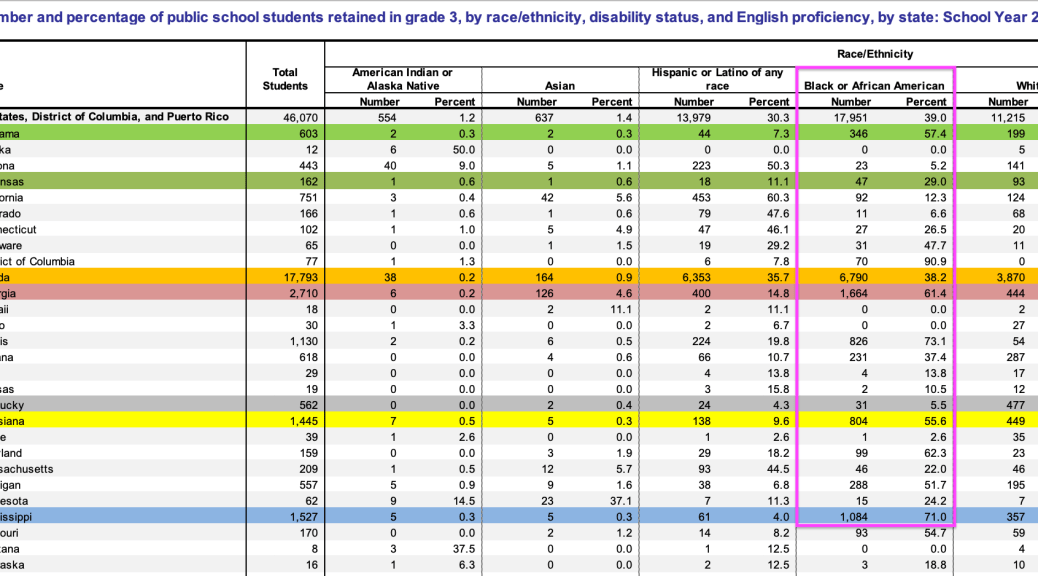
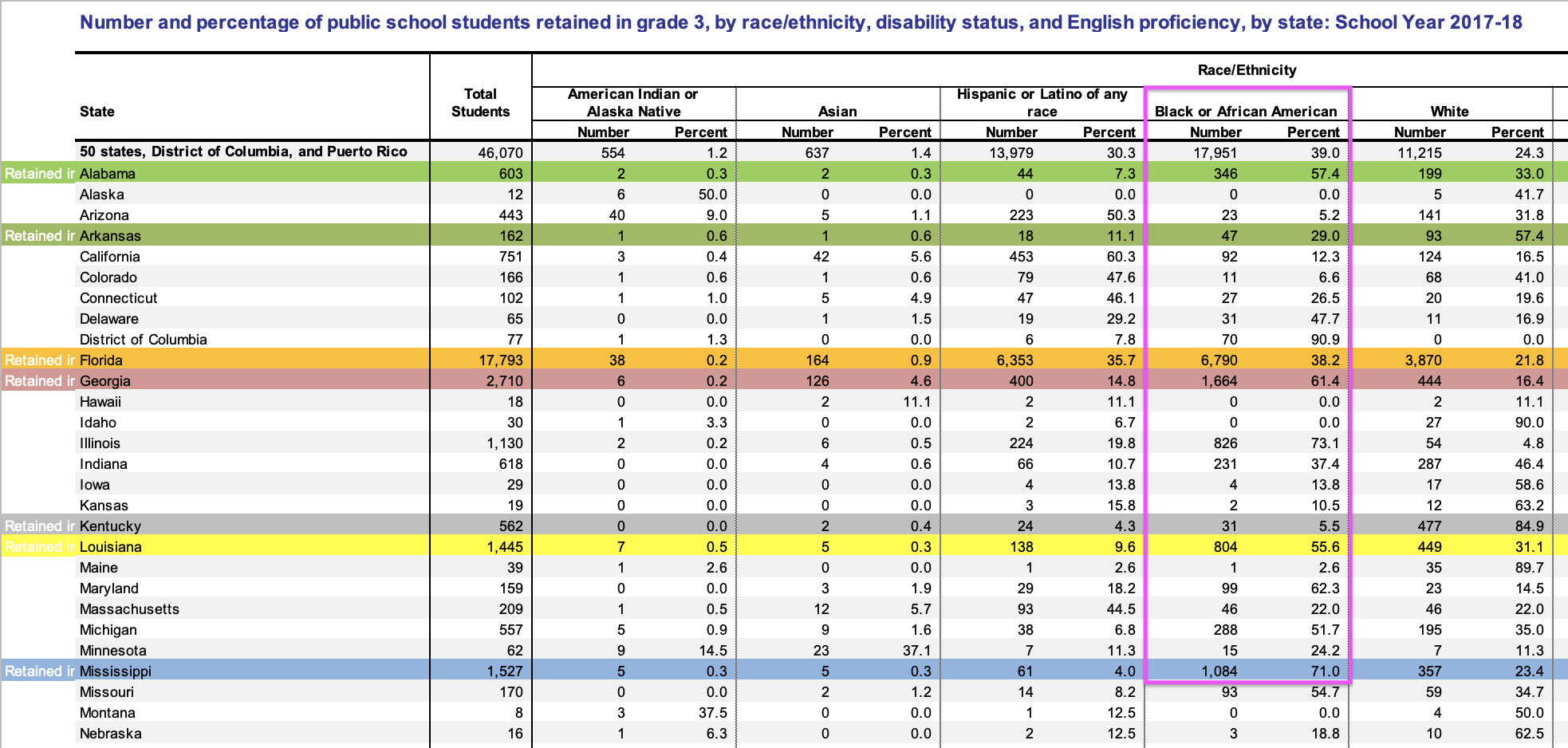
Here are some of the ugly numbers concerning grade retention and its disproportionate impact on Black students:
The short response to all this must be that grade retention is gaming the system and it is harmful to children, disproportionately harmful to Black, brown, and poor children.
Similar to ExcelinEd, Ohio Excels has entered the grade retention advocacy movement as part of the larger disaster reformreading policy movement occurring in the US for about a decade.
There is a pattern emerging in grade retention advocacy that contrasts with decades of research showing that grade retention, on balance, disproportionately impacts marginalized populations of students without improving academic achievement but correlating strongly with students dropping out of high school. [1]
The key aspects of the new advocacy reports include the following:
Funding and support by conservative think tanks.
An emphasis on early test score increases (grades 3 and 4) and claims of no negative impacts on students.
One problem is that these grade retention reports are often promoted in the media in incomplete and misleading ways, fitting into a similar pattern of education journalism.
The omissions, what is not reported, are the most important aspects of this advocacy, however.
Just as ExcelinEd uses one or two reports to endorse grade retention (again, see here for why that is misleading), this report connected to OSU has some key elements and one fatal flaw.
First, as is true about almost all grade retention, the reality of retention in OH is that it disproportionately impacts vulnerable populations of students:
The retained students were between 2.7% to 4.0% of all students subject to the retention policy. Numerically the largest group were retained in 2017 (4,590) and the smallest in 2016 (2,892).4 Overall, some 55% of retained students were male (versus 50% of not retained students), and 91% were economically disadvantaged (versus 50% of not retained students). Of the 20,870 retained some 17% had a disability (versus 10% of not retained students). In terms of race and ethnic characteristics, the largest fraction (48%) of students retained were African American (versus 14.3% of not retained students), 34% were White, Non-Hispanic (versus 72% of not retained students), 11% were Hispanic (versus 6% of not retained students), and 7% were Multiracial or Other Races (versus 5% of not retained students).
This report then concludes positive academic growth in math and reading for retained students. However, as with other recent grade retention advocacy reports, these positive academic gains remain linked to grade-level performance, and not age-level performance.
In short, retained students are always performing academically at an older age that non-retained students (note that this report carefully compares retained to nonretained students without controlling for age).
This is a key problem since even one month of age difference correlates strongly with phonics checks (and early literacy assessments tend to focus heavily on decoding and not comprehension):
Therefore, none of the recent grade retention advocacy reports show a causal relationship between retention and academic achievement. In fact, there is no evidence that the retained students’ gains are not simply being a year older.
These advocacy reports depend on the public confusing correlation and causation, and media fails to make that scientific distinction.
Decades of research as well have shown great emotional harm in grade retention; the grade retention advocacy reports simply ignore the personal and emotional consequences of grade retention by hyper-focusing on narrow measures of academic gain.
Grade retention is a punitive policy that disproportionately impacts Black and brown children, poor children, special needs children, and multi-lingual learners. [2]
Endorsing grade retention is ideological, neither scientific nor ethical.
The rise is grade retention advocacy reports are failing by omission and children are suffering the consequences of using reading legislation for political gain.












 dr. p.l. (paul) thomas