Pluribus is a science fiction series that moves very slowly, often beautifully, and echoes other post-apocalyptic films.
While we were watching S1E7, The Gap, my partner recognized parallels with I Am Legend (and that sparked for me The Omega Man).
The series fits into my favorite type of science fiction, often films that dramatize the existential dread of the human condition through stark settings and extreme isolation—The Andromeda Strain and 2001: A Space Odyssey, for example.
The Gap, for me, solidifies the core motifs of the series through Carol Sturka’s simmering rage against her painful loneliness. But the focus in S1E7 on Manousos intensifies the existential motif through his stubbornly self-defeating trek—a quasi-Sisyphean pilgrimage (with a clever twist on Chekhov’s gun).
My journey to existentialism has an unusual origin (a seed planted in the rich soil of my childhood introduction to science fiction films by my mother)—Billy Joel’s “The Stranger” and “My Life.”
Carol’s loss of her partner, her excruciating loneliness in the wake of that loss, and then her growing attraction to Zocia reminded me of Joel’s songs that deeply impacted my teen years before I started reading and studying existential philosophy on my own in college:
Did you ever let your lover See the stranger in yourself?
And:
They will tell you you can’t sleep alone in a strange place Then they’ll tell you you can’t sleep with somebody else Ah, but sooner or later, you sleep in your own space Either way, it’s okay, you wake up with yourself.
Carol and Manousos are desperately clinging to their humanity while simultaneously experiencing and dramatizing the most horrifying aspects of that humanity—precarity.
Creators of science fiction often have to remind people that post-apocalyptic narratives are less warnings of what may come to be and more slightly exaggerated reflections of how things are.
Like Carol and without the impact of an alien virus, we humans are all completely alone—we always wake up with ourselves—and we long for being with others, often a special other, a monogamous other.
One of my favorite authors bristled at being called a science fiction writer, Kurt Vonnegut, but his works often did include key elements of science fiction such as aliens, time travel, total destruction of humanity, and yes, those existential elements of human loneliness and even fatalism.
But Vonnegut offers an interesting tension in his thematic grounding; he used his fiction to advocate for our potential to embrace our full humanity, our kindness, and the need to form and cultivate communities, extended families.
Vonnegut’s humanism and socialism sit just beneath the surface of his narratives that tend to darkly satirize the dehumanizing systems that people both create and tolerate. Player Piano is a brutal satire of corporate America decades before The Office or Office Space.
Some aspects of human precarity are inevitable, our bodies are prone to disease and they age inevitably to death.
And, yes, we often find our anxieties picking at the scab of our mortality.
But in Pluribus, death is at the edges in many ways (Helen dies and that sparks Carol’s intense loneliness). The focus of the story, however, is the fierce anger and determination of Carol to maintain and save her and everyone’s humanity, a determination seen in Manousos turned up a few notches.
Then there is the other precarity, the one created by systems, the one those systems need so that precarity is cultivated in horrible and dehumanizing ways.
Our Sisyphean existence in the US is dutifully and daily playing our roles as workers, and that role is carefully constructed to be a precarious one.
If we don’t work, we don’t eat.
If we lose our jobs, we lose healthcare, retirement, and frankly, our humanity.
Most people in capitalism cannot define themselves without their jobs. And few things bring more shame that losing a job.
It is subtle, but in S1E8, Charm Offensive, Carol and Zocia become lovers; the next morning, Carol writes again, returning to her job as a writer.
Few things are wasted in Pluribus—Manousos is warned about the spikes on the trees, and Zocia tells Carol “we” are excited she is writing again when Carol lies that she is.
Nothing is wasted, like the title of S1E1, We Is Us.
The paradox of the human condition, our precarity, e pluribus unum.
I am writing this as someone who is solidly on the Left, and not in the misleading way often expressed in the US where the Left really doesn’t exist in any substantial way. I fit into what would be seen as the Left in Europe or Scandinavian countries.
But my being on the Left is mostly about my scholarly view of the world, although, of course, that impacts how I navigate a very conservative country where ideologies of the Right are seen as the norm.
I also believe in nonviolence so I am very uncomfortable with current narratives that the Left is violent, and somehow uniquely violent.
I reject perpetuating and glorifying violence; I reject celebrating violence; and I strongly reject the violent gun culture of the US that is also tolerated as the norm.
I do not consider violence on or from the Left to be of the Left (although that is rare when compared to violence from the Right). Violence is a distortion of Leftist values and commitments.
As well, I do not feel any kinship with or endorse in any way the many celebrities that conservatives in the US describe as representative of the Left—such as Stephen Colbert and Jimmy Kimmel, who now have come to represent both the Left and concerns being raised about government censorship of the Left.
Colbert and Kimmel, to me, are vapid Hollywood, the performance of progressivism that is relatively common within celebrity culture. There is nothing radical in vapid Hollywood progressivism, and to be blunt, many celebrities who believe they are performing progressivism and activism are perpetuating conservative norms of the US.
I was born into, raised in, and continue to live in a very conservative state, South Carolina, and my upbringing in the rural Upstate was steeped in Southern Baptist religion and blunt racism, sexism, and homophobia.
Who I became by my second year of college and who I continue to evolve into—this Self is a person of the nonviolent Left, again nothing resembling the caricature and demonizing of the Left occurring today.
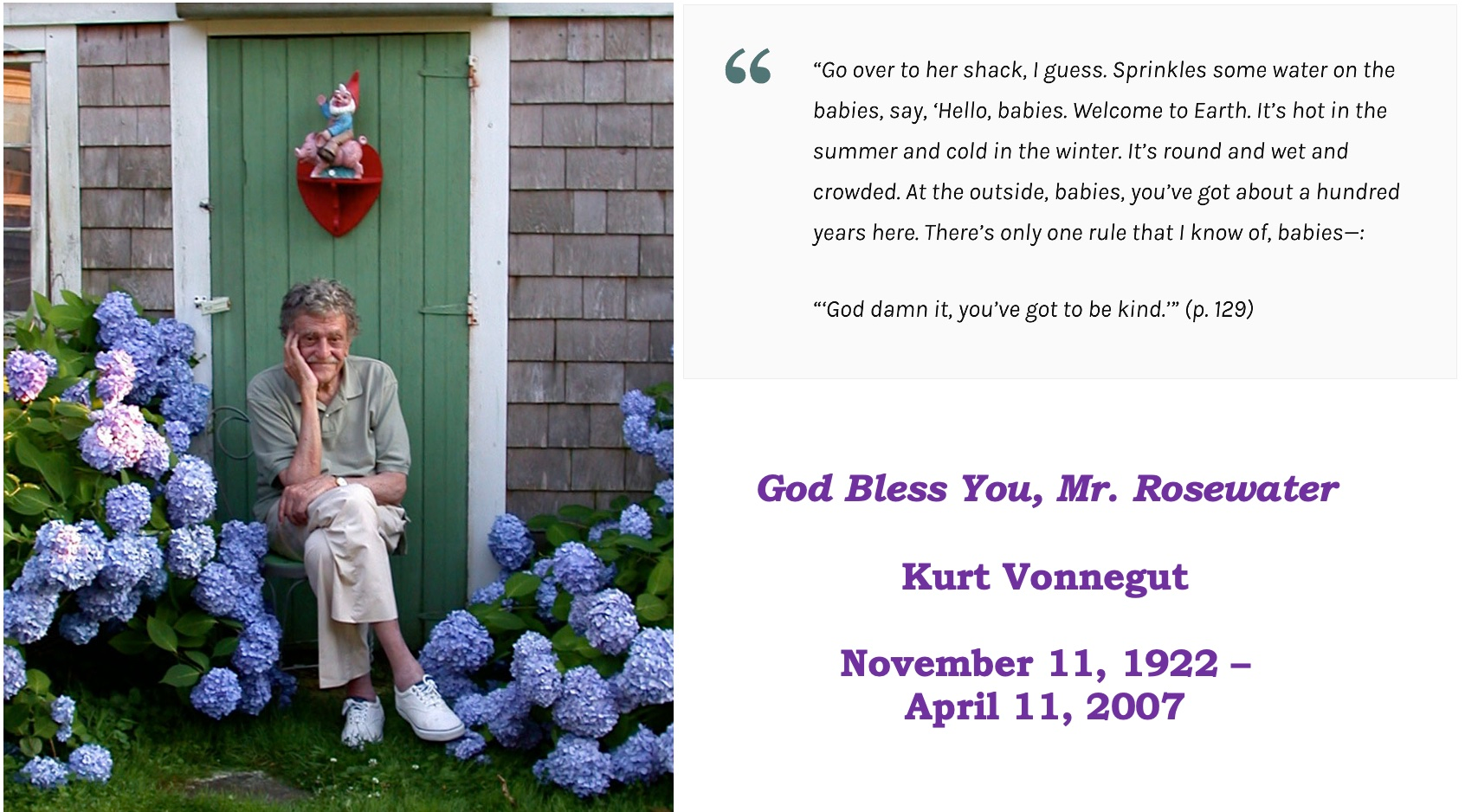
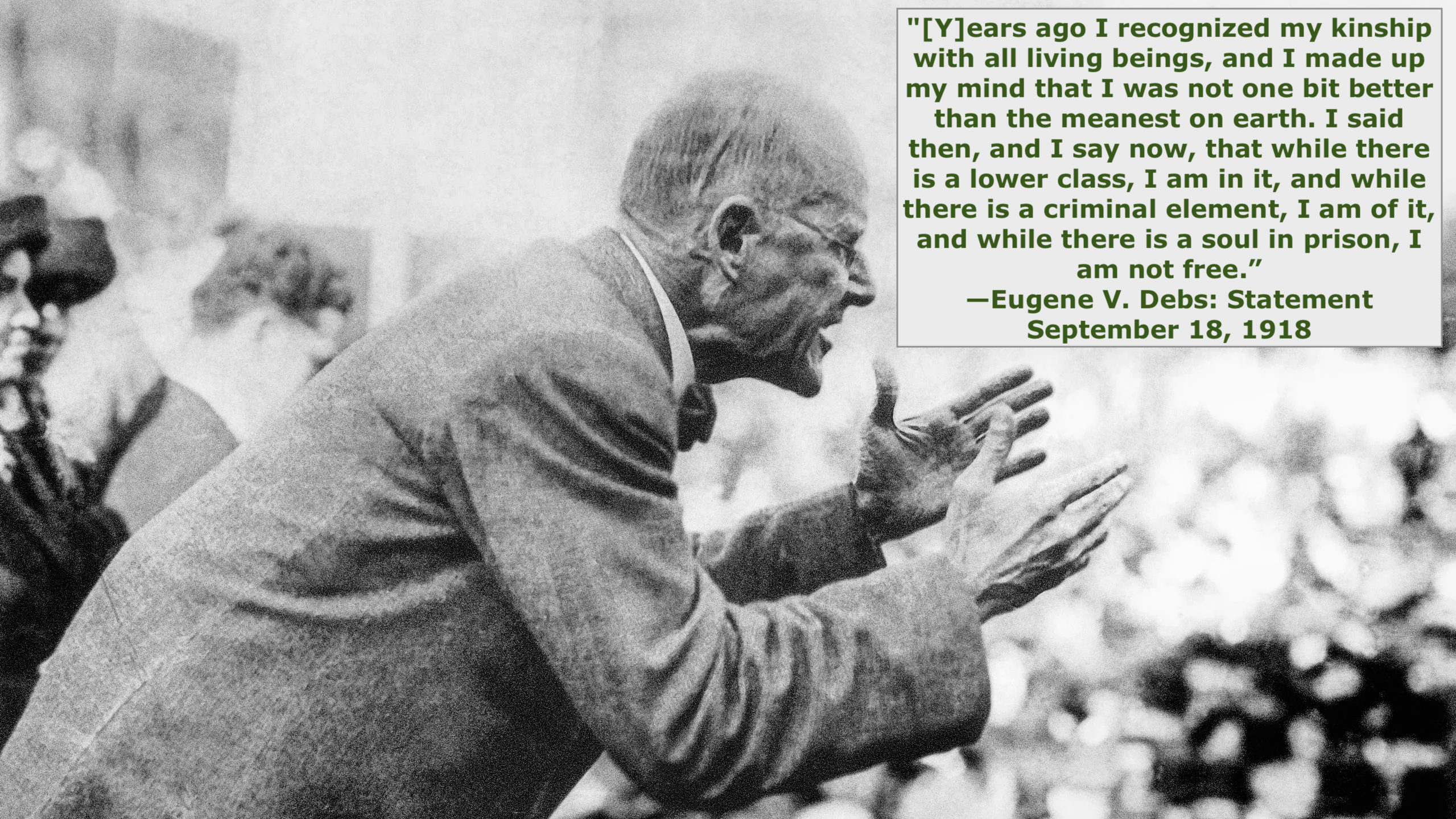
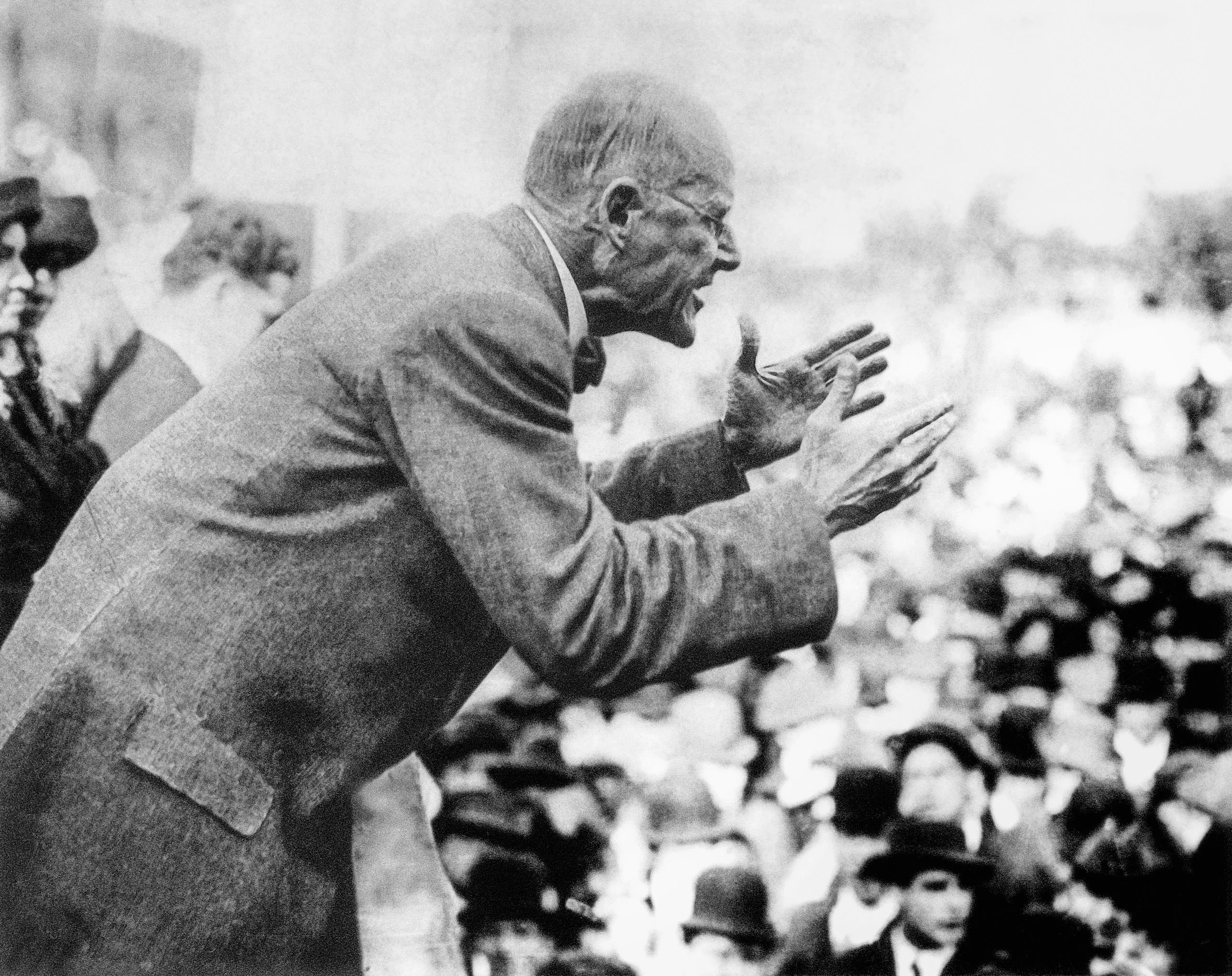
The Left I recognized in myself is grounded in the writing of Kurt Vonnegut, who was profoundly shaped by his Midwestern roots—free thinking and humanism. Vonnegut also was inspired by and introduced me to Eugene V. Debs, one of the most prominent socialists in US history.
I have never found a better way to express what I believe, what constitutes my moral compass, than the words written and spoken by Debs and Vonnegut:
And it is because of these words that I cannot say that I love America—because we have struggled as a country to meet these ideals—but I can say proudly that I love the promise of America, these words that I think are about the most poetic and beautiful promise humans can pursue, as expressed by writer John Gardner:
That idea—humankind’s inalienable right to life, liberty, and the pursuit of happiness—coupled with a system for protecting human rights —was and is the quintessential American Dream. The rest is greed and pompous foolishness—at worst, a cruel and sentimental myth, at best, cheap streamers in the rain.
But this wonderful promise—”humankind’s inalienable right to life, liberty, and the pursuit of happiness—coupled with a system for protecting human rights”—remains unfulfilled because we have failed to truly practice these ideals, we have been negligent about making this promise real—even when we are repeatedly reminded, as MLK expressed:
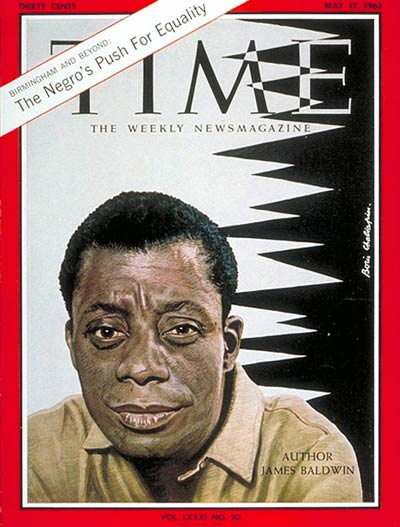
Moreover, I am cognizant of the interrelatedness of all communities and states. I cannot sit idly by in Atlanta and not be concerned about what happens in Birmingham. Injustice anywhere is a threat to justice everywhere. We are caught in an inescapable network of mutuality, tied in a single garment of destiny. Whatever affects one directly, affects all indirectly. Never again can we afford to live with the narrow, provincial “outside agitator” idea. Anyone who lives inside the United States can never be considered an outsider anywhere within its bounds.
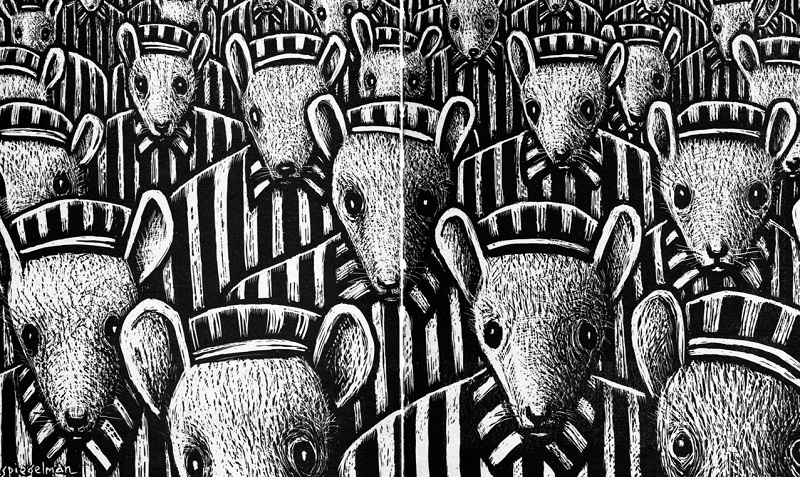
Vonnegut, we must note, was profoundly shaped by being a prisoner of war, and both Debs and MLK were jailed for their moral causes.
We should acknowledge, then, that we all are prisoners of our negligence, our failure to create a safe society, a willingness to simply live with mass and school shootings, and the rising political tide that seeks to take away some people’s access to life, liberty, and the pursuit of happiness.
And the alternative, the path toward honoring the promise, is not even that difficult: “We humanists try to behave as decently, as fairly, and as honorably as we can without any expectation of rewards or punishments in an afterlife.”
Decently. Fairly. Honorably.
As Vonnegut was apt to quip, like a Christian nation.
And yet: “While there is a soul in prison, I am not free.”
Through my journey with clinical anxiety, I have come to realize that anxiety is not a monolithic thing for all of us even as our own personal anxiety may be of a specific kind.
None the less, I think it is fair to say that anxiety comes from a disconnect between our inner selves and the the world around us, especially when that disconnect seems oppressive, judgmental, and inescapable.
Sometimes anxiety is the result of recognizing who we truly are is unlike how we are expected to be or how we perceive most other people to be. Other times, anxiety is the result of becoming (too) aware of impending doom—both the possibility of something real that is foreboding but (too) often a manufactured doom that isn’t realistic or rational.
For what most or many people simply consider living or the human condition, we anxious are fully charged with an awareness, an expectation of impending doom.
I suspect that all humans long for a sort of life that allows us to be fully who we are, and thus, I have always been drawn to a simple but now fully dismantled American ideal, guaranteeing all humans life, liberty, and the pursuit of happiness.
What a beautiful thing, filled with a sort of relief that allows our full humanity—the pursuit of happiness.
My existential self finds this wonderful because I believe the pursuit of happiness is itself happiness, like Sisyphus and his rock, “The struggle itself toward the heights is enough to fill a [hu]man’s heart. One must imagine Sisyphus happy.”
There is a sort of paradox to this pursuit of individual happiness, however, a paradox that is expressed by Eugene V, Debs:
Your Honor, years ago I recognized my kinship with all living beings, and I made up my mind that I was not one bit better than the meanest on earth. I said then, and I say now, that while there is a lower class, I am in it, and while there is a criminal element I am of it, and while there is a soul in prison, I am not free.
And then, in this fiction of Kurt Vonnegut, whose life and work were inspired by Debs:
There is another paradox.
Writers and thinkers were the first experiences I had with recognizing other people who thought like me existed, unlocking a sort of awareness that I was mostly unlike the people and place of my birth and young life.
One of those first authors for me was J.D. Salinger and the small novel-in-two-parts Franny and Zooey.
Salinger appeared to be himself on a sort of personal journey to awareness, one that was grounded in something like a Christian mysticism. Eventually the bulk of Salinger’s work was grounded in the Glass family with a Christ-figure, Seymour, who commits suicide but remains the moral core for his siblings.
That is where Franny and Zooey sits, one of Seymour’s brothers, Zooey, and his sister, Franny, continuing their own spiritual quests—”a sort of prose home movie.”
While Salinger’s fiction laid the groundwork for me as a reader and writer, he also taught me a much harder and uglier lesson. Salinger himself, Salinger the real-world man, proved to be not only incapable of fulfilling the idealized spiritual goals he wrote about through Seymour, but also incapable of being a decent human being.
And despite his failures as a person and the now insensitive choices he made for Seymour as the speaker of Jesus-like parables, the end of Franny and Zooey fits into the continuum the reached my embracing Debs and Vonnegut (above) and then, below, David Lynch.
Seymour mentored his siblings while all the children were performers on a radio show; Seymour implored them all the be their best for the “Fat Lady,” his metaphor for the least among us, an uncomfortable but sincere effort at teaching these children Christian charity and love.
As Franny is crumbling mentally, Zooey explains: “But I’ll tell you a terrible secret—Are you listening to me? There isn’t anyone out there who isn’t Seymour’s Fat Lady.”
And then Zooey continues: “Don’t you know the goddam secret yet? And don’t you know—listen to me now—don’t you know who that Fat Lady really is? … Ah, buddy. Ah, buddy. It’s Christ Himself. Christ Himself, buddy.”
Not a paradox at all, but Salinger’s humanistic and even practical rendition of Christianity makes perfect sense as I found and settled into Vonnegut’s persistent efforts to spread the message of Christian kindness through his own humanism and atheism:
On a smaller scale than Salinger, I had to realize that Vonnegut, too, struggled to be the human he asked all of us to be—although on balance, I think Vonnegut was just flawed in the ways most of us are because we are human.
What causes me greater sadness and, yes, anxiety, is that in our current world, the dominant Christians in the US are collectively as horrible as Salinger was on the individual level.
We are a people bereft of kindness, Christian charity, Christian love.
We are a people aggressively imposing hatred and fear onto others.
I have always been a skeptical person, but now I am slipping—as many do as they grow older—into perpetual cynicism.
I want to believe that it is possible to live the life we want, to be our full and true selves—life, liberty, and the pursuit of happiness—while dedicating ourselves to insuring that everyone has that freedom as well.
Our happiness and the happiness of others are not in tension, in competition.
Our happiness and the happiness of others are dependent on each other.
The weight of my cynicism is harder and harder to carry into my mid-60s.
But there is one person who seems to have found something, found some way to live the ideals that I also embrace and believe with my entire self would make our lives collectively happier, erasing our anxieties.
Maybe these ideals are beyond the capabilities of human beings.
Now we are back to Vonnegut who played around with the essential flaw in humans—”the only true villain in my story: the oversized human brain.”
It is harder and harder each day, but I keep trying to have hope, hoping Maggie Smith is right: “This place could be beautiful,/right? You could make this place beautiful.”
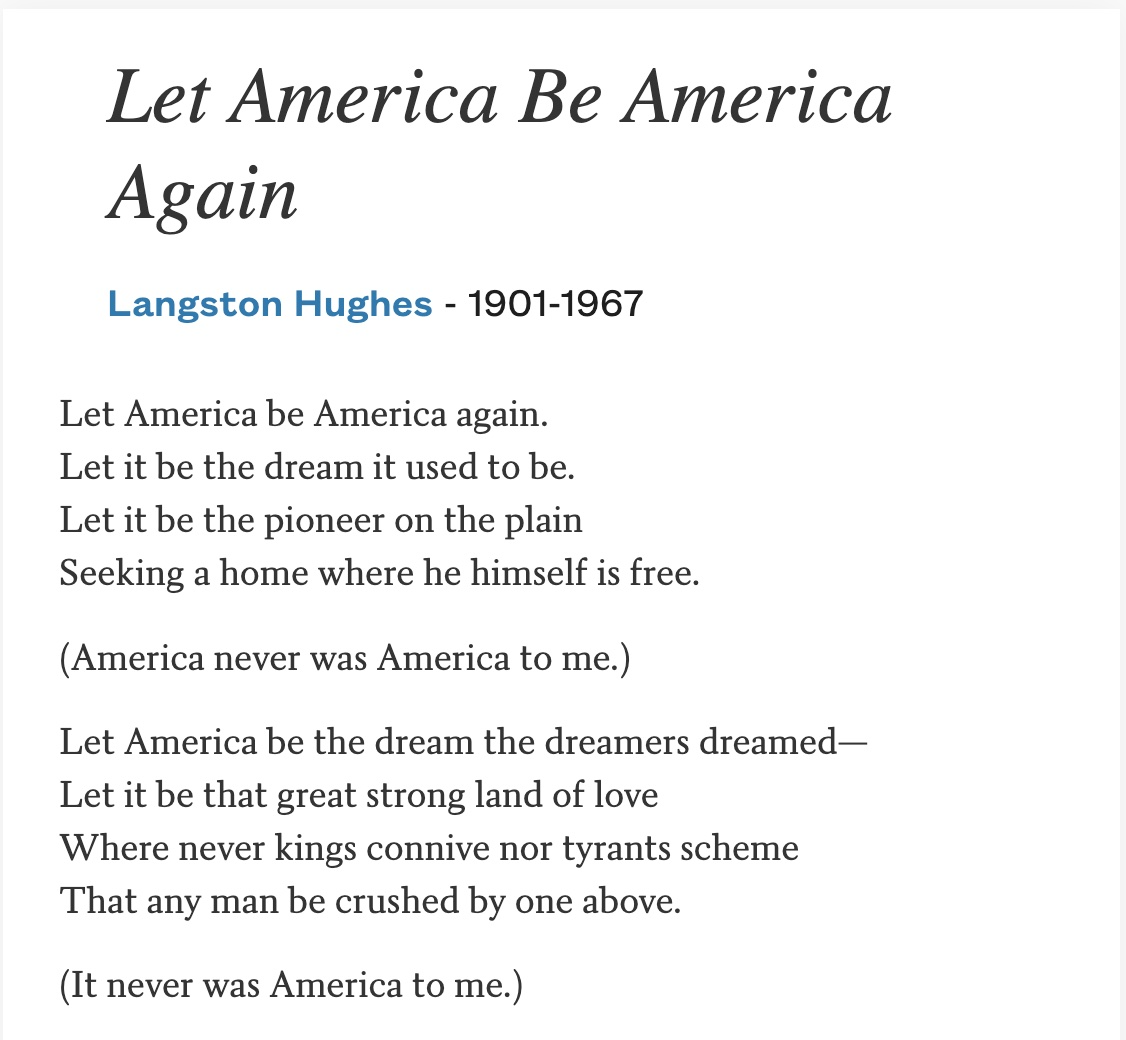
That multi-genre unit was grounded in part on a war poetry unit I taught for many years, anchored by R.E.M.’s “Orange Crush.” Traditional poems found commonly in anthologies included the following:
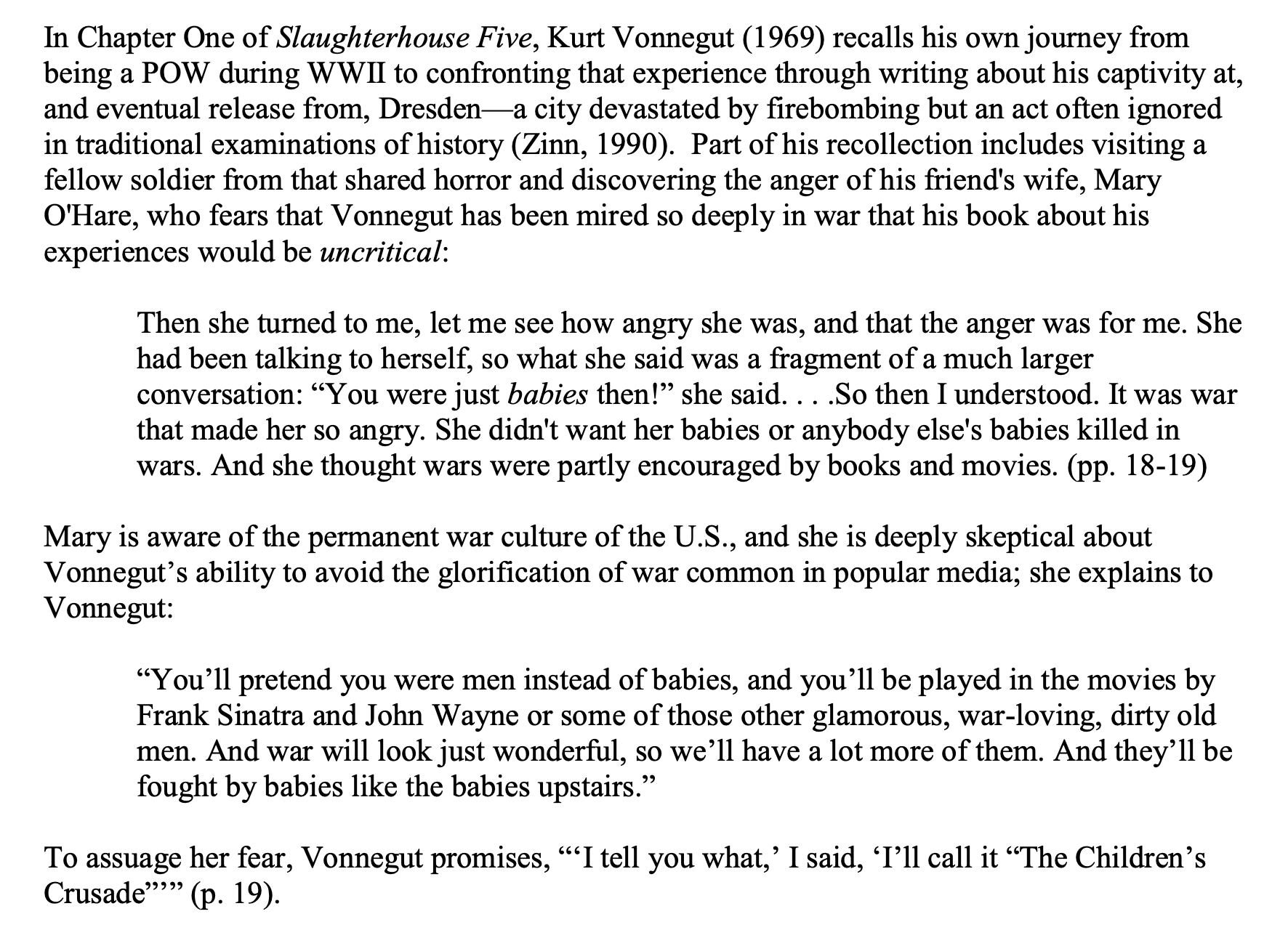
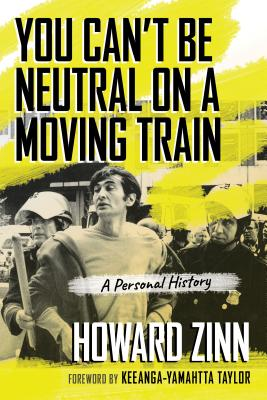
The unit on peace (click on the title above and the article begins on page 15) includes work by Howard Zinn, music by CAKE, and fiction by Kurt Vonnegut, specifically Vonnegut’s explanation of how he crafted his most recognized work, Slaughterhouse Five:
Also in 2023, there is a pervasive national narrative that K-12 teacher and professors in higher education are indoctrinating students with leftist/Marxist ideology. While this argument is old and inaccurate, almost no one is confronting the real ways in which traditional schooling indoctrinates children.
Most traditional approaches to history, in fact, portray war as normal, characterize the US as an ethical victor of war (freedom fighters), and offers almost no concession that peace is ever an option for violence and acts of terrorism and aggression.
I suspect that conservatives will consider a peace-oriented liberal indoctrination but will never admit traditional approaches to history are indoctrination.
If we care about academic freedom and humanity, then offering peace as an option seems to be the least we can do for children and all students.
Americans are less free in 2023 than just a couple years ago.
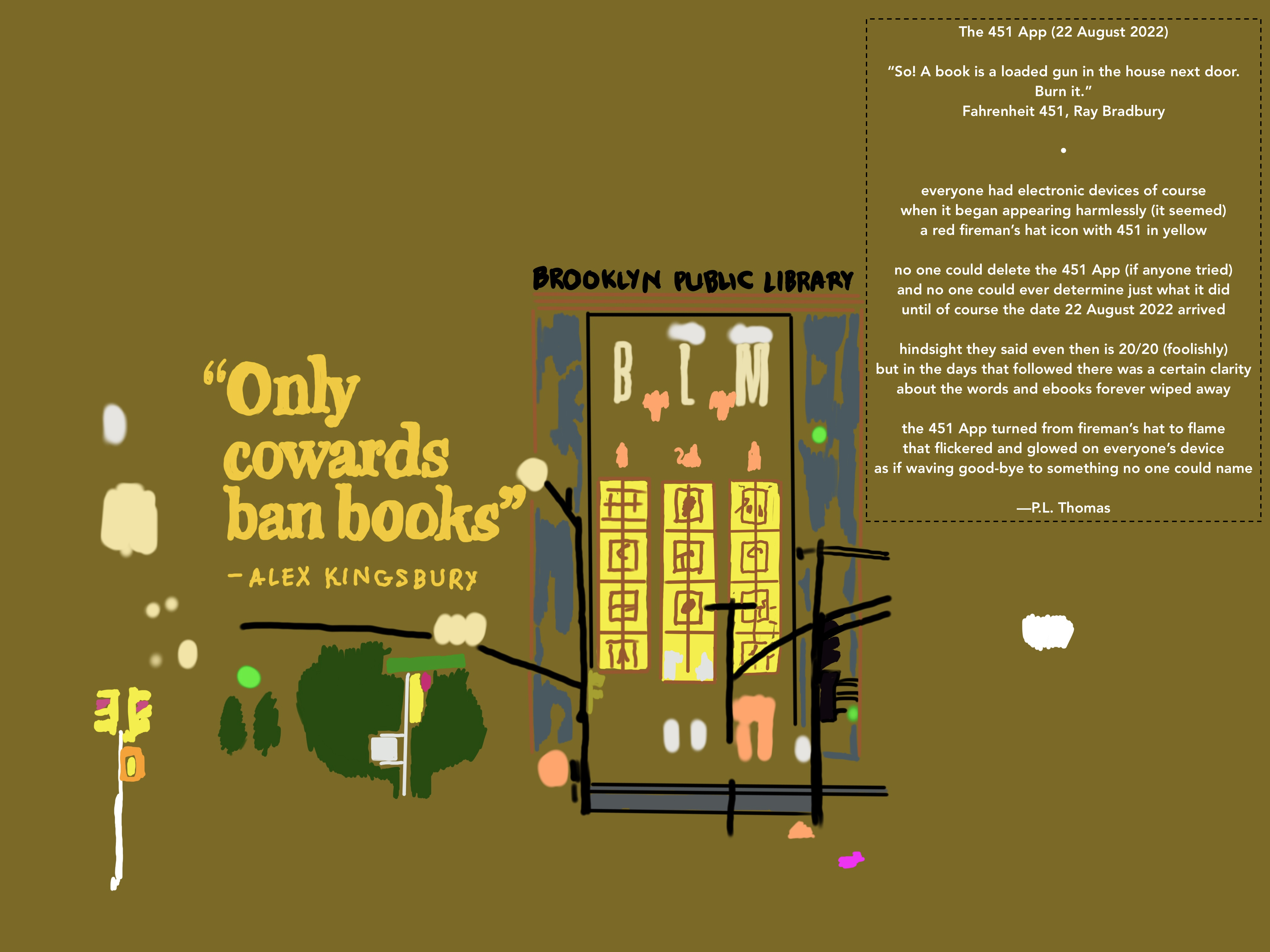
While some may see Florida’s assault on books, school curriculum, and higher education as an aberration, censorship, bans, and curriculum gag orders are increasingly common across the US, as reported by Eesha Pendharkar:
This is the third year in a row in which Republican lawmakers have increased their legislative efforts to restrict LGBTQ students’ rights and curtail lessons, books, and other materials about LGBTQ people.
“There certainly seems to be renewed energy around passing censorship legislation around LGBTQ identity, which is law really only in one state,” said Jeremy Young, the senior manager of free expression and education at PEN America.
“But that’s likely to increase dramatically this year.”
Since 2021, lawmakers in 22 states have introduced 42 bills with language and restrictions similar to those in the “Don’t Say Gay” measure, formally known as the Parental Rights in Education law. Since the start of this legislative session, 26 of those bills have been introduced in 14 states that use the same language as Florida’s law, with many imposing more severe restrictions compared with the original bill, which Gov. Ron DeSantis, a Republican, signed in 2022.
Republicans and conservatives have launched a campaign to ban books, censor ideas and topics in schools from elementary school through higher education, eradicate academic freedom, and indoctrinate children by seizing control of education through legislation.
These legislative attacks target the LGBTQ+ community, minoritized races, the legacy and history of racism in the US, and everyone who embraces a pluralistic democracy.
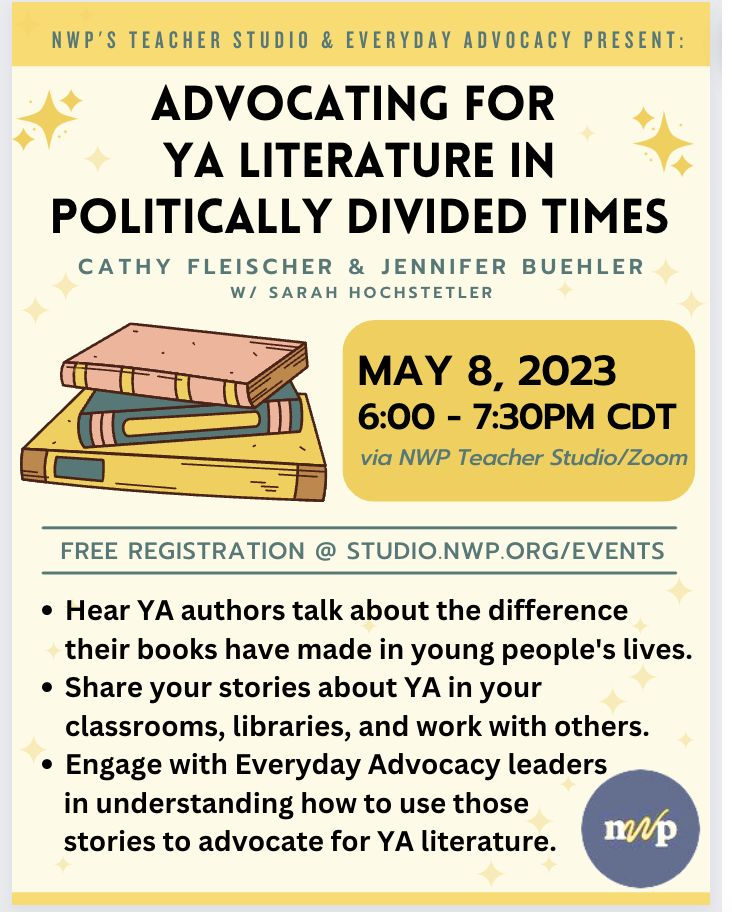
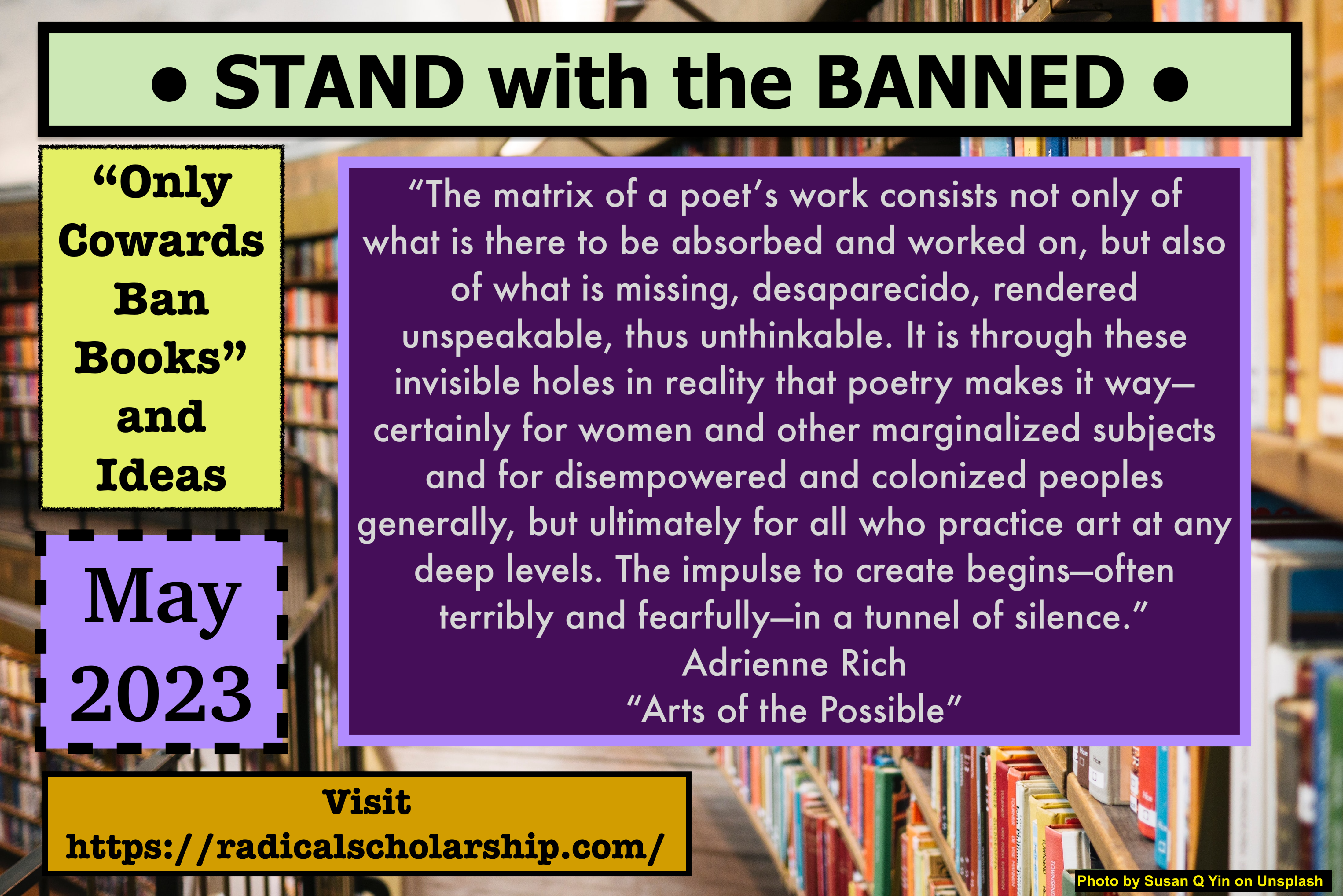
Please contact me by email paul(dot)thomas(at)furman(dot)edu or message me through Twitter if you’d like to sign on in support or offer any events that carry this tag #standwiththebanned.
Below I will list signees, individuals or groups/organizations, who offer support as well as list resources for fighting bans and censorship.
I will also be posting day-by-day books, texts, and authors. for the entire month of May 2023.
As I drove from Upstate South Carolina to Chicago, I watched as billboards offered a refrain about “real” and aspects of religious faith that are not real, or at best cannot be proven real.
I always imagine the same sort of signage about Harry Potter novels: “Harry Potter is real.” “Hogwarts is real.”
There is very little real difference among all sorts of fantasy writing along with the mythologies and stories throughout the Bible; yes, fictional narratives can be powerful in terms of themes and motifs that add meaning to our human condition, but the compulsion to render them (falsely) as “real” actually erodes that power.
But this compulsion that these myths and stories must be factual, real, literal (when, again, they either are not real or simply cannot be proven real) is something rarely challenged or interrogated because belief is so pervasive in how humans function.
This claim of “real” ultimately is a veneer designed to give the myths more weight, more power, because the real intent of these myths is control.
Gilles Deleuze examined the shift from societies of discipline to societies of control, targeting specifically “prison, hospital, factory, school, family” as structures under perpetual reform.
The narrative driving this should be familiar to everyone: “Institution A is failing and thus must be reformed.” Somehow this is a compelling narrative even though it falls apart under its own weight since the perpetual cycles never fully demonstrate the source of the failure and then any set of reforms always lead to yet another round of crisis: “Institution A is failing and thus must be reformed.”
As a educator in the US for the forty-plus year accountability era, I have witnessed that the perpetual state of reform is not about reform at all, but about control (both political and market interests being served).
If schools are always failing (and by direct and indirect implication) then teachers are always failing, students are always failing; therefore, top-down authoritarian mandates are needed to right the ship, to “fix” schools, teachers, and students.
Deleuze’s examination is a subset, I think, of an even larger force in US culture, mythologies of control.
From Christian myths to rugged individualism, boot strapping, and the American Dream, these mythologies of control serve authoritarian structures by maintaining a culture of failure and fear among most people who feel compelled to conform to these unrealistic mythologies.
The consequences of failing to acknowledge and reject mythologies of control are watching as the US morphs from the Trump era into the era of DeSantis, who has embraced the logical next steps after Trump’s jumbled attack on the 1619 Project: Political control of education is one of the ultimate goals of authoritarianism.
Dismantling schools/universities and gutting libraries have been made possible by decades of education bashing begun under Reagan and then almost gleefully embraced by Democratic and Republican leaders.
The failing schools myth, the incompetent teachers myth, and the failing students myth are little different than the false but pervasive high-crime myth that political leaders and the media repeat endlessly, despite evidence to the contrary.
Americans embrace our disproportionate police state and prison culture because a mythology of control about crime maintains irrational public fear and promotes a willingness to sacrifice Other People (disproportionately Black and brown).
It is extremely important, however, to recognize that these myths are made more powerful and compelling because of foundational myths such as Original Sin, “hell is real,” and the relentless myths of rugged individualism and boot strapping.
Florida has reduced their education system to these myth by directly rejecting even discussing systemic forces such as racism.
Anyone who doubts that reform and religious narratives are about control must unpack why authority always resorts to banning books, censoring ideas, and taking full control of education.
Mythologies of control are dehumanizing, and there are far more compelling narratives. Kurt Vonnegut explains:
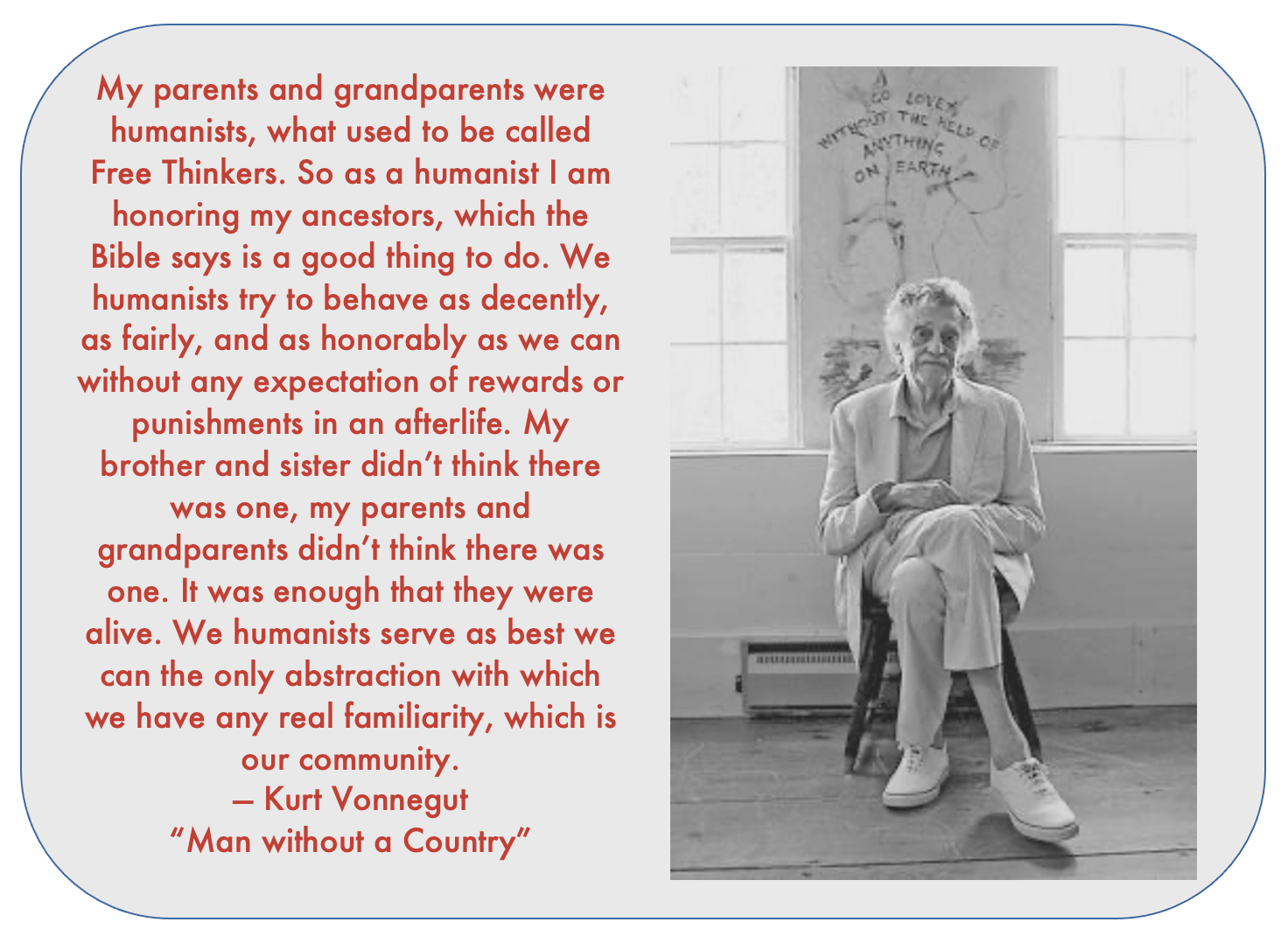
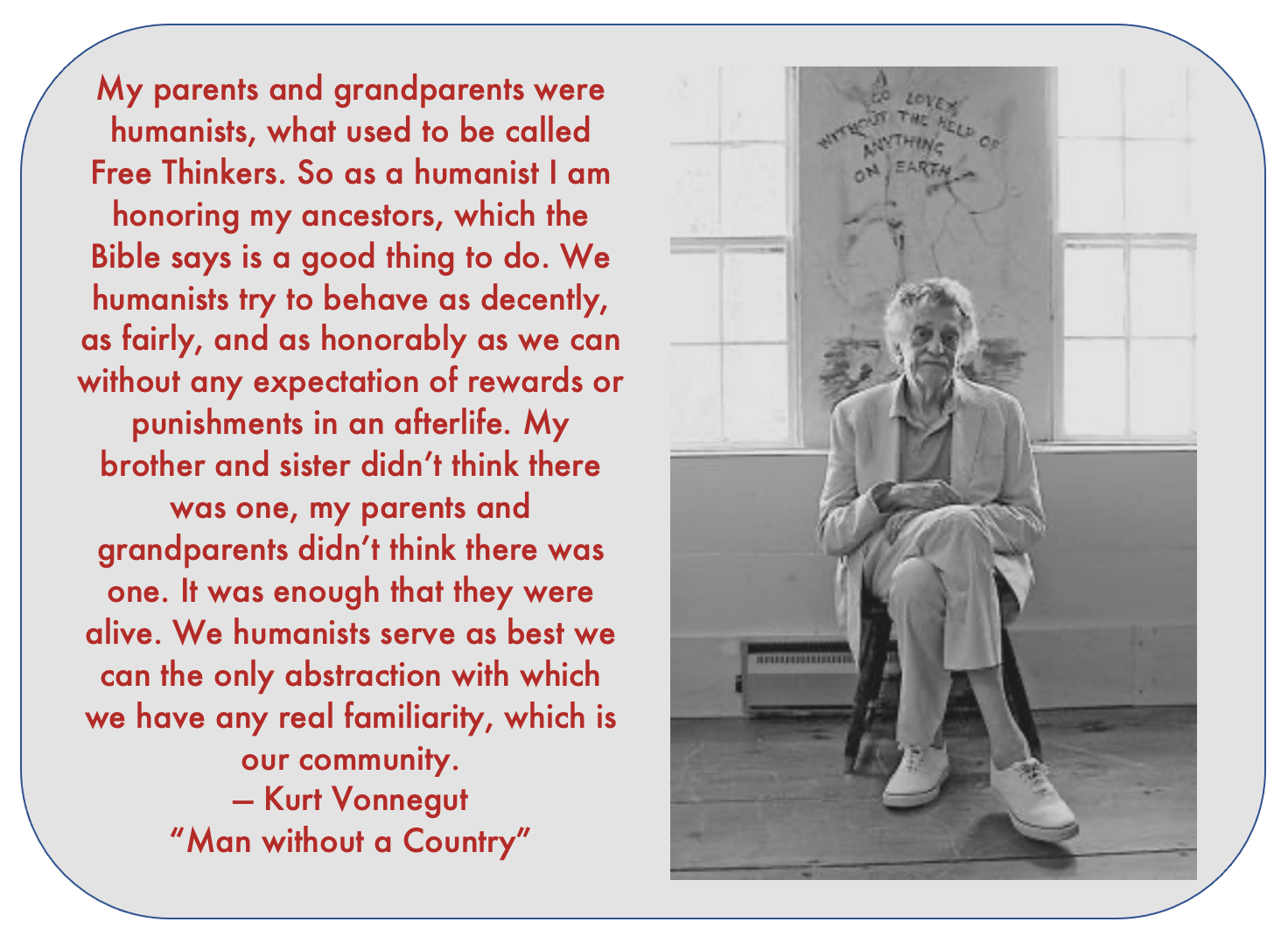
My parents and grandparents were humanists, what used to be called Free Thinkers. So as a humanist I am honoring my ancestors, which the Bible says is a good thing to do. We humanists try to behave as decently, as fairly, and as honorably as we can without any expectation of rewards or punishments in an afterlife. My brother and sister didn’t think there was one, my parents and grandparents didn’t think there was one. It was enough that they were alive. We humanists serve as best we can the only abstraction with which we have any real familiarity, which is our community.
And yet, you will not see humanists purchasing billboards announcing “Billy Pilgrim is real.” “Tralfamadore is real.”
The call to behave decently, well, it is enough and fabricating ways to coerce that behavior simply destroys the very thing that makes being human being human.
As Ralph Waldo Emerson argued, to abdicate our mind is to abdicate our full humanity:
Whoso would be a man must be a nonconformist. He who would gather immortal palms must not be hindered by the name of goodness, but must explore if it be goodness. Nothing is at last sacred but the integrity of your own mind. Absolve you to yourself, and you shall have the suffrage of the world. I remember an answer which when quite young I was prompted to make to a valued adviser, who was wont to importune me with the dear old doctrines of the church. On my saying, What have I to do with the sacredness of traditions, if I live wholly from within? my friend suggested,–“But these impulses may be from below, not from above.” I replied, “They do not seem to me to be such; but if I am the Devil’s child, I will live then from the Devil.” No law can be sacred to me but that of my nature. Good and bad are but names very readily transferable to that or this; the only right is what is after my constitution, the only wrong what is against it.
[Header and all images property of Marvel and artists]
Growing up in the 1960s and 1970s, I watched several popular versions of vigilante films, notably starring Charles Bronson (Death Wish), Clint Eastwood (High Plains Drifter, Hang ‘Em High), and Tom Laughlin (Billy Jack).
Simultaneously, I became a reader and collector of superhero comic books by Marvel. At the core of superhero comics—both the problem with and within the sub-genre—is the moral and ethical elements of vigilanteism and the tension between the rule of law and justice.
Virtually every superhero narrative is directly or indirectly addressing that moral dilemma, but many superhero characterizations have alluded to the real-world conflict between Martin Luther King Jr.’s commitment to nonviolence as a path to justice and Malcolm X’s embracing “by any means necessary.”
Too often those allusions are simplified if not ham-fisted; consider for example Professor X and Magneto in both films and print comic books.
One of the better efforts to interrogate the role of violence in seeking justice, I think, is the Daredevil/Punisher arc in the Netflix Daredevil series. It is “better,” I think, because the characterizations of both Daredevil and the Punisher are messier and slightly more realistic than print comic books.
Season 2 of Netflix’s Daredevil centers the essential differences between Daredevil and the Punisher as vigilantes.
Daredevil 7 (v7) is written by Chip Zdarsky and drawn by Rafael De Latorre with the cover by Marco Checchetto and Matthew Wilson
Issue 7 opens by framing the Punisher, Frank Castle as a murderer, insane, and a pawn of The Hand:
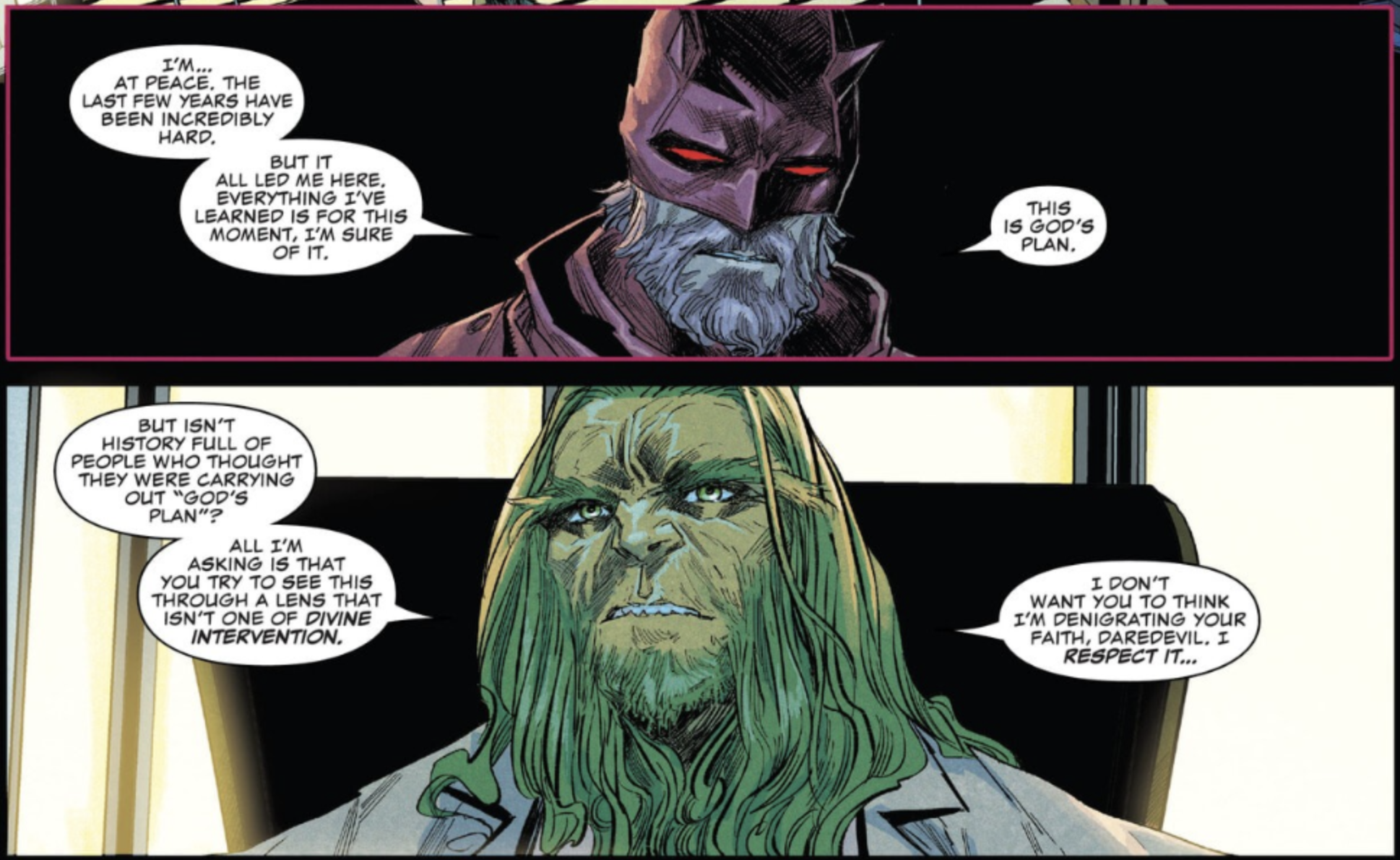
This framing complicates both the act of vigilanteism as well as the different moral imperatives that guide Daredevil and the Punisher. For Daredevil, he must see himself as substantially distinct from the Punisher in mentality, intent, actions, and outcomes; remember, Daredevil has evoked that he knows the mind of god:
Another excellent complication in issue 7 is the role of free will [1], a tension that rests at the center of faith, religion, and perceptions of g/God: If g/God is all powerful and all knowing, where does that leave human free will?
Daredevil, of course, must believe simultaneously in a world of god and that he has free will to behave in ethical ways, with moral imperatives that the Punisher chooses to ignore.
And here this issues evokes a powerful and, again, complex examination of the rule of law:
This is the sort of nuanced distinctions Martin Luther King Jr. made during his non-violent protests:
You express a great deal of anxiety over our willingness to break laws. This is certainly a legitimate concern. Since we so diligently urge people to obey the Supreme Court’s decision of 1954 outlawing segregation in the public schools, it is rather strange and paradoxical to find us consciously breaking laws. One may well ask, “How can you advocate breaking some laws and obeying others?” The answer is found in the fact that there are two types of laws: there are just laws, and there are unjust laws. I would agree with St. Augustine that “An unjust law is no law at all.”
Now, what is the difference between the two? How does one determine when a law is just or unjust? A just law is a man-made code that squares with the moral law, or the law of God. An unjust law is a code that is out of harmony with the moral law. To put it in the terms of St. Thomas Aquinas, an unjust law is a human law that is not rooted in eternal and natural law. Any law that uplifts human personality is just. Any law that degrades human personality is unjust.
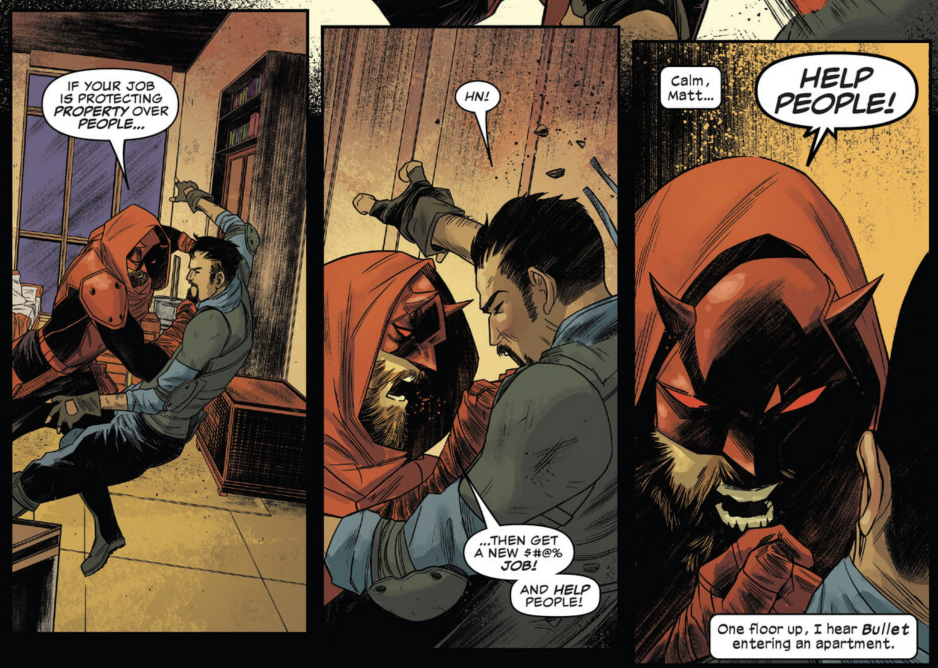
Man-made law versus the law of God as well as the purposes and consequences of laws/breaking the law sits at the center of Daredevil’s quest continued in issue 7:
Directly and indirectly, Zdarsky has been exploring the tensions between capitalism/materialism and socialism/spirituality; here, the police state is framed as a tool of capitalism (“protecting property over people”), thus justifying Daredevil’s lawbreaking.
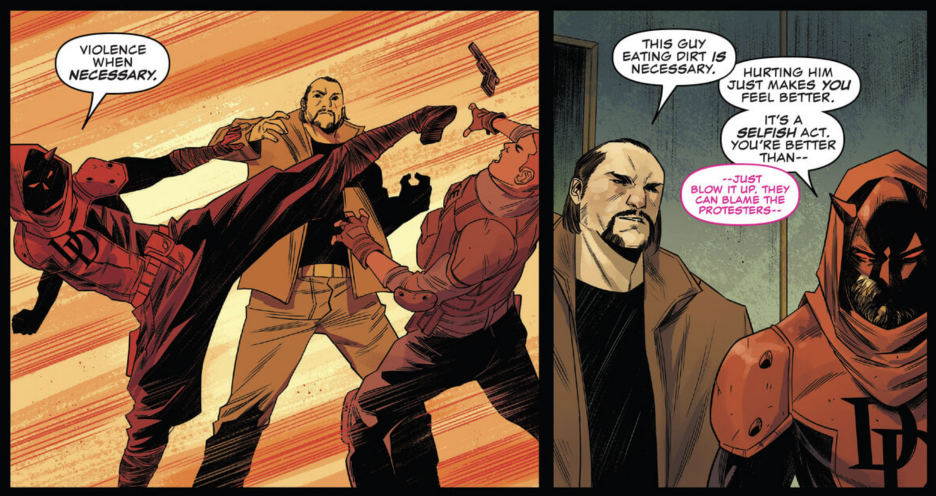
The code of ethics for the Fist becomes “help people” and “violence when necessary”:
While the narrative so far of Daredevil v7 has focused almost entirely on a new iteration of Daredevil, issue 7 reminds us that Matt Murdock is an (at least) equal partner in the quest for justice:
Daredevil as “decent superhero,” and Matt Murdock as “damned good lawyer” (with the added ironic layer of “damned”).
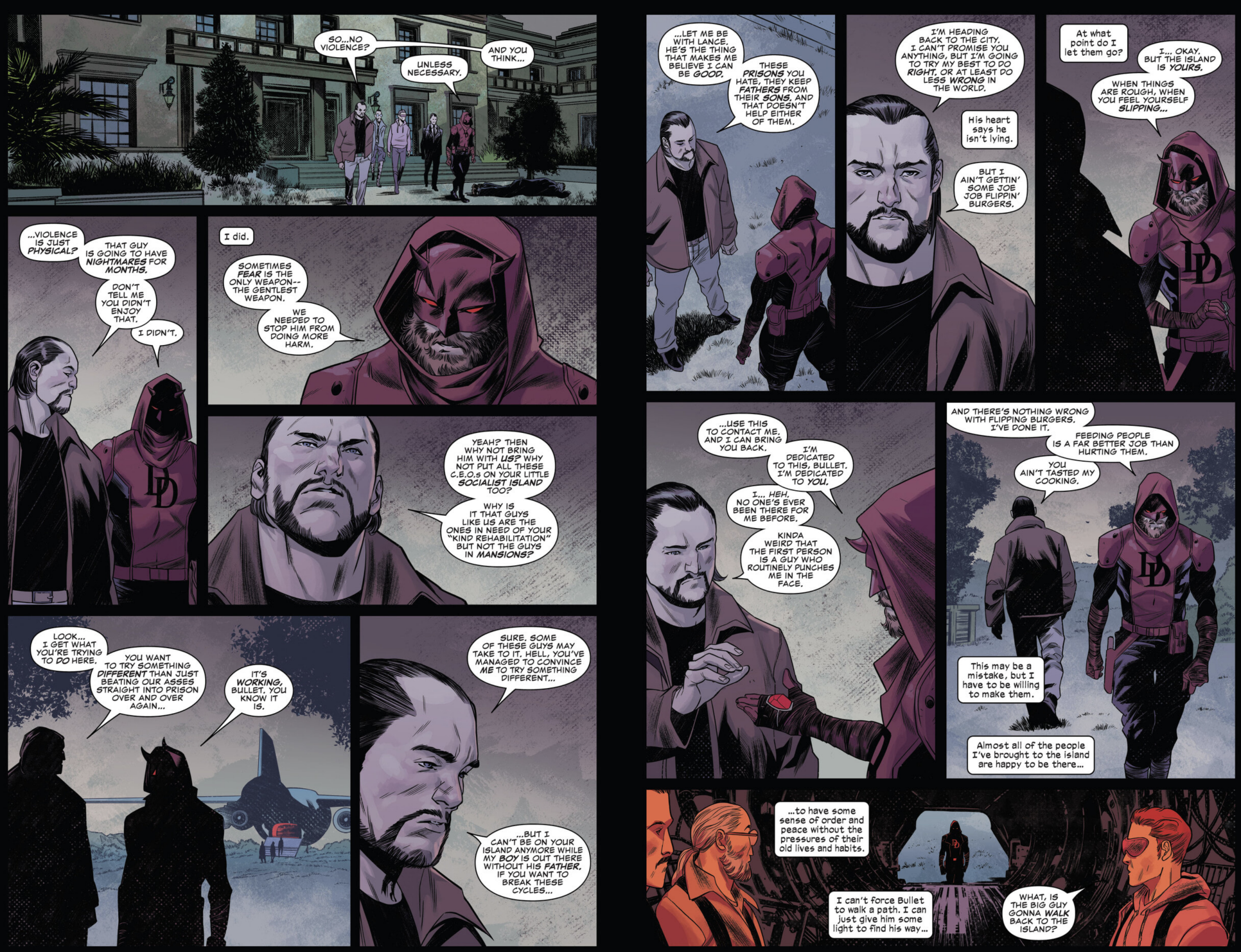
Bullet proves to be an important character in the Daredevil/Punisher dynamic because he adds complexity and confrontations to their differences and ultimately introduces important elements, a child and overt references to socialism/capitalism (linked to the philosophies of Jesus and property over people in the storytelling):
What and who is being consumed in capitalism/consumerism and who is allowed to go hungry [2]—these social commentaries hang over the more melodramatic aspects of superhero narratives.
While great efforts (especially by Daredevil) are made to distinguish Daredevil from the Punisher, we learn that their common ground is children:
The issue ends by returning to enduring Biblical questions about the sin’s of the father and the sins of the son as well as the pervasive presence of evil.
Readers are now poised to watch mere mortals battle in the names of god and evil, and we must wonder if any real distinction exists when violence is always an option.
[1] The iconic aliens of Kurt Vonnegut’s Slaughterhouse-Fivemarvel at the idealistic delusion of the human race when challenged by Billy Pilgrim about free will:
“If I hadn’t spent so much time studying Earthlings,” said the Tralfamadorian, “I wouldn’t have any idea what was meant by ‘free will.’ I’ve visited thirty-one inhabited planets in the universe, and I have studied reports on one hundred more. Only on Earth is there any talk of free will.”
If the child were brought up into the sunlight out of that vile place, if it were cleaned and fed and comforted, that would be a good thing, indeed; but if it were done, in that day and hour all the prosperity and beauty and delight of Omelas would wither and be destroyed. Those are the terms. To exchange all the goodness and grace of every life in Omelas for that single, small improvement: to throw away the happiness of thousands for the chance of happiness of one: that would be to let guilt within the walls indeed.
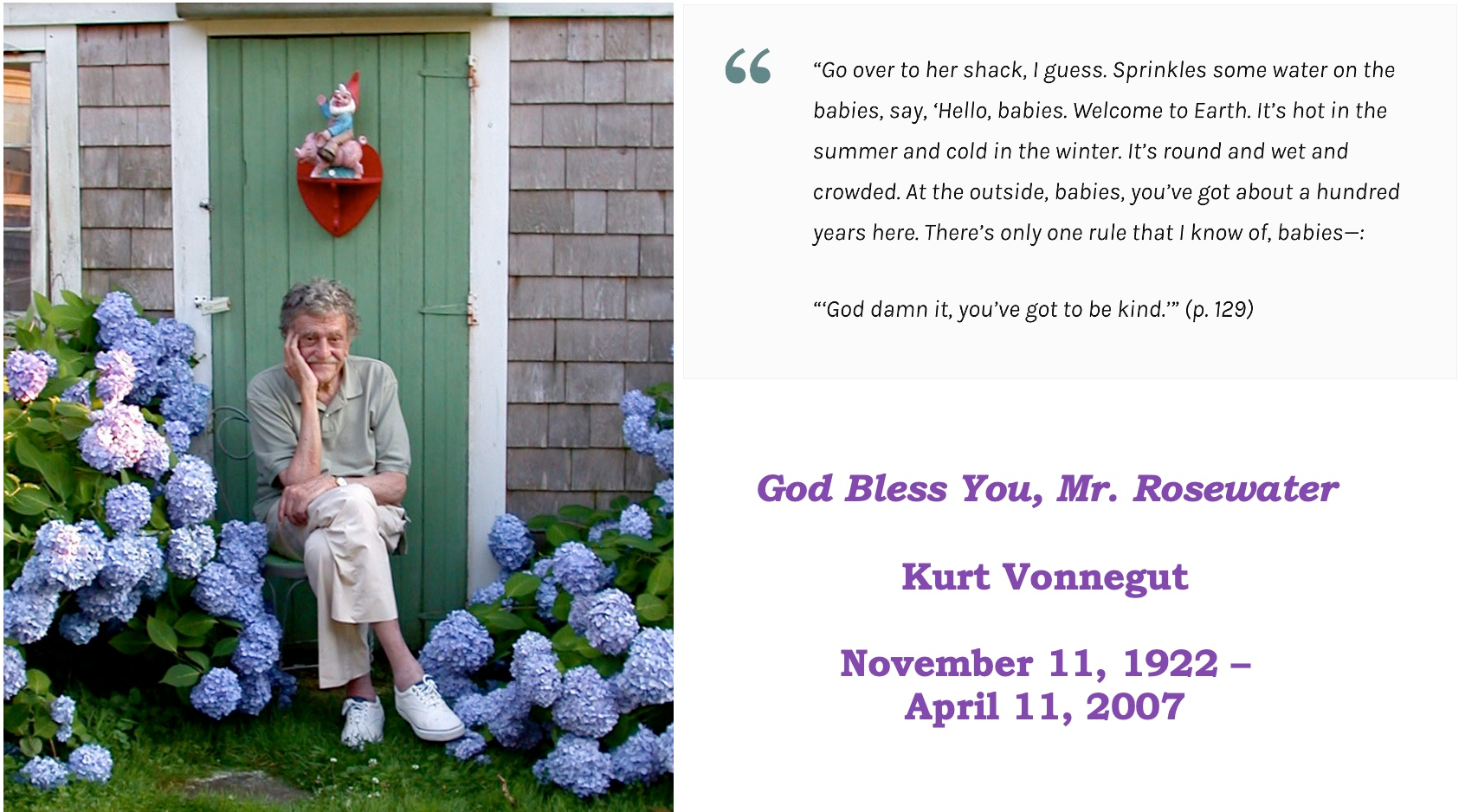
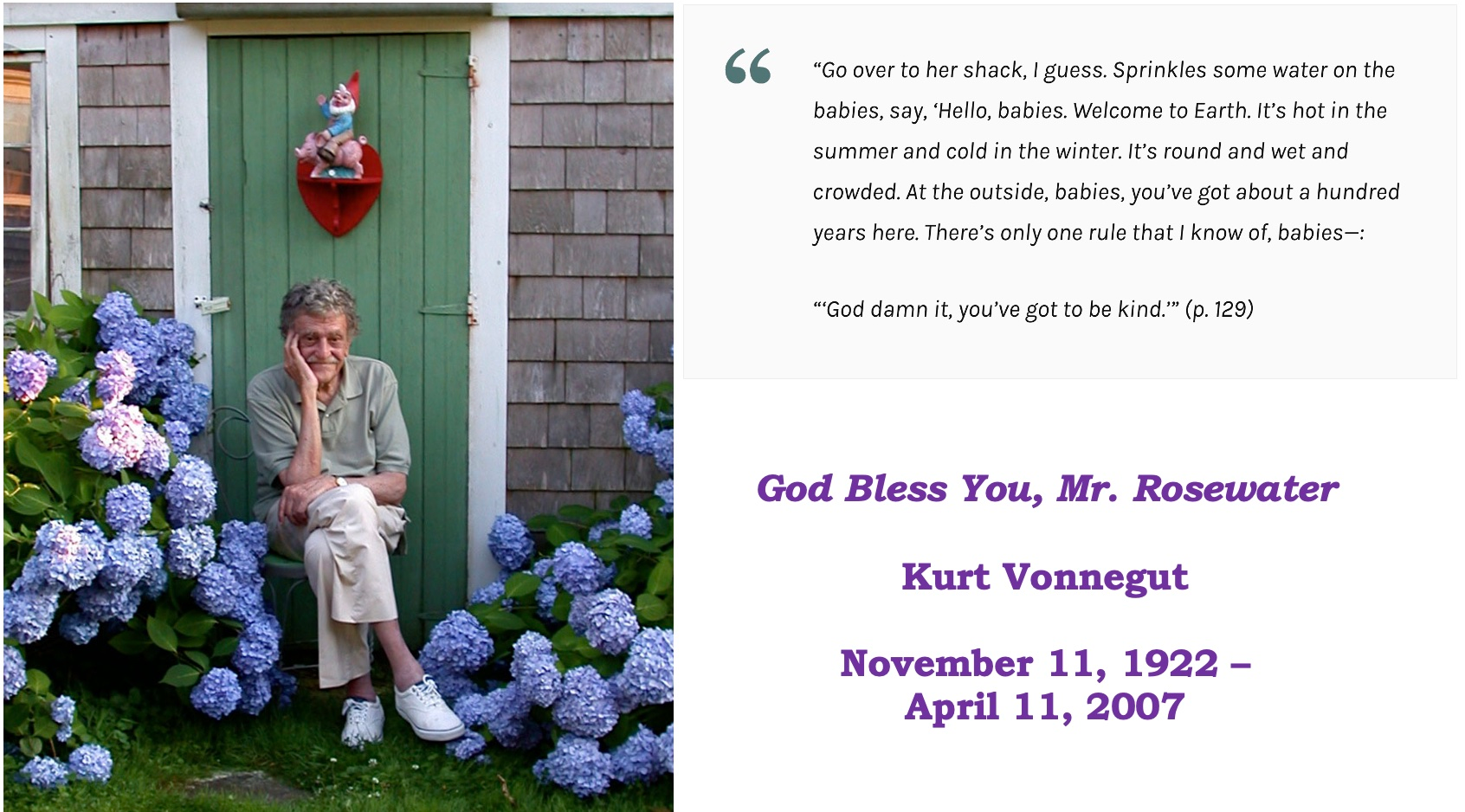
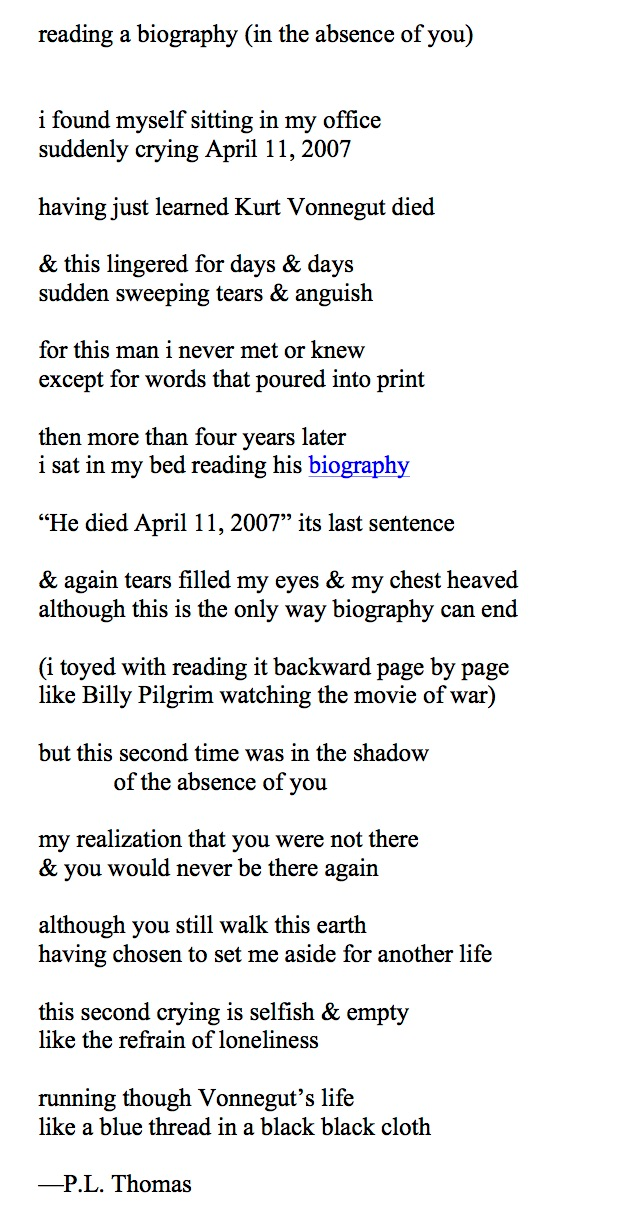
Kurt Vonnegut himself would likely burst into a raspy laugh, a smoker’s laugh, at the arbitrary importance associated with today being the 100th year from his date of birth, 11 November 1922.
This was a man who stumbled through WWII, but somehow not only survived the war but also rose out of the ashes of the fire bombing of Dresden, an experience that would serve as the basis for his most celebrated novel, Slaughterhouse-Five.
That novel helped Vonnegut rise once again, but this time out of obscurity, a struggling writer and former POW who chose art as his vocation after returning to his post-war life. His anti-war message resonated with what would become his foundational base of readers, college-aged students, then a time of heightened anti-war sentiment around Vietnam.
Yes, Vonnegut gradually became another old white man of the canon, and he appealed often to young white men of a certain privilege (a contemporary of sorts with J.D. Salinger with whom Vonnegut likely shared many ardent fans).
And yes, as the curtain was pulled back, Vonnegut had many of the flaws white men with power seem unable to avoid.
But the dark humor combined with the deceptively simple idealism of his novels, short stories, and essays have continued to resonate. In my opinion, his work justifies that Vonnegut still matters—or better phrased, that Vonnegut should still matter. And here, again deceptively simple, are three reasons why:
Vonnegut confesses in the blurring of genres that were his novels—autobiography quilted with fiction—that being anti-war was nearly as futile as being anti-glacier, that begging for kindness mostly fell on deaf ears, and that evoking Jesus to make his arguments even as he rejected God and religion failed to convert those flush with missionary zeal.
Yet, he persisted.
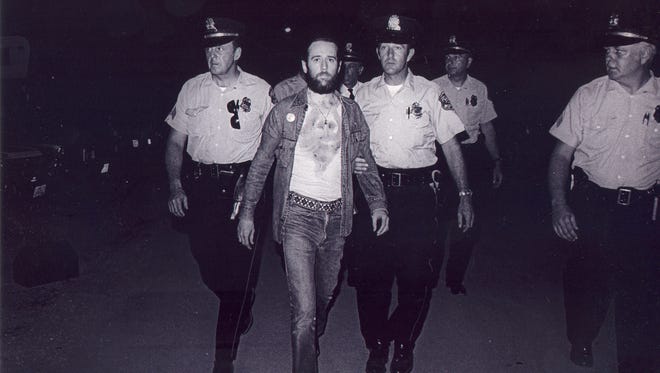
Like George Carlin, however, Vonnegut became increasingly cynical and angry as he aged.
Turning to essays mostly in his later years, Vonnegut wrote snarling political rants that none the less had the same allure of his fiction. He had little patience for Republicans or most Americans’ careless disregard for how humans are slowly but surely destroying the only planet that we have.
Again, I remain convinced we should heed Vonnegut’s many valuable warnings and messages—notably the ones above. But possibly most important of all is this from his opening chapter, The First Amendment, of Palm Sunday:
Republicans across the U.S. in 2022 are invoking God, claiming they were chosen by God, while they ban books and curriculum to control what students can and cannot learn.
This is the fate Vonnegut warned us about.
I can’t imagine anything other than biting anger from Vonnegut about Republican governors and of course the greatest stain on the country now, Trump.
Vonnegut is not looking down on our carelessness from above; as he noted often, God and heaven are human concoctions, evidence of our frailties.
Corporeally, Vonnegut is gone, mere dust.
We are left here in a crumbling democracy, watching the end of freedoms because more people have missionary zeal for a nonexistent afterlife than for the very real people walking around beside us.
More so than even our children.
And that, I think, would rouse Vonnegut’s greatest ire at our negligence, foolishness, and sad, bitter hatred.
Today, 100 years from Vonnegut’s birth, is a horribly sad day that continues to remind me of yet another old white man, William Butler Yeats:
The best lack all conviction, while the worst
Are full of passionate intensity.


































 dr. p.l. (paul) thomas