Category Archives: literacy

URGENT: Media Misreading the Reading Crisis Yet Again

Media Misreading the Reading Crisis Yet Again

By Katie Kelly and P.L. Thomas

Photo by Nathaniel Shuman on Unsplash

Several news articlesvideosreports on new state legislation, and commentaries across mainstream media have built a false narrative about a Reading Crisis. That story includes several key elements: Teachers do not know, and thus do not practice, the science of reading because teacher education has failed them.

Not only have the mainstream media offered only one narrative, but also, for example, the Education Writers Association chose one of the most prominent misleading articles for a Public Service, small staff award: Emily Hanford’s “Hard Words.”

In 2019, the Reading Wars have begun anew but with different language: Phonics advocates have simplified “the science of reading” to “all students need systematic phonics,” for example. And this round has resulted in dramatic changes in state reading policies.

As literacy educators and scholars, however, we contend that these messages are misrepresenting the Reading Crisis and the science of reading — both of which are far more complicated than being presented by much of the media, dyslexia advocates, and political leaders.

Those Who Ignore History: A Look Back at Reading Crises

The newest misdiagnosed Reading Crisis begs for a truism: “Those who cannot remember the past are condemned to repeat it” (George Santayana).

For example, the November 1942 issue of The Elementary English Review(National Council of Teachers of English) included a provocative piece, What Shall We Do About Reading Today?: A Symposium, prompted by the high rate of illiteracy among men drafted into WWII.

This symposium offers answers to the titular question from leading literacy experts of the time, including Lou LaBrant (former president of NCTE). Represented by assembled experts on literacy, this Reading Crisis foreshadows these debates are misguided and driven by ideology instead of evidence.

While we recommend reading the symposium responses in full, let’s focus on LaBrant: “Nevertheless, we hear many persons saying that the present group of near-illiterates are results of ‘new methods,’ ‘progressive schools,’ or any deviation from the old mechanical procedures. They say we must return to drill and formal reciting from a text book” (p. 240).

However, LaBrant discredits that blame because the recruits identified as illiterate or semi-literate “…are drop-outs, who have not completed elementary school, come from poorly taught and poorly equipped schools, and actually represent the most conservative and backward teaching in the United States [emphasis in original]” (pp. 240–241).

Next, in the 1980s/1990s, the media announced a Reading Crisis in California blamed on whole language. Literacy scholar Stephen Krashen, and others, debunked that claim, noting although whole language was the official reading approach of the state, teachers almost never implemented whole language. Further, the reading score plummet correlated with whole language being the official policy, but the causes of those lower scores were a large influx of non-native speakers of English and reduced educational funding.

Throughout much of the 20th century, reading instruction in practice remained skills-based, perpetuating a simple view of reading. That criticism of whole language, however, prompted a call for more scientific approaches to teaching reading, which meant mandated scripted instruction with an emphasis on phonics instruction. This was also driven by the high stakes accountability era of No Child Left Behind.

Contrasting thoughtful literacy, scripted reading programs narrow curriculum focusing on skills instruction and test preparation through teacher-directed learning (Kozol, 2005; Lipman, 2004). In this context, students serve as vessels with teachers depositing knowledge. This back-to-basics model of instruction encourages replication and regurgitation of information with little emphasis on comprehension instruction, critical thinking, and rich discussion of text (Comber & Nichols, 2004Durkin, 1981Leland, Harste, & Huber, 2005Shannon, 2007Taberski, 2011).

Being a good word caller does not equate to being a good reader, but can produce a false-positive on narrow types of reading tests. This unbalanced approach to teaching literacy is not only problematic, but also dangerous.

Misreading the Reading Crisis Yet Again

Despite the value of a more student-centered curriculum that fosters critical thinking, some advocate for a return to skills-based systematic phonics instruction, framed as the “science of reading,” and claim another Reading Crisis. With a new push for phonics as a single pathway to literacy, the role of the meaning making process in reading will again be neglected.

In her seminal study, Delores Durkin found an overemphasis on testing comprehension rather than teaching comprehension. Reading is a complex cognitive process mediated by social and cultural practices requiring instruction and interaction with text and others to construct meaning. Therefore, we must shift our view of literacy beyond decoding to include constructing meaning and reading texts critically by expanding instructional practices and the ways we assess reading.

The so-called science of reading is, in fact, balanced literacy, which includes a focus on multiple components of literacy including phonics, comprehension, and writing: “A balanced approach will privilege authentic texts and tasks, a heavy emphasis on writing, literature, response, and comprehension, but it will also call for an ambitious program of explicit instruction for phonics, word identification, comprehension, spelling, and writing” (Pearson, 2004, p. 243).

While phonics is an essential component of reading instruction in the primary grades, “it should be noted that phonics is one element of a comprehensive literacy program that must also include practice in comprehension, fluency, vocabulary, writing, and thinking” (ILA, 2018).

No Crisis, But We Are Failing Our Students

Crisis rhetoric misreads not only how we currently teach and historically have taught reading, but also misrepresents the causes of low student achievement in reading while perpetuating some of the worst possible policies and legislation such as grade retention based on high-stakes testing.

This Reading Crisis ignores that focusing on narrow standards and high-stakes testing combined with the de-professionalization of teaching and under-funding education has resulted in overcrowded classrooms where teachers and students conform to mechanical reading programs privileging the wealthy and overemphasize test scores.

As teacher educators, we can attest that regardless of what we teach about reading and literacy, most teachers feel pressured to implement programs and raise test scores.

Rather than blaming students and teachers for the opportunity gap entrenched in formal schooling, consider the achievement debt due to inequitable funding, poor healthcare, and a lack of political courage. With increasingly diverse student populations, we have a responsibility to address this debt by serving all students through culturally relevant teaching practices.

We must, then, disrupt the misguided narrative of crisis that disguises the sociocultural historical and political factors that influence reading instruction as a disease that simply needs a vaccination in the form of systematic phonics.

Katie Kelly is an Associate Professor of Education at Furman University. A former elementary teacher and literacy coach, Katie teaches courses in literacy methods and assessment at the undergraduate and graduate levels. She is the coauthor of Reading to Make a Difference: Using Literature to Help Students Speak Freely, Think Deeply, and Take Action (Heinemann). Follow her work at bookbuzz.blog and @ktkelly14.

P. L. Thomas, Professor of Education (Furman University), taught high school English for 18 years in South Carolina before moving to teacher education and teaching first-year writing. He is author of Teaching Writing as Journey, Not Destination: Essays Exploring What “Teaching Writing” Means (IAP). Follow his work at https://radicalscholarship.wordpress.com/ and @plthomasEdD.

A Meditation on Stringing Words Together: The National’s “Roman Holiday”

I’m still standing in the same place where you left me standing

“I Am Easy to Find,” The National

For those of us who love words and fall deeply in love with authors and pop music performers, few things are as exciting as new works. I listened for the first time to The National’s I Am Easy to Find on the release day during a long drive.

The first song, “You Had Your Soul with You,” had already been released so my rush happened on the second song, “Quiet Light,” when I felt the urge to cry before the lyrics even began.

And by the seventh song, the titular “I Am Easy to Find,” I could hold back no longer, crying steadily as I drove. There is something uniquely powerful about the combination of beautiful music and beautiful words strung together in a way that make your heart ache.

As an English teacher for about two decades during the first half of my career, I was always searching for an effective way to teach poetry well. Students tended not to like poetry but also had very narrow and mistaken associations with poetry—poetry rhymes, for example, and being overly concerned with what poems mean.

It probably seems trite, but I did find that investigating poetry—asking, what makes poetry, poetry?—combined with starting with pop music song lyrics helped allay student antagonism toward what I consider a beautiful and powerful form of human expression.

Throughout the 1980s and 1990s, I grounded my poetry unit in the music of R.E.M. Although I now mainly teach education and writing courses, I continue to think as an English teacher—especially in terms of applying reading like a writer to text such as song lyrics to inform how we read and write well.

Especially with the rise of close reading, driven by the mostly now defunct Common Core, many formal lessons focusing on analyzing text remains trapped in false notions that meaning is restricted to the parameters of the text, words strung together on the page.

“I’m your hospital, I’m your silver cross,” opens The National’s “Roman Holiday,” preparing the listener for how to unpack these metaphors, but also confronting the arguments of close reading that meaning is a mechanical process bound to text only.

In the opening verse as well, “Patti wasn’t lonely, Robert wasn’t lost” establishes the factual basis of the song, explained by the primary lyricist, Matt Berninger:

I am a huge fan of that book [Patti Smith’s memoir Just Kids], but I was actually looking at Judy Linn’s book of Patti Smith photos. A lot of the imagery in it is of Patti Smith and Robert Mapplethorpe when they were really young, just hanging out in their apartment: dressing up, taking pictures of each other, looking cool. It’s such a beautiful portrait of pals, such a romance. And then there’s also a line I took from Patti Smith’s Instagram, a comment she sent to somebody who had just lost someone to suicide: “Please think the best of him.” I found it incredibly moving. I was just obsessed with her kindness and her wisdom in the face of so many sad things.

Carin Besser, Berninger’s wife and co-lyricist on The National lyrics for several of the recent albums, adds how being a lyricist is similar to poetry in an interview:

You have a background in poetry and as a writer and editor. How is lyric writing similar or different than what you’ve done in the past?

I think I probably like the same thing about poems and song lyrics. When I read poems or listen to a song I love, I get very hung up on certain lines, especially lines I both don’t and do understand. I love that. But it’s not that impressive. It’s like being attracted to sequins. I don’t really understand story or plot well, but I love a way of finding that compressed or cock-eyed way of saying the thing, so that you can kind of re-hear the thing, or so that you can hear the feeling of thought on its way.

Any kind of language on the way to an idea, I tend to like. It’s mysterious enough to me that I stay interested. I also love songs where the singer is rambling on and almost doesn’t seem to hear what the song is doing. Or when a vocal melody slides around in order to make a point. I also sometimes feel like with song-making, there are all these bags of fireworks laying around, so many ways in a song with a singer and against the backdrop of all the musical ideas, so many ways to try to make an impression.

As a foundational text to investigate poetry—genre, mode, form—”Roman Holiday” is a powerful experience for students. Typically, using pop music, I ask students to listen to the song once without any lyrics; I then do a second listening with the lyric before the students.

Without context, “Roman Holiday” may be read a number of valid ways, focusing on unpacking the technique (metaphor, rhyme/half-rhyme, sound devices, imagery, motifs) in a traditional process (think New Criticism and close reading).

The half-rhymes are engaging (cross/lost, rains/shame, him/museum) and sounds help give the lyrics cohesion (please/police). But analyzing “Roman Holiday” decontextualized ultimately fails the song and the reading; better is to place the song in a text set including:

Technique and craft of the lyrics and the entire song are effective and powerful, but they are vehicles for the much larger discourse between a variety of texts and modes of expression, including photography, memoir, and social media.

If close reading guides coming to understand “Roman Holiday,” we are having an incomplete experience. This song depends on history, controversy, and two influential artists, Patti Smith and Robert Mapplethorpe.

How Smith, specifically, has resonated as an artist and thinker while Mapplethorpe died much younger builds along with Smith’s response to suicide (“Please, think the best of him”) to something both grounded in these two lives and the greater and more complex human condition.

While reading and interpreting text remains concepts misunderstood and misrepresented in the media and by the public, this sort of rich and complex unpacking of “Roman Holiday” speaks to how NCTE defines reading:

Reading is a complex and purposeful sociocultural, cognitive, and linguistic process in which readers simultaneously use their knowledge of spoken and written language, their knowledge of the topic of the text, and their knowledge of their culture to construct meaning with text. Each of these types of knowledge impacts the sense that readers construct through print. Readers easily comprehend text with familiar language but are less successful at comprehending text with unfamiliar language. Readers easily comprehend text on familiar topics but are less successful at comprehending texts on unfamiliar topics. At the same time, the interpretations readers construct with texts as well as the types of texts they read are influenced by their life experiences.

Without a knowledge of the topic of this song (Smith and Mapplethorpe’s relationship), a close reading misses a great deal. Yes, there is really compelling craft here, but there is also history and deep emotion.

Pop songs, like poetry, lend them selves to re-listening/rereading. Meaning grows, even blossoms with each experience because we are always a different person each time we re-listen/reread.

The meaning of any text is never fixed, never simply trapped in the stringing together of words.

For me, “There are police in the museum/She said please” stays with me after hearing the song; the use of “police/please” haunts me.

I am uncertain I can articulate why, but it certainly has meaning—and that meaning is more than intellect, enriched by emotion.


See Also

Florence Welch on Sobriety, Embracing Loneliness and Loving Patti Smith

Florence + The Machine – Patricia

The Enduring Influence of the National Reading Panel (and the “D” Word)

What do the National Reading Panel (NRP) report (2000), A Nation at Risk (1983), and the seminal “word gap” study by Hart and Risley (1992/1995) have in common?

First, each of these has become a recurring citation in mainstream media when addressing reading (NRP), school accountability (A Nation at Risk), and literacy (“word gap”).

Next, and quite troubling to those of us in education and literacy, all of these have been debunked.

A wide array of scholars have called into question Hart and Risley’s methods, conclusions, and assumptions. Gerald Bracey and Gerald Holton have unmasked A Nation at Risk as a false political crisis. And NRP panelist Joanne Yatvin as well as Stephen Krashen have significantly refuted the validity of the NRP report and process.

Recently, the reading wars have been rebooted across mainstream media; concurrent with that has been a rash of new reading legislation in several states.

In both cases, a common phrase is “the science of reading,” a thin veil for renewed emphasis on systematic phonics—in part driven by advocates for children with dyslexia.

News articles across Education Week, NPR, PBS, and other outlets have praised this so-called need for the science of reading while almost uniformly referring to the NRP as the primary research base for that “science.”

One journalist, Emily Hanford, who won an EWA award for her “science of reading” article, discounted my charged the NRP had been debunked with “One member expressing a minority view does not equal ‘debunked.'”

Here, I want to note that I have discovered many people react strongly to the term “debunk,” seemingly because they interpret its meaning simplistically; however, note the nuance of the term:

debunk

In the case of the NRP report, I contend it has been debunked because, specifically, a member of the committee who protested that the panel included no genuine teacher of reading has carefully shown that the report is inadequate and also predicted it would be misused in the following ways:

FALSE: The National Reading Panel was a diverse and balanced group of reading experts.

TRUE: Congress asked for a balanced panel, but that’s not what it got….

FALSE: The panel carried out a comprehensive analysis of the entire field of reading research.

TRUE: Only a small fraction of the field was considered, and only a few hundred studies were actually analyzed….

FALSE: The panel determined that there are five essentials of reading instruction.

TRUE: Although the NRP reported positive results for five of the six instructional strategies it investigated, it never claimed that these five were the essential components of reading….

FALSE: The panel endorsed only explicit, systematic instruction. [a]

TRUE: Only in the phonics subgroup report is “explicit, systematic” instruction called essential….

FALSE: The panel identified certain comprehensive commercial reading programs as being research-based, and concluded that teachers need one of these programs, or a comparable program, to teach children effectively.

TRUE: No comprehensive reading programs were investigated by the panel. The panel had nothing to say about whether teachers need a commercial program or can develop their own….

FALSE: The panel identified phonics as the most important component of reading instruction throughout the elementary grades. [a]

TRUE: The panel made no such determination….

FALSE: The panel found that phonics should be taught to all students throughout the elementary grades. [a]

TRUE: The panel found no evidence to justify teaching phonics to normally progressing readers past 1st grade….

FALSE: The panel’s findings repudiate whole language as an approach to teaching reading.

TRUE: The panel did not investigate whole language as a topic and did not draw any conclusions about it as an approach to teaching reading….

ALSE: The panel found research evidence indicating how teachers should be trained to teach reading. [a]

TRUE: The panel found no such evidence….

I stand fast that even though Yatvin technically is a minority opinion, she has the greatest expertise of the panel and her clarifications have proven accurate.

Yatvin’s skeptical first-hand account has also been reinforced by Elaine M. Garan’s critique of the phonics report. Anyone citing the NRP must keep in mind Garan’s (2001) conclusion:

If Teaching Children to Read were a typical research study, published in an education journal and destined to be read only by other researchers, then I could simply end my analysis by saying that the panel’s own words have established that the research base in its report on phonics is so flawed that the results do not even matter. However, as we have seen, this study has clout. It has a public relations machine behind it that has already promulgated the results throughout a very wide, very public arena as representing unbiased scientific “truth.” (p. 506)

Almost 20 years ago, Garan had the same cocnerns as Yatvin, both of which have come disturbingly true:

The conclusions of this study as reported in the Summary have generated headlines not only in education publications, such as Education Week and Reading Today, but also in such newspapers as USA Today, the Cleveland Plain Dealer, and the Indianapolis Star. It is, perhaps, too late to mitigate the effects of this widely distributed, widely publicized project. However, I can hope that this analysis will provide a tool for others who will want to delve more deeply into the findings of the NRP report before accepting or rejecting it on the basis of the philosophical hot topics that the research addresses. If our instructional methods are to be dictated by research, then shouldn’t that research be sound? (p. 506)

Now, we should be answering that question with a definitive “yes” even as that resists the misguided call of the “science of reading.”

But there is more reason to reject the NRP report as sacrosanct guidance for how to teach reading; it was at the center of the politically corrupt Reading First scandal that exposed relationships between government officials and Open Court textbooks.

It is not mere speculation that there is a problematic relationship between phonics advocacy and for-profit organizations serving education.

The short version about the fact of the NRP being debunked is that it was a politically skewed panel from the beginning, and then its process was also deeply flawed, manipulating what research was considered in order to favor a systematic phonics message that wasn’t supported by the actual science of reading available then, and now.

To reference the NRP report as credible is to overstate its value, to misrepresent not only the report but the field of teaching reading.

Yet, journalists with no expertise in literacy and no background in the history of reading or teaching reading are falling prey to alluring language, “the science of reading,” and fulfilling the warnings offered by Yatvin and Garan nearly two decades ago.


[a] Note that in the current media coverage of “the science of reading,” this is exactly how references to the NRP are being misused.

Parent Advocacy and the New (But Still Misguided) Phonics Assault on Reading

“School days were eagerly anticipated by Francie,” a central character in Betty Smith’s A Tree Grows in Brooklyn (p. 143). The novel often is a powerful fictional account of poverty among white working class people at the turn of the twentieth century.

But Francie Nolan is also a girl who loves books, libraries, and an idealized view of what formal schooling will be. Yet, “[b]efore school, there had to be vaccination,” the narrator explains. “That was the law”:

When the health authorities tried to explain to the poor and illiterate that vaccination was  a giving of the harmless form of smallpox to work up immunity against the deadly form, the parents didn’t believe it. … Some foreign-born parents refused to permit their children to be vaccinated. They were not allowed to enter school. Then the law got after them for keeping the children out of school. A free country? they asked. (pp. 143-144)

Left alone by their working mother, Francie and her brother, Neeley, must go for their vaccinations, prodded only by a neighbor who rouses them from playing in the dirt and mud. Francie suffers through not only the shot itself, but also the doctor’s insensitive and classist criticism: “‘Filth, filth, filth, from morning to night. I know they’re poor but they could wash. Water is free and soap is cheap. Just look at that arm nurse'” (p. 146).

Despite the trauma of the vaccinations and the class-shaming by the doctor, “Francie expected great things from school” (p. 151). However, “Brutalizing is the only adjective for the public schools of that district around 1908 and ’09. Child psychology had not been heard of in Williamsburg in those days” (p. 153).

That “brutalizing” included:

The cruelest teachers were those who had come from homes similar to those of the poor children. It seemed that in their bitterness towards those unfortunate little ones, they were somehow exorcizing their own fearful backgrounds. (p. 153)

A decade past a century since this novel, and I must acknowledge there is a disturbing series of patterns that remain, including the anti-vaccination movement as well as a significant portion of parents who find public schools unresponsive to the needs of specific populations of students.

Since I am currently reading Smith’s novel, I was drawn to some comparisons when I encountered, once again, the media’s misguided fascination with the “science of reading”: What parents of dyslexic children are teaching schools about literacy from PBS News Hour.

I cannot help asking if mainstream media would ever run this story: What anti-vaccination parents are teaching doctors about disease.

And then, while the new (but still misguided) phonics assault on reading has been spreading for a few years now, Education Week once again piles onto the bandwagon driven by parents advocating for their children with dyslexia: Stephen Sawchuk’s Battle Over Reading: Parents of Children With Dyslexia Wage Curriculum War and College of Education Now Prepares Teachers in the Science of Reading.

Sawchuk’s piece recycles both misinformation about dyslexia (1 in 10 children are diagnosed, according to Dyslexia International, but many sources suggest the exact percentage ranges from 5% to 17%) and resorts once again to citing the National Reading Panel as a credible report on reading (it has been thoroughly debunked). In fact, intensive, systematic phonics for all students has also been discredited.

Yet as Andrew Davis acknowledges: “The zeal with which synthetic phonics is championed by its advocates has been remarkably effective in pushing it to the top of the educational agenda; but we should not mistake zeal for warrant.”

As I examined and unpacked concerning school choice, we must resist idealizing parental choice, even in regard to those parents’ children. The anti-vaccination movement occurring now is grounded in both those parents wanting what is best (in their view) for their children’s health and a garbled misunderstanding of vaccinations driven by one deeply flawed study that makes those parents believe they have science on their side:

Lacking the scientific background, in an attempt to protect their children, parents contemplating the risk of vaccine are vulnerable to omission biases by which they are more likely to take the risk of inaction than the risk of action….

The anti-vaccine movement appears to be part of a larger trend of discontent and distrust in the established preeminence of scientific evidence over impressions and opinions. A corollary to the discontent is the democratization of health-related decision making, by which stakeholders have an increasingly stronger voice over experts, as well as the dethroning of the Expert. While democratization of health care decision making is cheered by liberals and conservatives alike, its benefits are still to be proven. Decisions in the area of disease prevention require knowledge of the medical field involved and an understanding of statistics, in the absence of which no amount of communication skills and efforts would do any good.

This, I think, is a powerful harbinger of how the new (but still misguided) phonics assault on reading is being perpetuated by rhetoric (“the science of reading”) and zeal among parents who seek to democratize the teaching of reading, and as a result, the expertise of literacy educators is erased and replaced by parent will and political caveat.

Here are some essential facts being ignored by the avalanche of zeal among mostly parents of children with dyslexia:

  • No student, regardless of special needs such as dyslexia, should be mis-served by our public education system. Parents of children advocating for best practices in the service of their children must be heard, and public schools must respond, attended to, however, by special needs educators and scholars, not the policy demands of the parents or political leaders. “My child must be served” is different than “This is how you will serve my child.”
  • Reading needs of the general population of students must not be held hostage to the needs of unique subsets of students—especially when the zeal of a few is allowed to overwhelm the expertise of educators and literacy scholars.
  • Historically, reading instruction has been a victim of false crisis rhetoric, and current calls for “the science of reading” is yet another round of phonic-only propaganda that cannot serve students well.
  • The research base on reading instruction (the actual science of reading) has never rejected phonics instruction (including whole language and balanced literacy), but each student needs varying degrees of direct phonics instruction, only enough so that the student begins reading and develops as a reader through holistic experiences such as reading by choice and being read to.
  • There has never been a time in the history of formal education in the U.S. that some have not claimed we have a reading crisis. Never. That crisis rhetoric has always been misguided and driven by those with some ulterior agenda or no expertise in literacy.
  • Most of the ways that formal schooling now fails students in terms of reading instruction can be connected to the accountability movement—focusing on ever-changing standards and high-stakes testing as well as imposing prescriptive reading programs onto teachers and students.

Parental zeal in the anti-vaccination movement has spurred measles outbreaks, proving that parental zeal must not be allowed to trump medical expertise.

Parental zeal for public schools properly serving students with dyslexia must not be allowed to drive reading policy for all children; this is just as unwarranted even as the consequences may not be so easily exposed.


“A case for why both sides in the ‘reading wars’ debate are wrong — and a proposed solution” Is 50% Wrong

In her The Answer Sheet, Valerie Strauss offers yet another post about the current Reading War/Crisis: A case for why both sides in the ‘reading wars’ debate are wrong — and a proposed solution.

Strauss explains before offering the long post:

This is an unusual post about the “reading wars,” that seemingly never-ending battle about how to best teach reading to students — systematic phonics or whole language. This argues that both sides have it wrong, and the authors, two brothers who are literacy experts, suggest a new way.

While this is a provocative, often nuanced, and compelling, it makes a fatal flaw common in the seemingly never-ending false war between phonics and whole language by misdefining whole language and then failing to take care when citing research that seems to show neither systematic phonics nor whole language are more effective than the other.

First, let me offer an example of this type of failure in a slightly different context, the powerful and complicated work of Lisa Delpit.

Delpit has made for many years a strong case about the inequity of educational opportunities that cheat black students (as well as many other vulnerable populations). At times, Delpit’s work has been co-opted by traditional advocates for education—notably those calling for intensive phonics and isolated grammar instruction.

Here, Delpit make a very direct refuting of that sort of co-opting:

I do not advocate a simplistic ‘basic skills’ approach for children outside of the culture of power. It would be (and has been) tragic to operate as if these children were incapable of critical and higher-order thinking and reasoning. Rather, I suggest that schools must provide these children the content that other families from a different cultural orientation provide at home. This does not mean separating children according to family background, but instead, ensuring that each classroom incorporate strategies appropriate for all the children in its confines.

However, the sources of why Delpit came to confront how formal education often cheats black students is an important window into why many continue to misrepresent the Reading War/Crisis by defining incorrectly whole language (or balanced literacy).

As Delpit explains:

A doctoral student of my acquaintance was assigned to a writing class to hone his writing skills. The student was placed in the section led by a white professor who utilized a process approach, consisting primarily of having the students write essays and then assemble into groups to edit each other’s papers. That procedure infuriated this particular student. He had many angry encounters with the teacher about what she was doing. …

When I told this gentleman that what the teacher was doing was called a process method of teaching writing, his response was, ‘Well, at least now I know that she thought she was doing something. I thought she was just a fool who couldn’t teach and didn’t want to try.’ This sense of being cheated can be so strong that the student may be completely turned off to the educational system.

Yes, this teacher and experience had clearly failed that doctoral student, but if we are careful to note the details of that failure, what we discover is that the teacher had also failed process (or workshop) writing instruction.

Process or workshop writing instruction is far more that peer conferencing; it entails drafting and student choice of topics and text form, conferences with peers and the instructor, explicit instruction of all aspects of composing (including grammar, mechanics, and usage) based on the needs of the students revealed in their original essay drafts (typically called mini-lessons), careful and varied reading-like-a-writer experiences with rich texts, and producing final authentic artifacts or writing.

To be brief here, Delpit is correct that “other people’s children” are disproportionately cheated by reduced curriculum and inadequate instruction, but it is misleading to lay that blame at the feet of process/workshop methods since the student example shows this is not what was implemented.

Now, let’s circle back to the “both sides are wrong” claim by Jeffrey S. Bowers and Peter N. Bowers.

Bowers and Bowers discredit systematic phonics fairly carefully and fairly,  I think. But when they turn to the research on whole language, they make no effort to verify if the research cited in fact confirmed that whole language was being implemented with any level of fidelity.

As I have noted often in the 1980s/1990s, the media announced a Reading Crisis in California blamed on whole language. Literacy scholar Stephen Krashen, and others, debunked that claim [1], noting although whole language was the official reading approach of the state, teachers almost never implemented whole language.

As well, Bowers and Bowers make an odd choice about defining what whole language is by citing and defining as follows:

According to foundational theory for whole language, learning to read is just like learning to speak (Goodman, 1967). Given that virtually everyone from every culture learns to speak without any formal instruction in a context of being exposed to meaningful speech, it is concluded that children should learn to read in the same way, naturally, by reading meaningful text. The fact that not all verbal children learn to read with whole language should be a first clue that something is wrong with this theory.

This dramatically over-simplifies Goodman’s work, but also ignores decades of refinement of what whole language became, and then how many have embraced balanced literacy.

When we are referring to whole language, however, the fundamental problem with discounting whole language often rests with not understanding what it is: “Whole language is not a program, package, set of materials, method, practice, or technique; rather, it is a perspective on language and learning that leads to the acceptance of certain strategies, methods, materials, and techniques.—Dorothy Watson, 1989.”

And a failure to acknowledge that “… [w]hole language…builds on the view that readers and writers integrate all available information in authentic literacy events as they make sense of print. Whole language teachers don’t reject phonics; they put it in its proper place [emphasis added]” (K. Goodman, Phonics Phacts, p. 108).

Let me put this directly: Whole language does reject the need for systematic phonics for all children, but the language philosophy endorses entirely that some phonics is needed, that each child should receive the amount and type of phonics instruction needed to read independently—not to comply with a reading program, to cover a set of universal standards, or to raise test scores.

The argument posed by Bowers and Bowers is correct only if we misdefine whole language and fail to critically examine research that claims to be measuring whole language effectiveness or if whole language was even implemented with any sort of fidelity.

As it sits now, the Bowers and Bowers’s argument is 50% wrong.


[1] Note that the reading test score decreases (the reason for the claim of a reading crisis) were caused mostly by a large influx of non-native English speaking students and drastic budget cuts for education. The ways in which students were being taught to read are correlations at best with those scores.

For Further Reading

Defending Whole Language: The Limits of Phonics Instruction and the Efficacy of Whole Language Instruction, Stephen Krashen, Reading Improvement 39 (1): 32-42, 2002.

Facts: On the nature of whole language education (Heinemann)

To read or not to read: decoding Synthetic Phonics, Andrew Davis

Teaching and Learning: The Dysfunctional Celebrity Couple

I am deeply torn about the obsession with celebrities in the U.S. because seeking to be a celebrity brings with the rewards of fame a sort of 24-hour surveillance that no human deserves, or can survive.

When I see a media report on Celebrity X finally finding the love of their life, I immediately anticipate the cheating or break-up coverage to come. And then, the next story years later about Celebrity X finally finding the love of their life.

There exists in the U.S. a fundamental misunderstanding about the causal relationship between celebrity and happiness—that celebrity causes happiness.

I think teaching and learning suffer from both an over-exaggerated media and public focus as well as the same misunderstanding.

Let me share here that over the first few years of my becoming a high school English teacher I was racked with doubt about my work as a teacher because I routinely noticed that despite my teaching student often failed to demonstrate learning.

But something else bothered me as well.

Those first years in the early and mid-1980s included a common practice of issuing to students and then teaching from Warriner’s grammar text. Although I knew isolated grammar instruction was at least problematic, if not harmful (which George Hillocks showed within a decade of this experience), I tried to somehow follow the expectations of my department (use the grammar book!) and teach well my students to write.

Here’s the concern: Students were driven dutifully through, for example, “who/whom” chapters of Warriner’s, exercises and tests, from about 5th grade through 12th grade.

I watched as my students scored poorly on the “who/whom” assessments, waded through the worksheets.

Looking back, I connect this “who/whom” foolishness with my own high school adventures with “shall/will” exercises and tests.

First, “whom” is nearly dead, soon to join dear-departed “shall.” In a weird way, student ambivalence about “who/whom” will eventually be justified—just as those of us who failed to care about “shall/will” have won out.

More importantly, however, I realized in those first few years of teaching that there is in fact a very weak causal relationship between teaching and learning.

That I teach cannot guarantee learning, and students demonstrating (or not) learning often is not proof they have or haven’t been taught.

I have been brought back to this because so much of the current phonics fundamentalism I witness on social media is grounded in two deeply flawed premises.

Phonics fundamentalists are mired in anecdote. Broach the topic of reading on social media and legions will weight in with “I know a student” or “I have a child,” which leads to the second problem.

Phonics fundamentalists are trapped in weak evidence that students can’t read and then are convinced that lack of reading ability is caused by a failure of teaching.

A middle schooler reads poorly, they argue, and it is because that middle schoolers has weak decoding skills—because nobody teaches phonics anymore!

This resonates with me because as a literacy educator focusing mainly on the teaching of writing for 35 years and counting, I hear regularly the “nobody teaches grammar anymore” refrain—posed similarly by those making rash claims based on flimsy evidence.

Both phonics and grammar fundamentalism suffer as well from a serious lack of historical perspective.

Since at least 1900, roughly a beginning point of broad formal public education (although that promise was marred for about 7 more decades by all sorts of failures in assuring racial and gender equity), there has not been a moment when the media and the public was not lamenting that “kids today can’t read or write.”

When intensive phonics had its heyday: The media and public screamed students couldn’t read.

When isolated grammar was all the rage: The media and public screamed students couldn’t write correctly.

In this fourth decade of being a teacher, I am weary of fundamentalism and missionary zeal.

I have little patient for adults who have lower standards for themselves than the children and young people they claim to be serving.

I also have a heaping helping of humility.

I am a teacher.

However, teaching is no guarantee of learning.

Students failing to demonstrate learning is no proof they haven’t been taught before they entered my classroom—or while they have been in my classroom.

Teaching and learning are a dysfunctional celebrity couple.

We must stop staring and expecting them to fulfill some idealistic vision we are imposing on the universe.

And we would all be better off checking our fundamentalism and missionary zeal.

You know, kids today, they are wonderful, and to be perfectly honest, they make me happy to be alive to witness their becoming.

They can do without the worksheet, phonics and grammar rules. Maybe patience and adults who are kind and attentive.

You see, I, too, dwell in idealism, of a different kind.


Two Threads on Reading

I may tease these ideas more fully in blogs but for now, see two threads of mine below from Twitter.

What are teachers taught about reading in teacher education? “It just doesn’t matter.” [Click the Twitter bird in the upper right of the image for the thread.]

When advocacy for one student oversteps into what every student needs: The reading edition. [Click the Twitter bird in the upper right of the image for the thread.]

The Big Lie about the “Science of Reading” (Updated)

While too often inordinately dangerous* for the most vulnerable, social media can be a powerful window into how we think about and judge education. Recently, the reading wars have been once again invigorated; this time driven often by parents and advocates for students with special needs and accompanied by a very familiar refrain, the “science of reading.”

One problem with public debate about education is that political and public voices often lack experience and expertise in education as well as any sort of historical context.

First, those who have studied the history of education, and specifically the ever-recurring reading wars, know that there has never been a decade in the last 100+ years absent political and public distress about a reading crisis.

However, one doesn’t need a very long memory to recognize that if we currently are (finally?) having a reading crisis, it comes in the wake of almost two decades (nested in a larger four decades of accountability birthed under Ronald Reagan) dedicated to scientifically-based education policy, specifically reading policy driven by the National Reading Panel (NRP).

The NRP was touted as (finally?) a clearing house of high-quality evidence on teaching children to read (although it proved itself to be partisan hokum).

This is all quite fascinating in the context of the current media blitz about the reading crisis and a need (yes, once again) to focus on the science of reading. Concurrent with that media fail is a move within the academia to shift reading away from literacy experts and into the purview of special needs, treating all reading instruction as something like remediation or a learning disability.

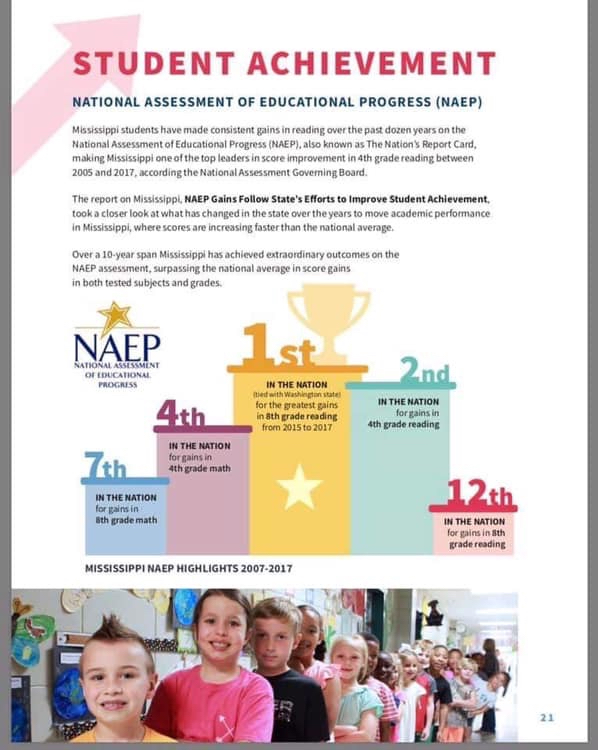
For example, I noticed a very odd dynamic on social media: a post on a community Facebook page for advocates of education that was linked to a dyslexia Facebook page promoting this from Mississippi:

MS gains propaganda

The message included dramatic arguments: Mississippi has somehow found the science of reading and is excelling in ways South Carolina refuses to do.

Knowing standardized test scores, and NAEP specifically, well, I was immediately skeptical of these claims.

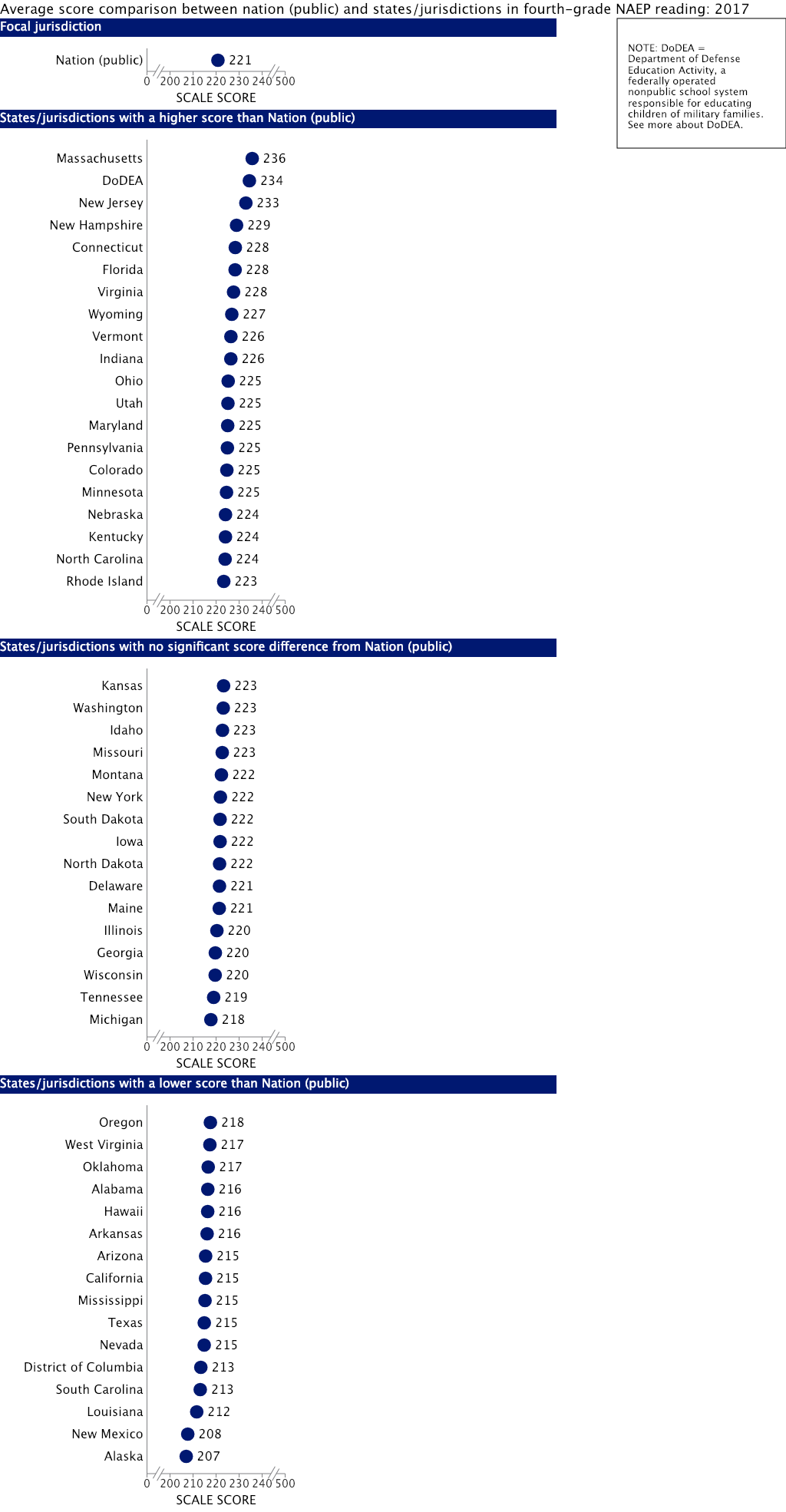
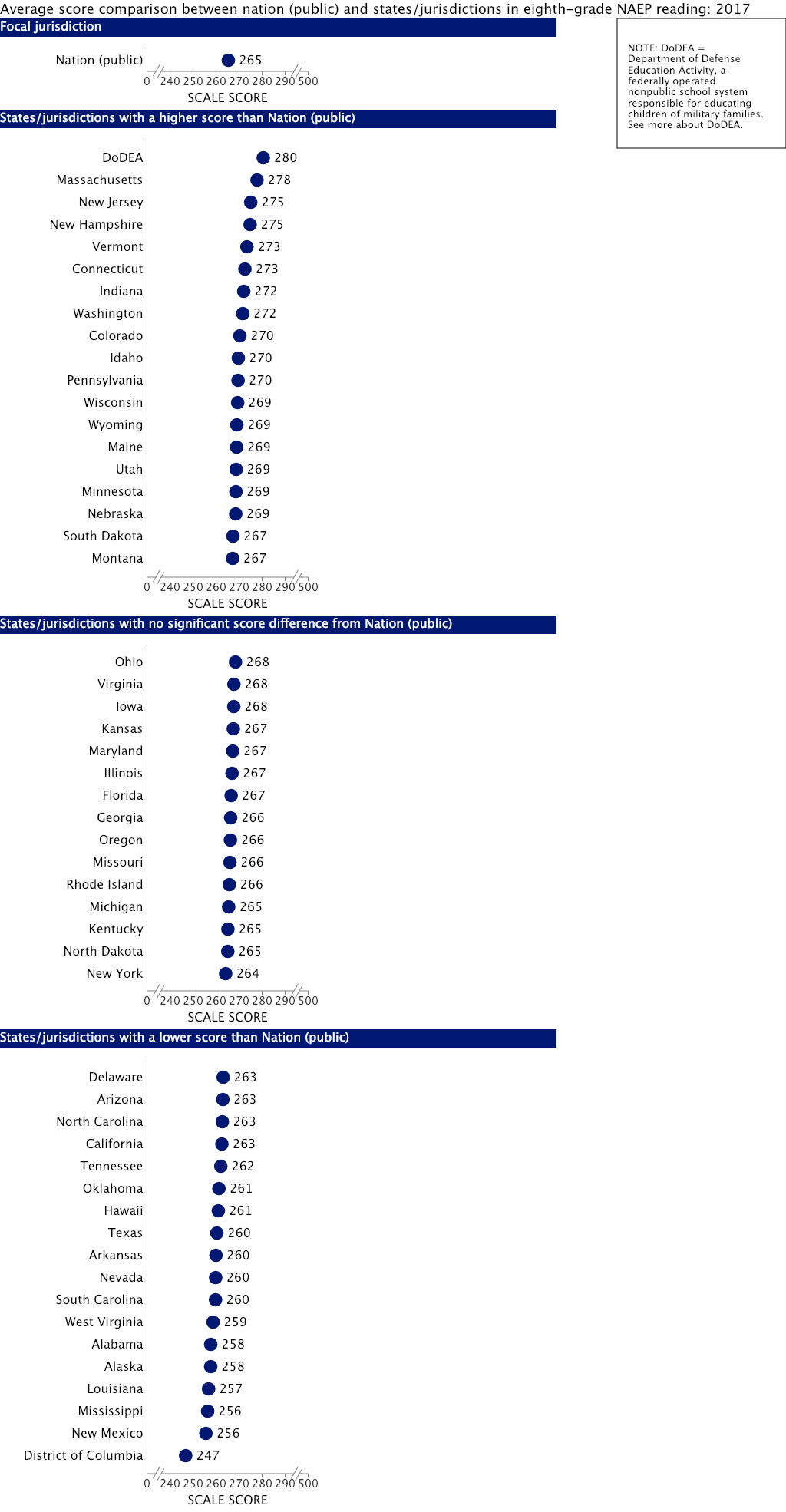
Here is the short version: In 2017 NAEP data, MS is slightly ahead of SC in 4th-grade reading (both states remain near the bottom and below the national average), but SC is slightly ahead of MS in 8th-grade reading (again, both near the bottom and below the national average):

4th reading 2017

8th reading 2017

While Mississippi is promoting gains (accurately), the data remain clear that high-poverty states tend to score low on standardized testing while more affluent states tend to score higher.

What is extremely important to note is that some traditionally low scoring states have found methods (test-prep, reading programs focused on raising test scores, and grade retention) that increase test scores short term (making for political propaganda), but those gains have proven to be a mirage, disappearing in the span between 3rd/4th- grade tests to 8th-grade tests and then high school (see, for example, research on Florida).

So we sit here with some real problems and questions: Is there a reading crisis in the U.S. and my home state of SC? And if so, is that crisis somehow the result of refusing to implement the science of reading?

Well, first, I need to note that the “science of reading” is code for intensive phonics and is intended as an antidote to the current evil in reading, balanced literacy.

Now, consider this: In the late 1980s and early 1990s, a similar event happened when people started shouting about the reading crisis in California spawned by whole language (now, people claim balanced literacy and whole language are the same thing, and thus, equally evil).

Literacy scholar Stephen Krashen, and others, unmasked that round of the reading wars, noting that although CA claimed whole language as the official reading approach of the state, teachers were almost never practicing whole language.

Further, the reading score plummet of those years did correlate with whole language being the official policy, but the causes of those lower scores were a large influx of non-native speakers of English and significant decreases in educational funding (larger classes specifically negatively impacting achievement).

This isn’t particularly simple or compelling but let’s detail why this recent round of the reading wars is way off base:

  • Standardized tests of reading are only proxies of reading, typically they reduce reading to a series of discrete skills that test designers claim add up to reading. This is at least inadequate, if not misleading. No standardized test measures eagerness and joy for reading, as well; nearly none address critical literacy.
  • Making raising reading test scores your primary or exclusive goal is actually cheating all students. Period. And this is what many states are doing, including MS.
  • Achieving test score gains when you are low scoring is much easier that making gains when you are high achieving.
  • Adopting, implementing, and staying focused on any reading program—these are also very common practices, and completely flawed approaches to literacy. Access to books in the home and choice reading remain the strongest predictors of increased reading and reading achievement.
  • Ultimately, if we insist on using reading test scores to judge the quality of teaching reading in any state or the country, we must acknowledge that how students are being taught is both almost impossible to identify and completely impossible to characterize as one clear practice (teachers are very likely to shut their doors and do as they please, regardless of policies).
  • And most important is the fact that standardized test scores of reading are a reflection of a large number of factors, with teaching practices only one (probably small) causal factor.

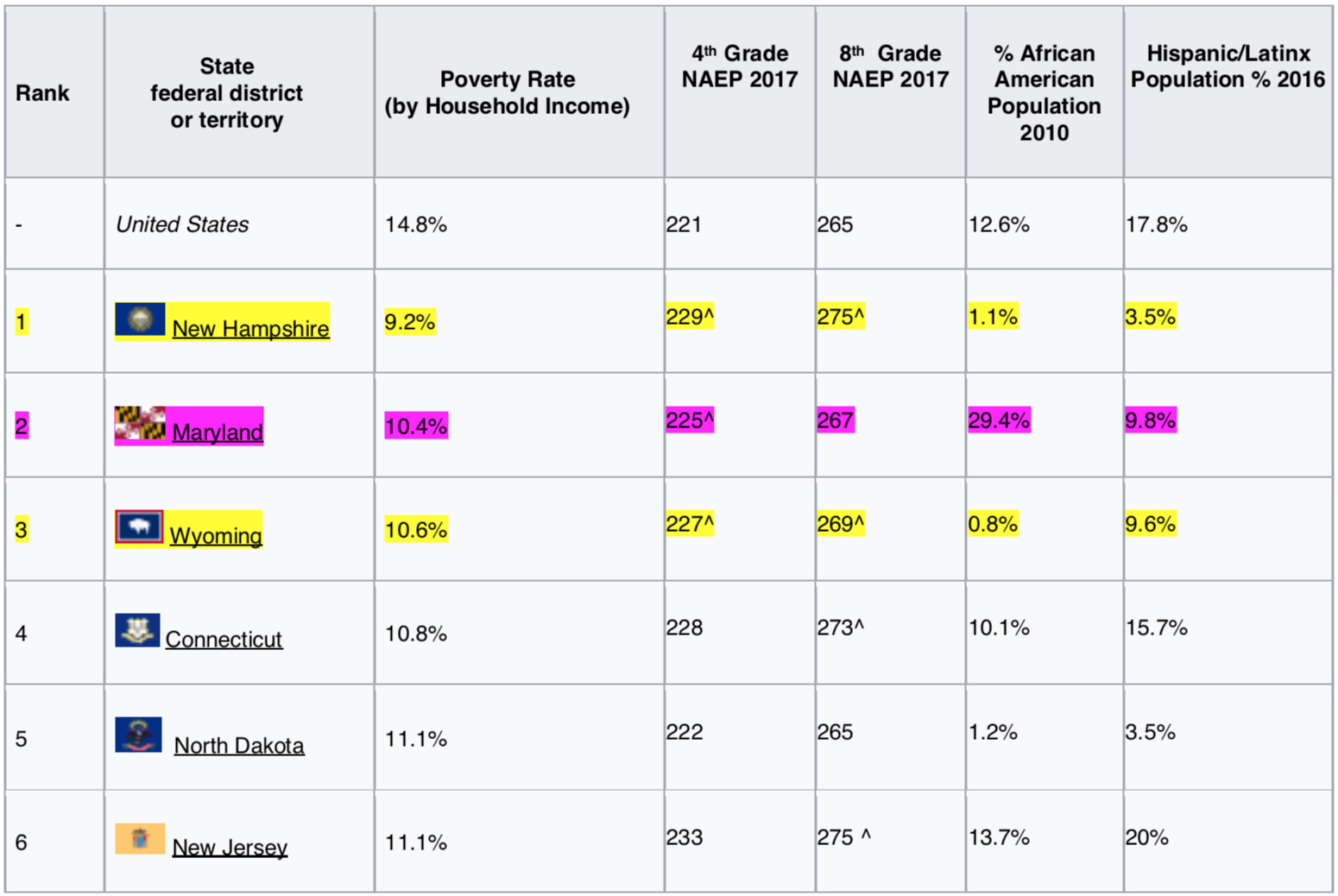
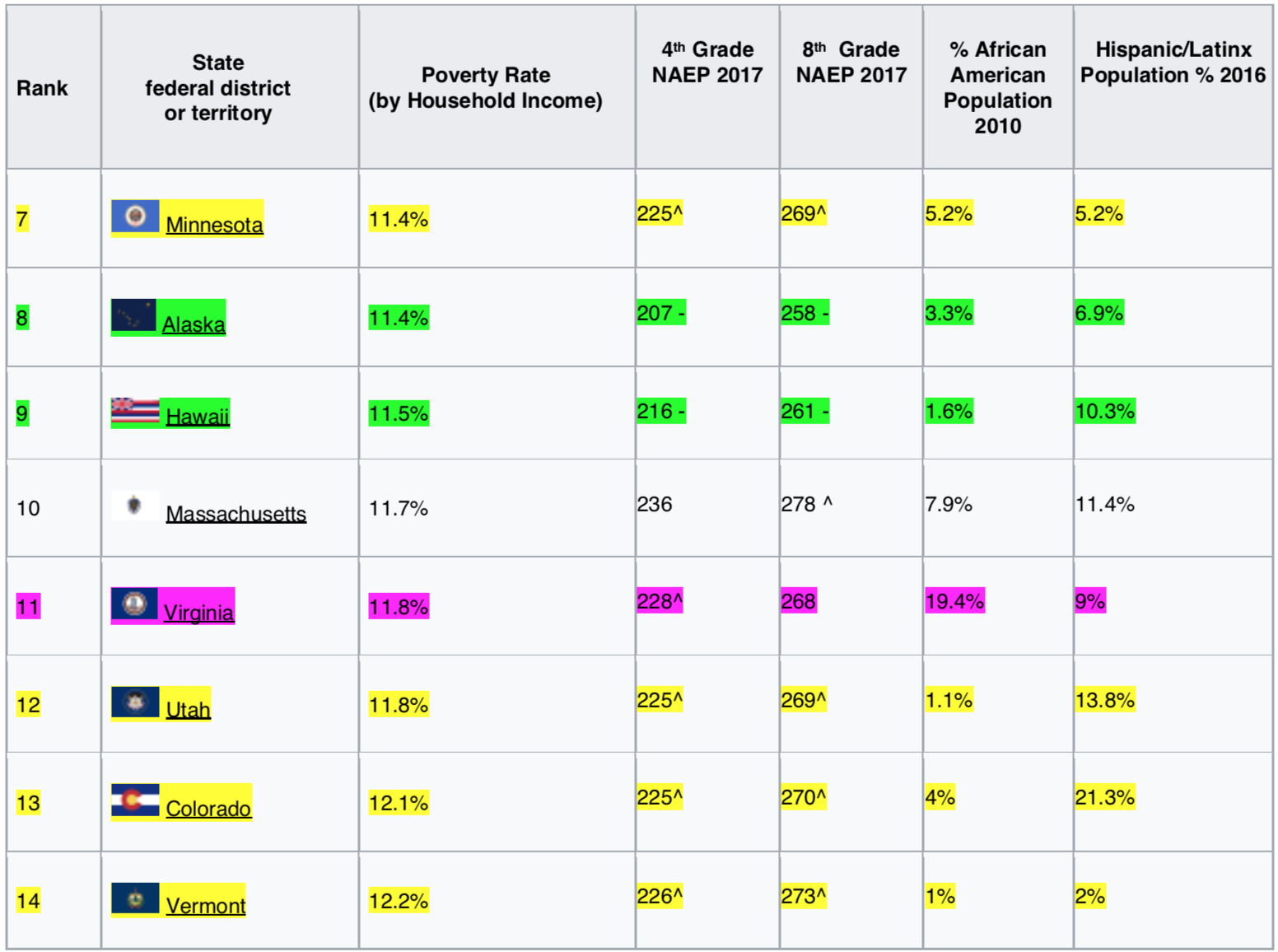
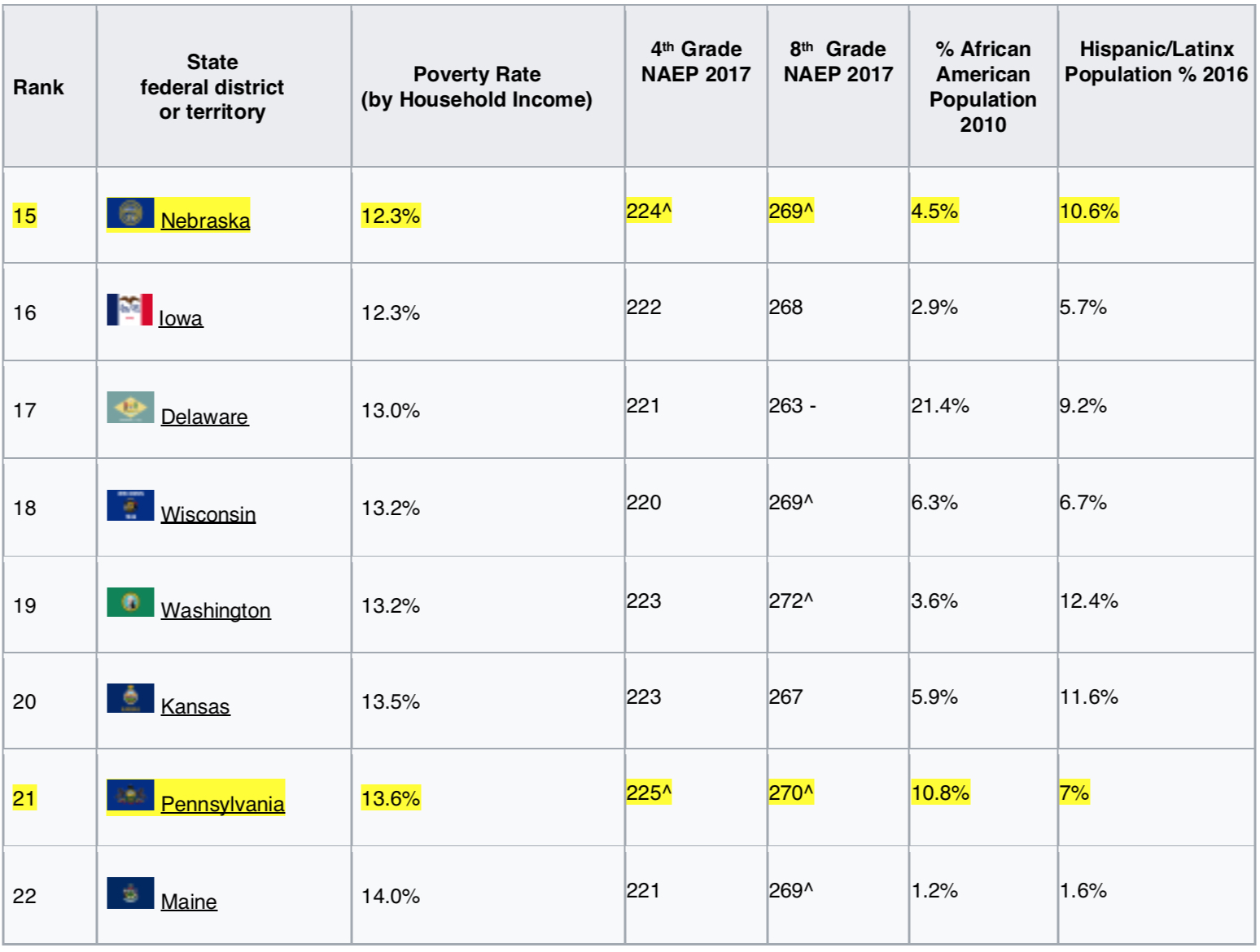
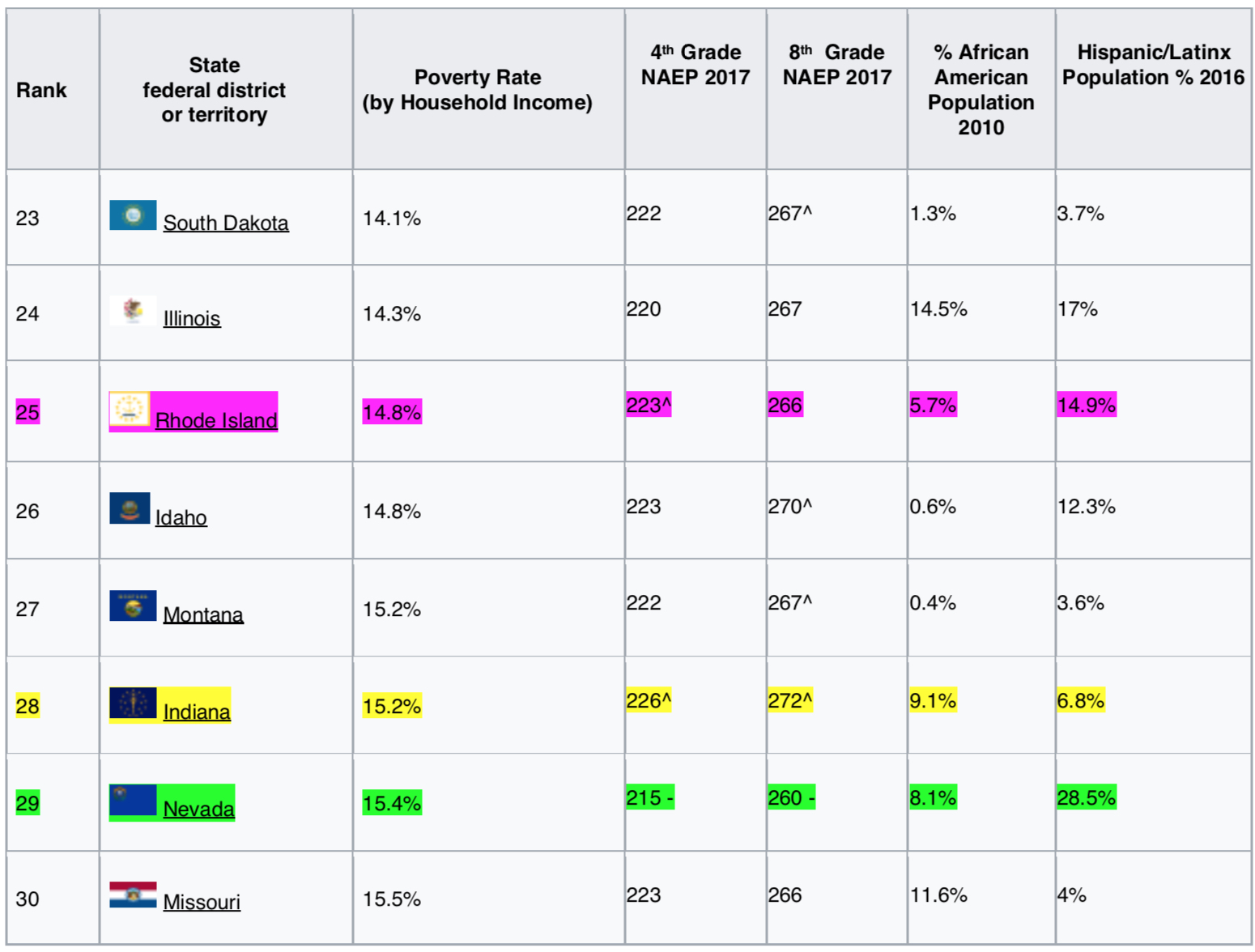
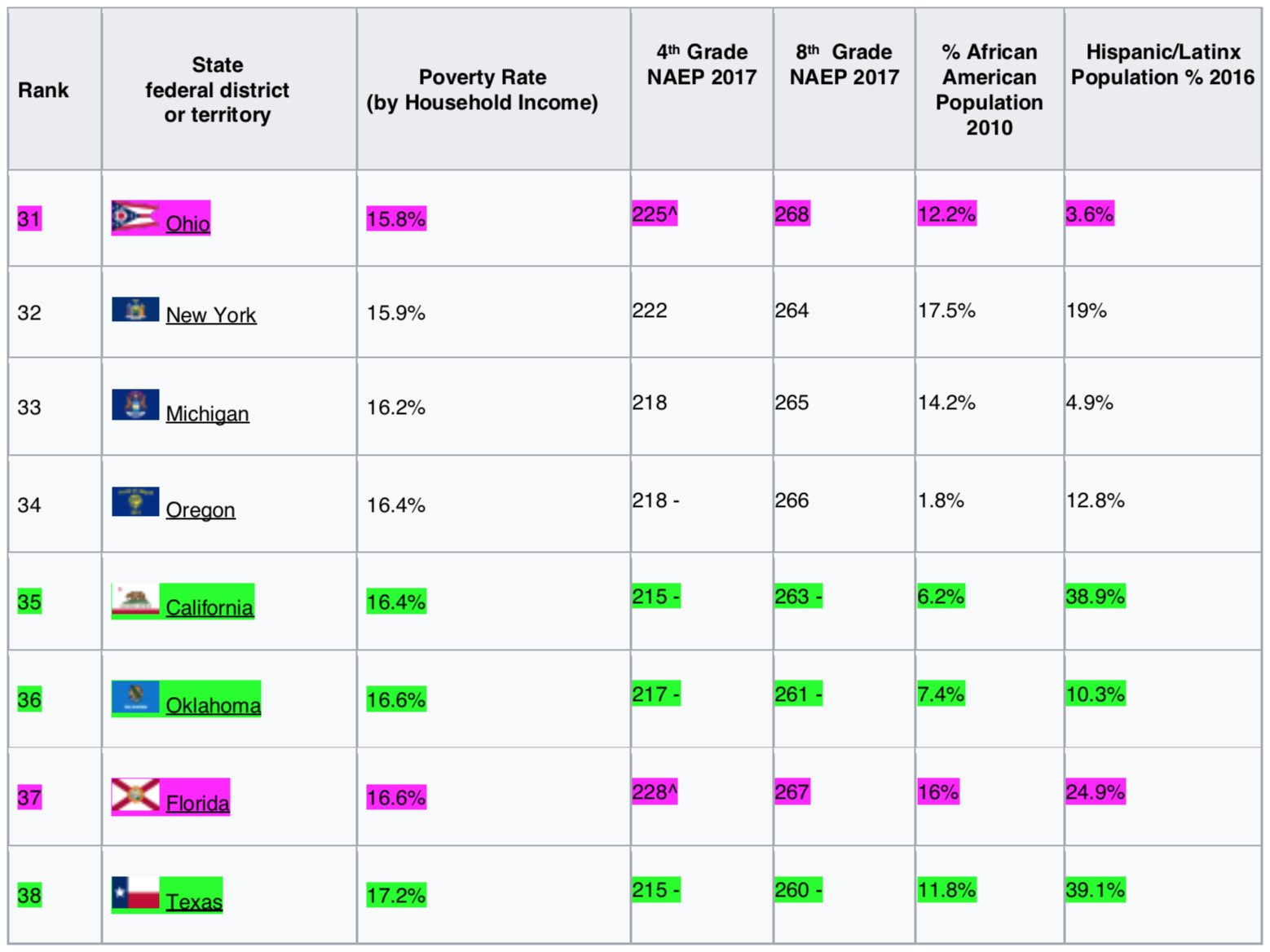
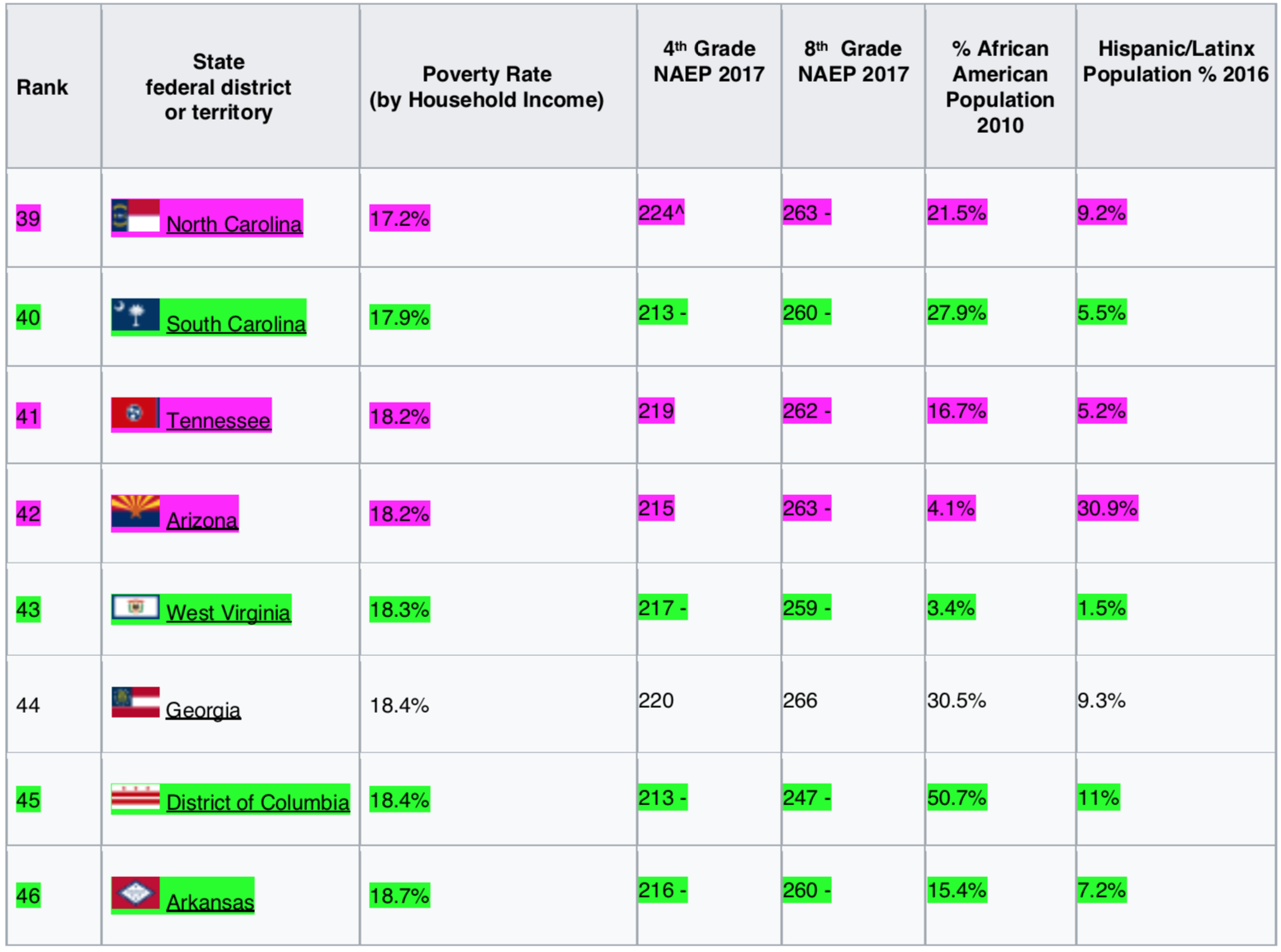
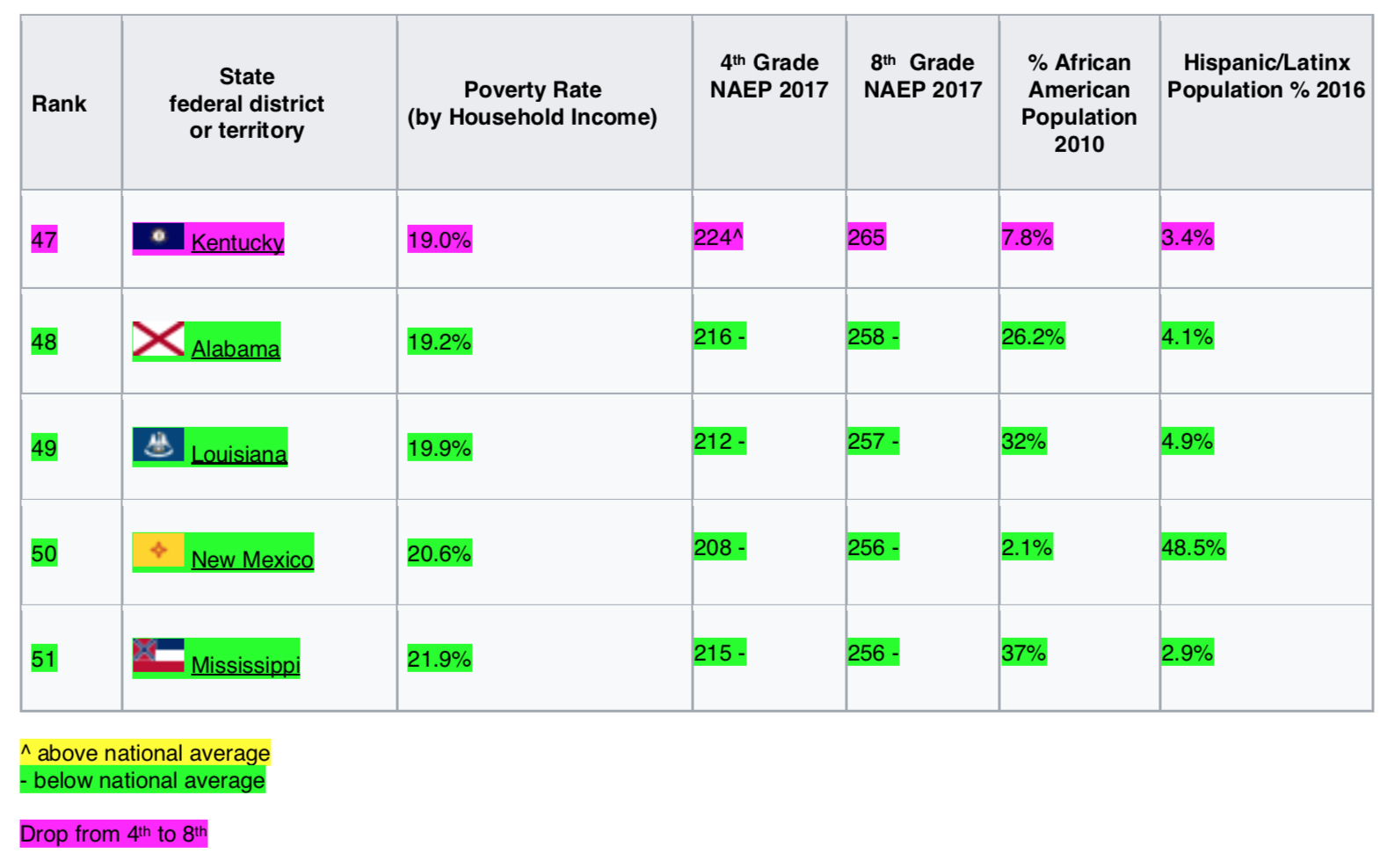
To that last point, consider this matrix of 2017 NAEP reading scores (4th/8th) along with the poverty in each state, the African American population percentage, and the Hispanic/Latinx population percentage. These data portray a much more complex picture of the reading problem, and resist the distraction that how students are being taught reading is cheating students, who could be saved by the “science of reading” (which, by the way, is balanced literacy—o, irony):

[Click links above each chart for expanded charts with grade retention legislation identified.]

Poverty NAEP 4 8 2017 grade retention 1

NAEP reading 2017 1

Poverty NAEP 4 8 2017 grade retention 2

NAEP reading 2017 2

Poverty NAEP 4 8 2017 grade retention 3

NAEP reading 2017 3

Poverty NAEP 4 8 2017 grade retention 4

NAEP reading 2017 4

Poverty NAEP 4 8 2017 grade retention 5

NAEP reading 2017 5

Poverty NAEP 4 8 2017 grade retention 6

NAEP reading 2017 6

Poverty NAEP 4 8 2017 grade retention 7

NAEP reading 2017 7

The “science of reading” mantra is a Big Lie, but it is also a huge and costly distraction from some real problems.

Relatively affluent states still tend to score above average or average on reading tests; relatively poor states tend to score below average on reading tests.

Some states that historically scored low, under the weight of poverty and the consequences of conservative political ideology that refuses to address that poverty, have begun to implement harmful policies to raise test scores (see the magenta highlighting) in the short-term for political points.

It is 2019. There is no reading crisis in the way the “science of reading” advocates are claiming.

It is 2019. Balanced literacy is the science of reading, but it is not the most common way teachers are teaching reading because schools are almost exclusively trying to raise scores, not students who are eager, joyful, and critical readers.

It is 2019. Political and public efforts to do anything—often the wrong thing—so no one addresses poverty remain the American Way.

It is 2019. It is still mostly about poverty when people insist it is about reading and reading policy.


* This opening has been revised because I made a careless error by making an analogy using the “Wild West,” seeking an engaging opening but making a culturally insensitive comparison instead. I regret this use of phrasing, but also appreciate being kindly informed of my carelessness in private. I try to listen to such concerns, and kindness, and am learning every day to be a better person, and writer.


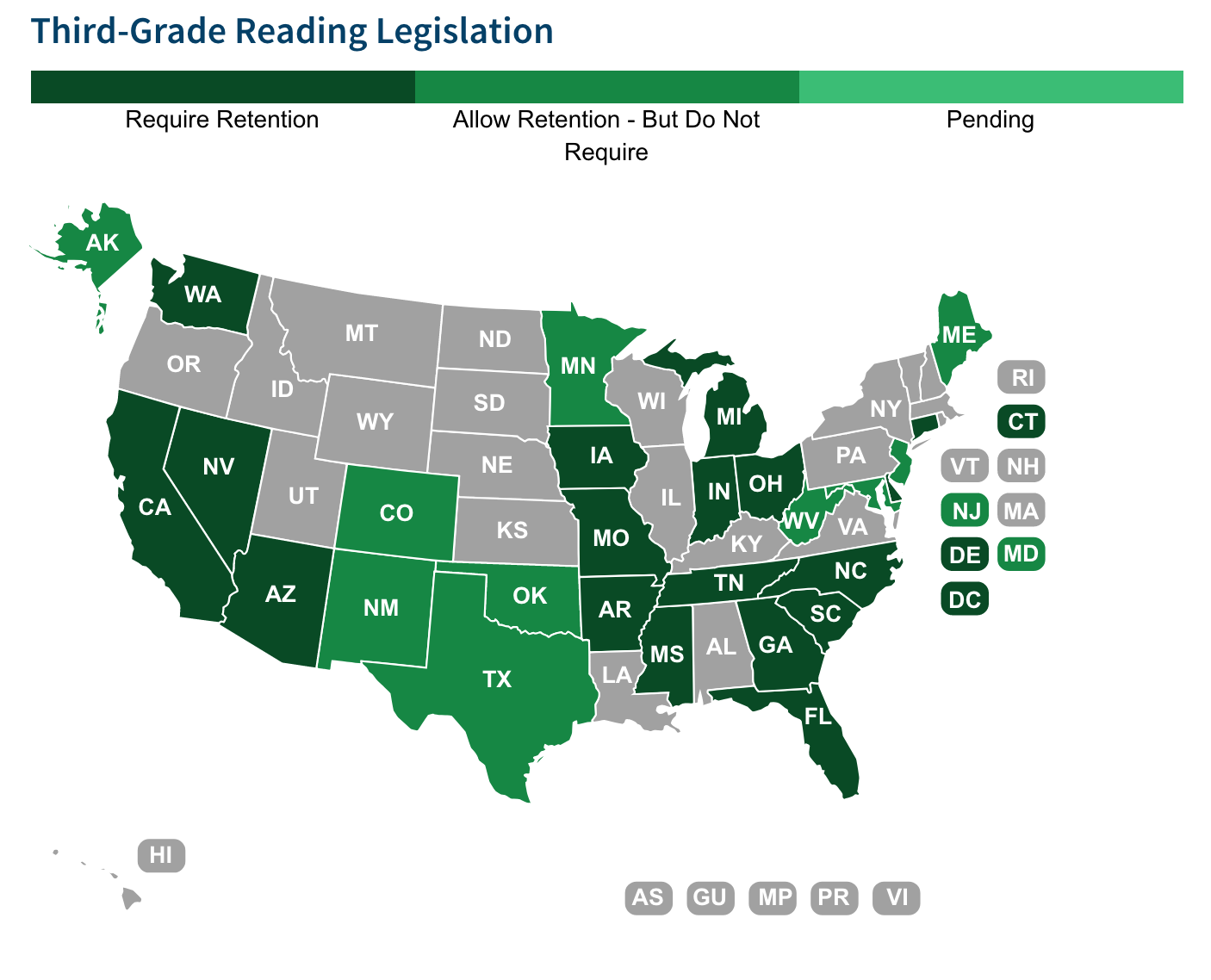
Third-Grade Reading Legislation

3rd grade retention legislation

Evidence v. Advocacy in Teaching Reading: “We Should Not Mistake Zeal for Warrant”

There is a certain karmic irony to the rise of public intellectuals who start to drive outside their lane—actually who take over all the lanes—only to prove that, in fact, they do not know everything.

Current bloviator-know-nothings include Jordan Peterson and Steven Pinker, the latter who has squandered intellectual capital he had built in psycholinguistics.

Both are experts in the field of psychology, a discipline apt to include far too many scholars with delusions of grandeur (only surpassed in arrogance by scholars in economics and about on par with scholars in political science for knowing everything).

Those of us who are scholars, practitioners, or both in the field of education have suffered a long history of being marginalized as both not really an academic discipline (education as “teacher training”) and merely classroom teachers.

As someone with experience and expertise as a practitioner (high school English teacher for 18 years) and researcher in education, I often find I hold no sway in issues related to education in my public work or with my scholarly impact. Imagine if I held forth in book form on psychology, economic, or politics? Think the New York Times would scramble to hang on my every word as they did for a psychologist claiming to be an expert in teaching reading?

(These are rhetorical questions.)

There exists another layer to education that often remains unexamined: K-12 public education is almost exclusively run along partisan political lines through bureaucracy and legislation that is not created by practitioners or educational researchers.

Practitioners who teach literacy/reading and literacy/reading scholars are currently under assault again by a new round of the reading wars. As has been common in these periodic skirmishes, there really is no war because the so-called factions do not have anywhere near equal power.

As a self-proclaimed reading expert, Daniel Willingham, psychology professor, represents what is essentially wrong with the entire framing of debates about teaching reading as a war.

Stated perfectly by Andrew Davis in his careful debunking of intensive/synthetic phonics advocacy, “The zeal with which synthetic phonics is championed by its advocates has been remarkably effective in pushing it to the top of the educational agenda; but we should not mistake zeal for warrant.”

During the current media blitz once again hand-wringing that children are not being taught to read because teachers are not prepared properly in teacher education and students are not receiving intensive phonics instruction, Willingham held forth on his blog to answer: Just how polarized are we about reading instruction?

His post doesn’t answer the question very well, but in another moment of karmic irony, Willingham reveals why “we should not mistake zeal for warrant.”

Affecting a tone of being fair and balanced, Willingham offers 6 positions on reading:

  1. The vast majority of children first learn to read by decoding sound. The extent to which children can learn to read in the absence of systematic phonics instruction varies (probably as a bell curve), depending on their phonemic awareness and other oral language skills when they enter school; the former helps a child to figure out decoding on her own, and the latter to compensate for difficulty in decoding.
  2. Some children—an extremely small percentage, but greater than zero—teach themselves to decode with very minimal input from adults. Many more need just a little support.
  3. The speed with which most children learn to decode will be slower if they receive haphazard instruction in phonics than it would be with systematic instruction. A substantial percentage will make very little progress without systematic phonics instruction.
  4. Phonics instruction is not a literacy program. The lifeblood of a literacy program is real language, as experienced in read-alouds, children’s literature, and opportunities to speak, listen, and to write. Children also need to see teachers and parents take joy in literacy.
  5. Although systematic phonics instruction seems like it might bore children, researchers examining the effect of phonics instruction on reading motivation report no effect.
  6. That said, there’s certainly the potential for reading instruction to tilt too far in the direction of phonics instruction, a concern Jean Chall warned about in her 1967 report. Classrooms should devote much more time to the activities listed in #4 above than to phonics instruction.

He then claims the reading wars problem is that factions take either the side of the even or the odd numbered claims—although he argues “I think all of the six statements above are true.”

The problem is a sneaky one because most of Willingham’s audience, like Willingham, has no literacy expertise or practical experience teaching children to read. For a lay audience, it is unfair to expect anyone to notice that Willingham has misrepresented the so-called factions in the reading war.

One of the leading literacy experts in the U.S. is Stephen Krashen; in his relentless analysis of research on teaching reading, he notes that the pro-phonics research often is deeply flawed because it presents either garbled or false definitions of whole language (or balanced literacy) in order to make claims of intensive phonics being more effective.

Willingham’s claims about reading instruction and the failures of teaching, teachers, and teacher education can only stand on completely misrepresenting the field of literacy and the so-called debate itself.

Let me frame a different approach to understanding the problem pro-phonics advocates fumble.

Here is the real dynamic concerning the teaching of reading in U.S. K-12 education: Teaching reading practices are guided primarily by legislation (with no assurance that legislation is grounded in anything more than zeal at the expense of warrant) and then driven by the combination of textbook companies appealing to that legislation and accountability structures (most significantly the mandate to raise reading test scores without investigating if those scores are credible proxies for reading growth or—god forbid—reading eagerness).

That is almost the entire real-world power structure governing how students are taught to read.

Well outside this dynamic stand teacher education and literacy/reading researchers, practitioners, and advocates—all of whom have almost no power, yet are the scapegoats when psychology-professors-turned-reading-experts hold forth in book form or in the NYT.

I should note, as well, that an even smaller and less powerful group often not acknowledged is literacy experts with a historical perspective, a group that I strongly identify with.

The teaching of reading and the public debate about reading have always been characterized by overblown histrionics and a nearly complete failure to implement what we know about learning to read in K-12 public schools because of partisan political bureaucracy, textbook companies, the massive and growing testing industry, and the misguided influence of non-educators posing as reading and literacy experts.

I realize there is nothing sexy about this—there is no war, or crisis—and this message once again will fall on deaf ears because I do not currently hold a position in a psychology department or an elected position where I could pander to an uninformed electorate.


Recommended

To read or not to read: decoding Synthetic Phonics, Andrew Davis

What is wrong with NPR’s “why millions of children can’t read” (NPR Morning Report, Jan 2 and Feb 6, 2019), Stephen Krashen

Defending Whole Language: The Limits of Phonics Instruction and the Efficacy of Whole Language Instruction, Stephen Krashen

Misreading Cause and Effect in Literacy Instruction: Vocabulary Edition

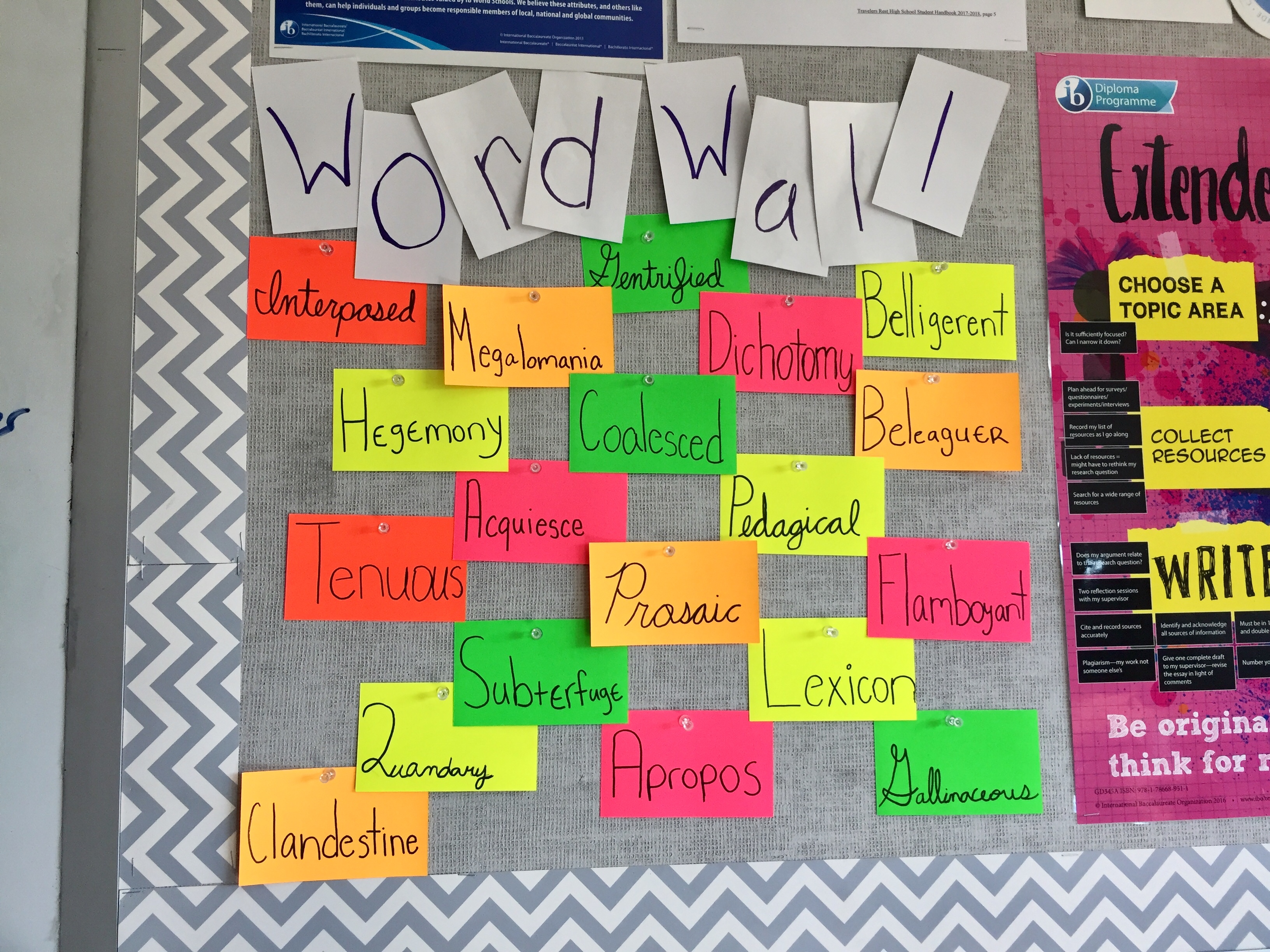
A former student of mine in teacher education, who was an English major and is in her third year of teaching, excitedly shared with me that her high school English students have spontaneously begun maintaining a vocabulary list.

What is interesting about this vocabulary list? Students are cataloguing the words they are learning simply by hearing this teacher use the language of a highly literate and well-educated person.

Marakoff word wall
Word wall created and maintained by students at Travelers Rest High School (South Carolina).

I take no credit for this, but this real-world, spontaneous, and rich environment for literacy growth does reflect (although in a more effective way) what I share with my teacher candidates about my 18 years teaching high school English.

Eventually, I ended the practice in my English department of issuing grammar textbooks and vocabulary workbooks to all students. Teachers were given sets of both and allowed to use as they pleased. In my classes, neither were used in any way.

As the example above from my former student’s class shows, I would model for my students how to discuss literature (texts), films, and popular music, often restating their comments in more sophisticated and complex ways.

Gradually, and spontaneously, my students began to mimic the language and terminology in their discussions and writing.

Coincidentally, my former student’s excitement over her students’ vocabulary activities preceded by a couple days a post on NCTE Connects asking about effective vocabulary instruction. I immediately responded:

Like grammar instruction, vocabulary instruction is deeply misguided when it is in isolation and vocabulary-for-vocabulary’s sake. People are confused and tend to invert erroneously what people with high literacy and large vocabularies mean. Vocabulary is a consequence of rich and extended literacy experiences; cramming vocabulary INTO students is not how you make someone highly literate. In short, if you care about vocabulary, reduce dramatically time and energy spent on vocabulary instruction and focus on rich literacy experiences, notably reading by choice and vibrant discussion. One early-career teacher I know has witnessed her students initiating a vocabulary list of words she teaches them simply through her own expression (her talking to the classes and students); they hear new words almost daily, ask her about them, and are engaged in authentic vocabulary attainment. Also fyi: Power of Common Core to Reshape Vocabulary Instruction Reaches Back to 1944!

This comment is brief so I want to elaborate on some of the key points.

First, the traditional urge to teach literacy skills—grammar, mechanics, usage, and vocabulary, for example—in isolation and sequentially to build toward some ideal whole is deeply engrained but also deeply flawed.

I find this to be the result of uncritical assumptions about the power and effectiveness of analysis. Education has embraced a truism that likely isn’t true: working from part to whole is easier and better for all learning.

How many of us have uttered or been told, kindly, “Let me break this down for you”?

Let me pause here and ask you to do a thought experiment (or maybe just focus on a very specific memory).

Have you ever purchased something you had to assemble? Furniture, a swing set, the hellscape that is anything from Little Tikes?

These items come with detailed instructions, guiding you from part to whole to construct whatever you have purchased. Have you ever been compelled to dutifully follow those directions, laying out the parts as directed and then meticulously beginning your project?

And do you recall that moment when you were mostly lost because you couldn’t really decipher the directions? What did you do? Maybe you grabbed the box and began comparing your Frankenstein’s monster scattered on the floor with the whole thing depicted in the picture on the box?

This urge, some brain research suggests, may be rooted in that only about 1 in 4 people are predisposed to part-to-whole thinking—while 3 in 4 of us work naturally whole-to-part*.

Here is a powerful example of how norms and assumptions can create ineffective practices. Literacy instruction may not be more efficient or effective for most of our students in traditional approaches grounded in skills instruction because literacy is wholistic.

Next, this flawed set of assumptions is also driven by flipping—and misreading—cause and effect in literacy growth.

Yes, highly literate people and sophisticated uses of language are often characterized, for example, by large and complex vocabularies. However, this characteristic is an outcome, an effect.

The mistake too many make in literacy instruction is viewing targeted vocabulary expansion as a cause for rich literacy; thus, extensive vocabulary lists, workbooks, and tests (including nearly fanatical instruction in prefixes, root words, and suffixes) that waste time and energy better spent in the real cause of literacy growth—rich literacy experiences such as reading often and deeply by choice and having complex discussions grounded in those rich experiences with a wide variety of texts.

Here is a relatively simple and more accurate truism, then: A large and nimble vocabulary is an effect of rich literacy experiences—not the cause of literacy development.

So here is a final thought experiment: Imagine taking those vocabulary workbooks out of your students’ hands (and backpacks) and then lead them to the school library, introducing them to the greatest vocabulary books available lining the shelves all around them.


* My argument about the relationship between part and whole, after almost four decades of teaching and spending much of that studying intently the research on literacy acquisition and growth, is that part and whole are symbiotic, working together in ways that defy a linear/sequential model. So I am not really rejecting part-to-whole for whole-to-part, but arguing for whole-part-whole-part … something not easy to express in words or a diagram.