Category Archives: Poverty

Ending Poverty Requires Community, Not War

Many, if not most, wars have failed to salvage victory from the inherent destruction war brings.

All wars leave collateral damage in their wake.

A big picture message offered in Michelle Alexander’s The New Jim Crow is that the war on drugs, a key part of the larger era of mass incarceration, has devastated the lives and futures of African American males in ways that are nearly incomprehensible. That collateral damage, as well, has been disproportional—accentuated by the fact that AA and whites use illegal drugs in the same percentages but AA shoulder the burden of punishment.

The era of mass incarceration and the war on drugs are evidence of the nightmare of codifying behavior as illegal as a context for punishment. Is it possible that the legalizing of marijuana in Colorado represents a move away from the “war” approach to recreational drugs—a recognition, again, almost a century after the failure of prohibition?

Laws and wars, then, define the lines between combatants and the conditions of criminality; those lines and conditions, easily shifted, determine who matters, and who does not.

As the public discourse rises about the 50th anniversary on the war on poverty, we are being asked if the war on poverty worked and if we need a new war on poverty. These are the wrong questions, especially the latter.

In my work on ignoring poverty in the U.S., I raise the possibility that contemporary political strategies surrounding poverty include the paradox of constantly mentioning and highlighting poverty in order to ignore it. Over the past decades, “poverty” is repeatedly on the lips of political leaders and in the pronouncements of the mainstream and “new” media.

Yet, childhood poverty in the U.S. continues to rise, that childhood rate remains at the bottom of international comparisons, and the gap between the top 1% and everyone else in the U.S. grows.

Has the war on poverty worked? No.

But the problem with that one-word answer is that despite abundant evidence that some social programs do alleviate poverty (prompting many to say the war on poverty has worked as an argument for more and direct social intervention), the failure is that we have been conducting a war.

Ending poverty in the U.S. requires community, not war.

If we as a people genuinely wish to end poverty, genuinely believe in equity for every human regardless of her/his coincidences of birth, we must first set aside the war approach (as we must with the war on drugs and the era of mass incarceration).

That first step must then create a spirit of community that ends what truly was occurring during the war on poverty—a war on the people trapped in poverty.

Behind the political rhetoric of the war on poverty lies a cultural myth in the U.S. that individuals are to blame for their lot—that somehow those people with the least (and sometimes no) political capital are causing the exact forces that trap them.

A commitment to community over war acknowledges, as Kristof does, basic political facts:

The best example of how government antipoverty programs can succeed involves the elderly. In 1960, about 35 percent of older Americans were poor. In 2012, 9 percent were. That’s because senior citizens vote, so politicians listened to them and buttressed programs like Social Security and Medicare.

In contrast, children are voiceless, so they are the age group most likely to be poor today. That’s a practical and moral failure.

I don’t want anybody to be poor, but, if I have to choose, I’d say it’s more of a priority to help kids than seniors. In part, that’s because when kids are deprived of opportunities, the consequences can include a lifetime of educational failure, crime and underemployment.

The war on poverty fails as long as it remains a war, and not a moral imperative among a community of people.

Ending poverty must no longer be trivialized, then, as political expediency—the consequences of creating through state and federal policy a war on poverty. That approach can become only a running tally of manufactured winners and losers.

While any are in poverty, everyone is a loser.

As we end the war on poverty as our primary approach, as we end the war on people trapped in poverty by no longer blaming them for their situations or for the broader facts of poverty and inequity, and as we commit instead to community and the moral imperative of ending poverty, we must also end the empty claim that schools primarily or alone can eradicate poverty—a jumbled message advocated within a larger commitment to “big business.”

As we confront 50 years of war waged on poverty, we must be sure to acknowledge the collateral damage—the stereotype of the welfare queen, that misrepresents people living in poverty but reflects the classism and racism tarnishing our democracy, shredding the fabric of human kindness and dignity.

As we confront 50 years of war waged on poverty, we must be sure to name and see the very real consequences of addressing poverty mainly as it impacts those with political, cultural, and economic capital; ending childhood poverty through direct social commitments, then, is an announcement that poverty and inequity are inexcusable in a free society, and not merely a partisan political talking point.

As we confront 50 years of war waged on poverty, we must admit that mass incarceration and accountability-based education reform contribute to and do not address the plight of poverty. An end to the punitive war on poverty must be joined with ending equally flawed approaches to punitive legal and educational policies.

As we confront 50 years of war waged on poverty, we must push aside the passive radical mask we use to honor a Martin Luther King Jr. facade allowing that war on poverty to exist; instead, we must champion the radical anti-war King, whose messages near the end of his life called for a direct end to poverty:

In the treatment of poverty nationally, one fact stands out: there are twice as many white poor as Negro poor in the United States. Therefore I will not dwell on the experiences of poverty that derive from racial discrimination, but will discuss the poverty that affects white and Negro alike.

Up to recently we have proceeded from a premise that poverty is a consequence of multiple evils:

  • lack of education restricting job opportunities;
  • poor housing which stultified home life and suppressed initiative;
  • fragile family relationships which distorted personality development.

The logic of this approach suggested that each of these causes be attacked one by one. Hence a housing program to transform living conditions, improved educational facilities to furnish tools for better job opportunities, and family counseling to create better personal adjustments were designed. In combination these measures were intended to remove the causes of poverty.

While none of these remedies in itself is unsound, all have a fatal disadvantage. The programs have never proceeded on a coordinated basis or at a similar rate of development.

  • Housing measures have fluctuated at the whims of legislative bodies. They have been piecemeal and pygmy.
  • Educational reforms have been even more sluggish and entangled in bureaucratic stalling and economy-dominated decisions.
  • Family assistance stagnated in neglect and then suddenly was discovered to be the central issue on the basis of hasty and superficial studies.

At no time has a total, coordinated and fully adequate program been conceived. As a consequence, fragmentary and spasmodic reforms have failed to reach down to the profoundest needs of the poor.

In addition to the absence of coordination and sufficiency, the programs of the past all have another common failing — they are indirect. Each seeks to solve poverty by first solving something else.

I am now convinced that the simplest approach will prove to be the most effective — the solution to poverty is to abolish it directly by a now widely discussed measure: the guaranteed income….

We are likely to find that the problems of housing and education, instead of preceding the elimination of poverty, will themselves be affected if poverty is first abolished. The poor transformed into purchasers will do a great deal on their own to alter housing decay. Negroes, who have a double disability, will have a greater effect on discrimination when they have the additional weapon of cash to use in their struggle.

A war on poverty is an indirect and piecemeal approach to poverty. As King implored, we need a direct plan to end poverty, requiring a new commitment to community and an end to social policies as war.

Capitalism, Silencing Women, Silencing Teachers

A central aspect of my blog about Classroom Teaching Experience and Whose Voice Matters highlights that the silencing of teachers is a subset of the silencing of women. That post followed my claim that teaching is an invisible profession.

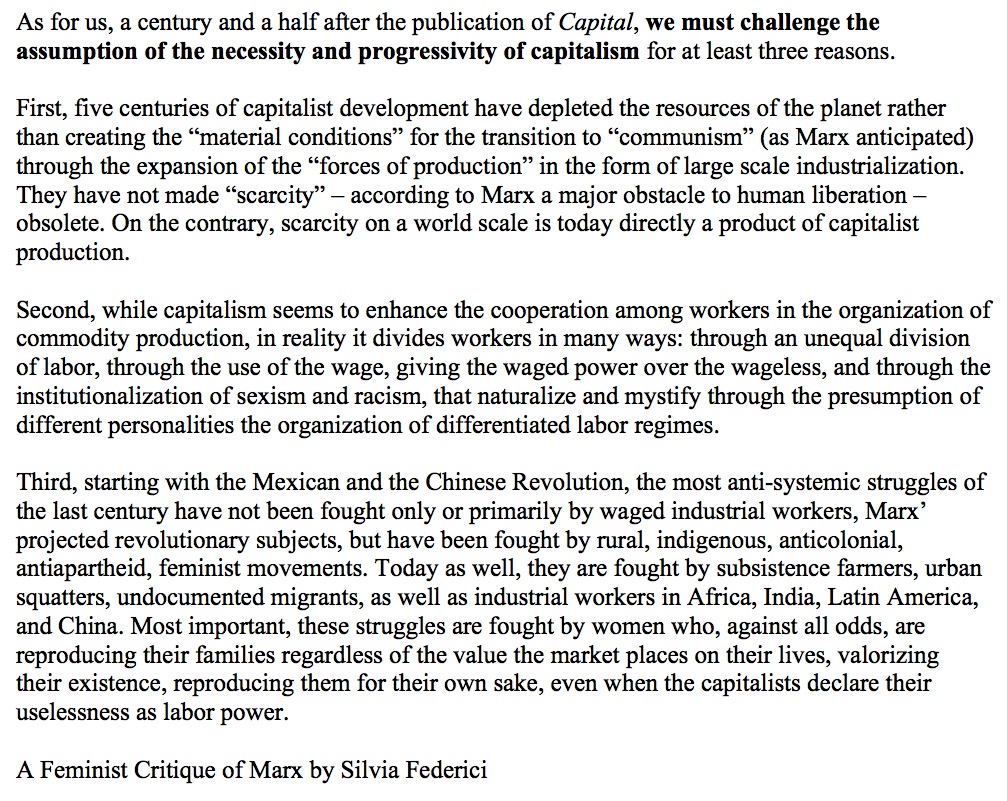
Since posting that blog, I have read A Feminist Critique of Marx by Silvia Federici, which in part asserts the invisibility of women in Marx’s analysis of capitalism:

At the center of this critique is the argument that Marx’s analysis of capitalism has been hampered by his inability to conceive of value-producing work other than in the form of commodity production and his consequent blindness to the significance of women’s unpaid reproductive work [her emphasis] in the process of capitalist accumulation. Ignoring this work has limited Marx’s understanding of the true extent of the capitalist exploitation of labor and the function of the wage in the creation of divisions within the working class, starting with the relation between women and men.

And then:

Federici

[click above to enlarge]

From the above, Federici’s first point about scarcity invites a reading of Scarcity (Sendhil Mullainathan and Eldar Shafir) as well as considering how scarcity in the lives of people trapped in poverty as a consequence of a market economy that pools wealth in a small number of people at the top impacts every aspect of their lives, including their ability to learn.

Seeking gender, race, and class equity cannot be separated from the need for wholesale workers’ solidarity—a solidarity that requires teachers to envision themselves as workers and to embrace the status of worker as a noble possibility for free people.

Civil Rights Issue of Our Time?

While the credibility of challenges leveled at the current education reform agenda—such as commitments to Common Core or the rise of “no excuses” charter schools—is often called into question throughout social and mainstream media, I see little to no questioning of political mantras of education crisis, utopian expectations for schools, and the consistent refrain of education reform being the civil rights issue of our time.

In fact, even reports coming from the USDOE show that if education reform is the civil rights issue of our time, the policies are certainly not doing what is needed to combat the demonstrable failures of the public school system.

Problem #1: Discipline in schools remains incredibly inequitable by race:

Disparate Discipline Rates and Arrests and Referrals to Law Enforcement

[click to enlarge]

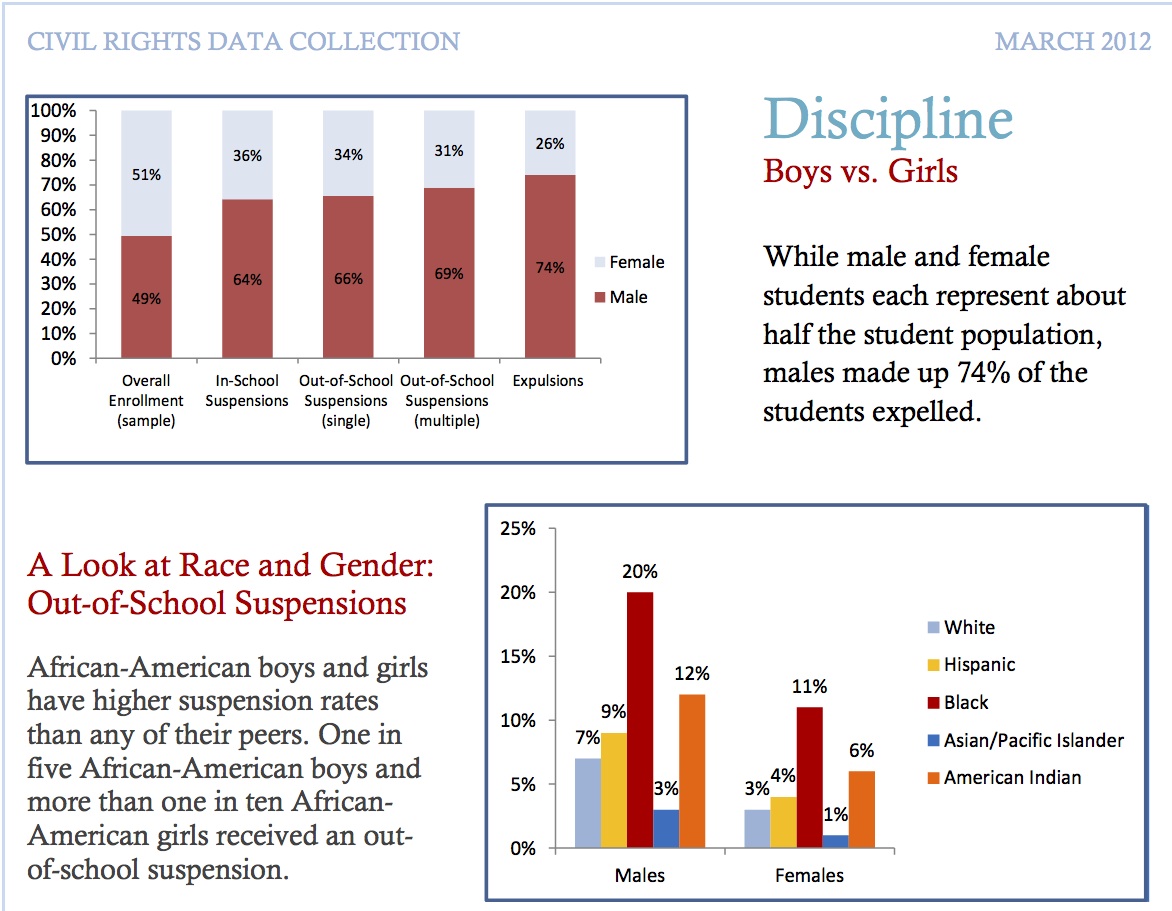
Problem #2: Discipline in schools is inequitable by gender, complicating inequity by race:

Discipline Boys vs. Girls and A Look at Race and Gender: Out-of-School Suspensions

[click to enlarge]

Problem #3: Access to advanced courses and retention rates are inequitable by race:

GandT.suspension
Access to Gifted and Talented Education (GATE) Programs and Retention Rates

[click to enlarge]

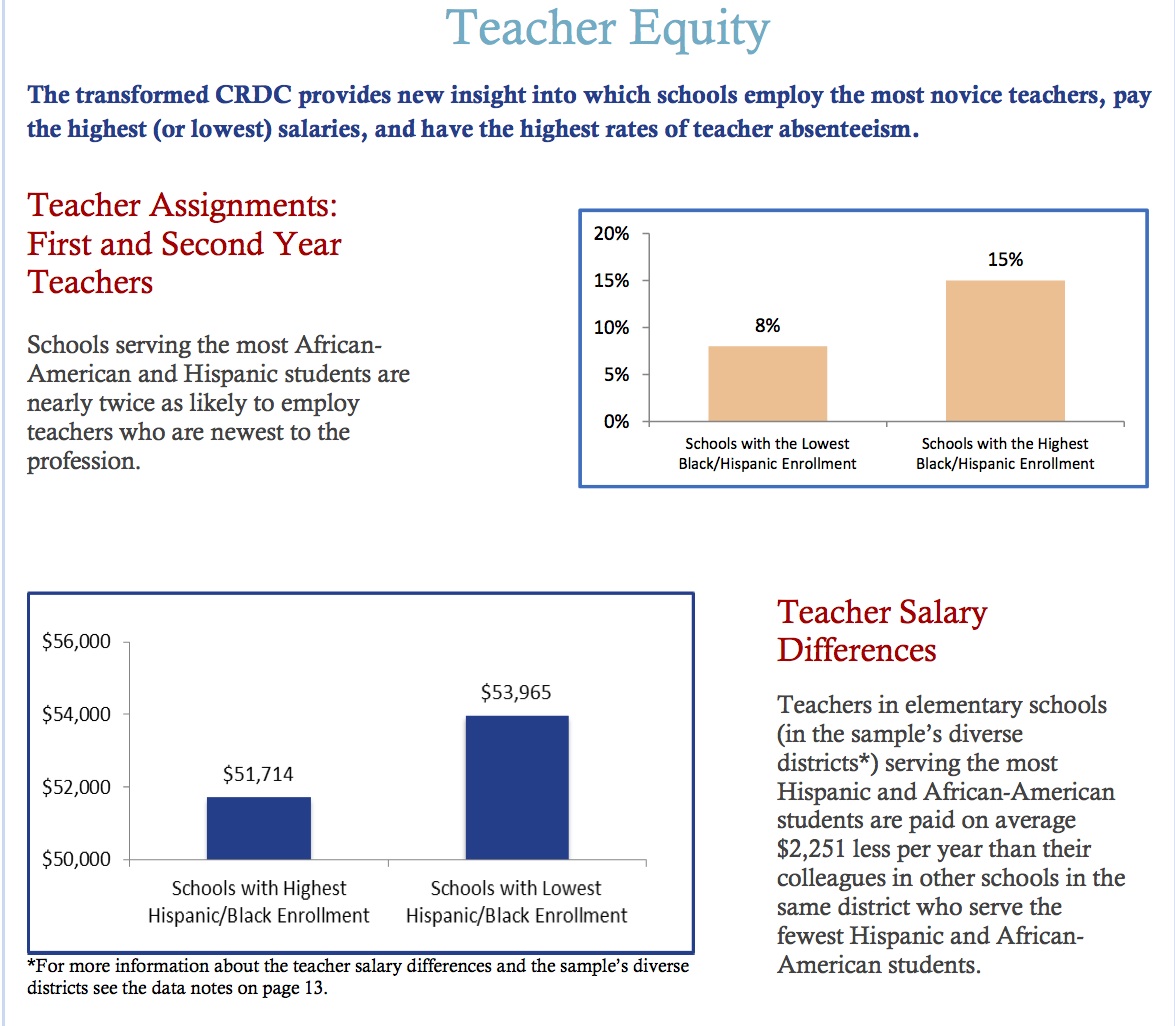
Problem #4: Teacher assignment and compensation are inequitable by race:

Teacher Assignments: First and Second Year Teachers and Teacher Salary Differences

[click to enlarge]

Problem #5: School discipline policies such as zero tolerance policies are racially inequitable and parallel to the current era of mass incarceration disproportionately impacting African American males:

There is abundant evidence that zero tolerance policies disproportionately affect youth of color. Nationally, black and Latino students are suspended and expelled at much higher rates than white students. Among middle school students, black youth are suspended nearly four times more often than white youth, and Latino youth are roughly twice as likely to be suspended or expelled than white youth. And because boys are twice as likely as girls to receive these punishments, the proportion of black and Latino boys who are suspended or expelled is especially large.  Nationally, nearly a third (31 percent) of black boys in middle school were suspended at least once during the 2009–10 school year. Part of this dynamic is that under-resourced urban schools with higher populations of black and Latino students are generally more likely to respond harshly to misbehavior. (p. 3)

As I have stated before, if education reform is the civil rights issue of our time, federal and state reform agendas would end zero tolerance policies, eradicate “no excuses” ideologies, and stop retention practices—as well as address the measurable inequities by race, class, and gender marring public schools in the U.S.

“They ask only opportunity”: Helen Keller and Those Who Will Not See

The evolution of my fully understanding formal education began when I was very young and learning moment by moment at the feet of my mother, who taught my sister and me to play canasta (a complicated two-deck card game related to rummy) and love Dr. Seuss well before we started first grade.

Of course, I thought I knew something about school after 16.5 years that culminated in my undergraduate degree, and then I began to teach. That led to another delusion about my understanding formal schooling—until I became a father.

By third grade, my daughter was teaching me lessons about school I had only come to understand at the edges. One of those lessons involved her class reading The Miracle Worker in their textbook. I watched my daughter being taught the passive radical myth (which I have connected with Nelson Mandela, Martin Luther King Jr., Gandhi, and Jesus; and also explored in the ways Pat Tillman’s life and death have been manipulated)—Keller reduced to a caricature of simplistic moral lessons aimed at feeding children in the U.S. the myths that deform (see Paulo Freire).

Helen Keller, however, was someone quite different—a true radical in thought and action. Below is an updated reposting of a blog from June 29, 2012, exploring the power in Keller’s voice, one marginalized, ignored, silenced.

Helen Keller could not attend the 1906 meeting of Association for Promoting the Interests of the Blind. In a letter, Keller implored Mark Twain to speak on her behalf: “But, superfluous as all other appeals must seem after you and Mr. Choate have spoken, nevertheless, as I am a woman, I cannot be silent, and I ask you to read this letter, knowing that it will be lifted to eloquence by your kindly voice.”

In these words echo Keller’s ironic awareness of the invisibility of women who are silenced.

About the need for advocacy for the blind, Keller wrote in part:

To know what the blind man needs, you who can see must imagine what it would be not to see, and you can imagine it more vividly if you remember that before your journey’s end you may have to go the dark way yourself. Try to realize what blindness means to those whose joyous activity is stricken to inaction….The seeing man goes about his business confident and self-dependent. He does his share of the work of the world in mine, in quarry, in factory, in counting room, asking of others no boon, save the opportunity to do a man’s part and to receive the laborer’s guerdon. In an instant accident blinds him. The day is blotted out. Night envelops all the visible world. The feet which once bore him to his task with firm and confident stride stumble and halt and fear the forward step. He is forced to a new habit of idleness, which like a canker consumes the mind and destroys its beautiful faculties. Memory confronts him with his lighted past. Amid the tangible ruins of his life as it promised to be he gropes his pitiful way. You have met him on your busy thoroughfares with faltering feet and outstretched hands, patiently “dredging” the universal dark, holding out for sale his petty wares, or his cap for your pennies; and this was a man with ambitions and capabilities.

It is because we know that these ambitions and capabilities can be fulfilled that we are working to improve the condition of the adult blind. You cannot bring back the light of the vacant eyes; but you can give a helping hand to the sightless along their dark pilgrimage. You can teach them new skill. For work they once did with the aid of their eyes you can substitute work that they can do with their hands. They ask only opportunity, and opportunity is a torch in the darkness [emphasis added]. They crave no charity, no pension, but the satisfaction that comes from lucrative toil, and this satisfaction is the right of every human being.

This message of empathy and advocacy speaks beyond the turn of the twentieth century and beyond the challenges confronting the blind. In the twenty-first century, Americans are not fully human unless they are workers first. Without work, Americans struggle to have adequate and affordable health care, to feel basic dignity or security.

In the twenty-first century, people and children increasingly trapped in poverty are the targets of derision and marginalization as this country has maintained a war on the poor and not on poverty.

Those Who Will Not See: The Privileged

Let’s imagine, now, Keller’s words rewritten to address the advocacy needed for adults and children trapped in poverty:

To know what the poor person needs, you who are privileged must imagine what it would be not to privileged, and you can imagine it more vividly if you remember that before your journey’s end you may have to go the dark way yourself. Try to realize what poverty means to those whose joyous activity is stricken to inaction….The privileged man goes about his business confident and self-dependent. He does his share of the work of the world in mine, in quarry, in factory, in counting room, asking of others no boon, save the opportunity to do a man’s part and to receive the laborer’s guerdon. In an instant accident impoverishes him. The day is blotted out. Night envelops all the visible world. The feet which once bore him to his task with firm and confident stride stumble and halt and fear the forward step. He is forced to a new habit of idleness, which like a canker consumes the mind and destroys its beautiful faculties. Memory confronts him with his lighted past. Amid the tangible ruins of his life as it promised to be he gropes his pitiful way. You have met him on your busy thoroughfares with faltering feet and outstretched hands, patiently “dredging” the universal dark, holding out for sale his petty wares, or his cap for your pennies; and this was a man with ambitions and capabilities.

It is because we know that these ambitions and capabilities can be fulfilled that we are working to improve the condition of people trapped in poverty. You cannot bring back the light of the vacant eyes; but you can give a helping hand to the poor along their dark pilgrimage. You can teach them new skill. For work they once did with the aid of their opportunity you can substitute work that they can do with their hands. They ask only opportunity, and opportunity is a torch in the darkness. They crave no charity, no pension, but the satisfaction that comes from lucrative toil, and this satisfaction is the right of every human being.

The U.S. is not a land of opportunity, but a land of privilege begetting privilege at the expense of the impoverished and the swelling working class and working poor. The privileged berate public institutions, such as universal public education, and the people who dedicate their lives to public service, such as the teachers in those schools.

The privileged rail against universal health care and day care because they were raised with both and maintain both regardless of their behavior.

The corporate consumer culture has tied all basic elements of human dignity—an income, retirement, health care, security—to employment rendering a hard day’s labor essentially a kind of twentieth-century wage-slavery.

American workers are shackled to their status as workers, a condition that benefits mostly the owners, the bosses, the privileged.

If American workers were provided the basic dignities of being human independent of their work, those workers would have autonomy—something historically afforded by unions and tenure (the anathemas of corporate consumerism)—they would have voice, they would have the authentic freedom and choice flippantly championed by the privileged.

Keller’s impassioned plea about the need for empathy at the foundation of advocacy speaks to the same empathy needed against the arrogance of privilege that has corrupted the American character and the American Dream.

“Perhaps, after all, America never has been discovered. I myself would say that it had merely been detected,” mused Oscar Wilde.

America remains a shining possibility, but it is destined to remain only a possibility as long as those with power continue to lead but refuse to see that the true character of a country’s people is revealed each day among that country’s workers and the conditions of their labor.

Our Real-World Dystopia

As a science fiction (SF) fan, partial to dystopian SF, and writer, I would have a great novel on my hands if this weren’t simply the way things are.

How to create a real-world dystopia:

  1. Identify “privilege” as “achievement” using a mechanism that you label “scientific” and “standard.”
  2. Use “achievement” to create the authority class.
  3. Repeat.

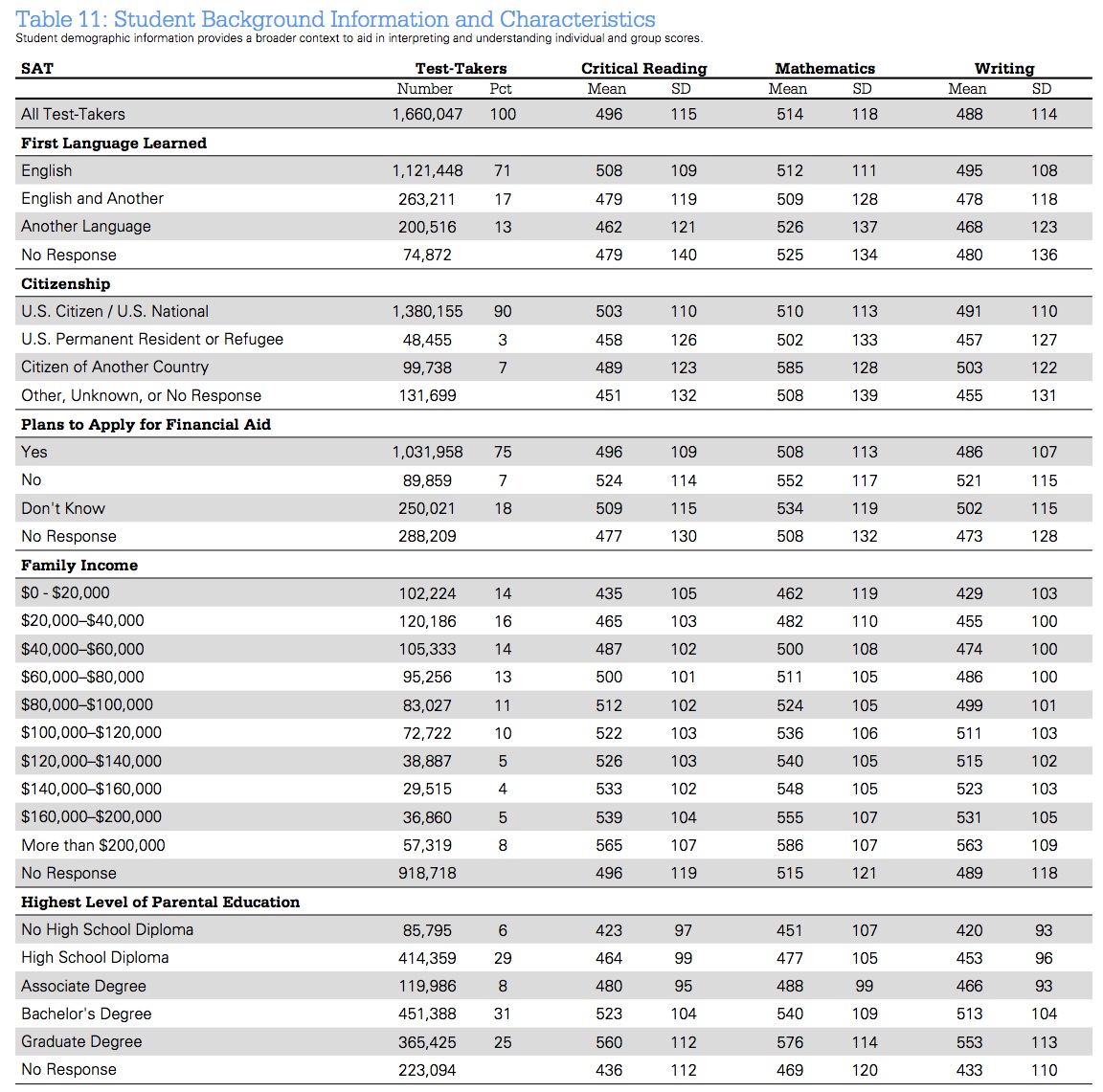
Sounds easy, but some may call this outlandish. So let me offer a visual:

SAT 2013 OOS factors
2013 SAT Data

And for those who enjoy the power of the word, let me offer this:

Paul Tough v. Peter Høeg – or – the Advantages and Limits of “Research” or, How Children Succeed v. Borderliners , Ira Socol

Dystopias are hard to see when you live in one—just as fish have no idea what “water” means.

End Zero-Tolerance Policies: A Reader

What do zero-tolerance policies, “no excuses” practices, and grade retention have in common?

They all negatively and disproportionately impact children from poverty, minority children, English language learners, and boys; and nearly as disturbing, all are discredited by large bodies of research.

Is the tide turning against at least zero-tolerance policies? Lizette Alvarez reports:

Faced with mounting evidence that get-tough policies in schools are leading to arrest records, low academic achievement and high dropout rates that especially affect minority students, cities and school districts around the country are rethinking their approach to minor offenses.

Zero-tolerance policies, “no excuses” practices, and grade retention have something else in common: they should all be eradicated from our schools. And thus, here is a reader to help support calls for ending these practices and policies:

Police in the Hallways: Discipline in an Urban High School, Kathleen Nolan

Review: Police in the Hallways: Confronting the “Culture of Control,” P. L. Thomas

The School-to-Prison Pipeline, Journal of Educational Controversy (vol. 7, issue 1, Fall/2012-Winter 2013)

Hope Against Hope: Three Schools, One City, and the Struggle to Educate America’s Children, Sarah Carr

New Schools, Old Problems [Review: Hope Against Hope], P. L. Thomas

Education Reform in the New Jim Crow Era

Truthout TV Interviews P.L. Thomas About the New “Jim Crow” Era of Education Reform

Just Say No to Just Read, Florida, South Carolina [includes retention research]

Implementing Policies to Reduce the Likelihood of Preschool Expulsion, Walter S. Gilliam, PhD

Prekindergarteners Left Behind: Expulsion Rates  in State  Prekindergarten Programs, Walter S. Gilliam, PhD

Henry Giroux on the “School to Prison Pipeline”

The Mis-education of the Negro, Carter Godwin Woodson

Arresting Development • Zero Tolerance and the Criminalization of Children, Annette Fuentes

Belief Culture: “We Don’t Need No Education”

“Four in 10 Americans, slightly fewer today than in years past, believe God created humans in their present form about 10,000 years ago.” This December 2010 poll also includes the finding that a scant 16 percent of the U.S. populace accepts evolution without any hand of God involved. [1]

The U.S. is unique compared to the rest of Western world, which tends to accept evolution, but the comparison is less significant than the inference we can draw about the U.S. and the associated impacts visible in our disdain for not only education, but also the well-educated, the informed: the predominant culture in the US is a belief culture.

By “belief,” I do not refer to religious faith per se. This discussion is about a belief culture that is secular, political and, ultimately, ideological, even when belief is connected to religious traditions and stances.

As Einstein offered, both belief and science have value, even as complements to each other: “Science without religion is lame, religion without science is blind” – especially as faith informs our ethics. But in the U.S., we are apt to misuse belief and ignore (or misunderstand) science when we need it most.

While it is unlike the rest of the Western world with regard to its take on evolution, the belief culture does reflect what new science is discovering about the power of belief over fact as a part of some humans’ nature:

Facts don’t necessarily have the power to change our minds. In fact, quite the opposite. In a series of studies in 2005 and 2006, researchers at the University of Michigan found that when misinformed people, particularly political partisans, were exposed to corrected facts in news stories, they rarely changed their minds. In fact, they often became even more strongly set in their beliefs. Facts, they found, were not curing misinformation. Like an underpowered antibiotic, facts could actually make misinformation even stronger.

The U.S. appears, on the surface, to be a scientific society – we consume the newest and best technology dutifully and with voracity; however, US citizens are largely opposed to scientific ways of knowing and understanding the world, to drawing conclusions about the world based on the weight of evidence while reserving a fixed conclusion if contradictory evidence reveals itself in the future. Our split personality about science is, in fact, not contradictory; we love to consume ever-changing technology, but that insatiable appetite is about the consumption, not the science.

Pop Culture and Blind Tradition

Consider the pop culture we also consume endlessly. How have we portrayed intellectuals and who do we love in our entertainment?

From Marlon Brando and James Dean to the Fonz on “Happy Days,” we have adored the uneducated, who prove themselves to be better and even smarter than the educated. In fact, if you look carefully at “Friends,” you see an interesting evolution of that narrative.

Both Joey and Ross are often portrayed as clueless and bumbling, tapping into our love of those who are not smart. But look closer. The audience, as well as the other characters, laugh with Joey (who is apparently uneducated) and at Ross (who has a PhD and is a scientist – a paleontologist, in fact). Look carefully at the episode in which Ross and Phoebe argue about evolution; Ross is shown to be foolish by the cleverer Phoebe, who doesn’t embrace evolution or value evidence.

This is the America of belief. We cherish stubborn doctrine and clever rhetoric even at the expense of fact and we often speak about tradition.

Recently, in my home state of South Carolina – which sits solidly in the Deep South that William Faulkner captured precisely in the macabre “A Rose for Emily” (yes, in the South we cling to the corpse of tradition, and are proud of it) – yet another controversy has recently erupted around the celebration of secession. Just as South Carolina has clung to the Confederate flag, the state is proud of being first to secede and to honor state’s rights (usually omitting that those state’s rights included slavery). “This is not about slavery, but tradition!” is the refrain.

Try to make a reasoned (that is, evidence-based) argument about secession or the flag issue in the South and you are apt to play Ross to the multitudes of Phoebes.

South Carolina is not alone. Secession balls are planned throughout the South, where the calls for tradition and state’s rights drown out any concerns about slavery. Again, just like those who cling to creationism, many in the South are not swayed by evidence – unless it confirms what they already believe.

The truth is that many people in the US are committed to belief over evidence and are simultaneously devoted to consumerism – creating a perfect storm for the political and corporate elites, but also sounding a death knell for the promise of universal public education established by our founders, who happened to be men of reason (although the belief among many Americans is that they were Christian men all; again, don’t bother with the evidence).

As Joe Keohane writes in the Boston Globe about the findings regarding the power of belief over facts:

In an ideal world, citizens would be able to maintain constant vigilance, monitoring both the information they receive and the way their brains are processing it. But keeping atop the news takes time and effort. And relentless self-questioning, as centuries of philosophers have shown, can be exhausting. Our brains are designed to create cognitive shortcuts – inference, intuition, and so forth – to avoid precisely that sort of discomfort while coping with the rush of information we receive on a daily basis. Without those shortcuts, few things would ever get done. Unfortunately, with them, we’re easily suckered by political falsehoods.

Belief Equals Anti-Intellectualism

The line from the Pink Floyd song providing my subtitle, “We don’t need no education,” is followed by, “We don’t need no thought-control.” This equation of education and thought-control is at the heart of the anti-intellectualism supported by the belief culture of the US, which has failed the promise of universal public education for a thriving democracy.

Let’s compare Thomas Jefferson and Secretary of Education Arne Duncan:

In a letter to John Tyler, Jefferson made this argument in 1810:

I have indeed two great measures at heart, without which no republic can maintain itself in strength: 1. That of general education, to enable every man to judge for himself what will secure or endanger his freedom. 2. To divide every county into hundreds, of such size that all the children of each will be within reach of a central school in it.

Many decades before the rise of critical pedagogy, Jefferson recognized the important relationship between access to education for everyone and education’s role in individual empowerment. Writing to George Wythe in 1786, Jefferson addressed tax support for education:

I think by far the most important bill in our whole code, is that for the diffusion of knowledge among the people. No other sure foundation can be devised for the preservation of freedom and happiness…. The tax which will be paid for this purpose is not more than the thousandth part of what will be paid to kings, priests and nobles who will rise up among us if we leave the people in ignorance.

Taxation to support universal education, then, was tied, for Jefferson, to freedom and happiness, but education was also a bulwark against the rise of an elite class – what today we witness as a corporate elite ruling both corporate and political America.

Now compare Jefferson’s comments to Secretary Duncan’s conclusions about Program for International Student Assessment (PISA) scores from 2009:

Here in the United States, we have looked forward eagerly to the 2009 PISA results. But the findings, I’m sorry to report, show that the United States needs to urgently accelerate student learning to remain competitive in the knowledge economy of the 21st century. The United States has a long way to go before it lives up to the American dream and the promise of education as the great equalizer. Every three years, PISA assesses the reading, mathematics, and scientific literacy of 15-year-old students. It provides crucial information about how well our students are prepared to do the sorts of reading, mathematics, and science that will be demanded of them in postsecondary education or the job market, and as young adults in modern society. Unfortunately, the 2009 PISA results show that American students are poorly prepared to compete in today’s knowledge economy.

Duncan gives a brief nod to education as an “equalizer,” but he repeatedly connects education to competitiveness, a strong workforce and as reinforcing our “knowledge economy.”

These differences are significant because they feed into our belief culture and its value of compliance and authority over evidence and skepticism. Jefferson’s hope that universal public education would empower the poor against the oppression of the wealthy has been lost in the tidal wave of education for competitiveness and a world-class workforce.

Instead of experts speaking to the public based on evidence, we have a belief culture guided by celebrity based on wealth (Bill Gates and Oprah) and self-promotion (Michelle Rhee) who speak to our cultural assumptions instead of to the evidence from our society and our schools.

Corporate States of America: The New Big Bang Theory

As we move into the second decade of the 21st century – an era that held great promise for technology so advanced that humanity couldn’t imagine its glories – we are faced with “The Big Bang Theory” on Thursday nights. More sitcom fun focused on an objectified young woman next door who is repeatedly exposed as not very bright – but we love her; we laugh with her because she is a certain kind of pretty (consider the lineage to Marilyn Monroe). She enjoys weekly high jinks with four scientists, all of whom we laugh at like Ross, especially the self-proclaimed brightest, Sheldon.

And don’t discount that this hilarity takes place within a show connected with the evolution controversy -the Big Bang – and four university scientists. (Scientific theory is just a theory, we are reminded by the masses.)

We are not the America Ralph Waldo Emerson evoked when he wrote “Self-Reliance”; we are not a nation that is scientific in the purest sense of the word: “Speak what you think today in hard words and tomorrow speak what tomorrow thinks in hard words again, though it contradict every thing you said today.”

We are a people clinging to belief, and it is a belief that is tied to a certain kind of authority, one that speaks to that belief but can never challenge it. We believe any authority that voices back to us what we already believe.

Duncan’s comments are messages designed to trigger what people already believe about our schools and about international competitiveness, but let’s also look at how the media plays a role parallel to the role of our entertainment industry. Consider a recent headline at The Huffington Post: “SHOCKING: Nearly 1 In 4 High School Graduates Can’t Pass Military Entrance Exam.”

Ironically, this claim isn’t shocking, since it states what the public already believes (because they have been told the story for decades): public schools are failing. But when you read the very first paragraph, you find something that should be shocking: “Nearly one-fourth of the students who try to join the US Army fail its entrance exam, painting a grim picture of an education system that produces graduates who can’t answer basic math, science and reading questions, according to a new study released Tuesday.”

The opening doesn’t confirm the sensational headline. One-in-four “students who try to join the US Army” is a much different population than all high school graduates (the population the headline seems to indicate). Few readers will notice, and few will challenge the headline, because the headline’s claim is something we already believe, just as equating education with readiness for the military appears, although quite different from Jefferson’s charge, perfectly appropriate for most Americans. At the core of the American belief culture is our acceptance of education as training, education as coercion, education as normalizing.

And what about those pesky PISA rankings for the US? Again, a simplistic reporting of the ranking fulfills what we believe about schools, so the media perpetuates the distortion despite evidence from China itself that those rankings don’t warrant the crisis reaction American media and political leaders have perpetuated. As academic and blogger Yong Zhao notes:

Interestingly, this has not become big news in China, a country that loves to celebrate its international achievement. I had thought for sure China’s major media outlets would be all over the story. But to my surprise, I have not found the story covered in big newspapers or other mainstream media outlets.

While the US uses the PISA rankings to bash schools and call for standardization in order to ensure our global competitiveness, many in China are lamenting the corrosive impact of test-driven education. But that message works against our beliefs, and we are unlikely to hear it. China seems poised to recognize the failure of standardization, while the US continues to call for more and more standardization. That should be shocking. (As well, when international comparisons of test scores include considerations of poverty, a different message is revealed about the US.

The belief dynamic has allowed the corporate and political elite in the US to use universal public education to solidify the status quo of their elite positions – reversing Jefferson’s ideal. As Alfie Kohn has argued (and as we have ignored), we use schools to prepare students for a standards- and test-driven system, to perpetuate discipline and self-discipline and to squelch human agency and skepticism.

In the second decade of the 21st century, we do not have liberals and conservatives vying for the votes and minds of America; we have corporate Democrats and corporate Republicans vying through a false dichotomy for the votes and minds of American consumers who are too often eager to hear what they already believe.

Keohane explains that the power of belief threatens the promise of democracy:

This bodes ill for a democracy, because most voters – the people making decisions about how the country runs – aren’t blank slates. They already have beliefs, and a set of facts lodged in their minds. The problem is that sometimes the things they think they know are objectively, provably false. And in the presence of the correct information, such people react very, very differently than the merely uninformed. Instead of changing their minds to reflect the correct information, they can entrench themselves even deeper.

And we have a belief culture mesmerized by celebrity authority that perpetuates the marginalization of education and of being educated and informed.

At the center of this false political dichotomy and celebrity leadership, we have universal public education reduced to serving as both scapegoat – “Schools are failing to maintain America’s place in the global economy!” – and the political/corporate tool of creating a compliant workforce and an electorate eager to score well on multiple-choice testing.

Throughout the first decade of the 21st century, the faith culture in the US fully relinquished expertise to celebrity. Al Gore and Rush Limbaugh have spoken for climate change (the little cousin to the evolution debate), spurred by Davis Guggenheim’s “An Inconvenient Truth.”

And then Guggenheim’s “Waiting for ‘Superman'” built the platform upon which Duncan, Rhee and Gates could lead the charge for education reform supported by Oprah, MSNBC and even Real Time with Bill Maher and The Colbert Report.

Watching, listening and even commenting on the cultural debates over climate change, evolution and education, I come back to the evolution debate and the cavalier discounting of evolutionary theory by the vocal members of the belief culture: evolution is just a theory, they state emphatically. “Just a theory” reveals two very important aspects of the failure of the belief culture.

First, the statement reveals that most people misunderstand the term “theory.” “Theory” is a scientific term (and, thus, a nuanced term) that is analogous to what laypeople would call fact, since a theory is the conclusion drawn from applying the scientific process to credible and extensive evidence. And that leads to the second important aspect we can draw from the statement.

By conflating “theory” with “hypothesis,” the spokespeople for the belief culture are suggesting that “theory” is no better than “belief” – that we shouldn’t accept things without evidence.

And this is the central problem with a belief culture – espousing erroneous and contradictory ideas while discounting reasonable and evidence-based information simply because that knowledge contradicts tradition.

Leaving a society trapped in the most dangerous aspect of belief: entrenched ideology.

Leaving many of us who seek education for empowerment and human agency trapped in an old song: “We don’t need no education / We don’t need no thought-control….”

[1] Posted at Truthout 26 January 2011

See Related Posts

Time as Capital: The Rise of the Frantic Class

Le Guin’s “The Ones Who Walk Away from Omelas”: Allegory of Privilege

Zombies, “Scarcity,” and Understanding Poverty

Lessons from the Zombie Apocalypse

Education Reform as Collaboration, Not Competition

At This Week in Poverty, Greg Kaufmann offers Anti-Poverty Leaders Discuss the Need for a Shared Agenda. Taking a similar pose, Diane Ravitch offers her reasoned “dissent” to my post, Secretary Duncan and the Politics of White Outrage, explaining at the end:

My advice to Paul Thomas, whose sense of outrage I share, is to embrace coalition politics. When the white moms and dads realize they are in the same situation as the black and Hispanic moms and dads, they become a force to be reckoned with. The coalition of diverse groups is a source of political power that will benefit children and families of all colors and conditions.

Both pieces raise an important element in the education reform debates, especially as that overlaps with efforts to address and eradicate poverty and inequity: Failure in education and equity reform has be driven by commitments to competition models instead of embracing collaboration and coalitions. To that, I offer the following:

Education Reform as Collaboration, Not Competition

Since the mid- to late-1800s, and especially over the past thirty years, public education has experienced a constant state of reform that can be characterized by one disturbing conclusion—none of that reform appears to work (or, at least, political leaders and the media stay committed, often in conjunction, to that claim).

Despite massive political, public, and financial commitments to creating better schools in the U.S., most people remain concerned that education is not achieving its promise. While debates often focus on issues related to state-to-state or international comparisons of test scores, we have also struggled with issues of equity, such as high drop-out rates and achievement gaps (see HERE and HERE).

Ultimately, the failure of decades of education reform is likely that we have committed to in-school-only reform. “No excuses” and “poverty is not destiny” represent educational policy such as Knowledge Is Power Program (KIPP) charter schools and calls for tougher standards (Common Core) and next-generation tests. Education consultant Grant Wiggins defends this in-school-only focus: “Teachers and schools make a difference, a significant one. And we are better off improving teaching, learning, and schooling than anything else as educators because that’s what is in our control.”

Since three decades of standards-based and test-driven accountability have resulted in the current call for different standards and tests, we are poised at a moment when in-school-only reform and competition models such as school choice and Race to the Top must be examined as part of the problem. Instead, education reform must be an act of collaboration that addresses directly both social and educational reform. That collaboration model should begin by acknowledging that we are failing both the historical promise of public education and the call in No Child Left Behind to create scientifically-based education reform. For example, consider just two powerful research-based reasons to change course.

The Joseph Rowntree Foundation highlights the importance of social reform as a powerful mechanism for educational reform: “The impact of increases in income on cognitive development appears roughly comparable with that of spending similar amounts on school [emphasis added] or early education programmes. Increasing household income could substantially reduce differences in schooling outcomes, while also improving wider aspects of children’s well-being.”

And Sendhil Mullainathan and Eldar Shafir in Scarcity: Why Having Too Little Means So Much show that—despite the in-school reform argument for students needing “grit”—people in abundance succeed because of slack, not grit, and those same people would struggle in scarcity.

Education reform, then, needs to shift away from in-school-only commitments and competition, thus seeking ways in which the lives and schools of children can create the slack all children deserve so that their grit can matter.

The Poverty Trap: Slack, Not Grit, Creates Achievement

Poverty is a trap children are born into:

brown wire crab cage
Photo by James Lee on Unsplash

No child has ever chosen to be poor. Children have never caused the poverty that defines their lives, and their education.

Yet, the adults with political, corporate, and educational wealth and power—who demand “no excuses” from schools and teachers serving the new majority of impoverished children in public schools and “grit” from children living in poverty and attending increasingly segregated schools that offer primarily test-prep—embrace a very odd stance themselves: Their “no excuses” and “grit” mottos stand on an excuse that there is nothing they can do about out-of-school factors such as poverty.

Living in poverty is a bear trap (and it is), and education is a race, a 100-meter dash.

“No excuses” advocates calling for grit, then, are facing this fact:

Children in poverty line up at the starting line with a bear trap on one leg; middle-class children start at the 20-, 30-, and 40-meter marks; and the affluent stand at the 70-, 80-, and 90-meter marks.

And while gazing at education as a stratified sprint, “no excuses” reformers shout to the children in poverty: “Run twice as fast! Ignore the bear trap! And if you have real grit, gnaw off your foot, and run twice as fast with one leg!”

These “no excuses” advocates turn to the public and shrug, “There’s nothing we can do about the trap, sorry.”

What is also revealed in this staggered 100-meter race is that all the children living and learning in relative affluence are afforded slack by the accidents of their birth: “Slack” is the term identified by Mullainathan and Shafir as the space created by abundance that allows any person access to more of her/his cognitive and emotional resources.

In the race to the top that public education has become, affluent children starting at the 90-meter line can jog, walk, lie down, and even quit before the finish line. They have the slack necessary to fail, to quit, and to try again—the sort of slack all children deserve.

Children in relative affluence do not have to wrestle with hunger, worry about where they’ll sleep, feel shame for needing medical treatment when they know their family has no insurance and a tight budget, or watch their families live every moment of their lives in the grip of poverty’s trap.

As Mullainathan and Shafir explain: “Scarcity captures the mind.” And thus, children in poverty do not have such slack, and as a result, their cognitive and emotional resources are drained, preoccupied.

The ugly little secret behind calls for “no excuses” and “grit” is that achievement is the result of slack, not grit.

Children living and learning in abundance are not inherently smarter and they do not work harder than children living and learning in poverty. Again, abundance and slack actually allow children to work slower, to make more mistakes, to quit, and to start again (and again).

Quite possibly, an even uglier secret behind the “no excuses” claim that there is nothing the rich and powerful can do about poverty is that this excuse is also a lie.

David Berliner (2013) carefully details, “To those who say that poverty will always exist, it is important to remember that many Northern European countries such as Norway and Finland have virtually wiped out childhood poverty” (p. 208).

More children are being born into the trap of poverty in the U.S., and as a result, public schools are now serving impoverished students as the typical student.

The “no excuses” and “grit” mantras driving the accountability era have been exposed as ineffective, but have yet to be acknowledged as dehumanizing.

Instead of allowing some children to remain in lives they didn’t choose or create and then condemning them also to schools unlike the schools affluent children enjoy, our first obligation as free people must be to remove the trap of poverty from every leg of every child.

Reference

David C. Berliner (2013) Inequality, Poverty, and the Socialization of America’s Youth for the Responsibilities of Citizenship, Theory Into Practice, 52:3, 203-209, DOI: 10.1080/00405841.2013.804314

UPDATE

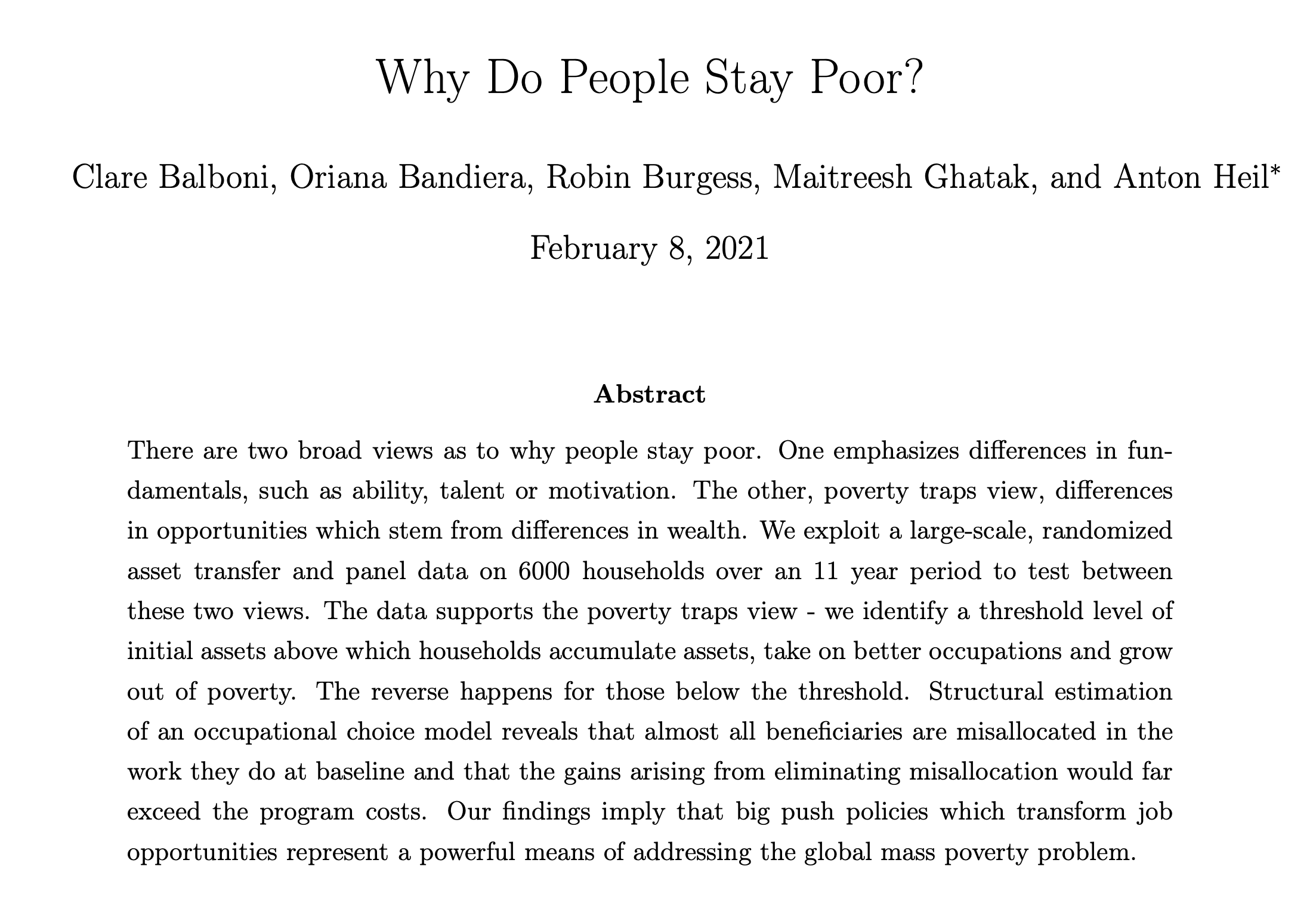
Why Do People Stay Poor? Clare Balboni, Oriana Bandiera, Robin Burgess, Maitreesh Ghatak, and Anton Heil

Image

Rising Weight of Poverty on Public Schools

[This ran without hyperlinks at The Greenville News (November 1, 2013) and The Charleston Post & Courier (November 4, 2013)]

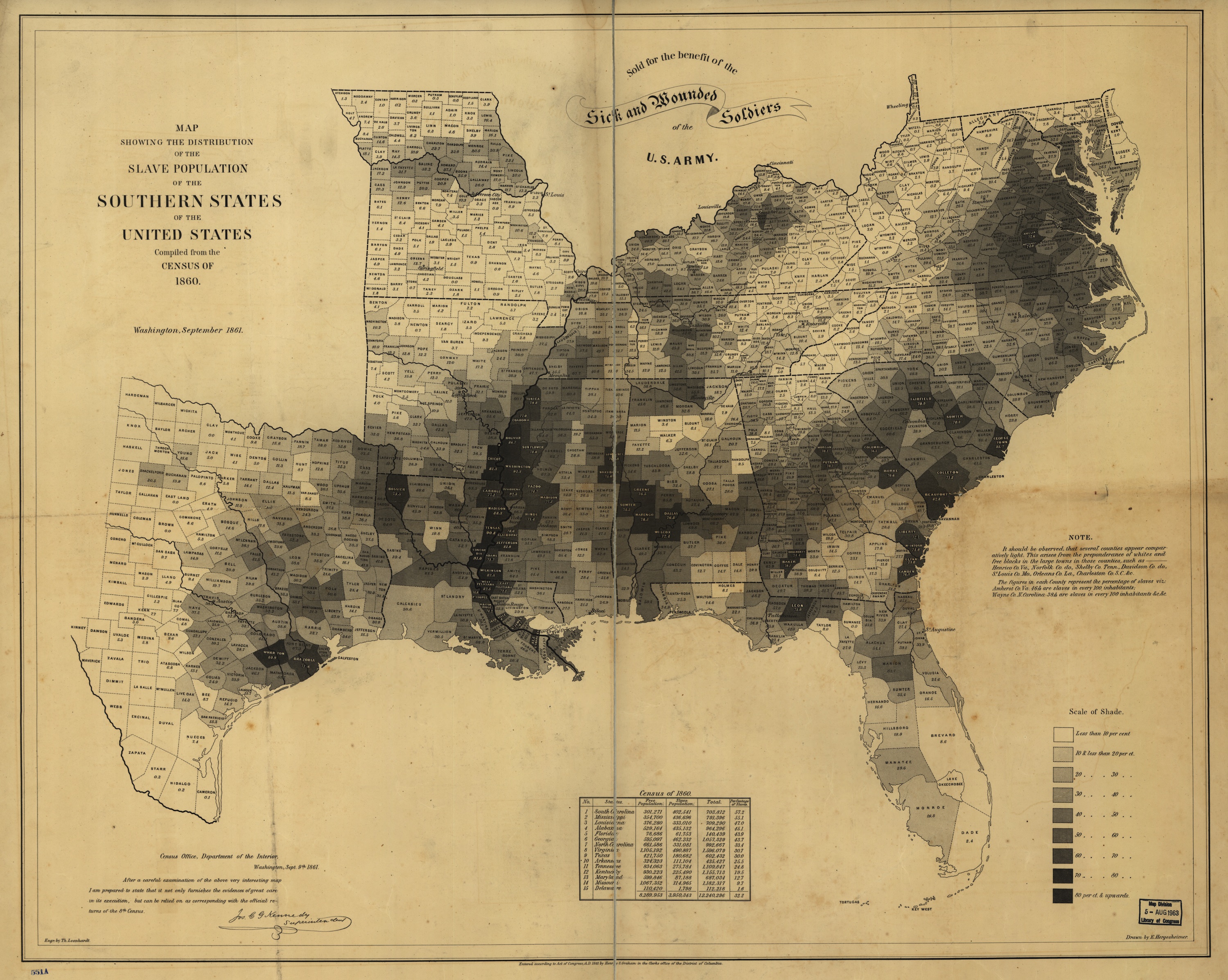
According to 1860 census data, South Carolina had the highest percentage (57.2%) of its population as slaves in the U.S. Beaufort County (82.8%) and Georgetown County (85.7%) represented the significant impact of slave populations along the coast.

The legacy of the scar of slavery in SC remains in the form of I-95 and what is now recognized as the “Corridor of Shame”—a collection of public schools bordering that interstate highway and serving in some of the highest poverty areas of SC.

Another legacy of the South is school segregation. A 2012 report from The Civil Rights project detailed the rise of re-segregated schools across the South:

Black and Latino students in the South attend schools defined by double isolation by both race and poverty. The South reports high overall shares of students living in poverty, but students of different racial backgrounds are not exposed equally to existing poverty. The typical black and Latino student in the region goes to a school with far higher concentrations of low-income students than the typical white or Asian student.

The South, the report explained, has become a majority-minority region of the U.S.; however, “Since 1991, black students in the South have become increasingly concentrated in intensely segregated minority schools (90-100% minority students).”

In SC, for example, only 38.5% of white students attend majority-minority, high-poverty schools—a slight decrease when compared to 1970 (41.2%), 1980 (42.7%), and 1991 (41.8%). For African American students, however, majority-minority, high-poverty schools are the norm.

An October 2013 study from the Southern Education Foundation has revealed that the “new majority” of students in U.S. public schools are high-poverty. For SC, that means that 54.7% of public school students are living in poverty. This ranking places SC in the bottom quartile of the U.S.—approximately where many of the indicators used to compare the state’s education system rank the state.

The overwhelming evidence now shows that SC is experiencing the same social dynamics that characterize the U.S.—an increase in child and family poverty, a widen gap between the affluent and the working poor and poor, and a slow recognition that public schools tend to reflect and perpetuate those inequities instead of helping children overcome them.

For SC, these messages about re-segregating schools, increasing populations of impoverished students, and rising numbers of English Language learners should signal an end to current public discourse and policy related to education reform.

Many of the policies currently endorsed and poised to be implemented in SC are either not designed to address the poverty problem or are certain to increase the problems students bring to our schools.

For example, charter schools in SC and across the U.S. are not producing student achievement distinguishable from public schools, but charter schools are strongly associated with segregating students by race and class.

As well, redesigning teacher evaluation and pay based on student test scores is guaranteed to discourage SC’s best and brightest teachers from teaching in our high-poverty schools, increasing the historical failure to provide our high-poverty and ELL students with certified and experienced teachers. This same failure is repeated by increasing our commitments to Teach for America, which places uncertified and inexperienced teachers with high-poverty students.

One of most damaging policies being endorsed in SC is the call to retain third graders based on test scores. Retention research for the past forty years shows that retention does not improve achievement but does increase dropping out of school. A test-based retention policy, then, will disproportionately and negatively impact high-poverty and ELL students in our state.

A final, but indirect failure of current education reform is the adoption of Common Core and the related high-stakes tests.

SC’s education problems have nothing to do with our curriculum or our testing. Investing tax payers’ dollars and educators’ time to yet again changing our standards and tests is a tremendous failure of leadership in a state now facing that new majority of high-poverty students.

Saying poverty doesn’t matter appears to be a popular and even effective political ploy, but such baseless claims do nothing to end the weight of poverty on our students, our schools, and our state.

The first step to ending a problem is facing that problem: SC has a poverty problem, and to overcome that, we must make tough political decisions about social and educational policy that current education reform plans fail to address.