MacPhee, D., Handsfield, L.J., & Paugh, P. (2021). Conflict or conversation? Media portrayals of the science of reading. Reading Research Quarterly, TBD. https://doi.org/10.1002/rrq.384
Abstract
In this article, we contend that in media stories on the science or reading, journalists have relied on strategic metaphorical framing to present reading education as a public crisis with a narrow and settled solution. Drawing on data from a critical metaphor analysis of 37 media stories, we demonstrate how frames used in recent media reporting have intensified the reading wars, promoting conflict and hampering conversation among stakeholders and across research paradigms and methodologies. The media have asserted a direct connection between basic research and instructional practice that, without sufficient translational research that attends to a variety of instructional contexts and student populations, may perpetuate inequities. We end with an example of collaboration and a challenge to reframe reading education in ways that center collaboration and conversation rather than conflict.
Bowers, J. S., & Bowers, P. N. (2021, January 22). The science of reading provides little or no support for the widespread claim that systematic phonics should be part of initial reading instruction: A response to Buckingham. https://doi.org/10.31234/osf.io/f5qyu
Abstract
It is widely claimed that the science of reading supports the conclusion that systematic phonics should be part of initial reading instruction. Bowers (2020) challenged this conclusion after reviewing all the main evidence, and Buckingham (2020a) provided a detailed response where she argues that the evidence does indeed support systematic phonics and criticizes an alternative form of instruction called “Structured Word Inquiry” or (SWI). Here we show that every substantive criticism Buckingham makes is factually incorrect or reflects a fundamental mischaracterization. There is nothing in her article that challenges the conclusions that Bowers (2020) draws regarding systematic phonics, and nothing that challenges the claims we have made in the past regarding SWI. This should not be used to support whole language or balanced literacy, but it should motivate researchers to consider alternative methods that are well motivated on theoretical grounds, such as SWI.
After a relatively quiet phase, the “reading wars” reignited in 2018 in the wake of a flurry of news media coverage sparked by a public radio documentary that argued that students across America were receiving inadequate phonics instruction. More than a dozen states—including Florida, Texas and North Carolina—rushed to react, passing laws requiring pre-service and current teachers to place a greater emphasis on phonics.
Now researchers who study Culturally and Linguistically Diverse (CLD) students are raising questions about the potential impact of these efforts on such students, including emerging bilinguals. …
One of the defining moments of my first-year writing seminar is my reading aloud the first few paragraphs from A Report from Occupied Territory by James Baldwin.
This essay in The Nation from July 11, 1966, offers students dozens of powerful examples of compelling and purposeful writing, Baldwin at his best. But the circumstances of the essay are what first strike my students.
“There was a great commotion in the streets, which, especially since it was a spring day, involved many people, including running, frightened, little boys,” Baldwin writes. “They were running from the police.”
We note that Baldwin uses “police[men]” five times in the first paragraph, which focuses on people in the Harlem “in terror of the police” because “two of the policemen were beating up a kid.”
Students immediately noted that Baldwin was addressing exactly the same racism grounded in policing that has been the source of social unrest in the U.S. throughout 2020.
In other words, racism in policing in the U.S. is not a recent crisis, but a historically systemic fact of policing.
The more things change, we noted, the more they stay the same.
The history of education in the U.S. is often fascinating and surprising, but it also is like being Phil (Bill Murray) in Groundhog Day—especially when it comes to bandwagons and political and public cries of “crisis.”
Fews aspects of education represent this pattern more than reading, suffering the “science of reading” (SoR) movement since early 2018.
The SoR movement is nothing new, a movement anchored in the past.
But as David Reinking, Victoria J. Risko and George G. Hruby note at The Answer Sheet (The Washington Post), “More worrisome, a majority of states have enacted, or are considering, new laws mandating how reading must be taught and setting narrow criteria for labeling students as reading disabled.”
As my students came to recognize about racism and policing in the U.S., anyone who examines the history and current bandwagon of reading will see that schools, teachers, and students have, like Phil, lived the same day over and over—reading is in crisis and here is the silver-bullet for all students to read.
One must wonder why we never pause to confront that this formula has never resulted in anything other than the same crisis.
And one must acknowledge that something cannot be a movement if it is anchored in doing the same thing over and over while expecting different results.
Both the website and the League represent the very worst of missionary zeal and good intentions; and they both fail the fact check necessary for claims about a reading crisis and the bandwagon of SoR.
First, The Reading League grounds their concerns in a misguided and false red flag about whole language, as reported on Syracuse.com: “Murray is referring to the large base of research and knowledge that proves scientifically-grounded methodology in teaching reading is more effective than the ‘whole language’ approach most curriculum takes.”
This argument has two significant flaws. First, whole language has been replaced by balanced literacy for decades. And second, the 1990s revealed a discredited assault on whole language and an ignored analysis of by Darling-Hammond that showed a positive correlation between higher NAEP scores and students being in whole language classrooms.
The website, The Science of Reading: A Defining Movement, is complicated to fact check because there seems to be a purposeful effort to appear to be different than the SoR bandwagon by rejecting the term as a “buzzword” and demanding “We must preserve the integrity of reading science.”
Further, in the Preamble to their The Science of Reading: A Defining Guide, one sentence stands out: “We know that our children can be taught to read properly the first time.”
“The first time”?
Literacy and reading are lifelong learning experiences, and this claim raises a genuine red flag about this movement.
But the biggest reveal about the so-called SoR movement is in the definition, where there is a narrow parameter set for “scientifically-based”: experimental/quasi-experimental study design, replication or refinement of findings, and peer-reviewed journal publication.
The SoR movement is a bandwagon with its wheels mired in the same muddle arguments that have never been true and silver-bullet solutions that have never worked.
Like Phil, we find ourselves waking up to the same day in reading.
This is no crisis, but it certainly is a tired, old story that needs to be left behind through some other vehicle than a bandwagon.
Currently, I am in year 37 of teaching in SC, serving as a high school English teacher at Woodruff High for 18 years before moving to teacher education at Furman University for the past 19 years. I entered education in SC in 1984, the first days of the accountability movement in our state.
Despite political leaders changing standards and high-stakes testing multiple times over the past four decades, political and public perception remains convinced that our students are, once again, failing to learn to read.
Bill 3613 is making the same mistake political leaders have been making since the 1980s, tinkering with punitive legislation aimed at our students and teachers while ignoring the overwhelming negative impact of inequity in our students’ homes and communities as well as the harmful negative learning and teaching conditions that persist in our schools.
Read To Succeed, which Bill 3613 seeks to amend, misreads both how students learn to read and how best to teach reading. Reading growth is not simple, and test scores are a stronger measure of poverty and social inequities than the state of student learning or the quality of teaching.
This proposed legislation is yet another example of SC jumping on a flawed educational bandwagon (this time copying Mississippi), the “science of reading” movement that has resulted in harmful educational policy such as increased grade retention, over-screening for dyslexia, and prescribing “one-size-fits all” instruction for students.
The National Council of Teachers of English (NCTE), the largest professional organization for English teachers in the U.S., has issued a strong policy statement rejecting third-grade retention supported by decades of research showing grade retention remains harmful for students. Dorothy C. Suskink also recently posted at NCTE that the “science of reading” movement is deeply misleading in its use of the term “science,” misrepresentation of the National Reading Panel, dependence on discredited reports from the National Council on Teacher Quality, and claims of crisis from NAEP scores.
Prominent literacy scholars David Reinking, Victoria J. Risko and George G. Hruby have also challenged the many flaws in the “science of reading” movement that are now included in Bill 3613. “When the teaching of reading is framed as a war, nuance and common areas of agreement are casualties,” they conclude, adding: “But worse, our children can become innocent victims caught in a no man’s land between those more interested in winning a conflict than in meeting individual needs.”
As has been proven by Read to Succeed so far, the most vulnerable students in our state will be harmed by the policies in this bill the most while political leaders in the state continue to lack the political will and courage to address the root causes of educational challenges across SC—poverty and racial inequity.
I urge political leaders in SC to think differently about our students, our teachers, and our schools; notably, I strongly recommend that we seek ways to create homes, communities, and schools that allow our students to grow and excel in the literacy development.
Continuing to tinker with prescriptive and punitive reading legislation is a dereliction of political and ethical duty; we can and must do better, by doing differently.
In the opening weeks of my first-year writing seminar, I introduce students to reading like writers (here and here), emphasizing that we are not reading to write literary analysis (as many of them have done for Advanced Placement Literature) but reading to explore and acquire moves and approaches for effective writing.
Since the first essay assignment is a personal narrative, I provide them with several essay examples and highlight “Peculiar Benefits” by Roxane Gay as a powerful model of what we are trying to accomplish—engaging the reader with personal narrative in order to ask the reader to consider or reconsider some larger idea or argument.
Today I read aloud, as I typically do, the first three paragraphs of the essay from the original online version of Gay’s essay at The Rumpus (many students read Gay’s Bad Feminist, which includes a slightly revised version). We had a robust discussion, and many students were interested in the essay and excited by the writing strategies we highlighted, centered around purposeful writing instead of templates or rules.
Once we ended that discussion, I noted that the three paragraphs included two places that were copyedited for the published essay in Bad Feminist. I asked if any students noticed those examples of what many English teachers and editors would mark as “non-standard” or “errors.”
No student had noticed so I read aloud the two sentences, prompting them to look closely again:
For my brothers and I it was an adventure, sometimes, a chore, and always a necessary education on privilege and the grace of an American passport….
It was hard for a child who grew up on cul-de-sacs, to begin to grasp the contrast between such inescapable poverty alongside almost repulsive luxury and then, the United States, a mere eight hundred miles away, with it’s gleaming cities rising out of the landscape, and the well-maintained interstates stretching across the country, the running water and the electricity.
One student noticed that “for my brothers and I” would be edited to “for my brothers and me”; I discussed with the class the common problem of case switching when there are two people versus one. Most people would always choose “for me” and not “for I,” but will choose “for my brothers and I” based on a weird urge to overcorrect likely grounded in being chastised as children for “Me and him went to the store.”
It took a bit more nudging, but eventually they saw the “it’s” that would be edited to “its.” Here I noted that people have an urge to insert the apostrophe with “its” although it is the same form as “his” (which never has an apostrophe added) and “hers”/”theirs” (which occasionally gets the added apostrophe).
The apostrophe works in both possession and contraction, causing people problems in written text never present in spoken language. People never confuse the constructions of “Bob’s car” and “there are two Bobs in our family” when heard aloud—even without the aid of the apostrophe.
My point here was to help students begin to move away from the paralyzing effect of being perfect (avoiding surface “errors”) and to recognize what people are doing when they read.
I shared with them a recent story about my granddaughter, Skylar, who is six and eagerly reads aloud throughout her day whenever she sees text.
A couple weeks ago, I had picked up my granddaughter and grandson (Brees, who is four). While we were driving to my apartment, stopped at a red light, Skylar asked, “Papa, what is L E O S?”
I turned back toward her and noticed a business sign directly out her window. “It’s ‘Leo’s,'” I said. “A name.”
She immediately announced, “Leo’s TV.”
First, I think it is interesting that she seems to have paid no attention to the apostrophe (and there is ample evidence that almost all modern readers of English find little to no value in the apostrophe; hence, it is likely dying as a marker for possession and contractions).
But with the recent phonics-mania and revived advocacy for the “simple view” of reading, it is also a valuable cautionary tale, this experience with a sign.
Of the six letters Skylar was reading, four of them are just saying the letter; if she had tried to decode those two words in any simple way, she would have mangled them greatly.
And imagine if the owner were “Zoe” or “Joe.”
Both the moment with my granddaughter and my first-year writing students demonstrates the holistic nature of literacy—of reading. And frankly, there is nothing simple about it.
For a six-year-old, there is a maze of fonts as well as the use of capitol or lower case lettering all mixed in with dozens of arcane phonics “rules” and exceptions; but for more advanced readers such as my students, even when they have been prompted to use close reading in their literary analysis, they simply do not see many microlevel, isolated elements of text.
Certainly phonemic awareness and patterns are valuable aspects of creating meaning from text. But Skylar often uses a much better technique; ask what you don’t know and blend it with what you do.
So-called standard spelling, punctuation, and grammar have some value for sharing meaning among users of a language, but my students have become nearly immobile as writers because they try to be perfect even as they are discovering and creating meaning with text.
And I have watched Skylar laboriously try to sound out a word, grinding all meaning to a halt. But when I say the word aloud for her, she recognizes it and flies ahead. She often already knows it by sight the next time we come across it.
In the span between being a beginning reader to an independent and expert reader, there is much any person needs to acquire—and little we can predict that “all students” must do along the way. Let’s not fall for the allure of “simple” and certainly let’s not continue leading our students down a path toward paralysis, where meaning goes to die.
Like “Leo,” another three-letter word needs to be always at the forefront of anyone growing as a reader, “joy.”
South Carolina is poised with Bill 3613 to continue the historical failures of addressing reading in South Carolina through micromanaging legislation that has not resulted in improving home, community, individual equity or learning outcomes for students living in poverty, Black students, Emergent Bilinguals, or students with special needs.
Currently, I am in year 37 of teaching in SC, serving as a high school English teacher at Woodruff High for 18 years before moving to teacher education at Furman University for the past 19 years. I entered education in SC in 1984, the first days of the accountability movement in our state.
Despite political leaders changing standards and high-stakes testing multiple times over the past four decades, political and public perception remains convinced our schools are failing, and that our students are, specifically, failing to learn to read.
Read To Succeed, which Bill 3613 seeks to amend, was a serious mistake at its inception since it misreads both how students learn to read and how best to teach reading. Reading growth is not simple, and test scores are a stronger measure of poverty and social inequities than the state of student learning or the quality of teaching.
Bill 3613 is making the same mistake political leaders have been making since the 1980s, tinkering with prescriptive legislation aimed at our students and teachers while ignoring the overwhelming negative impact of inequity in our students’ homes and communities as well as the harmful negative learning and teaching conditions that persist in our schools.
This proposed legislation is yet another example of SC jumping on a flawed educational bandwagon (this time copying Mississippi), the “science of reading” movement that has resulted in harmful educational policy such as increased grade retention, over-screening for dyslexia, and prescribing “one-size-fits all” instruction for students.
The National Council of Teachers of English (NCTE), the largest professional organization for English teachers in the U.S., has issued a strong policy statement rejecting third-grade retention supported by decades of research showing grade retention remains harmful for students. Dorothy C. Suskink also recently posted at NCTE that the “science of reading” movement is deeply misleading in its use of the term “science,” misrepresentation of the National Reading Panel, dependence on discredited reports from the National Council on Teacher Quality, and claims of crisis from NAEP scores.
Prominent literacy scholars David Reinking, Victoria J. Risko and George G. Hruby have also challenged the many flaws in the “science of reading” movement that are now included in Bill 3613. “When the teaching of reading is framed as a war, nuance and common areas of agreement are casualties,” they conclude, adding: “But worse, our children can become innocent victims caught in a no man’s land between those more interested in winning a conflict than in meeting individual needs.”
As has been proven by Read to Succeed so far, the most vulnerable students in our state will be harmed by the policies in this bill the most while political leaders in the state continue to lack the political will and courage to address the root causes of educational challenges across SC—poverty and racial inequity.
I urge political leaders in SC to think differently about our students, our teachers, and our schools; notably, I strongly recommend that we seek ways to create homes, communities, and schools that allow our students to grow and excel in the literacy development. Continuing to tinker with prescriptive and punitive reading legislation is a dereliction of political and ethical duty; we can and must do better, by doing differently.
I am contacting you with an urgent caution about Bill 3613 and the historical failures of addressing reading in South Carolina through micromanaging legislation that has not resulted in improving home, community, individual equity or learning outcomes for students living in poverty, Black students, Emergent Bilinguals, or students with special needs.
Currently, I am in year 37 of being an educator in SC, serving as a high school English teacher at Woodruff High for 18 years before moving to teacher education at Furman University for the past 19 years. I entered education in SC in 1984, the first days of the accountability movement in our state.
Despite changing standards and high-stakes testing multiple times over the past four decades, political and public perception remains convinced our schools are failing, and that our students are, specifically, failing in reading achievement.
Read To Succeed was a serious mistake at its inception since it misreads both how students learn to read and how best to teach reading. Reading growth is not simple, and test scores are a stronger measure of poverty and social inequities than the state of student learning or the quality of teaching.
Bill 3613 is making the same mistake political leaders have been making since the 1980s, tinkering with prescriptive legislation aimed at our students and teachers while ignoring the overwhelming negative impact of inequity in our students’ homes and communities as well as the harmful negative learning and teaching conditions that persist in our schools.
I am attaching a full statement and a resource list that includes powerful and valuable recommendations from important national organizations (NCTE, ILA, NEPC) who have addressed how best to reform our schools in order to serve all students and to foster literacy in effective and compelling ways.
Please read and consider the resources I have provided, notably the nearly exhaustive collection of research on grade retention and NCTE’s Position Statement strongly rejecting grade retention as reading policy; below I highlight the should not/should recommended with research support from NEPC (see the resource list below):
Should not fund or endorse unproven private-vendor comprehensive reading programs or materials.[i]
Should not adopt “ends justify the means” policies aimed at raising reading test scores in the short term that have longer-term harms (for example, third-grade retention policies).[ii]
Should not prescribe a narrow definition of “scientific” or “evidence-based” that elevates one part of the research base while ignoring contradictory high-quality research.[iii]
Should not prescribe a “one-size-fits-all” approach to teaching reading, addressing struggling readers or English language learners (Emergent Bilinguals), or identifying and serving special needs students.
Should not prescribe such a “one-size-fits-all” approach to preparing teachers for reading instruction, since teachers need a full set of tools to help their students.
Should not ignore the limited impact on measurable student outcomes (e.g., test scores) of in-school opportunities to learn, as compared to the opportunity gaps that arise outside of school tied to racism, poverty, and concentrated poverty.[iv]
Should not prioritize test scores measuring reading, particularly lower-level reading tasks, over a wide range of types of evidence (e.g., literacy portfolios and teacher assessments[v]), or over other equity-based targets (e.g., access to courses and access to certified, experienced teachers), always prioritizing the goal of ensuring that all students have access to high-quality reading instruction.
Should not teacher-proof reading instruction or de-professionalize teachers of reading or teacher educators through narrow prescriptions of how to teach reading and serve struggling readers, Emergent Bilinguals, or students with special needs.
Should not prioritize advocacy by a small group of non-educators over the expertise and experiences of K-12 educators and scholars of reading and literacy.
Should not conflate general reading instruction policy with the unique needs of struggling readers, Emergent Bilinguals, and special needs students.
And therefore:
Should guarantee that all students are served based on their identifiable needs in the highest quality teaching and learning conditions possible across all schools:
Full funding to support all students’ reading needs;
Professionally prepared teachers with expertise in supporting all students with the most beneficial reading instruction, balancing systematic skills instruction with authentic texts and activities;
Full and supported instructional materials for learning to read, chosen by teachers to fit the needs of their unique group of students;
Intensive, research-based early interventions for struggling readers; and
Guaranteed and extensive time to read and learn to read daily.
Should support the professionalism of K-12 teachers and teacher educators, and should acknowledge the teacher as the reading expert in the care of unique populations of students.
Should adopt a complex and robust definition of “scientific” and “evidence-based.”
Should embrace a philosophy of “first, do no harm,” avoiding detrimental policies like grade retention and tracking.[vii]
Should acknowledge that reading needs across the general population, struggling readers, Emergent Bilinguals, and special needs students are varied and complex.
Should adopt a wide range of types of evidence of student learning.
Should prioritize, when using standardized test scores, longitudinal data on reading achievement as guiding evidence among a diversity of evidence for supporting instruction and the conditions of teaching and learning.
Should establish equity (input) standards as a balance to accountability (output) standards, including the need to provide funding and oversight to guarantee all students access to high-quality, certified teachers; to address inequitable access to experienced teachers; and to ensure supported, challenging and engaging reading and literacy experiences regardless of student background or geographical setting.
Should recognize that there is no settled science of reading and that the research base and evidence base on reading and teaching reading is diverse and always in a state of change.
Should acknowledge and support that the greatest avenue to reading for all students is access to books and reading in their homes, their schools, and their access to libraries (school and community).[viii]
I urge political leaders in SC to think differently about our students, our teachers, and our schools; notably, I strongly recommend that we seek ways to create homes, communities, and schools that allow our students to grow and excel in the literacy development.
Continuing to tinker with prescriptive and punitive reading legislation is a dereliction of political and ethical duty; we can and must do better, by doing differently.
[i] This is true even when the program is generally understood to be of high quality. See Gonzalez, N. (2018, November 26). When evidence-based literacy programs fail. Phi Delta Kappan, 100(4), 54-58. Retrieved March 15, 2020, from LINK
See also International Reading Association (2002). What is evidence-based reading instruction? Retrieved March 15, 2020, from LINK
Office of the Inspector General. (2006). The Reading First program’s grant application process. Final inspection report. Washington, DC: US Department of Education. Retrieved March 15, 2020, from LINK
[ii] See the sources linked at Thomas, P.L. (2014). Grade Retention Research. Radical Eyes for Equity. Retrieved March 15, 2020, from LINK
[iii] See resources linked at Thomas, P. L. (2020). Understanding the “Science of Reading”: A Reader. Radical Eyes for Equity. Retrieved March 15, 2020, from LINK
[iv] Carter, P.L. & Welner, K.G. (Eds) (2013). Closing the opportunity gap: What America must do to give all children an even chance. New York, NY: Oxford University Press.
Reardon, S.F., Weathers, E.S., Fahle, E.M., Jang, H., & Kalogrides, D. (2019). Is separate still unequal? New evidence on school segregation and racial academic achievement gaps (No. 19-06). CEPA Working Paper. Retrieved March 15, 2020, from LINK
[v] Valencia, S.W. (1998). Literacy Portfolios in Action. San Diego, CA: Harcourt Brace. Retrieved March 15, 2020, from LINK
Strunk, K.O., Weinsten, T.L., & Makkonen, R. (2014). Sorting out the signal: Do multiple measures of teachers’ effectiveness provide consistent information to teachers and principals?. Education Policy Analysis Archives, 22(100). Retrieved March 15, 2020, from LINK
Lavigne, D.A.L., & Good, D.T.L. (2020). Addressing teacher evaluation appropriately. APA Division 15 Policy Brief Series, 1(2). Retrieved March 15, 2020, from LINK
[vi] Schanzenbach, D.W. (2014). Does class size matter? Boulder, CO: National Education Policy Center. Retrieved March 15, 2020, from LINK
[vii] Atteberry, A., LaCour, S.E., Burris, C., Welner, K.G., & Murphy, J. (2019). Opening the gates: Detracking and the International Baccalaureate. Teachers College Record, 121(9), 1-63.
See also the sources linked at Thomas, P.L. (2014). Grade retention research. Radical Eyes for Equity. Retrieved March 15, 2020, from LINK
[viii] Fryer, R., & Levitt, S. (2004). Understanding the black-white test score gap in the first two years of school. The Review of Economics and Statistics, 86(2), 447-464.
Lance, K.C., & Kachel, D.E. (2018). Why school librarians matter: What years of research tell us. Phi Delta Kappan, 99(7), 15-20. Retrieved March 15, 2020, from LINK
Krashen, S. (2013). Access to books and time to read versus the common core state standards and tests. English Journal, 21-29. Retrieved March 15, 2020, from LINK
The summer of 1975, I was diagnosed with scoliosis and fitted with a form-fitting plastic body brace anchored with aluminum rods and spanning from my pelvic bone to my chin. This was a hell of a way to start my ninth grade at Woodruff Junior High.
I would wear that brace 23 hours a day, gradually weaning myself off the support as my vertebrae both (mostly) repaired their disfigurement and eventually stopped growing; this meant I wore the brace for much of my high school experience as well.
My childhood and teen years were a contradiction of Southern racism, ignorance, and bigotry warmly wrapped in the blanket of my loving and doting working-class parents. My scoliosis was a significant financial burden on my parents (who never flinched at the medical care it required), but it also in some ways broke their hearts.
I was a skinny and very anxious human, deeply self-conscious and introverted before the years of the brace came upon me in the roiling shit-storm of adolescence.
It was at this juncture of my life that I discovered comic books, what now seems like a logical extension of the fascination I inherited from my mom for science fiction (she loved classic black-and-white B-movies, always claiming The Day the Earth Stood Still as her favorite film).
Once again, my parents never wavered when I began collecting and drawing from Marvel comics in the mid-1970s. They drove me to the local pharmacies to buy new comics and even bought a pretty large and important collection from a guy selling hundreds of comics in the local newspaper.
By high school graduation, I had amassed essentially every comic book Marvel published in the 1970s.
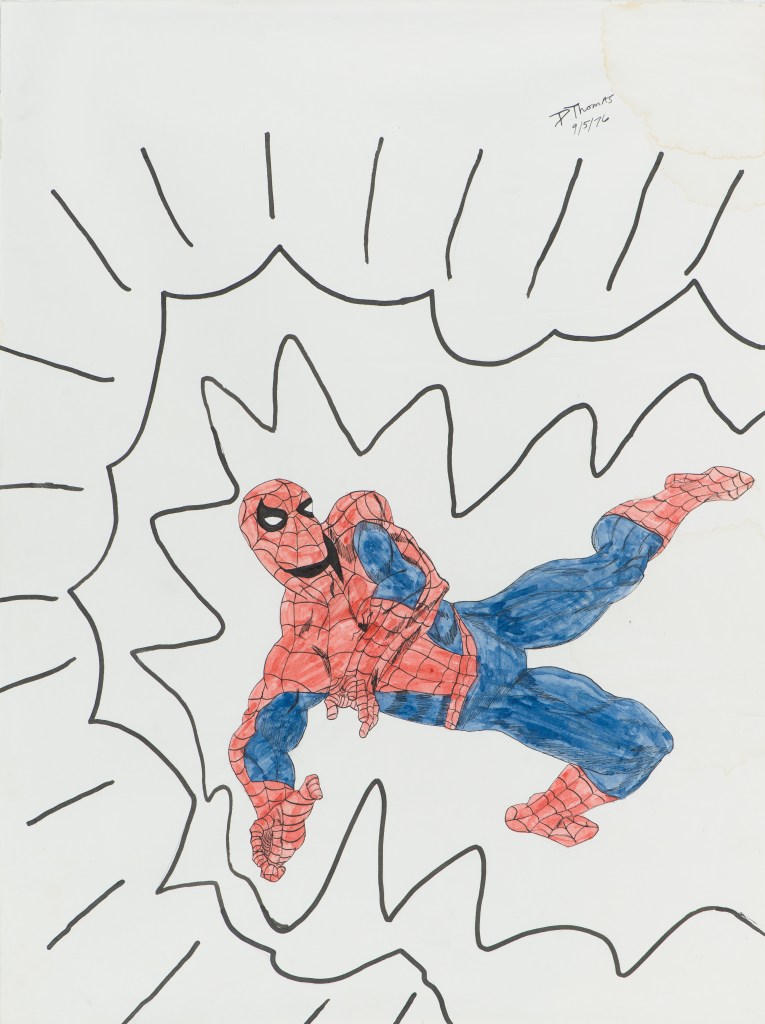
It would take me many years to recognize that my comic book collecting and science fiction reading were the foundation upon which I eventually chose to be a high school English teacher and came to recognize that I am a writer (although I initially clung to being a comic book artist since I spent hours and hours standing at our kitchen bar drawing from the comics I collected). (See my original artwork from the mid-/late 1970s below.)
Just thirteen days away from turning 60, I am baffled at not being able to specifically identify when I stopped collecting comics some time around graduating high school and attending college. I assume it seemed childish at some point even though I kept my 7000-book collection well into marriage.
I do know that when we bought our first townhouse, I sold that collection for way less than it was worth in both dollars and for my soul. I held onto the full run of Howard the Duck, but let everything else fund my misguided pursuit of the corrupted American Dream—home ownership.
At some point in the late 1980s and early 1990s, I briefly returned to collecting, prompted by several of my high school students and the Frank Miller rebooting of Batman as well as the Tim Burton/Michael Keaton films. This coincided with the 1990s boom/bust of mainstream comics by Marvel and DC, and once again, adult life kept me from really fully engaging in something I love.
When I moved to higher education in 2002 after 18 years teaching high school English, I found a way to merge my adolescent love for comic books and my adult life—comic book scholarship and blogging. I also published one book on comic books, which allowed me a justification for buying comics and graphic novels once again (and a way to move beyond super hero comics). I learned a great deal (and made several embarrassing mistakes) when I merged my fandom with my scholarship, but that work about a decade ago, once again, didn’t really stick—although it certainly didn’t fade away either.
Recently, I allowed myself to re-commit to collecting, focusing on Daredevil and then adding the newest Wolverine run. I am back engaged with a local comic book store just minutes from where I live, and I also collected the recent X of Swords run from Marvel. (See part of my Xmas haul below.)
And yesterday, something very interesting happened for me, again just two weeks from turning 60.
I never became a gamer because I always have struggled with the controls, and in my advancing age, that has been a real hurdle even more pronounced. But I also experienced a significant amount of disorientation as well as feeling extremely (for lack of a better word) dumb.
Starting a game left me paralyzed, repeatedly asking what I was supposed to do. I often was coached with this advice: Just explore and watch for what the game shows you to do.
That meant nothing to me, even less than nothing. In fact, I soon realized that I was simply unable to read the video games while experienced gamers have internalized hundreds of signals and cues to the point that “what you are supposed to do” seems obvious (see this on gaming, for example).
One of my foundational complaints about the “science of reading” movement has been its embracing a simple view of reading, and here I was, at 60, experiencing how incredibly complex reading is—that reading is far more than decoding print (and is even often apart from print).
Gaming like reading comic books is a holistic experience with text as well as images all guided by prior knowledge and experiences, and the blending of many different kinds of codes that are both unique to a single environment as well as common across the medium/genre/form.
The subgenres of gaming have commonalities like the subgenre of comic books, super hero comics.
Although I have recognized myself as a writer for forty years now—and never lift a pencil to draw any more—I was pulled back into comic book collecting because of the artwork, first Daredevil (a series that has always had distinct and powerful artists working on the character, in my opinion), then the rebooted Wolverine series, and now the incredible artists working on X-Men.
X-Men vol. 5, issues 5 and 6 (cover art: Leinil Francis Yu and Sunny Gho)
In several of my college courses, I have integrated comic books and graphic novels, often to students who have never read comics. They almost always admit that reading comics is much harder and takes much longer than they expected. It wasn’t, they discovered, like reading a text-only essay or book.
As I have been diving back into the X of Swords series and the rebooted X-Men series spearheaded by Jonathan Hickman, I have noticed my haphazard reading style of comics, very art-based and not very sequential (I glance around the entire spread and often dart back and forth among the text and panels).
And so here is the very interesting thing from yesterday.
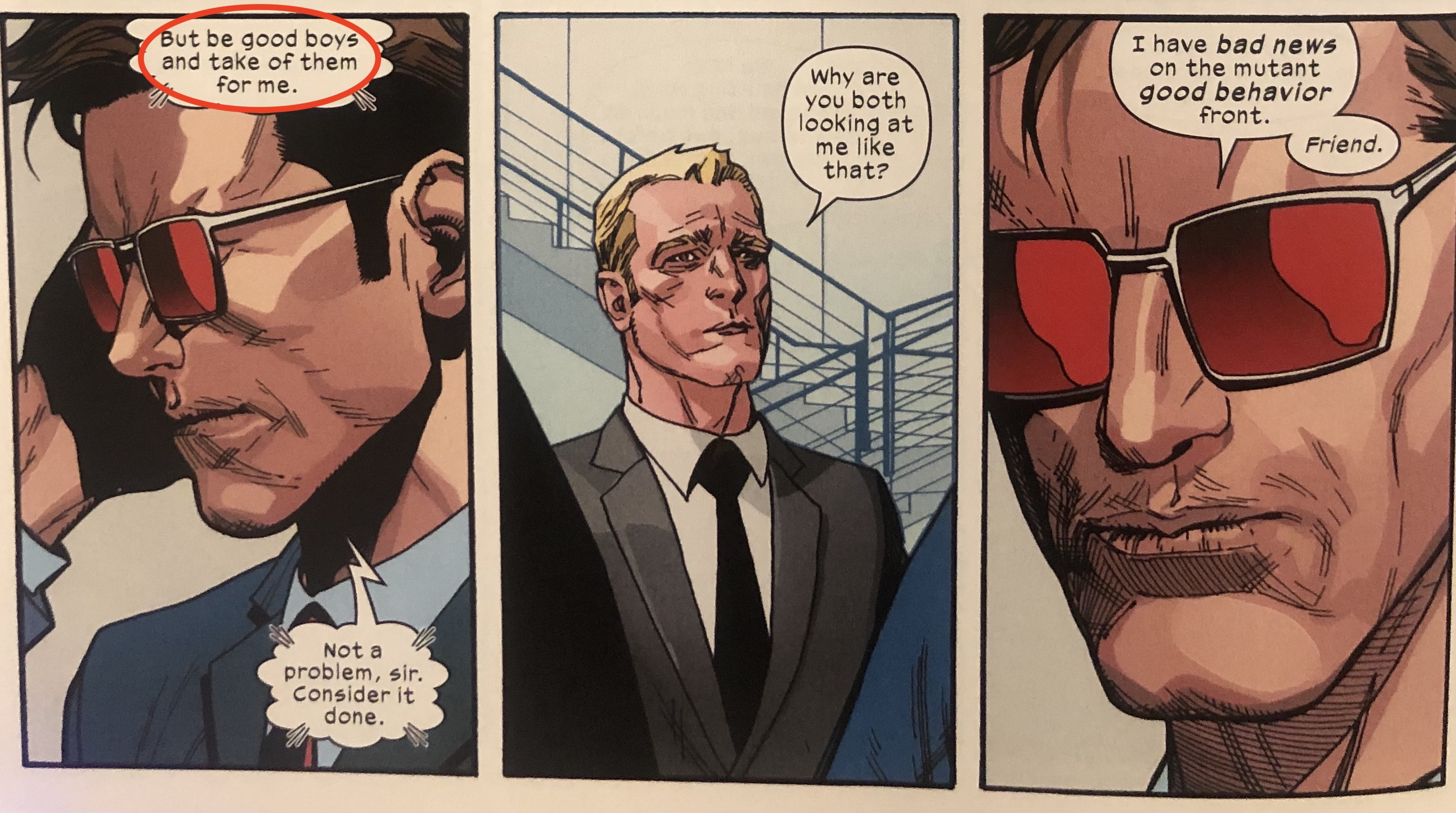
In issue 4 of X-Men (vol. 5), Magneto quotes Aldous Huxley:
A sucker for literary references, I paused to search the quote, and then returned to reread the pages leading up to and after the use of the quote. Then, I realized something unusual that I had not noticed when first reading:
X-Men vol. 5, issue 4 (Hickman/Yu)
The omission of “care.”
Every time I read this, I still insert “care” automatically and have to force myself to see that it isn’t there (as if Professor X is doing it for me each time).
There are dozens of cues in those three panels, some of them text (and one of them the absence of assumed text).
As I count down the days until I turn 60, I am living some of the fantastical elements we associate with children’s stories, comic books, and science fiction—a pandemic, a Capitol siege, and the many eras of my own life overlapping with each other as if I am both living my current life and going back in time.
Life is no comic book or video game, but I am tasked with making sure as I explore the things around me that I pay attention to all the cues of what I am supposed to do—and it remains a very complicated task in 2021 as it was in 1975.
In the pre-pandemic world that seems much further in the past than it is, I traveled from South Carolina to Milwaukee in February of 2020 to speak at the Wisconsin State Reading Association (WSRA) annual convention.
My public work had been dominated by refuting the “science of reading” movement for more than a year at that point—including having a book in press on the “science of reading” as another version of the Reading War—so I arrived in Milwaukee a bit apprehensive about how I would be received.
My session was well attended by an energetic crowd of teachers who seemed eager to engage in why the “science of reading” movement was misguided, but I also encountered another distinct frustration among teachers I had not anticipated.
A significant part of the “science of reading” agenda has been to attack popular reading reading programs, notably programs associated with Lucy Calkins and Teachers College (see here and here, for example).
As I interrogated and discounted many aspects of the “science of reading” agendas, the attendees were supportive of my analysis, but teachers often expressed very negative experiences with Calkins’s programs, the third most popular reading program in the U.S.
What I was witnessing surprised me, but I soon realized that Calkins represented for very different reasons multiple problems with how reading is taught in formal schooling throughout the U.S.
When I asked teachers attending that session why they were so frustrated and even angry about Calkins’s programs, I heard what I have long argued about the essential problem with anyreading program: Administrators spend a great deal of time and effort making sure teachers implement adopted program, and not acknowledging teacher expertise or student needs and learning.
To be fair, teachers frustrated with Calkins’s reading programs were credibly concerned about how it was being mandated and implemented (no real fault of Calkins or the publishers).
Despite my efforts and the efforts of my scholars and teachers of literacy, the “science of reading” momentum has only increased. The most recent development is likely one of the worst.
Across the U.S. media advocacy and parental zeal have directly resulted in state reading legislation, the worst of which has implemented third-grade retention policies. But the next shoe to drop has been how those policies directly impact teaching and learning—repeating the Open Court, Reading First, and National Reading Panel scandal not even fifteen years in the past.
And once again during the “science of reading” frenzy, Lucy Calkins is in the middle—as reported by the most prominent “science of reading” media propagandist, Emily Hanford:
The Arkansas Division of Secondary and Elementary Education announced in October 2019 that any curriculum that utilizes cueing strategies won’t be approved for use in the state, meaning that Calkins’ materials and another popular program, Fountas and Pinnell Classroom, are effectively banned [emphasis added]. Colorado released a list of approved core reading curriculum, and Calkins’ programs weren’t on the list. A group outside St. Louis sent a letter signed by 216 parents, students and taxpayers to the school board asking that Calkins, and Fountas and Pinnell be dropped. The Oakland Unified School District, whose use of Calkins’ products was highlighted in the 2019 APM Reports story, announced it was forming a committee to consider adopting new curriculum. And Student Achievement Partners, a nonprofit consulting group, published a review that concluded Calkins’ curriculum materials are “unlikely to lead to literacy success for all of America’s public schoolchildren.”
So we are now confronted with a very disturbing but common formula related to reading instruction:
Media “Experts” + Parental Zeal + Political Knee-jerk Legislation + Market Forces = Failing Reading, Again
Let me return to the teachers attending my session at WSRA.
If anyone were genuinely interested in understanding the complexities of teaching reading in formal schooling, almost everything needed was available in those teachers’ comments.
For the most part, these teachers recognized the misrepresentations and problems with the “science of reading” agenda, notably that journalists and parents were driving the conversations on how to teach children to read; they also knew from lived experiences as teachers that reading programs—all reading programs—are the problem, and not the solution.
At the core of the flaws in the “science of reading” movement is the belief that there is a clearly and easily defined “right way” to teach reading, that most teachers (for some odd reason) refuse to acknowledge that one “right way” (and/or were never taught that “right way” by teacher educators who, again for some odd reason, refuse to acknowledge that one “right way”), and that all we need to do is to adopt that “right way” to (finally?) teach all children to read.
Yet, this is both magical and overly simplistic thinking.
There is no one “right way” to teach reading and there is no silver-bullet reading program.
Teaching students to read well is negatively impacted by dozens of factors that lie well outside the confines of what any reading program can address—socio-economic inequity, racial inequity, school funding, an oppressive accountability/standards/testing culture, human nature, etc.
“Science of reading” advocates have spent a great deal of time demonizing Calkins and her workshop-based, holistic programs, but now they also seem almost gleeful to claim that she has come over to their side.
All of this rather petty “gotcha” approaches to the cult of celebrity as that impacts education (Calkins as a literacy guru or Hanford as the “science of reading” prophet) has perpetuated one of the worst dynamics surrounding how we run our schools—market forces.
The changes being made to Calkins’s programs are responding to the market being closed; it genuinely doesn’t matter in that context if the original programs were or weren’t “scientific” and it doesn’t matter if the changes are or aren’t “scientific.”
Publishers respond to market forces, and for public education, that means that democratically elected officials are responding to constituents and creating legislation that governs what reading materials states can and cannot purchase to teach children to read.
This is capitalism, not science; this is the free market, not education for equity and democracy.
The NCLB, NRP, Reading First, and Open Court scandal of the 2000s laid out clearly that the exact same process happening because of the “science of reading” movement is destined to fail, guaranteed to corrupt how we teach reading.
Teaching children to read is about individual children and their teachers. At best reading programs can provide some of the tools needed to help children read, but reading programs generally are used at their worst—as ends unto themselves.
Whether or not Calkins has gone over to the “science of reading” movement is nothing to celebrate or condemn.
That we remain mired in “all students must” and myopically committed to adopting the “right” reading program are the real problems—once again.
UPDATE
Calkins has offered a clarification that challenges how Hanford and EdWeek have characterized the changes to her program; key comments include:
Many of you are asking questions in response to the latest Ed Week blog. While I am glad that Ed Week and Emily Hanford are studying the work we are doing at Teachers College, their articles can spawn misunderstandings and misconceptions, so let me clarify….
While the journalists will try to persuade you otherwise (controversy gets more eyes on the page than consensus), this is actually a small shift in our thinking, one that applies to the way that a teacher coaches a child who is in the early stages of reading development—which, if using Guided Reading Levels, aligns with approximately levels C through H. Some kids progress though the levels at pace, and for them this shift doesn’t really matter. However, it is an important shift to make for those readers who’ve not picked up the phonics knowledge they need and for working with kids who have dyslexia.
What stays the same in our work with K-1 readers? 98% of it. We still support the rich comprehension work that has always been a part of workshop teaching. We still support kids reading with agency. We still support choice and rereading and reading to learn and talking about books. We still support the reciprocity between writing and reading. We still support kids learning letters, onsets and rimes, spelling patterns, and high frequency words as we have taught them. We still support using the learning progressions and assessment-based teaching. We still support kids reading with phonics, fluency, and comprehension. We still support kids seeing themselves in books and learning about others through reading. We still support kids learning to lead richly literate lives.
17 September 2020 turned out to be a day of disinformation about education in the U.S. The White House launched another assault on education (not a surprise), and the International Literacy Association offered (for a fee) “Making Sense of the Science of Reading.”
The latter is disappointing from a powerful and influential professional organization because the “sense” made appears to be quite different than the intent.
SoR links reading to policies and practices that lack scientific support and cross ethical lines of allowing the ends to justify the means (for example, nonsense literacy and grade retention linked to high-stakes testing).
Here, I want to focus on how SoR crosses ethical lines in order to justify and misrepresent the very “science” those advocates embrace.
Writing about corporal punishment, Rutherford quotes from Gertrude Williams: “[s]ince the dawn of humanity, children have been treated with incredible cruelty and have little recourse to the law which regarded them as things, not persons” (p. 356).
In my scholarship and public work, corporal punishment and grade retention share something, ironically, with SoR advocacy; I contend that the scientific research base (both decade’s long) on corporal punishment and grade retention , while not “settled,” is overwhelmingly compelling against the use of either with children and students.
And thus, I am deeply alarmed at ILA justifying the use of grade retention as a component of the SoR movement. A speaker at the ILA event and a follow-up email from ILA highlighted a disturbing report from the conservative Manhattan Institute: Do Retention Policies Affect Student Success?
In 1974, talking on education at UC Berkley, James Baldwin confronted the same sort of inequity toward children highlighted by Rutherford on corporal punishment: “And education is a billion-dollar industry and the least important part of that industry is the child.”
With that in mind, the report on grade retention from Perrault and Winters must be interrogated for its lack of peer review (How does one reach for the unscientific to support the scientific?) and its distorted view of teaching and learning along with its antagonism toward children (and teachers).
Perrault and Winters make several key mistakes in how they focus this report and what they fail to identify and consider important.
Decades of high-quality research on grade retention as well as more recent examinations of high-stakes retention similar to what Perrault and Winters address have found the following: grade retention’s impact on raising test scores is mixed, but even when test scores increase, those gains dissipate over time (those gains, then, are a mirage); grade retention is strongly correlated with negative consequences for students, including being separated from their peers and increasing the likelihood of dropping out of school; and grade retention tends to disproportionately impact students of color, high-poverty students, English language learners, and special needs students (contributing, then, to perpetuating inequity).
Perrault and Winters choose to ignore the overwhelming negative consequences, preferring to argue for the ends justifying the means, and instead focus again on a simplistic look at whether or not the “threat” of grade retention increases test scores for students not retained (a circular argument for decreasing grade retention).
Those choices lead to a very disturbing and flawed argument that grade retention, according to Perrault and Winters, improved student learning and teaching (a reductive claim based solely on test scores as an adequate proxy for learning and teaching); their concluding rhetoric is very telling:
Our results, however, suggest that earlier studies, which focus entirely on retained students, substantially understate the benefits of test-based promotion policies on student achievement. The test-score improvements that we find within the third grade for students in Arizona and Florida apply to a much larger group of students than those who were eventually retained by the policies. Indeed, our results show that the threat of retention [emphasis added] improves student academic achievement, thus reducing the need for retention.
SoR advocacy and ILA have made a fatal flaw in citing this report in order to argue that the ends justify the means.
Grade retention is overwhelmingly harmful to students, it does not improve learning and teaching, and it disproportionately harms the most vulnerable students in our schools.
Short-term gains produced by test-based retention policies fade over time with students again falling behind but with a larger likelihood of dropping out of school. These unintended consequences are most prevalent among ethnic minority and impoverished students. The author concludes by providing alternatives for ending social promotion that do not include grade retention as well as suggestions for further researching the role such policies play in perpetuating class inequities. [from abstract]
The SoR movement has lost its way, depending on reports and anecdotes in order to promote a simplistic view of reading and teaching reading.
As Baldwin noted in the 1970s, education is an industry, and we must be suspicious why so many are compelled to make claims that seem more likely to serve the interests of those who produce and sell reading (phonics) programs and reading tests than the very children we claim to serve.
At 59 with almost 40 years experience as an educator (focusing on literacy) and writer, I remain someone who struggles with spelling.
And when I come across an unfamiliar word, I ask around until I find someone who can pronounce it aloud for me; I have never really tried to “sound it out”—even though I have intuited a huge amount of letter/sound patterns in the English language.
Also, as a Southerner, my common pronunciation of many words doesn’t quite align with the so-called “proper” pronunciation of many words; I can make one-syllable words two syllables, and choke two-syllable words into one.
“Hell” is one of my better versions of the former.
More like “hey-uhl.”
None the less, I am a highly literate person with a reading and writing background that outpaces most people in sheer volume significantly. I also love language and the history of the English language.
After fumbling my way earnestly through a decade or more of teaching high school English and honing my craft as a writer, I discovered critical pedagogy and critical literacy in my 30s during my doctoral program. That “discovery” was simply a recognition of an ideology and practice I had already been attempting to grasp daily as a teacher, but finding this philosophy already existed was deeply liberating—and crucial for my own practice as an educator of literacy.
I have a very firm appreciation for and understanding of the holistic nature of literacy, but I also am an ardent advocate for critical literacy as the ultimate goal of reading and writing instruction.
My commitments to holistic and critical literacy have resulted in a career-long battle with advocates of isolated and intensive grammar and phonics instruction (what I frame as grammar/phonics as the goal of instruction, not as authentic components of broader literacy goals such as critical literacy).
For a couple years now, I have been confronting the most recent Reading War, often labeled as the “science of reading,” which is another veneer for advocates of systematic intensive phonics for all students.
The general public, likely, isn’t aware that “phonics” isn’t a monolithic instructional practice or concept; within the field of phonics, there is debate (such as synthetic approach versus analytic phonics).
The systematic intensive phonics being advocated for all students by proponents of the “science of reading” includes a focus on teaching students to decode nonsense words (such as the assessment DIBELS).
The embracing of teaching and assessing nonsense words is a central concern for me as a holistic and critical literacy teacher.
Advocates of the phonics screening tests claim that they are fun. In fact, for fluent readers, it can destroy their recognition as competent readers. In one school example, a boy who came to school reading, and who continued to flourish as a fluent reader, scored 2/40! Since the test includes nonsense words in the quest to focus on decoding (he read “elt” as “let,” “sarps” as “rasp,” and “chab” as “cab,” to foreground a few). What he seemed to be doing was re-arranging the letters or sounds and reconstructing them into recognizable words that he knew made sense. Meanwhile, another child whom the teacher regarded as not being a fluent reader was able to sound out the nonsense words as well as regular words and achieve a score of 16/40, all without knowing their meaning. Thus, the raw scores from the test of each child give us no information about them as readers and how they can make meaning from text; they simply show how they decode words out of context.
Adoniou (2018) has pointed out that while the phonics screening test scores are increasing in the United Kingdom where it was introduced in 2011, with children improving in their ability to read words like “kigh” and “queep,” reading comprehension scores have not improved. So, the claims of success of teaching with the phonics approach would seem to be premature. She also notes that the assertion that the test has given teachers more data with which to support children struggling with reading is false. There is no evidence that test results data was any better than the teachers’ professional judgements. Some of the synthetic phonics “kits” include 80 hours of lessons for 20 weeks in small groups of no more than four children. This requires high-level resourcing for systems, and while research revealed improved skills in phonemic awareness and letter sound knowledge, as that is what the 80 hours was designed for, there were “no better outcomes on reading whole passages of text” (Quach et al., 2019, p. 8).
Here is the crux of the ultimate failure of the “science of reading” movement; it embraces nonsense literacy, claiming it is a necessary step on the journey toward comprehension for all students.
That is, at best, a tenuous claim, but it does expose the anaemic view of literacy and incomplete goals of the “science of reading” movement, which fails to reach for (or even acknowledge) critical literacy for all students and seeks to justify spending precious time on nonsense with children—time that could and should be better spent in rich and authentic literacy experiences.
As Yelland’s example above shows, nonsense is a distraction from sense-making in reading; however, nonsense makes for very manageable (and profitable) “phonics instruction.”
It shouldn’t have to be stated, but let me be clear, for children learning to read, we must choose critical literacy over nonsense literacy.
educator, public scholar, poet&writer – academic freedom isn't free