Category Archives: reading

The Problems with “Show Me the Research” in Teaching Reading

I was born in 1961 and entered first grade in 1967, already able to read independently and play sophisticated card and board games.

My mother had taped index cards with words identifying objects all around our house. She had attended one year of junior college, but had no training in how to teach.

None the less, from the first day of school, I excelled in literacy, scoring in the 99th percentile on standardized tests. My learning to read has two important elements; I was of the generation taught by the Dick and Jane basal readers (whole-word focus over discrete phonics), and my learning to read overlapped with one of the most aggressive reading crisis moments in the U.S., spurred by Rudolf Flesch’s Why Johnny Can’t Read, first published in 1955.

To whom and what should we attribute my high-achieving literacy skills? How could research tease out any causal inferences about my reading achievement? I was certainly not a Johnny who couldn’t read even as I had almost no direct phonics instruction, and I am sure the basal readers and my teachers’ instructional methods had only minimal impact on my literacy development (other than that I loved Ms. Landford, my first grade teacher, and wanted desperately to please her).

Many years later, I was a high school English teacher in the rural high school I had attended. One year, a wonderful student whose mother was also an English teacher in the school scored a perfect 800 on the verbal section of the SAT.

People throughout the school and town often congratulated me and praised my role in her perfect score. For many, that student’s success was proof I was an outstanding teacher of English.

Frankly, I had almost nothing to do with that score; but her excellent literacy development—like my own—had hundreds if not thousands of causal elements leading to her scoring that 800.

Both of these examples, I think, help highlight the problem of proximity and time in making causal claims about who and what contribute to student learning and growth.

Real world teaching and learning are incredibly messy and always cumulative; any student’s measurable achievement has a mind-numbingly complex history behind that achievement that is not fairly attributed to any singular cause.

Now let me offer another complication.

Many years ago, I began confronting the poverty workbook and claims of Ruby Payne. When scholars on poverty and race began to challenge Payne (much of that in Teachers College Record), those challenges often exposed that Payne’s claims about poverty were almost entirely stereotypes and not supported by the research base on social class and race.

In other words, scholars were essentially saying that Payne needed to “show the research.” So she did—and exposed her own misunderstanding about that request.

Payne’s workshops and program became popular when No Child Left Behind injected federal money into schools in order to close the achievement gap. Payne, then, was being hired not necessarily to provide schools with credible expertise on social class and race (which Payne lacks in her training), but to raise test scores.

Payne’s rebuttal to the criticism was providing data suggesting that her workshops did raise test scores for the vulnerable populations associated with the achievement gap (although I am not suggesting that the data she provided did prove such).

This wrinkle to “show me the research” is incredibly important since it draws attention to exactly what we are looking for in that research; Payne’s critics were raising one issue about evidence, and Payne countered with evidence of a completely different kind.

More than six decades after the Why Johnny Can’t Read crisis (which is indistinguishable from the reading crisis in the 1940s before and the whole language “plummet” in the 1990s after), the U.S. is mired in another round of the Reading War, driven by advocacy for the “science of reading.”

The “science of reading” movement rehashes the stale Flesch argument that student reading is in crisis because of a failure to teach systematic intensive phonics to all students.

This round, however, emphasizes “science” and has embraced both a simple view of reading and a narrow view of “science” (evidence).

Advocates for the “science of reading” beat the “science” drum and often demand that anyone challenging their advocacy “show me the research”—while disregarding the problems I have detailed above.

“Show me the research” in this case is limited to the so-called gold standard of research, quantitative empirical research with controls and findings that are generalizable.

In virtually all fields, especially medicine, that gold standard is sacred for good reason.

However, this view of “science” and research is deeply flawed in education, for the problems I outline above.

Direct phonics instruction is easy to isolate and research in order to fulfill the mandate that only some research counts in reading research; this is also the way the National Reading Panel greatly skewed the work of the panel, excluding decades of research that did not meet the threshold of “gold standard.”

“Show me the research” seems on the surface to be a reasonable and even essential starting point when debating how to teach students to read. Yet, it isn’t.

First, demanding research on whole language or balanced literacy effectiveness misunderstands what these two terms represent. Whole language (WL) and balanced literacy (BL) are philosophies of literacy; they are not programs or even instructional practices.

To suggest we can separate in some blunt and clear way phonics from WL or BL is as misguided as Payne’s response to her critics. WL and BL as guides for instructional practices would include a wide variety of phonics instruction (including direct phonics instruction).

When researchers do try to make that distinction, we find that there is often little or no differences in outcomes (see Bowers, 2020), or as with Payne, the “better” approach isn’t proving what we really are seeking or any difference dissipates over time (See Krashen, 2006; Krashen, 2004).

Ultimately, the “show me the research” demand about the teaching of reading is a problem because the “science of reading” movement has embraced not just simple views of reading and research, but simplistic views.

Reading comprehension and critical literacy are not a simple formula, and learning to read is a complex and even haphazard process that occurs over many years (if not our entire lives) and depends on a wide assortment of interworking elements such as decoding, content and life knowledge, comprehension, and critical awareness.

While gold standard research seeks to isolate instructional methods, that sort of data has limited use in the real-world, where students are not static beings (and may be outliers) and are not able to control for poverty, racism, and sexism in their lives (all factors that likely have far more influence on their achievement than reading instruction, reading programs, or reading philosophies).

The work of Lou LaBrant reveals that we have had for a century a wealth of research and evidence on what can work to teach students to read.

The problem with “show me the research” about teaching reading is not a lack of research, but a fundamental failure to understand human behavior, especially how one comes to be an eager and independent reader.

Reading is not simple; just because you can reduce it to an algebra equation doesn’t mean you should.

The balanced literacy movement sought to give some philosophical structure to the recognition that learning to read is complex and haphazard. Additionally, balanced literacy was an effort to forefront the professional autonomy of the teacher.

To be blunt, balance literacy (like whole language) has never been implemented with those goals intact. The accountability movement has dominated the teaching of reading with a formula that is somehow absent in the current debate: standards + high-stakes testing = reading programs – teacher autonomy.

To be blunt again, more teachers are being compelled to teach reading in ways that seek to raise test scores (recall the Payne problem from above) and not to foster eager and independent critical readers.

The “science of reading” movement is making and perpetuating the Payne mistake in education.

“Show me the research” in this case is a misdirection and further evidence that many people are not willing to acknowledge the complexity of reading, the complexity of human behavior, or the professional autonomy of teachers.

I became a highly literate person with no direct phonics instruction. That’s a neat little story about my life, but it doesn’t prove a damn thing about anyone else.

This round of the Reading War is weaponizing the term “science” in ways that are guaranteed to distract us yet again from the complicated and politically unpopular work of addressing inequity in the lives and schooling of children.

That evidence is clear and disappointing.


Recommended

Phoney Phonics: How Decoding Came to Rule and Reading Lost Meaning

Fact Checking the “Science of Reading”: A Quick Guide for Teachers

Fact Checking the “Science of Reading”: A Quick Guide for Teachers

Download a PDF here

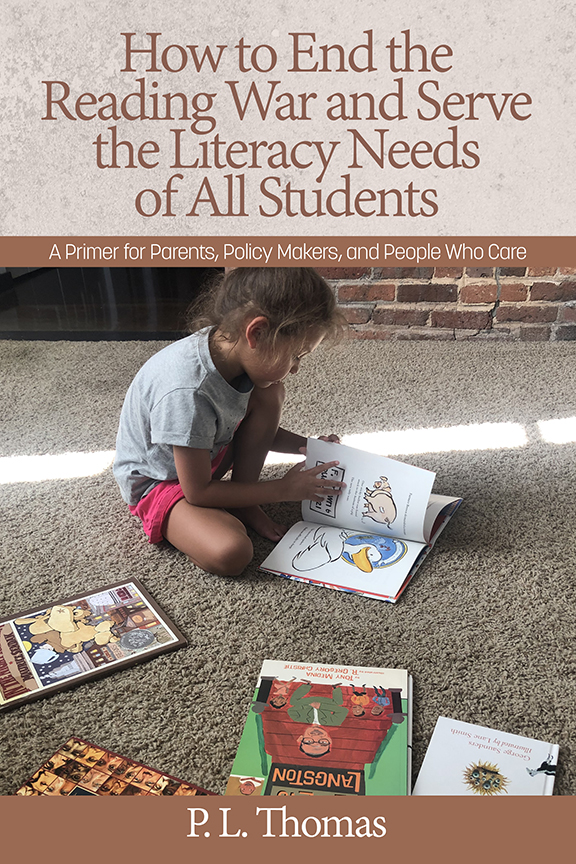
Thomas, P.L. (2020). How to end the Reading War and serve the literacy needs of all students: A primer for parents, policy makers, and people who careCharlotte, NC: Information Age Publishing.


Recent Research Refuting “Science of Reading” Claims

Dyslexia

Johnston, P., & Scanlon, D. (2021). An examination of dyslexia research and instruction with policy implications. Literacy Research: Theory, Method, and Practice70(1), 107–128. https://doi.org/10.1177/23813377211024625

Science

Yaden, D.B., Reinking, D., & Smagorinsky, P. (2021). The trouble with binaries: A perspective on the science of reading. Reading Research Quarterly, 56(S1), S119– S129. https://doi.org/10.1002/rrq.402

Balanced Literacy and Whole Language

Semingson, P., & Kerns, W. (2021). Where is the evidence? Looking back to Jeanne Chall and enduring debates about the science of reading. Reading Research Quarterly, 56(S1), S157– S169. https://doi.org/10.1002/rrq.405

 “Simple” View of Reading

Duke, N.K., & Cartwright, K.B. (2021). The science of reading progresses: Communicating advances beyond the simple view of reading. Reading Research Quarterly, 56(S1), S25– S44. https://doi.org/10.1002/rrq.411

Filderman, M. J., Austin, C. R., Boucher, A. N., O’Donnell, K., & Swanson, E. A. (2022). A meta-analysis of the effects of reading comprehension interventions on the reading comprehension outcomes of struggling readers in third through 12th grades. Exceptional Children88(2), 163–184. https://doi.org/10.1177/00144029211050860

State-Level Reading Policy

Cummings, A. (2021). Making early literacy policy work in Kentucky: Three considerations for policymakers on the “Read to Succeed” act. Boulder, CO: National Education Policy Center. https://nepc.colorado.edu/publication/literacy

Collet, V.S., Penaflorida, J., French, S., Allred, J., Greiner, A., & Chen, J. (2021). Red flags, red herrings, and common ground: An expert study in response to state reading policy. Educational Considerations, 47(1). https://doi.org/10.4148/0146-9282.2241

National Education Policy Center & Education Deans for Justice and Equity (2020). Policy statement on the “science of reading.” Boulder, CO: National Education Policy Center. http://nepc.colorado.edu/publication/fyi-reading-wars

Intensive Systematic Phonics

Wyse, D., & Bradbury, A. (2022). Reading wars or reading reconciliation? A critical examination of robust research evidence, curriculum policy and teachers’ practices for teaching phonics and reading. Review of Education, 10, e3314. https://doi.org/10.1002/rev3.3314

Bowers, J.S. (2020).Reconsidering the evidence that systematic phonics is more effective than alternative methods of reading instruction. Educational Psychology Review, 32(2020), 681–705. https://link.springer.com/article/10.1007%2Fs10648-019-09515-y

“Science of Reading” Advocacy Stumbles, Falls

First, the stumble.

Yet another education journalist (also identified as a novelist and historian), Natalie Wexler, has weighed in on the “science of reading” (SoR). Wexler isn’t an educator, and she seems to suffer from the Columbus Syndrome far too common among journalists covering education.

I am not linking to the article, but it has already been updated since Wexler has received strong challenges to her tactics in this over-stated and misleading article

Accompanying the standard misrepresentations about teaching reading in the U.S., Wexler attempts to cast an accusatory shadow—invoking racism—over teaching reading by joining the “science of reading” propaganda movement.

However, Zaretta Hammond set the record straight on Twitter. In brief, Hammond challenges Wexler’s jumbled attempts at calling out racism and misguided references to recent racist police violence as well as implicating Hammond’s work in Wexler’s claims.

As Hammond notes, Wexler’s failure exposes the problems with fanning a Reading War that, once again, keeps our gaze on so-called failed students and failing teachers instead of systemic inequity and racism.

Wexler is wrong about reading and racism, but the criticism her article prompted has only nudged her to retract the racism stumbles, whitewashing her mistakes by apologizing on Twitter and revising her article.

Now, the fall.

One of the most damaging aspects of the “science of reading” movement has been how swiftly advocates of SoR and dyslexia have translated their movement into state-level reading legislation.

While I have been helping literacy educators and activists resist these efforts to change state education laws, some of us saw at least a pause in the SoR momentum with the Covid-19 pandemic, an unfortunate consequence that now seems to have had unintended positive outcomes for education (flawed reading legislation not passing for financial stress prompted by the pandemic).

For example, “A bid to improve Louisiana’s dismal reading skills for its youngest students died near the legislative finish line, leaving backers baffled on just what happened,” writes Will Sentell.

The surprise at this defeat comes, as Sentell explains, because “[t]he proposal, House Bill 559, had led something of a charmed life until it wilted at the end.”

However, as with other state-level reading legislation agendas across the U.S., this bill was grounded in misinformation about reading achievement as well as claims about the “science” they claim is missing in reading instruction.

Advocacy for the SoR has a fatal flaw found in both Wexler’s article and the “charmed” but failed bill in Louisiana—a “rigid refusal” to address first and fully the systemic inequity that is at the root of all educational measurements, including reading achievement.

SoR advocacy is grounded in a deficit lens that sees only individuals (students, teachers) and measures them against very reduced and narrow ideas of what counts as “normal.”

This advocacy also falls victim to silver-bullet solutions, reducing teaching to “all students must” and suggesting that this program is better than that program (without recognizing that the problem is reducing reading instruction to any program).

SoR advocacy is a misuse of “science” and a misunderstanding of human nature and the teaching/learning dynamic.

There is a powerful relationship among measurable reading achievement by students, reading instruction provided students in formal schooling, and the corrosive persistence of racism and systemic inequity in U.S. society and schools—systemic racism and inequity.

Since the SoR playbook is wrong on all of that, as Hammond ends her Twitter thread, “Know the difference.”

See Also

NEW: How to End the Reading War and Serve the Literacy Needs of All Students: A Primer for Parents, Policy Makers, and People Who Care (IAP)

Policy Statement on the “Science of Reading”


NEW: How to End the Reading War and Serve the Literacy Needs of All Students: A Primer for Parents, Policy Makers, and People Who Care (IAP)

How to End the Reading War and Serve the Literacy Needs of All Students: A Primer for Parents, Policy Makers, and People Who Care (IAP)

amazon

Barnes and Noble

ThomasCase2

[excerpt from Introduction]

How to End the Reading War and Serve the Literacy Needs of All Students: An Overview

The chapters that follow are not intended to document how we should or can teach reading. In fact, there is abundant work that has existed since the early twentieth century to document the many and varied ways we know we should help foster students as readers from the first days of school to the last. As well, this entire book is working well outside being a how-to on teaching reading or a storehouse of research—even as I am advocating that test-driven reading policy and instruction are asking way too little of students and their teachers.

Instead, this is an informative work, focusing on the historical and current Reading War, that builds to a framework for moving beyond that war, and as the subtitle states, serving the literacy needs of all students.

Chapter 1 (A Historical Perspective of the Reading War: 1940s and 1990s Editions) offers a historical overview of crisis responses to reading, focusing on the 1940s (WWII literacy rates of soldiers) and a 1990s report spurred by NAEP. This historical perspective is often missing from media coverage of reading and reading policy debates and decisions made at the federal and state levels.

In Chapter 2 (The Twenty-First Century Reading War: “The Science of Reading,” Dyslexia, and Misguided Reading Policy), I examine the current “science of reading” phenomenon in mainstream media driven by mainstream media, Emily Hanford and Education Week as key examples, but also fueled by dyslexia advocacy, all of which has manifested themselves in education policy such as adopting grade retention based on 3rd-grade test scores and training teachers in the “science of reading.”

Chapter 3 (Misreading Reading: The Good, the Bad, and the Ugly) addresses key concepts and topics that are misunderstood but central to the media coverage of the recent Reading War, such as the following: The National Reading Panel (NRP), reading programs, balanced literacy (BL), whole language (WL), phonics, scientific research, grade retention, teacher education, and teacher autonomy.

Finally, in Chapter 4 (How to End the Reading War and Serve the Literacy Needs of All Students: Shifting Our Deficit Gaze, Asking Different Questions about Literacy), the following reforms needed to end the Reading war will be explored:

  • Social policy must be implemented to address inequity and the homes, communities, and lives of children; these socioeconomic reforms must be viewed as central to reading policy.
  • The mainstream media must abandon Christopher Columbus and both-sides journalism that addresses education/reading.
  • Reading policy must abandon ineffective and hurtful commitments that include standards, high-stakes testing, grade retention, etc.
  • Classroom and school practices must abandon reading programs and silver-bullet approaches to literacy; and teaching must be far more individualized and patient.
  • Evidence-based teaching of reading must expand the meaning of “scientific” and evidence.

In the Conclusion (The Science of Literacy: A 36-Year Journey and Counting), I challenge a narrow view of “science,” especially in terms of education and literacy.

As you read the following chapters, I want you to keep some big-picture concerns in mind: What do we ultimately mean when we talk about teaching children to read? And what does it mean for a student to be able to read?

I want you to consider this story from a high school ELA class discussion on capital punishment. As the teacher led a discussion on the death penalty, a student interjected that Texas currently uses decapitation for the death penalty. The teacher paused, and then suggested that this wasn’t true. The student hurriedly explained it was true, and that he had proof.

The student took out his smartphone, pulling up an article to show the teacher. The article was from The Onion.

Patiently, the teacher informed the student that The Onion is satire, to which the student replied, “No, it isn’t.” Keep in mind that this high school student can pronounce the words in the article; he had read the entire piece.

Are our reading standards, sacred high-stakes tests, and reading programs fostering the sort of students who are critical readers, capable of navigating a complex world better than the student above? Is this Reading War in any way addressing that problem?

Recommended

Policy Statement on the “Science of Reading”

Open Letter: Education Week’s Coverage of the Life, Career, and Death of Ken Goodman

The May 21, 2020 article in Education Week by Stephen Sawchuk fails to honor the remarkable life and career of Ken Goodman on the occasion of his death. Instead, the publication has used this significant loss to the field of literacy as well as the Goodman family and friends for yet another opportunity to perpetuate the misleading narrative about the “science of reading.”

While Ken Goodman spent his life and career dedicated to reading and literacy, leaving behind a legacy of wide-reaching influence through his scholarship and embodying an ethic of kindness and inquiry, the selective use of interviews and incomplete references to research in the EdWeek article construct a distorted and tarnished image of a powerful voice in the field of education.

There is ample room for scholarly debate and disagreement in the complex and still evolving understanding of how children learn to read; however, EdWeek has chosen a solemn moment to continue a single-minded and misguided refrain about the “science of reading”—at the expense of the dignity and respect many know Ken and his family deserve.

Those signed below find the EdWeek coverage both insensitive to Ken and his family, and harmful to the field of literacy and reading.

This is a new low in EdWeek’s role as a high-profile voice in education. By mis-serving Ken and the field of literacy and reading, EdWeek has further eroded the publication’s credibility.

Signed,

Shira Adler
MFA, Founder & CEO Synergy

Richard Allington
Professor Emeritus
University of Tennessee

Marcia Baxter
Literacy Coach Columbia, SC

Laurey Brevig Almirall, EdD
Third grade teacher, Port Washington School District

Delisa Alsup Ed.S
Reading and Literacy Leadership
Instructional Coach

Bess Altwerger
Professor Emerita
Towson University
Former School Board Member, Howard County, MD

Nancy Bailey, Ph.D.
Education Blogger

Kylene Beers, Ed.D.
Literacy specialist and educational consultant
Past-president National Council of Teachers of English;
Recipient of the CEL Leadership Award

Carrie Birmingham
Associate Professor of Education
Pepperdine University

Susi Bostock, Ed.D.
Elementary Education
Half Hollow Hills School District, NY

Dorey Brandt-Finell, Family Advocate and Educational Specialist
David Finell, Principal (retired)

Lois Bridges Ph.D.
VP/Publisher

C. Garth Brooks,
British Columbia Literacy Council of the ILA
Executive Director, LEADER Special Interest Group of the ILA

Sally Brown, Ph.D.
Professor of Literacy Education
Reading Program Director
Department of Curriculum, Foundations, and Reading
Georgia Southern University

Charlotte A. Butler, MAELT
P-20 Literacy Coordinator (retired)

Lucy Calkins
Richard Robinson Professor of Children’s Literature at Teachers College, Columbia University
Founding Director of the Teachers College Reading and Writing Project

Professor Brian Cambourne, B.A. Litt.B (Hons), Ph.D A.M
Principal Fellow University of Wollongong, NSW, Australia

Cecilia Candreva, Ed.D.
Retired Elementary Principal
Franklin Square School District, NY

Rose Anne Casement
Professor Emerita
University of Michigan-Flint

Erika Strauss Chavarria
Spanish Teacher, Howard County MD

Linda Christensen
Director, Oregon Writing Project
Lewis & Clark College
Editor, Rethinking Schools
Editor Rethinking School

Ruby Clayton, Teacher
Indianapolis Public Schools

Gerald Coles,
Education Researcher
Reading the Naked Truth: Literacy Legislation & Lies (Heinemann)

Nancy Creech, Ed.D.
Elementary Teacher & Reading Specialist, Retired

Caryl Crowell, M.Ed, Ed.S.
Retired, Tucson Unified School District

Paul Crowley, PhD
Professor Emeritus
Sonoma State University
Rohnert Park, CA

Joan Czapalay,
Teacher, Educator (Nova Scotia, MSVU)
Parent and Grandparent

Diane DeFord
Professor Emerita and Endowed Professor
University of South Carolina

Benjamin Doxtdator
English Teacher, Education Writer

Corydon Doyle, Ph.D.
English Teacher Mount Sinai UFSD
Adjunct Professor Long Island University

Amy J. Dray
Program Officer
Spencer Foundation

Katie Dredger
Associate Professor
James Madison University

Peter Duckett, PhD
Bahrain Bayan
Kingdom of Bahrain

Carole Edelsky, Ph.D.
Professor Emerita
Arizona State University

Eric W. Eye, M.A.
HS ELA teacher

Amy Seely Flint
Professor
University of Louisville

Barbara Flores, Ph.D.
Professor Emerita
CSU, San Bernardino

Jennifer Flores
Tucson TAWL

Susan Florio-Ruane Ed.D.
Professor Emerita
College of Education
Michigan State University

Alan Flurkey
Professor, Literacy Studies
Department Chair, Specialized Programs in Education
Hofstra University

Salli Forbes, Ph.D.
Professor Emerita and Reading Recovery Trainer
The University of Northern Iowa

David E. Freeman, Ph.D.
Professor Emeritus
The University of Texas Río Grande Valley

Yvonne S. Freeman, Ph.D.
Professor Emerita
The University of Texas Río Grande Valley

Peter H. Fries
Professor emeritus
Central Michigan University

Stefanie Fuhr, MEd

Janet S. Gaffney
Professor, University of Auckland
Professor Emerita, University of Illinois

Andrea Garcia, Ph.D.
Literacy Educator, Mexico

Suzanne Gespass

Carol Gilles, Associate Professor of Reading/Language Arts, Emerita
University of Missouri, Columbia

Debra Goodman
Professor, Hofstra University
President, Center for Expansion of Language and Thinking

Wendy J Trachtman Goodman, MA ED
36 year veteran classroom teacher

Vera Goodman
Teacher and Reading Expert
Creator of The Making Sense Approach to Reading
Calgary, Alberta

Yetta Goodman, Regents Professor Emerita
University of Arizona, College of Education

Helmuth Leal Guatemalan
professional in tourism and activist in improving the techniques of teaching in Guatemala

Kris Gutierrez, University of California, Berkeley

Xenia Hadjioannou, Ph.D.
Associate Professor of Language and Literacy Education
Penn State Harrisburg

Sue Haynes, M.S. ed, M.ed, Literacy Specialist
Author of Creative Mavericks: Beacons of Authentic Learning

Dr. Roxanne Henkin
Professor Emeritus
The University of Texas at San Antonio
Past President
Literacies & Languages for All
Director Emeritus
San Antonio Writing Project

Kathleen A. Hinchman, Professor
School of Education
Syracuse University

Jim Horn, PhD
Professor, Cambridge College

Dr. Mary Howard
Literacy Consultant and Author

Liz Hynes-Musnisky, Ph.D.,
Associate Professor, Department of Critical Reading
Nassau Community College

Ana Christina da Silva Iddings
Professor, Vanderbilt University

Lori Jackson,
Reading Interventionist and Coach

Debra Jacobson

Rosemarie A. Jensen, M.Ed.
UF ProTeach Grad

Bobbi Jentes-Mason, Ph.D.
Professor Emerita
Teacher Education

Nancy J. Johnson, Ph.D.
Professor Emeritus
Western Washington University
Bellingham, WA

Katie Kelly, Ph.D.
Associate Professor of Education
Coordinator of Literacy Graduate Program Furman University

Gary Kilarr
Center for the Expansion of Language and Thinking

Dorothy F. King

Brian Kissel, Ph.D.

Dr. Dick Koblitz
Adjunct Professor at Webster University in St. Louis, Missouri and Saint Louis University
Literacy Consultant

Alfie Kohn
author and lecturer / Belmont, MA

Stephen Krashen
Professor Emeritus
University of Southern California

Lorraine Krause
Retired teacher
Peter Krause
Retired Superintendent of Schools

Tasha Laman

Lester Laminack
Children’s Author
Professor Emeritus Western Carolina University

Christine Leland​
Professor Emerita, Indiana University, Indianapolis

Mitzi Lewison
School of Education
Indiana University

Georgia Leyden, MA in Education, Reading and Language
Retired first grade teacher
Retired lecturer, School of Education, Sonoma State University

Calvin A. Luker
Respect ABILITY Law Center
Co-founder, Our Children Left Behind

Elizabeth Lynch, Ed.D.,
retired elementary school teacher, Brentwood UFSD, NY,
former Adjunct Associate Professor, Dowling College, NY,
Adjunct Assistant Professor, Hofstra University

Gina Margiotta, NBCT
LAUSD

Prisca Martens
Ray Martens

Carmen M. Martínez-Roldán
Associate Professor & Program Director Bilingual Bicultural Education,
Teachers College, Columbia University

Stephanie L. McAndrews

Becky McCraw
Goucher Elementary
Cherokee County Schools

J. Cynthia McDermott

Dr. Theresa McGinnis
Associate Professor, Literacy Studies
Hofstra University

Jeff McQuillan
Independent Researcher

Rick Meyer
Regents’ Professor Emeritus
University of New Mexico

Alexandra Miletta
Ed Blogger

Heidi Mills
Distinguished Professor Emerita
University of South Carolina

Kathryn Mitchell Pierce
Saint Louis University

Luis Moll
Emeritus Professor, University of Arizona
Reading Hall of Fame

Maureen Arnold Morrissey, M.ED.
37 year veteran teacher

Liz Murray, Ed D.

Michele Myers
Clinical Associate Professor
University of South Carolina

Jennifer Ochoa
8th grade English Teacher

Susan Ohanian
Fellow, National Education Policy Center

Mike Oliver, principal
Zaharis Elementary, Mesa Public Schools
“Zaharis Elementary School is standing on the shoulders of Ken Goodman.”

Richard C. Owen, Publisher
Richard C. Owen Publishers, Inc.

Celia Oyler
Professor, Teachers College, Columbia University

Glennellen Pace, PhD, Associate Professor Emerita
Lewis & Clark College Graduate School of Professional Studies
Portland, OR

Karen V. Packard, Ed.D
Retired teacher educator, Title 1 director, reading/language arts specialist and classroom teacher

Johnna Paraiso, EdD
Rutherford County Schools, ESL/ Adult Literacy Educator
Education Professor, Tennessee State University

Nancy Paterson, PhD
Associate Professor (Retired) Literacy Studies
College of Education, Grand Valley State University
Former Chair Middle Section, NCTE

Patricia Paugh
Associate Professor
University of Massachusetts Boston

P. David Pearson
Evelyn Lois Corey Emeritus Professor of Instructional Science
Graduate School of Education
University of California, Berkeley

Erica Ann Pecorale

Ann Peluso
Assistant Superintendent of Curriculum & Instruction (Retired)
West Hempstead School District, NY

Kathleen O’Brien Ramirez, PhD
Universal Multilingual Literacy

Patricia Reed-Meehan, Ed.D.
Literacy Teacher, NYC Department of Education
Adjunct Professor, EECE Queens College

Louann Reid, PhD
Professor of English Education
Chair Department of English
Colorado State University

Lynne Hebert Remson, PhD, CCC-SLP, BCS-F
Speech-Language Pathologist
Small Talk Speech and Language Specialists

Victoria J. Risko
Professor Emerita
Vanderbilt University

Laura Roop, Director
Western Pennsylvania Writing Project
University of Pittsburgh

Elisabeth Costa Saliani, Ph.D.
William Floyd UFSD
20 year teacher of Elementary ENL

Lenny Sánchez
Faculty, Language and Literacy Education
co-Director, Bilingualism Matters @ UofSC
co-Editor, Literacy Research: Theory, Method, and Practice

Sherry Sanden, Ph.D., NBCT alum
Interim Associate Director
Associate Professor, Early Childhood Literacy

Ronda Schlumbohm, M.Ed Reading
Grade 2, Salcha Elementary

Renita Schmidt
Associate Professor Emeritus
University of Iowa

Jean Schroeder

David Schultz, EdD, Retired
Long Island University Riverhead
Mattituck-Cutchogue School District

Sara H. Somerall

Louise Sweeney Shaw, Ed.D.
Associate Professor, Curriculum and Learning
Southern Connecticut State University

Nancy Rankie Shelton, PhD
Professor, UMBC, Literacy Education

Ira Shor
Professor Emeritus
City University of NY Graduate Center

Marjorie Siegel,
Professor, Teachers College, Columbia University

Flory Simon U of A Retired
Co-Director Southern Arizona Writing Project

Yvonne Siu-Runyan, Ph.D.
Professor Emerita, The University of Northern Colorado
Past President, National Council Teachers of English
Boulder, CO

Tracy L. Smiles, Ph.D.
Professor Emerita, Western Oregon University

Melinda Smith, MAEd
Elementary Teacher
Manhasset UFSD, NY

Patricia G Smith Ph.D.,retired
Federation University
Victoria, Australia

Ellen Spitler, PhD
Associate Professor
Metropolitan State University of Denver

Diane Stephens
Professor Emerita
University of South Carolina

Charlotte H. Stocek, Ph.D.

Steven L. Strauss, MD, PhD
Neurologist
Baltimore, Md

Denny Taylor
Distinguished Alumni, Columbia University
Distinguished Scholar, NCRLL
Inducted (2004) Reading Hall of Fame
Founder of Garn Press

Monica Taylor, PhD
Professor, Department of Educational Foundations
Montclair State University

P.L. Thomas, EdD
Professor of Education
Furman University
NCTE’s 2013 George Orwell Award winner

Serena Troiani Ph.D.
Elementary school teacher Port Washington UFSD, NY
Adjunct Assistant Professor Queens College, NY

Dr Jan Turbill FACE
University of Wollongong
Australia

Dr. Jesse P. Turner
Central Connecticut State University

Ruth J. Sáez Vega
Universidad de Puerto Rico
San Juan, Puerto Rico

Meghan Valerio, M.Ed.
Doctoral Student & Graduate Assistant
Curriculum and Instruction, Emphasis in Literacy
Kent State University

Elisa Waingort
Classroom Teacher
Calgary, Alberta
Canada

Judy M. Wallis, Ed.D.
Literacy Author and Consultant
Former Director of Language Arts

Russ Walsh
Adjunct Instructor, Graduate Education
Rider University

Yang Wang
Assistant Professor in Language and Literacy
University of South Carolina

Lois Weiner, Ed.D.
Professor Emerita, NJCU

Steve Wellinski
Associate Professor of Reading Education
Eastern Michigan University

Darlene Westfall, M.ED.
Special Education Teacher

Kathryn F Whitmore, PhD
Professor and Department Chair
Metropolitan State University of Denver
And PROUD student of Dr Kenneth S Goodman

Carolynn E. Wilcox, English Teacher,
Early College of Arvada and Affiliate Professor,
Department of English,
Metropolitan State University of Denver

Jeffery L Williams
Past-President of Reading Recovery Council of North America
K-12 Literacy Coach and Teacher Leader

Joan Wink, Professor Emerita
California State University, Stanislaus

Thomas DeVere Wolsey, EdD
Graduate School of Education
The American University in Cairo

Recommended

Policy Statement on the “Science of Reading”

What Every Parent Should Know about Kenneth S. Goodman

If You’re Going to Write About Science of Reading, Get Your Reading Right

The release of the joint statement (National Education Policy Center and Education Deans for Justice and Equity) on the “science of reading” version of the current Reading War held, I hoped, great promise for at least slowing a very harmful process. I also briefly crossed my fingers that the statement could ease some of the discord and help key figures in the debate find that there is more common ground than disagreement.

However, social media has provided evidence that neither of these outcomes is likely. The advocates of the “science of reading” doubled down on their condescension and general nastiness (a feature of Twitter), and there is this blog post from Daniel Willingham: If You’re Going to Write About Science of Reading, Get Your Science Right.

I commented several times on the post and even offered a discussion by email. Willingham did respond to my comments and the exchange was civil, but alas, fruitless.

The crux of Willingham’s concerns about the statement seems to be:

I think the statement is pretty confused, as it conflates issues that ought to be considered separately. This statement is meant to be about the science of reading, so much of the confusion arises from a failure to understand or appreciate the nature of science, how basic science applies to applied science, and the scientific literature on reading.

This is a misreading of the policy; I think that misreading is in part prompted by Diane Ravitch’s framing of the statement with “There is no Science of Reading,” which Willingham references in his first paragraph.

To clarify, Ravitch’s framing is misleading, and Willingham has failed to grasp the purpose of the statement, directly identified by NEPC:

All students deserve equitable access to high-quality literacy and reading instruction and opportunities in their schools. This will only be accomplished when policymakers pay heed to an overall body of high-quality research evidence and then make available the resources necessary for schools to provide our children with the needed supports and opportunities to learn. This joint statement from NEPC and the Education Deans for Justice and Equity provides guiding principles for what any federal or state legislation directly or indirectly impacting reading should and should not do.

This statement is a policy statement that raises a long-overdue red flag about a complicated process: Mainstream media have created a narrative that teachers have failed to use the “science of reading” because teacher education has failed to teach that, preferring balanced literacy instead. This narrative also claims the “science of reading” is settled and that the research base justifies systematic intensive phonics instruction for all students, a claim being used to endorse and implement misguided reading legislation across the U.S. [1]

Willingham has missed that nuanced and complex focus of the statement and spends the blog post mostly challenging issues that simply do not exist in the statement itself, primarily complaining that the statement has a fundamental misunderstanding of “science” (“The distinction between basic and applied science ought to be fundamental to any discussion of the science of reading”).

Since a key element of the statement raises that exact issue, this extended complaint is itself, to use Willingham’s language, “confused.”

A couple of important points lie beneath the unfortunate consequence of the topic of teaching reading continuing to be a fruitless debate (what the statement is explicitly seeking to end).

First, the teaching of reading as a subset of the field of education has historically and now currently been over-run with epistemic trespassing; psychology, economics, and political science routinely encroach on education as if the discipline itself has no scholarship or scholars.

Some of this trespassing has to do with disciplinary hierarchies linked to distinctions between quantitative and qualitative research (often veneers for academic sexism), but some of the trespassing is simply disciplinary bullying.

While I completely agree with Willingham that anyone making claims about the “science of reading” should understand “science,” he has failed to acknowledge an equally important requirement—understanding reading and literacy.

As Nathan Ballantyne examines carefully, having robust and critical skills in one field, psychology, does not necessarily equip a scholar for transferring those skills to another field, especially (as Willingham notes himself) into a field grounded in real-world practice such as education, teaching children to read.

Willingham and Mark Seidenberg, both psychologists, are two of the main scientists cited in the “science of reading” narrative in mainstream media, and two of its defenders (although as scholars, they both tend to offer far more caveats and nuance than advocates who are journalists).

They, however, lack a background in teaching literacy, and while their research is quite valuable, as the statement notes, narrow types of “scientific” are ultimately incomplete evidence for day-to-day teaching.

No one is arguing there is no “science of reading,” but the ham-fisted claims about “settled” science and the misuse of “science” to support flawed reading policy are inexcusable.

But here is a much more problematic part of this continued debate. Willingham represents not only epistemic trespassing, but also has explicitly discredited all educational researchers, suggesting journalists as more credible:

Believing something because someone else believes it rather than demanding and evaluating evidence makes you sound either lazy or gullible. But we yield to the authority of others all the time. When I see my doctor I don’t ask for evidence that the treatments he prescribes are effective, and when an architect designed a new deck for my house I didn’t ask for proof that it could support the weight of my grill and outdoor furniture. I believed what they told me because of their authority.

I think education researchers don’t speak with that kind of authority and (apparently unlike Sanden) I don’t think we deserve it. I can point to two key differences between a doctor (or architect, or accountant, or electrician, etc) and education researchers.

He adds later, “Anyone can take the title ‘education researcher.’”

As someone with an EdD and who straddles two different fields, education and English, I can assure you that this sort of disciplinary bullying is still common in the academy. Education is routinely dismissed as mere occupational preparation, and English is framed as one of the impractical fields in the impractical humanities.

This sort of disrespectful finger pointing, I think, must be unmasked since any time someone points a finger, several are pointing back as well.

“The replication of findings is one of the defining hallmarks of science,” note Diener and Biswas-Diener, adding:

In modern times, the science of psychology is facing a crisis. It turns out that many studies in psychology—including many highly cited studies—do not replicate. In an era where news is instantaneous, the failure to replicate research raises important questions about the scientific process in general and psychology specifically. People have the right to know if they can trust research evidence. For our part, psychologists also have a vested interest in ensuring that our methods and findings are as trustworthy as possible.

Psychology, then, like economics feels justified trespassing on other fields, possibly to deflect from the needed critical inspection of their own field. It seems one reason psychology has a crisis in the quality of their science is a pattern of defensiveness:

When findings do not replicate, the original scientists sometimes become indignant and defensive, offering reasons or excuses for non-replication of their findings—including, at times, attacking those attempting the replication. They sometimes claim that the scientists attempting the replication are unskilled or unsophisticated, or do not have sufficient experience to replicate the findings. This, of course, might be true, and it is one possible reason for non-replication.

I have been in the field of literacy for 36 years, and in academia for 18 years. I am quite certain there are no pure fields and no fields that can be discounted as cavalierly as Willingham does about “education scholars” and education research (I recommend Bracey on the problems with educational research and how it is interpreted, by the way).

I also have directly admitted that epistemic trespassing is always problematic, but many topics may in fact necessitate such trespassing. Understanding and teaching reading does in fact benefit from a wide range of disciplinary evidence (as the statement asserts).

But no topic benefits from academia’s most petty traditions, including disciplinary hierarchies and bullying.

If expertise in science deserves respect (and it certainly does), then expertise in literacy and teaching reading also deserve respect—and neither should be handed over to journalism as the arbiter of those fields or to politicians who have the power of policy.

Those of us in the academy who often are discounted for being in an Ivory Tower should have higher standards for our own behavior, but there is much work yet to be done to eradicate hierarchies and pettiness even among the so-called well educated.

Let’s keep in  mind that although getting the science right is certainly important, we are in this to get the reading right, and that is the focus of the statement that some are misreading.


[1] See the following to help construct the narrative:

Gewertz, C. (2020, February, 20). States to schools: Teach reading the right way. Education Week. Retrieved from https://www.edweek.org/ew/articles/2020/02/20/states-to-schools-teach-reading-the-right.html

Loewus, L. (2019, December 3). Data: How reading is really being taught. Education Week. Retrieved from https://www.edweek.org/ew/articles/2019/12/04/data-how-reading-is-really-being-taught.html

Russo, A. (2018, November 14). Hard reporting: Why reading went under the radar for so long – and what one reporter is aiming to do about it. Phi Delta Kappan. Retrieved from https://kappanonline.org/russo-hard-reporting-why-reading-went-under-the-radar-for-so-long-and-what-one-reporter-is-aiming-to-do-about-it/

Schwartz, S. (2019, December 3). The most popular reading programs aren’t backed by science. Education Week. Retrieved from  https://www.edweek.org/ew/articles/2019/12/04/the-most-popular-reading-programs-arent-backed.html

Stukey, M.R., & Fugnitto, G. (2020). The settled science of teaching reading—part I. Collaborative Circle Blog. Retrieved from https://www.collaborativeclassroom.org/blog/the-settled-science-of-teaching-reading-part-1/

Will, M. (2020, January 22). Preservice teachers are getting mixed messages on how to teach reading. Education Week. Retrieved from https://www.edweek.org/ew/articles/2020/01/22/preservice-teachers-are-getting-mixed-messages-on.html

Will, M. (2018, October 24). Teachers criticize their colleges of ed. for not preparing them to teach reading. Education Week. Retrieved from http://blogs.edweek.org/edweek/teacherbeat/2018/10/teacher_prep_programs_reading.html

Will, M. (2019, December 3). Will the science of reading catch on in teacher prep? Education Week. Retrieved from https://www.edweek.org/ew/articles/2019/12/04/most-ed-professors-favor-balanced-literacy.html

Misreading the Main Idea about Reading

About a decade ago, I accepted an invitation from the ACT to review a set of new test questions for their reading section. As a career-long anti-standardized test advocate, after talking with several colleagues, I accepted that an inside view of the process would help me better confront the problems with tests such as the ACT and the SAT.

The process included receiving the test section, taking the test myself (and taking notes), and then being flown to Iowa City to attend a workshop where we walked through each question to help the test designers revise and edit so this section could be added to the implementation of the test.

Some important take aways included discovering that the test designers were almost exclusively experts in test design (not reading or literacy) and confirming that “good test questions” were mostly about if the question creates “spread” (a range of correct and incorrect) in the data and not if the question is a valid assessment of reading ability (whatever that is).

This experience came to mind when I ran across this on Twitter:

A well-educated adult struggling with a kindergartner’s worksheet also reminds me of “Sara Holbrook, the writer who couldn’t answer test questions about her own work,” covered by Peter Greene.

While I think we may need to extend some grace to the teacher who sent this work home during a pandemic, I also think we should confront that this is a quite common way to approach reading and teaching reading—common ways that are deeply flawed.

Both the kindergarten homework and the author puzzled by standardized test questions reflect reading instruction and assessment that are skills-driven—framing the holistic act of reading as a collection of identifiable reading skills such as “main idea.”

A skills approach to teaching and testing reading tends to focus on decoding (phonics), vocabulary, prior knowledge (content), and an array of reading strategies (identifying main idea, predicting, context clues, etc.).

While literacy teachers and scholars tend to agree that these all are valid elements of reading, the debate lies in whether or not teaching and testing them in isolation are valid reflections of the whole act of reading.

The skills approach has some practical advantages in whole-class formal schooling, especially when classes include 25-35 students and when thousands of students are being tested.

In other words, a skills approach is efficient (easy to manage as instruction, and quick and cost-effective as assessment) and it also lends itself to a teacher-centered, authoritative mode of teaching (someone in authority determines the answers, and by their authority, those answers are “correct”).

The skills approach during early literacy development also feeds well into the New Criticism norm of text analysis that is common in middle and high school (re-branded under the Common Core as “close reading”). Reading assessment in standardized testing requires that “right” answers exist neatly in any text and that a systematic form of analysis lends itself to identifying that “right” answer.

But, as the kindergarten and published author examples above demonstrate, the skills approach and the “right” answer view of texts are deeply flawed, and likely work against fostering students as eager, independent, and critical readers.

No sophisticated adult readers sit down to answer a set of multiple-choice questions about a text they have read once they are finished. Those of us who pleasure read are likely to do almost nothing once we have read, or we eagerly find other people who have read the text so we can discuss the experience.

And those conversations are rarely punctuated with “main idea” or “theme,” but mostly about how we felt about the text and all the connections we noticed with our lives or other experiences we have had with all sorts of art—other texts, movies, music, etc.

Here, then, are a few ways we should change how we teach and assess reading, especially with young students.

First, in kindergarten, our focus should be far less on skills and mostly on fostering eager readers. Frankly, there is no urgent need for children this young to correctly interpret any text.

Reading to beginning readers and inviting them to have a wide range of emotional and text-based responses (mostly free of evaluating them for being right or wrong) should replace a skills approach in kindergarten (and likely through the first three or four years of school).

Gradually, we should move toward helping students navigate text in ways that improve their ability to gain valid conclusions from that text, keeping in mind that “meaning” isn’t necessarily fixed and in many cases may be more about contested meaning, not one right answer.

Skills approaches to reading can mostly be justified as efficient, but seeing reading as a set of discrete skills and strategies is, none the less, not reading since it is a holistic act.

As I have noted before, for example, people have large vocabularies from reading extensively, but learning a bunch of isolated vocabulary doesn’t necessarily make a person highly literate. We too often flip the value and consequences of the whole act of reading and identifiable reading skills and strategies.

Next, we must be careful not to teach or test skills for the sake of those skills, but to always keep our focus on the whole text and the reader’s reading experience while acknowledging that skills and strategies are working together in the process of making meaning and reaching critical conclusions about the text.

For example, the kindergarten worksheet is having children find “main idea” as if that is a reasonable or authentic goal (it isn’t) instead of helping students come to understand that text has large meaning (such as main idea and theme) that can be justified through smaller elements in the text (supporting ideas, literary and rhetorical techniques).

Asking students “What do you think is important about this text?” (Or “What did you enjoy in this text?”) is a much better approach that can be followed by “Why do you think that?” (moving them to offer textual support). Here, we are starting with the student (not some skill or predetermined “right” answer) and still fostering careful and purposeful approaches to text.

Finally, the big picture problem with these examples, and why a skills approach is common in the teaching and testing of reading, is that we have created teaching and learning conditions that are counter-educational for literacy growth.

We have chosen efficiency over authentic literacy in the U.S. because we refuse to invest in teaching and learning conditions (low student/teacher ratios, fully funded classrooms and materials) that would support effective teaching and rich learning by our students.

Skills approaches to reading are efficient and manageable, but as the kindergarten example above shows, they simply are not reasonable or authentic.

While I question the periodic cries that the U.S. has a reading crisis, I can attest from 36 years of teaching that we do far too often make young people hate to read—and there are tragic consequences to misreading the main idea about reading in schools.


See Also

Negotiating Meaning from Text: “readers are welcome to it if they wish”

LaBrant, L. (1937, February 17). The content of a free reading programEducational Research Bulletin, 16(2), 29–34.


Did Balance Literacy Fail to Teach Your Child to Read?

For 36 years now, I have been teaching people to write; that journey is a large subset of my own being and becoming a writer, an experience that is captured well in an old Nike poster I used to hang on the wall of my high school classroom, proclaiming “There is no finish line.”

there is no finish line

For the last decade-plus, I have taught first-year college students to write. While I am teaching writing, however, I also am teaching young people how to do college, how to make the important transition from being a student to being a scholar.

Part of that work is unlearning bad habits from high school embedded in traditional approaches to writing essays.

Here is one of the worst: Many students come to college having followed a narrow writing process in which teachers require students to submit a one-paragraph introduction with a direct thesis statement. Once approved, the student is then released to write an essay that fulfills that approved essay thesis.

This instills in students two incredibly misguided practices. One is writing with a level of certainty that an 18-year-old has yet to reach (particularly on topics about which they have only second-hand knowledge); and another is failing to see drafting and writing as an act of discovery, as a journey to understanding ideas better.

Neither of these lessons from high school serve young people well in their quest of becoming more educated, being a scholar. Scholarship and deep understanding of a field or discipline comes mostly from interrogating ideas, not from grand pronouncements.

Knowledge is living forest; dogma is a rigid stone slowly wearing away to nothing in its resistance to the elements.

This also comes into play when anyone is trying to understand a situation outside their own areas of expertise. As Ballantyne explains about epistemic trespassing:

First, the intellectual characters of trespassers often look unsavoury. Out of their league but highly confident nonetheless, trespassers appear to be immodest, dogmatic, or arrogant [emphasis added]. Trespassers easily fail to manifest the trait of intellectual humility and demonstrate one or another epistemic vice (Whitcomb et al. 2017, Cassam 2016). Second, it’s useful to distinguish between trespassers holding confident opinions and investigating questions in another field [emphasis in original]. I assume it can be epistemically appropriate for people to look into questions beyond their competence, even when it would be inappropriate for them to hold confident opinions.

This is a key distinction (arrogance v. modesty) for an enduring question in the U.S., one that has remained at the forefront of public and political debate since at least the 1940s: Why are students not learning to read?

If we are going to focus on asking questions and not making grand pronouncements, we probably should first interrogate the question, and confirm whether or not students are learning to read in reasonable ways and when they genuinely need to read independently.

Here we have a serious problem because at no period in the U.S. has anyone pronounced reading achievement to be satisfactory; thus, the somewhat bell-shaped curve of reading achievement among school-age students could very likely simply be normal.

Yet, most of us view education as a 100% attainable venture—all students can and should learn to read by X age. This is a valuable ideal, but it certainly isn’t a reasonable measure for any sort of accountability (see the disaster that was No Child Left Behind).

We are left then with an enduring question that I think is valid and worth considering: Why do some students not become eager and critical readers at the same rate as most of their biological peers?

Data for many decades have shown that all sorts of achievement gaps, reading included, are strongly correlated with the socioeconomic status of any student’s parents, home, and community as well as the educational attainment of the parents (notably the mother). [Every administration of the SAT reflects those patterns, for example.]

Especially over the past forty or so years, however, emphasizing the correlation between inequity and academic achievement has been discounted with making “excuses.” Public and political concern for any problem seeks to find individual causes to blame, but Americans tend to balk at systemic explanations for negative outcomes.

When the U.S. declared a reading crisis in the 1940s during WWII, many immediately blamed progressive education, then strongly associated with John Dewey. But there were three practical problems with that blame.

First, as Alfie Kohn has explained, Dewey’s progressive education has never been implemented on any wide scale in the U.S. Despite mainstream arguments to the contrary, formal education in the U.S. has almost always been primarily conservative and traditional.

Second, as Lou LaBrant carefully detailed in 1942:

1. Not many men in the army now have been taught by these newer methods [emphasis in original]. Those few come for the most part from private or highly privileged schools, are among those who have completed high school or college, and have no difficulty with reading.

2. While so-called “progressive” schools may have their limitations, and certainly do allow their pupils to progress at varied rates, above the second grade their pupils consistently show superior ability in reading. Indeed, the most eager critics have complained that these children read everything they can find, and consequently do not concentrate on a few facts. Abundant data now testify to the superior results of purposeful, individualized reading programs [emphasis in original].

3. The reading skills required by the military leaders are relatively simple, and cause no problem for normal persons who have remained in school until they are fourteen or fifteen. Unfortunately the large group of non-readers are drop-outs, who have not completed elementary school, come from poorly taught and poorly equipped schools, and actually represent the most conservative and backward teaching in the United States [emphasis in original]. (pp. 240-241)

Third, and this is possibly the most important point for understanding our current reading crisis, many students were unsuccessful in situations where educators claimed to be practicing progressive education, but in fact, were not.

Let me offer an example—Dewey’s project method.

First, Dewey tended to offer philosophical and theoretical parameters for teaching, but refused to offer models and never templates or programs. This made, ironically, a practitioner of pragmatism (Dewey’s philosophical roots shared with William James) quite impractical for day-to-day teaching and the running of schools.

William Heard Kilpatrick, however, seized the moment and packaged the project method, which did find its way into schools, often ones that claimed to be progressive.

Here comes the real but complicated problem.

In 1931, LaBrant (the subject of my dissertation and a devout Deweyan progressive) launched into the use of the project method in classes where students are supposed to be learning reading and writing:

The cause for my wrath is not new or single. It is of slow growth and has many characteristics. It is known to many as a variation of the project method; to me, as the soap performance. With the project, neatly defined by theorizing educators as “a purposeful activity carried to a successful conclusion,” I know better than to be at war. With what passes for purposeful activity and is unfortunately carried to a conclusion because it will kill time, I have much to complain. To be, for a moment, coherent: I am disturbed by the practice, much more common than our publications would indicate, of using the carving of little toy boats and castles, the dressing of quaint dolls, the pasting of advertising pictures, and the manipulation of clay and soap as the teaching of English literature. (p. 245)

Let’s imagine that some students did not grow as readers or writers if they were crafting, and not reading or writing (as LaBrant argued for over six decades), and let’s also imagine that if there was poor reading growth in these classrooms, people certainly associated that with progressive practices since it was explicitly using the project method.

To untangle this, we need to recognize that as LaBrant admonished, using the project method to craft instead of having students read and write was a misuse and misunderstanding of progressive philosophy.

Neither the project method nor progressivism failed these students, but the misuse of both certainly did.

This pattern has repeated itself at both small and large levels for decades.

The 1980s-1990s reading crisis was blamed on whole language, but almost no one was implementing whole language and the drop in test scores were easily connected to systemic factors such as reduced funding and an influx of English language learners (Emergent Bilinguals).

It is also interesting to investigate the many misuses of the term “best practice” and the instructional strategy literature circles, both important aspects of Harvey “Smokey” Daniels educational work and regrets he has explained in detail about too many people misunderstanding and misapplying the terms and practices.

At a state-level ELA teacher conference many years ago, I listened to Daniels explain that he wishes he could distance himself from the term “best practice” because nothing stopped publishers from slapping the term on any book because publishers knew the concept was in vogue. In short, like Dewey, Daniels was aware that he had no control over whether or not anything labeled “best practice” was in fact best practice (supported by evidence and research).

So this all leads to the blog post’s title: Did balance literacy fail to teach your child to read?

I suspect if you have made it this far and if you have fully interrogated the information I have provided, you can expect that the answer is very unlikely.

Are too many students not acquiring reading at rates we would prefer in the U.S.? Absolutely.

Are identifiable subgroups particularly mis-served in reading in our public schools—students with dyslexia, poor students, students of color, English language learners (Emergent Bilinguals)? Absolutely and inexcusably so.

Have these students who have experienced educational inequity sat in classrooms and schools that have adopted and implement reading programs labeled “balanced literacy”? There is no question this has happened, and continues to happen.

The paradox about blaming balanced literacy is that as a guiding reading philosophy and theory, balanced literacy supports that every student should receive whatever reading instruction the student needs (systematic intensive phonics, reading authentic texts, read alouds, special needs intervention, etc.); therefore, if a student isn’t receiving what they need, then the fault doesn’t lie with balanced literacy—just as Kilpatrick’s project method was being misused in the 1930s.

This may seem like a trivial distinction, but I think it is important because the current “science of reading” movement is laser-focused on blaming balanced literacy and offering a silver-bullet solution, systematic intensive phonics for all students.

This bodes poorly for students because with a false diagnosis, you are likely endorsing a flawed cure.

It is compelling to identify one thing to blame and to embrace a structured single solution, but that is a historically failed strategy.

Over the last few decades, we have no evidence that reading has ever been taught in any sort of uniform way, even in the same school (although analyses from the 1990s showed a positive correlation between whole language classes and higher NAEP reading scores). The causes for low reading achievement are incredibly complex, linked to out-of-school factors as well as teaching and learning conditions in schools.

We should focus more directly on out-of-school factors, but if we insist on in-school only reform to increase reading achievement, we would do better to start with teaching and learning conditions (low student/teacher ratios for struggling students, better funding) and then to abandon lock-step implementation of any reading program (not ones labeled “balance literacy” or ones prescribing systematic intensive phonics for all students).

And the one real reform we refuse to acknowledge or address is making sure every child and young person in the U.S. has access to reading in their homes, communities, and schools. When people wield “science of reading” like a hammer, they fail to acknowledge the enormous research base showing access to texts as the strongest indicator of students acquiring literacy.

In fact, the more things change, the more they stay the same. We are about 80 years late on listening to LaBrant:

An easy way to evade the question of improved living and better schools for our underprivileged is to say the whole trouble is lack of drill. Lack of drill! Let’s be honest. Lack of good food; lack of well-lighted homes with books and papers; lack of attractive, well equipped schools, where reading is interesting and meaningful; lack of economic security permitting the use of free schools—lack of a good chance, the kind of chance these unlettered boys are now fighting to give to others. Surround children with books, give them healthful surroundings and an opportunity to read freely. They will be able to read military directions—and much more. (p. 241)

Epistemic Trespassing: From Ruby Payne to the “Science of Reading”

[Header Photo by Aaron Hare on Unsplash]

In the midst of the Covid-19 pandemic, President Donald Trump has continued his disturbing trademark of self-assurance and bravado in the absence of expertise:

The president – who repeatedly downplayed the threat early in the global outbreak – has this week been hyping an anti-malarial drug, chloroquine, as a possible therapeutic treatment.

“It may work, it may not work,” he said on Friday. “I feel good about it. It’s just a feeling. I’m a smart guy … We have nothing to lose. You know the expression, ‘What the hell do you have to lose?’”

As has become a common pattern now, these rash and dangerous claims were tempered by an actual expert in medicine:

Yet Trump’s “feeling”, on which he so often relies, was confronted by science when Dr Anthony Fauci, director of the National Institute of Allergy and Infectious Diseases, cautioned that evidence of chloroquine’s benefits against coronavirus is “anecdotal” and it should not be viewed as a miracle cure.

Trump is a cartoonish embodiment of epistemic trespassing, as defined by Nathan Ballantyne:

Epistemic trespassers are thinkers who have competence or expertise to make good judgments in one field, but move to another field where they lack competence—and pass judgment nevertheless. We should doubt that trespassers are reliable judges in fields where they are outsiders. 

As the example of Trump above demonstrates—and as Ballantyne notes about Richard Dawkins and Neil deGrasse Tyson—it is quite common for people to trespass into areas of knowledge and expertise outside their own discipline or experiences.

Here, I want to investigate epistemic trespassing first in the Ruby Payne phenomenon, and then to better understand the current “science of reading” version of the Reading War.

Let’s consider epistemic trespassing more fully next.

Epistemic Trespassing: “exemplary critical thinking in one field does not generalize to others”

I don’t want to overwhelm this discussion with too fine an analysis from philosophical and linguistic fields; notably, I am sharing here outside my narrow area of expertise, education, while staying inside a part of my disciplinary expertise (linguistics) and seeking to avoid the very mistakes I am naming here.

This section draws on work by Ballantyne (linked above) and Bristol and Rossano, both of which are detailed and discipline-specific scholarship.

The examples below—Ruby Payne’s popularity as a self-proclaimed expert in poverty and education, and the “science of reading” movement driven by Emily Hanford (journalist) and Mark Seidenberg (cognitive neuroscientist)—will make this brief overview more concrete, I hope.

Everyone has experiences and a wide range of knowledge (what we learn in formal settings and through educational degree and certification, but also what we learn by something like being self-taught, our hobbies, for example).

We human beings are trespassers at heart,” Ballantyne explains, and we are left then with trying to understand when the trespassing becomes a problem—such as Trump promoting dangerous information through his self-assured style.

As Bristol and Rossano detail, the order of when each speaker makes claims as well as the relationship between or among speakers in terms of common ground (“mutual knowledge, beliefs, and assumptions”) all contribute to if trespassing occurs in the interaction and whether or not the discussion or debate is negatively impacted by that trespassing. 

They identify why trespassing is a problem in general discourse as follows:

Taking an authoritative position about domains that are squarely within another’s epistemic territory can be socially unacceptable (consider ‘informing’ or ‘correcting’ someone about their ethnicity, religious beliefs, emotions, or physical sensations). The terms gaslighting and mansplaining used colloquially to describe this type of offensive behavior.

Bristol and Rossano also outline “a four-point list of things that people can typically be assumed to know better than others:”

a. Information obtained through the speaker’s/hearer’s internal direct experience,

b. Information embodying detailed knowledge which falls into the range of the speaker’s/hearer’s professional or other expertise,

c. Information obtained through the speaker’s/hearer’s external direct experience including information verbally conveyed to the speaker/ hearer by others which he/she considers reliable,

d. Information about persons, objects, events and facts close to the speaker/hearer including such information about the speaker/ hearer him/herself

Distinguishing these contexts are incredibly important, I think, when any public debate concerns a body of research in a specific field (such as poverty or reading instruction) and how that intersects with the day-to-day experiences of teachers (see a. and b. above); and then how those overlapping situations are impacted by media and political discussions of the topic (see c. above).

Ballentyne notes that epistemic trespassing is both very common and quite likely necessary for understanding complex problems or experiences. Therefore, I want to add briefly here a few key elements of trespassing that can help understand how that trespassing works against the goals of better understanding.

Making assertive and authoritative claims (without having expertise) is much more problematic than asking questions. But even as a non-expert may be justified in asking those questions, there must be a recognition that disciplinary fields and knowledge already exist (someone with expertise has probably already asked and answered the question).

Ballentyne identifies “three types of problematic trespassing cases, where two different fields share a particular question:”

(a)  Experts in one field lack another field’s evidence and skills;

(b)  Experts in one field lack evidence from another field but have its skills;

(c)  Experts in one field have evidence from another field but lack its skills.

And a final key point from Ballentyne is that “[t]respassers are a crafty bunch, of course, and they may resist reasoning in the way I’ve described.” In short, trespassers often justify their trespassing because of their zeal for the topic and/or their belief that the field they are trespassing on isn’t sufficiently complex for them to need the expertise or background to make claims.

How does that happen? “Sometimes trespassers will have enough knowledge to give them false confidence that they are not trespassers but not enough knowledge to avoid trespassing,” Ballentyne explains, identifying the Dunning-Kruger effect.

Ultimately, while epistemic trespassing is both common and some times unavoidable, “recognizing the risks of trespassing should often encourage greater intellectual modesty” that can lead to greater understanding instead of “bickering over whose perspective is best,” Ballentyne concludes.

Education itself is a hybrid field, and as a result, it is often the target of epistemic trespassing. In fact, a great deal of public discourse around education is left to economists, psychologists, and political scientists.

Next, I discuss two significant examples of why epistemic trespassing is often more harmful than effective—Ruby Payne’s poverty framework and the “science of reading” debate.

The Payne Dilemma

Let’s think carefully about what it means to be a K-12 public school teacher in the U.S. Since I taught in public school for 18 years, I think the following parameters are accurate:

  • Teachers are expected to have a very wide and deep understanding of a large number of specialized fields.
  • Teachers are often put into teaching and learning conditions that inhibit effective and excellent teaching and learning.
  • Teachers are afforded very little professional autonomy, but are often held accountable for implementing mandates and then for outcomes (measurable student learning).

Here is a perfect example.

In the wake of No Child Left Behind’s focus on closing the achievement gap (created by socio-economic and racial inequity), schools and teachers were placed under greater accountability for raising test scores for low-income and so-called racial minority students.

That gap has existed for as long as formal education has existed so in many ways it is fair to say that too little has been done to address why the gap exists. For teachers, however, the public and political responsibility and blame mostly lie with them even though that is a false claim.

The intensified focus of NCLB on the achievement gap created an opportunity for Ruby Payne to promote her poverty framework, a workbook and series of talks and in-service workshops.

Many schools and districts eagerly contracted for her services, and teachers appeared to overwhelmingly embrace her messages and strategies.

Now here is the problem, confronted by Ng and Rury (2009):

Payne’s self­-proclaimed expert status to speak on poverty is a particular challenge for collaboratively advancing the conversation underway between educational practitioners, policy makers, and researchers. Although expertise may be derived from more than just conducting scholarly research and following defined academic protocols, such professional standards help ensure certain levels of rigor within particular discussions, and also in gathering the basic information required to compare or replicate studies that collectively might benefit the field. In its current form, Payne has framed an explanation and a conversation about poverty in terms that cannot be engaged by others, but has significant implications for both theory and practice in education.

Payne’s poverty framework is epistemic trespassing (she has no formal expertise in sociology or inequity studies) that has now been challenged by a number of scholars who work in sociology as well as educational inequity (Bomer et al., 2008; Dudley-Marling, 2007; Gorski, 2008; Ng & Rury, 2009).

Payne’s characterizations of people in poverty are mostly offensive stereotypes, and her educational perspective is driven by a deficit perspective of people in poverty as well as teaching and learning; her emphasis is on deficits in students from poverty and how to “fix” those students in the context of middle-class norms.

But the scholars who have contested Payne’s epistemic trespassing have also had to confront that teachers tended to accept her flawed and harmful work; here Bomer et al. explain this uncomfortable dynamic:

Racializing the representations of poverty means that Payne is portraying poor people as people of color, rather than acknowledging the fact that most poor people in the US are white (Roberts, 2004). By doing so, Payne is perpetuating negative stereotypes by equating poverty with people of color. Although there is a correlation between race and class, this does not justify her use of racialized “case studies.”

Payne’s audience of teachers is primarily white, female, and middle class, so their probable shared perspective [emphasis added] makes it likely that such signals will be understood as racial. Given that the truth claims do not explicitly address the relationships between poverty, race, ethnicity, and gender, we are merely pointing out the absence of such considerations from Payne’s work.

Most K-12 teachers are white, middle-class women, like Payne herself. So here are a couple of aspects to this that should be considered.

Years ago, I brought Bomer to speak on Payne’s framework at a state ELA conference for teachers. After he spoke, I watched as a white woman who grew up in poverty vigorously argued with Bomer that Payne is right. Recall Bristol and Rossano: “things that people can typically be assumed to know better than others: a. Information obtained through the speaker’s/hearer’s internal direct experience.”

Now let’s add another key element. Imagine that you are a teacher who has worked tirelessly with high-poverty students throughout your career, been given impossible teaching conditions and little professional autonomy, and then suffered the brunt of the blame because those students are not achieving academically as expected.

Payne was providing teachers a way to shift the unfair blame (from teachers to the so-called “conditions of poverty”) and also appeared to be a compassionate and supportive ally (providing instructional approaches and materials).

While I regret that many teachers failed to critically reject the stereotypes in Payne’s work, in many ways embracing Payne was entirely rational in a seemingly hopeless professional setting.

Given credible information and time, most teachers come to see the problem in Payne’s work. But for many years, those defending Payne rejected criticism primarily based on significant teacher buy-in (see Ballentyne on how people justify epistemic trespassing).

And as Bristol and Rossano noted, since Payne started the conversation on poverty and education before scholars refuted her work, Payne’s epistemic trespassing holds a sort of false expertise and her work continues to be used in schools in the U.S.

The “Science of Reading” as Epistemic Trespassing

A couple of years ago, Emily Hanford, a journalist with no background in teaching or teaching reading, initiated the “science of reading” narrative in the mainstream media. Like Payne, Hanford has a natural appeal for most K-12 teacher.

The persistent claim that the U.S. has a reading crisis is also very similar to the achievement gap dynamic Payne addresses since teachers have little autonomy in teaching reading (guided often by standards, testing, and adopted reading programs) but are the focus of blame when low-income and marginalized students have low reading scores.

Hanford and Mark Seidenberg (cognitive neuroscientist), among others, represent the primary problem with epistemic trespassing in the “science of reading” debate because most of the prominent “experts” are not from the field of literacy, but they tend to justify their trespassing because they can point to the support of teachers and parents of struggling readers (mostly students with dyslexia) as proof that despite their lack of expertise, their claims are accurate.

Often, and especially on social media, advocates for the “science of reading” resort to anecdotes (see Bristol and Rossano’s a. above), which are valid experiences and concerns by parents and teachers, in order to justify the over-simplified generalizations and sweeping policies that the “science of reading” has endorsed.

To understand how complicated the “science of reading” debate has become, I want to end with this context of the debate.

In the wake of the 2017 and 2019 NAEP reading scores, the ground was fertile for yet another cry of “reading crisis.” Teachers have already been through a decade of value-added methods and all sorts of high-stakes teacher accountability, and now, once again, teachers would be the target of blame for low reading scores by students in the most challenging life conditions.

Hanford’s message—teachers aren’t using the “science of reading” because they were never taught the “science of reading” in their teacher education programs—relieved teachers of blame, but also spoke to their frustration. What frustration?

Keeping Bristol and Rossano’s a. in mind, many teachers across the U.S. have labored under misguided lockstep reading programs, two of which have been targeted by “science of reading” advocates as lacking scientific backing (Lucy Calkins’s Units of Study and Fountas and Pinnell’s reading programs).

This has been a perfect storm of misinformation, compounded by parent advocacy for students with dyslexia who appear to have been under-identified and too often not served adequately.

For teachers, it is reasonable to find these arguments compelling: It isn’t you; it is the culture of poverty. It isn’t you, it is your teacher education program and your school’s reading program.

And keeping in mind Ballentyne’s warning about the Dunning-Kruger effect, it is also reasonable that Payne, Hanford, and others feel justified in their epistemic trespassing because they have the vocal support of the very professionals they are seeking to help (don’t underestimate the power of zeal and good intentions).

However, it isn’t reasonable or helpful ultimately when important topics and public policy are driven by the results of epistemic trespassing—and the current “science of reading” movement is another example of that problem.

Trump’s feelings about a cure for Covid-19 has possibly had dire consequences—poisonings in Nigeria and a death in the U.S.

Advocacy for the “science of reading” is not immediately as dangerous or careless as that worst-case scenario for epistemic trespassing; however, too many states are misreading the reading debate and considering or adopting very harmful reading policies that will hurt students and once again not serve the needs of teachers a professionals.