
Category Archives: reading
The More Things Change …
As I have previously recommended Jeff McQuillan’s work on reading from the 1990s, I want to highlight briefly another example of the more things change, the more they stay the same.
In 2007, the Thomas B. Fordham Institute released Whole-Language High Jinks: How to Tell When “Scientifically-Based Reading Instruction” Isn’t by Louisa Moats. This report includes on the cover a despondent looking Black girl with her head down near a book, reminding me of the manipulative imaging used in the documentary Corridor of Shame.
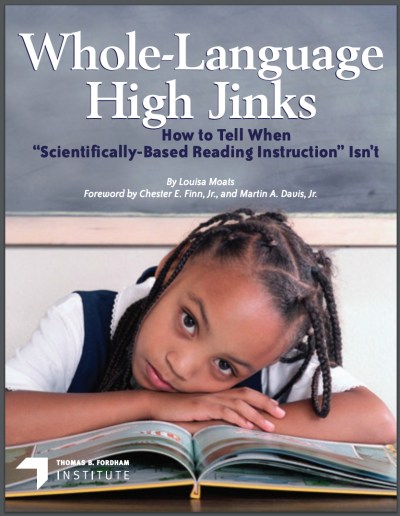
Moates is touted as a “renowned reading expert” and “author of the American Federation of Teachers’ Teaching Reading Is Rocket Science and an earlier Thomas B. Fordham Foundation report, Whole Language Lives On: The Illusion of “Balanced” Reading Instruction.”
The Executive Summary makes a case that may sound familiar to anyone paying attention to media coverage of the “science of reading” since 2018:
While the field of reading has made enormous strides in recent years—especially with the publication of the National Reading Panel’s landmark report and enactment of the federal Reading First program—discredited and ineffectual practices continue in many schools. Although the term “whole language” is rarely used today, programs based on its premises, such as Reading Recovery, Four Blocks, Guided Reading, and especially “balanced literacy,” are as popular as ever. These approaches may pay lip service to reading science, but they fail to incorporate the content and instructional methods proven to work best with students learning to read.
And guess where the failures lie?
Moats exposes popular but scientifically untenable practices in reading instruction, including
- use of memorization, picture cues, and contextual guessing for teaching word recognition, justified by the faulty “three cueing systems” theoretical model, instead of direct, systematic teaching of decoding and comprehension skills;
- substitution of “teacher modeling” and reading aloud for explicit, organized instruction;
- rejection of systematic and explicit phonics, spelling, or grammar instruction;
- confusion of phonemic awareness with phonics;
- reliance on “leveled” books and trade books to organize instruction; and
- use of whole-language approaches for English language learners.
However, a review of this report exposed several key problems that, again, may sound familiar:
In Whole language high jinks: How to tell when ‘scientifically-based reading instruction’ isn’t, Louisa Moats contends that she provides “the necessary tools to distinguish those [programs] that truly are scientifically based… from those that merely pay lip service to science” (p. 10). This review finds that Moats exaggerates the findings of the National Reading Panel (NRP), especially the effects of systematic phonics on reading achievement. She also ignores research completed since the NRP report was issued seven years ago. Perhaps most disturbingly, she touts primarily commercial curriculum products distributed by her employer — products that have far fewer published studies of effectiveness than the products and methods she disparages.
These flaws pervade the report’s subsequent discussion of what “scientifically based reading instruction” should look like. In the end, the Fordham report works more effectively as promotional material for products and services offered by Moats’ employer, SoprisWest, than as a reliable guide to effective reading instruction.
The report and review spurred a few exchanges among Moats, Allington (also here), and NEPC that also capture well the reading debate that will not die.
And here is a fun fact: During the time since NCLB and the NRP that Moats criticizes schools for failing to implement “scientific” reading instruction, Mississippi had an 8-point jump in 4th-grade NAEP reading scores from 2002 to 2009:
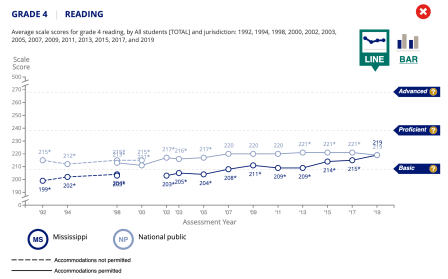
Was unscientific whole language/balanced literacy the cause of that jump [1], or is it possible that making any sort of direct causal claim about classroom instructional practices and NAEP score trends is misleading (especially without research to investigate the many causes of test scores)?
Alas! The more things change, the more they stay the same.
[1] According to advocates of the “science of reading,” Mississippi did not adopt the “science of reading” until 2013.
The Real Reading Debate and How We Fail to Teach Reading
Sometimes cliches hit the nail on the head: It’s deja vu all over again.
Sometimes hackneyed metaphors paint the best picture: When you find yourself in a hole, keep digging.
And that brings us to the “science of reading” version of the Reading War.
Here, I want to address the often misunderstood real reading debate as well as outline how there has been a historical failure in teaching reading that continues today.
First, let’s clarify some facts about reading.
For over a century, measurable reading achievement (test scores) has been mostly correlated with socio-economic factors (the students home, community, and school) and not significantly correlated with how students are being taught to read.
In that same time period, there has never been a moment when the U.S. hasn’t declared “reading crisis.” And as a result of this myopic view of reading achievement, the U.S. has a recurring Reading War; some notable moments include the 1940s, the 1950s-1960s, and the 1990s (see especially McQuillan).
Throughout the history of reading instruction, phonics instruction has always been a key component of how students are taught to read in school. The Urban Legend that in some eras (such as the 1990s) and that some philosophies/theories of literacy (whole language, balanced literacy) have rejected completely phonics instruction has been compelling to the media and the public, but it is factually false.
The Real Reading Debate
Phonics instruction, however, is at the core of the real and enduring reading debate. That debate includes three approaches to phonics instruction detailed by Krashen: “(1) intensive, or heavy phonics, (2) basic, or light phonics, and (3) zero phonics.”
Here is where mainstream media, the public, and politicians fumble the debate; the popular framing is that the Reading War is about phonics versus zero phonics.
The real debate is between intensive phonics (systematic intensive phonics for all students or phonics first for all students to be able to read) and basic phonics (phonics as one component of teaching reading among many). But as Krashen clarifies: “Zero Phonics. This view claims that direct teaching is not necessary or even helpful. I am unaware of any professional who holds this position.”
From late 2018 until today, the “science of reading” movement has promoted intensive phonics and misrepresented the current field of teaching reading as being in the nonexistent zero phonics camp (this is how whole language and balanced literacy are typically mischaracterized, especially in media coverage).
This intensive phonics/phonics first advocacy also misrepresents that position as settled science, which it isn’t.
The basic phonics position (whole language, balanced literacy) embraces the following:
- Phonics instruction is one of many instructional practices that can be effective in teaching early reading, but many students enter formal schooling already able to read without any formal instruction in phonics; therefore, formal reading instruction must be guided by student needs, not commitments to instructional practices (such as systematic intensive phonics for all students).
- In-school reading instruction should include direct phonics instruction for students who need that, but reading instruction should recognize those students for whom direct phonics is ineffective or unnecessary. Broadly, beware any one-size-fits-all claims about teaching reading.
- Phonics must always be an instructional means (never phonics for phonics’ sake), but evaluating the role of phonics in fostering fluency, comprehension, joy, and critical literacy is often incomplete or absent.
The current “science of reading” movement is also misguided in its claims about research. Systematic intensive phonics must be evaluated in terms of its effectiveness for student reading fluency and comprehension (not simply does systematic intensive phonics produce phonemic awareness, pronunciation).
The research base, in fact (and including the National Reading Panel), suggests that systematic intensive phonics is limited in effectiveness to first grade and only when that direct instruction is grounded in holistic and authentic literacy instruction. Isolated systematic intensive phonics is ineffective for fostering comprehension and necessarily wastes time better spent on other literacy instruction and practices.
There also is a large and compelling research base that shows out-of-school factors and access to books in the home and school are far more important in students learning to read than how much phonics they receive in formal schooling.
The paradox, then, is that every time the Reading War reignites, the media misrepresent the debate (phonics v. no phonics) while the real debate (intensive phonics v. basic phonics) is never really addressed.
How We Fail to Teach Reading
And thus, the paradox about how we fail to teach reading.
Historically and currently, we have mostly failed U.S. public education and reading in the same ways (but not how most mainstream critics claim).
The first level failure is that we consistently ignore the impact of out-of-school factors on all student learning and measurable achievement, including especially reading. Poverty, racism, sexism, and all sorts of systemic inequities are reflected in reading scores on tests such as NAEP.
Yet, most education reform, including reading legislation, targets in-school policies only, misdiagnosing the problem but also setting up the reforms for appearing to fail.
Next, responses to reading as a crisis are clouded by presentism, a lack of historical context. The reading crisis always includes the same flawed arguments and offer the same solutions that have never succeeded in the past.
However, the third level is grounded in more recent history, the accountability era in education begun in the 1980s and 1990s and driven by standards and high-stakes testing. This recent historical trend has failed reading instruction because student needs have been ignored because schools and teachers have been hyper-focused on standards (always changing) and high-stakes tests (always changing).
Connected to those distractions is that over the last 40 years districts and schools have overcommitted to reading programs that are correlated with those standards and high-stakes tests; most teachers have been held accountable for implementing those prescriptive reading programs, instead of being professional stewards of student literacy needs.
A key lesson we are not learning is that standards, high-stakes testing, and reading programs have been incredibly harmful for student learning and reading achievement. Changing the reading programs to ones that are systematic intensive phonics will not correct this flaw.
Finally, and cumulatively, we fail to teach reading well in the U.S. because we are negligent about the conditions of our students’ lives and then negligent about the teaching and learning conditions of our students’ schools.
Here is a very sad fact: It is easier for most people to say for the hundredth time that all students need systematic intensive phonics than to admit and then address the following:
- All children deserve universal health care.
- All children deserve food security.
- All children deserve to have parents with work security.
- All children deserve a stable and safe home.
- All students deserve the highest quality learning environment (low student/teacher ratios, experienced certified teachers, well funded supplies and school).
- All students deserve access to reading materials in their homes, their communities, and their schools.
- All students deserve individual and patient instruction from their teachers and their schools.
- No student is merely a test score.
Once again, however, we are faced with a very real reading debate and with how we are still failing to teach reading.
Once again, we are failing both.
What Federal and State Reading Legislation Should and Should Not Do
Since the early 1980s, a significant role of state government has included funding and mandating public school practices and policies. Spurred by A Nation at Risk under Ronald Reagan, most states committed to the accountability era in U.S. public education grounded in state standards and high-stakes testing.
Bringing that state-based process to the federal level, George W. Bush ushered in the federal role in the accountability era with No Child Left Behind in the early 2000s.
The federal and state templates for education policy and reform have been fairly consistent for forty years, and currently, most political leaders and media pundits continue to claim that public education is failing, specifically targeting reading achievement by students.
Since most states have passed or are rushing to pass education legislation targeting reading practices and policies, here are guiding principles for what any federal or state legislation directly or indirectly impacting reading should and should not do:
- Should not publicly fund private vendor comprehensive reading programs.
- Should not endorse private vendor reading programs or reading materials.
- Should not adopt “ends justify the means” policies aimed at raising reading test scores in the short term (for example, 3rd-grade retention policies).
- Should not prescribe a narrow definition of “scientific” or “evidence-based.”
- Should not prescribe a “one-size fits all” approach to teaching reading, addressing struggling readers or English language learners, identifying and serving special needs students, or teacher education and preparation of teachers of reading.
- Should not ignore the limited impact in-school only practices have on measurable student outcomes (test scores).
- Should not prioritize reading test scores over a wide range of targets and types of evidence to insure all students have high-quality access to learning to read.
- Should not teacher-proof reading instruction or de-professionalize teachers of reading or teacher educators through narrow prescriptions of how to teach reading and serve struggling readers, English language learners, or students with special needs.
- Should not prioritize advocacy by parents and non-educators over the expertise and experiences of K-12 educators and university-based scholars of reading and literacy.
- Should not conflate general reading instruction policy with the unique needs of struggling readers, English language learners, and special needs students.
- Should not over-react to short-term measurements of reading achievement (test data).
And thus,
- Should fully fund and guarantee to all students the highest quality teaching and learning conditions for learning to read: low student/teacher ratios, well funded and supported instructional materials for learning to read chosen by teachers to fit the needs of their unique populations of students (prioritizing authentic texts for students in the classroom and in their homes), guaranteed and extensive time to read and learn to read daily.
- Should reduce significantly the amount of and consequences for standardized testing and adopt accountability structures that include a wide range of types of evidence of student learning over a long period of time.
- Should support the professionalism of K-12 teachers and teacher educators.
- Should adopt a complex and robust definition of “scientific” and “evidence-based.”
- Should embrace a philosophy of “first, do no harm.”
- Should acknowledge that students needs across the general population, struggling readers, English language learners, and special needs students are varied and complex.
- Should acknowledge the teacher as the reading expert in the care of unique populations of students and prioritize evidence-based student needs over complying with uniform standards or prescriptive programs.
- Should provide funding and oversight for guaranteeing all students access to high-quality teachers (certified, experienced) and challenging, rich reading/literacy experiences regardless of student background or geographical setting (equity [input] standards over accountability [output] standards).
- Should recognize that the research base and evidence base on reading and teaching reading is diverse and always in a state of change (i.e., there is no settled science of reading).
- Should acknowledge and support that the greatest avenue to reading for all students is access to books and reading in their homes, their schools, and their access to libraries (school or community).
- Should prioritize longitudinal data (test scores) on reading achievement as guiding evidence among a diversity of evidence for supporting instruction and teaching/learning conditions.
- Should guarantee that all students are served based on their identifiable needs in the highest quality teaching and learning conditions possible across all schools.
Education legislation targeting reading needs to be guiding concepts and not prescriptions. But the overarching guiding principle should be grounded in the abundant evidence of failure by education reform over the past four decades; at the very least, federal and state legislation should not continue to do the same things over and over while expecting different outcomes.
Education Reform De-professionalizes Women Educators
Who were your teachers?
In elementary school, nearly 9 of 10 teachers are women; by high school, about 6 of 10 are women. And nearly all of your teachers, 80%, were white (see NCES data).
As a student and a teacher, then, I have spent a great deal of my life in spaces where women are the overwhelmingly majority; often I am the only man in the room.
Recently, while I was presenting at two education conferences (South Carolina Council of Teachers of English and Wisconsin State Reading Association), I had several important experiences with recognizing teaching as a profession constituted by mostly women.
At SCCTE, I attended a session led by SC for Ed, making eye contact with one of the organization’s leaders at one point in recognition that I was the only man in the room. This session was on teacher activism and the need to inform state legislators about education while the state considers a major education bill.
As the discussion focused on many of the state representatives being condescending, I offered to the group that many of the problems faced in education can be traced to men in political leadership (and administration) not trusting or allowing the full professionalism of teachers since the field is primarily women.
Alia Wong explains that teaching continues to see a rise in the percentage of women in the field while other professions have the opposite gender trajectory:
Ingersoll and his research team highlight the rising proportion of women who are, for example, physicians (from 10 percent in 1972 to 40 percent in 2018, according to Bureau of Labor Statistics data and federal surveys), lawyers (from 4 percent to 37 percent over the same time period), and pharmacists (13 percent to 63 percent).
Wong then confirms what we confronted at the SC for Ed session at SCCTE:
What explains these contradictory trends? Much of it comes down to misunderstandings of what teaching entails and how those assumptions intersect with gender norms. Unlike in many other countries, in the United States, teaching has long been seen as a relatively low-status profession. In 2018, a survey of people in roughly three dozen countries asked respondents to rank 14 different professions—including teaching, medicine, law, social work, and website engineering—by each career’s perceived social status. On the one hand, survey participants in the United States gave teachers a middling ranking, and tended to liken them to librarians; respondents in countries such as China and Malaysia, on the other hand, put teachers in first place, analogizing them to doctors.
This cultural disregard for teaching has a gendered consequence: The status of a given career tends to correlate with the share of men in that profession—higher status equals more men, generally speaking. And that has its own consequence: Research has found that employers place less value on work done by women than on that done by men. These trends reinforce each other in perpetuity.
Even in education, as the status of the position within education rises, so does the proportion of men, Wong notes: “Notably, close to half of all principals today, including two-thirds of those serving high schools, are men, as are more than three-quarters of school-district superintendents.”
Administration also reflects greater power and higher pay than classroom teachers.
I gave a presentation and spoke on a panel just a week later at WSRA; my session was attended by almost all women, and then I was the only man on a 6-person panel.
During my presentation, Misreading Reading Again and Again: The Media, Reading Policy, and Teaching Reading, two comments by teachers and the discussions around them help navigate the nearly constant state of reform occurring in education and more directly the current “science of reading” movement that is driving many states to adopt new reading legislation.
First, as I was discrediting the myth that whole language failed in California in the 1980s and 1990s—when the state experienced a significant drop in education funding and an increase in English language learners—a woman interjected that she taught in California during this time.
Her class was 32 second graders, including 6 ELL students (hers was an inclusion/ELL class). Her direct statement was that the teaching and learning conditions made effective teaching of reading (or anything) nearly impossible, regardless of the reading program or philosophy she implemented.
Here, we must recognize that teaching and learning conditions can and often do de-professionalize teachers.
Later, I was discussing the recent attacks on Lucy Calkins Units of Study reading program, emphasizing first that I do not endorse any reading programs (including Calkins’s). Many attending the session clapped for the idea that schools should not spend funding on programs, but provide teachers all the books and materials needed to teach reading.
But as we interrogated the problem with Calkins’s program, several teachers enthusiastically announced their hatred for not only the program but Calkins herself, as the name on the program.
What we unpacked was that even despite Calkins own warning not to implement the program as a structured mandate to teachers, many administrators have turned this and other reading programs into a way to manage and monitor teacher practice.
In other words, the valid anger felt by teachers about Unit of Study is their awareness that the program is used to further de-professionalize them.
And that brings us back to the “science of reading” movement that has some disturbing elements. First is the argument that the “science of reading” is settled (suggesting that science is a fixed prescription)—even though the evidence on teaching reading is rightfully described as compelling even as that evidence base is diverse (both in types of research and what that evidence supports).
Next, building off that misrepresentation of science, this movement is calling for systematic intensive phonics (phonics first) for all students; without too much imagination here, we can see that this is a blanket mandate that de-professionalizes teachers and certainly will have the same negative impact on teacher attitudes that misguided implementation of Calkins’s program currently exposes.
But the most disturbing aspect of the “science of reading” movement is that it is the next step feeding the over forty years of education reform that has plagued U.S. education.
Public education has experienced relentless political intrusion since the early 1980s, mandates standards, testing, and programs that have erased nearly every aspect of professionalism from the field of teaching.
And political intrusion, we must recognize, is almost entirely the work of men.
Think of the recent anti-abortion laws in Alabama. While the press highlighted a woman governor signing the bill, Alabama has 23 women out of 140 legislators, a mere 16.4% (see gender balances in state government here).
As has been dramatized brilliantly in Margaret Atwood’s The Handmaid’s Tale (and the Netflix adaptation), tokenized women, such as the governor of Alabama, often work in the service of men.
While many faces on the “science of reading” movement are women, their agenda is being used mostly by men in political power to mandate education policy and further de-professionalize teachers.
My home state of South Carolina has about the same gender imbalance as Alabama (28 women out of 170 legislators, 16.5%), and many of the SC for Ed teachers interacting with state representatives and senators are receiving angry and condescending responses that demonstrate a lack of respect for teachers.
What people fail to recognize about the systematic intensive phonics movement as an attack on balanced literacy is that phonics programs fit well into the top-down authority model implemented in many schools and driven by accountability mandates (legislation included). Balanced literacy, on the other hand, is intended as a guiding philosophy of literacy that depends on teacher autonomy and professionalism to provide all students what they need to learn.
Balanced literacy does not mandate any practice for all students, and does not bar any practice where students demonstrate a need.
Accountability, education legislation, and reading programs have mostly worked against teacher professionalism, against the autonomy and professionalism of women.
Teachers need teacher and learning conditions that make their work as professionals possible, but the current movement to legislate the “science of reading” will further erode teacher autonomy and distract from the real work needed.
Teachers do not need yet more reform; teachers need their profession to be respected and supported.
#WSRA20 – Misreading Reading Again, and Again: The Media, Reading Policy, and Teaching Reading
UPDATED: Understanding the “Science of Reading”: A Reader
UPDATE
See Fact checking @DanaGoldstein phonics article @nytimes – a thread
See Also: Gerald Coles, Cryonics Phonics: Inequality’s Little Helper
In one way, ground zero for the “science of reading” movement can be traced to Emily Hanford in 2018, but cognitive scientists (Daniel Willingham and Mark Seidenberg, for example) focusing on reading and advocacy for students with dyslexia (or struggling to read in ways that some label as dyslexia) have also played key roles in the movement.
The “science of reading movement” has not been simply a media event, however. That advocacy has resulted in state education/reading legislation that has included third-grade retention of students based on reading test scores, mandating systematic intensive phonics (phonics first) for all students, and new mandates for teachers of reading and teacher education programs.
What is absent in most of the media and political endorsement of the “science of reading” is a critical lens for the claims as well as historical context.
The “science of reading” narrative, at best, is incomplete, and at worst, is deeply misleading.
Below are the key elements and links to help anyone better understand the issues:
Historical Perspective
What Shall We Do About Reading Today?: Looking Back to See Now More Clearly
Back to the Future of Reading Instruction: 1990s Edition
Recommended: Literacy Crises: False Claims and Real Solutions, Jeff McQuillan
The “Science of Reading,” an Overview
The Big Lie about the “Science of Reading” (Updated)
The Big Lie about the “Science of Reading”: NAEP 2019 Edition
Systematic Intensive Phonics (Phonics First, Phonics versus Whole Language/Balanced Literacy)
Reconsidering the Evidence That Systematic Phonics Is More Effective Than Alternative Methods of Reading Instruction, Jeffrey S. Bowers (2020)
To Read or Not to Read: Decoding Synthetic Phonics, Andrew Davis
Does Phonics Deserve the Credit for Improvement in PIRLS? Stephen Krashen
The Problem with Balanced Literacy
Progressivism and Whole Language: A Reader
National Reading Panel (NRP)
The Enduring Influence of the National Reading Panel (and the “D” Word)
Reading Programs (Lucy Calkins)
Reading Programs Put Reading Last
Teacher Education and National Council on Teacher Quality (NCTQ)
If Teacher Education Is Failing Reading, Where Is the Blame?
Mississippi 2019 NAEP Reading Scores
UPDATED: Mississippi Miracle or Mirage?: 2019 NAEP Reading Scores Prompt Questions, Not Answers
See Also
Reading as a First-Mile Problem: Recognizing the Role of Poverty and Inequity in Literacy Development
Literacy scholar Tim Shanahan answers the question Why Is It So Hard to Improve Reading Achievement? with the following: “Classroom implementation is the last mile in reading reform.” He eventually adds, “The last mile rhetoric shouldn’t be a hair-on-fire message, but one that acknowledges both the current successes and the need to do better.”
Shanahan’s consideration of the persistent public and political concern over low reading achievement appears to offer a balanced admission that many approaches to reading instruction can be successful, but framing reading as a last-mile problem is finding yourself in a hole and deciding you just need to dig a little deeper.
Shanahan seems to accept a number of different “levers” as valid approaches to improving student reading, including a somewhat veiled endorsement of Common Core standards; in fact, he concedes: “Let’s face it. Our problem in reading isn’t that nothing works. It’s that everything does.”
In 2020, what Shanahan’s last-mile argument reveals, however, is that there is a mistake in teaching reading that can be addressed, but as a society, we refuse to acknowledge that reading is a first-mile problem.
That first mile is much larger than formal schooling, and what we refuse to recognize is that measurable reading achievement is a marker for the disadvantages of poverty and inequity in both the lives and schooling of vulnerable populations of students (students in poverty, black and brown students, English language learners, special needs students).
The accountability movement driven by ever-new standards and ever-new tests has been paralyzed by in-school only reform. That movement is both an example of last-mile reform and why last-mile reform has failed.
First, let’s acknowledge that Shanahan does make a key argument about how reading is taught; for example, a recent review of meta-analyses of systematic intensive phonics has shown that most approaches to teaching reading are about equally effective, as Shanahan suggests.
However, the current “science of reading” version of the Reading War argues that systematic intensive phonics must be required for all students; this phonics-first claim has been concurrent with pathologizing most struggling readers as probably dyslexic.
If we shift from last-mile reform to first-mile reform, then, we must avoid both “all students must” and “everything works,” choosing instead to admit that every student deserves the reading instruction they need (regardless of what programs or standards mandate), and we must acknowledge that students living in relative privilege often acquire reading rather easily, suggesting that the conditions within which students live and learn need to be reformed—not the students or the teaching methods.
First-mile reform in reading must start with addressing poverty and inequity in every child’s life. Alleviating poverty, addressing food security, improving work opportunities and security, adopting universal health care—these are issues of equity that would allow all students to acquire reading in ways that are now common for affluent students (often before entering formal schooling).
Stable communities and homes not overburdened by poverty and inequity would have the opportunities to provide children with language-rich environments that send children to formal schooling already highly literate, often reading before direct instruction.
First-mile reform of reading, however, is not a narrow commitment to out-of-school only, but it makes primary equity-focused out-of-school reform while also including equity-focused in-school reform as secondary but essential.
Instead of digging the accountability hole deeper by seeing reading reform as a last-mile challenge, we must climb out of that silo and think differently about in-school reform.
Equity-focused reading reform starts with the conditions of teaching and learning—guaranteeing students small student/teacher ratios in early literacy classes, insuring all students have experienced and highly-qualified teachers, and funding fully the materials needed for rich literacy experiences (authentic texts for all students and robust libraries in the schools and in children’s homes and communities).
This new approach to reform would also avoid tracking students and then would monitor more directly equitable learning opportunities as opposed to narrow measurable outcomes. For example, all students should be in rich and challenging courses—and not in test-prep classes or highly prescriptive programs (reading programs or systematic phonics for all).
Last-mile reading reform continues to focus on students as inherently flawed humans who need to be fixed; first-mile reading reform recognizes that systems are flawed, and that all students can flourish if their living and learning environments are equitable and conducive to learning.
Ultimately, continuing down the current road to reading reform as if we just need to be more demanding of teachers and students in the crucial last mile is continuing to recognize the negative impact of poverty and inequity on children’s ability to read and teachers’ effectiveness in teaching reading.
We mustn’t keep our heads down, we mustn’t keep digging.
We need finally to acknowledge that reading is a first-mile problem.
Fact-checking Phonics, NRP, and NCTQ
The “science of reading” movement often claims that a systematic intensive phonics-first approach to teaching reading is endorsed by science that is settled, that the National Reading Panel (NRP) is a key element of that settled science, and that teacher education is mostly absent of that “science of reading” (a message that has been central to NCTQ for many years).
These claims, however, misrepresent what evidence actually shows. Here, then, are some evidence-based fact-checks of phonics, NRP, and NCTQ.
Phonics
Reconsidering the Evidence That Systematic Phonics Is More Effective Than Alternative Methods of Reading Instruction, Jeffrey S. Bowers (2020)
Abstract
There is a widespread consensus in the research community that reading instruction in English should first focus on teaching letter (grapheme) to sound (phoneme) correspondences rather than adopt meaning-based reading approaches such as whole language instruction. That is, initial reading instruction should emphasize systematic phonics. In this systematic review, I show that this conclusion is not justified based on (a) an exhaustive review of 12 meta-analyses that have assessed the efficacy of systematic phonics and (b) summarizing the outcomes of teaching systematic phonics in all state schools in England since 2007. The failure to obtain evidence in support of systematic phonics should not be taken as an argument in support of whole language and related methods, but rather, it highlights the need to explore alternative approaches to reading instruction.
[For context, note some of the problems remaining in how whole language is addressed in this post.]
National Reading Panel
The Federal Government Wants Me to Teach What?: A Teacher’s Guide to the National Reading Panel Report, Diane Stephens (NCTE, 2008)
An Ever-So-Brief Summary with Book Recommendations
1. Phonemic Awareness. According to the studies cited in the NRP report, this is best taught to very young children (K–1) using letters, and when letters are used, PA instruction is considered to be phonics. Therefore, it is not necessary to have a separate instructional time for PA. Rather, children should have opportunities to learn about how language is made up of parts (e.g., onsets and rimes, or word families) as part of phonics instruction. An effective way to do this in the classroom? Provide time for students to write using invented spelling (pp. 2-1 through 2-86). (See Strickland, 1998, for further information about invented spelling.)
2. Phonics. According to the studies cited in the NRP report, there is no evidence that phonics instruction helps in kindergarten or in grades 2 to 9. It does help first graders learn the alphabetic principle—that there is a relationship between letters and sounds. No one method is better than any other. For example, for at-risk first graders, a modified whole language approach and one-on-one Reading Recovery–like instruction both helped children with comprehension (pp. 2-89 through 2-176). This phonics instruction should be conducted in the context of whole, meaningful text. (See Moustafa, 1997, for information on embedded, whole-part-whole instruction.)
3. Fluency. According to the authors of the Fluency report, the practice of round robin (at any age) does not help children and can indeed hurt them. However, according to the studies cited in the Fluency report, repeated oral reading (K–12) helps with comprehension because reading to readers fluidly instead of word-by-word reading helps them better understand the text. Ways to help with this? Try such things as readers theater (pp. 3-1 through 3-43). (See Opitz and Rasinski’s Good-bye Round Robin: 25 Effective Oral Reading Strategies [1998] for additional instructional suggestions.)
4. Vocabulary (grades 3 to 8). One method is not better than another. Children learn most of their vocabulary incidentally (pp. 4-15 through 4-35). (For further information about vocabulary learning, see Nagy, 1988.)
5. Comprehension (grades 3 to 6). Children need to learn that print makes sense and to develop a variety of strategies for making sense of print (pp. 4-39 through 4-168). (For further information on teaching for comprehension, see the references listed in Chapter 8: Beers, 2002; Sibberson & Szymusiak, 2003; Taberski, 2000; Tovani, 2000; see also Harvey & Goudvis, 2000.)
Across all of these recommendations? According to the studies cited in the NRP report, if we want children to learn something, we need to teach them that something. Want great readers? Then teach children what great readers do.
NCTQ (Teacher Education)
NOTE: This is more complicated, but first I am posting an older (2006) and new (2020) report from NCTQ both making essentially the same claims that teacher education fails to teach the “science of reading.” Then, I include a link to several reviews that show that NCTQ’s “reports” are methodologically flawed and essentially propaganda, not “science.”
What Education Schools Aren’t Teaching (2006)
2020 Teacher Prep Review: Program Performance in Early Reading Instruction

If Teacher Education Is Failing Reading, Where Is the Blame?
The current “science of reading” climate surrounding public education in the U.S. has its roots, ironically, in misreading (or at least reading uncritically) A Nation at Risk, a report during the Ronald Reagan administration that was widely reported by mainstream media. The politically driven and deeply flawed report also prompted the accountability movement in the U.S.—state standards and high-stakes testing—that eventually enveloped the entire country by the 1990s.
The report established a false but compelling cultural truism that is too rarely interrogated: Public schools in the U.S. are failing. Since the early 1980s, political leadership has decided that the failure is due to a lack of accountability, but accountability of whom or what has shifted over the past 40 years.
The first blame narrative focused on students and schools, ushering in high-stakes testing at 3rd grade, 8th grade, and high school (exit exams) as well as school and district report cards. Eventually high-stakes accountability of students and schools seemed not to change the measurable outcomes that advocates had promised; there were also unintended consequences such as exit exams increasing drop-out rates.
Gradually after No Child Left Behind, the blame narrative moved to teachers, in part driven by George W. Bush’s popularizing the slogan “soft bigotry of low expectations,” the rise of charter schools embracing “no excuses,” and the same messages and buy-in for Bush era education policy by Barack Obama’s administration and Department of Education.
For about a decade the blame narrative focused on teachers, and political leaders rushed to intensify teacher evaluation, notably the use of value-added methods (VAM). Once again, the outcomes promised by advocates did not come to fruition. Recently, in fact, the tide is turning hard against the use of VAM and other types of punitive teacher evaluations.
The vacuum left in the blame narrative did not remain long. Concurrent with the “science of reading” movement that claims public school teachers are not teaching reading guided by the “science of reading” is the next round of blame—teacher education [1].
The blame narrative makes for strange bedfellows. While mainstream media have begun to pound the drum of blame about teacher education fairly consistently, the leading literacy professional organization, the International Literacy Association (ILA), has join the story as well.
Education Week has led this charge; for example, Madeline Will writes in Preservice Teachers Are Getting Mixed Messages on How to Teach Reading:
Decades of research have shown that teaching explicit, systematic phonics is the most reliable way to make sure that young students learn how to read words. Yet an Education Week analysis of nationally representative survey results found that professors who teach early-reading courses are introducing the work of researchers and authors whose findings and theories often conflict with one another, including some that may not be aligned with the greater body of scientific research.
EdWeek‘s survey data are being confirmed, it seems, by ILA’s survey data: 60% of respondents claim their teacher education programs did not prepare them well to teach reading.
First, we should pause at media and professional organizations citing survey data while also embracing a very rigid and narrow demand for the “science of reading.” Survey data have many problems, and in this case, we may want to know if disgruntled teachers were disproportionately motivated to reply.
None the less it is quite a different thing to say “60% of respondents claimed X” than “60% of teachers claimed X.” Are these survey data representative of all teachers of reading?
Let’s assume this is true, that more than half of teachers charged with reading instruction are not properly prepared to teach reading. But let’s also unpack how that came to be, and ultimately answer in a fair way, where is the blame?
For the past 30-40 years, teachers and teacher educators have had less and less professional autonomy; or stated a different way, the professional autonomy of teachers and teacher educators has been reduced to how well they can implement mandated standards and produce measurable outcomes that prove those standards were implemented and effective.
In the high-stakes accountability era, then, if we are going to accept that 60% of teachers were not well prepared in their teacher education programs, we must be willing to acknowledge that those programs were governed most often by the accreditation process. Organizations such as NCATE and CAEP have been holding teacher education accountable along with the coordination of professional organizations.
How teacher education approached literacy broadly and reading specifically was grounded in standards designed by ILA (elementary) and the National Council of Teachers of English (NCTE) (secondary), and those programs were periodically monitored by ILA and NCTE for if or how well the programs met those standards.
If we currently believe that the teaching of reading in our public schools is failing our students, we must also acknowledge that teachers are implementing state standards of reading and preparing students for state tests of reading; those teachers were also taught how to teach in teacher education programs implementing national standards determined by ILA and NCTE.
Accepting the survey data as valid, then, the blame for these failures lie in the accountability and accreditation process, of which teachers and teacher educators are mere agents.
After being a classroom teacher of ELA for 18 years and then a teacher educator for the last 18 years, I believe I have a strong and well informed view of what is really happening. This is a better explanation, but not a simple one that the media would prefer or a politically expedient one that politicians would prefer.
Education was never the type of failure determined by A Nation at Risk, and a lack of accountability was never the cause of what the true failures in education were then and are today.
Formal education is a reflection of and a perpetuating force for inequity in the U.S. Public schools are not game changers.
Therefore, it is true that far too many students are not being taught to read well enough, and that on balance, public education is failing far too many students.
Those failures are about inequity—inequity of opportunities both outside and inside schools that disproportionately impacts poor students, black and brown students, English language learners, and special needs students (the “science of reading” movement has correctly identified these vulnerable student populations, in fact).
And as jumbled as the journey has been, the logic experiment I offer above reaches a credible conclusion: the accountability era has failed. Miserably. Once again disproportionately impacting vulnerable populations of students.
But accreditation has failed just as much. Accountability grounded in standards and high-stakes assessment are not conducive to teaching, learning, or scholarship.
As a former classroom teacher, I can attest to that fact; as a current teacher educator, I can confirm that complying with accreditation mandates dilute my courses and overburden my professional work to the exclusion of scholarship and research.
Accountability structures are mostly bureaucracy, mostly a distraction from real teaching, learning, or professional behavior.
While I am frustrated with mainstream media misrepresenting reading and reading instruction, I am baffled that ILA would enter a fray that turns the blame narrative back on the organization itself. Maybe they didn’t think this through, but it is really almost impossible not to blame professional organizations who govern teacher education if we determine teacher education has failed.
Here, then, is a larger lesson of this entire four-decades mess: Let’s stop looking for people to scapegoat in the blame narrative, and recognize instead that the accountability/accreditation systems are failing us, especially when we are complying well to them.
Professional autonomy for K-12 teachers and teacher educators is a process we have not tried, but one far more likely to give our schools and our students a better chance if we also acknowledge that social and educational equity need the same financial and administrative focus we have given accountability since the early 1980s.
[1] See: Contesting Science That Silences: Amplifying Equity, Agency, and Design Research in Literacy Teacher Preparation
In contrast to the claims made by the SOR community, research in literacy teacher preparation has been exten- sive, scientific, and useful for guiding reform efforts. CITE-ITEL, an online database (https://cite.edb.utexas. edu/) of published research articles on literacy teacher preparation, offers a window into contemporary scholar- ship on the same.3 CITE-ITEL is updated regularly and is freely accessible. There are currently 677 research studies in the database, published between 1999 and 2019 in over 90 scholarly journals. These include journals sponsored by professional organizations in literacy (see Table 1) and other highly respected, independent journals (e.g., Teaching and Teacher Education, Reading Psychology).
The term science of reading appears in only four of the 677 research reports, and none of the studies examined the reliability or validity of the assessment tools used to mea- sure the knowledge that preservice teachers hold about the SOR. Despite the political and media attention given to the SOR and the tools on which the SOR community relies, there is no body of evidence that reflects the SOR perspective on literacy teacher preparation by members of the literacy teacher preparation research community
Hoffman, J.V., Hikida, M., & Sailors, M. (2020). Contesting science that silences: Amplifying equity, agency, and design research in literacy teacher preparation. Reading Research Quarterly, 55(S1), S255–S266. Retrieved July 26, 2022, from https://doi.org/10.1002/rrq.353
See Also
Of Rocks and Hard Places—The Challenge of Maxine Greene’s Mystification in Teacher Education, P. L. Thomas
The Fatal Flaw of Teacher Education: “We have met the enemy and he is us.”

