In one way, ground zero for the “science of reading” movement can be traced to Emily Hanford in 2018, but cognitive scientists (Daniel Willingham and Mark Seidenberg, for example) focusing on reading and advocacy for students with dyslexia (or struggling to read in ways that some label as dyslexia) have also played key roles in the movement.
The “science of reading movement” has not been simply a media event, however. That advocacy has resulted in state education/reading legislation that has included third-grade retention of students based on reading test scores, mandating systematic intensive phonics (phonics first) for all students, and new mandates for teachers of reading and teacher education programs.
What is absent in most of the media and political endorsement of the “science of reading” is a critical lens for the claims as well as historical context.
The “science of reading” narrative, at best, is incomplete, and at worst, is deeply misleading.
Below are the key elements and links to help anyone better understand the issues:
Literacy scholar Tim Shanahan answers the question Why Is It So Hard to Improve Reading Achievement? with the following: “Classroom implementation is the last mile in reading reform.” He eventually adds, “The last mile rhetoric shouldn’t be a hair-on-fire message, but one that acknowledges both the current successes and the need to do better.”
Shanahan’s consideration of the persistent public and political concern over low reading achievement appears to offer a balanced admission that many approaches to reading instruction can be successful, but framing reading as a last-mile problem is finding yourself in a hole and deciding you just need to dig a little deeper.
Shanahan seems to accept a number of different “levers” as valid approaches to improving student reading, including a somewhat veiled endorsement of Common Core standards; in fact, he concedes: “Let’s face it. Our problem in reading isn’t that nothing works. It’s that everything does.”
In 2020, what Shanahan’s last-mile argument reveals, however, is that there is a mistake in teaching reading that can be addressed, but as a society, we refuse to acknowledge that reading is a first-mile problem.
That first mile is much larger than formal schooling, and what we refuse to recognize is that measurable reading achievement is a marker for the disadvantages of poverty and inequity in both the lives and schooling of vulnerable populations of students (students in poverty, black and brown students, English language learners, special needs students).
The accountability movement driven by ever-new standards and ever-new tests has been paralyzed by in-school only reform. That movement is both an example of last-mile reform and why last-mile reform has failed.
First, let’s acknowledge that Shanahan does make a key argument about how reading is taught; for example, a recent review of meta-analyses of systematic intensive phonics has shown that most approaches to teaching reading are about equally effective, as Shanahan suggests.
However, the current “science of reading” version of the Reading War argues that systematic intensive phonics must be required for all students; this phonics-first claim has been concurrent with pathologizing most struggling readers as probably dyslexic.
If we shift from last-mile reform to first-mile reform, then, we must avoid both “all students must” and “everything works,” choosing instead to admit that every student deserves the reading instruction they need (regardless of what programs or standards mandate), and we must acknowledge that students living in relative privilege often acquire reading rather easily, suggesting that the conditions within which students live and learn need to be reformed—not the students or the teaching methods.
First-mile reform in reading must start with addressing poverty and inequity in every child’s life. Alleviating poverty, addressing food security, improving work opportunities and security, adopting universal health care—these are issues of equity that would allow all students to acquire reading in ways that are now common for affluent students (often before entering formal schooling).
Stable communities and homes not overburdened by poverty and inequity would have the opportunities to provide children with language-rich environments that send children to formal schooling already highly literate, often reading before direct instruction.
First-mile reform of reading, however, is not a narrow commitment to out-of-school only, but it makes primary equity-focused out-of-school reform while also including equity-focused in-school reform as secondary but essential.
Instead of digging the accountability hole deeper by seeing reading reform as a last-mile challenge, we must climb out of that silo and think differently about in-school reform.
Equity-focused reading reform starts with the conditions of teaching and learning—guaranteeing students small student/teacher ratios in early literacy classes, insuring all students have experienced and highly-qualified teachers, and funding fully the materials needed for rich literacy experiences (authentic texts for all students and robust libraries in the schools and in children’s homes and communities).
This new approach to reform would also avoid tracking students and then would monitor more directly equitable learning opportunities as opposed to narrow measurable outcomes. For example, all students should be in rich and challenging courses—and not in test-prep classes or highly prescriptive programs (reading programs or systematic phonics for all).
Last-mile reading reform continues to focus on students as inherently flawed humans who need to be fixed; first-mile reading reform recognizes that systems are flawed, and that all students can flourish if their living and learning environments are equitable and conducive to learning.
Ultimately, continuing down the current road to reading reform as if we just need to be more demanding of teachers and students in the crucial last mile is continuing to recognize the negative impact of poverty and inequity on children’s ability to read and teachers’ effectiveness in teaching reading.
We mustn’t keep our heads down, we mustn’t keep digging.
We need finally to acknowledge that reading is a first-mile problem.
The “science of reading” movement often claims that a systematic intensive phonics-first approach to teaching reading is endorsed by science that is settled, that the National Reading Panel (NRP) is a key element of that settled science, and that teacher education is mostly absent of that “science of reading” (a message that has been central to NCTQ for many years).
These claims, however, misrepresent what evidence actually shows. Here, then, are some evidence-based fact-checks of phonics, NRP, and NCTQ.
There is a widespread consensus in the research community that reading instruction in English should first focus on teaching letter (grapheme) to sound (phoneme) correspondences rather than adopt meaning-based reading approaches such as whole language instruction. That is, initial reading instruction should emphasize systematic phonics. In this systematic review, I show that this conclusion is not justified based on (a) an exhaustive review of 12 meta-analyses that have assessed the efficacy of systematic phonics and (b) summarizing the outcomes of teaching systematic phonics in all state schools in England since 2007. The failure to obtain evidence in support of systematic phonics should not be taken as an argument in support of whole language and related methods, but rather, it highlights the need to explore alternative approaches to reading instruction.
[For context, note some of the problems remaining in how whole language is addressed in this post.]
An Ever-So-Brief Summary with Book Recommendations
1. Phonemic Awareness. According to the studies cited in the NRP report, this is best taught to very young children (K–1) using letters, and when letters are used, PA instruction is considered to be phonics. Therefore, it is not necessary to have a separate instructional time for PA. Rather, children should have opportunities to learn about how language is made up of parts (e.g., onsets and rimes, or word families) as part of phonics instruction. An effective way to do this in the classroom? Provide time for students to write using invented spelling (pp. 2-1 through 2-86). (See Strickland, 1998, for further information about invented spelling.)
2. Phonics. According to the studies cited in the NRP report, there is no evidence that phonics instruction helps in kindergarten or in grades 2 to 9. It does help first graders learn the alphabetic principle—that there is a relationship between letters and sounds. No one method is better than any other. For example, for at-risk first graders, a modified whole language approach and one-on-one Reading Recovery–like instruction both helped children with comprehension (pp. 2-89 through 2-176). This phonics instruction should be conducted in the context of whole, meaningful text. (See Moustafa, 1997, for information on embedded, whole-part-whole instruction.)
3. Fluency. According to the authors of the Fluency report, the practice of round robin (at any age) does not help children and can indeed hurt them. However, according to the studies cited in the Fluency report, repeated oral reading (K–12) helps with comprehension because reading to readers fluidly instead of word-by-word reading helps them better understand the text. Ways to help with this? Try such things as readers theater (pp. 3-1 through 3-43). (See Opitz and Rasinski’s Good-bye Round Robin: 25 Effective Oral Reading Strategies [1998] for additional instructional suggestions.)
4. Vocabulary (grades 3 to 8). One method is not better than another. Children learn most of their vocabulary incidentally (pp. 4-15 through 4-35). (For further information about vocabulary learning, see Nagy, 1988.)
5. Comprehension (grades 3 to 6). Children need to learn that print makes sense and to develop a variety of strategies for making sense of print (pp. 4-39 through 4-168). (For further information on teaching for comprehension, see the references listed in Chapter 8: Beers, 2002; Sibberson & Szymusiak, 2003; Taberski, 2000; Tovani, 2000; see also Harvey & Goudvis, 2000.)
Across all of these recommendations? According to the studies cited in the NRP report, if we want children to learn something, we need to teach them that something. Want great readers? Then teach children what great readers do.
NCTQ (Teacher Education)
NOTE: This is more complicated, but first I am posting an older (2006) and new (2020) report from NCTQ both making essentially the same claims that teacher education fails to teach the “science of reading.” Then, I include a link to several reviews that show that NCTQ’s “reports” are methodologically flawed and essentially propaganda, not “science.”
The current “science of reading” climate surrounding public education in the U.S. has its roots, ironically, in misreading (or at least reading uncritically) A Nation at Risk, a report during the Ronald Reagan administration that was widely reported by mainstream media. The politically driven and deeply flawed report also prompted the accountability movement in the U.S.—state standards and high-stakes testing—that eventually enveloped the entire country by the 1990s.
The report established a false but compelling cultural truism that is too rarely interrogated: Public schools in the U.S. are failing. Since the early 1980s, political leadership has decided that the failure is due to a lack of accountability, but accountability of whom or what has shifted over the past 40 years.
The first blame narrative focused on students and schools, ushering in high-stakes testing at 3rd grade, 8th grade, and high school (exit exams) as well as school and district report cards. Eventually high-stakes accountability of students and schools seemed not to change the measurable outcomes that advocates had promised; there were also unintended consequences such as exit exams increasing drop-out rates.
Gradually after No Child Left Behind, the blame narrative moved to teachers, in part driven by George W. Bush’s popularizing the slogan “soft bigotry of low expectations,” the rise of charter schools embracing “no excuses,” and the same messages and buy-in for Bush era education policy by Barack Obama’s administration and Department of Education.
For about a decade the blame narrative focused on teachers, and political leaders rushed to intensify teacher evaluation, notably the use of value-added methods (VAM). Once again, the outcomes promised by advocates did not come to fruition. Recently, in fact, the tide is turning hard against the use of VAM and other types of punitive teacher evaluations.
The vacuum left in the blame narrative did not remain long. Concurrent with the “science of reading” movement that claims public school teachers are not teaching reading guided by the “science of reading” is the next round of blame—teacher education [1].
The blame narrative makes for strange bedfellows. While mainstream media have begun to pound the drum of blame about teacher education fairly consistently, the leading literacy professional organization, the International Literacy Association (ILA), has join the story as well.
Decades of research have shown that teaching explicit, systematic phonics is the most reliable way to make sure that young students learn how to read words. Yet an Education Week analysis of nationally representative survey results found that professors who teach early-reading courses are introducing the work of researchers and authors whose findings and theories often conflict with one another, including some that may not be aligned with the greater body of scientific research.
EdWeek‘s survey data are being confirmed, it seems, by ILA’s survey data: 60% of respondents claim their teacher education programs did not prepare them well to teach reading.
First, we should pause at media and professional organizations citing survey data while also embracing a very rigid and narrow demand for the “science of reading.” Survey data have many problems, and in this case, we may want to know if disgruntled teachers were disproportionately motivated to reply.
None the less it is quite a different thing to say “60% of respondents claimed X” than “60% of teachers claimed X.” Are these survey data representative of all teachers of reading?
Let’s assume this is true, that more than half of teachers charged with reading instruction are not properly prepared to teach reading. But let’s also unpack how that came to be, and ultimately answer in a fair way, where is the blame?
For the past 30-40 years, teachers and teacher educators have had less and less professional autonomy; or stated a different way, the professional autonomy of teachers and teacher educators has been reduced to how well they can implement mandated standards and produce measurable outcomes that prove those standards were implemented and effective.
In the high-stakes accountability era, then, if we are going to accept that 60% of teachers were not well prepared in their teacher education programs, we must be willing to acknowledge that those programs were governed most often by the accreditation process. Organizations such as NCATE and CAEP have been holding teacher education accountable along with the coordination of professional organizations.
How teacher education approached literacy broadly and reading specifically was grounded in standards designed by ILA (elementary) and the National Council of Teachers of English (NCTE) (secondary), and those programs were periodically monitored by ILA and NCTE for if or how well the programs met those standards.
If we currently believe that the teaching of reading in our public schools is failing our students, we must also acknowledge that teachers are implementing state standards of reading and preparing students for state tests of reading; those teachers were also taught how to teach in teacher education programs implementing national standards determined by ILA and NCTE.
Accepting the survey data as valid, then, the blame for these failures lie in the accountability and accreditation process, of which teachers and teacher educators are mere agents.
After being a classroom teacher of ELA for 18 years and then a teacher educator for the last 18 years, I believe I have a strong and well informed view of what is really happening. This is a better explanation, but not a simple one that the media would prefer or a politically expedient one that politicians would prefer.
Education was never the type of failure determined by A Nation at Risk, and a lack of accountability was never the cause of what the true failures in education were then and are today.
Formal education is a reflection of and a perpetuating force for inequity in the U.S. Public schools are not game changers.
Therefore, it is true that far too many students are not being taught to read well enough, and that on balance, public education is failing far too many students.
Those failures are about inequity—inequity of opportunities both outside and inside schools that disproportionately impacts poor students, black and brown students, English language learners, and special needs students (the “science of reading” movement has correctly identified these vulnerable student populations, in fact).
And as jumbled as the journey has been, the logic experiment I offer above reaches a credible conclusion: the accountability era has failed. Miserably. Once again disproportionately impacting vulnerable populations of students.
But accreditation has failed just as much. Accountability grounded in standards and high-stakes assessment are not conducive to teaching, learning, or scholarship.
As a former classroom teacher, I can attest to that fact; as a current teacher educator, I can confirm that complying with accreditation mandates dilute my courses and overburden my professional work to the exclusion of scholarship and research.
Accountability structures are mostly bureaucracy, mostly a distraction from real teaching, learning, or professional behavior.
While I am frustrated with mainstream media misrepresenting reading and reading instruction, I am baffled that ILA would enter a fray that turns the blame narrative back on the organization itself. Maybe they didn’t think this through, but it is really almost impossible not to blame professional organizations who govern teacher education if we determine teacher education has failed.
Here, then, is a larger lesson of this entire four-decades mess: Let’s stop looking for people to scapegoat in the blame narrative, and recognize instead that the accountability/accreditation systems are failing us, especially when we are complying well to them.
Professional autonomy for K-12 teachers and teacher educators is a process we have not tried, but one far more likely to give our schools and our students a better chance if we also acknowledge that social and educational equity need the same financial and administrative focus we have given accountability since the early 1980s.
[1] See: Contesting Science That Silences: Amplifying Equity, Agency, and Design Research in Literacy Teacher Preparation
In contrast to the claims made by the SOR community, research in literacy teacher preparation has been exten- sive, scientific, and useful for guiding reform efforts. CITE-ITEL, an online database (https://cite.edb.utexas. edu/) of published research articles on literacy teacher preparation, offers a window into contemporary scholar- ship on the same.3 CITE-ITEL is updated regularly and is freely accessible. There are currently 677 research studies in the database, published between 1999 and 2019 in over 90 scholarly journals. These include journals sponsored by professional organizations in literacy (see Table 1) and other highly respected, independent journals (e.g., Teaching and Teacher Education, Reading Psychology).
The term science of reading appears in only four of the 677 research reports, and none of the studies examined the reliability or validity of the assessment tools used to mea- sure the knowledge that preservice teachers hold about the SOR. Despite the political and media attention given to the SOR and the tools on which the SOR community relies, there is no body of evidence that reflects the SOR perspective on literacy teacher preparation by members of the literacy teacher preparation research community
Hoffman, J.V., Hikida, M., & Sailors, M. (2020). Contesting science that silences: Amplifying equity, agency, and design research in literacy teacher preparation. Reading Research Quarterly, 55(S1), S255–S266. Retrieved July 26, 2022, from https://doi.org/10.1002/rrq.353
While rewatching Zombieland recently, I noticed that this version of the zombie genre was not only a blend of horror and comedy but also a slightly different take on the zombie mythology; a central character, Columbus (played by Jesse Eisenberg), embodies a motif focusing not on the zombies but on the survivors, and their survival techniques often grounded in anxiety and other compulsions that are often a burden in the so-called normal world.
Zombie narratives are enduring in popular culture throughout history because reanimation of life and the near impossibility of killing the reanimated are truly horrifying elements. But zombie narratives are also highly adaptable to many cultural perspectives.
Currently the Reading War has been reanimated around the branding of the “science of reading,” and this version seems even harder to kill than previous iterations; the effectiveness of the double tap perfected by Columbus in the film would be deeply appreciated in this circumstance.
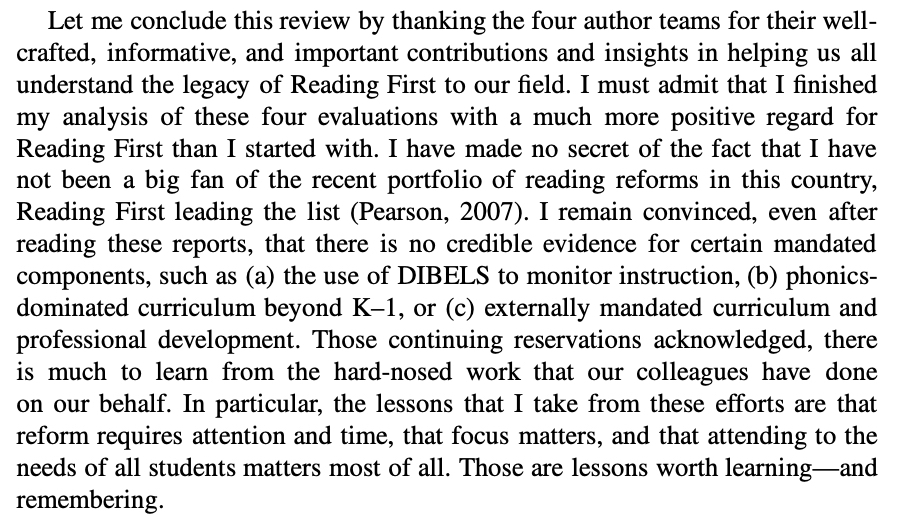
As we wander into 2020, the “science of reading” movement has developed a few new approaches grounded in the foundational arguments that have made “science of reading” as compelling as a zombie story: discrediting popular reading programs as not scientific and reanimating Reading First (the program built on the National Reading Panel).
Central to these developments in the “science of reading” onslaught on reading are two key names: Timothy Shanahan and Lucy Calkins.
In many ways, Shanahan (a member of NRP) has emerged as a key voice in rewriting the history of both the NRP and Reading First. Calkins, as the name on a widely adopted reading program, now represents the so-called failed balanced literacy movement.
Here we have names and people superimposed onto the false war between phonics (Shanahan) and balanced literacy/whole language (Calkins).
However, there is no value in mainstream media pointing fingers at Calkins, charging her with a self-serving agenda, while supporting Shanahan, who is conducting his own PR campaign for his role in the NRP. Let them without agendas cast the first stone. (Hint: There are plenty of agendas to go around on this.)
A new player has moved into the curriculum review market: Nonprofit consulting group Student Achievement Partners announced this week that it is going to start evaluating literacy curricula against reading research.
The seven literacy researchers who reviewed the program gave it a negative evaluation, writing that it was “unlikely to lead to literacy success for all of America’s public schoolchildren.”
This last point quoted from the review is incredibly important to unpack, as is the urgency with which the mainstream media reports this review mostly uncritically.
First, there is a serious contradiction and hypocrisy when the mainstream media commit to a term such as the “science of reading,” demanding that reading instruction is always grounded in a narrow concept of “scientific” (the so-called gold standard of cognitive psychology, specifically), but participate in press release journalism.
We must ask about the review endorsed by EdWeek: Is it scientific? Has it been blind peer-reviewed? Do the authors have any agendas that would skew the findings?
And then we must argue: If mainstream journalists are now demanding that educators implement only practices supported by high-quality scientific studies, those journalists should not report on any reviews or studies that themselves are not also high-quality scientific studies.
This contradiction in which the media have lower standards for their reporting than for the agenda they are promoting is a window, however, into what is really going on, bringing us back to the conclusion about Calkins’s reading program.
All reading programs can and should be viewed through that conclusion: “unlikely to lead to literacy success for all of America’s public schoolchildren.”
In fact, like the Orwellian named Reading First, reading programs always put reading last because reading programs are inevitably linked over the past 40 years to the accountability movement; teachers and students have been disproportionately held accountable for implementing and following the programs and not for authentic reading.
Reading First did in fact fail, despite arguments to the contrary, because the bureaucracy allowed the natural corruption inherent in the market; funding for reading became inappropriately tied to specific reading programs and textbook companies using the label of “scientifically based” (a central element of No Child Left Behind and the NRP almost twenty years ago).
Reading was last in the Reading First scandal because the focus became adopting and implementing Open Court.
The real irony here is that the market/accountability dynamic is at the heart of why it makes perfect sense to conclude that Calkins’s program is “unlikely to lead to literacy success for all of America’s public schoolchildren.”
And the bigger irony is that whole language and balanced literacy were attempts to pull back from scripted and prescriptive program approaches to teaching reading and to provide philosophical and theoretical frameworks within which teachers could use their professional autonomy to shape reading instruction to the needs of “all of America’s public schoolchildren.”
This is a much ignored truism found in John Dewey: In education, we must resist reducing philosophical and theoretical truths to fixed templates that then become not guiding principles but simplistic mandates to be fulfilled.
Children reading eagerly and critically—this is the real goal of teaching reading in our public schools; that is putting reading first, not any commercial program whether it be systematic intensive phonics or one promoted as balanced literacy.
Reanimating NRP and Reading First is, I concede, on its second round so I can hold out hope that a vigilant double tap may put these zombies back in the ground permanently.
None the less, I will remain anxious like Columbus, skeptical that we are safe.
My experience with Yoko Ogawa’s The Memory Police was filled with moments of disorientation that matched at a much smaller level the events of the novel, set on an unnamed island where the inhabitants suffer through a series of disappearances under the surveillance of the Memory Police.
First, I was drawn to the stunning cover and a description promising a stark work of science fiction.
Since I received a hardback copy and the inside flap claims the novel is a “stunning new work,” I began reading the work as exactly that—a newly published novel by a young writer.
Yet, as I read, the genre wasn’t so neatly clearcut, and I soon learned the novel is from 1994, the English translation being new, but Ogawa, now in her late 50s, has a celebrated career in Japan.
“I sometimes wonder,” the narrator begins, “what was disappeared first—among all the things that have vanished from the island” (p. 3). And from there, the novel proceeds ominously but softly, or subtly, in a voice and a story that do prove to be stark but defy a simple label of science fiction; at turns it reads as fantasy, and then as fable or allegory.
For a book centered on the provocative act of disappearing, I was drawn as well to how much is not there to begin with. Character names and place names are missing or sparse. But I also felt off balance, disoriented, by the mismatch between the patient and soft narration against the foreboding doom of the disappearances, some of which seem minor although the loss and the ever-present threat of the Memory Police render all of the disappearances life-altering.
Reading Ogawa for the first time reminded me of Haruki Murakami, Albert Camus’s The Stranger, and Philip K. Dick—although I quickly warmed to seeing the novel as purely a work by Ogawa. In some ways there is a sense of detachment and very slow development I find often Murakami, and may be shared qualities of Japanese narrative.
Broadly, Ogawa’s fable is a powerful reflection of Camus’s existential message from The Stranger: “after a while you could get used to anything” (p. 77). However, in Ogawa’s allegorical nightmare, that concept is both proven and stretched almost beyond comprehension by the end of the novel.
It is the similarity with Philip K. Dick that sits strongest with me, though. Like Dick, Ogawa creates a pervasive sense of foreboding and fatalism in the lives of the characters. The totalitarian reality of The Memory Police is similar to many of Dick’s works as well as Margaret Atwood’s The Handmaid’s Tale and The Testaments, but Ogawa keeps the reader detached from and uninformed about the facts of that oppressive society.
Also similar to Dick, Ogawa investigates human nature, including what makes anyone human—or in this case, what can a human lose and still remain human (similar to a motif in Kazuo Ishiguro’s Never Let Me Go).
Another sparse aspect of the novel is plot, but as a reader, I was fully engaged with the characters; Ogawa’s careful and delicate portrayal of friendship and intimacy suggests that at least one key component of being fully human is our community with others.
The Memory Police begins calmly and persistently, but it never really reaches a boil or fever pitch, ultimately fading to the end more so than disappearing suddenly as is the case within the narrative. The novel, in fact. ends with the word “disappear,” and I was left filled and emptied simultaneously.
While reading this novel, I ordered four more of Ogawa’s works, and immediately began The Housekeeper and the Professor, where I found a rhythm that feels distinctly Ogawa’s.
While this slim novel reads as literacy fiction with a touch of allegory, absent many of the conventions of genre fiction, Ogawa once again deals with memory. In The Memory Police, characters not only have material disappearances, but over time, most of the characters no longer remember what has been lost—except for the rare few who become targets of the Memory Police.
Recall becomes dangerous, and suggests those with their memories intact have power that the omnipresent Memory Police are charged with erasing.
The premise of The Housekeeper and the Professor is not fantastical, but it is exceptional; the Professor of the title is an aging mathematical genius who, after an accident, has only 80 minutes at a time of memory along with his memory of his life prior to 1975.
Since his short-term memory constantly resets, his sister-in-law, alone as his caretaker, is challenged to keep a housekeeper employed to manage his life.
Ogawa builds on this unusual circumstance a really sweet and beautiful narrative about the housekeeper, her young son (dubbed Root by the Professor), and the Professor. The characters are often gentle and kind souls, often delicate, in spite of the odd nature of the Professor’s life and their tenuous relationships.
The story is often quirky, and Ogawa manages several moments of real tension on much smaller levels than in The Memory Police, but palpable tension none the less.
Although not essential knowledge for the reader, this novel’s use of mathematical principles is the motif that holds the story together, more weighty than the low profile of the plot and the slow development of the themes and characterizations. For the Professor and eventually the housekeeper and her son, math is beautiful and fascinating.
In Ogawa’s work, memory as that blends with all human relationships seems to be an essential element of being fully human, but in The Housekeeper and the Professor, readers also witness something about our basic humanity, for example in how the Professor interacts with and teaches Root:
Among the many things that made the Professor an excellent teachers was the fact that he wasn’t afraid to say “we don’t know.” For the Professor, there was no shame in admitting you didn’t have the answer, it was a necessary step toward the truth. It was as important to teach us about the unknown or the unknowable as it was to teach us what had already been safely proven. (p. 63)
That last sentence, I think, is a wonderful description of my experience reading Ogawa, which now continues with her collected three novellas, The Diving Pool.
After posting this in 2019 while working on the first edition of How to End the Reading War and Serve the Literacy Needs of All Students: A Primer for Parents, Policy Makers, and People Who Care, I have published the second edition and continued to work on the “science of reading” movement.
Regretfully, McQuillan’s work is even more relevant in 2023 because the media and political response to the SOR movement has gained momentum despite the evidence that it is mostly misinformation and another round of the exact reading war McQuillan debunked in the 1990s.
I highly recommend accessing this (which I will cite/quote below in the update of the original post):
Recently, I have been (frantically but carefully) drafting a new book for IAP about the current “science of reading” version of the Reading War: How to End the Reading War and Serve the Literacy Needs of All Students: A Primer for Parents, Policy Makers, and People Who Care.
Those familiar with this blog and my scholarly work should be aware that I often ground my examinations of education in a historical context, drawing heavily on the subject of my dissertation, Lou LaBrant. The book I am writing begins in earnest, in fact, with “Chapter 1: A Historical Perspective of the Reading War: 1940s and 1990s Editions.”
As I have posted here, the “science of reading” over-reaction to reading and dyslexia across mainstream media as well as in state-level reading legislation has a number of disturbing parallels with the claims of a reading crisis in the 1980s and 1990s. Few people, I explained, are aware of the 1997 report authored by Linda Darling-Hammond on NAEP, reading achievement in the U.S., and the positive correlations with whole language (WL) practices and test scores.
I imagine even fewer education journalists and political leaders have read a powerful and important work about that literacy crisis in the 1990s, Literacy Crises: False Claims and Real Solutions by Jeff McQuillan.
In his Chapter 1, “What Isn’t Wrong with Reading: Seven Myths about Literacy in the United States,” McQuillan admits, “Serious problems exist with reading achievement in many United States schools,” adding, “Yet in the midst of media coverage of our (latest) ‘literary crisis,’ we should be very clear about what is and is not failing in our schools” (p. 1).
This leads to his list of myths ([1] updated with material from McQuillan’s article noted above), which are again being recycled in the “science of reading” version of the Reading War:
Myth 1: Reading Achievement in the United States Has Declined in the Past Twenty-Five Years.
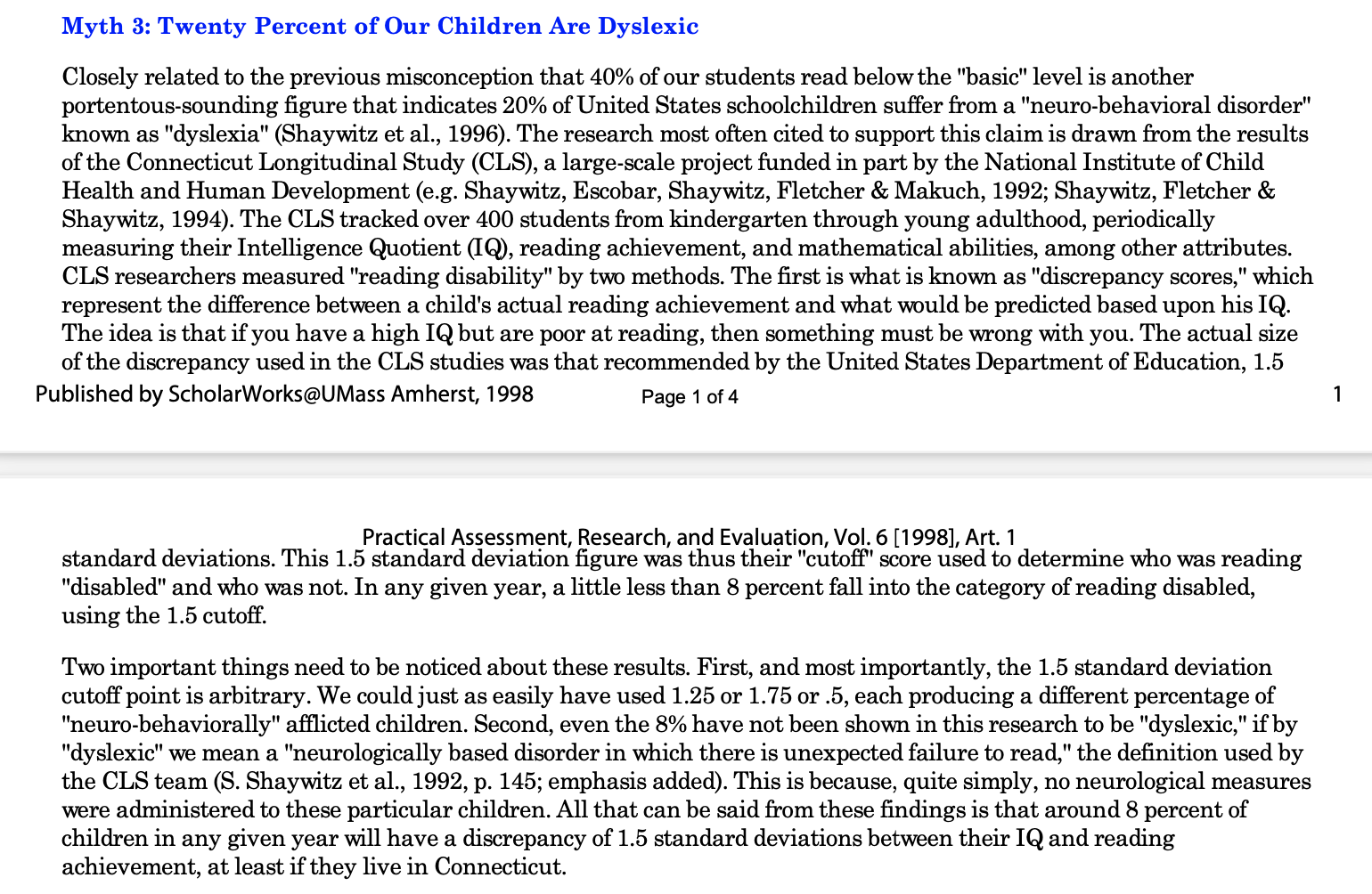
Myth 2: Forty Percent of United States Children Can’t Read at a Basic Level.
Myth 3: Twenty Percent of Our Children Are Dyslexic.
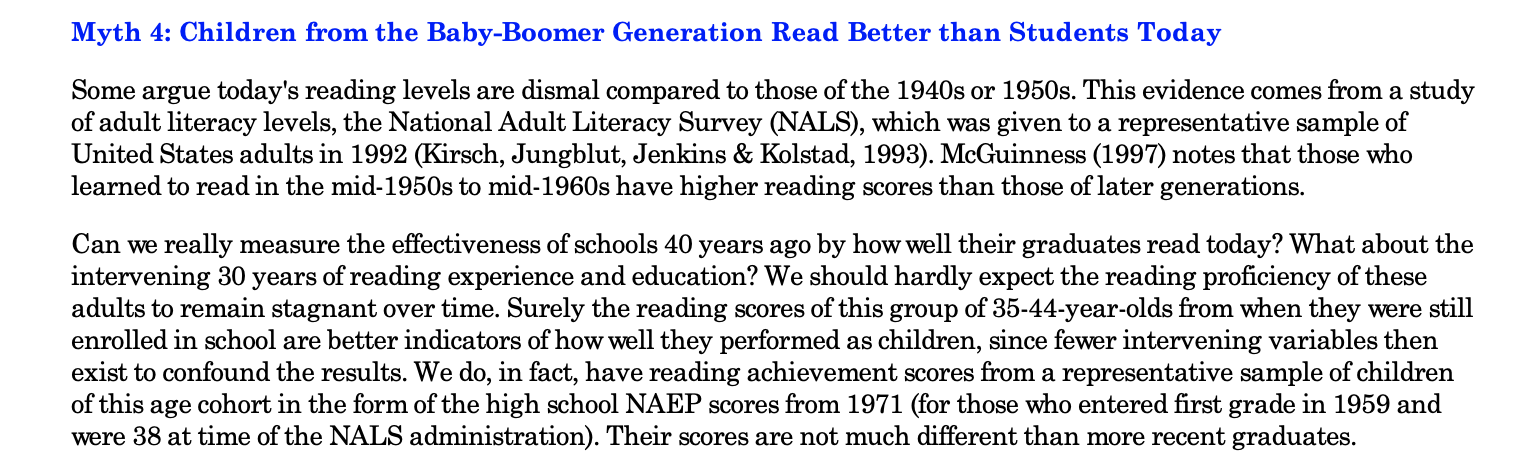
Myth 4: Children from the Baby Boomer Generation Read Better than Students Today.
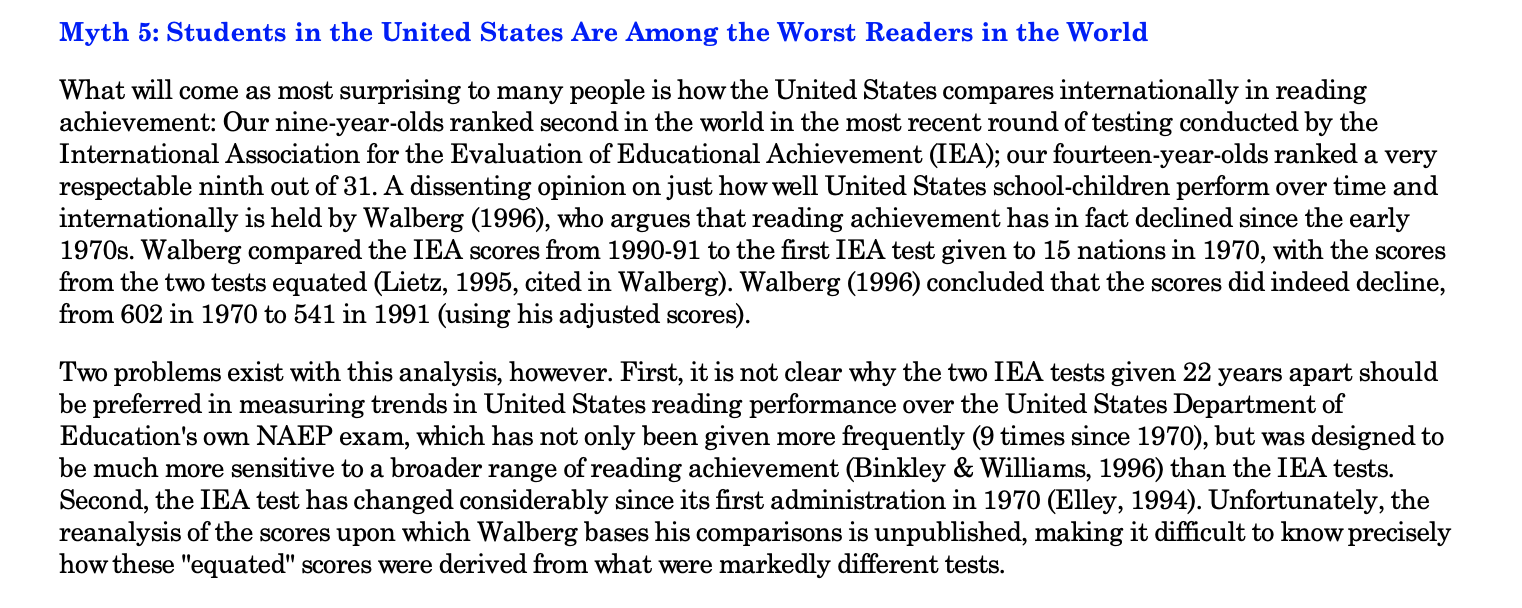
Myth 5: Students in the United States Are Among the Worst Readers in the World.
Myth 6: The Number of Good Readers Has Been Declining, While the Number of Poor Readers Has been Increasing.
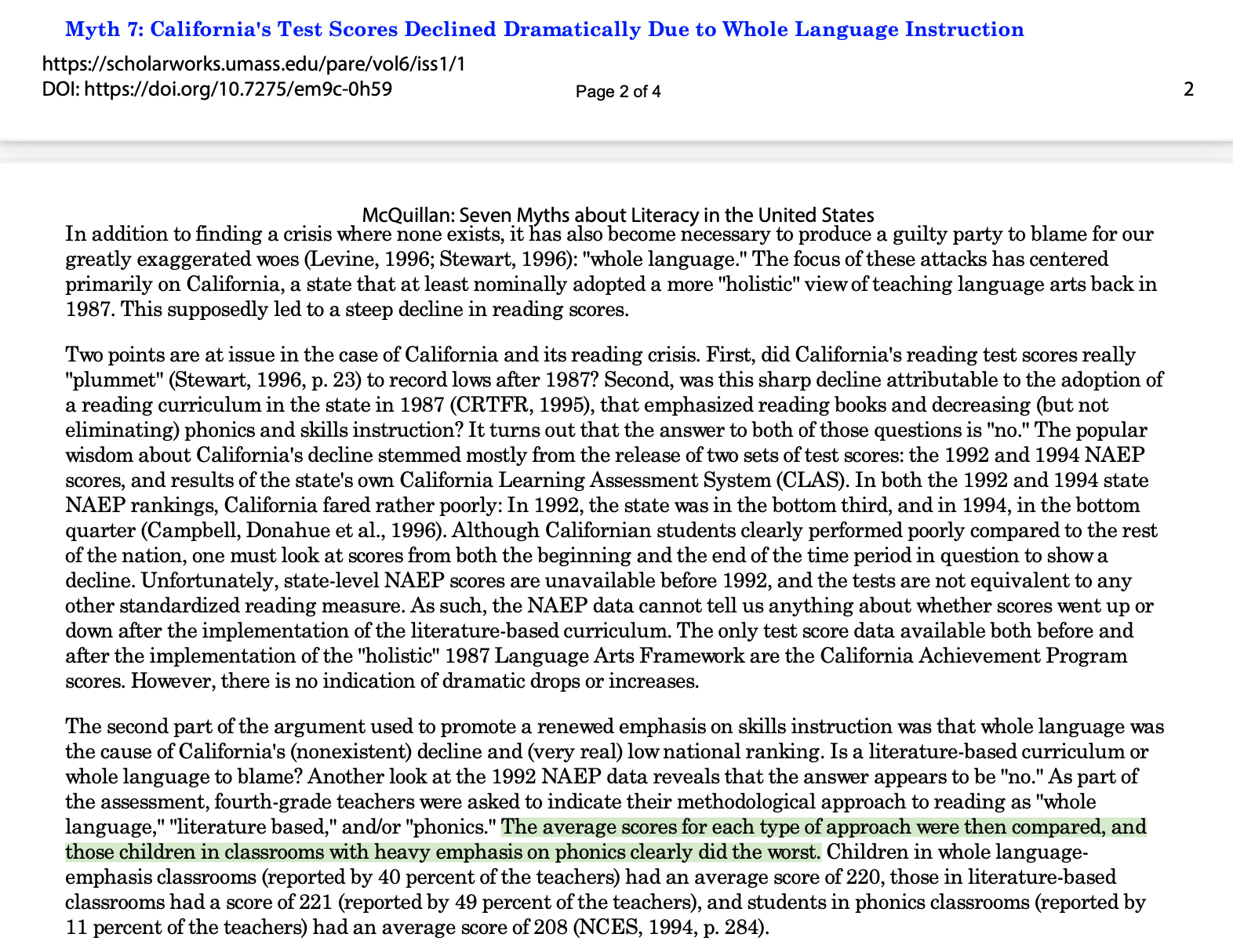
Myth 7: California’s Test Scores Declined Dramatically Due to Whole Language Instruction.
McQuillan carefully dismantles each of these, with evidence, but many today continue to make the same misguided and unsupported claims.
In 2019 (and 2023), McQuillan’s work remains important, and relevant, both for understanding how we should teach better our students to read and how the current version of the Reading War is wandering once again down very worn dead-end roads.
Science is an old-growth forest, each tree an organic thing. Think of a tree as a theory. At any moment that tree (theory) is fully a tree but not the tree it will be.
As a tree grows, it becomes more robust, a stronger trunk, deeper roots. If we inspect that trunk, we find rings detailing the history of how that tree became stronger with age. Theories too are not simply the result of fixed evidence, but an accumulation of evidence, an accumulation that evolves over time.
Science, like that old-growth forest, is never settled, but it is always at any moment the best that it can be in terms of being a forest and in terms of the trees being the tress of that moment. You see, science is also organic, not yet the forest or trees it can and will be.
Old-growth forests are also characterized by being untouched by humans, and while science is the product of humans, science often seeks ways to limit the flaws of that human contact (a lofty and unattainable goal, but one that helps science aspire toward truth and Truth).
Science ultimately is aspirational; it can never be settled, fixed, and anyone using science as a hammer is, in fact, not being scientific.
Science is not a hammer.
Science is an old-growth forest, each tree an organic thing.
#
Viewing science as a hammer is the fatal flaw of the “science of reading” (SoR) movement that has gained momentum in 2019. Advocates of SoR begin by claiming that this science is settled:
In spite of the current discussions, the science on this instructional issue is settled. Castles, Rastle, & Nation (2018) lay out that there is a clear progression to effective literacy instruction. First and foremost, children need to understand the principles of spelling-sound correspondences and to solidify a store of high-frequency words to read words and phrases fluently. Most children need explicit teaching to build this knowledge. After decoding and high-frequency words are established, more attention can be devoted to comprehension with a focus on making meaning. Castles et al. (2018) offer a logical and research-based model. In spite of this research, educators remain without consensus about what is most important—phonics instruction or a focus on comprehension.
Science is not a hammer, neither is it to be used to bludgeon nor is it a singular tool.
In fact, especially for education as well as teaching literacy, science is a much broader spectrum of evidence than SoR advocates are arguing, steeped as they are in the neurosciences.
The science needed to guide real-world teaching of literacy is an old-growth forest of many types of trees at different stages of growth.
For example, I primarily have been a teacher of writing for 36 years and counting. I have taught students from 9th grade through graduate courses.
As a scholar of teaching writing, I am well versed in the experimental/quasi-experimental research base on teaching writing as well as a huge and complex body of qualitative research.
I also have 36 years of experience with thousands of students.
All of that is at my disposal as I teach any student to write, an act that for me is highly individualized—even when I taught 100-125 high school students five days a week.
The generalizations and controls that result from and govern experimental/quasi-experimental research (which is dominant in neuroscience) are informative (not prescriptive) for me as a teacher, but my work tends to be with many different outliers—humans, that is—who may thrive with practices outside the constraints of narrow types of science.
I don’t use science as a hammer because students are fragile things, and instruction that treats them all as ten-penny nails is unwarranted.
#
You may be thinking about climate change, evolutionary science, or vaccinations—all of which many people would argue are settled science.
“Settled,” I think, remains a problematic word even in those contexts.
All science based in experimental/quasi-experimental research when properly vetted is compelling, compelling to the point that it feels settled, compelling to the point that we must act in ways that confirm it is settled even as we are aware this tree may grow.
Since all sciences remain in the replication loop, we are best off calling even the largest tree with the most powerful trunk and deepest roots “compelling,” not settled.
In qualitative research, “compelling” is the best we can hope for, but much of that research is compelling, although with caveats about the evidence not reaching standards of generalizability and the conditions of the evidence not bound by controls.
#
Let me end with an anecdote, what some would call not scientific. It is the story of having taught writing for 36 years and counting, and still being very cautious about my practice and very nervous about the fate of my field of teaching writing.
Actually this is an anecdote about gathering anecdotal evidence, the sort of scientific teaching that John Dewey envisioned for progressive educators.
I always spend the last class of my first-year writing seminars by discussing with students what has worked and what I should do differently in the future.
I also use this class to re-emphasize that my overarching goals for these classes are about fostering in them greater authority and autonomy as students and writers about to run the gauntlet of three-and-a-half additional years (or more) of college.
This fall, students argued for having Essay 1 turned in earlier, allowing more time and class sessions for Essay 3 (the academically cited essay), and moving Essay 4 earlier to leave more time for the revised submission.
We fleshed out these requests against the goals of the course, and ultimately, I found their anecdotal feedback compelling. My schedule for fall 2020 will be revised.
As the professor, as well, I have reflected on how to better encourage students to revise their essays and not simply address what I have marked for them. I discussed this problem with another teacher, and am considering a new policy on how students should resubmit their essays.
In the past, I have required students to resubmit essays in clean Word files, track changes, comments, and highlighting all removed. Part of that requirement was aimed at helping students better use Word as a tool, but I also have trouble with Word files that are busy.
However, as I discussed student revision with a friend who teaches writing, I thought about how students having the track changes visible for their revisions would show them how much, or how little, they actually revised. Visible track changes can be a very effective teaching tool.
So my new policy may be that students submit two Word files, one clean and one with only the track changes of their revisions (with the file including “TC”).
This, then, is a brief anecdote about how I teach scientifically as a professional educator, a writer, and an expert in literacy. I teach with caution, I resist teaching with a hammer.
This means that when some students demonstrate a need for a type of instruction not supported by a narrow type of research, I still provide the student with that instruction. We may even experiment with a range of strategies until the student feels capable on their own.
I am always cautious, but I am also nervous because while the “science of reading” mania is in full stride, I see on the horizon a similar fate for the teaching of writing: Scientific evidence on how to teach writing is slim.
I suspect the mainstream media will discover a field that already exists, has for a century or more. I suspect the allure of “science” will blind that media and those who also feel passionate about the dismal state of student writing.
So somewhat preemptively, I want to offer about the teaching of writing:
Science is not a hammer.
Science is an old-growth forest, each tree an organic thing.
To make his case, Reeves — much like the Mississippi Department of Education itself — is chronically selective in his statistics, telling only part of the story and leaving out facts that would show that many of these gains are either illusory or only seem to be impressive because the state started so far behind most of the rest of the nation….
Even the state’s impressive improvement on the National Assessment of Educational Progress may not be quite all that it seems.
From 2013 to 2019, the latest year for which results are available, Mississippi students rose faster in fourth grade reading than anyone on the national test. They improved their ranking from 49th to 29th. The gains in math were even more impressive, jumping from 50th to 23rd during that same time frame.
Reeves attributes the progress to “third grade gate,” the reform pushed through by Republicans in 2013 that requires third graders to demonstrate they are at least minimally proficient in reading before they advance to fourth grade.
The Republican belief is that the threat of having to repeat a grade has prompted students, their families and teachers to work harder to be sure that doesn’t happen.
Another interpretation has been offered, though. It’s that because of third grade gate, Mississippi’s lowest performing students get an extra year of instruction before they take the fourth grade test. With the state failing more than twice as many students in their early years as the national average, that could create a significant advantage, though probably a short-lived one.
The research remains inconclusive on this point. It’s not on the others.
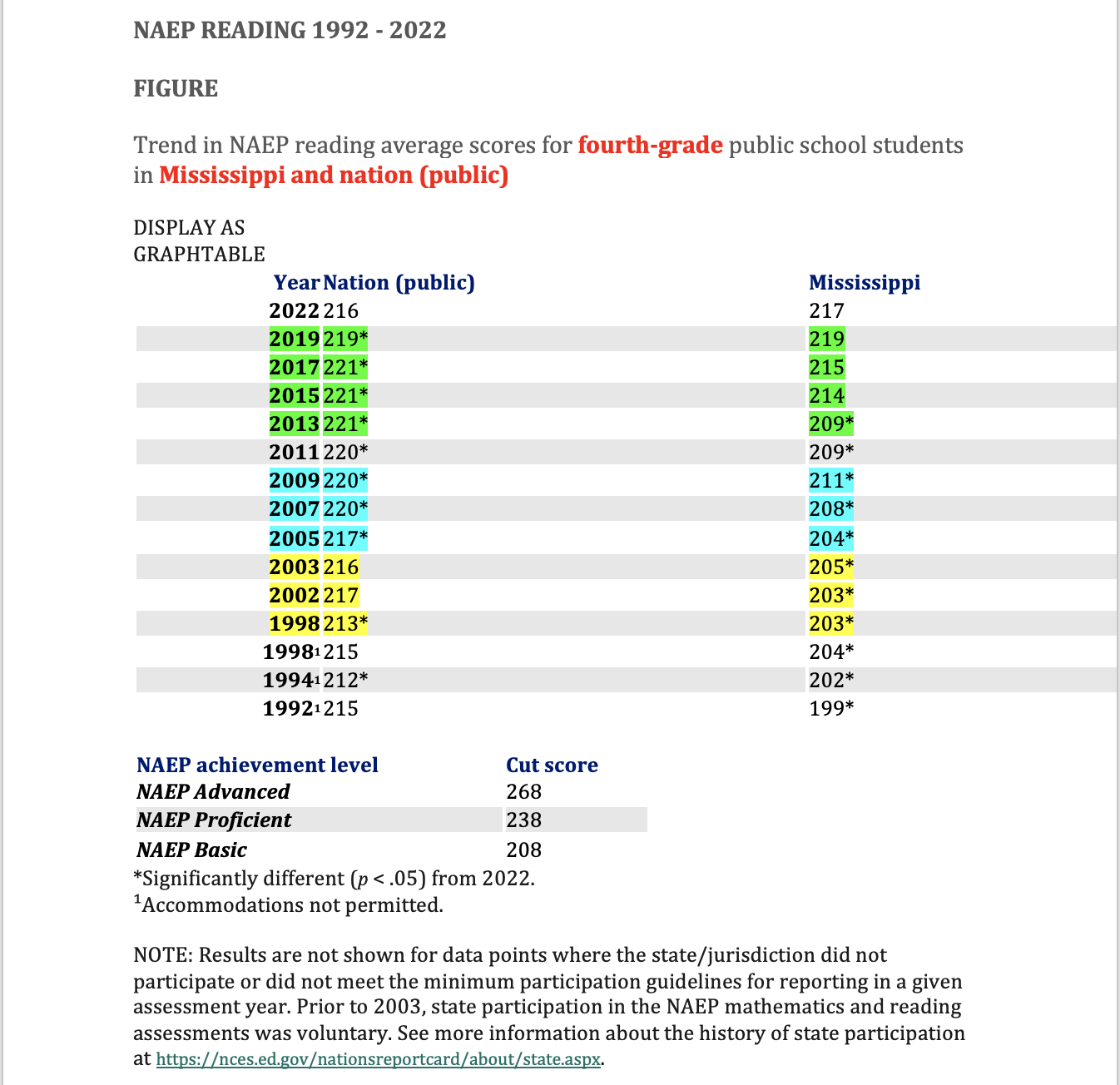
Note the trends in Mississippi’s NAEP Reading scores from 1992 through 2022 and the contrast between grade 4 and grade 8:
Note that Mississippi’s grade 4 reading scores on NAEP show:
MS has steadily improved scores over thirty years despite adopting different reading programs, implementing different state standards, and reforming with multiple reading policies.
MS has had two large gains—one from 2005 to 2009, 7 points, and one from 2013 to 2019, 10 points, dropping to 8 with 2022—raising a question about the role of SOR legislation since that first large gain is pre-SOR.
MS remains well below proficient on average, similar to other high-poverty states.
Note that Mississippi’s grade 8 reading scores on NAEP show:
Apparent “gains” made in grade 4 have disappeared by grade 8 (consistent with research on systematic phonics instruction for reading).
MS grade 8 scores on reading have remained relatively flat for 24 years.
MS grade 8 larger increases happened in 2002-2003 and 2017-2019, again one well before and another after SOR legislation.
This is a great deal to ask of the average reader, but Hanford’s argument is grounded in a claim that most students in the U.S. are being taught reading through methods that are not supported by scientific research (code for narrow types of quantitative research that can identify causal relationships and thus can be generalized to all students).
However, the contradiction lies in Hanford’s own concession about the 2019 NAEP reading data from Mississippi:
The state’s performance in reading was especially notable. Mississippi was the only state in the nation to post significant gains on the fourth-grade reading test. Fourth graders in Mississippi are now on par with the national average, reading as well or better than pupils in California, Texas, Michigan and 18 other states.
What’s up in Mississippi? There’s no way to know for sure what causes increases in test scores [emphasis added], but Mississippi has been doing something notable: making sure all of its teachers understand the science of reading.
To be fair, there is a way to know, and that would be conducting scientific research that teases out the factors that can be identified as causing the test score changes in the state.
In her missionary zeal for the “science of reading,” Hanford contradicts herself by taking most of the article to imply without any scientific evidence, without any research, that Mississippi’s gains are by her fervent implication a result of the state’s embracing the “science of reading”: “In 2013, legislators in Mississippi provided funding to start training the state’s teachers in the science of reading.”
Therefore, it is simply far too soon after the release of the 2019 NAEP scores to suggest any relationship between classroom practices (as if they are uniform across an entire state) and NAEP scores. Any implications about Mississippi are premature and irresponsible to make for journalists, politicians, or advocates for education.
Premature and irresponsible.
Second, data from Mississippi are more than 4th-grade 2019 reading—if we genuinely want to know something of value about teaching children to read.
Mississippi’s outlier 4th-grade reading scores are way more complicated once we frame them against longitudinal NAEP scores as well as 8th-grade reading scores. These, then, are more data we should using to ask questions about Mississippi instead of making rash and unscientific claims:
4th grade reading trends
4th grade score gaps
8th grade reading trends
8th grade score gaps
Here are some complicated takeaways from this larger picture:
If the “science of reading” is the cause of recent gains in 4th-grade reading in MS, how do we explain that MS has seen a trend of increased scores since 1998 and pretty significant jumps between 2005 and 2009[1], well before the shift identified by Hanford in 2013?
Why does MS still show about the same gaps between Black and white students as well as between socioeconomic classes of students since 1998 if how we teach reading is the key factor in achievement?
And a really powerful question concerns 8th grade: Are any 4th-grade gains by MS (or any state) merely mirages since many states with 4th-grade gains see a drop by 8th grade and since longitudinal 8th-grade scores are mostly flat since 1998?
UPDATE:Todd Collins has raised another important caveat to the 4th-grade reading gains in Mississippi because the state has the highest 3rd-grade retention percentages in the country:
But Mississippi has taken the concept further than others, with a retention rate higher than any other state. In 2018–19, according to state department of education reports, 8 percent of all Mississippi K–3 students were held back (up from 6.6 percent the prior year). This implies that over the four grades, as many as 32 percent of all Mississippi students are held back; a more reasonable estimate is closer to 20 to 25 percent, allowing for some to be held back twice. (Mississippi’s Department of Education does not report how many students are retained more than once.)
This last concern means that significant numbers of students in states with 3rd-grade retention based on reading achievement and test scores are biologically 5th-graders being held to 4th-grade proficiency levels. Grade retention is not only correlated with many negative outcomes (dropping out, for example), but also likely associated with “false positives” on testing; as well, most states seeing bumps in 4th-grade test scores also show that those gains disappear by middle and high school.
Ultimately, if anyone wants to argue that how we teach reading in the U.S. must be grounded only in a narrow view of “scientific” (and that is a terrible argument, by the way), then any claims we make about the effectiveness of those practices must also be supported by scientific research.
Despite efforts to make Mississippi a shining example of how all states should address reading policy, we should be using Mississippi (and the 29 states scoring higher) to examine all the factors contributing to why students achieve at the levels they do on NAEP reading.
Unless of course we have real political courage and are willing to admit that NAEP and any form of standardized testing are the wrong way to make these decisions.
Here’s something to think about in that regard: As long as we use this sort of testing, we will always have some states above the average, several at the average, and some below the average—resulting in the same nonsensical hand wringing we see today that is no different than any decade over the last 100 years.
I recommend instead of all the scientific research needed to make any fair claim, we stop the testing, make teaching and learning conditions better, make the lives of children and their families in the U.S. better, and do the complicated daily work it requires to serve the needs of all students.
NOTE
[1] Hanford contradicts herself again and open the door to another question:
For years, everyone assumed Mississippi was at the bottom in reading because it was the poorest state in the nation. Mississippi is still the poorest state, but fourth graders there now read at the national average. While every other state’s fourth graders made no significant progress in reading on this year’s test, or lost ground, Mississippi’s fourth-grade reading scores are up by 10 points since 2013, when the state began the effort to train its teachers in the science of reading. Correlation isn’t causation* [emphasis added], but Mississippi has made a huge investment in helping teachers learn the science behind reading.
There is an 8-point jump in 4th-grade reading in MS from 2002 to 2009—well before the 2013 shift to the “science of reading”—thus how is that explained? [UPDATED]
* For the record, causation is a key component of “scientific,” which Hanford espouses for reading, yet she stoops to correlation (not scientific) to make her argument.
educator, public scholar, poet&writer – academic freedom isn't free














 dr. p.l. (paul) thomas