Category Archives: reading

Back to the Future of Reading Instruction: 1990s Edition

[Header Photo by Javier Allegue Barros on Unsplash]

The year is 1997 and the topic, of course, is improving a failing education system in the U.S. Linda Darling-Hammond explains in the Preface [1]:

This follow-up report, Doing What Matters Most: Investing in Quality Teaching, seeks to gauge the nation’s progress toward the goal of high-quality teaching in every classroom in every community. It draws on data about the conditions of teaching that have become available since the original Commission report was released, and it examines policy changes that have occurred.

This report has five recommendations that may sound familiar:

I. Standards for teachers linked to standards for students….

II. Reinvent teacher preparation and professional development….

III. Overhaul teacher recruitment and put qualified teachers in every classroom….

IV. Encourage and reward knowledge and skill….

V. Create schools that are organized for student and teacher success.

We need better standards for teachers and students, better teacher education, better recruitment of teachers focusing on high quality, better reward systems for teacher expertise and outcomes, and better teaching and learning conditions.

Yet, the report also offers some sobering information:

Over the last decade, reforms have sought to increase the amount of academic coursework and the numbers of tests students take, in hopes of improving achievement. These initiatives have made a great difference in coursetaking: In 1983, only 14% of high school students took the number of academic courses recommended in A Nation at Risk—4 units in English and 3 each in mathematics, science, and social studies. By 1994, more than half (51%) had taken this set of recommended courses.

Despite these changes, achievement scores have improved little, and have actually declined slightly for high school students in reading and writing since 1988 (see figure 3). [emphasis added]

Let’s look at that figure 3:

NAEP trends 1980 1990

Notice anything familiar above when we look at 4th and 8th grade reading since the early 1990s?

trend grade 4 reading
trend grade 8 reading

While this report concedes what research has long shown—the largest influences on measurable student outcomes are out-of-school factors (parent income, level of education, etc.)—the focus remains on teacher practices, offering a rare set of correlations between scores and those practices:

Correlates of reading NAEP 1992

Here is where I want to pause to note that while no one has conducted even a correlational graph such as the one above—and no one has conducted scientific research to identify causal relationships—to draw conclusions about 2017 and 2019 NAEP scores, this chart raises some key questions about the current “science of reading” claims about teacher education and the need for systematic intensive phonics (and not whole language or balanced literacy).

Note above that whole literacy practices and training correlate with higher scores.

Twenty years after this report from Darling-Hammond have seen at least two significant additional rounds of educational reform, one driven by No Child Left Behind and another sputtering one connected to Common Core.

Just as educational leaders were in the 1990s, we are left with the same data problems, notably flat or dismal reading scores, and can only reach for the same lazy arguments that have never worked before.

The five recommendations from 1997 are echoed today by political leaders and the “science of reading” crowd, all bashing teacher education, teacher expertise, and focusing on standards, tests, and programs.

And little to nothing is done about food and work security, healthcare, or class size—even though these conditions combined would dwarf any measurable impact of teacher quality or program/standards quality.

Ultimately, the “science of reading” and NAEP-crisis rhetoric are doomed because the Christopher Columbus syndrome (thinking you have discovered something that others you ignore or marginalize have known forever) insures that one truism will remain true—those ignorant of history are doomed to repeat it.

Today’s reading crisis is that, back to the future of reading, a 1990s edition recast [2].


[1] Credit and appreciation to Diane Stephens, literacy expert and former professor at the University of South Carolina, who brought this report to my attention.

[2] Don’t forget the 1940s also: “What Shall We Do About Reading Today?”

White Lies, Black Incarceration, and the Promise of Reading in Prison

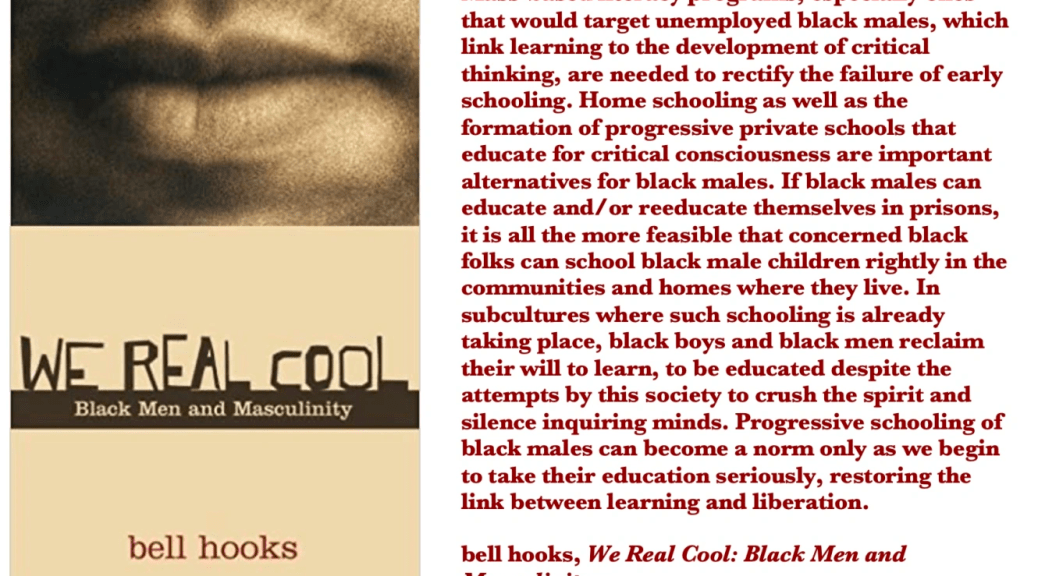
“The curiosity that may be deemed a sign of genius in a white male child is viewed as trouble making when expressed by black boys,” observes bell hooks in Chapter 3 of her We Real Cool: Black Men and Masculinity.

The book’s title echoes the wonderful and precise poem by Gwendolyn Brooks, which also in its powerful concision offers a portrait of the dire consequences of toxic masculinity for Black men.

I came to this work of hooks along with The Will to Change: Men, Masculinity, and Love through an online documentary, The Feminist on Cellblock Y:

The documentary features Richie Reseda who, while incarcerated, began seminars on the patriarchy and toxic masculinity grounded in the writings of bell hooks.

hooks begins Chapter 3 with “More than any other group of men in our society black males are perceived as lacking in intellectual skills,” a claim both represented and refuted by the men who animate the documentary through personal reflections and candid filming of them investigating the texts written by hooks and then navigating prison seminars that rival and even surpass the sorts of college classrooms these men have been systematically denied.

From reading hooks, Reseda came to recognize the systemic forces—patriarchy, toxic masculinity, rape culture—that shaped him and his cellmates into criminals:

Nowadays in the imperialist white-supremacist capitalist patriarch culture, most boys from poor and underprivileged classes are socialized via mass media and class-biased education to believe that all that is required for their survival is the ability to do physical labor. Black boys, disproportionately numbered among the poor, have been socialized to believe that physical strength and stamina are all that really matter.

Reseda explains in the documentary that he also found so-called rehabilitation programs in prison using the same ideologies grounded in patriarchy and toxic masculinity, reducing prisoners, for example, to narrow expectations for manhood and the black body.

The result of his awareness spawned his patriarchy seminars as well as his political activism that helped create an opportunity for him and others to learn their way out of incarceration.

The CNN documentary has a bit over 25,000 views on YouTube and Reseda has around 800 followers on Twitter; the awareness of Reseda, his story, and how it represents the U.S. culture that turns Black men into criminals are far below the magnified lens being afforded Pete Buttigieg, a former mayor running for president.

Buttigieg has fashioned a personae, Mayor Pete, that includes a powerful mix of compelling narratives in the U.S.—military veteran, genius, and the monogamous (and nonthreatening) gay man.

Yet, Buttigieg is a product of systemic forces very similar to the pattern confronted by Reseda in both society and prison rehabilitation; Buttigieg is the embodiment of white male privilege and the bootstrap myth.

While the media have celebrated Buttigieg in ways that are disproportionate to his polling, Michael Harriot has taken Buttigieg to task for possibly the best example of the former mayor’s unexamined privilege and racism.

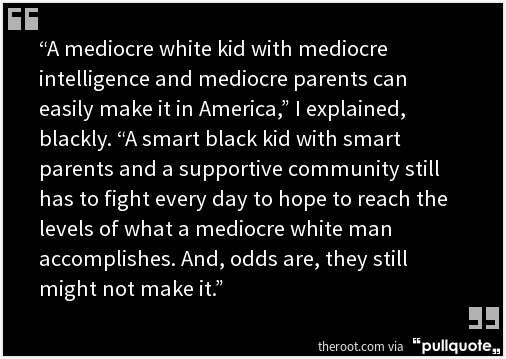
In 2011, Buttigieg mansplained/whitesplained that poor minorities struggle because they do not have adult role models who value education. He offered a compelling and popular narrative in the U.S. that is grounded in gross stereotypes that have been refuted by scholarship on social class and race, as Harriot highlights:

“Kids need to see evidence that education is going to work for them,” Buttigieg explained whitely, when he was running for mayor in 2011. [“]You’re motivated because you believe that at the end of your education, there is a reward; there’s a stable life; there’s a job. And there are a lot of kids—especially [in] the lower-income, minority neighborhoods, who literally just haven’t seen it work. There isn’t someone who they know personally who testifies to the value of education.”

Yet, Harriot explains, “I am from what most people would call ‘the hood.’ The bad section of town. You know—where black people live.” And then he deconstructs both Buttigieg and the culture of poverty Buttigieg voices:

I never said fuck it.

But if I did, it wouldn’t have been because of a lack of role models. If I had chosen to keep my mama’s lights on instead of making that daily trek, my decision wouldn’t have been based on a tropological dearth of “motivation” or communal ambivalence. As I grow older, I realize that I was not gifted, talented or even diligent.

I’m just a lucky motherfucker.

Presidential candidate Pete Buttigieg is a lucky motherfucker, too.

He attended one of the best private schools in the country that was quite literally on the campus of one of the best colleges in the country, Notre Dame University, where his father worked as a professor for 29 years. His mother taught at an even better, more elite school. And if you ask how he got into Harvard or became a Rhodes Scholar, Mayor Pete would probably insist that it had nothing to do with whiteness. He would likely tell you that he valued education and had great role models, both of which are probably true. There is no question that he is intelligent, hard-working and well-educated.

But he didn’t have to jump a ditch.

Buttigieg is culturally popular in the U.S. because he helps keep the focus on the individual; this is in stark contrast to the systemic arguments made by hooks and then demonstrated in the lives of prisoners such as Reseda.

As Harriot asserts, Buttigieg’s message and the entire bootstrap/ rising tide narrative is a lie.

The reality of the ditch in Harriot’s life becomes a metaphor for blackness as an obstacle, for patriarchy and toxic masculinity as a prison.

Reseda’s story, however, has a key—reading and education. When Reseda and other prisoners begin to read for their own liberation, when they become a community of scholars behind bars, they effectively unlocked their intellectual cells and, for some, created avenues to lives outside of incarceration.

While the U.S. fails significantly with its history of mass incarceration, disproportionately impacting Black men, The Feminist on Cellblock Y demonstrates that life inside and outside of prison for Black men, brown men, and poor men has a disturbing similarity to Albert Camus’s musing on life in The Stranger because in both settings these men are prisoners of the patriarchy and toxic masculinity.

Reseda through his own agency working against the system found liberation in the books of hooks so we should not be surprised by this: West Virginia Is Charging Its Inmates $0.03 Cents a Minute to Read Free E-Books. Here’s Why That Matters.

Books, you see, as Ray Bradbury demonstrated in Fahrenheit 451, are dangerous for those with unearned power and liberating for everyone else.

As hooks concludes in her Chapter 3:

If black males can educate and/or reeducate themselves in prisons, it is all the more feasible that concerned black folks can school black male children rightly in the communities and homes where they live. In subcultures where such schooling is already taking place, black boys and black men reclaim their will to learn, to be educated despite the attempts by this society to crush the spirit and silence inquiring minds. Progressive schooling of black males can become a norm only as we begin to take their education seriously, restoring the link between learning and liberation.

$0.03 per minute seems like a small cost, but it is another significant ditch to maintain an imbalance of privilege that elevates Buttigieg while attempting to keep Reseda behind bars.


See Also

Pete Buttigieg Called Me. Here’s What Happened, Michael Harriot

Image

Worst NAEP Reading 2019 Hot Take of the Week

This is really a hard feat, but Put “Whole Language” on Trial by the King of Know-Nothing edureform Michael J. Petrilli is easily the worst NAEP Reading 2019 Hot Take of the week.

Dumb doesn’t get any dumber than this:

An equal-opportunity challenge related to shoddy teacher preparation would likely face the same roadblock. Further, there is little, if any, legal precedent for suing schools of education; even medical schools enjoy significant protections from charges of malpractice related to the physicians they train.

All of which is why it would be important to go after states, and in particular states that have already lost finance-adequacy cases. It would also help if the chosen target states do not require elementary-school teachers to pass an in-depth test of the science of reading before entering the classroom, and if the states host several big education schools that earn failing grades when it comes to preparing candidates to teach reading effectively. States that appear to meet those criteria include Kentucky, South Carolina, and Washington.

Petrilli has entered the “science of reading debate” a little late but just as fact-challenged as the other advocates have been.

So here are a few questions:

  • Where is scientific research that how teacher education programs prepare teachers to teach reading is actually how they teach reading once in the field? (Not any.)
  • Where is scientific research that there is a causal relationship between how reading is taught (and if those approaches are uniform across an entire state) and NAEP scores? (Not any.)
  • And where is scientific research to explain—as Petrilli highlights above—these outcomes for Kentucky, South Carolina, and Washington? (Not any.)

NAEP R 2019 4

NAEP R 2019 7

NAEP R 2019 8

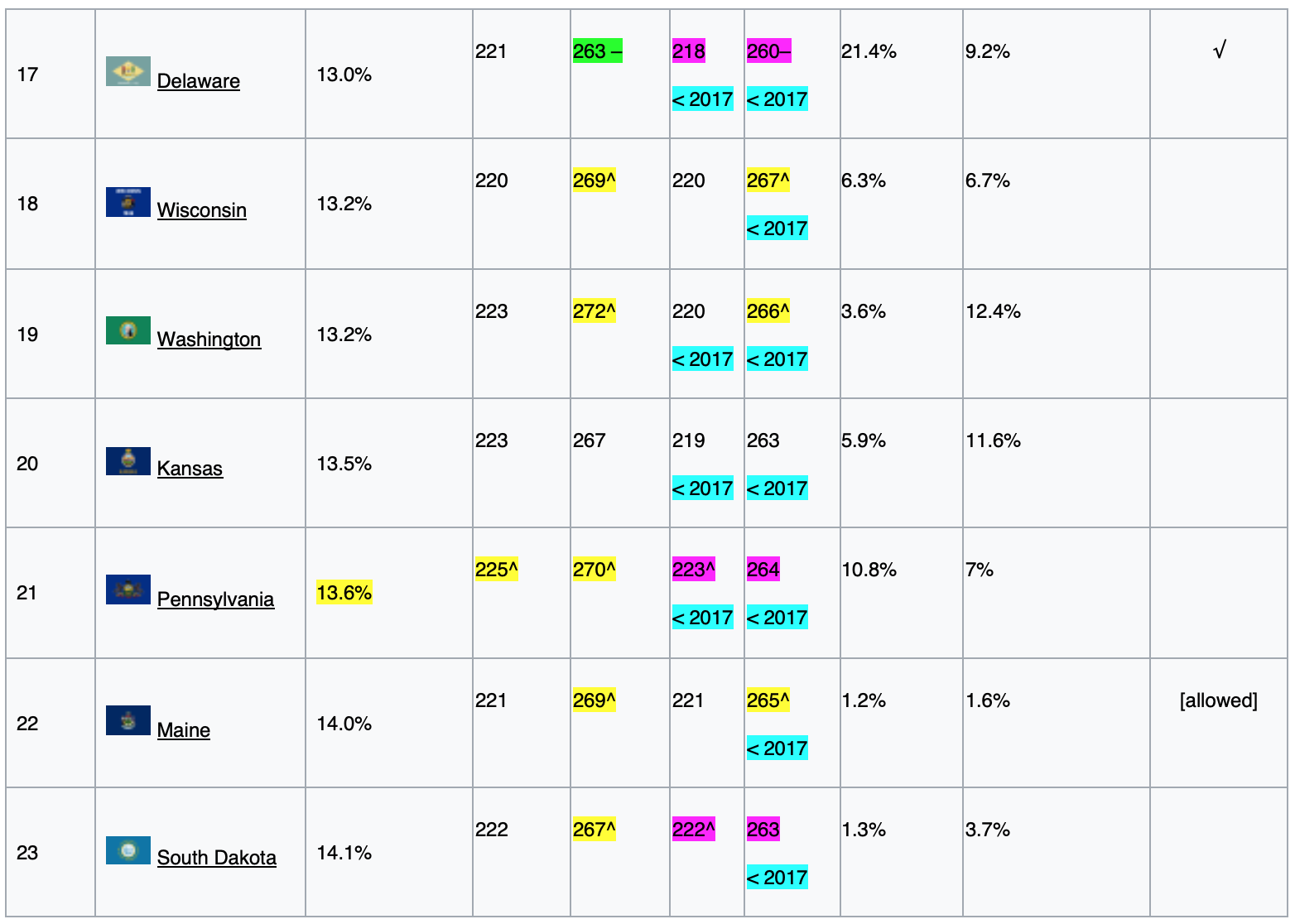
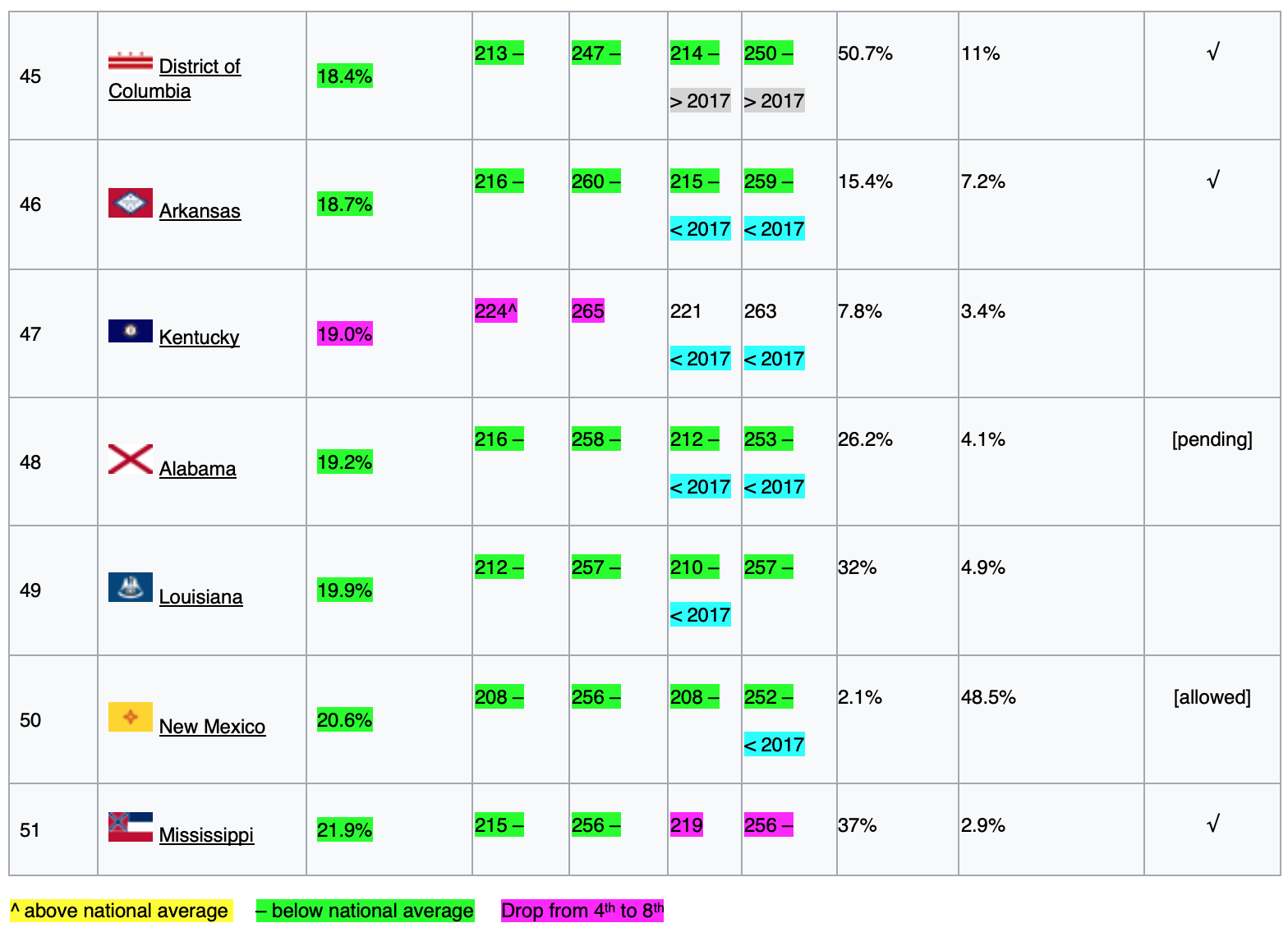
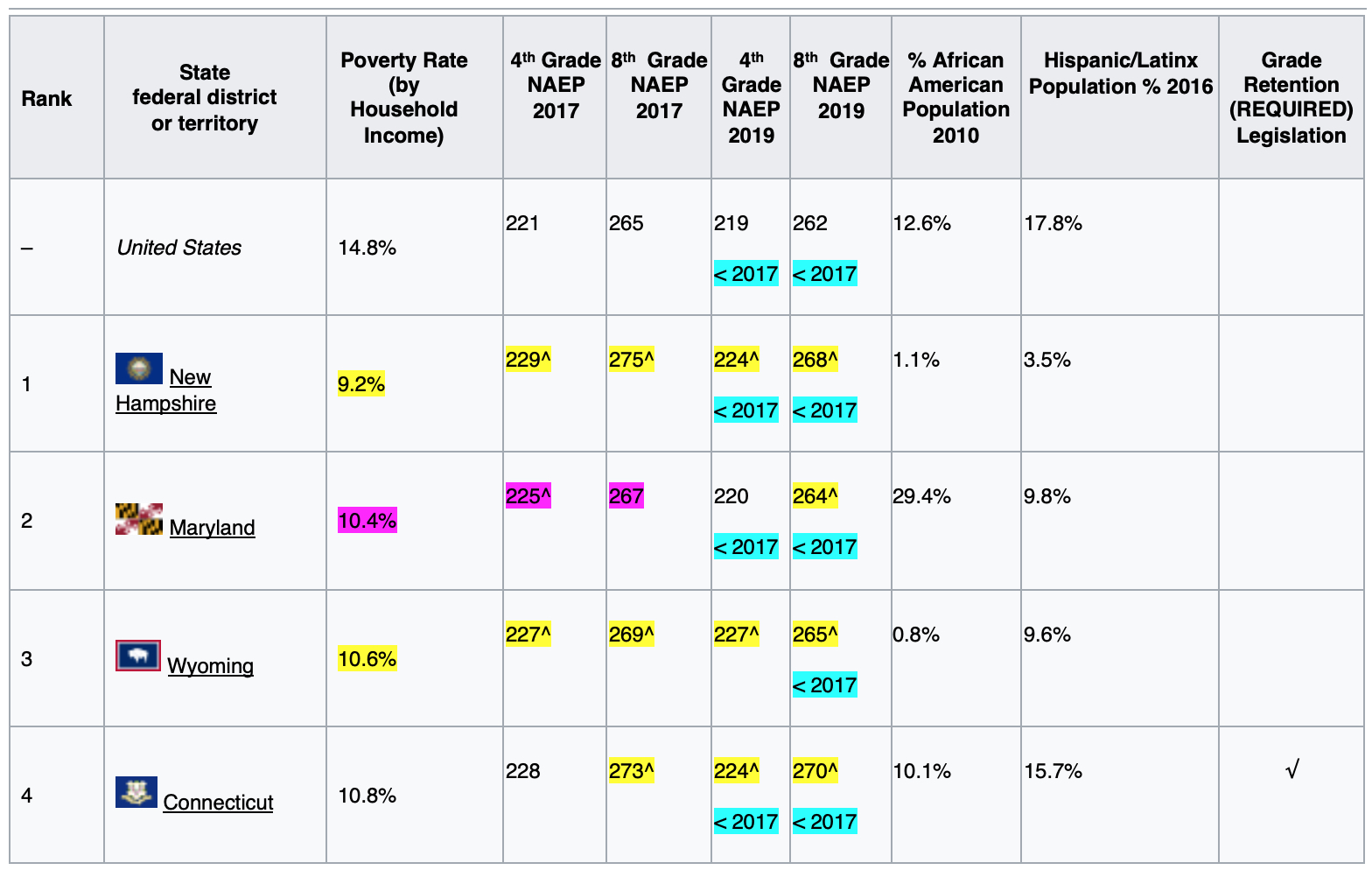
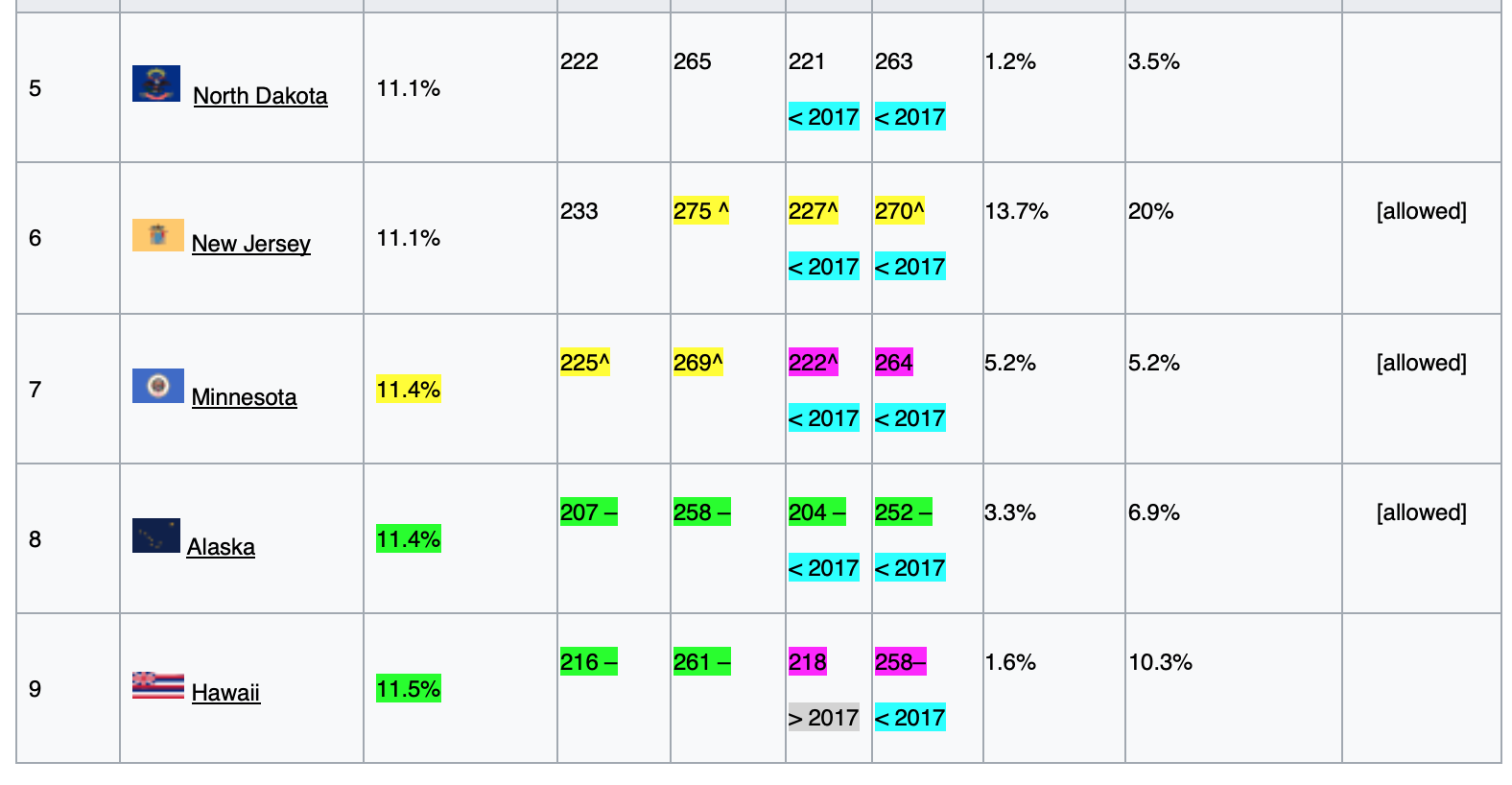
Kentucky, South Carolina, and Washington have 2017 and 2019 NAEP reading scores all over the place—above, at, and below the national average; dropping from 4th to 8th; and dropping from 2017 to 2019 (except one increase by SC, which remains below the national average in every test).

Petrilli is yet another know-nothing that is grasping as “scientific” straws with no evidence on his side.

This is all hokem, rhetorical grandstanding that proves to be hollow.

Shouting the “science of reading” proves itself once again to been mere ideology.

Research, the Media, and the Market: A Cautionary Tale

Reporting in The New York Times, Gina Kolata offers a compelling lede:

The findings of a large federal study on bypass surgeries and stents call into question the medical care provided to tens of thousands of heart disease patients with blocked coronary arteries, scientists reported at the annual meeting of the American Heart Association on Saturday.

The new study found that patients who received drug therapy alone did not experience more heart attacks or die more often than those who also received bypass surgery or stents, tiny wire cages used to open narrowed arteries.

And Julie Steenhuysen adds an interesting detail to this new major study: “At least two prior studies determined that artery-clearing and stenting or bypass surgery in addition to medical treatment does not significantly lower the risk of heart attacks or death compared with non-invasive medical approaches alone.”

But these details may prove to be the most important ones of all: “Over $8 billion worth of coronary stents will be sold annually by 2025, according to a new research report by Global Market Insights, Inc. The increase over the years will be created by an increase in artery diseases coupled with a growing demand for minimally invasive surgeries,” explains Stephen Mraz.

So now let’s do the math. If heart doctors shift to what the new research shows, “The nation could save more than $775 million a year by not giving stents to the 31,000 patients who get the devices even though they have no chest pain, Dr. Hochman said,” reports Kolata.

Better and less intrusive patient care, lower overall medical costs for a U.S. healthcare system already overburdened—what is there to keep the medical profession from embracing compelling scientific research?

Well, the market of course.

Lower costs come from fewer heart surgeries, meaning heart surgeons lose income—and possibly patients.

Keep in mind that while the medical profession decades ago emphasized best practice in prescribing antibiotics (only when bacterial infections are detected), many doctors found that following best practice led to dissatisfied patients, who flexed their consumer muscles by finding doctors who would usurp best practice and prescribe the requested antibiotics even when they weren’t warranted.

The new research on stents and heart disease treatment is a cautionary tale involving research, the media, and the market—a cautionary tale that should inform the current call for the “science of reading,” especially as that impacts children with dyslexia.

That several studies now show the use of stents should be reduced or at least delayed, but that doctors have resisted that evidence calls out for us to ask an important question about scientific research: In whose interest is the research being applied?

At the International Literacy Association 2019 conference, P. David Pearson, University of California, Berkeley, lays out in about 11 minutes a compelling unpacking of What Research Really Says About Teaching Reading–and Why That Still Matters.

In this framing talk before a panel discussion, Pearson confronts the role of media in misinforming the public about research, challenges advocates of “scientific research” who fluctuate between endorsing research and following “common sense,” and calls for not ignoring “scientific research” but expanding the types of research relied upon to make teaching and learning decisions (recognizing a broad spectrum of evidence-based research that trumps ideology or assumptions).

One of the most compelling examples offered by Pearson is how the media framed research on reading after the report from controversial National Reading Panel (NRP), at the center of No Child Left Behind’s mandate for scientific research. The headline Pearson highlights is “Systematic, explicit, synthetic phonics improves reading achievement.”

Yet, the specific study being cited actually was far more complicated, and less endorsing of systematic phonics; along with “many other elements…, a small but robust effect for a subset of the population is found on a measure that requires kids to read a lists of pseudowords.”

Pearson adds that even if we accept the larger NRP report as valid (and several scholars do not), the report calls for systematic phonics for K-1 students, not older struggling readers. Yet, as Pearson explains, many calling for the “science of reading” push for systematic phonics programs throughout grades well beyond grade 1.

So there exists several traps in calling for scientific research in education, and more narrowly, in the teaching of reading.

As another example, consider Timothy Shanahan’s response to the effectiveness of dyslexia fonts:

Over the past decade or so, three new fonts have appeared (Open Dyslexia, Dyslexie, and Read Regular), all claiming—without any empirical evidence—to somehow aid dyslexic readers.

Since then there have been 8 studies into the value of these fonts.

Most of the studies found no improvement in reading rate, accuracy, or eye fixations (Duranovic, et al., 2018; Kuster, et al., 2018; Rello & Baeza-Yates, 2013; Wery & Diliberto, 2017). The studies even found that dyslexics—children and adults—preferred reading standard fonts to the special ones (Harley, et al., 2016; Kuster, et al., 2018; Wery & Diliberto, 2017).

Only one study reported a benefit of any kind—the dyslexic students in this study read faster (Marinus, et al., 2016). This benefit apparently came, not from the font design, but from the spacing within and between words. The researchers increased the spacings in the standard fonts and the same effect was seen. Masulli (2018) likewise found that larger spacings improved the reading speed of dyslexics—but that effect was apparent with non-dyslexic readers, as well.

Reading faster is a good thing, of course, as long as reading comprehension is maintained. Unfortunately, these studies didn’t look at that.

The use of dyslexia fonts, then, are driven by the market—consumer demand being met by businesses—but not supported by evidence; neither the claims of the businesses nor the outcomes from implementing the fonts are justified by “scientific evidence.”

Just as Hooked on Phonics flourished in two different iterations (the first felled by court rulings that exposed the lack of research backing market claims), many reading and phonics programs in education are buoyed by ideology and the market but not by research.

But the traps around programs and “scientific” are extremely complex from two different angles.

First, as noted in several examples above, teaching and learning are likely not served well within a market dynamic whereby parents and students are the consumers and teachers and the schools serve the inexpert demands of those consumers.

Yes, parents and students have a right to express their need, but they most often lack the expertise to demand how that need should be met.

Parents of children with reading problems or dyslexia should be demanding that their children be served better and appropriately. But calling for specific policy and practice is outside the purview of those “consumers.” (This is the same dynamic in patients seeking doctors who prescribe antibiotics when they are not needed, creating a health hazard for themselves and others when medical best practice is usurped by market demand.)

The second trap, however, is “scientific” itself. As I have detailed, experimental and quasi-experimental research (what we mean by “scientific,” as Pearson discusses) draws causal relationships that can be generalized. By definition, then, generalizable research doesn’t address outliers or real-world situations where several factors impact the effectiveness of teaching and learning.

The “scientific” trap positions a parent of a child struggling to read, diagnosed with dyslexia, into a problematic corner if that child finds success with dyslexia fonts, a practice not supported by research.

Teaching and teachers must be guided by evidence, both the evidence of a wide range of research and the evidence drawn from the individual students in any classroom.

To teach is to quilt together what a teacher knows about the field, reading for example, and then to match instruction to where any student is and where any student wishes to go.

This, ironically, is the philosophy behind balanced literacy, the approach demonized (usually with false claims and without evidence) by those calling for the “science of reading.”

Each time advocacy for systematic intensive phonics for all students gains momentum, I ask the key question: In whose interest is the research being applied?

Go back to the new research on stents, a true life-and-death matter, and think about that question when you read the media demand the “science of reading.”


For Further Consideration

Flu Outbreak Reduces Class Sizes To Level Appropriate For Learning

The Wrong “Scientific” for Education

The release of National Assessment of Educational Progress (NAEP) 2019 scores in math and reading, announced as an “emergency” and “devastating,” has thrown gasoline on the rhetorical fire that has already been sweeping across media—a call for “scientific” research to save public education in the U.S.:

While the media and the public seem historically and currently convinced by the rhetoric of “scientific,” there is a significant irony to the lack of scientific evidence backing claims about the causes of NAEP scores; for example, some have rushed to argue that intensive phonics instruction and grade retention legislation have caused Mississippi’s NAEP reading gains while many have used 2019 NAEP scores to declare the entire accountability era a failure.

Yet, none of these claims have the necessary scientific evidence to make any of these arguments. There simply has not been the time or the efforts to construct scientific studies (experimental or quasi-experimental) to identify causal factors in NAEP score changes.

Another problem with the rhetoric of “scientific” is that coinciding with that advocacy is some very disturbing contradictory realities:

And let’s not forget that for at least two decades, “scientific” has been central to No Child Left Behind and the Common Core—both of which were championed as mechanisms for finally bringing education into a new era of evidence-based practices.

We must wonder: If “scientific” is the answer to our educational failures, what has happened over the past twenty years of “scientific” being legislated into education, resulting in everyone shouting that the sky is falling because 2019 NAEP scores are down from 2017 as well as relatively flat since the early 1990s (30 of the 40 years spanning accountability)?

First, there is the problem of definition. “Scientific” is short-hand for a very narrow type of quantitative research, experimental and quasi-experimental research that is the gold standard of pharmaceutical and medical research.

To meet the standard of “scientific,” then, research in education would have to include random-sample populations of students and a control group in order to draw causal relationships and make generalizations. This process is incredibly expensive in terms of funding and time.

As I noted above, no one has had the time to conduct “scientific” research on 2019 NAEP data so making causal claims of any kind for why NAEP scores dropped is necessarily not “scientific.”

But there is a second, and larger, problem with calling for “scientific” research in education. This narrow form of “scientific” is simply wrong for education.

Experimental and quasi-experimental research seeks to identify causal generalizations. In other words, if we divide all students into a bell-shaped curve with five segments, the meaty center segment would be where the generalization from a study has the greatest effectiveness. The adjacent two outer segments would show some decreasing degrees of effectiveness, leaving the two extreme segments at the far ends of the curve likely showing little or no effectiveness (these students, however, could have learned under instruction not shown as generally effective).

Yet, in a real classroom, teachers are not serving a random sampling of students, and there are no controls to assure that some factors are not causing different outcomes for students even when the instructional practice has been shown by scientific research to be effective.

No matter the science behind instruction, sick, hungry, or bullied students will not be able to learn.

The truth is, in education, scientific studies are nearly impossible to conduct, are often overly burdensome in terms of expense and time, and are ultimately not adequate for the needs of real teachers and students in real classrooms—where teaching and learning are messy, idiosyncratic, and impacted by dozens of factors beyond the control of teachers or students.

Frankly, nothing works for all students, and a generalization can be of no use to a particular student with an outlier need.

While we are over-reacting to 2019 NAEP reading scores, we have failed to recognize that there has never been a period in the U.S. when reading achievement was adequate; over that history teachers have implemented hundreds of different instructional strategies, reading programs, standards, and high-stakes tests—and we always find the outcomes unsatisfying.

If there is any causal relationship between how we teach and how students learn, it is a cumbersome matrix of factors that has been mostly unexamined, especially by “scientific” methods.

And often, history is a better avenue than science.

The twenty-first century has not been the only era calling for “scientific” in educational practice.

The John Dewey progressivism of the early twentieth century was also characterized by a call for scientific practice. Lou LaBrant, who taught from 1906 until 1971 and rose to president of the National Council of Teachers of English in the 1950s, was a lifelong practitioner of Deweyan progressivism.

LaBrant called repeated for closing the “gap” between research and practice, but she also balked at reading and writing programs—singular approaches to teaching all students literacy.

While progressive education and Dewey are often demonized and blamed for educational failure by mid-twentieth century, the truth is that progressivism has never been widely embraced in the U.S.

Today, however, we should be skeptical of the narrow and flawed call for “scientific” and embrace instead the progressive view of “scientific.”

For Dewey, the teacher must simultaneously teach and conduct research—what eventually would be called action research.

To teach, for progressives, is to constantly gather evidence of learning from students in order to drive instruction; in this context, science means that each student receives the instruction they demonstrate a need for and that produces some outcomes of effectiveness.

In an elementary reading class, some students may be working in read aloud groups while others are receiving direct phonics instruction, and even others are sitting in book clubs reading picture books by choice. None of them, however, would be doing test-prep worksheets or computer-based programs.

The current urge toward “scientific” seems to embrace the false assumption that with the right body of research we can identify the single approach for all students to succeed.

Human learning, however, is as varied as there are humans.

This brings us to the current “science of reading” narrative that calls for all students to receive intensive systematic phonics, purportedly because scientific research calls for such. The “science of reading” narrative also rejects and demonizes “balanced literacy” as not “scientific.”

We arrive then back at the problem of definition.

The “science of reading” advocacy is trapped in too narrow a definition of “scientific” that is fundamentally wrong for educating every student. Ironically, again, balanced literacy is a philosophy of literacy (not a program) that implements Deweyan progressive “scientific”; each student receives the reading instruction they need based on the evidence of learning the teacher gathers from previous instruction, evidence used to guide future instruction.

Intensive phonics for all begins with a fixed mandate regardless of student ability or need; balanced literacy starts with the evidence of the student.

If we are going to argue for “scientific” education in the U.S., we would be wise to change the definition, expand the evidence, and tailor our instruction to the needs of our students and not the propagandizing of a few zealots.

For two decades at least, the U.S. has been chasing the wrong “scientific” as a distraction from the real guiding principle, efficiency. Reducing math and reading to discrete skills and testing those skills as evidence for complex human behaviors are as misleading as arguing that “scientific” research will save education.

Teachers as daily, patient researchers charged with teaching each student as that student needs—that is the better “scientific” even as it is much messier and less predictable.

On Poetry and Prose: Defining the Undefinable

As a professor of first-year writing, I spend a good deal of time helping students unpack what they have learned about the essay as a form and about writing in order to set much of that aside and embrace more nuanced and authentic awareness about both.

Teaching writing is also necessarily entangled with teaching reading. In my young adult literature course, then, I often ask students, undergraduate and graduate (many practicing teachers), to do similar unpacking about their assumptions concerning writing and reading.

I have noted before that my first-year students often mangle what I would consider to be very basic labels for writing forms and genres—calling a short prose piece a poem and identifying a play as a novel because they read both in book form.

Because of the ways students have been taught writing to comply with accountability and high-stakes testing of writing, they also confuse modes (narration, description, exposition, and persuasion) for genres or types of essays.

These overly simplistic or misguided ideas extend to distinguishing between fiction and non-fiction as well as prose and poetry.

I am always adding to my toolkit, then, lessons that ask students to investigate and interrogate genre, form, and mode, instilling a sense that literacy remains something undefinable that we none the less try to define so that we feel we have greater control over it.

This post details a lesson about recognizing all literacy as a journey, and embracing defining the undefinable.

The seeds of the lesson, in fact, start with my own stumbling through my journey with literacy. The first time I read Gate A-4 by Naomi Shihab Nye, I assumed the piece was a personal essay.

I think I may have shared with students and even referred to the passage as such. At some point after that, I ran across the piece being referred to as fiction, a very brief short story.

This week, as I was planning a lesson on how we distinguish poetry from short fiction, I considered using “Gate A-4” along with four poems by women poets—Adrienne Rich’s “Aunt Jennifer’s Tigers,” Maggie Smith’s “Good Bones,” Emily Dickinson’s “Wild night – Wild nights!,”  and Margaret Atwood’s “Siren Song.”

As I searched online for “Gate A-4,” I noticed that the piece was routinely identified as a poem. However, when I did a “Look Inside” search of Naomi Shihab Nye’s Honeybee: Poems & Short Prose, I discovered that the piece is clearly prose, one of what the book description identifies as “eighty-two poems and paragraphs.”

I also discovered a wonderful video of Nye reading the passage:

This became the opening for the lesson, which began with asking students to watch the read aloud without a text in front of them. After viewing, I asked them to identify the text form—what is this thing she is reading?

The students were cautious, even hesitant to answer, exposing, I think, the many elements of a text that advanced readers use to make a significant number of decisions in a very brief moment. We know poetry from prose simply from seeing the text, even before reading.

As we struggled, I handed out a copy of “Gate A-4” and explained it is prose (although some guessed poem). I also pulled up the amazon link and showed them the piece in the original book.

Next I placed them in small groups with the four poems noted above, asking them to use one or as many of them as they wanted to create a quick lesson on what makes a poem, a poem.

The first group decided to use all four poems, and began by noting students would identify what most people associated with poetry in “Aunt Jennifer’s Tigers”—rhyme and stanzas.

They also recognized that turning to “Good Bones,” those assumptions were challenged, as they explained, since this poem didn’t rhyme and has no stanzas (which we later clarified to note it is simply one stanza, constructed of lines).

Since “Aunt Jennifer’s Tigers” and “Wild night – Wild nights!” tend to conform to narrow and traditional characteristics associated with poetry and “Good Bones” and “Siren Song” look poetic but sit outside those characteristics, we began to brainstorm how to have broader concepts; for example, we explored that all the poems have repetition (noting that rhyme is sound repetition) and concluded that poetry is often driven by purposeful line form and stanzas.

Possibly the key moment of this discussion was when the second group added that the best we can say is that a poem is a poem because the writer identifies it as such. We have come to a similar conclusion about the genre of young adult literature.

Another important part of this exploration came from a student who explained that he had always been bothered by trying to write poetry in high school, specifically the concept of line breaks. The how of breaking lines eluded him.

Here is something I always emphasize when teaching someone to write poetry—the art and craft of line breaks.

Broadly, we can help students better understand form and genre by keeping them focused on prose as a work driven by purposeful sentence and paragraph formation and poetry as a work driven by purposeful line and stanza formation (recognizing that even poetry sometimes is prose poetry).

To help answer this student’s concern about line breaks, I pulled up my newest poem about my father’s death, “quotidian,” and walked the class through my first draft (typed in Notes on my iPhone and emailed to myself) as well as how I came to choose and then work within the stanza pattern.

The big-picture lessons from this activity include the following:

  • Helping students understand that writing forms, genres, and modes are driven (not constrained) by some conventions, but also fluid.
  • Exploring that writers of all types of genres and forms work from a very similar toolbox—writers of poetry and prose care about sound, for example.
  • Emphasizing form and meaning are related in writing, but as soon as anyone finds a firm definition, a piece challenges that.
  • Identifying how writers and readers navigate form, genre, and mode with purposefulness as well as awareness. As I explained about line breaks and stanzas when writing poetry, there is no magical formula, but most poets do seek some guiding pattern or patterns and then shape poetry within or against those patterns.

Many years ago as a high school English teacher, I gradually shifted away from defining poetry during our poetry unit, and choosing instead to ask throughout, “What makes poetry, poetry?” We simply came to understand poetry better by asking a question instead of finding a clear definition.

I remain convinced that seeking greater awareness about text is a long journey, best guided by always seeking a definition rather than imposing one.

Regardless of the definition we discover, or fail to uncover, I hope that students remain in awe as I am each time I read “Gate A-4” even as I also remain conflicted about just what the thing is she is reading aloud on the video.

On Normal, ADHD, and Dyslexia: Neither Pathologizing, Nor Rendering Invisible

[Header Photo by Artem Beliaikin on Unsplash]

In 1973, Elliott Kozuch explains, “the American Psychiatric Association (APA) — the largest psychiatric organization in the world — made history by issuing a resolution stating that homosexuality was not a mental illness or sickness. This declaration helped shift public opinion, marking a major milestone for LGBTQ equality.”

Homosexuality in many eras and across many cultures has been rendered either invisible (thus, the “closet” metaphor) or pathologized as an illness (thus, the horror that is conversion therapy).

This troubling history of responses to homosexuality confronts the inexcusable negative consequences of shame and misdiagnosis/mistreatment against the more humane and dignified recognition that “normal” in human behaviors is a much broader spectrum than either invisibility or pathologizing allows.

How we determine “normal” in formal education is profoundly important, and the current rise of dyslexia advocacy as that impacts and drives reading legislation and practice for all students parallels the dangers identified above with rendering invisible or pathologizing children who struggle with reading.

woman sitting on bed while holding book
Photo by David Lezcano on Unsplash

Further, this more recent focus on dyslexia looks incredibly similar to the increased diagnosis of ADHD, which was initially left invisible and then pathologized (probably over-diagnosed and heavily medicated).

Let’s focus first, then, on ADHD, and how the dynamic of “normal,” “invisible,” and “pathologized” impacts children.

In 2013 Maggie Koerth-Baker reported:

The number of diagnoses of Attention Deficit Hyperactivity Disorder has ballooned over the past few decades. Before the early 1990s, fewer than 5 percent of school-age kids were thought to have A.D.H.D. Earlier this year, data from the Centers for Disease Control and Prevention showed that 11 percent of children ages 4 to 17 had at some point received the diagnosis — and that doesn’t even include first-time diagnoses in adults.

But here is the problem:

That amounts to millions of extra people receiving regular doses of stimulant drugs to keep neurological symptoms in check. For a lot of us, the diagnosis and subsequent treatments — both behavioral and pharmaceutical — have proved helpful. But still: Where did we all come from? Were that many Americans always pathologically hyperactive and unable to focus, and only now are getting the treatment they need?

Probably not. Of the 6.4 million kids who have been given diagnoses of A.D.H.D., a large percentage are unlikely to have any kind of physiological difference that would make them more distractible than the average non-A.D.H.D. kid. It’s also doubtful that biological or environmental changes are making physiological differences more prevalent. Instead, the rapid increase in people with A.D.H.D. probably has more to do with sociological factors — changes in the way we school our children, in the way we interact with doctors and in what we expect from our kids.

For context, when I was exploring the ADHD phenomenon in 2013, I ran across a provocative piece from 2012 about ADHD in France, Why French Kids Don’t Have ADHD, published in Psychology Today. Immediately, this spoke to my concern about both pathologizing human behavior that may be within a broader understanding of normal and my skepticism about immediately medicating, instead of addressing diet, environment, etc.

However, the situation in France is far more complicated as noted in a piece also published by Psychology Today in 2015 , French Kids DO Have ADHD, this time acknowledging:

In other words, it’s not that French kids, or Europeans, don’t have ADHD, says French child psychiatrist Michel Lecendreux, but that they’re clinically invisible. “It’s just not very well understood, nor is it very well-diagnosed, nor well-treated.” Lecendreux, a researcher at the Robert Debre Hospital in Paris who also heads the scientific commission for the French ADHD support group HyperSupers, told me that his research suggests that fewer than one-third of French children who have ADHD are being diagnosed.

The circumstances around ADHD in France reveal the power of narratives and cultural responses to human behavior, any people’s perception of “normal.” A study by Sébastien Ponnou and François Gonon from 2017, in fact, details the pervasiveness of different narratives about ADHD in French media:

Two models of attention deficit hyperactivity disorder (ADHD) coexist: the biomedical and the psychosocial. We identified in nine French newspapers 159 articles giving facts and opinions about ADHD from 1995 to 2015. We classified them according to the model they mainly supported and on the basis of what argument. Two thirds (104/159) mainly supported the biomedical model. The others either defended the psychodynamic understanding of ADHD or voiced both models. Neurological dysfunctions and genetic risk factors were mentioned in support of the biomedical model in only 26 and eight articles, respectively. These biological arguments were less frequent in the most recent years. There were fewer articles mentioning medication other than asserting that medication must be combined with psychosocial interventions (14 versus 57 articles). Only 11/159 articles claimed that medication protects from school failure. These results were compared to those of our two previous studies. Thus, both French newspapers and the specialized press read by social workers mainly defended either the psychodynamic understanding of ADHD or a nuanced version of the biomedical model. In contrast, most French TV programmes described ADHD as an inherited neurological disease whose consequences on school failure can be counteracted by a very effective medication. (abstract)

Back in the US, in Room for Debate from 2016, several experts challenged overpathologizing children with ADHD labels, the racial disparity in that pathologizing, and the dangers of medicating for ADHD as an avenue to controlling children.

Thus, the interaction among the fields of medicine and psychology, media representations of clinical conditions, and the spectrum along “normal,” “invisible,” and “pathologized” has profound consequences for children/teens and formal education.

Currently, we are witnessing mainstream media build a compelling narrative about the “science of reading” and the needs of children with dyslexia; this is a narrative about children with dyslexia being rendered invisible and there existing a “science of reading” that is the medicine necessary to cure that pathology.

However, as the examinations of homosexuality and ADHD above demonstrate, when it comes to the humanity and dignity of children being served by the institution of public education, we cannot tolerate either rendering them and their behaviors invisible or over-pathologizing, and thus misdiagnosing/mistreating, them.

This leads to the current rush to assess and identify dyslexia as a foundational part of teaching all children to read, policies about which the International Literacy Association (2016) offer several concern:

Errors in reading and spelling made by children classified as dyslexic are not reliably different from those of younger children who are not classified as dyslexic. Rather, evidence suggests that readers with similar levels of competence make similar kinds of errors. This does not suggest a greater incidence of dyslexia, but instead that some difficulties in learning to work with sounds are normal.

International Literacy Association (2016)

Yet, the rise in advocacy for identifying dyslexia has gained significant momentum in state policy even as ILA warns:

Some have advocated for an assessment process that determines who should and should not be classified as dyslexic, but this process has been shown to be highly variable across states and districts in the United States, of questionable validity, and too often resulting in empirically unsupported, one-size-fits-all program recommendations [emphasis added].

International Literacy Association (2016)

No child struggling to read should have that struggle rendered invisible, but pathologizing behavior that does not conform to a narrow definition of normal also carries significant and negative consequences. As ILA notes above, a more reasonable approach is simply to expand the spectrum of normal while building a supportive environment tempered with patience.

I teach a graduate student whose child is now in a school for dyslexic children. That child was floundering personally and academically in traditional school, and now flourishes, something everyone would applaud.

The parent, however, made a really powerful observation, noting that the child’s recent success comes in a school that champions Orton-Gillingham-based reading programs [1] (often OG for short).

Advocates for universal screening for dyslexia also advocate for systematic intensive phonics for all students, specifically OG. Yet, this child is now in a school with a 1-8 teacher-student ratio and a guaranteed 1.5 hours a day with 1-2 teacher-student ratio instruction.

The parent stated flatly that almost any child would flourish in those conditions and the different way the child is being taught to read is not necessarily the real cause of the new success. I must add, we absolutely have no research exploring these dynamics and controlling for variables that would help us understand the importance of reading programs versus learning/teaching conditions (see, for example, unfounded and overstated responses to 2019 NAEP reading scores).

Struggling to read is, in fact, quite normal, and a long, chaotic process. Teaching reading is very complex, unique to each child, and as ILA clarifies, “there is no certifiably best method for teaching children who experience reading difficulty.”

Demands that all children attain some prescribed proficiency in reading by third grade are artificial and themselves unnatural, abnormal.

No child should be invisible in schools, but pathologizing childhood behavior that is quite normal because some adults have irresponsible deadlines and expectations for those children is inexcusable.

Teaching children to read needs a new normal, one that acknowledges the power of learning and living conditions while avoiding the dangers of finding fault in any child that we can simply cure with some magical quick fix.


[1] From ILA:

[R]esearch does not support the common belief that Orton-Gillingham–based approaches are necessary for students classified as dyslexic (Ritchey & Goeke, 2007; Turner, 2008; Vaughn & Linan-Thompson, 2003). Reviews of research focusing solely on decoding interventions have shown either small to moderate or variable effects that rarely persist over time, and little to no effects on more global reading skills. Rather, students classified as dyslexic have varying strengths and challenges, and teaching them is too complex a task for a scripted, one-size-fits-all program (Coyne et al., 2013; Phillips & Smith, 1997; Simmons, 2015). Optimal instruction calls for teachers’ professional expertise and responsiveness, and for the freedom to act on the basis of that professionalism.

International Literacy Association (2016)

Resisting the Silver Bullet in Literacy Instruction (and Dyslexia): “there is no certifiably best method for teaching children who experience reading difficulty”

The Mind, Explained episode 1, Memory, introduces readers to some disorienting facts about human memory, transported in the soothing and authoritative voice-over by Emma Stone.

The episode shares a 9-11 memory from a young woman, recalling sitting as a child in her classroom and watching the smoke from the Twin Tower collapse billowing past the window as she worried about her mother working in the city.

Her memory is vivid and compelling, but it also factually wrong—both the detail of the billowing smoke (the window didn’t face that direction and the proximity of the school would not have allowed that event to occur) and her mother was not in the city that day.

Memory, the episode reveals, is often deeply flawed, as much a construction by the person as any sort of accurate recall.

Watching this, I thought about one of the most misinterpreted poems commonly taught in schools, Robert Frost’s “The Road Not Taken.”

This poem, and how people almost universally misread it, is parallel to the problems with memory in that people tend to impose onto text what we predict or want that text to say; and the verbatim elements of a text, the raw decoding of words, also depends heavily on schema, what the reader knows and the correlations that reader makes with words and phrases.

Frost’s poem, by the way, is about the significance of choosing, in that when we choose we determine our path. But the poem literally states multiple times that the paths are the same; therefore, the poem is not some inspirational poster about making the right choice—although this is the sort of simplistic message many people want to read.

Since I have been wrestling with the recent rise of dyslexia advocates calling for intensive systematic phonics instruction and dyslexia screening for all students as well as the over-reaction to the 2019 reading data from NAEP, I believe the memory and poem interpretation phenomena help explain how and why the “science of reading” narrative is so effective while simultaneously being deeply misguided (and misleading).

The media and most people find a single explanation for reading problems compelling; the argument that more students have dyslexia than are being identified and that one program type (intensive systematic phonics, usually Orton-Gillingham–based) will cure the low reading achievement crisis matches what people want to hear.

The disturbing irony is that those oversimplifying reading challenges and solutions as “the science of reading” are themselves not being very scientific even as they idealize “scientific research.”

I have argued against this in education for many years, and have identified this broadly as technocratic, an over-reliance on narrow types of measurement in order to control the teaching/learning process in ways that are not realistic in real-world classrooms.

The call for reading instruction driven by the “science of reading,” then, comes against several problems. First, literacy acquisition and instruction are both inherently messy and chaotic. Despite our seeking efficient and effective methods, mandating that all students develop the same ways and at the same rates is futile, and harmful. Concurrent with that reality, highly structured teaching of literacy is something that is manageable but likely ineffective, and again, harmful.

Narrow expectations for “scientific” tend to include controlling for external factors and reaching generalizable conclusions—both of which can be inappropriate for guiding teaching real students in an actual classroom.

Should reading policy and practice be informed by scientific studies? Of course, but any teacher must frame that against the needs of each student, needs that may dictate practices outside the parameters of narrow research. And every teacher has another type of evidence—their practice.

We must also, recognize, however, that the science of reading, and the science around dyslexia, are both not as clearcut as some advocates seem to suggest.

When we ask the questions being posed now—Is there a reading crisis (distinct from the historical trends of reading test scores)? Is there a dyslexia crisis? Should all students be screened for dyslexia? Should all students receive intensive systematic phonics instruction?—the answers do not match the current media and advocacy frenzy.

The 2016 International Literacy Associations Reading Advisory on Dyslexia offers a much different framing of “scientific,” in fact:

Both informal and professional discussions about dyslexia often reflect emotional, conceptual, and economic commitments, and they are often not well informed by research.

First, some children, both boys and girls, have more difficulty than others in learning to read and write regardless of their levels of intelligence or creativity. When beginning literacy instruction is engaging and responsive to children’s needs, however, the percentage of school children having continuing difficulty is small (Vellutino et al., 1996; Vellutino, Scanlon, & Lyon, 2000).

Second, the nature and causes of dyslexia, and even the utility of the concept, are still under investigation [emphasis added]….

Third, dyslexia, or severe reading difficulties, do not result from visual problems producing letter and word reversals (Vellutino, 1979)….

Errors in reading and spelling made by children classified as dyslexic are not reliably different from those of younger children who are not classified as dyslexic. Rather, evidence suggests that readers with similar levels of competence make similar kinds of errors. This does not suggest a greater incidence of dyslexia, but instead that some difficulties in learning to work with sounds are normal [emphasis added]….

[I]nterventions that are appropriately responsive to individual needs have been shown to reduce the number of children with continuing difficulties in reading to below 2% of the population [emphasis added] (Vellutino et al., 2000).

As yet, there is no certifiably best method for teaching children who experience reading difficulty [emphasis added] (Mathes et al., 2005). For instance, research does not support the common belief that Orton-Gillingham–based approaches are necessary for students classified as dyslexic [emphasis added] (Ritchey & Goeke, 2007; Turner, 2008; Vaughn & Linan-Thompson, 2003)….

Some have advocated for an assessment process that determines who should and should not be classified as dyslexic, but this process has been shown to be highly variable across states and districts in the United States, of questionable validity, and too often resulting in empirically unsupported, one-sizefits-all program recommendations [emphasis added].

The science of reading actually suggests we should not see a reading crisis in our test data, and not conflate low test scores in reading with special needs such dyslexia.

And we must reject calls to adopt singular evaluation processes and reading programs that claim to address the natural development and challenges of 98% of students.

All general population students and students with special needs need rich and robust literacy instruction that helps teachers recognize their needs in order to foster their natural development over many years (resisting as well the false notion that 3rd grade is a magical moment for all students to attain the same mastery of literacy).

While there are certainly good intentions behind calls for identifying and serving students with dyslexia, the over-reaction to reading test scores and oversimplification of “scientific” are pathologizing and stigmatizing students, and eroding effective teaching and authentic learning.

Like memory and poems by Frost, teaching reading and becoming a reader are complicated. Many find that so unpleasant, they have retreated into a mantra that isn’t itself very well grounded in evidence, the hallmark of “scientific.”

The evidence we use on reading, test scores, has for at least a century shown us that there really is no normal development of reading at predictable benchmarks and that measurable reading achievement has always been and continues to be a powerful marker for the socio-economic status of the students tested.

Technocrats do not want evidence that is historical and sociological, however, preferring instead to impose a problem and a solution onto the data in ways that are as comforting as a detailed, though significantly flawed, memory.

See Also

Scientific evidence on how to teach writing is slim

Proof Points (Writing Instruction)

The Big Lie about the “Science of Reading”: NAEP 2019 Edition

After the release of the 2017 NAEP reading scores, states such as Mississippi launched a campaign to celebrate the success of their reading legislation. This effort coincided with a recent explosion in states adopting reading legislation driven by dyslexia advocates who promote systematic intensive phonics for all students.

The claims coming from Mississippi didn’t seem credible, so I began what turned into a very long (and maybe endless) examination of the growing power of dyslexia advocates to drive what are essentially very bad forms of reading legislation, notably third grade retention and systematic intensive phonics for all students.

In my initial analysis of 2017 NAEP reading scores for 4th and 8th grades, I addressed the use of “the science of reading” as veneer for ideological advocacy; I also focused on the misuse by dyslexia/phonics advocates and the media of the National Reading panel and flawed claims about and definitions of “balanced literacy” and “whole language,” including mostly ahistorical understandings of how reading has been taught and discussed in political and public forums.

With the release of 2019 NAEP data, as we should expect, the same folk are back at over-reacting and misunderstanding standardized reading test data (mostly mainstream media), and dyslexia/phonics advocates are cherry picking evidence to reinforce their ideological advocacy.

All in all, these responses to NAEP data are lazy, and incredibly harmful.

Broadly, responses by the media and advocates have been overly simplistic, and lacking even a modicum of effort to tease out in a scientific way (ironic, eh?) mere correlations from actual causal associations among student demographics, reading policy, reading programs, the fidelity of implementing policy/programs, NAEP testing quality (how valid a proxy is NAEP reading tests for critical reading ability?), etc.

In a Twitter thread, I attempt to make a case against rushing to judgment based on 2019 NAEP reading data:

A little NAEP thread:

In 2017 MS made overstated claims about their NAEP reading scores, hiding the fact that 4th grade bumps disappeared by 8th grade and that NAEP scores remain mostly correlated with poverty; see:

The Big Lie about the “Science of Reading” (Updated)

2019 NAEP reading scores are likely to be a reboot of that for MS since 4th grade reading is an outlier among states in terms of gains but MS remains about average in 4th grade.

But very low still in 8th.

Only fair things to say about new round of NAEP reading scores:

• The US has never had a period over the last 100 years when we said “reading scores are where they should be.”
• There is always a claim of “reading crisis.”
• This is irrespective of how reading is taught.
• NAEP scores, like all standardized test scores, are mostly (60% +) correlated to out-of-school factors.
• NAEP scores only marginally about student achievement/reading, teacher/teaching quality, reading program effectiveness.
• NAEP scores are very pale proxies of reading

Recent rounds of NAEP reading scores, however, are revealing how really bad reading policies (grade retention, intensive systematic phonics for all) can in the short term raise scores while likely deeply harming reading and readers. 4th-grade reading score bumps are mirages.

Equity gap between rich/poor reflected in NAEP reading scores amplifies the reality in the US that the rich get richer while the poor get poorer. Wealth = high achievement; poverty = low achievement. Student outcomes are a consequence of social negligence not student ability.

Placed in recent context of 2017 NAEP reading data and a wider recognition that student demographics (race, socioeconomic status) are historically and currently the greatest causal factors in student standardized test scores, the most fair argument to make in the wake of NAEP 2019 is that the matrix of reading policies and whether or not the policies are implemented at all or well (elements that we do not have data to support in any fashion) cannot be identified as success or failure. We may, however, be able to suggest that focusing on policy, standards, programs, and high-stakes testing simply does not change measurable reading outcomes in positive ways.

If you are fair and careful with the data I am including below, the correlations among all of the factors do not paint any clear picture at all about the effectiveness of programs or policy (again, even if we assume those programs and policies are being implemented at all or well).

Anyone using this data to claim “grade retention works” or “systematic intensive phonics works” is simply being deeply dishonest because no one has done any of the necessary work to tease out those claims in a scientific way (random sampling, controlling for non-instructional factors, investigating fidelity to policies and programs, etc.).

In other words, those advocating for the “science of reading” are making no effort to be scientific themselves in the pursuit of proving if their claims are valid, or not.

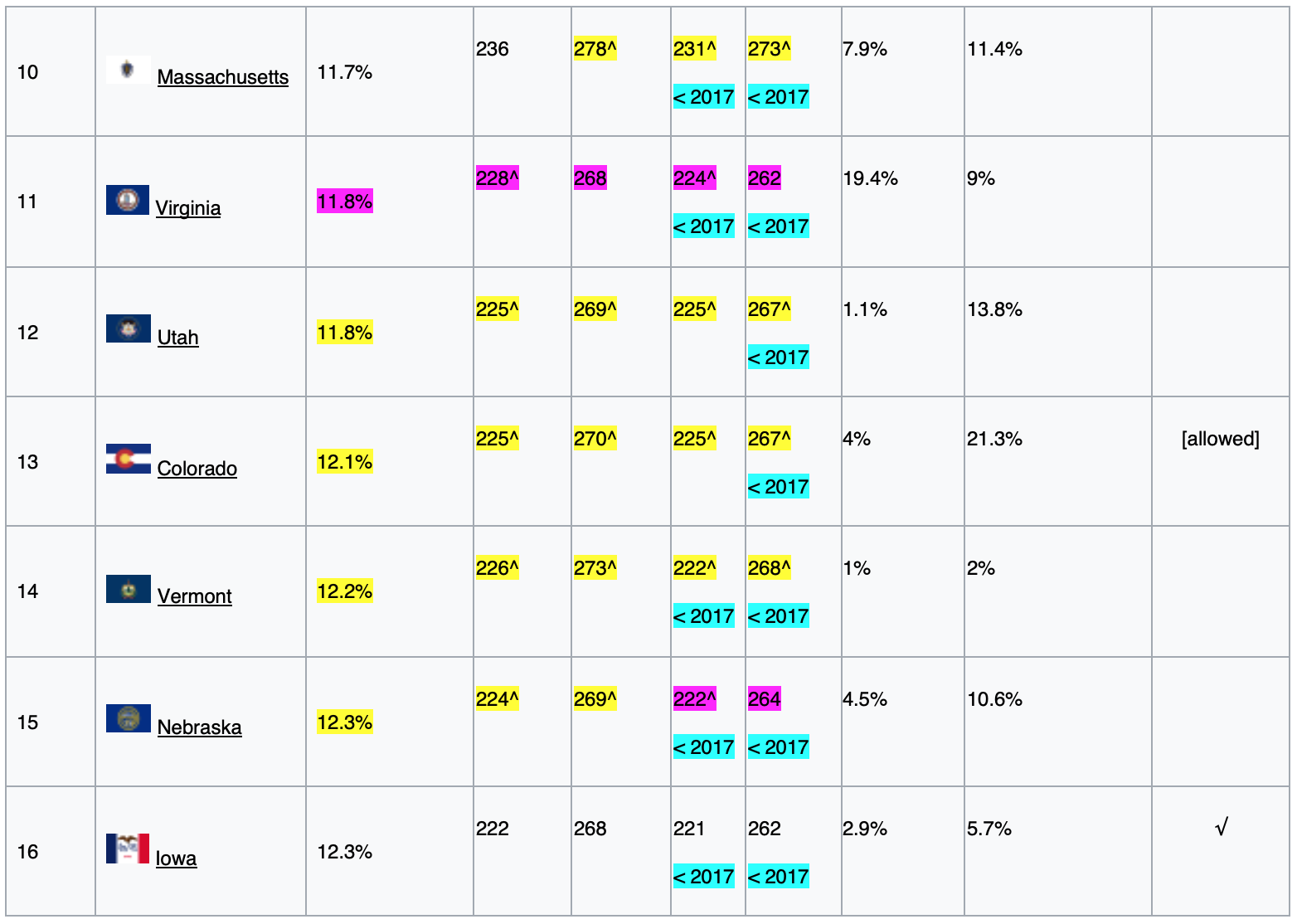
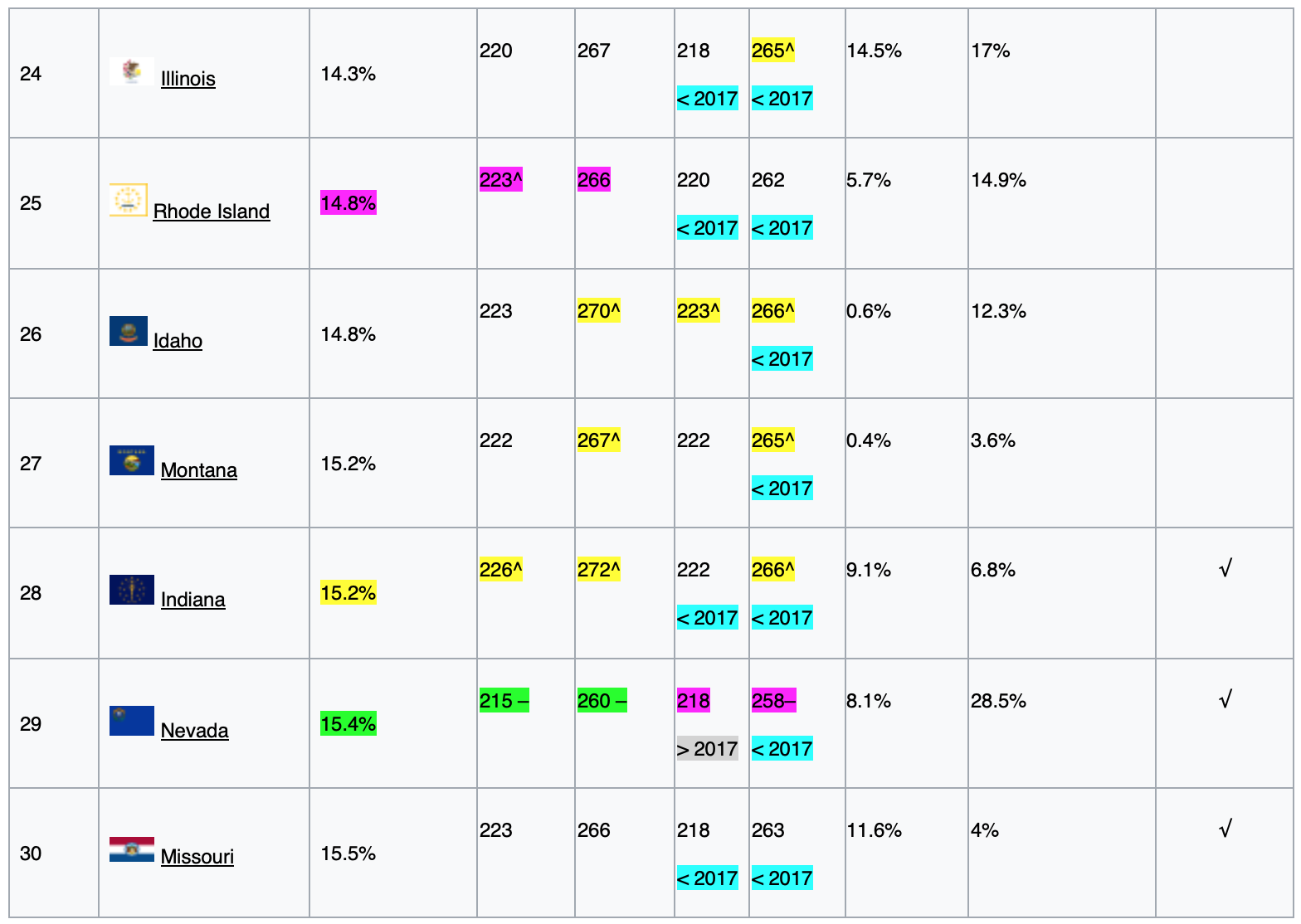
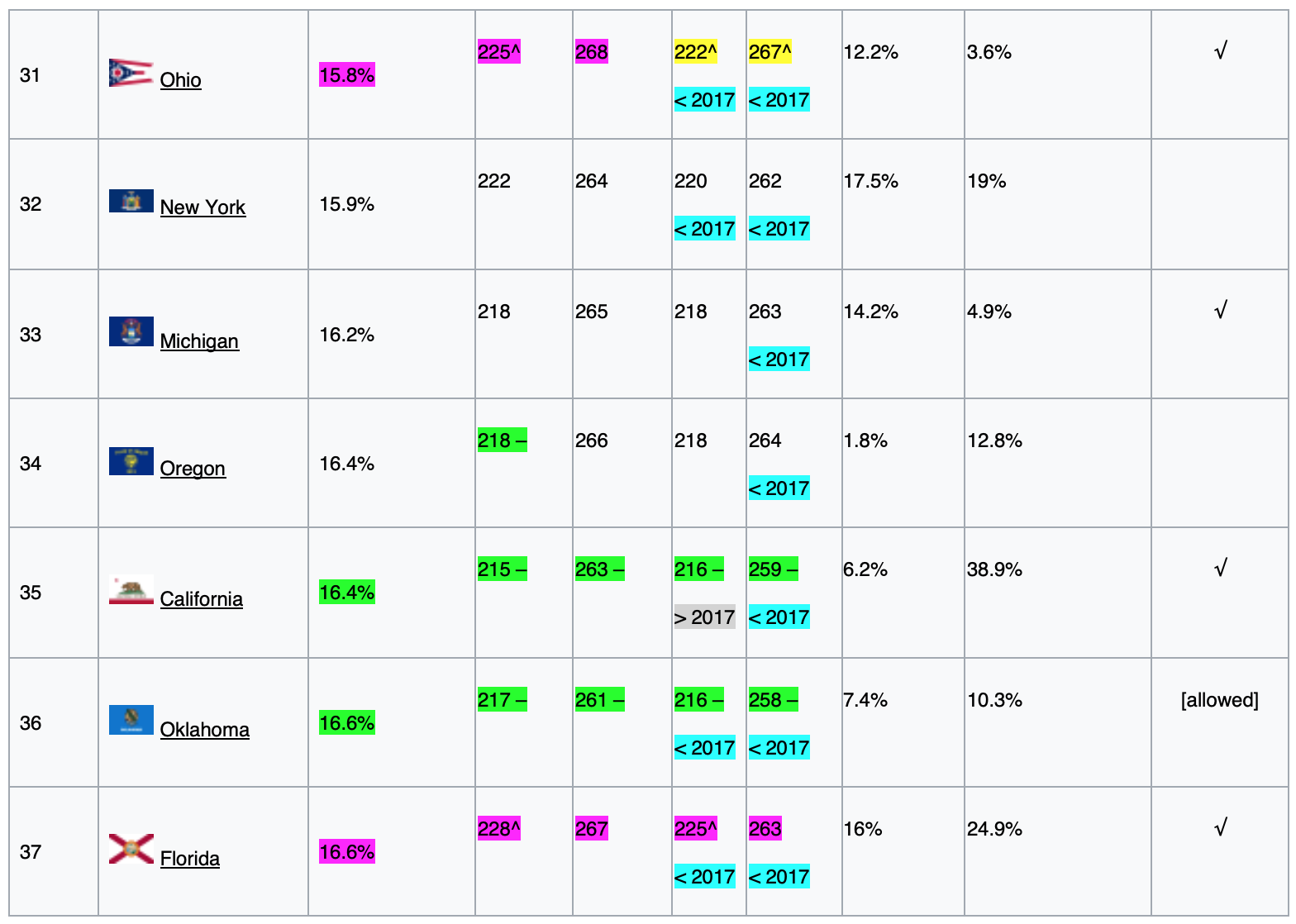
None the less, here are the updated data in a manageable chart:

NAEP R 2019 1

NAEP R 2019 2b

NAEP R 2019 3NAEP R 2019 4NAEP R 2019 5NAEP R 2019 6NAEP R 2019 7NAEP R 2019 8

If we genuinely believe a few points here or there, comparing entirely different populations of students under ever-shifting conditions both in their lives and in their education, are in fact not just statistically significant but significant, then we have a wealth of evidence above to suggest that all the standards, testing, and policies are actually degrading student reading achievement.

Finally, I want to stress, the greatest problem exposed by how the media and dyslexia/phonics advocates are responding to NAEP 2019 is that reading is too often a political and ideological football, and students in real classrooms and real lives are being reduced to petty games.

Again, at no point over the past 100 years have the crisis and failure arguments about reading achievement been any different than at this exact moment—regardless of how students have been taught to read (including peak years of intensive phonics and jumbled claims of implementing whole language).

How states mandate and implement reading instruction as well as relentlessly test it in the worst possible formats is a tale of too many cooks in the kitchen, with most of them having no credibility.

See Also

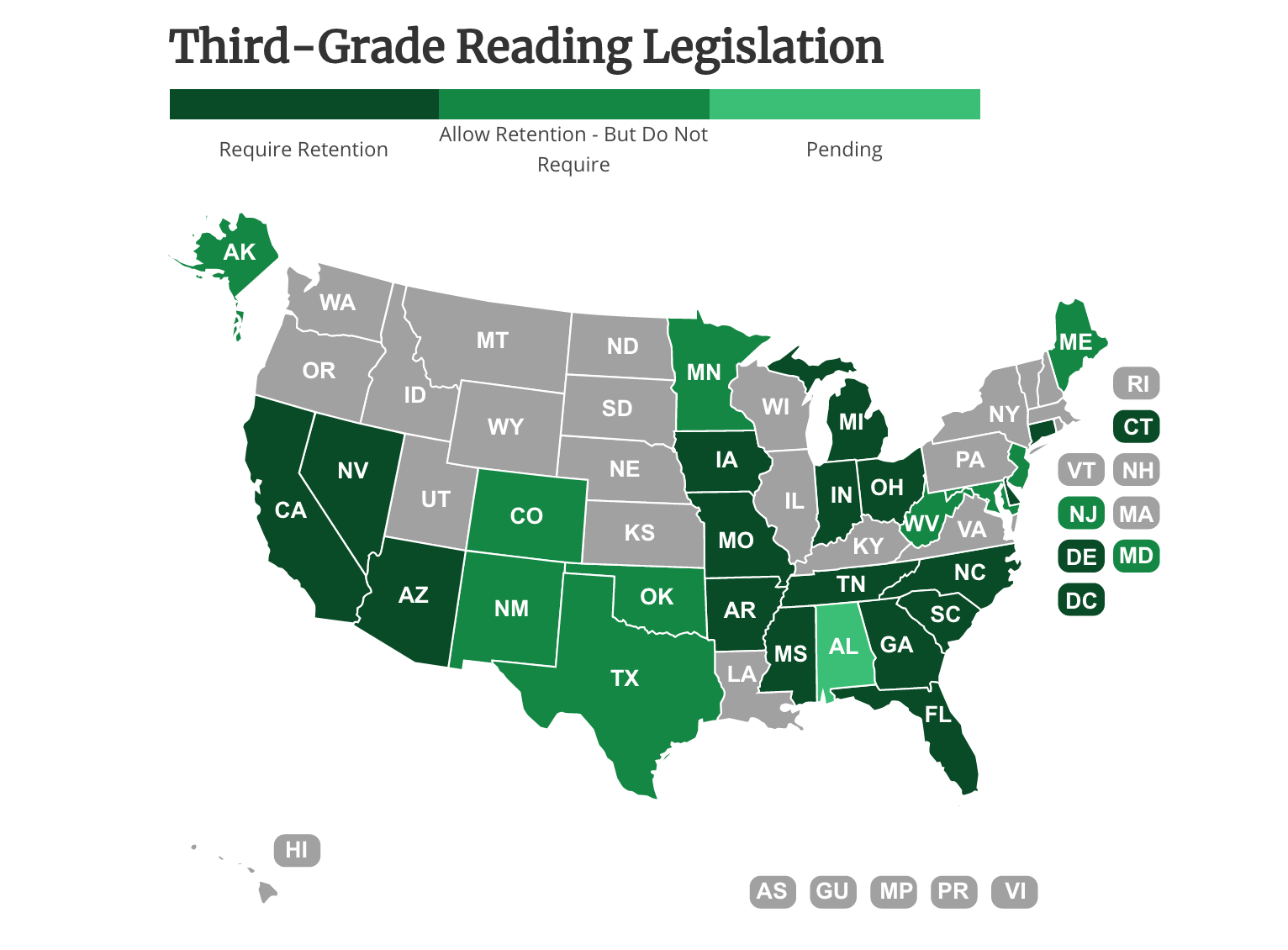
Third-Grade Reading Legislation

retention legislation UPDATED

Third Grade Reading Policies (2012)

From Bruce Baker


The Problem with Balanced Literacy

My summer graduate course, Foundations and Current Trends in Literacy Research and Practice, never fails at being an invigorating course for me and my students because it combines foundational topics in literacy with a never-ending series of current debates and controversies surrounding those enduring elements of teaching and learning literacy.

For several years recently, my home state of South Carolina has provided ample content because of the current reading legislation, Read to Succeed, heavily drawn from Florida’s reading policy and commitment to grade retention as a punitive key element in teaching reading.

This summer, however, even with Read to Succeed firmly entrenched and resulting in grade retention for students, a new wave of controversy has invigorated this course’s topics—the media focus on the “science of reading” driven by advocates for students with dyslexia and the (tired) resurgence of calls for systematic phonics for all students.

The scapegoats in this “science of reading” frenzy are teacher education and balanced literacy (the younger cousin of the similarly maligned whole language).

At the end of class preceding the next day’s focus on balanced literacy, a graduate student asked for a quick definition because since she was new to education and had recently experienced many interviews that asked her to define balanced literacy, she felt quite disoriented and uninformed about what it means.

I pulled up my standard paragraph from Dixie Lee Spiegel and immediately heard several other students note this isn’t how they have had the term defined in their schools.

As I read the daily reflections on the readings for balanced literacy, this response, I think, is an important way to address the problem with balanced literacy (edited for some minor formatting):

My school places a huge emphasis on balanced literacy. However, it is presented more in terms of how much time and in what context various components of literacy should be implemented in class daily (we even have it in a pie chart) [emphasis added]. We used to have a great deal of autonomy in the curriculum we chose in reading and writing, but our district recently adopted Lucy Calkins’ Units of Study. Although Calkins desires for teachers to use her units as a framework, it has become a way to make sure all teachers are doing the same thing [emphasis added]. In practice we have a balanced literacy program in terms of we give students choice (although in the early grades very restricted choices), allow time for free reading, a lot of experience with literacy, small, guided reading group instruction, and explicit phonics instruction; we are doing all of this in a systematic, controlled way. I read the article about effective balanced literacy instruction and felt it did a great job in summarizing the qualities that make a teacher highly effective in the implementation of balanced literacy. But the point is…it takes a highly effective teacher, period.

Having only been consistently teaching for five years, I also understand how incredibly challenging it is to be a masterful teacher. I feel I could have seemed that I was implementing balanced literacy proficiently in a class I had two years ago. Most of my class came from literacy rich environments and could discuss books in meaningful ways. The ones that did struggle, were inspired by their peers to take risks in reading (they made me look good). This past year, I did not have a class as a whole that loved reading. For a lot of them, it was a challenge to get them to listen to stories much less engage in meaningful conversations. The majority of them would say they hated to read. Calkins (and my reading coach) would have me go to a first grade unit of study and implement more basic literacy skills to scaffold, but there was no way I would be able to do this alone. The lessons are very in depth and it would have cost me more time than I had available. Also, those mini-lessons would not have appealed to the 6 or 8 students who were ready to have more comprehensive, richer discussions. Reading and literacy implementation was a struggle all year.

I also realize that it is easier within systems to quantify and package things, but you simply cannot do this with teachers and students [emphasis added]. It is easy to show learning in a quantitative way. Although my students achieved higher reading levels this year, which looks great on an SLO [Student Learning Objectives], as a teacher I know that I missed it with them. I also realize that I can say I am doing balanced literacy, but I know it isn’t truly what balanced literacy is intended to be [emphasis added].

To open the discussion, after reading this an other reflections with similar descriptions, I explained to the class that both whole language and balanced literacy are philosophies of teaching and acquiring literacy; they provide evidence-based broad concepts to guide practice, but neither was originally intended to be programs or templates for how teachers teacher or how students learn.

As the response above demonstrates, however, education in practice is often over-reliant on programs and less diligent about addressing philosophy or theory. In short, the problem with balanced literacy is not that teacher education teaches balanced literacy and not the science of reading (note because balanced literacy as a philosophy of literacy embraces that full and complex science of reading) and not that teachers do not know the science of reading but are teaching balanced literacy, but that almost all schools have adopted programs, many of which claim the label of “balanced literacy” while also breaking the foundational elements of that philosophy (see the last sentence of the response above).

And just as the media, dyslexia advocates, and phonics proponents have endorsed, these reading programs (labeled “balanced literacy” or not) are primarily about addressing standards, preparing students for high-stakes tests, and imposing a one-size-fits-all approach to teaching and learning reading; and therein is the essential flaw.

All teachers and all students doing the same things at the same time and being held accountable for doing the mandated program—this is literacy instruction in the U.S., and this is the grand failure no one in the media or in political leadership is willing to address.

All the bluster around calling out “balanced literacy” is nothing more than distraction because it doesn’t really matter what label we assign to how teachers teach reading or how students learn reading; what matters are the expertise of teachers, the needs of students, and the teaching/learning conditions that support or inhibit (see complying with reading programs) effective teaching and learning.

The real problem with balanced literacy is too few people know what it is and as a result are failing it along with the students and teachers caught in that misguided vortex.