Category Archives: reading

Two Threads on Reading

I may tease these ideas more fully in blogs but for now, see two threads of mine below from Twitter.

What are teachers taught about reading in teacher education? “It just doesn’t matter.” [Click the Twitter bird in the upper right of the image for the thread.]

When advocacy for one student oversteps into what every student needs: The reading edition. [Click the Twitter bird in the upper right of the image for the thread.]

The Big Lie about the “Science of Reading” (Updated)

While too often inordinately dangerous* for the most vulnerable, social media can be a powerful window into how we think about and judge education. Recently, the reading wars have been once again invigorated; this time driven often by parents and advocates for students with special needs and accompanied by a very familiar refrain, the “science of reading.”

One problem with public debate about education is that political and public voices often lack experience and expertise in education as well as any sort of historical context.

First, those who have studied the history of education, and specifically the ever-recurring reading wars, know that there has never been a decade in the last 100+ years absent political and public distress about a reading crisis.

However, one doesn’t need a very long memory to recognize that if we currently are (finally?) having a reading crisis, it comes in the wake of almost two decades (nested in a larger four decades of accountability birthed under Ronald Reagan) dedicated to scientifically-based education policy, specifically reading policy driven by the National Reading Panel (NRP).

The NRP was touted as (finally?) a clearing house of high-quality evidence on teaching children to read (although it proved itself to be partisan hokum).

This is all quite fascinating in the context of the current media blitz about the reading crisis and a need (yes, once again) to focus on the science of reading. Concurrent with that media fail is a move within the academia to shift reading away from literacy experts and into the purview of special needs, treating all reading instruction as something like remediation or a learning disability.

For example, I noticed a very odd dynamic on social media: a post on a community Facebook page for advocates of education that was linked to a dyslexia Facebook page promoting this from Mississippi:

MS gains propaganda

The message included dramatic arguments: Mississippi has somehow found the science of reading and is excelling in ways South Carolina refuses to do.

Knowing standardized test scores, and NAEP specifically, well, I was immediately skeptical of these claims.

Here is the short version: In 2017 NAEP data, MS is slightly ahead of SC in 4th-grade reading (both states remain near the bottom and below the national average), but SC is slightly ahead of MS in 8th-grade reading (again, both near the bottom and below the national average):
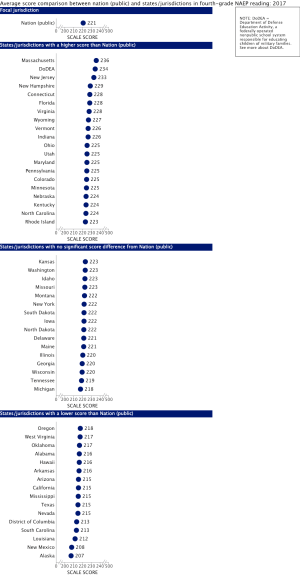
4th reading 2017

8th reading 2017

While Mississippi is promoting gains (accurately), the data remain clear that high-poverty states tend to score low on standardized testing while more affluent states tend to score higher.

What is extremely important to note is that some traditionally low scoring states have found methods (test-prep, reading programs focused on raising test scores, and grade retention) that increase test scores short term (making for political propaganda), but those gains have proven to be a mirage, disappearing in the span between 3rd/4th- grade tests to 8th-grade tests and then high school (see, for example, research on Florida).

So we sit here with some real problems and questions: Is there a reading crisis in the U.S. and my home state of SC? And if so, is that crisis somehow the result of refusing to implement the science of reading?

Well, first, I need to note that the “science of reading” is code for intensive phonics and is intended as an antidote to the current evil in reading, balanced literacy.

Now, consider this: In the late 1980s and early 1990s, a similar event happened when people started shouting about the reading crisis in California spawned by whole language (now, people claim balanced literacy and whole language are the same thing, and thus, equally evil).

Literacy scholar Stephen Krashen, and others, unmasked that round of the reading wars, noting that although CA claimed whole language as the official reading approach of the state, teachers were almost never practicing whole language.

Further, the reading score plummet of those years did correlate with whole language being the official policy, but the causes of those lower scores were a large influx of non-native speakers of English and significant decreases in educational funding (larger classes specifically negatively impacting achievement).

This isn’t particularly simple or compelling but let’s detail why this recent round of the reading wars is way off base:

  • Standardized tests of reading are only proxies of reading, typically they reduce reading to a series of discrete skills that test designers claim add up to reading. This is at least inadequate, if not misleading. No standardized test measures eagerness and joy for reading, as well; nearly none address critical literacy.
  • Making raising reading test scores your primary or exclusive goal is actually cheating all students. Period. And this is what many states are doing, including MS.
  • Achieving test score gains when you are low scoring is much easier that making gains when you are high achieving.
  • Adopting, implementing, and staying focused on any reading program—these are also very common practices, and completely flawed approaches to literacy. Access to books in the home and choice reading remain the strongest predictors of increased reading and reading achievement.
  • Ultimately, if we insist on using reading test scores to judge the quality of teaching reading in any state or the country, we must acknowledge that how students are being taught is both almost impossible to identify and completely impossible to characterize as one clear practice (teachers are very likely to shut their doors and do as they please, regardless of policies).
  • And most important is the fact that standardized test scores of reading are a reflection of a large number of factors, with teaching practices only one (probably small) causal factor.

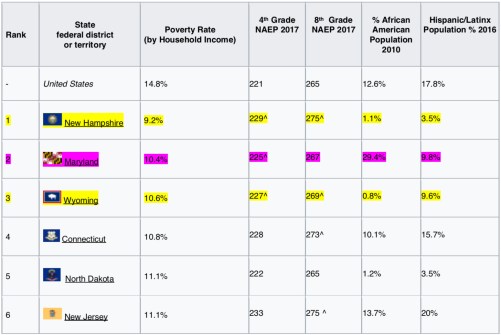
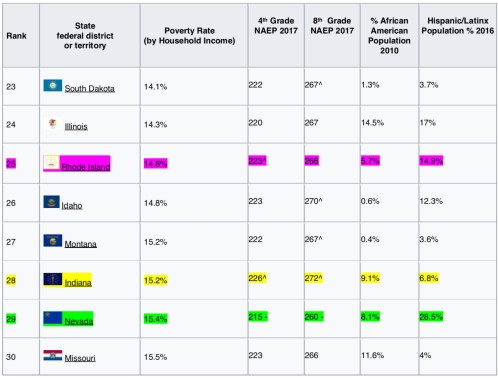
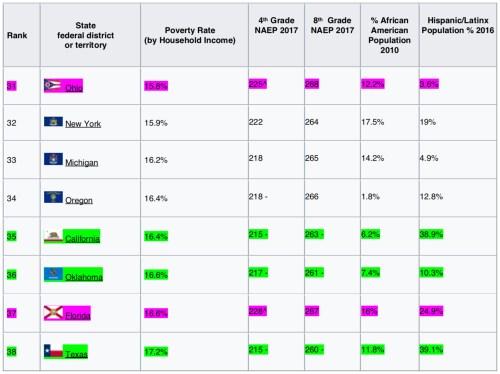
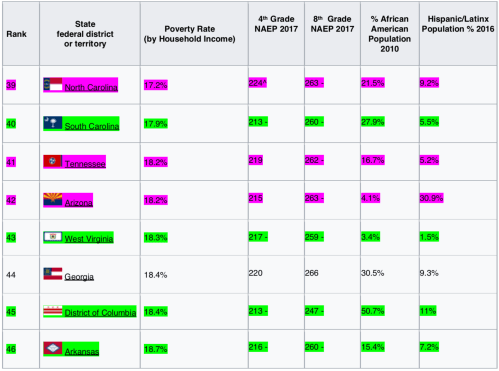
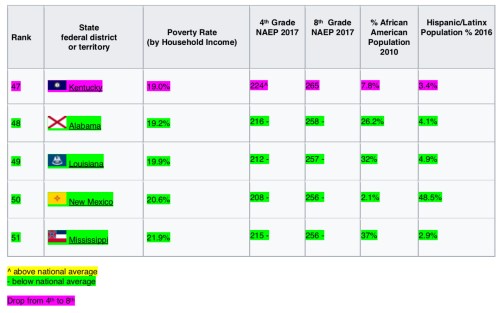
To that last point, consider this matrix of 2017 NAEP reading scores (4th/8th) along with the poverty in each state, the African American population percentage, and the Hispanic/Latinx population percentage. These data portray a much more complex picture of the reading problem, and resist the distraction that how students are being taught reading is cheating students, who could be saved by the “science of reading” (which, by the way, is balanced literacy—o, irony):

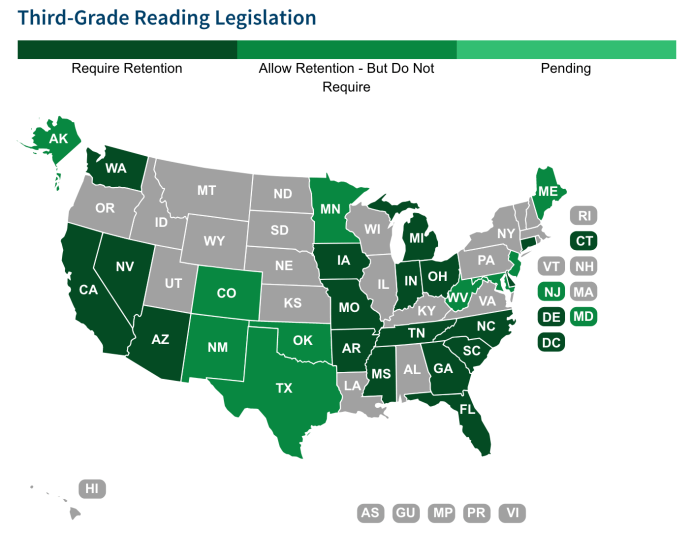
[Click links above each chart for expanded charts with grade retention legislation identified.]

Poverty NAEP 4 8 2017 grade retention 1
NAEP reading 2017 1

Poverty NAEP 4 8 2017 grade retention 2

NAEP reading 2017 2

Poverty NAEP 4 8 2017 grade retention 3

NAEP reading 2017 3

Poverty NAEP 4 8 2017 grade retention 4
NAEP reading 2017 4

Poverty NAEP 4 8 2017 grade retention 5
NAEP reading 2017 5

Poverty NAEP 4 8 2017 grade retention 6
NAEP reading 2017 6

Poverty NAEP 4 8 2017 grade retention 7
NAEP reading 2017 7

The “science of reading” mantra is a Big Lie, but it is also a huge and costly distraction from some real problems.

Relatively affluent states still tend to score above average or average on reading tests; relatively poor states tend to score below average on reading tests.

Some states that historically scored low, under the weight of poverty and the consequences of conservative political ideology that refuses to address that poverty, have begun to implement harmful policies to raise test scores (see the magenta highlighting) in the short-term for political points.

It is 2019. There is no reading crisis in the way the “science of reading” advocates are claiming.

It is 2019. Balanced literacy is the science of reading, but it is not the most common way teachers are teaching reading because schools are almost exclusively trying to raise scores, not students who are eager, joyful, and critical readers.

It is 2019. Political and public efforts to do anything—often the wrong thing—so no one addresses poverty remain the American Way.

It is 2019. It is still mostly about poverty when people insist it is about reading and reading policy.


* This opening has been revised because I made a careless error by making an analogy using the “Wild West,” seeking an engaging opening but making a culturally insensitive comparison instead. I regret this use of phrasing, but also appreciate being kindly informed of my carelessness in private. I try to listen to such concerns, and kindness, and am learning every day to be a better person, and writer.


Third-Grade Reading Legislation
3rd grade retention legislation

Evidence v. Advocacy in Teaching Reading: “We Should Not Mistake Zeal for Warrant”

There is a certain karmic irony to the rise of public intellectuals who start to drive outside their lane—actually who take over all the lanes—only to prove that, in fact, they do not know everything.

Current bloviator-know-nothings include Jordan Peterson and Steven Pinker, the latter who has squandered intellectual capital he had built in psycholinguistics.

Both are experts in the field of psychology, a discipline apt to include far too many scholars with delusions of grandeur (only surpassed in arrogance by scholars in economics and about on par with scholars in political science for knowing everything).

Those of us who are scholars, practitioners, or both in the field of education have suffered a long history of being marginalized as both not really an academic discipline (education as “teacher training”) and merely classroom teachers.

As someone with experience and expertise as a practitioner (high school English teacher for 18 years) and researcher in education, I often find I hold no sway in issues related to education in my public work or with my scholarly impact. Imagine if I held forth in book form on psychology, economic, or politics? Think the New York Times would scramble to hang on my every word as they did for a psychologist claiming to be an expert in teaching reading?

(These are rhetorical questions.)

There exists another layer to education that often remains unexamined: K-12 public education is almost exclusively run along partisan political lines through bureaucracy and legislation that is not created by practitioners or educational researchers.

Practitioners who teach literacy/reading and literacy/reading scholars are currently under assault again by a new round of the reading wars. As has been common in these periodic skirmishes, there really is no war because the so-called factions do not have anywhere near equal power.

As a self-proclaimed reading expert, Daniel Willingham, psychology professor, represents what is essentially wrong with the entire framing of debates about teaching reading as a war.

Stated perfectly by Andrew Davis in his careful debunking of intensive/synthetic phonics advocacy, “The zeal with which synthetic phonics is championed by its advocates has been remarkably effective in pushing it to the top of the educational agenda; but we should not mistake zeal for warrant.”

During the current media blitz once again hand-wringing that children are not being taught to read because teachers are not prepared properly in teacher education and students are not receiving intensive phonics instruction, Willingham held forth on his blog to answer: Just how polarized are we about reading instruction?

His post doesn’t answer the question very well, but in another moment of karmic irony, Willingham reveals why “we should not mistake zeal for warrant.”

Affecting a tone of being fair and balanced, Willingham offers 6 positions on reading:

  1. The vast majority of children first learn to read by decoding sound. The extent to which children can learn to read in the absence of systematic phonics instruction varies (probably as a bell curve), depending on their phonemic awareness and other oral language skills when they enter school; the former helps a child to figure out decoding on her own, and the latter to compensate for difficulty in decoding.
  2. Some children—an extremely small percentage, but greater than zero—teach themselves to decode with very minimal input from adults. Many more need just a little support.
  3. The speed with which most children learn to decode will be slower if they receive haphazard instruction in phonics than it would be with systematic instruction. A substantial percentage will make very little progress without systematic phonics instruction.
  4. Phonics instruction is not a literacy program. The lifeblood of a literacy program is real language, as experienced in read-alouds, children’s literature, and opportunities to speak, listen, and to write. Children also need to see teachers and parents take joy in literacy.
  5. Although systematic phonics instruction seems like it might bore children, researchers examining the effect of phonics instruction on reading motivation report no effect.
  6. That said, there’s certainly the potential for reading instruction to tilt too far in the direction of phonics instruction, a concern Jean Chall warned about in her 1967 report. Classrooms should devote much more time to the activities listed in #4 above than to phonics instruction.

He then claims the reading wars problem is that factions take either the side of the even or the odd numbered claims—although he argues “I think all of the six statements above are true.”

The problem is a sneaky one because most of Willingham’s audience, like Willingham, has no literacy expertise or practical experience teaching children to read. For a lay audience, it is unfair to expect anyone to notice that Willingham has misrepresented the so-called factions in the reading war.

One of the leading literacy experts in the U.S. is Stephen Krashen; in his relentless analysis of research on teaching reading, he notes that the pro-phonics research often is deeply flawed because it presents either garbled or false definitions of whole language (or balanced literacy) in order to make claims of intensive phonics being more effective.

Willingham’s claims about reading instruction and the failures of teaching, teachers, and teacher education can only stand on completely misrepresenting the field of literacy and the so-called debate itself.

Let me frame a different approach to understanding the problem pro-phonics advocates fumble.

Here is the real dynamic concerning the teaching of reading in U.S. K-12 education: Teaching reading practices are guided primarily by legislation (with no assurance that legislation is grounded in anything more than zeal at the expense of warrant) and then driven by the combination of textbook companies appealing to that legislation and accountability structures (most significantly the mandate to raise reading test scores without investigating if those scores are credible proxies for reading growth or—god forbid—reading eagerness).

That is almost the entire real-world power structure governing how students are taught to read.

Well outside this dynamic stand teacher education and literacy/reading researchers, practitioners, and advocates—all of whom have almost no power, yet are the scapegoats when psychology-professors-turned-reading-experts hold forth in book form or in the NYT.

I should note, as well, that an even smaller and less powerful group often not acknowledged is literacy experts with a historical perspective, a group that I strongly identify with.

The teaching of reading and the public debate about reading have always been characterized by overblown histrionics and a nearly complete failure to implement what we know about learning to read in K-12 public schools because of partisan political bureaucracy, textbook companies, the massive and growing testing industry, and the misguided influence of non-educators posing as reading and literacy experts.

I realize there is nothing sexy about this—there is no war, or crisis—and this message once again will fall on deaf ears because I do not currently hold a position in a psychology department or an elected position where I could pander to an uninformed electorate.


Recommended

To read or not to read: decoding Synthetic Phonics, Andrew Davis

What is wrong with NPR’s “why millions of children can’t read” (NPR Morning Report, Jan 2 and Feb 6, 2019), Stephen Krashen

Defending Whole Language: The Limits of Phonics Instruction and the Efficacy of Whole Language Instruction, Stephen Krashen

Misreading Cause and Effect in Literacy Instruction: Vocabulary Edition

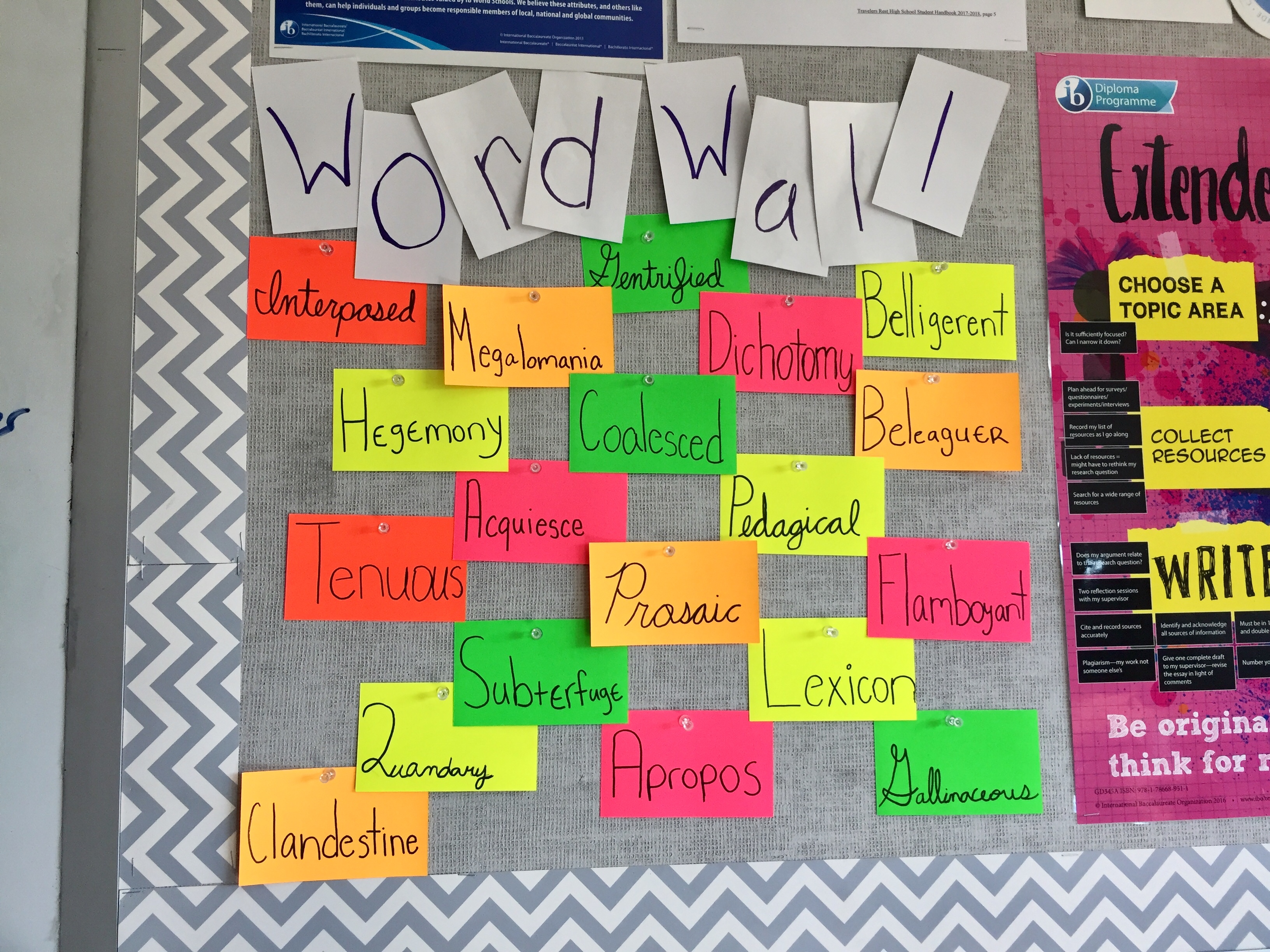
A former student of mine in teacher education, who was an English major and is in her third year of teaching, excitedly shared with me that her high school English students have spontaneously begun maintaining a vocabulary list.

What is interesting about this vocabulary list? Students are cataloguing the words they are learning simply by hearing this teacher use the language of a highly literate and well-educated person.

Marakoff word wall
Word wall created and maintained by students at Travelers Rest High School (South Carolina).

I take no credit for this, but this real-world, spontaneous, and rich environment for literacy growth does reflect (although in a more effective way) what I share with my teacher candidates about my 18 years teaching high school English.

Eventually, I ended the practice in my English department of issuing grammar textbooks and vocabulary workbooks to all students. Teachers were given sets of both and allowed to use as they pleased. In my classes, neither were used in any way.

As the example above from my former student’s class shows, I would model for my students how to discuss literature (texts), films, and popular music, often restating their comments in more sophisticated and complex ways.

Gradually, and spontaneously, my students began to mimic the language and terminology in their discussions and writing.

Coincidentally, my former student’s excitement over her students’ vocabulary activities preceded by a couple days a post on NCTE Connects asking about effective vocabulary instruction. I immediately responded:

Like grammar instruction, vocabulary instruction is deeply misguided when it is in isolation and vocabulary-for-vocabulary’s sake. People are confused and tend to invert erroneously what people with high literacy and large vocabularies mean. Vocabulary is a consequence of rich and extended literacy experiences; cramming vocabulary INTO students is not how you make someone highly literate. In short, if you care about vocabulary, reduce dramatically time and energy spent on vocabulary instruction and focus on rich literacy experiences, notably reading by choice and vibrant discussion. One early-career teacher I know has witnessed her students initiating a vocabulary list of words she teaches them simply through her own expression (her talking to the classes and students); they hear new words almost daily, ask her about them, and are engaged in authentic vocabulary attainment. Also fyi: Power of Common Core to Reshape Vocabulary Instruction Reaches Back to 1944!

This comment is brief so I want to elaborate on some of the key points.

First, the traditional urge to teach literacy skills—grammar, mechanics, usage, and vocabulary, for example—in isolation and sequentially to build toward some ideal whole is deeply engrained but also deeply flawed.

I find this to be the result of uncritical assumptions about the power and effectiveness of analysis. Education has embraced a truism that likely isn’t true: working from part to whole is easier and better for all learning.

How many of us have uttered or been told, kindly, “Let me break this down for you”?

Let me pause here and ask you to do a thought experiment (or maybe just focus on a very specific memory).

Have you ever purchased something you had to assemble? Furniture, a swing set, the hellscape that is anything from Little Tikes?

These items come with detailed instructions, guiding you from part to whole to construct whatever you have purchased. Have you ever been compelled to dutifully follow those directions, laying out the parts as directed and then meticulously beginning your project?

And do you recall that moment when you were mostly lost because you couldn’t really decipher the directions? What did you do? Maybe you grabbed the box and began comparing your Frankenstein’s monster scattered on the floor with the whole thing depicted in the picture on the box?

This urge, some brain research suggests, may be rooted in that only about 1 in 4 people are predisposed to part-to-whole thinking—while 3 in 4 of us work naturally whole-to-part*.

Here is a powerful example of how norms and assumptions can create ineffective practices. Literacy instruction may not be more efficient or effective for most of our students in traditional approaches grounded in skills instruction because literacy is wholistic.

Next, this flawed set of assumptions is also driven by flipping—and misreading—cause and effect in literacy growth.

Yes, highly literate people and sophisticated uses of language are often characterized, for example, by large and complex vocabularies. However, this characteristic is an outcome, an effect.

The mistake too many make in literacy instruction is viewing targeted vocabulary expansion as a cause for rich literacy; thus, extensive vocabulary lists, workbooks, and tests (including nearly fanatical instruction in prefixes, root words, and suffixes) that waste time and energy better spent in the real cause of literacy growth—rich literacy experiences such as reading often and deeply by choice and having complex discussions grounded in those rich experiences with a wide variety of texts.

Here is a relatively simple and more accurate truism, then: A large and nimble vocabulary is an effect of rich literacy experiences—not the cause of literacy development.

So here is a final thought experiment: Imagine taking those vocabulary workbooks out of your students’ hands (and backpacks) and then lead them to the school library, introducing them to the greatest vocabulary books available lining the shelves all around them.


* My argument about the relationship between part and whole, after almost four decades of teaching and spending much of that studying intently the research on literacy acquisition and growth, is that part and whole are symbiotic, working together in ways that defy a linear/sequential model. So I am not really rejecting part-to-whole for whole-to-part, but arguing for whole-part-whole-part … something not easy to express in words or a diagram.

In Brief: Drafting Absent Correctness and Universal Literature

Student Drafting without the Tyranny of Correctness

After I blogged about navigating the trivial in writing instruction, I shared the post with two first-year writing seminars. I then asked them a few questions about several of the claims I had made.

Several of the students quickly confirmed that most of their writing experiences before entering college and my class were driven by concerns about being correct and then efforts to correct their work when given an opportunity to revise.

From that, I asked if their experiences with drafting in my class had been different. Interestingly, in both classes, several students shared that they felt much more free to draft because I do not grade, I give them detailed feedback on their drafts and in conferences, and they know they will be able to address correctness later in the drafting process once they develop a draft worth editing.

The discussion did confirm that many of the students have begun to shift from focusing on the trivial and working more directly on the substantive—engaging and focused openings, specific openings and closings that help frame the essay, and maintaining the focus (thesis) throughout the essay.

I stressed to these students that I was aware we could accomplish only so much in one semester, but I felt over the next few years many would make great strides and attribute some of that to what we have established in these seminars.

On balance I feel confident many of my approaches to teaching writing have fostered healthy attitudes about language and writing in my students.

Rethinking Universal Literature: Unpacking Whiteness and Allegory

In her opening talk at NCTE’s 2018 national convention in Houston, Texas, Chimamanda Ngozi Adichie shared a disturbing story about a white male cab driver quickly saying he would not be interested in her writing. The subtext of his response was that he assumed her work to be for women and blacks, only.

Adichie added that she never discounted white male writers in that way; in fact, she said she loved some dead white men writers.

Combined with a Saturday morning roundtable, Teaching the Canon in 21st Century Classrooms, experiences at the conference have begun to help me push against what literature we call “universal,” and how whiteness and maleness tend to hide beneath a cloak of allegory in ways that mask the racial and gendered elements in those works.

In my young adult literature class, we are exploring the film Pleasantville as text and how different media and expanding what counts as text can create diverse literature units.

Pleasantville demonstrates in film many of the characteristics we ask students to examine in print texts; it also expects close reading of technique by the viewer.

But one powerful aspect of the film is its investigation of race by using black-and-white against color and then exploring racism with a white cast (the segregation is between those in black-and-white and those in color):

Using this film can help students interrogate what we use to determine universality in literature, and then to consider if allegory allows whiteness and maleness to be normalized, and thus unacknowledged in ways that blackness and femaleness are not allowed to be unacknowledged or universal.


See Also

Cormac McCarthy’s Mostly White, Male Mythology: Rethinking the Canon

Toni Morrison, the White Gaze, Race, and Writing

Dear Media, Stop Misrepresenting Reading Instruction, Please

From Education Week to the Hechinger Report to The Answer Sheet (the latter two typically good sources for education journalism), the media simply cannot resist publishing misguided takes on how we do and should teach reading.

Citing the National Reading Panel as credible (it isn’t), misrepresenting whole language and balanced literacy (as somehow anti-phonics), hand-wringing about third-grade reading ability, and taking broad uneven swipes at teacher education—these are the hallmarks of bad journalism and garbled takes (usually with ulterior motives) on the reading wars.

Since I simply cannot continue to make the same points over and over, I suggest below a bit of actual reading to clarify why the media continually misrepresents the reading wars:

Here is a final note worth emphasizing: Phonics-intense and phonics-only reading instruction is a gold mine for textbook publishers, reading program shills, and the testing industry.

Consider carefully the who and why of public commentaries screeching about reading instruction, especially when the arguments are full of easily identifiable holes in their credibility and logic.

Misreading the Reading Wars Again (and Again)

Here is some incredibly bad edujournalism: Hard Words: Why aren’t kids being taught to read?

And the summary blurb beneath the title takes that to truly awful:

Scientific research has shown how children learn to read and how they should be taught. But many educators don’t know the science and, in some cases, actively resist it. As a result, millions of kids are being set up to fail.

Now, let me offer a brief rebuttal.

First, the claim that we are not teaching reading as we should is well into its twelfth decade of crisis rhetoric. But the classic example rests at mid-twentieth century: Why Johnny Can’t Read.

That blather was a lie then and it remains a lie today.

I invite you to peruse the work of a literacy educator who taught from the 1920s into the 1970s and left behind decades of scholarship: Lou LaBrant. But the short version is the reading war claim that we are failing reading instruction is a long history of false claims grounded in selling reading programs.

Now let’s be more direct about the bad journalism.

This article cites thoroughly debunked sources—the National Reading Panel (NRP) and a report from NCTQ.

The NRP was a political sham, but it also was not an endorsement of heavy phonics. Please read this unmasking by an actual literacy expert and member of the NRP, Joanne Yatvin: I Told You So! The Misinterpretation and Misuse of The National Reading Panel Report.

NCTQ is a partisan think tank exclusively committed to discrediting teacher education. Their reports, when reviewed, are deeply flawed in methodology and typically misread or misrepresent research in order to reach the only conclusion they ever reach—teacher education is a failure! (Like reading instruction, apparently, has always been.)

I offer here one example of why no NCTQ report should be cited as credible: Review of Learning about Learning: What Every New Teacher Needs to Know. (See also GUEST POST by Peter Smagorinsky: Response to the new NCTQ Teacher Prep Review.)

NCTQ lacks credibility, but the organization has learned how to manipulate the current state of press-release journalism that simply publishes whatever aggressive organizations are willing to feed journalists desperate for click bait.

As well, the article plays the usual game of misrepresenting whole language and balanced literacy. A more accurate explanation of whole language and balanced literacy exposes a really ugly reason some are so eager to trash both and endorse phonics: the former are not tied to (lucrative) reading programs, but phonics is a veritable cash cow for textbook companies and the testing industry. (Note the NRP and NCLB directly led to a textbook scandal under the Bush administration.)

Although I tire making this point, no one in literacy recommends skipping direct phonics instruction. WL and BL both stress the need for the right amount and right time for direct phonics instruction (depending on student needs) and recognize that most students eventually need rich and authentic whole reading experiences to grow as readers (not phonics rules, not phonics worksheets, not phonics tests).

Finally, however, is the real paradox.

Formal schooling has likely never taught reading well. Little of that has to do with teacher education or teacher buy in. Again, see LaBrant’s work from the 1920s into the 1960s and 1970s; she laments the gap between good research and practice over and over.

Of course, the key point is why are we failing our students and everything we know about teaching reading?

One powerful reason is the accountability movement grounded in standards and high-stakes tests. Reading instruction (like writing instruction) has been corrupted by the all-mighty tests.

Test reading is reductive (and lends itself to direct phonics instruction, hint-hint), but it is a pale measure of deep and authentic reading, much less any student’s eagerness to read.

Because of the accountability movement, then, and because of high-pressure textbook reading programs, we have for decades ignored a simple fact of research: the strongest indicator of reading growth in students is access to books in the home (not phonics programs).

I want to end by addressing the real scapegoat in all this—teacher education.

Full disclosure: I have been working in teacher education for 17 years, after 18 years teaching high school English in public school.

But, I am the first to admit teacher education is quite bad, technocratic, bureaucratic, and mostly mind-numbing.

Teacher education, however, is not the problem because whether or not we are teaching reading research and practices correctly is irrelevant; teacher candidates overwhelmingly report that once they are in the classroom, they are told what to do and how—what they know from teacher education is tossed out the window.

The article is not a powerful call, then, for teaching students to read. It is a standard example of really bad edujournalism.

Ironically, a bit of Googling and reading could have alleviated much of that, but I guess we are asking for too much and may want to blame teacher education and teachers for those journalists’ inability to read.

Recommended

Whatever Happened to Scientifically Based Research in Education Policy?

Corporations Are Behind The Common Core State Standards — And That’s Why They’ll Never Work

Much Ado about Politics (Not Reading)

As new legislation was being debated in South Carolina, what was destined to become Read to Succeed, I was in contact with some strong advocates for public education who were seeking ways to shape effective reading policy in the state.

My input was focused on acknowledging the research base that refuted the popular political agendas mostly mimicking Florida reading policies driven by standardized high-stakes testing and grade retention for third graders.

First, decades of research reveal that despite popular support for grade retention (and bending to public antagonism for social promotion) grade retention is overwhelmingly harmful to students, especially our most vulnerable students (students living in poverty, black and brown students, English language learners).

Second, the Florida model has enough data and research to conclude that test-based third-grade retention produces some short-term bumps in test scores (what I would call false positives since this may be simply that students are taking the test again, and likely is not indication of reading growth) but those mirage-gains disappear over time (see Jasper’s doctoral dissertation on the data).

None the less, I was soon informed that there would be bi-partisan support for a new reading policy (Read to Succeed), even though it was flawed, because there would be an influx of more funding for reading.

Fast forward to now, the fall of 2018, when the first students are being impacted by this legislation—documented well by Paul Bowers at The Post and Courier (Charleston, SC):

South Carolina schools held back about 354 students in third grade for the 2018-19 school year under a new law designed to retain students with reading deficiencies.

That figure represents about one-half of 1 percent of the third-graders who took the state SC READY reading subtest in the spring — and only about 8.5 percent of the students who earned the lowest possible grade, “Not Met 1.”

While many will read this as either failure or success in terms improving reading and literacy in the state, the real lessons here are about politics, and the essential failure of bureaucratic measures for educational purposes.

Let me unpack some of how the consequences of Read to Succeed for 300-plus students is much ado about politics (not reading):

  • Is SC 47th in reading proficiency in the U.S. as Bowers reports? This may seem obvious, or at least non-partisan data, but educational rankings are inherently flawed, thoroughly debunked by Gerald Bracey. SC is doomed to low rankings in reading if those rankings remain anchored to high-stakes standardized tests (which reflect socio-economic status of any child’s home and community than educational attainment) and if SC political leadership refuses to address the state being also mired in the bottom quartile of high-poverty states. To claim SC ranks at the bottom of reading proficiency is a distraction from the root cause of those scores—inequity and poverty.
  • Is retaining 300+ students too many or too few? Bowers coverage seems to imply that Read to Succeed has fallen well short of having an effective impact while, as I was referenced in the article, I remain adamant that 345 students retained are 345 too many. Here is why. This legislation has created a bureaucratic mandate for a great deal of time and tax-payer money to be spent on more bureaucracy than valid reading instruction or reading opportunities for students. More high-stakes testing (which distorts what counts as reading), greater stigmas and misguided demands on vulnerable populations of students, more data collecting and analysis (without regard for the quality of that data), more prescriptions and mandates for teachers that result in less effective reading instruction—this in a nutshell is why Read to Succeed is a waste of time and money as well as a fraud in terms of addressing or improving reading in the state.
  • What really is going on—the politics that trumps reading? Read to Succeed has been exposed as legislation more dedicated to political viability (the public loves grade retention, and remains naive about high-stakes testing) than funding and supporting public education or teacher professionalism and autonomy. Read to Succeed is a political mirage, generating political capital at the expense of student achievement (see also Florida).
  • What are the negative lessons so far of Read to Succeed? (1) Stop mimicking the politics-of-the-day from other states, (2) reject education policy grounded in high-stakes testing and punishment (grade retention), (3) resists political agendas and embrace research and educational expertise , and (4) stop isolating political attention on schools as if they are not subsets of and influenced by larger and more powerful social realities such as poverty and inequity.
  • What should SC be committed to instead? Most importantly, political leadership and the public in the state must admit that social policy is the first line of educational policy; SC needs to address historical pockets of poverty in the state often linked to racism and generational inequity. This big picture failure of political leadership, however, does not mean there is nothing we can do in our schools concerning reading. Schools also must be reformed to end the inequities they often reflect and perpetuate—tracking, teacher assignments, school funding, experimentation (schools choice and charter schools, for example) that refuses to address directly public school reform. Finally, reading instruction can and should be reformed to include the following: much lower student/teacher ratios to facilitate effective instruction; guaranteeing student access to books and reading in their homes, communities, and schools; creating and supporting teacher professionalism and autonomy in terms of strong foundations in high-quality reading instruction not driven by raising test scores; patience for student growth in reading that rejects the flawed (and false) crisis response to third-grade literacy; and a robust campaign to inform better the public and parents about effective reading instruction, healthy student growth in reading, and how educational outcomes are more often than not a reflection of society and community affluence, not school or teacher quality.

Read to Succeed is yet another story about political motivation coupled with the good intentions of those charged with implementing truly flawed policy (see No Child Left Behind and the current Every Student Succeeds Act).

Good intentions are never enough, and good intentions can never overcome political negligence.

Since we remain enamored by ranking, let’s confront a very ugly fact: SC ranks first (or at least at the top) in political negligence, and Read to Succeed is just one more lesson in that embarrassing reality, one that has bitter consequences for the most vulnerable children in the state.

“[A]ll this fiddle”: On Genre Wars in a Time of Craft Beer

Poetry MM

“Poetry,” Marianne Moore

Several years ago I was initiated into the craft beer world—having been a serious drinker of beer since high school but being a somewhat resolute low-brow consumer in many ways eschewing the snobbery I witnessed among wine connoisseurs.

Along with my cycling friends Rob and Brian, I made a couple trips to Colorado for bicycling and beer; while on those trips, I was gradually indoctrinated into a more refined understanding of craft beer, mostly guided by Brian.

Today, I frequent local and regional breweries almost exclusively for my beer drinking—along with my one remain low-brow habit of grande Dos Equis ambers a couple times a week at Mexican restaurants.

I remain far too naturally unsophisticated to ever grasp wine nuances, although I have friends who can easily convince me to enjoy wine with them, but my beer palate is moderately well educated, and I do enjoy a wide range of craft beers that I am certain baffles the mostly Bud Light crowd of my hometown and state.

Having come to beer snobbery late in life, I find the distinctions about “good” or “bad” beer quite similar to the genre wars that I have been living since I was a teen since my introduction to so-called literary fiction was significantly primed by my initial love for science fiction (mere “genre” fiction) and comic books (not any sort of literature at all!).

In Literary fiction or genre? When Megan Abbott and Naomi Novik are writing, who cares, Michale Robbins opens by confronting: “If there’s a distinction between ‘genre fiction’ and ‘literary fiction,’ it’s certainly not that the former isn’t literary and the latter isn’t generic. It’s mostly that the generic conventions of the latter are those that critics and professors are trained to value most.”

A former student, who was a top-notch English major and now teaches English, recently finished reading Donna Tartt’s The Goldfinch and drew the same conclusion—if we remain in a formalist paradigm of what counts as “literary,” then Tartt’s novel may well be pronounced so much popular fiddle.

Yet, as my former student noted, the novel could just as easily be praised if we change our metrics, set aside our snobbery.

John Warner’s Is ‘The Great Gatsby’ really required reading? Disrupt Texts challenges teachers to reconsider the classics also ventures into the debate about such snobberies grounded in the canon:

Much of the discussion among educators focuses on how using these texts can be enhanced by injecting marginalized perspectives. This is the “disrupt” part of Disrupt Texts. Rather than taking a single perspective as representative for all, the discussion challenges the notion of a single, fixed history. This is the root of critical thinking and a pre-requisite to lasting learning.

Education isn’t merely transmitting information; students must be taught to make meaning for themselves.

Warner’s last point can be extended, I think, to giving students not the right or only lens for evaluating texts (using the often unnamed New Criticism approach to dissecting text often written with New Criticism’s emphasis on craft and meaning in mind) but many and varied opportunities to examine texts in order to draw their own ways to navigate texts (a variety of lens, some more formal such as feminist or Marxist) and their own guidelines for what makes texts compelling, satisfying, and even “good.”

My former student and I continued to discuss her experience with The Goldfinch, the challenges, I noted, of making a really long novel satisfying. Tartt’s work, she said, was enjoyable to read, but she felt it failed in some important ways—ways I categorize as achieving or not that “satisfying.”

This discussion prompted me to think about Haruki Murakami’s 1Q84, a very long and complex work.

When I first read 1Q84, I was initially drawn to the rotating main characters, but when a third focal character is introduced, I began to feel uncomfortable, a sense that the novels’ cohesion was being compromised.

Also I was uneasy with Murakami’s novel being labeled “science fiction”; I could not see anything about the work as I read it that would make me classify it as that genre (maybe something like fantasy or magical realism?).

I find all of Murakami compelling so I read quite eagerly even as I was uncomfortable with the possibility that the long work would not remain cohesive (I am sure my English training in New Criticism and literary snobbery were in play here as well). However, the work came together, fell into place—although how that happens is at least fantastical (one would argue a convention of genre not literary fiction).

All of this is to say that as an experienced and autonomous reader I have developed capacities for interrogating texts, mostly to determine if I enjoyed the work and the writer.

Some of my formal background as a student and English education major/English teacher actually inhibits my joy as a reader—a reality all too common for students.

The genre wars, then, often create barriers to reading and reading for pleasure.

In Moore’s “Poetry,” her second stanza evokes “high-sounding interpretation,” “unintelligible,” and “we/ do not admire what/ we cannot understand.”

Writers, like Moore and others, it seems, do themselves play into the genre wars and all that snobbery, especially about what constitutes the “good” writers as distinct from the hacks. But in the end, writers are mostly about having readers, readers eager to read, readers satisfied by a compelling and cohesive text—wishing for a next story, or book, or essay, or poem.

I cannot shake from my own mind as a reader the importance of texts being satisfying, cohesive. But I also think about my joy as a reader.

Two of the most wonderful texts I have ever read are Roxane Gay’s “There is No ‘E’ in Zombi Which Means There Can Be No You Or We”  and Carmen Maria Machado’s “The Husband Stitch”—beautiful, compelling works of fiction that depend heavily on so-called genre conventions but rise well above the bar of satisfying (even if we cannot resist the allure of evaluation, whether they are “literature”).

As a reader I am seeking writing that demonstrates purpose, a fidelity, I think, to the sort of writing the writer intends, the sort of text I am choosing to read.

Everything else is just fiddle, like calling Miller High Life “The Champagne of Beers.”