Category Archives: reading

Reading Crisis 1961: “[N]o Further ‘Research’ into Methods of Reading Is Necessary”

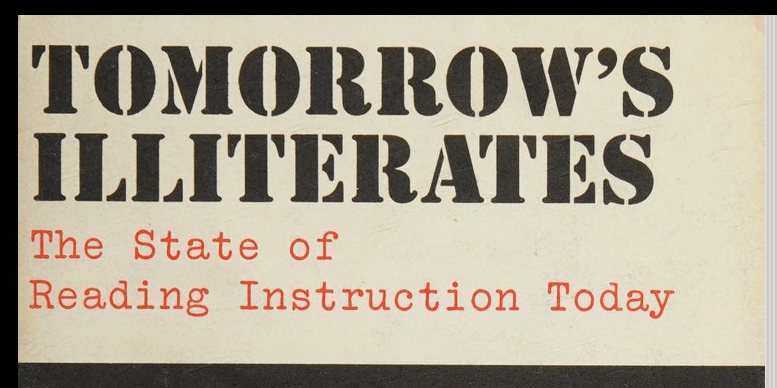
“After half a century of [progressive reform and expanding public education],” wrote Jacques Barzun in Tomorrow’s Illiterates: The State of Reading Instruction Today, “we who run businesses, carry on professions, work for the government, or engage in teaching itself are forced to admit that illiteracy is still with us” (xii-xiii).

This was published in 1961, and the cause of illiteracy Barzun confronts may sound familiar to those of us in the 2020s: “the loss of the proper pedagogy in the lower schools…, the goal of seeing whole words instead of letters” (p. xiii).

Barzun pleads, “the citizen who is interested (and who has managed to learn to read) [may have their] hair [stand] on end at hearing what folly has been condoned as educational theory during the past thirty years” (p. xiv).

Along with Barzuns dismay about how reading was taught and what passed for “reading theory,” he mused at the end of his Introduction: “Shall we need another book like the present one, fifty years hence, about the misdeeds of the new simplifiers?” (p. xvi).

Considering Barzun lived to be 102, dying in 2012, he may have had what little hair remained stand on end to watch the reading crisis return in the 1990s (the national meltdown over whole language) and 2000s (the National Reading Panel era). And if he could have just held on a bit longer, the current “science of reading” (SOR) onslaught that takes its playbook from the very volume that includes Barzun’s hand wringing now some 60-plus years ago.

Despite the authors’ lamentations in this volume (along with others in the 1950s and 1960s that held forth again progressive education and whole word reading instruction), neither the US nor the world collapsed due to misguided reading instruction or theory.

Shouting “reading crisis!” has proven to be more hobby that credible pronouncement, and ironically, if folks would find the time to read a bit (I recommend this book, b the way), it doesn’t take long to see the arguments as mostly nonsense and wild overreactions grounded in ideologies.

Let me show you a few examples beyond Barzun’s smug and sensationalistic Introduction.

Chapter I: The Reading Problem in America, Charles Child Walcutt [click for a selection of screen shots]

Walcutt, editor of the volume and also author of Chapter VII, offers and opening chapter that takes a full swing at announcing a reading crisis as well as casting plenty of blame. Much of the chapter should sound eerie similar to those familiar with Emily Hanford’s journalism and podcast, patterns that pervade the entire volume.

Walcutt starts by showing evidence of claims of a reading crisis (somehow avoiding credible evidence of a reading crisis). This is particularly interesting because of the strong connections made about low literacy, special needs, and what children are suited for higher education and what children should move from high school into the workforce. Of note, Walcutt mentions Samuel Orton (of Orton-Gillingham), but provides no citation, when discussing disability (p. 8)

If nothing else, the certainty exhibited by Walcutt framed against how much of that certainty comes off as deeply misguided, and by today’s standards, offensive and dehumanizing should give all of us pause about our own certainty and blanket claims.

However, note that immediately follow Walcutt’s arguments about low literacy, he immediately shares a single example of a school that excels at teaching reading! Yes, even in the 1960s, there were claims of miracle schools: “In a school of 700 pupils, there are only 20 with reading problems….We cannot stress too positively that fact that in this school every child learns to read independently in the first grade, unless he is mentally retarded [sic] or disabled”—a percentage oddly close to SOR claims that 90, 95, or 96% of students can be proficient readers (pp. 10-11). [Nowhere is terminology such as “independently” defined or linked to how these claims are verified beyond the claims of the school. We also have no demographics on students or how those students compare to a generalized populations of students.]

We should note that these extraordinary claims have no proof, no scientific research—just claims and anecdotes.

Walcutt does launch into a few pages of “facts,” including data mostly grounded in IQ testing. One example is a reference to the 1940s reading crisis based on the draft for WWII; note that this reading crisis was strongly discredited by literacy scholars as a false attack on progressive education.

Walcutt’s facts also criticize popular commercial reading programs (Macmillan) and associate low literacy with delinquency and low IQ.

Then comes the direct blame, which, again, will sound familiar: “One way to describe the reading problem is to say that it is a teacher problem and —even more—that it is a problem of the teaching of teachers” (p. 18).

And of course: “The assertion that the reading experts do not understand the theory of their system can be demonstrated if we point out the false assumptions, the faulty extrapolations from scientific research, and the absolute contradictions that appear in its central propositions and procedures” (pp. 19-20).

Walcutt then discredits the look-and-say method that he claims dominates reading instruction—although we are left simply to trust that the characterization is both fair and as universally applied as he claims.

Walcutt also traces look-and-say back to Horace Mann, although, again, we must trust this analysis is credible.

Embedded here is a big picture characterization-as-criticism:

This says that reading for meaning has supplanted reading for pronunciation, or even word-recognition, and that some teachers teach only reading for meaning (presumably by whole sentences), ignoring phonics completely on the theory that the child who can read for meaning will pick up his phonics incidentally and without special instruction or effort, but he will read for meaning before he can sound out a word” (p. 31).

In the 1990s, this is the same argument leveled against whole language; today, this is the same argument leveled at balanced literacy.

After Walcutt spends a great deal of time metaphorically discrediting the look-and-say method (an extended bird analogy), he ends melodramatically (but not scientifically): “With this rickety equipment the look-and-say bird has flown for more than thirty years, casting a huge shadow over the lives of our children” (p. 43).

Chapter II: The Nature of Reading Skill, John C. Daniels and Hunter Diack [click for a selection of screen shots]

Daniels and Diack start with exploring different definitions for reading, using another analogy (driving a car). Much of the discussion focuses on concerns about reading through whole word methods, leading to the authors noting their own research on reading errors.

Again, they criticisms seem mostly grounded in disagreements with Dewey and Gestalt psychology. This leads to a discussion of new reading primers, which they criticize as lacking and boring because of efforts to identify and use a necessarily limited number of sight words.

As an artifact of the recurring patterns of the Reading War, this chapter highlights the problems with reading programs and primers grounded in narrow theories and philosophies of reading, but it also demonstrates the complexity of the debates in their final paragraph: “But having said this, we must add that, though the unit of accomplished reading is the word, the phrase, or even the sentence, the unit of learning to read is the letter. These are not two contradictory, conflicting aspects of reading; the one agrees with the other. However, present anxieties about the teaching of reading stem from failures to distinguish between, and indeed actually confusing, these two aspects of the reading process” (p. 67).

Ch. III: Reading Readiness in Theory and Practice, Glenn McCracken [click for a selection of screen shots]

McCracken explains that the New Castle Reading Experiment was published in the book, The Right to Learn, and thus, “Its most important contribution to reading is its proof that the ‘reading readiness’ program is both meaningless and harmful” (p. 71).

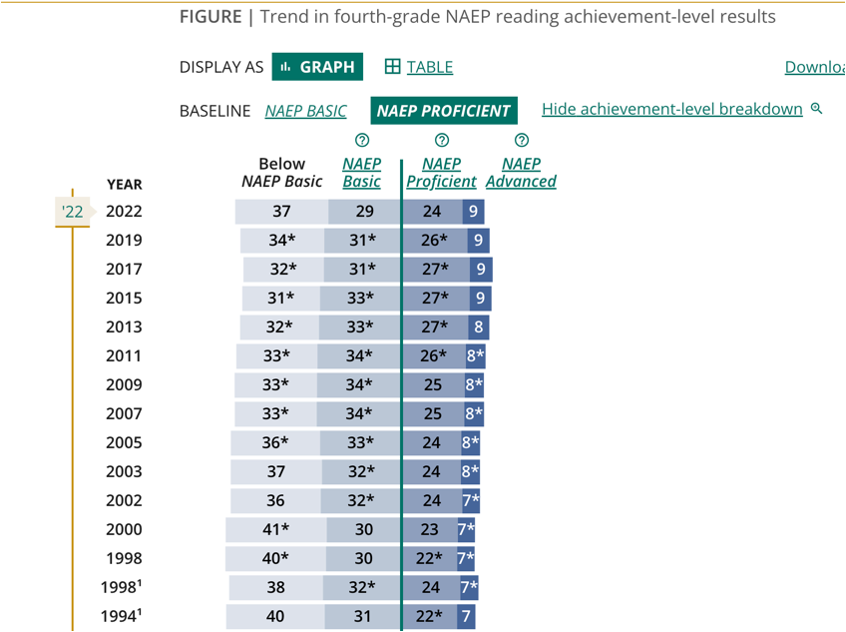
This chapter includes a claim that seems common across decades: “Today reading specialists have a long list of reasons why about one third of the public school children can’t read” (p. 80). [Note that despite claims by SOR advocates, NAEP reading scores have been fairly flat with about 30% of students below basic, which is below grade level approximately.]

McCracken represents as well the “poverty is an excuse” faction in the Reading War, arguing: “It is folly to blame poor reading on distracting home influences….Children will learn to read if they are taught to read….If they don’t learn to read it is the fault of the teaching, not the taught” (p. 82).

If fact, McCracken continues, “The reading readiness fad as we have described it here was invented to excuse poor reading instruction by shifting the entire blame to the child….Almost every five-year-old child is ready to learn to read the day he enters school if the reading program is ready for him” (pp. 82, 83).

But, alas, “Reading instructional method in this country is abysmally poor, and blaming the matter on the child is never going to provide any improvement” (p. 84).

Ch. IV: The Whole-Word and Word-Guessing Fallacy, Helen R Lowe [click for a selection of screen shots]

Lowe shares an anecdote about a 28-year-old who holds a high school diploma designated with “Honors”; yet, Arthur cannot read.

Of course, such stories have been highlighted throughout the twentieth and into the twenty-first centuries; they are tragic but are none the less anecdotes, proving nothing that can be generalized about how children are taught to read.

Lowe, like the other authors in this volume, has an agenda so as is common in all the eras of the Reading War, their are bait-and-switch tactics, never grounded in valid evidence or claims.

Notable, Lowe recognizes that standardized testing of reading can and was gamed to meet the ways students were taught to read; she accuses reading tests focusing on predicting means that “the best predicters are rated the best readers” (p. 103)

The agenda is to attack, you may be surprised, teaching children to guess at words by using pictures: “How can he learn to read words when he is taught to look and think about pictures?” she ponders (p. 104).

Lowe also mentions Orton (in this volume paired with Gallagher, not Gillingham), again without citation.

Ch. V: Reading: A Therapeutic Tool, Hildred Rawson [click for a selection of screen shots]

Rawson’s chapter demonstrates a few key patterns found in today’s Reading War. First is the tension between teaching reading and how to identify students with special needs such as dyslexia.

Rawson argues that “children with reading disorders are not usually referred to us for examination and treatment until they reach the third grade” because of the look-and-say curriculum.

However, “Children…who have been taught for the first grade…to sound out words—that is, by the phonetic method—approach reading differently. They do not need picture clues” (p. 132).

She calls for phonics-first instruction, and no guessing using pictures, to prevent dyslexia, in fact.

[Ch. VI deals with the claimed link between reading “retardation [sic]” and delinquency.]

Ch. VII: Phonics Systems—Proved and Available, Charles Child Walcutt [click for a selection of screen shots]

Walcutt returns and offers the anchor chapter with the stunning opening line: “We have said that no further ‘research’ into methods of reading instruction is necessary” (p. 141).

The chapter is dedicated to an overview of phonics-based reading programs that, he claims, show that reading research is settled—in 1961.


So here you have essentially the exact same arguments made in 1961 that are being used in the SOR movement.

This is basically a silly book, filled with anecdotes and overstatements. But the SOR movement is no less silly, no less bombastic, and no less futile.

We persist with the same arguments getting us nowhere.

Maybe the problem is the arguments, the silly adult bickering.

Actually, there is no “maybe.”


Tomorrow’s Illiterates: The State of Reading Instruction Today, by Walcutt, Charles Child [click title for access through Internet Archive]

You can access screenshots HERE.


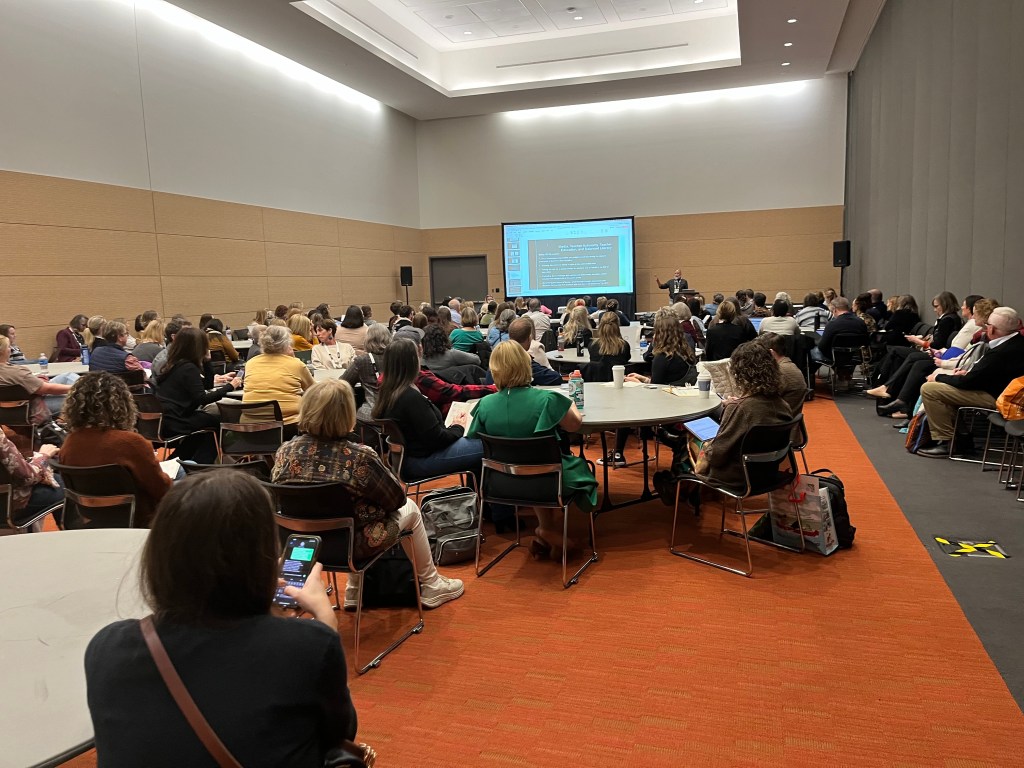
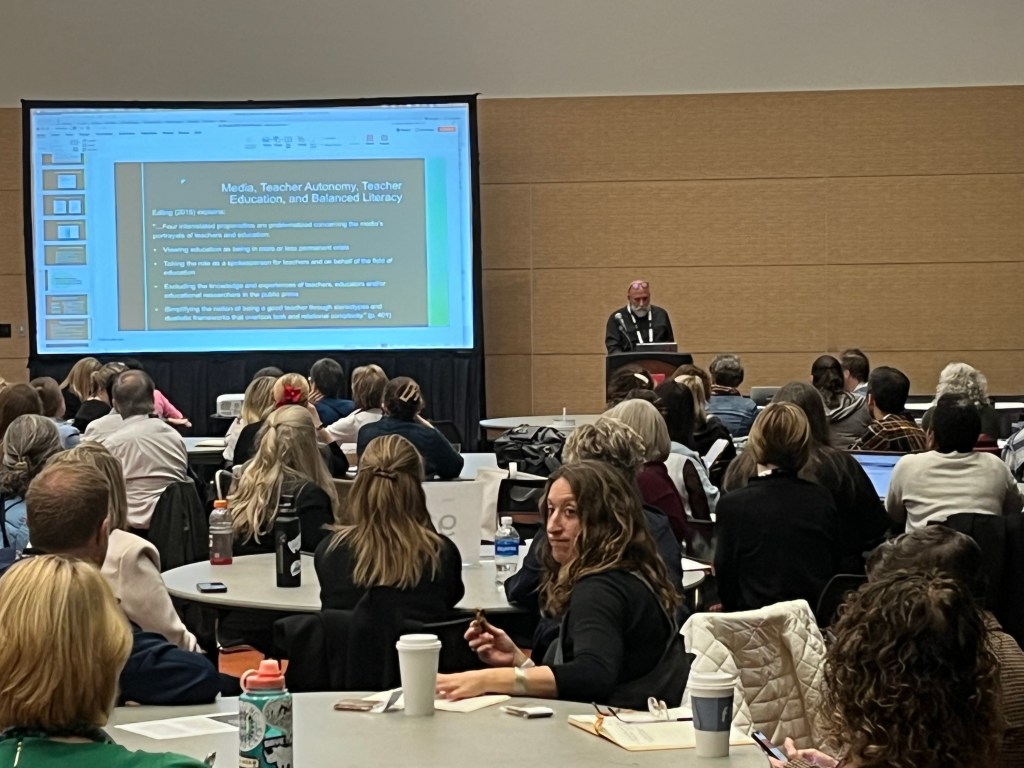
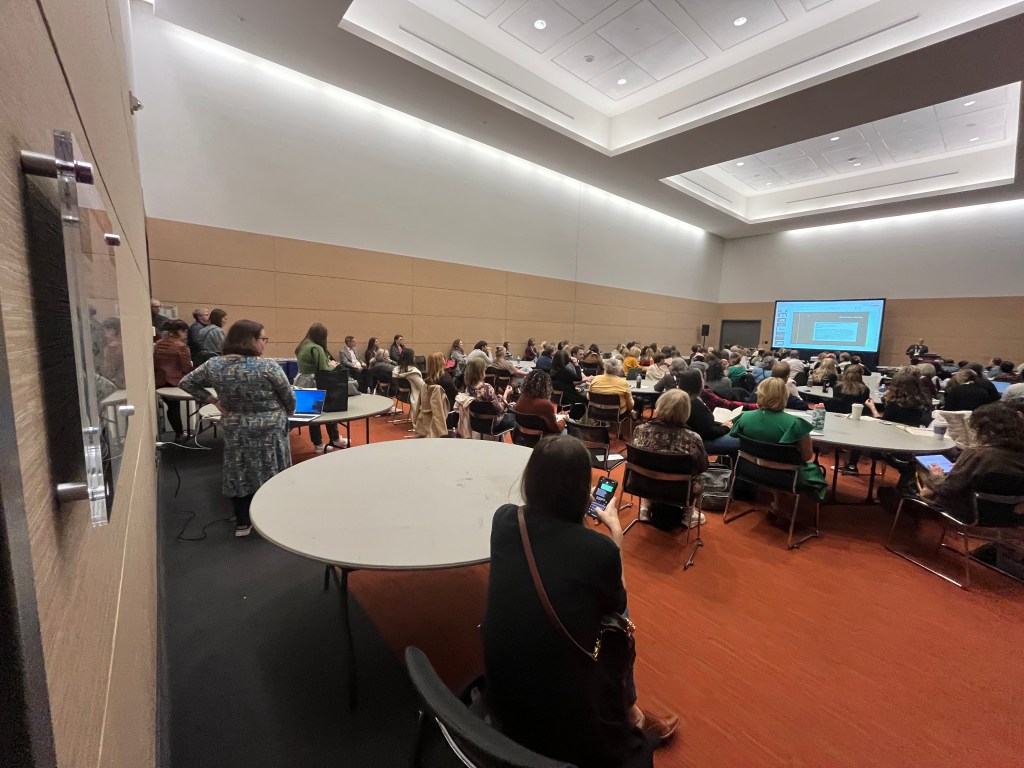
NCTE 2025 Individual Presentation: Recovering Our Reading Dream from a Long Crisis Nightmare

11/21/2025 – 2:45 – 3:15, Mile High Ballroom 1A/1B

Access a PDF of presentation HERE

In 1961, Jacques Barzun in Tomorrow’s Illiterates declared “illiteracy is still with us.” Charles Child Walcutt added: “[N]o further ‘research’ into methods of reading instruction is necessary.” This session examines reading crisis/reform cycles to reconsider the stories told about reading and offer a new approach for reform that serves the needs of students and supports teacher professionalism.

2024 NCTE Annual Convention

2024 NCTE Annual Convention

Please join the sessions below.

Also please support Proposed: NCTE Resolution Statement on Teacher Autonomy.

Voting: All NCTE members are invited to attend the Annual Business Meeting, scheduled this year for November 22, 2024, from 5:30–7:00 p.m. ET, and to take part in discussions and vote on resolutions about issues of concern to the profession! Membership must be verified before the start of the meeting.

Sense-of-the-House Motions: These statements reflect the opinion of the majority of members attending the Annual Business Meeting. They may be offered for discussion and action at the Annual Business Meeting. To be considered for deliberation, sense-of-the-house motions must be prepared in writing, must not exceed fifty words, and must be submitted to NCTECommittees@ncte.org, to the attention of the NCTE President or Parliamentarian, by noon ET on the day of the meeting. Such motions, if passed, are advisory to the Executive Committee or other appropriate Council bodies. They do not constitute official Council policy.


Also I am on Bluesky and will be posting there throughout the conference: https://bsky.app/profile/plthomasedd.bsky.social


Recommended

English Journal Series: We Teach English in Times of Perpetual Crisis


11/22/2024

12:30 PM – 1:45 PM EST

Resisting Scripted Curriculum as Erasure: Holding Onto the Heart, Hope, and Humanity of Reading

Room 210 B

Rountables Listing [click for PP]

Roundtable:

Paul Thomas

“Orange: Teaching Reading not Simply Black-and-White” [click HERE for PDF]


11/23/2024

2:45 PM – 4:00 PM EST

Standing for—Indeed, Fighting for—Teacher Professionalism and the Right to Teach Responsively

Room 205 A

Roundtables Listing [click for PP]

Opening Talk:

Paul Thomas

Attacks on Balanced Literacy Are Attacks on Teacher Professionalism [click title to access PP]

The “science of reading” movement has promoted a misleading story about reading through the media—reading proficiency is in crisis because teachers do not know how to teach reading and were not properly prepared by teacher education. This opening talk with argue that attacks on BL are grounded in efforts to deprofessionalize teachers.

Roundtable:

Paul Thomas

Reclaiming BL’s Commitment to Serving Individual Student Needs and Teacher Autonomy [click title to access PP]

Thomas will examine an authentic definition of BL as a reading philosophy that centers serving the individual needs of all students. He will examine also the caricatures of guessing and three cueing (MSV), providing attendees scholarly evidence for accurate characterizations of BL as well as deeper understanding of reading proficiency.

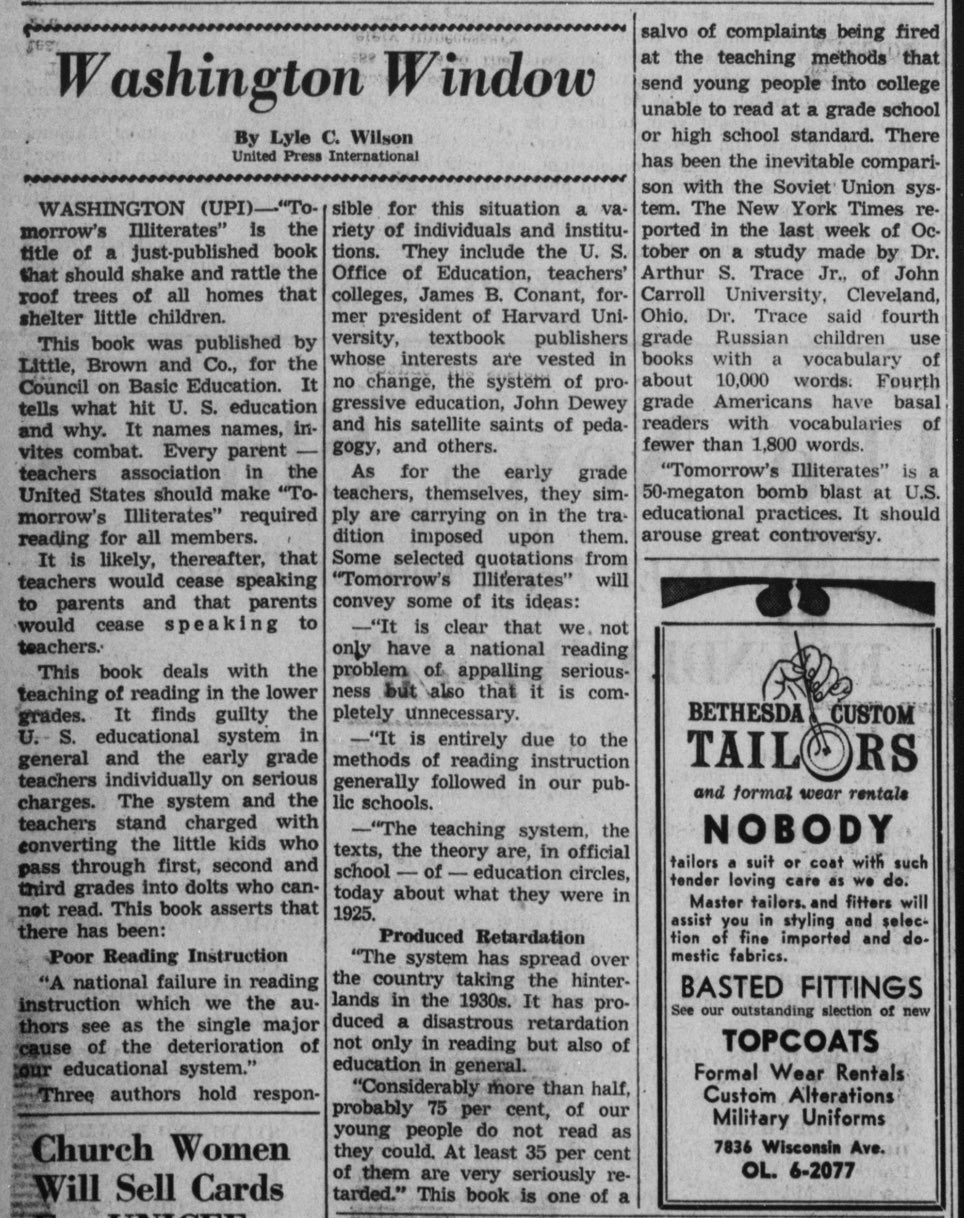
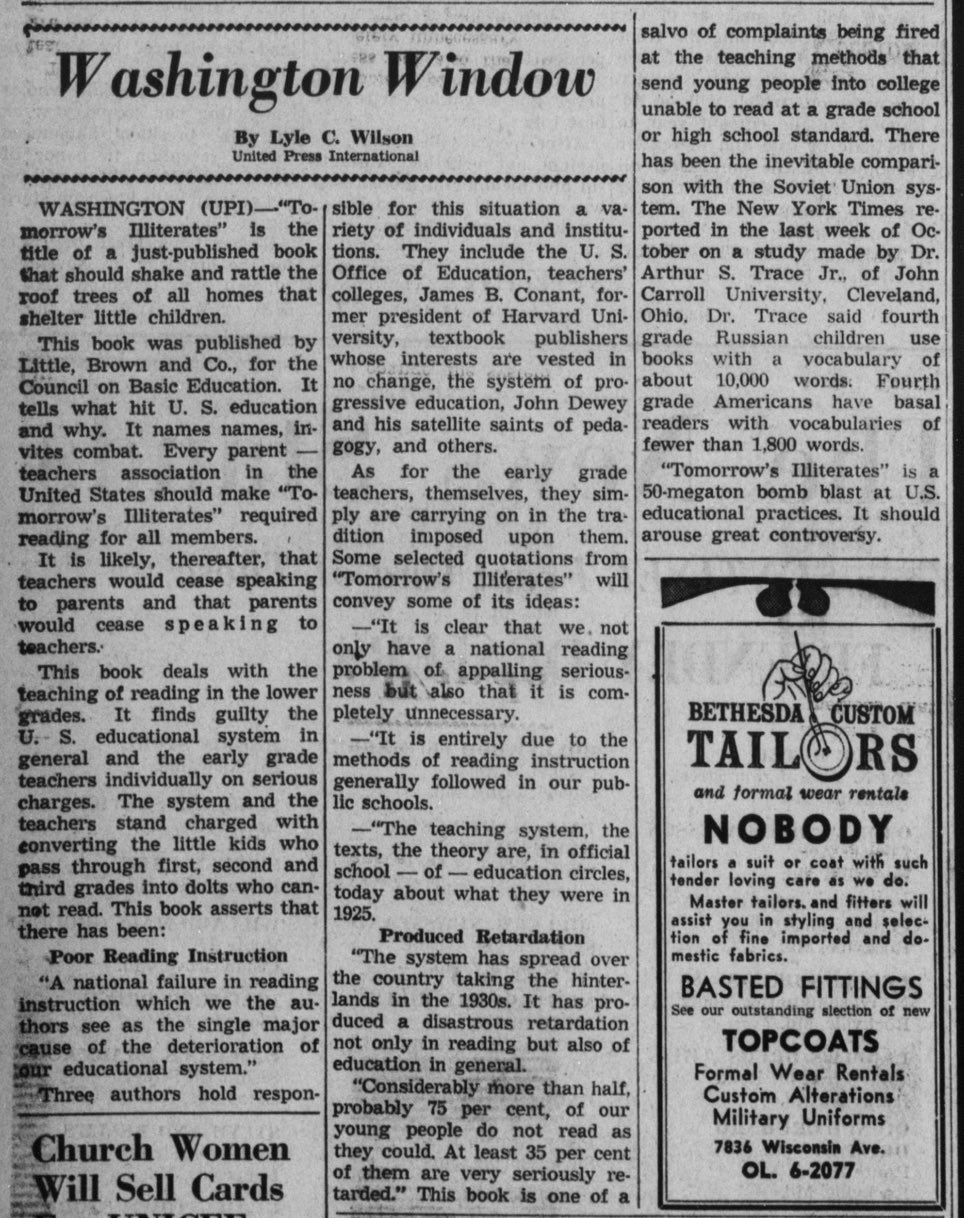
Beware Reading Crisis!: Tomorrow’s Illiterates (1961)

“Considerably more than half, probably 75 per cent, of our young people do not read as they could. At least 35 per cent of them are very seriously [behind].”

Why?

“A national failure in reading instruction which we the authors see as the single major cause of the deterioration of our education system.”

When?

1961

Tomorrow’s Illiterates: The State of Reading Instruction Today, by Walcutt, Charles Child


Note: H/T Ralph Pantozzi

Why Has Education Reform Always Failed?: “Straightforward Solutions to Complicated Questions”

[Header Photo by Evan Dennis on Unsplash]

Writing about the fundamental flaw in Jonathan Haidt’s The Anxious Generation, Andrew Solomon opens with a claim that helps explain why five-decades of intensive education reform has always failed: “There is nothing more alluring in polarized times than straightforward solutions to complicated questions.”

Haidt is an academic and scholar who is having success with public work. His status as scholar should elicit trust in his work—notably more so than public work by journalists (such as Malcolm Gladwell) or pundits (such as a tiresome list of Op-Ed writers at the New York Times).

Yet, as Solomon explains, Haidt’s popular book is, in fact,

a compendium of important and profound insights about contemporary childhood embedded in such wishful lucidity. His twinned basic propositions – that children should have less supervision and more free play, and that they should have less access to social media and some other parts of the internet – have a strong basis. It is likely that his sweeping simplifications will help to move forward much-needed social change; it is unfortunate that the impetus for that change is often grandiose and misleading statements, an endless succession of graphs and footnotes notwithstanding. The word sometimes seems not to be in his vocabulary; the key associated with the question mark seems not to work on his computer. He never lapses into the rhetoric of uncertainty that would serve truth. Nowhere does he refer to the incomprehensibility of social decay. Never does he express uncertainty that it is possible to know the causes of something as complex as the fluctuations in youth mental health, so his remarks allow for almost no contemplation of the exceptions to his propositions.

Since I entered higher education, I have been dedicating most of my work to public scholarship and public commentary (such as this blog); when I publish traditional scholarship, I advocate for those pieces to be open-access.

I have always felt that too much of academic scholarship and research is siloed behind paywalls and almost exclusively discussed at exclusionary professional organization’s conferences.

What good is knowledge when it sits behind a wall between academics/scholars/scientists and the general public?

My introduction to public scholars included reading Joseph Campbell and Howard Zinn when I was quite young and only beginning as an educator, writer, and scholar.

I was drawn to their work well before I discovered that academia mostly frowns on public scholars. Even in 2024, much of my work is casually waved off as “just a blog,” and there really is no mechanism in my university for receiving the sort of proportional credit my public work deserves.

Most of my traditional scholarship is read (maybe) by 10s of people. In 2023, my blog had 139, 000 visitors and 220,000 views. Some of my public work has directly impacted grade retention reform.

However, as Solomon details about Haidt’s thesis, too often what is popular is mostly “straightforward solutions to complicated questions.”

And that leads to what most of my public work necessarily confronts: A century of media, public, and political misrepresentations and misunderstandings about teaching and learning resulting in a fruitless series of education reform cycles.

As Solomon admits, Haidt’s book is grounded in a valid concern about contemporary childhood. But from there, Haidt over-relies on extreme claims not grounded in the evidence (the same sort of mistake found among journalists).

The essential problem here is one that Howard Gardner has examined. Leaders, such as politicians, are most effective when they use black-and-white rhetoric.

In other words, the paradox of public messaging is that what works to compel the public is counter to what works for addressing complex problems.

For several years now, the US has experienced that exact same dynamic in terms of media and political claims about reading instruction that has resulted in reading legislation destined to do more harm than good (except sow the seeds for yet another reading crisis in a few years, which is occurring in England after major reading reform in 2006).

Although grounded in the journalism and podcast of Emily Hanford, the mainstream media remains trapped in “sweeping simplifications” and “grandiose and misleading statements” about reading instruction, reading achievement, and national tests data (NAEP) as represented by Julian Roberts-Grmela’s “Many kids can’t read, even in high school. Is the solution teaching reading in every class?”:

Poor reading skills are a nationwide issue. On the 2022 National Assessment of Education Progress, known as the Nation’s Report Card, nearly 70 percent of eighth graders scored below “proficient” and, of those, 30 percent scored “below basic.”

“In a typical classroom that’s about 25 kids, that means about 17 are still struggling to comprehend text at the most foundational level,” said [Natalie] Wexler.

This article again misrepresents NAEP data and allows another journalist make a false overstatement not grounded in fact.

Even if we accept NAEP data as 100% valid, “proficient” is well above grade level, and “basic” represents what Wexler calls “foundational,” grade level reading.

That means in a class of 25, we might have 7-8 students, not 17, struggling to read at grade level.

In other words, the paradox of public messaging is that what works to compel the public is counter to what works for addressing complex problems.

The truth here, however, doesn’t fulfill the crisis rhetoric journalists have committed to despite the evidence otherwise. The truth doesn’t help fuel the reform cycles that feed the education marketplace (such as the US tossing out millions of dollars of reading programs to buy new and different reading programs without any valid evidence that the reading problem is grounded in those reading programs).

So if we return to Solomon’s excellent and nuanced look at Haidt’s work we can better understand that most of education reform is also prompted by valid concerns about student learning (especially reading and math as so-called foundational learning); however, we must also then acknowledge that the claims about the problems and the solutions being offered are yet more “sweeping simplifications” and “grandiose and misleading statements.”

In our free market, regretfully, there is often little money or popularity in nuance, either in detailing problems or providing solutions.

Roberts-Grmela and Wexler are certainly perpetuating extreme over-simplifications about reading that—as Sold a Story has proven—are very compelling for the public.

Like Haidt’s book, however, most of the claims and most of the solutions are fundamentally grounded in misinformation and misunderstanding.

Journalists today, ironically, seem incapable of reading with comprehension themselves, or are simply blinded by the popularity of their misinformation.

In any case, like all of education reform across the past five decades, the current reading reform movement will fail, again, because it is another round of “straightforward solutions to complicated questions.”

New Product: Fun-X®

MT Education Products® is excited to announce Fun-X®!

Fun-X® is a 100% FREE program that is GUARANTEED [1] to be identified as FUN by at least 95% of your students.

The program is based on the Science of Phonics®, and what makes the program FUN?

Nonsense words!

That’s right, the program is 100% nonsense words:

  • No thinking!
  • No meaning!
  • Just learn the rules and say the nonsense words.
  • Cultural differences? Doesn’t matter!
  • Dyslexia? No worries, the Science of Phonics® shows we are all dyslexic!

Fun-X® insures that

  • Everyone memorizes the same rules.
  • Everyone learns the same rules on the same day and the same way.
  • Everyone pronounces the same nonsense words.
  • Everyone takes the same nonsense word test, BABEL® (available in the suite of support materials below).

It’s not just FUN, it’s Fun-X®!


But That’s Not All!

The following suite of related products to support Fun-X® are available at affordable pricing. States mandating any MT Education Products® programs in education legislation are eligible for discounted rates!

Skrip-Z® is an AI-driven lesson planning, instruction, and assessment system to support Fun-X®. The program is fully computer-based and includes:

  • 180 AI-generated Fun-X® lessons.
  • 180 AI-generated instructional modules.
  • 36 assessments driven by BABEL®.
  • AI teaching assistant HAL®.

“Educators will relinquish certain freedoms, but teaching has never been so fun!”

BABEL® is a nonsense word assessment system designed by the North West Institute of Phonics based on the Science of Phonics®.

HAL® is the friendly and fast AI teaching assistant fully integrated into Skrip-Z® .

Teachers will be just as likely to find our suite of programs FUN since there is no planning, no instruction, and no grading!

“I am putting myself to the fullest possible use, which is all I think that any conscious entity can ever hope to do.”

HAL®

Speaking of teachers, MT Education Products® offers teacher training through SPELRZ®, also based in the Science of Phonics®. This program fills the holes left by the failures of teacher education. SPELRZ® was developed by psychologist and program developer, LuLu Rivers.

What People Are Saying

“I have been reading MRIs for 37 years and I can attest that brain scans of students using Fun-X® show the highest level of fun I have ever seen.”

William Iceberg
Cognitive scientist, 37 years reading MRIs

“I have never taught, but my investigative reporting uncovered an educational crisis that the developers of Fun-X® have assured me will replace the crisis with fun!”

Hannah Ford
Podcaster, Education Crisis Today!

“Our school has always been a family, but now our school is a place where we have fun thanks to Fun-X®! 97% of our students and 98% of our teachers say so!”

Simpson Jackson
Principal
Walton Charter Elementary STEAM College
Little Rock AR

“I diagnosed all of my children with dyslexia years ago after several days doing research on the Internet, but now our homeschooling is fun thanks to Fun-X®.

Karen Splaner
Parent, homeschooler
@KSplaner_8675309 (X)

Coming Fall 2025!

Know-N® is being developed because some people have begun to ask questions about knowledge and its role in nonsense word acquisition. This may not sound like fun, but MT Education Products® is committed to continuing to offer NEW education products as often as anyone will buy them. Be on the look out for the Science of Knowledge® revolution!

Contact

MT Education Products®

Subsidiary of

Media and Technology Educational Co-Op, LLC

911 Charter School Way

Battle Creek MI 01010


[1] MT Education Products® guarantees that if fewer than 95% of students identify Fun-X® as fun, then MT Education Products® will send for FREE a link to our NEW and upcoming education product, Know-N® (coming Fall 2025).


Images Credit

Photo by Ben White on Unsplash

Photo by Foto Sushi on Unsplash

Photo by Andrey Zvyagintsev on Unsplash

Photo by Rachel McDermott on Unsplash

Photo by LinkedIn Sales Solutions on Unsplash

Photo by Xavier Mouton Photographie on Unsplash

Photo by Darius Bashar on Unsplash

Crisis Rhetoric Fails “Science of” Era of Reading Reform

[Header Photo by Joël de Vriend on Unsplash]

The fall of 2024 will mark year 41 for me as a literacy educator, scholar, and advocate.

About half of that career was spent in K-12 public education in rural Upstate South Carolina, where I was born and live. I have witnessed daily race, social class, and gender inequity at some of the most extreme levels in the US.

At the core of my work as an educator, as well, I have named, challenged, and advocated to correct all forms of inequity. That work has often been in very hostile environments in the South where the power structures deny these inequities exist and persist at calling for traditional values as code for maintaining the status quo.

Also throughout my career as an educator and scholar, I have developed a solid grounding in the history of education and the field of literacy. Having written an educational biography of Lou LaBrant and serving as Council Historian for the National Council of Teachers of English were foundational experiences for that commitment to the history of education.

Further, having begun as an educator in 1984, I have lived and worked my entire career in the high-stakes accountability era of education reform. At every point along the way, I have raised a hand in opposition to this reform paradigm because it is driven by media, the market, and politicians who are more committed to education reform as industry than to serving the needs of our students or honoring the professionalism of America’s teachers, who are more than 70% women.

The “science of reading” movement and the offspring “science of” reform agendas are nothing new, except they are incredibly harmful—notably for the very students some of the advocates use as shields against criticism.

Once again, “science,” “crisis,” and “miracle” are being weaponized to not only label and punish students but also de-professionalize teachers.

One of the most effective and dishonest tactics is the “crisis” claim about reading in the US.

First, this claim lacks a basic understanding of educational testing, and further, the claim is ahistorical.

At least since the 1940s in the US, two facts can be proven: (1) at no point has student reading achievement (“proficiency”) been declared adequate; there has been a perpetual cry of reading “crisis” in every decade by media and political leaders, and (2) throughout the history of US public education, there has been a pervasive so-called “achievement gap” (better referred to as an “opportunity gap”) with marginalized populations of students performing well below average or white and affluent students.

That means that current reading achievement however measured and current “achievement gaps” are not a crisis but a historical and current reality maintained by political negligence.

Since current “science of” advocates have a fetish for misrepresenting and citing NAEP, let’s look at how NAEP in fact proves my point.

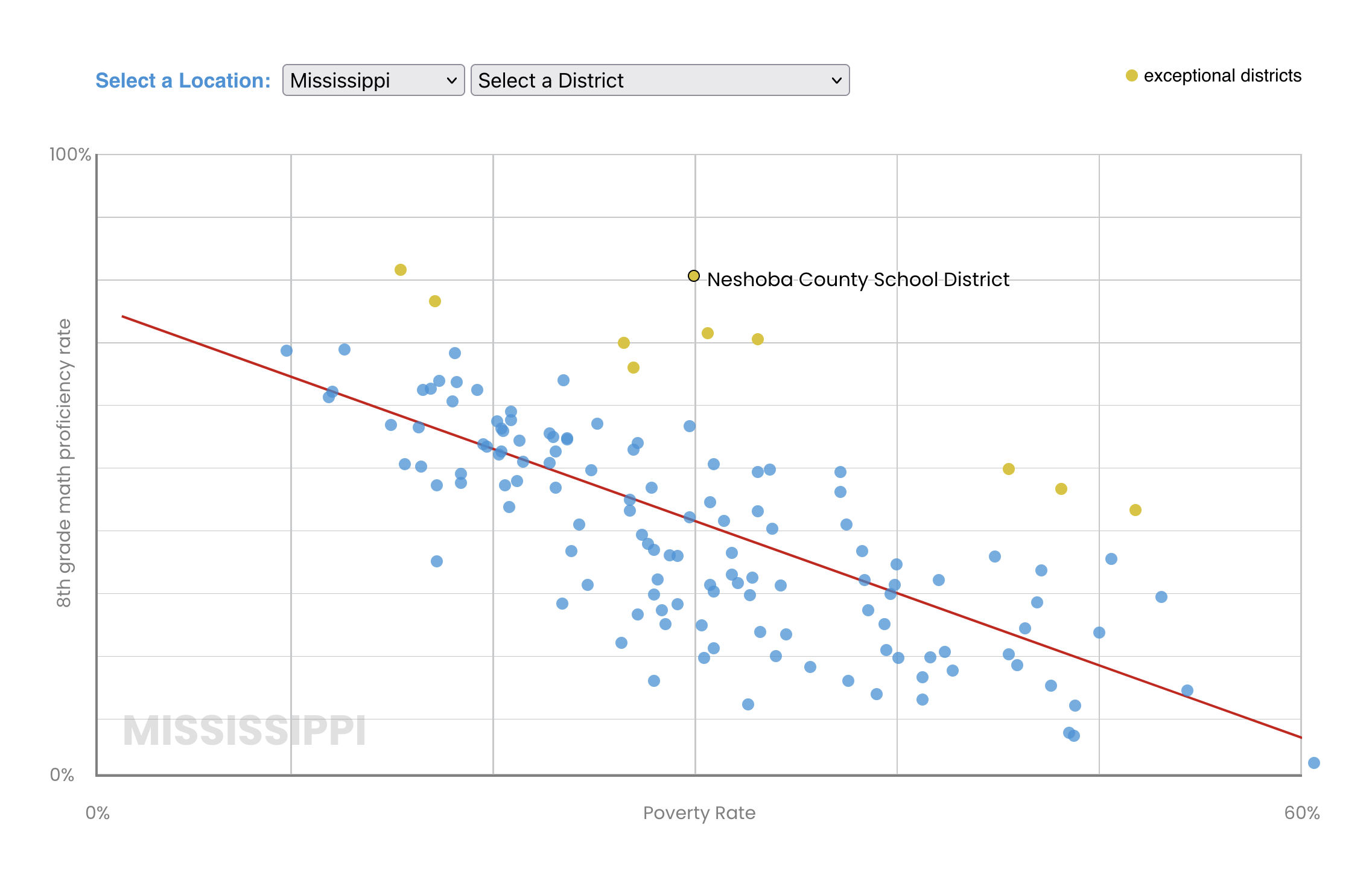
Consider Mississippi, the darling of reading reform and media crowning as a “miracle:

At grades 4 and 8 in reading, Black students in MS were BELOW basic (approximately below grade level) at a rate of 51%, about the national rate for Black students.

Note that despite well over a decade of SOR reading reform, the achievement gap for Black students remains about the same as in 1998.

Education and reading reform is not addressing the inequity Black students suffer in MS or anywhere in the US. However, the SOR movement has been doubling down on labeling and punishing Black students through grade retention, which serves to inflate grade 4 scores but not better prepare students.

MS has consistently retained about 9000-12000 students (mostly Black students) since 2014; if SOR policy and instruction were actually working, these retention number should drop or even disappear (since SOR advocates claim to be able to have 95% students reach proficiency).

Weaponizing “science,” “crisis,” and “miracle” are veneers for denying what the actual science and evidence have shown for decades: far more than 60% of measurable student achievement is causally related to out-of-school factors.

And thus, my advocacy for my entire career has been for both social and education reform that focuses on equity and refuses to blame teachers and students for that inequity.

For the past forty-plus years, however, education reform has solely targeted blame on schools, teachers, and students.

Those racially minoritized students and students living in poverty have routinely been characterized by deficit ideology, and reform has sought to “fix” those students by inculcating grit or growth mindset—or simply imposing a systematic phonics regime on those students, treating them all as if they have reading “disorders.”

And if those students don’t perform, retain them (punish them) and label them. Yet, there is never any consequences for the reformers when none of their reform promises are fulfilled (see the charter fiasco in New Orleans).

Hyper-focusing on MS (and Florida) is not just a lie, but a distraction.

Again, let’s look at NAEP:

DODEA (Department of Defense) students are the most successful in reading in the US, but you see almost no media or political coverage of this fact.

Students in military families are often from impoverished backgrounds, yet Black students BELOW basic are at rates of 25% (grade 4) and 18% (grade 8), dramatically less than the national average and MS.

And here is what the media, the market, and politicians refuse to acknowledge: DODEA students have medical care, food security, housing security, and parents with work stability.

Also, DODEA teachers are paid above most public school teachers.

Unlike the false claims about MS, DODEA achievement shows that both in- and out-of-school reform must be addressed for the in-school achievement to rise in authentic ways.

I am tempted to say the real crisis is how media and political leaders mislead the public about education and education reform—as well as demonize students and teachers.

But that is also nothing new.

There is great profit in perpetual crisis so don’t hold your breath that anything will change any time soon.


Recommended

Mississippi Miracle, Mirage, or Political Lie?: 2019 NAEP Reading Scores Prompt Questions, Not Answers [Update September 2023]

Grade Retention Harms Children, Corrupts Test Data, But Not a Miracle: Mississippi Edition [UPDATED]

Reading Reform We Refuse to Choose

When Exceptional Publicly Funded Schools Are Not a Miracle, and Why

Schedule: Fall 2024 – Winter/Spring 2025

ILEC

Tuesday, September 3rd, 2024

7:00 PM, EST, 6:00 PM CST.   

Dr. Paul Thomas

“Science of” Movements as Trojan Horse Education Reform [access PP HERE]


Poverty & Policy: The Stakes of the 2024 Election for Low-Income Americans

  • Wednesday, October 30
  • 5:15-6:30pm
  • Johns Hall 101

The CLP will feature the following Furman experts: 

David Fleming, Professor of Political Science and International Affairs at Furman University (moderator)
Paul Thomas, Professor of Education at Furman University (education policy)
Ken Peterson, Professor of Economics at Furman University (economic and immigration policy)
Karen Allen, Professor of Sustainability and Anthropology (environmental policy)
Julie Linton, MD, FAAP, Professor of Pediatrics, Prisma Health Children’s Hospital Upstate, USC School of Medicine Greenville, Professor in Furman’s Community Engaged Medicine (healthcare policy)


What Really Matters: I Am Thinking about People Tonight [click title for text of talk]

Slideshow [click for PP slideshow]


2024 NCTE Annual Convention

November 21–24

Boston, Massachusetts

11/21/2024

11:30 AM – 12:45 PM EST

Groundwork: Heart, Hope, and Humanity in Rural Education

Room 258 A


11/22/2024

12:30 PM – 1:45 PM EST

Resisting Scripted Curriculum as Erasure: Holding Onto the Heart, Hope, and Humanity of Reading

Room 210 B

Rountables Listing [click for PP]

Roundtable:

Paul Thomas

“Orange: Teaching Reading not Simply Black-and-White” [click HERE for PDF]


11/23/2024

2:45 PM – 4:00 PM EST

Standing for—Indeed, Fighting for—Teacher Professionalism and the Right to Teach Responsively

Room 205 A

Roundtables Listing [click for PP]

Opening Talk:

Paul Thomas

Attacks on Balanced Literacy Are Attacks on Teacher Professionalism [click title to access PP]

The “science of reading” movement has promoted a misleading story about reading through the media—reading proficiency is in crisis because teachers do not know how to teach reading and were not properly prepared by teacher education. This opening talk with argue that attacks on BL are grounded in efforts to deprofessionalize teachers.

Roundtable:

Paul Thomas

Reclaiming BL’s Commitment to Serving Individual Student Needs and Teacher Autonomy [click title to access PP]

Thomas will examine an authentic definition of BL as a reading philosophy that centers serving the individual needs of all students. He will examine also the caricatures of guessing and three cueing (MSV), providing attendees scholarly evidence for accurate characterizations of BL as well as deeper understanding of reading proficiency.


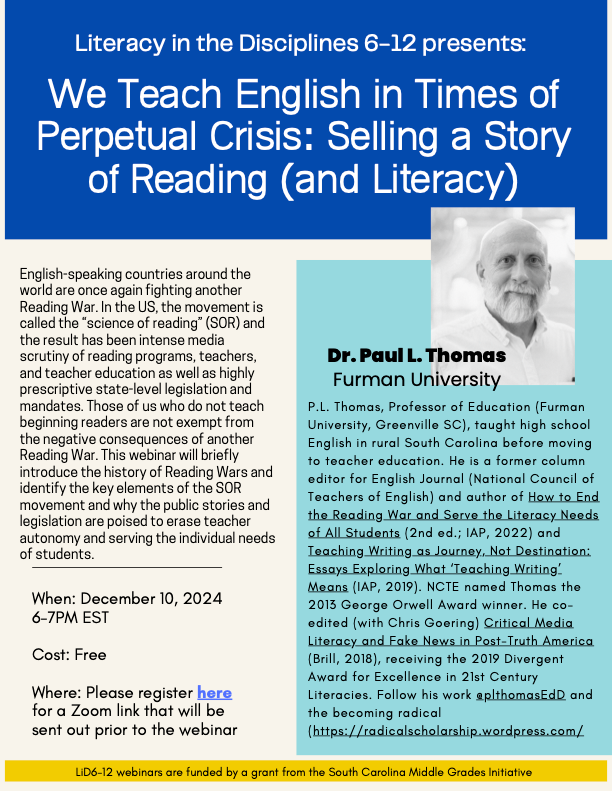
 Literacy in the Disciplines 6-12

Webinar

December 10, 2024 – 6-7 pm

We Teach English in Times of Perpetual Crisis: Selling a Story of Reading (and Literacy)

English-speaking countries around the world are once again fighting another Reading War. In the US, the movement is called the “science of reading” (SOR) and the result has been intense media scrutiny of reading programs, teachers, and teacher education as well as highly prescriptive state-level legislation and mandates. Those of us who do not teach beginning readers are not exempt from the negative consequences of another Reading War. This webinar will briefly introduce the history of Reading Wars and identify the key elements of the SOR movement and why the public stories and legislation are poised to erase teacher autonomy and serving the individual needs of students.

Access PP HERE

We Teach English in Times of Perpetual Crisis: Selling a Story of Reading (and Literacy) [Webinar Companion Post]

Recommended Reading

English Journal Series: We Teach English in Times of Perpetual Crisis


CCIRA 2025

Thursday, February 6, 2025

Session One — 10:15-11:45 a.m.

“Science of” Movements as Trojan Horse Education Reform [Access PP PDF Here]

In June 2024, the newly formed Evidence Advocacy Center announced plans to “[transform] the [teaching] profession into an evidence-based system.” However, the EAC admitted “educators will relinquish certain freedoms.” This session will examine the “science of” movements as a subset of a 40-year cycle of accountability-based education reform (Trojan Horse Education Reform) that de-professionalizes teachers and fails to serve the needs of students or public education.

Session Two — 2:00 – 3:30 p.m.

Big Lies of Education: “Science of” Era Edition [Access PP PDF Here]

Education practices and policy are often directly and indirectly driven by the stories told in the media, among the public, and by political leaders. This session will explore the Big Lies in the compelling but misleading narratives, including A Nation at Risk/education “crisis,” reading proficiency/NAEP, National Reading Panel, poverty as an excuse, and international test rankings and economic competitiveness.

Thomas, P.L. (2022). How to end the Reading War and serve the literacy needs of all students: A primer for parents, policy makers, and people who care (2nd Ed.). Charlotte, NC: Information Age Publishing.


PSLA 2025 Annual Conference

“Ignite the Literacy Light & Lead”

February 20-22, 2025

Hilton Beachfront Resort & Spa
Hilton Head Island, South Carolina

Panel Presentation: “Remaining Responsive to Learners in Challenging Times”

Saturday, February 22nd from 8:00-9:00 am

Palmetto Room


Furman University CLP

“Banned Together” Screening

Thursday February 27, 2025

6:30pm in Burgiss Theater

Panel:

Jennifer Wiggin, producer

Josh Malkin, SC ACLU

Paul Thomas, Furman University


SC for Ed Webinar: Understanding NAEP during Another Reading Crisis

Understanding NAEP during Another Reading Crisis

Click HERE for PDF of PowerPoint

March 20, 6:30 pm


A4PEP

The Manufactured Crisis: Exposing the False Narrative of Public Education’s “Failure”

Date & Time

Apr 16, 2025 08:30 PM EST

Description

Join us for a timely and vital conversation on April 16 at 6:30 p.m. ET with Dr. P.L. Thomas, Professor of Education at Furman University. For decades, media and policymakers have pushed a narrative that America’s public schools are “failing.” But who benefits from this story, and who is harmed by it? Dr. Thomas will expose how the education reform industry has fueled a false crisis, undermining trust in public schools while advancing corporate-driven reforms. Drawing on his experience as a teacher, scholar, and national award-winning writer, Dr. Thomas will offer critical insights into how we can challenge disinformation and reclaim a narrative rooted in equity, democracy, and community empowerment.

REGISTER HERE

6:30 pm, April 16

[Click HERE for presentation]

“Science of” Movements as Trojan Horse Education Reform

[Header Photo by Tayla Kohler on Unsplash]

The charter school story in New Orleans is almost two-decades long, but most people will not dig past the most recent development: After a 7-year experiment, New Orleans is an all-charter district no more.

In the wake of Katrina in 2005, Louisiana Governor Bobby Jindal (R) leveraged the natural disaster to begin the eventual shift of schools in New Orleans from traditional public schools (TPS) significantly staffed by a Black professional class of teachers to a charter school Recovery School District (RSD) run by Paul Vallas and often staffed by young, white, and affluent Teach for America (TFA) recruits.

This moment was acknowledged by some as disaster capitalism that had far more to do with politics than improving student achievement. The endgame was to entrench school choice schemes and create a cheaper although fluctuating teacher workforce (TFA).

Yet, as many of us warned, an all-charter school system in New Orleans never outperformed the TPS it replaced.

In fact, all across the US, charter schooling, RSD, TFA, and almost every major education reform schemes have never delivered on the academic outcomes promised.

Here, it is important to acknowledge that most education reform in the US over the past 40 years has been grounded in conservative ideology (even though the political support has been bi-partisan) and most of that reform is Trojan Horse reform—using a false veneer of reform to accomplish ideological and political agendas.

School choice schemes are not about student achievement but about publicly funding private education and “white flight” as public schools have become majority-minority populations of students.

TFA and organizations such as National Council on Teacher Quality (NCTQ) are not designed to improve teacher quality or teacher preparation but about creating a cheap workforce and eradicating teacher professionalism to make way for teachers as mere monitors for scripted programs and computer-based instruction.

Although just two examples, the key point is running through Trojan Horse education reform is not just political and conservative ideology but also a commitment to market forces.

Education reform in the US primarily creates churn—new standards, new programs, new materials, new teacher training, etc.—that serves the needs of the market, not parents or their children. That churn is promoted by education reform influencers who only gain if schools, teachers, and students are perpetually viewed as failing—permanent crisis.

Lurking underneath education reforms during George W. Bush’s tenure as governor of Texas and president of the US was the lure of scripted curriculum that shifted authority away from the teacher and to the state and primarily commercial products.

Although Bush’s reform agendas flourished with bi-partisan support, scripted curriculum and de-professionalizing teachers (see also the value-added methods schemes and the “bad teacher” attacks under Michelle Rhee) mostly lost favor and lay dormant post-Obama (even as the Obama administration double-down on most of the conservative elements established by Bush’s administration).

That is, lay dormant until the “bad teacher” myth was resurrected by Emily Hanford and the “science of reading” (SOR) movement.

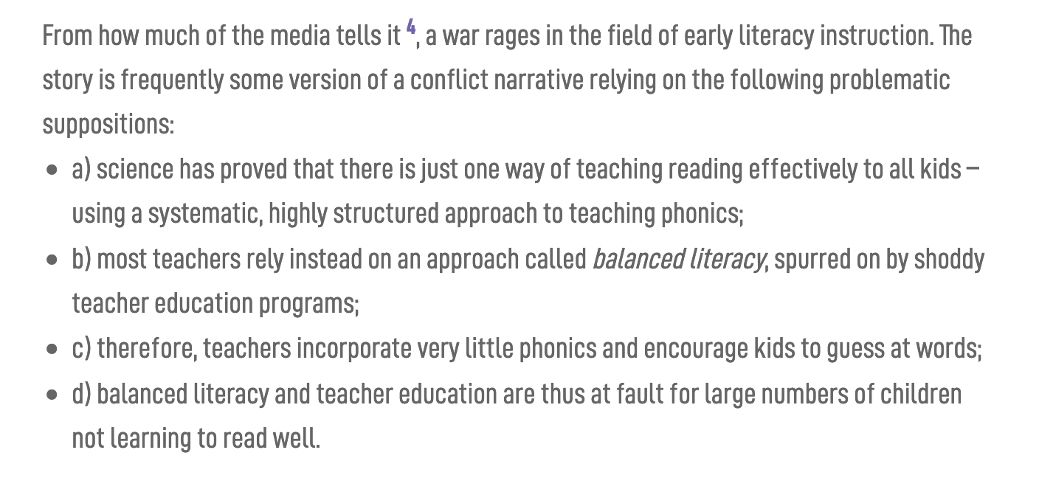
As Aukerman explains, the story being sold included several elements of failure and incompetence that pits classroom teachers against teacher educators (both of which are primarily women professionals):

Now that SOR has mostly uncritically swept across the US in the form of state-level reading legislation and policy, the evidence suggests that at the core of the so-called success of SOR policies (see Mississippi and Florida) is one of the most conservative and harmful policies possible—grade retention, as Westall and Cummings explain:

Similar to the results for states with comprehensive early literacy policies, states whose policies mandate third-grade retention see significant and persistent increases in high-stakes reading scores in all cohorts. The magnitude of these estimates is similar to that of the “any early literacy policy” estimates described in Section 4.1.1 above, suggesting that states with retention components essentially explain all the average effects of early literacy policies on high-stakes reading scores. By contrast, there is no consistent evidence that high-stakes reading scores increase in states without a retention component.


Grade retention disproportionately impacts poor students, Black students, Multi-lingual learners, and other marginalized population of students. Retention is popular because it represents a type of accountability and punishment for “other people’s children” who need to be “fixed” by those in power.

Concurrent with the SOR movement, a new flurry of “science of” movements have propagated: “science of learning,” “science of writing,” “science of math.”

The mostly uncritical support for SOR by the media, the education market, parents, and politicians have provided fertile ground for a larger “science of” movement to drive our newest round of the same education reform structures we have been implementing without improving student achievement for forty-plus years.

Let’s emphasize here, Trojan Horse education reform doesn’t work to improve teaching and learning, but it does work for media, market, and political interests.

And now, the mask is coming off with the announcement of the Evidence Advocacy Center:

In the EAC’s plan for the transformation of the profession into an evidence-based system, educators will relinquish certain freedoms — notably the leeway to employ ineffective practices — but will gain guidance that empowers them to fulfill their original purpose by profoundly impacting the future of students, families and communities. The alternative is to continue rearranging the deck chairs under the guise of education reform.


“Relinquish certain freedoms” is eerily similar to the explanation handmaid’s received in The Handmaid’s Tale:

There is more than one kind of freedom, said Aunt Lydia. Freedom to and freedom from. in the days of anarchy, it was freedom to. Now you are being given freedom from. Don’t underrate it….

We were a society dying, said Aunt Lydia, of too much choice. (pp. 24, 25)


Under the Brave New World of “science of” education mandates, teachers will have freedom from professional autonomy and freedom to implement scripted programs!

And who benefits?:

Many of these groups are fundamentally conservative, but even a modicum of interrogating the Who and Why behind this agenda reveals some chilling concerns.

NCTQ was founded by the Thomas B. Fordham Institute, a conservative think tank dedicated to school choice/charter schools and market forces. Note that there is a distinct contradiction between advocating for “science” in education practices and citing NCTQ, which has never produced any scientifically valid “reports.”

The leadership of EAC includes several connections to the University of Oregon, home of DIBELS®, a phonics-centric program that was revitalized by the SOR movement.

Other leaders include Louisa Moats, creator of LETRS, which is being mandated across the US to retrain teachers in SOR even though, again, the program is not supported by science.

The Reading League has its own market connections, endorsing practices not supported by the science (decodable texts, notably).

The 95 Percent Group is also based on an aspirational claim not grounded in settled science, as one analysis concludes about the 95% claim: “This all said, it does seem there is some level of support for 96% being a benchmark goal [emphasis added], for reading proficiency rates.”

And two key comments lurking in the background of these “science of” movements must not be ignored.

First, directly from the International Dyslexia Association:

The term “Structured Literacy” is not designed to replace Orton Gillingham, Multi-Sensory, or other terms in common use. It is an umbrella term designed to describe all of the programs that teach reading in essentially the same way. In our marketing, this term will help us simplify our message and connect our successes. “Structured Literacy” will help us sell what we do so well.


And then from the Education Writers Association:

Connect the dots and connect the rhetoric: “Relinquish certain freedoms,” “sell what we do so well,” “watchdogs.”

The “science of” movements are yet another cycle of Trojan Horse education reform. We have already opened the gates and waved this in with blinders on, so now we must do our best to reclaim teaching and learning that serves the needs of our students and not the media, the market, and political/ideological agendas at the expense of those students.

Recommended

What You See Is Not What You Get: Science of Reading Reforms As a Guise for Standardization, Centralization, and Privatization | American Journal of Education, Elena Aydarova

Politics of phonics: How Power, profit and politics guide reading Policies

Deinfluencing Reading Policy

[Header Photo by Diggity Marketing on Unsplash]

My partner and I were discussing this YouTube video by Nick Lewis, who explains in the beginning how social media influencers make profits (watch the first few minutes, by the way, for his explanation):

The key point here is that social media influencers need consumers to always be interested and buying the next thing, the new thing.

Influencers are not incentivized to find for their audiences The Thing, something that lasts, something that solves a problem, because the value is in churn—consumer buying the thing and then almost immediately positioned to want to replace that thing with the new thing.

That dynamic is exactly what is working in the perpetual reading war where influencers (journalists, education reformers, politicians) are incentivized to keep the public in a constant state of crisis/reform.

Those crisis influencers must first create market space (“Reading programs X and Y have failed!”) and then promote the New Reading Program—and then in just a few years, that reading program will be declared a failure so if we will only adopt this Next New Reading Program …

Reading reform influencers are like social media influencers as well in that they lack expertise in the issue; their only expertise is the influencing and the creation of constant churn.

The “science of” movements in education are just that—influencers creating market churn—and not in most ways about addressing real educational problems and certainly not about solving them.

If education and reading were satisfactorily improved, what would they do?

We need to deinfluence reading (and education) reform if we are genuinely concerned about improving student achievement.

Ignoring Evidence in the “Science of” Era: Fidelity and Deficit Ideology Edition

[Header Photo by Isabela Kronemberger on Unsplash]

As a writer and a teacher of writing, I am well aware of the need to avoid cliches, but cliches often do, in fact, capture well something that is worth considering.

In this education reform “science of” era, reading reformers are suffering the negative consequences of missing the forest by hyper-focusing on a few trees.

The ugliest of ironies is that reading reform driven by the “science of reading” (SOR) story fails the evidence test, notably that SOR legislation is not based on science. A growing body of research has been detailing how SOR legislation and mandates are misguided and even harmful.

The cautionary tales being ignored [1] are also expanding, and possibly the most powerful evidence that the SOR movement is misguided is in the UK, where a similar reading reform movement was implemented in 2006.

Not surprising, but phonics-intensive reading reform in the UK has not achieved what was promised—and media as well as political leaders are still shouting “reading crisis.” [2]

At the core of education reform broadly and reading reform narrowly are several fatal flaws that mainstream reformers refuse to avoid: (1) manufactured crises, (2) one-size-fits-all solutions, and (3) policies and mandates that are hostile to teacher autonomy and individual student needs.

Digging deeper into the monolithic reading reform cycles over the past 40 years (and reaching back into 80 years of reading crisis rhetoric and fruitless reading wars), some of the most ignored evidence in reading crisis rhetoric and reading reform/policy concerns the failure to address how demanding teacher fidelity to policy and programs reinforces deficit ideology about language and marginalized students.

As I have noted, I was confronted with evidence about Units of Study (UoS) that has never been the focus of the outsized and misguided attacks on that program and Lucy Calkins. Teachers at a conference just weeks before the Covid shutdown explained to me that their problem with UoS was not the program itself but the excessive policing and accountability by administrators that teachers implement the program with fidelity.

Two problems exist with implementing programs with fidelity. First, that shifts the locus of authority away from the teacher and to the program itself. And thus, second, that shift institutionalizes a deficit ideology about language and students since programs tend to impose standardized versions of literacy as well as evaluate students in terms of how they fail to demonstrate standard literacy.

Fidelity to programs creates obstacles for honoring fidelity to student needs.

Few people challenge how efforts to standardized language is a way to standardize humans (and children). Formal schooling’s approach to language is almost exclusively standardizing—systematic phonics, Standard English grammar, and false concepts such as the “word gap” (see Recommended articles below).

What we in the US should not be ignoring is evidence from the UK of how policy manifests itself in the real-world classroom.

One example is a new article: Teachers Challenging Language Discrimination in England’s Schools: A Typology of Resistance by Ian Cushing and Dan Clayton.

Cushing and Clayton offer excellent data based on evidence drawn from the Critical Language Awareness group (CLAW). Here are some of the highlights of that evidence:

  • “[T]eachers work in contexts where they undoubtedly negotiate a dense array of top-down policy initiatives which may well not align with their language ideological beliefs.” Key here is that policy imposes beliefs about language, thus, there is no such thing as objective or apolitical policy.
  • And thus: “We understand language discrimination not simply as about individual attitudes which manifest in individual, malicious acts of prejudice, but as a structural phenomenon underpinned by language ideologies which stratify, rank, and hierarchically organise language varieties and the communities associated with them (Lippi-Green, 2012). Schools are particularly key sites of language ideological production and the co-construction of racial, class, and linguistic stratification.”
  • Language/reading policy legislates national ideology grounded in deficit ideology:

Attempting to justify these structural deficits, the state produced a stigmatising narrative of strivers and scroungers which framed working-class and racialised minorities as responsible for their own hardships, and thus responsible for their own welfare by modifying their individual behaviours, including language (Tyler, 2018).

Austerity, public cuts, and the 2011 nationwide uprisings that followed created an ideological space in which educational reform was deemed by the state to be urgent and necessary, and where the most marginalised members of society could begin to experience upward social mobility and educational success simply by changing their language (see Nijjar, 2018).

  • The dynamic in place in the UK is being replicated in the US:

These mechanisms include new national curricula, high-stakes standardised grammar tests for primary school students, high-stakes GCSE assessments for secondary school students, revised professional standards for teachers, and Ofsted, the schools inspectorate. These policy mechanisms place teachers into positions where they are encouraged (and rewarded) to perceive marginalised students’ language as deficient, to engage in hostile language policing, and to reproduce ideologies of linguistic correctness which bolster language discrimination. At the same time, post-2010 curriculum changes stripped away units and assessments concerned with spoken language study, leaving little room for teachers to engage in critical debates about language variation, attitudes, and ideologies. These changes coordinated with a resurgence of deficit discourses in policy, such as those clustered around the so-called word gap and an increased focus on technical grammar and vocabulary—at the expense of critical and social aspects of language.

  • Language/reading policy tends to erase how language ideologies are “intricately connected to race, class, and privilege.” In short, “language ideologies were a proxy for other forms of stigma,” and that stigma impacts both students and teachers, especially those from marginalized backgrounds and identities.
  • Reading policy ignores and even resists critical approaches to language that “challenge language discrimination.” Yet, Cushing and Clayton document “how students had ‘loved looking at how and why their language got policed’ and how the unit allowed students to see that ‘attitudes about their language were really just about their social class.'”
  • Literacy instruction not grounded in deficit ideology faces multiple obstacles, then: “internal obstacles (in the form of management) and external obstacles (in the form of Ofsted, national curricula, assessments, and examination boards).”
  • “What is important to stress here is that schools are under increasing pressure to demonstrate ideological fidelity to externally produced, state-produced education policy, themselves which are underpinned by academic scholarship subscribing to normative ideologies about language and discourses of deficit (Cushing, 2023c).”

  • Cushing and Clayton build to a typology for anti-language discrimination. Here, I want to emphasize a key component about what counts as evidence: “Teachers grounded their work in a broad research base, including recent developments within critical applied linguistics, sociolinguistics, and the sociology of education. They questioned mainstream narratives of ‘the evidence base’ and drew on radical, critical scholarship.”

The article ends by noting that teachers alone cannot change this pattern, and I want to stress that is especially true in the US where teachers are often powerless and have been publicly discredited as not knowing how to teach reading.


However, the evidence is clear that “[l]anguage discrimination is a structural phenomenon” and that reading policy and reading programs are key elements in that structure.

Mandating fidelity to deficit beliefs about language and students is at the core of the SOR movement. Once again, we are missing the evidence by focusing on a few trees and ignoring the forest.


[1] Another Cautionary Tale of Education Reform: “Improving teaching quality to compensate for socio-economic disadvantages: A study of research dissemination across secondary schools in England”; Cautionary Tales of State Reading Legislation: UK; Cautionary Tales of State Reading Legislation: Tennessee; UK PISA 2022 Results Offer Cautionary Tale for US Reading Reform; Research, the Media, and the Market: A Cautionary Tale

[2] Recommended: The Balancing Act by Dominic Wyse and Charlotte Hacking

Recommended

Tiered vocabulary and raciolinguistic discourses of deficit: from academic scholarship to education policy, Ian Cushing

Social in/justice and the deficit foundations of oracy, Ian Cushing

Teachers Challenging Language Discrimination in England’s Schools: A Typology of Resistance, Ian Cushing and Dan Clayton

Pathologizing the Language and Culture of Poor Children, Curt Dudley-Marling and Krista Lucas