First, based on NAEP data—similar to Cassidy’s report—Shakeel and Peterson in EdNext offer a much different view of student achievement in the US, notably about reading achievement:
Contrary to what you may have heard, average student achievement has been increasing for half a century. Across 7 million tests taken by U.S. students born between 1954 and 2007, …[r]eading scores have grown by 20 percent of a standard deviation during that time, nearly one year’s worth of learning.
When we examine differences by student race, ethnicity, and socioeconomic status, longstanding assumptions about educational inequality start to falter. Black, Hispanic, and Asian students are improving far more quickly than their white classmates in elementary, middle, and high school. In elementary school, for example, reading scores for white students have grown by 9 percent of a standard deviation each decade, compared to 28 percent for Asian students, 19 percent for Black students, and 13 percent for Hispanic students. Students from low socioeconomic backgrounds also are progressing more quickly than their more advantaged peers in elementary and middle school. And for the most part, growth rates have remained steady throughout the past five decades.
Shakeel and Peterson’s analysis confirms a concern raised by scholars for decades after A Nation at Risk—the manufactured educational crisis perpetuated by the media, political leaders, and education publishers.
Keeping the US in perpetual crisis has resulted in over four decades of blaming students, teachers, and public schools as failures even though education policy and funding have been exclusively controlled by political leadership at the national and state levels.
That leads us to a state-by-state analysis from NPE that avoids blaming students, teachers, and schools by holding political leadership accountable for the following:
Privatization Laws: the guardrails and limits on charter and voucher programs to ensure that taxpayers and students are protected from discrimination, corruption, and fraud.
Homeschooling Laws: laws to ensure that instruction is provided safely and responsibly.
Financial Support for Public Schools: sufficient and equitable funding of public schools.
Freedom to Teach and Learn: whether state laws allow all students to feel safe and thrive at school and receive honest instruction free of political intrusion.
The top five states include North Dakota, Connecticut, Vermont, Illinois, and Nebraska with Arkansas, North Carolina, Utah, Arizona, and Florida sitting at the bottom.
SC ranks 39th, receiving a grade of F for failing to fully support public schools or our democracy. That political negligence has resulted in decades of unwarranted negative messages about our schools, teachers, and students.
These reports combined offer SC an opportunity to resist crisis rhetoric as well as rejecting the ineffective reform cycles since the 1980s.
The problems facing our students, teachers, and schools are social inequities such as poverty and racism, but we also have a history of political negligence in our state that has resulted in a national recognition of our Corridor of Shame.
We can and should do better for our students, schools, and state by recognizing that the real failure is not our schools but our political leadership and the lack of political will to fund and support education as a foundational part of our democracy.
“Lack of support for early years language and communication development is leading to a “literacy crisis” that could be costing the economy £830m for each school year group, according to new research,” write Ella Creamer in The Guardian.
The report cited is a February 2024 analysis and heralds another round of reading crisis in the UK.
This is quite interesting considering that in 2006, the UK implemented a phonics-centered reform agenda that has been documented to have been robustly practiced, notably that all students have received systematic phonics in the UK for almost two decades:
Prior to 2006 the teaching of reading in most classrooms in England is best described as balanced instruction, in which some phonics teaching has always been part of the teaching of reading typically for children in the infant years (aged five to seven) although not necessarily ‘systematic phonics’ instruction…. However in 2006 the Rose Report recommended that there should be even more emphasis on phonics teaching….
This was followed by the increased emphasis on discrete teaching of phonics recommended by the Rose Report and the PNS from 2006 onwards. Further intensification of synthetic phonics teaching was seen in England’s national curriculum of 2014, along with a range of other measures to ensure teacher compliance with the prescribed method of teaching reading, including the use of the PSC; the vetting of phonics teaching schemes; and the use of the inspectorate to focus on outcomes in statutory reading assessments as a prime focus in school inspections.
Also of note, that research in 2022 revealed, once again, these reforms were misguided and ineffective. The researchers concluded, calling for a more balanced approach:
In addition to the importance of contextualised reading teaching as an evidence-based orientation to the teaching of reading we hypothesise the following pedagogical features that are likely to be effective. Phonics teaching is most likely to be effective for children aged five to six. Phonics teaching with children younger than this is not likely to be effective. A focus on whole texts and reading for meaning, to contextualise the teaching of other skills and knowledge, should drive pedagogy. Classroom teachers using their professional judgement to ensure coherence of the approach to teaching phonics and reading with other relevant teaching in their classroom is most likely to be effective. Insistence on particular schemes/ basals, scripted lessons, and other inflexible approaches is unlikely to be optimal. Well-trained classroom assistants, working in collaboration with their class teachers, could be a very important contribution to children’s reading development.
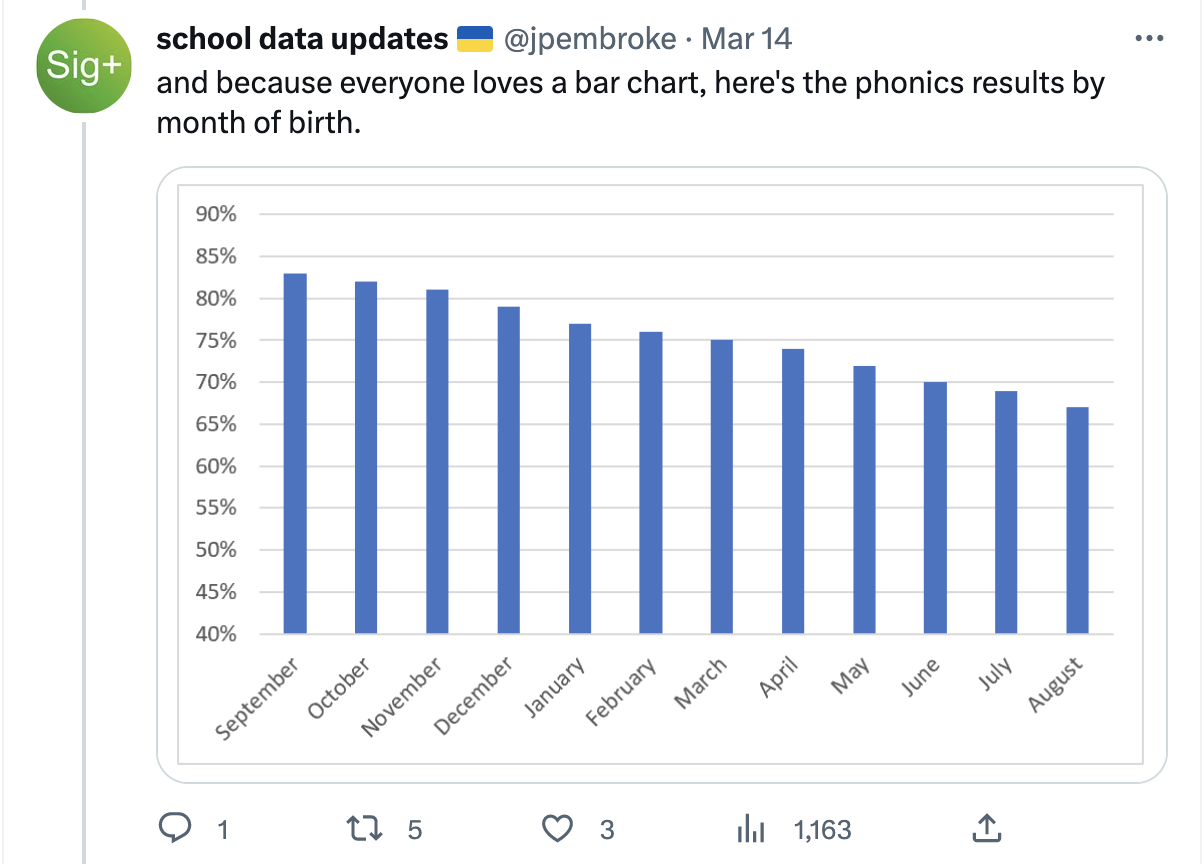
More evidence from the UK shows that reducing reading instruction to systematic phonics ignores both the science of reading instruction and the realities of human development. The mandatory phonics checks in the UK show that achievement correlates strongly with birth month, not instruction and certainly not resulting in the sort of reading achievement that avoids another reading war:
The “science of reading” movement in the US is misguided and costly, mostly benefitting commercial interests repackaging reading programs and materials emphasizing phonics.
States are rushing to mimic practices that have already failed in the UK. Our students and teachers deserve better.
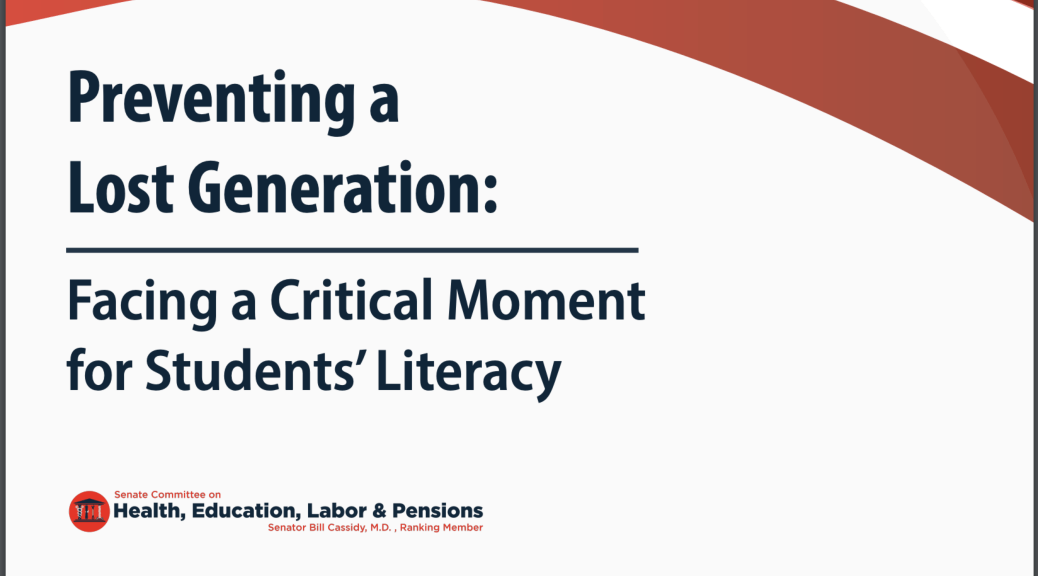
“The 2022 NAEP results show that the average reading score for fourth graders is lower than it has been in over 20 years. For eighth and twelfth graders, average scores are at about a 30-year low,” states Senator Bill Cassidy (R-LA) in his new literacy report, adding, “The 2022 NAEP LongTerm Trend assessment for nine-year-old students showed average reading scores not seen since 1999.”
Cassidy’s alert about a reading crisis fits into dozens and dozens of media articles announcing crises and failures among students, teachers, and public schools all across the US. Typical of that journalism was Nicholas Kristof in the New York Times about a year ago:
One of the most bearish statistics for the future of the United States is this: Two-thirds of fourth graders in the United States are not proficient in reading.
Reading may be the most important skill we can give children. It’s the pilot light of that fire.
Yet we fail to ignite that pilot light, so today some one in five adults in the United States struggles with basic literacy, and after more than 25 years of campaigns and fads, American children are still struggling to read. Eighth graders today are actually a hair worse at reading than their counterparts were in 1998.
One explanation gaining ground is that, with the best of intentions, we grown-ups have bungled the task of teaching kids to read. There is growing evidence from neuroscience and careful experiments that the United States has adopted reading strategies that just don’t work very well and that we haven’t relied enough on a simple starting point — helping kids learn to sound out words with phonics.
As I have noted, education and reading crises have simply been a fact of US narratives since A Nation at Risk. But as I have also been detailing, these claims are misleading and manufactured.
Based on NAEP data—similar to Cassidy’s report—Shakeel and Peterson offer a much different view of student achievement in the US, notably about reading achievement:
This analysis demonstrates that the current reading crisis is manufactured, exclusively rhetorical and ideological, generating profit for media, politicians, and commercial publishers.
In short, the manufactured crises are distractions from the other contrarian truth about education as highlighted in the analysis from NPE:
This educational grading from NPE is unique because it doesn’t grade students, teachers, or public school, but holds political leadership accountable for supporting universal public education and democracy. The standards for these grades include the following:
Privatization Laws: the guardrails and limits on charter and voucher programs to ensure that taxpayers and students are protected from discrimination, corruption, and fraud.
Homeschooling Laws: laws to ensure that instruction is provided safely and responsibly.
Financial Support for Public Schools: sufficient and equitable funding of public schools.
Freedom to Teach and Learn: whether state laws allow all students to feel safe and thrive at school and receive honest instruction free of political intrusion.
These two examples come from contrasting ideologies, yet they offer contrarian truths about public schools and student achievement that would better serve how we talk about schools and student achievement as well as how we seek ways in which to reform those schools in order to better serve those students and our democracy.
Thomas, P.L. (2022). The Science of Reading movement: The never-ending debate and the need for a different approach to reading instruction. Boulder, CO: National Education Policy Center. http://nepc.colorado.edu/publication/science-of-reading
Accordingly, when policymakers explore new guidelines, they would be wise to do the following:
• Be wary of overstatements and oversimplifications within media and public advocacy, acknowledging concerns raised but remaining skeptical of simplistic claims about causes and solutions.
• Attend to known influences on measurable student reading achievement, including the socioeconomics of communities, schools, and homes; teacher expertise and autonomy; and teaching and learning conditions.
• Recognize student-centered as an important research-supported guiding principle but also acknowledge the reality that translating such research-based principles into classroom practice is always challenging.
• Shift new reading policies away from prescription and mandates (“one-size-fits-all” approaches) and toward support for individual student needs and ongoing teacher-informed reform.
In rethinking past efforts and undertaking new reforms, policymakers should additionally move beyond the ineffective cycles demonstrated during earlier debates and reforms, avoid ing specific mandates and instead providing teachers the flexibility and support necessary to adapt their teaching strategies to specific students’ needs. Therefore, state policymakers should do the following:
• End narrowly prescriptive non-research-based policies and programs such as:
o Grade retention based on reading performance. o High-stakes reading testing at Grade 3. o Mandates and bans that require or prohibit specific instructional practices, such as systematic phonics and the three-cueing approach. o A “one-size-fits-all” approach to dyslexia and struggling readers.
• Form state reading panels, consisting of classroom teachers, researchers, and other literacy experts. Panels would support teachers by serving in an advisory role for teacher education, teacher professional development, and classroom practice. They would develop and maintain resources in best practice and up-to-date reading and literacy research.
On a more local level, school- and district-level policymakers should do the following:
• Develop teacher-informed reading programs based on the population of students served and the expertise of faculty serving those students, avoiding lockstep implementation of commercial reading programs and ensuring that instructional materials support—rather than dictate—teacher practice.
• Provide students struggling to read and other at-risk students with certified, experienced teachers and low student-teacher ratios to support individualized and differentiated instruction.
U.S. Senator Bill Cassidy, M.D. (R-LA) has released a report on literacy that opens with yet another example of misrepresenting NAEP reading scores to manufacture a reading crisis for political gain: “Two-thirds of America’s fourth and eighth graders are not proficient in reading.”
The report is an embarrassing recycling of the media misinformation campaign about reading in the US.
In fact, most of the footnotes cite news articles (including the Washington Times, a conservative outlet that lacks credibility) and conservative think tanks (ExcelinEd, Fordham). [1]
Notably missing are citations to scientific research on reading or credible analyses of NAEP data.
Responses are needed and can be sent to Literacy@help.senate.gov by April 5, 2024.
Good intentions are not enough and government policy on education has done more harm than good since A Nation at Risk. We can do better, and we should. But we must start with accurate claims and credible solutions.
A school for students with dyslexia continues to stay open despite two F grades from the BESE, Louisiana’s Board of Elementary and Secondary Education. The Louisiana Key Academy is run by Senator Bill Cassidy (R-LA) and his wife, Laura. Both are physicians. Neither are specialists in reading disorders, although they have a child with dyslexia.
Some Big Lies of Education start with journalists (even at the biggest of media outlets).
“One of the most bearish statistics for the future of the United States is this: Two-thirds of fourth graders in the United States are not proficient in reading,” wrote Nicholas Kristof in The New York Times.
Kristof’s piece in 2023 can be traced back to a similar claim by Emily Hanford in 2018: “More than 60 percent of American fourth-graders are not proficient readers, according to the National Assessment of Educational Progress, and it’s been that way since testing began in the 1990s,” including a surprisingly ineffective graphic:
The student reading proficiency Big Lie grounded in misrepresenting or misunderstanding NAEP is likely one of the most complicated Big Lies of Education.
In media and political rhetoric, first, the terms “reading proficiency” and “grade level reading” are commonly jumbled and used inappropriately as synonyms.
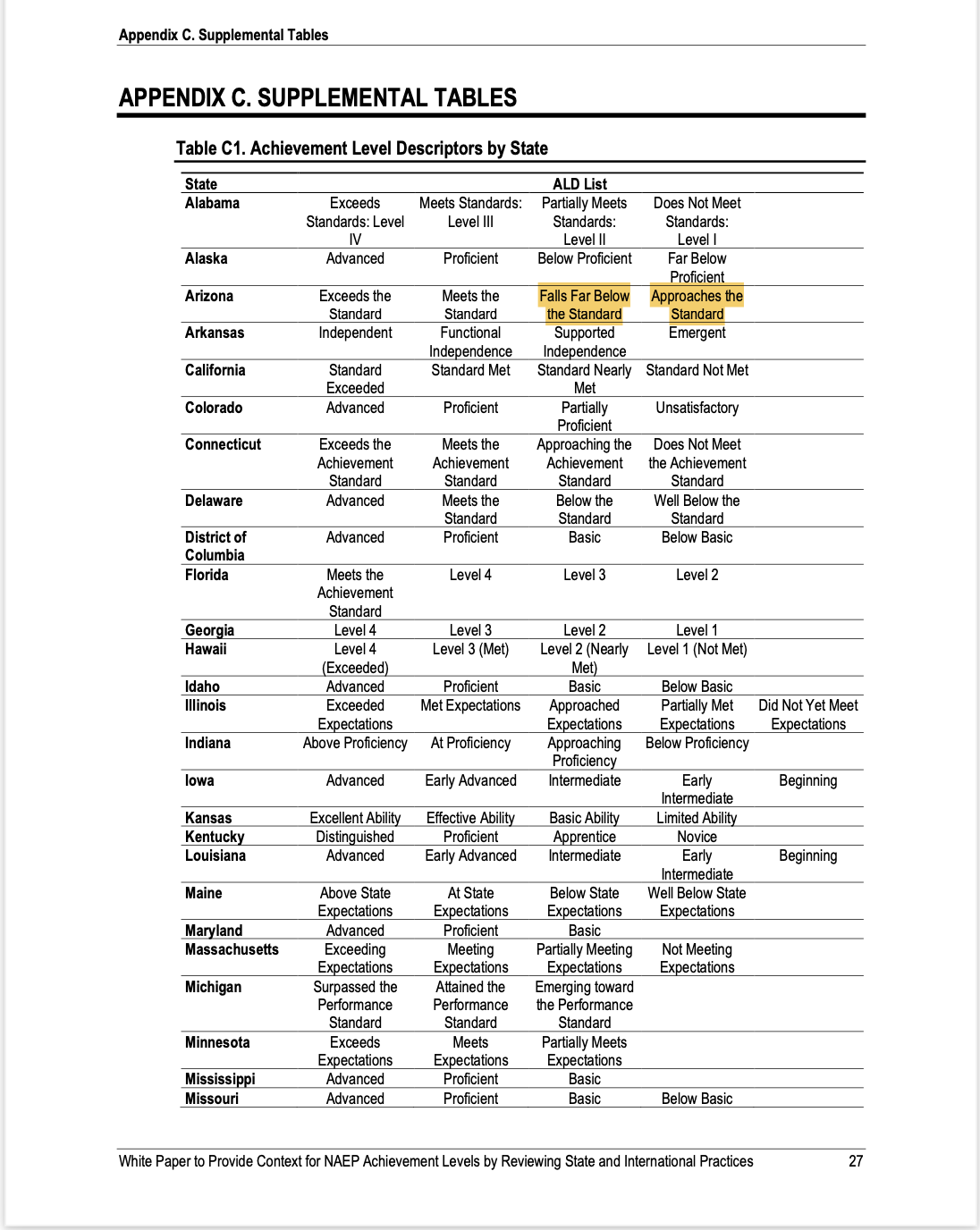
Achievement levels such as “basic” and “proficient,” used in NAEP for reading, are misleading and complicated for most people not familiar with technical terminology.
NAEP “basic” is approximately grade level (although even that claim is problematic since no standard exists in the US for “proficient” or “grade level”), and “proficient” on NAEP is high:
Rosenberg, B. (2004, May). What’s proficient? The No Child Left Behind Act and the many meanings of proficiency. Washington, DC: American Federation of Teachers. https://files.eric.ed.gov/fulltext/ED497886.pdf
NAEP testing and data are normative, measuring what a general population is achieving (not individual students), and as noted above, NAEP “proficient” is aspirational.
Hanford’s and Kristof’s Big Lie, then, is a combination of blurring NAEP achievement levels with grade level reading achievement and manufacturing a reading crisis with that misinformation.
Ironically, NAEP grade 4 reading scores for a decade show that 2/3 of students are reading at or above grade level, the inverse of the false crisis claims of the media:
The Big Lie about reading proficiency and NAEP help perpetuate the Big Lie about educational crisis, but it also masks the more complicated truths: the US has no standard metric for assessing the national reading achievement of students, and focusing on manufactured reading crises distracts reformers from addressing what we can identify—inequitable access to reading proficiency among minoritized and marginalized populations of students.
I recommend the following to understand the essential failure, the Big Lie, of using NAEP to manufacture a crisis around reading proficiency in the US:
Rosenberg, B. (2004, May). What’s proficient? The No Child Left Behind Act and the many meanings of proficiency. Washington, DC: American Federation of Teachers. https://files.eric.ed.gov/fulltext/ED497886.pdf
In my work as a public educator/scholar, I have had conversations with dozens of people seeking to understand education issues and topics because they are not themselves educators or are not literacy educators.
Yesterday, I had such a conversation for over an hour, discussing the issue of reading in my state in the context of the “science of reading” (SOR) movement.
During that discussion, a key point was made about how debates about reading proficiency of students and teaching reading are often absent nuance—and that the nuance itself is part of the problem with finding effective reform.
Like all states in the US (although at an extreme level), my home state of South Carolina has been an early and eager education reform state, including multiple iterations of reading legislation reform.
Also like most states, SC education and reading reform has been a constant cycle of crisis and new reform. We seem to refuse to acknowledge that reform itself is need of reform because so far the reform never works (or we wouldn’t need the next round of reform).
None the less, since we seem committed to shouting reading crisis every few years in order to justify yet more reading reform, this round of reading crisis serves as a powerful example of how the rhetoric around discussing reading proficiency and teaching reading is fraught with miscommunication and often unnecessary antagonism because of basic misunderstandings or problematic clarifications.
At the broadest level, what we mean by “reading” is an essential part of the conversation.
Particularly in the SOR era, there is a spectrum of what counts as “reading” for beginning readers that has on one extreme the ability to pronounce words absent meaning (such as nonsense words), and then on the other extreme, students being able to create meaning from a text without decoding (walking through a picture book and recreating the story either from memory or using the pictures).
Somewhere in the middle of that spectrum is, I think, what we should be talking about when we talk about reading—a student’s ability to eagerly and critically produce meaning from text grounded in automatic word recognition.
However, what greatly complicates how we talk about “reading” is that discussion often relies on (what should be) technical language.
Media, public, and political rhetoric around reading tends to use for “reading” both “reading proficiency” and “grade level reading.” Rarely, those two terms are used distinctly, but more often than not, they are tossed around as synonymns.
Here is a serious concern as I have noted often.
First, we have no standard metric of “proficient” or “grade level” at the federal or state level, and there is little understanding about how “proficient” is often an aspirational metric that is well above “grade level” (for example, NAEP achievement levels in which “basic” is approximately grade level).
Next, we have no clarification in the US about what percentage of students can or should be at whatever level we agree on and at what grade. [Note that I would add another issue is that we prefer “grade level” to “age level,” the latter being in my opinion a better metric.]
This, then, leads to another significant aspect of the current SOR movement; when we talk about reading, we often talk about what percentage of students are reading appropriately (?) at certain designated grades, often grade 3 or 4.
A claim made by SOR advocates helps show how this is a problem since many of them promise that 90-95% of students can be proficient readers.
Setting aside that this is a speculative claim and not a statistic supported by a valid body of science, the 90-95% argument often isn’t a clear one in terms of when.
Does that mean 90-95% of students can eventually become proficient readers or grade level readers, or that 90-95% of students can be proficient or at grade level in every single grade throughout schooling?
I think those questions are essential clarifications to address.
Among other elements of reading wars and education/reading reform, I think what we talk about when we talk about reading needs to be addressed in ways that clarify the elements noted above.
We need standard definitions for “reading,” “reading proficiency,” and “grade level reading”; we also should strongly consider replacing “grade level” with “age level” (to alleviate that distorting impact of policies such as grade retention on standardized measures of reading).
And we also need a national conversation about what are reasonable and aspirational goals for what percentage of students meet those metrics and when.
We seem to have ignored a key lesson and failure of NCLB—mandating 100% of students achieve proficiency by 2014. In other words, aspirational mandates doom reform to failure and erase any possibility that we do in fact reform reading policy in the best interests of students (and not the adults who profit in the debate and reform).
We all must do better to acknowledge what we talk about when we talk about reading—or we are destined to remain trapped in the crisis/reform cycle that hasn’t served anyone well (except for the profiteering) for over forty years.
Note
The title is a reference to a title that is a reference. Haruki Murakami’s What I Talk About When I Talk About Running, which is inspired by Raymond Carver’s What We Talk About When We Talk About Love.
Entering the sixth year of detailing how the “science of reading” (SOR) movement uses “science” as a cover for claims that are primarily rhetorical and ideological, I once again must highlight that this misinformation campaign continues to be “holy text” in mainstream media.
What remains stunning about the relentless misleading and factually wrong series of articles in mainstream media is the sheer absence of understanding about the topic of reading by those promoting SOR with missionary zeal.
SOR advocates lack scientific evidence for their claims and seem mostly driven by market/commercial or political/ideological agendas.
Durig’s misinformation is not only the exact same series of false claims you can find weekly since about 2018, but also a disturbingly careless recycling of Emily Hanford’s copycat misinformation articles initiated by “Hard Words” and then recycled into the melodramatic and misleading Sold a Story podcast.
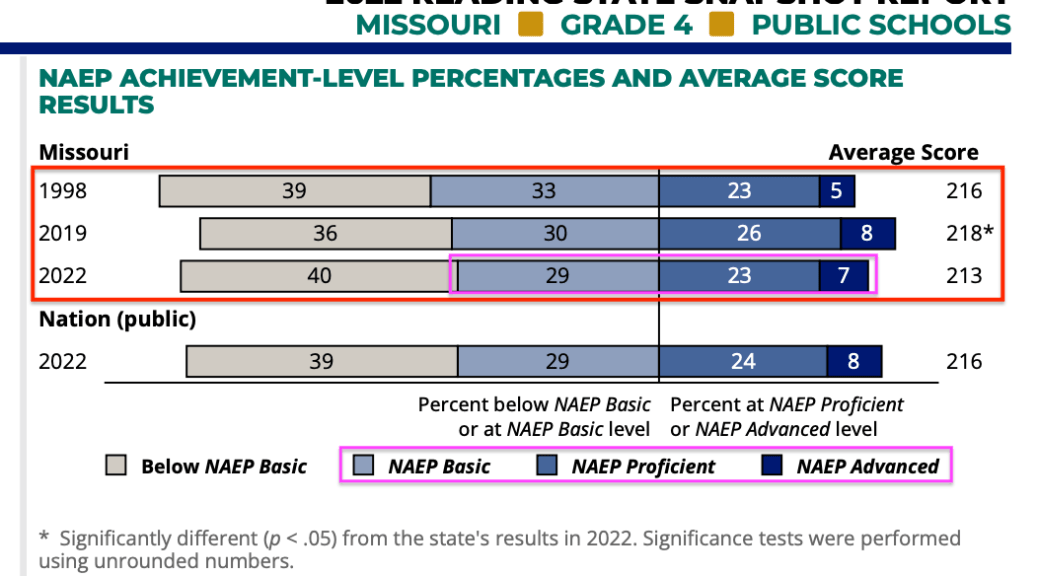
If you follow that link, you find a reference to MO’s NAEP grade 4 reading scores:
Using the exact same misinformation tactic as Hanford in 2018 and Nicholas Kristof in the NYT, Durig either doesn’t understand NAEP achievement levels or is being purposefully misleading; in either case, readers would be better served by not reading further since her argument is built on a lie.
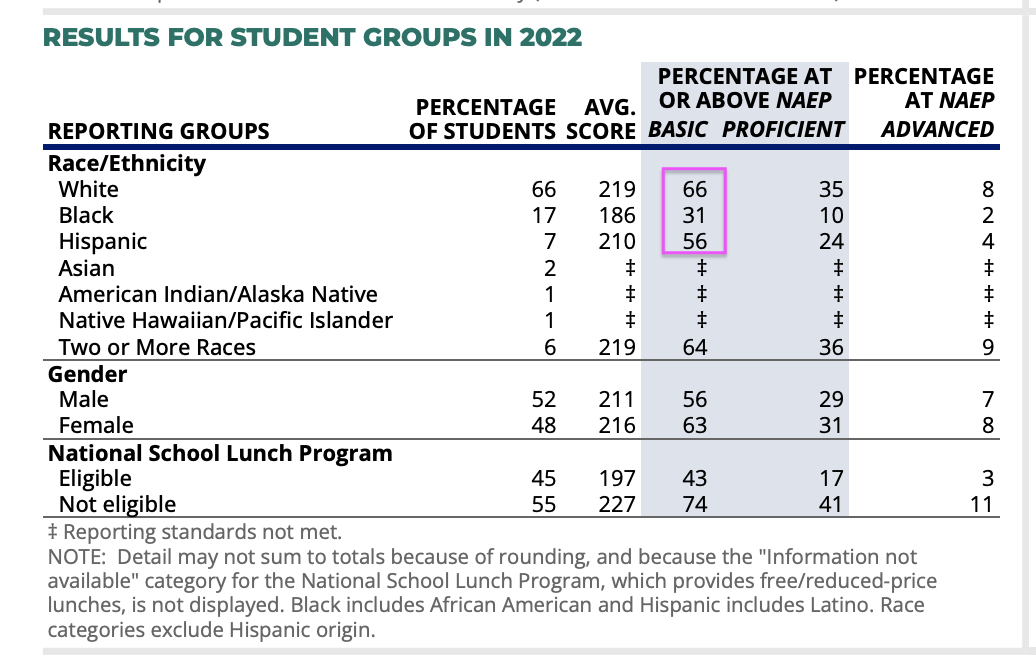
NAEP “basic” is approximately grade level reading, and thus, 60% of MO students are reading at grade level or above, not 30%. [1]
One must ask, if you have to lie to make your case, do you have a case?
The follow-up claims—”The numbers are even more alarming for Black and Hispanic students in the state. They drop to 17% and 7%, respectively”—do not seem corroborated by the NAEP link, showing 31% of Black students at grade level or above and 56% of Hispanic students at grade level or above:
In the US, achievement inequity along racial lines is a historical failure of all achievement, not just reading. But again, if this is a serious issue, misinformation isn’t needed.
But it gets worse, if that is possible, because, Durig claims, “We are in the midst of a reading revolution. The way kids are taught to read in Missouri — and across the country — needs to be overhauled. And any rebuild should be based on the science of reading, including phonics.”
What is most disturbing is the lack of “science” in what follows, notably these well-worn but false series of claims and the links to anything except “science”:
Unfortunately, a lot of early reading teachers in the United States still practice what’s known as balanced literacy. That approach relies heavily on teacher choice and professional judgment. Teachers are taught to have many tools in their toolbox, and to use the methods that they think are most appropriate for their students.
One common practice in balanced literacy is guided reading, in which teachers coach students in a variety of comprehension strategies as they read a book matched to their level. Teachers encourage students who struggle over individual words to use pictures and context, in addition to looking at the letters, to guess at what the word could be.
But should kids be guessing at words when learning to read? There’s a ton of research that says no.
Note that these claims include two hyperlinks—the first to NCTQ (which links to a blog post to prove the 90% claim), and the second to Education Week, more misinformation journalism, not science.
As many have demonstrated by conducting external peer-review, NCTQ is an ideologically conservative think tank founded by The Thomas B. Fordham Institute. NCTQ releases non-scientific reports that are not peer-reviewed. In other words, no NCTQ report meets even the minimum standards of “science,” and in fact, the reports have been shown to use shoddy methods to draw predetermined conclusions about teacher education. [2]
Durig also depends on the Balanced Literacy Big Lie, reducing BL to a caricature of guessing using pictures instead of decoding. Notably as well, Durig offers no links for the “ton of research” claim (because there is none).
The accurate claim about BL is that we have no scientific research to support claims of a reading crisis, no scientific research proving BL has failed, and no data proving any universal application of BL or reading programs. The media and political attacks on BL and reading programs are entirely rhetorical and ideological.
With this careless and misleading article, we find ourselves trapped in the sixth year of the Hanford SOR lie, and it seems too few people are willing to tell the real story of reading, the one that students deserve instead of using “science” to promote the same baseless reading war we have been waging since at least the 1940s.
Fuller, E. J. (2014). Shaky methods, shaky motives: A critique of the National Council of Teacher Quality’s review of teacher preparation programs. Journal of Teacher Education, 65(1), 63-77. https://journals.sagepub.com/doi/10.1177/0022487113503872
Cochran-Smith, M., Stern, R., Sánchez, J.G., Miller, A., Keefe, E.S., Fernández, M.B., Chang, W., Carney, M.C., Burton, S., & Baker, M. (2016). Holding teacher preparation accountable: A review of claims and evidence. Boulder, CO: National Education Policy Center. http://nepc.colorado.edu/publication/teacher-prep
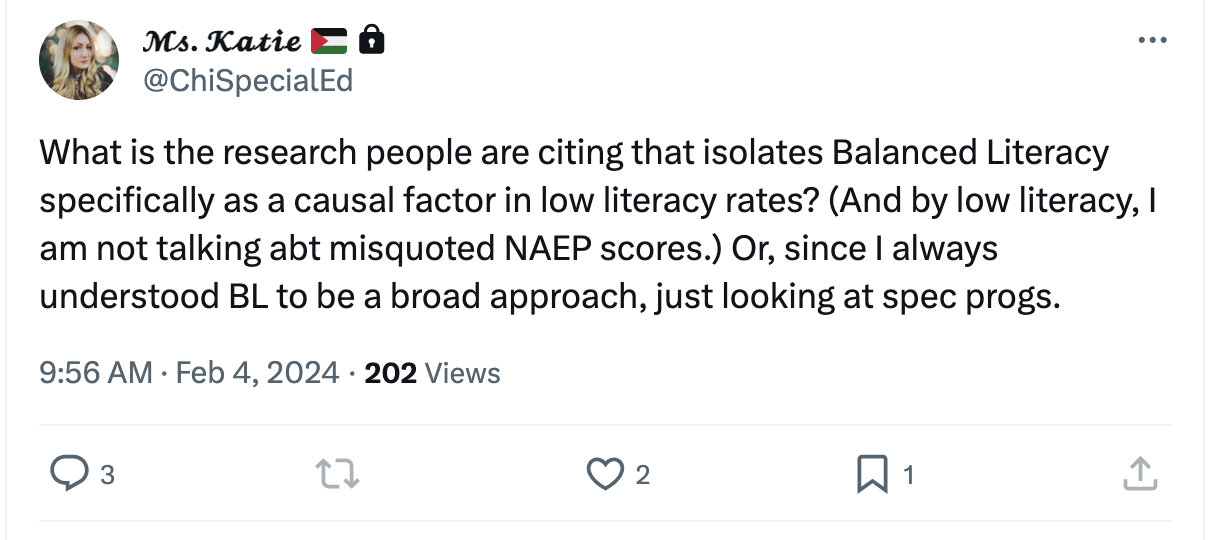
Let’s start with paired texts, one from X/Twitter and one from media:
With more than half of Connecticut’s third-graders failing to meet reading benchmarks, education stakeholders across the state agree that existing strategies must change in order to boost student scores.
How to go about that change is where the consensus ends.
State education officials are doubling down on their support of “Right to Read” legislation they believe will provide equal opportunity for all children learning how to read, despite local school leaders’ misgivings about the implementation of the law.
One of those critics is Westport Supt. of Schools Thomas Scarice, who after state officials refused to grant the town a waiver from the new program, expressed “disappointment as a result of the endless hours our faculty and leaders have spent on this waiver process.” He was responding to a request for comment from the Westport Journal in December.
In Westport, 73.8 percent of third graders achieved reading proficiency last year — 10 percentage points lower than the year before — but still among the highest in the state.
The state Department of Education “moved the goal posts throughout the process, and we continued to flex to meet those expectations,” Scarice contended.
“Programs do not teach kids. Materials do not teach kids. Highly skilled professional educators teach kids, and that is what we have in Westport,” he said.
In the midst of the reading program shuffle that the second text above is addressing, we must answer Katie’s question with a not-so-fun fact: “Science of Reading” (SOR) foundational claims that balanced literacy programs have cause a reading crisis in the US are not supported by science.
In fact, research for decades (including NRP reports) have shown that whole language, balanced literacy, and systematic phonics are about equally effective for student reading proficiency (comprehension); for example:
Bowers, J.S. (2020). Reconsidering the evidence that systematic phonics is more effective than alternative methods of reading instruction. Educational Psychology Review, 32(2020), 681-705. https://link.springer.com/article/10.1007%2Fs10648-019-09515-y
Wyse, D., & Bradbury, A. (2022). Reading wars or reading reconciliation? A critical examination of robust research evidence, curriculum policy and teachers’ practices for teaching phonics and reading. Review of Education, 10(1), e3314. https://doi.org/10.1002/rev3.3314
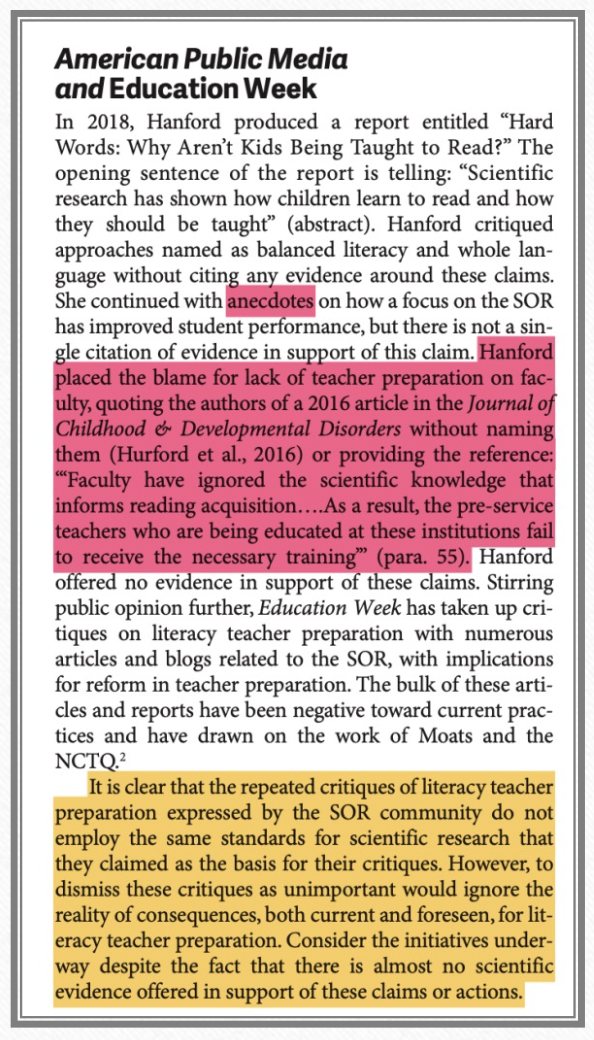
The really frustrating fact about the SOR movement is that “science” is the rhetoric of the advocacy and legislation, but anecdote is the primary evidence used to perpetuate essentially ideological claims:
Hoffman, J.V., Hikida, M., & Sailors, M. (2020). Contesting science that silences: Amplifying equity, agency, and design research in literacy teacher preparation. Reading Research Quarterly, 55(S1), S255–S266. https://doi.org/10.1002/rrq.353
Like CT, most states and notably NYC have passed legislation mandating districts and schools drop existing programs falsely labeled as “failing” and choose among a few reading programs falsely labeled SOR.
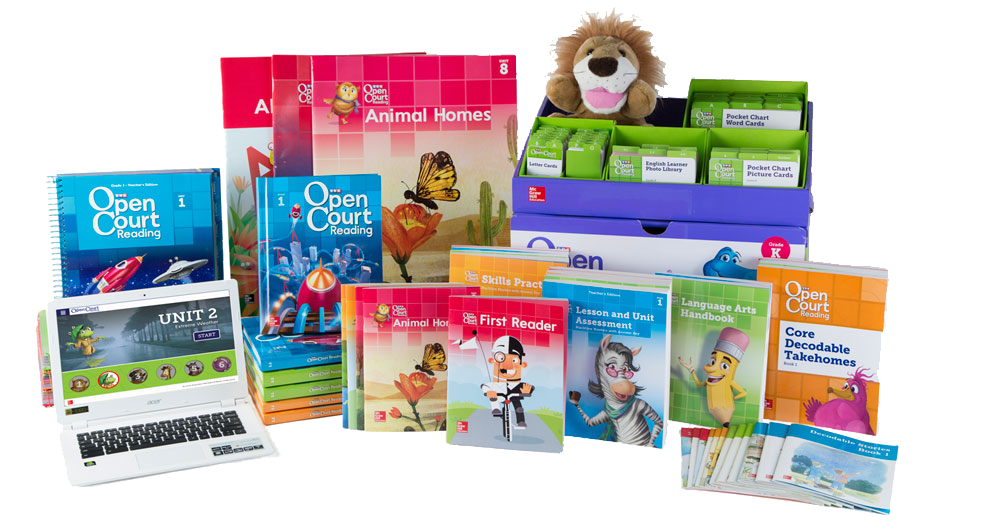
As one vivid example of this charade is the fate of the program Open Court, which has had a recent turn as program-of-the-day in the wake of the NRP/NCLB mandate that all programs had to be scientifically-based.
Although written in 2017, this overview of Open Court by McQuillan could have been written today, or sadly, several years from now:
Translation: Open Court does no better, and often worse, than the alternatives.
This most recent study is by no means the only evidence against phonics instruction or programs such as Open Court. The list of studies that show the failure of phonics is too long to repeat here, but you can whet your appetite by looking at what happened with the U.S. Department of Education’s spectacularly expensive and utterly ineffective Reading First program (here, here, and here, for starters).
Journalists and politicians get to move on to the next Great Cause, but the teachers and kids stuck in Open Court classrooms often have no such option.
And thus, the really not-so-fun fact is that despite ample evidence to the contrary, some states have included Open Court in the new mandates!
Here is the real issue that is at the core of our obsession with manufacturing a reading crisis and then demanding the exact same reform strategies, again—mostly declaring some programs failures and mandating new programs instead: Reading programs have not caused a reading crisis, and different reading programs are not the reform solution regardless of our reading goals.
Since I have been making this argument literally for decades, I end here with a reader to emphasize that I endorse no reading programs—never have, never will:
And it bears repeating: “’Programs do not teach kids. Materials do not teach kids. Highly skilled professional educators teach kids, and that is what we have in Westport,’ [Westport Supt. of Schools Thomas Scarice] said.”
educator, public scholar, poet&writer – academic freedom isn't free












 dr. p.l. (paul) thomas