
Voices from the Middle, Vol. 30, No. 3, March 2023

Republican/conservative education reform has been a subset of disaster capitalism for decades now, most prominently after Hurricane Katrina when Republicans used the natural disaster to dismantle public education and erase the existing teacher workforce in New Orleans.
In 2023, Republicans have continued to manufacture educational crises in order to reform education, where “reform” is a veneer for dismantling education.
The twin conservative attacks on schools include the anti-CRT/curriculum gag order movement and the “science of reading” (SOR) movement—both depending on false claims of educational failures by teachers and public schools.
What flies under the radar is that anti-CRT and reading legislation are being promoted by conservative organizations and ideologies in the form of “model legislation” and fact sheets that are devoid of facts.
In the context of the crisis/miracle narratives about education in the media, among the public, and by politicians, disaster reform has evolved into its own powerful and harmful machine.
Not surprising, a key example comes from Florida and Jeb Bush: ExcelinEd.
The disaster education reform organization is Orwellian in its claims but insidious in its carefully packaged information and templates for policy. The key point here is that the SOR movement as a media and parent advocacy event has now fully been folded into the existing Republican education reform machine that is more about dismantling education than supporting student learning or teacher quality.
In short, the materials about reading presented by ExcelinEd are false but very well designed and compelling to the general public and politician looking for ready-made legislation and effective talking points.
As the NCLB/NRP era showed us with Reading First, however, the entire Bush family is driven by market interests, not a pursuit of democratic education for all.
ExcelinEd offers online a series of PDF resources:
The short version of concern here is that nearly all of the information above is misinformation; however, as the SOR movement has shown, most people remain easily targeted by claims of a reading crisis and a set of simplistic blame and solutions.
As I have shown, there simply is no reading crisis in the US, but there is a very long history of political negligence in terms of providing marginalized students and their teachers with the learning and teaching environments as well as social conditions that would support earlier and more developed reading in our students.
Two aspects of the materials above deserve highlighting (again).
First, the Republican commitment to SOR is grounded in doubling-down on punitive policy, grade retention.
The two states identified over and over in the materials above are Florida and Mississippi; however, those states are examples of mirages, not miracles.
ExcelinEd only cites work by Winters [1] to “prove” the effectiveness of grade retention. This strategy is cherry picking “research” by a conservative “scholar” who (surprisingly) only finds positive results for the conservative reform of the day—school choice, charter schools, VAM evaluations of teachers, and now, grade retention.
The research on grade retention is complicated but politically attractive since grade retention (the likely sources of “success” in FL and MS) can raise reading scores in grades 3 or 4, but those “gains” disappear by middle school.
Grade retention distorts the population of students being tested by removing the lowest scoring students and reintroducing older students to grade-level testing. As I have noted before, students achievement can vary significantly by just a month of age difference:

A review of the Florida Model that depends on grade retention has concluded that research does not show whether any short term gains are from retention or additional services. Further, a comprehensive study still notes that grade retention is harmful, especially to marginalized populations of students:
The negative effect of retention was strongest for African American and Hispanic girls. Even though grade retention in the elementary grades does not harm students in terms of their academic achievement or educational motivation at the transition to high school, retention increases the odds that a student will drop out of school before obtaining a high school diploma.
Hughes, J. N., West, S. G., Kim, H., & Bauer, S. S. (2018). Effect of early grade retention on school completion: A prospective study. Journal of Educational Psychology, 110(7), 974–991. https://doi.org/10.1037/edu0000243
A second problematic aspect is the hyper-focus on three-cueing, which fits into the Rufo “caricature” approach to attacking CRT.
Republicans have latched onto the SOR misinformation campaign that perpetuates a cartoon version of three-cueing and fabricates a crisis around claiming that teachers are telling students to guess words instead of using phonics/decoding strategies.
Three-cueing, in fact, is a research-based approach better referred to as “multiple cueing”:

ExcelinEd’s prepackaged misinformation campaign and templates for legislation are yet more proof that the SOR movement is another nail in the coffin of public education, an anti-teacher and anti-public school movement that depends on crisis rhetoric and fulfills the goals of disaster reform driven by Republicans and conservatives who serve the needs of the educational marketplace—not students, or teachers.
[1] UPDATE: Another Mississippi “miracle” article in the NYT highlights grade retention positively, again citing only a new study by Kirsten Slungaard Mumma and Marcus A. Winters.
First, this is a working paper supported by Mississippi Department of Education and the acknowledgements add: “This project was made possible by a grant from ExcelinEd.”
Here are some key additional caveats beyond how biased this report likely is in terms of meeting the ideological aims of ExcelinEd:
Finally, we must wondering why Kristof chose to highlight a flawed and biased think-tank funded report on grade retention instead of this: Following the Letter of the Law: 2020-21 Retention Outcomes Under Michigan’s Read by Grade Three Law.
Westall, Utter, and Strunk find much more problematic outcomes with retention, findings that fit within decades of research:
Early literacy skills are critical to the educational outcomes of young students. Accordingly, 19 states have early literacy policies that require grade retention for underperforming readers at the end of third grade. However, there is mixed evidence about retention’s effectiveness and concerns that retention may disproportionately impact traditionally disadvantaged student groups. Using regressions and a regression discontinuity design, we examine retention outcomes under Michigan’s early literacy law, the Read by Grade Three Law. We find that Black and economically disadvantaged students are more frequently eligible for retention and retained than their peers. While controlling for students’ test performance, particularly their math scores, eliminates this disparity for Black students, it persists for economically disadvantaged students. We show that differences in average math performance, exemption characteristics, district characteristics, and eligibility-induced student mobility across districts do not explain the disparities in the implementation of retention by economic disadvantage status.
Abstract

In the US, the crisis/miracle obsession with reading mostly focuses on NAEP scores. For the UK, the same crisis/miracle rhetoric around reading is grounded in PIRLS.
The media and political stories around the current reading crisis cycle have interested and overlapping dynamics in these two English-dominant countries, specifically a hyper-focus on phonics.
Here are some recent media examples for context:
Let’s start with the “soar[ing]” NAEP reading scores in MS, LA, and AL as represented by AP:

Now, let’s add the media response to PIRLS data in the UK:
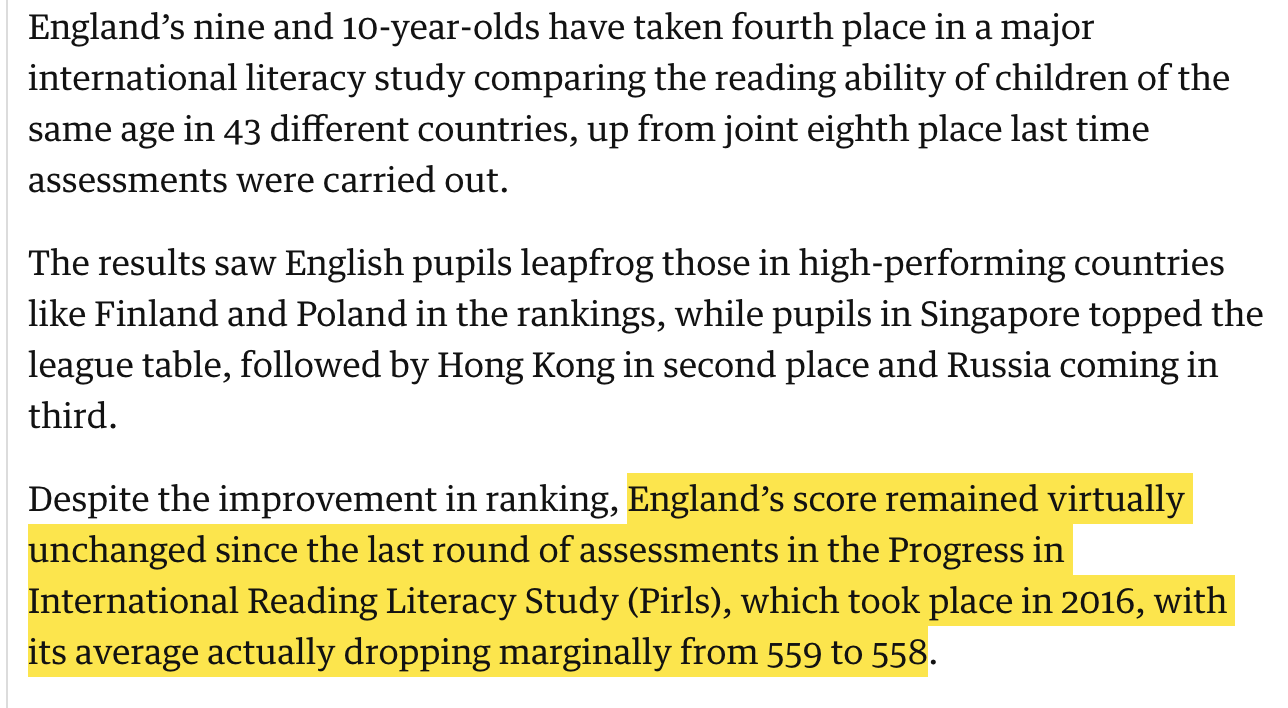

Now I will share data on NAEP and PIRLS that shows media and political responses to test scores are fodder for their predetermined messaging, not real reflections of student achievement or educational quality.
A key point is that the media coverage above represents a bait-and-switch approach to analyzing test scores. The claims in both the US and UK are focusing on rank among states/countries and not trends of data within states/countries.
Do any of these state trend lines from FL, MS, AL, or LA appear to be “soar[ing]” data?

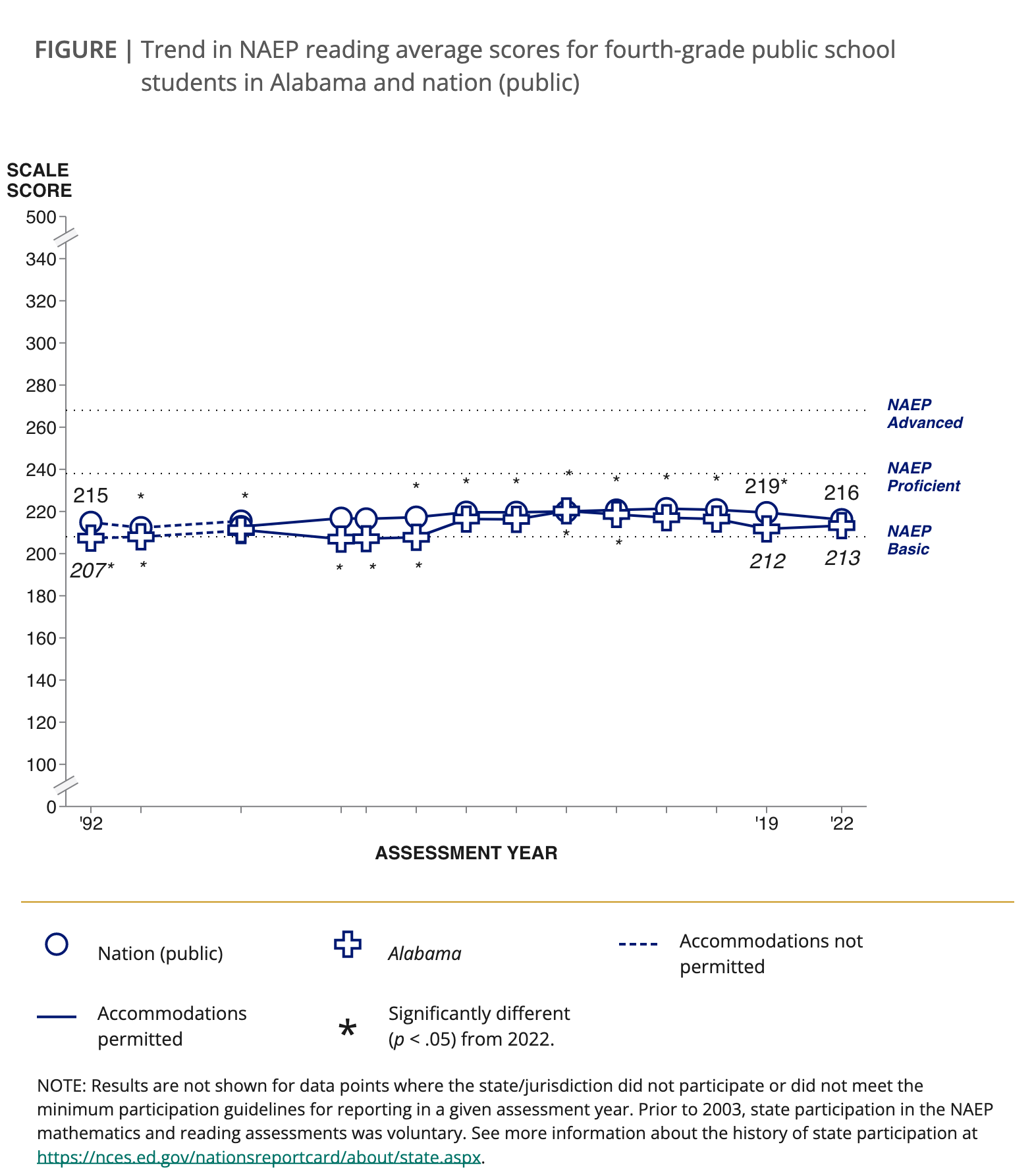


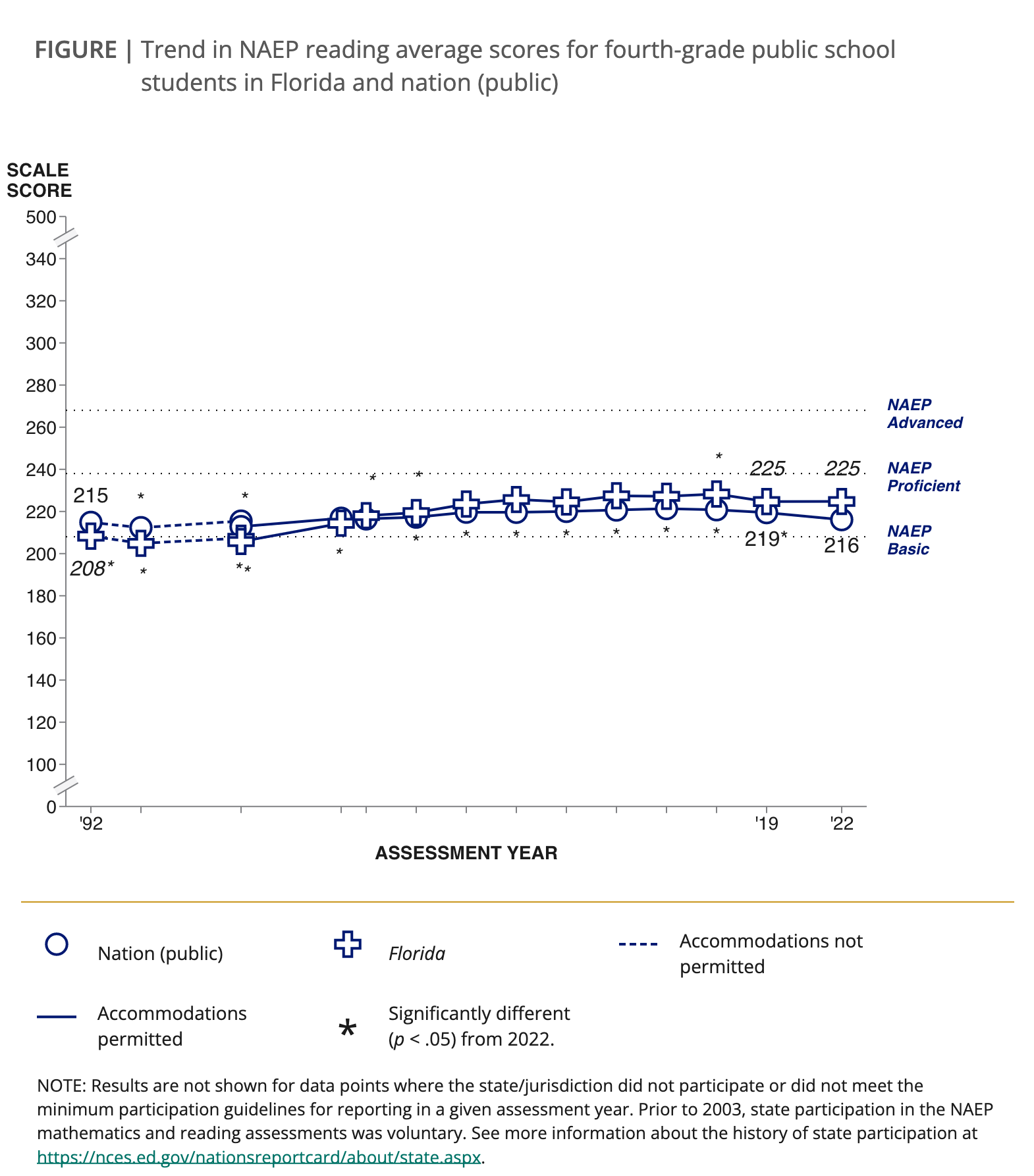

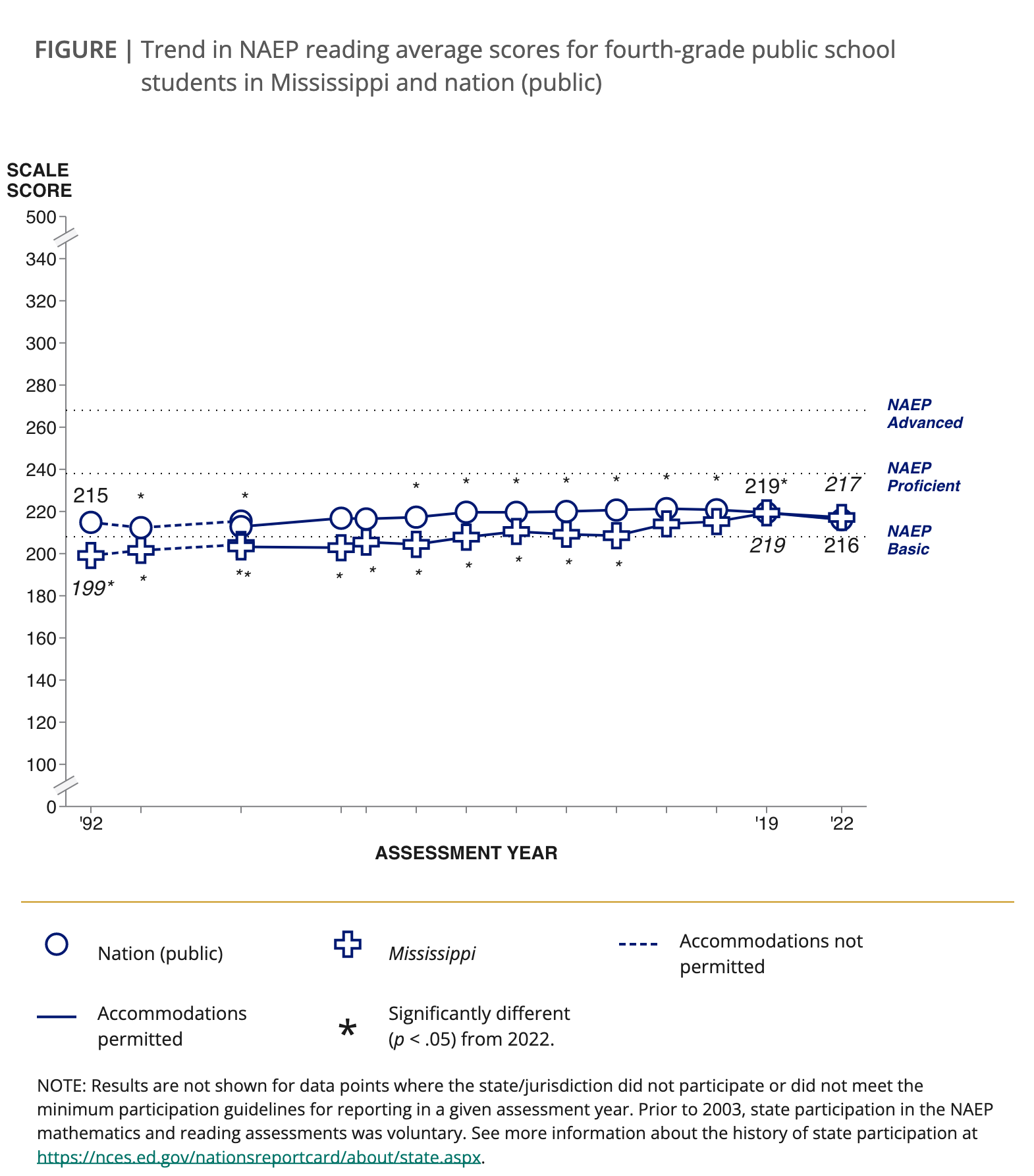
The fair description of the “miracle” states identified by AP is that test scores are mostly flat, and AL, for example, appears to have peaked more than a decade ago and is trending down.
The foundational “miracle” state, MS, has had two significant increases, one before their SOR commitment and one after; but there remains no research on why the increases:

Scroll up and notice that in the UK, PIRLS scores have tracked flat and slightly down as well.
The problematic elements in all of this is that many journalists and politicians have used flat NAEP scores to shout “crisis” and “miracle,” while in the UK, the current flat and slightly down scores are reason to shout “Success!” (although research on the phonics-centered reform in England since 2006 has not delivered as promised [1]).
Many problems exist with relying on standardized tests scores to evaluate and reform education. Standardized testing remains heavily race, gender, and class biased.
But the greatest issue with tests data is that inexpert and ideologically motivated journalists and politicians persistently conform the data to their desired stories—some times crisis, some times miracle.
Once again, the stories being sold—don’t buy them.
Three Twitter threads on reading, language and a response to an article in the Sunday Times today by Nick Gibb, Michael Rosen
[1] Wyse, D., & Bradbury, A. (2022). Reading wars or reading reconciliation? A critical examination of robust research evidence, curriculum policy and teachers’ practices for teaching phonics and reading. Review of Education, 10(1), e3314. https://doi.org/10.1002/rev3.3314
Mainstream media continues to push a false story about MS as a model for the nation. Note that MS, TN, AL, and LA demonstrate that political manipulation of early test data is a mirage, not a miracle.
All four states remain at the bottom of NAEP reading scores for both proficient and basic a full decade into the era of SOR reading legislation:


May 16, 2023
To Curriculum Coordinators in South Carolina School Districts:
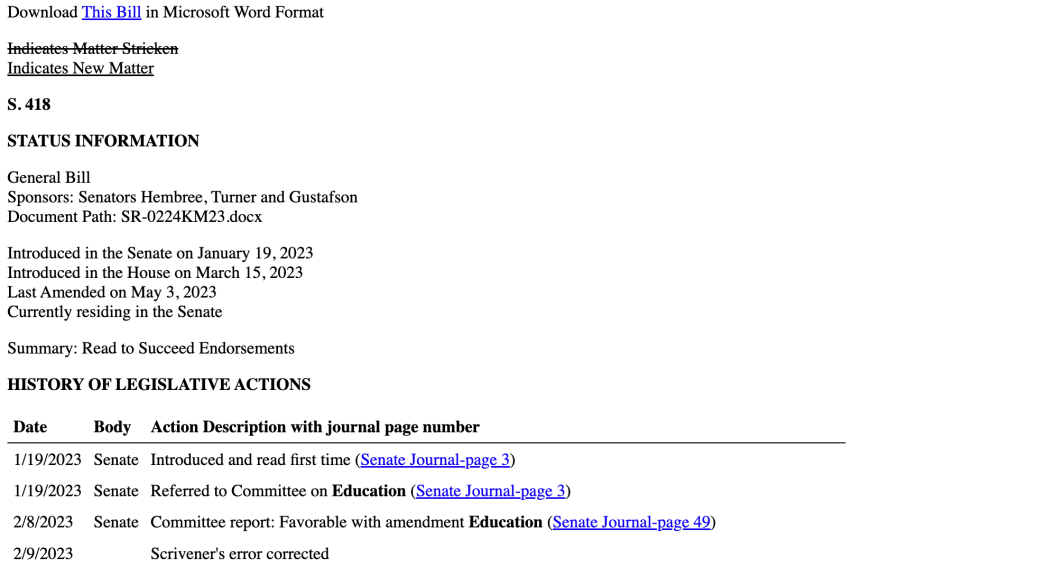
I was a professor at USC-Columbia for 18 years before I retired in 2017; I was a professor in other states for 12 years before that. My area of expertise is reading assessment and instruction. In the last couple of years, I have heard from several SC educators about proposed changes to literacy practices in SC schools. These changes were recently detailed in Senate Bill 418 which has now been held over until the next legislative session. It is my understanding that the bill was held over because a number of individuals and organizations disagreed with parts of what was proposed.
As a professor, I had the opportunity to work with legislators and came to understand that because no one legislator can have a broad and deep knowledge on all topics, they regularly end up having to vote on legislation which is outside their area of expertise. When I became aware of Senate Bill 418, I wrote to members of the House and Senate Education and Public Works Committees providing them with some information about reading process, assessment, and instruction. I also suggested changes to the wording of the bill so that it could reflect current knowledge in the field. If you wish to read that letter, it is attached.
Here though is the basic information:
There is a science of reading. By this I mean that there have been thousands of studies published about reading process, assessment, and instruction. This body of research is quite wide and includes research on many different aspects of reading. Indeed, the International Reading Association recently devoted two entire issues of Reading Research Quarterly to this topic.
While there are differences of opinion on some particulars, the research conducted by reading researchers and which appears in peer-reviewed literacy journals has found that many factors contribute to reading success including:
(1) Knowledgeable teachers who know how to assess the strengths and needs of their students and then provide instruction – whole group, small group, and one-on-one – based on what they know about their students. Because children vary, they do not use a one-size-fits all approach.
(2) Children who understand that reading is supposed to make sense. The alternative is for education to produce students who can read every work fluently but who cannot retell the story or answer questions about what they read. (Teachers sometimes refer to this as students “who can read but not understand what they read.”)
(3) Children who believe they are capable of making sense of print and so willingly spend time reading. This is often referred to as agency and Dr. Peter Johnston has a very helpful chapter on that in his book Choice Words. Like all of us, children do not choose to do things at which they believe they will fail.
(4) Children who have access to books with which they can be successful both at home and in school. Just as we do not expect athletes to improve without appropriate equipment (like soccer balls for soccer players), we cannot expect children to grow as readers if they do not have books to read.
(5) Children who have time to read both at home and in school. Research has shown conclusively that there is a link between volume of reading and reading achievement.
(6) Children who have a variety of skills and strategies to problem-solve meaning. Those skills and strategies include knowing about written language. For the youngest children, this includes understanding that books in English are read left to right and top to bottom. Children also need to understand that words can be segmented and blended and that there are some reliable sound/symbol relationships. Some consonants, for example, can be counted on to make just one sound, while seven of them (e.g., the letter C) make two sounds. Similarly, there are combinations of letters – /an/ for example – which almost always “says” the same thing as in man, tan, fan. As children progress, children then recognize that /an/ appears in words such as manufacturing, slant and fantastic. Children also learn about grammar and punctuation and story structure and genre. This list goes on and on.
Sometimes, some journalists and salespersons) assert that there is one correct sequence of skill and strategy instruction. Those individuals also argue that phonics instruction should precede the opportunity to read. In addition, they claim that a one-size-fits-all approach is best. This approach is often referred to as Science of Reading (SOR).
It is important to note that the SOR is not the same as the science of reading discussed earlier in this letter.
What reading research (the science of reading) has shown is that there are no differences in outcomes among the various approaches to teaching phonics and that a one-size-fits-all approach is not effective. Knowledgeable teachers know best about what instruction is needed at what time for their students. In addition, as authors Reinking, Hruby and Risko (2023) explain in their research article, phonics instruction has been shown to be “more effective when embedded in a more comprehensive program of literacy instruction that accommodates students’ individual needs and multiple approaches to teaching phonics—a view supported by substantial research.”
There simply is no research support for SOR or for a product, called LETRS, often associated with it. There have not been controlled studies in which the progress of students in classrooms taught by SOR teachers were compared to the progress of students taught by teachers whose practices were consistent with research on best practices. And there is absolutely no research which shows that LETRS is an effective instructional approach. (See HERE).
SOR advocates also suggest that phonemic awareness (PA) be taught orally while the National Reading Panel found that PA is best taught using letters, as a part of phonics instruction.
In the midst of what are often media-created reading wars, it is particularly important that decision-makers rely on the wide body of research on reading (the science of reading) and not on an approach with the misleading title, SOR.
It is also very important not to be misled by unsubstantiated claims. Reading-research published in peer-refereed journals and teacher expertise should guide decisions about reading process, reading assessment, and reading instruction. Our focus as educators should be on assuring that all students have knowledge teachers, access to books, time to read and instruction based on the strengths and needs of the children in our care.
Please contact me if you would like further information. Meanwhile, a consistently reliable resource about best practices in reading is the federal What Works Clearing House.
Thank you for your attention to this.
Diane Stephens
Distinguished Professor Emerita
John E. Swearingen, Sr. Professor Emerita in Education
University of South Carolina
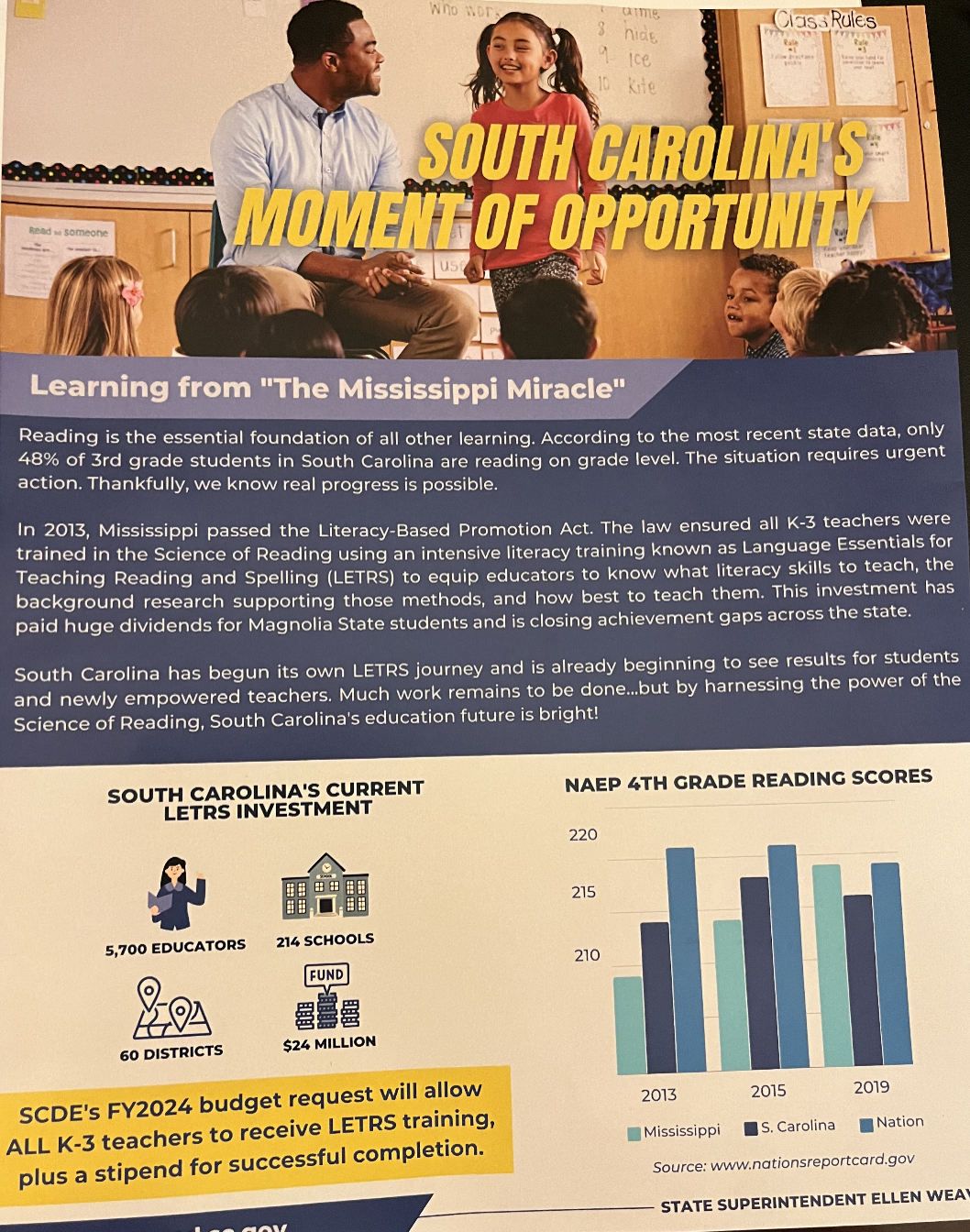
The South Carolina Department of Education distributed an infographic on the “science of reading” (SOR). The flyer includes a number of mischaracterizations and misinformation, which is a common event since the SOR movement now drives new or revised reading legislation in 47 states (often emphasized strongly in Republican-led states along with CRT bans, curriculum gag orders, and book censorship).
This is a fact check for educators, elected officials, media, and the public interested in supporting effective and accurate information about students learning to read and teaching reading in SC.
The infographic:

What is the state of reading achievement in the US and SC?
FACT: Reading achievement in the US and most states has remained essentially flat for three-plus decades. There is no credible evidence of a reading crisis, although historical negligence to serve marginalized populations of students is supported by the data.


Was there a Mississippi “miracle”?
FACT: The Mississippi “miracle” is a manufactured narrative created by the media. MS has had steady increases in early reading achievement for over three decades, well before any SOR legislation or LETRS training. MS also has a very high rate of grade retention and flat grade 8 achievement despite the grade 4 increases, suggesting that the early score increases are a “mirage.” There simply is no scientific evidence of a MS “miracle” or that implementing SOR and LETRS training increased reading achievement.


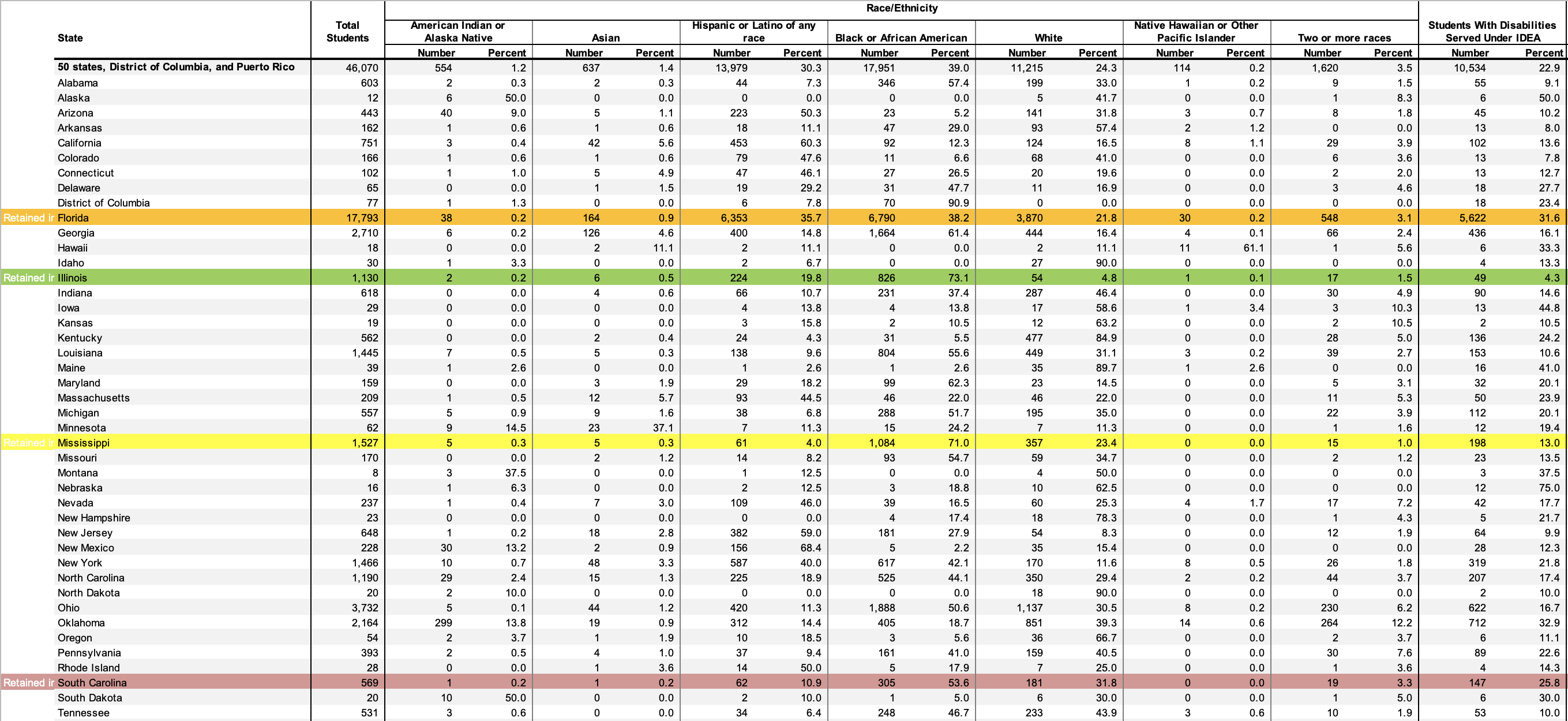
Recommended: A Critical Examination of Grade Retention as Reading Policy (OEA)
Does LETRS training improve reading instruction or reading achievement?
FACT: There is no scientific evidence that LETRS training is effective for increasing student reading achievement. Teachers seem to feel more confident after the training, however.
Hoffman, J.V., Hikida, M., & Sailors, M. (2020). Contesting science that silences: Amplifying equity, agency, and design research in literacy teacher preparation. Reading Research Quarterly, 55(S1), S255–S266. Retrieved July 26, 2022, from https://doi.org/10.1002/rrq.353
Research Roundup: LETRS (PDF in link above also)
Have whole language, balanced literacy, and three cueing failed to provide students with adequate reading instruction?
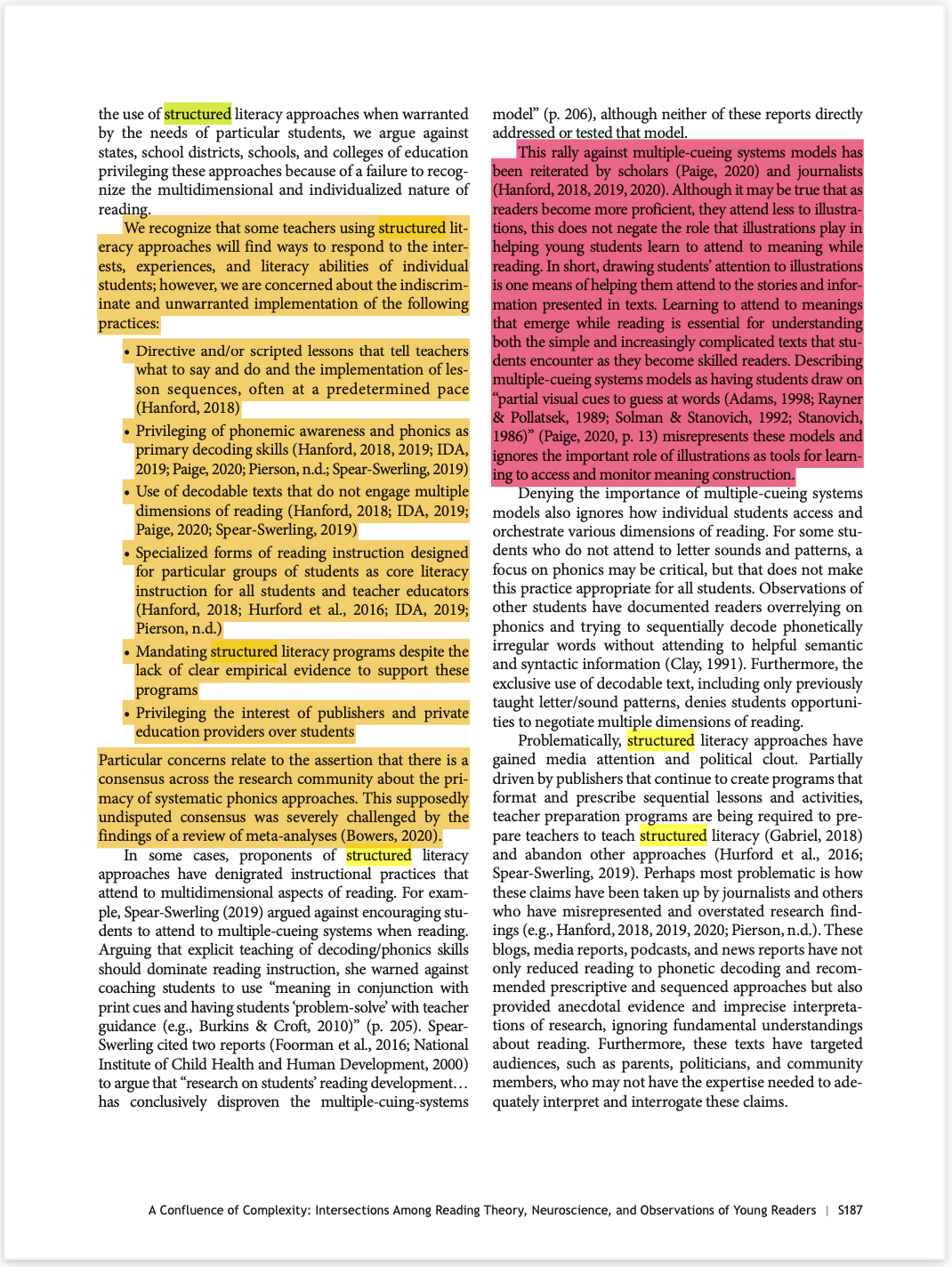
FACT: There is no research showing WL, BL, or three cueing (multiple cueing) have failed students. WL and BL do include phonics and skills instruction, and achievement over many decades has remained flat regardless of the teaching theory or reading program being implemented. Multiple cueing is a research-supported practice, but political attacks on three cueing are based in caricature.
Recommended: Thomas, P.L. (2022). The Science of Reading movement: The never-ending debate and the need for a different approach to reading instruction. Boulder, CO: National Education Policy Center. http://nepc.colorado.edu/publication/science-of-reading
Compton-Lilly, C.F., Mitra, A., Guay, M., & Spence, L.K. (2020). A confluence of complexity: Intersections among reading theory, neuroscience, and observations of young readers. Reading Research Quarterly, 55(S1), S185-S195. Retrieved July 26, 2022, from https://doi.org/10.1002/rrq.348

What is the value of the National Reading Panel (NRP) report?
FACT: The NRP report is now 20+ years old, and reading research has advanced beyond the report’s findings. The report also was underfunded and incomplete and should not be viewed as “settled” science. The media and political misrepresentation of the NRP report, however, continues to mislead; the report found systematic phonics instruction increases pronunciation of nonsense words in grade one, but does not improve comprehension. As well, the report found systematic phonics was no more effective than WL or BL.
National Reading Panel
Report of the National Reading Panel: Teaching children to read. (2000, April). U.S. Department of Health and Human Services. https://www.nichd.nih.gov/publications/pubs/nrp/smallbook
Reports of the subgroups. (2000, April). U.S. Department of Health and Human Services. https://www.nichd.nih.gov/publications/pubs/nrp/report
Phonemic awareness. (n.d.). Big ideas in beginning reading. Center on Teaching and Learning. Oregon University. http://reading.uoregon.edu/big_ideas/pa/pa_what.php
Stephens, D. (2008). The federal government wants me to teach what? A teacher’s guide to the National Reading Panel report. National Council of Teachers of English. https://cdn.ncte.org/nctefiles/resources/newsletter/magazine/nrp_report.pdf
Shanahan, T. (2005). The National Reading Panel report: Practical advice for teachers. Learning Point Associates. https://files.eric.ed.gov/fulltext/ED489535.pdf
Shanahan, T. (2003, April). Research-based reading instruction: Myths about the National Reading Panel report. The Reading Teacher, 56(7), 646-655.
Bowers, J.S. (2020).Reconsidering the evidence that systematic phonics is more effective than alternative methods of reading instruction. Educational Psychology Review, 32(2020), 681-705. https://link.springer.com/article/10.1007%2Fs10648-019-09515-y
Collet, V.S., Penaflorida, J., French, S., Allred, J., Greiner, A., & Chen, J. (2021). Red flags, red herrings, and common ground: An expert study in response to state reading policy. Educational Considerations, 47(1). https://doi.org/10.4148/0146-9282.2241
Garan, E.M. (2001, March). Beyond smoke and mirrors: A critique of the National Reading Panel report on phonics. Phi Delta Kappan, 82(7), 500-506. https://doi.org/10.1177/003172170108200705
Seidenberg, M.S., Cooper Borkenhagen, M., & Kearns, D.M. (2020). Lost in translation? Challenges in connecting reading science and educational practice. Reading Research Quarterly, 55(S1), S119–S130. https://doi.org/10.1002/rrq.341
Yatvin, J. (2002). Babes in the woods: The wanderings of the National Reading Panel. The Phi Delta Kappan, 83(5), 364-369
Yatvin, J. (2003). I told you so! The misinterpretation and misuse of The National Reading Panel Report. Education Week, 22(33), 44-45, 56. https://www.edweek.org/ew/articles/2003/04/30/33yatvin.h22.html
Yatvin, J. (2000). Minority view. https://www.nichd.nih.gov/sites/default/files/publications/pubs/nrp/Documents/minorityView.pdf
What is the “SOR”science of reading”?
FACT: Starting as a media movement supported by state-based dyslexia organizations, SOR has become a political movement due to its direct impact on state legislation. That movement has misrepresented the reading sciences. Further, SOR has increasingly become a marketing label for reading materials and programs, often identified as “structured literacy,” which can be scripted programs that de-professionalize teachers and impose a one-size-fits-all approach to phonics on all students.
Note: Mark Seidenberg, a key neuroscientist cited by the “science of reading” movement, offers a serious caution about the value of brain research: “Our concern is that although reading science is highly relevant to learning in the classroom setting, it does not yet speak to what to teach, when, how, and for whom at a level that is useful for teachers [emphasis added]” (RRQ 341).
Recommended: SOR Movement Maintains Conservative Assault on Teachers and Public Schools
Compton-Lilly, C.F., Mitra, A., Guay, M., & Spence, L.K. (2020). A confluence of complexity: Intersections among reading theory, neuroscience, and observations of young readers. Reading Research Quarterly, 55(S1), S185-S195. https://doi.org/10.1002/rrq.348
Duke, N.K. & Cartwright, K.B. (2021). The science of reading progresses: Communicating advances beyond the simple view of reading. Reading Research Quarterly, 56(S1), S25-S44. https://doi.org/10.1002/rrq.411
Filderman, M.J., Austin, C.R., Boucher, A.N., O’Donnell, K., & Swanson, E.A. (2022). A meta-analysis of the effects of reading comprehension interventions on the reading comprehension outcomes of struggling readers in third through 12th grades. Exceptional Children, 88(2), 163-184. https://doi.org/10.1177/00144029211050860
Barber, A.T., Cartwright, K.B., Hancock, G.R., & Klauda, S.L. (2021). Beyond the simple view of reading: The role of executive functions in emergent bilinguals’ and English monolinguals’ reading comprehension. Reading Research Quarterly, 56(S1), S45-S64. https://doi.org/10.1002/rrq.385
Cervetti, G.N., Pearson, P.D., Palincsar, A.S., Afflerbach, P., Kendeou, P., Biancarosa, G., Higgs, J., Fitzgerald, M.S., & Berman, A.I. (2020). How the reading for understanding initiative’s research complicates the simple view of reading invoked in the science of reading. Reading Research Quarterly, 55(S1), S161-S172. https://doi.org/10.1002/rrq.343
Seidenberg, M.S., Cooper Borkenhagen, M., & Kearns, D.M. (2020). Lost in translation? Challenges in connecting reading science and educational practice. Reading Research Quarterly, 55(S1), S119-S130. Retrieved July 26, 2022, from https://doi.org/10.1002/rrq.341
Yaden, D.B., Reinking, D., & Smagorinsky, P. (2021). The trouble with binaries: A perspective on the science of reading. Reading Research Quarterly, 56(S1), S119-S129. Retrieved July 26, 2022, from https://doi.org/10.1002/rrq.402
A Critical Examination of Grade Retention as Reading Policy (OEA)
Mississippi Miracle, Mirage, or Political Lie?: 2019 NAEP Reading Scores Prompt Questions, Not Answers [Update 7 December 2022]
Reading Science Resources for Educators (and Journalists): Science of Reading Edition [UPDATED]
The Negative Legislative Consequences of the SOR Media Story: An Open-Access Reader
Open Letter on Reading Legislation
Open Letter: S.418 Reading Bill in SC – Diane Stephens
Thomas, P.L. (2022). The Science of Reading movement: The never-ending debate and the need for a different approach to reading instruction. Boulder, CO: National Education Policy Center. http://nepc.colorado.edu/publication/science-of-reading
[This is a detailed rebuttal of S.418, a reading bill in SC, by Diane Stephens, Distinguished Professor Emerita, John E. Swearingen, Sr. Professor Emerita in Education, University of South Carolina]
To members of the House and Senate Education Committees:
On April 19, 2023, I sent you a letter about the success of the South Carolina Reading Initiative (2000-2010). SCRI focused on helping teachers broaden their knowledge base so they could make informed scientifically-based curricular decisions based on student’s strengths and needs. Then I sent a second, shorter letter (see attached), because I thought shorter letters had a better chance of being read. This is my third letter and was based on a close read of S.418. (For your convenience, a copy of this letter, in word, with page numbers is attached as are copies of my first two letters).
Please postpone action on S.418 until there is time for everyone to provide informed feedback.
Meanwhile, here is my informed feedback.
I worked with struggling readers for 48 years. Although each individual is unique, when I listen to them read and ask them about what they read, I’ve learned that readers (K–adult) generally fall into two distinct categories:
Category #1. The reader does not yet accurately use the visual information on the page. For example, the text shows a child about to put a spider in a box. The text is: Sally put a bug in a box. The child read, “Sally put a spider in a box.” The child was attending to some of the print (Sally, put, a, in, a, box) and to the picture (of a spider) but not attending to the word bug. The teacher can subsequently draw attention to the word bug and help the child use their knowledge of sound/symbol relationships to figure out that the word is bug; knowledge the child previously learned from the teacher.
An older student read, “Mr. Baker is a weatherman. He takes a lot about the weather.” However, the text was “He talks a lot about the weather.”
In this case, the student was using four of the letters t, a, k, s and not attending to the l. The teacher can subsequently draw the student’s attention to all the letters and letter sounds in the word.
Category #2: What the student says when reading aloud fluently is an exact match to what is on the page, but the student can neither retell what they read, nor can they answer questions about it.
These students need to learn that reading is supposed to make sense—that they are supposed to be thinking when reading, not just call words. Teachers use a variety of strategies to help with this.
Teachers need autonomy to decide the best way to respond to these two different kinds of readers.
Therefore, while the proposed language for 5-155-110 (2) is:
(2) classroom teachers each school district periodically reassess their curriculum and instruction to determine if they are helping each student progress as a proficient reader and make modifications as appropriate. No PK-5 textbook or instructional materials that employ the three-cueing system model of reading, visual memory as the primary basis for teaching word recognition, or the three-cuing system model of reading based on meaning, structure and syntax, and visual, which is also known as “MSV” should be used in reading instruction
I suggest:
(2) Classroom teachers and school district periodically assesses their curriculum and instruction to determine if they are helping each student progress as a proficient reader and to make modifications as appropriate.
Rationale
Teachers need to be responsible for evaluating their curriculum and instruction. This should not solely be a district responsibility.
As this section it drafted, it implied that there is an instructional method called the three-cueing/MSV and there is not such a method. The information about three-cueing/MSV represents a misunderstanding about three of the cues to which all readers pay attention.
“M” refers to meaning and it is certainly critical that students focus on meaning in order to comprehend. The category #2 student above needed help learning that reading is supposed to make sense. Certainly, legislators do not intend for teachers to stop helping children with comprehension.
“V” stands for Visual. This is also referred to as “phonics” (the relationship between phonemes/sounds and graphemes/letters). The readers in Category #1 needed help paying more attention to the print on the page. Certainly, legislators do not intend for teachers to stop helping children with phonics.
“S” stands for structure/grammar and some students pay so little attention to meaning that they insert words that are grammatically incorrect. For example, if the sentence was “I looked out my window and saw the __ at the bird feeder,” some students might provide the word “black.” Teachers then respond appropriately based on what they know about the person as a reader. Certainly, legislators do not intend for teachers to stop helping children with grammar.
In addition to the above changes, I suggest that:
2. While the proposed language for 59-155-110 (6) is:
(6) classroom teachers receive pre-service and in-service coursework which prepares them to help all students comprehend grade-level texts in foundational literacy skills, structured literacy, and the science of reading; how to analyze data to inform reading instruction; and provide scientifically-based interventions as needed so that all students develop proficiency with literacy skills and comprehension; classroom teachers certified in early childhood, elementary, or special education must complete board approved coursework in foundational literacy skills, structured literacy, and the science of reading or successfully complete the scientifically research-based reading instruction assessment approved by the board
I suggest:
(6) Early childhood, elementary, and special education teachers receive board-approved, scientifically based, pre-service and in-service coursework that prepares them to help all students comprehend grade level texts. This includes instruction in foundational literacy skills, reading assessment (so they know how to analyze data to inform reading instruction), and the reading interventions needed so that all students develop reading proficiency.
Rationale
First, it is not clear to me why the legislature would not want teachers to help all students to comprehend grade level texts, so I suggest that language not be deleted.
Second, the meaning of the term “structured literacy” is not commonly used in the reading research literacy and using it here is unnecessarily confusing. What, for example, would “unstructured literacy” be? See also suggestion for 59-155-120 (13).
Third, “science of reading” is often used to refer to a particular ideology and is not synonymous with “scientifically-based reading research “—research which has been shown in be effective in multiple peer-reviewed studies (see National Reading Panel Report, 2000).
Fourth, this paragraph could be more concise so that the meaning of the section is clearer.
3. While the proposed language for 59-155-120 (4) is:
(4) “Foundational literacy skills” means phonological awareness, phonemic awareness, phonics, fluency, vocabulary, and reading comprehension; this definition of foundational literacy skills specifically excludes the “three-cueing system”, which is any model of teaching students to read based on meaning, structure and syntax, and visual cues, which may also be known as “MSV”.
I suggest:
(4) “Foundational literacy skills” means phonological awareness, phonemic awareness, phonics, fluency and reading comprehension.”
Rationale
For reasons noted above, the wording “this definition of literacy skills excludes the ‘three-cuing system,’ which is any model of teaching students to read based on meaning, structure and syntax, which may also be known as ‘MSV” should be deleted. The “three cuing system” is not a method and certainly the legislature does not intend for teachers to stop helping children with meaning, grammar, and phonics.
4. While the proposed language for 59-155-120 (7) is:
(7) “Reading interventions” means individual or group assistance in the classroom and supplemental support based on curricular and instructional decisions made by classrooms teachers who have proven effectiveness in teaching reading and a literacy endorsement or reading coaches who meet the minimum qualifications established in guidelines published by the Department of Education.
I suggest:
(7) “Reading interventions” means individual or group assistance in the classroom and supplemental support based on curricular and instructional decisions made by classrooms teachers who have proven effectiveness in teaching reading and who have a literacy endorsement or by reading coaches who meet the minimum qualifications established in guidelines published by the Department of Education.
Rationale
These changes clarify the meaning.
5. While 59-155-120 (12) currently offers a definition of Science of Reading as:
“.. the body of research that identifies evidence-based approaches for explicitly and systematically teaching students to read, including foundational literacy skills that enable students to develop reading skills as required to meet state standards in reading.
I suggest instead that the definition of Scientifically-based Reading Research be used instead:
(12) “Scientifically-based reading research” (SBRR) refers to research that appears in peer-reviewed journals of reading and whose findings are consistently established across a substantial number of peer-reviewed studies. SBRR identifies evidence-based approaches for explicitly and systematically teaching students to read, including foundational literacy skills that enable students to develop reading skills as required to meet state standards in reading.
Rationale
“Science of reading” is not equated in the reading research literature as synonymous with “scientifically-based reading research” – although it is used interchangeably in this bill. Using the broadly understood term, scientifically-based reading research (SBRR), clarifies the basis on which decisions about curriculum and instruction should be based and avoids potential confusion.
6. While the proposed language for 59-155-120 (13) is:
(13) “Structured Literacy” means an evidence-based approach to teaching oral and written language aligned to the science of reading founded on the science of how children learn to read and characterized by explicit, systematic, cumulative, and diagnostic instruction in phonology, sound-symbol association, syllable instruction, morphology, syntax, and semantics.
I suggest that (13) be eliminated.
Rationale
“Structured literacy” is not a term commonly used in reading research. The definition provides no new information and using it here is unnecessarily confusing. 59-155-120 (4) already stipulated that foundational literacy skills “means phonological awareness, phonemic awareness, phonics, fluency and reading comprehension.” That seems both clear and sufficient.
7. While the proposed language for 59-155-130 (1) is:
(1) providing professional development to teachers, school principals, and other administrative staff on reading and writing instruction and reading assessment that informs instruction the science of reading, structured literacy, and foundational literacy skills based on the science of reading
I suggest:
(1) providing professional development to teachers, school principals and other administrative staff on scientifically-based reading research on both reading instruction and reading assessment.
Rationale
Teachers need to know about reading assessment so they can adequately address the strengths and needs of their students. And, as noted earlier, in this bill, “science of reading” is treated as the equivalent of scientifically-based reading research (SBRR) and using them interchangeable is a potential source of confusion. SBRR is consistent with the language used in reading research. “Structured literacy” is not commonly used in the reading research literature and using it here is unnecessarily confusing. 59-155-120 (4) already stipulated that foundational literacy skills “means phonological awareness, phonemic awareness, phonics, fluency and reading comprehension.” That seems both clear and sufficient
8. While the proposed language for 59-155-130 (3) is:
(3) working collaboratively with institutions of higher learning offering courses in reading and writing for initial teacher certification in early childhood, elementary, and special education, and those institutions of higher education offering accredited master’s degrees in reading-literacy to design coursework in the science of reading, structured literacy, and foundational literacy skills leading to a literacy teacher add-on endorsement by the State. Institutions of higher learning that offer initial teacher certification in early childhood, elementary, and special education must provide the Department, and publicly report on their website and to all potential teacher candidates, the success rate of the institution’s teacher candidates who attempt the scientifically research-based reading instruction assessment approved by the board required for teacher certification
I suggest:
(3) requiring institutions of higher learning that offer initial scientifically-based reading research teacher certification in early childhood, elementary, and special education to provide the Department, and publicly report on their website and to all potential teacher candidates, the success rate of their teacher candidates on the board approved scientifically-based reading research reading assessment required for teacher certification.
Rationale
Again, the universally accepted meaning of scientifically-based reading research is not the equivalent of the science of reading. “Structured literacy” is not commonly used in the reading research literature and using it here is unnecessarily confusing. 59-155-120 (4) already stipulated that foundational literacy skills “means phonological awareness, phonemic awareness, phonics, fluency and reading comprehension.” That seems both clear and sufficient
9. While the proposed language for 59-155-130 (4) is:
(4) providing professional development in reading grounded in the science of reading, structured literacy, and foundational literacy skills and coaching for already certified reading/literacy coaches and literacy teachers
I suggest:
(4) providing professional development in scientifically-based reading research reading and coaching for already certified reading/literacy coaches and literacy teachers
Rationale
Again, it is preferable to use the commonly accepted term “scientifically-based reading research.” There also seems to be no reason to repeat the terms “structured literacy, and foundational literacy skills”. “Structured literacy” is not commonly used in the reading research literature and using it here is unnecessarily confusing. 59-155-120 (4) already stipulated that foundational literacy skills “means phonological awareness, phonemic awareness, phonics, fluency and reading comprehension.” That seems both clear and sufficient
10. While the proposed language for 59-155-140 (A) (2) is:
(2) The state plan must be based on reading research and proven-effective practices, aligned to the science of reading, structured literacy, and foundational literacy skills and applied to….
I suggest:
The state plan must be based on scientifically-based reading research and applied to . . .
Rationale
Again, the use “scientifically-based reading research” instead of “the science of reading”, is that standard wording used in reading research. “Structured literacy” is not commonly used in the reading research literature and using it here is unnecessarily confusing. 59-155-120 (4) already stipulated that foundational literacy skills “means phonological awareness, phonemic awareness, phonics, fluency and reading comprehension.” That seems both clear and sufficient
11. While the proposed language for 59-155-140 (B) (2) (a) is:
(2) (a) Each district PK-12 5 reading proficiency plan shall document how reading and writing assessment and instruction for all PK-5 students is aligned to the science of reading, structured literacy, and foundational literacy skills
I suggest:
(2) (a) Each district PK-5 reading proficiency plan shall document how reading and writing assessment and instruction for all PK–5 students is aligned with scientifically-based reading research.
Rationale
Same comment regarding scientifically-based reading research, “structured literacy” and the fact that foundational literacy skills have already been defined.
12. While the proposed language for 59-155-140 (B) (2) (f) is:
(2) (f) Each district PK-12 5 reading proficiency plan shall explain how the district will provide teacher training in reading and writing instruction the science of reading, structured literacy, and foundational literacy skills
I suggest:
(2) (f) Each district PK-5 reading proficiency plan shall explain how the district will provide teacher training in reading and writing instruction based on scientifically-based reading research
Rationale
Same comments regarding scientifically-based reading research, the use of the term “structured literacy” and the fact that foundational literacy skills have already been defined.
13. While the proposed language 59-155-160 (5) (D) is:
Retained students must be provided intensive instructional services and support, including a minimum of ninety minutes of daily reading and writing instruction, supplemental text-based foundational literacy skill instruction, and other strategies grounded in the science of reading . . .
I propose:
Retained students must be provided intensive instructional services and support, including a minimum of ninety minutes of daily reading and writing instruction, supplemental foundational literacy skill instruction, and other strategies based on scientifically-based reading research.
Rationale
Same comment regarding scientifically-based reading research, the use of the term “structured literacy” and the fact that foundational literacy skills have already been defined.
15. While the proposed language of 59-155-170 (B) is:.
These practices must be mastered by PK-5 teachers through high-quality training and addressed through well-designed and effectively executed assessment and instruction implemented with fidelity to research scientifically-based instructional practices presented in the state, district, and school reading plans. All PK-5 teachers, administrators, and support staff must be trained adequately in reading comprehension the science of reading, structured literacy, and foundational literacy skills in order to perform effectively their roles enabling each student to become proficient in content area reading and writing.I
I suggest:
These practices must be mastered by PK–5 teachers through high-quality training and addressed through well-designed and effectively executed assessment and instruction implemented with fidelity to scientifically-based instructional practices presented in the state, district, and school reading plans. All PK–5 teachers, administrators, and support staff must be trained adequately in scientifically-based reading research in order to effectively perform their roles and to enable each student to become proficient in content area reading and writing.
Rationale
Same comment regarding scientifically-based reading research, the use of the term “structured literacy” and that foundational literacy skills have already been defined.
With deepest thanks for all the hard work you do,
Diane Stephens, Ph.D.
Distinguished Professor Emerita
John E. Swearingen, Sr. Professor Emerita in Education
University of South Carolina
The newest NAEP crisis (until the next one) concerns history and civics NAEP scores post-pandemic.
Similar to the NAEP crisis around reading—grounded in a misunderstanding of “proficiency” and what NAEP shows longitudinally (see Mississippi, for example)—this newest round of crisis rhetoric around NAEP exposes a central problem with media, public, and political responses to test data as well as embedding proficiency mandates in accountability legislation.
As many have noted, announcing a reading crisis is contradicted by longitudinal NAEP data:
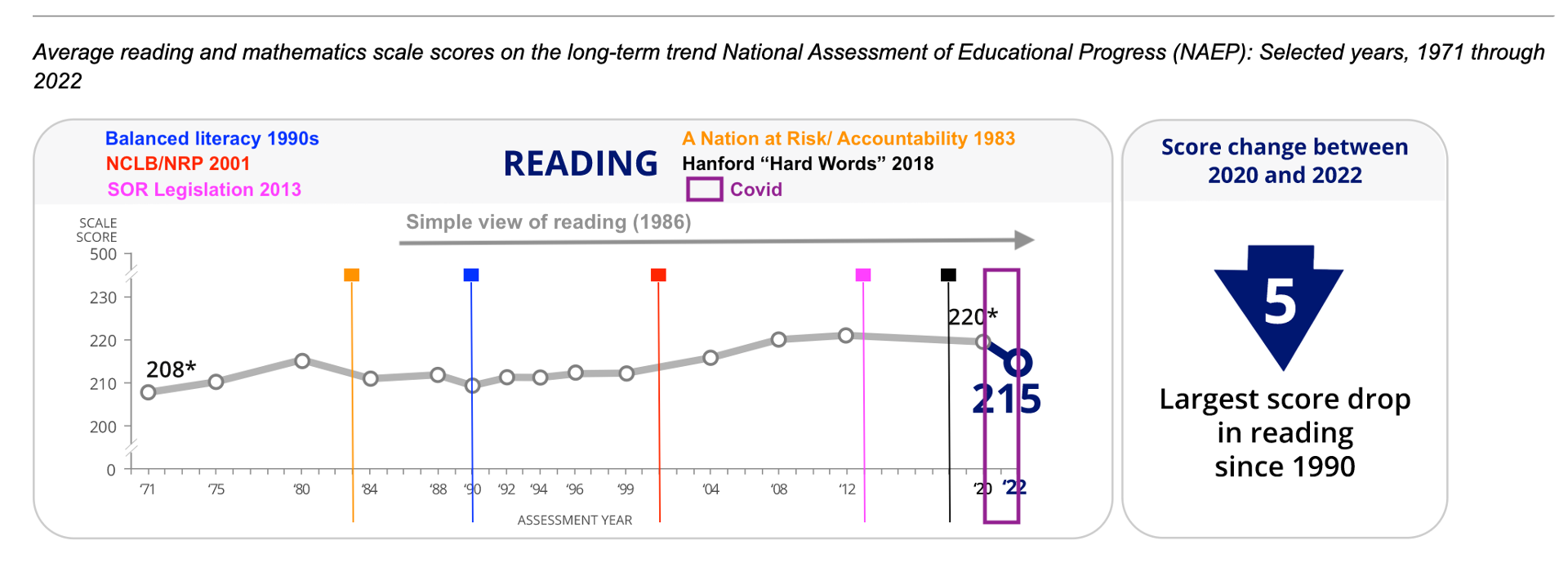
But possibly a more problematic issue with NAEP is confusing NAEP achievement levels with commonly used terms such as “grade level proficiency” (notably as related to reading).
Yet, as is explained clearly on the NAEP web site: “It should be noted that the NAEP Proficient achievement level does not represent grade level proficiency as determined by other assessment standards (e.g., state or district assessments).”
Public, media, and political claims that 2/3 of students are below grade level proficiency, then, is a false claim based on misreading NAEP data and misunderstanding the term “proficiency,” which is determined by each assessment or state (not a fixed metric).
Here is a reader for those genuinely interested in understanding NAEP data, what we mean by “proficiency,” and why expecting all students to be above any level of achievement is counter to understanding human nature (recall the failed effort in NCLB to mandate 100% of student achievement proficiency by 2014):
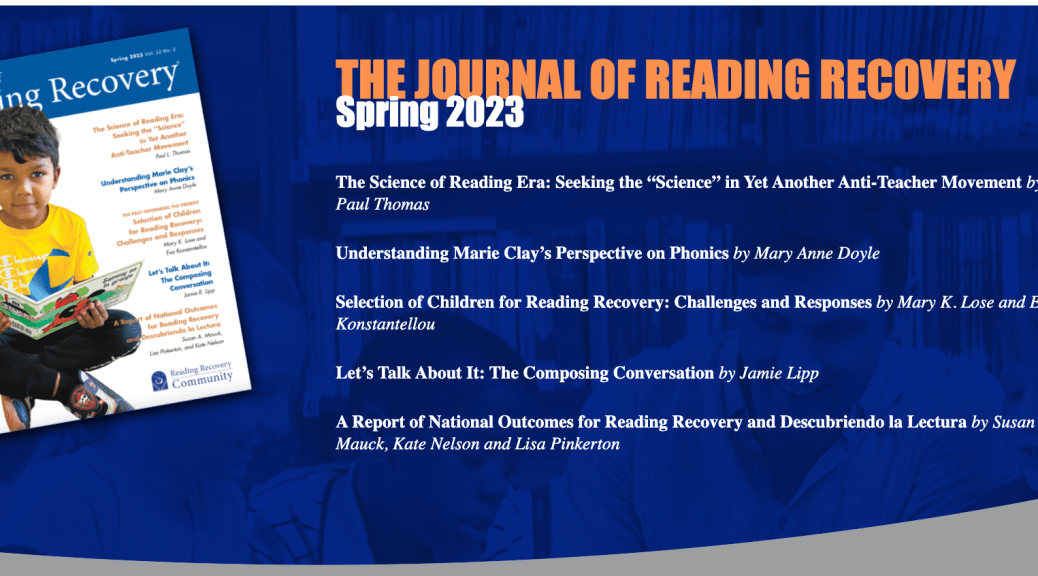
Thomas, P.L. (2023). The Science of Reading Era: Seeking the “Science” in Yet Another Anti-Teacher Movement. Journal of Reading Recovery, 22(5), 5-17.
Lee, Sy-ying & Lao, Christy & Krashen, Stephen & McQuillan, Jeff. (2021). Predicting reading ability among ten-year-olds. 20. 20-21.
The Caring Subversion of Nel Noddings: An Appreciation, Alfie Kohn
[Header Photo by Kelly Sikkema on Unsplash]
Although Gerald Bracey and Gerald Holton exposed A Nation at Risk many years ago, James Harvey calling the Reagan-era “report” “gaslighting” is possibly the best way to frame the manufactured crisis that set off five decades of misguided education reform in the US.
The crisis rhetoric of A Nation at Risk has become the norm for how media covers education, how the public perceives public education (mostly “other people’s schools”), and how politicians gain political points.
Harvey notes: “One of the tragedies around ‘A Nation at Risk’ was not simply that it misdiagnosed the problem and put forth ersatz solutions, but that it refused to face up to the financial implications of its argument.”
The elements of that crisis approach to education include the following:
As many scholars have noted, these claims are baseless but made primarily as a political move to dismantle public education and teacher education (and also teachers unions).
The media has now spoken directly into that conservative machine with the “science of reading” (SOR) movement that follows the tired and destructive pattern begun under Reagan in the 1980s.
For example, there is now a clear merging of the SOR movement and conservative politics as well as education market interests—from charter schools to the Bushes and Republican governors:

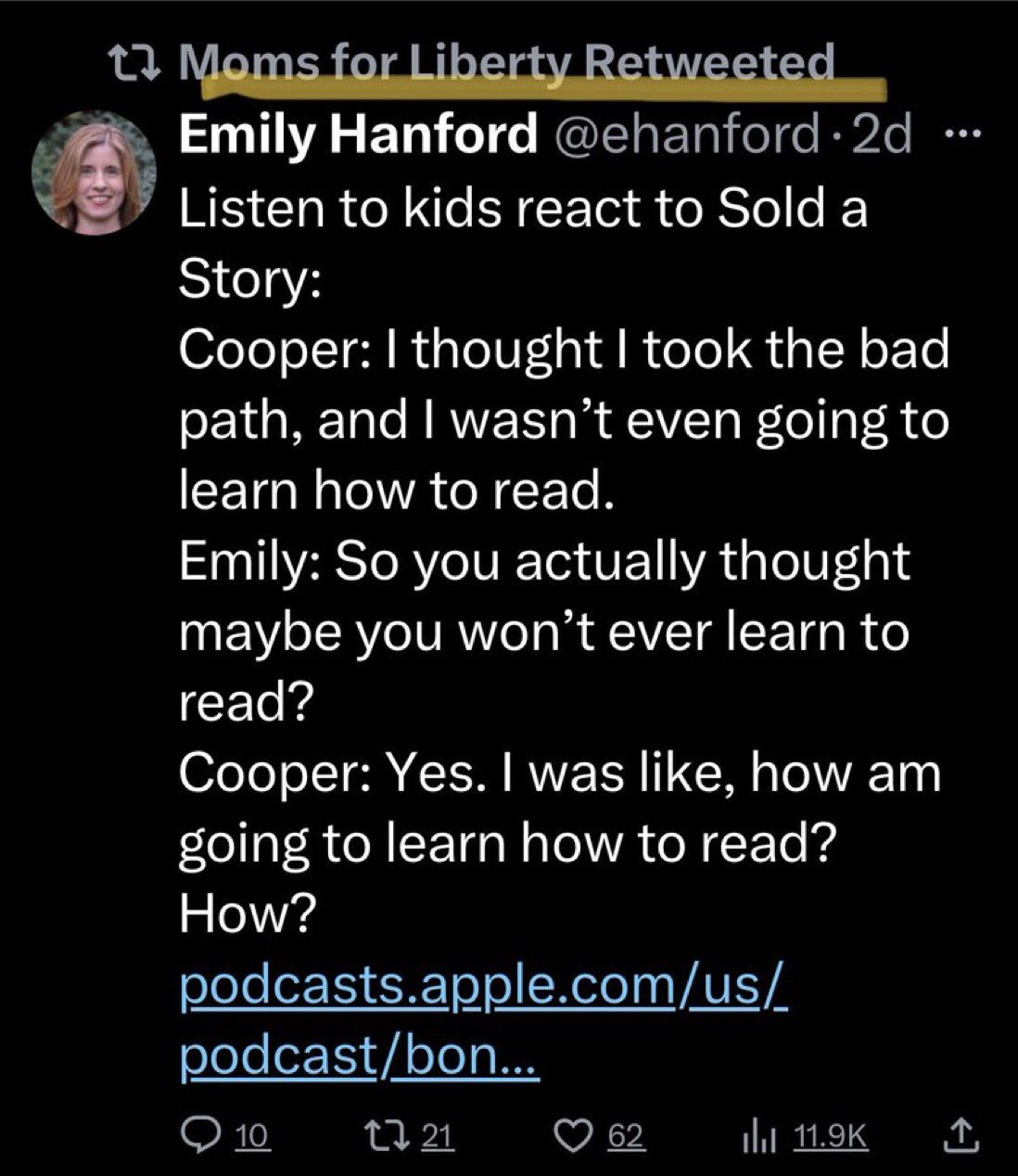

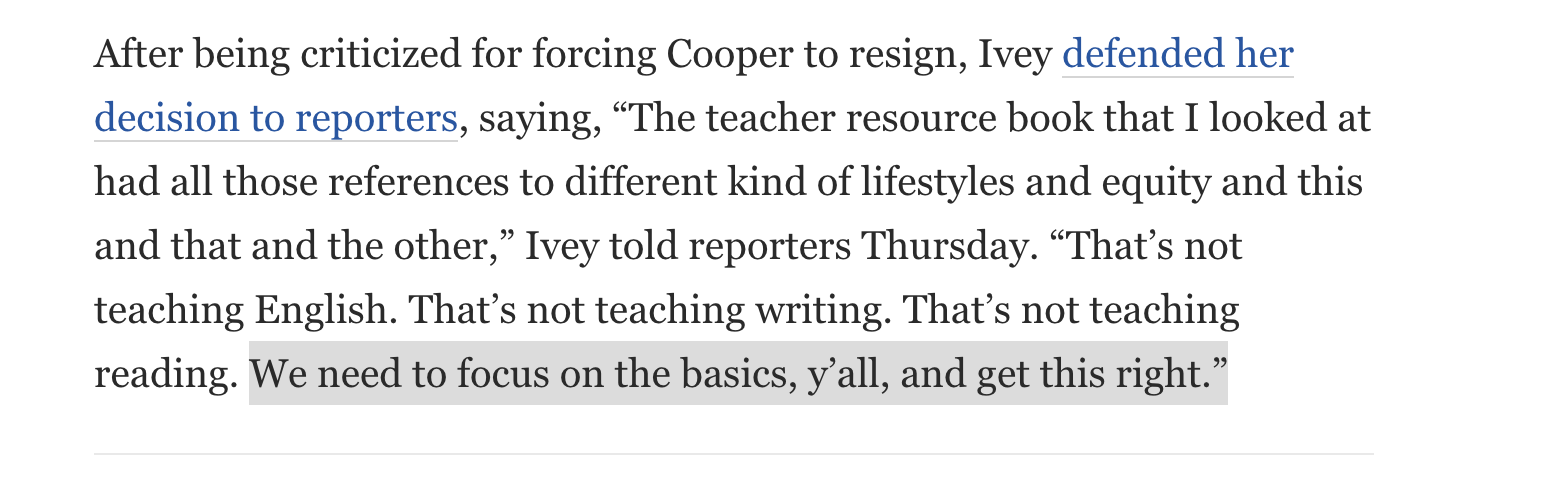




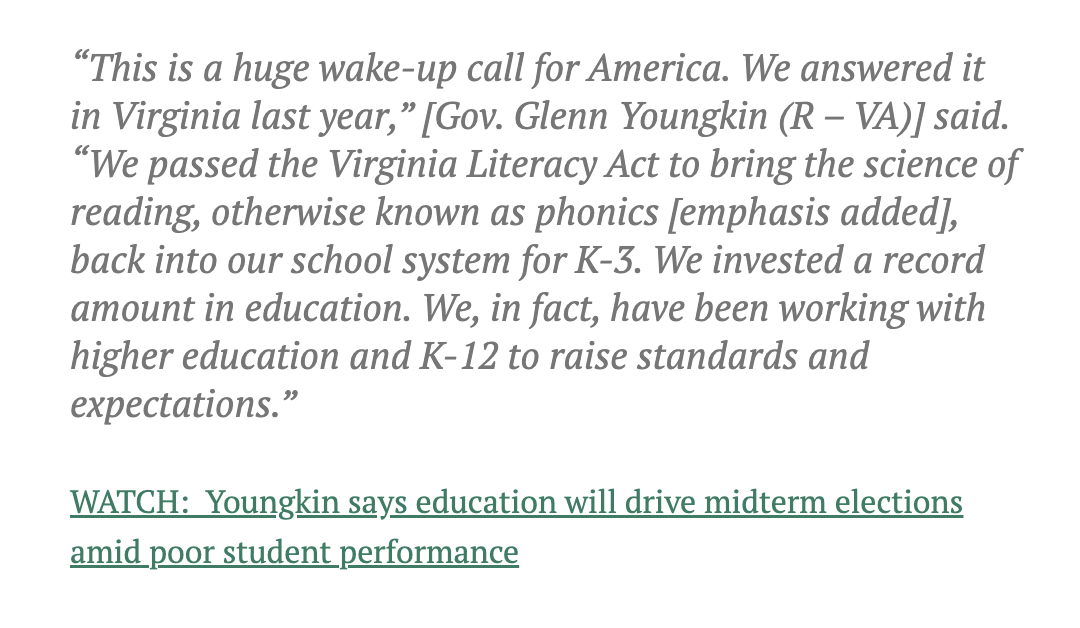
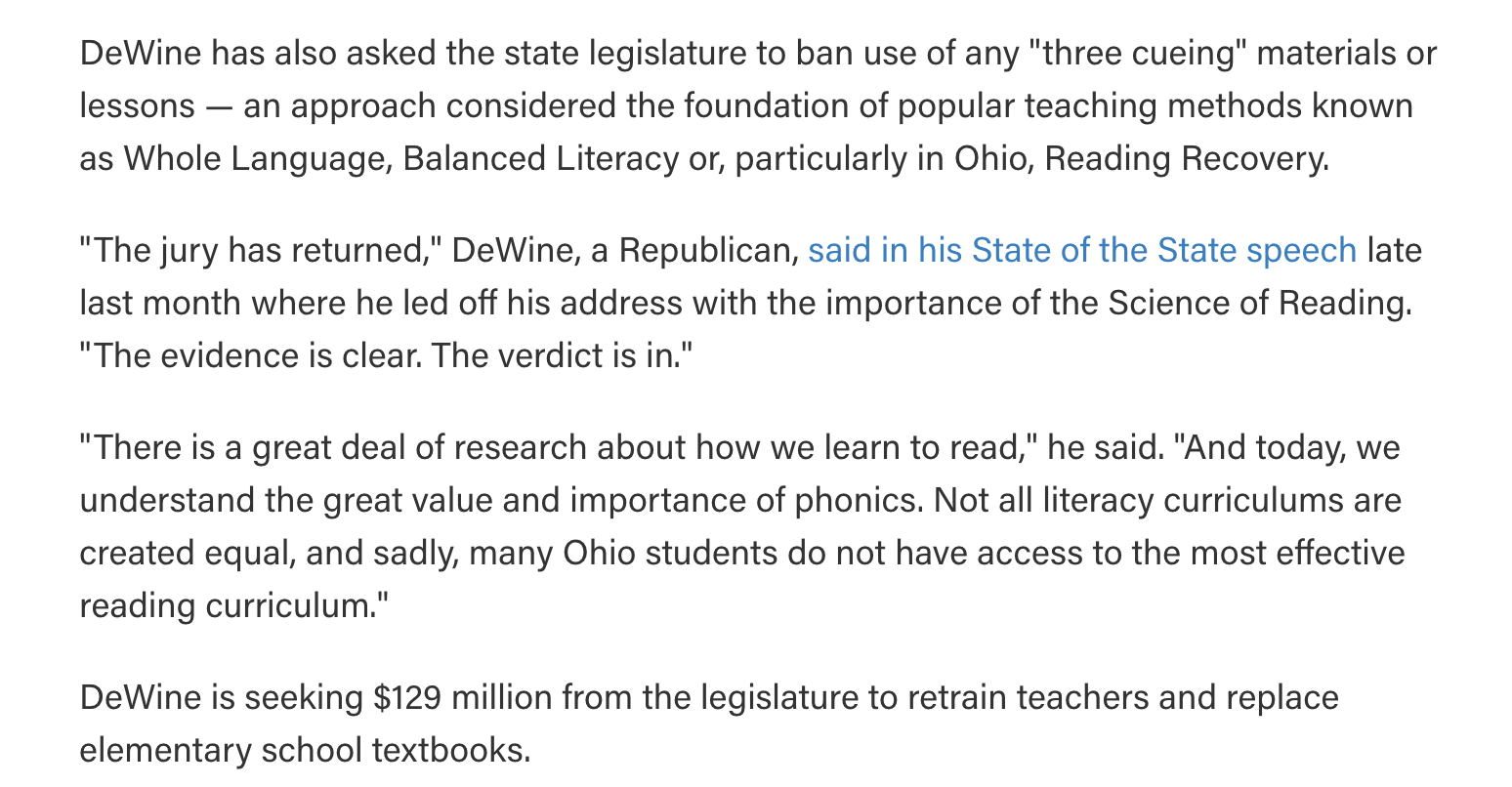
What is very disturbing is that the false claims of crisis and the misguided policy solutions being passed in almost every state now were already exposed twenty years ago by Richard J. Meyer’s Captives of the Script: Killing Us Softly with Phonics:
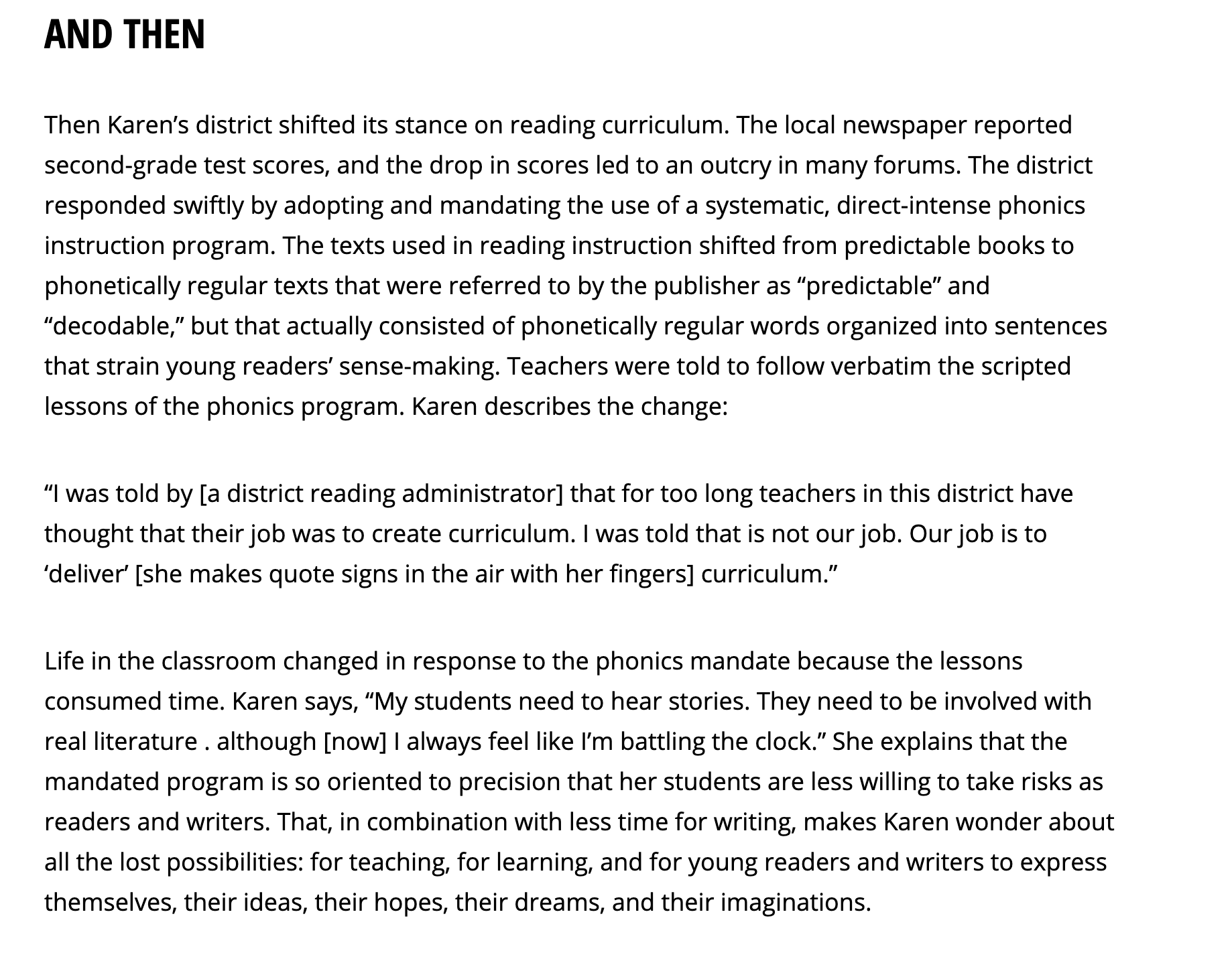

The SOR movement is yet more teacher bashing and school bashing, serving the conservative anti-school agenda of Republicans and market interests that feed off our public schools.
This has never been about reading.
This has never been about serving the needs of children.
This is more partisan politics; this is about conservative ideology at the expense of children, teachers, and public education.
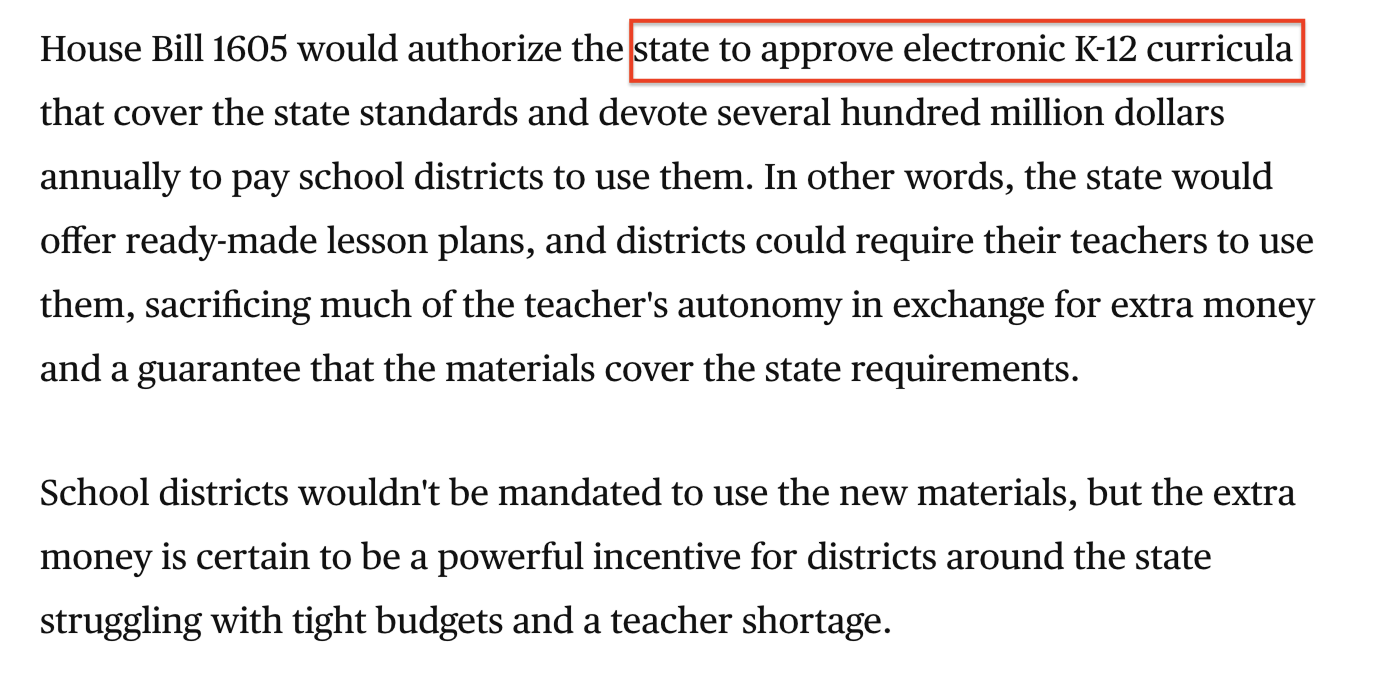
From Texas, more pieces to the puzzle:
‘Woke’ filter? Texas teachers face less creative control under pair of bills

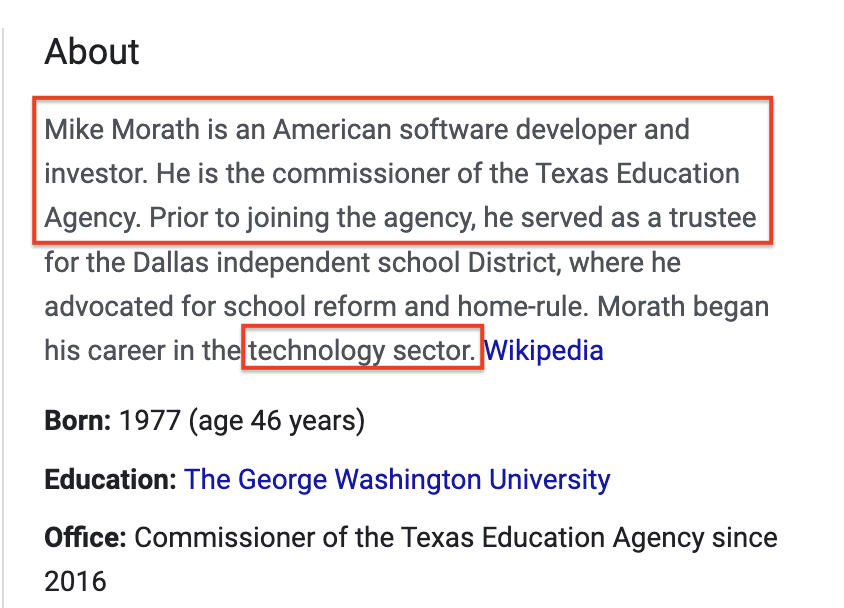

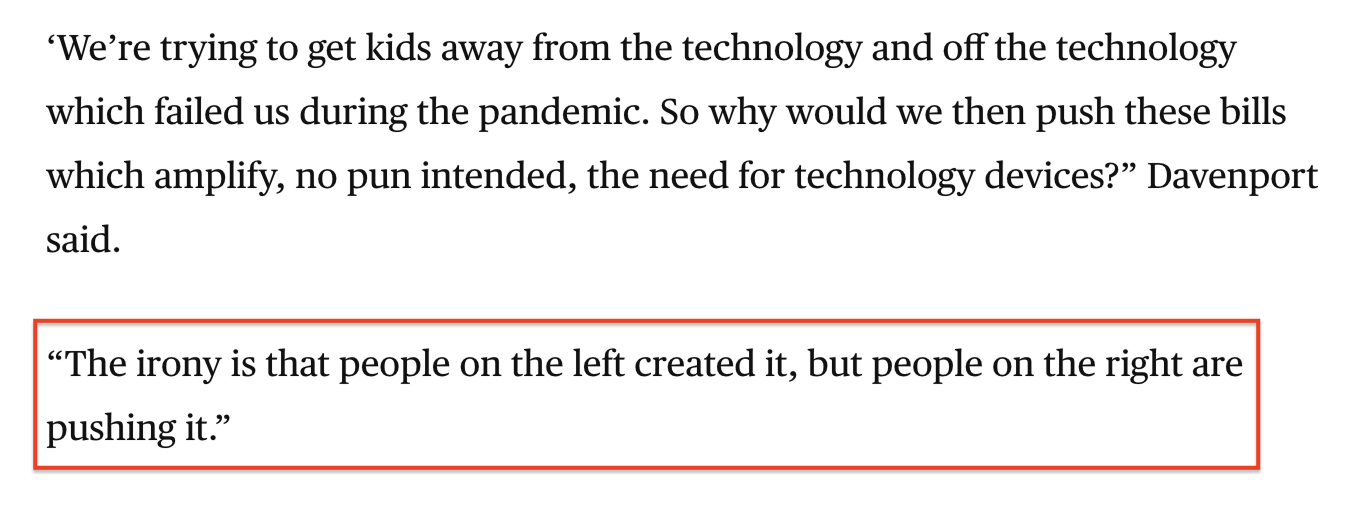
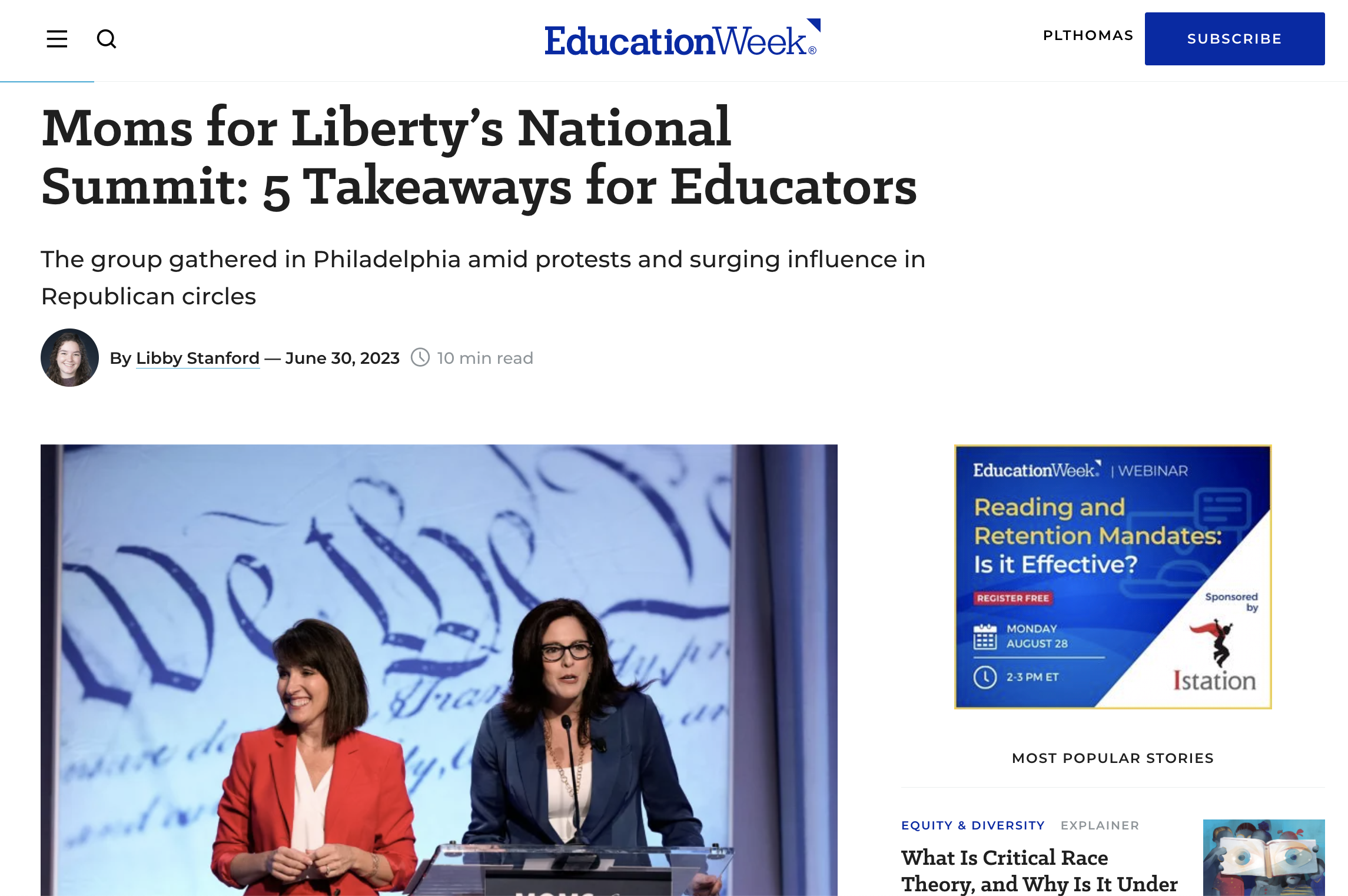
The connection between Moms for Liberty and the SOR movement continue to grow stronger:


Conservatives continue to double-down on the media misinformation because SOR is a deeply conservative movement grounded in a manufactured crisis.
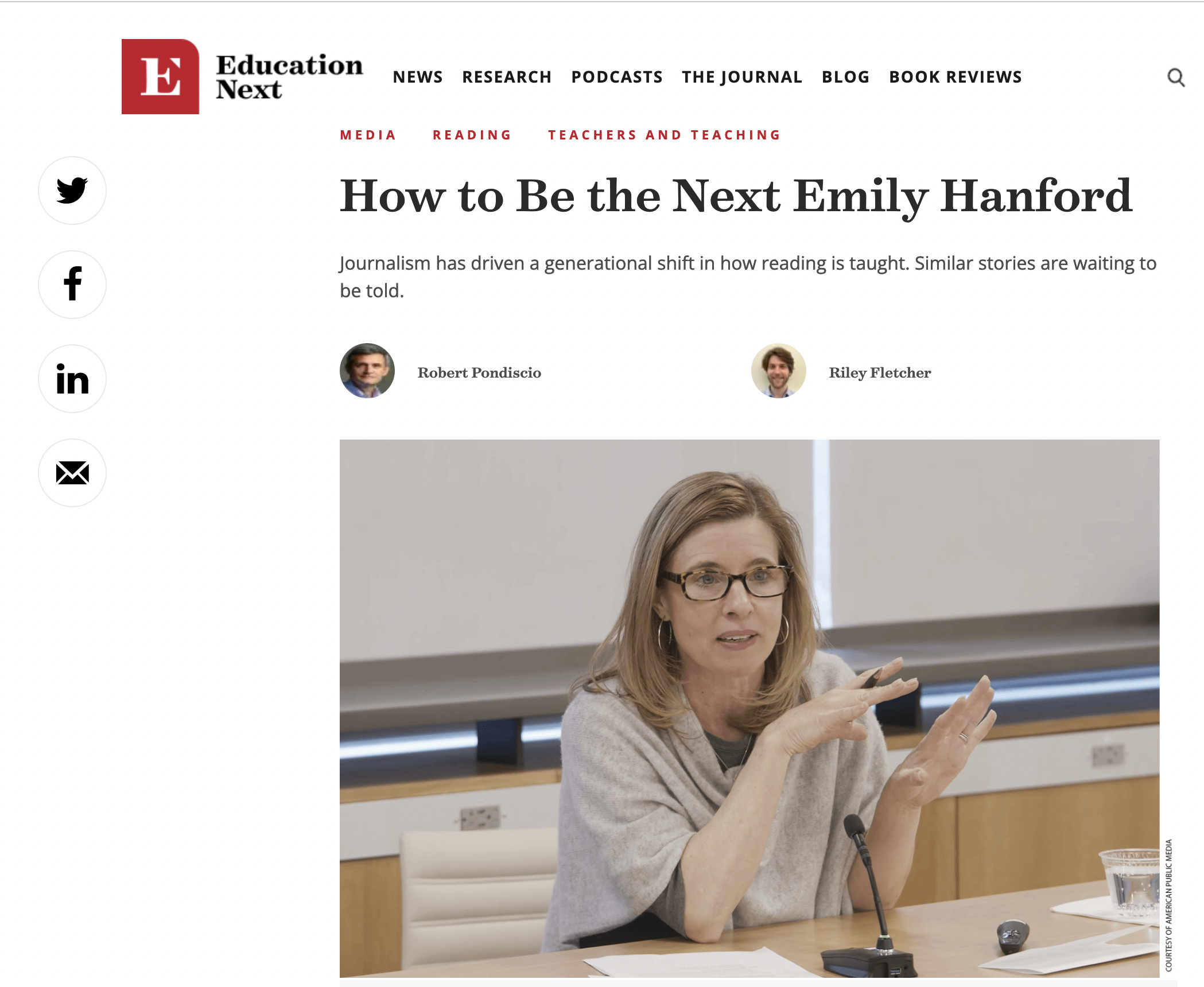
Politics of phonics: How Power, profit and politics guide reading Policies

[Below is an OpEd submitted to newspapers in SC; no response yet.]
Writing in Teachers College Record, literacy scholars Reinking, Hruby, and Risko explain: “Since 2015, 47 state legislatures have enacted, or are currently considering, a remarkable total of 145 bills that address reading and reading instruction in public schools.”
A few days apart, an article in the New York Times again announced the US has a reading crisis, and in EdSource, a school’s exceptional success with multilingual learners was celebrated.
The problem with new reading legislation, another reading crisis, and highlighting education “miracles” is that they all are factually untrue.
For example, Reinking, Hruby, and Risko demonstrate that reading achievement as measured by NAEP grade 4 reading scores have remained flat for many years in the US:
The same is true of South Carolina:
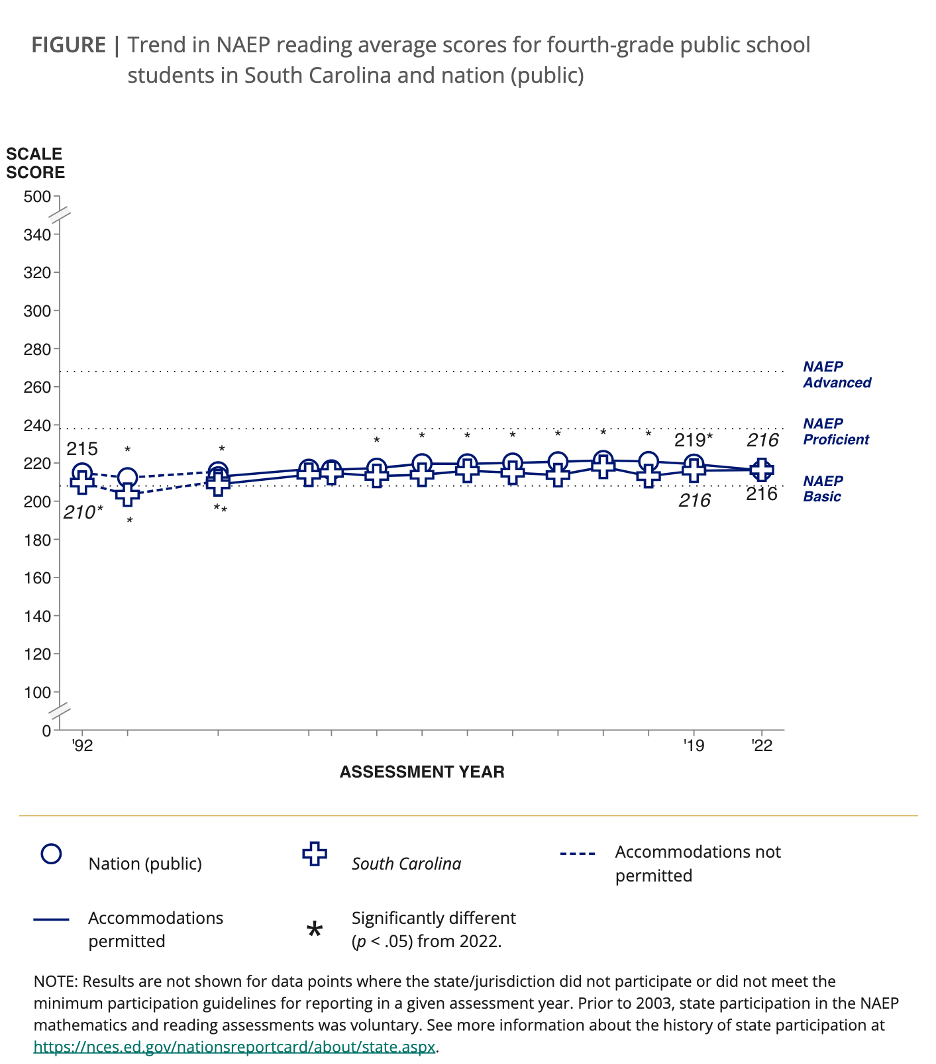
South Carolina has also been an early and eager adopted of standards, high-stakes testing, and embracing the current trend to legislate reading. However, these models of crisis and reform have never produced the sort of reading achievement that the media, the public, or political leaders have promised.
After multiple versions of different standards and tests as well as several rounds of reading wars, South Carolina like the rest of the US continues to lament low reading proficiency in students.
As a lifelong literacy educator in SC over five decades, I recommend that we first stop focusing on crisis and “miracle” stories about our schools, our teachers, and our students. These extreme stories almost always prove to be misleading or false.
Next, and most importantly, we need to do something different—at the school and classroom levels, but also at the political level of legislation, funding, and mandates.
South Carolina has a historical challenge of extreme pockets of poverty, and recent data from the value-added era of education reform under Obama confirmed that about 86 – 99% of measurable student achievement is linked to out-of-school factors, not teacher practice or quality.
The historical negligence of political leadership in SC highlighted in the documentary Corridor of Shame has simply never been addressed.
Further, what do students, teachers, and public schools needed from legislators in SC?
Political leaders must resist the current trend to ban teaching practices and reading programs while also mandating narrow approaches to reading and a new batch of preferred reading programs.
Simply put, there is no silver bullet for teaching reading, and neither the problem nor the solution is a magic reading program.
Students and teachers instead need political leaders to address learning and teaching conditions in our schools concurrent with addressing poverty and inequity in the homes and communities of our children.
Equitable learning and teaching conditions would include repealing grade retention, reducing significantly class sizes in the earliest grades and for the populations of students struggling to read, funding better all aspects of public education (teacher pay, school facilities, learning and teaching materials), and refusing to succumb to the current trends of legislating curriculum through bans and censorship.
The two most powerful commitments that a state can make in terms of supporting education and reading instruction is ensuring that the individual educational needs of all students are supported and that teacher professionalism is directly and fully supported.
For my entire career in SC as a literacy educator, political leaders have failed to address poverty and inequity, ignored the needs of our most vulnerable students, and eroded the profession of teaching in the state.
The stories we have told and the political responses to those stories have failed all of us for decades. We must do better and that means we must do something different.






 dr. p.l. (paul) thomas