In early and mid-twentieth century, pro-phonics advocates misrepresented and attacked John Dewey and progressivism (neither of which had much real influence in public education).
By the late twentieth century, whole language became the target of misinformation and attacks (although NAEP data in the 1990s showed a strong correlation between whole language approaches and higher student scores on reading [1]).
During the NCLB/NRP era of the turn of the century, attacks and misinformation focused on balanced literacy.
The current reading war driven by the “science of reading” movement is also mired in emotional anecdotes, personal attacks, and a steady diet of mainstream media misinformation.
As Hoffman, Hikida, and Sailors have documented [2], Emily Hanford at APM and mainstream media such as Education Week are following the same “big lie” approach to covering reading and education repeated throughout the last 80 years:
Hanford critiqued approaches named balance literacy and whole language without citing any evidence around those claims. She continued with anecdotes on how a focus on the SOR has improved student performance, but there is not a single citation of evidence in support of this claim. … Stirring public opinion further, Education Week has taken up critiques on literacy teacher preparation with numerous articles and blogs related to the SOR, with implications for reform in teacher preparation. The bulk of these articles and reports have been negative toward current practices and have drawn on the work of Moates and the NCTQ.
It is clear that the repeated critiques of literacy teacher preparation expressed by the SOR community do not employ the same standards for scientific research that they claimed as the basis for their critiques.
Hoffman, J.V., Hikida, M., & Sailors, M. (2020). Contesting science that silences: Amplifying equity, agency, and design research in literacy teacher preparation. Reading Research Quarterly, 55(S1), S255-S266. https://doi.org/10.1002/rrq.353
I have documented the same careless journalism—calling for the “science of reading” and then switching to anecdotes, misinformation, and unsupported claims—as Hanford recycles her original articles into an overreaction to Mississippi’s 2019 NAEP scores.
The newest recycling of Hanford’s misinformation is a podcast, Sold a Story, which itself is selling a false story, a “big lie.”
Boosted by overzealous and often angry and hateful advocates of SOR and dyslexia, the misinformation is mostly allowed and excused in an “ends justify the means” environment around the SOR movement.
That many SOR advocates continue to use anecdote while calling for “science,” that many SOR advocates are comfortable misrepresenting practices, scholars, and programs—this erodes their credibility even as many if not most people in the literacy community agree that students should be better served in their literacy education and that teachers should be better prepared and better supported as professionals.
Simply put, the ends do not justify the means, especially when SOR advocates means are creating ends that are in fact harmful.
To be clear, identifying misinformation is not endorsing the people and programs being attacked and misrepresented. I am a strong critic of both reading programs [3] and teacher education [4].
But that someone or something deserves criticism does not justify emotional attacks, hateful rhetoric, or easily refuted misinformation.
Here, then, I am collecting evidence to correct the misinformation:
[2] Hoffman, J.V., Hikida, M., & Sailors, M. (2020). Contesting science that silences: Amplifying equity, agency, and design research in literacy teacher preparation. Reading Research Quarterly, 55(S1), S255-S266. https://doi.org/10.1002/rrq.353
As one of my sabbatical projects I have been completing my online annotated bibliography of English educator Lou LaBrant.
My doctoral dissertation was an educational biography of LaBrant, but since the late 1990s, I have returned often to her work in my teaching, my scholarship, and my public advocacy and writing.
LaBrant’s recognition of the power and dangers of the “big lie” in the wake of WWII reads incredibly prescient in 2022 in the wake of Trump and the garbled rise of “fake news” in post-truth America.
However, LaBrant’s idealism about America now feels inexcusably naive—for her America and ours.
The “big lie” is not just a feature of politics; in fact, the “big lie” has become mainstream media’s primary approach to a wide range of topics. And the “big lie” is a recurring way the media, the public, and politicians batter universal public education—one of the essential elements of a free people committed to democracy.
Those without historical context may think “fake news” and the “big lie” concerning education either doesn’t exist or is a very recent phenomenon.
In the nineteenth century, in fact, the Catholic church established an assault on public education that sounds eerily similar to today:
[P]ublic schools … [are] a “dragon … devouring the hope of the country as well as religion.” Secular public education … [is filled with] “Socialism, Red Republicanism, Universalism, Infidelity, Deism, Atheism, and Pantheism—anything, everything, except religion and patriotism.”
This initial assault on public education was grounded in the “big lie,” and to be blunt, it was about market share: the Catholic Church feared the allure of universal public education drawing students from their schools.
Here is a fact of history few people acknowledge: There hasn’t been a day since then that anyone has been satisfied with student achievement in the U.S.
The media, the public, and political leaders love few things more than lamenting students’ scores on our sacred standardized tests—the SAT/ACT since early twentieth century, ITBS, and then the onslaught of state accountability tests and NAEP since the 1980s and 1990s.
And here is another fact: Throughout a century-plus of characterizing public education as failing, classroom instruction, student demographics, teacher demographics, school compositions, state standards and assessments, etc., have all changed dozens and dozens of times.
However, at any point of education crisis, there is ample room to blame singular causes for failure, and that, of course, is the “big lie.”
The “big lie” approach to criticizing education is currently driving two powerful and harmful movements—the anti-CRT/book banning movement and the “science of reading” movement.
Are teachers (well over 75% white women) indoctrinating students with anti-whiteness by hiding CRT in the curriculum? No. It is a manufactured crisis, a “big lie.”
Are teachers and librarians grooming students to become LGBTQ+ by assigning books that portray alternatives to so-called traditional families and sexuality? No. It is a manufactured crisis, a “big lie.”
Are teachers failing to implement reading science in their reading instruction (because teacher educators either willfully ignore or don’t know reading science) and therefore allowing students to fail to acquire reading proficiency? No. It is a manufactured crisis, a “big lie.”
Are major reading programs dependent on three-cueing and lacking systematic phonics cheating students out of acquiring reading proficiency? No. It is a manufactured crisis, a “big lie.”
However, all of these are examples of not only the “big lie,” but also how effective the “big lie” can be.
Let’s consider reading proficiency for a moment to unpack the “big lie” behind the “science of reading” movement.
Here are NAEP reading scores for grade 4 since 1992:
Notice that national data hover within a few points of 220 for thirty years—what in many ways can fairly be called a flat longitudinal data line.
Most people associate the “science of reading” movement starting at the earliest around 2013 and specifically around 2018.
Yet, those recent scores are little different than the two decades before (and we must acknowledge that the “science of reading” is not resistant to powerful social forces such as the pandemic).
Also, across thirty years, students and teachers have been held accountable for several different sets of standards, many different reading programs have been adopted and implemented, and the demographics of students have shifted in significant ways (public schools are increasingly populated by higher poverty students, and minoritized students constitute over 50% of students).
Nothing is consistent except student achievement.
It is nonsensical to ascribe blame (or credit) to any one instructional approach, any one adopted program, any one set of standards, etc.
So if we address one of the elements of the “big lie” in the “science of reading” movement—that Lucy Calkins’s Units of Study is a primary way we fail students learning to read—this seems preposterous in the grand scheme of educational crisis rhetoric, but also, that program is only the third most used.
But further, since I taught in public schools for 18 years, I can attest that students in two different classes taught by different teachers are not receiving the same instruction regardless of the official curriculum or programs.
The “big lie,” then, is always grounded in oversimplification and relies on crisis rhetoric to stir emotional responses.
Once we add context such as acknowledging that Jeanne Chall made the same exact arguments about the failures of reading instruction and achievement from the late 1960s into the 1990s and then the National Reading Panel made the same exact claims and offered the same exact solution (scientifically based instruction) just twenty years ago, the “big lie” is exposed as a house of cards.
Why, then, does the “big lie” repeat itself so often in education discussions and why is it so effective?
First, educational effectiveness is mostly driven by out-of-school factors (60%-80% of measurable student achievement) and not teacher instruction, curriculum, standards, or adopted programs. However, Americans resist systemic explanations and ideologically are attracted to blaming individual behavior.
Therefore, blaming Lucy Calkins is more compelling to American ideology than acknowledging poverty and inequity as the causal reasons behind student learning.
Second, we as a society have a dysfunctional relationship with statistics.
On one hand, Americans trust or believe in the bell-shaped curve, which predicts that human behaviors (including learning) will fall on a continuum that includes a few failing, many achieving “normally,” and a few excelling.
A perfect example of that dysfunction is that George W. Bush’s crowning legislation, No Child Left Behind (NCLB), included the self-defeating requirement that all student be proficient by 2014.
One reason that NCLB was replaced by the Every Student Succeeds Act (ESSA) is that politicians eventually realized such a requirement cannot be mandated by caveat, legislation, and such an expectation defies human behavior.
Wanting and trying to foster proficient readers so that all students achieve the literacy they deserve (what we absolutely must do) is far different than requiring and expecting that all students meet that lofty goal—especially since we do not have the political will to address the out-of-school factors that would have the greatest impact on that achievement.
As LaBrant noted, the “big lie” is an ugly reality in politics, but it also is an ugly and effective way to make sure our schools continue to fail to meet the needs of all students.
The anti-CRT/book banning movement and the “science of reading” movement are selling the “big lie” and, ironically, lots of people are cashing in (the really nasty hypocrisy coloring all of this).
We can and should do better for our students, especially those who need us the most (those trapped in the lower end of that bell-shaped curve).
But the “big lie” serves the political and financial interests of those dedicated to those lies.
Keep in mind when people point an accusatory finger, three more are pointing back.
Those screaming that someone else is selling a story, well, are selling a different story, the “big lie.”
My foundations of American education course serves as an introduction to public education and our education majors, but the course also fulfills a general education requirement.
The class comprises mostly first- and second-year students, and those considering education as a major or career can be most of the class or very few. None the less, virtually all of them are a bit disoriented when we begin the course reading philosophers—Foucault, Deleuze, and Freire specifically.
I invite them to read some relatively brief passages from all three, warn them that reading philosophy is challenging, and then reassure them that we are simply using these ideas to begin our semester-long interrogation of how we have public schools and why.
When 2022 NAEP data were released, I immediately thought about a few things.
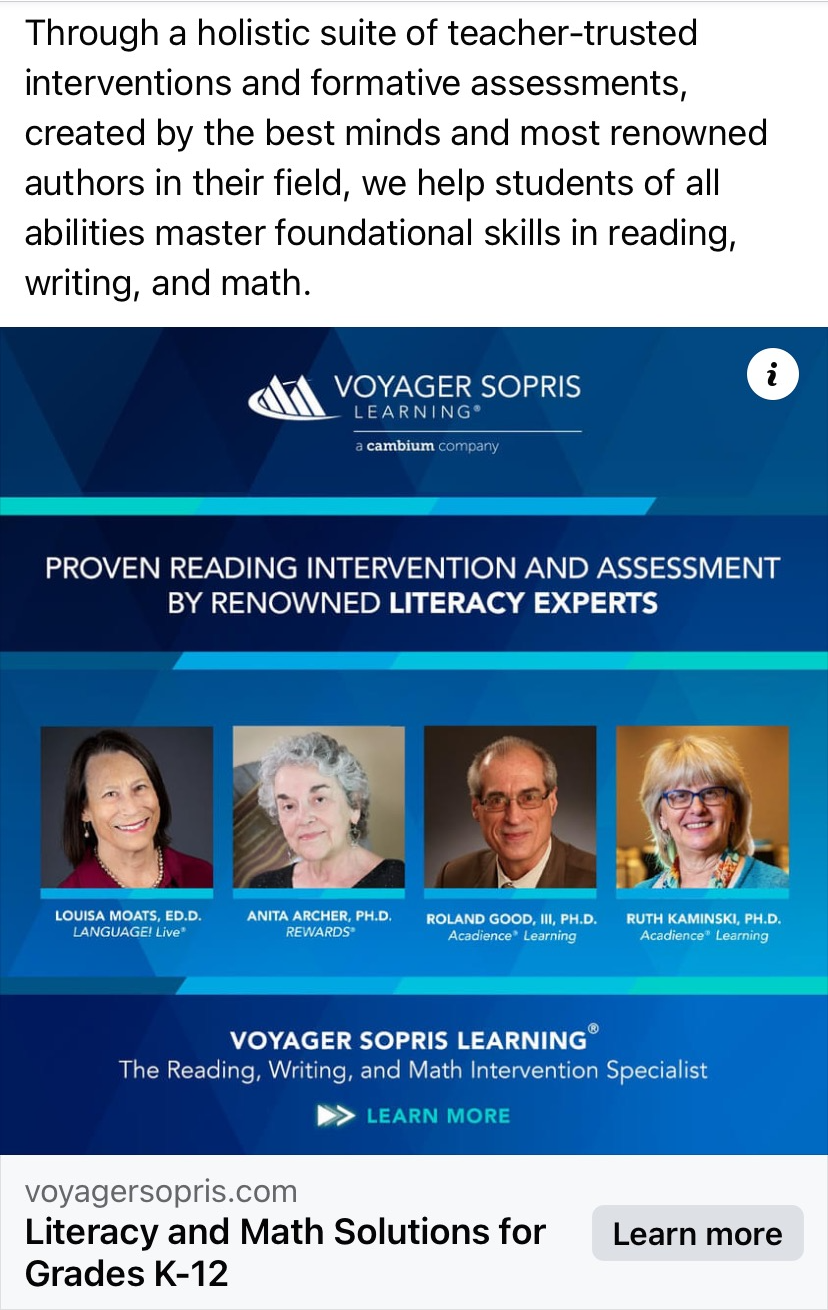
First, with the dramatic coverage of math scores dropping (see HERE and HERE), I told a few friends to brace themselves for the inevitable next step. And it took only about one day for my prediction to happen with an ad popping up on Facebook:
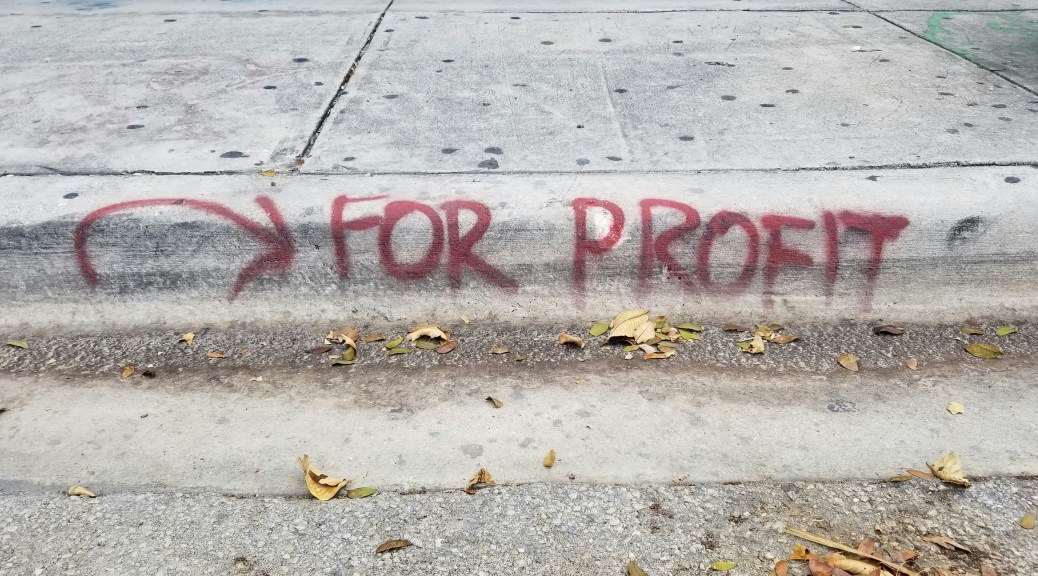
In the U.S., notably since the release of A Nation at Risk (see HERE and HERE) in the early 1980s, the easiest thing to predict is that the education market place is going to profit from educational crisis.
This fits into my second thought, which is the current and ongoing “science of reading” crisis that was prompted in 2018 by Emily Hanford, but was significantly boosted by the cries of “reading crisis” after the release of the 2019 NAEP data (see HERE, HERE, HERE, and HERE).
Now, I regret to note, math will be the next over-reaction, as the ad above shows now that edu-businesses scramble to add math to their offering for reading—solutions need a problem, and high-stakes testing is a problem machine. [1]
And the big picture thing I thought about was Deleuze, from the reading I have students consider:
We are in a generalized crisis in relation to all the environments of enclosure—prison, hospital, factory, school, family….The administrations in charge never cease announcing supposedly necessary reforms: to reform schools, to reform industries, hospitals, the armed forces, prisons….In disciplinary societies one was always starting again (from school to the barracks, from the barracks to the factory), while in the societies of control one is never finished with anything—the corporation, the educational system, the armed services being metastable states coexisting in one and the same modulation, like a universal system of deformation. (pp. 3-4, 5)
Deleuze builds to a powerful and prescient warning:
For the school system (emphasis in original): continuous forms of control, and the effect on the school of perpetual training, the corresponding abandonment of all university research, the introduction of the “corporation” at all levels of schooling. (p. 7)
As a key example, many (if not most) teachers of reading in the U.S. now are being told that their university training was useless, and that they need new training in the “science of reading.” And education corporations are lining up to sell schools that training, a story sold with the “science of reading” label (see about LETRS).
Just to be clear, this is not about the failure of teacher certification or about teaching teachers to teach or students to read; this is about profit through perpetual crisis and (re)training.
And here is the disconnect.
While I carefully help students over the course of a semester examine the claimed democratic foundations of public education (well documented in the writings of Thomas Jefferson and key figures in American education such as John Dewey), we quickly uncover that those democratic ideals are often secondary—or even erased—by market commitments.
So here we are in 2022 still riding the wave of accountability, standards, and high-stakes testing that began with A Nation at Risk and built to George W. Bush’s No Child Left Behind (NCLB).
As early as the 1990s, however, many education scholars warned that this education crisis was manufactured—essentially a political lie that was bolstered by a media frenzy and a market grab.
The education crisis/education market place dynamic has been in full swing for over forty years now, and the ugly truth is that all of the crisis rhetoric used to justify incessant accountability layered onto a constant process of new standards and new tests is, as Berliner and Biddle documented, manufactured, a lie.
As compelling as it is, we simply do not now have a reading crisis; we have never had a reading crisis.
And NAEP 2022 data do not expose a math crisis.
“Crisis” suggests something new, immediate, and pressing to address.
Student learning has been about the same for nearly a century. Some students thrive (mostly correlated with affluence and being white), many students learn in spite of the system, and too many students are neglected or mis-served (correlated strongly with poverty, minoritized race, multi-language learning, and special needs).
Just to swing back to reading, there is no decade (or even year) over the last 80 years that public, media, and political opinions expressed satisfaction in reading achievement; student reading proficiency has always been characterized as failing, and a crisis.
Always.
As we creep toward an election, we need to admit a few things.
First, the market and commercialism matter more in the U.S. than democracy or even freedom.
We not only want schools to produce (compliant) workers, but also have turned public education into a crisis-based education market place.
Take a little journey to Education Week‘s web site and note that flurry of ads for the “science of reading,” for example:
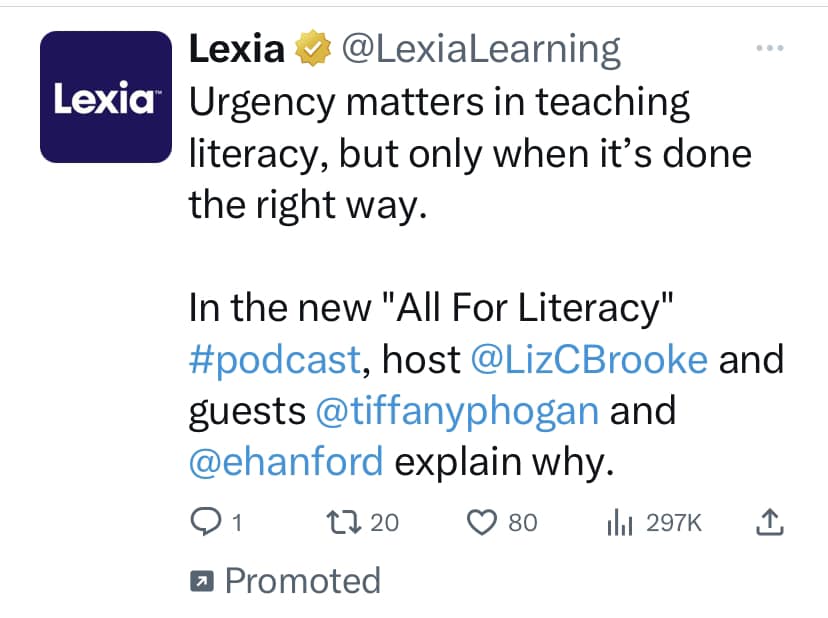
[Update] Or see what pops up “promoted” on Twitter:
And monitor over the coming weeks; you’ll see more and more addressing math.
Since 2018, media has generated millions of clicks with coverage of the “science of reading,” journalists are winning cash awards and receiving huge speaking fees to discuss the “science of reading,” and education corporations are pulling in millions for software, programs, and training labeled the “science of reading.”
Please take just a brief historical overview since the 1980s. Not a single reform has worked, not a single crisis/reform cycle has been deemed a success.
As Deleuze explains, the point of crisis/reform is to remain always in crisis/reform because that cycle creates a market, and for some people, that market generates profit.
But that crisis/reform cycle has a high cost for students, teachers, and society.
The “science of reading” crisis ironically follows just about two decades after the reading crisis identified by the National Reading Panel and at the center of NCLB—which mandated that teachers had to implement only scientifically-based practices (notably in reading).
That failed (apparently) and the current response is to shout (once again) “crisis!” and demand that mandates restrict teaching to the “science of reading.”
Four decades-plus into a crisis/reform hole and we continue to dig.
Part of me feels sorry for what is about to happen to math, and part of me feels really bad that I hope the coming math nonsense will relieve a little pressure from reading.
But mostly, I hate the lies, political, media, and commercial interests that are eager to shout “crisis!” because in the spirit of the good ol’ U.S. of A., there is money to made in all that bullshit.
Thomas, P.L. (2022). The Science of Reading movement: The never-ending debate and the need for a different approach to reading instruction. Boulder, CO: National Education Policy Center. http://nepc.colorado.edu/publication/science-of-reading
Born in 1961, I entered public school as a first grader in 1967. This was during an era before kindergarten was common for all, and I also had the great fortune or being raised by a working-class stay-at-home mother who doted on my sister and me.
I can’t recall not being able to read, but I do know that my mother taught my sister and me to read well before entering formal schooling. She taped index cards on objects around the house with words identifying those objects, and we read all the time. Lots of Dr. Seuss and such.
My education included the Dick and Jane approach of whole-word instruction; however, I don’t really recall much about learning to read once I entered school except maybe boredom (concerning the lessons, I mean, because I adored my first-grade teacher, Ms. Lanford).
I also can’t really ever think of “sound it out” as a strategy for me when I encountered words I didn’t know. Asking other people is my go-to strategy even today, as I wander into my 60s.
None the less, I do value the role of phonics—the relationship among letters, letter clusters, words, and meaning in a systematic way—although I also recognize the limitations of phonics and rules in the grand scheme of reading for meaning.
The lazy phonics debate tends to work at the extremes—a nonsensical argument that all students need systematic phonics instruction before they can comprehend (phonics-first) couched in the false argument that some literacy scholars and teachers embrace zero phonics instruction (a mischaracterization of whole language and balanced literacy).
The reasonable and practical middle—basic phonics (see here and here)—is often ignored as a result of this laziness.
Systematic intensive phonics for all students is as harmful (and misleading) as providing beginning readers with no phonics strategies for their developing journey to comprehension and critical reading.
One aspect of the phonics-first argument that is rarely confronted is that systematic instruction in phonics rules must establish standard pronunciation, necessarily then alienating young children who are raised in so-called non-standard dialects (such as myself, a Southerner).
We in the South play havoc with “pen,” “pin,” and “pan.”
That lack of interrogating standard pronunciation sits inside the already complicated relationship we encounter in the English language. Consider these words:
some
home
comb
bomb
tomb
womb
woman
women
The pronunciation of “o” is all over the place, and of course, there are so-called rules for why, but that calls into question how valuable phonics rules are versus developing word recognition (and phonics awareness) by reading and thinking about words and meaning versus through drills and rules-based isolated instruction.
Instead of teaching students a rules-based approach to decoding, we should be inviting students into the complexity of letter/sound/word relationships. Basic phonics is a gateway to understanding and comprehension.
How words are pronounced, however, is much more than phonics rules. Pronunciation often is influenced by regional dialects, word etymology, and context of usage.
A fascinating way to explore that is the word “coyote.” Mignon Fogarty explains:
People pronounce “coyote” at least five different ways. It differs by region, age, and even social factors. Some people even pronounce it different ways when they mean different things by it.
While we are perpetually arguing about why students are not reading as well (or as quickly) as we’d like as a society, we persist in failing those students by having lazy arguments and settling for oversimplified charges of failure followed by simplistic solutions.
Again, we are mired in the lazy phonics debate:
“This is a huge wake-up call for America. We answered it in Virginia last year,” [Gov. Glenn Youngkin (R – VA)] said. “We passed the Virginia Literacy Act to bring the science of reading, otherwise known as phonics, back into our school system for K-3. We invested a record amount in education. We, in fact, have been working with higher education and K-12 to raise standards and expectations.”
[UPDATE] And it continues to spread; see Ohio Gov. Mike DeWine (R):
“The jury has returned,” DeWine, a Republican, said in his State of the State speech late last month where he led off his address with the importance of the Science of Reading. “The evidence is clear. The verdict is in.”
“There is a great deal of research about how we learn to read,” he said. “And today, we understand the great value and importance of phonics. Not all literacy curriculums are created equal, and sadly, many Ohio students do not have access to the most effective reading curriculum.”
DeWine is seeking $129 million from the legislature to retrain teachers and replace elementary school textbooks.
One element of the “science of reading” movement that has received a great deal of media coverage and policy updates across the U.S. is the perennial concern for dyslexia.
While dyslexia debates have often been included in reading crises and reading wars over the past century (see the overview in this policy brief), the current advocacy around dyslexia often exaggerates the impact of dyslexia and oversimplifies how students identified with dyslexia can best be served in classrooms.
In 2019, a grassroots campaign led by parents succeeded in passing a wave of dyslexia legislation. Many states mandated hallmarks of the Orton-Gillingham method, specifically calling for “multisensory” instruction, to help students with dyslexia read and write better.* In New York, where I live, the city spends upwards of $300 million a year in taxpayer funds on private school tuition for children with disabilities. Much of it goes to pay for private schools that specialize in Orton-Gillingham instruction and similar approaches, which families insist are necessary to teach their children with dyslexia to read.
While O-G is extremely popular with parents and is now a dominant approach in practice and policy, “[t]he researchers in both the 2021 and 2022 studies all cautioned that the jury is still out on Orton-Gillingham,” Barshay explains because research (the “science”) simply does not show multi-sensory approaches such as O-G are more effective, including:
The larger 2022 analysis of 53 reading interventions had a higher bar for study quality and only one Orton-Gillingham study made the cut. Several of the reading interventions that marketed themselves as “multisensory” also made the cut, but the researchers didn’t detect any extra benefits from them.
“They weren’t more effective than the ones that didn’t market themselves as multisensory,” said Hall.
As with all reading science and research on how students learn to read and how best to teach reading, the science on dyslexia is not simple and certainly is not settled.
Recommended on Dyslexia
Allington, R.L. (2019, Fall). The hidden push for phonics legislation. Tennessee Literacy Journal, 1(1), 7-20.
Johnston, P., & Scanlon, D. (2021). An examination of dyslexia research and instruction with policy implications. Literacy Research: Theory, Method, and Practice, 70(1), 107. Retrieved July 26, 2022, from https://doi.org/10.1177/23813377211024625
Hall, C., et al. (2022, September 13). Forty years of reading intervention research for elementary students with or at risk for dyslexia: A systematic review and meta-analysis. Reading Research Quarterly. Retrieved October 17, 2022, from https://doi.org/10.1002/rrq.477
Stevens, E. A., Austin, C., Moore, C., Scammacca, N., Boucher, A. N., & Vaughn, S. (2021). Current state of the evidence: Examining the effects of Orton-Gillingham reading interventions for students with or at risk for word-level reading disabilities. Exceptional Children, 87(4), 397–417. https://doi.org/10.1177/0014402921993406
While Paulo Freire is strongly associated with critical pedagogy, I often remind myself that Freire came to his philosophy of teaching and learning through his commitment to teaching adults to read and write.
The U.S. finds itself repeatedly in a state of crisis-paralysis because people periodically discover illiteracy and aliteracy among our students and even adults.
The irony of the nearly nonstop and melodramatic cries of “reading crisis” is that the need for literacy always remains vital for human autonomy, human dignity, and human freedom, but the crisis approach always fails that need.
The problem is that public fears around illiteracy and aliteracy are often overly simplistic, and then calls for solving the “reading crisis” are equally simplistic.
The current Reading War driven by the “science of reading” movement is once again repeating that failed dynamic, notably by claiming that the simple view of reading (SVR) is the current and settled reading science (it isn’t; see here).
And concurrent with this Reading War is a dramatic rise in censorship and book banning—yet another layer of misunderstanding reading and teaching/learning.
Since we seem destined to remain stuck in misreading reading, I want to share Freire’s The Importance of the Act of Reading as an ideal text to reconsider what reading is and why literacy is central to the human condition.
First and vital to understanding literacy, Freire begins by asserting “the practice of teaching—which is political practice as well.”
In other words, teaching reading and any reading done by students (or anyone) are inherently political acts—behaviors that necessarily place humans in situations of power imbalances.
Freire’s meditation on reading was originally presented as a talk in Brazil in 1981. Then, Freire challenged the mechanical and reductive view of reading:
Reading is not exhausted merely by decoding the written word or written language, but rather anticipated by and extending into knowledge of the world. Reading the world precedes reading the word, and the subsequent reading of the word cannot dispense with continually reading the world. Language and reality are dynamically intertwined. The understanding attained by critical reading of a text implies perceiving the relationship between text and context.
One side of the reading debate often focuses on isolated text-only approaches that argue for phonics-first and/or systematic phonics instruction for all before addressing comprehension (or critical comprehension, which is often only approached for some students deemed “advanced”).
Freire, however, grounds reading in the context of reading the world before beginning to decode text for meaning.
In short, context matters, and lived experiences form the basis of anyone acquiring reading and writing. This is key to understanding the problem with focusing exclusively or primarily on in-school reading and writing instruction.
If we in the U.S. value reading for all students and adults, we must acknowledge that addressing the lived experiences of all people—eliminating poverty, food insecurity, job insecurity, etc.—is an essential aspect of needed reading policy.
Simply changing how we teach reading will never achieve the goals we claim to have.
And in this talk, Freire used his own experiences to think aloud and complexly about reading:
I put objective distance between myself and the different moments in which the act of reading occurred in my existential experience: first, reading the world, the tiny world in which I moved; afterwards, reading the word, not always the word-world in the course of my schooling.
Yes, young students must make the transition from reading their world to reading the word, but those acts of reading cannot (and should not) be separated (think of the reductive practice of having students pronounce nonsense words).
Freire speaks not only to acquiring reading, but also to why we read—and this is a powerful refuting of the rise in censorship and book bans being imposed by some parents onto all parents and students:
As I became familiar with my world, however, as I perceived and understood it better by reading it, my terrors diminished.
It is important to add that reading my world, always basic to me, did not make me grow up prematurely, a rationalist in boy’s clothing. Exercising my boy’s curiosity did not distort it, nor did understanding my world cause me to scorn the enchanting mystery of that world. In this I was aided rather than discouraged by my parents.
It was precisely my parents who introduced me to reading the word at a certain moment in this rich experience of understanding my immediate world.
Like Freire, my journey to literacy was enthusiastically driven by my parents and their commitment to me having free access to essentially anything I wanted to read. And like Freire, I had that freedom significantly reinforced by teachers when I was in high school:
I would like to go back to a time when I was a secondary-school student. There I gained experience in the critical interpretation of texts I read in class with the Portuguese teacher’s help, which I remember to this day. Those moments did not consist of mere exercises, aimed at our simply becoming aware of the existence of the page in front of us, to be scanned, mechanically and monotonously spelled out, instead of truly read. Those moments were not reading lessons in the traditional sense, but rather moments in which texts were offered to our restless searching, including that of the young teacher, Jose Pessoa.
Reading and all literacy as well as formal and informal education are human ways of coming to understand the world—including the dark and light—so that we gain agency in our living, so that we are not paralyzed by fear and ignorance.
The why and how of reading, then, are not mere mechanics, but a complex process of critical comprehension:
Mechanically memorizing the description of an object does not constitute knowing the object. That is why reading a text taken as pure description of an object (like a syntactical rule), and undertaken to memorize the description, is neither real reading, nor does it result in knowledge of the object to which the text refers.
And regardless of the simplistic calls by Republicans and conservatives to “just teach” and to not be political, we must recognize that all teaching, learning, and literacy are political acts. As he did throughout his career, Freire denounced the banking concept of teaching that erases human agency and views students as empty piggy banks into which teachers deposit value:
First, I would like to reaffirm that I always saw teaching adults to read and write as a political act, an act of knowledge, and therefore as a creative act. I would find it impossible to be engaged in a work of mechanically memorizing vowel sounds, like in the exercises ba-be-bi-bo-bu, la-le-li-lo-lu. Nor could I reduce learning to read and write merely to learning words, syllables, or letters, a process of teaching in which the teacher fills the supposedly empty heads of the learners with his or her words. On the contrary, the student is the subject of the process of learning to read and write as an act of knowing and a creative act. The fact that he or she needs the teacher’s help, as in the pedagogical situation, does not mean that the teacher’s help annuls the student’s creativity and responsibility for constructing his or her own written language and reading this language.
Freire builds to this: “Reading the world always precedes reading the word, and reading the word implies continually reading the world.”
Reading is not simply decoding text or recognizing whole words. Reading is context, and reading requires context—a context that is far more than letters, sounds, words, sentences, and paragraphs.
Reading is a very human and individual act because “reading always involves critical perception, interpretation, and re-wrìting what is read,” which is how Freire wrote his talk before sharing it aloud as yet another act of re-reading in order to re-write.
Since 2006, England has been implementing mandatory systematic phonics for all students—a policy approach very similar to the “science of reading” (SOR) movement in the U.S.
Reading programs are not one-size-fits-all solutions to challenges related to reading achievement.
Intensive phonics instruction for beginning readers can raise phonics assessment scores in the short run, but greater care should be taken to not call phonics tests “reading improvement” and (once again) those early increases disappear as young readers develop (see the reading science on phonics in the policy brief linked below).
Here is the key chart:
Documentary Fail in US
A documentary on the “science of reading” movement is imminent, The Truth about Reading.
I was deeply skeptical when I first heard about the documentary (see Nancy Bailey’s concerns HERE).
However, I agreed in good faith to be interviewed this past summer, but now that I have seen the promotional trailer, I feel as if my initial skepticism was warranted.
The trailer is melodramatic (think Corridor of Shame, a documentary with good intentions but deeply problematic delivery), and continues to forefront journalists while misrepresenting teacher practice and reading science.
In short, beware.
Recommended
Thomas, P.L. (2022). The Science of Reading movement: The never-ending debate and the need for a different approach to reading instruction. Boulder, CO: National Education Policy Center. http://nepc.colorado.edu/publication/science-of-reading
Increasingly, this is how students are being assessed in classrooms, but also in standardized tests of “reading,” often as evidence that the “science of reading” works (see Coles for a thorough examination of how the media and schools make this misleading claim [1]).
This approach is grounded in DIBELS [2], an assessment of nonsense words, but many reading programs that are phonics-first and phonics-intensive now incorporate having students pronounce nonsense words and promote the programs as the “science of reading” and/or “structured literacy.”
Structured Literacy
Structured literacy describes a scripted approach to teaching reading that requires uniform instruction. It may include the following: scripted lessons, systematic phonics (including programs such as Orton-Gillingham [59] ), decodable texts, [60] prescribed reading instruction for all students based on the needs of struggling students, structured literacy reading programs, and strict requirements for program compliance. [61] Structured literacy draws from cognitive psychology, brain research, and neuroscience, although literacy researchers caution there is still much to learn about the brain and learning to read. [62]
While proponents of competing theories all claim research support, there is general agreement that the evidence-based literature presents at least three consistent and compelling conclusions: Reading is a complex process consisting of a wide range of skills and strategies; culture and experience impact learning to read; and student needs change as they develop reading proficiency. [63]
Thomas, P.L. (2022). The Science of Reading movement: The never-ending debate and the need for a different approach to reading instruction. Boulder, CO: National Education Policy Center. http://nepc.colorado.edu/publication/science-of-reading
Several problems exists with this new emphasis on systematic phonics and phonics-first instruction (devoid of comprehension). First, focusing on strict rules of phonics and using nonsense words teaches young readers that mere pronunciation is reading (which it isn’t) and allows overly simplistic definitions to feed overly simplistic (and misleading) assessments.
And that leads to a second problem—raising scores on basic pronunciation of words, especially nonsense words that are designed to meet the simplistic rules being taught, is much easier to do than to teach and assess comprehension. Notably, raising these scores is even easier once other policies are in place, such as the harmful but effective use of grade retention.
Current examples of reading “miracles” (such as Mississippi from 2019; see here) are mirages; the score gains are distortions of data and the assessments are simply not measuring reading (again, they are measuring a very reduced type of pronunciation devoid meaning).
The greatest problem, however, is that the current nonsense word focus significantly misrepresents what the reading science shows about systematic phonics:
Systematic Phonics and Comprehension
Although phonics is only one essential aspect of reading, many researchers emphasize the importance of systematic phonics instruction for beginning and struggling readers. Research on the direct impact of phonics on reading comprehension is complicated because many approaches to phonics exist—from synthetic or analytic phonics [68] and systematic phonics programs (such as Orton-Gillingham) to phonics instruction embedded in holistic instruction [69] (such as whole language and balanced literacy [70]).
In short, research on the importance of phonics instruction is clear, but there is much less clarity about what type of phonics to teach and how much direct instruction students need or when. [71] There is consensus that proficient readers have strong phonics knowledge, but how that occurs (through direct instruction, reading, or both) remains a point of debate.
One recent overview of 12 meta-analyses [72] of the effectiveness of systematic phonics concluded that systematic phonics instruction for all students was no more effective than whole language or balanced literacy approaches. This analysis raises concerns about conducting research comparing competing instructional reading practices and recommends that policy-makers seek additional approaches to reading instruction. [73] As noted earlier, a 2022 analysis of England’s shift to systematic phonics concluded that the new phonics-first approach was not as effective as a “balanced” approach to reading instruction. [74]
Recent research on systematic or direct phonics instruction continues to show effectiveness in children pronouncing real and nonsense words (notably in Grade 1), but less effectiveness in promoting comprehension, especially in kindergarten or for readers in later grades. [75] Instead of systematic phonics, reading amount and comprehension instruction are more effective or at least as important as phonics for fostering comprehension and learning to read. [76]
Thomas, P.L. (2022). The Science of Reading movement: The never-ending debate and the need for a different approach to reading instruction. Boulder, CO: National Education Policy Center. http://nepc.colorado.edu/publication/science-of-reading
Ultimately, the “science of reading” movement is oversimplifying the messages the public, parents, and political leaders receive concerning how to teach reading, what counts as reading, and how to assess reading.
Learning to read is complex, and unique to each student; thus, teaching reading is also complex and somewhat haphazard. Ideally, formal schooling in reading should foster reading over many years, recognizing that individual students will progress at different rates.
Yes, we want eager and skilled readers, and we should work purposefully to provide all students the experiences they need to learn both the enjoyment of reading and the power of critical literacy. And yes, skilled critical readers have decoding skills, content knowledge, and a number of inter-related strategies for making meaning from text and other communication signals (we “read” icons all across our technology devices, for example).
But for many of us who are skilled readers, we have gained all those skills from reading, not from doing isolated, decontextualized, and nonsense practice instead of reading.
Pronouncing nonsense words is complete nonsense, and even worse, it is not reading—but it is wasting valuable teaching and learning time that every student deserves, time better spent with meaningful experiences with real words and real texts.
59 “Structured Literacy is an umbrella term that was adopted by the International Dyslexia Association to refer to the many programs (like Orton-Gillingham) that teach reading by following the evidence and research behind the Science of Reading. Programs that exemplify the components and methods that are outlined in the term, Structured Literacy, have been found to be beneficial for all students and essential for students who struggle with reading.” Retrieved July 26, 2022, from https://www.orton-gillingham.com/
61 Compton-Lilly, C.F., Mitra, A., Guay, M., & Spence, L.K. (2020). A confluence of complexity: Intersections among reading theory, neuroscience, and observations of young readers. Reading Research Quarterly, 55(S1), S185-S195. Retrieved July 26, 2022, from https://doi.org/10.1002/rrq.348
62 Compton-Lilly, C.F., Mitra, A., Guay, M., & Spence, L.K. (2020). A confluence of complexity: Intersections among reading theory, neuroscience, and observations of young readers. Reading Research Quarterly, 55(S1), S185-S195. Retrieved July 26, 2022, from https://doi.org/10.1002/rrq.348
Seidenberg, M. (2018). Language at the speed of sight: How we read, why so many can’t, and what can be done about it. Basic Books.
Seidenberg, M.S., Cooper Borkenhagen, M., & Kearns, D.M. (2020). Lost in translation? Challenges in connecting reading science and educational practice. Reading Research Quarterly, 55(S1), S119-S130. Retrieved July 26, 2022, from https://doi.org/10.1002/rrq.341
Willingham, D.T. (2017). The reading mind: A cognitive approach to understanding how the mind reads. Jossey-Bass.
63 Compton-Lilly, C.F., Mitra, A., Guay, M., & Spence, L.K. (2020). A confluence of complexity: Intersections among reading theory, neuroscience, and observations of young readers. Reading Research Quarterly, 55(S1), S185-S195. Retrieved July 26, 2022, from https://doi.org/10.1002/rrq.348
70 Bowers, J.S. (2020). Reconsidering the evidence that systematic phonics is more effective than alternative methods of reading instruction. Educational Psychology Review, 32(2020), 681-705. Retrieved July 26, 2022, from https://link.springer.com/article/10.1007%2Fs10648-019-09515-y
72 “Meta-analysis is the statistical combination of results from two or more separate studies.” See Deeks, J.J., Higgins, J.P.T., & Altman, D.G. (2022). Chapter 10: Analysing data and undertaking meta-analyses. Cochrane Training. Retrieved July 26, 2022, from https://training.cochrane.org/handbook/current/ chapter-10
73 Bowers, J.S. (2020). Reconsidering the evidence that systematic phonics is more effective than alternative methods of reading instruction. Educational Psychology Review, 32(2020), 681-705. Retrieved July 26, 2022, from https://link.springer.com/article/10.1007%2Fs10648-019-09515-y
74 Wyse, D., & Bradbury, A. (2022). Reading wars or reading reconciliation? A critical examination of robust research evidence, curriculum policy and teachers’ practices for teaching phonics and reading. Review of Education, 10(1), e3314. Retrieved July 26, 2022, from https://doi.org/10.1002/rev3.3314
75 Bowers, J.S. (2020). Reconsidering the evidence that systematic phonics is more effective than alternative methods of reading instruction. Educational Psychology Review, 32(2020), 681-705. Retrieved July 26, 2022, from https://link.springer.com/article/10.1007%2Fs10648-019-09515-y
Davis, A. (2013, December 13). To read or not to read: Decoding synthetic phonics. IMPACT No. 20. Philosophical Perspectives on Education Policy. Retrieved July 26, 2022, from https://doi.org/10.1111/2048-416X.2013.12000.x
Filderman, M. J., Austin, C.R., Boucher, A.N., O’Donnell, K., & Swanson, E.A. (2022). A meta-analysis of the effects of reading comprehension interventions on the reading comprehension outcomes of struggling readers in third through 12th grades. Exceptional Children, 88(2), 163-184. Retrieved July 26, 2022, from https://doi.org/10.1177/00144029211050860
Pearson, P.D. (2019, October 12). What research really says about teaching reading—and why that still matters [Video]. International Literacy Association 2019 Conference. Retrieved May 18, 2022, from https:// ila.digitellinc.com/ila/sessions/123/view
Wyse, D. & Bradbury, A. (2022). Reading wars or reading reconciliation? A critical examination of robust research evidence, curriculum policy and teachers’ practices for teaching phonics and reading. Review of Education, 10(1), e3314. Retrieved July 26, 2022, from https://doi.org/10.1002/rev3.3314
76 Allington, R.L., & McGill-Franzen. (2021). Reading volume and reading achievement: A review of recent research. Reading Research Quarterly, 56(S1), S231-S238. Retrieved July 26, 2022, from https://doi.org/10.1002/rrq.404
Filderman, M.J., Austin, C.R., Boucher, A.N., O’Donnell, K., & Swanson, E.A. (2022). A meta-analysis of the effects of reading comprehension interventions on the reading comprehension outcomes of struggling readers in third through 12th grades. Exceptional Children, 88(2), 163-184. Retrieved July 26, 2022, from https://doi.org/10.1177/00144029211050860
In the 2000s, the National Reading Panel (NPR) report and the reports from its subgroups[1] were adopted into George W. Bush’s No Child Left Behind (NCLB) legislation, mandating scientifically based instruction[2] and establishing a framework for how reading should be taught in the U.S.—what is often identified as the Five Pillars of Reading: phonemic awareness, phonics, fluency, vocabulary, and comprehension.[3]
However, only two decades later, the U.S. is facing another reading “crisis” along with an increase in state-level reading legislation and policy being revised or introduced.[4] The current movement is often the result of advocacy by parents concerned about dyslexia (Decoding Dyslexia[5]) and media coverage of the “science of reading.”[6] That advocacy and media messaging have been incredibly effective in terms of driving legislation and policy; however, many literacy scholars and researchers have noted the media-based movement exaggerates and oversimplifies claims about reading, science, and research; depends on anecdotes and misleading think-tank claims about successful implementation of reading research; and creates a hostile social media climate around reading debates.[7]
A summer 2022 analysis by Education Week shows that at least 30 states have passed revised or new reading legislation in the past decade and 2/3rd of those states includes grade retention policies.[8] Over that decade, state-level reading policies and practices include the following:
Legislation focusing on reading proficiency by 3rd grade, often including grade retention policies linked to high-stakes testing.[9]
Commercial reading programs being banned at the state level and re-evaluated at the district and school levels.
Reading policy and practices targeting dyslexia, including universal screening and mandates for systematic phonics instruction (often Orton-Gillingham[10]).
Policies have mandated systematic phonics instruction for all students.
A renewed emphasis on phonics in teacher professional development (such as requiring training in LETRS) and teacher education.[11]
Two aspects of this reading “crisis” and subsequent legislation and policy are important for all policy makers in states across the U.S.: (1) Continuing to follow the same in-school only policy approaches to education and reading[12] are destined to fail again,[13] and (2) several elements of the “science of reading” movement are contradictory and even harmful for students.[14]
Below, this examination focuses on grade retention as reading policy, highlighting the complicated impact of grade retention on reading achievement (specifically standardized test scores) as well as the disproportionate negative impact of retention on vulnerable populations of students (racial minorities, multilingual learners, students identified as at-risk, high poverty, below reading proficiency, etc.)
Grade Retention as Reading Policy
As noted earlier, grade retention as reading policy is relatively common and expanding across the U.S.:
The “science of reading” movement has increased state policies mandating grade retention based on high stakes testing, copycat versions of the post-NCLB “Florida model,” despite evidence suggesting that retention remains harmful.[15] Media have presented increased standardized test scores in Mississippi (see an examination of Mississippi’s 2019 NAEP scores below) as proof of the effectiveness of reading science reforms,[16] although it is likely, as Todd Collins for Thomas B. Fordham Institute explains, that Mississippi’s high retention rate[17] and not classroom instruction reform is the primary source of the score increases. Evidence since the mid-2000s confirms grade retention can increase test scores short-term, but the long-term impact is negative, since grade retention remains associated with students dropping out of high school.[18]
Because of short-term reading score increases, grade retention policy remains politically compelling for policy makers because high-profile research is covered in the media and used by advocates to impact policy change based on standardized reading scores.[19] Yet, policy makers must be cautious because research has not yet clarified if those increases are caused by retention or other policies impacting retained students: “This means the researchers do not know if these positive outcomes for those below the cut-score were due to the greater likelihood of retention or to the assurance of additional services”; reviews of short-term gains continue to show that they fade over time and that negative consequences of grade retention (like eventually dropping out of school) remain.[20]
Ultimately, grade retention increasing 3rd and 4th grade standardized test scores is likely a statistical mirage (notably since evidence shows those gain disappear by middle school). That mirage is likely the result of how grade retention changes the population of students being tested by
(1) removing students likely to score low from the testing pool (students retained in 3rd grade would not be in their peer testing pool in 4th grade) and
(2) creating a population of students to be tested when at least one year biologically older than the pool being testing (once those retained in 3rd grade are promoted to 4th grade).
Since grade retention as reading policy is unlikely to produce valid increases in reading proficiency among students and since grade retention remains strongly associated with negative outcomes for students (dropping out of high school, for example), policy makers are strongly encouraged to eliminate grade retention mandates based on standardized test scores in grade 3 as identified by a Resolution from the National Council of Teachers of English (NCTE):
Grade retention, the practice of holding students back to repeat a grade, does more harm than good:
retaining students who have not met proficiency levels with the intent of repeating instruction is punitive, socially inappropriate, and educationally ineffective;
basing retention on high-stakes tests will disproportionately and negatively impact children of color, impoverished children, English Language Learners, and special needs students; and
retaining students is strongly correlated with behavior problems and increased drop-out rates.[21]
What about Mississippi?
While a high-profile article in the New York Times suggested a Mississippi reading “miracle” based on 2019 National Assessment of Educational Progress (NAEP) scores,[22] that conclusion was greatly misleading and incomplete. However, a closer and more nuanced look at Mississippi provides a valuable understanding for current policy makers concerned about reading legislation and policy.
First, as noted above by Collins, Mississippi’s 2019 NAEP scores are significantly impacted by grade retention, and policy makers must acknowledge that grade retention disproportionately impacts vulnerable student populations (see NCTE Resolution), for example:
Table 1 shows that, specifically for example, Black students are disproportionately impacted by grade retention. Numbers of students retained and that disproportion are strong indicators of the harm and punitive impact of grade retention.
Further, Mississippi’s 2019 NAEP reading scores for grade 4 were outliers compared to the rest of the U.S, that outlier status suggests that Mississippi may not be a valid source of scaling up reform for other states. Nonetheless, Mississippi’s longitudinal data, since 1998,[23] suggests improved test data over time and well before many of the recent policies:
Although Mississippi’s policies, standards, and assessments have varied since 1998, the state has shown gradual but persistent improvement in grade 4 reading scores on NAEP. The 2019 large increase used by the “science of reading” movement to claim “miracle,” however, is not unique; see the significant increase from 2002 to 2009, occurring well before any use of the term “science of reading.”
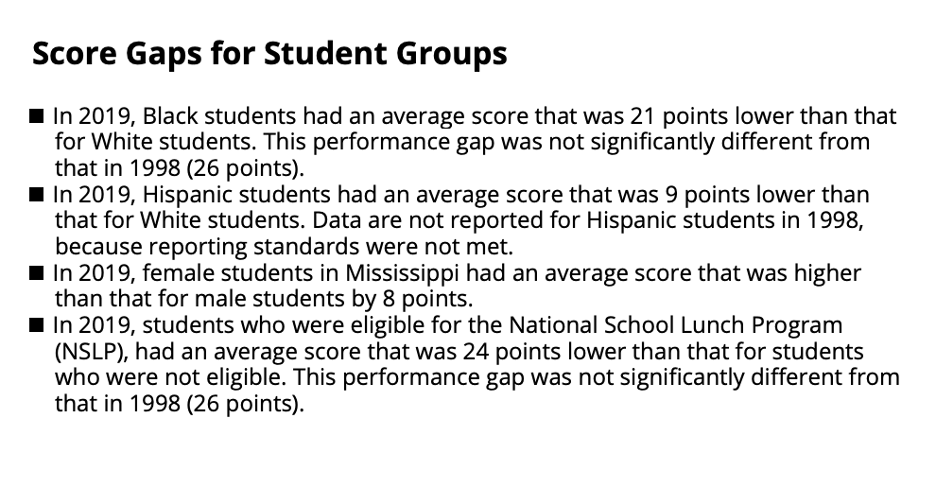
Important to understand is that improvement in education is likely complicated to cause and difficult to link to any single practice; therefore, policy makers must be diligent about “first, do no harm” by avoiding policies that may have politically expedient outcomes at the expense of the best interest of students and teachers. The relative increase and success by Mississippi in 2019 when compared to the rest of the U.S. is strongly tempered by a fuller analysis also:
Many policy makers have been seeking ways to close these gaps for decades, and Mississippi shows us that even when there is gradual and persistent improvement, problems of inequity remain.[24] Therefore, Mississippi’s 2019 NAEP data are not a “miracle,” but they are an important red flag about the insufficiency of school-only policy and of doing the same things over and over while expecting different results.[25]
Grade retention distorts test data, disproportionately impacts and punishes vulnerable populations of students, and creates a distraction from reading reform’s ultimate goal of increased student reading proficiency.
Third-Grade Proficiency and the “Word Gap”
Along with grade retention, policy makers must reconsider two other aspects of reading that often influences policy and practice—third grade reading proficiency and the “word gap.”
Policy makers and educators tend to focus on third grade reading proficiency because it (like grade retention) is correlated with negative outcomes for students, such as dropping out and prison.[26] However, while these concerns are valid, grade-level reading must be recognized as a measurement primarily created and used by the textbook industry; identifying “third grade reading level” is not as accurate or useful as many people think. More importantly, research suggests a correlation between third grade proficiency and negative outcomes, which does not warrant creating high-stakes policy around a single grade or a single measurement.[27]
Based on a popularize and often cited study by Hart and Risley from 1995,[28] it has become “common knowledge” to associate literacy with social class, specifically that high-poverty students have low literacy (fewer words) and that middle-class and affluent students have high literacy (more words). A number of scholars, however, have discredited the study as well as called into question associating literacy with simple word counts.[29] Curt Dudley-Marling notes that the Hart and Risley study is marred by poor methodology (should not be used to generalize about all students) and is grounded in class and race stereotypes; in short, the “word gap” is little more than a misguided assumption about students, reading, and literacy.[30]
Alternative Policy: A Recommendation
States must absolutely respond to valid concerns about reading achievement by parents and other advocates; however, the historical and current policies and reforms have continued to fail students and not to achieve goals of higher and earlier reading proficiency by students, especially the most vulnerable students who struggle to read.
While a broad range of new approaches are needed for state policy and classroom practice,[31] immediately states must repeal retention policy linked to high stakes testing in 3rd grade. Grade retention creates a test-score increase that is a mirage, harms students in the long run, and distracts from more effective and supportive reading policy.
Instead of punitive policies such as grade retention, state policy makers should consider the following:
Eliminate high-stakes policies (retention) around a single grade (3rd) and create a more nuanced monitoring process around a range of grades (3rd – 5th) based on a diverse body of evidence (testing, teacher assessments, parental input, etc.).
Remove punitive policies that label students and create policies that empower teachers and parents to provide instruction and support based on individual student needs.
See Also
Thomas, P.L. (2022). The Science of Reading movement: The never-ending debate and the need for a different approach to reading instruction. Boulder, CO: National Education Policy Center. Retrieved [date] from http://nepc.colorado.edu/publication/science-of-reading
Addendum
An analysis of achievement as measured by NAEP scores shows many states have significant decreases between grades 4 and 8, notably Florida. Since the “Florida model” of grade retention has been used in many states, this decrease reflects that grade 4 scores are often mirages. See:
What is the cost to the individual children and overall system performance?
Is that affecting Florida’s learning rate for older kids and the eighth grade NAEP collapse? A 2017 study of a cohort of southwest Florida students showed that seven years after retention, 94% of the retained group remained below reading proficiency. It also showed that third and sixth graders find retention as stressful as losing a parent.
First, this is a working paper supported by Mississippi Department of Education and the acknowledgements add: “This project was made possible by a grant from ExcelinEd.”
Here are some key additional caveats beyond how biased this report likely is in terms of meeting the ideological aims of ExcelinEd:
The policy brief concedes: “That said, though the results are distinctly positive for the policy treatment overall, the analysis cannot entirely disentangle the extent to which the observed benefits in ELA are due to the additional year of instruction or to other specific features of the approach Mississippi took to providing literacy-focused supports and interventions to students.”
In the full working paper, section “2.1 Within-Age vs Within-Grade Comparisons” details a common failure of analyzing grade retention: “Comparing the later outcomes of students retained at a point in time to students in their cohort who were promoted is complicated by the fact that the two groups are enrolled in different grade levels during later years.” The findings of this working paper must be tempered by this fact of the study: “Unfortunately, within-age comparisons of student test scores are not possible in Mississippi because scores on the state’s standardized tests are comparable within grades over time but not across grades.” In other words, as noted above, higher test scores may be the result of students simply being older in a tested grade level, and not because grade retention or any of the services/instructional practices were effective. Again, these “gains” are likely mirages.
[2] Wilde, J. (2004, January). Definitions for the No Child Left Behind Act of 2001: Scientifically-based research. National Clearinghouse for English Language Acquisition and Language Instruction Educational Programs. Retrieved June 9, 2022, from https://ncela.ed.gov/files/rcd/BE021264/Definitions_of_the_NCLB_Act.pdf
[4] Cummings, A. (2021). Making early literacy policy work in Kentucky: Three considerations for policy makers on the “Read to Succeed” act. Boulder, CO: National Education Policy Center. Retrieved May 18, 2023, from https://nepc.colorado.edu/publication/literacy
Cummings, A., Strunk, K.O., & De Voto, C. (2021). “A lot of states were doing it”: The development of Michigan’s Read by Grade Three law. Journal of Educational Change. Retrieved April 28, 2022, from https://link.springer.com/article/10.1007/s10833-021-09438-y
Hoffman, J.V., Hikida, M., & Sailors, M. (2020). Contesting science that silences: Amplifying equity, agency, and design research in literacy teacher preparation. Reading Research Quarterly, 55(S1), S255–S266. https://doi.org/10.1002/rrq.353
Johnston, P., & Scanlon, D. (2021). An examination of dyslexia research and instruction with policy implications. Literacy Research: Theory, Method, and Practice, 70(1), 107. https://doi.org/10.1177/23813377211024625
MacPhee, D., Handsfield, L.J., & Paugh, P. (2021). Conflict or conversation? Media portrayals of the science of reading. Reading Research Quarterly, 55(S1), S145—S155. doi:10.1002/rrq.384
[9] Cummings, A. (2021). Making early literacy policy work in Kentucky: Three considerations for policy makers on the “Read to Succeed” act. Boulder, CO: National Education Policy Center. Retrieved May 19, 2023, from https://nepc.colorado.edu/publication/literacy
Cummings, A., Strunk, K.O., & De Voto, C. (2021). “A lot of states were doing it”: The development of Michigan’s Read by Grade Three law. Journal of Educational Change. Retrieved April 28, 2022, from https://link.springer.com/article/10.1007/s10833-021-09438-y
[11] Hoffman, J.V., Hikida, M., & Sailors, M. (2020). Contesting science that silences: Amplifying equity, agency, and design research in literacy teacher preparation. Reading Research Quarterly, 55(S1), S255—S266. https://doi.org/10.1002/rrq.353
[13] Cummings, A. (2021). Making early literacy policy work in Kentucky: Three considerations for policy makers on the “Read to Succeed” act. Boulder, CO: National Education Policy Center. Retrieved May 18, 2023, from https://nepc.colorado.edu/publication/literacy
Cummings, A., Strunk, K.O., & De Voto, C. (2021). “A lot of states were doing it”: The development of Michigan’s Read by Grade Three law. Journal of Educational Change. Retrieved April 28, 2022, from https://link.springer.com/article/10.1007/s10833-021-09438-y
Collet, V.S., Penaflorida, J., French, S., Allred, J., Greiner, A., & Chen, J. (2021). Red flags, red herrings, and common ground: An expert study in response to state reading policy. Educational Considerations, 47(1). https://doi.org/10.4148/0146-9282.2241
[14] Thomas, P.L. (2022). How to End the Reading War and Serve the Literacy Needs of All Students:A Primer for Parents, Policy Makers, and People Who Care (2nd ed.). Information Age Publishing.
National Education Policy Center & Education Deans for Justice and Equity (2020). Policy statement on the “science of reading.” Boulder, CO: National Education Policy Center. http://nepc.colorado.edu/publication/fyi-reading-wars
Thomas, P.L. (2022). The Science of Reading movement: The never-ending debate and the need for a different approach to reading instruction. Boulder, CO: National Education Policy Center. Retrieved from http://nepc.colorado.edu/publication/science-of-reading
Huddleston, A. P. (2014). Achievement at whose expense? A literature review of test-based grade retention policies in U.S. school. Education Policy Analysis Archives, 22(18). http://dx.doi.org/10.14507/epaa.v22n18.2014
Jasper, K., Carter, C., Triscari, R., & Valesky, T. (2017, January 9). The effects of the mandated third grade retention on standard diploma acquisition and student outcome over time: A policy analysis of Florida’s A+ Plan. Policy Analysis. Retrieved July 24, 2022, from https://theoptoutfloridanetwork.files.wordpress.com/2017/01/e782a-executivesummary.pdf
Huddleston, A. P. (2014). Achievement at whose expense? A literature review of test-based grade retention policies in U.S. school. Education Policy Analysis Archives, 22(18). http://dx.doi.org/10.14507/epaa.v22n18.2014
Hughes, J. N., West, S. G., Kim, H., & Bauer, S. S. (2018). Effect of early grade retention on school completion: A prospective study. Journal of Educational Psychology, 110(7), 974–991. https://doi.org/10.1037/edu0000243
Jasper, K., Carter, C., Triscari, R., & Valesky, T. (2017, January 9). The effects of the mandated third grade retention on standard diploma acquisition and student outcome over time: A policy analysis of Florida’s A+ Plan. Policy Analysis. Retrieved July 24, 2022, from https://theoptoutfloridanetwork.files.wordpress.com/2017/01/e782a-executivesummary.pdf
National Council of Teachers of English. (2015). Resolution on mandatory grade retention and high-stakes testing. Retrieved May 19, 2023, from https://ncte.org/statement/grade-retention/
[20] Robinson-Cimpian, J.P. (2015, December). Review of The effects of test-based retention on student outcomes over time: Regression discontinuity evidence from Florida. National Education Policy Center. Retrieved July 24, 2022, from https://nepc.colorado.edu/thinktank/review-NBER-retention
[21] National Council of Teachers of English. (2015). Resolution on mandatory grade retention and high-stakes testing. Retrieved May 19, 2023, from https://ncte.org/statement/grade-retention/
[24] Ladson-Billings, G. (2006). From the achievement gap to the education debt: Understanding achievement in U.S. schools. Educational Researcher, 35(7), 3-12.
[25] National Education Policy Center & Education Deans for Justice and Equity (2020). Policy statement on the “science of reading.” Boulder, CO: National Education Policy Center. http://nepc.colorado.edu/publication/fyi-reading-wars
[27] National Council of Teachers of English. (2015). Resolution on mandatory grade retention and high-stakes testing. Retrieved May 19, 2023, from https://ncte.org/statement/grade-retention/
[28] Hart, B. & Risley, T.R. (1995). Meaningful differences in the everyday experiences of young American children. Brookes.
[30] Dudley-Marling, C. (2007). Return of the deficit. Journal of Educational Controversy, 2(1), Article 5. Retrieved August 10, 2022, from https://cedar.wwu.edu/jec/vol2/iss1/5
[31] Thomas, P.L. (in press). The “science of reading”: The never-ending reading war and the need for a different approach to literacy instruction (policy brief). Boulder, CO: National Education Policy Center.
Please access this policy brief on the “science of reading” movement from NEPC:
Thomas, P.L. (2022). The Science of Reading movement: The never-ending debate and the need for a different approach to reading instruction. Boulder, CO: National Education Policy Center. Retrieved [date] from http://nepc.colorado.edu/publication/science-of-reading
The policy brief emphasizes the need to avoid one-size-fits-all reading policy and practice. For context, please see:
We should acknowledge that one-size-fits-all metrics do not fairly measure what matters most in many schools. Right now, what matters most is finding ways to address and improve students’ mental health so they can get back on track with learning. We should reward schools for innovation, for creating programs that will take time to evaluate.
Simple numbers promote simple solutions and can prevent promising programs with long-term positive implications from taking root. Before we head into another school year, let’s look at dismantling the ranking systems that are burdening our administrators with busywork and preventing authentic improvement.











 dr. p.l. (paul) thomas