

[Header Photo by Yohann LIBOT on Unsplash]
The metaphors for education reform are far too easy, and thus, becoming themselves cliches—deja vous all over again, beating a dead horse, and for me, the most apt, zombies.
Education reforms are championed, and then implemented; invariably, these reforms never achieve what is promised—charter schools/ school choice, reading reform, accountability built on (new) standards and (new) standardized tests, and then, of course, merit pay for teachers.
The Editorial Staff at the Post and Courier are trying to resurrect the zombie politics of merit pay: SC teacher bonuses show promise, but rules need spelling out:
It took a whole lot of years, and a state education superintendent who advocates some really smart ideas and some really bad ones, but the S.C. Legislature seems finally to have settled into supporting the idea of paying at least a few teachers based at least partially on performance, rather than simply the amount of time they’ve been teaching and the degrees they have.
This lede seems as hastily written (the double “at least) and thought out. However, one aspect of politics and education reform that my students are currently analyzing is that people tend to rely on their beliefs over empirical evidence when advocating for policies.
Further, “performance” and “simply” are doing some heavy and misleading lifting.
Over 15 years ago while I was researching and writing a book on school choice, I found a fascinating research report from a conservative think tank in Wisconsin (renamed in 2017 from the Wisconsin Policy Research Institute), which had one of the longest and most robust school choice policies in the US.
Despite the study [1] finding choice ineffective, George Lightbourn introduced the report as a Senior Fellow, admitting:
The report you are reading did not yield the results we had hoped to find. We had expected to find a wellspring of hope that increased parental involvement in the Milwaukee Public Schools (MPS) would be the key ingredient in improving student performance.
And later on the WPRI web site (no longer available online), Lightbourne emphasized:
So that there is no misunderstanding, WPRI is unhesitant in supporting school choice. School choice is working and should be improved and expanded. School choice is good for Milwaukee ‘s children.
Here is a key moment in education reform: Despite the evidence to the contrary, the reformers remain steadfast in supporting the policy because they believe in it. [2]
And that brings us to merit pay for teachers, a policy that has been tried over and over (as well as often in the private sector) without ever yielding the outcomes promised.
In fact, research has shown that merit pay produces negative consequences without the positives promised.
A significant aspect of that failure is that decades of research has shown that cooperation and collaboration are more effective that competition, which is at the core of merit pay schemes.
And in education, we must acknowledge that competition is incompatible with the work of educators; under merit schemes, teachers are being incentivized to have their students outperform other teacher’s students—a gross distortion of the ethics of teaching.
Let’s turn back to “performance,” which suggests that all teachers can be objectively or fairly evaluated for the quality of their teaching in the context of dozens of students with an incredibly wide range of abilities.
This always means standardized testing (note here that many teachers work in areas that are not tested, making the merit schemes a nightmare of evaluation or an astronomical increase in testing of students).
The US is only about a decade away from one of the most intense eras of teacher evaluation based on “merit,” the value-added methods policies under the Obama administration.
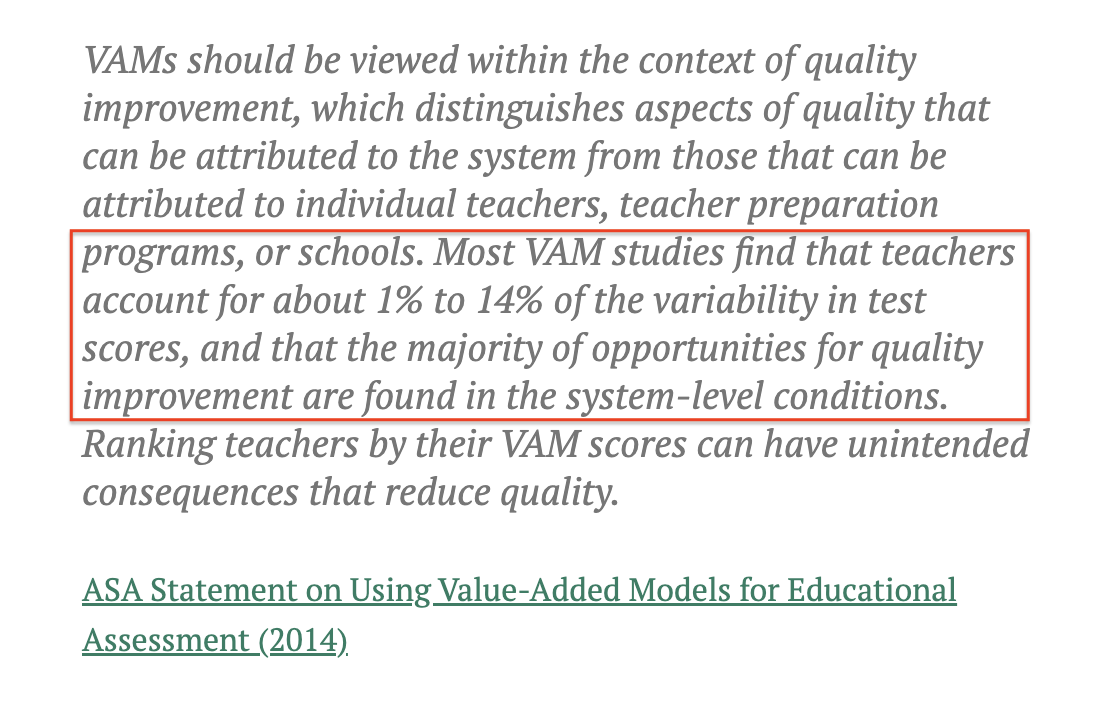
And here is what the American Statistical Association concluded in 2014:
VAMs should be viewed within the context of quality improvement, which distinguishes aspects of quality that can be attributed to the system from those that can be attributed to individual teachers, teacher preparation programs, or schools. Most VAM studies find that teachers account for about 1% to 14% of the variability in test scores, and that the majority of opportunities for quality improvement are found in the system-level conditions. Ranking teachers by their VAM scores can have unintended consequences that reduce quality.
Teachers have extremely small measurable impacts on tested student learning, and, this is key to note, “the majority of opportunities for quality improvement are found in the system-level conditions.”
Again, the research conflicts with bootstrapping myths in the US, but decades of evidence shows what the ASA discovered, notably in a 2024 study from Maroun and Tienken:
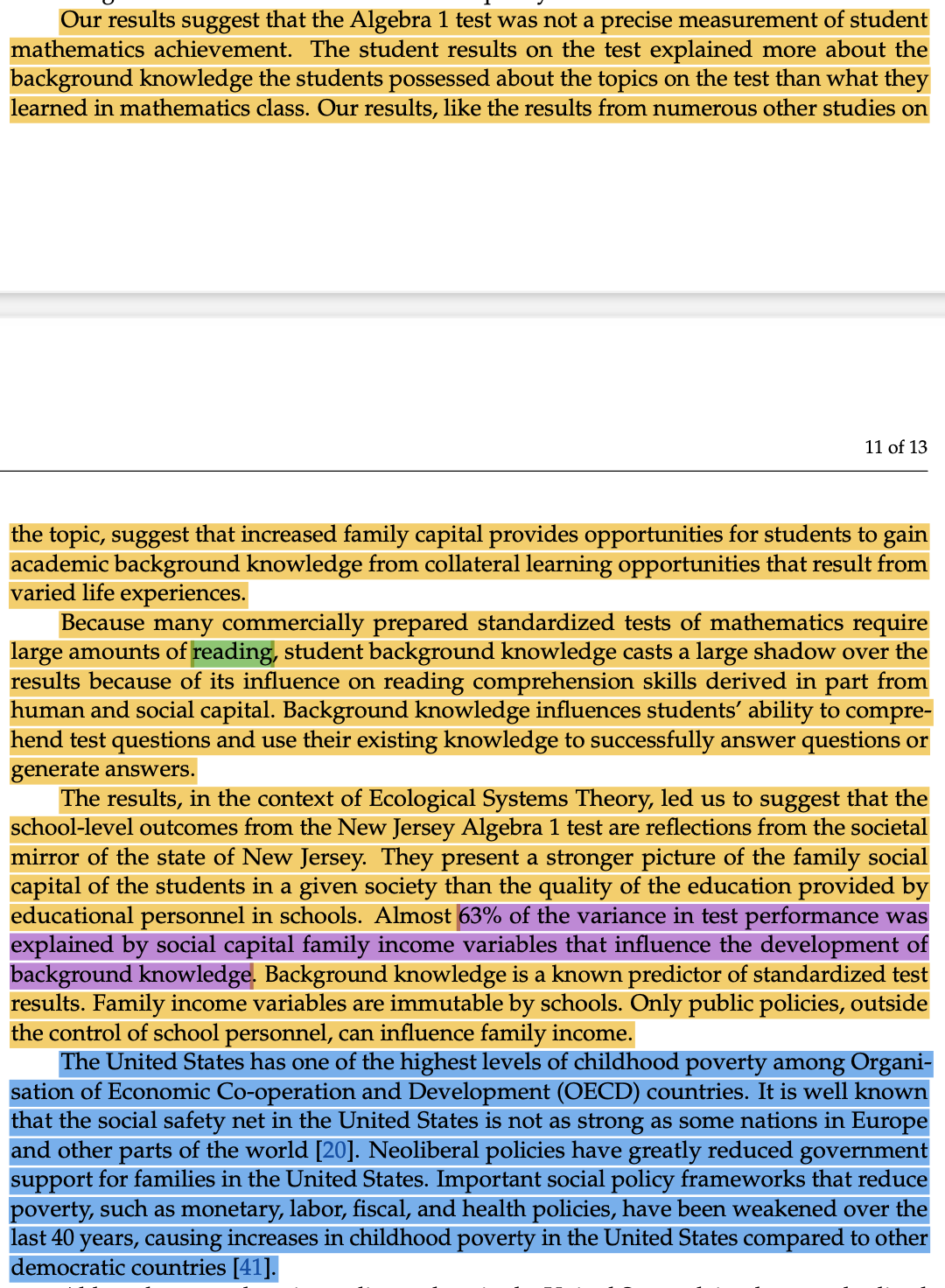
Almost 63% of the variance in test performance was explained by social capital family income variables that influence the development of background knowledge. Background knowledge is a known predictor of standardized test results. Family income variables are immutable by schools. Only public policies, outside the control of school personnel, can influence family income….
The influence of family social capital variables manifests itself in standardized test results. Policy makers and education leaders should rethink the current reliance on standardized test results as the deciding factor to make decisions about student achievement, teacher quality, school effectiveness, and school leader quality. In effect, policies that use standardized test results to evaluate, reward, and sanction students and school personnel are doing nothing more than rewarding schools that serve advantaged students and punishing schools that serve disadvantaged students.
The evidence is overwhelming, then, that there simply is no justification for advocating for or trying again merit pay for teachers.
The scheme will invariably be costly, produce negative outcomes, and not worked as promised by those who simply believe merit pay is the thing to do.
We should pay teachers more, and we should fund and support our public schools in ways that improve the teaching and learning conditions in those schools.
However, the policies that will have the greatest impact on teaching and learning remain social policies such as universal healthcare, food security, housing and home security, access to books in the home, and as Mauron and Tienken argue, a matrix of “public policies, outside the control of school personnel.”
You see, what we need to do is not supported by what many in the US choose to believe despite what the evidence shows us.
[1] Dodenhoff, D. (2007, October). Fixing the Milwaukee public schools: The limits of parent-driven reform. Wisconsin Policy Research Institute Report, 20(8). Thiensville, WI: Wisconsin Policy Research Institute. https://www.badgerinstitute.org/wp-content/uploads/2022/08/vol20no8.pdf
[2] Note that choice advocates in Wisconsin have persisted:
NEPC Review: Wisconsin’s Most Cost-Effective K-12 Program (School Choice Wisconsin, August 2025) https://nepc.colorado.edu/sites/default/files/reviews/NR%20Baker_23.pdf













 dr. p.l. (paul) thomas