Leaning Think Tanks or (More) Flawed Education Journalism?

In the spirit of good journalism, let me start with full disclosure.

I am on the Editorial Board of NEPC (you’ll see why this matters in a few paragraphs), and that means I occasionally provide blind peer review of research reviews conducted by scholars for NEPC. That entails my receiving a couple very small stipends, but I have never been directly or indirectly asked to hold any position except to base my reviews on the weight of the available evidence.

Further, since this appears important, I am not now and have never been a member of any teacher or professor union. Recently, I spoke to a local union-based conference, but charged no fee (my travel from SC to TN was covered).

Finally, I have been confronting the repeatedly poor journalism covering education and education reform for several years, notably see my recent piece, Education Journalism Deserves an F: A Reader.

My key points about the failures of journalism covering education include (i) journalists assuming objective poses, that are in fact biased, (ii) the lack of expertise among journalists about the history and research base in education, and (iii) the larger tradition in journalism to dispassionately (again a pose, but not real) present “both sides” of every issue regardless of the credibility of those sides or regardless of whether or not the issue is really binary (let’s highlight also that virtually no issue is binary).

So I remain deeply disappointed when major outlets, here Education Week, and experienced journalists, specifically Stephen Sawchuk, contribute to the worst of education reform by remaining trapped in the worst aspects of covering education.

Sawchuk’s U.S. Teacher-Prep Rules Face Heavy Criticism in Public Comments includes a common framing of “both sides” in order to address the USDOE’s new proposal to reform teacher education.

That framing pits NEPC against the Thomas B. Fordham Institute—although a number of others with stakes in the debate are listed. What is notable here is how Sawchuk chooses to characterize each; for example:

Still other commenters drew on a brief prepared by the National Education Policy Center, a left-leaning think tank at the University of Colorado at Boulder that is partly funded by teachers’ unions and generally opposes market-based education policies….

Thomas B. Fordham Institute, which generally backs stronger accountability mechanisms in education….

Only a handful of commenters were outright supportive of the rules. At press time, a coalition of groups were preparing to submit a comment backing the proposal. The coalition’s members included: Democrats for Education Reform, a political action committee; Teach Plus, a nonprofit organization that supports teacher-leadership efforts; the National Council on Teacher Quality, an advocacy group; and the alternative-certification programs Teach For America and TNTP, formerly known as The New Teacher Project.

In the U.S., labeling NEPC “left-leaning” and highlighting union affiliation is just as coded as calling Richard Sherman a thug. We all know that wink-wink-nudge-nudge is dismissive, prompting Audrey Amrein-Beardsley to ask, “Why such (biased) reporting, Sawchuk?”

Yet, Fordham supports “stronger accountability” and not a single group in the third listing has a “nudge” despite, for example, NCTQ entirely lacking credibility.

Also, NEPC has a hyperlink, but none of the others? And where is the link to the actual report from NEPC, and is there any credible evidence the report on the USDOE’s proposal is biased or flawed?

Since traditional faux-fair-and-balanced journalism continues to mislead, since we are unlikely to see a critical free press any time soon, let me, a mere blogger with 31 years of teaching experience (18 in a rural public SC high school, and the remainder in teacher education) and about twenty years of educational scholarship offer some critical clarifications.

First, here is the abstract for Kevin K. Kumashiro‘s review of Proposed 2015 Federal Teacher Preparation Regulations by the USDOE:

On December 3, 2014, the U.S. Department of Education released a draft of proposed new Teacher Preparation Regulations under Title II of the Higher Education Act with a call for public comments within 60 days. The proposal enumerates federally mandated but state-enforced regulations of all teacher preparation programs. Specifically, it requires states to assess and rate every teacher preparation program every year with four Performance Assessment Levels (exceptional, effective, at-risk, and low-performing), and states must provide technical assistance to “low-performing” programs. “Low-performing” institutions and programs that do not show improvement may lose state approval, state funding, and federal student financial aid. This review considers the evidentiary support for the proposed regulations and identifies seven concerns: (1) an underestimation of what could be a quite high and unnecessary cost and burden; (2) an unfounded attribution of educational inequities to individual teachers rather than to root systemic causes; (3) an improperly narrow definition of teacher classroom readiness; (4) a reliance on scientifically discredited processes of test-based accountability and value-added measures for data analysis; (5) inaccurate causal explanations that will put into place a disincentive for teachers to work in high-needs schools; (6) a restriction on the accessibility of federal student financial aid and thus a limiting of pathways into the teaching profession; and (7) an unwarranted, narrow, and harmful view of the very purposes of education.

If there is anything “left-leaning” or any evidence that union money has skewed this review, I strongly urge Sawchuk or anyone else to provide such evidence—instead of innuendo masked as balanced journalism.

And let’s unpack “left-leaning” by looking at NEPC’s mission:

The mission of the National Education Policy Center is to produce and disseminate high-quality, peer-reviewed research to inform education policy discussions. We are guided by the belief that the democratic governance of public education is strengthened when policies are based on sound evidence.

A revision appears in order so I can help there also:

Still other commenters drew on a brief prepared by the National Education Policy Center, a left-leaning think tank committed to democratic and evidence-based policy at the University of Colorado at Boulder that is partly funded by teachers’ unions and generally opposes market-based education policies not supported by the current research base….

Since NEPC is balanced against Fordham, it seems important to note that NEPC has three times awarded Fordham its Bunkum Award (2010, 2008, 2006) for shoddy and biased reports; thus, another revision:

Thomas B. Fordham Institute, a free-market think tank which generally backs stronger accountability mechanisms in education regardless of evidence to the contrary.

I added the hyperlink to the Fordham mission statement, which uses code also (“options for families,” “efficient,” “innovation,” “entrepreneurship”) to mask their unwavering support not for “stronger” accountability but for market-based policy.

What does all this teach us, then?

All people and organizations—including Education Week, NEPC, and Fordham—are biased. To pretend some are and some aren’t is naive at best and dishonest at worst.

NEPC, I believe, freely admits there is a bias to what reports are selected for review (just as EdWeek chooses what issues to cover and where to place and how to emphasize those pieces), but the reviews implement the most widely accepted practices for transparency and accuracy, blind peer-review. Further, the reviews are freely available online for anyone to examine carefully and critically.

The real story that mainstream media are refusing to cover is that the USDOE (and the so-called reformers such as TFA, NCTQ, DFER, TNTP, etc.) lacks the experience and expertise to form education policy, but the actual researchers and practitioners of the field of education remain marginalized.

Yes, the real story is that those rejecting the USDOE’s proposed teacher education regulations are credible and that the proposal itself (as Kumashiro details) lacks credibility (notably in its use of value-added methods, which has been rejected for use in high-stakes ways by researchers left-leaning, right-leaning, and moderate; see HERE, HERE, HERE, HERE, and HERE).

The greatest failure among the mainstream media is the inability of journalists to recognize and then address that their narrative about “reformers v. anti-reformers” is a straw man argument and that the real battle is between those seeking reform built on the research base (researchers and educators consistently marginalized and demonized) and the rich and powerful without credibility committed to accountability, standards, and high-stakes testing as a mask for market ideologies—despite three decades of research showing that has not worked.

And since I opened with transparency, let me end with a solid clarification that I am on record as a teacher educator that teacher education desperately needs reforming, as does public education broadly, professional education organizations, and teacher unions. And thus, I recommend the following:

Open Letter to Teachers Unions, Professional Organizations, and Teacher Education

Are We (Finally) Ready to Face Teacher Education’s Race Problem?

What’s Wrong with Teacher Education?

Conditions v. Outcomes: More on What’s Wrong with Teacher Education (and Accountability)? pt. 2

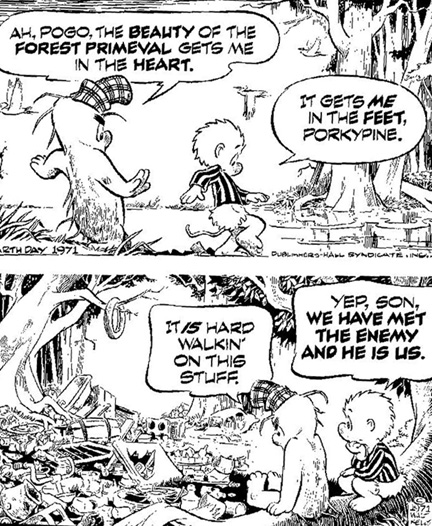
The Fatal Flaw of Teacher Education: “We have met the enemy and he is us.”

Since the fall of 1984, I have been a teacher—the first 18 years as a high school English teacher in a rural public school in South Carolina, and then as a teacher educator at a private liberal arts university only about an hour’s drive from that high school and my hometown.

SC adds important layers to viewing the professions of K-12 teacher and college professor because SC is a so-called “right-to-work” state (non-union) and the South clings to a tradition of respecting authority (notably as a mask for lingering sexism, racism, and harsh attitudes about children).

Throughout my three-plus decades as an educator, I have worked within and against the accountability movement that has now reached a fever pitch, aiming the political, media, and public accusatory fingers at both teachers and teacher educators. I believe my public record as a strong public education, student, and teacher advocate is solid so it is incredibly difficult to turn my accusatory finger toward those colleagues I genuinely admire, have sought to defend against the misguided and dishonest attacks from the eduction reform movement.

As I have detailed repeatedly, claims that education is itself a powerful mechanism for social change and individual success and that teachers are the most important aspect of that formula are factually untrue.

Historically and currently, educators at all levels have little influence over or voice in public policy, and the norms of teaching have always dictated that teachers and professors remain objective, and thus not political, in the classroom.

All of these factors have combined for the perfect storm, specifically in the South but nationally as well, for further de-professionalizing teaching as federal and state policy continues to increase accountability based on prescriptive standards and high-stakes testing despite the growing evidence that those policies do not work.

Teacher education stands at the intersection of that disturbing trend.

“We have met the enemy and he is us.”

While I continue to seek ways to support K-12 teachers in raising and asserting their professional voices, I am deeply aware that public school teachers (especially in non-union states) must consider the job insecurity related to any political efforts.

Yes, I want K-12 public school teachers to embrace their empowerment, but I appreciate that call from a tenured university professor rings hollow.

That is not the case, however, among my university-based teacher educators, many of whom are themselves tenured and all of whom are directly culpable for the policies being imposed on both public education and teacher education.

Yet, in the same tradition of public school teachers, teacher educators remain mostly inert, passive, and compliant. In fact, as I have noted, many in teacher education rush to out-do the exact reformers poised to destroy public education and teacher education.

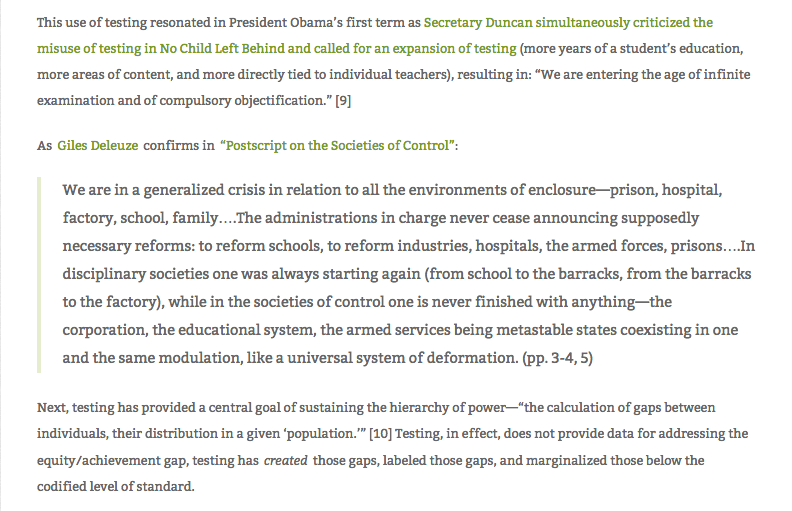
Education reform at all levels and in all contexts is designed so that everyone is constantly starting over, never able to finish because the bureaucracy needs that paralysis of infinite compliance:

testing 2

Having now been in higher education for well over a decade, I have watched how other departments and disciplines function. Most disciplines are not only self-determining, but also self-policing.

Biologists are not scrambling to comply with political demands, and they certainly are not abdicating their field to political, media, or public expectations. Consider that biology remains firm on evolutionary biology and climate change despite the tremendous political, media, and public misunderstanding and misinformation about as well as resistant to significant bodies of research and credible evidence.

Teacher education, on the other hand, simultaneously notes that value-added methods (VAM) for evaluating teachers and teacher education are not supported by the research base while also rushing to implement policies that require VAM in teacher evaluation as well as certification and accreditation.

Such professional schizophrenia for K-12 teachers is unhealthy and dehumanizing, but often understandable in the larger context of job security.

In higher education, that professional schizophrenia is inexcusable.

To my fellow teacher educators, then, I must stress that we are the possible line in the sand about failed accountability, about the complete failure to implement evidence-based policy and practice.

When we lament the lack of respect for education by the other disciplines, when we lament that teaching is not a prestigious profession in the U.S., when we read yet another media trashing of teachers and teacher certification and degrees, when we listen to politicians and self-proclaimed reformers with no background in education make repeated claims that are untrue, how do we simply complain and then turn right around and comply?

Or possibly more important: Why do we simply complain and then turn right around and comply?

As long as we continue such schizophrenia, we are contributing to education as the punch line in a not-so-funny cartoon:

Pogo_-_Earth_Day_1971_poster

For Further Reading

Maxine Greene and the “Frozen Sea Inside of Us”

Lessons from the Zombie Apocalypse

“A generalized crisis in relation to all the environments of enclosure”: Deleuze

Re-framing teacher evaluation discourse in the media: an analysis and narrative-based proposal, Jasmine B. Ulmer

NFL’s Shielded Barbarism Exposes Racism in U.S.

A few days after the 2015 Super Bowl XLIX, during the ESPN Radio Mike & Mike sports talk show, Mike Greenberg returned to the debate over Seattle Seahawks running back Marshawn Lynch, while also mentioning New England Patriots Rob Gronkowski‘s appearance on ABC’s Jimmy Kimmel Live.

Lynch has received considerable criticism for his behavior during required media sessions as well as crotch-grabbing after scoring touch downs.

Greenberg has more or less argued that much of that criticism (except for the crotch grabbing) is misguided, including calling for everyone to leave Lynch alone. Since Arizona Cardinals linebacker Larry Foote (and others) has recently claimed Lynch is a dangerous role model, especially for inner-city youth, Greenberg pointed to Gronkowski’s comments to Kimmel, offered jokingly:

“I got pushed or something, and it was the last game of the year, and I was like, ‘Screw it, I’m throwing some haymakers,'” Gronkowski said Monday night.

Further, Greenberg highlighted that Gronkowski had also said the last book he read was in ninth grade, To Kill a Mockingbird, pointing out that Gronkowski had attended the University of Arizona.

The intersection of judgmental reactions to Lynch with, as Greenberg emphasized, most people viewing Gronkowski (playfully referred to as “Gronk”) as a lovable goof who likes to have a good time, partying and dancing (even after post-season loses), prompted Greenberg to wonder why Lynch and Gronkowski receive such different public responses.

Two important messages are presented in that intersection and Greenberg’s inability to understand it.

First, the closing seconds of Super Bowl XLIX included a “scrum that marred the end” of the game, ESPN reported, noting Gronkowski was not ejected. While viewing the fight with Kimmel, Gronkowski laughed about the incident:

“I don’t think I did. Roger, no, I did not,” the tight end said with a smile when asked by Kimmel whether he threw punches, referring to commissioner Roger Goodell.

Gronkowski said he did not want the league to fine him, jokingly saying he needed money for an upgraded party bus.

“Roger, that wasn’t me,” Gronkowski said as video replay of the fight was aired during the interview.

In a season highlighted by the NFL receiving several black eyes and bloody noses for players involved in off-the-field violence and the league appearing to fumble how to handle those public failures, and against the on-going pressure and fines bombarding Lynch mainly for not talking to the media, both the fight and Gronkowski’s role in and attitude about it expose the cavalier and hypocritical barbarism of the NFL itself.

Every play in the NFL depends on violence—but only the sort of violence endorsed by the shield. Fights after a violent play are forbidden (apparently because the sport has some sort of ethical code?). And violence off the field is now also forbidden since those incidences have been made public.

Especially New England fans, but virtually everyone who weighed in on the fight, directly and indirectly drifted into why Lynch receives more criticism and hatred than Gronkowski—those Seahawks revealed who they really are (hint: thugs).

Setting aside that moralizing by Patriots or Patriots fans may be one of the most hypocritical events in all of sports, how the media and public responded leads to an explanation for Greenberg’s question.

The NFL maintains a tight grip on its shield, hoping to hide behind it, but the inherent hypocrisy of the sport and business is gradually being exposed. As well, the NFL provides ample evidence of the power of racism remaining in the U.S.

The media and public cry, Why doesn’t Lynch know his place?

And then the media and public guffaw with Gronkowski: “The people of Boston could not love him more.”

Those different responses are literally black and white.

Of the two, the far worse role model is Gronkowski—whose nudge-nudge-wink-wink to “Roger” was clearly disrespecting authority (but remains safely in the Joe-Namath playboy template of good ol’ U.S.A. middle-class hypocrisy), whose response to the fight never rose above what we should expect from a nine-year-old, and whose reading comment may be the most troubling of all.

Of the two, Lynch deserves a much different response—as Jay Smooth explains far more eloquently than I could.

Delusion is a powerful thing, and in the U.S., our entertainment is certainly some of the ugliest examples of our delusions.

Those delusions of entertainment, however, reveal some hard truths.

The selective barbarism of the NFL is our barbarism.

But the most barbaric reality about the NFL is the racism shielded as moralizing condemning Lynch but exempt for Gronkowski.

Consuming Education and Unintended (Ignored) Consequences

As I have noted often, the roots of the accountability era—President Reagan’s directive for the Nation at Risk report—are clearly connected to commitments to free market forces as central to education reform.

Over the past thirty years or so, parental choice has been promoted through a variety of market formats (vouchers, tuition tax credits, charter schools), and then accountability driven by standards and high-stakes tests have increasingly been morphed from academic incentives to financial incentives—starting with school report cards and exit exams for students before expanding to linking teacher retention and pay to student test scores and even now calling for adding teacher education to the value-added mania.

Many have begun to confront the negative impact of focusing high-stakes accountability on test scores, but those concerns tend to be about narrowing the curriculum and expectations by teaching to the test or about the lack of credible research supporting value-added methods of evaluating teachers or teacher education programs.

While those concerns are powerful and accurate, something more insidious is rarely examined: the unintended and ignored consequences of creating in education a culture of competitiveness among teachers about student test scores.

Whether value-added methods are used to determine teacher retention or merit pay, those policies are creating a system of labeling and ranking teachers, and thus, pitting teachers against each other for a finite number of jobs or pool of compensation.

The result of those policies is that each teacher must now not only prioritize her/his students’ test scores, but also seek ways in which her/his students can score higher than students in other teachers’ classes.

If Teacher A, then, finds ways in which to raise her/his students’ scores, she/he is incentivized to implement those practices while not sharing them with the wider community of teachers.

Yes, value-added methods (VAM) further reduce education to teaching to the test, but even more troubling is that VAM codifies a culture of competition that consumes the very community needed so that all students and all teachers excel.

Competition is often barbaric—as we witnessed at the end of the 2015 Superbowl when the Seahawks and Patriots were reduced in the closing seconds to the sort of fighting not accepted in the sport of football.

Schools, teaching, and learning are increasingly like those closing seconds—the circumstances are reduced, the stakes are high, and everyone becomes desperate to grab “his/hers,” without regard to others.

In education, then, the market forces us into the barbarism that formal education has been trying to overcome for decades.

Coach K, Sports Fandom, and More on My Redneck Past

From early childhood through young adulthood, my wife and I lived lives dedicated to sports—she a real and successful athlete (state champion, MVP, honorable mention All-American), and me a sincere, hard-working wanna-be.

Our daughter was born in 1989, and I am sure we almost immediately began dreaming of her athletic exploits.

Although my wife and I had shared a love for basketball and mostly played sports traditional in the U.S., we registered our daughter at age 4 in recreational soccer, which neither of us had ever played or even watched.

For two or three years, my daughter languished in soccer (or so it seemed to my wife and me), and each time registration came around, we would carefully ask her if she was sure she wanted to play—because it seemed to us that she wasn’t really all-in, wasn’t really cut out for soccer (or maybe sports at all).

A great deal of recreational soccer was social, and our daughter was forming a close group of friends, all of whom were building some of their identity around playing soccer.

Eventually since we were athletes, and my wife was a high school coach (volleyball), the rec league coerced us to coach. That first year my wife coached our daughter, my daughter was a marginal player on a team with one player clearly elite.

As competitive people by nature, my wife and I coached as we played, to win; thus, the elite player received the playing time and praise, and my wife and I accepted more and more that our daughter wasn’t the fanatical athlete we have been, that we anticipated in our off-spring.

I really believe we were both quite fine with that.

Until one day at a match—I remember this clearly, but admit such memories are often embellished—I watched the two teams take the field for the usual Saturday morning play.

My daughter then was a frail and energetic soul—always a joy to watch do anything. So I was watching her.

She scanned the opposing team, and immediately when the match started, she darted toward the largest girl on the other team, knocking her down and then standing over her for a brief second to be sure she got the message.

Not long after that day, while I sat in a doctoral class about an hour and a half away, my wife watched my daughter score six goals in a rec match.

Something had clicked, and in a few years, my daughter soon moved to club soccer.

From the age of 10 until she graduated high school, she was one of the fastest, most graceful, and most intense soccer player I ever witnessed.

Although she looks more like a cheerleader or an all-finesse, don’t-touch-me striker, she became an elite defender—her club team winning state championships and making a strong impact on regional soccer. My daughter was also the SC MVP in the first SC/NC all-star high school match.

To this day (she is in her mid-20s, recently married and a mother), my daughter will watch U.S. football and regret she doesn’t get to hit people any more.

My wife and I, then, spawned an intense and competitive child, who once played a club soccer match on a broken ankle and started her high school senior season pretending (i.e., lying about) her ribs weren’t broken so she could play.

There was a certain karmic balance to the weeks leading up to Coach K at Duke University winning his 1000th game as a head coach.

At about the age of 10, I became an ardent Duke fan—primarily because my mother and maternal grandfather were—more than a decade before Coach K would arrive. I have been a serious sports fan ever since, although in the last 8 or so years that has gradually become more and more of a problem for me.

That ethical dilemma is best captured in the moments when Coach K crosses himself before games and then when he is shouting profanities at his players.

As the lionizing of Coach K escalated in anticipation of his being the first male coach to hit 1000 wins at the top level of college basketball, I have wrestled more and more with the boy and young man who lived and died by Duke basketball—the same young man who saw in his daughter and encouraged in her as well the sort of athletic zeal that now makes me very uncomfortable.

My Coach K problem is linked like Coach K himself to my Bobby Knight problem.

Knight and Coach K embody my passion, my nearly demonic passion for competing at the highest level. But both coaches also embody everything I reject about coaching.

As a coach, I was a hard-ass, and I was very demanding of my players and myself. But I never shouted profanities at them, and I tried never to demean them, to intrude on their dignity.

As a soccer coach, I often stood on the sidelines adjacent to the opposing team—not across the field as in many other sports. Once while at an away match, the opposing coach was the extreme version of a screaming profane coach.

While one of my defenders (who often bristled at my demanding nature) was briefly out of the match and standing beside me, he turned to me and said, “I know I complain a lot about you, but I sure am glad you don’t act like that coach.”

And so was I, and I very much appreciated his telling me that—because I knew he mostly clenched his teeth all the times we clashed about my demands for their commitment and excellence.

When I agreed to become the soccer coach while teaching English at my hometown high school, I had two foundational commitments. One was I wanted to have the support to do the job right, and two was I wanted to start a girls program—with my eye on my daughter and her friends having a team when they were older.

Something I miss dearly about no longer teaching at that high schools is also about tension. As a white, male redneck myself, I knew my white, male redneck students—and especially my white, male redneck players on the teams I coached. That knowledge created an odd and even palpable tension among us—part brotherhood, and part distrust.

Committing to doing my job as soccer coach right meant that I had to learn soccer quickly—having never played myself—but it also meant I had to build a program (and not just a team) and a culture of professionalism—all of which I had come to understand through my daughter’s club soccer experiences.

That effort at building a culture of professionalism antagonized players, parents, and fans at matches.

I have no interest in ignoring or erasing the past—not mine, nor history writ large. But as a teacher and coach, I saw me in my students, and I did work quite seriously at rehabilitating the worst aspects of my redneck past that I saw in those students and athletes.

Step one with my soccer team was addressing warming up before matches. Before I took over, the team prepared for the matches in a way that reminded me of a carnival—lots of mayhem and lots of yelling and laughing.

If there is one thing about being a redneck that is our fatal flaw it is our proclivity to be loud and brash—an unwarranted arrogance that rips through anyone, any time like a tornado through a trailer park in springtime.

My players loved to play soccer; they begged every practice to scrimmage, only. But there was no sense of practice, and no grasp of the purposeful dedication to detail that was required to be successful.

Practices were a constant battle—how to instill the importance of drills, but also how to convince players to practice well.

So warm ups became the key turning point for moving the team from a doormat for other teams to a solid high school soccer team.

The team was entrusted with running warm ups on their own—guided by captains, but everyone’s responsibility. And the new norm was silence. The routine was precise, and the effect was crucial—as we immediately appeared to be a team with a mission, a team that was all in.

And it is in these efforts that my inner-Coach K and inner-Bobby Knight were on display. I have never been one for discipline or authoritarianism, but I have always been drawn to doing things right—with care, purpose, and precision.

Doing things right remains in our control, while being gifted is at the whim of the gods.

As a wanna-be athlete, as a teacher, as a coach, as a parent—nearly to a fault (if not to a fault), I sought to do these commitments right.

For all his flaws that we seem to ignore, Coach K, for me, embodies that same drive—as did Bobby Knight, Larry Bird, Tiger Woods, Bill Russell, Muhammed Ali, and many, many athletes I admired, like my daughter and my wife.

It is an intensity to be admired, an intensity destined to cross lines we shouldn’t cross.

Several years past 50 now, with my daughter a mother, I am often reflective about my redneck past—one that included many years of being a sports fan and being a zealous father of a daughter/athlete playing soccer at the highest levels.

In some, if not many ways, I wish I could go back and avoid much of that. I think I asked too much of my daughter—although she loved those soccer years and the friends and accolades she gathered.

I think I may be at the end of the fandom journey as well. Such loyalties die hard, I am afraid, but I am more and more uncomfortable about how coaches treat athletes (in fact, I have always been disturbed by that) and the prices athletes pay for their sport.

Many years ago I stopped letting a game or match by a team I pull for determine what I do and when. But sport is so large, and the social elements so encompassing, that I haven’t stopped watching, and hoping.

This past week, I watched Duke lose to Notre Dame and then make a surge at the end to knock off undefeated Virginia. That was thrilling because I do still enjoy athletic excellence.

And of course, I joined friends and watched the Superbowl.

All of it, however, leaves a bad taste in my mouth, “nibbles at the soul.”

I miss my daughter at 10, and then every year, every moment until she no longer walked onto a field to play soccer.

Few things were as wonderful as watching her play. She was fast, intense, and more graceful than nearly anyone else who played.

But there were concussions, broken bones, and tearful losses.

My mind and heart are torn—and I hope there remains some way to save all that is beautiful about what sport has to offer from all that has been ruined about sports.

Yes, there is something to excelling, to rising above, to pushing past where you thought you could go. And sport can be, should be about that—human frailty and human potential.

I’m pretty sure it too often is not about that, and everyday I am older, I am less tolerant of ignoring that fact.

Teacher Education to USDOE: “Let Us Ruin Our Own Discipline!”

Maybe this is appropriate with Groundhog Day approaching—since many of us now associate that with the Bill Murray comedy classic. But I am also prone to seeing all this through the lens of science fiction (SF), possibly a zombie narrative like World War Z.

“This,” for the record, is the accountability plague that began in the early 1980s and continues to spread through every aspect of public education—starting with students and schools, followed by infecting teachers, and now poised to infect teacher education.

As I noted above, on one hand, the accountability game is predictable: some government bureaucracy (state or federal) launches into yet another round of accountability driven by standards and high-stakes testing and then educators respond by showing that they too can play the accountability game.

On the other hand, accountability seems to be a SF plague, spawned in the bowels of government like the root of the zombie apocalypse.

Pick your analogy, but the newest round isn’t really any different than all the rounds before.

The USDOE announces accountability for teacher education, in part using value-added methods drawn from student scores on high-stakes tests.

NEPC offers an evidence-based review, refuting accountability based on student test scores as a way to reform teacher education.

But in the wake of misguided bureaucracy and policy, possibly the most disturbing part of this pattern of doing the same thing over and over while expecting different results is that educators themselves invariably line up demanding that we be allowed to do that same thing ourselves (including our own continuous complaints about all the bureaucracy with which we gleefully fall in line).

In this case, Stephen Sawchuck reports for Education Week:

More than a dozen education school deans are banding together, aiming to design a coherent set of teacher-preparation experiences, validate them, and shore up support for them within their own colleges and the field at large.

Deans for Impact, based in Austin, Texas, launches this month with a $1 million grant from the Charles and Lynn Schusterman Family Foundation.

The new group’s embrace of data-informed changes to teacher-preparation curricula—even, potentially, based on “value added” information—is likely to generate waves in the insular world of teacher preparation. It’s also a testament to teacher-educators’ search for an alternative to traditional associations and accreditation bodies.

And, the deans say, it’s a chance to move away from talking about which information on teacher preparation to collect to beginning the use of such data.

And Valerie Strauss adds at her The Answer Sheet blog an open letter to the USDOE from teacher educators, including:

We recommend that you develop a process for revising these regulations that substantively includes the educational community in advancing your goal of making teacher preparation programs more accountable for successful preparation of teachers. We suggest you convene classroom teachers and school administrators; academics with expertise in teacher education, teaching, learning and student achievement and assessment; and policymakers to develop accountability measures that more accurately assess program quality and the successful preparation of teachers.

Sigh.

“[Y]our goal of making teacher preparation programs more accountable,” and thus, teacher education once again falls all over itself to prove we can out-accountable the accountability mania that has not worked for thirty-plus years.

Let’s be clear, instead, that accountability (a lack of or the type of) has never been the problem; thus, accountability is not the solution.

Let’s be clear that while teacher quality and teacher preparation obviously matter, they mostly cannot and do not matter when the teaching and learning conditions in schools prevent effective teaching, when children’s live render them incapable of learning.

And finally, let’s be clear that in that context, we have a great deal to do before we can or should worry too much about teacher quality and teacher preparation.

Even when we can truly tease out teacher quality and better teacher education, accountability will not be the appropriate way to do either.

Teacher education is a field, a discipline just as any other field or discipline. The essential problem with teacher education is that it has never been allowed to be a field or discipline; teacher education is mired in bureaucracy.

The open letter noted above is only half right. Yes, teacher education needs autonomy, but that autonomy must not remain tethered to the same hole digging we have been doing for decades.

Teacher education autonomy must be about reimagining teacher education as the complex and dynamic field it is—not a puppet for political and bureaucratic manipulation—whether done to us or done to ourselves.

Don’t Buy School Choice Week

When I wrote Why Advocacy and Market Forces Fail Education Reform almost four years ago, I had recently spent a great deal of time researching and writing about school choice within the focus of parental choice.

Then as well as now, the ever-growing body of evidence shows that school choice, parental choice, and market forces never achieve the outcomes advocates claim. And yet, each year we must suffer through School Choice Week, which is just a slightly heightened and compressed example of the same sort of misleading advocacy that exists every week of the year in the U.S.

Choice, we must acknowledge, in the U.S. is a sort of consumer choice: We must allow people the choice of either a Honda Accord or a Toyota Camry (but choosing not to drive shall not be on the table).

So when any school choice advocate launches into the typical blather that we must give all parents the sort of choice that wealthy parents have (one of the most insincere and distorted examples of manipulative rhetoric you’ll hear), we must not allow the debate to remain within a skewed choice-only context.

As I have stated before, democracy depends on social contracts that rise above the necessity of choice:

choice quote

Since School Choice Week slips into the wake of celebrating Martin Luther King Jr. (see also how parental choice has been manipulated in the “no excuses” charter school debate), we must also note that choice is a hollow call dedicated to the Invisible Hand and a pale hope that market forces may accomplish indirectly what a moral people can accomplish directly—as King confronted in the last days of his life:

In addition to the absence of coordination and sufficiency, the programs of the past all have another common failing — they are indirect. Each seeks to solve poverty by first solving something else.

I am now convinced that the simplest approach will prove to be the most effective — the solution to poverty is to abolish it directly by a now widely discussed measure: the guaranteed income.

Again, the evidence is overwhelming that public, charter, and private schools have about the same impact on students once we adjust measurable student learning by external factors.

Private schools appear to be better mostly because they are selective (think of judging hospitals that admit only healthy patients compared to hospitals that admit all patients), charter schools waving higher achievement fail to note that such measurable gains tend to equal the longer days/years and are not attributable to any aspect of “charterness” (my analysis of two years of charter schools in SC shows that fewer than a handful of over 50 charters outperform comparable public schools), and both private and charter schools reveal that choice often contributes to negative outcomes such as segregation, teacher and student churn, and inequitable opportunities for marginalized students such as English language learners and special needs students.

And while private schools as powerful models of what market forces produce fail to show that type of schooling impacts significantly student achievement, that parental choice advocates ignore the qualities of private schools most attractive to parents illustrates the insincerity of school choice proponents: private schools popular with the affluent have very low student/teacher ratios, yet class size is routinely discounted as important among reformers who embrace choice; private schools offer rich curricular offerings including so-called electives that are being cut and marginalized in public and “no excuses” charter schools.

School choice lacks credible evidence for advocates’ claims, and choice advocates’ constantly shifting commitments also reveal questionable credibility: vouchers, tuition tax credits, public school open enrollment, and charter schools as primary mechanisms as well as higher grades, graduation rates, and college enrollment as moving targets of “success.”

Choice in education is an ideological lie driven by an idealized faith that ignores the negative consequences of choice: some parents choose for their children to drop out of school, some parents choose to smoke with their children in the car, some parents choose to place their children in schools based on racist and classist beliefs.

School Choice Week, then, is a marketing scam. Don’t buy it.

The Public School Advantage, Christopher A. and Sarah Theule Lubienski

Parental choice?: A critical reconsideration of choice and the debate about choice

Choice

Charter schools

“School Choice Week” is a Good Time to Review the Evidence (NEPC)

The Real Education Crisis?

For Education Week‘s Quality Counts 2015, Christina A. Samuels opens a piece on early reading with the following:

Children who are not reading proficiently by 3rd grade are widely seen as being in academic crisis. Educators are increasingly looking for actions they can take in the younger grades—even as early as preschool—to head off failure later in a child’s school career.

Framing 3rd-grade reading proficiency as a crisis is about as enduring (and suspect) as the uncritical belief in the literacy deficit among children raised in poverty.

Later in the article, Samuels notes that many states have implemented grade retention policies based on high-stakes tests in 3rd grade, adding:

Student retention as a part of a strategy to support early literacy has vocal critics as well as supporters. But no one is arguing against the importance of ensuring that children are reaching reading milestones throughout the early grades.

Modeling once again the central flaw of education journalism, Samuels represents grade retention as nothing more than a tug-of-war between “vocal critics” and “supporters”—with word choices that clearly skew the reader toward the more reasonable “supporters.”

Despite the intentions of this piece about the importance of early literacy in children, we must acknowledge that the real crisis in education is both how the media covers education and how politicians design and implement policy.

First, “crisis” is the worst possible description of any educational condition since a state of crisis forces urgency when deliberation and patience are warranted. Think about the differences between emergency rooms and doctors’ offices. (See a discussion of crisis here also.)

Impoverished children have overwhelming life conditions that inhibit their ability to learn at the same rates and in the same ways as their more affluent peers. Children in poverty do not need harsh and intense educational experiences (harsh and intense often characterize their lives, and are thus the conditions muting their learning); they do not need high-stakes tests and punitive consequences.

And that leads to the ultimate education crisis: Confusing grade retention with reading policy.

That is not only a crisis, but inexcusable since there is no debate about grade retention, despite the breezy framing above.

Decades of research show that grade retention is often harmful and other strategies are always more effective (Note: the evidence-based alternative to grade retention is not “social promotion,” the great ugliness tossed out by all who embrace grade retention).

I suppose the great irony here is that it appears many in the media and most political leaders are not capable of reading the research and have a really limited vocabulary themselves.

So let me make this simple: There is no crisis in reading, and grade retention hurts children.

Now let’s address and fully fund rich and evidence-based reading for all children throughout their formal education in our public schools and make genuine commitments to the lives of all children so those policies can work.

For Further Reading

NCTE: Resolution on Mandatory Grade Retention and High-Stakes Testing

Florida Retention Policy a Blight on Literacy, Children across US

Grade Retention Research

Retain to Impede: When Reading Legislation Fails (Again)

First, Do No Harm: That Includes the Media

Just Say No to Just Read, Florida, South Carolina

Keeping children back a year doesn’t help them read better

The “White Gaze” and the Arrogance of Good Intentions

Bearing witness from privilege, as I have examined, walks very close to a line that must not be crossed—a line between honoring and listening versus man/whitesplaining.

This is intended as the former, admitting full well the dangers of good intentions.

Writing about the film Selma, Brittney Cooper confronts the “white gaze”:

New York Times critic Maureen Dowd saw “Selma” last week “in a theater of full of black teenagers.” Her ethnographic impressions of the “stunned” emotional responses that these D.C. teenagers had to seeing four little girls blown up in an Alabama church basement and watching civil rights leaders viciously clubbed during a march in Selma reek of the kind of voyeuristic and clueless white gaze often used to devalue and pathologize urban youth.  They become fascinating objects of study to those who don’t get to spend a lot of time with them.

And it is precisely these kinds of impressions from white people, the inability to make sense of genuine black emotion, the inability to recognize what filmic representations that respect the interior lives of black people actually might look like, that have contributed to the disingenuous backlash against the Selma film.

Read Cooper’s piece, entirely, carefully, and more than once—until her concluding points resonate:

The recent tragic killings of unarmed youth have surely taught us that if we don’t work from a presumption of black humanity, facts don’t mean very much in our interpretation of events.

More than that, those in power choose the “facts” that matter.

And then, as Cooper mentions Toni Morrison, watch Morrison:

Dowd and Charlie Rose embody the “voyeuristic and clueless white gaze” driven by their privilege and the veneer of good intentions: Dowd and Rose assuming the pose of thoughtful, measured, and professional (mostly because of their status).

Finally, Sendhil Mullainathan places lingering, systemic racial discrimination within good intentions:

Arguments about race are often heated and anecdotal. As a social scientist, I naturally turn to empirical research for answers. As it turns out, an impressive body of research spanning decades addresses just these issues — and leads to some uncomfortable conclusions and makes us look at this debate from a different angle….

But this widespread discrimination is not necessarily a sign of widespread conscious prejudice….

This kind of discrimination — crisply articulated in a 1995 article by the psychologists Mahzarin Banaji of Harvard and Anthony Greenwald of the University of Washington — has been studied by dozens of researchers who have documented implicit bias outside of our awareness….

Ugly pockets of conscious bigotry remain in this country, but most discrimination is more insidious. The urge to find and call out the bigot is powerful, and doing so is satisfying. But it is also a way to let ourselves off the hook. Rather than point fingers outward, we should look inward — and examine how, despite best intentions, we discriminate in ways big and small.

Our first obligation is to look inward, identify and admit our privilege, and then, listen.

educator, public scholar, poet&writer – academic freedom isn't free