May the Force Be With You: Reading for Pleasure Instead of Reading as Task

[Header Photo by Brian McGowan on Unsplash]

May 4 has become a special day in pop culture, especially for fans and nerds who love Star Wars. May 4, 2024, proved to be a doubly special day since it fell on Free Comic Book Day.

That morning, I had two of my grandchildren—my granddaughter, 9, and my grandson, 7. With some trepidation that they would be far less excited than I was, I offered to take them to Free Comic Book Day at my local comic book shop, The Tangled Web.

The store was filled with adult faces I knew from visiting the shop at least weekly, but I was pleased to see many children there also as we weaved through the pay line to reach the back room tables stacked with free comic books.

The sign read “Three Books Only,” and the store owner greeted us, adding that the comics for children were on the first table.

My grandson said he saw the book he wanted, Pokemon, as we shuffled forward in line.

When we reached the end, where the owner was sitting, my granddaughter was holding three books when she saw one at the end she wanted so we told her she could swap out one she was holding.

The owner heard us and told her to keep all four.

We looked around a bit—my grandson wanted to see the high-priced Pokemon cards behind the case—and then as we walked to the car, my granddaughter took my hand and said the owner was nice for letting her have an extra book.

Immediately in the car, my grandson began flipping through his Pokemon book, saying some times he just likes to look at the pictures. I told him that over my comic book life sine the 1970s, I almost always do a first “read” of the books just looking at the artwork.

Back at the apartment, my granddaughter took one book in to read, a teaser copy of Monster High (IDW). My partner was setting up for her and the children to play Smash Bros. on the TV while my granddaughter consumed her new comic book.

Soon, she moved over to the couch, sitting down heavily and sighing. The story ended in a cliff hanger, and she was sad there wasn’t more.

My granddaughter was hooked. The magic of free comic book day.

No tests. No assignments. No chastising children not to look at pictures while making meaning.

Just a few encouraging adults, access to books, and the freedom to read for pleasure.

We had to drop the children off with their father just after midday to head to my partner’s book club. I tend to be a passive observer, although I did read their first book.

The book club consists of mostly friends in a gamer group, and the anchor for the monthly gathering is a series of wines for tasting.

The discussions are relatively haphazard, often wandering off into very interesting tangents punctuated with attending to children and dogs or grabbing snacks provided by everyone.

This Saturday the food was supposed to be Star Wars themed because of May 4.

As time passed and some needed to leave, the group chose the next book—this month had been nonfiction and the next category is works in translation (something I was particularly excited about)—by sharing blurbs about several suggested books (including three from my partner).

As they worked through the summaries, I ordered the first two options—Frankenstein in Baghdad: A Novel and Kim Jiyoung, Born 1982: A Novel. But the group chose the novel most enthusiatiscally recommended by my partner, Kafka on the Shore by Haruki Murakami.

My partner taught that novel for several years, and I have a co-edited volume on Murakami, just submitted an invited chapter on Murakami’s Men Without Women based on this blog post, and am currently re-reading 1Q84.

To say the least, my partner and I are as excited as my grandchildren were in the wake of Free Comic Book Day.

The next day, however, I read Dan Kois writing about the “Decline by 9”:

[A] child’s attitude towards reading enjoyment and importance is a predictor of reading frequency, which is why it also is striking to note the drop between ages eight and nine in the percentage of kids who think reading books for fun is extremely or very important (from 65% to 57%). Similarly, the number of kids who say they love reading drops significantly from 40% among eight-year-olds to 28% among nine-year-olds.

Kois acknowledges some of the standard reasons cited for children not reading—often over many decades blaming technology such as smartphones today—but then makes this point:

But others also pointed to the way reading is being taught to young children in an educational environment that gets more and more test-focused all the time. “I do not blame teachers for this,” said O’Sullivan, but the transformation of the reading curriculum means “there’s not a lot of time for discovery and enjoyment in reading.” She noted a change I, too, had noticed: Reading in the classroom has moved away from encouraging students to dive into a whole book and moved toward students reading excerpts and responding to them. “Even in elementary school, you read, you take a quiz, you get the points. You do a reading log, and you have to read so many minutes a day. It’s really taking a lot of the joy out of reading.”

The specific reference is to the “science of reading” (SOR) movement that has targeted reading programs by banning some and mandating those that are often scripted curriculum and phonics-heavy.

As Kois’s article acknowledges, the SOR movement is sacrificing important aspects of reading, including pleasure, rich texts, and diversity [1].

Yes, possibly even more intensely than at any point over the past 40 years of high-stakes accountability in education, the SOR movement has sacrificed reading for pleasure to reading as task.

But this is a matter of intensity because formal schooling has always been one of the places where pleasure reading goes to die.

I taught high school English for 18 years throughout the 1980s and 1990s, witnessing first-hand that most of my very bright students had become non-readers even though you could visit any K-1 classroom and see a room full of children eager to read.

My high school students all had one thing in common—formal schooling.

This May the Fourth was a truly wonderful day for reading that I was gifted to witness. On a Saturday and nowhere near a school.

I watched children and adults choose to be readers, eager and excited.

And again, no tests. No assignments. No chastising anyone about how to make meaning or what mattered about what they were reading.

This May the Fourth was about The Force, not some Jedi skill set, but reading for pleasure and not reading as a task.


Note

[1] Does the “Science of Reading” Fulfill Social Justice, Equity Goals in Education? (pt. 1)

America Dishonors MLK By Refusing to Act on Call for Direct Action (pt. 2)

Scripted Curriculum Fails Diversity, Students, and Teachers: SOR Corrupts Social Justice Goals (pt. 3)

Recommended

The power of touch is vital for both reading and writing, Naomi S. Baron (The Conversation)

The Guardian view on English lessons: make classrooms more creative again

Not Lost in a Book, Dan Kois
Blue America: “policemen and functionaries who kept society as it is”

[Header Photo by Steve Johnson on Unsplash]

Bella Baxter experiences several awakenings—some gradual, some abrupt—in Alasdair Gray’s Poor Things, a pastiche of Mary Shelley’s Frankenstein as well as Shelley’s feminist ideals.

A resurrected, manufactured woman, Bella had committed suicide while pregnant. Godwin Baxter, the Dr. Frankenstein to Bella as the Monster, reanimates Bella by replacing her brain with the brain of the unborn child from her womb.

This woman-child must come to terms with this history, but as she matures and that child brain develops, Bella gradually embraces a social justice awareness solidified by an epiphany during her time of temporary escape from Godwin and the doctor to whom she is engaged, Archibald McCandless.

In her letter to Godwin, she details that epiphany in Alexandria:

I had just seen a working model of nearly every civilized nation. The people on the veranda were the owners and the rulers—their inherited intelligence and wealth set them above everyone else. The crowd of beggars represented the jealous and the incompetent majority, who were kept in their place by the whips of those on the ground between: the latter represented policemen and functionaries who kept society as it is. And while they spoke I clenched my teeth and fists to stop them biting and scratching these clever men who want no care for the helpless sick small, who use religions and politics to stay comfortably superior to all that pain: who make religions and politics, excuses to spread misery with fire and sword and how could I stop all this? I did not know what to do. (pp. 175-176)

I am reading this after watching the celebrated film adaptation during the spring of 2024.

The reading coincides with my partner and me watching O.J.: Made in America, in the wake of Simpson’s death as well as the rise of student protests across college campuses in the US.

My eyes paused at “policemen and functionaries who kept society as it is.”

OJ Simpson and Black America

For most people, nuance is a challenge, but two things that seem contradictory can be true at the same time. During O.J.: Made in America, these two things seem abundantly true: Simpson brutally murdered two people, and the LAPD was a disturbingly racist organization that embodied Bella’s realization above.

The Simpson trial became, as prosecution lawyers and family members of the murdered noted, a referendum on Mark Furhman, exposed racist policeman, as the sacrificial racist for all the sins of the LAPD (including, as the documentary includes, the Rodney King beating and the shooting of Eula Love, among others).

While lawyers on both sides either tossed out rhetoric such as the “race card” or refuted that charge as playing the “credibility card,” the trial of Simpson ironically did focus more on Furhman and the LAPD than Simpson and the murder victims, and also ironically, despite Simpson actively spending much of his life distancing himself from being Black, it was in the end being the claimed Black victim of police racism that seems to have led to his not being convicted.

The documentary in many ways is about race as well as about policing and the police. And that trial forces viewers to consider the tension that exists between policing and justice as often not the same thing.

Along with what now almost seems cartoonish—Simpson trying on unsuccessfully the gloves found at the murder scene—a key moment in the trial is Fuhrman denying his regular use of the racial slur, the N-word. A number of audio tapes from Fuhrman assisting in the development of a screenplay proved that Fuhrman almost gleefully used the racial term, forcing him to retake the stand, plead the fifth repeatedly, and likely shift the jury in favor of acquitting.

I grew up in the South throughout the 1960s and 1970s. Nothing about Fuhrman’s use of a racial slur and the culture of racism surprised me. I lived that, and I recognize that for many white people over the second half of the twentieth century, racism wasn’t a belief; it was something they knew.

In 1971, my parents achieved their working class dream, building their own home on the golf course being built just north of my home town. They were early members of that country club—although the course was a country club mostly in that it was for whites only. The members were overwhelmingly rednecks like my parents.

When I was a teen, in the mid-/late 1970s, one member had a Native American wife and an Indian family joined. These people from a distance looked “Black,” as some members would say. Routinely, members directly and indirectly harassed these people and the use of racial slurs were common in those awful moments.

However, in the 1990s around the time of the Rodney King beating and the OJ Simpson murder trial, one day I had a confrontation with my then father-in-law. He was a highway patrolman who attended church every Sunday, tithing, as they say, religiously.

What led up to this I can’t entirely recall, but he had criticized me, I think, for not going to church or not taking my daughter, then around 6.

The house was filled with several of his grandchildren, and I said directly to him that at least I didn’t use a racial slur in front of children (he did so regularly and had that day).

He was a policeman, he was a god-fearing man, and this, I want to emphasize, was normal.

After decades of no justice, the Simpson trial seems to tell us that in that moment Simpson’s guilt and his being held accountable for brutal murders was less important in some way, especially in LA and especially to Black Americans, than finally holding the LAPD—in the person of Fuhrman—indirectly accountable.

This moment in history was about “policemen and functionaries who kept society as it is.”

College Students and Red America

Watching the Simpson documentary series, and thinking again about Fuhrman, I was compelled to reconsider my own journey with racism and racial slurs. Yes, I spent many years of childhood into my teen years hearing, using, and thinking the worst of racial slurs and beliefs.

By high school, though, I spent much of my life with Black teammates and friends at school. I had close White male and female friends who lived partially closeted lives because they had romantic and sexual relationships with Black people.

I loved those people and absolutely knew by then that the racism and the words we used against Black people were wrong, inexcusable, dehumanizing.

I trust by college, I would have never uttered the N-word, even as it continued to pop into my thoughts. And I am certain that college is the place where I became a completely different person than I had been raised to be.

This spring, in fact, I did one of my common teaching skits where I overtly mention Marxism or Communism and then look up at the ceiling, alerting the students that I was likely being surveilled by Bill Gates and/or the university president.

This has always been intended as a joke, to ease the expected tension from me mentioning Marxism and communism.

Yes, somehow despite my roots, I grew up to be a teacher/professor who is an agnostic and legitimate Leftist (as Bella wants to be). I have spent much of my life and career actively resisting inequity, racism, classism, sexism, and homophobia—despite remaining in the South where that fight remains necessary even as it is a different culture than the one I grew up in.

But while I had the luxury of joking, a UNC professor, a member of the Lumbee Tribe of North Carolina, discovered he was, in fact, being recorded by his university without his knowledge.

And during this spring of 2024, while I have been reading Poor Things and watching O.J.: Made in America, college students across the US have formed protests about Israel’s military bombardment of Palestinians.

Once again my life and the lives of the mostly affluent and sheltered students at my university have stood far in the distance, in safety. The way I and many others across the US watched the video of Rodney King being beaten, the LA riots after the acquittal of those police officers, the slow-motion (it seemed) pursuit of Simpson and Cowlings in the white Bronco, and the so-called trial of the century, where Simpson was found innocent.

Daily, now, I think mostly ignored by many in the US, unlike us all being glued to TVs for the pursuits and trial of Simpson, college students and academics are being assaulted and arrested by police officers ushered in by college administration.

This is Red America: “policemen and functionaries who kept society as it is.”


The Unintended Multiverse of Black Widow’s Origin

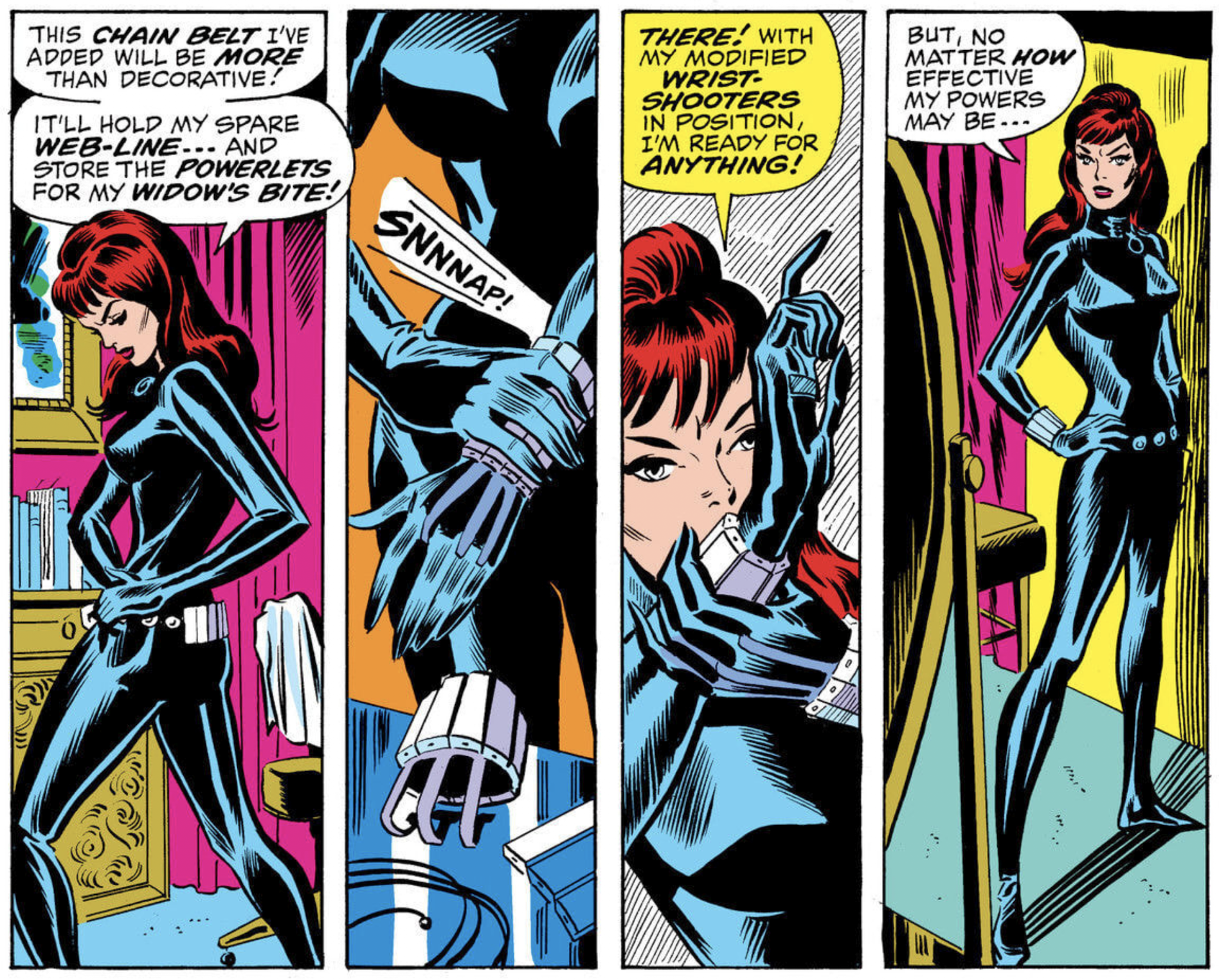
[Header Panel from Tales of Suspense (v1) 57; Don Heck, artist]

After writing a blog series on Black Widow, I searched for an opportunity to turn that work into a book, despite my own trepidation about committing to another book.

The proposal process proved to be frustrating and even deflating (a couple strong publishers were encouraging before passing on the project). Recently, however, I reached out to a friend/colleague with a series at Brill and found a home for my Black Widow volume.

I have noted often how important having my blogging as drafts for projects is to my work, and with this series-to-book, I am again convinced of the power of blogging as an entry point to more traditional work.

Using the blog posts as first drafts, I have begun the work of rewriting, drafting new material, and replacing hyperlinks with academic citation (the least enjoyable aspect of the work).

So far the most exciting part of this project is the new material, often grounded in my discovering and learning about how Black Widow has been included in the print comics since the early 1960s (and I will have to fully add her MCU appearances since the blog series covered the comic books only).

Comic book scholarship is fascinating and challenging because so much of the work requires writing in text about a visual medium (and for me that seems deeply reductive similar to reducing a poem to “the theme of the poem is X”).

Here, then, I want to allow us to revel in the visual, focusing on the first portrayals of Black Widow in the Marvel Universe:

The three issues of Tales of Suspense are the first appearances of Black Widow, and Black Widow’s first appearances with the Avengers (the team with which she is now popularly associated) are a mixture of her relationship with Hawkeye (initiated in Tales of Suspense 57) and her origin as an enemy agent.

Amazing Spider-Man 86 represents the rebooting of Black Widow as the contemporary super-agent many people recognize today (primarily from the MCU and Scarlett Johansson’s portrayal).

The three early appearances are also examinations of the early days of Marvel, the blur and contradictions of multiple creators working in the Marvel Method, and the relatively less sophisticated publication process of comic books seven decades ago.

So here are some fun examples of the unintended multiverse of portrayals of Black Widow in the beginning.

As I examined in the blog series and will expand in the book, Marvel over the decades has hypersexualized and underestimated Black Widow as a character. Often, Black Widow is trapped in the writer/artist’s and reader’s gaze with her body either bound or exposed.

It is quite interesting, then, to look over the jumbled portrayals of Black Widow’s outfits/costumes and hair in these first representations.

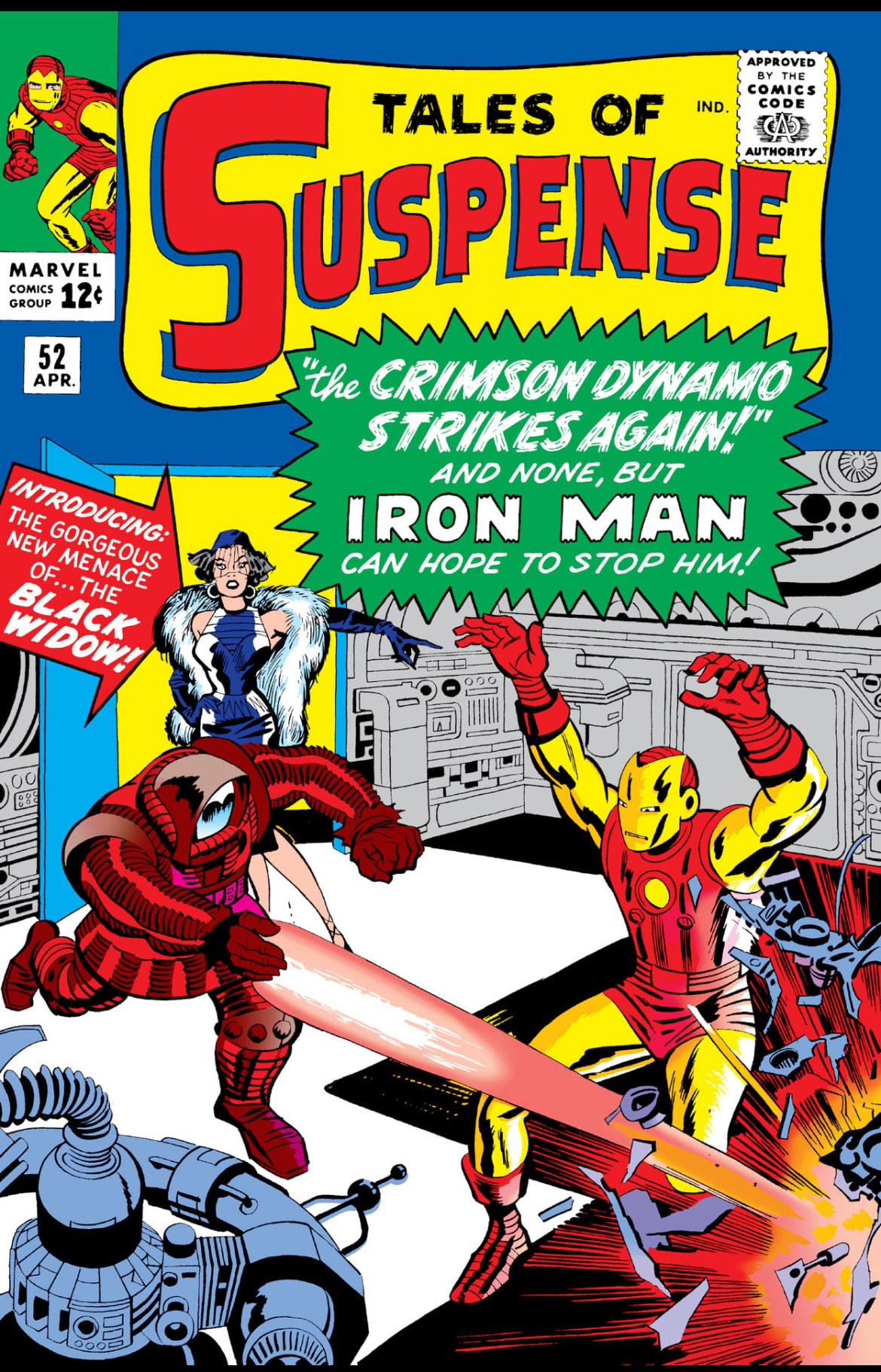
Tales of Suspense (v1) featured Iron Man, and issue 52 introduced Black Widow as “Madame Natasha”:

Tales of Suspense (v1) 52; cover by Jack Kirby and George Roussos

That fist cover image of Black Widow (by Jack Kirby and George Roussos) reveals a Cold War era temptress-spy with her wearing an exotic hat, fur shoulder wrap, and a purple and white dress in the background as Iron Man fights the Crimson Dynamo. Black Widow doesn’t look very heroic in this first image, and oddly, in the interiors, the hat and dress are green, but the exotic outfit remains mostly the same in terms of the hat and a fur shoulder wrap (although the images are not consistent with the cover):

Tales of Suspense (v1) 52, writers Stan Lee and N. Korok (Don Rico), artist Don Heck

This jumbling of color and outfits along with contradiction between the covers and interiors are a pattern until the somewhat final reboot of Black Widow in ASM 86.

In Tales of Suspense 53 and 57, Black Widow remains essentially as introduced, with the cover of 53 (by Jack Kirby) reflecting better her clothing in issue 52 (except the color scheme is dark blue and brown hair) and announcing her as “gorgeous, but deadly” on the opening splash page (where her clothing is once again green and her hair black):

Tales of Suspense (v1) 53, cover by Jack Kirby
Tales of Suspense (v1) 53, writers Stan Lee and N. Korok (Don Rico), artist Don Heck
Tales of Suspense (v1) 57, cover by Don Heck. Note the bare shoulder with Black Widow smaller at the bottom (patterns that will continue).
Tales of Suspense (v1) 57, writer Stan Lee and artist Don Heck

Next, Black Widow appears in Avengers (v1) 29 about two years after Tales of Suspense. The Don Heck cover reveals a much more identifiable superhero Black Widow with a mask, cape, utility belt, and wrist gadgets; again, the coloring is conflicting with green outfit on the cover and brown hair but blue uniform (with added netting) and black hair in the interior (of note is that Natasha’s hair has a few transformations before settling on red):

Avengers (v1) 29, cover by Don Heck and Frank Giacoia
Avengers (v1) 29, writer Stan Lee and artist Don Heck

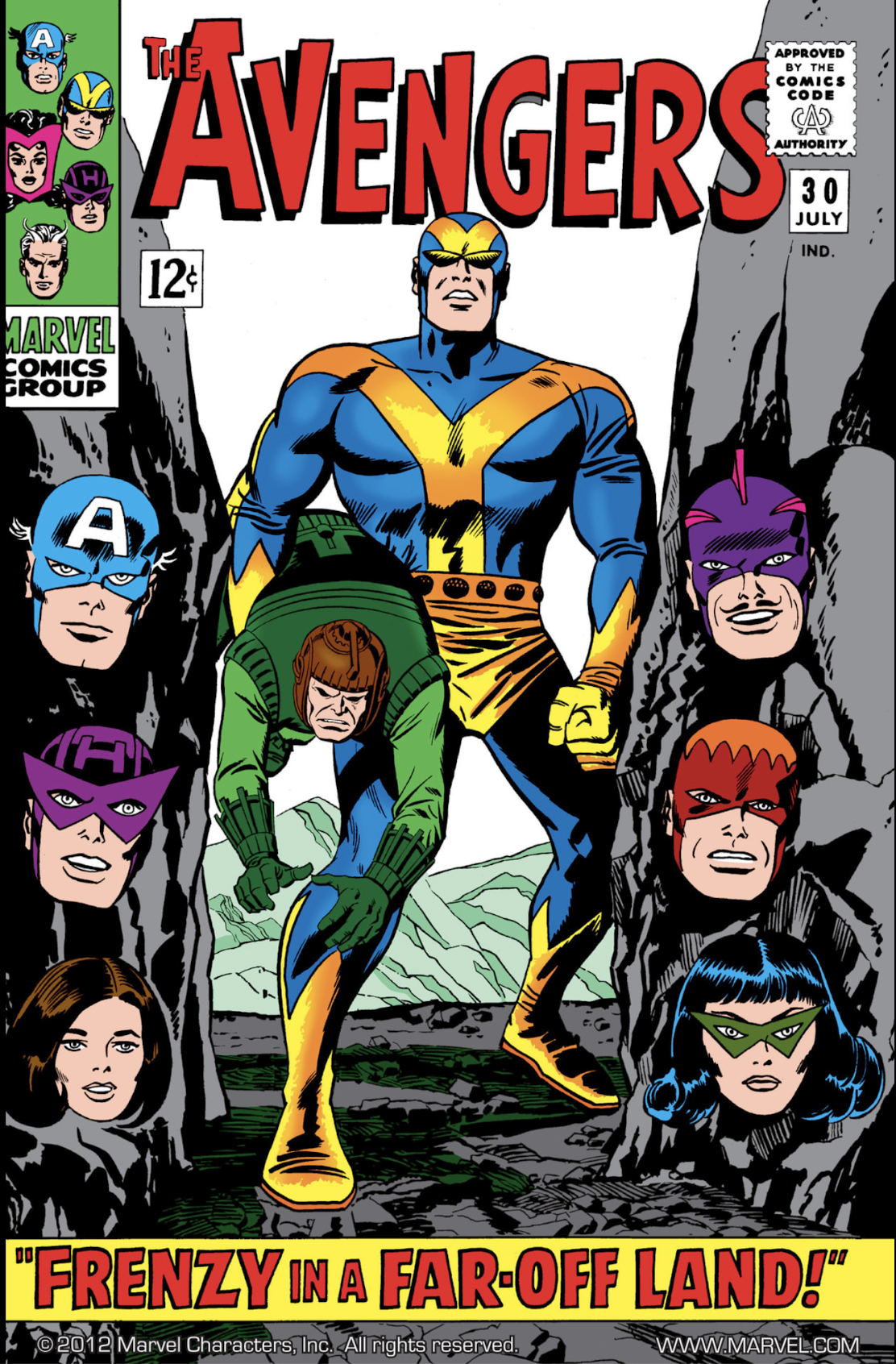
Avengers 30 continues Black Widow as Avengers nemesis—the Jack Kirby and Don Heck cover maintaining her black hair but showing a green mask (with this issue interiors having an entirely new black and gray color scheme):

Avengers (v1) 30, cover by Jack Kirby and Don Heck
Avengers (v1) 30, writer Stan Lee and artist Don Heck

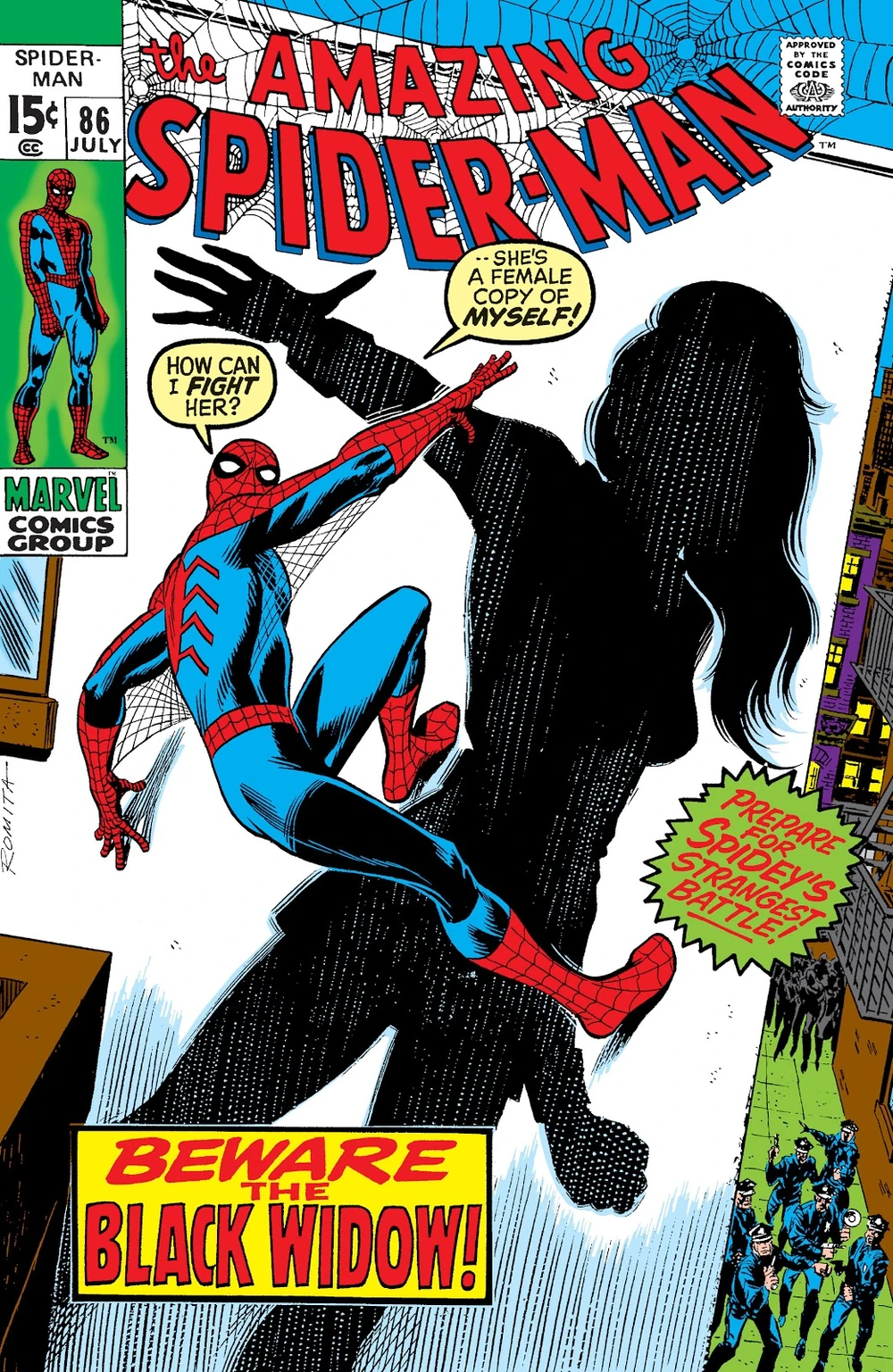
John Romita Sr. would guide Marvel toward Black Widow 2.0 in Amazing Spider-Man (v1) 86 with the now familiar black “patent leather jumpsuit,” maskless, and sporting the iconic red hair for good (see Romita’s explanation here). The John Romita Sr. cover stands today as one of the iconic Spider-Man and Black Widow covers (and note that the silhouette suggests a skirt that never appears in the interior):

Amazing Spider-Man (v1) 86, cover by John Romita Sr.

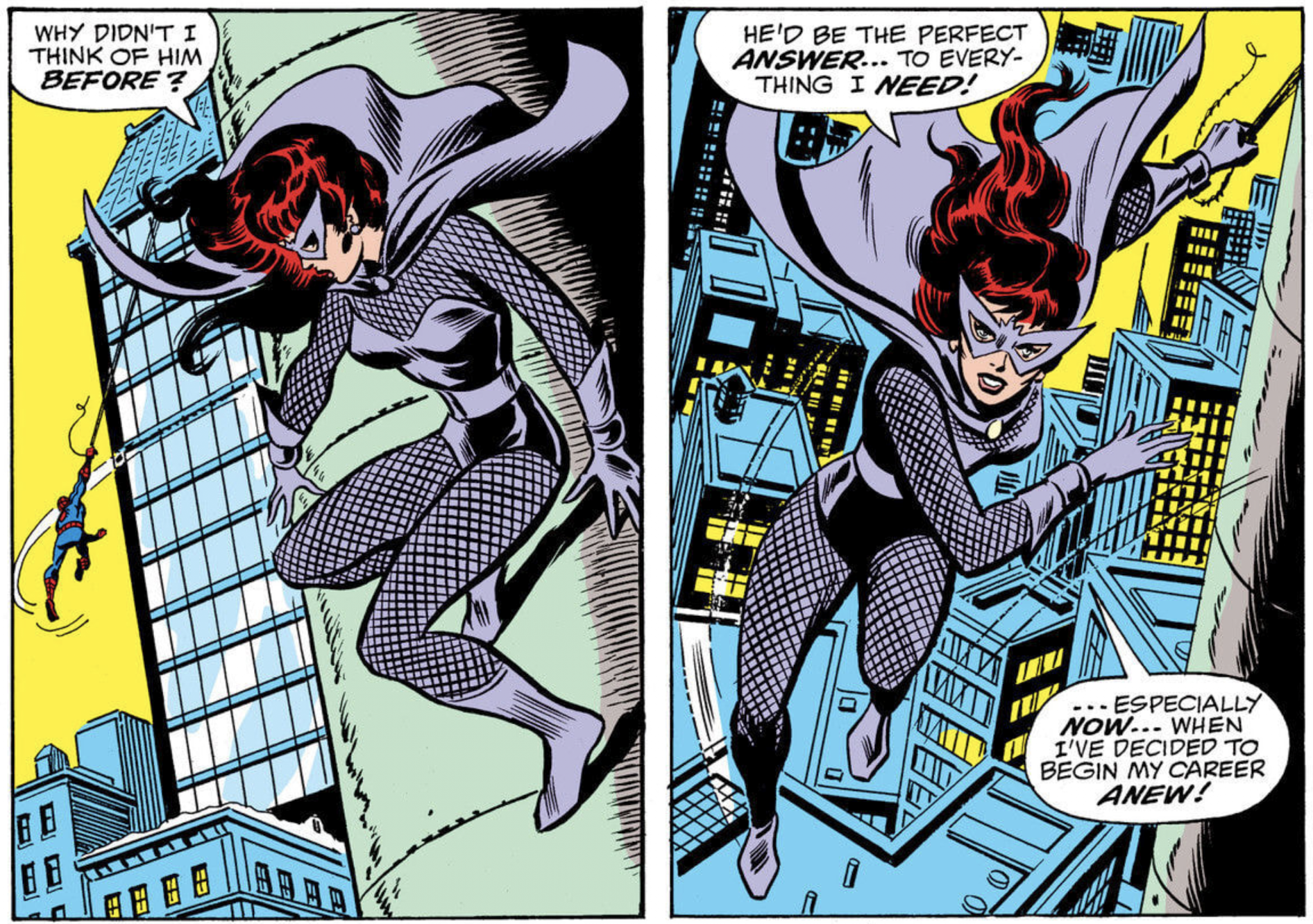
On the splash page of issue 86, Black Widow is announced as “a sensational new costumed adventurer,” and then, she is depicted throughout the opening in a grey classic outfit with a mask and cape:

Interiors of ASM (v1) 86, writer Stan Lee and artist John Romita Sr.

This rebooting issue also includes a couple-page flashback overview of Black Widow in the Marvel Universe, with even more jumbled portrayals:

Interiors of ASM (v1) 86, writer Stan Lee and artist John Romita Sr.

ASM (v1) 86 serves as the foundational reveal of the Black Widow recognizable today—red hair, black skin-tight suit, and the overall look of a super agent:

Interiors of ASM (v1) 86, writer Stan Lee and artist John Romita Sr.

These, I think, are fascinating looks at not only the early evolution of Black Widow (often hypersexualized and underestimated), but also Marvel and comic books themselves.

Words are not enough, it seems, when there is an unintentional multiverse of colors and outfits that seem to be gaslighting readers who pay attention.


NOTE

The Black Widow & Hawkeye (2024) miniseries pays tribute to the origins of Black Widow in issues 1 and 2 variant covers:

Black Widow & Hawkeye 1 (variant), cover by Artgerm Lau
Black Widow & Hawkeye 2 (variant), cover by Jesus Saiz

NEPC: Are Science of Reading Laws Based on Science?

[Reposted by permission from NEPC]

What’s scientific about the “science of reading?”

Not much, according to NEPC Fellow Elena Aydarova of the University of Wisconsin-Madison, as explained in a recent article published in the peer-refereed Harvard Educational Review. In fact, she warns that legislators are using science-of-reading legislation to distract from more serious approaches to addressing students’ needs.

Using an “anthropology of policy approach,” Aydarova zeroes in on legislative debates surrounding science of reading (SOR) reforms that have swept the nation in the past half decade. As of July 2022, 29 states and the District of Columbia had adopted this approach, Aydarova writes.

Aydarova closely examines Tennessee’s Literacy Success Act (LSA). She analyses videos of legislative meetings and debates, stakeholder interviews, and examinations of bills, policy reports, media coverage, and other documents associated with the LSA, which was passed in 2021.

This SOR bill was first introduced in 2020. As the bill underwent revisions, the phrase “science of reading” was substituted with “foundational literacy skills” to describe the same content: “Across contexts and artifacts produced by various actors, the meanings of ‘science of reading’ shifted and were frequently replaced with new signs, such as ‘foundational literacy skills,’ ‘phonics,’ and others.”

Aydarova finds little evidence that advocates, intermediaries, or legislators grounded their support in anything resembling scientific evidence. Instead, “science of reading” becomes a catch-all phrase representing a grab bag of priorities and beliefs: “[I]n advocates’ testimonies and in legislative deliberations, neuroscience as SOR’s foundational element was reduced to vague references to ‘brain’ and was often accompanied by casual excuses that speakers did not know what ‘it all’ meant.”

Motivations for supporting SOR reforms range from commercial to ideological. For instance, Aydarova notes that after the passage of The Literacy Success Act in 2021, nearly half of Tennessee’s school districts adopted curricula promoted by the Knowledge Matters Campaign. This campaign, supported by curriculum companies such as Amplify and wealthy backers such as the Charles Koch Foundation, added SOR wording to its marketing effort as the curriculum it had originally supported fell out of favor due to its association with Common Core State Standards, which had become politically unpopular in many states.

As the SOR bill reached the legislative floor, “science” was rarely mentioned.

“The link to science disappeared, and instead the sign shifted toward tradition rooted in these politicians’ own past experiences,” Aydarova writes. “During final deliberations, legislators shared that they knew phonics worked because they had learned to read with its help themselves.”

Concerningly, the bill’s supporters also positioned it as “a substitution for investing in communities and creating the safety nets that were necessary for families to climb out of poverty.”

For instance, legislators dismissed as “state over-reach” proposals that would have expanded access to early education or placed more social workers in schools in underserved communities. Yet they “emphasized the importance of proposing legislation to reform reading instruction to solve other social issues,” such as incarceration, impoverishment, and unemployment. Aydarova writes:

Based on artificial causality—poverty and imprisonment rates would decline if phonics was used for reading instruction—these reforms naturalized the widening socioeconomic inequities and depoliticized social conditions of precarity that contribute to growing prison populations. Through these material substitutions, the SOR legislation promised students and their communities freedom, and robbed them of it at the same time.

In the end, Aydarova finds that, “Science has little bearing on what is proposed or discussed, despite various policy actors’ claims to the contrary. Instead, SOR myths link tradition, curriculum products, and divestment from social safety nets.”

NEPC Resources on Education Policy and Policymaking ->


See Also

Cautionary Tales of State Reading Legislation: Tennessee

Republish: Phonics isn’t working – for children’s reading to improve, they need to learn to love stories, The Conversation

Willem Hollmann, Lancaster University; Cathie Wallace, UCL, and Gee Macrory, Manchester Metropolitan University

Government data has shown that in 2022-23, 30% of five-year-olds in England were not meeting the expected standard for literacy at the end of their reception year at school. Literacy was the area of learning in which the lowest proportion of children reached the target level.

Now, recent research from think tank Pro Bono Economics has found that this lack of early reading skills could result in a £830 million cost to the economy for each year group over their lifetimes.

A 2023 report from the National Literacy Trust found that less than half of children aged eight to 18 say they enjoy reading. Enjoyment is at its lowest level since 2005. Part of learning to read should be learning to love books – and enjoyment in reading is linked to higher achievement. If children don’t like reading, how we teach it to them isn’t working.

Our view, as academic linguists, is that part of the reason why so many children do not experience joy in reading is the excessive focus on synthetic phonics in early education.

Synthetic phonics teaches reading by guiding children to decode words by linking letters (graphemes) to their corresponding sounds (phonemes). For instance, children are taught that the letter “g” corresponds to the initial sound in “get”.

Synthetic phonics is often referred to in everyday language simply as “phonics”. That is useful shorthand but technically speaking “phonics” is a broader term, which refers to all methods of teaching reading that emphasise relations between letters and sounds. Phonics, in this broader sense, also includes analytic phonics, for example. But in analytic phonics whole words are analysed, with the pronunciation of individual letters and groups of letters deduced from that – not the other way around.

Synthetic phonics has always played a role in teaching children how to read, alongside other methods. However, following recommendations by former headteacher and Ofsted Chief Inspector Sir Jim Rose in 2006, it rapidly became the main approach in England, more so than in other Anglophone nations.

The government has pointed to England’s high ranking in the comparative Progress in International Reading Study (PIRLS) as evidence that phonics is working. Unfortunately, other research does not support this narrative around synthetic phonics and literacy.

Another international comparison of student achievement, PISA (Programme for International Student Assessment), looks at 15-year-olds. Here, UK students’ performance in reading was at its highest in 2000, before the heavy emphasis on phonics. Children in the Republic of Ireland and Canada, where synthetic phonics isn’t as central, outperform their British peers in reading.

And in general, England’s PIRLS scores – as well as other data – show that achievement in reading has stayed fairly stable since 2001, rather than showing the improvement that might be expected if phonics was indeed so effective.

Processing language

In synthetic phonics, children do not focus on texts or even paragraphs or sentences. Instead, they process language word by word, letter by letter. An extreme but real example of this is when they are asked to read word lists that even include nonsense words, such as “stroft” or “quoop”. The goal here isn’t to expand vocabulary but to practice blending letter sounds, turning each word into a challenging task.

Children are also given “decodable books”, intended to help them practice a few specific sounds. A genuine example of a story designed to make children practice just eight phonemes, starts as follows: “Tim taps it. Sam sits in. Tim nips in. Sam tips it.” Many of these artificial sentences sound unlike anything children would ever hear or read in a real-life context.

To be fair, the images in this decodable book make it clear that Tim taps the door of a house, that Sam sits inside that house, and so on. But it’s difficult to imagine that children’s attention will be captured by these stories – it certainly wasn’t in the case of one of us, Willem’s, own children.

This is not a good start if we wish to encourage kids to read for pleasure, as the National Curriculum rightly suggests we should.

Educational researchers have argued that the government’s focus on synthetic phonics is not warranted by the research literature. And the relation between sounds and spelling in English is devilishly difficult compared to many other languages, such as Spanish or Polish. For instance, “g” sounds very different in “gel” than it does in “get”. This makes exceedingly high reliance on synthetic phonics a poor decision to begin with.

Broader comprehension

There are alternatives to England’s focus on synthetic phonics. In the Republic of Ireland and Canada, for instance, phonics is integrated into an approach that emphasises reading whole texts and includes strategies other than just synthetic phonics. Children are taught to consider the wider context to look for meaning and identify words.

Take the sentence “Sam sits in his house”. A child may not have learnt the sound corresponding to “ou” and not been taught that an “e” at the end of a word isn’t always pronounced. But if they have genuinely understood the preceding sentences in the story, they have a good chance of figuring out that the word is “house” knowing that Tim has just knocked on a front door and that Sam must sit inside something.

And we know from a study that has examined the findings of many research papers that a phonics-led approach is less effective than one that focuses on comprehension more broadly, by getting children to engage with the text and images in different ways.

We believe the government’s plan for literacy isn’t working. Focusing on stories that children like to read would be a better place to start.

Willem Hollmann, Professor of Linguistics, Lancaster University; Cathie Wallace, Emeritus Professor, Institute of Education, UCL, and Gee Macrory, Visiting Scholar in Education, Manchester Metropolitan University

This article is republished from The Conversation under a Creative Commons license. Read the original article.

Almost Stories

[Header Photo by George Lemon on Unsplash]

Almost Story 1: Merry Christmas

Joak watched Aleez waiting for the school bus for the entire first week of school. The mornings were dark and cold.

Although Aleez stood stoically, Joak imagined she was freezing, under-dressed. He found himself later in the days imagining her nose and hands frigid.

Joak and Aleez had never spoken, but he knew her name because on the first day of class the teacher had pronounced exactly two names wrong—hers and his—while calling the roll.

That teacher had also made it abundantly clear that their names, or at least the pronunciation of their names, had been a personal affront to that teacher.

The first morning of the second week, Joak had bought a blanket over the weekend. He handed it to Aleez without a word. She kept her hands still at her sides, but looked him intently in the eyes.

After a few awkward moments with the blanket extended, Joak said, “Merry Christmas.” Immediately, he felt stupid; it was a joke his father had often used although their family never celebrated Christmas.

“We don’t do Christmas,” she said softly. She took the blanket, wrapped it around her shoulders, and then, looked away.


Almost Story 2: Expiration Date

Neither of them said it, but what turned out to be a first date was at the apartment pool.

Because he had spent his teen years as a lifeguard, he hated pools, and even swimming. But that wasn’t the worst of it.

This not-a-first-date first date would be in partial clothing, swimwear. Which he also hated. A sort of low self-esteem reflex. He also felt a certain level of anxiety that she too would be in swimwear.

None of that would eventually matter. All of that was quickly erased when he glanced down and noticed her tattoo, small text across her left rib cage: “Best Before 12/05/1994.”

Before he could speak, and as he raised his gaze to meet her eyes, he couldn’t tell in the sunshine and heat if she were blushing, but she immediately knew he read the tattoo and said: “Yep. Expiration date. Day I turn 30.”

Another Cautionary Tale of Education Reform: “Improving teaching quality to compensate for socio-economic disadvantages: A study of research dissemination across secondary schools in England”

Linked in her article for The Conversation is Sally Riordan’s “Improving teaching quality to compensate for socio-economic disadvantages: A study of research dissemination across secondary schools in England.”

This analysis is another powerful cautionary tale about education reform, notably the “science of reading” (SOR) movement sweeping across the US, mostly unchecked.

As I do a close reading of Riordan’s study, you should also note that the foundational failure of the SOR movement driving new and reformed reading legislation in states is that the main claims of the movement are dramatically oversimplified or misleading. I strongly recommend reviewing how these SOR claims are contradicted by a full examination of the research and science currently available on reading acquisition and teaching: Recommended: Fact-checking the Science of Reading, Rob Tierney and P David Pearson.

This close reading is intended to inform directly how and why SOR-based reading legislation is not only misguided but likely causing harm, notably as Riordan addresses, to the most vulnerable populations of students that education reform is often targeting.

First, here is an overview of Riordan’s study:


Similar to public, political, and educator beliefs in the US, “QFT [quality first teaching] is a commonly held belief amongst school staff” in the UK, Riordan found. In other words, despite evidence that student achievement is overwhelmingly linked to out-of-school factors, teacher quality and instructional practices are often the primary if not exclusive levers of education reform designed to closed so-called achievement gaps due to economic inequities.

This belief, however, comes with many problems:


Riordan’s analysis is incredibly important in terms of how the SOR movement and overly simplistic messaging (see Tierney and Pearson) have been translated into reductive legislation, adopting scripted curriculum, and banning or mandating practices that are not, in fact, supported by science or research.

Riordan identifies bureaucracy and simplistic messaging as the sources of implementation failure:


Nonetheless, “[t]his explicit demand [belief in QFT] is an example of the growing pressure on education practitioners to ensure their practices are supported by evidence (of many kinds),” Riordan explains, adding, “School staff believe that high-quality teaching reduces SED attainment gaps and that their belief is backed by research evidence.”

The research/science-to-instruction dynamic is often characterized by narrow citations or cherry-picking evidence: “Because school leaders cited the same references to research evidence to justify very different policies and practices, I conducted a review of the literature that led to these citations.”

One key problem is that while the evidence base may be narrow and “[a]lthough there is agreement that high-quality teaching is important to tackle SED, principles of QFT are nevertheless being implemented in a myriad of ways across secondary schools in England.”

In the US, many scholars have noted that the SOR movement uses “science” rhetoric but depends on anecdotes for evidence; and, in the UK:

Although many school staff (and particularly school leaders) are aware of the EEF resources and believe that there is evidence supporting principles of QFT, no interviewee described this evidence in any further detail. When asked why QFT works, staff reasoned intuitively. The line of reasoning that can be reconstructed from their replies is independent of the research evidence.

…This intuitive argument, reasoned by school staff, is limited but I do not challenge its validity. The main point here is that this line of reasoning does not reflect the research evidence (which is described in detail below ‘The weakness of the evidence for QFT’). It is not the strength of the evidence base that has convinced school leaders to implement QFT practices. This highlights the importance of the psychological aspects of bringing research evidence to bear on practice. It also raises the possibility that a message was disseminated that was already widely believed. I turn to this bureaucratic concern next.

Improving teaching quality to compensate for socio-economic disadvantages: A study of research dissemination across secondary schools in England

That intuitive urge, again, however, is linked to limited evidence: “Just five studies are being relied upon to disseminate the message that high-quality teaching is the most effective way to reduce SED attainment gaps.”

What may also be driving a misguided reform paradigm is convenience, or a lack of political imagination:


Evidence- or science-based reform, then, tends to be reduced to a “sham” (consider the misleading “miracle” rhetoric around Mississippi, also addressed in Tierney and Pearson):


The unintended consequence is a “misdirection of energy and time of school staff” driven by “pressure to conform to the policies promoted.”

Key to recognize is Riordan identifies that QFT reforms not only fail to close gaps but also cause harm: Some “attempts to improve the quality of teaching are contributing to a large attainment gap,” including: “It is by turning to a more refined measure of SED that we find evidence that the school’s innovations in teaching and learning over the last five years have benefitted its most affluent students most of all.”

Riordan’s conclusion is important and damning:

It has reviewed the wider picture in which school leaders are choosing to implement (or at least justifying the implementation of) particular practices based on a generic message instead of the specific research supporting those practices. The problem here is that the mechanisms operating to connect research with practice are too crude to acknowledge the richness and messiness of social science research. The message, ‘high-quality teaching is the most effective way to support students facing SED’, is too simple to be meaningful. 

Improving teaching quality to compensate for socio-economic disadvantages: A study of research dissemination across secondary schools in England

For the US, education reform broadly and the SOR movement can also be described as grounded in messages that are “too simple to be meaningful” and thus too simple to be effective and even likely to be harmful.


educator, public scholar, poet&writer – academic freedom isn't free