Recognizing in 1963 what would eventually be the Trump voter, James Baldwin in an interview with Kenneth Clark:
“These days—this is one of them—when you wonder what your role is in this country and what your future is in it … [and] how you are going to communicate to the vast, heedless, unthinking, cruel white majority that you are here.” … “I am terrified,” [Baldwin] said, “by the moral apathy, the death of the heart that is happening in my country. These people have deluded themselves for so long that they really don’t think I am human …. And this means that they have become … moral monsters.” [From The Fire Is Upon Us, Nicholas Buccola, p. 186]
Ellen DeGeneres sitting and yucking it up with George W. Bush in the owner’s suite of an NFL game—including the Dallas Cowboys, owned by Jerry Jones—may be the perfect metaphor for the U.S. in 2019.
While DeGeneres as a gay woman has become a key public figure in the broader fight for equity, she ultimately has attained something, like Oprah, that keeps her well above the consequences of inequity in the U.S.—enormous wealth and celebrity.
Laughing in the rarified air of the owner’s suite, DeGeneres and Bush are literally well above the actual game in which grown men bash each other senseless for the entertainment and enormous profit of others.
In this contemporary colosseum, we should be reminded that DeGeneres and Bush are merely two actors in an exclusive club of wealth and fame.
DeGeneres has doubled-down after some have criticized her being very publicly chummy with the former president, who is also good pals with Michelle Obama. Fans of DeGeneres have praised her for her message of love and her argument that we can and should love each other even if—and maybe especially if—we have different beliefs.
But here is the problem. If this were about beliefs—if DeGeneres were Muslim and Bush, Christian, and they were showing how people of different faiths can and should love each other—then DeGeneres would be entirely justified.
This, however, is not about beliefs.
W. Bush for decades was a key leader of the Republican Party, which enacted policy and laws as well as advocated for policy and laws that are anti-gay, anti-woman, pro-mass incarceration, pro-gun, etc.
And here is the crucial point: These laws are inherently inequitable; they deny life, liberty, and the pursuit of happiness. Additionally, these laws and policies negatively impact marginalized and impoverished Americans disproportionately.
Yes, Ellen has faced inequity as a women and for being gay, but on balance, her wealth and celebrity have greatly mollified those consequences; she—and W. Bush—is but a far-removed observer of this world that is quite real for the rest of us.
For example, as Republicans move the U.S. toward greatly restricting and even banning abortion, we must recognize that wealthy women will never be denied excellent health care, excellent birth control, and access to safe abortions.
Never.
These restrictive and harmful laws will mostly negatively impact marginalized and impoverished American women.
DeGeneres and Bush see politics and belief, then, as just a game—not really all that different than the NFL contest where they sat as far as possible away from the violence.
Republican or Democrat? Cowboy or Packer? What’s the diff, eh?
Ultimately, DeGeneres has no obligations, however, to live her life any other way than the way she wants, including keeping and fostering her connectedness to the world of enormous wealth and celebrity. She has reminded us over and over that she is friends with Aaron Rogers (quarterback of the Packers, who were playing the Cowboys as she lounged with W.)—and of course, with Justin Bieber.
Using her enormous bully pulpit, DeGeneres goes beyond living her life, often, and advocates for the rest of us to live our lives a certain way; in this case, she is preaching a sort of universal and unconditional love.
How, then, can DeGeneres be wrong?
At one level, DeGeneres’s message approaches respectability politics, at least to the point that many people supporting her seem to think she is calling for civility among political rivals. Respectability politics is often used to deflect from the central issue, as was the case with Colin Kaepernick.
Calls for civility also work as a shield for those with power and privilege. Just as the rich and famous often live above the consequences of laws and social norms, people with power and wealth have expectations for others that they themselves never follow.
Respect authority. Watch your tone.
There is nothing civil about declaring homosexuality a sin; there is nothing civil about calling abortion murder.
On another level, DeGeneres simply misunderstands or at least oversimplifies love. Instead, I recommend James Baldwin’s admonitions about love:
In order to achieve freedom of this sort, Baldwin contended, we must love one another. His understanding of love was deep and complex, and the love he prescribed was difficult and often unsettling. To love someone, he explained, is to deny them “spiritual and social ease,” which “hard as if may sound,” is “the most important thing that one human being can do for another.” Love requires us to force each other to confront the delusions that we rely on to avoid taking responsibility for our lives. “Love takes off the masks,” Baldwin declared, “that we fear we cannot live without and know we cannot live within.” (From The Fire Is Upon Us, Nicholas Buccola, p. 163, quoting from Baldwin’s “Down at the Cross,” pp. 335, 341)
I am not saying DeGeneres should be uncivil to W. Bush, but I am saying that what someone of her stature and influence could do is to love Bush in such a way that he feels spiritual and social discomfort, that is he is forced to take off the masks of his corrupt political ideologies.
That Bush accepts responsibility for the consequences of his actions.
As Baldwin implored throughout his career, it is a terrible delusion that the rich and famous believe they are above it all because there is simply nothing that doesn’t impact each and everyone one of us even as some seem to be having a great time while, you know, Rome is burning.
“How did Gilead fall?” Margaret Atwood asks in the Acknowledgements, noting that The Testaments, set 15 years after the main action of The Handmaid’s Tale but drafted 30-plus years after that novel, “was written in response to this question” (p. 417).
Even a writer of Atwood’s talent and success probably could never have imagined that Handmaid has become the cultural and political touchstone that has occurred with the rise of Trump and the popular Hulu series.
Those who found Handmaid in the late 1980s to be powerful then and an extremely compelling work of fiction may be skeptical about Atwood’s very late return to this now modern classic. For both the newly converted and the long-time fans of Atwood, I want to assure you all that this much delayed sequel pays off quite wonderfully.
I came to Atwood as a teacher—specifically high school Advanced Placement Literature and Composition—and then as a scholar. I have also grounded a tremendous amount of my academic and public work in Atwood’s fiction and non-fiction.
With efforts here, then, to avoid as much as possible spoilers, I want to highlight a few of the ways in which Atwood maintains elements from Handmaid while also extending her writer’s urge to connect literacy with empowerment and attaining ones full humanity.
The Testaments offers the narratives of three women—notably including Aunt Lydia from Handmaid. In both novels, as is common with Atwood’s fiction, the narrations are both lending a voice to those often unheard or silenced and working as meta-narrations about the nature of truth when stories are told, retold, and examined (both novels end with Gilead being the focus of academic scholarship).
Much of Atwood’s fiction is an exploration of what it means to tell and retell stories.
Names and renaming are also prominent in the sequel, dramatizing the power of names and (re)naming as those processes disproportionately impact women in the service of men and patriarchy.
Handmaid details the end of the U.S. and how Gilead comes into being, although much of that is limited to what Offred could have known as a handmaid. Then, many of the finer details are revealed in the Historical Notes, a scholarly examination of Gilead well after its fall.
Testaments broadens the perspectives by including one voice from an inner woman of power, a woman mostly trapped in the upper levels of the Gilead machine, and another view from outside (Canada) that is both somewhat naive and deeply cynical.
These testaments piece together a well established Gilead for the reader and also document the theocracy’s final days. Some of the most compelling elements here are the full development of Aunt Lydia and the careful examination of two characters being groomed to be Aunts (after narrowly avoiding being wed to Commanders).
Part XVII: Reading Room serves as an excellent example of where Atwood excels in combining many of the thematic and narratives elements of her dystopian speculative novel. Aunts are women designed within Gilead to control other women; Aunts are embodiments of a sort of paradoxical authority, including their legal access to reading and writing.
In their journey to becoming Aunts, Agnes and Becka—who have bonded over their fears of being married to a Commander—take on a mentee (Agnes)/mentor (Becka) relationship since Becka has learned to read and write well ahead of Agnes. The motif of reading and writing is emphasized near the end of the novel, and Gilead, I think, to highlight the power of language.
Agnes struggles:
My reading abilities progressed slowly and with many stumbles. Becka helped a lot. We used Bible verses to practise, from the approved selection that was available to Supplicants.. With my very own eyes I was able to read portions of Scripture that I had until then only heard. (p. 297)
These scenes reminded me of Atwood’s deft use in the original novel of Commanders reading scripture to the Wives and Handmaids, with the reader alerted to what Becka soon reveals to Agnes:
The day came when the locked wooden Bible box reserved for me would be brought out to the Reading Room and I would finally open this most forbidden of books. I was very excited about it, but that morning Becka said, “I need to warn you.”
“Warn me?” I said. “But it’s holy.”
“It doesn’t say what they say it says.” (p. 302)
This echoes in Handmaid when the Commander reads the Bible before the Ceremony with Offred:
The Commander pauses, looking down, scanning the page….We lean toward him a little, iron fillings to the magnet. He has something we don’t have, he has the word. How we squandered it once….
For lunch it was the Beatitudes….They played it from a tape….The voice was a man’s….I knew they made that up, I knew it was wrong, and they left things out, too, but there was no way of checking. (pp. 88-89)
In both novels, Atwood reveals that whoever controls the word maintains power. These novels should remind readers that throughout history, learning to read has been carefully controlled—who is allowed, who is not, and who remains so burdened with living that to read seems a luxury.
And so Agnes gains a sort of consciousness along with gaining literacy: “Being able to read and write did not provide the answers to all questions. It led to other questions, and then to others” (p. 299).
As Becka cautioned, Agnes confronts that “[t]he truth was not noble, it was horrible”:
This is what the Aunts meant, then, when they said women’s minds were too weak for reading. We would crumble, we would fall apart under the contradictions, we would not be able to hold firm.
Up until that time I had not seriously doubted the rightness and especially the truthfulness of Gilead’s theology. If I’d failed at perfection, I’d concluded that the fault was mine. But as I discovered what had been changed by Gilead, what had been added, and what had been omitted, I feared I might lose my faith. (p. 303)
This awakening in Agnes born of her learning to read and write leads to a larger theme for Atwood: “Once a story you’ve regarded as true has turned false, you begin suspecting all stories” (p. 307).
And in Testaments, “Beneath its outer show of virtue and purity, Gilead was rotting” (p. 308).
As compelling as Atwood’s motifs are in their deconstructing of history and the present, The Testaments if no mere “protest novel,” which James Baldwin rejected, explaining:
It must be remembered that the oppressed and the oppressor are bound together within the same society; they accept the same criteria, they share the same beliefs, they both alike depend on the same reality….
The failure of the protest novel lies in its rejection of life, the human being, the denial of his beauty, dread, power, in the insistence that it is his categorization alone which is real and which cannot be transcended. (pp. 17-18)
I stood as I have many times in front of the two tea dispensers at a chain sub sandwich shop. But this time, I was suddenly struck with the choice I always make—the “unsweet tea.”
I was born, raised, and have lived my entire life in the Deep South. My mother made tea that would rival pancake syrup and trained my sister and me in the meticulous ritual of steeping tea bags and then pouring the hot tea over a huge mound of processed sugar.
The tea pot was dedicated only to steeping tea, and the tea jar and the giant plastic sugar spoon were sacred as well.
Once I left home, my mother flirted with sun tea, but the syrup-sweet tea of my childhood later became my defining feature of what could rightfully call itself The South. When ordering tea, The South hands you sweetened ice tea; hot tea or tea without sugar are not even mentioned, or considered.
So with a great deal of shame, I must admit that only a week or so ago I was truck with the absurdity that is “unsweet tea,” which of course is just tea.
The “unsweet” is a necessity only because “sweet tea” in South Carolina is the norm, the default, what has been rendered invisible and simultaneously right.
All across the U.S., then, “unsweet tea” in The South is a less controversial entry point into how whiteness works as the norm, the invisible, and the right.
White people in North America live in a social environment that protects and insulates them from race-based stress. This insulated environment of racial protection builds white expectations for racial comfort while at the same time lowering the ability to tolerate racial stress, leading to what I refer to as White Fragility. White Fragility is a state in which even a minimum amount of racial stress becomes intolerable, triggering a range of defensive moves. These moves include the outward display of emotions such as anger, fear, and guilt, and behaviors such as argumentation, silence, and leaving the stress-inducing situation. These behaviors, in turn, function to reinstate white racial equilibrium.
White fragility as a response to naming and confronting privilege as well as racism is extremely powerful because that response is clinging to an entrenched norm with incredibly long and anchored roots.
Just as whiteness must be exposed and confronted in society, education that is liberatory and life- as well as society-changing must be willing to commit, as Gloria Ladson-Billings explains, to culturally relevant teaching:
A hallmark for me of a culturally relevant teacher is someone who understands that we’re operating in a fundamentally inequitable system [emphasis added] — they take that as a given. And that the teacher’s role is not merely to help kids fit into an unfair system, but rather to give them the skills, the knowledge and the dispositions to change the inequity. The idea is not to get more people at the top of an unfair pyramid; the idea is to say the pyramid is the wrong structure. How can we really create a circle, if you will, that includes everybody?
Instead, Ladson-Billings laments:
I find that teachers often shy away from critical consciousness because they’re afraid that it’s too political [emphasis added]. A perfect example for me is some years ago when Mike Brown was killed in Ferguson, that district in Ferguson sent out a directive that teachers not talk about this. This is exactly what kids are talking about every single day, because at night when they go home and turn on the news, their streets are flooded with protesters, and they need an adult to help make sense of this. But the school has said, “No, you can’t talk about this.”
One result of teachers and schools self-regulating in the service of whiteness, privilege, and inequity is tokenism—viewing culturally relevant teaching through a deficit lens isolated on Black and Brown students or students living in poverty; and selecting curriculum, materials (texts, programs, etc.), and events that highlight diversity and multiculturalism,
but [as Ladson-Billings explains] what research has found is just changing the content is never going to be enough, if you are pedagogically doing the very same things: Read the chapter, answer the questions at the back of the book, come take the test. You really haven’t attended to the deep cultural concerns. What happens is school districts want you to do just that — teach exactly the way you’ve been teaching, just change the information [emphasis added]. That does little or nothing to increase engagement, and it certainly doesn’t help kids feel any more empowered about what they’re learning.
Whiteness, like sweet tea in The South, is ubiquitous in the U.S.—but whiteness desires to remain invisible as it drives privilege for some and further entrenches inequity for others. White fragility is the only consequence of rendering whiteness visible so that it can be eradicated.
This confrontation of whiteness is the duty of white people, and that must not be dulled by tokenism and self-regulation.
Recognizing that “unsweet tea” is just tea serves as a powerful example of the importance of naming as a first step to exposing in a journey to eradicating whiteness and privilege.
Genuine and robust culturally relevant teaching does offer a promise to move beyond whiteness and to quell white fragility, as Ladson-Billings argues:
When we do this work, there are certain baselines that people have to have. Number one, they have to believe that racism is real, and number two, they have to believe that they may be acting on it….
The most segregated group of kids in the country are white kids. We never refer to their schools as segregated. We refer to black and brown kids as going to segregated schools.
So, integration in which kids of different races and ethnicities have an opportunity to fully participate in the life of the school is what I would hope to see.
De-centering whiteness proves to be a bitter drink for white people who are too often compelled to respond with white fragility or tokenism.
Now, whiteness must seek ways to work against itself, making whiteness visible, centering it one last time in order to recenter our society and schools in ways that are equitable.
Among other teachers and education scholars, I have been making a case throughout my 36 years in education that has prompted mostly derision from edureformers, politicians, the media, and “no excuses” advocates; the position grounded in evidence includes:
Standardized and high-stakes tests are weak proxies for student achievement and teacher/school quality but powerful proxies for the socioeconomic status of students’ homes and communities.
And thus, important contributions made by teachers and schools to student learning are very difficult to measure or identify in any direct or singular way (either in a one-sitting test or linked to one teacher over one course, etc.).
Accountability structures do not and cannot reform in any substantive way teaching and learning; in fact, high-stakes standards and testing are likely to impact negatively complex and powerful teaching and learning in the name of democracy, human agency, and equity.
All in-school-only education reform, then, will appear to (and actually) “fail” as long as public policy does not first or concurrently address socioeconomic inequities such as healthcare, work quality and stability, food insecurity, safety and justice, etc.
Social and educational reforms are extremely complex and take far more time than political and public impatience allows; however, the proper political will should shift the U.S. social and educational reform toward an equity structure (not an accountability structure) in order to see observable positive change over time.
In-school equity reform must address teacher assignments, de-tracking course access, fully funding all in-school meals, fully publicly funding K-16 education, school discipline and dress codes grounded in restorative justice and race/class/gender equity, and student/teacher ratios.
Historically and currently, public education—as well as charter schools and private schools—serve well the students with the most race, class, and gender privileges and mis-serve inexcusably the most vulnerable students—black and brown students, English language learners, special needs students, and impoverished students.
Accountability does not and cannot address that gap; high-stakes testing measures that gap and often increases the inequity since the stakes are tied to gatekeeping in education and society.
Formal education in the U.S. has mostly reflected and perpetuated our national and regional inequities, and the claim that schooling is a “game changer” remains a deforming myth.
As a recent additional source of evidence for my claims, please see this study by Kenneth Shores, Pennsylvania State University and Matthew P. Steinberg, George Mason University:
The Great Recession was the most severe economic downturn in the United States since the Great Depression. Using data from the Stanford Education Data Archive (SEDA), we describe the patterns of math and English language arts (ELA) achievement for students attending schools in communities differentially affected by recession-induced employment shocks. Employing a difference-in-differences strategy that leverages both cross-county variation in the economic shock of the recession and within-county, cross-cohort variation in school-age years of exposure to the recession, we find that declines in student math and ELA achievement were greater for cohorts of students attending school during the Great Recession in communities most adversely affected by recession-induced employment shocks, relative to cohorts of students that entered school after the recession had officially ended. Moreover, declines in student achievement were larger in school districts serving more economically disadvantaged and minority students. We conclude by discussing potential policy responses. (Abstract)
She is five or six years old, my daughter, sitting in the backseat and requesting “Dog in the Sink” from the R.E.M. mix-tape I made her.
Mishearing the line “dogging the scene,” she renamed “What’s the Frequency, Kenneth?” as she did several songs, including another favorite “That’s great it starts with an earthquake birds and snakes and aeroplanes.”
We spent a great deal of time in the car together. To and from school. To and from soccer practice. To and from soccer matches and tournaments.
Typically, my daughter would ask me to play songs, often R.E.M. since that is what I was listening to almost all the time, and to sing along while she watched me singing in the rearview mirror. Once she had the lyrics, she would tell me to stop, and she would then sing.
The song permanently blurs with life with my daughter as a child, her asking about the end of “Kenneth” when “I never understood the frequency” becomes the closing “I never understood, don’t fuck with me.”
As she grew up, of course, she understood more and more of the lyrics, including the profanity. I never shielded her from the music I listened to so our adventure with music morphed a bit from those mostly innocent early days.
Another album just passing its 23rd anniversary is CAKE’s Fashion Nugget. My daughter was fascinated by “Nugget” as an early teen; it is profane and in your face.
When she would climb into the car with some of her soccer teammates, as we drove to lunch between matches, she would ask me to play “that song,” and I would survey the friends—”Your parents are ok with this?”—and we’d listen to “Nugget,” her face beaming.
I have several of these song moments permanently imprinted in my memory—my daughter singing “O, my, my, O, tell yea” unaware of “hell” as an option while singing along to Tom Petty, for example.
But as “Kenneth” has been on a permanent loop in my mind, I have realized that I struggle to recreate in those memories my daughter sitting in the back seat. I have this vague awareness of that, but I often lose her face and child self behind the more immediate image of my granddaughter, who I see often and spend a good deal of time interacting with in her carseat.
I will never get back “Dog in the Sink,” my daughter at 5, 6, 7, 8, 9, 10 …
I have lost forever a world of mixtapes and spending every waking moment in the service of a child.
“Kenneth” on a loop in my mind makes me very happy and deeply sad all at once.
I also will never again have a new R.E.M. album. I have, in fact, just redecorated my office, replacing some of the R.E.M. posters with The National—a band I found through R.E.M.
I have always been haunted by Emily in Our Town, after her death realizing that we can’t and don’t look at anything hard enough in the moment.
“The world is too much with us,” Wordsworth warns; we are too busy living to really appreciate the moment.
My daughter used to come down stairs and repeatedly run and jump on me on the couch. She was rambunctious and laughing. But I was too often easily exhausted by that.
It deserved more. It deserved the same care and attention as those times we spent in the car, me playing songs she requested and her eventually telling me to stop singing so she could.
I was too easily distracted in my 30s and 40s: “Getting and spending, we lay waste our powers”; squandering, I would add.
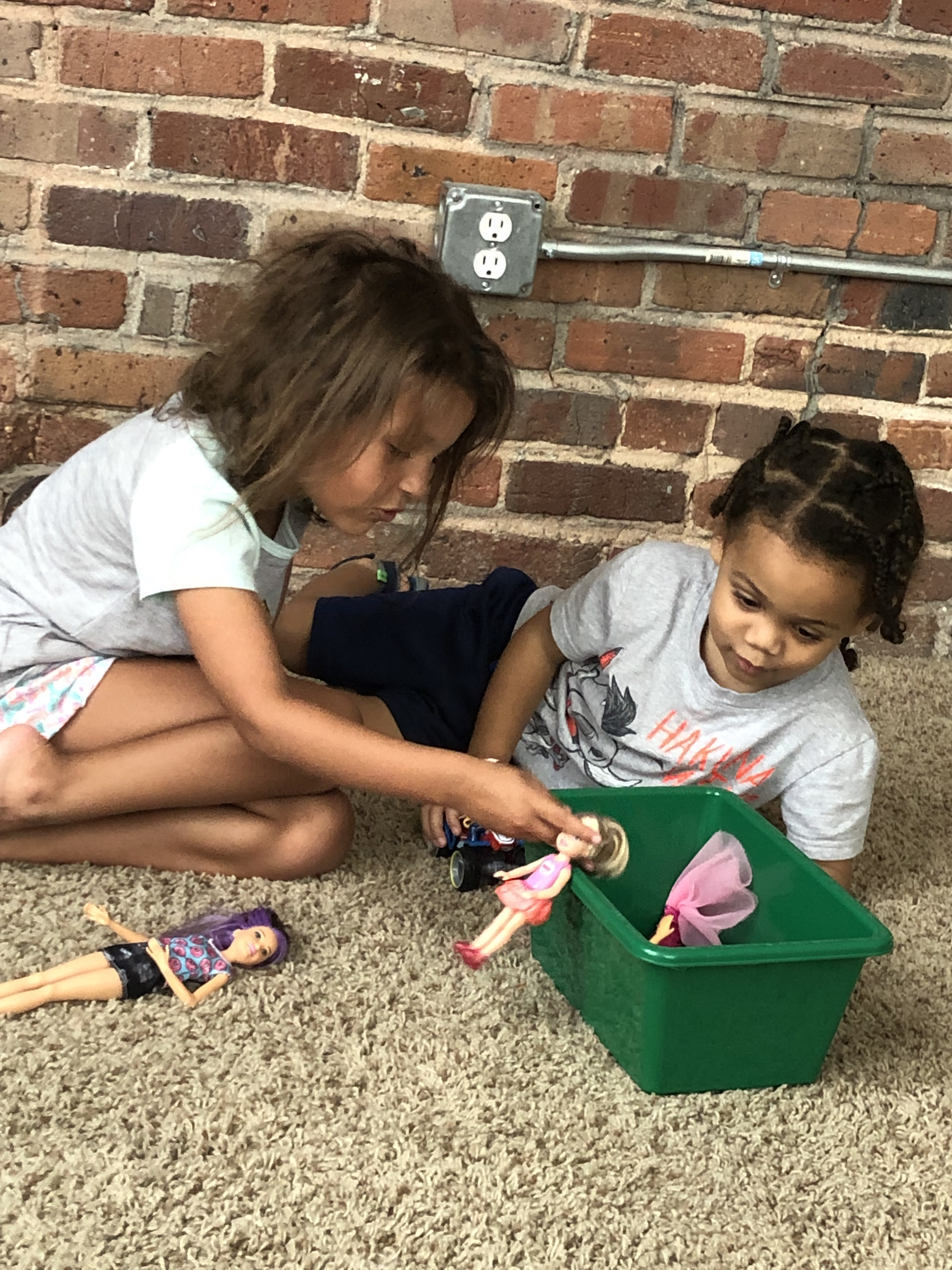
I am better now in some ways. I will sit on the floor with my grandchildren, even when it is exhausting and even when I know it will last only a moment before they are off to something else.
I have sat hours quite still with each of those grandchildren in my lap, sleeping or watching TV or their iPad. I used to joke I was my granddaughter’s recliner.
It is a pose I am happy to hold—now.
We carry always with us these things we lose, these things we cannot hold onto no matter how deeply we want to make the world, time stand still.
It is a bit overwhelming to realize I have lost those images of my daughter as a child, her voice even, and her mannerisms and personality. All of that morphing into my granddaughter.
When I confuse the names of my daughter and granddaughter it may be the most honest moments of my life. They have piled up inside me in a way that I cannot untangle, a way that I would never want to untangle because I would be afraid of completely unraveling it all. Losing again what I have lost already.
“Papa, look!” my granddaughter demands as I am driving; I struggle to make her happy, but I have to explain I can’t turn around while driving.
I try to use the rearview mirror, but my granddaughter will have none of that. She wants my full attention, not some indirect reflection.
The rearview mirror was enough for my daughter.
It’s a shame mirrors reflect only the moment. It’s a shame we often don’t enjoy those moments.
My chest swelled and I cried when I opened the text: “Her artwork is displayed in the hallway.”
“Her” is my granddaughter, Skylar, in her first few weeks of 5K in the rural primary school serving my hometown. Skylar is biracial and her parents are divorced; her school sits in a relatively high-poverty area of Upstate South Carolina, about the 11th most impoverished state in the U.S. and a deeply inequitable state by economics, race, and gender.
Usually, still, Skylar climbs onto my lap or beside me on the couch, just to be physically against me; I often hold tightly one of her small feet or she hooks an arm through mine as if we are tumbling through space and she needs to make sure we are tethered together forever.
This past weekend I watched her play at a bounce house and party facility, there for my grandson’s (Brees) third birthday party. Skylar ran with earnestness to maintain pace with a some of the children, her friends, but balked at a few of the bounce houses.
She stood nervously at one before turning to me and asking, “Is it dangerous in there?”
At another bounce house earlier, she initially refused to go in, shuffling up against my legs and softly telling me she didn’t like it. Later, she scrambled in, and as she had on another trip there, became trapped so an older boy went in to help her.
She crawled out crying.
As I looked at this artwork of hers, I was reminded of the weekend party, the bounce houses and peer pressure that proved to be nearly unbearable delight and fright for my dearest granddaughter who I love far too much.
When my daughter began to light my grandson’s birthday cake, Skyler warned her to move the cake back with “Remember. Safety first.”
Skylar, you see, already exhibits some of the anxiety and hyper-awareness I know all too well. She is a deeply sensitive child who is powerfully drawn to and deeply wary of the world she inhabits.
She inspires in me as my daughter did the urge to lift her into my arms and hold her close to me. Forever.
Of course, that is not love and that is not even remotely desirable since it would be an act (literally or metaphorically) of denying this beautiful girl her full and complicated life.
As my existential self-education taught me, our passions are our sufferings; if we seek ways not to suffer, we then must abandon our passions.
My precious Skyler will hurt in her life, be disappointed in very real ways. That’s being fully human.
I am disappointed and even angry, however, that she like all children in the U.S. is being handed a country that remains far too calloused about children, girls and women, and the many inequities that much of the country simply pretends do not exist.
I am disappointed and even angry, however, that the schooling she can expect is almost never like her artwork being displayed in the hallways but more like a prison, or a hospital.
As I told a class last night, her 3K, 4K, and 5K experiences already contain assessments of her “readiness” and how well she meets standards—and ultimately, she must meet the demands of being on grade level for that most important grade of all, third.
Many loving, kind, and gifted teachers will work uncritically as agents of this terribly flawed educational system even as they show her their love and kindness. School, then, will be one of the things I cannot protect her from, one of the things that will hurt her.
Despite Skyler’s disadvantages of race, gender, and a fractured family, she has what Barbara Kingsolver calls a “family fortune” in the love and care offered by both sets of grandparents and access to race and economic privileges in that extended family.
I often look at Skylar and Brees, recognizing that Skyler will mostly be viewed as white (although people routinely mention her tan, even in the dead of winter) and Brees will mostly be viewed as black.
Their lives will remained colored by the centering of whiteness in the U.S., again something I cannot protect either of these children from.
Skylar will be pushed a little, or even a lot, behind boys just because she is a girl, and will likely grow up to earn a fraction of those some young men who more often than not are just a fraction of her.
So my heart ached at the bounce houses as I walked around just to keep an eye on her, just to be there when she wanted to say she was feeling shy or afraid.
And I cried when I saw the artwork now hanging in her school.
I am trying very hard with my grandchildren and reminded of the speaker in Maggie Smith’s “Good Bones”:
…Life is short and the world
is at least half terrible, and for every kind
stranger, there is one who would break you,
though I keep this from my children. I am trying
to sell them the world.
And then the end of Smith’s poem, mixed as it is with tortured optimism:
This place could be beautiful,
right? You could make this place beautiful.
As I look at the artwork of a 5-year-old child, I am left with a question as well: Isn’t this what school should be about?
Before my father graduated high school, he had a full set of false teeth. Finding—and later being able to afford—dentures that fit well were an important part of his life for sixty years.
Once his health began to deteriorate nearly as precipitously as his bank account in the last several years, that final set of dentures, lower quality and cost, made him look even less like himself than the disorienting transformation from aging and ill health—both making him enlarge, barrel-chested and swollen, as he simultaneously shrank in stature.
My father was a rough and rambunctious 1950s redneck growing up, losing teeth a few at a time from playing sports and the occasional fight. His dentist eventually decided to pull the last few and fit him with false teeth.
My mother, my sister, and I, then, never knew my father when he had teeth.
This was part of my 1960s childhood, a redneck life in Upstate South Carolina, my father’s home town. It seems fair to say that my mother was, as a North Carolinian raised mostly in Lexington and Lumberton, a hillbilly of sorts.
But theirs was no mixed marriage.
In fact, it took me many years, and well after I had moved out, to recognize the nuances of my parent’s slightly different Southern drawls and vocabulary. Both of my grandfathers had been painfully quiet men, although my maternal grandfather was equally painful in the slowness of his speech when he did (rarely) speak.
So I needed some distance to begin to acknowledge that this SC/NC couple had families who were often as unlike as like each other.
When my parents died a couple years ago, with those deaths shrouded in the ugliest possible consequences of an inadequate and inhumane healthcare system, I was pushed further into more fully and openly interrogating my redneck past.
Recently, I have been confronted, first, with Season 2 of Mindhunter focusing on the Atlanta child murders and the series’s characterization of KKK members, Georgia crackers, and next, with Ozark‘s fascination with distinguishing between rednecks and hillbillies.
Over the years, I have been exasperated often with the portrayal of white Southerners in the media, entertainment, and even popular memoirs (such as Hillbilly Elegy and Blood Done Signed My Name).
Those representations range along a spectrum of cartoonish to romanticized that deeply distorts both the humanity of those of us from the South as well as the many serious flaws that do persist among poor and working-class white Southerners.
As a lifelong Southern redneck who grew into social awareness and continues to wrestle with that redneck past against a deeply held moral imperative toward social justice, I am constantly faced with a paradox—seeking ways to defend the accurate, complex, and often deeply flawed white Southern characterization while in no way defending its historical and current racism, sexism, and homophobia.
With this newest focus by the two series above on redneck, hillbilly, and cracker, I have been thinking about my toothless father and the ugly stereotype of the toothless redneck/hillbilly/cracker.
The broader stereotype of white southerners is that we talk grammatically incorrect (therefore, we are stupid) and we are often poor.
These stereotypes expose deficit and misguided perceptions of both language and poverty, but it is the “toothless” slur that draws my attention now.
I hear fairly often about poor Southern whites that they have less sense than teeth, or something like that. And while watching Ozark fumble through their interest in distinguishing between rednecks and hillbillies, I have for the first time more clearly considered how damning the “toothless” slur is.
Being toothless among the poor has its roots in all sorts of inequity, mostly that poor and working-class Americans too often do not have access to affordable healthcare (including dental) or healthy food.
The “toothless” slur ignores that inequity but certainly reinforces the rugged individual myth: If only poor white trash would take care of their teeth!
Toothlessness is their shame, both cosmetic and as a sign of carelessness (if not the real ugly floor of all poverty shaming, laziness).
More recently than this Southern stereotype, this shaming of rednecks regardless of region, is the toothless meth addict, a characterization again grounded in shaming and perpetuating that the addict is solely to blame for the consequences of the addiction.
Watching both Mindhunter and Ozark, I think of my immediate family as well as the many, many rednecks of my life lived in SC. But I also have come to think very often of my toothless father.
With his better quality dentures and his crewcut, my father struck the pose of the handsome, hardworking white man of the mid-twentieth century South. He also believed in all of the great American myths about rugged individualism and pulling yourself up by the bootstraps as well as the ugliest racist and classist narratives that were ever-present in his community.
My father and mother did everything they could to maintain the veneer that they had no past in being poor and they were not working-class, but middle-class.
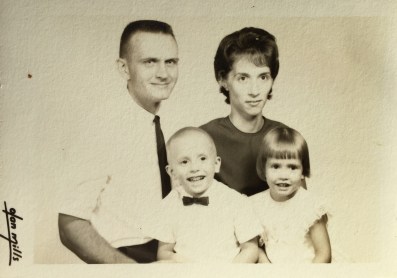
Keith, Rose, Paul, and Eydie Thomas— the family.
Their paradox was that they did in fact have a hand in their own disturbing dying days that were greatly accelerated and worsened by a harsh society and inhumane government that they endorsed until their last breaths.
It feels too much like a Poe short story, my being sometimes haunted by my father’s last pair of dentures that made him look cartoonish and pitiful, only a faint glimmer of the man I knew as a child. A powerful and all-too-happy young man who grew into massive forearms and a constant refrain of “If I was any better, I couldn’t stand it” to anyone who asked how he was doing.
Until that last pair of dentures, I had lived with a different image, one recreated by the telling of stories by my father.
When I was very young, my father was play-wrestling with my mom (they were very playful young adults, together and with my sister and me). My mom feigned that she was in distress and called for me to help her.
Just a child, I ran over and kicked hard at my father’s head. He turned away untouched, covertly removed his false teeth, and then rolled back to confront me with a huge toothless grin.
I screamed and cried, as my father told the story, while my mom and dad laughed.
This was my childhood, but I cannot tolerate the romanticizing of white Southerners anymore than I can stomach the petty stereotypes driven by poverty shaming.
I have loved my parents and family very deeply while also being very angry at them and my hometown for all the hatred and the self-defeating politics.
Over the last few years, the media have become obsessed with struggling whites all across the U.S. Many are rednecks, hillbillies, and even crackers.
There is so much white fragility on display that I recognize now even more deeply how whites resist equity and hard truths in the U.S. while always hiding behind a very large and starkly white banner. Maybe “Christian nation” or simply “U.S.A.”
Or the most disturbing and red “Make America Great Again.”
Yes, there are distinctions among rednecks, hillbillies, and crackers—but those really do not matter as much as what they have in common, an inordinate power linked to their being white and an irrational anger toward a world finding ways to expose those privileges so that we can end them.
And walking through that world, I am the son of a toothless redneck.
Having spent nearly four decades teaching high school and college students to write, I have also during that time talked with and listened to many colleagues also either teaching writing or assigning writing in their courses.
As teachers are prone to do, these teachers often complain about their students; I am apt to argue that teachers of writing are even more prone to complaining because teaching writing is labor-intensive work that often fails to produce short-term evidence that the teaching has been effective.
If we don’t complain, well, there simply may not be enough wine to buoy us through the weekends and stacks upon stacks of essays.
While I have a great deal of compassion and empathy for all teachers, and especially teachers of writing, I often shudder at the usual complaints about “students today”—complaints that often are grounded in deficit views of students and misguided perceptions of what teaching writing means, much less what sorts of writing outcomes we should be expecting of teens and young adults.
Howe Professor and Director of Roger and Joyce Howe Center for Writing Excellence, Elizabeth Wardle offers four important challenges to the most common complaints about students as writers:
First, students are what they have always been: learners. There is no evidence that student writing over all is any better or worse than it has ever been. What is true is that faculty members have been complaining about student writing for as long as students have been writing….
Second, to improve as writers, students need to write frequently, for meaningful reasons, to readers who respond as actual readers do — with interest in ideas, puzzlement over lack of clarity or logic, and feedback about how to think more deeply and write more clearly to accomplish the writer’s purposes. There is no shortcut….
The third point: All writers struggle with new genres and conventions; learning to write in new situations always requires instruction and practice because there is no singular “writing in general” and certainly no singular “good” writing in general….
Which brings me to a final point: Teaching writing is everyone’s responsibility, but it’s not any one person’s responsibility to teach all kinds of writing. We are each responsible for helping students understand the written practices that we use in our fields and professions.
These are powerful broad challenges to some of the most common complaints I hear. Therefore, I want to focus here on her third point by addressing a persistent refrain from teachers of writing—students can’t (or don’t) write effective thesis statements.
While many K-12 and higher education teacher and professors uncritically view the thesis statement as an essential aspect of what Wardle refutes (“singular ‘good’ writing in general”), I do not teach students to write thesis sentences (within a broader effort to have them move beyond the introduction/body/conclusion template of the essay), but instead, we seek writing that develops a focus over the opening paragraphs (usually about 2-5 paragraphs) and an essay that has coherence.
This approach is grounded in helping students develop essay awareness along with a broader awareness of the many conventions of essays across academic disciplines as well as writing beyond the academy.
What guides this practice is, first, my experiences as a writer, and then important challenges to the negative consequences of thesis-driven writing offered by Duxbury and Ballinger.
But I also have students move away from the thesis sentence and toward focus and coherence because I witness in every course that most students have been misguided by the tyranny of the thesis sentence. Students write badly trying to accomplish the very thing many teachers complain they cannot do.
Most students in K-12 writing experiences have been required to submit an introduction and thesis before they can draft an essay. This practice ignores the power of discovery drafting but it also suggests that very young writers must always write from the perspective of making direct and fixed claims, to assume a stance of authority they simply do not (and cannot) have.
Conversely, especially for young writers still developing their awareness of writing craft, their understanding of conventions, and their content knowledge, writing that raises questions or interrogates ideas is far more compelling and effective than students making grand pronouncements beyond the scope of their authority.
And nearly all writers come to understand their focus while drafting because the best drafting is a form of thinking.
As a teacher of writing, I more often than not while responding to early drafts point to a sentence or two late in the essay and respond, “This is your opening,” because the student has wandered into a strong essay focus.
Focus and coherence, while both are complex concepts, prove to be better guiding principles than thesis sentences as well as stilted introductions and conclusions (the template approach found in the five-paragraph essay and its cousins).
Warner and many others note, however, that template writing (the five-paragraph essay) is both very bad writing and really lazy thinking. Few topics worthy of discussion, especially in formal education, can be neatly reduced to three points.
In the 1990 edition of Style, Joseph Williams dedicates two chapters to coherence because, as he explains:
All of us have stopped in the middle of a memo, an article, or a book realizing that while we may have understood its words and sentences, we don’t quite know what they should all add up to. …[W]e will offer some principles that will help you diagnose that kind of writing and then revise it. …No one or two of [the principles] is sufficient to make a reader feel a passage is coherent. They are a set of principles that writers have to orchestrate toward that common end.
Williams speaks here to the third point Wardle is making—that writers achieve “good writing” in many different ways to fulfill many different purposes.
As teachers of writing, we are left with helping students “orchestrate” the many and varied conventions, forms, and purposes that they face. But templates cannot and do not serve those needs.
Like the five-paragraph template, the thesis statement is a pale and flawed way for writers of any age to create and achieve focus and coherence.
Moving away from thesis sentences and toward writing that establishes focus and coherence can best be achieved by inviting students to draft as an act of discovery and allowing students to interrogate ideas instead of seeking ways to make fixed claims that they then must support.
All of this must be supported by helping students understand achieving coherence conceptually (principles) and then connecting those principles to craft and strategies that students mine from mentor texts and then apply (through experimentation) in their own original writing expressing their own original (and evolving) thinking.
The 21st century charter school movement in the U.S. has been at least a deeply flawed solution for a misunderstood problem. But charter advocacy has also suffered from a serious contradictory pair of arguments aimed simultaneously at traditional public schools (TPS) and charter schools.
As stringent high-stakes accountability gradually ramped up for TPS from the early 1980s and through both the George W. Bush No Child Left Behind (NCLB) era and the even more intense (and volatile) Obama administration, charter school advocacy increased, and those schools expanded across the U.S. driven by the argument that charter schools flourish because of their independence from bureaucratic mandates.
TPS suffered a series of ever-new standards and high-stakes tests, persistent narratives that they were “failing,” and a recalcitrant public and political leadership that refused to acknowledge the nearly crippling impact of social inequity on any school’s ability to effectively teach children.
Yet, at the same time, charter schools were routinely hailed falsely as “miracles” and neither the public nor political leadership seemed to care that research repeatedly revealed that charter schools simply did not outperform TPS (just as private schools do not outperform TPS). In short, charter schools have continued to float on advocacy and magical thinking even when we can clearly show that school type has nearly no impact on student outcomes—since those outcomes are far more significantly driven by out-of-school factors (home and community economic status, parental education levels, home security, access to food, medical care access, etc.).
Just as the Bush/Paige Texas “miracle” that spurred NCLB was soundly debunked, the Harlem “miracle” often cited by Obama/Duncan proved directly and indirectly (the many copy-cat charter “miracles” across the U.S., such as KIPP charter schools) to be mirages.
Like KIPP advocacy, however, the all-charter-school reality that has occurred in New Orleans after Katrina has also flourished on political and media misrepresentations.
An editorial in the Post and Courier (Charleston, SC) has now offered one step in the right direction on charter schools in SC—but it fails to offer the only logical end-game concerning charter funding in this high-poverty state.
Yes, as the editorial notes after citing a Tulane study on charters [1]:
Closing failing charter schools is important because they receive millions of dollars in taxpayer funding that could otherwise be used to improve regular public schools. It’s essential because parents are led to believe that charter schools are superior to public schools, when in some cases they’re taking their kids out of traditional public schools that are better than the charter schools.
As I have detailed dozens of times directly about comparing charter schools and TPS in SC, most charter schools are about the same or worse than TPS that are serving similar populations of students. When charter schools appear to be outperforming, typically those gains are mirages that distract us from the real causal differences—under-serving special needs students, under-serving English language learners, expanded school days and/or years that account for the “growth” being measured, private funding, relief from accountability that comparable TPS must follow.
A simple dictum here is that if we allowed TPS those same caveats, we would see absolutely no surface differences in test scores; a more complicated dictum is that if charter schools had to function under the nearly paralyzing spectrum of obligations that TPS have always addressed, those charter schools would be seen as failures also.
The harsh truth no one wants to confront is that formal schooling, regardless of the type, has a very small measurable impact on student achievement when compared to the relatively larger influence of out-of-school factors. Related to that harsh truth is that once vulnerable students enter formal schooling, they far too often experience even greater inequities because all school models (TPS, charter schools, private schools) both reflect and perpetuate inequities in their policies (teacher assignment, tracking, disciplinary policies, class size and course access inequity, etc.).
As some of us in education have been arguing for decades, education reform must be grounded in equity and in-school reform can succeed only as a companion to significant social and economic reform that addresses food insecurity, work stability, health care, and safety (what I have called social context reform).
Again, the P&C editorial has offered an important charge that “South Carolina was never great at enforcing the responsibility requirement” for charter schools. But simply closing failing charter schools is not enough since we should not be creating charter schools to begin with.
In fact, we should close all charter schools because the charter churn (and all school choice) is a wasteful and politically cowardly indirect approach to reform.
SC is a historically high-poverty state that simultaneously clings to self-defeating conservative politics. Neither social/economic nor education policy in the state serves well the very large vulnerable populations of the state, not the adults or the children.
The political rhetoric and the ideology it spreads are themselves mirages at best, and cruel lies at worst.
New Orleans since 2005 has erased and replaced a TPS system with a charter system, and still the narrative remains about the exact same—schools need reform.
Formal schools regardless of the type reflect the children and communities they serve. Formal schools are rarely change agents.
If SC or any state genuinely wants education reform that serves all students, we will first invest in our entire state in ways that meet the needs of the most vulnerable among us and then we will re-invest in a public school system that fulfills the promise that every child has the greatest opportunity to learn that we can imagine.
Leaving equity in our society and our schools to the Invisible Hand is nothing more than a slap to the faces of the people and children who need us the most.
[1] This Tulane study has been repeatedly misrepresented by charter advocates; please see the following for a fuller and more complex picture of what that study can suggest, and what it does not:






:format(jpeg):mode_rgb():quality(90)/discogs-images/R-1582690-1337795875-1821.jpeg.jpg)


 dr. p.l. (paul) thomas