Tag Archives: politics

Why Education Reformers Have to Lie About the Left

[Header Photo by Jametlene Reskp on Unsplash]

Education pundits and education reformers (mostly never educators themselves) are some of the most arrogant people you’ll ever encounter.

This is odd because their grand announcements are invariably built on lies, but even more puzzling is that none of their claims and promises about their pet reforms ever work out.

Charter schools and school choice, teacher evaluation based on value-added methods, accountability schemes driven by (ever new) standards and (ever new) standardized tests—none of these have worked, and the evidence for that is quite obvious because we remain always in education crisis regardless of the reforms.

In fact, the real story behind education punditry and reform is that all of these folk profit from perpetual crisis and reform; they are not really invested in improving education or the lives and learning of children in the US.

Education punditry and reform in the US is an industry that relies on two lies—crisis and miracles.

Apropos for the Trump era, in fact, education punditry and reform depend on the Big Lies to promote their baseless attacks on education failure and to recycle their rhetoric as well as their reform plans (that, again, never work).

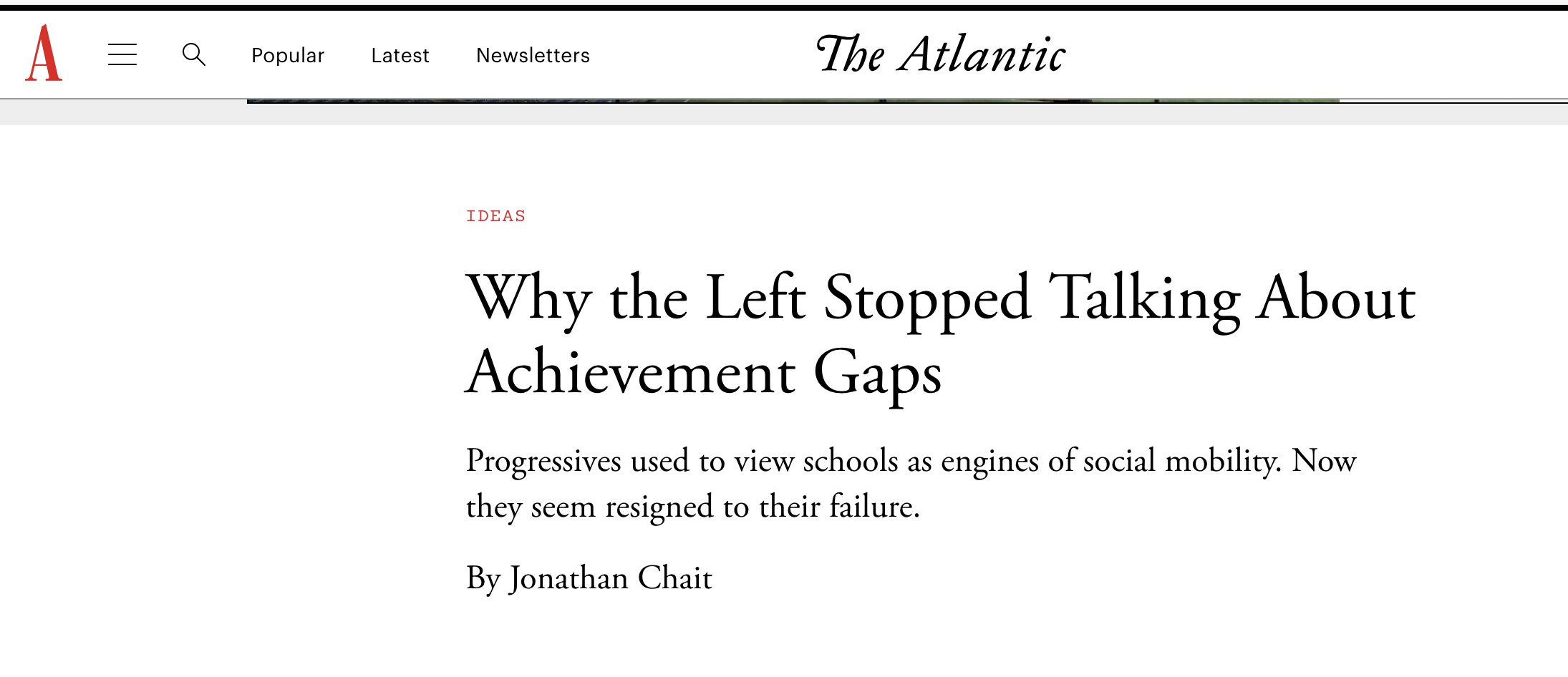
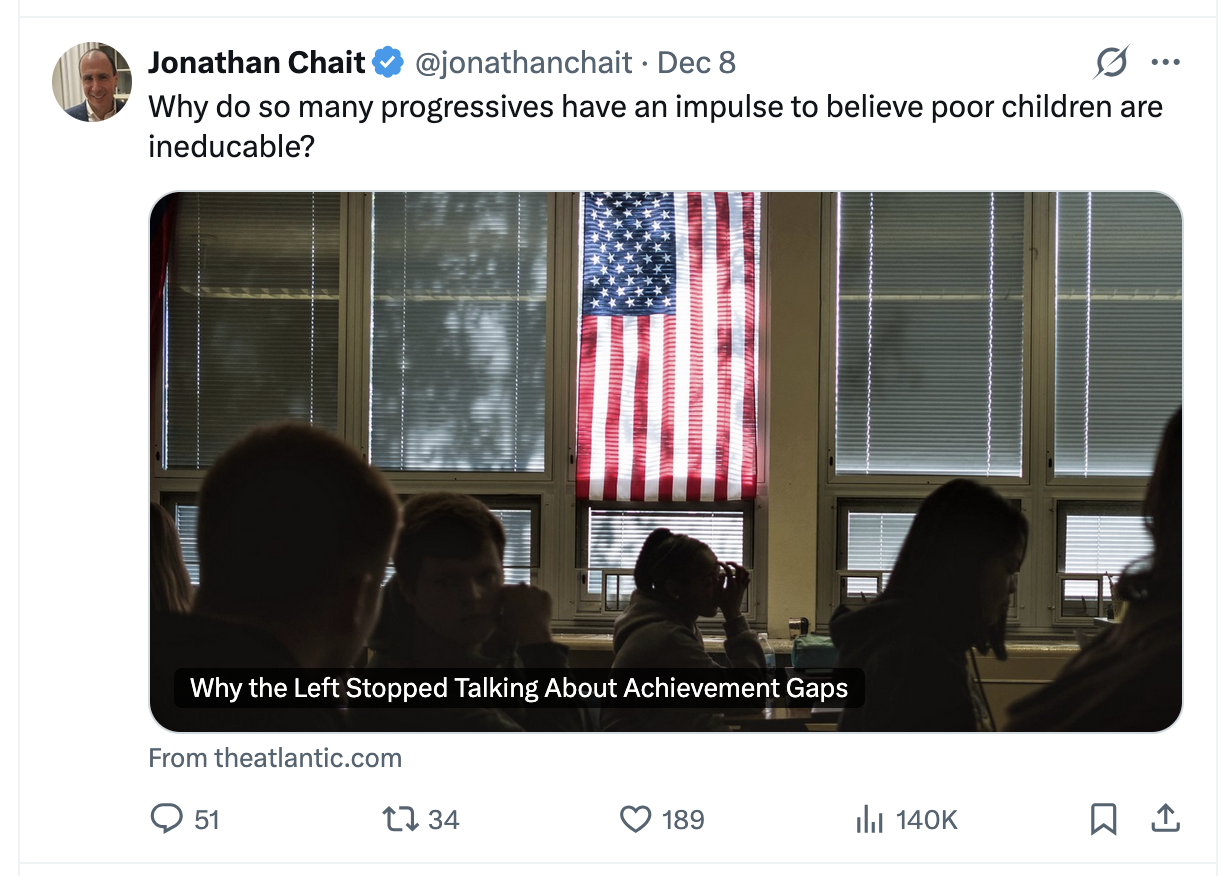
Jonathan Chait, ironically the author of The Big Con, has jumped on the false Mississippi “miracle” reading reform train as well as doubling down on one of the most offensive Big Lies:

This Big Lie is the “no excuses” lie that some people on the progressive left use poverty as an excuse; this is the George W. Bush “soft bigotry of low expectations” strawman.

The “no excuses” movement was primarily a part of the huge charter school movement popular under Obama, the charter school movement that, not surprisingly, joined the litany of ed reforms that did not work.

Here is the key detail: The “no excuses” rhetoric has been resurrected by the false Mississippi “miracle.” You see, if Mississippi has in fact produced a reading reform miracle, then the “poverty is an excuse” charge has been proven correct!

First, however, there is no one on the progressive left who believes poor children cannot learn or cannot be educated. And no one is arguing education reform cannot work.

The critical and progressive argument is actually evidence-based but possibly more complicated than the average pundit or reformer can understand.

The evidence is overwhelming that over 60% of measurable student achievement is causally related to factors outside the control of schools.

A 2024 study has once again proven this, and that schools alone cannot mitigate that powerful influence on learning:

Almost 63% of the variance in test performance was explained by social capital family income variables that influence the development of background knowledge. Background knowledge is a known predictor of standardized test results. Family income variables are immutable by schools. Only public policies, outside the control of school personnel, can influence family income.

That same research supports the actual argument from the progressive left: Accountability education reform grounded in standards and high-stake testing will not work, and has not worked since the early1980s:

The influence of family social capital variables manifests itself in standardized test results. Policy makers and education leaders should rethink the current reliance on standardized test results as the deciding factor to make decisions about student achievement, teacher quality, school effectiveness, and school leader quality. In effect, policies that use standardized test results to evaluate, reward, and sanction students and school personnel are doing nothing more than rewarding schools that serve advantaged students and punishing schools that serve disadvantaged students.

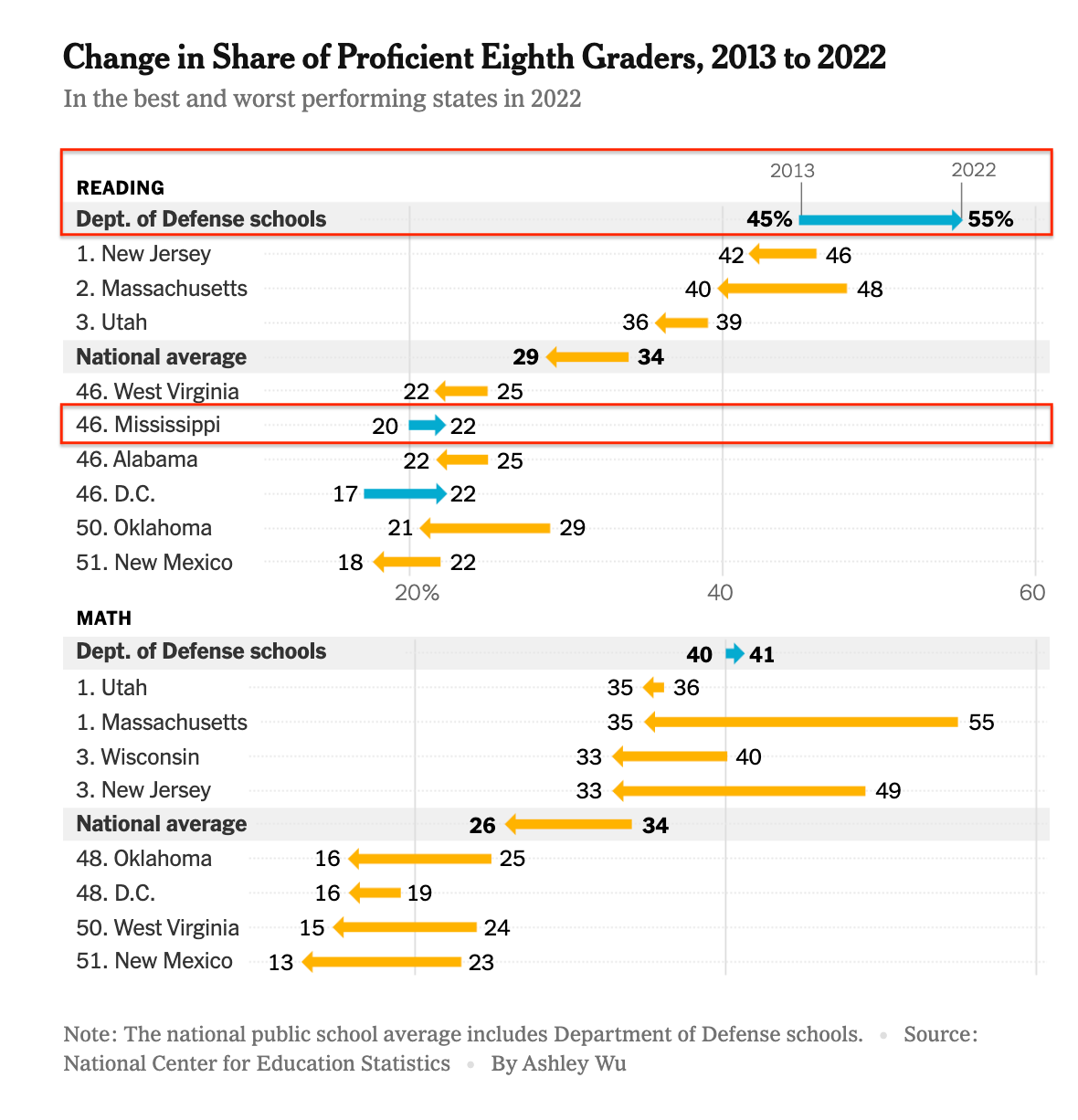
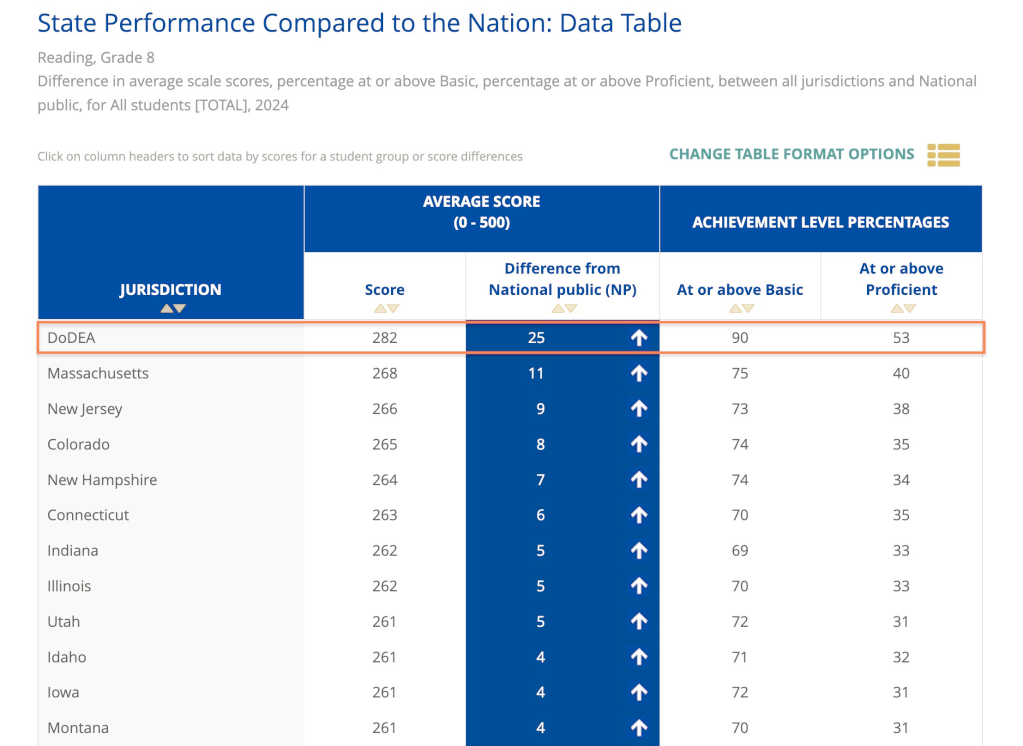
What we on the progressive and critical left are arguing is that education reform should be grounded in equity policy but it must also be supported by social reform. In short, evidence such as the Department of Defense schools’ success on NAEP show that when students have their healthcare, food, and housing secured, schools are more likely to be effective:

Next, Chait’s primary Big Lie is compounded by perpetuating the Mississippi “miracle” lie.

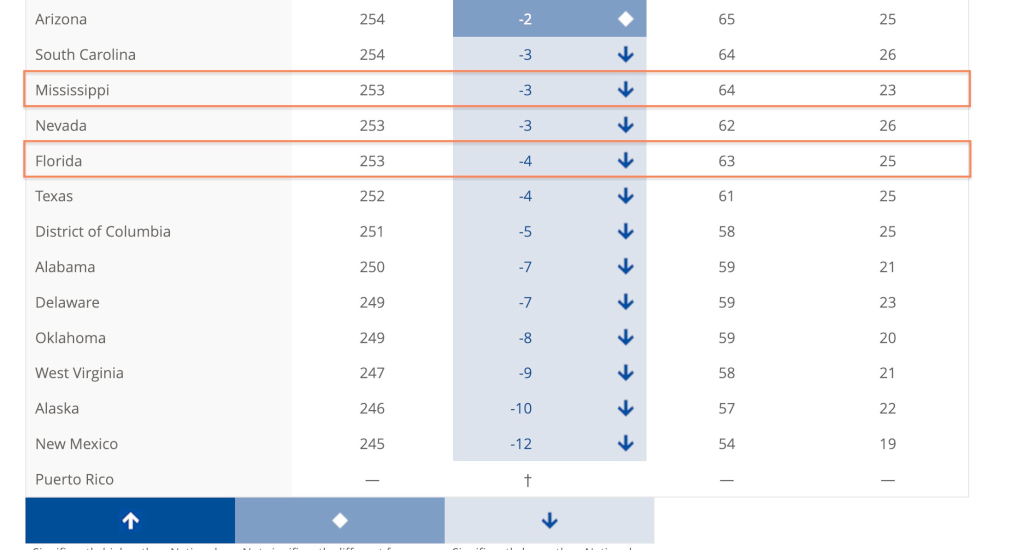
There is but one kernel of truth in the Mississippi “miracle” lie (and it is the only one the pundits and reformers mention). Like Florida, Mississippi has conjured exceptionally high grade 4 reading scores on NAEP.

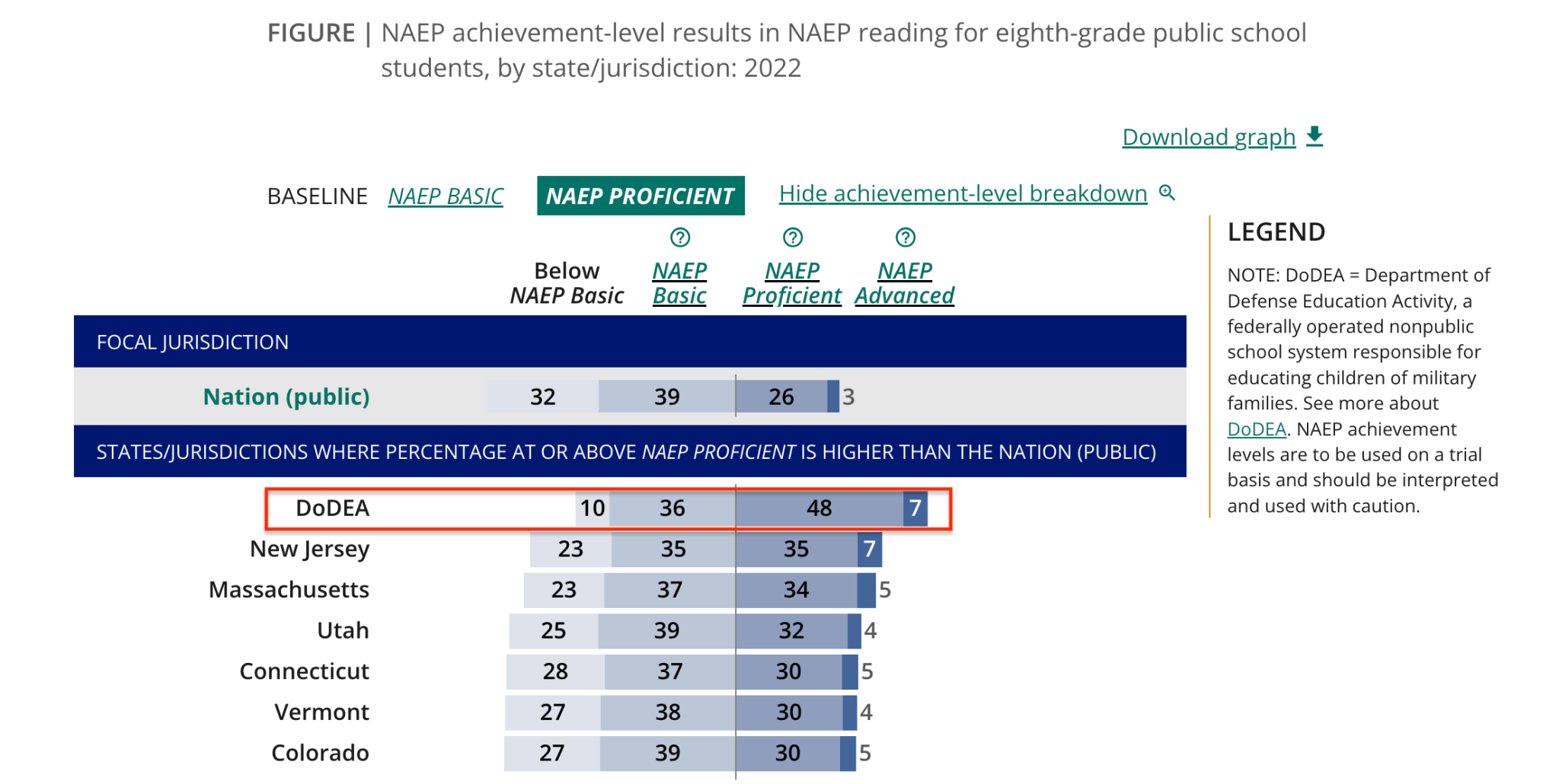
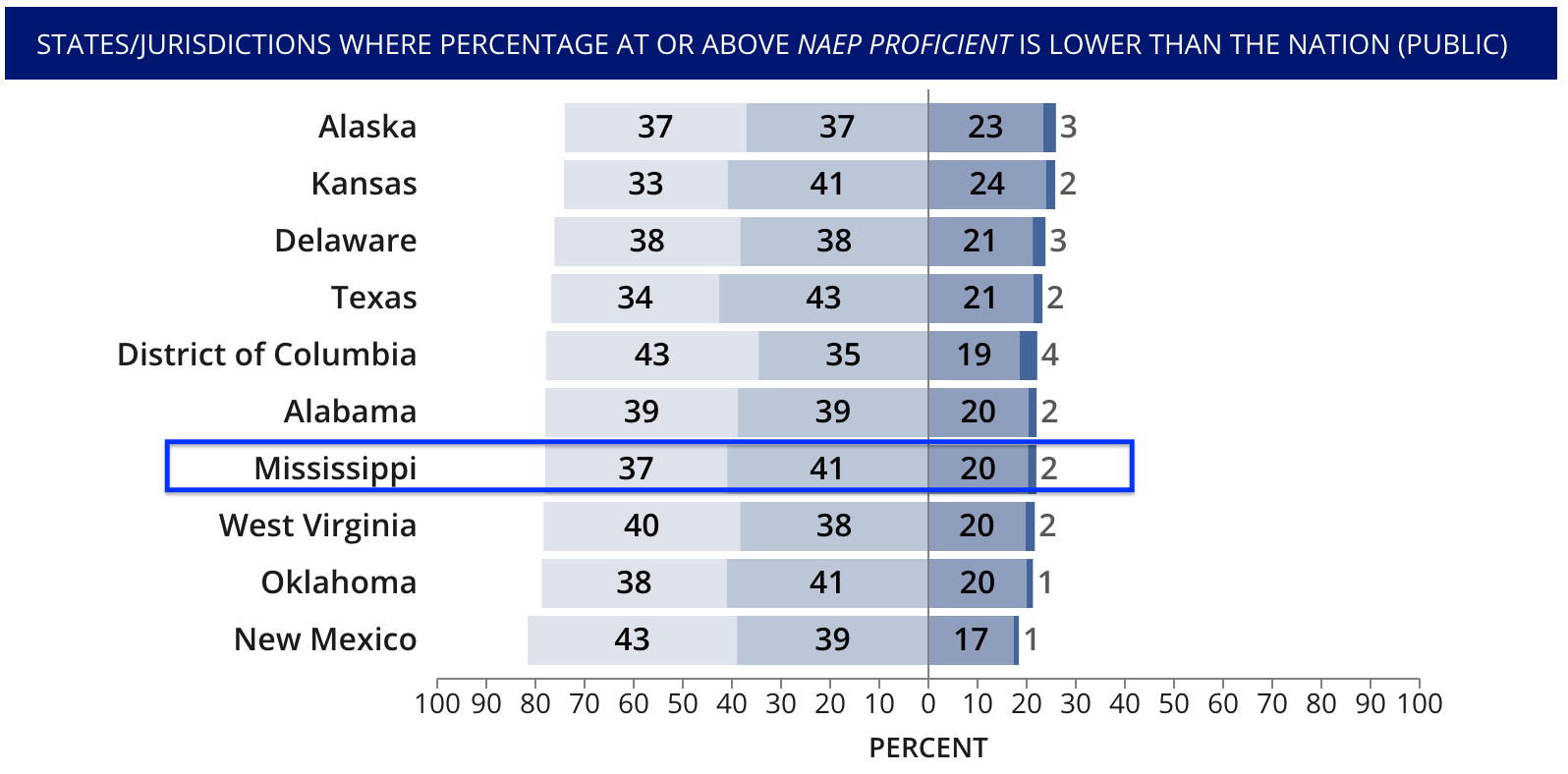
However, two analyses [1] have shown that that score increase appears to be the result of grade retention and not instructional, teacher, or program reforms. Both MS and FL have seen their outlier grade 4 reading scores drop into the bottom 25% of state scores by grade 8, suggesting the grade 4 scores are the product of corrupting the pool of students tested through grade retention and not genuine increases in reading proficiency. Again contrast MS and FL with DoDEA schools in grade 8 (top image is the top performing states and bottom image is the bottom performing states):

The Mississippi story has two additional problems.

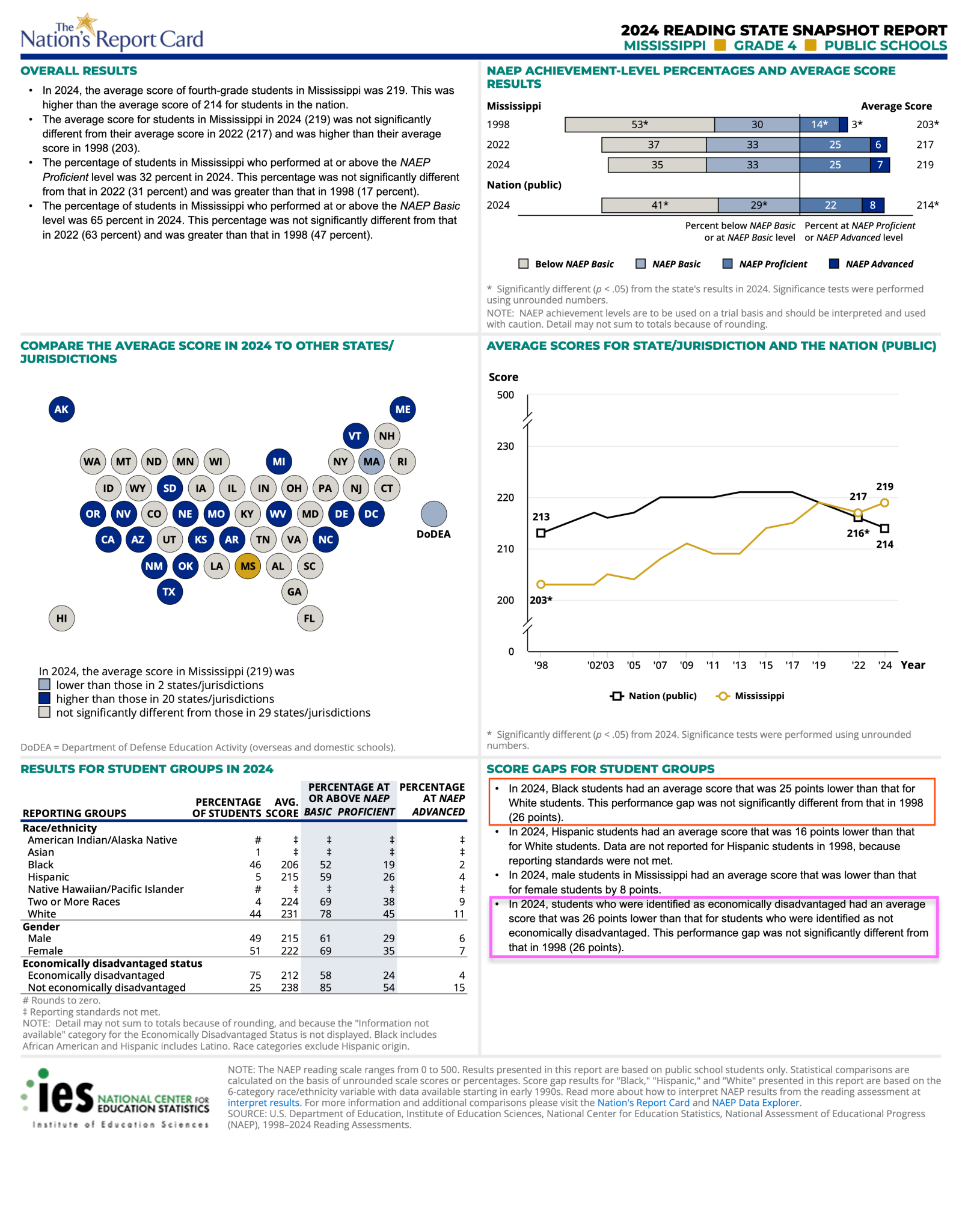
Mississippi has the same race and poverty achievement gap in grade 4 reading as the state did in 1998:

And possibly the most damning and ugliest problems with the Mississippi “miracle” lie is that the state has not seen a decrease in the number of students retained (who are disproportionately Black and poor); if their reform was working, this number should be near zero:

  • 2014-2015 – 3064 (grade 3) – 12,224 K-3 retained/ 32.2% proficiency
  • 2015-2016 – 2307 (grade 3) – 11,310 K-3 retained/ 32.3% proficiency
  • 2016-2017 – 1505 (grade 3) – 9834 K-3 retained / 36.1 % proficiency
  • 2017-2018 – 1285 (grade 3) – 8902 K-3 retained / 44.7% proficiency
  • 2018-2019 – 3379 (grade 3) – 11,034 K-3 retained / 48.3% proficiency
  • 2021-2022 – 2958 (grade 3) – 10,388 K-3 retained / 46.4% proficiency
  • 2022-2023 – 2287 (grade 3) – 9,525 K-3 retained/ 51.6% proficiency
  • 2023-2024 – 2033 (grade 3) – 9,121 K-3 retained/ 57.7% proficiency
  • 2024-2025 – 2132 (grade 3) – 9250 K-3 retained/ 49.4% proficiency [2]

The truth exposed by the Big Lies of education pundits and reformers is that they are not interested in evidence or improving the lives and education of children.

There is more profit in the Big Lies and maintaining a perpetual state of education crisis and reform; you see, maintaining The Big Con.


[1] See On education miracles in general (and those in Mississippi in particular) and The Effects of Early Literacy Policies on Student Achievement.
[2] Not that, in fact, recent data show retention increased and proficiency decreased in the past two years.

Science of Reading or Science of Retention?: Why Miracles Fail Reading Reform

[Header Photo by Ava Sol on Unsplash]

My entire career in education, begun in the fall of 1984, has been during the accountability era of education that is primarily characterized by one reality—perpetual reform.

The template has been mind-numbingly predictable, a non-stop cycle of crisis>reform>crisis>reform, etc.

Another constant of that cycle is that the crisis-of-the-moment has almost always been overblown or nonexistent, leading to reforms that fall short of the promised outcomes. Reforms, ironically, just lead to another crisis.

But one of the most powerful and damning elements in the crisis/reform cycle has been the education miracle. [1]

Two problems exist with basing education reform on education miracles. First, and overwhelmingly, education miracles are almost always debunked as misinformation, misunderstanding of data, or outright fraud. Research has shown that statistically education miracles are so incredibly rare that they essentially do not exist.

Second, even when an education miracle is valid, it is by definition an outlier, and thus, the policies and practices of how the miracle occurred are likely not scalable and certainly should not be used as a template for universal reform.

Those core problems with education miracles have prompted the attention of Howard Wainer, Irina Grabovsky and Daniel H. Robinson, who have analyzed the reading reform miracle claims linked to Mississippi:

In 1748, famed Scot David Hume defined nature. He elaborated such a law as “a regularity of past experience projected by the mind to future cases”. He argued that the evidence for a miracle is rarely sufficient to suspend rational belief because a closer look has always revealed that what was reported as a miracle was more likely false, resulting from misperception, mistransmission, or deception….

A careful examination confirms that enthusiasm to emulate Mississippi should be tempered with scepticism….

In short, the authors followed a key point of logic: If something seems too good to be true, then it is likely not true.

In their analysis, On education miracles in general (and those in Mississippi in particular), they focused on two of the key problems with the story about Mississippi’s outlier grade 4 reading scores (in the top quartile of state scores) on NAEP: What is the cause of the score increases? And, why are Mississippi’s grade 8 reading scores remaining in the bottom quartile of state scores?

They found, notably, that Mississippi’s instructional reform, teacher retraining, additional funding, and reading program changes were not the cause of the score increases, concluding:

But it was the second component of the Mississippi Miracle, a new retention policy, perhaps inspired by New Orleans’ Katrina disaster a decade earlier, that is likely to be the key to their success….

Prior to 2013, a higher percentage of third-graders moved on to the fourth grade and took the NAEP fourth-grade reading test. After 2013, only those students who did well enough in reading moved on to the fourth grade and took the test.

It is a fact of arithmetic that the mean score of any data set always increases if you delete some of the lowest scores (what is technically called “left truncation of the score distribution”)….

In short, Mississippi has inflated grade 4 NAEP scores, but that is unlikely evidence that student reading proficiency has improved. This is not a story about reading reform, but about “gaming the system”:

It is disappointing, but not surprising, that the lion’s share of the effects of the “Mississippi miracle” are yet another case of gaming the system. There is no miracle to behold. There is nothing special in Mississippi’s literacy reform model that should be replicated globally. It just emphasises the obvious advice that, if you want your students to get high scores, don’t allow those students who are likely to get low scores to take the test. This message is not a secret….

Wainer, Grabovsky and Robinson’s analysis also needs to be put in context of two other studies.

First, their analysis puts a finer point on the findings by Westall and Cummings, whose comprehensive review of contemporary reading reform found the following: Third grade retention (required by 22 states) is the determining factor for increased test scores (states such as Florida and Mississippi, who both have scores plummet in grade 8), but those score increases are short-term.

Next is a recent study on grade retention. Jiee Zhong concluded:

[T]hird-grade retention significantly reduces annual earnings at age 26 by $3,477 (19%). While temporarily improving test scores, retention increases absenteeism, violent behavior, and juvenile crime, and reduces the likelihood of high school graduation. Moreover, retained students exhibit higher community college enrollment but lower public university attendance, though neither estimate is statistically significant.

Grade retention masquerading as reading reform, then, is fool’s gold for inflating test scores, but it is also harming the very students the reform purports to be helping.

The evidence now suggests that reading reform should not be guided by miracle claims; that no states should be looking to a miracle state for reading reform templates; that the so-called “science of reading” movement is mostly smoke and mirrors, and should be recognized as the “science of retention”; and that grade retention policies are distorting test scores at the expense of our most vulnerable students in life changing ways.


[1] Thomas, P.L. (2016). Miracle schools or political scam? In W.J. Mathis & T.M. Trujillo, Learning from the Federal Market-Based Reforms: Lessons for ESSA. Charlotte, NC: IAP.

Students, Poverty, and Reading: The Pernicious Folly of Red v. Blue Political Propaganda

[Header Photo by Lisa Keffer on Unsplash]

Public discourse on education in the US has a long and tedious history of shouting either “crisis” or “miracle” while often basing both of those on misunderstanding or willing misrepresenting students, teacher, and public schools.

Politicians and the media, it seems, are fatally committed to crisis/miracle discourse—especially when the topic is student reading proficiency.

In the current Reading Crisis cycle that has it roots in 2018/2019 media narratives about failed reading instruction and repeated misunderstanding about NAEP reading data, the miracle-of-the-moment is Mississippi, often held up as a template for other states to follow.

As I have detailed, Mississippi reading reform is more mirage than miracle, and states should be skeptical about rushing to (again) adopt copy-cat legislation.

While the Mississippi “miracle” story continues to be sold, a new and insidious version of that story has emerged with an ugly undercurrent of the Trump/MAGA playbook—pitting Red v. Blue states at the expense of students.

The new combatants in the Reading War are Mississippi versus California (see HERE and HERE).

Several problems exist with comparing and then pitting MS against CA in terms of student achievement and teaching/schooling; however, let’s start with the big picture context of poverty and measurable student achievement.

As the US spirals toward disrupting SNAP and punishing people living in poverty, it is worth noting that the largest group in poverty is children, who lack economic or political power:

Related, then, in 2024, Maroun and Tienken replicated a research conclusion that has existed for decades, finding the following:

Almost 63% of the variance in test performance was explained by social capital family income variables that influence the development of background knowledge. Background knowledge is a known predictor of standardized test results. Family income variables are immutable by schools. Only public policies, outside the control of school personnel, can influence family income.

Further, they recommend:

Although some education policy makers in the United States claim that standardized test results are an important component of a comprehensive system of educational quality control, the results from decades of research on the topic suggest otherwise. The influence of family social capital variables manifests itself in standardized test results. Policy makers and education leaders should rethink the current reliance on standardized test results as the deciding factor to make decisions about student achievement, teacher quality, school effectiveness, and school leader quality. In effect, policies that use standardized test results to evaluate, reward, and sanction students and school personnel are doing nothing more than rewarding schools that serve advantaged students and punishing schools that serve disadvantaged students.

Thus, the fundamental problem with comparing MS and CA is the use of NAEP and other testing data to make broad claims and draw conclusions about educational success or failures.

Next, comparing MS and CA falls into the culture of poverty trap by treating poverty as monolithic.

While both MS and CA have significant populations of students in poverty, MS faces racialized and significantly rural poverty challenges while CA confronts a multilingual and racialized poverty challenge that is both urban and rural.

These are not the same, and frankly, since CA has nearly half of the student population as multilingual learners, reading proficiency is incredibly complicated to address in the context of racial inequity as well as poverty.
Even acknowledging those differences, most of the MS/CA comparisons are carelessly simplistic; consider the reading trends for both states based on NAEP grade 4, the most common basis for media discourse about reading:

Since 1998, both states saw growth with CA achieving a more steady improvement. However, there is no data-based evidence of a reading crisis for either state or across the US. [Note that MS has had two spikes in growth, one being well before the so-called MS model, again suggesting that ascribing “miracle” to the current model is misguided.]

MS and CA do demonstrate that educational success and failure are linked to many factors, notably the Covid-dip. That many factors impact student achievement—and that almost 2/3rds of those factors are beyond the walls of schools—discounts claims recently that the MS model, which includes a change in instruction and teacher training, is some sort of silver-bullet for success.

Research shows that only grade retention is causally linked to higher test scores, however.

Education reform, including reading reform, is highly political and even politicized in the US. Neither political leaders nor media are immune to knee-jerk declarations of crisis or miracles.

The reading achievement in neither MS nor CA makes a case for red/blue political theater—unless you have your agenda set regardless of the evidence.

Both MS and CA face tremendous hurdles when teaching literacy in the context of poverty, racism, and multilingual learners. Those hurdles are made more complicated by silly political games, especially when those games are designed to ignore the most important data about the impact of out-of-school factors on student achievement.

One valid comparison between MS and CA is that when the Washington Post falsely claimed CA had adopted the MS model, Martha Hernandez responded by highlighting the unique nature of CA’s needs:

Let’s be clear, AB 1454 is not about narrowing literacy instruction to one approach. Rather, it’s about realizing California’s long-standing, comprehensive vision for literacy that meets the needs of all students — including our state’s 1.1 million English learners.

The bill has been described in the media as California’s new “science of reading” bill, but this shorthand fails to accurately reflect the legislation’s comprehensive scope and intention.

MS, on the other hand, seems determined to lean into the politics of their model, a conservative politics that uses the red/blue tensions to further ideological agendas.

Our students deserve not only better social and educational reform but also not being used as a political football by adults who should know better.


NEPC: Celebrating and Remembering David Berliner

Celebrating and Remembering David Berliner

Education scholar, leader, wit, gadfly, mentor, father, friend and NEPC Fellow David C. Berliner died September 26th, 2025. He was 87.

As an academic who specialized in educational psychology, Berliner received many of the most prestigious accolades awarded to those in his field. He was elected to the National Academy of Education and the International Academy of Education, and he was given award after award: the E.L. Thorndike Award in educational psychology, the AERA’s Distinguished Contributions Award and its Outstanding Public Communication of Education Research Award, the Friend of Education award of the NEA, and the Brock Prize in Education Innovation. He served as president of AERA and Dean of the College of Education at Arizona State University. He taught at universities around the nation and the world.

David’s Bar Mitzvah, 1951

Although he excelled in the Ivory Tower, Berliner was probably best known as a public intellectual who intrepidly pushed back against lawmakers and education policy that flew in the face of research and (quite frequently) common sense. This work is represented, for instance, in his general-interest books The Manufactured Crisis (1996, co-authored with Bruce Biddle), Collateral Damage (2007, co-authored with Sharon Nichols), and 50 Myths and Lies that Threaten America’s Public Schools (2014, co-authored with Gene Glass).

David and Ursula, March For Our Lives

“In the raging battle over school reform, David wanted to fight—and fight he did,” said NEPC’s Alex Molnar.

In books, articles, op-eds, and speeches, he relentlessly exposed the lies and hypocrisy of neoliberal school reform advocates and the danger posed by their market-based vision of public education. He fought hard but he was a joyous warrior—dancing would have definitely been allowed at David’s revolution! I have never met anyone more full of life. I will miss you terribly, my friend.

David and Ursula

David enjoying the waters of Hawaii, 2025

The 200-plus articles, reports, chapters, and books Berliner authored during his lifetime ranged from scholarly writings on psychology, pedagogy, and assessment to accessible books that used plain language to explain how education research was applied—and misapplied—in the real world. He remained prolific to the end, publishing a book of 19 personal and reflective essays, Public Education for Our Nation’s Democracy: Commentaries on Schooling in America, the month he passed away.

“David was an acerbic critic of the past two+ decades of what was called ‘education reform,’” his friend, the education scholar Diane Ravitch, wrote upon his death.

David laughed at the nonsensical but heavily funded plans to ‘reform’ education by imposing behaviorist strategies on teachers, as if they were robots or simpletons. David had no patience with the shallow critics of America’s public schools. He respected the nation’s teachers and understood as few of the critics did, just how valuable and under-appreciated they were.

Although his work grappled with serious topics, David was known for his lighthearted approach. He was our enthusiastic host of The Bunkum Awards, a satirical “honor” that NEPC used to bestow on the most appalling educational think-tank reports of the year. The videos, which are from 2013 and 2014, are still fun to watch, as David joyfully skewers the award recipients.

2014 Bunkum Awards

David also took great joy in the simple pleasures of life, from sunsets to seltzers to real honest-to-goodness New York City bagels, especially when enjoyed with his many friends, his children and grandchildren, and his beloved wife, Ursula Casanova.

David and Kevin in 2023

At an online memorial held October 4th in his honor, the word repeatedly used to describe him was “mensch.” “Just thinking of David always made my heart smile,” said NEPC’s Kevin Welner. “His presence among us, effusing decency and empathy, was a reminder of why we’re here on earth.”

“He was a great guy, in so many ways,” his daughter BethAnn Berliner told us. “We’ve heard from people how he was a giant in the field, a scholar, a teacher, a mentor, and an advocate. But to me, he was just dad and that was far greater.”

A Christian Nation that Honors All Free People

[Header Photo by Rob Coates on Unsplash]

“No one can be authentically human

while he prevents others from being so.”

Pedagogy of the Oppressed, Paulo Freire


I am not a Christian; I am not a religious person.

I have always held sacred the essential guarantees of the American Dream built on our individual liberties and the separation of church and state that is necessary for the integrity of both the church and the state.

The current and intensified efforts by Christian conservatives and Christian nationalists have moved past making the misleading claim that the US is a Christian nation, created by Christian founders, and toward establishing the sort of Christian nation that erases our democratic principals and appears more like the dystopian theocracy found in The Handmaid’s Tale.

In this new reality, I am willing to support and advocate for the sort of Christian nation that I have not seen from any Christians claiming the US is a Christian nation or calling for the US to become.

It is a beautiful idea in its simplicity, built on the foundation of two principles—one Christian and one democratic.

First, the Christian principle: “So in everything, do to others what you would have them do to you, for this sums up the Law and the Prophets” (Matthew 7:12).

And the second, the democratic principle: “We hold these truths to be self-evident, that all men are created equal, that they are endowed by their Creator with certain unalienable Rights, that among these are Life, Liberty and the pursuit of Happiness” (The Declaration of Independence [1]).

I know that what I want is to be safe and also free to be the person I know I am; I also know that life and liberty are nothing if each of us is not also free to pursue what makes us happy.

And none of that should be infringed upon by others or the force of government.

That life, liberty, and happiness is for me, but I cannot seek ways to impose what I believe is right for me onto anyone else. Notably, I do not have the right to use the force of government to impose my beliefs onto anyone or everyone else.

The essential role of government by a free people is to insure that freedom for everyone even as it looks different from person to person.

Even though I strongly disagree with fundamentalist Christians and Christian nationalists, I believe they have and must maintain the right to pursue those beliefs among all consenting adults who agree with them.

Safely, freely, and without the imposition of others or the force of government.

They should not, again, seek the force of government to impose those beliefs on anyone else. To me, that is a perversion of “Christian nation” that is a democracy into Christian nationalism that become a theocracy.

“Do to others what you would have them do to you” is a beautiful and concise expression of Christian love that, for me, is fully compatible with the grounding democratic principles of “life, liberty, and the pursuit of happiness.”

Free people do not have to choose between being a Christian nation and being a free people—that is, if we genuinely believe in both.


[1] I find the passage in full after this key phrase significant also:

That to secure these rights, Governments are instituted among Men, deriving their just powers from the consent of the governed, –That whenever any Form of Government becomes destructive of these ends, it is the Right of the People to alter or to abolish it, and to institute new Government, laying its foundation on such principles and organizing its powers in such form, as to them shall seem most likely to effect their Safety and Happiness. Prudence, indeed, will dictate that Governments long established should not be changed for light and transient causes; and accordingly all experience hath shewn, that mankind are more disposed to suffer, while evils are sufferable, than to right themselves by abolishing the forms to which they are accustomed. But when a long train of abuses and usurpations, pursuing invariably the same Object evinces a design to reduce them under absolute Despotism, it is their right, it is their duty, to throw off such Government, and to provide new Guards for their future security.

A Message from the Nonviolent Left

[Header Photo by George Pagan III on Unsplash]

I am writing this as someone who is solidly on the Left, and not in the misleading way often expressed in the US where the Left really doesn’t exist in any substantial way. I fit into what would be seen as the Left in Europe or Scandinavian countries.

But my being on the Left is mostly about my scholarly view of the world, although, of course, that impacts how I navigate a very conservative country where ideologies of the Right are seen as the norm.
I also believe in nonviolence so I am very uncomfortable with current narratives that the Left is violent, and somehow uniquely violent.

I reject perpetuating and glorifying violence; I reject celebrating violence; and I strongly reject the violent gun culture of the US that is also tolerated as the norm.
I do not consider violence on or from the Left to be of the Left (although that is rare when compared to violence from the Right). Violence is a distortion of Leftist values and commitments.

As well, I do not feel any kinship with or endorse in any way the many celebrities that conservatives in the US describe as representative of the Left—such as Stephen Colbert and Jimmy Kimmel, who now have come to represent both the Left and concerns being raised about government censorship of the Left.

Colbert and Kimmel, to me, are vapid Hollywood, the performance of progressivism that is relatively common within celebrity culture. There is nothing radical in vapid Hollywood progressivism, and to be blunt, many celebrities who believe they are performing progressivism and activism are perpetuating conservative norms of the US.

I was born into, raised in, and continue to live in a very conservative state, South Carolina, and my upbringing in the rural Upstate was steeped in Southern Baptist religion and blunt racism, sexism, and homophobia.

Who I became by my second year of college and who I continue to evolve into—this Self is a person of the nonviolent Left, again nothing resembling the caricature and demonizing of the Left occurring today.

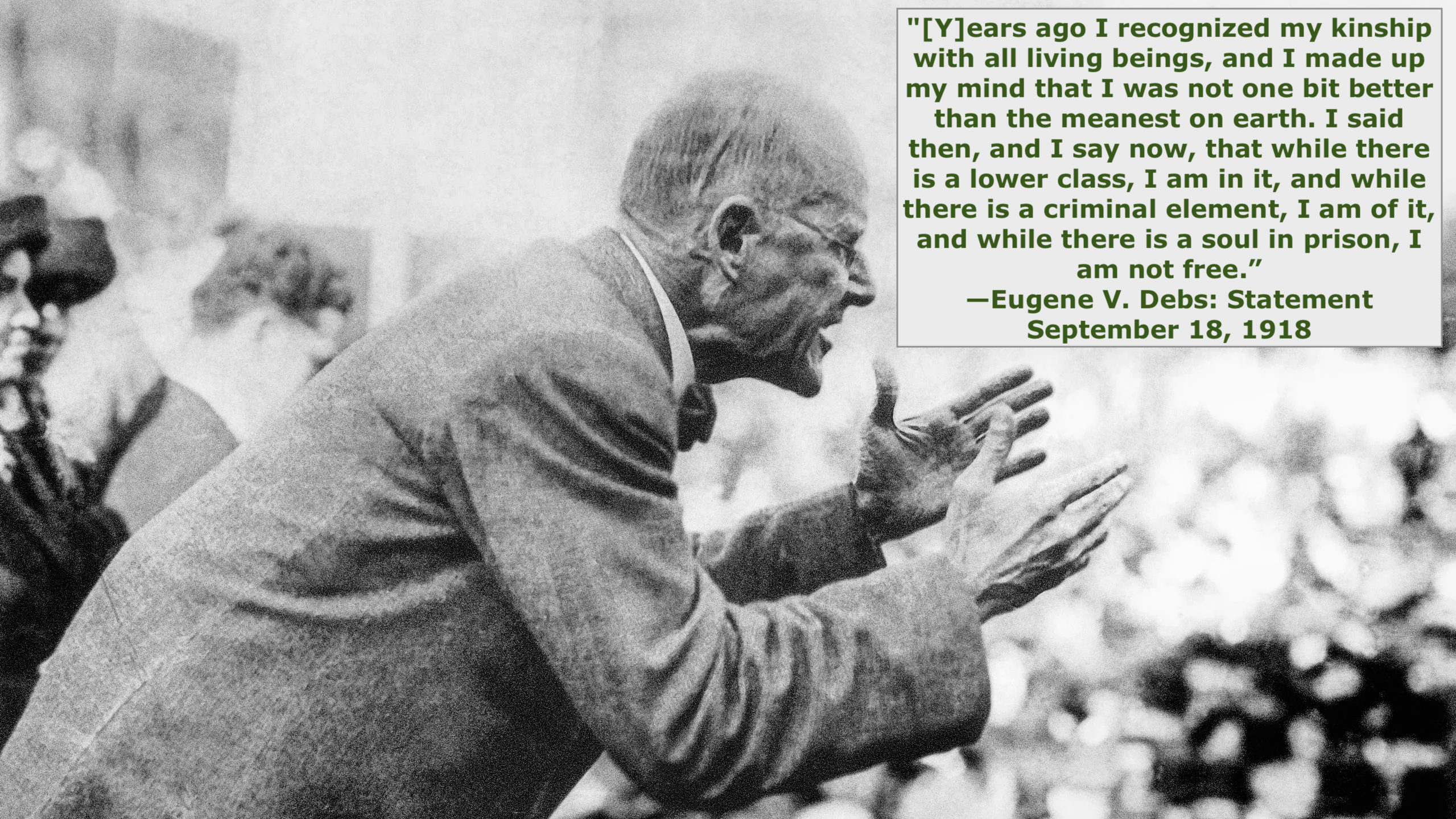
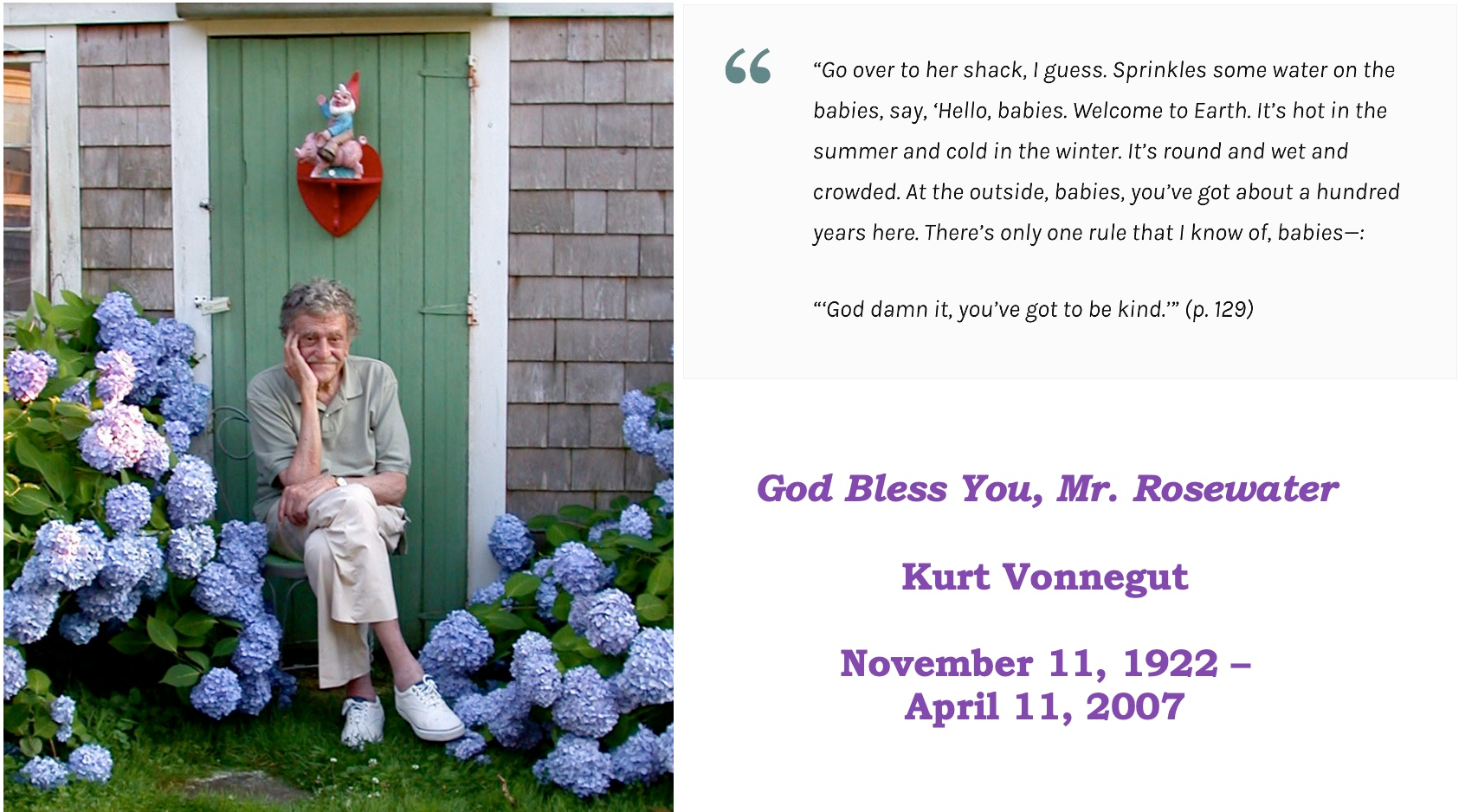
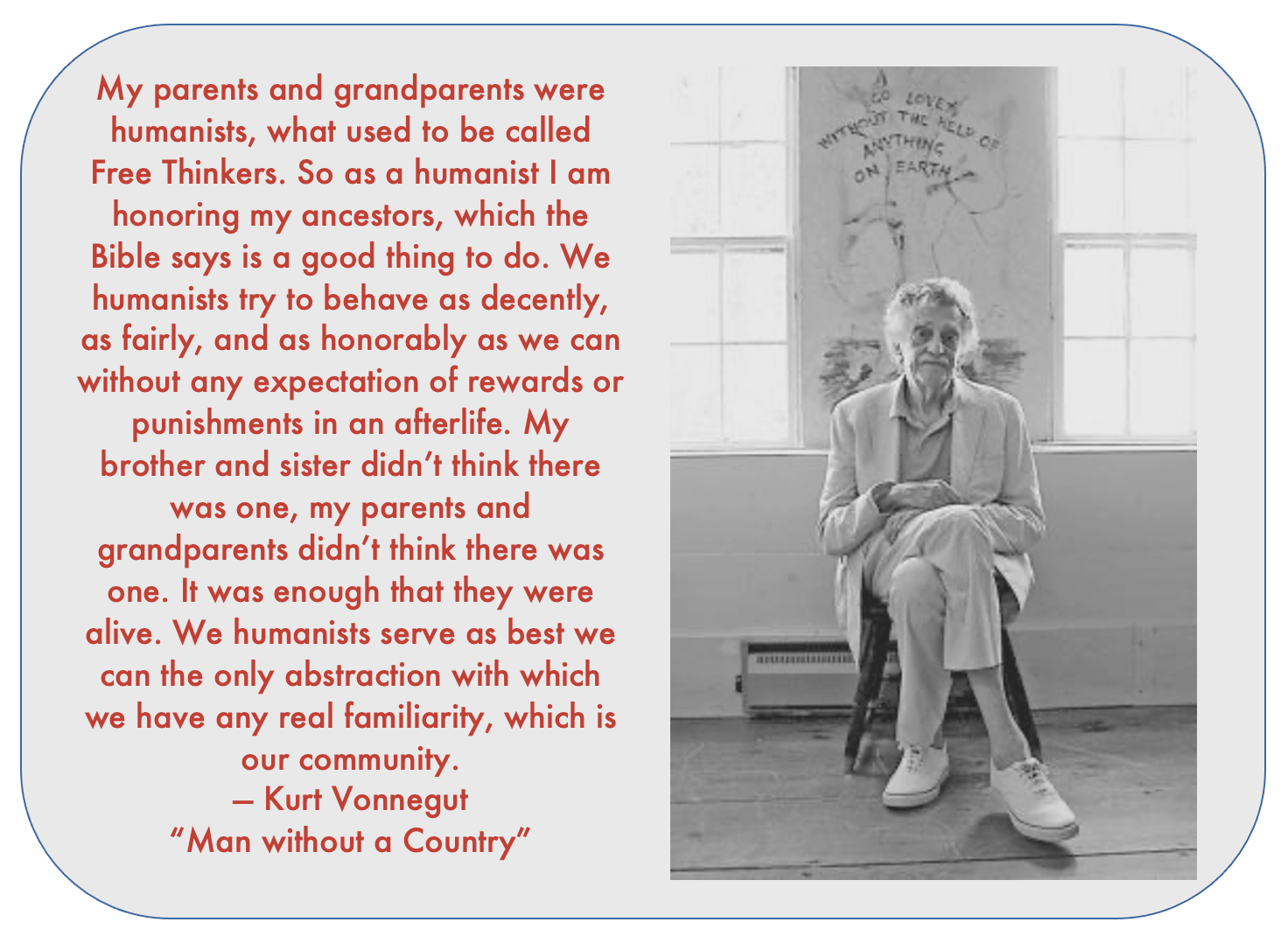
The Left I recognized in myself is grounded in the writing of Kurt Vonnegut, who was profoundly shaped by his Midwestern roots—free thinking and humanism. Vonnegut also was inspired by and introduced me to Eugene V. Debs, one of the most prominent socialists in US history.

I have never found a better way to express what I believe, what constitutes my moral compass, than the words written and spoken by Debs and Vonnegut:

And it is because of these words that I cannot say that I love America—because we have struggled as a country to meet these ideals—but I can say proudly that I love the promise of America, these words that I think are about the most poetic and beautiful promise humans can pursue, as expressed by writer John Gardner:

That idea—humankind’s inalienable right to life, liberty, and the pursuit of happiness—coupled with a system for protecting human rights —was and is the quintessential American Dream. The rest is greed and pompous foolishness—at worst, a cruel and sentimental myth, at best, cheap streamers in the rain.

But this wonderful promise—”humankind’s inalienable right to life, liberty, and the pursuit of happiness—coupled with a system for protecting human rights”—remains unfulfilled because we have failed to truly practice these ideals, we have been negligent about making this promise real—even when we are repeatedly reminded, as MLK expressed:

Moreover, I am cognizant of the interrelatedness of all communities and states. I cannot sit idly by in Atlanta and not be concerned about what happens in Birmingham. Injustice anywhere is a threat to justice everywhere. We are caught in an inescapable network of mutuality, tied in a single garment of destiny. Whatever affects one directly, affects all indirectly. Never again can we afford to live with the narrow, provincial “outside agitator” idea. Anyone who lives inside the United States can never be considered an outsider anywhere within its bounds.

Vonnegut, we must note, was profoundly shaped by being a prisoner of war, and both Debs and MLK were jailed for their moral causes.

We should acknowledge, then, that we all are prisoners of our negligence, our failure to create a safe society, a willingness to simply live with mass and school shootings, and the rising political tide that seeks to take away some people’s access to life, liberty, and the pursuit of happiness.

And the alternative, the path toward honoring the promise, is not even that difficult: “We humanists try to behave as decently, as fairly, and as honorably as we can without any expectation of rewards or punishments in an afterlife.”

Decently. Fairly. Honorably.

As Vonnegut was apt to quip, like a Christian nation.

And yet: “While there is a soul in prison, I am not free.”


Recommended

Debs speech, Kurt Vonnegut

Vonnegut’s Sermon on the Mount

Celebrating Violence Is a Type of Violence—But So Are Words

[Header Photo by Jon Tyson on Unsplash]

Somewhere around tenth grade, I began to recognize in myself a strong belief in nonviolence.

One day in English class remains a seminal moment in my life—one that included people who would shape my life profoundly as an educator.

I was in Lynn Harrill‘s class. Lynn would become my mentor and friend, the man influenced who I am in ways that rivaled my own father’s influence.

Lynn’s English class was unlike any English class I had ever sat in before. We had to write essays (English classes in junior high had been mostly working in grammar textbooks and diagramming sentences), and Lynn grounded his teaching in robust class discussions.

And many of us loved those discussions, and him.

One class period, we found ourselves in a heated class debate about who would willingly fight in a war if drafted. Coincidentally, that day the principal, Mr. Clark Simpkins, was observing Lynn, and Mr. Simpkins was the husband of my 6th-grade math teacher (who I loved) and father of two sons around my age. Most significantly, Mr. Simpkins would be the person who hired me for my first job teaching English.

As the debate unfolded, a clear division developed—all of the male students eagerly expressed a desire to fight in a war, except for me, the lone male student speaking for nonviolence with the young women in the class.

The day of my interview about 7 years later, Mr. Simpkins reminded me of that day, and honestly, there was a bit more than a veiled implication that my beliefs could keep me from being hired—one of many moments when, even after I was hired, these implications were used to keep me in my place.

Being a advocate for nonviolence in the South was perceived as unmanly, unpatriotic; it certainly was one of many of my beliefs that made me unlike the culture of my home and my career.

None the less, one of my recurring units as a teacher, one that my students appreciated and seemed to strongly engage with, included an exploration of nonfiction writing through the writings and activism of Henry David Thoreau, Gandhi, and Martin Luther King Jr.

The thread running through these men and their lives, of course, was advocacy for civil disobedience and nonviolence.

The goals of this unit were primarily about helping students grow as critical readers and writers, but I also very much wanted my students to consider and reconsider their own beliefs about violence.

I had grown up in the same Southern culture of my students, and I know most of them had not had that opportunity.

This, of course, is a long way to say emphatically that I without qualification believe that celebrating violence is a type of violence.

And I reiterate that in the wake of the inexcusable killing of Charlie Kirk.

Here I want to add that I am also concerned about the aggressive whitewashing of Kirk’s rhetoric and agenda by many conservatives who are using Kirk’s death for political and ideological gain.

That, I believe, is almost equally as offensive as callously celebrating or joking about the gruesome public murdering of a person in what should be a free and safe society.

As just one example of the debates on social media about what Kirk did and did not promote, let’s look at the claim that Kirk advocated for the death penalty for being gay, linked to his quoting Leviticus 20:13 and calling that “God’s perfect law.”

[I will not link the video here because I do not want to platform Kirk, but this is easy to search and confirm. If you doubt anything here, please find the clip yourself.]

This moment by Kirk is, in fact, an example of words as violence because simply mentioning stoning gay people to death because of God’s law is, at best, a veiled threat to the lives of anyone who is gay.

It is a reminder of what has been. It is a warning about what could be again.

History is replete with religious and institutional torturing, imprisoning, and killing people simply for being gay, and often these acts were grounded in religious dogma.

If Kirk was as smart as his advocates claim, he was quite aware of what he was doing by citing Leviticus and saying the law is “perfect.”

This was a threat, a form of rhetorical violence.

But what strikes me as the most concerning aspect of this moment is that Kirk is grinning and smiling throughout. He sees this little reference to stoning gay people to death as a joke, just a cool guy making a “by the way” point to engage in civil debate and discourse.

Despite Kirk being framed as a champion of free speech and an advocate for civil discourse, the content of what Kirk said often contained misinformation and hostile claims about marginalized people; that isn’t civil discourse, and “free speech” doesn’t mean people are not held accountable for what they say.

If Kirk’s agenda cannot be fully articulated after his death, that suggests it wasn’t valid to begin with.

For LGBTQ+ people, quoting Leviticus devalues to their lives and threatens their happiness; it is not a podcast joke, not simply a way to play “gotcha” in an online debate.

This is their lives, and all they request is that they have the same access to life, liberty, and the pursuit of happiness that Kirk along with his family and followers also want and deserve.

To be blunt, there are many examples like this that discredit the whitewashing of Kirk being perpetrated by people with political and ideological agendas, people who seem unconcerned about using Kirk’s death for their gains.

There are only a few fair options among those of us who fully condemn and reject the killing of Kirk; we all must start with the truth about who Kirk was and what he advocated for, and then we must reject it or embrace it. The latter is the only way praise and honoring Kirk by his advocates can be taken seriously.

If anyone has to misinform or lie to praise someone, that calls into question whether that person, in fact, deserves praise.

For me the only way to honor Kirk is to condemn the senseless killing and then to accurately describe who Kirk was and what he championed.

To cheer for his death or to misrepresent his life’s work is to dishonor not only Kirk but all of use.

Who Controls Science Controls: “we all need to conform to the science”

[Header Photo by Markus Spiske on Unsplash]

While there is ample and disturbing evidence to keep our focus on the tremendous destructive outcomes of the second Trump administration, we should also recognize that the seeds of these worst policies for education were planted by George W. Bush as both governor of Texas and president of the US.

The recent release of the government report with fake citations (likely from using AI) is just one of the most chilling examples of the cumulative effect of government control of what counts as “science,” and thus, Why Trump’s push for ‘gold-standard science’ has researchers alarmed.

So, first, we must note that Bush education agenda in Texas included scripted curriculum, and then, more significantly, Bush’s signature No Child Left Behind (NCLB) was grounded in mandating “scientifically based” instruction and programs.

Ironically, despite NCLB’s “scientifically based” mandate, in the second decade after implementation, the media, politicians, and pundits declared a reading crisis and ascribed the cause to teacher education and teachers failing to know and use the “science of reading” (SOR).

SOR has, then, spawned the “science of math” and more broadly the “science of learning.”

Similar to the bi-partisan support for NCLB and most education reform since the 1980s, a politically diverse coalition has embraced and endorsed the “science of” movement, although few people have acknowledged that the agenda is mostly conservative ideology.

Some are, however, starting to recognize that “science of” policies are working to de-professionalize teachers through mandating scripted curriculum.

Rachael Jefferson confronts this reality:

There is not enough evidence behind the science of learning to justify it being enshrined in our education system, Jefferson contends. 

“It posits science really as an absolute, and it also suggests explicitly that nobody can question its authority because it is the ‘science’ of learning.

“In other words, ‘whatever [teachers have] been doing for the last few decades is unimportant now, we all need to conform to the science’.

“That’s a very heavy-handed way of approaching pedagogy and also approaching teachers in the field who are very, very experienced in this,” Jefferson tells EducationHQ.

The problem here is not “science,” but who controls what counts as science and how “science” is used as control.

NCLB codifying what counted as “scientifically based” was cause for concern. But over the past two decades, a narrow definition of “science” has evolved, reinforcing the contradictory “science of” movement that demands applying that narrow view of “science” as a veneer for an ideological agenda.

What counts as “science” and credible evidence in education—and all fields—should not be abdicated to government bureaucracy (as evidenced by the current Trump administration).

Ultimately, the “science of” movement has proven to be less about teaching and learning or reforming education, and more about political and ideological control (parallel to the current misuse of “science” by Health and Human Services [HHS] Secretary Robert F. Kennedy Jr.)

For teaching and learning, scientific research certainly provides important and powerful evidence for teaching and teachers; however, the “science of” movement is distorting and controlling what counts as “science” for ideological and political agendas.

The Trump agenda for so-called “gold-standard science” is the logical and catastrophic logical outcome of many decades of political mandates for education reform.

The lesson?

Who controls science controls.


Recommended

The problem with vibes-based cellphone reporting – Kappan Online

The Science of Ideology: What Is Really Wrong with Education?

[Header Photo by Ivan Aleksic on Unsplash]

Responding to the symposium question “What Shall We Do about Reading Today?” Emmett A. Betts, professor of Education at Pennsylvania State College, opened the first article in a professional journal for elementary education with a broad claim:

In a democracy, the people get the kind of schools they want. One of the many functions of an educator is to point the way to ever better schools. If the people want many public and private institutions for the preparation of teachers regardless of the quality of the work or the teacher supply and demand, the people get them. If the people want better schools plants and instruction, they make their will known at the polls and they get what they want. In a democracy, the quantity and quality of educational opportunity is the product of what people want, and what they want is to no small degree conditioned by the educational leadership they have elected to follow. (p. 226)

This may read a bit idealistic or naive, but Betts, I think, offers an accurate characterization of the very complex public education system in the US—a system bound necessarily to the political system itself.

Betts then warns:

Very soon strong pressure will be felt by elementary school teachers to intensify instruction in certain areas, such as reading. This pressure will be brought to bear by non-educators who have found a deficiency but who may may offer no other solution than a “stronger prescription.” Years of fruitful research on learning many be cast aside in order to “do something about reading instruction….” To prevent this wastage, educators must be prepared to bring to bear a considerable accumulation of information that permits an adequate resolving of this problem. (p. 226)

Later in that issue, William S. Gray, University of Chicago, expands on Betts’s warning:

[R]ecent editorials…maintain that current deficiencies in reading are the product of “pseudo-scientific bungling and the innovation of so-called progressive methods of teaching. The solution advocated by one editor was the elimination of “impractical non-essentials,” which were not defined, and of “undisciplined dabbling with practical essentials. The implication of these vague criticisms is that recent innovations in teaching reading have been adopted without due consideration of essentials and of methods of achieving desired ends. Such assumptions are as unsound and merit no more consideration than a purely defensive attitude. (p. 235)

In forty-plus pages, eleven literacy scholars confront the same problems with a reading crisis that may sound familiar to people in 2025.

However, this is from 1942

And in a mere two decades, guess what the state of reading the US entailed?

“After half a century of [progressive reform and expanding public education],” wrote Jacques Barzun in Tomorrow’s Illiterates: The State of Reading Instruction Today (1961), “we who run businesses, carry on professions, work for the government, or engage in teaching itself are forced to admit that illiteracy is still with us” (xii-xiii).

Barzun adds, “the citizen who is interested (and who has managed to learn to read) [may have their] hair [stand] on end at hearing what folly has been condoned as educational theory during the past thirty years” (p. xiv).

Editor of this volume and author of chapters 1 and 7, Charles Child Walcutt argues: “One way to describe the reading problem is to say that it is a teacher problem and—even more—that it is a problem of the teaching of teachers” (p. 18).

And of course: “The assertion that the reading experts do not understand the theory of their system can be demonstrated if we point out the false assumptions, the faulty extrapolations from scientific research, and the absolute contradictions that appear in its central propositions and procedures” (pp. 19-20).

Over sixty years ago, a reading crisis was declared (twenty years after on just before it), teachers were blamed, and reading experts were accused of not understanding the science behind their own field.

Déjà vu all over again.

There is a recurring story—one that is profitable and easy to sell—that education in the US is a failure, notably reading and math education.

The problem with this story is that it has existed since the mid-1800s in some fashion; but as I share above, an intense era of education (reading and math) crisis is at least 80 years and running.

And then, the last 40 years has been characterized by perpetual education reform, several cycles of new standards, new tests, and constant high-stakes accountability.

At no point in the US has the public, the media, or political leaders declared education (reading or math) effective.

But since the 1980s, after the hyper-crisis panic of A Nation at Risk, the US has doubled and tripled down on in-school only reform—”pressure will be brought to bear by non-educators,” as Betts noted in 1942.

The story that isn’t compelling and is hard to sell is this: The history of education crisis and reform has been grounded in misdiagnosing educational problems, casting misguided blame, and mandating solutions that are destined to fail—and even cause harm.

However, here is a story told in research that the US will not accept:

Almost 63% of the variance in test performance was explained by social capital family income variables that influence the development of background knowledge. Background knowledge is a known predictor of standardized test results. Family income variables are immutable by schools. Only public policies, outside the control of school personnel, can influence family income….

Policy makers and education leaders should rethink the current reliance on standardized test results as the deciding factor to make decisions about student achievement, teacher quality, school effectiveness, and school leader quality. In effect, policies that use standardized test results to evaluate, reward, and sanction students and school personnel are doing nothing more than rewarding schools that serve advantaged students and punishing schools that serve disadvantaged students. (Maroun and Tienken, 2024)

In other words, the ways we measure school and teacher effectiveness as well as student achievement are in fact mostly measuring out-of-school factors.

So, what is really wrong with education?

Ideology/politics and market forces.

The disconnect between public, political, and media beliefs about education and decades of research reinforced by Maroun and Tienken is entirely ideological/political.

Many people in the US are bound to rugged individualism and the meritocracy myth, both of which feed into another belief that education transforms society.

So we are now at the story the US hates, refuses to acknowledges, and thus, does not sell: Schools reflect our society, but do not (cannot) transform it (reread the opening quote from Betts above).

There is a core libertarian belief in the US rejecting the dominance of systemic forces that drives crisis rhetoric about education as well as the politics and policy mandating how we implement our schools.

US public education has never been a singular process. There has never been one program or learning/teaching theory driving schools.

However, the ideological attacks on schools, teachers, and students have always reduced claims of crisis to simplistic problems and blame (reading the entire journal issue from 1942 or the book from 1961 is eerie and frustrating).

But possibly as powerful and problematic as ideology/politics is the impact of market forces on educational practices.

To be blunt, the education market benefits from perpetual education crisis, not from successful education reform. (See also: The healthcare market benefits from perpetual illness, not curing diseases and healthy people.)

Education crisis and reform, then, have been almost entirely ideological/political and market driven.

Ironically, perpetual crisis/reform benefits both ideology/politics and the market.

Regretfully, perpetual crisis/reform does not benefit schools, teachers, or students.

This also is a story that doesn’t sell: The current “science of” movement (science of reading, science of math, science of learning) is nothing new; in fact, this is simply the science of ideology (again).

Because of the outsized impact of ideology/politics and the market on how we talk about, judge, and implement schooling in the US, we do not have a crisis, but an entrench set of failures we lack the political will to address: perpetual opportunity and achievement gaps between affluent, white students and minoritized/marginalized students (Black and brown students, impoverished students, multilingual learners, and special needs students).

Yet those gaps have been about the same for many decades and across all areas of learning (there is no gap in reading, for example) that isn’t also in math or science, or even civics).

But as Maroun and Tienken show, those measured gaps are more about social inequity than education—even though those measures also show in-school inequity as well that magnifies systemic inequities.

The ideology/politics driving how we view and implement our schools is corrupted by a fatalism about needed social reform.

It isn’t that we cannot build a better society; it isn’t that we cannot build better schools.

It is that we simply have chosen that neither matters more than our sacred—and misguided—beliefs and market.


Recommended

Enough with the doom and gloom. American education isn’t failing. Perry Bacon Jr.

The overwhelming majority of American students are reaching “baseline proficiency,” in math, reading and science, according to PISA. That’s almost certainly because of our public school systems, where about 87 percent of students in grades K-12 get their education. U.S. politicians for a while were pushing the aspirational idea that most students should score proficient or above on the NAEP tests. That is a very high and probably unrealistic standard. Most of America’s students are reaching the NAEP “basic” level, mirroring the PISA results.

NAEP: A Modest Proposal

[Header Photo by Nguyen Dang Hoang Nhu on Unsplash]

Likely the most influential standardized test in the US is the National Assessment of Educational Progress (NAEP), under the purview of the beleaguered US Department of Education.

Also without question, NAEP is one of the most misunderstood and misrepresented standardized tests since the mainstream media, political leaders, pundits, and the public routinely shout “Crisis!” with each release of NAEP data.

NAEP’s achievement levels are misleading at best, but at worst, those achievement levels were designed to create the appearance of perpetuate educational failure, and yes, crisis.

“Proficient” is almost always conflated with “grade level” resulting in false claims, for example, that 2/3 of fourth graders are reading below grade level. NAEP’s “basic” is approximately what most states identify as “proficient”—suggesting on grade level (see an extensive analysis here).

What most people misunderstand as well about NAEP is its purpose: NAEP was born in the fertile soil of high-stakes accountability education reform spurred by the Reagan administration’s propaganda A Nation at Risk. Reagan sought to reintroduce forced prayer in schools and wanted to close the Department of Education, labeled an “abomination.”

However, what Reagan spawned was over four decades of ever-changing standards and tests to hold schools, teachers, and students accountable. In short, NAEP was created as a test of random samples of students to hold states accountable for their educational standards and outcomes (historically, public education has been the responsibility of the states, and NCLB in 2001 was a departure toward more federal oversight).

Frankly, NAEP was designed as an accountability mechanism, not a way to provide feedback on individual student achievement. (Note that state-level accountability testing was designed to provide individual student assessment that should provide evidence for instruction.)

In 2025, on the heels of recent shouts of “Crisis!” (again) because almost everyone has misunderstood and misrepresented NAEP scores across math, reading, and even civics, Reagan’s dream may be coming true since the Trump administration has promised to end the USDOE, and that move imperils the future of NAEP.

As Peter Greene has confronted, some have taken this uncertainty about NAEP to propose turning NAEP into (you should pause here to prepare yourself for the inanity) the failed Common Core experiment that sought to replace the state-based public education accountability process with national standards and testing.

Into the nonsense that is NAEP historically and the current doubling-down on Common Core Redux, I want to make a modest proposal about the future of NAEP.

Actually I want to make two modest proposals, acknowledging that the first is never going to happen (although it is the one more strongly supported by empirical data; you know, the “science” that so many education reformers claim to worship).

I strongly reject standardized testing as well as traditional classroom testing and grades. That has been at the core of my 40-plus-year career, and again, this is informed not just by my experiences as an educator but by a very robust body of research.

Therefore, my first modest (and completely unrealistic in the US) proposal is the conclusions reached by Maron and Tienken:

Almost 63% of the variance in test performance was explained by social capital family income variables that influence the development of background knowledge. Background knowledge is a known predictor of standardized test results. Family income variables are immutable by schools. Only public policies, outside the control of school personnel, can influence family income.

The United States has one of the highest levels of childhood poverty among Organisation of Economic Co-operation and Development (OECD) countries. It is well known that the social safety net in the United States is not as strong as some nations in Europe and other parts of the world [20]. Neoliberal policies have greatly reduced government support for families in the United States. Important social policy frameworks that reduce poverty, such as monetary, labor, fiscal, and health policies, have been weakened over the last 40 years, causing increases in childhood poverty in the United States compared to other democratic countries [41].

Although some education policy makers in the United States claim that standardized test results are an important component of a comprehensive system of educational quality control, the results from decades of research on the topic suggest otherwise [42]. The influence of family social capital variables manifests itself in standardized test results. Policy makers and education leaders should rethink the current reliance on standardized test results as the deciding factor to make decisions about student achievement, teacher quality, school effectiveness, and school leader quality. In effect, policies that use standardized test results to evaluate, reward, and sanction students and school personnel are doing nothing more than rewarding schools that serve advantaged students and punishing schools that serve disadvantaged students.

Alas, the US will never follow this last point because we refuse to acknowledge systemic forces and remain a people fatally committed to rugged individualism and bootstrap mythologies.

And thus, here is my compromise, a modest proposal that can and should be explored for the future of NAEP:

  • Rename achievement levels in standardized testing that share a national standard metric for the levels (all states and NAEP would share the same achievement levels and metric).
  • Achievement levels must be age-level and not grade-level (currently, using “grade level” allows states to game scores through grade retention, for example). A clear system of “below age level,” “age level,” and “above age level” would simplify reporting and allow for more accurate political, media, and public responses to data.

This proposal would be a first step, I hope. The problem at first is that this doesn’t address the excessive testing culture the US has embraced without positive outcomes for over forty years.

This first step, I think, can create a new basis for evaluating and viewing our public schools, and then, we may be primed to begin dismantling the standardized testing machine—or at least become more acclimated to reducing it dramatically.

The great irony of the power of high-stakes testing in the education accountability era is that it has proven only one thing: Weighing a pig does not make it fatter.

Testing, testing, and testing has not improved schools, teachers, or students, but it has created a perpetuate state of educational crisis.

Perpetual educational crisis serves only political agendas and the unquenchable education marketplace.

If we can entertain for a moment of idealism that the Trump disaster doesn’t destroy both the USDOE and public education, let’s consider how to more forward in ways that better serve the promise of public education and our fragile democracy.

If not an end to NAEP, at least a better NAEP that serves the interest of students and not political or market agendas?


See Also

Big Lies of Education: Reading Proficiency and NAEP

Beware Grade-Level Reading and the Cult of Proficiency

Rethinking Reading Proficiency