Education Lies that Won’t Die: Teacher Value

The list is mind-numbingly long—education lies that won’t die.

I have detailed often the standard manufactured crisis/miracle rhetoric surrounding discussions of education in media, among the public, and by politicians.

And currently, the manufactured reading crisis is grounded in the Big Lie about NAEP and reading proficiency.

Many education lies that won’t die are ideological beliefs masquerading as evidence-based claims; two of the most persistent of those involve assertions about teacher value and merit pay schemes.

Of course, teacher value is incredibly important to student learning; however, this argument is misleading at best, at worst a lie: “Research has shown that the number one factor influencing individual student achievement is the quality of the teacher in the classroom.”

It is an incredibly compelling misrepresentation of the data available, primarily because it appears to support the value of teachers.

Yet, the evidence over many years shows that measurable student achievement is mostly driven by out-of-school factors (OOS) with in-school factors and teacher quality as a subset of that, both significantly overshadowed by those OOS factors:

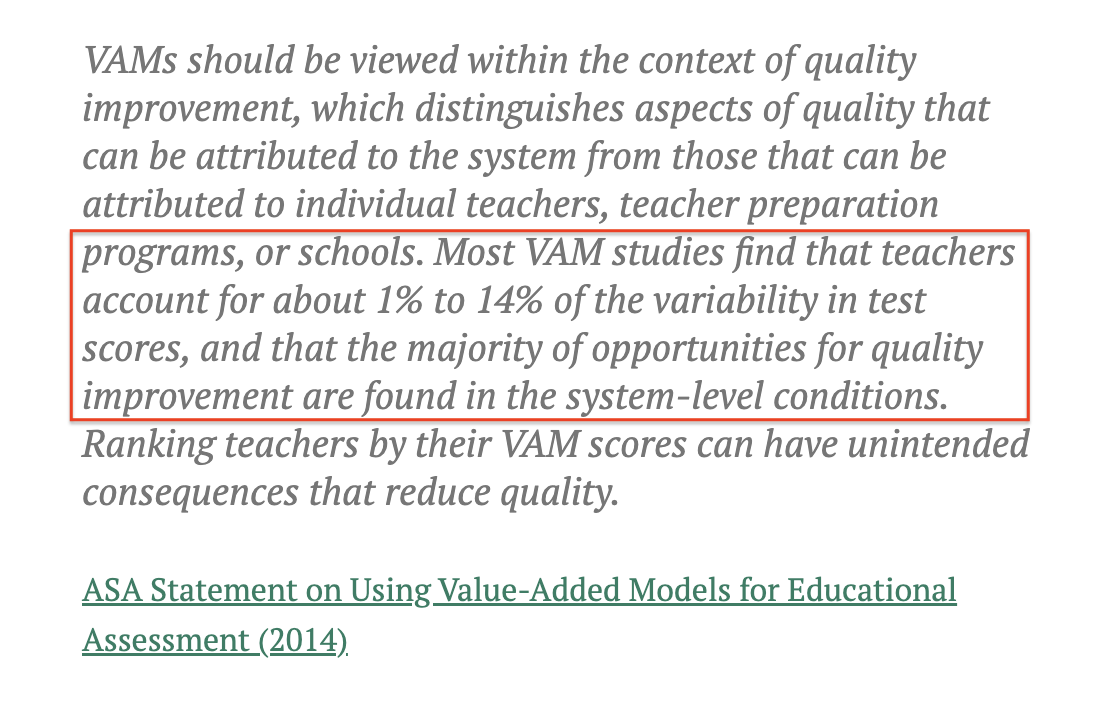
Teachers Matter, But So Do Words
ASA Statement on Using Value-Added Models for Educational Assessment (2014)
Family Background Accounts for 40% of SAT/ACT Scores Among UC Applicants

The paradox is that teacher value is very difficult to measure through student achievement tests. Further, claims about teacher value that misrepresent that value force teachers and students into nearly impossible conditions to be successful.

Locally, a district is revisiting value-added efforts to attract and retain teachers in high-poverty, majority-minority school, paired with merit pay schemes (that have been tried multiple times in South Carolina unsuccessfully).

Value-added methods of teacher evaluation and merit pay are ideological commitments, and both are strongly refuted by a large body of evidence.

Simultaneously with these failed schemes, education is increasingly hostile to teachers—parent organizations framing teachers as groomers and indoctrinators along with states and districts trending toward curriculum bans and scripted curriculum that de-professionalize those teachers:
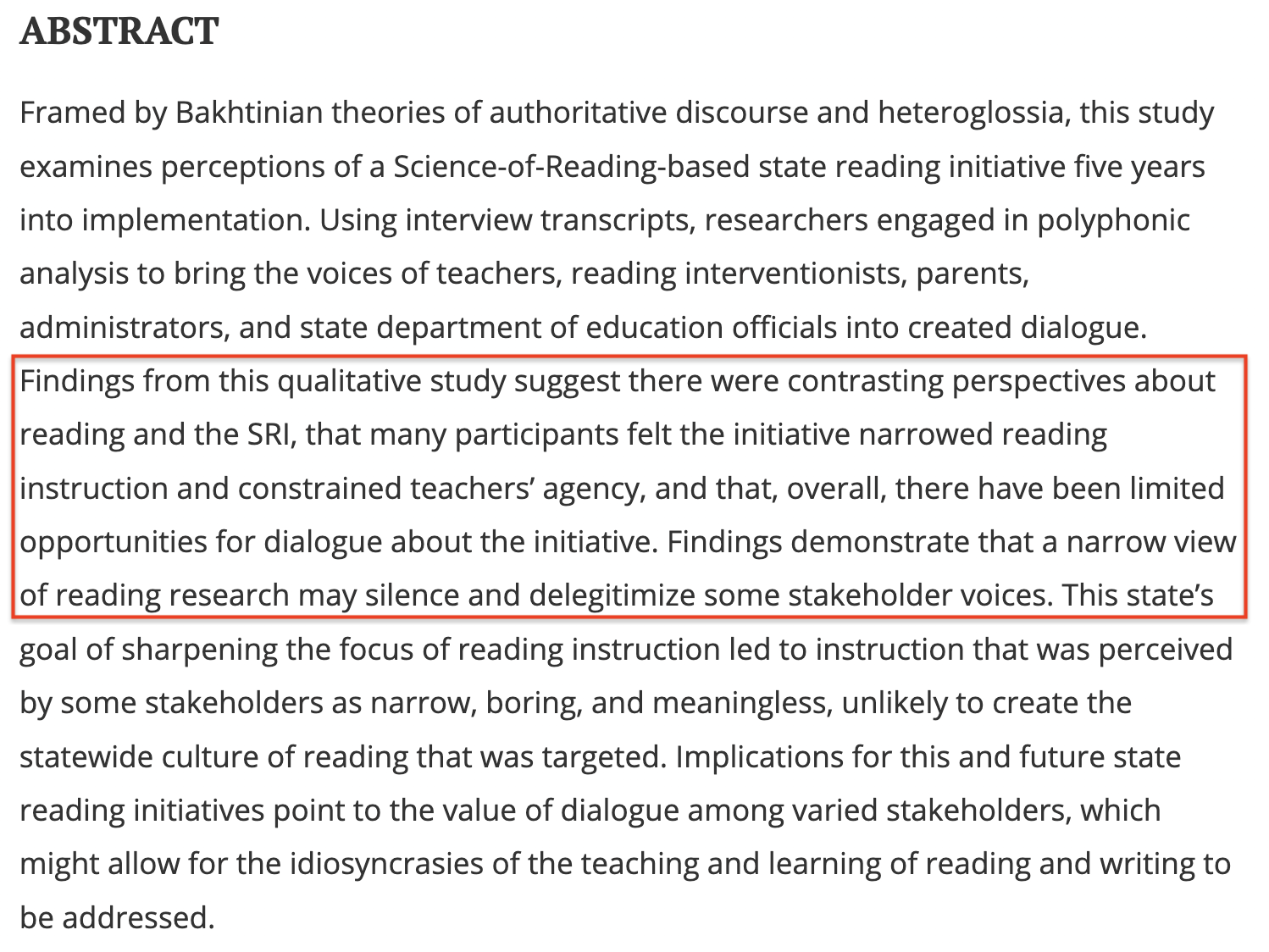
“Phonics Monkeys” and “Real Life Reading”: Heteroglossic Views of a State Reading Initiative

If we genuinely value teachers—and having been in this profession 40 years, I suspect that on balance we do not—we would address teaching and learning conditions (class size, teacher autonomy, etc.) within a larger effort to address social inequity in children’s communities and homes.

Ideology is not evidence, and education, teachers, and students deserve much better than political leaders and administrators using our schools as experiments of that ideology—especially when we have ample evidence that ideology is flawed.


Recommended

VAM: Why Is This Zombie Policy Still Around? Peter Greene


UPDATE

Maroun, Jamil, and Christopher H. Tienken. 2024. “The Pernicious Predictability of State-Mandated Tests of Academic Achievement in the United States” Education Sciences 14, no. 2: 129. https://doi.org/10.3390/educsci14020129

Abstract

The purpose of this study was to determine the predictiveness of community and family demographic variables related to the development of student academic background knowledge on the percentage of students who pass a state-mandated, commercially prepared, standardized Algebra 1 test in the state of New Jersey, USA. This explanatory, cross-sectional study utilized quantitative methods through hierarchical regression analysis. The results suggest that family demographic variables found in the United States Census data related to the development of student academic background knowledge predicted 75 percent of schools in which students achieved a passing score on a state standardized high school assessment of Algebra 1. We can conclude that construct-irrelevant variance, influenced in part by student background knowledge, can be used to predict standardized test results. The results call into question the use of standardized tests as tools for policy makers and educational leaders to accurately judge student learning or school quality.
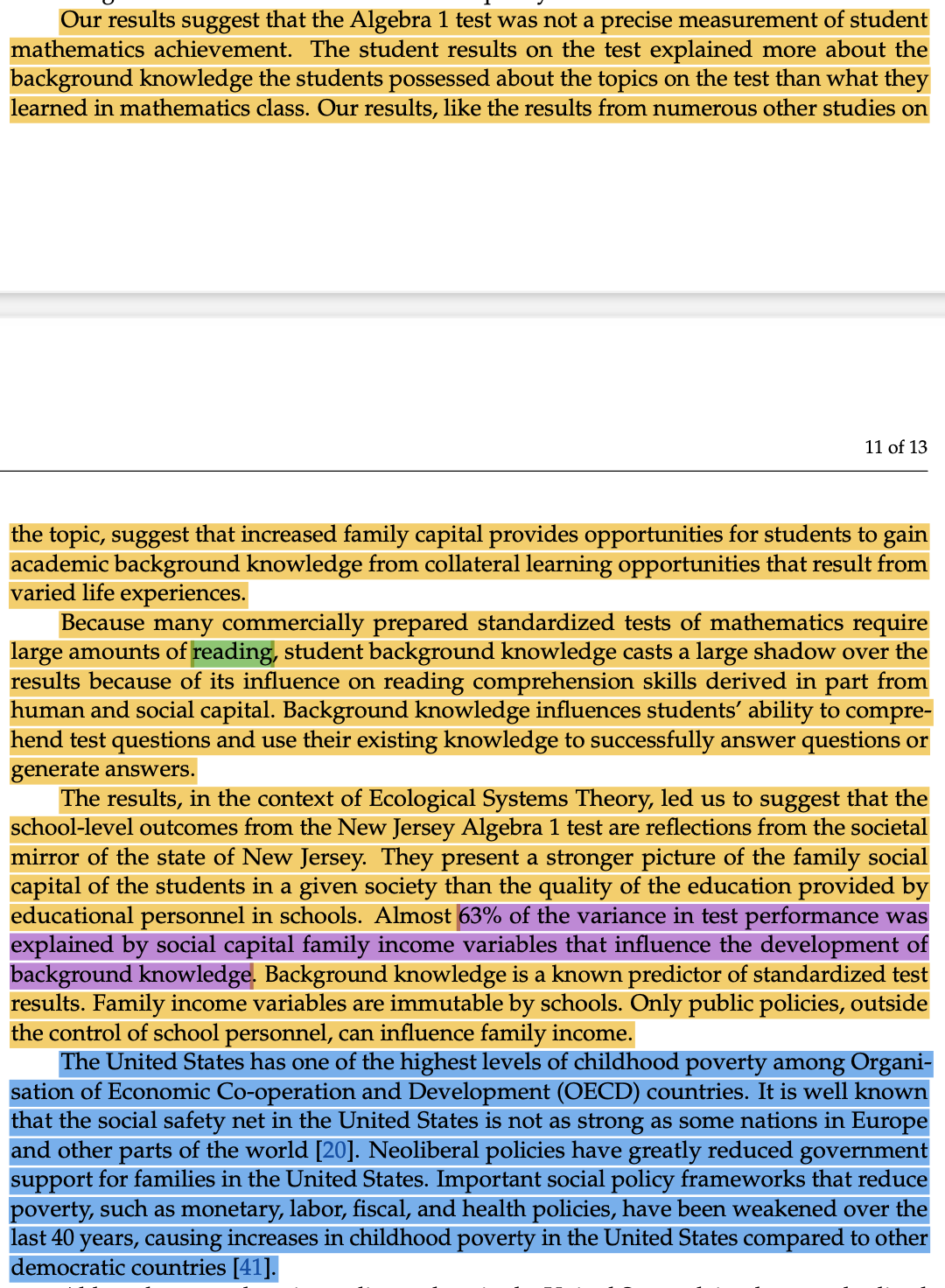

The Heightened Negative Consequences of Reductive Behaviorism on Student Learning

One of the most significant failures of media, public, political, and educational responses to the Covid/post-Covid era of traditional schooling is claiming that the Covid disruption created the problems being addressed about student mental health and student achievement.

The Covid/post-Covid era has heightened those problems in many ways, but the core issues were always the worst features of traditional schooling, notably the reductive behaviorism that drives testing/grading and classroom/school discipline.

Although I taught in K-12 education 18 years, I have been in higher education now for 22 years, working often with first-year students in my writing seminar (and this semester, in our advising program).

My first-year writing seminar students this fall are both very predictably similar to those I have taught for a couple decades and significantly exaggerated versions of those students.

We are at midterm, and students have just submitted Essay 2, a public essay in on-line format designed to help students ease into a formal cited essay (Essay 3). Essay 2 requires students to use hyperlinking for citation (and thus practice evaluating on-line sources, etc.) and incorporate images.

My first-year writing course is grounded in both writing workshop and minimum requirements instead of grades. This minimum requirements include the following:

  • Submit all essays in MULTIPLE DRAFTS per schedule before the last day of the course; initial drafts and subsequent drafts should be submitted with great care, as if each is the final submission, but students are expected to participate in process writing throughout the entire semester as a minimum requirement of this course—including a minimum of ONE conference per major essay.
  • Each essay rewrite (required) must be submitted after the required conference and BEFORE the next original essay is due (for example, E1RW must be submitted before E2 submission can be accepted).
  • Demonstrate adequate understanding of proper documentation and citation of sources through at least a single well-cited essay or several well-cited essays. A cited essay MUST be included in your final portfolio.

I recognize that I must not only teach students how to write at the college level, but also how to fully engage in a process writing course.

That last point is where students have always struggled, but Covid/post-Covid students are struggling mightily.

I provide students a wealth of support material and models for assignment, such as the following for general support:

And these specifically for Essay 2/hyperlink cited essay:

For context, I should note that I do not grade assignments throughout the semester (I must submit a course grade, which is based on a final portfolio as the final exam), and I do not take off for late work because I require that all work must be completed.

Historically, despite no grades or late penalty, my students have submitted work fully and on time at about a 90+% rate. Students typically receive As and Bs in the course with a sporadic student or two who do not meet the minimum requirements and thus fail (which is a consequence of simply not being able to fully engage in process writing).

A couple weeks ago, my first-year students submitted Essay 2; only 4 out of 12 did so on time.

So, yes, Covid/post-Covid education is different, but the issues are not new, just heightened.

What I am noticing is that students struggle to follow guidelines (see above), and I spend a great deal of time prompting students on their essay submission to review the sample and checklist provided.

One recent example struck me because a student submitted their Essay 2 rewrite, which was not significantly different than the initial submission—although I provided comments, directed them to the sample/checklist, and conferenced with the student (conferences end with revision plans and students choosing their rewrite due date).

I did not respond to the rewrite, but returned it with the original submission, noted my concern about almost no real revision, re-prompted the student to review the sample/checklist, and recommended another conference to insure the student and I are using our time well with another resubmission.

Two aspects of the essay were not addressed at all; the essay failed to mention the focus/thesis throughout the body of the essay (three subhead sections), and despite the checklist explicitly requiring students use journalistic paragraphing structure (noting restricting paragraphs to 1-3 sentences), the resubmission included (as in the original submission) opening and closing paragraphs of 5-6 sentences.

The student’s response is notable because they explained how hard they worked on the rewrite, including working with our writing lab, and then apologized.

I want to emphasize that I have over 40 years of teaching writing had to help students let go of the fear of mistakes and the urge to produce “perfect” writing in one submission. Most students simply can’t engage in process writing because the dominant culture of their schooling has been reductive behaviorism that hyper-focuses on student mistakes, fosters a reward/punishment culture, and shifts student concern from authentic artifacts and learning to securing grades.

As I have examined before, students are apt to view all feedback as negative even as I carefully and consistently urge them to see feedback as necessary for growing as writers.

One strategy I incorporate is showing students the real-world process of submitting and publishing academic writing; for example, my own experience publishing a policy brief:

This context, I think, helps some with the anxiety students feel about feedback and their tendency to view that feedback as negative (even though I am not grading them and they are performing in a low-stakes environment).

None the less, students at the college level have been so powerfully trained into the reductive behaviorism of success/failure, tests/grades, and avoiding mistakes that authentic process writing and writing outcomes (students write on topics by choice) are too foreign for them to fully engage.

What concerns me beyond why and how my students are struggling (in justifiable ways) is that I also see teachers and professors complaining about “students today” on social media.

Those complaints are quintessentially American responses—blaming the individuals while ignoring the systemic influences.

Our students are struggling in heightened ways because of the disruptions of Covid/post-Covid formal schooling. But traditional and uncritical commitments to reductive behaviorism are also at the core of their struggling as well.

Many if not most of the traditional approaches to schooling in the US are antagonistic not only to learning but also to the basic humanity of students and teachers.

Learning to write is a journey, a process, but so is all learning.

Students are the canaries in the coal mine warning us that education is too often dehumanizing and reductive. When students choose not to fully engage with that education, they may be making the most reasonable decision by choosing themselves.

Daredevil: Born Again (and Again, and Again …)

[Header and all images property of Marvel and artists]

Many fans of Daredevil fell in love with the Netflix series. But when that relationship ended after three seasons and the Marvel/Disney era threatened a permanent end to more outstanding serialized Daredevil, we fans were cast into limbo.

Unlike the Marvel universe(s), in the real world, things can end end; yet, we continued to hope for resurrection.

Death and resurrection are one of the most persistent (and maybe even cliche at this point) motifs of the superhero comic book genre (Batman experiencing about 22 deaths, for example)—powerfully represented by the career of X-Men’s Jean Grey/Phoenix:

X-Men Vol 1 #101

When Disney announced a reboot of Daredevil, fans rejoiced, and the death/rebirth motif once again resurfaced. This filmed rebirth, similar to the Netflix series, appeared committed to Daredevil’s print comic book roots:

Yes, the Disney reboot leaned hard into a favorite storyline from the Miller era:

Daredevil Vol 1 #230

Increasingly in the comic book world, however, any joy we fans feel can be incredibly short-lived (I barely began collecting Black Widow during the stellar Kelly Thomas v8 run before the series ended, along with the Black Widow solo title, after only 15 issues).

As anticipation mixed with dread grew about the Disney reboot of Daredevil (when cast members were announced, Foggy and Karen were noticeably absent), a strike delayed most original productions. In that pause, even more troubling news came: ‘Daredevil’ Hits Reset Button as Marvel Overhauls Its TV Business.

Daredevil canceled.

Daredevil rebooted.

Daredevil paused.

Daredevil rebooted again (for the better?).

During that same time span, print Daredevil also experienced a significant shift after the highly praised Chip Zdarsky run over two (inexplicable) volumes, 6 and 7.

Zdarsky’s Daredevil focused on extended explorations of Frank Miller’s focus on Matt as a Catholic and an increased emphasis on Daredevil in the ninja/supernatural world with Elektra (fully removed from Matt the lawyer and Daredevil the street-level superhero). In short, there was an abundance of spiritual fretting and an inevitable trip to Hell—and back.

The current reboot (v8) of Daredevil with a new creative team—Saladin Ahmed and Aaron Kuder—includes a soft shift back to Daredevil as a street-level superhero with a clever twist, “Recently, Matt somehow returned to life—born again as a Catholic priest”:

Daredevil Vol 8 #2

As with Zdarsky’s run, the priest/devil duality of the newest volume hints at plenty of Miller still surviving, including a Miller variant cover of v8 issue1:

Daredevil Vol 8 #1

Fans of Daredevil remain in a sort of nervous limbo while waiting for how Disney finally achieves the series Born Again, but in the mean time, we are gifted a somewhat classic rebirth of Matt and Daredevil as priest and devil with spectacular artwork and spreads:

The superhero genre of comic books provides a bittersweet irony since the one thing readers can count on is the death/rebirth motif sitting beneath the distorted passing of time—Matt/Daredevil barely aging over 60 years of comics.

While we readers can only depend in the real world on time passing and the inevitability of death.

Yes, in this real world, things will end end.

So we cling to the things that matter, the things we love.


Daredevil 1 (1964) and facsimile from 2025:

The Ignored Truth about Reading Proficiency in the US


Like dozens of stories in mainstream media, Marion Blank declared in Scientific American, “Biennial testing through NAEP [National Assessment of Educational Progress] consistently shows that two thirds of U.S. children are unable to read with proficiency.”

Reading proficiency crisis has been at the forefront of media coverage and state-level policy for over a decade now. However, the basic claim—2/3 of children not at grade-level proficiency—is misleading at best and false at worst.

The misunderstanding lies in NAEP achievement levels. NAEP warns, “It should be noted that the NAEP Proficient achievement level does not represent grade level proficiency as determined by other assessment standards.”

Tom Loveless calls this the “NAEP proficiency myth,” adding Basic represents grade-level proficiency, and thus, 2/3 of students in the US are reading at grade level or above.

Further, Blank begins the article touting achievement in Mississippi, focusing on impressive gains in NAEP reading. The media embracing of the Mississippi “miracle” further compounds the misinformation about both a reading crisis and one state’s ability to beat the odds.

To understand the US is not experiencing a reading crisis and MS is not a “miracle” template for reading reform, we must consider the recent call for Vermont to mimic MS.

On the 2022 NAEP reading test, VT has 62% of students at or above grade level proficiency (grade 4), compared to MS with 63%. Yes, this is an impressive similarity for MS with a state experiencing a significantly higher rate of poverty and minority students.

But that is not the whole story.

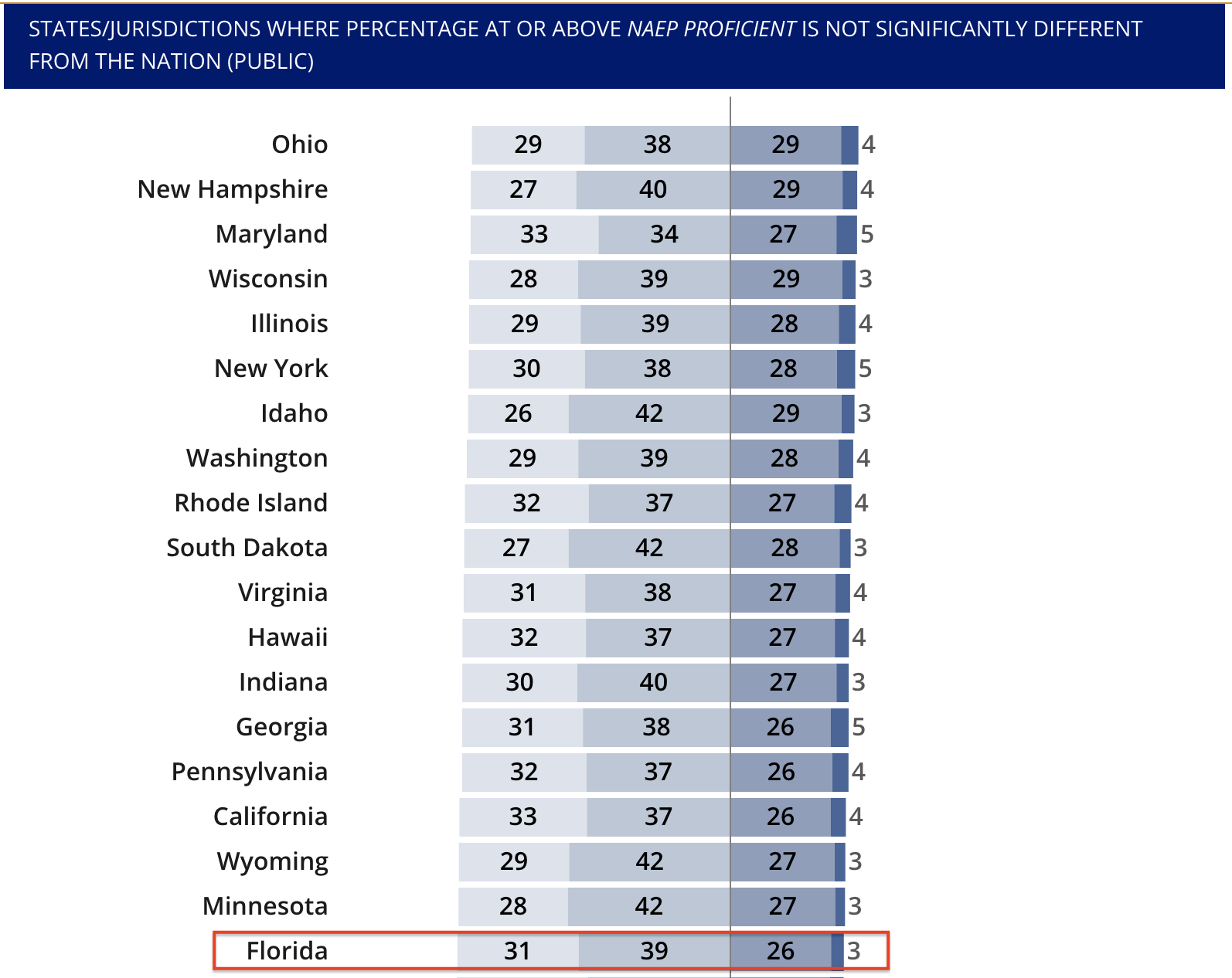
States such as MS and especially FL have very impressive grade 4 NAEP scores that plummet by grade 8: Compare VT (73% grade-level proficient and above) with MS (63%) and FL (69%), notably resulting in VT in the top 6 states in the US, MS in the bottom four, and FL ranking in the middle. Researchers have noted that FL students experience some the greatest drops in achievement from grade 4 to 8, in fact.

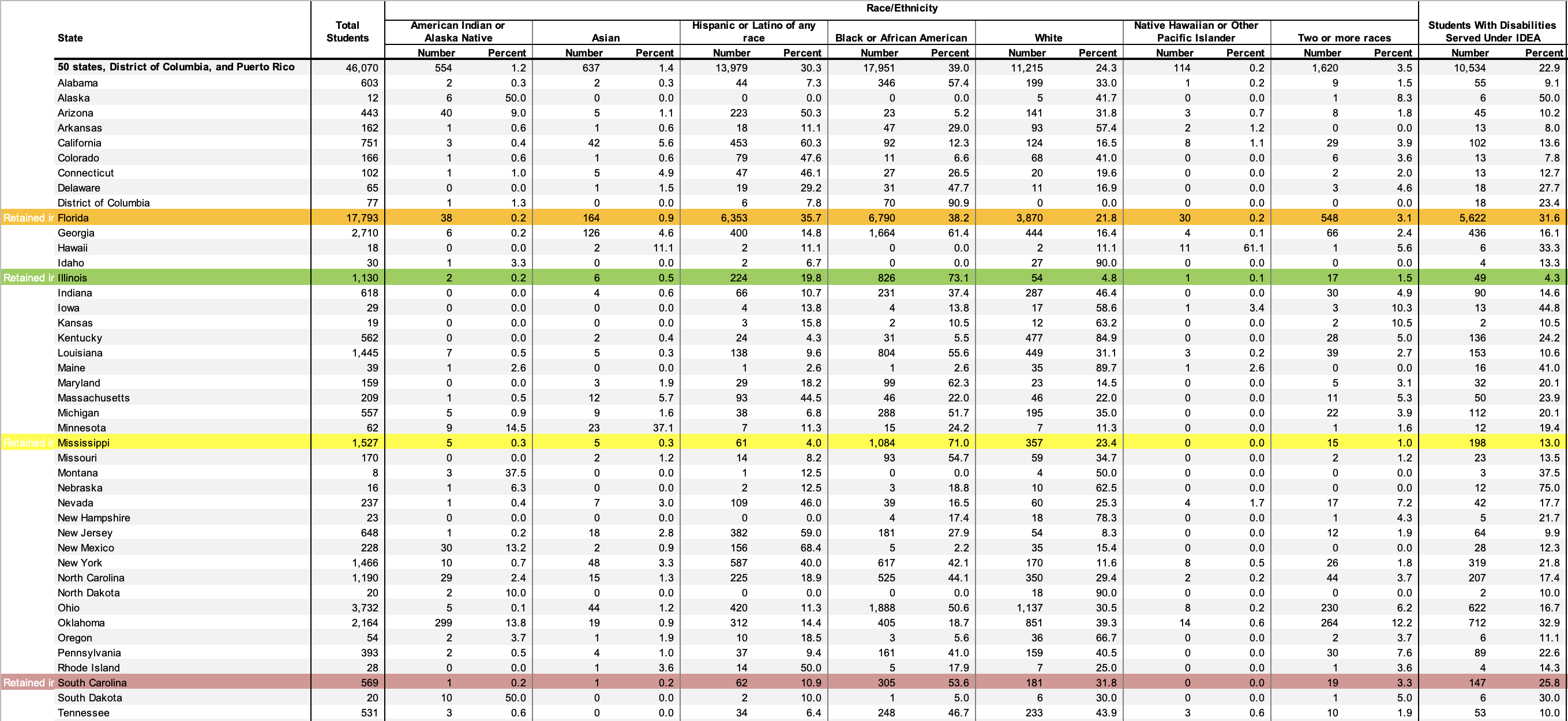
Another ignored fact is that MS, like FL, likely achieves the test score bump from extreme levels of grade retention—impacting from about 9,000 – 12,000 students per year across grades K through 3. The MS “miracle” is a test data “mirage.”

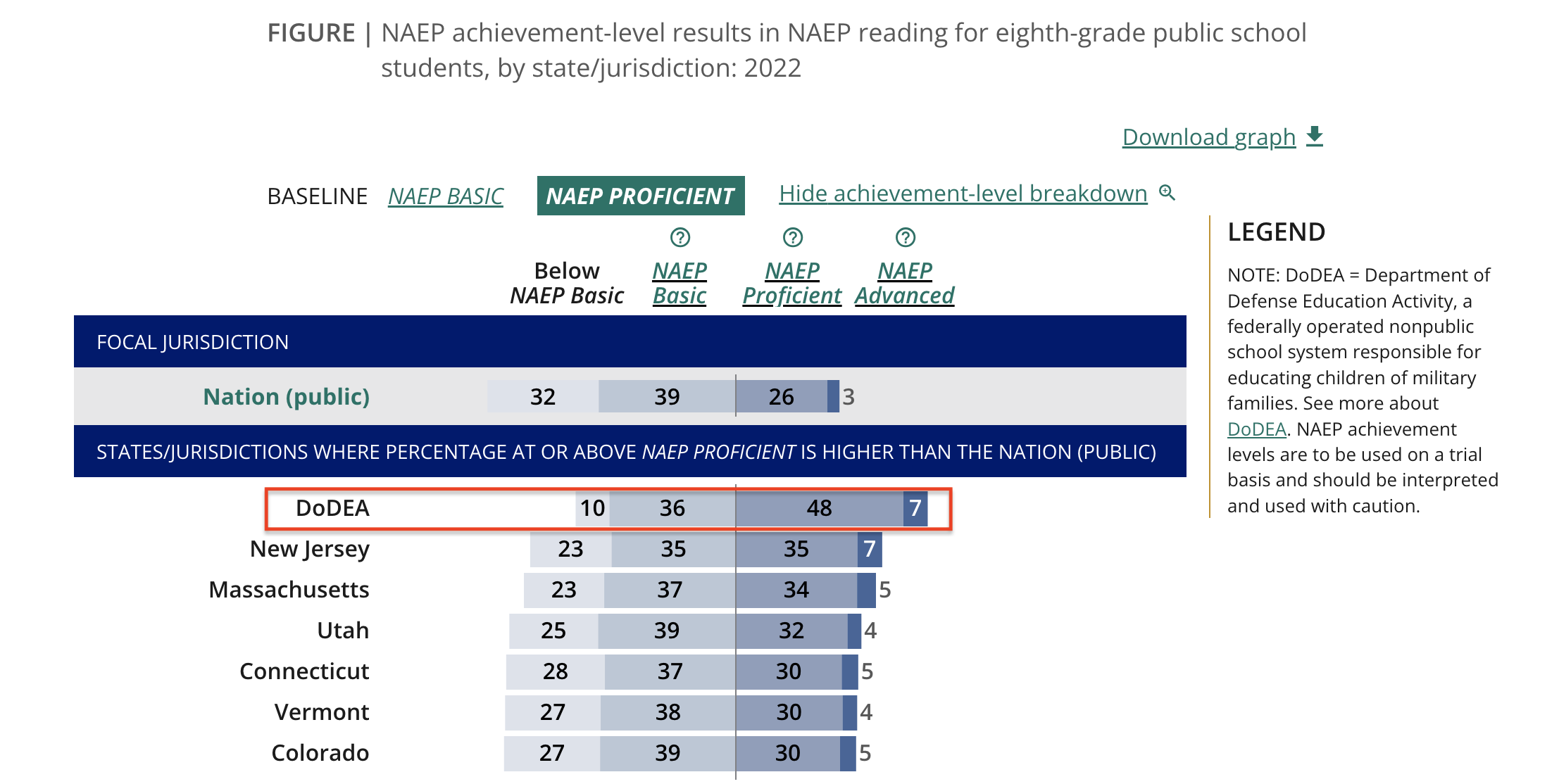
But the most important ignored truth about reading in the US can be found in the publicly funded schools run by the Department of Defense (DoDEA)—DoDEA schools NAEP outcomes include in 2022 (grade 4) 80% and (grade 8) 90% at or above grade-level proficient.

Now here is the most ignored truth about reading achievement. DoDEA schools are not distinct from traditional public schools because of reading instruction or reading programs, but as Mervosh reports:

How does the military do it? In large part by operating a school system that is insulated from many of the problems plaguing American education….

For starters, families have access to housing and health care through the military, and at least one parent has a job….

[T]eachers are also well paid, supported by a Pentagon budget that allocates $3 billion to its schools each year, far more than comparably sized school districts.

Who Runs the Best U.S. Schools? It May Be the Defense Department.

The most important and ignored truth about reading proficiency in the US is that reading is a marker for socioeconomic inequity in both our society and our schools. There is no crisis and there are no miracles. But as DoDEA schools demonstrate, if we have the political will, we can and should better serve all our children as developing readers and citizens.

Testing for Perpetual Education Crisis

“The administrations in charge,” writes Gilles Deleuze in Postscript on the Societies of Control, “never cease announcing supposedly necessary reforms: to reform schools, to reform industries, hospitals, the armed forces, prisons” (p. 4).

Deleuze’s generalization about “supposedly necessary reforms” serves as an important entry point into the perpetual education crisis in the US. Since A Nation at Risk, public education has experienced several cycles of crisis that fuel ever-new and ever-different sets of standards and high-stakes testing.

Even more disturbing is that for at least a century, “the administrations in charge” have shouted that US children cannot read—with the current reading crisis also including the gobsmacking additional crisis that teachers of reading do not know how to teach reading.

The gasoline that is routinely tossed on the perpetual fire of education crisis is test scores—state accountability tests, NAEP, SAT, ACT, etc.

While all that test data itself may or may not be valuable information for both how well students are learning and how to better serve those students through reform, ultimately all that testing has almost nothing to do with either of those goals; in fact, test data in the US are primarily fuel for that perpetual state of crisis.

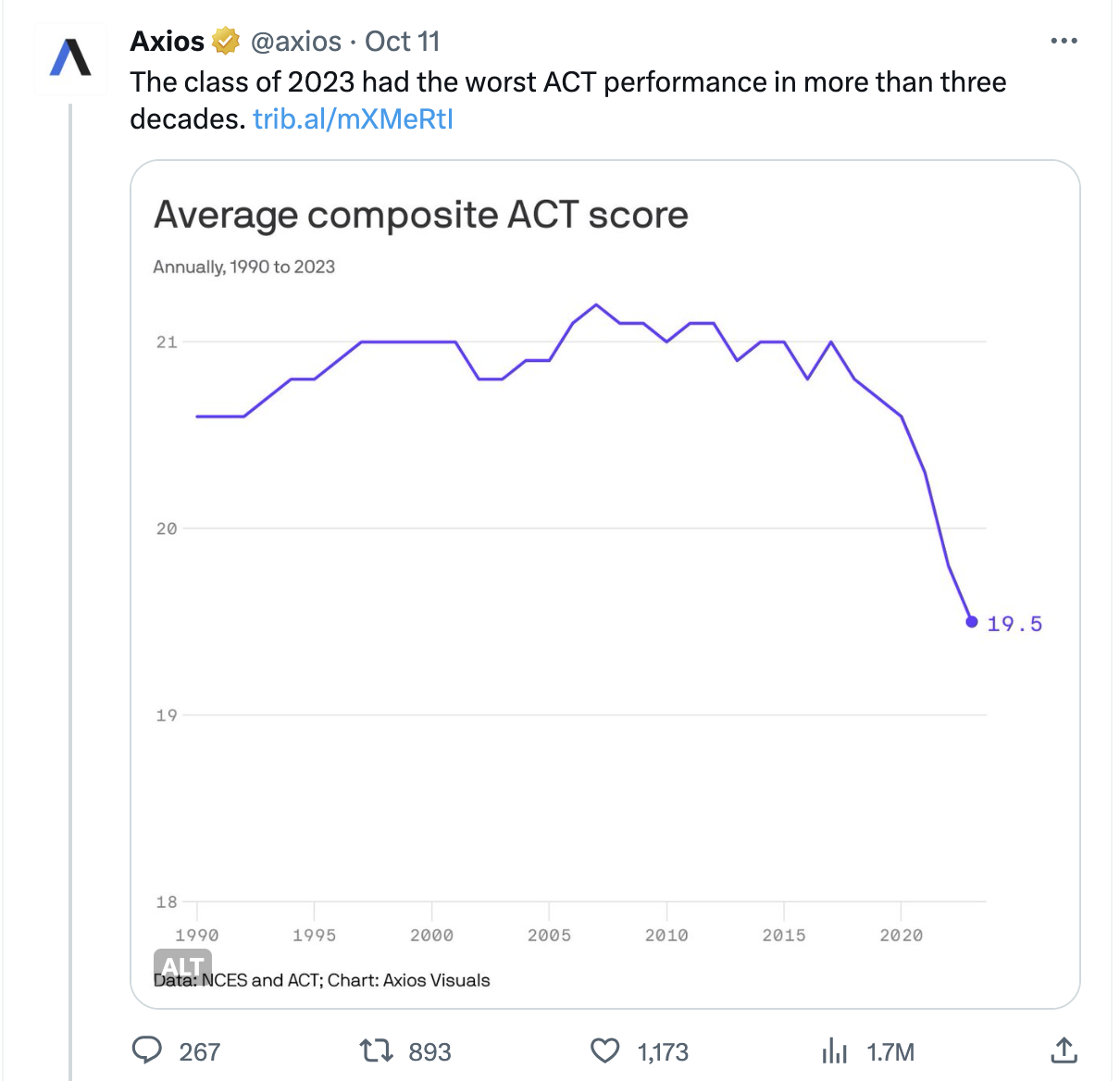
Here is the most recent example—2023 ACT scores:

I have noted that reactions and overreactions to NAEP in recent years follow a similar set of problems found in reactions/overreactions to the SAT for many decades; the lessons from those reactions include:

  • Lesson: Populations being tested impact data drawn from tests.
  • Lesson: Ranking by test data must account for population differences among students tested. 
  • Lesson: Conclusions drawn from test data must acknowledge purpose of test being used (see Gerald Bracey)

The social media and traditional media responses to 2023 ACT data expose a few more concerns about media, public, and political misunderstanding of test data as well as how “the administrations in charge” depend on manipulating test data to insure the perpetual education crisis.

Many people have confronted the distorting ways in which the ACT data are being displayed; certainly the mainstream graph from Axios above suggests “crisis”; however, by simply modifying the X/Y axes, that same data appear at least less dramatic and possibly not even significant if the issues I list above are carefully considered.

Many causal elements could be at work to explain the ACT decrease, including population shifts, social influences (such as the Covid impact), and the inherently problematic element of using test data for purposes not intended as well as making nuanced claims based on singular data points (averages).

For example, the ACT is exclusively designed to measure college preparedness, like the SAT, and not general educational quality of schools or general evaluations of student learning.

Students who take the ACT are a narrow subset of students skewed by region and academic selectivity (college-bound students versus general population of US students).

Also, while a careful analysis could answer these questions, the ACT score drop may or may not represent a significant event, depending on what that single point (average) represents (how many questions and how large is the change substantively).

Likely, however, there is never any credible reason to respond to college entrance data as a crisis of general educational quality because, as noted above, that simply is not what the tests are designed to measure.

The larger issue remains: Testing in the US rarely serves well evaluating learning and teacher, testing has not functioned in service of achieving effective education reform, but testing does fuel perpetual education crisis.

This crisis-of-the-day about the ACT parallels the central problem with NAEP, a test that seems designed to mislead and not inform since NAEP’s “Proficient” feeds a false narrative that a majority of students are not on grade level as readers.

The ACT crisis graph being pushed by mainstream media is less a marker of declining educational quality in the US and more further proof that “the administrations in charge” want and need testing data to justify “supposedly necessary reforms,” testing as gas for the perpetual education crisis fire.

When Exceptional Publicly Funded Schools Are Not a Miracle, and Why

Consider the following headlines from the New York Times:

The first two are confidently assertive (lots of knowing), and the third tiptoes into a question and a “may be.”

What is fascinating, and frustrating, is that the first two are almost entirely false coverage—the first badly misrepresenting reading achievement in MS and the second inexcusably misrepresenting NAEP reading data.

The key here is that the first article feeds into the misleading “miracle” narrative popular in media and political rhetoric about schools and the second asserts the “crisis” rhetoric about public education.

Media struggles with the third article topic—the exceptional achievement found in Department of Defense schools—and possibly the most telling quote in the article hits the nail on the head:

“If the Department of Defense schools were a state, we would all be traveling there to figure out what’s going on,” said Martin West, an education professor at Harvard who serves on the national exam’s governing board.

Who Runs the Best U.S. Schools? It May Be the Defense Department.

In a rare moment of almost getting things right about education and testing, the article highlights the outstanding achievement found in DoDEA schools:

Looking at reading achievement levels of NAEP is even more revealing:

While the media has dubbed MS a “miracle,” that same media struggles to understand the DoDEA success.

Why? Well, a few clues are in the article itself:

How does the military do it? In large part by operating a school system that is insulated from many of the problems plaguing American education.

Defense Department schools are well-funded, socioeconomically and racially integrated, and have a centralized structure that is not subject to the whims of school boards or mayors….

But there are key differences.

For starters, families have access to housing and health care through the military, and at least one parent has a job.

“Having as many of those basic needs met does help set the scene for learning to occur ,” said Jessica Thorne, the principal at E.A. White Elementary, a school of about 350 students.

Her teachers are also well paid, supported by a Pentagon budget that allocates $3 billion to its schools each year, far more than comparably sized school districts. While much of the money goes toward the complicated logistics of operating schools internationally, the Defense Department estimates that it spends about $25,000 per student, on par with the highest-spending states like New York, and far more than states like Arizona, where spending per student is about $10,000 a year .

“I doubled my income,” said Heather Ryan, a White Elementary teacher . Starting her career in Florida, she said she made $31,900; after transferring to the military, she earned $65,000. With more years of experience, she now pulls in $88,000.

Competitive salaries — scaled to education and experience levels — help retain teachers at a time when many are leaving the profession. At White Elementary, teachers typically have 10 to 15 years of experience, Ms. Thorne said.

Who Runs the Best U.S. Schools? It May Be the Defense Department.

Children with access to healthcare and food security, parents with stable incomes and housing, and well-paid faculty—these are all key to educational outcomes, many of us have argued for years, but the mainstream approach in the US for decades has been entirely focusing on in-school reform only—because the education establishment, conservatives argue, have used poverty as an excuse.

The reason DoDEA success is handled with a question and “may be” is that the evidence here is a message that is politically uncomfortable in the US: Education reform needs to be both social reform and school reform.

Credible reading scores (beyond grade 4) are about more than reading instruction or reading programs, but the DoDEA forces us to reconsider the “crisis”/”miracle” rhetoric and move beyond blaming teachers, reading ideologies, and reading programs.

Media and political leaders likely will let this story pass because “Logistical planning, including a predictable budget, ‘isn’t very sexy,’ but it is one key to success, said Thomas M. Brady, the director of Defense Department schools since 2014.”

So here is something we do know, but we are mostly unwilling to admit it: Poverty and inequity are not excuses, but tremendous barriers to the sort of opportunities all children deserve.

The success at DoDEA is certainly no miracle, but that success is the sort of model we should be using instead of the manufactured “miracle”/mirage of the day.

Poem: crying room (shooting star)

Where crybabies cry in the United States
Bright white on both sides like a plate
Nobody listens, nobody should

“Theory of the Crows,” The National

there’s no room
for crying

when the ghost returns
in full relief

full throated and full bodied
haunting and pleasant

like timeless astronauts
free floating

weightless and ahistorical
soundless and untethered

in space there’s no room
for apologies

when the ghost returns
like a shooting star


but a space suit’ll do for now
an impromptu crying room

where no one can hear the crumbling
these missing monuments

because no one said the amputations
were temporary or free

—P.L. Thomas


See Also

afraid of ghost (v.)

Should Vermont Mimic Mississippi?: SOR Edition

There is a story education journalists love to tell; it is so innocent and compelling that even Florida wouldn’t bother to ban it.

Here is the story:

Despite how many have eagerly believed this fairy tale, it is nearly entirely caricature, misinformation, and lies. But it works so well that almost every education journalist in the US has recycled the story to fit their area or state, pulling from the original holy text.

For example, the most recent retelling comes from Vermont: Too Many Vermont Kids Struggle to Read. What Went Wrong—and Can Educators Reverse a Yearslong Slide in Literacy?

Predictably, this retelling includes the usual list of misinformation and lies:

  • The beginning of the article is a litany of misinformation about NRP, NAEP, and reading proficiency (see below about how this piece focuses on grade 4 but ignores grade 8).
  • Throughout (see above), the article relies on the caricature of balanced literacy and guessing/three-cueing.
  • NCTQ is cited as a credible source although the conservative think tank has never released a peer-reviewed report that meets even the minimum standards of valid research.
  • Orton-Gillingham is referenced as moving toward “‘a more scientific approach'” although O-G (multisensory instruction) is not supported by the most recent scientific studies.
  • The piece allows Moates to promote her own commercial product, LETRS, although, as with O-G, no scientific research exists showing that the program results in higher student reading proficiency.
  • And maybe most concerning, this piece again praises Mississippi as a model for reading reform in VT—although MS represents the problem with confusing higher test scores driven by grade retention with better reading instruction.

As I have noted, for at least 40 years, education reform has suffered under a crisis/miracle dichotomy that has failed students, teachers, and education.

The current crisis/miracle dichotomy is the manufactured reading proficiency crisis and the Mississippi “miracle.”

However, MS is based on the Florida model, which is now two-decades old.

Ironically, both FL and MS prove to be not models for reform but models for how political manipulation of education causes great harm to children (like the dark underbelly of fairy tales).

Yes, FL has found a process by which the state’s grade 4 reading scores on NAEP sit high in the national rankings; that “achievement” sacrifices almost 20,000 retained third graders a year (Black, MLL, and poor children disproportionately among those retained).

Here is the key problem not being fully addressed by media or reformers: FL also represents one of the states with the largest drop in achievement from grades 4 to 8, because the retention-driven grade 4 scores are mirages:

· Florida kids regress dramatically as they age in the system. Since 2003, Florida’s eighth grade rank as a state has never come close to its fourth grade rank on any NAEP test in any subject.

· The size of Florida’s regression is dramatic and growing, especially in math. Florida’s overall average NAEP state rank regression between fourth and eighth grade since 2003 is 17 spots (math) and 18 spots (reading). But since 2015, the averages are 27 spots (math) and 19 spots (reading).

Florida’s education system is vastly underperforming

MS has achieved its false “miracle” status by mimicking FL—retaining about 9,000-12,000 K through grade 3 students per year, again disproportionately minoritized students.

So what about VT? Well, despite the handwringing over VT’s grade 4 NAEP and reading proficiency, the state sits high in the national rankings of grade 8 reading on NAEP:

Florida is well behind VT in grade 8 reading:

And MS remains at the bottom of grade 8 reading:

Like the entire US, VT simply is not experiencing a reading crisis. And certainly not because of the witches brew of balanced literacy stealing children’s ability to receive effective reading instruction.

VT may be, in fact, a better model for our need to add patience and nuance to our evaluation of reading proficiency, how we teach reading, how we measure proficiency, and when students need to reach our benchmarks as developing readers.

And thus, VT should not mimic MS since that would be throwing out the baby with the cauldron water.

Recommended

OPINION: Historically underserved school districts in Mississippi were hit hard in the pandemic and need immediate help  

When Media Misinformation Becomes Conservative Education Legislation Over-Reach: Reading Proficiency Edition

What happens when years of media misinformation become a powerful talking point for extreme conservative advocacy groups and extreme conservative elected officials?

Consider this:

From the misleading and inaccurate work of Emily Hanford in 2018 to the more recent nonsense written by Nicholas Kristof in 2023, the lie that won’t die (2/3 of children are not reading at grade level) has ultimately—see above—driven a wave of conservative education reform that blurs curriculum and book banning legislation with “back-to-basics” reform touting the “science of reading.”

The key problem with the reading proficiency lie is that student reading proficiency is possibly the exact opposite of the lie because NAEP achievement levels are incredibly (purposefully?) confusing:

NAEP student achievement levels are performance standards that describe what students should know and be able to do. Results are reported as percentages of students performing at or above three NAEP achievement levels (NAEP Basic, NAEP Proficient, and NAEP Advanced). Students performing at or above the NAEP Proficient level on NAEP assessments demonstrate solid academic performance and competency over challenging subject matter. It should be noted that the NAEP Proficient achievement level does not represent grade level proficiency as determined by other assessment standards (e.g., state or district assessments). See short descriptions of NAEP achievement levels for each assessment subject.Scale Scores and NAEP Achievement Levels


While still a complicated statistic and claim, the reality is that if we use NAEP data as evidence, about 2/3 of students in the US read at or above grade level.

A better pair of claims, however, is that we do not have a universal definition of reading proficiency and that “grade level” is a far less valuable metric than “age level” for assessing reading proficiency.

This reading proficiency lie that won’t die is helping feed one of the worst waves of conservative assaults on schools even considering the 40-plus years of conservative education reform also based on the Nation at Risk lie.

Here is a reader for both reading proficiency and conservative education reform:

Reading Proficiency

ILEC RESPONSE: MAINSTREAM MEDIA COVERAGE OF READING PROFICIENCY, TEACHERS OF READING, NAEP SCORES, AND TEACHER PREPARATION

WHAT DO WE REALLY KNOW ABOUT READING PROFICIENCY IN THE US?

UNDERSTANDING AND REFORMING THE READING PROFICIENCY TRAP

THE PROFICIENCY TRAP AND THE NEVER-ENDING CRISIS CYCLES IN EDUCATION: A READER

EVEN MORE PROBLEMS WITH GRADE-LEVEL PROFICIENCY

THE POLITICS OF READING PROFICIENCY (AND CHARTER SCHOOLS)

BEWARE GRADE-LEVEL READING AND THE CULT OF PROFICIENCY

Conservative Education Reform

EDUCATION REFORM HAS BEEN BIPARTISAN AND CONSERVATIVE FOR MORE THAN 40 YEARS: WHAT WOULD PROGRESSIVE EDUCATION REFORM LOOK LIKE?

THE INDOCTRINATION PARADOX: THE CHRISTIAN CONSERVATIVE CRUSADE FOR PUBLIC SCHOOLS

SOR MOVEMENT MAINTAINS CONSERVATIVE ASSAULT ON TEACHERS AND PUBLIC SCHOOLS [UPDATED]

TEACHING IN A TIME OF CONSERVATIVE TYRANNY

CONSERVATIVES ARE WRONG ABOUT PARENTAL RIGHTS

DEAR PARENTS, YOUR CHILDREN’S K-12 EDUCATION IS ALREADY VERY CONSERVATIVE